The Relationship Between Early-Stage Maladaptive Schemas and Treatment Adherence in Patients Diagnosed with Bipolar Disorder in Remission

 , , , , , and
Abstract
1. Introduction
2. Materials and Methods
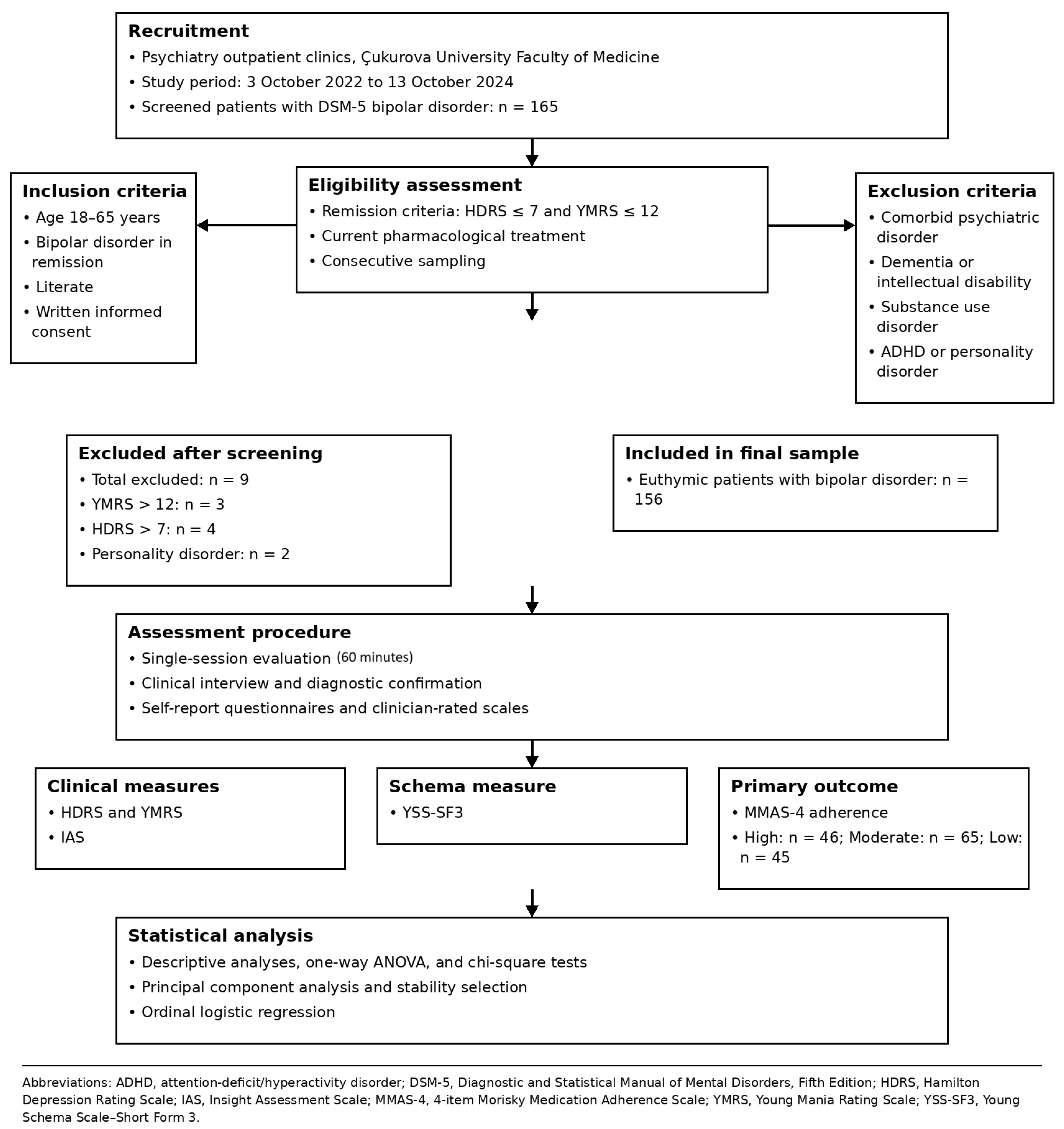
2.1. Participants
2.2. Procedure
2.3. Ethical Approval
2.3.1. Variable Selection and Dimensionality Assessment
2.3.2. Power Analysis
2.4. Measures
2.5. Statistical Analysis
3. Results
3.1. Sample Characteristics and Distribution of Medication Adherence
3.2. Comparison of Age and Early Maladaptive Schema Scores Across Adherence Groups
3.3. Stability Selection of Candidate Schema Predictors
3.4. Ordinal Logistic Regression Analysis of Factors Associated with Lower Adherence
3.5. Association Between Insight Level and Medication Adherence
4. Discussion
5. Conclusions
Author Contributions
Funding
Institutional Review Board Statement
Informed Consent Statement
Data Availability Statement
Conflicts of Interest
Abbreviations
| BD | Bipolar Disorder |
| HDRS | Hamilton Depression Rating Scale |
| IAS | Insight Assessment Scale |
| MMAS | Morisky Medication Adherence Scale |
| YMRS | Young Mania Rating Scale |
| YSS-SF3 | Young Schema Scale |
References
- American Psychiatric Association. Diagnostic and Statistical Manual of Mental Disorders, 5th ed.; American Psychiatric Publishing: Arlington, VA, USA, 2013. [Google Scholar]
- Johnson, S.L. Life events in bipolar disorder: Towards more specific models. Clin. Psychol. Rev. 2005, 25, 1008–1027. [Google Scholar] [CrossRef]
- Miklowitz, D.J.; Johnson, S.L. The psychopathology and treatment of bipolar disorder. Annu. Rev. Clin. Psychol. 2006, 2, 199–235. [Google Scholar] [CrossRef]
- Chakrabarti, S. Treatment adherence in bipolar disorder: A patient-centered approach. World J. Psychiatry 2016, 6, 399–409. [Google Scholar] [CrossRef]
- Sabaté, E. (Ed.) Adherence to Long-Term Therapies: Evidence for Action; World Health Organization: Geneva, Switzerland, 2003. [Google Scholar]
- Jawad, I.; Watson, S.; Haddad, P.M.; Talbot, P.S.; McAllister-Williams, R.H. Medication nonadherence in bipolar disorder: A narrative review. Ther. Adv. Psychopharmacol. 2018, 8, 349–363. [Google Scholar] [CrossRef] [PubMed]
- Rakofsky, J.J.; Levy, S.T.; Dunlop, B.W. Conceptualizing treatment nonadherence in patients with bipolar disorder and PTSD. CNS Spectr. 2011, 16, 11–20. [Google Scholar] [CrossRef] [PubMed]
- Rascati, K.L.; Richards, K.M.; Ott, C.A.; Goddard, A.W.; Stafkey-Mailey, D.; Alvir, J.; Sanders, K.N.; Mychaskiw, M. Adherence, persistence of use, and costs associated with second-generation antipsychotics for bipolar disorder. Psychiatr. Serv. 2011, 62, 1032–1040. [Google Scholar] [CrossRef] [PubMed]
- Belzeaux, R.; Boyer, L.; Mazzola-Pomietto, P.; Michel, P.; Correard, N.; Aubin, V.; Bellivier, F.; Bougerol, T.; Olie, E.; Courtet, P.; et al. Adherence to medication is associated with non-planning impulsivity in euthymic bipolar disorder patients. J. Affect. Disord. 2015, 184, 60–66. [Google Scholar] [CrossRef] [PubMed]
- Leclerc, E.; Mansur, R.B.; Brietzke, E. Determinants of adherence to treatment in bipolar disorder: A comprehensive review. J. Affect. Disord. 2013, 149, 247–252. [Google Scholar] [CrossRef]
- Gaudiano, B.A.; Weinstock, L.M.; Miller, I.W. Improving treatment adherence in bipolar disorder: A review of current psychosocial treatment efficacy and recommendations for future treatment development. Behav. Modif. 2008, 32, 267–301. [Google Scholar] [CrossRef]
- Gonzalez-Pinto, A.; Mosquera, F.; Alonso, M.; López, P.; Ramírez, F.; Vieta, E.; Baldessarini, R.J. Suicidal risk in bipolar I disorder patients and adherence to long-term lithium treatment. Bipolar Disord. 2006, 8, 618–624. [Google Scholar] [CrossRef]
- Mazza, M.; Mandelli, L.; Di Nicola, M.; Harnic, D.; Catalano, V.; Tedeschi, D.; Martinotti, G.; Colombo, R.; Bria, P.; Serretti, A.; et al. Clinical features, response to treatment and functional outcome of bipolar disorder patients with and without co-occurring substance use disorder: 1-year follow-up. J. Affect. Disord. 2009, 115, 27–35. [Google Scholar] [CrossRef] [PubMed]
- Mert, D.G.; Turgut, N.H.; Kelleci, M.; Semiz, M. Perspectives on reasons of medication nonadherence in psychiatric patients. Patient Prefer. Adherence 2015, 9, 87–93. [Google Scholar] [CrossRef] [PubMed]
- Scott, J.; Pope, M. Nonadherence with mood stabilizers: Prevalence and predictors. J. Clin. Psychiatry 2002, 63, 384–390. [Google Scholar] [CrossRef] [PubMed]
- Clatworthy, J.; Bowskill, R.; Parham, R.; Rank, T.; Scott, J.; Horne, R. Understanding medication non-adherence in bipolar disorders using a necessity–concerns framework. J. Affect. Disord. 2009, 116, 51–55. [Google Scholar] [CrossRef] [PubMed]
- Cohen, B.; Sixsmith, A.; Pollock Star, A.; Haglili, O.; O’Rourke, N. Direct and indirect predictors of medication adherence with bipolar disorder: Path analysis. JMIR Form. Res. 2023, 7, e44059. [Google Scholar] [CrossRef] [PubMed]
- Zaccari, V.; Fazi, M.; Scarci, F.; Correr, V.; Trani, L.; Filomena, M.G.; Piccione, V.; Cattan, S.J.; Ginni, M.G.; D’Olimpio, F.; et al. Understanding self-criticism: A systematic review of qualitative approaches. Clin. Neuropsychiatry 2024, 21, 455–476. [Google Scholar] [CrossRef]
- Young, J.E.; Klosko, J.S.; Weishaar, M.E. Schema Therapy: A Practitioner’s Guide; Guilford Press: New York, NY, USA, 2003. [Google Scholar]
- Hawke, L.D.; Provencher, M.D. Early maladaptive schemas among patients diagnosed with bipolar disorder. J. Affect. Disord. 2012, 136, 803–811. [Google Scholar] [CrossRef]
- Munuera, C.; Weil, F.; Minois, I.; Zanouy, L.; Gard, S.; Roux, P.; M’Bailara, K. Exploring maladaptive early schemas in adults with bipolar disorder: A systematic review of the literature. L’Encéphale 2020, 46, 65–77. [Google Scholar] [CrossRef]
- Ociskova, M.; Prasko, J.; Kantor, K.; Hodny, F.; Kasyanik, P.; Holubova, M.; Vanek, J.; Slepecky, M.; Nesnidal, V.; Belohradova, K.M. Schema therapy for patients with bipolar disorder: Theoretical framework and application. Neuropsychiatr. Dis. Treat. 2022, 18, 29–46. [Google Scholar] [CrossRef]
- Bär, A.; Bär, H.E.; Rijkeboer, M.M.; Lobbestael, J. Early maladaptive schemas and schema modes in clinical disorders: A systematic review. Psychol. Psychother. Theory Res. Pract. 2023, 96, 716–747. [Google Scholar] [CrossRef]
- Young, R.C.; Biggs, J.T.; Ziegler, V.E.; Meyer, D.A. A rating scale for mania: Reliability, validity and sensitivity. Br. J. Psychiatry 1978, 133, 429–435. [Google Scholar] [CrossRef] [PubMed]
- Karadağ, F.; Oral, E.T.; Yalçın, F.A.; Erten, E. Validity and reliability of the Young Mania Rating Scale in Turkey. Turk. J. Psychiatry 2001, 13, 107–114. [Google Scholar]
- Zimmerman, M.; Martinez, J.H.; Young, D.; Chelminski, I.; Dalrymple, K. Severity classification on the Hamilton Depression Rating Scale. J. Affect. Disord. 2013, 150, 384–388. [Google Scholar] [CrossRef] [PubMed]
- Akdemir, A.; Türkçapar, M.H.; Örsel, S.D.; Demirergi, N.; Dag, I.; Özbay, M.H. Reliability and validity of the Turkish version of the Hamilton Depression Rating Scale. Turk. J. Psychiatry 1996, 7, 3–13. [Google Scholar] [CrossRef]
- Soygüt, G.; Karaosmanoğlu, A.; Çakır, Z. Assessment of early maladaptive schemas: An examination of the psychometric properties of the Young Schema Scale Short Form-3. Turk. J. Psychiatry 2009, 20, 75–84. [Google Scholar]
- Morisky, D.E.; Green, L.W.; Levine, D.M. Concurrent and predictive validity of a self-reported measure of medication adherence. Med. Care 1986, 24, 67–74. [Google Scholar] [CrossRef]
- Yılmaz, S. Medication Side Effects and Medication Adherence in Psychiatric Patients. Unpublished Master’s Thesis, Istanbul University Institute of Health Sciences, Istanbul, Turkey, 2004. [Google Scholar]
- Bahar, G.; Savaş, H.A.; Ünal, A.; Savaş, E.; Kaya, H.; Bahar, A. Validity and reliability study of the Morisky medication adherence scale for bipolar disorder. Anadolu Psikiyatr. Derg. 2014, 15, 141–149. [Google Scholar] [CrossRef]
- Aslan, S.; Günay Kılıç, B.; Karakılıç, H.; Coşar, B.; Işık, E. İçgörünün Üç Bileşenini Değerlendirme Ölçeği: Güvenirlik ve Geçerlik Çalışması. Türkiye Psikiyatr. 2001, 3, 17–24. [Google Scholar]
- David, A.S. Insight and psychosis. Br. J. Psychiatry 1990, 156, 798–808. [Google Scholar] [CrossRef]
- Meinshausen, N.; Bühlmann, P. Stability selection. J. R. Stat. Soc. Ser. B 2010, 72, 417–473. [Google Scholar] [CrossRef]
- Sajatovic, M.; Valenstein, M.; Blow, F.C.; Ganoczy, D.; Ignacio, R.V. Treatment adherence with lithium and anticonvulsant medications among patients with bipolar disorder. Psychiatr. Serv. 2007, 58, 855–863. [Google Scholar] [CrossRef] [PubMed]
- Loots, E.; Goossens, E.; Vanwesemael, T.; Morrens, M.; Van Rompaey, B.; Dilles, T. Interventions to improve medication adherence in patients with schizophrenia or bipolar disorders: A systematic review and meta-analysis. Int. J. Environ. Res. Public Health 2021, 18, 10213. [Google Scholar] [CrossRef] [PubMed]
- Greene, M.; Paladini, L.; Lemmer, T.; Piedade, A.; Touya, M.; Clark, O. Systematic literature review on patterns of pharmacological treatment and adherence among patients with bipolar I disorder in the USA. Neuropsychiatr. Dis. Treat. 2018, 14, 1545–1559. [Google Scholar] [CrossRef]
- Novick, D.; Montgomery, W.; Treuer, T.; Aguado, J.; Kraemer, S.; Haro, J.M. Relationship of insight with medication adherence and the impact on outcomes in patients with schizophrenia and bipolar disorder: Results from a 1-year European outpatient observational study. BMC Psychiatry 2015, 15, 189. [Google Scholar] [CrossRef] [PubMed]
- Colom, F.; Vieta, E.; Reinares, M.; Martínez-Arán, A.; Torrent, C.; Goikolea, J.M.; Gastó, C. Psychoeducation efficacy in bipolar disorders: Beyond compliance enhancement. J. Clin. Psychiatry 2003, 64, 1101–1105. [Google Scholar] [CrossRef] [PubMed]
- Özdel, K.; Kart, A.; Türkçapar, M.H. Cognitive behavioral therapy in treatment of bipolar disorder. Arch. Neuropsychiatry 2021, 58, 66–77. [Google Scholar] [CrossRef] [PubMed]
- Kitayama, S.; Markus, H.R.; Matsumoto, H.; Norasakkunkit, V. Individual and collective processes in the construction of the self: Self-enhancement in the United States and self-criticism in Japan. J. Personal. Soc. Psychol. 1997, 72, 1245–1267. [Google Scholar] [CrossRef] [PubMed]
- Heine, S.J.; Lehman, D.R.; Markus, H.R.; Kitayama, S. Is there a universal need for positive self-regard? Psychol. Rev. 1999, 106, 766–794. [Google Scholar] [CrossRef]
- Boiger, M.; Güngör, D.; Karasawa, M.; Mesquita, B. Defending honor, keeping face: Interpersonal affordances of anger and shame in Turkey and Japan. Cogn. Emot. 2014, 28, 1255–1269. [Google Scholar] [CrossRef]
- Leung, A.K.Y.; Cohen, D. Within- and between-culture variation: Individual differences and the cultural logics of honor, face, and dignity cultures. J. Personal. Soc. Psychol. 2011, 100, 507–526. [Google Scholar] [CrossRef]
- Israel, J.A. Remission in depression: Definition and initial treatment approaches. J. Psychopharmacol. 2006, 20, 5–10. [Google Scholar] [CrossRef]
- Patel, N.C.; Patrick, D.M.; Youngstrom, E.A.; Strakowski, S.M.; DelBello, M.P. Response and remission in adolescent mania: Signal detection analyses of the Young Mania Rating Scale. J. Am. Acad. Child Adolesc. Psychiatry 2007, 46, 628–635. [Google Scholar] [CrossRef] [PubMed]


| Variable | Value |
|---|---|
| Age (years) | Mean ± SD = 39.6 ± 11.1 |
| Duration of illness (years) | Mean ± SD = 15.6 ± 9.7 |
| Gender | Female, n (%) = 73 (46.8) |
| Male, n (%) = 83 (53.2) | |
| Education level | Illiterate, n (%) = 4 (2.6) |
| Primary education, n (%) = 33 (21.2) | |
| Secondary education, n (%) = 57 (36.5) | |
| University, n (%) = 62 (39.7) | |
| Marital status | Single, n (%) = 75 (48.1) |
| Married, n (%) = 81 (51.9) | |
| Occupation | Working, n (%) = 69 (44.2) |
| Not working, n (%) = 87 (55.8) | |
| Place of residence | County seat, n (%) = 111 (71.2) |
| Smaller than the provincial capital, n (%) = 45 (28.8) | |
| Smoking | Yes, n (%) = 86 (55.1) |
| No, n (%) = 70 (44.9) | |
| Alcohol | Yes, n (%) = 34 (21.8) |
| No, n (%) = 122 (78.2) | |
| Substance use | Yes, n (%) = 4 (2.6) |
| No, n (%) = 152 (97.4) | |
| Suicide attempt | Yes, n (%) = 47 (30.1) |
| No, n (%) = 109 (69.9) | |
| Social support | Yes, n (%) = 133 (85.3) |
| No, n (%) = 23 (14.7) | |
| Insight | Complete, n (%) = 65 (41.7) |
| Partial, n (%) = 91 (58.3) | |
| Morisky adherence | High, n (%) = 46 (29.5) |
| Medium, n (%) = 65 (41.7) | |
| Low, n (%) = 45 (28.8) |
| Variable | High (n = 46) | Moderate (n = 65) | Low (n = 45) | F | p | η2 | p_Adj |
|---|---|---|---|---|---|---|---|
| Age (years) | 42.43 ± 9.78 | 39.83 ± 10.58 | 36.40 ±12.36 | 3.52 | 0.032 | 0.044 | 0.551 |
| Emotional Deprivation | 7.91 ± 3.72 | 12.09 ± 7.21 | 13.53 ± 7.79 | 9.16 | <0.001 | 0.107 | 0.003 |
| Failure | 11.43 ± 6.47 | 15.57 ± 7.99 | 17.76 ± 7.16 | 8.82 | <0.001 | 0.103 | 0.004 |
| Pessimism | 9.91 ± 5.68 | 12.77 ± 5.72 | 16.04 ± 5.78 | 13.06 | <0.001 | 0.146 | <0.001 |
| Social Isolation/Insecurity | 14.76 ± 8.38 | 19.37 ± 6.74 | 23.71 ± 7.34 | 16.56 | <0.001 | 0.178 | <0.001 |
| Self-Sacrifice | 11.50 ± 5.60 | 13.97 ± 5.14 | 16.38 ± 7.74 | 7.22 | 0.001 | 0.086 | 0.017 |
| Abandonment | 9.02 ± 4.63 | 11.15 ± 5.10 | 14.20 ± 5.60 | 11.77 | <0.001 | 0.133 | <0.001 |
| Punishment | 14.00 ± 6.21 | 18.34 ± 7.50 | 24.93 ± 6.38 | 29.54 | <0.001 | 0.279 | <0.001 |
| Defectiveness | 9.43 ± 5.43 | 12.34 ± 6.62 | 12.60 ± 5.25 | 4.24 | 0.016 | 0.052 | 0.275 |
| Suppression of Emotions | 9.93 ± 5.07 | 10.42 ± 4.23 | 14.22 ± 5.81 | 10.50 | <0.001 | 0.121 | <0.001 |
| Approval Seeking | 17.39 ± 7.93 | 21.51 ± 7.12 | 24.11 ± 5.95 | 10.53 | <0.001 | 0.121 | <0.001 |
| Interdependence/Dependency | 17.04 ± 9.88 | 19.69 ± 9.27 | 24.09 ± 8.84 | 6.63 | 0.002 | 0.080 | 0.029 |
| Privilege/Poor Self-Control | 16.96 ± 7.74 | 21.34 ± 6.32 | 24.62 ± 6.45 | 14.59 | <0.001 | 0.160 | <0.001 |
| Vulnerability to Threats | 9.87 ± 4.63 | 12.60 ± 5.07 | 16.02 ± 5.79 | 16.18 | <0.001 | 0.175 | <0.001 |
| High Standards | 8.22 ± 4.62 | 9.88 ± 4.41 | 9.91 ± 4.18 | 2.29 | 0.105 | 0.029 | 1.000 |
| Schema Subdimension | η2 | Selection Probability (π) | Stable |
|---|---|---|---|
| Punishment | 0.279 | 0.97 | Yes |
| Failure | 0.103 | 0.59 | No |
| Interdependence/Dependency | 0.080 | 0.46 | No |
| Emotional Deprivation | 0.107 | 0.42 | No |
| Approval Seeking | 0.121 | 0.28 | No |
| Privilege/Poor Self-Control | 0.160 | 0.11 | No |
| Pessimism | 0.146 | <0.10 | No |
| Social Isolation/Insecurity | 0.178 | <0.10 | No |
| Self-Sacrifice | 0.086 | <0.10 | No |
| Abandonment | 0.133 | <0.10 | No |
| Suppression of Emotions | 0.121 | <0.10 | No |
| Vulnerability to Threats | 0.175 | <0.10 | No |
| Predictor | β | SE | Z | p | OR | 95% CI | VIF |
|---|---|---|---|---|---|---|---|
| Punishment schema | 0.135 | 0.024 | 5.72 | <0.001 | 1.14 | 1.09–1.20 | 1.06 |
| Age (years) | −0.038 | 0.015 | −2.46 | 0.014 | 0.96 | 0.93–0.99 | 1.03 |
| Partial insight (ref.: full) | 1.332 | 0.343 | 3.88 | <0.001 | 3.79 | 1.93–7.42 | 1.05 |
| Insight | High Adherence | Moderate Adherence | Low Adherence |
|---|---|---|---|
| Full | 29 (63.0%) | 27 (41.5%) | 9 (20.0%) |
| Partial | 17 (37.0%) | 38 (58.5%) | 36 (80.0%) |
Disclaimer/Publisher’s Note: The statements, opinions and data contained in all publications are solely those of the individual author(s) and contributor(s) and not of MDPI and/or the editor(s). MDPI and/or the editor(s) disclaim responsibility for any injury to people or property resulting from any ideas, methods, instructions or products referred to in the content. |
© 2026 by the authors. Licensee MDPI, Basel, Switzerland. This article is an open access article distributed under the terms and conditions of the Creative Commons Attribution (CC BY) license.
Share and Cite
Karaytuğ, M.O.; Tamam, L.; Demirkol, M.E.; Namlı, Z.; Yeşiloğlu, C.; Çetin Demirtaş, S.; Fedai, Ü.A.; Kurt, A.M. The Relationship Between Early-Stage Maladaptive Schemas and Treatment Adherence in Patients Diagnosed with Bipolar Disorder in Remission. J. Clin. Med. 2026, 15, 3351. https://doi.org/10.3390/jcm15093351
Karaytuğ MO, Tamam L, Demirkol ME, Namlı Z, Yeşiloğlu C, Çetin Demirtaş S, Fedai ÜA, Kurt AM. The Relationship Between Early-Stage Maladaptive Schemas and Treatment Adherence in Patients Diagnosed with Bipolar Disorder in Remission. Journal of Clinical Medicine. 2026; 15(9):3351. https://doi.org/10.3390/jcm15093351
Chicago/Turabian StyleKaraytuğ, Mahmut Onur, Lut Tamam, Mehmet Emin Demirkol, Zeynep Namlı, Caner Yeşiloğlu, Sinem Çetin Demirtaş, Ülker Atılan Fedai, and Ali Meriç Kurt. 2026. "The Relationship Between Early-Stage Maladaptive Schemas and Treatment Adherence in Patients Diagnosed with Bipolar Disorder in Remission" Journal of Clinical Medicine 15, no. 9: 3351. https://doi.org/10.3390/jcm15093351
APA StyleKaraytuğ, M. O., Tamam, L., Demirkol, M. E., Namlı, Z., Yeşiloğlu, C., Çetin Demirtaş, S., Fedai, Ü. A., & Kurt, A. M. (2026). The Relationship Between Early-Stage Maladaptive Schemas and Treatment Adherence in Patients Diagnosed with Bipolar Disorder in Remission. Journal of Clinical Medicine, 15(9), 3351. https://doi.org/10.3390/jcm15093351