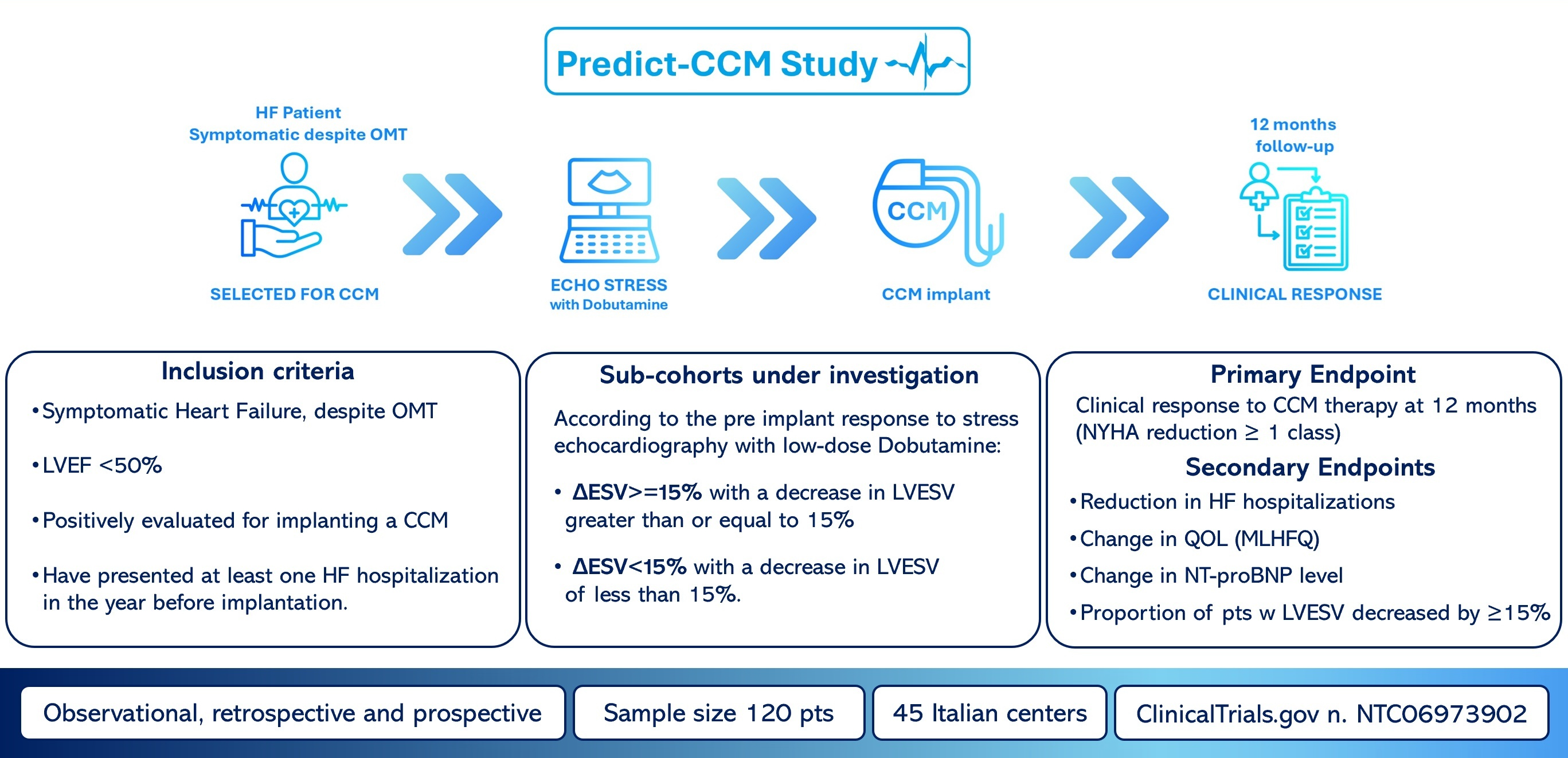
Rationale and Design of the PREDICT-CCM Study: Predictive Value of Dobutamine Stress Echocardiography for Clinical Response to Cardiac Contractility Modulation Therapy in a Multicenter Italian Cohort
 , , , ,
  , , , , ,
  ,
,
Abstract
1. Introduction
1.1. Cardiac Contractility Modulation (CCM)
- Improvement in NYHA class;
- Improvement in quality of life, as measured by the MLHFQ;
- Improvement in functional capacity, as measured by the 6 min walk test (6MWT);
- Increase in peak oxygen consumption (VO2);
- Reduction in HF-related hospitalizations and, in some analyses, cardiovascular mortality.
1.2. Pharmacological Stress Echocardiography
2. Materials and Methods
2.1. Objective of the Study
- -
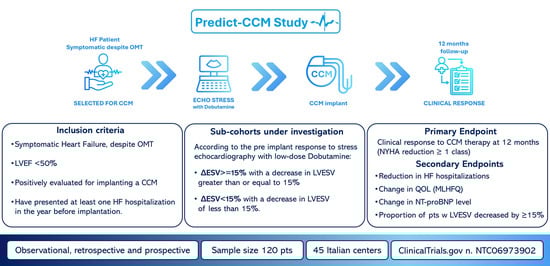
- “DeltaLVESV ≥ 15%” sub-cohort, defined by a decrease in LVESV of at least 15%.
- -
- “DeltaLVESV < 15%” sub-cohort, defined by a decrease in LVESV of less than 15%.
2.1.1. Primary Endpoint
- -
- Proportion of subjects with a clinical response to CCM at 12 months (≥1 NYHA class reduction)
2.1.2. Secondary Clinical Endpoints
- Reduction in the number of hospitalizations, Emergency Department visits, or day-hospital admissions lasting more than 4 h (e.g., those requiring intravenous inotropes) compared with the previous year;
- Change in the quality-of-life score, estimated using the “Quality of Life Questionnaire with Heart Failure—Minnesota” (MLHFQ), from baseline to the end of follow-up [31];
- Change in walk distance between baseline and the end of follow-up in the walk test (6MWT) (optional);
- Change in NT-proBNP level from baseline to the end of follow-up.
2.1.3. Secondary Echocardiographic Endpoints
- The proportion of subjects with a LVESV reduction of ≥15% on echocardiography at the end of follow-up compared with preimplantation;
- The proportion of subjects with a ≥20% increase in velocity time integral (VTI) between preimplantation and the end-of-follow-up echocardiography;
- The proportion of subjects with a ≥20% increase in ejection fraction (LVEF) between preimplantation and the end-of-follow-up echocardiography;
- The proportion of subjects with progression or improvement in mitral regurgitation (MR), classified as mild, moderate, or severe.
2.1.4. Secondary Safety Endpoints
- The proportion of subjects who, during follow-up, will undergo cardiac resynchronization therapy (CRT) implantation;
- The proportion of subjects who, during follow-up, will undergo left ventricular assist device (LVAD) implantation;
- The proportion of subjects who will receive a cardiac transplant during follow-up;
- The proportion of subjects who will die from HF during follow-up (also compared with the predicted mortality by the MAGGIC score [32]);
- Assessment of arrhythmic burden (for a patient with an implantable cardioverter-defibrillator (ICD): number of ventricular tachycardia episodes treated with ATP/shock; for a patient with a pacemaker/ICD/loop recorder: percentage of time spent in atrial fibrillation);
- Rate of procedure-related adverse events;
- Procedure and fluoroscopy times;
- Rate of reoperations (lead revision/replacement/infection).
2.2. Study Population
2.2.1. Inclusion Criteria
- Subjects of both sexes aged ≥ 18 years;
- Ability to understand and sign informed consent, including consent to process sensitive personal data;
- Symptomatic HF despite optimal medical therapy (OMT);
- Reduced left ventricular systolic function (EF < 50%);
- Candidates for CCM implantation according to the European Society of Cardiology 2021 Guidelines on heart failure and the CE mark approval provision [3];
- At least one HF-related hospitalization, Emergency Department visit, or day-hospital admission lasting >4 h (e.g., intravenous infusion of inotropes) in the year before implantation.
2.2.2. Exclusion Criteria
- Life expectancy < 1 year due to non-cardiac comorbidities;
- Contraindications to CCM implantation (e.g., absence of suitable vascular access, active infection, severe coagulopathies, mechanical tricuspid valve);
- Contraindications to pharmacologic stress echocardiography (e.g., decompensated HF, acute myocardial infarction, acute myocarditis/pericarditis, critical aortic stenosis, severe left ventricular outflow obstruction, aortic dissection, uncontrolled severe arrhythmias, known hypersensitivity to dobutamine, intraventricular thrombi) [23].
2.3. Study Design
2.4. Statistical Analysis
2.4.1. General Statistical Methods
2.4.2. Hypotheses
- Across all subjects, the proportion with clinical response to CCM therapy at 12 months of follow-up (NYHA class reduction ≥ 1 class) will be approximately 70%.
- The proportion of subjects with a positive response to LDDSE before CCM implantation (i.e., a decrease in LVESV of at least 15%) will be 80%.
2.4.3. Sample Size Estimation
2.4.4. Statistical Analysis Specifications
2.4.5. Primary Endpoint Data Analysis
2.4.6. Secondary Endpoints Data Analysis
2.5. Current Status
3. Discussion
4. Study Limitations
5. Conclusions
Author Contributions
Funding
Institutional Review Board Statement
Informed Consent Statement
Data Availability Statement
Conflicts of Interest
Abbreviations
| HF | Heart Failure |
| QOL | Quality Of Life |
| OMT | Optimal Medical Therapy |
| CCM | Cardiac Contractility Modulation |
| NYHA | New York Heart Association |
| LDDSE | Low-Dose Dobutamine Stress Echocardiography |
| MLHFQ | Minnesota Living with Heart Failure Questionnaire |
| LVESV | Left Ventricular End Systolic Volume |
| HFrEF | HF with reduced Ejection Fraction |
| MRAs | Mineralocorticoid Receptor Antagonists |
| CRT | Cardiac Resynchronization Therapy |
| 6MWT | 6-Minute Walk Test |
| VTI | Velocity Time Integral |
| LVEF | Left Ventricular Ejection Fraction |
| MR | Mitral Regurgitation |
| LVAD | Left Ventricular Assist Device |
| ICD | Implantable Cardioverter-Defibrillator |
| ITT | Intention-To-Treat |
References
- Levy, D.; Kenchaiah, S.; Glarson, M.; Benjamin, E.J.; Kupka, M.J.; Ho, K.K.; Murabito, J.M.; Vasan, R.S. Long-term trends in the incidence of and survival with heart failure. N. Engl. J. Med. 2002, 347, 1397–1402. [Google Scholar] [CrossRef] [Scilit]
- Savarese, G.; Becher, P.; Lund, L.; Seferovic, P.; Rosano, G.M.C.; Coats, A.J.S. Global burden of heart failure: A comprehensive and updated review of epidemiology. Cardiov. Res. 2022, 118, 3272–3287. [Google Scholar] [CrossRef] [Scilit]
- McDonagh, T.; Metra, M.; Adamo, M.; Gardner, R.S.; Baumbach, A.; Böhm, M.; Burri, H.; Butler, J.; Čelutkienė, J.; Chioncel, O.; et al. 2021 ESC Guidelines for the diagnosis and treatment of acute and chronic heart failure. Eur. J. Heart Fail. 2022, 24, 4–131. [Google Scholar]
- Cleland, J.G.; Daubert, J.C.; Erdmann, E.; Freemantle, N.; Gras, D.; Kappenberger, L.; Tavazzi, L.; Cardiac Resynchronization-Heart Failure (CARE-HF) Study Investigators. The effect of cardiac resynchronization on morbidity and mortality in heart failure. N. Engl. J. Med. 2005, 352, 1539–1549. [Google Scholar] [CrossRef] [Scilit]
- Glikson, M.; Nielsen, J.C.; Kronborg, M.B.; Michowitz, Y.; Auricchio, A.; Barbash, I.M.; Barrabés, J.A.; Boriani, G.; Braunschweig, F.; Brignole, M.; et al. 2021 ESC Guidelines on cardiac pacing and cardiac resynchronization therapy. Eur. Heart J 2021, 42, 3427–3520. [Google Scholar] [CrossRef] [Scilit]
- Campbell, C.M.; Kahwash, R.; Abraham, W.T. Optimizer Smart in the treatment of moderate-to-severe chronic heart failure. Future Cardiol. 2020, 16, 13–25. [Google Scholar] [CrossRef] [Scilit]
- Nägele, H.; Behrens, S.; Eisermann, C. Cardiac contractility modulation in non-responders to cardiac resynchronization therapy. Europace 2008, 10, 1375–1380. [Google Scholar] [CrossRef] [Scilit]
- Borggrefe, M.M.; Lawo, T.; Butter, C.; Schmidinger, H.; Lunati, M.; Pieske, B.; Misier, A.R.; Curnis, A.; Böcker, D.; Remppis, A.; et al. Randomized, double blind study of non-excitatory, cardiac contractility modulation electrical impulses for symptomatic heart failure. Eur. Heart J. 2008, 29, 1019–1028. [Google Scholar] [CrossRef] [Scilit]
- Kadish, A.; Nademanee, K.; Volosin, K.; Krueger, S.; Neelagaru, S.; Raval, N.; Obel, O.; Weiner, S.; Wish, M.; Carson, P.; et al. A randomized controlled trial evaluating the safety and efficacy of cardiac contractility modulation in advanced heart failure. Am. Heart J. 2011, 161, 329–337.e2. [Google Scholar] [CrossRef] [Scilit]
- Abraham, W.T.; Nademanee, K.; Volosin, K.; Krueger, S.; Neelagaru, S.; Raval, N.; Obel, O.; Weiner, S.; Wish, M.; Carson, P.; et al. Subgroup analysis of a randomized controlled trial evaluating the safety and efficacy of cardiac contractility modulation in advanced heart failure. J. Card. Fail. 2011, 17, 710–717. [Google Scholar] [CrossRef] [Scilit]
- Abraham, W.T.; Kuck, K.H.; Goldsmith, R.L.; Lindenfeld, J.; Reddy, V.Y.; Carson, P.E.; Mann, D.L.; Saville, B.; Parise, H.; Chan, R.; et al. A randomized controlled trial to evaluate the safety and efficacy of cardiac contractility modulation. JACC Heart Fail. 2018, 6, 874–883. [Google Scholar] [CrossRef] [Scilit]
- Borggrefe, M.; Burkhoff, D. Clinical effects of cardiac contractility modulation (CCM) as a treatment for chronic heart failure. Eur. J. Heart Fail. 2012, 14, 703–712. [Google Scholar] [CrossRef] [Scilit]
- Available online: https://impulsedynamics.it/indicazioni-da-marchio-ce-e-selezione-dei-pazienti/ (accessed on 1 January 2024).
- Mullens, W.; Dauw, J.; Gustafsson, F.; Mebazaa, A.; Steffel, J.; Witte, K.K.; Delgado, V.; Linde, C.; Vernooy, K.; Anker, S.D.; et al. Integration of implantable device therapy in patients with heart failure. A clinical consensus statement from the Heart Failure Association (HFA) and European Heart Rhythm Association (EHRA) of the European Society of Cardiology (ESC). Eur. J. Heart Fail. 2024, 26, 483–501. [Google Scholar] [CrossRef] [Scilit]
- Chopra, V.; Khan, M.S.; Abdelhamid, M.; Abraham, W.T.; Amir, O.; Anker, S.D.; Atherton, J.J.; Bacal, F.; von Bardeleben, R.S.; Brito, D.; et al. iCARDIO Alliance Global Implementation Guidelines on Heart Failure 2025. Heart Lung Circ. 2025, 34, e55–e82. [Google Scholar] [CrossRef] [Scilit]
- Witte, K.; Hasenfuss, G.; Kloppe, A.; Burkhoff, D.; Green, M.; Moss, J.; Peel, A.; Mealing, S.; Zaleski, I.D.; Cowie, M.R. Cost-effectiveness of a cardiac contractility modulation device in heart failure with normal QRS duration. ESC Heart Fail. 2019, 6, 1178–1187. [Google Scholar] [CrossRef] [Scilit]
- Narducci, M.L.; Nurchis, M.C.; Ballacci, F.; Giordano, F.; Calabrò, G.E.; Massetti, M.; Crea, F.; Aspromonte, N.; Damiani, G. Cost–utility of cardiac contractility modulation in patients with heart failure with reduced ejection fraction in Italy. ESC Heart Fail. 2024, 11, 229–239. [Google Scholar] [CrossRef] [Scilit]
- Fastner, C.; Varma, N.; Rao, I.; Falk, P.; Remppis, A.; Najarian, K.; Burkhoff, D.; Akın, I.; Kuschyk, J. Cardiac contractility modulation in HFrEF patients with QRS duration 120-149 ms: Reduction in heart failure hospitalizations and improvement in functional outcome. Heart Rhythm. 2024, 22, 1756–1762. [Google Scholar] [CrossRef] [Scilit]
- Sicari, R.; Nihoyannopoulos, P.; Evangelista, A.; Kasprzak, J.; Lancellotti, P.; Poldermans, D.; Voigt, J.-U.; Zamorano, J.L. on behalf of the European Association of Echocardiography. Stress echocardiography expert consensus statement: European Association of Echocardiography (EAE) (a registered branch of the ESC). Eur. J. Echocardiogr. 2008, 9, 415–437. [Google Scholar] [CrossRef] [Scilit]
- Lancellotti, P.; Pellikka, P.A.; Co-chair, F.; Budts, W.; Chaudhry, F.A.; Donal, E.; Dulgheru, R.; Edvardsen, T.; Garbi, M.; Ha, J.-W.; et al. The Clinical Use of Stress Echocardiography in Non-Ischaemic Heart Disease: Recommendations from the European Association of Cardiovascular Imaging and the American Society of Echocardiography. J. Am. Soc. Echocardiogr. 2016, 30, 101–138. [Google Scholar] [CrossRef] [Scilit]
- Pellikka, P.A.; Nagueh, S.F.; Elhendy, A.A.; Kuehl, C.A.; Sawada, S.G. American Society of Echocardiography recommendations for performance, interpretation, and application of stress echocardiography. J. Am. Soc. Echocardiogr. 2007, 20, 1021–1041. [Google Scholar] [CrossRef] [Scilit]
- Gilstrap, L.G.; Bhatia, R.S.; Weiner, R.B.; Dudzinski, D.M. Dobutamine stress echocardiography: A review and update. Res. Rep. Clin. Cardiol. 2014, 5, 69–81. [Google Scholar] [CrossRef] [Scilit]
- Becher, H.; Chambers, J.; Fox, K.; Jones, R.; Leech, G.J.; Masani, N.; Monaghan, M.; More, R.; Nihoyannopoulos, P.; Rimington, H.; et al. British Society of Echocardiography Policy Committee. BSE procedure guidelines for the clinical application of stress echocardiography, recommendations for performance and interpretation of stress echocardiography. Heart 2004, 90, vi23–vi30. [Google Scholar] [CrossRef] [Scilit]
- Geleijnse, M.L.; Krenning, B.J.; Nemes, A.; van Dalen, B.M.; Soliman, O.I.; Ten Cate, F.J.; Schinkel, A.F.; Boersma, E.; Simoons, M.L. Incidence, Pathophysiology, and Treatment of Complications during Dobutamine-Atropine Stress Echocardiography. Circulation 2010, 121, 1756–1767. [Google Scholar] [CrossRef] [Scilit]
- Matsumura, Y.; Takata, J.; Kitaoka, H.; Hamada, T.; Okawa, M.; Kubo, T.; Doi, Y. Low-dose dobutamine stress echocardiography predicts the improvement of left ventricular systolic function and long-term prognosis in patients with idiopathic dilated cardiomyopathy. J. Med. Ultrason. 2006, 33, 17–22. [Google Scholar] [CrossRef] [Scilit]
- Muto, C.; Gasparini, M.; Neja, C.P.; Iacopino, S.; Davinelli, M.; Zanon, F.; Dicandia, C.; Distefano, G.; Donati, R.; Calvi, V.; et al. Presence of left ventricular contractile reserve predicts midterm response to cardiac resynchronization therapy—Results from the LOw doe DObutamine stress-echo test in Cardiac Resynchronization Therapy (LODO-CRT). Heart Rhythm 2010, 7, 1600–1605. [Google Scholar] [CrossRef] [Scilit]
- Parsai, C.; Baltabaeva, A.; Anderson, L.; Chaparro, M.; Bijnens, B.; Sutherland, G.R. Low-dose dobutamine stress echo to quantify the degree of remodeling after cardiac resynchronization therapy. Eur. Heart J. 2009, 30, 950–958. [Google Scholar] [CrossRef] [Scilit]
- Mizia-Stec, K.; Wita, K.; Mizia, M.; Szwed, H.; Nowalany-Kozielska, E.; Chrzanowski, Ł.; Łoboz-Grudzień, K.; Gackowski, A.; Gilewski, W.; Chmiel, A. Preserved contractile reserve in a dobutamine test for the prediction of a response to resynchronisation therapy in ischaemic and non-ischaemic cardiomyopathy—A multicenter ViaCRT study. Int. J. Cardiol. 2014, 172, 476–477. [Google Scholar] [CrossRef] [Scilit]
- Wita, K.; Mizia-Stec, K.; Płon’ ska-Gos’ciniak, E.; Wróbel, W.; Gackowski, A.; Gąsior, Z.; Kasprzak, J.; Kukulski, T.; Sinkiewicz, W.; Wojciechowska, C. Low-dose dobutamine stress echo for reverse remodeling prediction after cardiac resynchronization. Adv. Med. Sci. 2015, 60, 294–299. [Google Scholar] [CrossRef] [Scilit]
- Poulidakis, E.; Aggeli, C.; Sideris, S.; Sfendouraki, E.; Koutagiar, I.; Katsaros, A.; Giannoulis, E.; Koukos, M.; Margioula, E.; Lagoudakou, S.; et al. Echocardiography for prediction of 6-month and late response to cardiac resynchronization therapy: Implementation of stress echocardiography and comparative assessment along with widely used dyssynchrony indices. Int. J. Cardiovasc. Imaging 2019, 35, 285–294. [Google Scholar] [CrossRef] [Scilit]
- Rector, T.; Kubo, S.; Cohn, J. Patient’s self-assessment of their congestive heart failure. Part 2: Content, reliability and validity of a new measure, The Minnesota Living with Heart Failure Questionnaire. Heart Failure. Heart Fail. 1987, 1, 198–209. [Google Scholar]
- Pocock, S.J.; Ariti, C.A.; McMurray, J.J.V.; Maggioni, A.; Køber, L.; Squire, I.B.; Swedberg, K.; Dobson, J.; Poppe, K.K.; Whalley, G.A.; et al. Predicting survival in heart failure: A risk score based on 39,372 patients from 30 studies. Eur. Heart J 2013, 34, 1404–1413. [Google Scholar] [CrossRef] [Scilit]
- Harris, P.A.; Taylor, R.; Thielke, R.; Payne, J.; Gonzalez, N.; Conde, J.G. Research electronic data capture (REDCap): A metadata-driven methodology and workflow process for providing translational research informatics support. J. Biomed. Inform. 2009, 42, 377–381. [Google Scholar] [CrossRef] [Scilit]
- Suruagy-Motta, R.F.O.; Fukunaga, C.K.; Da Silva, E.V.B.; Neves, G.R.; dos Santos, K.D.A.; Vieira, L.L.P.; Sampaio, M.H.N.N.; de Pádua Carvalho, B.C.; Júnior, E.F.X.; Brígido, A.R.D.; et al. Cardiac Contractility Modulation in Symptomatic Heart Failure With Reduced Ejection Fraction: A Systematic Review and Single-Arm Meta-Analysis. J. Cardiovasc. Electrophysiol. 2025, 36, 2544–2555. [Google Scholar] [CrossRef] [Scilit]
- Kuschyk, J.; Butler, J.; Fendler, T.; Varma, N. Cardiac contractility modulation: An update. Herzschrittmacherther. Elektrophysiol. 2025, 36, 329–335. [Google Scholar] [CrossRef] [Scilit]
- Masarone, D.; Falco, L.; d’Onofrio, A.; Nigro, G.; Ammendola, E.; Pacileo, G. Response to levosimendan predicts response to cardiac contractility modulation therapy: A pilot study. Rev. Esp. Cardiol. 2024, 77, 703–705. [Google Scholar] [CrossRef] [Scilit]

Disclaimer/Publisher’s Note: The statements, opinions and data contained in all publications are solely those of the individual author(s) and contributor(s) and not of MDPI and/or the editor(s). MDPI and/or the editor(s) disclaim responsibility for any injury to people or property resulting from any ideas, methods, instructions or products referred to in the content. |
© 2026 by the authors. Licensee MDPI, Basel, Switzerland. This article is an open access article distributed under the terms and conditions of the Creative Commons Attribution (CC BY) license.
Share and Cite
Zanon, F.; Uran, C.; Bonfantino, V.; Di Belardino, N.; Lupo, A.; Giaccardi, M.; Marchese, P.; Di Grazia, A.A.; Santini, L.; Di Lorenzo, L.; et al. Rationale and Design of the PREDICT-CCM Study: Predictive Value of Dobutamine Stress Echocardiography for Clinical Response to Cardiac Contractility Modulation Therapy in a Multicenter Italian Cohort. J. Clin. Med. 2026, 15, 3223. https://doi.org/10.3390/jcm15093223
Zanon F, Uran C, Bonfantino V, Di Belardino N, Lupo A, Giaccardi M, Marchese P, Di Grazia AA, Santini L, Di Lorenzo L, et al. Rationale and Design of the PREDICT-CCM Study: Predictive Value of Dobutamine Stress Echocardiography for Clinical Response to Cardiac Contractility Modulation Therapy in a Multicenter Italian Cohort. Journal of Clinical Medicine. 2026; 15(9):3223. https://doi.org/10.3390/jcm15093223
Chicago/Turabian StyleZanon, Francesco, Carlo Uran, Vincenzo Bonfantino, Natale Di Belardino, Antonio Lupo, Marzia Giaccardi, Procolo Marchese, Angelo Antonio Di Grazia, Luca Santini, Luigi Di Lorenzo, and et al. 2026. "Rationale and Design of the PREDICT-CCM Study: Predictive Value of Dobutamine Stress Echocardiography for Clinical Response to Cardiac Contractility Modulation Therapy in a Multicenter Italian Cohort" Journal of Clinical Medicine 15, no. 9: 3223. https://doi.org/10.3390/jcm15093223
APA StyleZanon, F., Uran, C., Bonfantino, V., Di Belardino, N., Lupo, A., Giaccardi, M., Marchese, P., Di Grazia, A. A., Santini, L., Di Lorenzo, L., Carreras, G., Sgarra, L., Ziacchi, M., Marinaccio, L., Mancini, L., Bisignani, G., Manes, M., Guarracini, S., Kol, A., ... Noventa, F. (2026). Rationale and Design of the PREDICT-CCM Study: Predictive Value of Dobutamine Stress Echocardiography for Clinical Response to Cardiac Contractility Modulation Therapy in a Multicenter Italian Cohort. Journal of Clinical Medicine, 15(9), 3223. https://doi.org/10.3390/jcm15093223