The Outcome of Immediate Adjuvant Postoperative External Beam Radiotherapy Versus Observation Alone After Radical Prostatectomy in High-Risk Prostate Cancer: A Meta Analysis


Abstract
1. Introduction
2. Methodology
2.1. Study Design
2.2. Eligibility Criteria
2.3. Search Strategy
2.4. Study Selection and Data Extraction
2.5. Statistical Analysis
2.6. Risk of Bias and Quality Assessment
3. Result
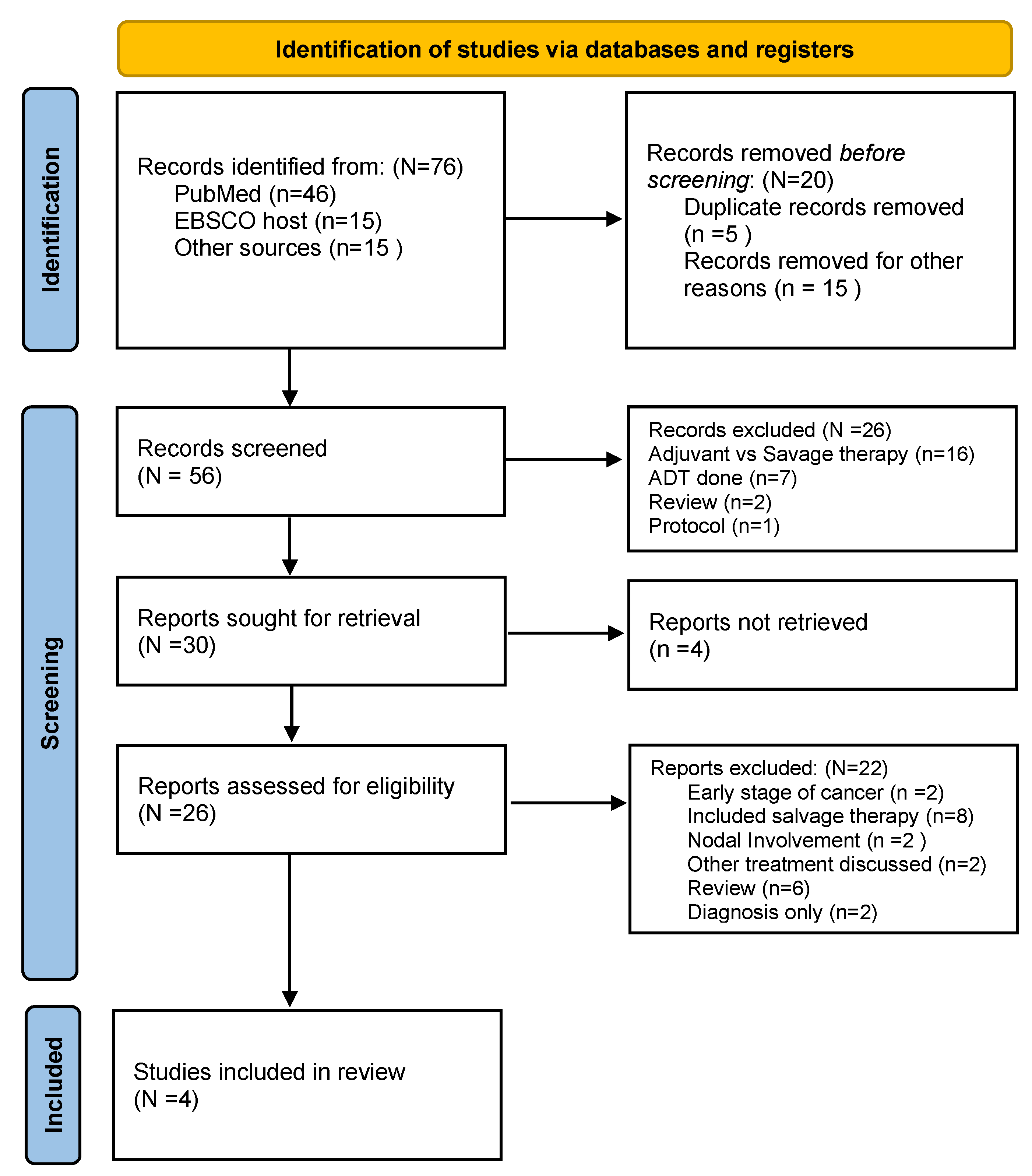
3.1. Study Selection
3.2. Characteristics of Included Studies
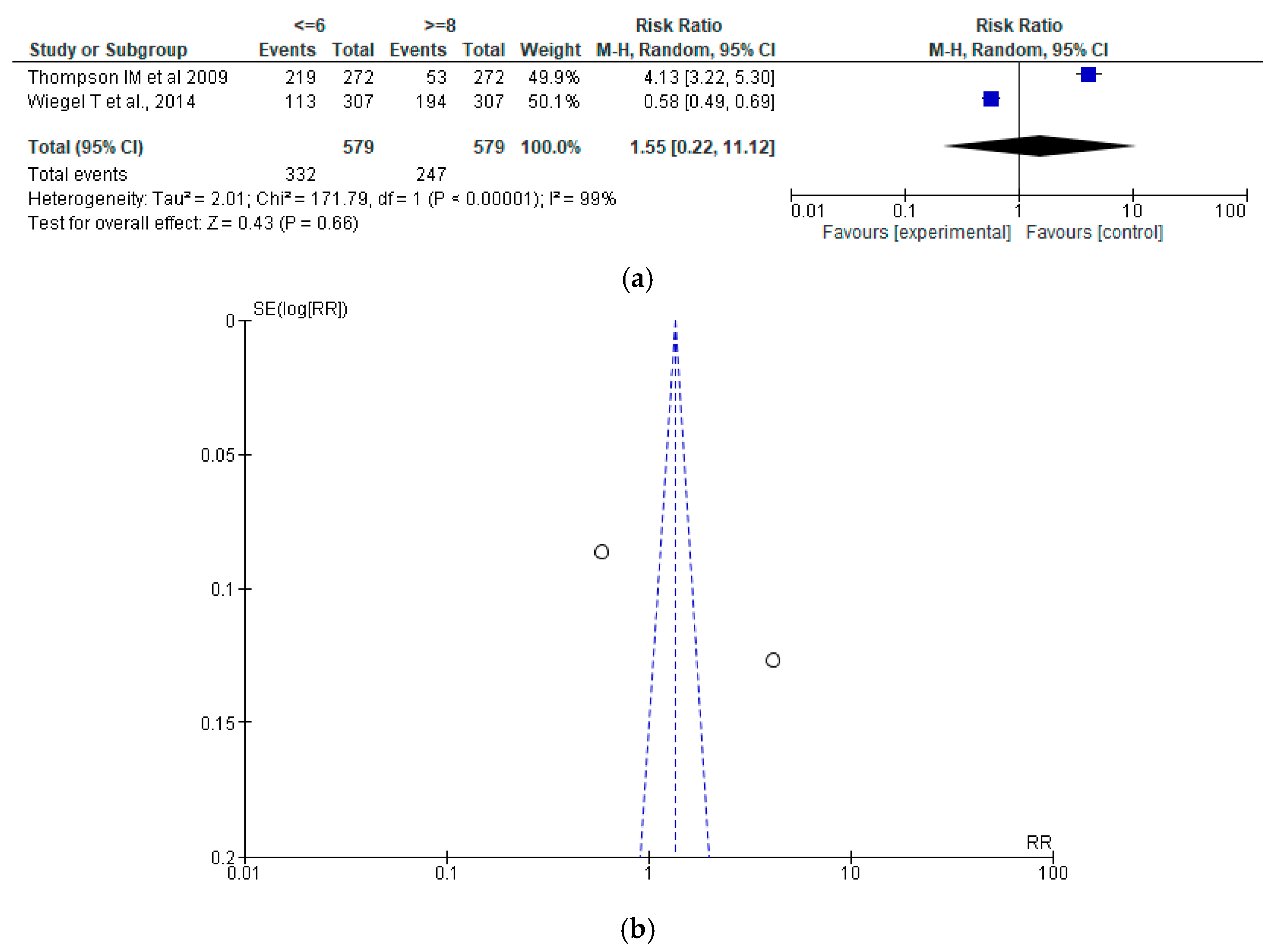
3.3. Metastasis-Free Survival
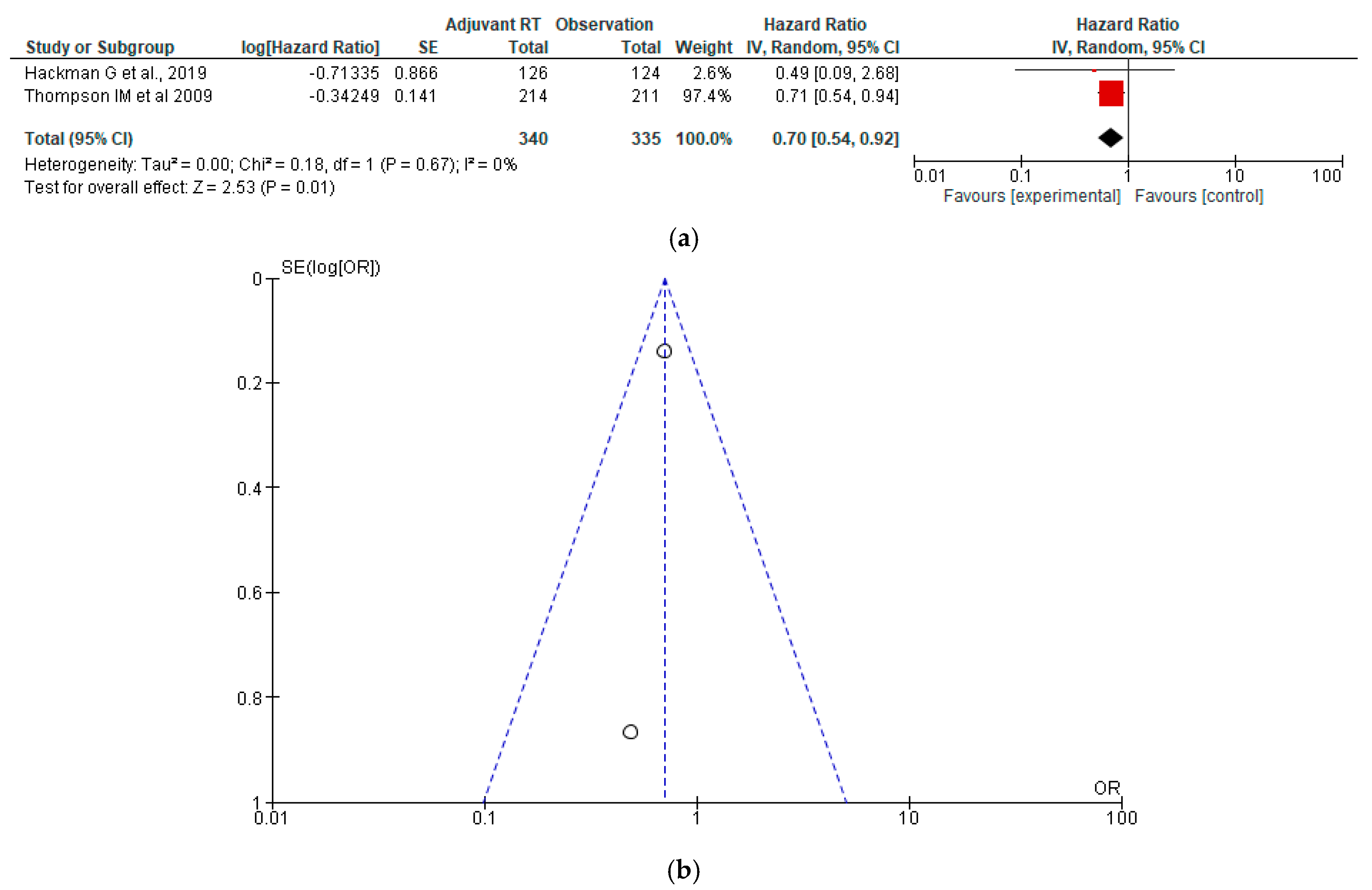
3.4. Overall Survival
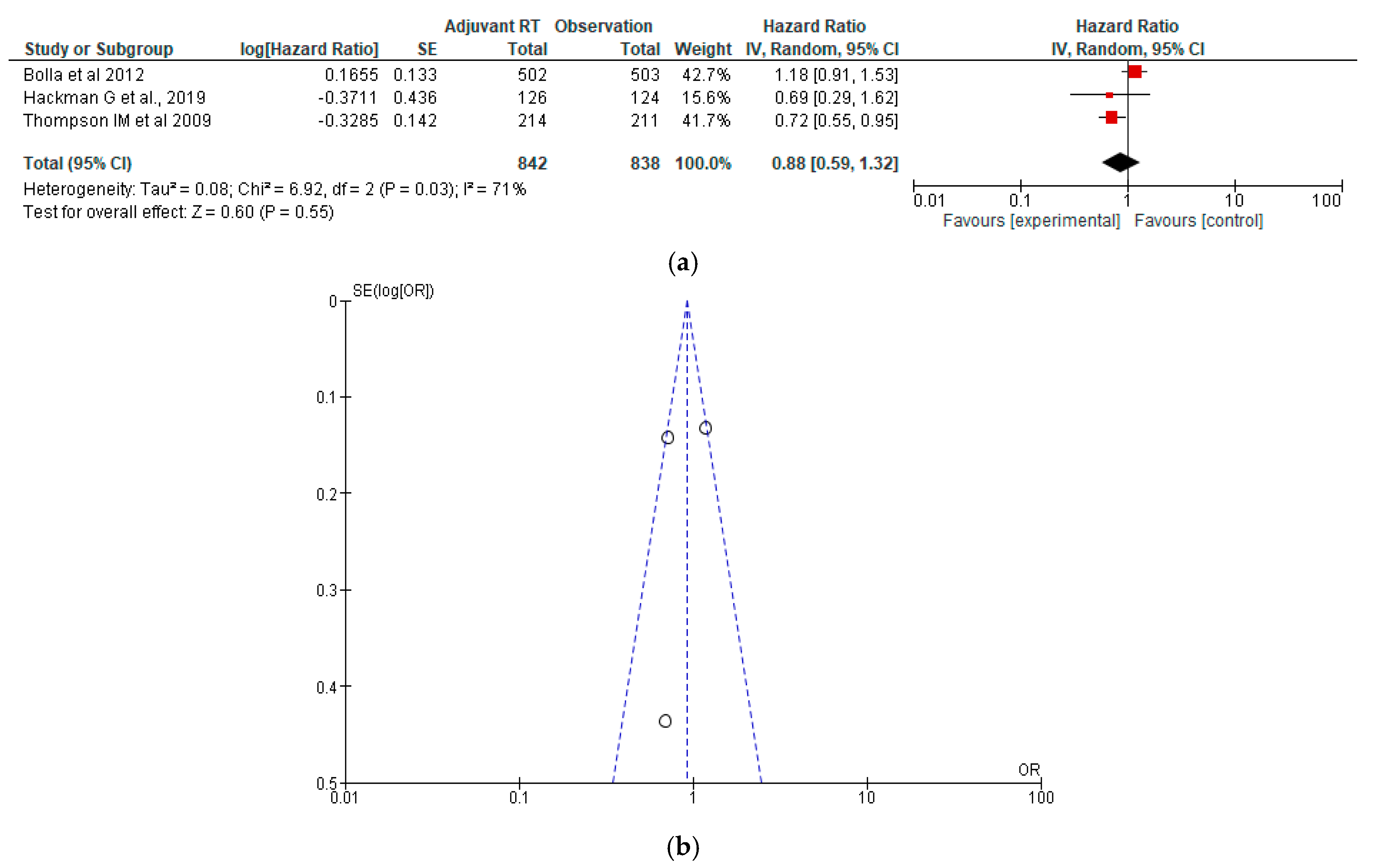
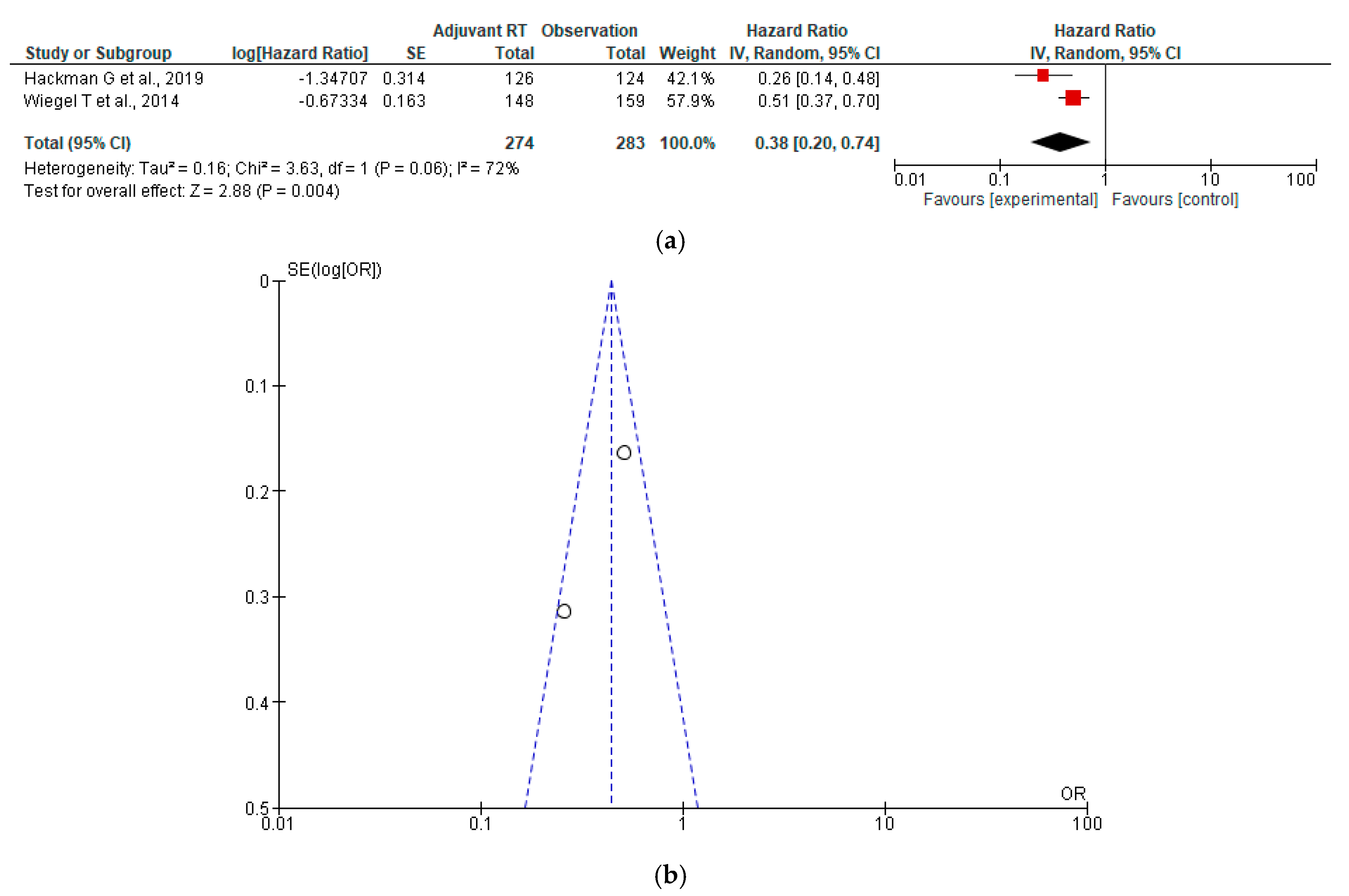
3.5. Progression-Free Survival (PFS)
3.6. Toxicity and Quality of Life
3.7. Risk of Bias
3.8. GRADE Certainty of Assessment
4. Discussion
4.1. Principal Findings
4.2. Comparison with Previous Study
4.3. Clinical Implications
5. Strengths and Limitations
6. Future Directions
7. Conclusions
Supplementary Materials
Author Contributions
Funding
Institutional Review Board Statement
Informed Consent Statement
Data Availability Statement
Conflicts of Interest
References
- Bray, F.; Ferlay, J.; Soerjomataram, I.; Siegel, R.L.; Torre, L.A.; Jemal, A. Global cancer statistics 2018: GLOBOCAN estimates of incidence and mortality worldwide for 36 cancers in 185 countries. CA Cancer J. Clin. 2018, 68, 394–424. [Google Scholar] [CrossRef]
- Ferlay, J.; Colombet, M.; Soerjomataram, I.; Parkin, D.M.; Piñeros, M.; Znaor, A.; Bray, F. Cancer statistics for the year 2020: An overview. Int. J. Cancer 2021, 149, 778–789. [Google Scholar] [CrossRef]
- Leslie, S.W.; Soon-Sutton, T.L.; Skelton, W.P. Prostate Cancer. In StatPearls; StatPearls Publishing: Treasure Island, FL, USA, 2024. Available online: https://www.ncbi.nlm.nih.gov/books/NBK470550/ (accessed on 10 April 2026).
- Rawla, P. Epidemiology of prostate cancer. World J. Oncol. 2019, 10, 63–89. [Google Scholar] [CrossRef]
- Shore, N. Management of early-stage prostate cancer. Am. J. Manag. Care 2014, 20, S260–S272. [Google Scholar] [PubMed]
- Urology Care Foundation. Prostate Cancer—Early-Stage. 2018. Available online: https://www.urologyhealth.org/urology-a-z/p/prostate-cancer (accessed on 10 April 2026).
- Ng, M.; Leslie, S.W.; Baradhi, K.M. Benign Prostatic Hyperplasia. In StatPearls; StatPearls Publishing: Treasure Island, FL, USA, 2024. Available online: https://www.ncbi.nlm.nih.gov/books/NBK558920/ (accessed on 10 April 2026).
- Cano Gómez, J.C.; Mantic Lugo, M.; Vela Panés, T.; García Guerrero, G.L. Epidemiology and clinic of vertebral metastasis. Rev. Esp. Cir. Ortop. Traumatol. 2023, 67, S500–S504. [Google Scholar] [PubMed]
- David, M.K.; Leslie, S.W. Prostate-Specific Antigen. In StatPearls; StatPearls Publishing: Treasure Island, FL, USA, 2024. Available online: https://www.ncbi.nlm.nih.gov/books/NBK557495/ (accessed on 10 April 2026).
- El Farhaoui, H.; Jdaini, A.; Elabbassi, O.; Bounouar, O.; Elmoudane, A.; Barki, A. Management of a localized prostatic adenocarcinoma despite the very high rate of PSA and the large tumor mass: Does PSA level indicate the stage of prostate cancer? Radiol. Case Rep. 2023, 18, 3501–3503. [Google Scholar] [CrossRef] [PubMed]
- Bo, M.; Ventura, M.; Marinello, R.; Capello, S.; Casetta, G.; Fabris, F. Relationship between prostate-specific antigen (PSA) and prostate volume in benign prostatic hyperplasia in the elderly. Crit. Rev. Oncol. Hematol. 2003, 47, 207–211. [Google Scholar] [CrossRef]
- Yusim, I.; Krenawi, M.; Mazor, E.; Novack, V.; Mabjeesh, N.J. The use of prostate-specific antigen density to predict clinically significant prostate cancer. Sci. Rep. 2020, 10, 20015. [Google Scholar] [CrossRef]
- Wang, S.; Kozarek, J.; Russell, R.; Drescher, M.; Khan, A.; Kundra, V.; Barry, K.H.; Naslund, M.; Siddiqui, M.M. Diagnostic performance of prostate-specific antigen density for detecting clinically significant prostate cancer in the era of magnetic resonance imaging: A systematic review and meta-analysis. Eur. Urol. Oncol. 2024, 7, 189–203. [Google Scholar] [CrossRef]
- Hong, C.W.; Amalou, H.; Xu, S.; Turkbey, B.; Yan, P.; Kruecker, J.; Pinto, P.A.; Choyke, P.L.; Wood, B.J. Prostate biopsy for the interventional radiologist. J. Vasc. Interv. Radiol. 2014, 25, 675–684. [Google Scholar] [CrossRef]
- Paterson, N.R.; Lavallée, L.T.; Nguyen, L.N.; Witiuk, K.; Ross, J.; Mallick, R.; Shabana, W.; MacDonald, B.; Scheida, N.; Fergusson, D.; et al. Prostate volume estimations using MRI and transrectal ultrasound compared to radical prostatectomy specimens. Can. Urol. Assoc. J. 2016, 10, 264–269. [Google Scholar] [CrossRef]
- Lee, J.S.; Chung, B.H. Transrectal ultrasound versus MRI in estimation of prostate volume compared with prostatectomy specimens. Urol. Int. 2007, 78, 323–327. [Google Scholar] [CrossRef]
- Stanzione, A.; Ponsiglione, A.; Di Fiore, G.A.; Picchi, S.G.; Di Stasi, M.; Verde, F.; Petretta, M.; Imbriaco, M.; Cuocolo, R. Prostate volume estimation on MRI: Accuracy and effects of ellipsoid and bullet-shaped measurements on PSA density. Acad. Radiol. 2021, 28, e219–e226. [Google Scholar] [CrossRef]
- Morote, J.; Borque-Fernando, A.; Triquell, M.; Celma, A.; Regis, L.; Mast, R.; de Torres, I.M.; Semidey, M.E.; Abascal, J.M.; Servian, P.; et al. Comparative analysis of PSA density and MRI-based predictive model for prostate biopsy selection. Cancers 2022, 14, 2374. [Google Scholar] [CrossRef]
- Thompson, I.M.; Valicenti, R.K.; Albertsen, P.; Davis, B.J.; Goldenberg, S.L.; Hahn, C.; Klein, E.; Michalski, J.; Roach, M.; Sartor, O.; et al. Adjuvant and salvage radiotherapy after prostatectomy: AUA/ASTRO guideline. J. Urol. 2013, 190, 441–449. [Google Scholar] [CrossRef]
- Würnschimmel, C.; Wenzel, M.; Wang, N.; Tian, Z.; Karakiewicz, P.I.; Graefen, M.; Huland, H.; Tilki, D. Radical prostatectomy for localized prostate cancer: 20-year oncological outcomes from a German high-volume center. Urol Oncol. 2021, 39, 830.e17–830.e26. [Google Scholar] [CrossRef] [PubMed]
- Yanai, Y.; Kosaka, T.; Mikami, S.; Takeda, T.; Matsumoto, K.; Masuda, T.; Oya, M. Prognostic impact of extraprostatic extension on prostate cancer with seminal vesicle invasion. Am. J. Clin. Exp. Urol. 2025, 13, 186–193. [Google Scholar] [CrossRef]
- Tharmalingam, H.; Tsang, Y.; Choudhury, A.; Alonzi, R.; Wylie, J.; Ahmed, I.; Henry, A.; Heath, C.; Hoskin, P.J. EBRT and HDR brachytherapy in prostate cancer: Impact of EBRT volume. Int. J. Radiat. Oncol. Biol. Phys. 2020, 106, 525–533. [Google Scholar] [CrossRef]
- Chun, S.J.; Kim, J.H.; Ku, J.H.; Kwak, C.; Lee, E.S.; Kim, S. Comparison of radical prostatectomy and EBRT in high-risk prostate cancer. Radiat. Oncol. J. 2021, 39, 231–238. [Google Scholar] [CrossRef] [PubMed]
- Dinçer, S.; Numanoğlu, Ç.; Akbörü, M.H.; Merder, E.; Dinçer, M. Results of adjuvant and salvage radiotherapy following radical prostatectomy. Bagcilar Med. Bull. 2021, 6, 125–133. [Google Scholar] [CrossRef]
- Vogel, M.M.E.; Kessel, K.A.; Schiller, K.; Devecka, M.; Gschwend, J.E.; Weichert, W.; Wilkens, J.J.; Combs, S.E. Adjuvant versus early salvage radiotherapy after prostatectomy. Radiat. Oncol. 2019, 14, 198. [Google Scholar] [CrossRef]
- Li, G.; Li, Y.; Wang, J.; Gao, X.; Zhong, Q.; He, L.; Li, C.; Liu, M.; Liu, Y.; Ma, M.; et al. Guidelines for radiotherapy of prostate cancer (2020 edition). Precis. Radiat. Oncol. 2021, 5, 160–182. [Google Scholar] [CrossRef]
- Srinivasan, S.; Kunder, S.; Maitre, P.; Murthy, V. Immediate or salvage radiotherapy after radical prostatectomy: Do we finally know? Natl. Med. J. India 2022, 34, 282. [Google Scholar] [CrossRef] [PubMed]
- Jain, S.; Mallick, I.; Tamhankar, A.S.; Gautam, G. Adjuvant versus early salvage radiotherapy for prostate cancer with adverse pathological features after radical prostatectomy. Indian J. Cancer 2022, 59, 170–177. [Google Scholar] [CrossRef]
- Renzulli, J.F.; Brito, J.; Kim, I.Y.; Broccoli, I. A meta-analysis on radiotherapy after prostatectomy: Adjuvant versus early salvage radiation. Prostate Int. 2022, 10, 80–84. [Google Scholar] [CrossRef]
- Vale, C.L.; Fisher, D.; Kneebone, A.; Parker, C.; Pearse, M.; Richaud, P.; Sargos, P.; Sydes, M.R.; Brawley, C.; Brihoum, M.; et al. Adjuvant or early salvage radiotherapy for localized and locally advanced prostate cancer: A systematic review and meta-analysis. Lancet 2020, 396, 1422–1431. [Google Scholar] [CrossRef] [PubMed]
- Morgan, S.C.; Waldron, T.S.; Eapen, L.; Mayhew, L.A.; Winquist, E.; Lukka, H. Adjuvant radiotherapy following radical prostatectomy for pT3 or margin-positive disease: A systematic review and meta-analysis. Radiother. Oncol. 2008, 88, 1–9. [Google Scholar] [CrossRef]
- Bhindi, B.; Lokeshwar, S.D.; Klaassen, Z.; Klotz, L.; Wallis, C.J.D. Systematic review and meta-analysis evaluating adjuvant radiation after prostatectomy. Can. Urol. Assoc. J. 2020, 14, 330–336. [Google Scholar] [CrossRef]
- PRISMA. PRISMA Guidelines. 2020. Available online: https://www.prisma-statement.org/ (accessed on 10 April 2026).
- Cochrane Methods. RoB 2 Tool. 2025. Available online: https://methods.cochrane.org/risk-bias-2 (accessed on 10 April 2026).
- RevMan. Review Manager (RevMan). Cochrane. 2025. Available online: https://revman.cochrane.org/info (accessed on 10 April 2026).
- Cochrane Methods. A Revised Cochrane Risk of Bias Tool for Randomized Trials. 2021. Available online: https://sites.google.com/site/riskofbiastool/welcome/rob-2-0-tool (accessed on 10 April 2026).
- Prasad, M. Introduction to the GRADE tool for rating certainty in evidence and recommendations. Clin. Epidemiol. Glob. Health 2024, 25, 101484. [Google Scholar] [CrossRef]
- Thompson, I.M.; Tangen, C.M.; Paradelo, J.; Lucia, M.S.; Miller, G.; Troyer, D.; Messing, E.; Forman, J.; Chin, J.; Swanson, G.; et al. Adjuvant radiotherapy for pathologic T3N0M0 prostate cancer reduces metastases and improves survival. J. Urol. 2009, 181, 956–962. [Google Scholar] [CrossRef]
- Bolla, M.; Van Poppel, H.; Tombal, B.; Vekemans, K.; Da Pozzo, L.; De Reijke, T.M.; Verbaeys, A.; Bosset, J.F.; van Velthoven, R.; Maréchal, J.M. Postoperative radiotherapy after radical prostatectomy for high-risk prostate cancer: Long-term results of a randomized trial (EORTC 22911). Lancet 2012, 380, 2018–2027. [Google Scholar] [CrossRef]
- Wiegel, T.; Bartkowiak, D.; Bottke, D.; Bronner, C.; Steiner, U.; Siegmann, A.; Golz, R.; Störkel, S.; Willich, N.; Semjonow, A.; et al. Adjuvant radiotherapy versus wait-and-see after radical prostatectomy: 10-year follow-up of the ARO 96-02/AUO AP 09/95 trial. Eur Urol. 2014, 66, 243–250. [Google Scholar] [CrossRef]
- Hackman, G.; Taari, K.; Tammela, T.L.; Matikainen, M.; Kouri, M.; Joensuu, T.; Luukkaala, T.; Salonen, A.; Isotalo, T.; Pétas, A.; et al. Randomized trial of adjuvant radiotherapy versus prostatectomy alone in patients with positive margins or extracapsular extension. Eur. Urol. 2019, 76, 586–595. [Google Scholar] [CrossRef]
- Su, H.C.; Li, C.C.; Li, W.M.; Yeh, H.C.; Ke, H.L.; Wu, W.J.; Chien, T.M.; Wen, S.C.; Wang, Y.C.; Lee, H.Y. Effectiveness of adjuvant therapy on biochemical recurrence in prostate cancer with positive margins. J. Formos. Med. Assoc. 2025; in press. [CrossRef] [PubMed]
- Bronkema, C.; Rakic, N.; Abdollah, F. Adjuvant radiotherapy in prostate cancer with positive margins or extracapsular extension. Ann. Transl. Med. 2019, 7, S291. [Google Scholar] [CrossRef] [PubMed]
- Kasibhatla, M.; Peterson, B.; Anscher, M.S. Postoperative treatment for pT3bN0M0 prostate cancer. Prostate Cancer Prostatic Dis. 2005, 8, 167–173. [Google Scholar] [CrossRef] [PubMed]
- Deek, M.P.; Tran, P.T.; Jabbour, S.K. Metastasis-directed therapy: A moving target advancing progress. J. Clin. Oncol. 2024, 42, 4–7. [Google Scholar] [CrossRef]
- Thompson, I.M.; Tangen, C.M.; Paradelo, J.; Lucia, M.S.; Miller, G.; Troyer, D.; Messing, E.; Forman, J.; Chin, J.; Swanson, G.; et al. Adjuvant radiotherapy for pathologically advanced prostate cancer. JAMA 2006, 296, 2329–2335. [Google Scholar] [CrossRef]
- Taylor, J.M.; Chen, V.E.; Miller, R.C.; Greenberger, B.A. Impact of prostate cancer treatment on quality of life: A narrative review. Res. Rep. Urol. 2020, 12, 533–546. [Google Scholar] [CrossRef]
- Gartrell, B.A.; Phalguni, A.; Bajko, P.; Mundle, S.D.; McCarthy, S.A.; Brookman-May, S.D.; De Solda, F.; Jain, R.; Yu Ko, W.; Ploussard, G.; et al. Factors impacting treatment decision-making and regret in prostate cancer. Eur. Urol. Oncol. 2024, 7, 1216–1227. [Google Scholar] [CrossRef]
- Nazim, S.M.; Fawzy, M.; Bach, C.; Ather, M.H. Multidisciplinary and shared decision-making in prostate cancer. Arab. J. Urol. 2018, 16, 367–377. [Google Scholar] [CrossRef]
- Shrestha, A.; Martin, C.; Burton, M.; Walters, S.; Collins, K.; Wyld, L. Quality of life versus length of life in cancer patients: A systematic review. Psychooncology 2019, 28, 1367–1380. [Google Scholar] [CrossRef]
- Droz, J.P.; Balducci, L.; Bolla, M.; Emberton, M.; Fitzpatrick, J.M.; Joniau, S.; Kattan, M.W.; Monfardini, S.; Moul, J.W.; Naeim, A.; et al. Management of prostate cancer in older men: Recommendations of the International Society of Geriatric Oncology. BJU Int. 2010, 106, 462–469. [Google Scholar] [CrossRef]
- Shickh, S.; Leventakos, K.; Lewis, M.A.; Bombard, Y.; Montori, V.M. Shared decision making in cancer care. J. Clin. Oncol. Educ. Book 2023, 43, e389516. [Google Scholar] [CrossRef]
- Argalácsová, S.; Vočka, M.; Čapoun, O.; Lambert, L. Timing of early salvage therapy in biochemical relapse of prostate cancer. Oncol. Rev. 2023, 17, 10676. [Google Scholar] [CrossRef] [PubMed]
- Segundo, C.G.S.; Gómez-Iturriaga, A.; Couñago, F. Are all prostate cancer patients fit for salvage radiotherapy? World J. Clin. Oncol. 2020, 11, 1–10. [Google Scholar] [CrossRef] [PubMed]
- Page, M.J.; McKenzie, J.E.; Bossuyt, P.M.; Boutron, I.; Hoffmann, T.C.; Mulrow, C.D.; Shamseer, L.; Tetzlaff, J.M.; Akl, E.A.; Brennan, S.E.; et al. The PRISMA 2020 statement: An updated guideline for reporting systematic reviews. BMJ 2021, 372, n71. [Google Scholar] [CrossRef] [PubMed]



| Study | Author, Year | Country | Sample Size | pT Stage/Risk Factors | RT Dose & Technique | Timing Post-RP | Primary Endpoint | Median Follow-Up |
|---|---|---|---|---|---|---|---|---|
| SWOG S8794 | Thompson I et al., 2009 [38] | USA | 425 | pT3N0M0 (ECE, SVI, positive margins) | 60–64 Gy, 2D | ≤18 weeks | MFS | 12.6 years |
| EORTC 22911 | Bolla M et al., 2012 [39] | Europe | 1005 | pT2–3N0 with positive margins or ECE | 60 Gy, 2D | ≤16 weeks | Biochemical PFS | 10.6 years |
| ARO 96-02 | Wiegel T et al., 2014 [40] | Germany | 307 | pT3N0, undetectable PSA | 60 Gy, 3D conformal | 6–12 weeks | PFS | 9.3 years |
| NCT02668718 | Hackman G et al., 2019 [41] | Finland | 250 | pT2 with positive margins or pT3a | 66.6 Gy, 3D conformal | ≤12 weeks | Biochemical PFS | 9.3 years |
| Study | Author, Year | Toxicity | QoL |
|---|---|---|---|
| SWOG S8794 | Thompson I et al., 2009 [38] | Not reported | Prospective QoL subset (n = 217): at 6 weeks, bowel tenderness/urgency 47% RT vs. 5% observation; urinary frequency more common with RT; no difference in ED (high in both) Global QoL: worse initially with RT, similar by year 2, then better with RT over the following 3 years |
| EORTC 22911 | Bolla M et al., 2012 [39] | 10-yr cumulative incidence: any late AE 70.8% RT vs. 59.7% (p = 0.001); Grade 3 late 5.3% RT vs. 2.5% (p = 0.052); GU ≥ G2 21.3% RT vs. 13.5% (p = 0.003); GI ≥ G2 2.5% vs. 1.9% (p = 0.47); no Grade 4 events; excess grade 1–2 largely within first 3 years | Not reported |
| ARO 96-02 | Wiegel T et al., 2014 [40] | Late toxicity (RT arm, n = 148): 1 Grade 3 bladder; 3 Grade 2 bladder; 2 Grade 2 rectum; no Grade 4 Grade 1 late bladder/rectal: 21.9% RT vs. 3.7% (p < 0.0001) Urethral stricture: 3% RT vs. 1% | Not reported |
| NCT02668718 | Hackman G et al., 2019 [41] | Any grade 3 AE: 56% RT vs. 40% (p = 0.016); Grade 4: 1% RT vs. 0% Most common Grade 3 AEs: ED 37% RT vs. 28%; urinary incontinence 12% vs. 5% GI disorders: Grade 1 77% RT vs. 13%; Grade 2 23% vs. 3%; Grade 3 1% vs. 1%; Grade 4 0% vs. 0% Urinary disorders: Grade 1 88% vs. 62%; Grade 2 57% vs. 38%; Grade 3 14% vs. 6%; Grade 4 0% vs. 0% Urethral stricture (Grade 3, surgery required): 12/126 (9.5%) RT vs. 3/124 (2.4%). | Patient-reported instruments: IIEF-5, IPSS, LENT-SOMA (urinary & intestinal) collected up to ~51 months Severe intestinal LENT-SOMA (grade 3–4): significantly higher with RT (modelling shows observation vs. RT OR 0.04, 95% CI 0.00–0.43; p = 0.008) Severe urinary LENT-SOMA: no significant difference (OR 0.76; p = 0.4) Severe ED by IIEF-5 over time: no significant between-group difference (OR 0.70; p = 0.4) Severe urinary symptoms (IPSS 20–35): trend toward more with RT (OR 0.51 for observation vs. RT; p = 0.061). |
Disclaimer/Publisher’s Note: The statements, opinions and data contained in all publications are solely those of the individual author(s) and contributor(s) and not of MDPI and/or the editor(s). MDPI and/or the editor(s) disclaim responsibility for any injury to people or property resulting from any ideas, methods, instructions or products referred to in the content. |
© 2026 by the authors. Licensee MDPI, Basel, Switzerland. This article is an open access article distributed under the terms and conditions of the Creative Commons Attribution (CC BY) license.
Share and Cite
Borhan, W.; Rajih, E. The Outcome of Immediate Adjuvant Postoperative External Beam Radiotherapy Versus Observation Alone After Radical Prostatectomy in High-Risk Prostate Cancer: A Meta Analysis. J. Clin. Med. 2026, 15, 3149. https://doi.org/10.3390/jcm15083149
Borhan W, Rajih E. The Outcome of Immediate Adjuvant Postoperative External Beam Radiotherapy Versus Observation Alone After Radical Prostatectomy in High-Risk Prostate Cancer: A Meta Analysis. Journal of Clinical Medicine. 2026; 15(8):3149. https://doi.org/10.3390/jcm15083149
Chicago/Turabian StyleBorhan, Walaa, and Emad Rajih. 2026. "The Outcome of Immediate Adjuvant Postoperative External Beam Radiotherapy Versus Observation Alone After Radical Prostatectomy in High-Risk Prostate Cancer: A Meta Analysis" Journal of Clinical Medicine 15, no. 8: 3149. https://doi.org/10.3390/jcm15083149
APA StyleBorhan, W., & Rajih, E. (2026). The Outcome of Immediate Adjuvant Postoperative External Beam Radiotherapy Versus Observation Alone After Radical Prostatectomy in High-Risk Prostate Cancer: A Meta Analysis. Journal of Clinical Medicine, 15(8), 3149. https://doi.org/10.3390/jcm15083149