Article

Peak Inspiratory Flow Capability for Simulated Dry Powder Inhaler Resistances in Asthma Patients Prescribed Pressurized Metered-Dose Inhalers with Valved Holding Chambers: The USE-DPI Study

by
Lara Bravo Quiroga
1,2,
José Miguel González Moro
1,3,
Francisco Javier Álvarez-Gutiérrez
4,
Krasimira Baynova
4,
Mariam De La Poza Abad
5 and
José Luis Izquierdo Alonso
3,6,*
1
Hospital Universitario Príncipe de Asturias, Alcalá de Henares, 28805 Madrid, Spain
2
Escuela de Doctorado, Universidad de Alcalá, 28801 Madrid, Spain
3
Departamento de Medicina y Especialidades, Universidad de Alcalá, 28801 Madrid, Spain
4
Hospital Universitario Virgen del Rocío, 41013 Sevilla, Spain
5
Centro de Salud Doctor Carles Ribas, 08038 Barcelona, Spain
6
Hospital Universitario de Guadalajara, 19002 Guadalajara, Spain
*
Author to whom correspondence should be addressed.
J. Clin. Med. 2026, 15(8), 3131; https://doi.org/10.3390/jcm15083131
Submission received: 18 March 2026 / Revised: 7 April 2026 / Accepted: 14 April 2026 / Published: 20 April 2026
(This article belongs to the Special Issue Advances in the Management of Chronic Cough and Severe Asthma)

Abstract

Background: Inhaled therapy is the mainstay of asthma management, yet many patients are prescribed pressurized metered-dose inhalers (pMDIs) with valved holding chambers (VHCs) based on a presumed low inspiratory capacity, often without objective measurement. The USE-DPI study aimed to determine how many of these patients can generate sufficient peak inspiratory flow (PIF) to use a dry powder inhaler (DPI). Methods: This multicenter, observational, cross-sectional study included 346 patients with asthma treated with pMDI and VHC. PIF was measured using the In-Check Dial at two resistance settings (R2 and R4). The primary outcome was the proportion of patients achieving PIF ≥ 30 L/min. Results: Almost all patients reached the 30 L/min threshold (99.4% at R2 and 98.7% at R4). Using a higher threshold of 60 L/min (R2), 76.1% met this criterion. Lower PIF (<60 L/min) was associated with older age, reduced lung function (FEV1 ≤ 80% predicted), and poorer asthma control. No significant variables were associated with failure to reach 30 L/min. Conclusions: Most patients using pMDI with VHC can generate sufficient inspiratory flow for medium- to high-resistance DPIs. Objective PIF assessment may help guide inhaler selection, although its clinical impact requires further study.

1. Introduction

Inhalation therapy is the treatment of choice for chronic respiratory diseases such as asthma, as it allows for direct drug delivery to the target organ using lower doses and resulting in fewer systemic side effects [1]. Nevertheless, between 30% and 90% of patients commit at least one significant error during the inhalation technique, which reduces clinical efficacy and promotes non-adherence [2]. In pressurized metered-dose inhalers (pMDIs), one of the most frequent critical errors is poor coordination between actuation and the onset of inspiration, although other relevant errors include inadequate exhalation before inhalation, insufficiently slow/deep inhalation, and failure to maintain an adequate post-inhalation breath-hold. When a valved holding chamber (VHC) is added, coordination demands are reduced, but cleaning, portability, and daily handling become more complex. In contrast, for dry powder inhalers (DPIs), a major critical error is failure to generate sufficient peak inspiratory flow (PIF) to disperse the powder effectively [2,3,4]. In the systematic review by Sanchis et al., data were collected regarding technique errors for both pMDIs and DPIs in 54,354 patients. Generally, more errors are detected with pMDIs, that are primarily associated with the coordination between device actuation and the onset of inspiration. In contrast, for DPIs, the most frequent critical error is the failure to generate sufficient peak inspiratory flow (PIF) to disperse the powder [2].
In clinical practice, DPIs are often avoided when there are concerns about insufficient inspiratory flow or a patient’s ability to generate adequate inhalation effort. Clinicians may instead favor pMDIs used with VHCs, reflecting both longstanding familiarity and limitations in available DPI formulations. Although VHCs can address some delivery issues, their size and handling requirements may reduce adherence, particularly in ambulatory or community setting [4,5,6]. Furthermore, the exclusion of DPIs not only restricts patient preferences but may also limit therapeutic options, as not all inhaled asthma medications are available in MDI systems. On the other hand, while pressurized metered-dose inhalers (pMDIs) contribute significantly to the carbon footprint of asthma care due to high-global-warming-potential propellants, transitioning to dry powder inhalers (DPIs) can reduce treatment-related equivalent emissions by over 50% to 95% while maintaining or improving clinical outcomes [7].
The performance of a DPI depends on the relationship between patient-generated flow, device resistance, and the turbulence produced within the device itself. A low-resistance device requires high flow, while a high-resistance device requires lower flow [8,9,10]. This is explained by the phenomenon of turbulent aerosolization, which is fundamentally mediated by airflow velocity and device resistance. Consequently, some devices can function optimally with a PIF of 30 L/min, a threshold that most patients with asthma might be able to reach [8,9,11].
In a proof-of-concept study (INSPIRE), we observed that most patients with asthma were able to achieve a PIF ≥ 30 L/min following brief technical instruction [12]. These findings suggest that a significant proportion of patients treated with a pMDI plus VHC could effectively manage a DPI, thereby simplifying their therapeutic regimen. Nevertheless, evidence from real-world clinical practice remains limited.
The USE-DPI study aimed to quantify, in asthma patients currently prescribed pMDI with VHC in routine care, the proportion able to generate adequate PIF for simulated DPI resistance profiles after briefing standardized instruction.

2. Material and Methods

This study was designed to evaluate inspiratory-flow capability under standardized testing conditions in asthmatic patients treated in routine practice with a pMDI and a VHC.

2.1. Study Population

This was a multicenter, observational, cross-sectional study in a real-world population of asthma patients treated with pMDI and VHC. The study was conducted in outpatient clinics of Pulmonology, Allergy, and Primary Care, involving stable patients diagnosed with bronchial asthma according to the GINA 2022 criteria. A total of 70 centers participated, each enrolling 5 patients over the age of 6 who were receiving any inhaled medication via pMDI and VHC and had undergone spirometry within the previous 12 months. Patients using other devices without a VHC, those with disabling comorbidities, or those with cognitive impairment that, in the investigator’s judgment, compromised participation were excluded.
Reasons for VHC prescription were recorded in the eCRF from the treating clinician’s documented indication in the medical record and, when needed, were complemented during the study visit by investigator confirmation with the patient or caregiver.
Although a pediatric subgroup was prospectively identified, only 41 participants were younger than 18 years, which limited statistical power for reliable inferential subgroup comparisons. Accordingly, the primary analysis was performed in the pooled population, and all age-specific inferences for pediatric population were avoided.

2.2. Procedures

Following the verification of selection criteria and the signing of informed consent, demographic, clinical, and functional data were recorded in an electronic Case Report Form (eCRF).
Participants completed the validated Test of Adherence to Inhalers (TAI) and Feeling of Satisfaction with Inhaler (FSI-10) questionnaires, both previously used in asthma/COPD populations [5,6]. Inspiratory maneuver was assessed under brief standardized instruction using the In-Check Dial (Alliance TechMedical. Burleson, TX. USA). PIF was measured with the In-Check Dial using two simulated resistance settings, R2 and R4, chosen to represent medium-low and medium-high resistance profiles rather than any single marketed DPI.
The investigator instructed each patient on the proper DPI inhalation maneuver (complete exhalation, rapid and deep inhalation, and a 5–10 s breath-hold) and provided training for up to two attempts using the In-Check Dial inspiratory flow meter. Once the technique was deemed adequate, PIF was measured at resistance levels R2 or R4 (alternated between patients). If the 30 L/min threshold was not met, a second attempt was permitted, and the best value was recorded. Inspiratory maneuvers were performed starting from Residual Volume (RV) up to Total Lung Capacity (TLC). To assess the effect of incomplete lung emptying on the inspiratory maneuver, the procedure was repeated with the patient starting inspiration from Functional Residual Capacity (FRC) as an exploratory objective.
The primary endpoint was the percentage of patients achieving a PIF 30 L/min at each resistance level. This threshold represents the optimal peak inspiratory flow (PIF) for high-resistance devices and the minimum requirement for low-to-medium resistance inhalers. Given that the target flow rate for low-to-medium resistance devices typically reaches or exceeds 60 L/min, this variable was specifically evaluated using R2 resistance levels. Secondary variables included the influence of age, sex, body mass index (BMI), pathology and severity, lung function, and comorbidities on maneuver success, as well as clinical criteria for VHC prescription, such as patient satisfaction and awareness of alternative devices.

2.3. Sample Size and Statistical Analysis

The primary objective was to analyze the percentage of patients capable of completing an adequate inspiratory maneuver with a dry powder inhaler. Given that 30% to 90% of patients commit at least one significant error in inhalation technique, an estimated value of 50% was used for the sample size calculation to ensure maximum variance. Based on this, and assuming a 95% confidence level and 6% precision using the percentage estimation formula for infinite samples, the minimum required sample size was 267 patients. Accounting for a potential 20% loss to follow-up, the total required sample was 334 patients. For logistical reasons and given the multicenter nature of the study (70 centers), the recruitment target was rounded to 5 patients per center, resulting in a pre-established total of 350 patients.
Analyses were performed using Stata 17 (StataCorp, College Station, TX, USA). Proportions were estimated with 95% CIs. McNemar’s test was used for paired proportion analysis, and multivariable logistic regression was employed to identify factors associated with maneuver success. Candidate covariates for multivariable models were restricted to variables prospectively captured with sufficient completeness and distribution in the eCRF. Variables with sparse data or very low event counts were not forced into the final models to avoid unstable estimates. A p value less than 0.05 was considered statistically significant.

2.4. Ethical Considerations

The protocol was approved by the Clinical Research Ethics Committee of the Hospital Universitario General de Guadalajara—University of Alcalá (Ref CEIm: 2024.02.EO). The study was conducted in accordance with the Declaration of Helsinki and Good Clinical Practice (GCP) guidelines. All participants (or their legal representatives in patients under 18) provided written informed consent prior to any study-specific procedures.

3. Results

A total of 346 patients (305 adults and 41 under 18 years of age) from 70 centers were included in the study. Baseline characteristics are detailed in Table 1. The mean age was 50.5 ± 22.8 years, and 67.9% of the participants were female. Although a pediatric cohort was identified using an arbitrary cutoff of 18 years, the sample size was insufficient to perform meaningful comparative analyses. Consequently, the analysis was conducted as a pooled sample, as both groups exhibited similar trends. Notably, 34.1% of the patients were aged ≥ 65 years. Regarding smoking status, 24% were active smokers and 12% were former smokers; therefore, a concomitant COPD (Chronic Obstructive Pulmonary Disease) component cannot be ruled out in these patients.

3.1. Indications for and Knowledge of Valved Holding Chamber Use

The reasons for prescribing a pMDI with a VHC are summarized in Table 2. The most frequent indication was to ensure adequate drug delivery, followed by coordination difficulties and suspected insufficient inspiratory capacity—the latter generally without objective confirmation. Patient knowledge regarding the device was poor; 16% were unaware of alternative inhalation options, and 60% did not know the specific reason for their VHC use. Furthermore, 72% of patients believed they could successfully use an inhaler without a chamber.

3.2. Adherence and Satisfaction

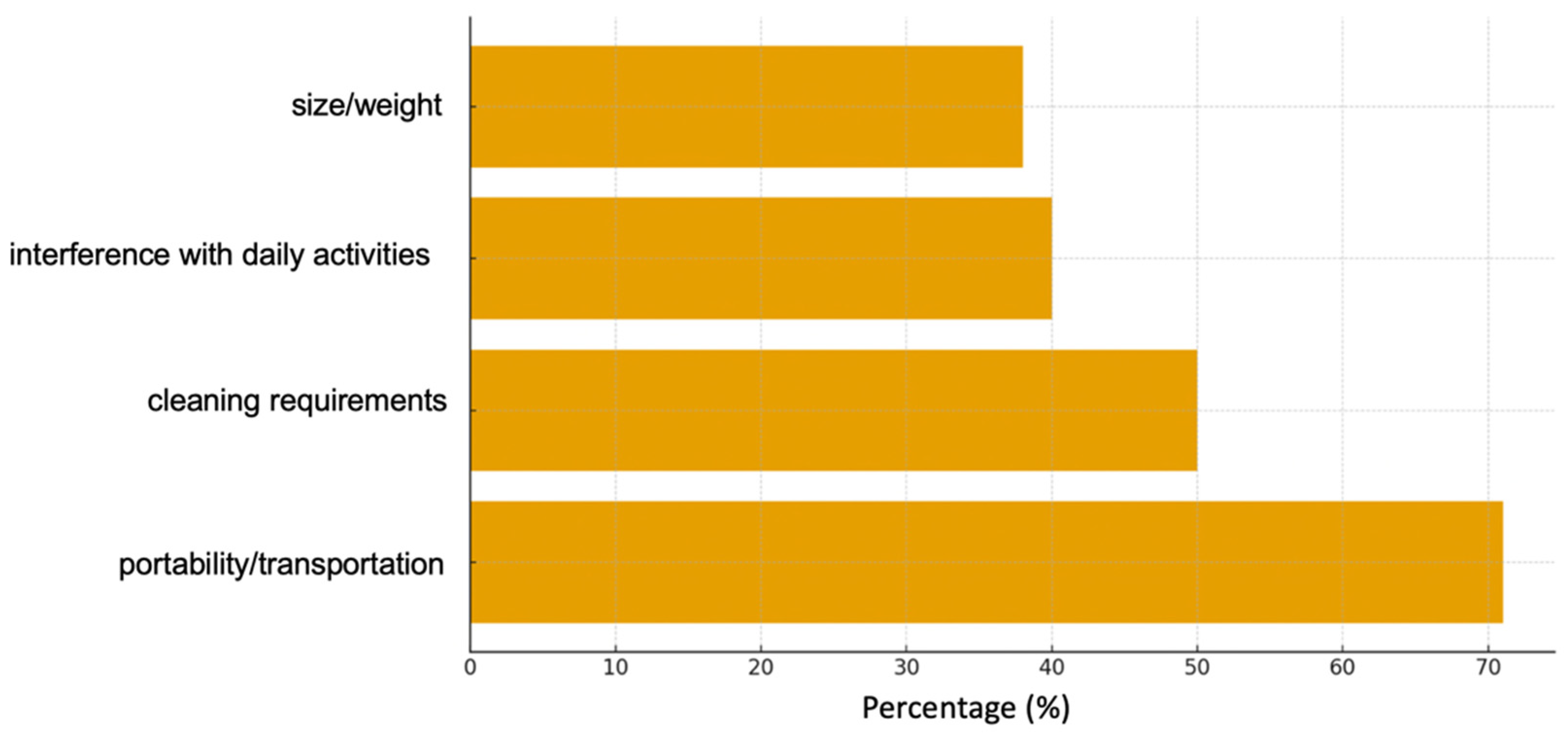
The TAI questionnaire demonstrated good adherence in the majority of patients. Adults exhibited minor fluctuations during asymptomatic periods or while on vacation. Overall satisfaction was high (75%). Figure 1 illustrates the primary limitations perceived by patients, most notably portability/transportation (71%), cleaning requirements (50%), interference with daily activities (40%), and size/weight (38%).

3.3. Peak Inspiratory Flow (PIF) Using the Standard Maneuver

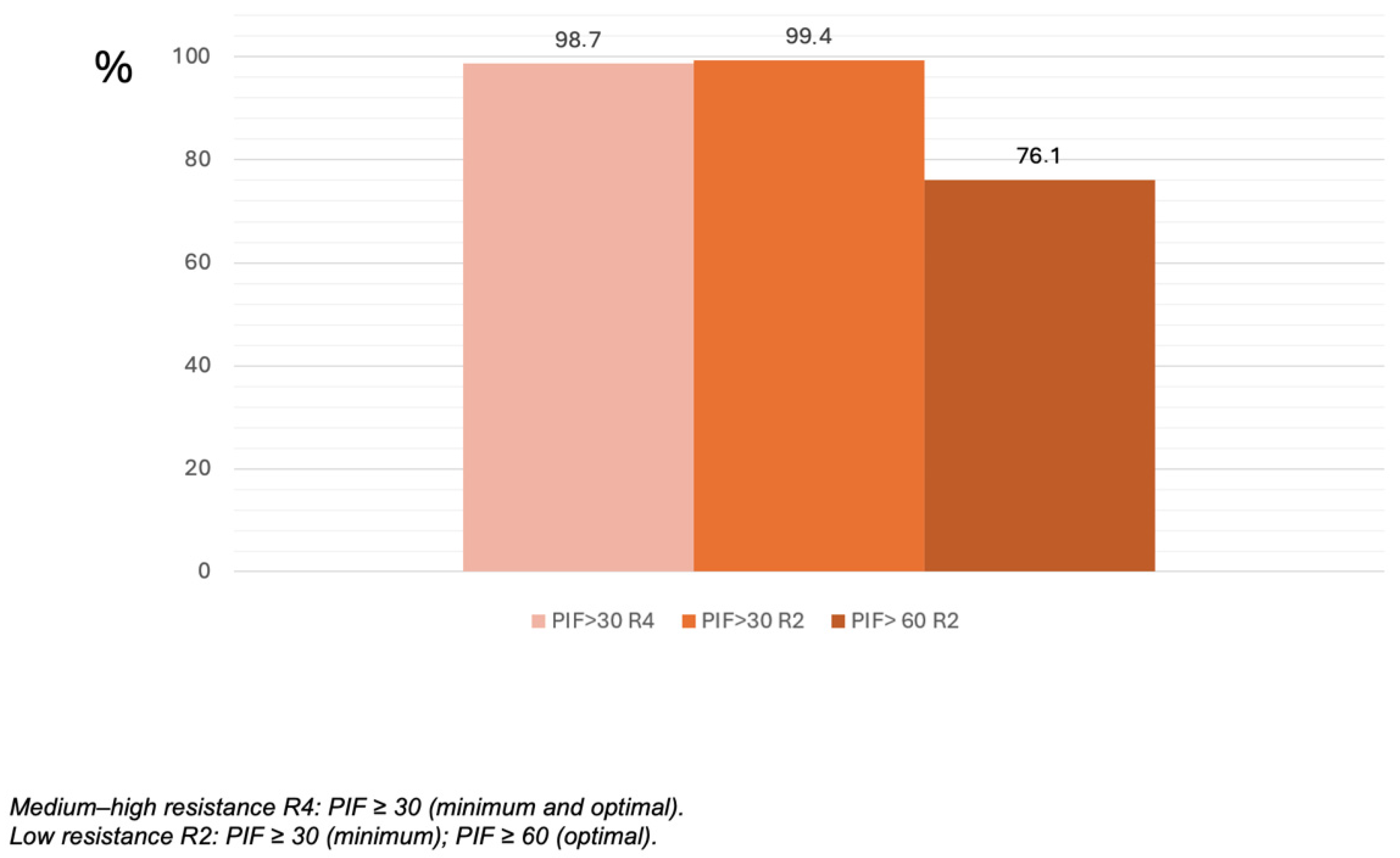
Figure 2 shows the distribution of the PIF achieved with R2 and R4 resistances following a complete exhalation. Notably, 98.7% and 99.4% of patients reached a PIF ≥ 30 L/min with the R4 and R2 settings, respectively. The proportion of subjects who failed to reach the ≥60 L/min threshold with R2 resistance was 23.9%. No significant differences were detected between resistance levels regarding the ability to exceed the 30 L/min threshold. However, patients aged ≥ 65 years, those with poorer lung function, or those with worse asthma control exhibited significantly higher proportions of failure to reach the 60 L/min threshold (Table 3).

3.4. Impact of Incomplete Lung Emptying

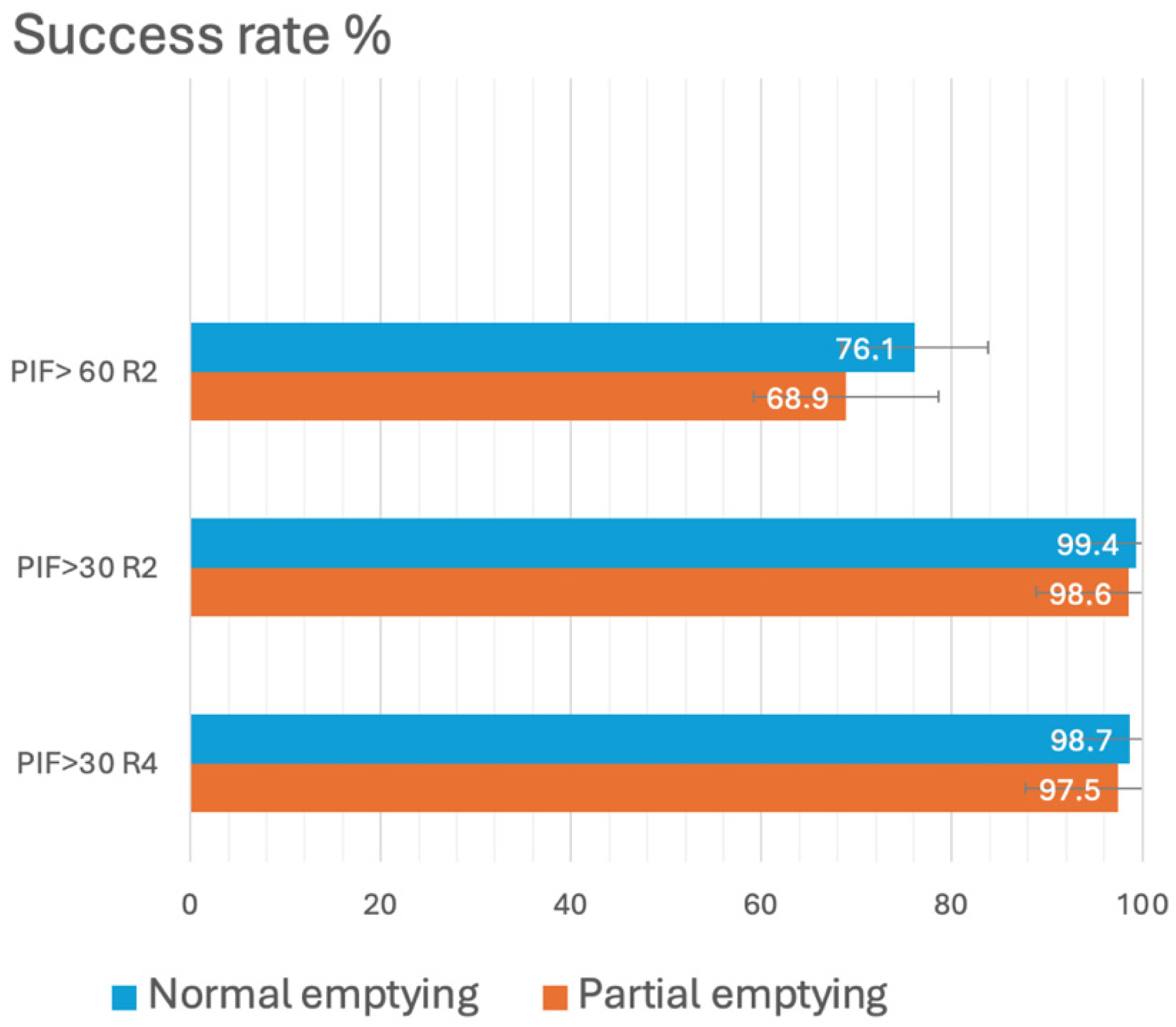
The evaluation of incomplete lung emptying showed that, using a PIF threshold of ≥30 L/min, the comparison between the standard maneuver and partial exhalation revealed only a minimal decrease in the success rate (from 99.4% to 98.6% for R2, and from 98.7% to 97.5% for R4). In contrast, when applying a more stringent criterion of ≥60 L/min, 76.1% of patients reached this threshold with the standard maneuver, a figure that fell to 68.9% following partial exhalation (Figure 3).

3.5. Analysis of Factors Associated with Maneuver Success

All patients were selected to analyze the factors associated with failure to perform a correct maneuver. With a PIF > 30 L/min as the dependent variable, univariate binary logistic regression models were first performed. For independent variables with p < 0.1, a stepwise forward multivariate model was constructed including the following independent variables: age, gender, severity, and control. For the PIF < 30 L/min threshold, no variables were found to be statistically significant or approaching the p = 0.05 level in the univariate analysis; therefore, no multivariate analysis was conducted (Table 4a).
Table 4b details the factors associated with a PIF < 60 L/min. Following multivariate analysis, age, lung function and poor asthma control were identified as the only statistically significant independent predictors.

4. Discussion

In this multicenter study conducted in a real-world prescribed population, but with standardized inspiratory-maneuver assessment, we observed that most patients with asthma treated with a pMDI and a VHC can generate a PIF sufficient to correctly utilize a high resistance DPI. More than 99% of the sample achieved a PIF ≥ 30 L/min at both medium-low (R2) and medium-high (R4) resistances, confirming that this flow threshold is attainable for nearly all patients following brief, standardized training.
Our findings highlight a significant disconnect between clinical practice and patient functional capacity. Although a clinical suspicion of “insufficient inspiratory capacity” is a primary reason for prescribing a VHC, this perception is rarely supported by objective measurements. In fact, 72% of patients in this study believed they could manage an inhaler without a chamber, and 60% were unaware of the reason why the device had been prescribed. This “prescriptive inertia,” based on subjective perceptions rather than reproducible data, may be unnecessarily limiting therapeutic options and patient autonomy.
The relationship between PIF, the internal resistance of the DPI, and the resulting turbulence is determinant for powder de-aggregation and the fine-particle dose. Previous studies have shown that medium- or high-resistance DPI systems generate adequate aerosolization with relatively modest PIF, whereas low-resistance devices require values exceeding 60 L/min [8,10,13]. This has led to questions regarding the universal application of the 60 L/min threshold, noting that flow requirements depend on device design and resistance [14,15,16,17]. Our findings are consistent with this interpretation: while 30 L/min was a nearly universal threshold, requiring ≥60 L/min significantly reduces the proportion of eligible candidates, particularly among elderly patients and those with poorer lung function. When the 60 L/min threshold was applied, the proportion of successful patients dropped to 76.1% with the standard maneuver, and further to 68.9% following partial exhalation. This pattern mirrors those described in COPD and mixed populations, where 20% to 40% of patients fail to reach this flow with low-resistance devices [13,15,18]. These data reinforce the importance of tailoring DPI selection to individual physiology and considering standardized PIF measurement as an integral part of the prescription process.
A distinctive aspect of this work is the evaluation of the impact of suboptimal technique, specifically incomplete lung emptying prior to inhalation—a frequent occurrence in real-world practice despite theoretical recommendations. Although this maneuver slightly reduces PIF, its impact on the 30 L/min threshold is minimal, decreasing from 99.4% to 97.5%. These findings indicate that inspiratory reserve allows for partial compensation of suboptimal technique when using medium- or high-resistance DPIs. However, the sensitivity of the ≥60 L/min threshold to imperfect exhalation reinforces the risk of under-dosing with low-resistance devices [14,15,16,17,18,19].
Prescription patterns for pMDI + VHC reveal relevant discrepancies: while suspected insufficient inspiratory capacity is frequently cited, it is seldom objectively evaluated. A significant portion of patients are unaware of why they use a chamber, and more than two-thirds believe they could manage without one, aligning with studies describing inhaler selection based more on perceptions than on reproducible metrics [17,18,19]. Adherence and satisfaction were high, consistent with previous data [4,5,6,20,21], although practical limitations related to the chamber (portability, cleaning, inconvenience) were identified as potential barriers to compliance [3,4,5,6,21]. Furthermore, within the current context of commitment to respiratory health and the environment, it is pertinent to note that DPIs lack the hydrofluoroalkane (HFA) propellants found in many pMDIs. Their preferential use significantly contributes to reducing the carbon footprint of asthma treatment, aligning with international sustainability recommendations.
Factors associated with an insufficient PIF to reach 60 L/min were advanced age, more pronounced bronchial obstruction, and poor clinical control, replicating patterns described in both asthma and COPD [15,16,17,18,22]. Recent studies propose PIF as a therapeutic biomarker and suggest that personalizing the inhaler according to PIF improves the device–patient fit [18,22]. From a technological perspective, the literature confirms the robustness of many medium-to-high resistance DPIs against variations in inspiratory flow. In vitro and in vivo studies demonstrate that the emitted dose and fine particle fraction remain relatively stable across a wide range of inspiratory flows [23,24,25,26], supporting the idea that the universal 60 L/min threshold is unnecessarily restrictive for many DPIs.
Additionally, the In-Check Dial, while validated for standardized PIF assessment, does not reproduce all device-specific internal geometries, dispersion mechanisms, or mouthpiece characteristics of commercial DPIs. Only two simulated resistance settings were evaluated; therefore, external validity is stronger for resistance classes than for individual products.
The use of pMDIs represents a significant environmental challenge in respiratory medicine, primarily due to the propellants they contain—hydrofluorocarbons HFC-134a and HFC-227ea—which are potent greenhouse gases with a global warming potential 1300 to 3000 times greater than that of CO2. In asthma management, short-acting β2-agonists (SABAs) delivered via pMDIs are a major contributor to these emissions, often accounting for up to two-thirds of the total inhaler-related carbon footprint. In this context, transitioning to dry powder inhalers (DPIs) or soft mist inhalers offers a substantial opportunity for decarbonization. For example, maintenance therapy with DPIs can reduce asthma-related CO2-equivalent emissions by more than 50% compared with pMDI-based regimens. Moreover, replacing SABA pMDIs with as-needed budesonide/formoterol DPIs has been associated with an estimated 95% reduction in the carbon footprint of asthma management, alongside improved clinical outcomes. Accordingly, while the development of low–global warming potential propellants is ongoing, prioritizing the clinical use of DPIs represents an immediate and effective strategy to reduce the environmental impact of asthma care [7,27,28].
The strengths of our study include its large sample size, multicenter representation, inclusion of both pediatric and adult populations, and the systematic assessment of PIF using resistances comparable to commercial DPIs. Limitations include the cross-sectional design, which precludes evaluating long-term performance stability or the clinical effects of switching to a DPI. In fact, because this was a cross-sectional physiological study, our data do not demonstrate that switching from pMDI with VHC to a DPI improves asthma control, adherence, exacerbation risk, or patient-reported outcomes. Those questions require prospective interventional studies with device-specific follow-up. Additionally, the In-Check Dial, while validated, does not exactly replicate every DPI on the market. The In-Check Dial, while validated for standardized PIF assessment, does not reproduce all device-specific internal geometries, dispersion mechanisms, or mouthpiece characteristics of commercial DPIs. In our study only two simulated resistance settings were evaluated; therefore, external validity is stronger for only two simulated resistance settings were evaluated; therefore, external validity is stronger for resistance classes than for individual products.
The inclusion of both adults and children, and the possibility of asthma-COPD overlap among current or former smokers, introduces clinical heterogeneity. Because the pediatric subgroup was small and smoking-related overlap could not be phenotypically resolved within the study design, the pooled results should be interpreted cautiously in this population.
In summary, our results suggest that the prescription of valved holding chambers due to suspected insufficient inspiratory flow is likely overemphasized in routine practice. Simple and reproducible PIF measurement should be integrated into routine patient assessment, allowing for device selection based on physiological criteria rather than subjective perceptions. Accordingly, the present findings should be interpreted as support for resistance-specific device assessment rather than for indiscriminate substitution of pMDI plus VHC by any DPI. Most patients using pMDI with VHC can generate sufficient inspiratory flow for medium- to high-resistance DPIs. Objective PIF assessment may help guide inhaler selection, although its clinical impact requires further study.

5. Conclusions

Although most asthma patients managed with pMDI and VHC can achieve peak inspiratory flows (PIFs) compatible with optimal inspiratory flow for medium-to-high resistance DPIs, following brief instruction, these findings are not universally applicable. Specifically, caution is warranted when considering low-resistance devices, which typically necessitate higher inspiratory flows. Consequently, while objective PIF assessment facilitates the identification of candidates for DPI transition, device selection must remain strictly tailored to the specific resistance profile of the inhaler.

Author Contributions

Conceptualization, L.B.Q., F.J.Á.-G. and J.L.I.A.; Methodology, J.L.I.A.; Validation, F.J.Á.-G., K.B. and J.L.I.A.; Formal analysis, L.B.Q. and J.L.I.A.; Investigation, L.B.Q., J.M.G.M., K.B. and M.D.L.P.A.; Resources, J.L.I.A.; Data curation, J.L.I.A.; Writing—original draft, J.L.I.A.; Writing—review & editing, L.B.Q., J.M.G.M., M.D.L.P.A. and J.L.I.A.; Supervision, J.M.G.M., F.J.Á.-G., K.B. and J.L.I.A.; Funding acquisition, J.L.I.A. All authors have read and agreed to the published version of the manuscript.

Funding

This study has been funded by Orion Company. Study IIS-SPA-OB-2023.

Institutional Review Board Statement

The study was conducted according to the guidelines of the Declaration of Helsinki, and approved by Clinical Research Ethics Committee of the Hospital Universitario General de Guadalajara—University of Alcalá; ref CEIm: 2024.02.EO; date: 14 February O2024.

Informed Consent Statement

Informed consent for publication was obtained from all identifiable human participants.

Data Availability Statement

The original contributions presented in this study are included in the article. Further inquiries can be directed to the corresponding author.

Acknowledgments

During the preparation of this work the authors used Chat-GPT 5.2 to detect mistakes in English translation. After using this tool/service, the authors reviewed and edited the content as needed and take full responsibility for the content of the published article.

Conflicts of Interest

L Bravo Quiroga reports consulting fees and payment or honoraria for lectures and presentations from ASTRA ZENECA, CSL BEHRING, CHIESI, GSK, ZAMBON. JM González-Moro has received honoraria for training and consultancy from AstraZeneca, GSK, MSD, Orion, and Sanofi-Regeneron and support for professional activities from Vitalaire. FJ Álvarez-Gutiérrez has received honoraria for training and consultancy from AstraZeneca, GSK, Orion, and Sanofi-Regeneron and support for professional activities from AstraZeneca, Sanofi-Regeneron, Chiesi, Gebro and Menarini. Krasimira Baynova has nothing to declare. M de la Poza reports consulting fees and payment or honoraria for lectures and presentations from ASTRA ZENECA, GSK, BOEHRINGER INGELHEIM, ORION, PFIZER, TEVA, ALMIRALL. JL Izquierdo reports Grant or contracts from GSK and ASTRA ZENECA; consulting fees and payment or honoraria for lectures and presentations from ASTRA ZENECA, BAYER, BOEHRINGER INGELHEIM, CHIESI, GSK, GRIFOLS, MENARINI, NOVARTIS, ORION, PFIZER, SANDOZ, TEVA, Zamb.on. The remaining authors declare that the research was conducted in the absence of any commercial or financial relationships that could be construed as a potential conflict of interest.

References

  1. Global Initiative for Asthma (GINA). Global Strategy for Asthma Management and Prevention; Global Initiative for Asthma (GINA): Fontana, WI, USA, 2022. [Google Scholar]
  2. Sanchis, J.; Gich, I.; Pedersen, S. Systematic Review of Errors in Inhaler Use: Has Patient Technique Improved Over Time? Chest 2016, 150, 394–406. [Google Scholar] [CrossRef]
  3. Price, D.B.; Román-Rodríguez, M.; McQueen, R.B.; Bosnic-Anticevich, S.; Carter, V.; Gruffydd-Jones, K.; Haughney, J.; Henrichsen, S.; Hutton, C.; Infantino, A.; et al. Inhalers errors in the CRITIKAL Study: Type, frequency, and association with asthma outcomes. J. Allergy Clin. Immunol. Pract. 2017, 5, 1071–1078. [Google Scholar] [CrossRef]
  4. Lurslurchachai, L.; Krauskopf, K.; Roy, A.; Halm, E.A.; Leventhal, H.; Wisnivesky, J.P. Metered dose inhaler technique among inner-city asthmatics and its association with asthma medication adherence. Clin. Respir. J. 2013, 8, 397–403. [Google Scholar] [CrossRef]
  5. Plaza, V.; Fernández-Rodríguez, C.; Melero, C.; Cosío, B.G.; Entrenas, L.M.; Pérez de Llano, L.; Gutiérrez-Pereyra, F.; Tarragona, E.; Palomino, R.; López-Viña, A. Validation of the “Test of the Adherence to Inhalers” (TAI) for asthma and COPD patients. J. Aerosol Med. Pulm. Drug Deliv. 2016, 29, 142–152. [Google Scholar] [CrossRef]
  6. Perpiñá Tordera, M.; Viejo, J.L.; Sanchis, J.; Badia, X.; Cobos, N.; Picado, C.; Sobradillo, V.; Martínez González del Río, J.; Duce, F.; Muñoz Cabrera, L. Assessment of patient satisfaction and preferences with inhalers in asthma with the FSI-10 Questionnaire. Arch. Bronconeumol. 2008, 44, 346–352. [Google Scholar] [CrossRef]
  7. Janson, C. How to reduce carbon footprints in asthma. ERJ Open Res. 2025, 11, 00032-2025. [Google Scholar] [CrossRef]
  8. Malmberg, P.; Everard, M.L.; Haikarainen, J.; Lähelmä, S. Evaluation of in vitro and in vivo flow rate dependency of Budesonide/Formoterol Easyhaler®. J. Aerosol Med. Pulm. Drug Deliv. 2014, 27, 329–340. [Google Scholar] [CrossRef]
  9. Jõgi, R.; Lähelmä, S.; Vahteristo, M.; Happonen, A.; Haikarainen, J. In vitro flow rate dependency of delivered doce and fine particle dose of salmeterol-fluticasone propionate Easyhaler® and Seretide Diskus® with patient flow rates collected in a randomized controlled trial. J. Aerosol Med. Pulm. Drug Deliv. 2019, 32, 88–98. [Google Scholar] [CrossRef]
  10. Ghosh, S.; Ohar, J.; Drummond, B. Peak Inspiratory Flow Rate in Chronic Obstructive Pulmonary Disease: Implications for Dry Powder inhalers. J. Aerosol Med. Pulm. Drug Deliv. 2017, 30, 381. [Google Scholar] [CrossRef]
  11. Levy, M.L.; Carroll, W.; Izquierdo Alonso, J.L.; Keller, C.; Lavorini, F.; Lehtimäki, L. Understanding Dry Powder Inhalers: Key Technical and Patient Preference Attributes. Adv. Ther. 2019, 36, 2547–2557. [Google Scholar] [CrossRef]
  12. Alvarez, F.J.; Baynova, K.; Alonso, J.I.; Santiago, A.V.; Aparicio, M.B. A training tool on inspiratory manoeuvre success in pMDIs and DPIs: The INSPIRE study. Thorax 2023, 78, A138. [Google Scholar]
  13. Mahler, D.A. Peak inspiratory flow rate as a criterion for dry powder inhaler use in chronic obstructive pulmonary disease. Ann. Am. Thorac. Soc. 2017, 14, 1103–1107. [Google Scholar] [CrossRef]
  14. Janssens, W.; VandenBrande, P.; Hardeman, E.; De Langhe, E.; Philps, T.; Troosters, T.; Decramer, M. Inspiratory flow rates at different levels of resistance in elderly COPD patients. Eur. Respir. J. 2008, 31, 78–83. [Google Scholar] [CrossRef]
  15. Chen, S.Y.; Huang, C.K.; Peng, H.C.; Yu, C.J.; Chien, J.Y. Inappropriate peak inspiratory flow rate with dry powder inhaler in chronic obstructive pulmonary disease. Sci. Rep. 2020, 10, 7271. [Google Scholar] [CrossRef]
  16. Barnes, C.N.; Mahler, D.A.; Ohar, J.A.; Lombardi, D.A.; Crater, G.D. Peak inspiratory flows: Defining repeatability limits and a predictive equation for different inhalers. Chest 2020, 158, 1413–1419. [Google Scholar] [CrossRef]
  17. Jailaini, M.F.M.; Muneswarao, J.; Ching, Z.H.; Hussain, R.; Hamid, M.F.A. Inhaler personalization based on peak inspiratory flow among dry powder inhaler users: A pilot randomized controlled trial in COPD. J. Pharm. Policy Pract. 2024, 17, 2415425. [Google Scholar] [CrossRef]
  18. Perugini, V.; Rhee, C.K.; Moon, J.Y.; Yee, T.P.; Ra, S.W.; Pirina, P.; Yoo, K.H.; Alcázar-Navarrete, B.; Gouder, C.; Pacheco, A.; et al. Assessment of peak inspiratory flow in COPD: A multicentre observational real-life study. BMJ Open Respir. Res. 2025, 12, e002408. [Google Scholar] [CrossRef]
  19. Amirav, I.; Newhouse, M.T.; Mansour, Y. Measurement of peak inspiratory flow with In-Check Dial device simulating DPI resistances in asthmatic children. Pediatr. Pulmonol. 2005, 39, 447–451. [Google Scholar] [CrossRef]
  20. Kawamatawong, T.; Tajarernmuang, P.; Kerdsirichairat, T. Peak inspiratory flow using In-Check Dial in Thai COPD patients. Int. J. Chronic Obstr. Pulm. Dis. 2017, 12, 3051–3056. [Google Scholar]
  21. Kaplan, A.; van Boven, J.F.M. Switching inhalers: A practical approach to keep on UR RADAR. npj Prim. Care Respir. Med. 2020, 30, 44. [Google Scholar] [CrossRef]
  22. Mahler, D.A. Peak inspiratory flow as a predictive therapeutic biomarker in COPD. Chest 2021, 160, 1116–1125. [Google Scholar] [CrossRef]
  23. Haikarainen, J.; Selroos, O.; Löytänä, T.; Metsaärinne, S.; Happonen, A.; Rytila, P. Budesonide/formoterol Easyhaler®: Performance under simulated real-life conditions. Pulm. Ther. 2017, 3, 125–138. [Google Scholar] [CrossRef]
  24. Xiroudaki, S.; Schoubben, A.; Giovagnoli, S.; Rekkas, D.M. Dry Powder Inhalers in the Digitalization Era: Current Status and Future Perspectives. Pharmaceutics 2021, 13, 1455. [Google Scholar] [CrossRef]
  25. Kainu, A.; Vartiainen, V.A.; Mazur, W.; Hisinger-Mölkänen, H.; Lavorini, F.; Janson, C.; Andersson, M. Successful Use of Easyhaler® Dry Powder Inhaler in Patients with Chronic Obstructive Pulmonary Disease; Analysis of Peak Inspiratory Flow from Three Clinical Trials. Pulm. Ther. 2024, 10, 133–142. [Google Scholar] [CrossRef]
  26. Leving, M.T.; Kocks, J.; Bosnic-Anticevich, S.; Dekhuijzen, R.; Usmani, O.S. Relationship between Peak Inspiratory Flow and Patient and Disease Characteristics in Individuals with COPD—A Systematic Scoping Review. Biomedicines 2022, 10, 458. [Google Scholar] [CrossRef]
  27. Kponee-Shovein, K.; Marvel, J.; Ishikawa, R.; Choubey, A.; Kaur, H.; Ngom, K.; Fakih, I.; Swartz, N.; Schatzki, T.; Signorovitch, J. Impact of choice of inhalers for asthma care on global carbon footprint and societal costs: A long-term economic evaluation. J. Med. Econ. 2022, 25, 940–953. [Google Scholar] [CrossRef]
  28. Vartiainen, V.; Woodcock, A.A.; Wilkinson, A.; Janson, C.; Björnsdóttir, U.; Haahtela, T.; Lehtimäki, L. Thoughtful prescription of inhaled medication has the potential to reduce inhaler-related greenhouse gas emissions by 85. BMJ Open Respir. Res. 2024, 11, e001782. [Google Scholar] [CrossRef]
Figure 1. Patient-reported barriers to the use of pressurized metered-dose inhalers with valved holding chambers (categories are not mutually exclusive).
Jcm 15 03131 g001
Figure 2. Distribution of Peak Inspiratory Flow (PIF) achieved at R2 and R4 resistance levels following complete exhalation.
Jcm 15 03131 g002
Figure 3. Impact of incomplete lung emptying on Peak Inspiratory Flow (PIF) values: comparison between the standard maneuver and partial exhalation.
Jcm 15 03131 g003
Table 1. Baseline Characteristics of the Study Population.
VariableTotal (N = 346)<18 Years (n = 41)≥18 Years (n = 305)
N34641305
Age (years)50.5 ± 22.811.6 ± 3.455.8 ± 18.9
Age at diagnosis (years)31.6 ± 21.76.7 ± 3.235.2 ± 20.9
Sex (female), n (%)235 (67.9)(43.9)217 (71.1)<0.001
Exhaled nitric oxide (FeNO)25 (13.5/40.5)32 (22.5/57.5)25 (12/40)0.077
Lung Function <0.001
 FEV1 ≥ 80% predicted187 (57.2)38 (92.7)149 (52.1)
 FEV1 60–80% predicted117 (35.8)3 (7.3)114 (39.9)
 FEV1 < 60% predicted23 (7.0)023 (8.0)
Asthma Severity (GINA 2019) 0.001
 Intermittent (Step 1)71 (21.6)14 (34.1)57 (19.8)
 Mild (Step 2)100 (30.4)16 (39.0)84 (29.2)
 Moderate (Step 3 or 4)119 (36.2)11 (26.8)108 (37.5)
 Severe (Step 5)39 (11.9)039 (13.5)
In the last 4 weeks
 Symptoms > 2 times/day (yes)159 (47.9)18 (43.9)141 (48.5)0.585
 Nighttime awakenings (yes)64 (19.3)9 (22.0)55 (18.9)0.643
 Rescue inhaler use > 2 times/week139 (41.9)23 (56.1)116 (39.9)0.049
 Activity limitation due to asthma155 (47.3)19 (46.3)136 (47.4)0.900
Asthma Control (GINA 2022) 0.729
 Well-controlled101 (30.4)11 (26.8)90 (30.9)
 Partially controlled (1–2)143 (43.1)20 (48.8)123 (42.3)
 Uncontrolled (3–4)88 (26.5)10 (24.4)78 (26.8)
Table 2. Reasons for prescribing pMDI with a Valved Holding Chamber (VHC).
Clinical Reason% of Patients
Ensuring adequate drug delivery 43.9%
Coordination difficulties 33.2%
Suspected insufficient inspiratory flow 15.6%
Preference of another healthcare professional 30.9%
Other 7.2%
Table 3. Patients achieving PIF > 60 L/min with R2 resistance.
VariableCriterion%Criterion%p
Age (years)<6582≥6561.4<0.001
% predicted FEV1 ≥8089<8056.7<0.001
Therapeutic Step≤283.1≥358.4<0.001
Asthma Control Well/partial84.2Uncontrolled48.8<0.001
VHC indicated due to low capacityNo85.7Yes34.5<0.001
Table 4. (a). Factors associated with PIF < 30L/min in the study population. (b). Factors associated with PIF < 60/min in the study population.
(a)
VariableUnivariateMultivariate
OR (IC 95%)pOR (IC 95%)p
Age (years) 1.030 (0.967/1.098)0.357--
Age (<65 vs. ≥65 years)1.420 (−/−)0.997--
Age at diagnosis (years)1.017 (0.947/1.092)0.647--
Sex (Male vs. Female)0.000 (−/−)0.995--
Lung Function 0.944--
 FEV1 ≥ 80%1-
 FEV1 60–80%1.617 (0.100/26.111)0.735
 FEV1 < 60%0.000 (−/−)0.998
Lung Function --
 FEV1 ≥ 80% vs. <80%1.348 (0.084/21.737)0.833
Asthma Severity 0.996--
 Intermittent (1)1-
 Mild (2)1.414 (0.087/22.995)0.808
 Moderate (3/4)2.3 × 106 (−/−)0.996
 Severe (5)2.3 × 10⁶ (−/−)0.998
Asthma Severity --
 Intermittent (1) vs. Mild/Moderate/Severe (3/4/5)3.657 (0.226/59.209)0.361
Asthma Control 0.996--
 Well controlled1-
 Partially controlled0.000 (−/−)0.996
 Uncontrolled1.129 (0.070/18.335)0.932
Asthma Control --
 Well controlled vs. Partially/Uncontrolled2.312 (0.143/37.355)0.555
(b)
VariableUnivariateMultivariate
OR (IC 95%)pOR (IC 95%)p
Age (years) 1.03 (1.02/1.05)<0.0011.018 (1.003/1.034)0.017
Age (<65 vs. ≥65 years)3.66 (2.16/6.182)<0.001-0.746
Age at diagnosis (years)1.35 (1.01/1.04)<0.001-0.373
Sex (Male vs. Female)1.47 (0.85/2.56)0.170--
Lung Function -0.217
 FEV1 ≥ 80%1-
 FEV1 60–80%5.20 (2.89/9.34)<0.001
 FEV1 < 60%10.28 (4.01/29.34)<0.001
Lung Function
FEV1 ≥ 80% vs. <80%5.83 (3.31/10.26)<0.0013.522 (1.824/6.804)<0.001
Asthma Severity <0.001-0.285
 Intermittent (1)1-
 Mild (2)3.72 (1.34/10.38)0.007
 Moderate (3/4)7.85 (2.94/20.97)<0.001
 Severe (5)3.41 (1.03/11.27)0.045
Asthma Severity
 Intermittent (1) vs. Mild/Moderate/Severe (3/4/5)5.34 (2.07/13.78)<0.001-0.397
Asthma Control <0.001 0.002
 Well controlled1-1
 Partially controlled1.66 (0.81/3.40)0.1661.153 (0.524/2.537)0.723
 Uncontrolled4.88 (2.37/10.06)<0.0013.299 (1.473/7.390)0.004
Asthma Control
 Well controlled vs. Partially/Uncontrolled2.66 (1.39/5.10)<0.001-0.916
OR: Odds Ratio; CI: Confidence Interval. FEV1: Forced Expiratory Volume in 1 s.
Disclaimer/Publisher’s Note: The statements, opinions and data contained in all publications are solely those of the individual author(s) and contributor(s) and not of MDPI and/or the editor(s). MDPI and/or the editor(s) disclaim responsibility for any injury to people or property resulting from any ideas, methods, instructions or products referred to in the content.