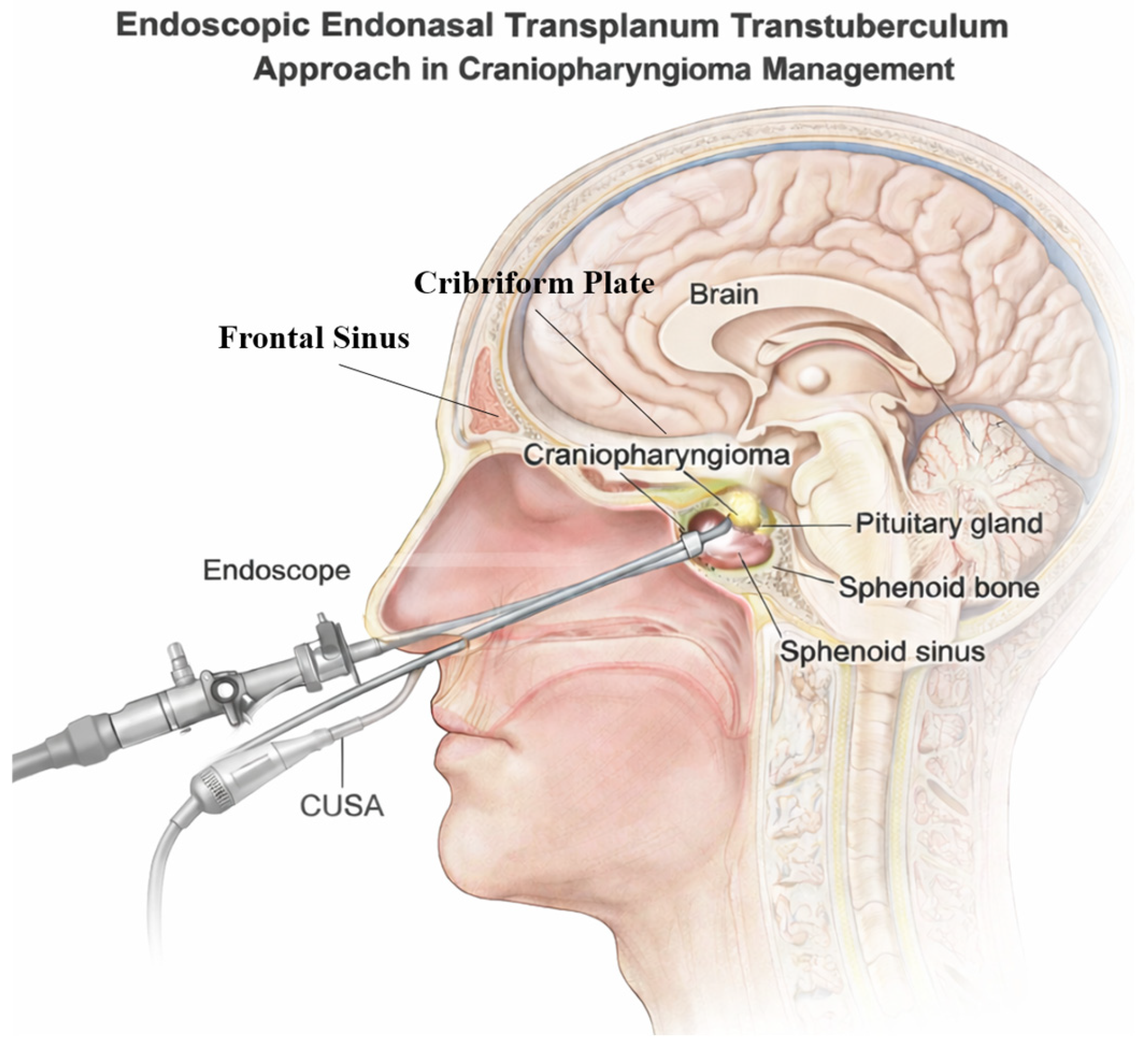
The Evolving Role of the Endoscopic Endonasal Transplanum–Transtuberculum Approach in the Management of Craniopharyngiomas: A Systematic Review of Outcomes, Reconstruction, and Surgical Evolution
 , and
, and
Abstract
1. Introduction
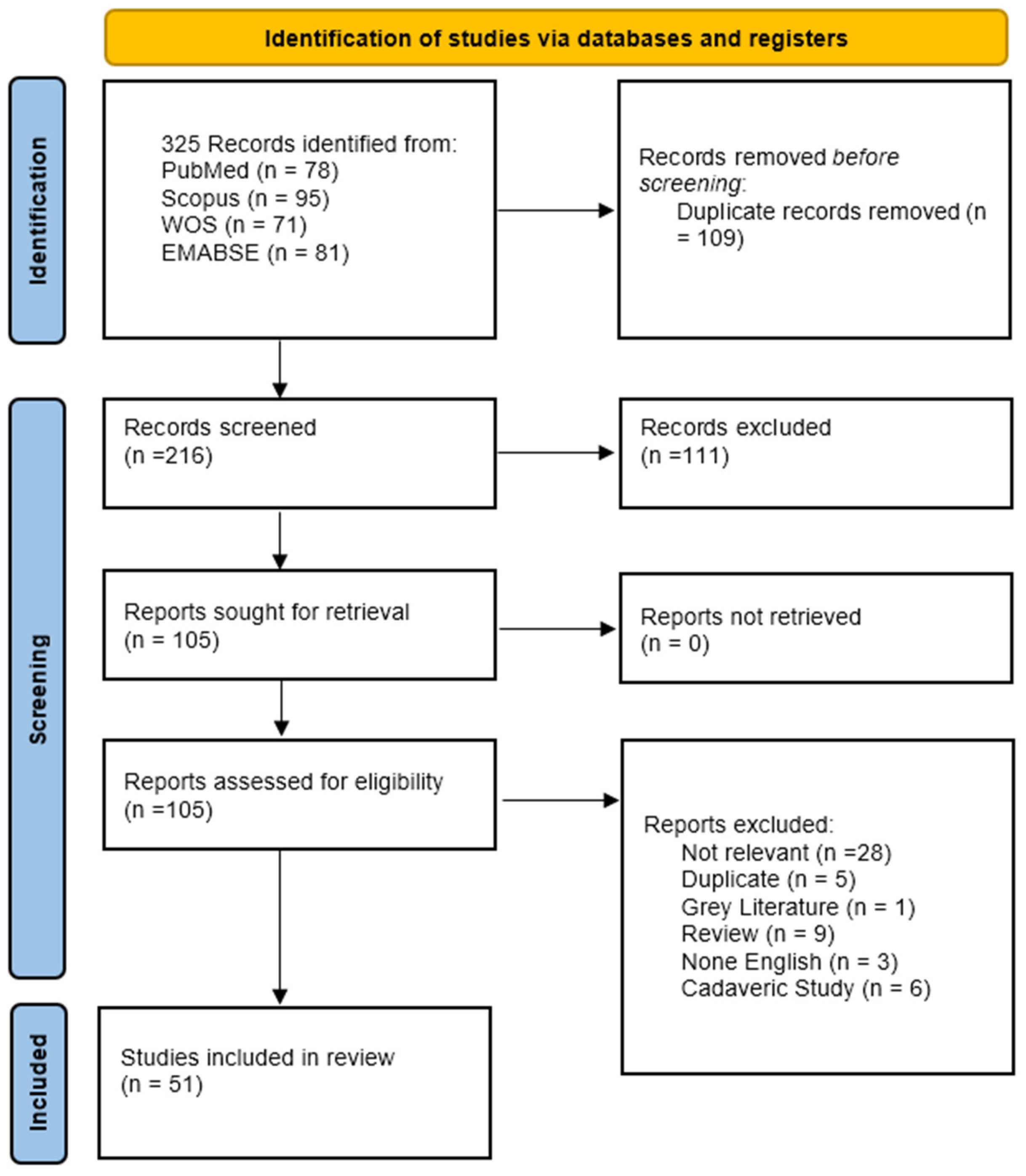
2. Methods
2.1. Search Strategy
2.2. Eligibility Criteria
2.3. Study Selection and Data Extraction
2.4. Risk of Bias Assessment
2.5. Grading of Evidence and Levels of Recommendations
2.6. Statistical Analysis
3. Results
3.1. Baseline Characteristics of Included Studies and Patients
3.2. Quality, Risk of Bias, and Level of Evidence Assessment
3.3. Clinical Presentation, Tumor Location, and Dimensions
3.4. Extent of Resection
3.5. Visual and Endocrine Outcomes
3.6. Cerebrospinal Fluid (CSF) Leak Outcomes
3.7. Follow-Up and Recurrence Analysis
4. Discussion
5. Conclusions
Supplementary Materials
Author Contributions
Funding
Institutional Review Board Statement
Informed Consent Statement
Data Availability Statement
Conflicts of Interest
References
- Müller, H.L.; Merchant, T.E.; Warmuth-Metz, M.; Martinez-Barbera, J.P.; Puget, S. Craniopharyngioma. Nat. Rev. Dis. Primers 2019, 5, 75. [Google Scholar] [CrossRef]
- Losa, M.; Vimercati, A.; Acerno, S.; Barzaghi, R.L.; Mortini, P.; Mangili, F.; Terreni, M.R.; Santambrogio, G.; Giovanelli, M. Correlation between clinical characteristics and proliferative activity in patients with craniopharyngioma. J. Neurol. Neurosurg. Psychiatry 2004, 75, 889–892. [Google Scholar] [CrossRef] [PubMed][Green Version]
- Ren, Q.; Fu, J.; Wu, B.; Xie, S.; Tang, B.; Hong, T.; Wu, J. Finger-like protrusions in adamantinomatous craniopharyngiomas: Implications for recurrence and prognosis following complete tumor resection and predictive factors. Neurosurg. Rev. 2025, 48, 242. [Google Scholar] [CrossRef] [PubMed]
- Gerganov, V.; Metwali, H.; Samii, A.; Fahlbusch, R.; Samii, M. Microsurgical resection of extensive craniopharyngiomas using a frontolateral approach: Operative technique and outcome. J. Neurosurg. 2014, 120, 559–570. [Google Scholar] [CrossRef] [PubMed]
- Weil, A.G.; Robert, T.; Alsaiari, S.; Obaid, S.; Bojanowski, M.W. Using the trans-lamina terminalis route via a pterional approach to resect a retrochiasmatic craniopharyngioma involving the third ventricle. Neurosurg. Focus 2016, 40, FocusVid 15440. [Google Scholar] [CrossRef]
- Kunihiro, N.; Goto, T.; Ishibashi, K.; Ohata, K. Surgical outcomes of the minimum anterior and posterior combined transpetrosal approach for resection of retrochiasmatic craniopharyngiomas with complicated conditions. J. Neurosurg. 2014, 120, 1–11. [Google Scholar] [CrossRef]
- Morisako, H.; Goto, T.; Goto, H.; Bohoun, C.A.; Tamrakar, S.; Ohata, K. Aggressive surgery based on an anatomical subclassification of craniopharyngiomas. Neurosurg. Focus 2016, 41, E10. [Google Scholar] [CrossRef]
- Oostra, A.; van Furth, W.; Georgalas, C. Extended endoscopic endonasal skull base surgery: From the sella to the anterior and posterior cranial fossa. ANZ J. Surg. 2012, 82, 122–130. [Google Scholar] [CrossRef]
- Komotar, R.J.; Starke, R.M.; Raper, D.M.; Anand, V.K.; Schwartz, T.H. Endoscopic endonasal compared with microscopic transsphenoidal and open transcranial resection of craniopharyngiomas. World Neurosurg. 2012, 77, 329–341. [Google Scholar] [CrossRef]
- Hadad, G.; Bassagasteguy, L.; Carrau, R.L.; Mataza, J.C.; Kassam, A.; Snyderman, C.H.; Mintz, A. A novel reconstructive technique after endoscopic expanded endonasal approaches: Vascular pedicle nasoseptal flap. Laryngoscope 2006, 116, 1882–1886. [Google Scholar] [CrossRef]
- Kassam, A.B.; Gardner, P.A.; Snyderman, C.H.; Carrau, R.L.; Mintz, A.H.; Prevedello, D.M. Expanded endonasal approach, a fully endoscopic transnasal approach for the resection of midline suprasellar craniopharyngiomas: A new classification based on the infundibulum. J. Neurosurg. 2008, 108, 715–728. [Google Scholar] [CrossRef] [PubMed]
- de Divitiis, E.; Cappabianca, P.; Cavallo, L.M.; Esposito, F.; de Divitiis, O.; Messina, A. Extended endoscopic transsphenoidal approach for extrasellar craniopharyngiomas. Neurosurgery 2007, 61, 219–228. [Google Scholar] [CrossRef] [PubMed]
- Koutourousiou, M.; Fernandez-Miranda, J.C.; Wang, E.W.; Snyderman, C.H.; Gardner, P.A. The limits of transsellar/transtuberculum surgery for craniopharyngioma. J. Neurosurg. Sci. 2018, 62, 301–309. [Google Scholar] [CrossRef] [PubMed]
- Chakrabarti, I.; Amar, A.P.; Couldwell, W.; Weiss, M.H. Longterm neurological, visual, and endocrine outcomes following transnasal resection of craniopharyngioma. J. Neurosurg. 2005, 102, 650–657. [Google Scholar] [CrossRef]
- Conger, A.R.; Lucas, J.; Zada, G.; Schwartz, T.H.; Cohen-Gadol, A.A. Endoscopic extended transsphenoidal resection of craniopharyngiomas: Nuances of neurosurgical technique. Neurosurg. Focus 2014, 37, E10. [Google Scholar] [CrossRef]
- Elliott, R.E.; Jane, J.A., Jr.; Wisoff, J.H. Surgical management of craniopharyngiomas in children: Meta-analysis and comparison of transcranial and transsphenoidal approaches. Neurosurgery 2011, 69, 630–643; discussion 643. [Google Scholar] [CrossRef]
- Cai, K.; Zhu, H.; Qiao, N.; Liu, F.; Song, Y.; Liu, X.; Wu, W.; Liu, C.; Cao, L.; Li, C.; et al. Endoscopic endonasal approach for craniopharyngioma resection in 604 cases: Tumor classification, treatment strategies, and surgical outcomes. J. Neurosurg. 2025, 144, 901–914. [Google Scholar] [CrossRef]
- Page, M.J.; McKenzie, J.E.; Bossuyt, P.M.; Boutron, I.; Hoffmann, T.C.; Mulrow, C.D.; Shamseer, L.; Tetzlaff, J.M.; Akl, E.A.; Brennan, S.E.; et al. The PRISMA 2020 statement: An updated guideline for reporting systematic reviews. PLoS Med. 2021, 18, e1003583. [Google Scholar] [CrossRef]
- Higgins, J.P.T.; Thomas, J.; Chandler, J.; Cumpston, M.; Li, T.; Page, M.J.; Welch, V.; Flemyng, E. Cochrane Handbook for Systematic Reviews of Interventions; John Wiley & Sons: Hoboken, NJ, USA, 2020; Available online: https://www.cochrane.org/authors/handbooks-and-manuals/handbook (accessed on 27 February 2026).
- Barker, T.H.; Stone, J.C.; Sears, K.; Klugar, M.; Tufanaru, C.; Leonardi-Bee, J.; Aromataris, E.; Munn, Z. The revised JBI critical appraisal tool for the assessment of risk of bias for randomized controlled trials. JBI Evid. Synth. 2023, 21, 494–506. [Google Scholar] [CrossRef]
- National Heart, Lung and Blood Institute. Study Quality Assessment Tools. 2019. Available online: https://www.nhlbi.nih.gov/health-topics/study-quality-assessment-tools (accessed on 27 February 2026).
- American Association of Neurological Surgeons; Congress of Neurological Surgeons; Joint Guidelines Review Committee. Guideline Development Methodology: CNS. 2012. Available online: https://www.cns.org/guidelines/guideline-development-methodology (accessed on 27 February 2026).
- Frank, G.; Pasquini, E.; Doglietto, F.; Mazzatenta, D.; Sciarretta, V.; Farneti, G.; Calbucci, F. The endoscopic extended transsphenoidal approach for craniopharyngiomas. Neurosurgery 2006, 59, ONS75–ONS83. [Google Scholar] [CrossRef]
- de Divitiis, E.; Cavallo, L.M.; Cappabianca, P.; Esposito, F. Extended endoscopic endonasal transsphenoidal approach for the removal of suprasellar tumors: Part 2. Neurosurgery 2007, 60, 46–59. [Google Scholar] [CrossRef] [PubMed]
- Laufer, I.; Anand, V.K.; Schwartz, T.H. Endoscopic, endonasal extended transsphenoidal, transplanum transtuberculum approach for resection of suprasellar lesions. J. Neurosurg. 2007, 106, 400–406. [Google Scholar] [CrossRef] [PubMed]
- Cavallo, L.M.; Prevedello, D.M.; Solari, D.; Gardner, P.A.; Esposito, F.; Snyderman, C.H.; Carrau, R.L.; Kassam, A.B.; Cappabianca, P. Extended endoscopic endonasal transsphenoidal approach for residual or recurrent craniopharyngiomas. J. Neurosurg. 2009, 111, 578–589. [Google Scholar] [CrossRef] [PubMed]
- Ceylan, S.; Koc, K.; Anik, I. Extended endoscopic approaches for midline skull-base lesions. Neurosurg. Rev. 2009, 32, 309–319. [Google Scholar] [CrossRef]
- Saeki, N.; Horiguchi, K.; Murai, H.; Hasegawa, Y.; Hanazawa, T.; Okamoto, Y. Endoscopic endonasal pituitary and skull base surgery. Neurol. Med.-Chir. 2010, 50, 756–764. [Google Scholar] [CrossRef]
- Kalinin, P.; Fomichev, D.; Kutin, M.; Kadashev, B. The endoscopic extended trassphenoidal approach for suprasellar craniopharyngiomas, EANS 2011 Abstracts. Acta Neurochir. 2011, 153, 1833–1905. [Google Scholar] [CrossRef]
- Ferroli, P.; Castiglione, M.; Maccari, A.; Broggi, M.; Acerbi, F.; Tringali, G.; Broggi, G. “Four Hands-Four Eyes” Extended Endoscopic Transsphenoidal Approach versus Interhemispheric Frontobasal Craniotomy for the Treatment of Midline Suprasellar Craniopharyngiomas. J. Neurol. Surg. Part B Skull Base 2012, 73, A200. [Google Scholar] [CrossRef]
- Kenning, T.J.; BeahM, D.D.D.; Farrell, C.T.J.; Schaberg, M.R.; Rosen, M.R.; Evans, J.J. Endoscopic endonasal craniopharyngioma resection. Neurosurg. Focus 2012, 32, E5. [Google Scholar] [CrossRef]
- Liu, J.K.; Eloy, J.A. Endoscopic endonasal transplanum transtuberculum approach for resection of retrochiasmatic craniopharyngioma. Neurosurg. Focus 2012, 32, E2. [Google Scholar] [CrossRef]
- de Lara, D.; Ditzel Filho, L.F.; Muto, J.; Otto, B.A.; Carrau, R.L.; Prevedello, D.M. Surgical management of craniopharyngioma with third ventricle involvement. Neurosurg. Focus 2013, 34, Video 5. [Google Scholar] [CrossRef]
- Iacoangeli, M.; Rienzo, A.D.; Colasanti, R.; Scarpelli, M.; Gladi, M.; Alvaro, L.; Nocchi, N.; Scerrati, M. A rare case of chordoma and craniopharyngioma treated by an endoscopic endonasal, transtubercular transclival approach. Turk. Neurosurg. 2014, 24, 86–89. [Google Scholar] [CrossRef] [PubMed]
- Ceylan, S.; Anik, I.; Koc, K.; Cabuk, B. Extended endoscopic transsphenoidal approach infrachiasmatic corridor. Neurosurg. Rev. 2015, 38, 137–147. [Google Scholar] [CrossRef] [PubMed]
- Sankhla, S.K.; Jayashankar, N.; Khan, G.M. Extended endoscopic endonasal transsphenoidal approach for retrochiasmatic craniopharyngioma: Surgical technique and results. J. Pediatr. Neurosci. 2015, 10, 308–316. [Google Scholar] [CrossRef] [PubMed]
- Fomichev, D.; Kalinin, P.; Kutin, M.; Sharipov, O. Extended Transsphenoidal Endoscopic Endonasal Surgery of Suprasellar Craniopharyngiomas. World Neurosurg. 2016, 94, 181–187. [Google Scholar] [CrossRef]
- Javadpour, M.; Giva, S.; Costigan, C.; Caird, J.; Crimmins, D.; Capra, M.; Pears, J.; Owens, C.; Brosnahan, D.; O’Sullivan, C.; et al. Cr-22 Early Outcomes of Endoscopic Extended Transsphenoidal Surgery for Craniopharyngiomas in Children. Neuro Oncol. 2016, 18, iii22–iii23. [Google Scholar] [CrossRef][Green Version]
- Nishioka, H.; Fukuhara, N.; Yamaguchi-Okada, M.; Yamada, S. Endoscopic Endonasal Surgery for Purely Intrathird Ventricle Craniopharyngioma. World Neurosurg. 2016, 91, 266–271. [Google Scholar] [CrossRef]
- Wannemuehler, T.J.; Rubel, K.E.; Hendricks, B.K.; Ting, J.Y.; Payner, T.D.; Shah, M.V.; Cohen-Gadol, A.A. Outcomes in transcranial microsurgery versus extended endoscopic endonasal approach for primary resection of adult craniopharyngiomas. Neurosurg. Focus 2016, 41, E6. [Google Scholar] [CrossRef]
- Alalade, A.F.; Ogando-Rivas, E.; Boatey, J.; Souweidane, M.M.; Anand, V.K.; Greenfield, J.P.; Schwartz, T.H. Suprasellar and recurrent pediatric craniopharyngiomas: Expanding indications for the extended endoscopic transsphenoidal approach. J. Neurosurg. Pediatr. 2018, 21, 72–80. [Google Scholar] [CrossRef]
- Almeida, J.P.; Suppiah, S.; Karekezi, C.; Marigil-Sanchez, M.; Wong, J.S.; Vescan, A.; Gentili, F.; Zadeh, G. Extended Endoscopic Approach for Resection of Craniopharyngiomas. J. Neurol. Surg. Part B Skull Base 2018, 79, S201–S202. [Google Scholar] [CrossRef]
- Liu, J.K.; Eloy, J.A. Endoscopic Endonasal Approach for Resection of a Pediatric Craniopharyngioma: Operative Video and Technical Nuances. J. Neurol. Surg. Part B Skull Base 2018, 79, S245–S246. [Google Scholar] [CrossRef]
- Mangussi-Gomes, J.; Vellutini, E.A.; Truong, H.Q.; Pahl, F.H.; Stamm, A.C. Endoscopic Endonasal Transplanum Transtuberculum Approach for the Resection of a Large Suprasellar Craniopharyngioma. J. Neurol. Surg. Part B Skull Base 2018, 79, S249–S250. [Google Scholar] [CrossRef]
- Messerer, M.; Maduri, R.; Daniel, R.T. Extended Endoscopic Endonasal Approach for Craniopharyngioma Removal. J. Neurol. Surg. Part B Skull Base 2018, 79, S199–S200. [Google Scholar] [CrossRef] [PubMed]
- Sweeney, K.; Costigan, C.; Caird, J.; Crimmins, D.; Capra, M.; Pears, J.; Cody, D.; Javadpour, M. Outcomes of endoscopic extended transsphenoidal surgery for craniopharyngiomas in children. Proceedings of the 2017 Autumn Meeting of the Society of British Neurological Surgeons. Br. J. Neurosurg. 2017, 32, 77–117. [Google Scholar] [CrossRef]
- Todeschini, A.B.; Montaser, A.S.; Shahein, M.; Revuelta, J.M.; Otto, B.A.; Carrau, R.L.; Prevedello, D.M. Endoscopic Endonasal Approach to a Suprasellar Craniopharyngioma. J. Neurol. Surg. Part B Skull Base 2018, 79, S237–S238. [Google Scholar] [CrossRef] [PubMed]
- Gauden, A.J.; Harley, B.; Pears, C.; Wickremesekera, A.; Parker, A.; Robinson, S.; Baguley, C.; Wormald, P.J. A regional Australasian experience of extended endoscopic transsphenoidal surgery for craniopharyngioma: Progression of the mentoring model. J. Clin. Neurosci. 2019, 68, 188–193. [Google Scholar] [CrossRef]
- Wang, C.; Zhang, Y.; Wang, J.; Ni, S. Anterior Cerebral Artery Rupture During Extended Endoscopic Endonasal Transsphenoidal Approach for Severely Calcified Craniopharyngioma. World Neurosurg. 2019, 126, 537–540. [Google Scholar] [CrossRef]
- Almeida, J.P.; Vescan, A.; Gentili, F. Surgical Nuances of Endoscopic Endonasal Resection of Craniopharyngiomas: 2-Dimensional Operative Video. Oper. Neurosurg. 2020, 19, E70. [Google Scholar] [CrossRef]
- Liu, J.K.; Zhao, K.; Eloy, J.A. Combined strategy of maximal endoscopic endonasal resection and early radiation therapy for complex cystic and solid craniopharyngioma: Operative video. Neurosurg. Focus Video 2020, 2, V7. [Google Scholar] [CrossRef]
- Tosaka, M.; Yamaguchi, R.; Aihara, M.; Miyagishima, T.; Yoshimoto, Y. Surgical Strategy Using Extended Endoscopic Transsphenoidal Approach for Craniopharyngioma: Single-Center Experience. J. Neurol. Surg. Part B: Skull Base 2020, 81, P061. [Google Scholar]
- Javadpour, M.; Amoo, M.; Crimmins, D.; Caird, J.; Daly, P.; Pears, J.; Owens, C.; Capra, M.; Cody, D. Endoscopic extended transsphenoidal surgery for newly diagnosed paediatric craniopharyngiomas. Child’s Nerv. Syst. 2021, 37, 1547–1561. [Google Scholar] [CrossRef]
- Ryan, L.; Makary, C.; Rutkowski, M.; Byrd, J.K. Resection of a Recurrent Craniopharyngioma in a 4-Year-Old Patient: An Endoscopic Endonasal Transplanum/Transtuberculum Approach with Nasoseptal Flap Reconstruction. J. Neurol. Surg. Part B Skull Base 2021, 82, P053. [Google Scholar]
- Ohta, J.; Kadoi, Y.; Tosaka, M.; Saito, S. Pseudo-intestinal obstruction after transsphenoidal surgery for craniopharyngioma. J. Surg. Case Rep. 2022, 2022, rjac254. [Google Scholar] [CrossRef] [PubMed]
- Guk, M.O.; Chukov, A.A. Endonasal endoscopic surgical treatment of craniopharyngiomas in adult patients our experience. Ukr. Neurosurg. J. 2023, 29, 46–56. [Google Scholar] [CrossRef]
- Kamal, M.A.; Henshall, D.E.; Hughes, M.A. Postoperative Diabetes Insipidus Mimicking Radiological Findings and Symptoms of Intracranial Hypotension: A Case Report. Cureus 2023, 15, e40398. [Google Scholar] [CrossRef]
- Khalil, W.; Salle, L.; Bresson, D.; Salle, H. Extended endoscopic transsphenoidal approach for suprasellar craniopharyngiomas. Acta Neurochir. 2023, 165, 677–683. [Google Scholar] [CrossRef]
- Shen, M.; Shou, X.; Ma, Z.; He, W.; Chen, Z.; Wang, Y. Endoscopic Endonasal Ipsilateral Posterior Clinoidectomy for Access to a Suprasellar Infundibulo-Tuberal Craniopharyngioma with a Narrow Chiasm-Pituitary Corridor: 2-Dimensional Operative Video. Oper. Neurosurg. 2023, 24, e116–e117. [Google Scholar] [CrossRef]
- Constanzo, F.; Ljubimov, V.; Vigo, V.; Rychen, J.; Gambatesa, E.; Rinaldi, M.; Uchida, T.; Lee, M.H.; Bex, A.; Xu, Y.; et al. Endoscopic Endonasal Transplanum Approach for a Tubero-Infundibular Craniopharyngioma in a Pediatric Patient. J. Neurol. Surg. Part B Skull Base 2024, 85, V063. [Google Scholar] [CrossRef]
- Chen, Y.X.; Wan, X.C.; Pan, L.S.; Peng, H.Y.; Hong, T.; Wu, X. Endoscopic endonasal surgery for the complete removal of tuberculum sellae meningioma coexisting with craniopharyngioma: Case report and literature review. Int. J. Surg. Open 2024, 62, 356–360. [Google Scholar] [CrossRef]
- Vigo, V.; Chang, J.E.; Nunez, M.A.; Prolo, L.M.; Hwang, P.H.; Fernandez-Miranda, J.C. Endoscopic Endonasal Transtuberculum Approach for Pediatric Tuberoinfundibular Craniopharyngioma: 2-Dimensional Operative Video. Oper. Neurosurg. 2023, 25, e147–e148. [Google Scholar] [CrossRef]
- Eaton, J.; Raub, S.; Ronsley, R.; Roth, C.L.; Ermoian, R.; Friedman, S.D.; Emerson, S.N.; Ferreira, M.; Lee, A.; Bly, R.A.; et al. Endoscopic endonasal resection of a craniopharyngioma in a 23-month-old patient: Illustrative case. J. Neurosurg. Case Lessons 2024, 8, CASE24209. [Google Scholar] [CrossRef]
- Finger, G.; Ruiz, M.J.C.; Salem, E.H.; Marquardt, M.D.; Wu, K.C.; Carlstrom, L.P.; Carrau, R.L.; Prevedello, L.M.; Prevedello, D.M. The infundibulochiasmatic angle and the favorability of an endoscopic endonasal approach in type IV craniopharyngioma: Illustrative case. J. Neurosurg. Case Lessons 2024, 7, CASE23545. [Google Scholar] [CrossRef]
- Matmusayev, M.; Kariev, G.M.; Asadullaev, U.; Takeuchi, K.; Nagata, Y.; Harada, H.; Saito, R. Extended Endoscopic Endonasal Transplanum and Transdorsum Sellar Approach for the Resection of Retroinfundibular Craniopharyngioma with Two-Piece Dural Opening: A Technical Case Report. Cureus 2024, 16, e51850. [Google Scholar] [CrossRef] [PubMed]
- Moiyadi, A.V.; Pai, P.; Kakati, K. Extended endoscopic endonasal trans-tubercular approach and radical resection of a giant calcified craniopharyngioma with pituitary stalk preservation—Technical nuances and steps. J. Clin. Neurosci. 2024, 130, 110896. [Google Scholar] [CrossRef] [PubMed]
- Noiphithak, R.; Yanez-Siller, J.C. Enhancing exposure in endoscopic endonasal resection of Craniopharyngioma: Sellar floor dural incision technique. J. Clin. Neurosci. 2024, 129, 110855. [Google Scholar] [CrossRef] [PubMed]
- Bove, I.; Solari, D.; Somma, T.; Nocini, R.; Palmiero, C.; Esposito, F.; Cappabianca, P.; Cavallo, L.M. Endoscopic Endonasal Approach for Craniopharyngiomas with Intraventricular Extension: Anatomic-Clinical Considerations and Surgical Outcomes in a Series of 61 Patients. Oper. Neurosurg. 2025, 10, 1227. [Google Scholar] [CrossRef]
- Matmusaev, M.; Yamada, Y.; Tambara, M.; Mamadaliev, D.; Watanabe, T.; Jurayeva, Y.; Sasaki, K.; Kariev, G.; Tanaka, R.; Kato, Y. Extended endoscopic endonasal approach for the resection of third ventricular craniopharyngiomas: A technical case report. Surg. Neurol. Int. 2025, 16, 419. [Google Scholar] [CrossRef]
- Olson, V.A.; Miglani, A.; Nguyen, B.; Spina, S.N.; Moussalem, C.K.; Patra, D.P.; Batjer, H.H.; Bendok, B.R. Transsellar and Transplanum Endoscopic Endonasal Resection of a Sellar and Suprasellar Craniopharyngioma with Virtual Reality Modeling: 2-Dimensional Operative Video. Oper. Neurosurg. 2025, 30, 629–630. [Google Scholar] [CrossRef]
- Elshazly, K.; AbdelFatah, M.A.; Youssef, M.E.; Mostafa, H.A.; Salem, A.M.; Mashad, M.G.E.; Hefny, S. Extended endoscopic transtuberculum approach for purely supradiaphragmatic pediatric craniopharyngiomas: Outcomes from a single-center cohort study. Neurosurg. Rev. 2025, 49, 17. [Google Scholar] [CrossRef]
- de Andrade, E.J.; Jarmula, J.; Sommerfeld, C.; Woodard, T.; Kshettry, V.; Sindwani, R.; Recinos, P.F. Skull Base Reconstruction after Transtuberculum–Transplanum Endoscopic Endonasal Approaches: Surgical Results. J. Neurol. Surg. Part B: Skull Base 2023, 84, S067. [Google Scholar] [CrossRef]
- Erfurth, E.M.; Holmer, H.; Fjalldal, S.B. Mortality and morbidity in adult craniopharyngioma. Pituitary 2013, 16, 46–55. [Google Scholar] [CrossRef]
- Wijnen, M.; Olsson, D.S.; van den Heuvel-Eibrink, M.M.; Hammarstrand, C.; Janssen, J.A.M.J.L.; van der Lely, A.J.; Johannsson, G.; Neggers, S.J.C.M.M. Excess morbidity and mortality in patients with craniopharyngioma: A hospital-based retrospective cohort study. Eur. J. Endocrinol. 2018, 178, 93–102. [Google Scholar] [CrossRef]
- Pereira, A.M.; Schmid, E.M.; Schutte, P.J.; Voormolen, J.H.; Biermasz, N.R.; van Thiel, S.W.; Corssmit, E.P.; Smit, J.W.; Roelfsema, F.; Romijn, J.A. High prevalence of long-term cardiovascular, neurological and psychosocial morbidity after treatment for craniopharyngioma. Clin. Endocrinol. 2005, 62, 197–204. [Google Scholar] [CrossRef] [PubMed]
- Yaşargil, M.G.; Curcic, M.; Kis, M.; Siegenthaler, G.; Teddy, P.J.; Roth, P. Total removal of craniopharyngiomas. Approaches and long-term results in 144 patients. J. Neurosurg. 1990, 73, 3–11. [Google Scholar] [CrossRef] [PubMed]
- Mortini, P.; Gagliardi, F.; Bailo, M.; Losa, M. Surgical Approach to Craniopharyngiomas: Transcranial Routes. In Diagnosis and Management of Craniopharyngiomas; Lania, A., Spada, A., Lasio, G., Eds.; Springer: Cham, Switzerland, 2016. [Google Scholar] [CrossRef]
- Nie, C.; Ye, Y.; Wu, J.; Zhao, H.; Jiang, X.; Wang, H. Clinical Outcomes of Transcranial and Endoscopic Endonasal Surgery for Craniopharyngiomas: A Single-Institution Experience. Front. Oncol. 2022, 12, 755342. [Google Scholar] [CrossRef] [PubMed]
- Na, M.K.; Jang, B.; Choi, K.S.; Lim, T.H.; Kim, W.; Cho, Y.; Shin, H.G.; Ahn, C.; Kim, J.G.; Lee, J.; et al. Craniopharyngioma resection by endoscopic endonasal approach versus transcranial approach: A systematic review and meta-analysis of comparative studies. Front. Oncol. 2022, 12, 1058329. [Google Scholar] [CrossRef]
- Du, C.; Feng, C.Y.; Yuan, X.R.; Liu, Q.; Peng, Z.F.; Jiang, X.J.; Li, X.J.; Xiao, G.L.; Li, Y.F.; Xiong, T. Microsurgical Management of Craniopharyngiomas via a Unilateral Subfrontal Approach: A Retrospective Study of 177 Continuous Cases. World Neurosurg. 2016, 90, 454–468. [Google Scholar] [CrossRef]
- Beckhaus, J.; Friedrich, C.; Müller, H.L. Vascular Morbidity and Mortality in Craniopharyngioma Patients—A Scoping Review. Cancers 2024, 16, 1099. [Google Scholar] [CrossRef]
- Koutourousiou, M.; Gardner, P.A.; Fernandez-Miranda, J.C.; Tyler-Kabara, E.C.; Wang, E.W.; Snyderman, C.H. Endoscopic endonasal surgery for craniopharyngiomas: Surgical outcome in 64 patients. J. Neurosurg. 2013, 119, 1194–1207. [Google Scholar] [CrossRef]
- Fan, J.; Liu, Y.; Pan, J.; Peng, Y.; Peng, J.; Bao, Y.; Nie, J.; Wang, C.; Qiu, B.; Qi, S. Endoscopic endonasal versus transcranial surgery for primary resection of craniopharyngiomas based on a new QST classification system: A comparative series of 315 patients. J. Neurosurg. 2021, 135, 1298–1309. [Google Scholar] [CrossRef]
- Rafaqat, W.; Bajwa, M.H.; Angez, M.; Enam, S.A. Surgical Outcomes of Endoscopic Endonasal Versus Transcranial Resections of Adult Craniopharyngioma: A Meta-Analysis. Brain Tumor Res. Treat. 2022, 10, 226–236. [Google Scholar] [CrossRef]
- Figueredo, L.F.; Martínez, A.L.; Suarez-Meade, P.; Marenco-Hillembrand, L.; Salazar, A.F.; Pabon, D.; Guzmán, J.; Murguiondo-Perez, R.; Hallak, H.; Godo, A.; et al. Current Role of Endoscopic Endonasal Approach for Craniopharyngiomas: A 10-Year Systematic Review and Meta-Analysis Comparison with the Open Transcranial Approach. Brain Sci. 2023, 13, 842. [Google Scholar] [CrossRef]
- Sadhasivam, S.; Arora, R.K.; Singh, K.; Nair, S.N. Hypothalamic Morbidities and Endocrinological Outcomes Following Transcranial and Endoscopic Endonasal Resection of Craniopharyngiomas: A Systematic Review and Meta-Analysis. Neurol. India 2025, 73, 955–966. [Google Scholar] [CrossRef]
- Ismaiel, W.F.; Abdelazim, M.H.; Younes, A.; Alsobky, M.E.; Hasan, A.; Taha, A.M. Outcome of the endoscopic repair of frontal sinus cerebrospinal fluid leak. Ann. Med. Surg. 2021, 70, 102887. [Google Scholar] [CrossRef]
- Diaz, M.J.; Kwak, S.H.; Root, K.T.; Fadil, A.; Nguyen, A.; Ladehoff, L.; Batchu, S.; Lucke-Wold, B. Current Approaches to Craniopharyngioma Management. Front. Biosci. (Landmark Ed.) 2022, 27, 328. [Google Scholar] [CrossRef]
- Fathollahi, M.A.; Soltani Khaboushan, A.; Iranmehr, A.; Dabbagh Ohadi, M.A.; Park, D.J.; Chang, S.D. Stereotactic radiosurgery for craniopharyngioma: A systematic review and meta-analysis. Neurosurg. Rev. 2025, 49, 2. [Google Scholar] [CrossRef]
- González-Gallego, C.; Molina, P.; Hostalot, C.; Oliva, A.; Blanco, A.; Puyalto de Pablo, P.; Comas, S.; Carrato, C.; Valassi, E.; Puig-Domingo, M. Modern treatment of craniopharyngioma to improve outcomes: Evidence of a change of paradigm. Endocrine 2025, 89, 20–29. [Google Scholar] [CrossRef]
- Javidialsaadi, M.; Luy, D.D.; Smith, H.L.; Cecia, A.; Yang, S.D.; Germanwala, A.V. Advances in the Management of Craniopharyngioma: A Narrative Review of Recent Developments and Clinical Strategies. J. Clin. Med. 2025, 14, 1101. [Google Scholar] [CrossRef]


| Study ID | Year | Study | Country | Sample Size | Age | Sex | Presenting Symptoms | Location | Lesion Diameter | Quality Rating (NIH/JBI) | CNS/AANS Class |
|---|---|---|---|---|---|---|---|---|---|---|---|
| Frank et al. [23] | 2006 | Case Series | Italy | 10 | Mean 42 (11–61) | 4 Males, 6 Females | BT Hemianopi, hypopituitarism, DI | Purely supradiaphragmatic (six patients), with a significant suprasellar component (four patients) | mean diameter of 2.9 cm (range, 1–4 cm) | High Quality | Class III |
| Divitiis et al. [12] | 2007 | Case Series | Italy | 10 | Mean 57.2 | 6 Males, 4 Females | BT Hemianopi, hypopituitarism, DI | 2 intrasuprasellar, 1 suprasellar, 6 suprasellar-intraventricular, 1 purely intraventricular | Not specified | High Quality | Class III |
| Divitiis et al. [24] | 2007 | Case Series | Italy | 7 | Mean 46.4 | 4 Male, 3 Female | Suprasellar lesions. | Not specified | High Quality | Class III | |
| Laufer et al. [25] | 2007 | Case Series | USA | 4 | Mean 52.25 | Not specified | visual loss/hyperphagia, DI, hypopituatizm | Suprasellar lesions. | mean 3375 | High Quality | Class III |
| Cavallo et al. [26] | 2009 | Case Series | Italy | 22 | Mean 49.4 (18–80) | 15 Male/7 Female | BT hemianopsia, decreased VA, PHP, DI, obesity, consciousness impairment | 12 Suprasellar, 9 Intra-suprasellar, 1 Meckel cave | 1.4–4.5 cm | High Quality | Class III |
| Ceylan et al. [27] | 2009 | Case Series | Turkey | 2 | Mean 49 | 2 Females | Not specified | Prechiasmatic with intrasellar cystic components | not specified | High Quality | Class III |
| Saeki et al. [28] | 2010 | Case Report | Japan | 1 | 43 | Male | left visual field defect. | Suprasellar lesions. | 1.5 cm | High Quality | Class III |
| Kalinin et al. [29] | 2011 | Case Series | Russia | 27 | Not specified | Not specified | Not specified | Suprasellar lesions. | mean 4.2 cm | Low Quality | Class III |
| Ferroli et al. [30] | 2012 | Case Report | Italy | 1 | 40 | Male | chronic headache in case one and for headache, postural instability, visual impairment in left eye, weight increase, polydipsia, and polyuria in case two. | Midline suprasellar | not specified | Fair Quality | Class III |
| Kenning et al. [31] | 2012 | Case Report | USA | 1 | 21 | Female | progressive bitemporal hemianopsia. | Suprasellar, retrochiasmatic | Not specified | Fair Quality | Class III |
| Lui et al. [32] | 2012 | Case Report | USA | 1 | 21 | Female | bitemporal hemianopsia | Suprasellar, retrochiasmatic | Not specified | Low Quality | Class III |
| De lara et al. [33] | 2013 | Case Report | USA | 1 | 68 | Female | Visual deterioration accompanied by worsening headaches | Suprasellar region | Not specified | High Quality | Class III |
| Iacoangeli et al. [34] | 2014 | Case Report | Italy | 1 | 24 | Male | Headache, visual deficits and transient diplopia | Sellar region to clivus | Not specified | High Quality | Class III |
| Ceylan et al. [35] | 2015 | Case Series | Turkey | 16 | Mean 30.2 (14–55) | 12 Female 4 Male | Not specified | 10 preinfundibular, 2 retroinfundibular, Transinfundibular–Retroinfundibular–Preinfundibular 4 | Not specified | High Quality | Class III |
| Sankhla et al. [36] | 2015 | Case Series | India | 15 | 8–15 | 9 Female, 6 Males | Headache and diminished vision, isolated cranial nerve deficits, seizures, and altered sensorium. | Retrochiasmatic | High Quality | Class III | |
| Javadpour et al. [38] | 2016 | Retrospective Cohort | Ireland | 11 | Median 9 (5–18) | Not specified | Not specified | Not specified | Not specified | Fair Quality | Class II |
| Fomichev et al. [37] | 2016 | Retrospective Cohort | Russia | 136 | Mean 49.3 | Female (55.9%), Male (44.1%) | Vision loss (82.4%), Hypothalamic-pituitary dysfunction (54.4%), Headaches (31.6%), Mental impairment (20.6%), Obstructive hydrocephalus (11.8%) | 111 suprasellar and 25 intra-extraventricular | 4.2 cm | High Quality | Class II |
| Nishioka et al. [39] | 2016 | Case Report | Japan | 3 | Case 1: 65 case 2: 29 case 3: 5 | Case 1: Female Case 2: Female Case 3: Male | Case 1: visual disturbance, headache Case 2: Hypogonadism, visual disturbance (bitemporal hemianopsia) Case 3: headache, vomiting, and double vision | Case 1: third ventricle Case 2: third ventricle Case 3: third ventricle | Case 1: 20 mm Case 2: 30 mm Case 3: 38 mm | High Quality | Class III |
| Wannemuehler et al. [40] | 2016 | Retrospective Cohort | USA | 9 | Mean 52.4 | Female (33.3)/Male (66.7) | Headache 66.7, Visual disturbance 88.9, Hypopituitarism 33.3 | Suprasellar and retrochiasmatic extension | 4.6 | Fair Quality | Class II |
| Alalade et al. [41] | 2018 | Retrospective Cohort | USA | 11 | Mean: 7.9 | Male: 8/Female: 3 | visual impairment 6, growth retardation 5, headches 4, somnolence/lethargy 2, cognitive impairment 1, polyuria 1 | Sphenoid sinuses were conchal (n = 5), presellar (n = 4) and sellar (n = 2). | 1.3 to 41.7 cm3 | High Quality | Class II |
| Almedia et al. [42] | 2018 | Case Report | Canada | 1 | 56 | Female | Bitemporal hemianopsia and visual acuity | Suprasellar craniopharyngioma. | Not specified | High Quality | Class III |
| Liu et al. [43] | 2018 | Case Report | USA | 1 | 12 | Male | Progressive visual loss and panhypopituitarism | Retrochiasmatic in the suprasellar region with third ventricular extension | Not specified | High Quality | Class III |
| Gomes et al. [44] | 2018 | Case Report | Brazil | 1 | 72 | Male | Bitemporal visual loss, mildly elevated prolactin levels | Suprasellar craniopharyngioma | Not specified | High Quality | Class III |
| Messerer et al. [45] | 2018 | Case Report | Switzerland | 1 | 52 | Male | Biitemporal hemianopia, bilateral decreased visual acuity | Retrochiasmatic with sellar and parasellar extension | Not specified | High Quality | Class III |
| Sweeney et al. [46] | 2017 | Prospective Cohort | Ireland | 12 | Range 5–18 | Not specified | Vision loss: 10 | Not specified | Not specified | Fair Quality | Class II |
| Todeschini et al. [47] | 2017 | Case Report | United states | 1 | 57 | Male | Vision loss | Suprasellar with third ventricle extension (type II Kassam). | Not specified | High Quality | Class III |
| Gauden et al. [48] | 2019 | Retrospective Cohort | New Zealand | 9 | Mean 37.6 (14–68) | Female 3/Male 6 | Visual deficit (100%), headache (89%), Panhypopituitarism 67% | Suprasellar 56%, Sellar extension 33%, 3rd ventricle extension 22% | from 1.5 to 3.4 cm | High Quality | Class II |
| Wang et al. [49] | 2019 | Case Report | China | 1 | 38 | Female | 20 years headache; 30 days blurred vision; VF defect and ↓ visual acuity | Suprasellar CP; severely calcified, poorly developed sphenoid sinus; narrow acoma–planum distance and narrow bilateral ICA distance (high-risk anatomy) | 1.4 × 1.8 cm | High Quality | Class III |
| Almeida et al. [50] | 2019 | Case Report | Canada | 1 | 52 | Female | Progressive visual decline and headaches; no hormonal deficiencies | Sellar–suprasellar solid-cystic lesion (CP), mainly preinfundibular, anterior to chiasm; medial to PcomA | Not reported | High Quality | Class III |
| Liu et al. [51] | 2020 | Case Report | USA | 1 | 56 | Female | slight confusion, progressive headache and visual loss, increased appetite, and weight gain. | Suprasellar retrochiasmatic region | Not specified | High Quality | Class III |
| Tosaka et al. [52] | 2020 | Case Series | Japan | 19 | Mean 48 (9–68) | 9 Male, 10 Female | NR (not reported as a structured list) | Suprasellar craniopharyngioma | Mean 28.5 mm (11–45 mm) | High Quality | Class III |
| Javadpour et al. [53] | 2021 | Prospective Cohort | Ireland | 15 | Median 10 (5–18) | 9 Male, 6 Female | Visual impairment ± headache; other presentations include vomiting, weight gain, growth retardation/delayed puberty, amenorrhea, DI | Transinfundibular (9/15), preinfundibular (5/15), retroinfundibular (1/15) | Tumor diameters measured SI × W × AP on MRI; examples range 20 × 17 × 15 mm up to 67 × 64 × 51 mm | High Quality | Class II |
| Ryan et al. [54] | 2021 | Case Report | USA | 1 | 4 | Female | Worsening headaches and vision loss | Not specified | 24.3 × 25.3 × 19.5 mm (suprasellar cystic component) | High Quality | Class III |
| Ohta et al. [55] | 2022 | Case Report | Japan | 1 | 61 | Male | Progressive right-sided vision loss and left-sided visual field loss | Pituitary suprasellar cystic tumor consistent with craniopharyngioma; pituitary stalk amputated for complete tumor removal | 26 × 18 × 24 mm | High Quality | Class III |
| Guk and Chukov [56] | 2023 | Retrospective Cohort | Ukraine | 69 | Mean 46.7 (19–73) | 60.9% Female, 39.1% Male | Visual disturbances (78.3%), Hypopituitarism (58%), Diabetes insipidus (14.5%) | Supradiaphragmatic (n = 65), Infradiaphragmatic (n = 4) | Not specified as a single mean; majority were cystic-solid (73.9%) | High Quality | Class II |
| Kamal et al. [57] | 2023 | Case Report | Uk | 1 | 48 | Female | Progressive visual field loss; later orthostatic headache, polyuria, and polydipsia | Suprasellar (cystic recurrence) | Not specified | High Quality | Class III |
| Khalil et al. [58] | 2023 | Case Report | France | 1 | 68 | Male | Not specified | Supradiaphragmatic and intraventricular extension | Not specified | High Quality | Class III |
| Shen et al. [59] | 2023 | Case Report | China | 1 | 41 | Female | Not specified | Suprasellar infundibulo-tuberal | Extremely narrow CPC (<5 mm) | High Quality | Class III |
| Constanzo et al. [60] | 2024 | Case Report | USA | 1 | 2 | Male | Adrenal insufficiency, hypothyroidism, visual field/light perception abnormalities | Tubero-infundibular (Recurrent) | Not specified | High Quality | Class III |
| Chen et al. [61] | 2024 | Case Report | China | 1 | 59 | Female | Intermittent headache and decreased visual acuity | Suprasellar region (CPG) and Tuberculum sellae (MNG) | Not specified | High Quality | Class III |
| Vigo et al. [62] | 2023 | Case Report | USA | 1 | 13 | Male | Stunted growth, decreased vision, headaches, low energy | Tuberoinfundibular (suprasellar/retrochiasmatic) | Not specified | High Quality | Class III |
| Eaton et al. [63] | 2024 | Case Report | USA | 1 | 23 months | Male | Nystagmus and falls | Sellar and suprasellar | 19.3 × 42.1 mm (Volume: 8.7 cm3) | High Quality | Class III |
| Finger et al. [64] | 2024 | Case Report | USA | 1 | 66 | Male | Bitemporal hemianopsia, Erectile dysfunction, Nocturia, Lightheadedness | Suprasellar (Type IV, protruding into 3rd ventricle) | 2.9 cm | High Quality | Class III |
| Matmusayev et al. [65] | 2024 | Case Report | Japan | 1 | 56 | Male | Visual disturbances (L homonymous hemianopia), cognitive dysfunction | Suprasellar and retroinfundibular | 48 mm (max) | High Quality | Class III |
| Moiyadi et al. [66] | 2024 | Case Report | India | 1 | Young boy | Male | Polyuria, hypersomnia, lethargy, headache, vision loss | Sellar-suprasellar (extending to 3rd ventricle floor) | Large | High Quality | Class III |
| Noiphithak et al. [67] | 2024 | Case Report | Thailand | 1 | 16 | Female | Progressive vision loss (decreased VA, bitemporal hemianopsia), Secondary adrenal insufficiency, Hyperprolactinemia | Suprasellar with retrosellar extension | Not specified | High Quality | Class III |
| Bove et al. [68] | 2025 | Retrospective Cohort | Italy | 61 | Mean 51.87 | 55.7% Male, 44.3% Female | Preoperative visual impairment (85.2%), Pituitary dysfunction (50.8%), Obesity (39.3%), Bitemporal hemianopsia (36%), Visual acuity (32.8%), Panhypopituitarism (21.3%), Hypopituitarism 1 axis (14.8%), Hydrocephalus (8.2%), Panhypopituitarism + DI (8.2%), Headache (6.5%), Consciousness impairment (6.5%), Hemianopsia + Quadrantanopia (4.9%), Bilateral quadrantanopia (4.9%), Hypopituitarism 2 axis (3.3%), DI (3.3%), Unilateral quadrantanopia (3.3%), Memory disturbance (3.2%), Unilateral hemianopsia (1.6%), Amaurosis + Hemianopsia/Quadrantanopia (1.6%) | Two cases (3.3%) were purely intraventricular cps. Most of the lesions (96.7%) presented with various degree of secondary involvement: 22 (36%) involved the SI, 28 (45.9%) the Infundibulum–ventricular chamber, and 9 (14.8%) the SI- Ventricular chamber. | 60.7% > 3 cm | High Quality | Class II |
| Matmusaev et al. [69] | 2025 | Case Report | Japan | 1 | 48 | Male | Visual disturbances and weight gain | Third ventricle | 30 mm | High Quality | Class III |
| Olson et al. [70] | 2025 | Case Report | USA | 1 | 41 | Female | Amenorrhea, weight gain, progressive visual field changes, hypothyroidism, and elevated prolactin levels | Sellar and suprasellar | Large mixed solid and cystic mass | High Quality | Class III |
| Elshazly et al. [71] | 2026 | Retrospective Cohort | Egypt | 14 | Mean 11.1 (5–16) | 64.3% Male, 35.7% Female | Visual impairment (100%) and headache (71.4%) | Purely supradiaphragmatic (Anterior skull base) | Mean maximal diameter: 3.6 cm (Range: 2.7–5.1) | High Quality | Class II |
| Andrade et al. [72] | 2023 | Retrospective Cohort | USA | 166 | Median 53.36 | 47% Male, 53% Female | Not specified | Not specified | Not specified | Fair Quality | Class II |
| Category | Specific Symptom | Frequency (n) |
|---|---|---|
| Neuro-Ophthalmological | Visual Acuity Loss (VAL) | 128 |
| Visual Field Defects (VFD) | 45 | |
| Diplopia | 2 | |
| Nystagmus | 1 | |
| Endocrine and Hypothalamic | Hypopituitarism/pituitary dysfunction | 78 |
| Obesity/weight gain | 30 | |
| Diabetes insipidus (symptoms) | 6 | |
| Growth retardation | 6 | |
| Hypogonadism/ED/amenorrhea | 3 | |
| Hyperprolactinemia | 3 | |
| Adrenal insufficiency | 2 | |
| Hypothyroidism | 2 | |
| Nocturia | 1 | |
| Neurological and General | Headache | 58 |
| Cognitive impairment | 7 | |
| Hydrocephalus | 6 | |
| Somnolence/lethargy | 4 | |
| Consciousness impairment | 4 | |
| Ataxia/falls/postural instability | 2 | |
| Nausea/vomiting | 1 | |
| Lightheadedness | 1 | |
| Low energy | 1 |
| Study ID | Year | GTR/NTR Rate | Visual Outcome | Endocrine Status (New DI/Deficits) | CSF Leak Rate (n/N) | Follow-Up | Recurrence |
|---|---|---|---|---|---|---|---|
| Frank et al. [23] | 2006 | 7 GTR, 1 STR, and 2 PR | Improved significantly in six out of eight patients | Did not improve | 3 cases | Mean 37 months | No |
| Divitiis et al. [12] | 2007 | 7 GTR, 2 STR, 1 PR | Visual field and/or acuity defect improved except one patient | Did not improve | 2 patients | Not specified | Not specified |
| Divitiis et al. [24] | 2007 | 5 GTR, 2 STR | 5 improved 2 unchanged | Not specified | 1 patient | Not specified | Not specified |
| Laufer et al. [25] | 2007 | Not specified | Improved | DI and panhypopituitarism develop in approximately 70% | 1 transient leak | 8.5 | Not specified |
| Cavallo et al. [26] | 2009 | 10 GTR, 9 STR, 3 PR | Improved | Did not improve | 1 patient (13.6%) | Not specified | Not specified |
| Ceylan et al. [27] | 2009 | 2 GTR | Not specified | Not specified | 5 of 13 (38.46%) | Median: 17.76 months | Not specified |
| Saeki et al. [28] | 2010 | Not specified | Not specified | Not specified | Not specified | Not specified | Not specified |
| Kalinin et al. [29] | 2011 | 70.4% GTR, 29.6% STR | Visual improvement in 13 (48%) patients, one patient (3.7%) permanent worsening of vision | Developed in 7 (26%) cases | 3 of 27 (11%) | Not specified | Not specified |
| Ferroli et al. [30] | 2012 | GTR | Not specified | Not specified | Not specified | Not specified | Not specified |
| Kenning et al. [31] | 2012 | GTR | Not specified | Not specified | Not specified | Not specified | Not specified |
| Lui et al. [32] | 2012 | GTR | Not specified | Not specified | Not specified | Not specified | Not specified |
| De lara et al. [33] | 2013 | GTR | Visual function has fully recovered | Transient diabetes insipidus | 0% | Not specified | No recurrence |
| Iacoangeli et al. [34] | 2014 | GTR | Visual and endocrine deficits rapidly improved | Panhypopituitarism and diabetes insipidus. | 0% | 2 years | No recurrence |
| Ceylan et al. [35] | 2015 | 10 GTR | 8 patients’ visual deficit and/or visual acuity defects (7 had improvement) | 2 patients menstrual cycle disorders, 8 patients’ various endocrine disorders | 2 of 16 (12.5%) | 2–89 months | Not specified |
| Sankhla et al. [36] | 2015 | 10 GTR, 4 STR, 1 PR | 9 diminished vision, vision recovered in 77.3% | 3 patients with diabetes insipidus and 2 with panhypopituitarism | 3 of 15 (20%) | 20 months to 6 years | Not specified |
| Javadpour et al. [38] | 2016 | GTR 3, NTR 3, STR 4, Debulking 1 | Preop 9 visual deficit, postop 7 improved | Hypopituitarism and diabetes insipidus (vast majority) | 12 of 136 (8.8%) | 3 months to 4 years | No recurrence |
| Fomichev et al. [37] | 2016 | GTR (72%), | Improved (89%), decrease (11%), | New or worsening hypothalamic-pituitary dysfunction 42.6% | 2 patients | Mean follow-up 42 months | 27 patients (20%) |
| Nishioka et al. [39] | 2016 | Case 1: GTR Case 2: GTR Case 3: GTR | Case 1: improved Case 2: improved Case 3: improved | Case 1: panhypopituitarism, DI Case 2: panhypopituitarism, DI Case 3: panhypopituitarism, DI | 1 patient | Case 1: 14 months Case 2: 11 months Case 3: 30 months | Case 1: no case 2: no case 3: no |
| Wannemuehler et al. [40] | 2016 | GTR: 5 (55.5), STR: 4 (44.4) | Improved: 8 (88.9), stable: 1 (11.1) | Panhypopituitarism: 3 (33.3), permanent di: 5 (55.5) | 2 of 9 (22.2%) | Mean follow-up time in days (SD): 216 (178.9) | 1 patient |
| Alalade et al. [41] | 2018 | 5 (45%) GTR, 2 (18%) NTR, 3 (27%) STR. | Vision stable or improved 8 (73%), vision worsened: 1 | New-onset hypopituitarism 6, New thyroid dysfunction 5, growth hormone dysfunction 1, DI: 6 (54%) | 1 of 11 (9%) | More than 36 months, 4 patients was less than 36 months | Recurrence 1 patient after a mean follow-up of 43 months |
| Almedia et al. [42] | 2018 | Not specified | Not specified | Not specified | Not specified | Not specified | Not specified |
| Liu et al. [43] | 2018 | GTR | Improved | Improved | Not specified | Not specified | Not specified |
| Gomes et al. [44] | 2018 | Not specified | Visual improvement | Panhypopituitarism on long-term follow-up | Not specified | Not specified | Not specified |
| Messerer et al. [45] | 2018 | GTR | Bitemporal hemianopia regressed and the visual acuity improved. A novel left homonymous hemianopia developed secondary to optic tract manipulation. | Not specified | Not specified | Not specified | Not specified |
| Sweeney et al. [46] | 2017 | GTR: 5, STR: 5, Debulking: 1 | Improved 7 patients | Hypopituitarism and DI on follow-up | 2 of 12 (16.7%) | Not specified | 2 patients have required further surgery for tumor progression following initial STR. |
| Todeschini et al. [47] | 2017 | NTR | At 3-month follow-up, his vision was back to normal | Panhypopituitarism 2 years after radiation therapy | Not specified | 6 years | No signs of recurrence |
| Gauden et al. [48] | 2019 | GTR 89%, STR 11% | Improvement deficit 44%, No resolution 56% | New panhypopituitarism 20%, Established Postoperative DI. 67% | 1 patient | 44 months | 1patient repeat endoscopic resection followed by radiotherapy 12 months after the initial presentation, 2 patients repeat endoscopic surgery |
| Wang et al. [49] | 2019 | NTR | Improved outcome (vision) at 1 year | Transient DI + mild hypernatremia, resolved before discharge; preop endocrine normal | 0% | 1 year | No recurrence at 1-year MRI |
| Almeida et al. [50] | 2019 | NTR | Visual improvement | No preop hormonal deficits; postop new DI/deficits not reported (discharged day 5 “no complications”) | 0% | Not reported | Not reported |
| Liu et al. [51] | 2020 | NTR | Improved to 20/20 on the right and 20/25 on the left with resolution of bitemporal hemianopsia. | There was transient diabetes insipidus which resolved after a few doses of DDAVP. | 0% | 3.5 years | No |
| Tosaka et al. [52] | 2020 | GTR 81% (17/21); NTR 90% resection in 3; PR1 | Improved 11; unchanged 6; deteriorated 3 | All patients needed some endocrinological compensation (specific DI/new deficits not quantified) | 1 patient | Not reported | Reoperation for recurrence: 2; small recurrences: 4 treated with stereotactic radiotherapy |
| Javadpour et al. [53] | 2021 | GTR 4/15; NTR 5/15; STR 6/15 | VF normalized in 9/13 with preop VF defects; 1 new persistent VF defect | New anterior pituitary dysfunction 6/11; new DI 9/12 (among those without preop DI); at last follow-up 14/15 anterior panhypopituitarism and 13/15 DI | 0% | Follow-up range 8–104 months; median reported 74 months in abstract (also detailed FU stats in Results) | Progression in 2/15, both after initial STR without RT, requiring further surgery/therapy |
| Ryan et al. [54] | 2021 | GTR | Not reported | Not reported | 0% | 6 months | No recurrence at 6 months |
| Ohta et al. [55] | 2022 | GTR | Not reported | Postoperative central DI (diagnosed on day of surgery) + hypopituitarism (pituitary function lost) | 0% | Discharged post-op day 79 | Not reported |
| Guk and Chukov [56] | 2023 | GTR: 50.7%; STR: 31.9%; PR: 13% | 66.7% Improved (of those with pre-op impairment), 13% Stable, 18.5% Deteriorated | New permanent DI: 33.3%; New hypopituitarism: 26.1% | 8 of 69 (11.6%) | Dynamic catamnesis follow-up visits | High recurrence rate noted as a general challenge (specific cohort rate not specified) |
| Kamal et al. [57] | 2023 | Debulking | Improved visual fields | New central diabetes insipidus (chronic) | 0% | 3 months | Yes (this was a redo surgery for cystic recurrence) |
| Khalil et al. [58] | 2023 | GTR | Improved visual field | Pre-existing panhypopituitarism and DI; post-op DI worsened | 0% | Not specified | Not specified |
| Shen et al. [59] | 2023 | GTR | Preserved | Preserved hypothalamic functions | 0% | Not specified | Not specified |
| Constanzo et al. [60] | 2024 | GTR | Improved | Developed Diabetes Insipidus; No other hypothalamic dysfunction | Not specified | Not specified | Previous recurrence (status post-transcranial surgery) |
| Chen et al. [61] | 2024 | GTR | Recovered (Visual acuity improved postoperatively) | Pre-op decreased thyroid hormone; post-op preservation of pituitary stalk for endocrine protection | 0% | 6 months | No (No recurrence shown on 6-month MRI) |
| Vigo et al. [62] | 2023 | GTR | Excellent recovery | Stalk preserved; specific post-op deficits not listed | Not specified | Not specified | Not specified |
| Eaton et al. [63] | 2024 | GTR | No new visual deficits; improved fundoscopic exam | New panhypopituitarism with diabetes insipidus (DI) | 0% | 6 months | No evidence of recurrence |
| Finger et al. [64] | 2024 | NTR | Improved | Persistent DI and central hypothyroidism | Not specified | 2 months | Not specified |
| Matmusayev et al. [65] | 2024 | GTR | Improved immediately | Anterior function preserved; Mild post-op DI | 0% | 19 months | No |
| Moiyadi et al. [66] | 2024 | GTR | Improved | Pre-op panhypopituitarism; post-op transient DI and persistent deficits | 0% | 4 years | No |
| Noiphithak et al. [67] | 2024 | GTR | Fully resolved (at 1 month) | Transient DI; All preoperative deficits resolved at 1 month | Not specified | 1 month | Not specified |
| Bove et al. [68] | 2025 | GTR: 65.6%; NTR: 13.1% | 76.9% improved, 19.2% stable, 3.9% worsened | New DI: 74.1%; New hypopituitarism: 86.7% | 6 of 61 (9.8%) | Mean 79.13 months | 6.5% (4/61) |
| Matmusaev et al. [69] | 2025 | GTR | Significant improvement in visual disturbances following surgery (visus: OD-1.0; OS-1.0) | Managed with hormone replacement therapy; preoperative hypopituitarism with DI | 0% | 15 months | No |
| Olson et al. [70] | 2025 | GTR | Stable vision at one-year postoperatively | Postoperative diabetes insipidus managed with DDAVP | Not specified | 12 months | No |
| Elshazly et al. [71] | 2026 | GTR: 35.7% (n = 5); NTR: 35.7% (n = 5) | 57.1% improved; 28.6% stable; 14.3% worsened | New DI: 85.7% (n = 12); New anterior deficits: 35.7% (n = 5) | 1 of 14 (7.1%) | 28.3 months (Range: 12–45) | No |
| Andrade et al. [72] | 2023 | Not specified | Not specified | Not specified | 6.6% | Not specified | Not specified |
Disclaimer/Publisher’s Note: The statements, opinions and data contained in all publications are solely those of the individual author(s) and contributor(s) and not of MDPI and/or the editor(s). MDPI and/or the editor(s) disclaim responsibility for any injury to people or property resulting from any ideas, methods, instructions or products referred to in the content. |
© 2026 by the authors. Licensee MDPI, Basel, Switzerland. This article is an open access article distributed under the terms and conditions of the Creative Commons Attribution (CC BY) license.
Share and Cite
Alomari, O.; Yazıcı, A.O.; Zorlu, T.G.; Ateş, A.; Çelik, C.; Güney, B.; Bozkurt, G. The Evolving Role of the Endoscopic Endonasal Transplanum–Transtuberculum Approach in the Management of Craniopharyngiomas: A Systematic Review of Outcomes, Reconstruction, and Surgical Evolution. J. Clin. Med. 2026, 15, 3072. https://doi.org/10.3390/jcm15083072
Alomari O, Yazıcı AO, Zorlu TG, Ateş A, Çelik C, Güney B, Bozkurt G. The Evolving Role of the Endoscopic Endonasal Transplanum–Transtuberculum Approach in the Management of Craniopharyngiomas: A Systematic Review of Outcomes, Reconstruction, and Surgical Evolution. Journal of Clinical Medicine. 2026; 15(8):3072. https://doi.org/10.3390/jcm15083072
Chicago/Turabian StyleAlomari, Omar, Ali Ozan Yazıcı, Tuğçe Gültepe Zorlu, Aylin Ateş, Cem Çelik, Beyzanur Güney, and Gulpembe Bozkurt. 2026. "The Evolving Role of the Endoscopic Endonasal Transplanum–Transtuberculum Approach in the Management of Craniopharyngiomas: A Systematic Review of Outcomes, Reconstruction, and Surgical Evolution" Journal of Clinical Medicine 15, no. 8: 3072. https://doi.org/10.3390/jcm15083072
APA StyleAlomari, O., Yazıcı, A. O., Zorlu, T. G., Ateş, A., Çelik, C., Güney, B., & Bozkurt, G. (2026). The Evolving Role of the Endoscopic Endonasal Transplanum–Transtuberculum Approach in the Management of Craniopharyngiomas: A Systematic Review of Outcomes, Reconstruction, and Surgical Evolution. Journal of Clinical Medicine, 15(8), 3072. https://doi.org/10.3390/jcm15083072