1. Introduction
Postoperative adhesions are a significant problem and develop in most patients (55% to 93%) after abdominal or pelvic surgery, often resulting in significant morbidity and complications, such as ileus, subfertility, chronic pelvic pain and small bowel obstruction, which can considerably increase healthcare costs [
1,
2,
3,
4,
5,
6,
7]. Adhesion-related reoperations are often more difficult and can lead to additional complications [
8], such as increased surgical time, incidence of organ injury and inadvertent enterotomy during reoperations [
9].
Good surgical techniques, including a minimally invasive approach, may reduce adhesions and minimize the abovementioned complications. The use of additional methods or agents (solid patches or films, liquids, or gels) is at present indicated according to specific or increased procedural or patient risk [
10]. These agents are placed inside the abdominal cavity, especially in the pelvic cavity, during or before completing the surgery, physically preventing unintended contact of traumatized tissues with viscera or peritoneum, as well as reducing the extent and severity of off-site adhesions during the 3- to 5-day period of peritoneal re-mesothelialization [
1].
4% Icodextrin Adhesion Reduction Solution (ADEPT
TM Baxter Health Care Corporation, Deerfield, IL, USA) is intended as an intraperitoneal instillate for reducing adhesions following gynecological laparoscopic surgeries in the abdominal pelvic cavity in adults. It is similar in structure to physiologically occurring carbohydrates and is a substrate for amylase, which, although not present in the peritoneal cavity, is present in abundance in the systemic circulation. Icodextrin achieves its function through a physical effect by maintaining a fluid reservoir and thus providing a temporary separation of peritoneal and serosal surfaces by hydroflotation. When administered intraperitoneally as a 1 L 4% solution, icodextrin functions as a colloid osmotic agent, allowing for the retention of a reservoir of fluid within the peritoneal cavity for 3–4 days. This minimizes tissue apposition during the critical period of fibrin formation and mesothelial regeneration following surgery, thereby providing a barrier to adhesion formation, by hydroflotation and dilution of potential adhesion-promoting molecules [
11].
The rationale for the current study is to provide additional clinical evidence supporting the safety and performance of 4% icodextrin as an adjunct to good surgical technique for the reduction in post-surgical adhesions in patients undergoing gynecological laparoscopic surgery. To this end, an analysis was conducted on the medical records of patients who had been administered this prophylactic agent following a gynecological procedure.
This is the first study ever reported evaluating the clinical readmission and reoperation rate after application of a specified adhesion prophylactic agent. Therefore, this study is important, as it describes the clinical outcomes and benefits of a specific medical product in reducing adhesion formation.
2. Materials and Methods
This study was a single-arm, retrospective study conducted at two centers specialized in minimally invasive surgery (Texas Fertility Center, Austin, TX, USA, and the University Hospital for Gynecology, Pius-Hospital, Oldenburg, Germany). Patient information was obtained by reviewing medical records and patient questionnaires: the last step aimed to supplement the medical records if information relevant to the study could be missing. Data were collected from adult female patient charts (≥18 years of age at the time of surgery) who had undergone an index laparoscopic gynecologic surgery at least 2 years prior to the start of the study and in whom 4% icodextrin was used to prevent post-surgical adhesions. Patients with reported pregnancy, nursing, or a frank infection in the abdominopelvic cavity at the time of surgery were excluded from the analysis.
Patient charts were reviewed to collect data on readmissions related to adhesions [
12], which were defined as:
Directly related to adhesions (adhesiolysis, nonoperative readmissions for adhesions, and adhesiolysis operations on female reproductive tract);
Possibly related to adhesions (gynecological operations, abdominal surgery, and nonoperative readmissions);
Open or laparoscopic reoperations that could potentially be complicated by present adhesions.
If the patient chart had no record of adhesion-related readmission within approximately 2 years of the index surgery, the patient was requested to complete a questionnaire after obtaining written consent. The questionnaire was also essential if a patient chart had a record of adhesion-related readmission within approximately 2 years of the index surgery and further information or clarification was needed. The questionnaire collected information regarding readmission or reoperation that was directly or possibly related to adhesions following the index gynecologic surgical procedure at a hospital or outpatient clinic other than the study sites where the initial surgery was performed.
The study was approved by the institutional review board (IRB) and the independent ethics committee (IEC) in each country. Firstly, the ethic approval was granted by the Medical Ethics Committee of the Carl von Ossietzky University Oldenburg (approval code 2023-107, dated 22 August 2023). Secondly, approval was granted by the Western-Copernicus Group IRB (approval code 20231728, dated 28 November 2023). A waiver of informed consent was granted by the ethic boards at the participating sites for the chart review. The investigators obtained valid consent from each patient who completed the questionnaire for the prospective data collection related to this study, as required by the ethic boards at the participating centers. The study was conducted in accordance with Good Clinical Practice guidelines and the Declaration of Helsinki. Participating investigational sites were responsible for complying with applicable regional or national regulations governing the conduct of post-market surveillance (follow-up) studies. This trial was registered on ClinicalTrials.gov (NCT05811585).
The primary analysis examined the incidence of hospital readmissions within 2 years from the date of index surgery that were directly or possibly related to adhesions (primary endpoint) using the data provided in the chart review. The study included only adult female patients who had undergone laparoscopic gynecological surgery two years prior and had received 4% icodextrin instillation to reduce postoperative adhesions.
Patients were assumed event-free if no adhesion-related events were identified in the chart. Additionally, a subgroup analysis of the primary endpoint was carried out to determine the effect of prior surgeries on the incidence of reoperations or readmissions.
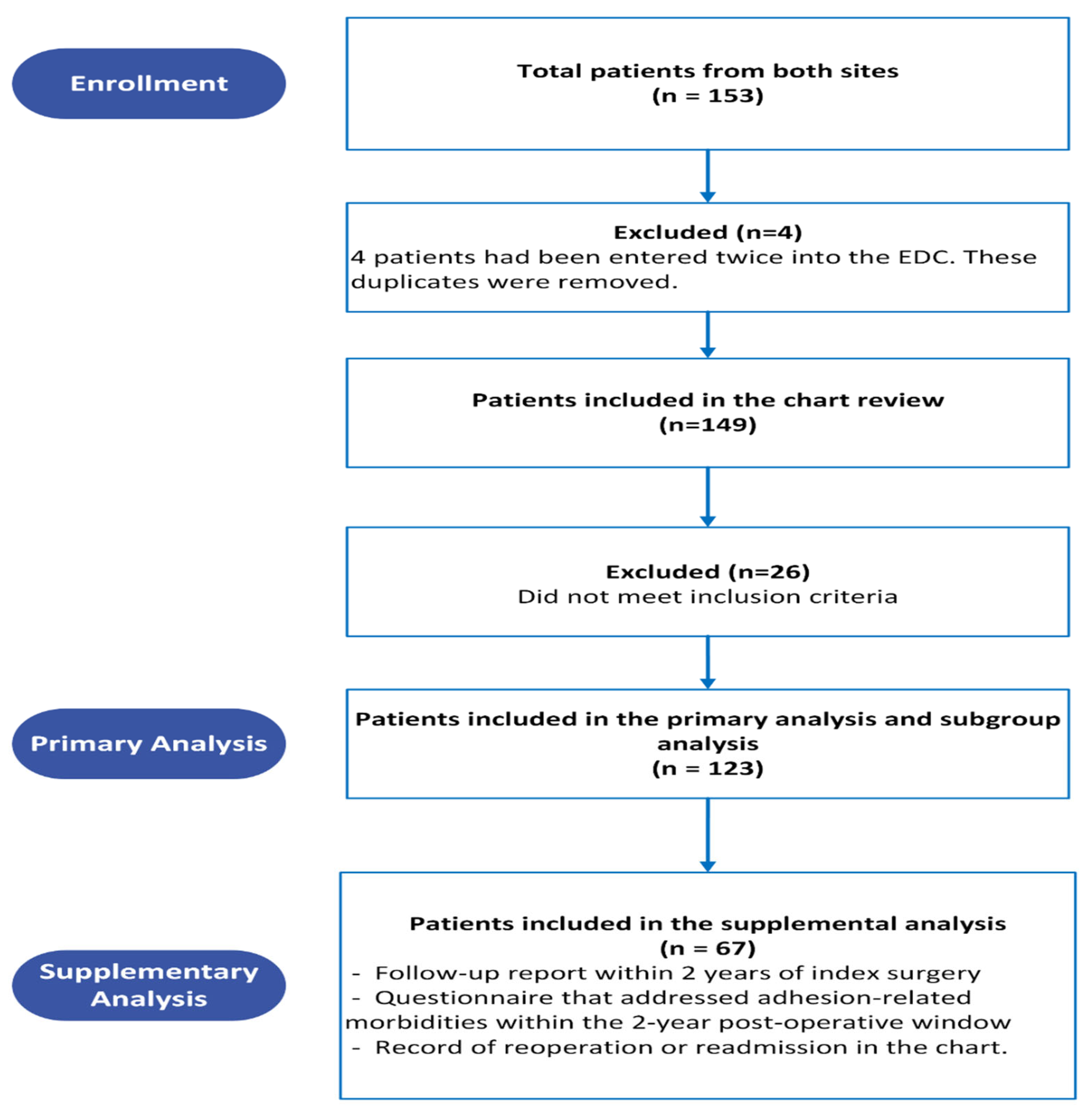
The supplemental analysis investigated the incidence using data from both the patient chart and the questionnaire. Patients were considered to have adhesion-related readmissions or reoperations if it was identified from either the chart review or patient-reported questionnaire. For the chart review portion of the supplemental analysis, patients were only included for analysis if there was evidence of 2-year follow-up in the chart. The questionnaire was intended to fill the evidence gap in cases where patients were treated for adhesion-related complications in other health systems within a 2-year window. Therefore, patients included in the supplementary analysis are those who responded to the questionnaire, who had a record of reoperation or readmission in the chart, and/or who had follow-up reported within 2 years of index surgery, as shown in the patient disposition flow chart.
The safety endpoint was assessed by collecting adverse events (AEs), serious adverse events (SAEs), and any other AEs potentially related to the device or procedure, as recorded in patient charts. The collection period was defined as the date of the index surgery to 2 years post operation.
Data were summarized using descriptive statistics for all eligible patients. Continuous variables were summarized by sample size (n), mean, standard deviation, median, minimum, and maximum. Frequency and percentages were provided for categorical variables. The exact 95% binomial confidence interval (CI; Clopper–Pearson) was provided for the incidence rate of adhesion-related events. Data from the patient questionnaire were summarized using descriptive statistics, and missing values were not imputed.
3. Results
A total of 153 charts from both study sites were screened; 149 patients were included in the chart review (
Figure 1), and 26 patients were excluded due to meeting one or more of the exclusion criteria, or because they returned invalid questionnaires.
A supplemental analysis was performed on 67 patients using data from both the chart and the questionnaire (
Table 1).
Demographics and Baseline Characteristics
As shown in
Table 2, the mean age of the 123 patients included in the primary analysis was 37.6 years (SD ± 11.50). Of these, 98 (79.7%) patients had prior abdominal/pelvic surgeries, whilst 25 (20.3%) did not have any prior abdominal/pelvic surgeries at the moment of the index surgery. The mean height (cm), weight (kg), and BMI (kg/m
2) were 166.32 (SD ± 7.212,
n = 120), 73.05 (SD ± 17.395,
n = 121), and 26.28 (SD ± 5.666,
n = 120), respectively.
Notably, of the 123 patients, there were 68 (55.3%) patients who were reported having endometriosis and 46 (37.4%) patients who were reported to have pelvic adhesions in their medical history (
Table 3).
The reported diagnosis at index procedure is shown in
Table 4. From the 123 patients included, 66 (53.7%) had a diagnosis of endometriosis, 43 (35.0%) had a diagnosis of ovarian cysts, 2 (1.6%) had a diagnosis of malignancy, 21 (17.1%) had a diagnosis of fibroids/myoma, and 110 (89.4%) were classified as “other”. Of these “other” diagnoses, 105 were adhesion-related. A total of 122 patients had procedures performed, 108 (87.8%) had lysis of adhesions, 65 (52.8%) had endometriosis surgery, 63 (51.2%) had diagnostic laparoscopy, 31 (25.2%) had ovarian cystectomy, 20 (16.3%) had myomectomy, 16 (13.0%) had ovarian resection, 1 (0.8%) had a hysterectomy, and 17 (13.8%) had procedures which were classified as “other”.
Results of study endpoints
Primary analysis
The primary analysis (
Table 5), which considered only reoperations or readmissions in the chart review, showed that 4 out of the 123 patients (3.3%) (95% CI: 0.89% to 8.12%) had at least one reoperation or readmission that was directly or possibly related to adhesion within 2 years of index surgery in their charts.
Overall, 15 reoperations or readmissions were identified in the patient charts (
Table 6), 10 of which were within the 2 years from index surgery, while 5 were more than 2 years from index surgery. For those 10 events, 2 were assessed by the investigators to be directly related to adhesions (2 patients), and 5 were possibly related to adhesions (2 patients).
Supplemental Analysis Results
A supplemental analysis was conducted using the data from both the chart review and the questionnaire. Of the 123 patients included in the primary analysis, 67 patients were included in the supplemental analysis. Of these 67 patients, 59 patients responded to the questionnaire, 4 patients did not respond to the questionnaire but had a record of reoperation or readmission in the chart, and another 4 patients did not respond to the questionnaire and had no reoperation or readmission in the chart but had documented evidence in the chart for at least 2 years of follow-up.
Of these 67 patients included in the supplemental analysis, 5 patients reported a readmission or reoperation that was directly or possibly related to adhesions within 2 years of index surgery in their questionnaire, with 2 being reported in both the chart review and questionnaire (
Table 7). For the supplemental analysis calculation, these were each counted once. Thus, 7 of 67 patients were identified as having reoperations or readmissions within 2 years that were directly or possible related to adhesions, as recorded on either patient questionnaires or in the chart review, which resulted in an incidence rate of 10.4% (95% CI 4.30% to 20.35%).
A worst case imputation sensitivity analysis was also performed, including the three reoperations/readmissions with missing data from the questionnaires for a total of 10 patients, which translates to a 14.9% (95% CI: 7.40% to 25.74%) incidence rate (
Table 8). The reasons for readmission, as indicated in the questionnaire, were endometriosis stage 4, adhesions, or pelvic pain. The events were classified as potentially related to adhesions.
Subgroup analysis of the primary endpoint, stratified by prior surgery
A total of 25 patients were reported to be surgically naïve, whilst 98 patients had reported prior surgeries. The results from the subgroup analysis showed an incidence rate of reoperations or readmissions of 4.0% (95% CI: 0.10% to 20.35%), as reported in the chart review, and 8.0% (95% CI: 0.98% to 26.03%) as reported in the chart review or questionnaire in the surgically naïve group (N = 25). For those patients who had prior surgery (N = 98), these values were 3.1% (95% CI: 0.64% to 8.69%) and 5.1% (95% CI: 1.68% to 11.51%), respectively.
An additional worst case imputation sensitivity analysis was performed including the three patients with incomplete information in the questionnaire. The incidence rates for this analysis were 8.0% (95% CI: 0.98% to 26.03%) for the surgically naïve group and 8.2% (95% CI: 3.59% to 15.45%) for the group who had prior surgery (
Table 9).
Safety Analysis
There were no adverse events related to 4% icodextrin reported in this study.
4. Discussion
This retrospective study was a single-arm, two-center review with a patient questionnaire to supplement the patient chart, with the aim to substantiate if 4% icodextrin reduces post-surgical adhesions in patients undergoing gynecological laparoscopic surgery. There were no safety concerns, nor any new safety signals identified. The data collected in this study indicate that 4% icodextrin is safe and effective as an intraperitoneal instillate in gynecological laparoscopic procedures.
The most obvious and effective strategy for adhesion prevention is to avoid surgery. If this is not an option, surgical techniques that minimize trauma and postoperative contact of injured sites should be chosen. For this purpose, careful tissue handling and minimization of electrocoagulation should be implemented, and manipulation of the peritoneum should be avoided as much as possible. Care should be taken to avoid chronic inflammatory reactions that may be caused by foreign bodies, and to support adhesion formation. Since laparoscopic approaches produce less peritoneal trauma than open surgery, adhesion formation can indeed be reduced but not prevented. Even laparoscopy introduces new problems like hypoxia of peritoneal cells, which can be induced by increased intra-abdominal pressure compressing supporting blood vessels or through laparoscopic graspers that apply far more pressure on tissues than what is actually needed to hold them, thereby causing significant tissue damage. Furthermore, the level of desiccation and abrasion and the subsequent damage to peritoneal cells can be minimized through frequent moistening of the surgical area, as well as through the gas used and by avoiding dry swabs and towels and reducing heat and light. An epidemiological study found that the overall risks of adhesion-related readmission following laparoscopic and open surgeries are comparable [
8]. Postoperative adhesions are common in almost all surgical fields and are associated with morbidity, mortality, and a significant decrease in quality of life. They can lead to intestinal obstruction, chronic abdominopelvic pain, secondary subfertility, organ dysfunction, and increased requirement of and difficulty in following surgeries, such as surgical lysing of adhesions [
9], which significantly reduces the life quality of patients. Adhesions in patients, particularly women, may warrant further surgeries, which are often more complex and can lead to additional complications [
10]. No single approach has been satisfactory in reducing adhesions [
11]. Advances in surgical techniques, such as laparoscopic surgery, can help minimize the probability of adhesion formation. No product has shown to be a substitute for good surgical technique, and the best approach to adhesion reduction may be a combination of treatments that are designed to minimize the adhesion forming process from the outset [
12], based on the inevitable peritoneal injury inflicted by any type of surgery. As a consequence, there continues to be a need for anti-adhesion barriers and agents in open and laparoscopic surgery. The ideal barrier agent should be biodegradable, laparoscopically applicable, clinically efficacious, and affordable for daily routine use.
The results from our study in patients treated with 4% icodextrin show an overall readmission rate of 3.3% within 2 years when factoring in readmissions/reoperations which were either directly or possibly related adhesion. It should be noted that the patient population was deemed to be at high risk for adhesion-related complications, with the most common index diagnosis being endometriosis and/or pelvic adhesion and the most common index procedure being adhesiolysis and endometriosis resection.
4% icodextrin is not considered a breakthrough product, as it has been well-established for more than 20 years and is the only approved hydroflotation device for reducing postoperative adhesions after gynecological laparoscopy. It acts to separate injured serosal surfaces during the period of peritoneal healing through the hydroflotation principle. Studies have also shown that 4% icodextrin solution is safe [
13,
14], well-tolerated [
15], effective [
13], and easy to use [
15] when used in laparoscopic gynecologic surgeries. However, there was still a gap in the clinical literature, which this study filled. Lower et al. (SCAR Study, 2004) [
8] reported that at 2 years, readmissions related to adhesions in medium- and high-risk laparoscopic gynecological patients without the use of any type of adhesion barrier was 2.1% (directly related) and 15.1% (possibly related). A Cochrane database review by Ahmad et al. [
16] concluded that gels and hydroflotation agents appear to be effective adhesion prevention agents for use during gynecologic surgery. Participants were less likely to have adhesions at second-look laparoscopies when they received a hydroflotation agent or a gel than when they received no treatment. There is no evidence that these agents improve fertility outcomes or pelvic pain, because these endpoints were not assessed in the study. However, the study recommends further research to confirm the success rates in this field of study [
16]. A more recent retrospective study by Krielen et al., published in 2020 [
17] using these SCAR data, has shown readmissions that are directly related to laparoscopic surgery within 2 years to be approximately 8%, and approximately 11% for cases that are possibly related. The overall readmissions and reoperations reported in the present study are lower than those reported in these data, despite this study population being predominantly high-risk considering their medical history, because of the high rate of adhesiogenic endometriosis and of pre-existing adhesions.
This study presents an original analysis of the clinical impact on hospital readmission and reoperation rates in patients undergoing high-risk gynecological laparoscopic surgery due to the use of 4% Icodextrin as an adhesion prophylactic agent. Notwithstanding, the study had limitations in that it was a retrospective analysis without a control group, whose patient population was high-risk (endometriosis or prior adhesions). The supplemental analysis may have a potentially biased population by only including those patients with identified events and confirmed 2-year follow-up after having completed the questionnaire.
5. Conclusions
A multitude of barriers are available for adhesion prevention, but given the multifactorial nature of adhesion development, there is no ideal agent to address such a complex pathophysiology that is not limited to the specific site of surgery. Adhesion barriers have demonstrated the potential to reduce the extent and severity of adhesion formation. Adhesion prevention agents, such as hydroflotation fluids that act all over the abdominal cavity, are not limited to a specific site. Reduction in de novo adhesion and adhesion formation on visceral sites and the abdominal wall has been observed in gynecologic procedures. 4% icodextrin has been used since 2006 and continues to be evaluated, investigated, and reported safe and efficacious in a variety of clinical settings, abdominopelvic operations, locations and patient populations. Clinical trial investigations have involved more than 5500 [
8,
9,
11,
12,
13,
14,
15,
18,
19,
20,
21,
22,
23,
24,
25,
26,
27] patients worldwide. The accumulated clinical information on this instilled anti-adhesion agent thoroughly demonstrates that the product is well-tolerated and appropriate for use in patients undergoing various types of laparoscopic abdominal and pelvic surgery, showing clinical benefits. 4% icodextrinis is recognized as an easy-to-use device that is widely employed in laparoscopic gynecological surgeries for adhesion reduction. Developments in adhesion reduction strategies and new agents offer a realistic possibility of reducing the risk of adhesion formation, thus improving the outcomes for patients and the associated onward burden for patients, surgeons, and healthcare systems. Available clinical data on anti-adhesion agents show encouraging results to complement good surgical practice to prevent adhesions.
This is the first study ever on readmission and reoperation rates of a specific adhesion prophylactic agent, namely icodextrin, showing, based on the international literature, better results than in patients with a comparable gynecological surgery without application of a protecting medical product. We encourage future research on adhesion barriers to address the growing need for the effective management of postoperative adhesions while looking for a preventative strategy for patients and improving outcomes.
Author Contributions
Study concept: K.S., R.L.D.W., M.S.d.W., R.D. and L.A.T.-d.l.R. Data collection: K.S., T.A. and M.S.d.W. All authors have read and agreed to the published version of the manuscript.
Funding
This research was funded by Baxter Healthcare Corporation grant number ADEPT/CDA-3889.
Institutional Review Board Statement
The study was conducted in accordance with the Declaration of Helsinki, and was approved by the institutional review board (IRB) and the independent ethics committee (IEC) at each country. Firstly, approval was granted by the Medical Ethics Committee of the Carl von Ossietzky University Oldenburg (approval code 2023-107, dated 22 August 2023). Secondly, approval was granted by the Western-Copernicus Group IRB (approval code 20231728, dated 28 November 2023).
Informed Consent Statement
Patient consent was waived due to the retrospective nature of the study.
Data Availability Statement
Data is unavailable due to privacy or ethical restrictions.
Acknowledgments
For their technical assistance, the authors would like to thank Terri Siebert, Antonio Vella, Wangfei Wang, and Jessica Svatek, all of whom are employees of Baxter Healthcare Corporation.
Conflicts of Interest
The authors hereby declare that they have no conflicts of interest regarding the completion of this study. The funders had no role in the design of the study; in the collection, analyses, or interpretation of data; in the writing of the manuscript; or in the decision to publish the results.
References
- Liu, Z.; Kou, Y.; Han, N.; Zhang, P. Electrophysiological and imaging outcomes analysis in patients with peripheral nerve injury treated with biodegradable conduit small-gap (2 mm) tubulization: A 5 year follow-up. IJCEM 2017, 10, 7774–7784. [Google Scholar]
- Monk, B.J.; Berman, M.L.; Montz, F.J. Adhesions after extensive gynecologic surgery: Clinical significance, etiology, and prevention. Am. J. Obstet. Gynecol. 1994, 170, 1396–1403. [Google Scholar] [CrossRef] [PubMed]
- Liakakos, T.; Thomakos, N.; Fine, P.M.; Dervenis, C.; Young, R.L. Peritoneal adhesions: Etiology, pathophysiology, and clinical significance. Dig. Surg. 2001, 18, 260–273. [Google Scholar] [CrossRef] [PubMed]
- Dizerega, G.S.; Campeau, J.D. Peritoneal repair and post-surgical adhesion formation. Hum. Reprod. Update 2001, 7, 547–555. [Google Scholar] [CrossRef]
- Chegini, N.; Kotseos, K.; Zhao, Y.; Bennett, B.; McLean, F.W.; Diamond, M.P.; Holmdahl, L.; Burns, J. Differential expression of TGF-beta1 and TGF-beta3 in serosal tissues of human intraperitoneal organs and peritoneal adhesions. Hum. Reprod. 2001, 16, 1291–1300. [Google Scholar] [CrossRef]
- Li, J.; Feng, X.; Liu, B.; Yu, Y.; Sun, L.; Liu, T.; Wang, Y.; Ding, J.; Chen, X. Polymer materials for prevention of postoperative adhesion. Acta Biomater. 2017, 61, 21–40. [Google Scholar] [CrossRef]
- Aref-Adib, M.; Phan, T.; Ades, A. Preventing adhesions in laparoscopic surgery: The role of anti-adhesion agents. Obstet. Gynaecol. 2019, 21, 185–192. [Google Scholar] [CrossRef]
- Lower, A.M.; Hawthorn, R.J.S.; Clark, D.; Boyd, J.H.; Finlayson, A.R.; Knight, A.D.; Crowe, A.M. Adhesion-related readmissions following gynaecological laparoscopy or laparotomy in Scotland: An epidemiological study of 24,046 patients. Hum. Reprod. 2004, 19, 1877–1885. [Google Scholar] [CrossRef]
- De Wilde, R.L.; Adlan, A.; Aquino, P.; Becker, S.; Bigozzi, M.; Catena, U.; Clark, J.; Darmawan, F.; Dubuisson, J.; Habana, M.; et al. Global recommendations on adhesion prophylaxis in gynaecological laparoscopic surgery. Facts Views Vis. ObGyn. 2024, 16, 291–293. [Google Scholar] [CrossRef]
- Poole, J.H. Adhesions following cesarean delivery: A review of their occurrence, consequences and preventative management using adhesion barriers. Women’s Health 2013, 9, 467–477. [Google Scholar] [CrossRef]
- De Wilde, R.L.; Devassy, R.; Broek, R.P.G.T.; Miller, C.E.; Adlan, A.; Aquino, P.; Becker, S.; Darmawan, F.; Gergolet, M.; Habana, M.A.E.; et al. The future of adhesion prophylaxis trials in abdominal surgery: An expert global consensus. J. Clin. Med. 2022, 11, 1476. [Google Scholar] [CrossRef] [PubMed]
- Torres-de la Roche, L.A.; Catena, U.; Clark, T.; Devassy, R.; Leyland, N.; De Wilde, R.L. Perspectives in adhesion prevention in gynaecological surgery. Facts Views Vis. Obgyn. 2023, 15, 291–296. [Google Scholar] [CrossRef] [PubMed]
- Brown, C.B.; Luciano, A.A.; Martin, D.; Peers, E.; Scrimgeour, A.; Dizerega, G.S. Adept Adhesion Reduction Study Group. Adept (icodextrin 4% solution) reduces adhesions after laparoscopic surgery for adhesiolysis: A double-blind, randomized, controlled study. Fertil. Steril. 2007, 88, 1413–1426. [Google Scholar] [CrossRef] [PubMed]
- Trew, G.; Pistofidis, G.; Pados, G.; Lower, A.; Mettler, L.; Wallwiener, D.; Korell, M.; Pouly, J.L.; Coccia, M.E.; Audebert, A.; et al. Gynaecological endoscopic evaluation of 4% icodextrin solution: A European, multicentre, double-blind, randomized study of the efficacy and safety in the reduction of de novo adhesions after laparoscopic gynaecological surgery. Hum. Reprod. 2011, 26, 2015–2027. [Google Scholar] [CrossRef]
- Sutton, C.; Minelli, L.; García, E.; Korell, M.; Pouly, J.L.; Pados, G.; Crowe, A.M.; Osborne, L.W.J.; Knight, A.D. Use of icodextrin 4% solution in the reduction of adhesion formation after gynaecological surgery. Gynecol. Surg. 2005, 2, 287–296. [Google Scholar] [CrossRef]
- Ahmad, G.; Thompson, M.; Kim, K.; Agarwal, P.; Mackie, F.L.; Dias, S.; Metwally, M.; Watson, A. Fluid and pharmacological agents for adhesion prevention after gynaecological surgery. Cochrane Database Syst. Rev. 2020, 7, Cd001298. [Google Scholar] [CrossRef]
- Krielen, P.; Stommel, M.W.J.; Pargmae, P.; Bouvy, N.D.; Bakkum, E.A.; Ellis, H.; Parker, M.C.; Griffiths, E.A.; van Goor, H.; Broek, R.P.G.T. Adhesion-related readmissions after open and laparoscopic surgery: A retrospective cohort study (SCAR update). Lancet 2020, 395, 33–41. [Google Scholar] [CrossRef]
- di Zerega, G.; Verco, S.; Young, P.; Kettel, M.; Kobak, W.; Martin, D.; Sanfilippo, J.; Peers, E.; Scrimgeour, A.; Brown, C. A randomized, controlled pilot study of the safety and efficacy of 4% icodextrin solution in the reduction of adhesions following laparoscopic gynaecological surgery. Hum. Reprod. 2002, 17, 1031–1038. [Google Scholar] [CrossRef]
- Andersen, D.; Wiseman, D.P.; Foster, D.; Appel, E.; Cardenas, J.; Zindel, J.; Maggard-Gibbons, M.M.; Broek, R.P.T.; De Wilde, R.L.; Carmichael, S.M.; et al. Proceedings of the American College of Surgeons surgical adhesions improvement project summit. J. Am. Coll. Surg. 2025, 240, 812–819. [Google Scholar] [CrossRef]
- Deus, C.; Kropf, S.; Kleinstein, J. Comparison of 2 different barrier solutions (icodextrin 4% vs. dextran 70) used as adhesion-prevention agents after microsurgical adnexal operations. J. Endometr. Pelvic Pain Disord. 2014, 6, 127–134. [Google Scholar] [CrossRef]
- Sakari, T.; Sjödahl, R.; Påhlman, L.; Karlbom, U. Role of icodextrin in the prevention of small bowel obstruction. Safety randomized patients control of the first 300 in the ADEPT trial. Color. Dis. 2016, 18, 295–300. [Google Scholar] [CrossRef]
- Catena, F.; Ansaloni, L.; Di Saverio, S.; Pinna, A.D. POPA Study: Prevention of postoperative abdominal adhesions by icodextrin 4% solution after laparotomy for adhesive small bowel obstruction. A prospective randomized controlled trial. J. Gastrointest. Surg. 2012, 16, 382–388. [Google Scholar] [CrossRef]
- Menzies, D.; Pascual, M.H.; Walz, M.; Duron, J.; Tonelli, F.; Crowe, A.; Knight, A. Use of icodextrin 4% solution in the prevention of adhesion formation following general surgery: From the multicentre ARIEL Registry. Ann. R. Coll. Surg. Engl. 2006, 88, 375–382. [Google Scholar] [CrossRef]
- Verguts, J.; Corona, R.; Timmerman, D.; Craessaerts, M.; Koninckx, P.R. Clearance Rates of Ringer’s Lactate and ADEPT and the Effect of Full Conditioning: A Randomized Controlled Trial. J. Gynecol. Surg. 2015, 31, 139–143. [Google Scholar] [CrossRef]
- Kössi, J.; Julkunen, K.; Setälä, M.; Luostarinen, M. Adhesion-related readmissions after surgery for deep endometriosis with the use of icodextrin—Long-term results. Gynecol. Surg. 2016, 13, 97–102. [Google Scholar] [CrossRef][Green Version]
- Nesbitt-Hawes, E.M.; Zhang, C.S.; Won, H.R.; Law, K.; Abbott, J.A. Urinary retention following laparoscopic gynaecological surgery with or without 4% icodextrin anti-adhesion solution. Aust. N. Zealand J. Obstet. Gynaecol. 2013, 53, 305–309. [Google Scholar] [CrossRef]
- Kraemer, B.; Wallwiener, M.; Brochhausen, C.; Planck, C.; Hierlemann, H.; Isaacson, K.B.; Rajab, T.K.; Wallwiener, C. A pilot study of laparoscopic adhesion prophylaxis after myomectomy with a copolymer designed for endoscopic application. J. Minim. Invasive Gynecol. 2010, 17, 222–227. [Google Scholar] [CrossRef] [PubMed]
| Disclaimer/Publisher’s Note: The statements, opinions and data contained in all publications are solely those of the individual author(s) and contributor(s) and not of MDPI and/or the editor(s). MDPI and/or the editor(s) disclaim responsibility for any injury to people or property resulting from any ideas, methods, instructions or products referred to in the content. |




 ,
,