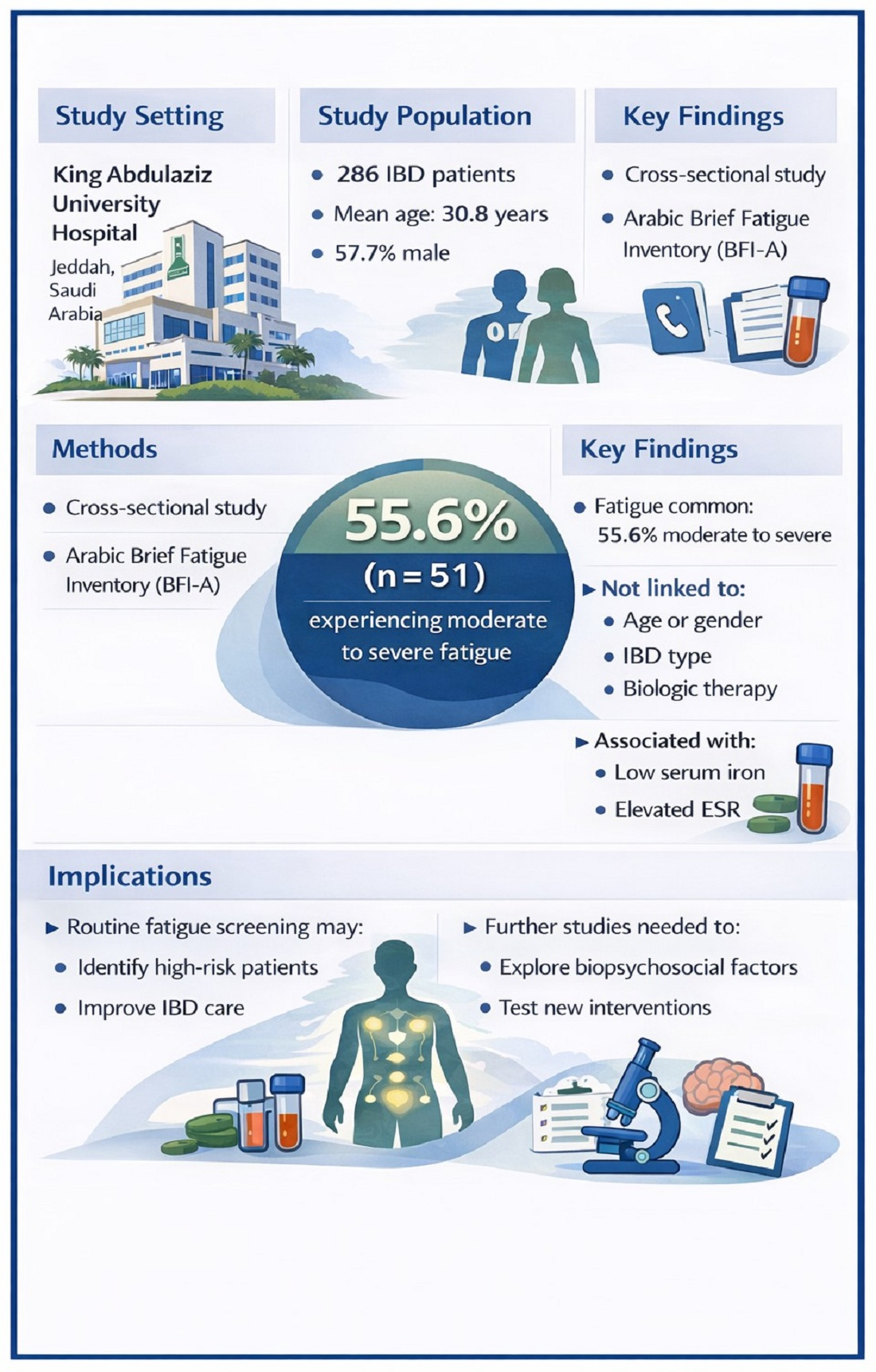
Prevalence of Fatigue Among Inflammatory Bowel Disease Patients at a Tertiary Center in Saudi Arabia

 ,
,  , , , and
Abstract
1. Introduction
2. Materials and Methods
2.1. Study Design and Setting
2.2. Participants and Data Collection
2.3. Fatigue Assessment
2.4. Statistical Analysis
2.5. Manuscript Writing
3. Results
3.1. Baseline Demographic and Clinical Characteristics
3.2. Treatment History and Laboratory Parameters
3.3. Prevalence and Severity of Fatigue
3.4. Fatigue and Demographic, Lifestyle, and Comorbidity Variables
3.5. Fatigue, Treatment Exposure, and Laboratory Markers
3.6. Fatigue and Disease Phenotype (Montreal Classification)
4. Discussion
4.1. Prevalence of Fatigue and Comparison with International Data
4.2. Demographic, Disease-Related, and Laboratory Correlates
4.3. Treatment Exposure
4.4. Psychosocial and Behavioral Contributors
4.5. Strengths and Limitations
5. Conclusions
Author Contributions
Funding
Institutional Review Board Statement
Informed Consent Statement
Data Availability Statement
Acknowledgments
Conflicts of Interest
Abbreviations
| 5-ASA | 5-aminosalicylate |
| BFI-A | Brief Fatigue Inventory–Arabic |
| BMI | body mass index |
| CBC | complete blood count |
| CD | Crohn’s disease |
| CRP | C-reactive protein |
| ESR | erythrocyte sedimentation rate |
| GI | gastrointestinal |
| HRQoL | health-related quality of life |
| IBD | inflammatory bowel disease |
| IQR | interquartile range |
| IV | intravenous |
| PO | per os (oral) |
| SD | standard deviation |
| TSH | thyroid-stimulating hormone |
| UC | ulcerative colitis |
References
- Flynn, S.; Eisenstein, S. Inflammatory bowel disease presentation and diagnosis. Surg. Clin. N. Am. 2019, 99, 1051–1062. [Google Scholar] [CrossRef]
- Mak, W.Y.; Zhao, M.; Ng, S.C.; Burisch, J. The epidemiology of inflammatory bowel disease: East meets West. J. Gastroenterol. Hepatol. 2020, 35, 380–389. [Google Scholar] [CrossRef]
- Radford, S.J.; McGing, J.; Czuber-Dochan, W.; Moran, G. Systematic review: The impact of inflammatory bowel disease-related fatigue on health-related quality of life. Frontline Gastroenterol. 2021, 12, 11–21. [Google Scholar] [CrossRef]
- van Langenberg, D.R.; Gibson, P.R. Systematic review: Fatigue in inflammatory bowel disease. Aliment. Pharmacol. Ther. 2010, 32, 131–143. [Google Scholar] [CrossRef]
- Moum, B.; Torp, R.; Henriksen, M.; Bernklev, T.; Jelsness-Jørgensen, L.P. Chronic fatigue is more prevalent in patients with inflammatory bowel disease than in healthy controls. Inflamm. Bowel Dis. 2011, 17, 1564–1572. [Google Scholar] [CrossRef]
- Minderhoud, I.M.; Oldenburg, B.; van Dam, P.S.; van Berge Henegouwen, G.P. The high prevalence of fatigue in quiescent inflammatory bowel disease is not associated with adrenocortical insufficiency. Am. J. Gastroenterol. 2003, 98, 1088–1093. [Google Scholar] [CrossRef]
- D’sIlva, A.; Fox, D.E.; Nasser, Y.; Vallance, J.K.; Quinn, R.R.; Ronksley, P.E.; Raman, M. Prevalence and risk factors for fatigue in adults with inflammatory bowel disease: A systematic review with meta-analysis. Clin. Gastroenterol. Hepatol. 2022, 20, 995–1009.e7. [Google Scholar] [CrossRef]
- Borren, N.Z.; van der Woude, C.J.; Ananthakrishnan, A.N. Fatigue in inflammatory bowel disease: Epidemiology, pathophysiology and management. Nat. Rev. Gastroenterol. Hepatol. 2019, 16, 247–259. [Google Scholar] [CrossRef]
- Schreiner, P.; Rossel, J.; Biedermann, L.; Valko, P.O.; Baumann, C.R.; Greuter, T.; Scharl, M.; Vavricka, S.R.; Pittet, V.; Juillerat, P.; et al. Fatigue in inflammatory bowel disease and its impact on daily activities. Aliment. Pharmacol. Ther. 2021, 53, 138–149. [Google Scholar] [CrossRef]
- Czuber-Dochan, W.; Ream, E.; Norton, C. Description and management of fatigue in inflammatory bowel disease. Aliment. Pharmacol. Ther. 2013, 37, 505–516. [Google Scholar] [CrossRef]
- Markowitz, A.J.; Rabow, M.W. Palliative management of fatigue at the close of life: “It feels like my body is just worn out”. JAMA 2007, 298, 217–227. [Google Scholar] [CrossRef] [PubMed]
- Nocerino, A.; Nguyen, A.; Agrawal, M.; Mone, A.; Lakhani, K.; Swaminath, A. Fatigue in inflammatory bowel diseases: Etiologies and management. Adv. Ther. 2020, 37, 97–112. [Google Scholar] [CrossRef] [PubMed]
- McGing, J.J.; Radford, S.J.; Francis, S.T.; Serres, S.; Greenhaff, P.L.; Moran, G.W. The etiology of fatigue in inflammatory bowel disease and potential therapeutic management strategies. Aliment. Pharmacol. Ther. 2021, 54, 368–387. [Google Scholar] [CrossRef]
- von Arnim, U.; Scholz, K. Fatigue in inflammatory bowel disease. Best Pract. Res. Clin. Gastroenterol. 2025, 78, 102059. [Google Scholar] [CrossRef]
- Villoria, A.; García, V.; Dosal, A.; Moreno, L.; Montserrat, A.; Figuerola, A.; Horta, D.; Calvet, X.; Ramírez-Lázaro, M.J. Fatigue in out-patients with inflammatory bowel disease: Prevalence and predictive factors. PLoS ONE 2017, 12, e0181435. [Google Scholar] [CrossRef]
- Chavarría, C.; Casanova, M.J.; Chaparro, M.; Acosta, M.B.-D.; Ezquiaga, E.; Bujanda, L.; Rivero, M.; Argüelles-Arias, F.; Martín-Arranz, M.D.; Martínez-Montiel, M.P.; et al. Prevalence and factors associated with fatigue in patients with inflammatory bowel disease: A multicentre study. J. Crohns Colitis 2019, 13, 996–1003. [Google Scholar] [CrossRef]
- Frigstad, S.O.; Høivik, M.L.; Jahnsen, J.; Cvancarova, M.; Grimstad, T.; Berset, I.P.; Huppertz-Hauss, G.; Hovde, Ø.; Bernklev, T.; Moum, B.; et al. Fatigue is not associated with vitamin D deficiency in patients with inflammatory bowel disease. World J. Gastroenterol. 2018, 24, 3293–3301. [Google Scholar] [CrossRef] [PubMed]
- Stroie, T.; Preda, C.; Meianu, C.; Istrătescu, D.; Manuc, M.; Croitoru, A.; Gheorghe, L.; Gheorghe, C.; Diculescu, M. Fatigue is associated with anxiety and lower health-related quality of life in patients with inflammatory bowel disease in remission. Medicina 2023, 59, 532. [Google Scholar] [CrossRef]
- Holten, K.I.A.; Bernklev, T.; Opheim, R.; Johansen, I.; Olsen, B.C.; Lund, C.; Strande, V.; Medhus, A.W.; Perminow, G.; Bengtson, M.-B.; et al. Fatigue in patients with newly diagnosed inflammatory bowel disease: Results from a prospective inception cohort, the IBSEN III study. J. Crohns Colitis 2023, 17, 1781–1790. [Google Scholar] [CrossRef]
- A Holten, K.; Bernklev, T.; Opheim, R.; Olsen, B.C.; Detlie, T.E.; Strande, V.; Ricanek, P.; Boyar, R.; Bengtson, M.-B.; Aabrekk, T.B.; et al. Fatigue in patients with inflammatory bowel disease in remission one year after diagnosis (the IBSEN III study). J. Crohns Colitis 2025, 19, jjae170. [Google Scholar] [CrossRef]
- Yoo, S.; Jung, Y.S.; Park, J.H.; Kim, H.J.; Cho, Y.K.; Sohn, C.I.; Jeon, W.K.; Kim, B.I.; Park, D.I. Fatigue severity and factors associated with high fatigue levels in Korean patients with inflammatory bowel disease. Gut Liver 2014, 8, 148–153. [Google Scholar] [CrossRef] [PubMed]
- Xu, F.; Hu, J.; Yang, Q.; Ji, Y.; Cheng, C.; Zhu, L.; Shen, H. Prevalence and factors associated with fatigue in patients with ulcerative colitis in China: A cross-sectional study. BMC Gastroenterol. 2022, 22, 281. [Google Scholar] [CrossRef]
- Aluzaite, K.; Al-Mandhari, R.; Osborne, H.; Ho, C.; Williams, M.; Sullivan, M.M.; Hobbs, C.E.; Schultz, M. Detailed multi-dimensional assessment of fatigue in inflammatory bowel disease. Inflamm. Intest. Dis. 2019, 3, 192–201. [Google Scholar] [CrossRef]
- Lee, H.H.; Gweon, T.G.; Kang, S.G.; Jung, S.H.; Lee, K.M.; Kang, S.B. Assessment of fatigue and associated factors in patients with inflammatory bowel disease: A questionnaire-based study. J. Clin. Med. 2023, 12, 3116. [Google Scholar] [CrossRef]
- Fresán Orellana, A.; Parra Holguín, N.N.; Yamamoto-Furusho, J.K. Mental health factors associated with fatigue in Mexican patients with inflammatory bowel disease. J. Clin. Gastroenterol. 2021, 55, 609–614. [Google Scholar] [CrossRef]
- Abdulla, M.; Mohammed, N.; AlQamish, J.; Sawaf, B. Quality of life and fatigue in inflammatory bowel disease: A systematic review. Healthcare 2025, 13, 2203. [Google Scholar] [CrossRef]
- Suleiman, K.; Al Kalaldeh, M.; AbuSharour, L.; Yates, B.; Berger, A.; Mendoza, T.; Malak, M.; Salameh, A.B.; Cleeland, C.; Menshawi, A. Validation study of the Arabic version of the Brief Fatigue Inventory (BFI-A). East. Mediterr. Health J. 2019, 25, 784–790. [Google Scholar] [CrossRef]
- Bodger, K.; Ormerod, C.; Shackcloth, D.; Harrison, M. Development and validation of a rapid, generic measure of disease control from the patient’s perspective: The IBD-Control questionnaire. Gut 2014, 63, 1092–1102. [Google Scholar] [CrossRef]
- Satsangi, J.; Silverberg, M.S.; Vermeire, S.; Colombel, J.F. The Montreal classification of inflammatory bowel disease: Controversies, consensus, and implications. Gut 2006, 55, 749–753. [Google Scholar] [CrossRef] [PubMed]
- Barnes, A.; Bryant, R.V.; Mukherjee, S.; Andrews, J.M.; Bampton, P.; Fraser, R.J.; Mountifield, R. Depression influences fatigue in inflammatory bowel disease, amongst other factors: A structural modelling approach. Ther. Adv. Gastroenterol. 2024, 17, 17562848241271987. [Google Scholar] [CrossRef]
- Mona, R.; Göldi, A.; Schneider, T.; Panne, I.; Egger, A.; Niess, J.H.; Hrúz, P. Fatigue is strongly associated with depressive symptoms in patients with inflammatory bowel disease. Inflamm. Intest. Dis. 2025, 10, 90–103. [Google Scholar] [CrossRef]
- Bernstein, C.N.; Fisk, J.D.; Dolovich, C.; Hitchon, C.A.; Graff, L.A.; El-Gabalawy, R.; Lix, L.M.; Bolton, J.M.; Patten, S.B.; Marrie, R.A. Understanding predictors of fatigue over time in persons with inflammatory bowel disease: The importance of depressive and anxiety symptoms. Am. J. Gastroenterol. 2024, 119, 922–929. [Google Scholar] [CrossRef]
- Grimstad, T.; Carlsen, A.; Kvaløy, J.T.; Bolstad, N.; Warren, D.J.; Aabakken, L.; Lundin, K.E.A.; Karlsen, L.; Steinsbø, Ø.; Omdal, R. Fatigue in inflammatory bowel disease: No effect of serum concentrations of infliximab, adalimumab or anti-drug antibodies during maintenance therapy. Scand. J. Immunol. 2025, 101, e70029. [Google Scholar] [CrossRef]
- Borren, N.Z.; Long, M.D.; Sandler, R.S.; Ananthakrishnan, A.N. Longitudinal trajectory of fatigue in patients with inflammatory bowel disease: A prospective study. Inflamm. Bowel Dis. 2020, 27, 1740–1746. [Google Scholar] [CrossRef]

| Characteristic | Overall, N = 286 |
|---|---|
| Age, years | |
| Mean (SD) | 30.8 (9.1) |
| Range | 12–66 |
| Sex, n (%) | |
| Female | 121 (42.3%) |
| Male | 165 (57.7%) |
| Anthropometrics, mean (SD) | |
| Weight, kg | 64.5 (19.8) |
| Height, cm | 163.4 (11.6) |
| BMI, kg/m2 1 | 23.8 (6.0) |
| Smoking status, n (%) | |
| Current smoker | 32 (11.2%) |
| Former smoker | 10 (3.5%) |
| Never smoker | 244 (85.3%) |
| Comorbidities, n (%) | |
| ≥1 comorbidity 2 | 40 (14.4%) |
| None 2 | 238 (85.6%) |
| Diabetes 3 | 3 (1.1%) |
| Hypertension 3 | 5 (1.9%) |
| Thyroid disorder 3 | 7 (2.6%) |
| Connective tissue disease 3 | 3 (1.1%) |
| Treatment, n (%) | |
| 5-ASA Use 1 | |
| Ever | 143 (52.8%) |
| Never | 128 (47.2%) |
| Steroid administration, n (%) 2 | |
| Intravenous (IV) | 3 (2.0%) |
| Oral (PO) | 107 (72.8%) |
| Both PO and IV | 37 (25.2%) |
| Steroid response, n (%) 3 | |
| Steroid-responsive | 132 (93.6%) |
| Steroid-dependent | 9 (6.4%) |
| Biologic therapy use, n (%) 4 | |
| Ever | 160 (62.3%) |
| Never | 97 (37.7%) |
| Laboratory values, mean (SD) | |
| Hemoglobin, g/dL 5 | 12.6 (2.2) |
| Platelet distribution width, fL 6 | 12.3 (7.7) |
| Ferritin, ng/mL 7 | 65.2 (132.8) |
| TSH, mIU/L 8 | 2.8 (3.6) |
| Erythrocyte sedimentation rate, mm/hr 9 | 21.8 (22.2) |
| C-reactive protein, mg/L 10 | 19.1 (37.8) |
| Vitamin D, nmol/L 11 | 52.0 (39.0) |
| Transferrin saturation, n (%) 12 | |
| Normal | 222 (81.9%) |
| Low | 47 (17.3%) |
| High | 2 (0.7%) |
| Characteristic | No Fatigue (n = 61) | Mild Fatigue (n = 66) | Moderate Fatigue (n = 104) | Severe Fatigue (n = 55) | p-Value |
|---|---|---|---|---|---|
| Age, years | 0.062 | ||||
| Median (IQR) | 32.0 (26.0–38.0) | 27.0 (22.2–33.0) | 29.0 (24.0–36.2) | 28.0 (25.0–36.0) | |
| Sex, n (%) | 0.780 | ||||
| Female | 28 (45.9%) | 29 (43.9%) | 40 (38.5%) | 24 (43.6%) | |
| Male | 33 (54.1%) | 37 (56.1%) | 64 (61.5%) | 31 (56.4%) | |
| BMI, kg/m2 | 0.100 | ||||
| Median (IQR) | 22.2 (18.7–25.3) | 22.9 (20.9–25.3) | 24.2 (20.2–26.7) | 24.3 (19.5–28.6) | |
| Smoking status, n (%) | 0.331 | ||||
| Current smoker | 9 (14.8%) | 3 (4.5%) | 15 (14.4%) | 5 (9.1%) | |
| Former smoker | 1 (1.6%) | 3 (4.5%) | 3 (2.9%) | 3 (5.5%) | |
| Never smoker | 51 (83.6%) | 60 (90.9%) | 86 (82.7%) | 47 (85.5%) | |
| ≥1 comorbidity, n (%) | 0.923 | ||||
| No | 51 (86.4%) | 57 (87.7%) | 85 (85.0%) | 45 (83.3%) | |
| Yes | 8 (13.6%) | 8 (12.3%) | 15 (15.0%) | 9 (16.7%) | |
| Diabetes, n (%) | 1.000 | ||||
| No | 56 (98.2%) | 63 (98.4%) | 98 (99.0%) | 50 (100.0%) | |
| Yes | 1 (1.8%) | 1 (1.6%) | 1 (1.0%) | 0 (0.0%) | |
| Hypertension, n (%) | 0.645 | ||||
| No | 57 (100.0%) | 62 (96.9%) | 97 (98.0%) | 49 (98.0%) | |
| Yes | 0 (0.0%) | 2 (3.1%) | 2 (2.0%) | 1 (2.0%) | |
| Thyroid disorder, n (%) | 0.731 | ||||
| No | 56 (98.2%) | 61 (95.3%) | 97 (98.0%) | 49 (98.0%) | |
| Yes | 1 (1.8%) | 3 (4.7%) | 2 (2.0%) | 1 (2.0%) | |
| Connective tissue disease, n (%) | 0.889 | ||||
| No | 57 (100.0%) | 63 (98.4%) | 98 (99.0%) | 49 (98.0%) | |
| Yes | 0 (0.0%) | 1 (1.6%) | 1 (1.0%) | 1 (2.0%) |
| Parameter | No Fatigue (n = 61) | Mild Fatigue (n = 66) | Moderate Fatigue (n = 104) | Severe Fatigue (n = 55) | p-Value |
|---|---|---|---|---|---|
| 5-ASA use | 0.455 | ||||
| Ever | 36 (61.0%) | 34 (54.0%) | 48 (48.0%) | 25 (51.0%) | |
| Never | 23 (39.0%) | 29 (46.0%) | 52 (52.0%) | 24 (49.0%) | |
| Steroid administration | 0.326 | ||||
| IV | 2 (6.1%) | 1 (3.4%) | 0 (0.0%) | 0 (0.0%) | |
| PO | 24 (72.7%) | 18 (62.1%) | 41 (78.8%) | 24 (72.7%) | |
| PO, IV | 7 (21.2%) | 10 (34.5%) | 11 (21.2%) | 9 (27.3%) | |
| Steroid response | 0.854 | ||||
| Steroid-dependent | 3 (9.1%) | 2 (6.9%) | 2 (4.3%) | 2 (6.2%) | |
| Steroid-responsive | 30 (90.9%) | 27 (93.1%) | 45 (95.7%) | 30 (93.8%) | |
| Biologic therapy use | 0.163 | ||||
| Ever | 16 (50%) | 70 (70%) | 59 (59%) | 32 (58.2%) | |
| Never | 16 (50%) | 30 (30%) | 41 (41%) | 21 (41.8%) | |
| Hemoglobin, g/dL | 0.545 | ||||
| Median (IQR) | 13.0 (11.2–14.1) | 12.4 (11.1–14.2) | 13.1 (11.0–14.5) | 12.3 (11.3–13.7) | |
| PDW, fL | 0.116 | ||||
| Median (IQR) | 11.4 (10.5–13.4) | 11.4 (9.9–13.1) | 11.8 (10.6–13.6) | 10.9 (9.7–12.2) | |
| Ferritin, ng/mL | 0.857 | ||||
| Median (IQR) | 36.9 (11.4–68.5) | 33.9 (8.1–89.8) | 27.5 (10.4–68.2) | 26.5 (8.6–54.9) | |
| Serum Iron, µg/dL | 0.011 | ||||
| Median (IQR) | 4.2 (2.3–6.4) | 4.4 (2.4–10.8) | 7.0 (4.0–13.6) | 8.1 (4.4–11.7) | |
| TSH, mIU/L | 0.439 | ||||
| Median (IQR) | 1.5 (1.2–2.5) | 2.2 (1.4–3.5) | 2.1 (1.5–3.4) | 2.2 (1.4–3.8) | |
| ESR, mm/hr | 0.023 | ||||
| Median (IQR) | 22.0 (8.0–38.0) | 14.5 (6.0–31.2) | 12.0 (4.2–19.8) | 18.0 (8.0–32.0) | |
| CRP, mg/L | 0.143 | ||||
| Median (IQR) | 5.8 (3.2–21.9) | 3.4 (3.2–12.6) | 3.5 (3.1–12.8) | 3.3 (3.2–12.2) | |
| Vitamin D, nmol/L | 0.300 | ||||
| Median (IQR) | 38.0 (25.9–59.5) | 40.2 (24.3–68.4) | 47.0 (30.4–69.2) | 41.5 (25.0–56.0) | |
| Transferrin saturation, n (%) | 0.785 | ||||
| Normal | 48 (80.0%) | 51 (81.0%) | 82 (83.7%) | 41 (82.0%) | |
| Low | 12 (20.0%) | 11 (17.5%) | 16 (16.3%) | 8 (16.0%) | |
| High | 0 (0.0%) | 1 (1.6%) | 0 (0.0%) | 1 (2.0%) |
| Variable | Coefficient (B) | SE | OR | 95% CI | p-Value |
|---|---|---|---|---|---|
| Intercept | −0.008 | 1.159 | N/A | N/A | 0.9942 |
| Age | −0.039 | 0.026 | 0.96 | [0.91, 1.01] | 0.1384 |
| Gender (Female vs. Male) | −0.145 | 0.523 | 0.86 | [0.31, 2.41] | 0.7817 |
| Comorbidity (Yes vs. No) | 0.518 | 0.735 | 1.68 | [0.40, 7.09] | 0.4806 |
| 5ASA (Ever vs. Never) | 0.450 | 0.527 | 1.57 | [0.56, 4.41] | 0.3928 |
| serum iron | 0.120 | 0.059 | 1.13 | [1.00, 1.27] | 0.0421 |
| ESR | 0.001 | 0.014 | 1.00 | [0.97, 1.03] | 0.9258 |
| Vitamin D level | 0.007 | 0.008 | 1.01 | [0.99, 1.02] | 0.3478 |
| Disease Characteristic | No Fatigue (n = 61) | Mild Fatigue (n = 66) | Moderate Fatigue (n = 104) | Severe Fatigue (n = 55) | p-Value |
|---|---|---|---|---|---|
| Diagnosis | 0.478 | ||||
| Ulcerative colitis | 24 (39.3%) | 18 (27.3%) | 34 (32.7%) | 18 (32.7%) | |
| Crohn’s disease | 37 (60.7%) | 47 (71.2%) | 65 (62.5%) | 35 (63.6%) | |
| IBD-U | 0 (0.0%) | 1 (1.5%) | 5 (4.8%) | 2 (3.6%) | |
| CD: Age at diagnosis (A) 1 | 0.289 | ||||
| A1 (≤16 years) | 8 (21.6%) | 18 (38.3%) | 20 (30.8%) | 8 (23.5%) | |
| A2 (17–40 years) | 28 (75.7%) | 27 (57.4%) | 45 (69.2%) | 25 (73.5%) | |
| A3 (>40 years) | 1 (2.7%) | 2 (4.3%) | 0 (0.0%) | 1 (2.9%) | |
| CD: Location (L) 1 | 0.660 | ||||
| L1 (ileal) | 9 (24.3%) | 12 (25.5%) | 16 (25.0%) | 11 (33.3%) | |
| L2 (colonic) | 4 (10.8%) | 10 (21.3%) | 7 (10.9%) | 3 (9.1%) | |
| L3 (ileocolonic) | 24 (64.9%) | 25 (53.2%) | 41 (64.1%) | 19 (57.6%) | |
| CD: Upper GI involvement 1 | 0.327 | ||||
| L4 (Yes) | 4 (11.4%) | 1 (2.1%) | 5 (8.2%) | 3 (9.1%) | |
| No | 28 (80.0%) | 35 (74.5%) | 46 (75.4%) | 27 (81.8%) | |
| CD: behavior (B) 1 | 0.894 | ||||
| B1 (non-stricturing, non-penetrating) | 16 (43.2%) | 24 (51.1%) | 25 (39.1%) | 17 (50.0%) | |
| B2 (stricturing) | 11 (29.7%) | 13 (27.7%) | 23 (35.9%) | 9 (26.5%) | |
| B3 (penetrating) | 10 (27.0%) | 10 (21.3%) | 16 (25.0%) | 8 (23.5%) | |
| CD: perianal disease 1 | 0.888 | ||||
| Yes | 11 (31.4%) | 17 (36.2%) | 25 (39.1%) | 13 (39.4%) | |
| No | 24 (68.6%) | 30 (63.8%) | 39 (60.9%) | 20 (60.6%) | |
| UC: extent (E) 2 | 0.704 | ||||
| E1 (proctitis) | 5 (20.8%) | 3 (16.7%) | 8 (23.5%) | 4 (22.2%) | |
| E2 (left-sided) | 8 (33.3%) | 9 (50.0%) | 16 (47.1%) | 5 (27.8%) | |
| E3 (extensive) | 11 (45.8%) | 6 (33.3%) | 10 (29.4%) | 9 (50.0%) | |
| UC: Mayo score 2 | 0.662 | ||||
| S0 (remission) | 2 (8.3%) | 1 (5.6%) | 1 (2.9%) | 1 (5.6%) | |
| S1 (mild) | 3 (12.5%) | 2 (11.1%) | 9 (26.5%) | 3 (16.7%) | |
| S2 (moderate) | 11 (45.8%) | 9 (50.0%) | 19 (55.9%) | 8 (44.4%) | |
| S3 (severe) | 8 (33.3%) | 6 (33.3%) | 5 (14.7%) | 6 (33.3%) |
Disclaimer/Publisher’s Note: The statements, opinions and data contained in all publications are solely those of the individual author(s) and contributor(s) and not of MDPI and/or the editor(s). MDPI and/or the editor(s) disclaim responsibility for any injury to people or property resulting from any ideas, methods, instructions or products referred to in the content. |
© 2026 by the authors. Licensee MDPI, Basel, Switzerland. This article is an open access article distributed under the terms and conditions of the Creative Commons Attribution (CC BY) license.
Share and Cite
Mukhtar, M.S.; Mosli, M.; Butt, N.; Bamousa, S.M.; Alqarni, S.A.; Mustafa, M.; Bawazir, Y.; Alsolaimani, R. Prevalence of Fatigue Among Inflammatory Bowel Disease Patients at a Tertiary Center in Saudi Arabia. J. Clin. Med. 2026, 15, 2941. https://doi.org/10.3390/jcm15082941
Mukhtar MS, Mosli M, Butt N, Bamousa SM, Alqarni SA, Mustafa M, Bawazir Y, Alsolaimani R. Prevalence of Fatigue Among Inflammatory Bowel Disease Patients at a Tertiary Center in Saudi Arabia. Journal of Clinical Medicine. 2026; 15(8):2941. https://doi.org/10.3390/jcm15082941
Chicago/Turabian StyleMukhtar, Mariam S., Mahmoud Mosli, Nadeem Butt, Saud M. Bamousa, Sharefah A. Alqarni, Mohammad Mustafa, Yasser Bawazir, and Roaa Alsolaimani. 2026. "Prevalence of Fatigue Among Inflammatory Bowel Disease Patients at a Tertiary Center in Saudi Arabia" Journal of Clinical Medicine 15, no. 8: 2941. https://doi.org/10.3390/jcm15082941
APA StyleMukhtar, M. S., Mosli, M., Butt, N., Bamousa, S. M., Alqarni, S. A., Mustafa, M., Bawazir, Y., & Alsolaimani, R. (2026). Prevalence of Fatigue Among Inflammatory Bowel Disease Patients at a Tertiary Center in Saudi Arabia. Journal of Clinical Medicine, 15(8), 2941. https://doi.org/10.3390/jcm15082941