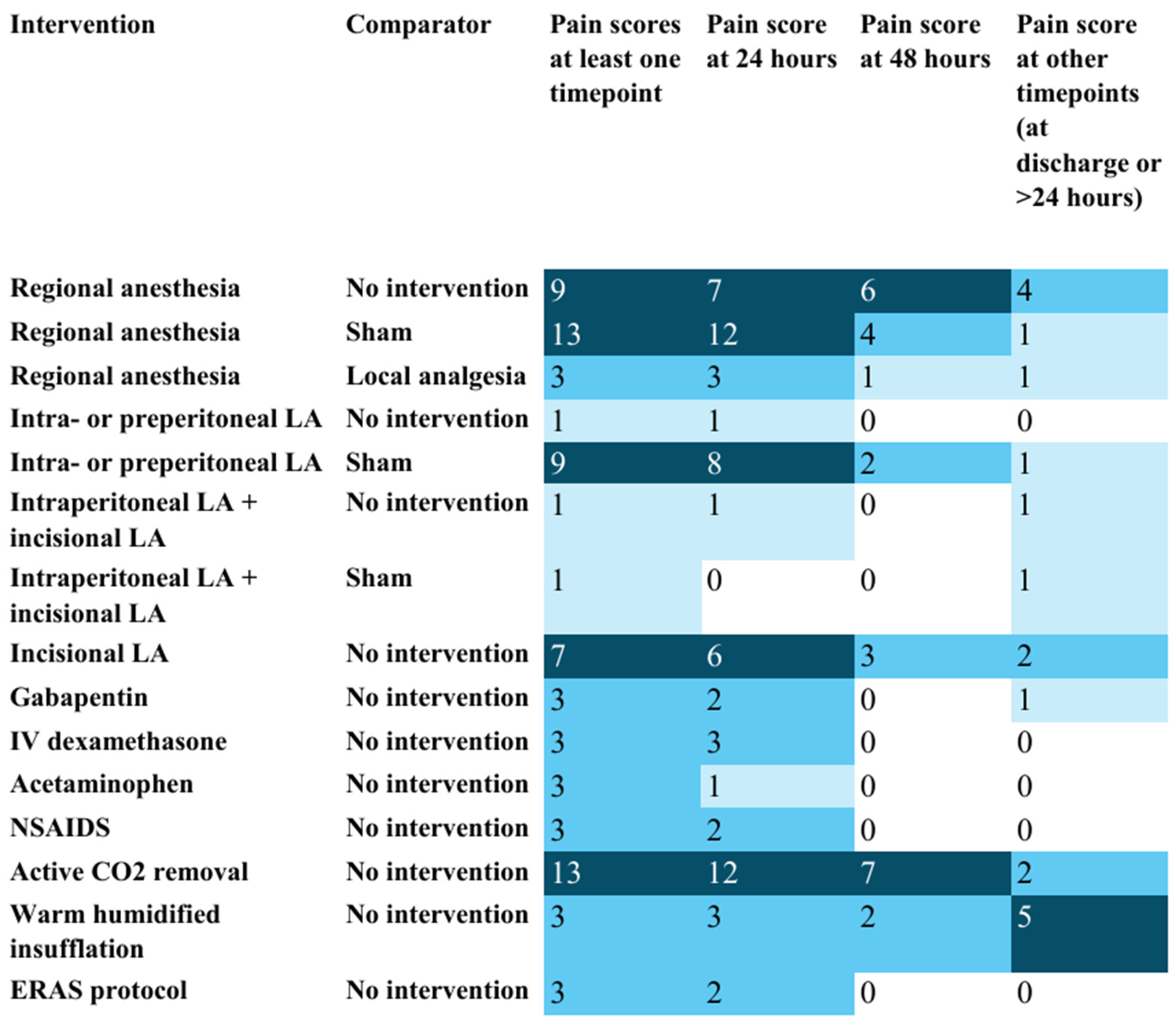
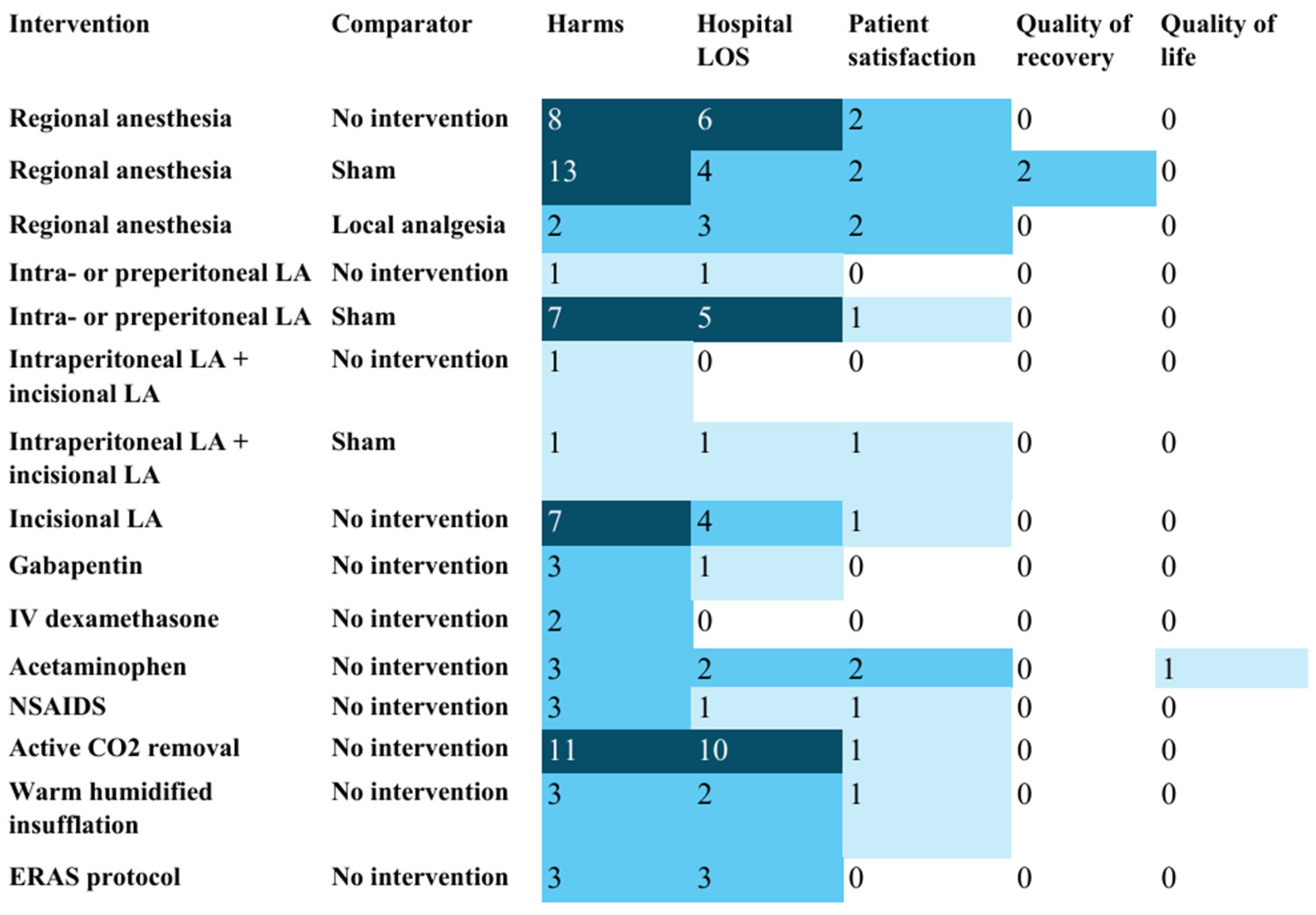
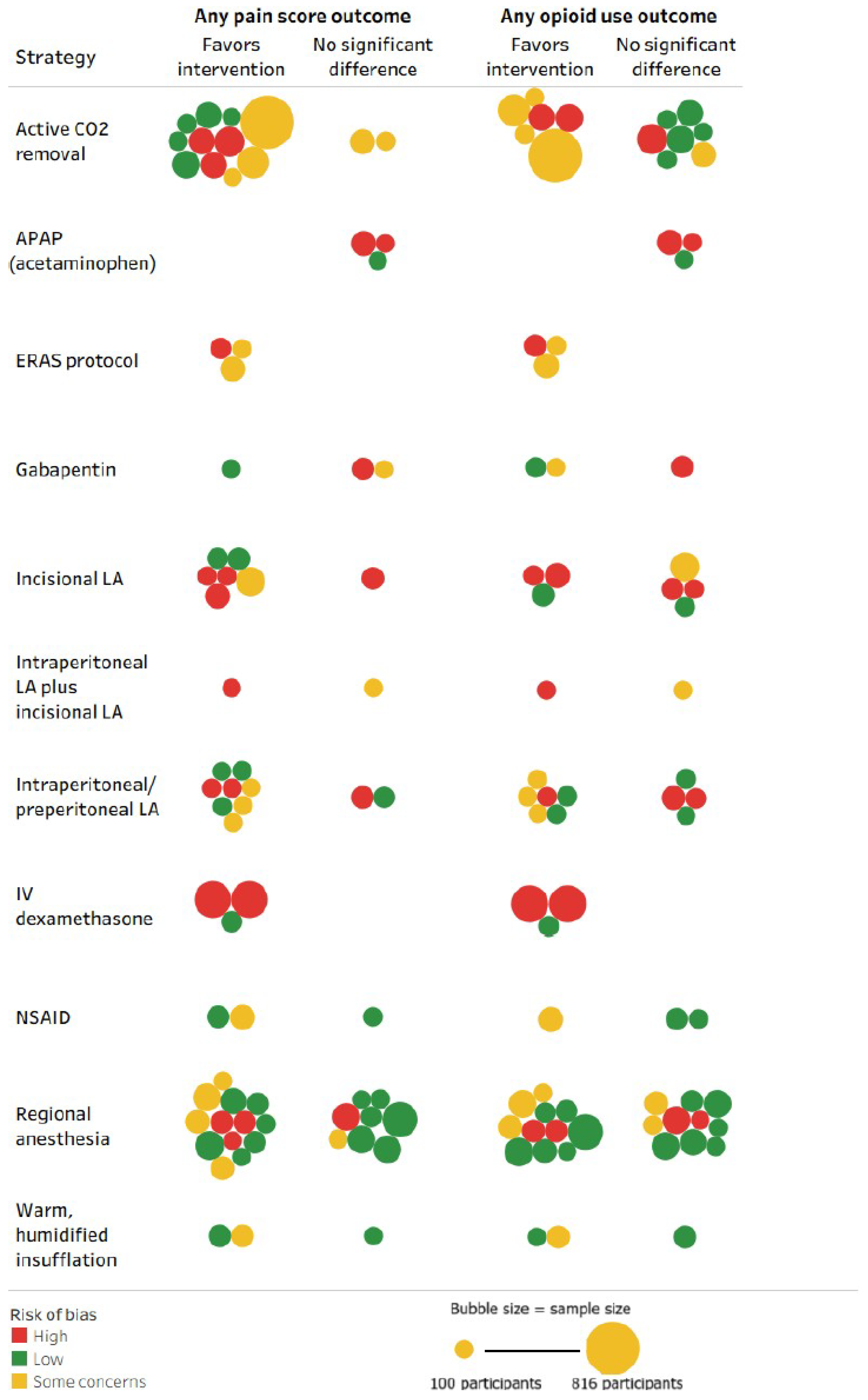
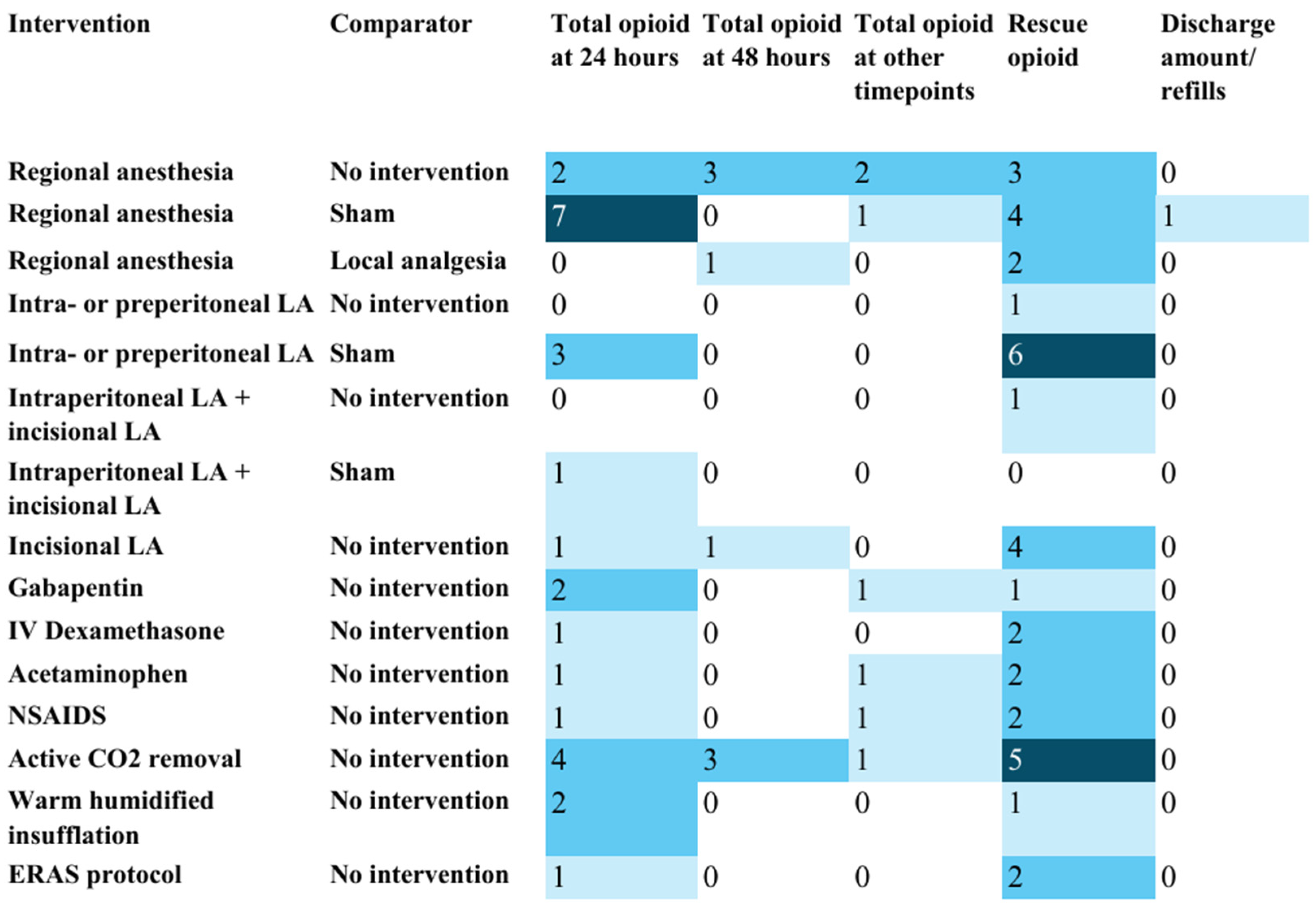
Evidence Map of Pharmacologic and Non-Pharmacologic Perioperative Strategies for Managing Acute Postoperative Pain After Laparoscopic Surgery, 2012–2025: The M-PALS Collaborative
 , , , , , , ,
Abstract
1. Introduction
2. Methods
2.1. Key Question
Data Sources and Study Selection
2.2. Data Extraction
2.3. Data Analysis and Evidence Synthesis
3. Results
3.1. Regional Anesthesia
3.2. Intraperitoneal or Preperitoneal Instillation of Local Anesthetics
3.3. Incisional Local Anesthetics
3.4. Gabapentinoids
3.5. Intravenous Dexamethasone
3.6. Acetaminophen
3.7. Non-Steroidal Anti-Inflammatory Drugs
3.8. Other Single-Study Pain Management Interventions
3.9. Multimodal Opioid-Free Strategies
3.10. Enhanced Recovery After Surgery Protocol
3.11. Low-Pressure Pneumoperitoneum or Active CO2 Removal
3.12. Warm and Humidified CO2 Insufflation
3.13. Complementary and Alternative Medicine Strategies
4. Discussion
4.1. Interventions with Emerging or Consistent Evidence
4.2. Future Directions
4.3. Limitations
5. Conclusions
Supplementary Materials
Author Contributions
Funding
Institutional Review Board Statement
Informed Consent Statement
Data Availability Statement
Acknowledgments
Conflicts of Interest
References
- Banka, G.; Woodard, G.; Hernandez-Boussard, T.; Morton, J.M. Laparoscopic vs open gastric bypass surgery: Differences in patient demographics, safety, and outcomes. Arch. Surg. 2012, 147, 550–556. [Google Scholar] [CrossRef] [Scilit] [PubMed]
- Nelson, H.; Sargent, D.J.; Wieand, H.S.; Fleshman, J.; Anvari, M.; Stryker, S.J.; Beart, R.W., Jr.; Hellinger, M.; Flanagan, R., Jr.; Peters, W.; et al. A comparison of laparoscopically assisted and open colectomy for colon cancer. N. Engl. J. Med. 2004, 350, 2050–2059. [Google Scholar] [CrossRef] [Scilit] [PubMed]
- Hah, J.M.; Bateman, B.T.; Ratliff, J.; Curtin, C.; Sun, E. Chronic Opioid Use After Surgery: Implications for Perioperative Management in the Face of the Opioid Epidemic. Anesth. Analg. 2017, 125, 1733–1740. [Google Scholar] [CrossRef] [Scilit]
- Schäfer, W.L.A.; Johnson, J.K.; Wafford, Q.E.; Plummer, S.G.; Stulberg, J.J. Primary prevention of prescription opioid diversion: A systematic review of medication disposal interventions. Am. J. Drug Alcohol Abuse 2021, 47, 548–558. [Google Scholar] [CrossRef] [Scilit] [PubMed]
- Bicket, M.C.; Long, J.J.; Pronovost, P.J.; Alexander, G.C.; Wu, C.L. Prescription Opioid Analgesics Commonly Unused After Surgery: A Systematic Review. JAMA Surg. 2017, 152, 1066–1071. [Google Scholar] [CrossRef] [Scilit] [PubMed]
- Matteson, K.A.; Schimpf, M.O.; Jeppson, P.C.; Thompson, J.C.; Gala, R.B.; Balgobin, S.; Gupta, A.; Hobson, D.; Olivera, C.; Singh, R.; et al. Prescription Opioid Use for Acute Pain and Persistent Opioid Use After Gynecologic Surgery: A Systematic Review. Obstet. Gynecol. 2023, 141, 681–696. [Google Scholar] [CrossRef] [Scilit]
- The United States Food & Drug Administration. Disposal of Unused Medicines: What You Should Know. U.S. Food and Drug Administration. Available online: https://www.fda.gov/drugs/safe-disposal-medicines/disposal-unused-medicines-what-you-should-know (accessed on 31 October 2024).
- Substance Use-Disorder Prevention that Promotes Opioid Recovery and Treatment for Patients and Communities Act. 2018. Available online: https://www.congress.gov/bill/115th-congress/house-bill/6 (accessed on 31 October 2024).
- National Academies Press. Evaluating Clinical Practice Guidelines for Prescribing Opioids for Acute Pain; National Academies Press: Washington, DC, USA, 2020; pp. 131–166. [Google Scholar]
- Methods Guide for Effectiveness and Comparative Effectiveness Reviews. Rockville (MD): Agency for Healthcare Research and Quality (US), 2008. Available online: https://www.ncbi.nlm.nih.gov/books/NBK47095/ (accessed on 31 October 2024).
- Page, M.J.; McKenzie, J.E.; Bossuyt, P.M.; Boutron, I.; Hoffmann, T.C.; Mulrow, C.D.; Shamseer, L.; Tetzlaff, J.M.; Akl, E.A.; Brennan, S.E.; et al. The PRISMA 2020 statement: An updated guideline for reporting systematic reviews. BMJ 2021, 372, n71. [Google Scholar] [CrossRef] [Scilit]
- Khalil, H.; Welsh, V.; Grainger, M.; Campbell, F. Guidance to undertaking systematic evidence maps. Environ. Int. 2025, 204, 109827. [Google Scholar] [CrossRef] [Scilit] [PubMed]
- Saran, A.; White, H. Evidence and gap maps: A comparison of different approaches. Campbell Syst. Rev. 2018, 14, 1–38. [Google Scholar] [CrossRef] [Scilit] [PubMed]
- CDC Understanding the Opioid Overdose Epidemic. Overdose Prevention. Available online: https://www.cdc.gov/overdose-prevention/about/understanding-the-opioid-overdose-epidemic.html?CDC_AAref_Val=https://www.cdc.gov/opioids/basics/epidemic.html (accessed on 31 October 2024).
- Minion, J.T.; Egunsola, O.; Mastikhina, L.; Farkas, B.; Hofmeister, M.; Flanagan, J.; Salmon, C.; Clement, F. PICO Portal. J. Can. Health Libr. Assoc. 2021, 42, 181–183. [Google Scholar] [CrossRef] [Scilit]
- Hoffmann, T.C.; Glasziou, P.P.; Boutron, I.; Milne, R.; Perera, R.; Moher, D.; Altman, D.G.; Barbour, V.; Macdonald, H.; Johnston, M.; et al. Better reporting of interventions: Template for intervention description and replication (TIDieR) checklist and guide. BMJ 2014, 348, g1687. [Google Scholar] [CrossRef] [Scilit]
- Sterne, J.A.C.; Savović, J.; Page, M.J.; Elbers, R.G.; Blencowe, N.S.; Boutron, I.; Cates, C.J.; Cheng, H.Y.; Corbett, M.S.; Eldridge, S.M.; et al. RoB 2: A revised tool for assessing risk of bias in randomised trials. BMJ 2019, 366, l4898. [Google Scholar] [CrossRef] [Scilit]
- Tableau, version 2025.2; Tableau Software: Seattle, WA, USA, 2025.
- Barr Grzesh, R.L.; Treszezamsky, A.D.; Fenske, S.S.; Rascoff, L.G.; Moshier, E.L.; Ascher-Walsh, C. Use of Paracervical Block Before Laparoscopic Supracervical Hysterectomy. J. Soc. Laparoendosc. Surg. 2018, 22, e2018.00023. [Google Scholar] [CrossRef] [Scilit] [PubMed]
- Calle, G.A.; Lopez, C.C.; Sanchez, E.; De Los Ríos, J.F.; Vásquez, E.M.; Serna, E.; Arango, A.M.; Castañeda, J.D.; Vásquez, R.A.; González, A.; et al. Transversus abdominis plane block after ambulatory total laparoscopic hysterectomy: Randomized controlled trial. Acta Obstet. Gynecol. Scand. 2014, 93, 345–350. [Google Scholar] [CrossRef] [Scilit] [PubMed]
- Cataldo, R.; Bruni, V.; Migliorelli, S.; Gallo, I.F.; Spagnolo, G.; Gibin, G.; Borgetti, M.; Strumia, A.; Ruggiero, A.; Pascarella, G. Laparoscopic-Guided Transversus Abdominis Plane (TAP) Block Combined with Port-Site Infiltration (PSI) for Laparoscopic Sleeve Gastrectomy in an ERABS Pathway: A Randomized, Prospective, Double-Blind, Placebo-Controlled Trial. Obes. Surg. 2024, 34, 2475–2482. [Google Scholar] [CrossRef] [Scilit] [PubMed]
- Chen, T.; Li, M.; Liu, Y.; Zhang, X.; Sun, X.; Li, J.; He, M.; Wang, Z. A Prospective Randomized Controlled Study of Ultrasound-Guided Rectus Sheath Block for Pain Management in Laparoscopic Umbilical Hernia Repair with Intraperitoneal Onlay Mesh. J. Pain Res. 2025, 18, 1–10. [Google Scholar] [CrossRef] [Scilit] [PubMed]
- Dai, L.; Ling, X.; Qian, Y. Effect of Ultrasound-Guided Transversus Abdominis Plane Block Combined with Patient-Controlled Intravenous Analgesia on Postoperative Analgesia After Laparoscopic Cholecystectomy: A Double-Blind, Randomized Controlled Trial. J. Gastrointest. Surg. Off. J. Soc. Surg. Aliment. Tract 2022, 26, 2542–2550. [Google Scholar] [CrossRef] [Scilit] [PubMed]
- Frost, A.S.; Kohn, J.R.; Le Neveu, M.; Brah, T.; Okonkwo, O.; Borahay, M.A.; Wu, H.; Simpson, K.; Patzkowsky, K.E.; Wang, K.C. Laparoscopic administration of bupivacaine at the uterosacral ligaments during benign laparoscopic and robotic hysterectomy: A randomized controlled trial. Am. J. Obstet. Gynecol. 2023, 229, 526.e1–526.e14. [Google Scholar] [CrossRef] [Scilit] [PubMed]
- Gungorduk, K.; Gulseren, V.; Tastan, L.; Özdemir, I.A. Paracervical block before laparoscopic total hysterectomy: A randomized controlled trial. Taiwan. J. Obstet. Gynecol. 2024, 63, 186–191. [Google Scholar] [CrossRef] [Scilit] [PubMed]
- Kawahara, R.; Tamai, Y.; Yamasaki, K.; Okuno, S.; Hanada, R.; Funato, T. The analgesic efficacy of ultrasound-guided transversus abdominis plane block with mid-axillary approach after gynecologic laparoscopic surgery: A randomized controlled trial. J. Anaesthesiol. Clin. Pharmacol. 2015, 31, 67–71. [Google Scholar] [CrossRef] [Scilit] [PubMed]
- Kinjo, Y.; Kurita, T.; Fujino, Y.; Kawasaki, T.; Yoshino, K.; Hachisuga, T. Evaluation of laparoscopic-guided rectus sheath block in gynecologic laparoscopy: A prospective, double-blind randomized trial. Int. J. Surg. 2019, 62, 47–53. [Google Scholar] [CrossRef] [Scilit] [PubMed]
- Li, X.; Xu, Z.Z.; Li, X.Y.; Jiang, T.T.; Lin, Z.M.; Wang, D.X. The analgesic efficacy of ultrasound-guided transversus abdominis plane block for retroperitoneoscopic renal surgery: A randomized controlled study. BMC Anesthesiol. 2019, 19, 186. [Google Scholar] [CrossRef] [Scilit] [PubMed]
- Lu, H.; Xie, Q.; Ye, W.; Zhou, Z.; Lei, Z. Ultrasound-guided erector spinae plane block for postoperative analgesia in Chinese patients undergoing laparoscopic cholecystectomy: A double-blind randomized controlled trial. Langenbecks Arch. Surg. 2023, 408, 111. [Google Scholar] [CrossRef] [Scilit] [PubMed]
- Mongelli, F.; Marengo, M.; Bertoni, M.V.; Volontè, F.; Ledingham, N.S.; Garofalo, F. Laparoscopic-Assisted Transversus Abdominis Plane (TAP) Block Versus Port-Site Infiltration with Local Anesthetics in Bariatric Surgery: A Double-Blind Randomized Controlled Trial. Obes. Surg. 2023, 33, 3383–3390. [Google Scholar] [CrossRef] [Scilit] [PubMed]
- Nazar, P.A.; Davul, A. Efficacy of Transmuscular Quadratus Lumborum Block in the Multimodal Regimen for Postoperative Analgesia after Total Laparoscopic Hysterectomy: A Prospective Randomised Double-Blinded Study. Int. J. Acad. Med. Pharm. 2023, 5, 324–327. Available online: https://www.academicmed.org/Uploads/Volume5Issue1/67.-57.-JAMP_Arpita-324-327.pdf (accessed on 26 March 2026).
- Pedrazzani, C.; Park, S.Y.; Conti, C.; Turri, G.; Park, J.S.; Kim, H.J.; Polati, E.; Guglielmi, A.; Choi, G.S. Analgesic efficacy of pre-emptive local wound infiltration plus laparoscopic-assisted transversus abdominis plane block versus wound infiltration in patients undergoing laparoscopic colorectal resection: Results from a randomized, multicenter, single-blind, non-inferiority trial. Surg. Endosc. 2021, 35, 3329–3338. [Google Scholar] [CrossRef] [Scilit] [PubMed]
- Ren, L.; Qin, P.; Min, S.; Wang, W.; Jin, J. Transversus Abdominis Plane Block Versus Local Wound Infiltration for Postoperative Pain After Laparoscopic Colorectal Cancer Resection: A Randomized, Double-Blinded Study. J. Gastrointest. Surg. 2022, 26, 425–432. [Google Scholar] [CrossRef] [Scilit] [PubMed]
- Ruiz-Tovar, J.; Garcia, A.; Ferrigni, C.; Gonzalez, J.; Levano-Linares, C.; Jimenez-Fuertes, M.; Llavero, C.; Duran, M. Laparoscopic-Guided Transversus Abdominis Plane (TAP) Block as Part of Multimodal Analgesia in Laparoscopic Roux-en-Y Gastric Bypass Within an Enhanced Recovery After Surgery (ERAS) Program: A Prospective Randomized Clinical Trial. Obes. Surg. 2018, 28, 3374–3379. [Google Scholar] [CrossRef] [Scilit] [PubMed]
- Ruiz-Tovar, J.; Gonzalez, G.; Sarmiento, A.; Carbajo, M.A.; Ortiz-De-Solorzano, J.; Castro, M.J.; Jimenez, J.M.; Zubiaga, L. Analgesic effect of postoperative laparoscopic-guided transversus abdominis plane (TAP) block, associated with preoperative port-site infiltration, within an enhanced recovery after surgery protocol in one-anastomosis gastric bypass: A randomized clinical trial. Surg. Endosc. 2020, 34, 5455–5460. [Google Scholar] [CrossRef] [Scilit] [PubMed]
- Salmonsen, C.B.; Lange, K.H.W.; Kleif, J.; Krøijer, R.; Bruun, L.; Mikalonis, M.; Dalsgaard, P.; Hesseldal, K.B.; Olsson, J.E.P.; Bertelsen, C.A.; et al. Transversus abdominis plane block in minimally invasive colon surgery: A multicenter three-arm randomized controlled superiority and non-inferiority clinical trial. Reg. Anesth. Pain Med. 2024, Epub ahead of print. [Google Scholar] [CrossRef] [Scilit] [PubMed]
- Sinha, A.; Jayaraman, L.; Punhani, D. Efficacy of ultrasound-guided transversus abdominis plane block after laparoscopic bariatric surgery: A double blind, randomized, controlled study. Obes. Surg. 2013, 23, 548–553. [Google Scholar] [CrossRef] [Scilit] [PubMed]
- Terranova, C.; Schiavoni, L.; Ficarola, F.; Plotti, F.; Nardone, C.D.C.; Montera, R.; Lotierzo, M.; Bartolone, M.; Pascarella, G.; Mattei, A.; et al. The Role of TAP/RS Block in Minor Gynecologic Laparoscopic Surgery: A Randomized Clinical Trial. Gynecol. Obstet. Investig. 2024, 89, 103–110. [Google Scholar] [CrossRef] [Scilit] [PubMed]
- Tülübaş, E.K.; Seyit, H.; Bostancı, İ.; Demir, G.; Köşük, H.; Şeker, Y.T.; Peker, K.D.; Alış, H. Laparoscopic Transversus Abdominal Plane Block is Effective in Multimodal Analgesia for Laparoscopic Sleeve Gastrectomy. Med. J. Bakirkoy 2019, 15, 198–203. [Google Scholar] [CrossRef] [Scilit]
- Wong, K.A.; Cabrera, A.G.; Argiroff, A.L.; Pechman, D.M.; Parides, M.K.; Vazzana, J.T.; Moran-Atkin, E.M.; Choi, J.J.; Camacho, D.R. Transversus abdominis plane block with liposomal bupivacaine and its effect on opiate use after weight loss surgery: A randomized controlled trial. Surg. Obes. Relat. Dis. 2020, 16, 886–893. [Google Scholar] [CrossRef] [Scilit] [PubMed]
- Xue, Q.; Chu, Z.; Zhu, J.; Zhang, X.; Chen, H.; Liu, W.; Jia, B.; Zhang, Y.; Wang, Y.; Huang, C.; et al. Analgesic Efficacy of Transverse Abdominis Plane Block and Quadratus Lumborum Block in Laparoscopic Sleeve Gastrectomy: A Randomized Double-Blinded Clinical Trial. Pain Ther. 2022, 11, 613–626. [Google Scholar] [CrossRef] [Scilit] [PubMed]
- Yin, G.; Li, Y.; Wei, P.; Ma, X.; Li, B.; Gan, G.; Song, X. Analgesic effect of the ultrasound-guided thoracolumbar paravertebral block in patients undergoing robot-assisted laparoscopic nephrectomy: A randomized controlled trial. BMC Anesthesiol. 2024, 24, 69. [Google Scholar] [CrossRef] [Scilit] [PubMed]
- Aldohayan, A.; Alshammari, S.; Binjaloud, A.; Bamehriz, F.; Narejo, A.S.; Aqil, M.; Aldahian, N.; Aldabaeab, A.; Eldawlatly, A. Pre-incisional Laparoscopic Preperitoneal Local Anesthetic Technique in Laparoscopic Sleeve Gastrectomy. J. Soc. Laparoendosc. Surg. 2022, 26, e2022.00049. [Google Scholar] [CrossRef] [Scilit] [PubMed]
- Arden, D.; Seifert, E.; Donnellan, N.; Guido, R.; Lee, T.; Mansuria, S. Intraperitoneal Instillation of Bupivacaine for Reduction of Postoperative Pain After Laparoscopic Hysterectomy: A Double-Blind Randomized Controlled Trial. J. Minim. Invasive Gynecol. 2013, 20, 620–626. [Google Scholar] [CrossRef] [Scilit] [PubMed]
- Cunningham, T.K.; Draper, H.; Bexhell, H.; Allgar, V.; Allen, J.; Mikl, D.; Phillips, K. A double-blinded randomised controlled study to investigate the effect of intraperitoneal levobupivacaine on post laparoscopic pain. Facts Views Vis. Obgyn 2020, 12, 155–161. [Google Scholar] [PubMed]
- Jairath, A.; Ganpule, A.; Gupta, S.; Mishra, S.; Sabnis, R.; Desai, M. Can intraperitoneal bupivacaine decreases pain in patients undergoing laparoscopic live donor nephrectomy? A randomized control trial. World J. Urol. 2017, 35, 985–989. [Google Scholar] [CrossRef] [Scilit] [PubMed]
- Kaur, R.; Seal, A.; Lemech, I.; Fisher, O.M.; Williams, N. Intraperitoneal Instillation of Local Anesthetic (IPILA) in Bariatric Surgery and the Effect on Post-operative Pain Scores: A Randomized Control Trial. Obes. Surg. 2022, 32, 2349–2356. [Google Scholar] [CrossRef] [Scilit] [PubMed]
- Manan, A.; Khan, A.A.; Ahmad, I.; Usman, M.; Jamil, T.; Sajid, M. Intraperitoneal bupivacaine as post-laparoscopic cholecystectomy analgesia. J. Coll. Physicians Surg. Pak. 2020, 30, 9–12. [Google Scholar] [CrossRef] [Scilit] [PubMed]
- Ruiz-Tovar, J.; Gonzalez, J.; Garcia, A.; Cruz, C.; Rivas, S.; Jimenez, M.; Ferrigni, C.; Duran, M. Intraperitoneal Ropivacaine Irrigation in Patients Undergoing Bariatric Surgery: A Prospective Randomized Clinical Trial. Obes. Surg. 2016, 26, 2616–2621. [Google Scholar] [CrossRef] [Scilit] [PubMed]
- Safari, S.; Rokhtabnak, F.; Djalali Motlagh, S.; Garkani, M.G.; Pournajafian, A. Effect of intraperitoneal bupivacaine on postoperative pain in laparoscopic bariatric surgeries. Surg. Obes. Relat. Dis. 2020, 16, 299–305. [Google Scholar] [CrossRef] [Scilit] [PubMed]
- Schipper, I.E.; Schouten, M.; Yalcin, T.; Algie, G.D.; Damen, S.L.; Smeenk, R.M.; Schouten, R. The Use of Intraperitoneal Bupivacaine in Laparoscopic Roux-en-Y Gastric Bypass: A Double-blind, Randomized Controlled Trial. Obes. Surg. 2019, 29, 3118–3124. [Google Scholar] [CrossRef] [Scilit] [PubMed]
- Zheng, L.Q.; Kosai, N.R.; Ani, M.F.C.; Maaya, M. The Impact of Laparoscopic Intraperitoneal Instillation of Ropivacaine in Enhancing Respiratory Recovery and Reducing Acute Postoperative Pain in Laparoscopic Sleeve Gastrectomy: A Double-Blinded Randomised Control; RELiEVE Trial. Obes. Surg. 2023, 33, 3141–3146. [Google Scholar] [CrossRef] [Scilit] [PubMed]
- Abet, E.; Orion, F.; Denimal, F.; Brau-Weber, A.; de Kerviler, B.; Jean, M.; Boulanger, G.; Dimet, J.; Comy, M. Interest of Using Ropivacaine for Outpatient Laparoscopic Cholecystectomy: Prospective Randomized Trial. World J. Surg. 2017, 41, 687–692. [Google Scholar] [CrossRef] [Scilit] [PubMed]
- Ismail, M.T.; Hassanin, M.Z.; Elshmaa, N.S. Preincisional infiltration and intraperitoneal instillation of levobupivacaine 0.25% for management of early postoperative pain following laparoscopic ovarian drilling. J. Obstet. Gynaecol. Res. 2013, 39, 543–548. [Google Scholar] [CrossRef] [Scilit] [PubMed]
- Ali, S.; Zarin, M.; Jan, Z.; Maroof, A. Effect of bupivacaine on postoperative pain after laparoscopic cholecystectomy. J. Coll. Physicians Surg. Pak. 2018, 28, 663–666. [Google Scholar] [CrossRef] [Scilit] [PubMed]
- Berlit, S.; Tuschy, B.; Brade, J.; Hüttner, F.; Hornemann, A.; Sütterlin, M. Topical anaesthetic patches for postoperative wound pain in laparoscopic gynaecological surgery: A prospective, blinded and randomised trial. Arch. Gynecol. Obstet. 2015, 291, 585–590. [Google Scholar] [CrossRef] [Scilit] [PubMed]
- Chowdhury, T.S.; Mustary, M.; Chowdhury, T.A. A randomized controlled trial depicting postoperative pain score following port-site infiltration during laparoscopy. J. South Asian Fed. Obstet. Gynaecol. 2019, 11, 230–234. [Google Scholar] [CrossRef] [Scilit]
- Fassoulaki, A.; Vassi, E.; Korkolis, D.; Zotou, M. Perioperative continuous ropivacaine wound infusion in laparoscopic cholecystectomy: A randomized controlled double-blind trial. Surg. Laparosc. Endosc. Percutaneous Tech. 2016, 26, 25–30. [Google Scholar] [CrossRef] [Scilit] [PubMed]
- Herrador-Benito, J.; Paramo-Zunzunegui, J.; Rodriguez-Caravaca, G.; Durán-Poveda, M. Pre-incisional local infiltration with levobupivacaine in laparoscopic cholecystectomy: A randomized and clinical trial. Cir. Cir. (Engl. Ed.) 2024, 92, 69–75. [Google Scholar] [CrossRef] [Scilit] [PubMed]
- Lin, S.; Hua, J.; Xu, B.; Yang, T.; He, Z.; Xu, C.; Meng, H.; Zhou, B.; Song, Z. Comparison of bupivacaine and parecoxib for postoperative pain relief after laparoscopic cholecystectomy: A randomized controlled trial. Int. J. Clin. Exp. Med. 2015, 8, 13824–13829. [Google Scholar] [PubMed]
- Zhang, H.; Du, G.; Liu, Y.F.; Yang, J.H.; A-Niu, M.G.; Zhai, X.Y.; Jin, B. Overlay of a sponge soaked with ropivacaine and multisite infiltration analgesia result in faster recovery after laparoscopic hepatectomy. World J. Gastroenterol. 2019, 25, 5185–5196. [Google Scholar] [CrossRef] [Scilit] [PubMed]
- Huynh, T.Q.; Patel, N.R.; Goldstein, N.D. Preoperative Gabapentin for Minimally Invasive Hysterectomy: A Randomized Controlled Trial. J. Minim. Invasive Gynecol. 2021, 28, 237–244.e2. [Google Scholar] [CrossRef] [Scilit] [PubMed]
- Pushparani, A.; Venkatraman, R.; Gayathri, L.; Sundaram, L.; Manojkumar, K. Efficacy of Single Dose Oral Gabapentin in Day Care Laparoscopic Surgeries-A Randomized Double-blinded Placebo Control Study. Int. J. Res. Pharm. Sci. 2022, 13, 311–317. [Google Scholar] [CrossRef] [Scilit]
- Rupniewska-Ladyko, A.; Malec-Milewska, M.; Kraszewska, E.; Pirozynski, M. Gabapentin before laparoscopic sleeve gastrectomy reduces postoperative oxycodone consumption in obese patients: A randomized double-blind placebo-controlled trial. Minerva Anestesiol. 2018, 84, 565–571. [Google Scholar] [CrossRef] [Scilit] [PubMed]
- Lee, C.; Chung, J.Y.; Lee, M. Sex-related differences in the efficacy of dexamethasone pretreatment for postoperative analgesia in patients undergoing laparoscopic cholecystectomy: A randomized controlled study. Turk. J. Med. Sci. 2017, 47, 1282–1286. [Google Scholar] [CrossRef] [Scilit] [PubMed]
- Lee, C.; Chung, J.Y.; Lee, M. Age-related differences in the efficacy of dexamethasone for postoperative analgesia in patients undergoing laparoscopic cholecystectomy: A randomised controlled study. Kuwait Med. J. 2018, 50, 282–287. [Google Scholar]
- Mohtadi, A.; Nesioonpour, S.; Salari, A.; Akhondzadeh, R.; Rad, B.M.; Aslani, S.M.M. The effect of single-dose administration of dexamethasone on postoperative pain in patients undergoing laparoscopic cholecystectomy. Anesthesiol. Pain Med. 2014, 4, e17872. [Google Scholar] [CrossRef] [Scilit] [PubMed]
- El Chaar, M.; Stoltzfus, J.; Claros, L.; Wasylik, T. IV Acetaminophen Results in Lower Hospital Costs and Emergency Room Visits Following Bariatric Surgery: A Double-Blind, Prospective, Randomized Trial in a Single Accredited Bariatric Center. J. Gastrointest. Surg. Off. J. Soc. Surg. Aliment. Tract 2016, 20, 715–724. [Google Scholar] [CrossRef] [Scilit] [PubMed]
- Rindos, N.B.; Mansuria, S.M.; Ecker, A.M.; Stuparich, M.A.; King, C.R. Intravenous acetaminophen vs saline in perioperative analgesia with laparoscopic hysterectomy. Am. J. Obstet. Gynecol. 2019, 220, 373.e1–373.e8. [Google Scholar] [CrossRef] [Scilit] [PubMed]
- Turner, L.C.; Zyczynski, H.M.; Shepherd, J.P. Intravenous Acetaminophen Before Pelvic Organ Prolapse Repair: A Randomized Controlled Trial. Obstet. Gynecol. 2019, 133, 492–502. [Google Scholar] [CrossRef] [Scilit] [PubMed]
- Grimsby, G.M.; Conley, S.P.; Trentman, T.L.; Castle, E.P.; Andrews, P.E.; Mihalik, L.A.; Hentz, J.G.; Humphreys, M.R. A double-blind randomized controlled trial of continuous intravenous Ketorolac vs placebo for adjuvant pain control after renal surgery. Mayo Clin. Proc. 2012, 87, 1089–1097. [Google Scholar] [CrossRef] [Scilit] [PubMed]
- Okam, P.C.; Ikechebelu, J.I.; Eleje, G.U.; Albert, I.C.; Okpala, B.C.; Okam, C.F.; Nwajiaku, L.A.; Joe-Ikechebelu, N.N.; Ezeigwe, C.O.; Chigbo, C.G.; et al. Efficacy and safety of diclofenac suppository for postoperative pain relief after diagnostic hystero-laparoscopy and dye test: A double-blind, placebo-controlled, randomized trial. Eur. J. Obstet. Gynecol. Reprod. Biol. X 2024, 23, 100326. [Google Scholar] [CrossRef] [Scilit] [PubMed]
- Beqiri, A.I.; Domi, R.Q.; Sula, H.H.; Zaimi, E.Q.; Petrela, E.Y. The combination of infiltrative bupivacaine with low-pressure laparoscopy reduces postcholecystectomy pain. A prospective randomized controlled study. Saudi Med. J. 2012, 33, 134–138. [Google Scholar] [PubMed]
- Chawla, T.; Shahzad, N.; Ahmad, K.; Ali, J. Post-operative pain after laparoscopic ventral hernia repair, the impact of mesh soakage with bupivacaine solution versus normal saline solution: A randomised controlled trial (HAPPIEST Trial). J. Minim. Access Surg. 2020, 16, 328–334. [Google Scholar] [CrossRef] [Scilit] [PubMed]
- Cope, A.G.; Wetzstein, M.M.; Mara, K.C.; Laughlin-Tommaso, S.K.; Warner, N.S.; Burnett, T.L. Abdominal Ice after Laparoscopic Hysterectomy: A Randomized Controlled Trial. J. Minim. Invasive Gynecol. 2021, 28, 342–350.e2. [Google Scholar] [CrossRef] [Scilit] [PubMed]
- De Cicco Nardone, C.; Ficarola, F.; Plotti, F.; Montera, R.; Feole, L.; Rampello, S.; Messina, G.; Luvero, D.; Marci, R.; Angioli, R.; et al. The role of peritoneal lavage in benign gynecologic laparoscopic surgery. Eur. Rev. Med. Pharmacol. Sci. 2023, 27, 6800–6808. [Google Scholar] [CrossRef] [Scilit] [PubMed]
- Friesgaard, K.D.; Brix, L.D.; Kristensen, C.B.; Rian, O.; Nikolajsen, L. Clinical effectiveness and safety of intraoperative methadone in patients undergoing laparoscopic hysterectomy: A randomised, blinded clinical trial. BJA Open 2023, 7, 100219. [Google Scholar] [CrossRef] [Scilit] [PubMed]
- Janjua, S.; Aslam, K.Z.; Sarfraz, S.; Qarni, A.; Niazi, W.; Sarfraz, M.B. Comparison of modified unilateral ultrasound guided subcostal transversus abdominis plane block with conventional port-site and intraperitoneal infiltration of bupivacaine for postoperative pain relief in laparoscopic cholecystectomy. Pak. Armed Forces Med. J. 2019, 69, 801–807. [Google Scholar]
- Kamali, A.; Ashrafi, T.H.; Rakei, S.; Noori, G.; Norouzi, A. A comparative study on the prophylactic effects of paracetamol and dexmedetomidine for controlling hemodynamics during surgery and postoperative pain in patients with laparoscopic cholecystectomy. Medicine 2018, 97, e13330. [Google Scholar] [CrossRef] [Scilit] [PubMed]
- Liu, X.; Hu, J.; Hu, X.; Li, R.; Li, Y.; Wong, G.; Zhang, Y.; on behalf of The study group. Preemptive Intravenous Nalbuphine for the Treatment of Post-Operative Visceral Pain: A Multicenter, Double-Blind, Placebo-Controlled, Randomized Clinical Trial. Pain Ther. 2021, 10, 1155–1169. [Google Scholar] [CrossRef] [Scilit] [PubMed]
- Mei, W.; Li, M.; Yu, Y.; Cheung, C.; Cao, F.; Nie, B.; Zhang, Z.; Wang, P.; Tian, Y. Tropisetron alleviate early post-operative pain after gynecological laparoscopy in sevoflurane based general anaesthesia: A randomized, parallel-group, factorial study. Eur. J. Pain 2014, 18, 238–248. [Google Scholar] [CrossRef] [Scilit] [PubMed]
- Nanda, A.; Sangineni, K.S.D.; Pakhare, V.; Ramchandran, G. Comparative Evaluation of Efficacy of Preventive Analgesia with Diclofenac and Buprenorphine Patch versus Single Diclofenac Patch for Postoperative Pain following General Anesthesia for Laparoscopic Cholecystectomy. Anesth. Essays Res. 2020, 14, 428–433. [Google Scholar] [CrossRef] [Scilit] [PubMed]
- Ruiz-Tovar, J.; Garcia, A.; Ferrigni, C.; Duran, M. Application of Vitamin E Acetate on Staple Lines and Anastomoses of Roux-en-Y Gastric Bypass: Impact on Postoperative Pain and Acute Phase Reactants. Obes. Surg. 2020, 30, 2988–2993. [Google Scholar] [CrossRef] [Scilit] [PubMed]
- Sherif, A.A.; Elsersy, H.E. The impact of dexmedetomidine or xylocaine continuous infusion on opioid consumption and recovery after laparoscopic sleeve gastrectomy. Minerva Anestesiol. 2017, 83, 1274–1282. [Google Scholar] [CrossRef] [Scilit] [PubMed]
- Yao, L.; Wang, Y.; Du, B.; Song, J.; Ji, F. Comparison of Postoperative Pain and Residual Gas between Restrictive and Liberal Fluid Therapy in Patients Undergoing Laparoscopic Cholecystectomy. Surg. Laparosc. Endosc. Percutaneous Tech. 2017, 27, 346–350. [Google Scholar] [CrossRef] [Scilit] [PubMed]
- El Sherif, F.A.; Othman, A.H.; Abd El-Rahman, A.M.; Taha, O. Effect of adding intrathecal morphine to a multimodal analgesic regimen for postoperative pain management after laparoscopic bariatric surgery: A prospective, double-blind, randomized controlled trial. Br. J. Pain 2016, 10, 209–216. [Google Scholar] [CrossRef] [Scilit] [PubMed]
- Bae, M.I.; Oh, J.; Lee, H.S.; Park, S.; Kwon, I.G.; Song, Y. Influence of psychological factors and pain sensitivity on the efficacy of opioid-free anesthesia: A randomized clinical trial. Gen. Hosp. Psychiatry 2024, 89, 84–92. [Google Scholar] [CrossRef] [Scilit] [PubMed]
- Clanet, M.; Touihri, K.; El Haddad, C.; Goldsztejn, N.; Himpens, J.; Fils, J.F.; Gricourt, Y.; Van der Linden, P.; Coeckelenbergh, S.; Joosten, A.; et al. Effect of opioid-free versus opioid-based strategies during multimodal anaesthesia on postoperative morphine consumption after bariatric surgery: A randomised double-blind clinical trial. BJA Open 2024, 9, 100263. [Google Scholar] [CrossRef] [Scilit] [PubMed]
- Collange, V.; Berruet, J.B.; Aubrun, F.; Poiblanc, M.; Olagne, E.; Mercier, N.G.; Parent, S.; Noel, P.; Devillez, S.; Perrou, M.; et al. Opioid free versus opioid sparing strategies for multimodal antinociception during laparoscopic colectomy: A randomised controlled trial. Anaesth. Crit. Care Pain Med. 2024, 43, 101436. [Google Scholar] [CrossRef] [Scilit] [PubMed]
- Geng, Z.; Bi, H.; Zhang, D.; Xiao, C.; Song, H.; Feng, Y.; Cao, X.; Li, X. The impact of multimodal analgesia based enhanced recovery protocol on quality of recovery after laparoscopic gynecological surgery: A randomized controlled trial. BMC Anesthesiol. 2021, 21, 179. [Google Scholar] [CrossRef] [Scilit] [PubMed]
- Kerketta, C.S.; Chhanwal, H.S.; Kheskani, D.; Sharma, V.; Sitapara, P.; Rathod, V.G. Opioid Free Anesthesia in Laparoscopic Surgery: A New Emerging Technique. J. Cell. Mol. Anesth. 2023, 8, 256–263. [Google Scholar] [CrossRef]
- Perez, J.J.; Strunk, J.D.; Preciado, O.M.; DeFaccio, R.J.; Chang, L.C.; Mallipeddi, M.K.; Deal, S.B.; Oryhan, C.L. Effect of an opioid-free anesthetic on postoperative opioid consumption after laparoscopic bariatric surgery: A prospective, single-blinded, randomized controlled trial. Reg. Anesth. Pain Med. 2024, 50, 699–705. [Google Scholar] [CrossRef] [Scilit] [PubMed]
- Yu, J.M.; Tao, Q.Y.; He, Y.; Liu, D.; Niu, J.Y.; Zhang, Y. Opioid-Free Anesthesia for Pain Relief After Laparoscopic Cholecystectomy: A Prospective Randomized Controlled Trial. J. Pain Res. 2023, 16, 3625–3632. [Google Scholar] [CrossRef] [Scilit] [PubMed]
- Papasavas, P.; Seip, R.L.; McLaughlin, T.; Staff, I.; Thompson, S.; Mogor, I.; Sweeney, J.; Gannon, R.; Waberski, W.; Tishler, D. A randomized controlled trial of an enhanced recovery after surgery protocol in patients undergoing laparoscopic sleeve gastrectomy. Surg. Endosc. 2023, 37, 921–931. [Google Scholar] [CrossRef] [Scilit] [PubMed]
- Prabhakaran, S.; Misra, S.; Magila, M.; Kumar, S.S.; Kasthuri, S.; Palanivelu, C.; Raj, P.P. Randomized Controlled Trial Comparing the Outcomes of Enhanced Recovery After Surgery and Standard Recovery Pathways in Laparoscopic Sleeve Gastrectomy. Obes. Surg. 2020, 30, 3273–3279. [Google Scholar] [CrossRef] [Scilit] [PubMed]
- Ruiz-Tovar, J.; Garcia, A.; Ferrigni, C.; Gonzalez, J.; Castellon, C.; Duran, M. Impact of implementation of an enhanced recovery after surgery (ERAS) program in laparoscopic Roux-en-Y gastric bypass: A prospective randomized clinical trial. Surg. Obes. Relat. Dis. 2019, 15, 228–235. [Google Scholar] [CrossRef] [Scilit] [PubMed]
- Abuelzein, M.L.A.; Baghdadi, M.A.; Abbdelhady, W.A.; Khairy, M.M. A prospective randomized controlled study on the role of restoring liver diaphragm surface tension and pain control at port sites in optimizing pain management following laparoscopic cholecystectomy. Ann. Gastroenterol. Surg. 2023, 7, 131–137. [Google Scholar] [CrossRef] [Scilit] [PubMed]
- Arumugaswamy, P.R.; Chumber, S.; Rathore, Y.S.; Maitra, S.; Bhattacharjee, H.K.; Bansal, V.K.; Aggarwal, S.; Dhar, A.; Asuri, K.; Kataria, K.; et al. Low-pressure pneumoperitoneum with deep neuromuscular blockade versus standard pressure pneumoperitoneum in patients undergoing laparoscopic cholecystectomy for gallstone disease: A non-inferiority randomized control trial. Surg. Endosc. 2024, 38, 449–459. [Google Scholar] [CrossRef] [Scilit] [PubMed]
- Asgari, Z.; Hosseini, R.; Rastad, H.; Hosseini, L. Does peritoneal suction drainage reduce pain after gynecologic laparoscopy? Surg. Laparosc. Endosc. Percutaneous Tech. 2018, 28, 73–76. [Google Scholar] [CrossRef] [Scilit] [PubMed]
- Chalermchockcharoenkit, A.; Hengrasmee, P.; Sophontanarak, P.; Sirimai, K.; Sutchritpongsa, P.; Srichaikul, P. Effects of delayed suprapubic port removal on post-laparoscopic shoulder pain: A randomized controlled trial. Gynecol. Surg. 2021, 18, 8. [Google Scholar] [CrossRef] [Scilit]
- Gungorduk, K.; Asicioglu, O.; Ozdemir, I.A. Effect of the pulmonary recruitment maneuver on pain after laparoscopic gynecological oncologic surgery: A prospective randomized trial. J. Gynecol. Oncol. 2018, 29, e92. [Google Scholar] [CrossRef] [Scilit] [PubMed]
- Kihlstedt Pasquier, E.; Andersson, E. Pulmonary Recruitment Maneuver Reduces Shoulder Pain and Nausea After Laparoscopic Cholecystectomy: A Randomized Controlled Trial. World J. Surg. 2021, 45, 3575–3583. [Google Scholar] [CrossRef] [Scilit] [PubMed]
- Noh, Y.J.; Kwon, E.J.; Bang, Y.J.; Yoon, S.J.; Hwang, H.J.; Jeong, H.; Lee, S.M.; Shin, Y.H. The effect of lung-recruitment maneuver on postoperative shoulder pain in patients undergoing laparoscopic cholecystectomy: A randomized controlled trial. J. Anesth. 2024, 38, 839–847. [Google Scholar] [CrossRef] [Scilit] [PubMed]
- Park, S.E.; Hong, T.H. Effects of extremely low-pressure pneumoperitoneum on postoperative recovery after single site robot-assisted cholecystectomy: A randomized controlled trial. Langenbecks Arch. Surg. 2023, 408, 242. [Google Scholar] [CrossRef] [Scilit] [PubMed]
- Pasquier, E.K.; Andersson, E. Pulmonary recruitment maneuver reduces pain after laparoscopic bariatric surgery: A randomized controlled clinical trial. Surg. Obes. Relat. Dis. 2018, 14, 386–392. [Google Scholar] [CrossRef] [Scilit] [PubMed]
- Radosa, J.C.; Radosa, M.P.; Mavrova, R.; Rody, A.; Juhasz-Böss, I.; Bardens, D.; Brün, K.; Solomayer, E.-F.; Baum, S. Five minutes of extended assisted ventilation with an open umbilical trocar valve significantly reduces postoperative abdominal and shoulder pain in patients undergoing laparoscopic hysterectomy. Eur. J. Obstet. Gynecol. Reprod. Biol. 2013, 171, 122–127. [Google Scholar] [CrossRef] [Scilit] [PubMed]
- Radosa, J.C.; Radosa, M.P.; Schweitzer, P.A.; Radosa, C.G.; Stotz, L.; Hamza, A.; Takacs, Z.; Lepper, P.M.; Wagenpfeil, S.; Linxweiler, M.; et al. Impact of different intraoperative CO2 pressure levels (8 and 15 mmHg) during laparoscopic hysterectomy performed due to benign uterine pathologies on postoperative pain and arterial pCO2: A prospective randomised controlled clinical trial. BJOG Int. J. Obstet. Gynaecol. 2019, 126, 1276–1285. [Google Scholar] [CrossRef] [Scilit] [PubMed]
- Singla, S.; Mittal, G.; Raghav; Mittal, R.K. Pain management after laparoscopic cholecystectomy-a randomized prospective trial of low pressure and standard pressure pneumoperitoneum. J. Clin. Diagn. Res. JCDR 2014, 8, 92–94. [Google Scholar] [CrossRef] [Scilit] [PubMed]
- Tsai, H.W.; Wang, P.H.; Yen, M.S.; Chao, K.C.; Hsu, T.F.; Chen, Y.J. Prevention of postlaparoscopic shoulder and upper abdominal pain: A randomized controlled trial. Obstet. Gynecol. 2013, 121, 526–531. [Google Scholar] [CrossRef] [Scilit] [PubMed]
- Jiang, R.; Sun, Y.; Wang, H.; Liang, M.; Xie, X. Effect of different carbon dioxide (CO2) insufflation for laparoscopic colorectal surgery in elderly patients: A randomized controlled trial. Medicine 2019, 98, e17520. [Google Scholar] [CrossRef] [Scilit] [PubMed]
- Klugsberger, B.; Schreiner, M.; Rothe, A.; Haas, D.; Oppelt, P.; Shamiyeh, A. Warmed, humidified carbon dioxide insufflation versus standard carbon dioxide in laparoscopic cholecystectomy: A double-blinded randomized controlled trial. Surg. Endosc. 2014, 28, 2656–2660. [Google Scholar] [CrossRef] [Scilit] [PubMed]
- Sutton, E.; Bellini, G.; Grieco, M.J.; Kumara, H.M.C.S.; Yan, X.; Cekic, V.; Njoh, L.; Whelan, R.L. Warm and Humidified Versus Cold and Dry CO2 Pneumoperitoneum in Minimally Invasive Colon Resection: A Randomized Controlled Trial. Surg. Innov. 2017, 24, 471–482. [Google Scholar] [CrossRef] [Scilit] [PubMed]
- Artiklar, T.; Erden, S. The Effect of Breathing and Coughing Exercises and Oxygen Therapy on Shoulder Pain and Analgesic Consumption After Laparoscopic Cholecystectomy: A Randomized Controlled Study. J. Perianesthesia Nurs. Off. J. Am. Soc. PeriAnesthesia Nurses 2024, 39, 540–546. [Google Scholar] [CrossRef] [Scilit] [PubMed]
- Gu, S.; Lang, H.; Gan, J.; Zheng, Z.; Zhao, F.; Tu, Q. Effect of transcutaneous electrical acupoint stimulation on gastrointestinal function recovery after laparoscopic radical gastrectomy—A randomized controlled trial. Eur. J. Integr. Med. 2019, 26, 11–17. [Google Scholar] [CrossRef] [Scilit]
- Joudi, M.; Fathi, M.; Izanloo, A.; Montazeri, O.; Jangjoo, A. An Evaluation of the Effect of Hypnosis on Postoperative Analgesia following Laparoscopic Cholecystectomy. Int. J. Clin. Exp. Hypn. 2016, 64, 365–372. [Google Scholar] [CrossRef] [Scilit] [PubMed]
- Kheradkish, F.; Valiani, M.; Amini Rarani, S.; Hashemi, M. The effect of acupressure on pain levels and physiologic indicator in patients undergoing laparoscopic cholecystectomy: A double-blind, randomized clinical trial. Complement. Ther. Clin. Pract. 2024, 57, 101868. [Google Scholar] [CrossRef] [Scilit] [PubMed]
- Peng, L.; Song, Y.; Lv, B.; Jing, C. The effect of implementation of pain neuroscience education and rehabilitation exercise on post-operative pain and recovery after laparoscopic colorectal surgery: A prospective randomized controlled trial. J. Anesth. 2023, 37, 775–786. [Google Scholar] [CrossRef] [Scilit] [PubMed]
- Wang, Y.; Sun, J.; Yu, K.; Liu, X.; Liu, L.; Miao, H.; Li, T. Virtual reality exposure reduce acute postoperative pain in female patients undergoing laparoscopic gynecology surgery: A Randomized Control Trial (RCT) study. J. Clin. Anesth. 2024, 97, 111525. [Google Scholar] [CrossRef] [Scilit] [PubMed]
- Zeeni, C.; Chamsy, D.; Khalil, A.; Abu Musa, A.; Al Hassanieh, M.; Shebbo, F.; Nassif, J. Effect of postoperative Trendelenburg position on shoulder pain after gynecological laparoscopic procedures: A randomized clinical trial. BMC Anesthesiol. 2020, 20, 27. [Google Scholar] [CrossRef] [Scilit] [PubMed]
- Lawal, O.D.; Gold, J.; Murthy, A.; Ruchi, R.; Bavry, E.; Hume, A.L.; Lewkowitz, A.K.; Brothers, T.; Wen, X. Rate and Risk Factors Associated With Prolonged Opioid Use After Surgery: A Systematic Review and Meta-analysis. JAMA Netw. Open 2020, 3, e207367. [Google Scholar] [CrossRef] [Scilit]
- De Cassai, A.; Sella, N.; Geraldini, F.; Tulgar, S.; Ahiskalioglu, A.; Dost, B.; Manfrin, S.; Karapinar, Y.E.; Paganini, G.; Beldagli, M.; et al. Single-shot regional anesthesia for laparoscopic cholecystectomies: A systematic review and network meta-analysis. Korean J. Anesthesiol. 2023, 76, 34–46. [Google Scholar] [CrossRef] [Scilit]
- Tian, Q.; Wang, H.; Guo, T.; Yao, B.; Liu, Y.; Zhu, B. The efficacy and safety of enhanced recovery after surgery (ERAS) Program in laparoscopic distal gastrectomy: A systematic review and meta-analysis of randomized controlled trials. Ann. Med. 2024, 56, 2306194. [Google Scholar] [CrossRef] [Scilit]
- Choi, G.J.; Kang, H.; Baek, C.W.; Jung, Y.H.; Kim, D.R. Effect of intraperitoneal local anesthetic on pain characteristics after laparoscopic cholecystectomy. World J. Gastroenterol. 2015, 21, 13386–13395. [Google Scholar] [CrossRef] [Scilit] [PubMed]
- Altman, A.D.; Robert, M.; Armbrust, R.; Fawcett, W.J.; Nihira, M.; Jones, C.N.; Tamussino, K.; Sehouli, J.; Dowdy, S.C.; Nelson, G. Guidelines for vulvar and vaginal surgery: Enhanced Recovery After Surgery Society recommendations. Am. J. Obstet. Gynecol. 2020, 223, 475–485. [Google Scholar] [CrossRef] [Scilit] [PubMed]
- Gustafsson, U.O.; Scott, M.J.; Hubner, M.; Nygren, J.; Demartines, N.; Francis, N.; Rockall, T.A.; Young-Fadok, T.M.; Hill, A.G.; Soop, M.; et al. Guidelines for Perioperative Care in Elective Colorectal Surgery: Enhanced Recovery After Surgery (ERAS(®)) Society Recommendations: 2018. World J. Surg. 2019, 43, 659–695. [Google Scholar] [CrossRef] [Scilit] [PubMed]
- Bourgeois, C.; Oyaert, L.; Van de Velde, M.; Pogatzki-Zahn, E.; Freys, S.M.; Sauter, A.R.; Joshi, G.P.; Dewinter, G. Pain management after laparoscopic cholecystectomy: A systematic review and procedure-specific postoperative pain management (PROSPECT) recommendations. Eur. J. Anaesthesiol. 2024, 41, 841–855. [Google Scholar] [CrossRef] [Scilit] [PubMed]
- Gurusamy, K.S.; Vaughan, J.; Davidson, B.R. Low pressure versus standard pressure pneumoperitoneum in laparoscopic cholecystectomy. Cochrane Database Syst. Rev. 2014, 2014, CD006930. [Google Scholar] [CrossRef] [Scilit]
- HHua, J.; Gong, J.; Yao, L.; Zhou, B.; Song, Z. Low-pressure versus standard-pressure pneumoperitoneum for laparoscopic cholecystectomy: A systematic review and meta-analysis. Am. J. Surg. 2014, 208, 143–150. [Google Scholar] [CrossRef] [Scilit]
- Pogatzki-Zahn, E.M.; Liedgens, H.; Hummelshoj, L.; Meissner, W.; Weinmann, C.; Treede, R.D.; Vincent, K.; Zahn, P.; The IMI-PainCare PROMPT consensus panel; Kaiser, U. Developing consensus on core outcome domains for assessing effectiveness in perioperative pain management: Results of the PROMPT/IMI-PainCare Delphi Meeting. Pain 2021, 162, 2717–2736. [Google Scholar] [CrossRef] [Scilit] [PubMed]
- Hohenschurz-Schmidt, D.; Cherkin, D.; Rice, A.S.C.; Dworkin, R.H.; Turk, D.C.; McDermott, M.P.; Bair, M.J.; DeBar, L.L.; Edwards, R.R.; Evans, S.R.; et al. Methods for pragmatic randomized clinical trials of pain therapies: IMMPACT statement. Pain 2024, 165, 2165–2183. [Google Scholar] [CrossRef] [Scilit]
- Merkow, R.P.; Kaji, A.H.; Itani, K.M.F. The CONSORT Framework. JAMA Surg. 2021, 156, 877–878. [Google Scholar] [CrossRef] [Scilit] [PubMed]
- Hopewell, S.; Chan, A.W.; Collins, G.S.; Hróbjartsson, A.; Moher, D.; Schulz, K.F.; Tunn, R.; Aggarwal, R.; Berkwits, M.; Berlin, J.A.; et al. CONSORT 2025 statement: Updated guideline for reporting randomised trials. Lancet 2025, 405, 1633–1640. [Google Scholar] [CrossRef] [Scilit] [PubMed]
- Parikh, R.R.; Lott, G.L.; Considine, M.; Sawtell, P.; Brandt, S.; Choconta Piraquive, L.; Pagadala, S.; Persson, D.J.; Claussen, A.M.; Tignanelli, C.; et al. Gaps and Priorities in Research on Multimodal Analgesia After Laparoscopic Surgery. Reg. Anesth. Pain Med. 2026, Epub ahead of print. [Google Scholar] [CrossRef] [Scilit] [PubMed]



Disclaimer/Publisher’s Note: The statements, opinions and data contained in all publications are solely those of the individual author(s) and contributor(s) and not of MDPI and/or the editor(s). MDPI and/or the editor(s) disclaim responsibility for any injury to people or property resulting from any ideas, methods, instructions or products referred to in the content. |
© 2026 by the authors. Licensee MDPI, Basel, Switzerland. This article is an open access article distributed under the terms and conditions of the Creative Commons Attribution (CC BY) license.
Share and Cite
Parikh, R.R.; Lott, G.L.; Considine, M.; Sawtell, P.; Brandt, S.; Choconta-Piraquive, L.A.; Pagadala, S.; Persson, D.J.; Claussen, A.M.; Tignanelli, C.J.; et al. Evidence Map of Pharmacologic and Non-Pharmacologic Perioperative Strategies for Managing Acute Postoperative Pain After Laparoscopic Surgery, 2012–2025: The M-PALS Collaborative. J. Clin. Med. 2026, 15, 2872. https://doi.org/10.3390/jcm15082872
Parikh RR, Lott GL, Considine M, Sawtell P, Brandt S, Choconta-Piraquive LA, Pagadala S, Persson DJ, Claussen AM, Tignanelli CJ, et al. Evidence Map of Pharmacologic and Non-Pharmacologic Perioperative Strategies for Managing Acute Postoperative Pain After Laparoscopic Surgery, 2012–2025: The M-PALS Collaborative. Journal of Clinical Medicine. 2026; 15(8):2872. https://doi.org/10.3390/jcm15082872
Chicago/Turabian StyleParikh, Romil R., Gabriella L. Lott, Miranda Considine, Peter Sawtell, Sallee Brandt, Luz Angela Choconta-Piraquive, Swathi Pagadala, Drew J. Persson, Amy M. Claussen, Christopher J. Tignanelli, and et al. 2026. "Evidence Map of Pharmacologic and Non-Pharmacologic Perioperative Strategies for Managing Acute Postoperative Pain After Laparoscopic Surgery, 2012–2025: The M-PALS Collaborative" Journal of Clinical Medicine 15, no. 8: 2872. https://doi.org/10.3390/jcm15082872
APA StyleParikh, R. R., Lott, G. L., Considine, M., Sawtell, P., Brandt, S., Choconta-Piraquive, L. A., Pagadala, S., Persson, D. J., Claussen, A. M., Tignanelli, C. J., Wilt, T., Sultan, S., Scherer, A. J., Berg, A., Martin, C. L., Wick, E., Melton, G. B., Butler, M. E., & Southwell, B. J. (2026). Evidence Map of Pharmacologic and Non-Pharmacologic Perioperative Strategies for Managing Acute Postoperative Pain After Laparoscopic Surgery, 2012–2025: The M-PALS Collaborative. Journal of Clinical Medicine, 15(8), 2872. https://doi.org/10.3390/jcm15082872