Efficacy and Tolerability of Extended-Duration Tonic Motor Activation for Treatment of Restless Legs Syndrome with Awakenings During Sleep

Abstract
1. Introduction
2. Materials and Methods
2.1. Participants
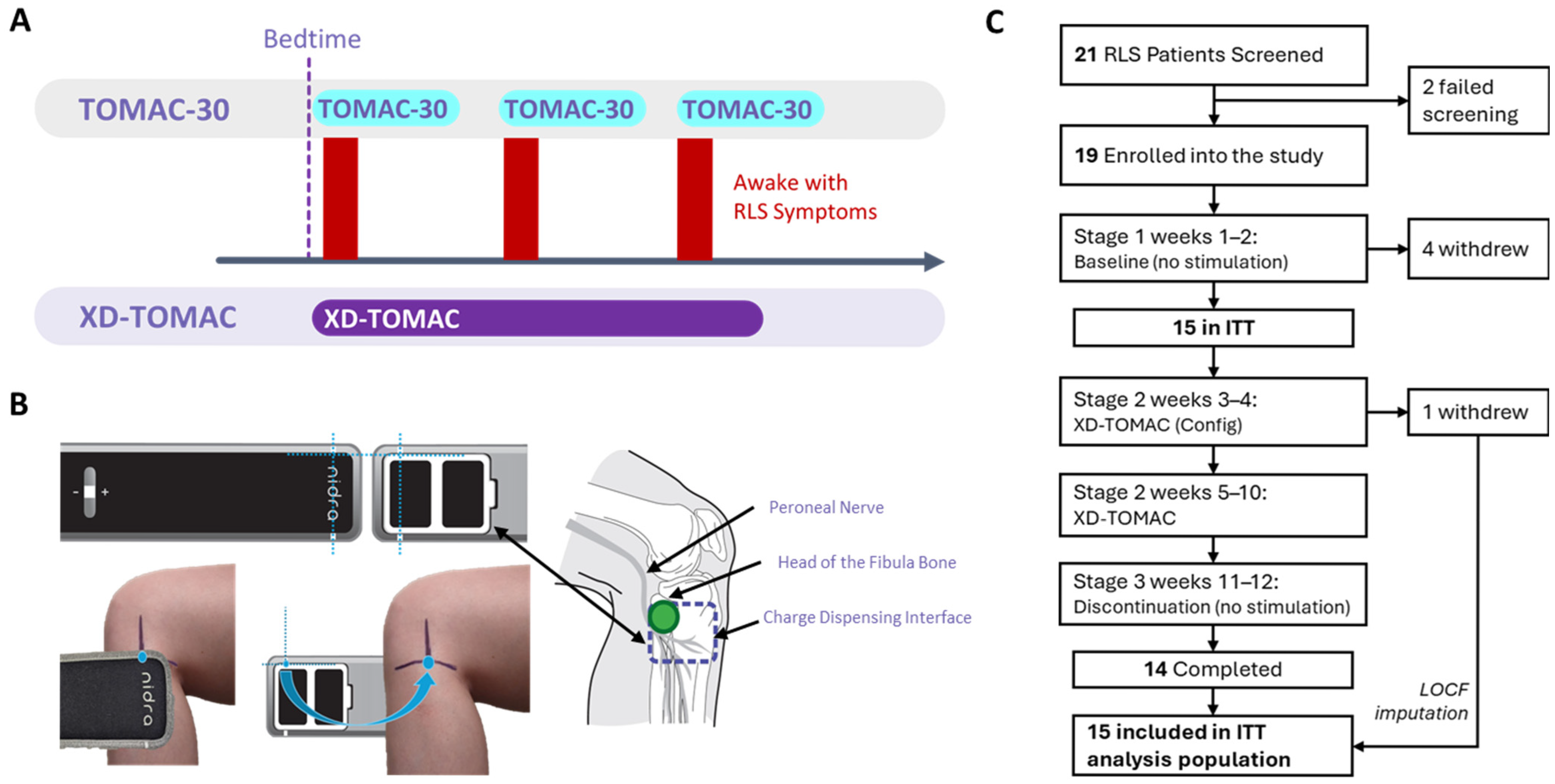
2.2. Study Design
2.3. Investigational Device
2.4. Efficacy Outcome Measures
2.5. Sleep Diary Outcome Measures
2.6. Statistical Analysis
2.7. Safety Analysis
2.8. Exploratory Analysis
3. Results
3.1. Participant Characteristics
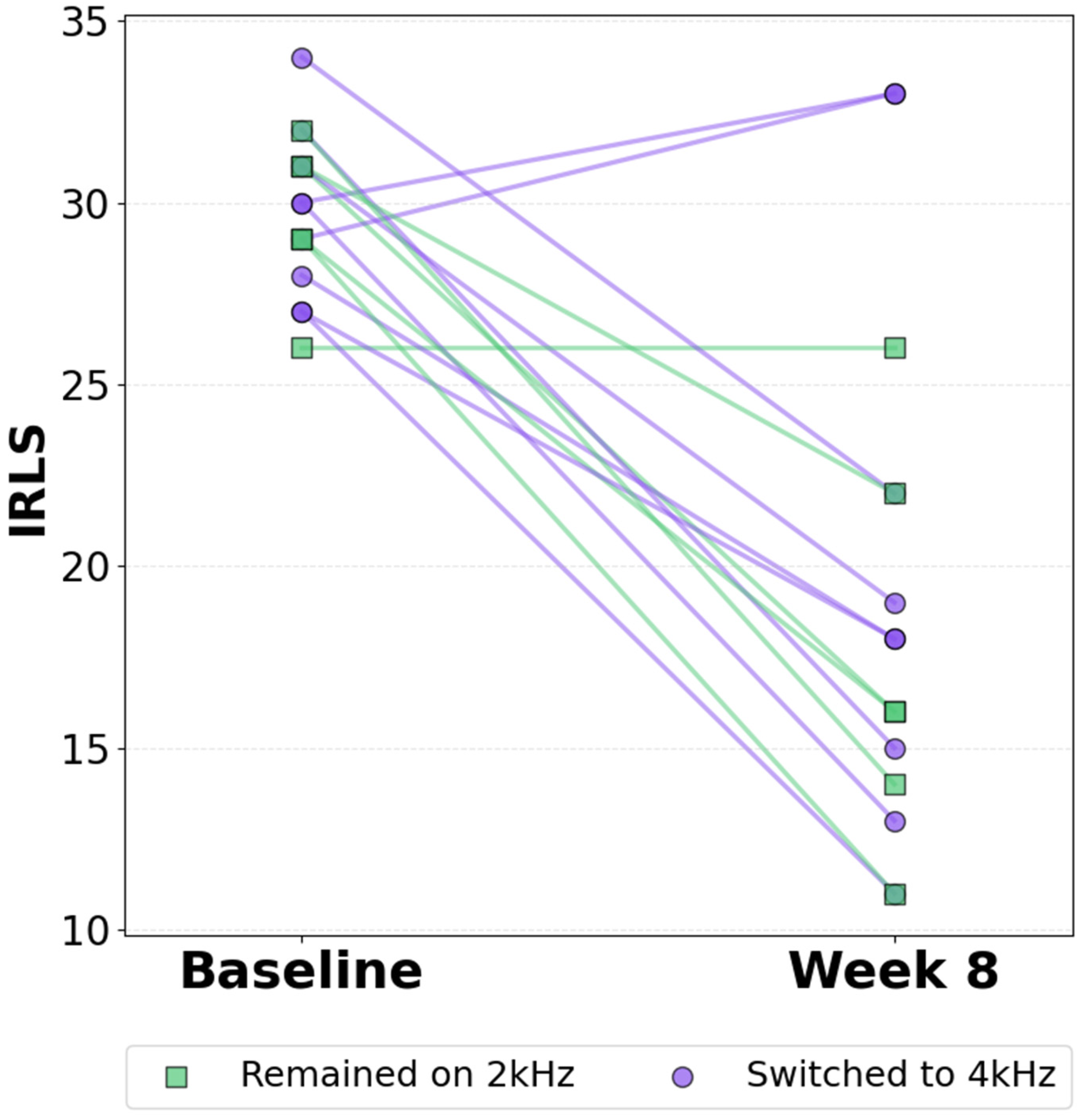
3.2. Primary and Key Secondary Efficacy Endpoints
3.3. Efficacy Outcomes After the 2-Week Post-Treatment Period
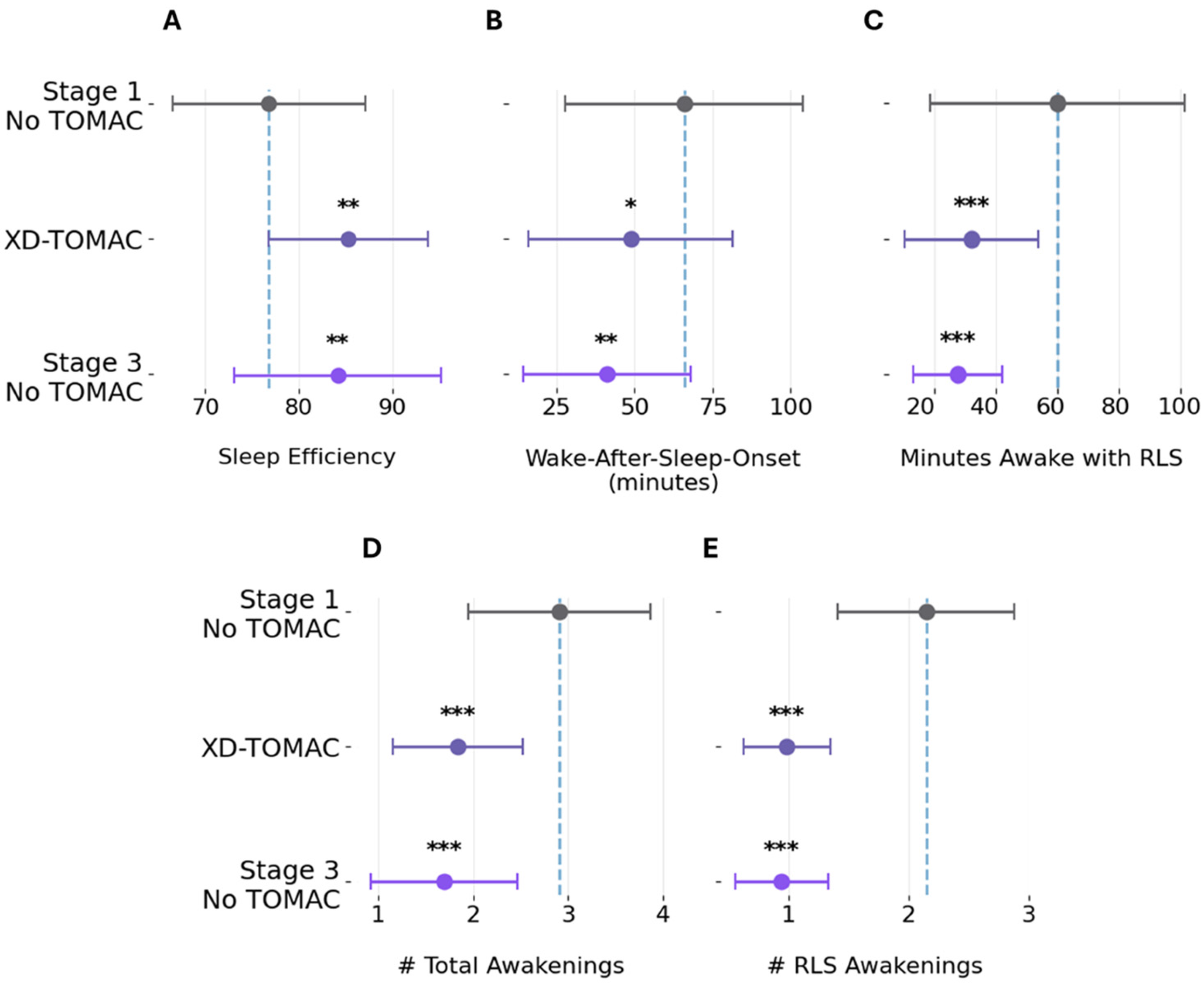
3.4. Sleep Diary Outcomes
3.5. Safety and Tolerability
3.6. Sensitivity Analysis
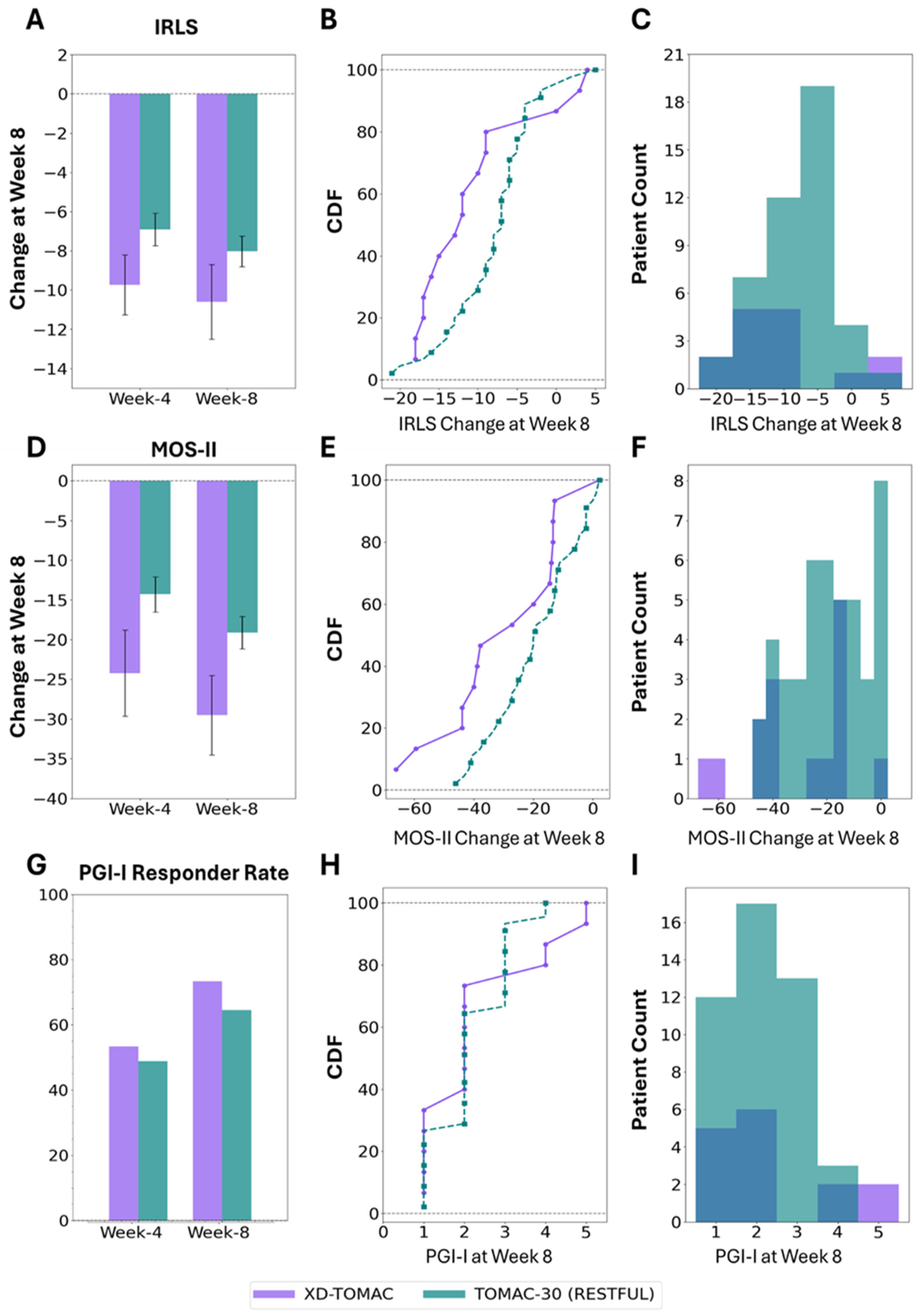
3.7. Comparative Analysis of XD-TOMAC Versus TOMAC-30 Using a Matched Cohort from the RESTFUL Study
4. Discussion
5. Conclusions
Supplementary Materials
Author Contributions
Funding
Institutional Review Board Statement
Informed Consent Statement
Data Availability Statement
Acknowledgments
Conflicts of Interest
Abbreviations
| RLS | Restless Legs Syndrome |
| TOMAC | Tonic Motor Activation |
| XD-TOMAC | Extended-Duration Tonic Motor Activation |
| IRLS | International RLS Study Group Rating Scale |
| MOS | Medical Outcomes Study |
| AASM | American Academy of Sleep Medicine |
| PGI-I | Participant Global Impressions of Improvement |
| SOL | Sleep Onset Latency |
| WASO | Wake After Sleep Onset |
| TIB | Time in Bed |
| TST | Total Sleep Time |
| SE | Sleep Efficiency |
| ITT | Intention To Treat |
| ANCOVA | Analysis of Covariance |
| SD | Standard Deviation |
| CI | Confidence Interval |
| AE | Adverse Event |
| NINDS | National Institute of Neurological Disorders and Stroke |
References
- Abetz, L.; Allen, R.; Follet, A.; Washburn, T.; Early, C.; Kirsch, J.; Knight, H. Evaluating the quality of life of patients with restless legs syndrome. Clin. Ther. 2004, 26, 925–935. [Google Scholar] [CrossRef] [PubMed]
- Bogan, R.K. Effects of restless legs syndrome (RLS) on sleep. Neuropsychiatr. Dis. Treat. 2006, 2, 513–519. [Google Scholar] [CrossRef] [PubMed]
- Zucconi, M.; Manconi, M. Sleep and Quality of Life in Restless Legs Syndrome; Humana Press: Totowa, NJ, USA, 2008. [Google Scholar]
- Zhang, H.; Zhang, Y.; Ren, R.; Yang, L.; Shi, Y.; Vitiello, M.V.; Sanford, L.D.; Tang, X. Polysomnographic features of idiopathic restless legs syndrome: A systematic review and meta-analysis of 13 sleep parameters and 23 leg movement parameters. J. Clin. Sleep Med. 2022, 18, 2661–2676. [Google Scholar] [CrossRef] [PubMed]
- Mullington, J.M.; Haack, M.; Toth, M.; Serrador, J.M.; Meier-Ewert, H.K. Cardiovascular, inflammatory, and metabolic consequences of sleep deprivation. Prog. Cardiovasc. Dis. 2009, 51, 294–302. [Google Scholar] [CrossRef] [PubMed]
- Reynolds, A.C.; Banks, S. Total sleep deprivation, chronic sleep restriction and sleep disruption. Prog. Brain Res. 2010, 185, 91–103. [Google Scholar] [PubMed]
- Silber, M.H.; Buchfuhrer, M.J.; Earley, C.J.; Koo, B.B.; Manconi, M.; Winkelman, J.W. Scientific and Medical Advisory Board of the Restless Legs Syndrome Foundation. The management of restless legs syndrome: An updated algorithm. Mayo Clin. Proc. 2021, 96, 1921–1937. [Google Scholar] [CrossRef] [PubMed]
- Winkelman, J.W.; Berkowski, J.A.; DelRosso, L.M.; Koo, B.B.; Scharf, M.T.; Sharon, D.; Zak, R.S.; Kazmi, U.; Falck-Ytter, Y.; Shelgikar, A.V.; et al. Treatment of restless legs syndrome and periodic limb movement disorder: An American Academy of Sleep Medicine clinical practice guideline. J. Clin. Sleep Med. 2025, 21, 137–152. [Google Scholar] [CrossRef] [PubMed]
- U.S. Food and Drug Administration. FDA Warns About Serious Breathing Problems with Gabapentin and Pregabalin; FDA Drug Safety Communication; U.S. Food and Drug Administration: Silver Spring, MD, USA, 2019. [Google Scholar]
- Oertel, W.H.; Hallström, Y.; Saletu-Zyhlarz, G.M.; Hopp, M.; Bosse, B.; Trenkwalder, C.; RELOXYN Study Group. Sleep and quality of life under prolonged-release oxycodone–naloxone for severe restless legs syndrome: An analysis of secondary efficacy variables of a double-blind, randomized, placebo-controlled study with an open-label extension. CNS Drugs 2016, 30, 749–760. [Google Scholar] [CrossRef] [PubMed]
- Trenkwalder, C.; Beneš, H.; Grote, L.; García-Borreguero, D.; Högl, B.; Hopp, M.; Bosse, B.; Oksche, A.; Reimer, K.; RELOXYN Study Group; et al. Prolonged-release oxycodone–naloxone for treatment of severe restless legs syndrome after failure of previous treatment: A double-blind, randomised, placebo-controlled trial with an open-label extension. Lancet Neurol. 2013, 12, 1141–1150. [Google Scholar] [CrossRef] [PubMed]
- Charlesworth, J.D.; Adlou, B.; Singh, H.; Buchfuhrer, M.J. Bilateral high-frequency noninvasive peroneal nerve stimulation evokes tonic leg muscle activation for sleep-compatible reduction of restless legs syndrome symptoms. J. Clin. Sleep Med. 2023, 19, 1199–1209. [Google Scholar] [CrossRef] [PubMed]
- Buchfuhrer, M.J.; Baker, F.C.; Singh, H.; Kolotovska, V.; Adlou, B.; Anand, H.; de Zambotti, M.; Ismail, M.; Raghunathan, S. Noninvasive neuromodulation reduces symptoms of restless legs syndrome. J. Clin. Sleep Med. 2021, 17, 1685–1694. [Google Scholar] [CrossRef] [PubMed]
- Bogan, R.K.; Roy, A.; Kram, J.; Ojile, J.; Rosenberg, R.; Hudson, J.D.; Scheuller, H.S.; Winkelman, J.W.; Charlesworth, J.D. Efficacy and safety of tonic motor activation (TOMAC) for medication-refractory restless legs syndrome: A randomized clinical trial. Sleep 2023, 46, zsad190. [Google Scholar] [CrossRef] [PubMed]
- Roy, A.; Ojile, J.; Kram, J.; Olin, J.; Rosenberg, R.; Hudson, J.D.; Bogan, R.K.; Charlesworth, J.D. Long-term efficacy and safety of tonic motor activation for treatment of medication-refractory restless legs syndrome: A 24-week open-label extension study. Sleep 2023, 46, zsad191. [Google Scholar] [CrossRef] [PubMed]
- Rigot, S.; Adlou, B.; Kolotovska, V.; Tekchandani, J.; Charlesworth, J.D. Tonic motor activation for restless legs syndrome is compatible with sleep onset and reduces periodic leg movements. Sleep 2024, 47, A304–A305. [Google Scholar] [CrossRef]
- Allen, R.P.; Picchietti, D.L.; Garcia-Borreguero, D.; Ondo, W.G.; Walters, A.S.; Winkelman, J.W.; Zucconi, M.; Ferri, R.; Trenkwalder, C.; International Restless Legs Syndrome Study Group; et al. Restless legs syndrome/Willis–Ekbom disease diagnostic criteria: Updated International Restless Legs Syndrome Study Group (IRLSSG) consensus criteria—History, rationale, description, and significance. Sleep Med. 2014, 15, 860–873. [Google Scholar] [CrossRef] [PubMed]
- Allen, R.P. Minimal clinically significant change for the International Restless Legs Syndrome Study Group rating scale in clinical trials is a score of 3. Sleep Med. 2013, 14, 1229. [Google Scholar] [CrossRef] [PubMed]
- Winkelman, J.W.; Berkowski, J.A.; DelRosso, L.M.; Koo, B.B.; Scharf, M.T.; Sharon, D.; Zak, R.S.; Kazmi, U.; Carandang, G.; Falck-Ytter, Y.; et al. Treatment of restless legs syndrome and periodic limb movement disorder: An American Academy of Sleep Medicine systematic review, meta-analysis, and GRADE assessment. J. Clin. Sleep Med. JCSM Off. Publ. Am. Acad. Sleep Med. 2025, 21, 153–199. [Google Scholar] [CrossRef] [PubMed]
- Patel, A.K.; Reddy, V.; Shumway, K.R.; Araujo, J.F. Physiology, sleep stages. In StatPearls; StatPearls Publishing: Treasure Island, FL, USA, 2024. [Google Scholar]
- Wickström, G.; Bendix, T. The “Hawthorne effect”—What did the original Hawthorne studies actually show? Scand. J. Work Environ. Health 2000, 26, 363–367. [Google Scholar] [CrossRef]



| ITT (n = 15) | |
|---|---|
| Age, years, mean (SD) | 53.3 (16.8) |
| Sex, n (%) | |
| Male | 6 (40) |
| Female | 9 (60) |
| Race/ethnicity, n (%) | |
| White, non-Hispanic | 12 (80) |
| White, Hispanic | 1 (6) |
| Black or African American | 1 (6) |
| Asian | 1 (6) |
| IRLS score, mean (SD) | 29.7 (2.2) |
| Years with RLS, years, mean (SD) | 11.5 (9.9) |
| MOS, mean (SD) | |
| MOS-I Sleep Problems Index | 79.3 (12.8) |
| MOS-II Sleep Problems Index | 67.1 (13.2) |
| Frequency of Symptoms per Week, mean (SD) | |
| RLS symptoms | 6.9 (0.5) |
| Midnight RLS symptoms | 5.9 (1.8) |
| RLS medications, n (%) | |
| None | 9 (60) |
| Alpha-2-delta ligands | 4 (27) |
| Dopamine agonists | 2 (13) |
| Benzodiazepines | 1 (7) |
| Opioid | 1 (7) |
| Stimulation intensity (mA), mean (SD) | 28.4 (3.6) |
| Primary Analysis at End of Stage 2 (Week 8 of XD-TOMAC) vs. Baseline | Exploratory Analysis at End of Stage 3 (After 2 Weeks of XD-TOMAC Discontinuation) vs. Baseline | |
|---|---|---|
| Primary Endpoint | ||
| Change in IRLS score | ||
| n | 15 | 15 |
| Mean | −10.6 | −9.3 |
| SD | 7.4 | 5.3 |
| Min, Max | −18, 4 | −16, 2 |
| 95% CI | −14.3 to −6.9 | −11.9 to −6.6 |
| p-value | <0.001 | <0.001 |
| Effect size | −1.43 | −1.76 |
| Key Secondary Endpoints | ||
| Frequency of RLS symptoms (days per week) | ||
| n | 15 | 15 |
| Mean | −0.7 | −0.4 |
| SD | 1.2 | 0.9 |
| Min, Max | −4, 0 | −3, 0 |
| 95% CI | −1.3 to −0.1 | −0.9 to 0.1 |
| p-value | 0.028 | 0.089 |
| Cohen’s d | −0.57 | −0.44 |
| Change in MOS-II score | ||
| n | 15 | 15 |
| Mean | −29.5 | −24.3 |
| SD | 19.4 | 19.2 |
| Min, Max | −66.1, 2.2 | −61.7, 1.7 |
| 95% CI | −39.4 to 19.7 | −34.0 to −14.6 |
| p-value | <0.001 | <0.001 |
| Cohen’s d | −1.52 | −1.27 |
| Change in MOS-I score | ||
| n | 15 | 15 |
| Mean | −27.1 | −22.0 |
| SD | 19.2 | 17.8 |
| Min, Max | −60.0, 3.3 | −60.0, 6.7 |
| 95% CI | −36.8 to −17.4 | −31.0 to −13.0 |
| p-value | <0.001 | <0.001 |
| Cohen’s d | −1.41 | −1.24 |
| PGI-I Responder | ||
| n | 15 | 15 |
| Responder % | 73 | 67 |
| Responder n | 11 | 10 |
| 95% CI | 48 to 89 | 42 to 85 |
| p-value | <0.001 | <0.001 |
| Number (%) of Participants | ||
|---|---|---|
| All AEs | Device-Related AEs | |
| Any AE | 9 (60.0) | 7 (46.7) |
| Serious AE | 0 | 0 |
| AE severity | ||
| Grade 1 | 9 (60.0) | 7 (46.7) |
| Grade 2 or higher | 0 | 0 |
| MedDRA preferred term | ||
| Discomfort | 4 (26.6) | 4 (26.6) |
| Skin irritation | 1 (6.6) | 1 (6.6) |
| Dry skin | 1 (6.6) | 1 (6.6) |
| Contusion | 1 (6.6) | 1 (6.6) |
| Abdominal discomfort | 1 (6.6) | 0 |
| Back pain | 1 (6.6) | 0 |
| Vomiting | 1 (6.6) | 0 |
Disclaimer/Publisher’s Note: The statements, opinions and data contained in all publications are solely those of the individual author(s) and contributor(s) and not of MDPI and/or the editor(s). MDPI and/or the editor(s) disclaim responsibility for any injury to people or property resulting from any ideas, methods, instructions or products referred to in the content. |
© 2026 by the authors. Licensee MDPI, Basel, Switzerland. This article is an open access article distributed under the terms and conditions of the Creative Commons Attribution (CC BY) license.
Share and Cite
Alawieh, H.; Swartz, K.J.; Rigot, S.K.; Charlesworth, J.D. Efficacy and Tolerability of Extended-Duration Tonic Motor Activation for Treatment of Restless Legs Syndrome with Awakenings During Sleep. J. Clin. Med. 2026, 15, 2845. https://doi.org/10.3390/jcm15082845
Alawieh H, Swartz KJ, Rigot SK, Charlesworth JD. Efficacy and Tolerability of Extended-Duration Tonic Motor Activation for Treatment of Restless Legs Syndrome with Awakenings During Sleep. Journal of Clinical Medicine. 2026; 15(8):2845. https://doi.org/10.3390/jcm15082845
Chicago/Turabian StyleAlawieh, Hussein, Kurtis J. Swartz, Stephanie K. Rigot, and Jonathan D. Charlesworth. 2026. "Efficacy and Tolerability of Extended-Duration Tonic Motor Activation for Treatment of Restless Legs Syndrome with Awakenings During Sleep" Journal of Clinical Medicine 15, no. 8: 2845. https://doi.org/10.3390/jcm15082845
APA StyleAlawieh, H., Swartz, K. J., Rigot, S. K., & Charlesworth, J. D. (2026). Efficacy and Tolerability of Extended-Duration Tonic Motor Activation for Treatment of Restless Legs Syndrome with Awakenings During Sleep. Journal of Clinical Medicine, 15(8), 2845. https://doi.org/10.3390/jcm15082845