Article

Survival Outcomes After irAE-Related Nivolumab Discontinuation in mNSCLC: A Multicenter Study

1
Department of Medical Oncology, Akdeniz University Faculty of Medicine Hospital, Antalya 07070, Turkey
2
Department of Medical Oncology, Medipol University Faculty of Medicine Hospital, Istanbul 34214, Turkey
3
Department of Medical Oncology, Hacettepe University Institute of Oncology, Ankara 06230, Turkey
4
Department of Medical Oncology, Kutahya Health Sciences University Faculty of Medicine Hospital, Kutahya 43100, Turkey
5
Department of Medical Oncology, Memorial Hospital, Antalya 07025, Turkey
*
Author to whom correspondence should be addressed.
J. Clin. Med. 2026, 15(8), 2818; https://doi.org/10.3390/jcm15082818
Submission received: 11 February 2026 / Revised: 21 March 2026 / Accepted: 30 March 2026 / Published: 8 April 2026
(This article belongs to the Section Oncology)

Abstract

Background: Immune checkpoint inhibitors (ICIs) such as nivolumab have transformed the treatment landscape of metastatic non-small cell lung cancer (NSCLC). We aimed to evaluate survival outcomes of patients who developed immune-related adverse events (irAEs) that required permanent treatment discontinuation. Methods: This national, multicenter study included 25 patients with metastatic NSCLC from four tertiary oncology centers in Turkey. All patients received nivolumab monotherapy and discontinued treatment because of irAEs. Long-term survival was analyzed using Kaplan–Meier methods and compared indirectly with historical benchmarks. Results: The median overall survival (OS) was 35.73 months (95% CI: 30.06–41.40). The 2-year and 5-year OS rates were 78.9% and 27.0%, respectively. Median progression-free survival (PFS) was 16.23 months. Pneumonitis was the most frequent irAE (48%). Liver metastases significantly reduced OS (23.93 vs. 38.50 months, p = 0.005). In univariate analysis, ECOG 2 status (HR:22.07), bone metastases (HR:3.52), and subsequent systemic therapy (HR:30.19) weresignificant predictors of progression. Conclusions: Patients with metastatic NSCLC who discontinue nivolumab due to irAEs achieve notable survival outcomes, suggesting that treatment-limiting toxicity may signal a robust and durable antitumor immune response. These findings, though limited by a small cohort, highlight a distinct responder phenotype in real-world clinical practice.

1. Introduction

The advent of immune checkpoint inhibitors (ICIs), particularly programmed cell death-1 (PD-1) inhibitors such as nivolumab, has fundamentally transformed the treatment landscape of metastatic non-small cell lung cancer (NSCLC). Despite the durable survival benefit demonstrated in pivotal clinical trials, including CheckMate 017 and CheckMate 057, a substantial proportion of patients fail to achieve long-term benefits, highlighting the unmet need for reliable and easily applicable clinical biomarkers [1,2,3]. The development of immune-related adverse events (irAEs) is often considered an off-target effect of an activated immune system, suggesting a potential correlation between toxicity and treatment efficacy [4,5,6]. This association is hypothesized to stem from shared antigens between the tumor and healthy tissues, where an overactive immune response targets both, thereby signaling a more robust anti-tumor effect [5].
Currently, programmed death-ligand 1 (PD-L1) expression and tumor mutational burden (TMB) are the most widely used predictive biomarkers for immunotherapy; however, their predictive performance remains suboptimal and inconsistent in real-world clinical practice. In this context, increasing attention has been directed toward immune-related adverse events (irAEs), which are thought to reflect heightened immune activation and may serve as surrogate markers of antitumor immune response [6,7,8]. The systematic review by Petrelli et al. has further solidified this link, showing that the presence of irAEs is significantly associated with improved progression-free and overall survival across various cancer types [4].
While long-term follow-up of pivotal trials suggests a positive association between irAEs and survival [3,9], real-world data—especially for patients forced to permanently discontinue therapy—remains limited [10,11]. Managing the delicate balance between therapeutic benefit and severe toxicity remains a major challenge in clinical oncology. Patients who must stop treatment early due to irAEs represent a unique subgroup where the “primed” immune system may continue to exert anti-tumor pressure even in the absence of continued drug exposure [7,12]. This study evaluated survival outcomes in a multicenter, real-world setting for patients with metastatic NSCLC who developed irAEs during nivolumab monotherapy and discontinued treatment as a result.

2. Materials and Methods

This national, multicenter, retrospective study included patients from four tertiary oncology centers in Turkey treated between 2015–2024. The eligibility criteria included patients aged ≥18 years with histologically confirmed stage 4 NSCLC. To be included in the study, patients must have received at least one dose of nivolumab monotherapy, experienced permanent treatment discontinuation specifically due to irAE(s), and had complete follow-up data available in medical records. Patients receiving combination immunotherapy or those with insufficient follow-up data were excluded. The study was designed as a descriptive multicenter experience to evaluate long-term outcomes in this specific patient subgroup.
Clinicopathological data were collected from electronic medical records. The collected data included age, gender, smoking history, ECOG performance status, histological subtype, presence of brain or liver metastases, and the line of therapy. IrAEs were defined as suspected immunologic etiologies requiring monitoring or immunosuppressive treatment and were graded according to CTCAE v5.0. While all types of immune-related toxicities leading to permanent discontinuation were documented, clinically significant events such as pneumonitis, colitis, and hepatitis were closely monitored due to their potential for severe morbidity in this patient population.
The primary endpoint was progression-free survival (PFS), and the secondary endpoint was overall survival (OS). PFS was defined as the time from the first dose of nivolumab to disease progression or death from any cause. OS was defined as the time from the first dose of nivolumab to death from any cause.Survival curves were estimated using the Kaplan–Meier method with log-rank tests. Due to the small sample size (n = 25), statistical analysis was primarily limited to univariate methods to avoid model instability and overfitting. Variables with a p-value < 0.1 in univariate screening were further evaluated to identify clinical trends. A two-sided p-value < 0.05 was considered significant.
During the preparation of this manuscript, the authors utilized Artificial Intelligence (AI) specifically for language editing, stylistic refinement, translation of data tables and assistance with reference formatting. These tools were employed solely to enhance the clarity, readability, and academic flow of the text. All scientific content, data interpretation, and conclusions were developed and verified by the authors. The authors take full responsibility for the accuracy and integrity of the manuscript.
This study was conducted in accordance with the principles of the Declaration of Helsinki and Good Clinical Practice guidelines. Approval was obtained from the Akdeniz University Faculty of Medicine Clinical Research Ethics Committee (Date: 31 October 2024; Decision No: 722). Owing to the retrospective nature of the study, the requirement for individual informed consent was waived by the ethics committee. To support the reproducibility of our findings, de-identified data will be made available to other researchers upon reasonable request.

3. Results

A total of 25 patients were included. The median age was 62 years (range: 39–81), with 60% being over age 60. Most patients had an Eastern Cooperative Oncology Group (ECOG) Performance Status (PS) score of 0–1 (92%). Adenocarcinoma was the most common histological type (56%). Metastatic sites included lung (68%), bone (48%), liver (24%), and CNS (24%). De novo metastatic disease was present in 64% of cases. Regarding PD-L1 levels, 45.8% were <1%, 16.7% were 1–49%, and 16.7% were >49% (Table 1).
The most frequent irAE was pneumonitis (48%), followed by colitis (24%) and dermatologic toxicity (12%). Other events included adrenalitis, hepatitis, myositis, and hematologic toxicity (4% each). The severity was grade 2 in 44%, grade 3 in 44%, and grade 4 in 8% of the irAEs (Table 1).
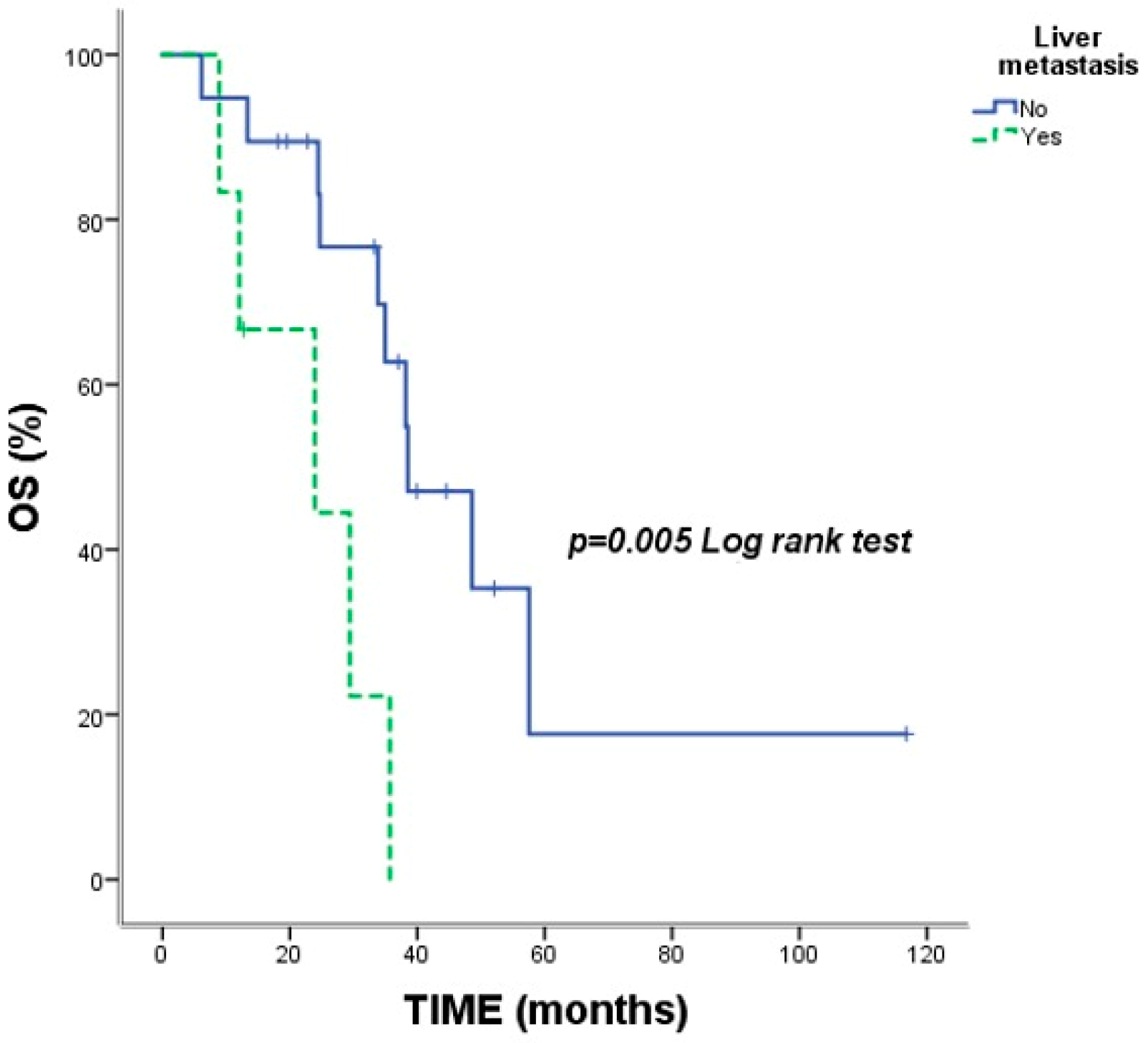
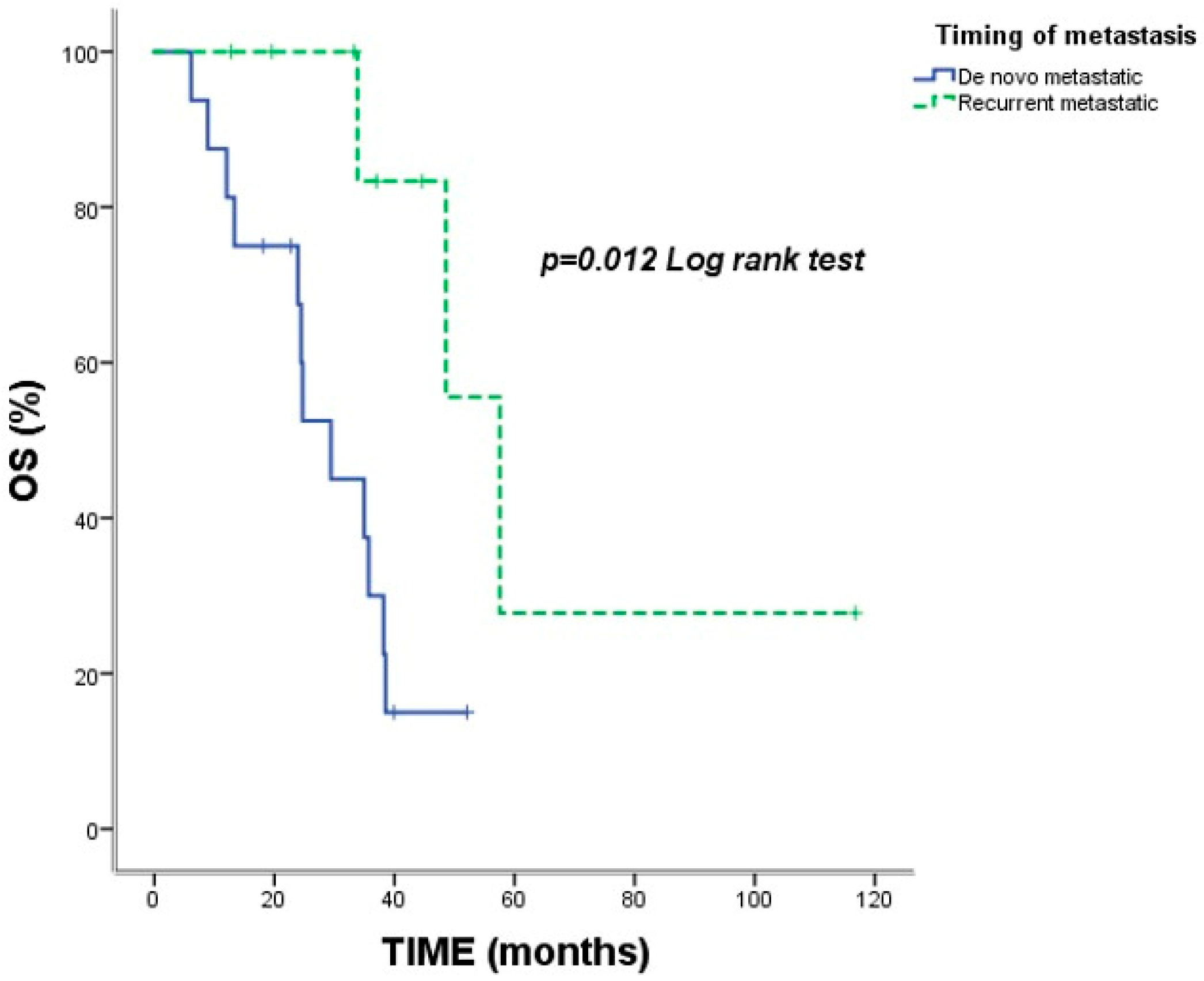
Median OS for the entire cohort was 35.73 months (95% CI: 30.06–41.40). The estimated 2-year and 5-year OS rates were 78.9% and 27.0%, respectively. Significantly shorter OS was observed in patients with liver metastases (23.93 vs. 38.50 months; p = 0.005) (Figure 1) and de novo metastatic disease (29.43 vs. 57.56 months; p = 0.012) (Figure 2) (Table 2).
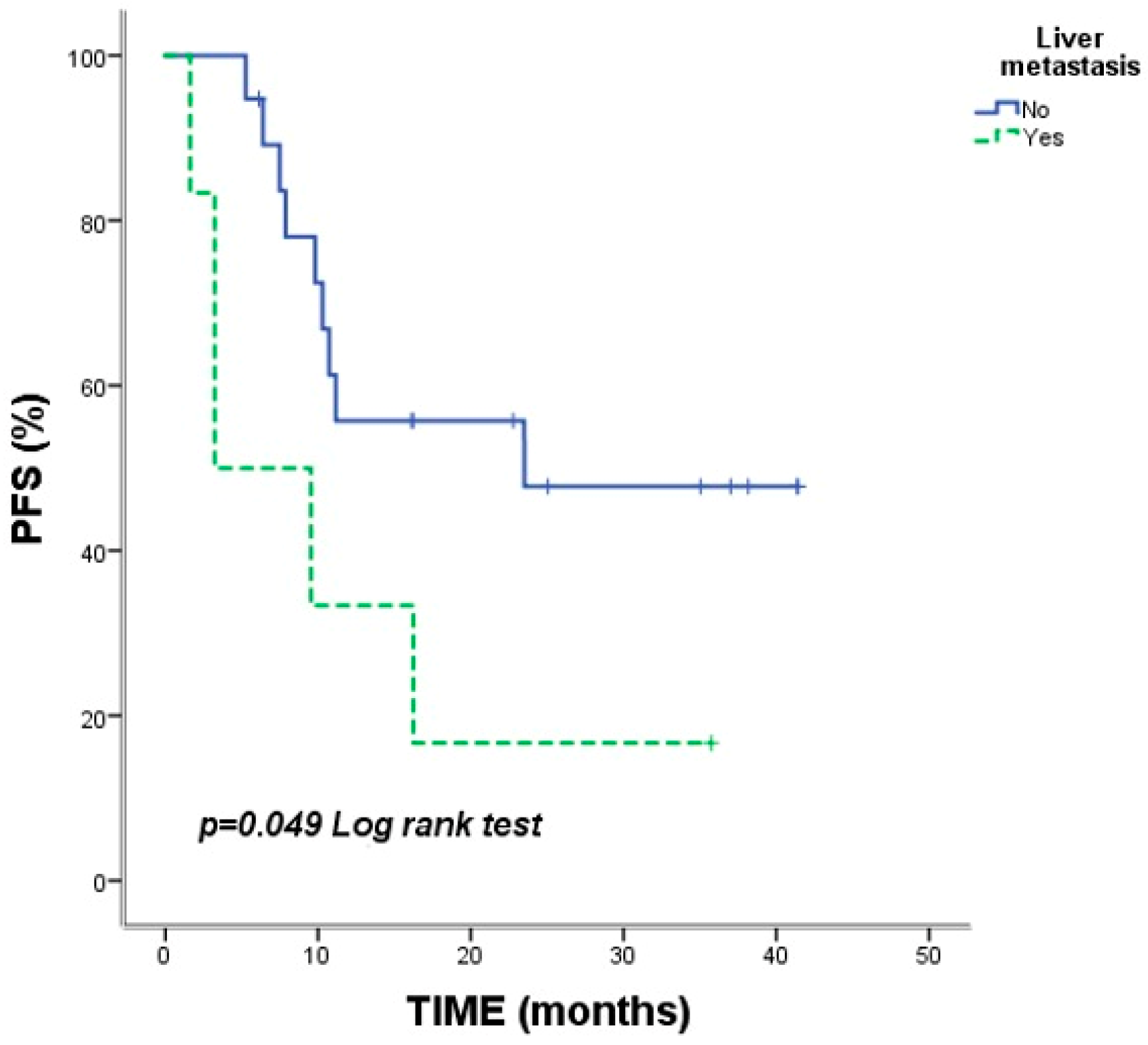
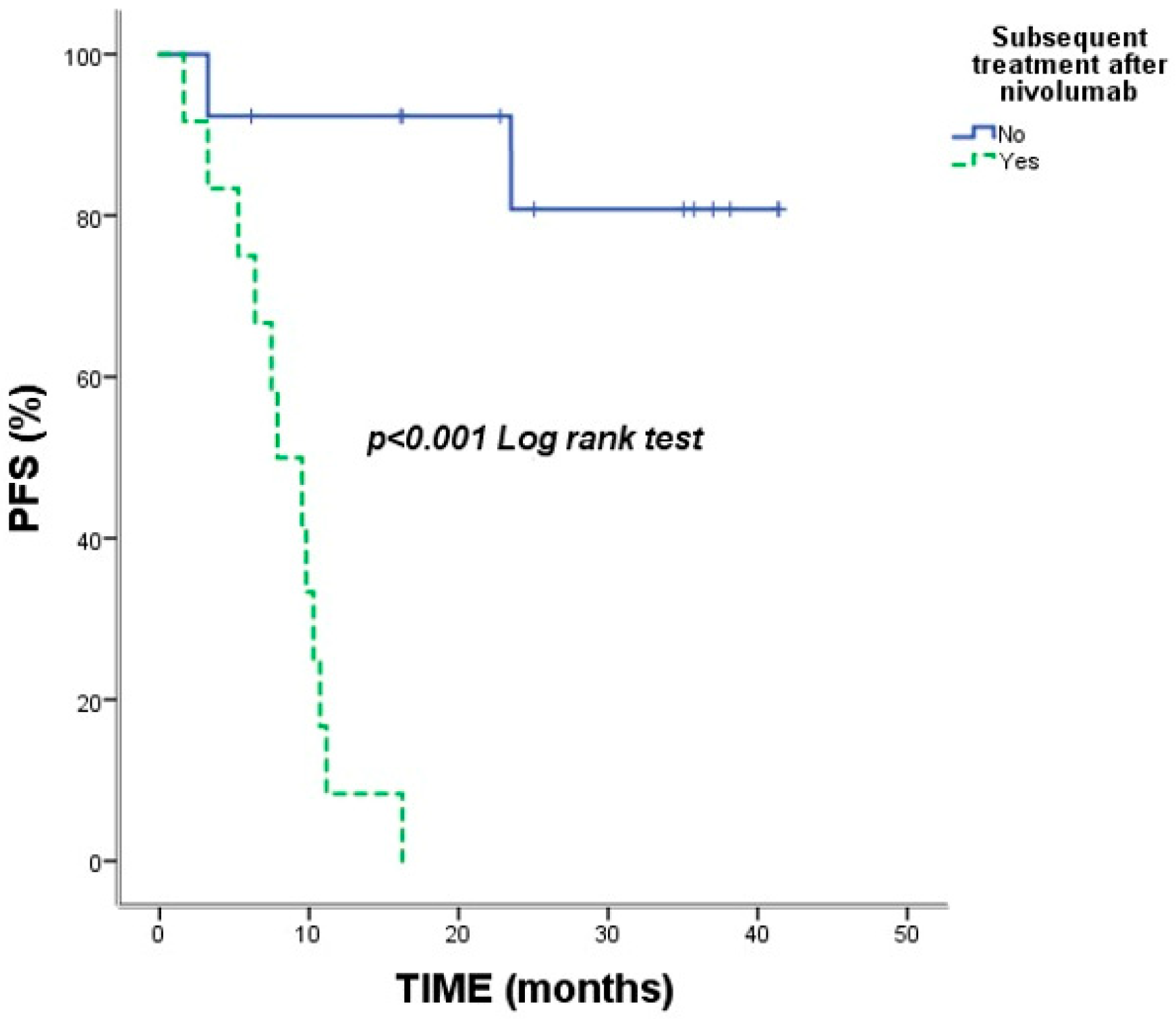
Median PFS was 16.23 months (95% CI: 2.05–30.40), with a 2-year PFS rate of 40.1%. Inferior PFS was associated with ECOG PS score of 2 (p = 0.001), liver metastases (p = 0.049) (Figure 3), subsequent treatment after nivolumab (p < 0.001) (Figure 4) and bone metastases (p = 0.018). Patients with a partial response to nivolumab had significantly longer PFS (p = 0.009) (Table 3).
In the univariate analysis, several clinical factors were associated with a significantly increased risk of disease progression. These factors included an ECOG PS score of 2 (p = 0.015), the presence of bone metastases (p = 0.026), and the requirement for subsequent systemic therapy following nivolumab discontinuation (p = 0.001) (Table 4). Given the small cohort size (n = 25), these variables were interpreted as descriptive indicators of clinical outcome rather than independent predictors in a multivariate model, to avoid the risk of statistical overfitting.

4. Discussion

In this real-world, multicenter study, patients with metastatic NSCLC who discontinued nivolumab due to irAEs demonstrated a median OS of 35.73 months and a 5-year OS rate of 27.0%. These results are numerically superior to landmark trials, such as CheckMate 017 and 057, where the 5-year OS for nivolumab-treated patients was approximately 13.4% [3]. Our observed 2-year PFS rate of 40.1% and 2-year OS of 78.9% also exceed the outcomes reported in these pivotal trials [1,2,3]. This notable difference suggests that patients who develop treatment-limiting toxicity may represent a distinct “prolonged-responder” phenotype. These findings align with Haratani et al. and recent meta-analyses, which identified irAE development as a clinical surrogate for robust anti-tumor immunity [4,6].
The survival benefit observed despite permanent treatment discontinuation supports the “hit-and-run” hypothesis. It has been suggested that once the immune system is sufficiently primed and achieves a “therapeutic threshold”—as evidenced by clinical irAEs—the induced T-cell memory appears capable of sustaining long-term disease control without the need for continuous PD-1 inhibition [7,10,11,12]. This ‘memory’ effect may explain the long-term survival plateaus observed in our cohort despite the early cessation of therapy [5,7,12].
In our cohort, pneumonitis was the most frequent irAE (48%), and these patients achieved a noteworthy median OS of 48.56 months. This is consistent with findings by Suresh et al., indicating that appropriately managed ICI-induced pneumonitis can correlate with favorable clinical outcomes [13]. Conversely, even within this immune-reactive cohort, liver metastases remained a negative prognostic indicator (mOS 23.9 months), likely due to the liver’s unique immunosuppressive microenvironment [14]. Furthermore, we observed that patients requiring rapid initiation of subsequent systemic therapy following discontinuation had poorer outcomes. This likely reflects a more aggressive underlying tumor biology in a subset of patients who fail to achieve the sustained ‘hit-and-run’ effect typically seen in long-term survivors [15].
Our findings align with several large-scale studies and systematic reviews that have reported a positive association between irAE development and improved survival in NSCLC [4,8,9]. For instance, Santini et al. demonstrated that patients experiencing irAEs had significantly longer OS compared to those who did not [8]. Similarly, Owen et al. highlighted that this association remains consistent across different types of immune checkpoint inhibitors [9]. The comprehensive review by Michot et al. further underscores the complex but often beneficial relationship between immune-mediated toxicity and anti-tumor efficacy [7].
Despite these encouraging observations, our study has several limitations. The retrospective, single-arm design and the relatively small sample size (n = 25) limit the generalizability of the findings and the statistical power for comparative analysis. Due to the cohort size, we focused on descriptive and univariate analyses to ensure statistical stability, as multivariate models in small samples can lead to unstable hazard ratios. Furthermore, we were unable to perform a robust statistical analysis on the relationship between time to irAE onset and survival outcomes, which remains a topic of significant interest in the literature [5,16]. Additionally, our results may be subject to guarantee-time bias (or lead-time bias); since patients must survive long enough to develop an irAE to be included, there is a risk of overestimating the survival benefit. However, the magnitude of the 5-year survival rate suggests a biological effect that potentially transcends this bias. Finally, the lack of an internal control group of irAE-negative patients prevents direct hazard ratio comparisons. Nevertheless, this multicenter real-world data provides valuable clinical insights into the long-term survival of patients who must discontinue immunotherapy due to toxicity.

5. Conclusions

Patients with metastatic NSCLC who discontinue nivolumab due to irAEs exhibit promising survival that far exceeds historical benchmarks. Our finding of a 27% 5-year OS rate suggests that treatment-limiting irAEs are a powerful surrogate for durable immune responses. Clinicians should recognize that while these events require management, they often herald a favorable long-term prognosis, even after therapy cessation.

Author Contributions

Conceptualization and methodology, A.M.C. and S.S.G.; software, A.M.C.; validation, A.M.T. and S.S.G.; formal analysis, A.M.C.; investigation, A.M.C., M.E. (Mustafa Ersoy), L.K., A.B., M.E. (Mustafa Erman) and M.H.Y.; resources, A.M.C., M.E. (Mustafa Ersoy), L.K., A.B., M.E. (Mustafa Erman) and M.H.Y.; data curation, A.M.C., A.M.T., A.B., M.E. (Mustafa Ersoy) and S.S.G.; writing—original draft preparation, A.M.C.; writing—review and editing, A.M.C.; visualization, A.M.C.; supervision, A.M.T. and S.S.G.; project administration, A.M.C. All authors have read and agreed to the published version of the manuscript.

Funding

This research received no external funding.

Institutional Review Board Statement

This study was conducted in accordance with the principles of the Declaration of Helsinki and Good Clinical Practice guidelines. Approval was obtained from the Akdeniz University Faculty of Medicine Clinical Research Ethics Committee (Date: 31 October 2024; Decision No: 722).

Informed Consent Statement

Patient consent was waived due to retrospective nature by the ethics committee.

Data Availability Statement

The data presented in this study are available on request from the corresponding author. The data are not publicly available due to privacy and ethical restrictions regarding patient confidentiality.

Acknowledgments

The authors would like to acknowledge the use of Artificial Intelligence (AI) for linguistic assistance and translation of research data tables during the drafting of this paper. The authors confirm that the final scientific content and conclusions were independently verified and remain their sole responsibility.

Conflicts of Interest

The authors declare no conflicts of interest.

References

  1. Borghaei, H.; Paz-Ares, L.; Horn, L.; Spigel, D.R.; Steins, M.; Ready, N.E.; Chow, L.Q.; Vokes, E.E.; Felip, E.; Holgado, E.; et al. Nivolumab versus Docetaxel in Advanced Nonsquamous Non-Small-Cell Lung Cancer. N. Engl. J. Med. 2015, 373, 1627–1639. [Google Scholar] [CrossRef] [PubMed]
  2. Brahmer, J.; Reckamp, K.L.; Baas, P.; Crinò, L.; Eberhardt, W.E.; Poddubskaya, E.; Antonia, S.; Pluzanski, A.; Vokes, E.E.; Holgado, E.; et al. Nivolumab versus Docetaxel in Advanced Squamous-Cell Non–Small-Cell Lung Cancer. N. Engl. J. Med. 2015, 373, 123–135. [Google Scholar] [CrossRef] [PubMed]
  3. Borghaei, H.; Gettinger, S.; Vokes, E.E.; Chow, L.Q.M.; Burgio, M.A.; Carpeno, J.d.C.; Pluzanski, A.; Arrieta, O.; Frontera, O.A.; Chiari, R.; et al. Five-Year Outcomes From the Randomized, Phase III Trials CheckMate 017 and 057: Nivolumab Versus Docetaxel in Previously Treated Non–Small-Cell Lung Cancer. J. Clin. Oncol. 2021, 39, 723–733. [Google Scholar] [CrossRef] [PubMed]
  4. Petrelli, F.; Grizzi, G.; Ghidini, M.; Ghidini, A.; Ratti, M.; Panni, S.; Cabiddu, M.; Ghilardi, M.; Borgonovo, K.; Parati, M.C.; et al. Immune-related Adverse Events and Survival in Solid Tumors Treated With Immune Checkpoint Inhibitors: A Systematic Review and Meta-Analysis. J. Immunother. 2019, 43, 1–7. [Google Scholar] [CrossRef] [PubMed]
  5. Postow, M.A.; Sidlow, R.; Hellmann, M.D. Immune-Related Adverse Events Associated with Immune Checkpoint Blockade. N. Engl. J. Med. 2018, 378, 158–168. [Google Scholar] [CrossRef] [PubMed]
  6. Haratani, K.; Hayashi, H.; Chiba, Y.; Kudo, K.; Yonesaka, K.; Kato, R.; Kaneda, H.; Hasegawa, Y.; Tanaka, K.; Takeda, M.; et al. Association of Immune-Related Adverse Events with Nivolumab Efficacy in Non–Small-Cell Lung Cancer. JAMA Oncol. 2018, 4, 374–378. [Google Scholar] [CrossRef] [PubMed]
  7. Michot, J.M.; Bigenwald, C.; Champiat, S.; Collins, M.; Carbonnel, F.; Postel-Vinay, S.; Berdelou, A.; Varga, A.; Bahleda, R.; Hollebecque, A.; et al. Immune-related adverse events with immune checkpoint blockade: A comprehensive review. Eur. J. Cancer 2016, 54, 139–148. [Google Scholar] [CrossRef] [PubMed]
  8. Zhao, Z.; Wang, X.; Qu, J.; Zuo, W.; Tang, Y.; Zhu, H.; Chen, X. Immune-Related Adverse Events Associated With Outcomes in Patients With NSCLC Treated With Anti-PD-1 Inhibitors: A Systematic Review and Meta-Analysis. Front. Oncol. 2021, 11, 708195. [Google Scholar] [CrossRef] [PubMed]
  9. Owen, D.H.; Wei, L.; Bertino, E.M.; Edd, T.; Villalona-Calero, M.A.; He, K.; Shields, P.G.; Carbone, D.P.; Otterson, G.A. Incidence, Risk Factors, and Effect on Survival of Immune-related Adverse Events in Patients With Non–Small-cell Lung Cancer. Clin. Lung Cancer 2018, 19, e893–e900. [Google Scholar] [CrossRef] [PubMed]
  10. Ricciuti, B.; Genova, C.; De Giglio, A.; Bassanelli, M.; Bello, M.G.D.; Metro, G.; Brambilla, M.; Baglivo, S.; Grossi, F.; Chiari, R. Impact of immune-related adverse events on survival in patients with advanced non-small cell lung cancer treated with nivolumab: Long-term outcomes from a multi-institutional analysis. J. Cancer Res. Clin. Oncol. 2018, 145, 479–485. [Google Scholar] [CrossRef] [PubMed]
  11. Schadendorf, D.; Wolchok, J.D.; Hodi, F.S.; Chiarion-Sileni, V.; Gonzalez, R.; Rutkowski, P.; Grob, J.-J.; Cowey, C.L.; Lao, C.D.; Chesney, J.; et al. Efficacy and safety outcomes in patients with advanced melanoma who discontinued treatment with nivolumab and ipilimumab because of adverse events: A pooled analysis of randomized phase II and III trials. J. Clin. Oncol. 2017, 35, 3807–3814. [Google Scholar] [CrossRef] [PubMed]
  12. Weber, J.S.; Kähler, K.C.; Hauschild, A. Management of Immune-Related Adverse Events and Kinetics of Response With Ipilimumab. J. Clin. Oncol. 2012, 30, 2691–2697. [Google Scholar] [CrossRef] [PubMed]
  13. Suresh, K.; Psoter, K.J.; Voong, K.R.; Shankar, B.; Forde, P.M.; Ettinger, D.S.; Marrone, K.A.; Kelly, R.J.; Hann, C.L.; Levy, B.; et al. Impact of Checkpoint Inhibitor Pneumonitis on Survival in NSCLC Patients Receiving Immune Checkpoint Immunotherapy. J. Thorac. Oncol. 2019, 14, 494–502. [Google Scholar] [CrossRef] [PubMed]
  14. Tumeh, P.C.; Hellmann, M.D.; Hamid, O.; Tsai, K.K.; Loo, K.L.; Gubens, M.A.; Rosenblum, M.; Harview, C.L.; Taube, J.M.; Handley, N.; et al. Liver Metastasis and Treatment Outcome with Anti-PD-1 Monoclonal Antibody in Patients with Melanoma and NSCLC. Cancer Immunol. Res. 2017, 5, 417–424. [Google Scholar] [CrossRef] [PubMed]
  15. Ricciuti, B.; Metro, G.; Baglivo, S.; Colabrese, D.; Chiari, R.; Bennati, C.; Paglialunga, L. Long-Lasting Response to Nivolumab and Immune-Related Adverse Events in a Nonsquamous Metastatic Non–Small Cell Lung Cancer Patient. J. Thorac. Oncol. 2017, 12, e51–e55. [Google Scholar] [CrossRef] [PubMed]
  16. Sato, K.; Akamatsu, H.; Murakami, E.; Sasaki, S.; Kanai, K.; Hayata, A.; Tokudome, N.; Akamatsu, K.; Koh, Y.; Yamamoto, N. Correlation between immune-related adverse events and efficacy in non-small cell lung cancer treated with nivolumab. Lung Cancer 2018, 115, 71–74. [Google Scholar] [CrossRef] [PubMed]
Figure 1. Kaplan–Meier survival curves according to liver metastasis status. Vertical tick marks indicate censored observations. p-value was calculated using the log-rank test.
Jcm 15 02818 g001
Figure 2. Kaplan–Meier overall survival (OS) curves according to timing of metastasis (de novo vs. recurrent). Vertical tick marks indicate censored observations. The p-value was calculated using the log-rank test.
Jcm 15 02818 g002
Figure 3. Kaplan–Meier progression-free survival (PFS) curves according to liver metastasis status. Vertical tick marks indicate censored observations. The p-value was calculated using the log-rank test.
Jcm 15 02818 g003
Figure 4. Kaplan–Meier curves for progression-free survival (PFS) according to subsequent treatment after nivolumab (yes vs. no). Vertical tick marks represent censored observations (patients without progression or lost to follow-up at the time of analysis). The p-value was derived from the log-rank test.
Jcm 15 02818 g004
Table 1. Distribution of Sociodemographic and Clinical Characteristics.
VariablesN%
Age
Mean ± SD60.44 ± 9.87
Median (min–max)62.0 (39–81)
<601040.0
>601560.0
ECOG Performance Status
01040.0
11352.0
228.0
Smoking Status
Former smoker2187.5
Current smoker312.5
Histology
Adenocarcinoma1456.0
SCC (Squamous Cell Carcinoma)832.0
Other312.0
Lung Metastasis
No832.0
Yes1768.0
Liver Metastasis
No1976.0
Yes624.0
Bone Metastasis
No1352.0
Yes1248.0
CNS Metastasis
No1976.0
Yes624.0
Adrenal Metastasis
No2288.0
Yes312.0
irAEs During Nivolumab Treatment
Pneumonitis1248.0
Colitis624.0
Adrenalitis14.0
Hepatitis14.0
Myositis14.0
Hematological14.0
Dermatological312.0
irAE Grade
Grade-114.0
Grade-21144.0
Grade-31144.0
Grade-428.0
Timing of Metastasis
De novo metastatic1664.0
Recurrent metastatic936.0
Prior Therapies for Stage IV
0 (None)416.0
1 line1872.0
2 lines312.0
PD-L1 Levels
<1%1145.8
1–49%416.7
>49%416.7
Unknown520.8
Response to Nivolumab
SD (Stable Disease)520.0
PR (Partial Response)1664.0
PD (Progressive Disease)416.0
Subsequent Therapy after Nivolumab
No1352.0
Yes1248.0
Progression
No1144.0
Yes1456.0
Mortality
Alive1040.0
Dead1560.0
Follow up (months)
Mean ± SD33.08 ± 22.14
Median (min–max)33.26 (6.13–116.77)
Table 2. Overall Survival (OS) Analysis.
Variables2-Year OS (%)5-Year OS (%)Median OS (Months) (95% CI)p
Overall78.927.035.73 (30.06–41.40)
Age
<6080.0-38.16 (31.66–44.65)0.823
>6076.612.834.96 (25.20–44.73)
ECOG Performance Status
080.026.757.56 (33.37–81.75)0.124
183.1-34.96 (22.55–47.37)
2--12.06 (Not Reached)
Smoking Status
Former Smoker (Quit)80.717.438.16 (25.10–51.22)0.179
Current Smoker--24.70 (24.32–25.07)
Histology
Adenocarcinoma69.840.738.16 (18.46–57.84)0.694
SCC87.5-38.83 (25.10–42.56)
Other100.0-48.56 (Not Reached)
Lung Metastasis
No62.533.335.73 (18.42–53.08)0.660
Yes88.2-34.96 (28.28–41.65)
Liver Metastasis
No89.517.638.50 (25.27–51.42)0.005
Yes44.4-23.93 (0.67–47.19)
Bone Metastasis
No83.923.038.16 (26.15–50.18)0.344
Yes74.1-33.83 (18.92–48.73)
CNS Metastasis
No84.210.535.73 (30.43–41.03)0.620
Yes66.7-33.83 (Not Reached)
Adrenal Metastasis
No80.4-38.16 (32.41–43.91)0.833
Yes66.733.329.43 (1.64–57.22)
irAEs During Nivolumab
Pneumonitis91.7-48.56 (27.70–69.43)0.221
Colitis62.5-29.43 (17.95–40.91)
Others71.435.734.96 (11.50–58.42)
irAE Grade
Grade-291.721.848.56 (24.36–72.76)0.137
Grade-371.6-29.43 (22.01–36.85)
Grade-450.0-13.36 (Not Reached)
Timing of Metastasis
De novo metastatic67.5-29.43 (20.79–38.07)0.012
Recurrent metastatic100.027.857.56 (42.80–72.32)
Initial Response to Nivolumab
SD60.0-24.70 (0.00–58.55)0.198
PR85.928.938.50 (34.01–42.99)
PD75.0-33.83 (1.24–66.41)
Subsequent Therapy
Not Received92.320.838.50 (37.66–39.33)0.155
Received65.6-24.70 (16.89–32.50)
Bold values indicate statistically significant p-values (p < 0.05).
Table 3. Progression-Free Survival (PFS) Analysis.
Variables2-Year PFS (%)Median PFS (Months) (95% CI)p
Overall40.116.23 (2.05–30.40)
Age
<6030.011.66 (9.91–12.42)0.827
>6046.716.23 (Not Reached)
ECOG Performance Status
050.010.73 (Not Reached)0.001
140.323.50 (4.32–42.67)
2-3.23 (Not Reached)
Smoking Status
Former Smoker (Quit)50.4-0.212
Current Smoker-10.30 (2.24–18.35)
Histology
Adenocarcinoma45.516.23 (Not Reached)0.508
SCC25.09.53 (6.16–12.90)
Other66.7-
Lung Metastasis
No37.516.23 (0.00–33.92)0.848
Yes44.311.16 (8.02–14.30)
Liver Metastasis
No47.823.50 (Not Reached)0.049
Yes16.73.23 (0.00–9.55)
Bone Metastasis
No60.6-0.018
Yes14.17.86 (4.25–11.48)
CNS Metastasis
No48.323.50 (Not Reached)0.409
Yes16.710.73 (9.09–12.37)
Adrenal Metastasis
No40.716.23 (0.00–32.55)0.582
Yes33.39.53 (0.00–19.61)
irAEs During Nivolumab
Pneumonitis54.5-0.427
Colitis16.79.53 (0.00–25.13)
Others42.911.16 (7.65–14.67)
irAE Grade
Grade-266.7-0.190
Grade-320.510.73 (8.94–12.52)
Grade-4-9.80 (Not Reached)
Timing of Metastasis
De novo metastatic30.511.16 (3.78–18.54)0.531
Recurrent metastatic55.6-
Initial Response to Nivolumab
SD-9.53 (2.97–16.08)0.009
PR53.0-
PD25.03.23 (Not Reached)
Subsequent Therapy
Not Received80.8-<0.001
Received-7.86 (4.41–11.31)
Bold values indicate statistically significant p-values (p < 0.05).
Table 4. Univariate Cox Regression Analysis for Progression Risk.
Variablesn (%)HR (95% Cl)p
ECOG Status 0.004
04 (16%)reference
114 (56%)0.98 (0.31–3.09)0.974
27 (28%)22.07 (1.82–266.47)0.015
Bone Metastasis
No21 (84%)reference0.026
Yes4 (16%)3.52 (1.16–10.69)
Subsequent Therapy
No15 (60%)reference0.001
Yes10 (40%)30.19 (3.72–244.97)
Bold values indicate statistically significant p-values (p < 0.05).
Disclaimer/Publisher’s Note: The statements, opinions and data contained in all publications are solely those of the individual author(s) and contributor(s) and not of MDPI and/or the editor(s). MDPI and/or the editor(s) disclaim responsibility for any injury to people or property resulting from any ideas, methods, instructions or products referred to in the content.