Timing and Outcomes of Cranioplasty After Decompressive Craniectomy: A Systematic Review of Neurological Recovery, Complications, and Predictive Factors
 ,
,  ,
,  ,
,
Abstract
1. Introduction
2. Materials and Methods
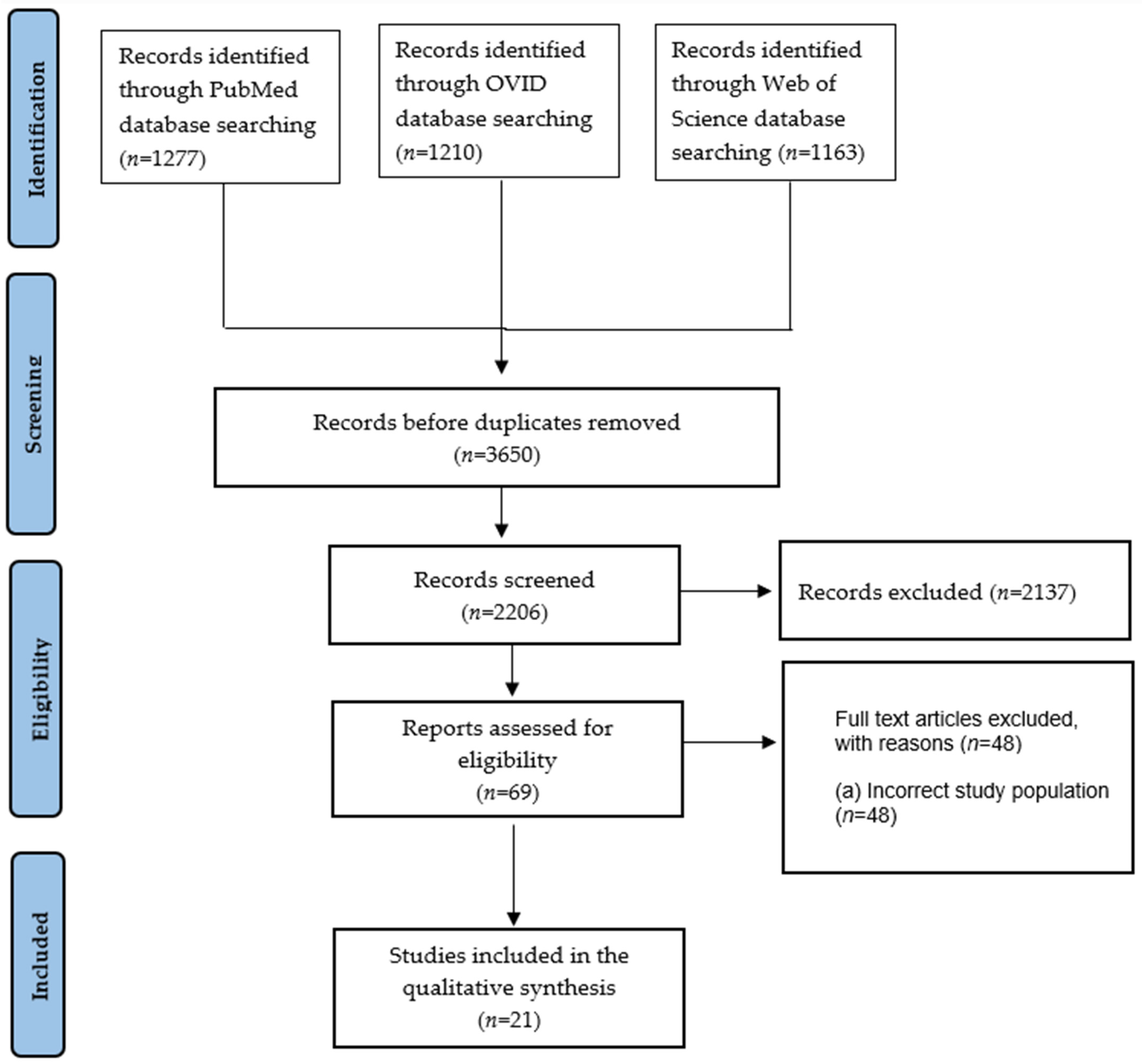
2.1. Research Aim and Search Strategy
- P ex (Population): Patients aged 18 and above with large cranial defects following decompressive craniectomy.
- I (Intervention): Patients who underwent early and late cranioplasty after decompressive craniectomy.
- C (Comparison): Compare postoperative complications and other findings after CP between patients in the early and late groups.
- O (Outcomes): Success rate, complication rates, patient survival, neurological function recovery, recovery time.
2.2. Selection Criteria
2.3. Data Extraction and Management
2.4. Risk of Bias Assessment
2.5. Structure Overview
3. Results
3.1. Demographic and Clinical Data of Radiology
3.2. Indications of Cranioplasty Timing
3.3. Demographic and Clinical Data of Patients Using Neurological Assessment Tools
3.3.1. GOSE as a Neurological Assessment Tool
3.3.2. GCS as a Neurological Assessment Tool
3.3.3. GOS as a Neurological Assessment Tool
3.3.4. FIM as a Neurological Assessment Tool
3.3.5. BI as a Neurological Assessment Tool
3.3.6. Combined Neurological Assessment Tools
NIHSS, MMSE, NCSE, FIM, GCS, Stress as Neurological Assessment Tools (Six Tools)
KPS, ZPS, Quality of Life, Psychological Function as Neurological Assessment Tools (Four Tools)
MMSE, PGIBBD, GOS as Neurological Assessment Tools (Three Tools)
GOS, mRS as Neurological Assessment Tools (Two Tools)
3.4. Complications as an Assessment Tool
3.4.1. Infection
3.4.2. Hydrocephalus
3.4.3. Hematoma
3.4.4. Seizure
3.4.5. Bone Graft Resorption (BGR)
3.4.6. Hygroma
3.4.7. Other Complications
4. Discussion
4.1. Neurological Recovery
4.2. Complication Rates
4.3. Imaging and Physiological Insights
4.4. Patient Selection and Timing Considerations
4.5. Limitations
5. Conclusions
Supplementary Materials
Author Contributions
Funding
Institutional Review Board Statement
Data Availability Statement
Conflicts of Interest
References
- Malcolm, J.G.; Rindler, R.S.; Chu, J.K.; Chokshi, F.; Grossberg, J.A.; Pradilla, G.; Ahmad, F.U. Early Cranioplasty Is Associated with Greater Neurological Improvement: A Systematic Review and Meta-Analysis. Neurosurgery 2018, 82, 278–288. [Google Scholar] [CrossRef] [PubMed]
- Xu, H.; Niu, C.; Fu, X.; Ding, W.; Ling, S.; Jiang, X.; Ji, Y. Early Cranioplasty vs. Late Cranioplasty for the Treatment of Cranial Defect: A Systematic Review. Clin. Neurol. Neurosurg. 2015, 136, 33–40. [Google Scholar] [CrossRef]
- Morton, R.P.; Abecassis, I.J.; Hanson, J.F.; Barber, J.; Nerva, J.D.; Emerson, S.N.; Ene, C.I.; Chowdhary, M.M.; Levitt, M.R.; Ko, A.L.; et al. Predictors of Infection after 754 Cranioplasty Operations and the Value of Intraoperative Cultures for Cryopreserved Bone Flaps. J. Neurosurg. 2016, 125, 766–770. [Google Scholar] [CrossRef]
- Henry, J.; Amoo, M.; Murphy, A.; O’Brien, D.P. Complications of Cranioplasty Following Decompressive Craniectomy for Traumatic Brain Injury: Systematic Review and Meta-Analysis. Acta Neurochir. 2021, 163, 1423–1435. [Google Scholar] [CrossRef]
- Zanaty, M.; Chalouhi, N.; Starke, R.M.; Clark, S.W.; Bovenzi, C.D.; Saigh, M.; Schwartz, E.; Kunkel, E.S.I.; Efthimiadis-Budike, A.S.; Jabbour, P.; et al. Complications Following Cranioplasty: Incidence and Predictors in 348 Cases. J. Neurosurg. 2015, 123, 182–188. [Google Scholar] [CrossRef]
- Archavlis, E.; Carvi, Y.; Nievas, M. The Impact of Timing of Cranioplasty in Patients with Large Cranial Defects after Decompressive Hemicraniectomy. Acta Neurochir. 2012, 154, 1055–1062. [Google Scholar] [CrossRef] [PubMed]
- Bender, A.; Heulin, S.; Röhrer, S.; Mehrkens, J.-H.; Heidecke, V.; Straube, A.; Pfefferkorn, T. Early Cranioplasty May Improve Outcome in Neurological Patients with Decompressive Craniectomy. Brain Inj. 2013, 27, 1073–1079. [Google Scholar] [CrossRef]
- Dujovny, M.; Aviles, A.; Agner, C.; Fernandez, P.; Charbel, F.T. Cranioplasty: Cosmetic or Therapeutic? Surg. Neurol. 1997, 47, 238–241. [Google Scholar] [CrossRef]
- Page, M.J.; McKenzie, J.E.; Bossuyt, P.M.; Boutron, I.; Hoffmann, T.C.; Mulrow, C.D.; Shamseer, L.; Tetzlaff, J.M.; Akl, E.A.; Brennan, S.E.; et al. The PRISMA 2020 Statement: An Updated Guideline for Reporting Systematic Reviews. BMJ 2021, n71. [Google Scholar] [CrossRef]
- Sioutas, G.S.; Napole, A.; Budihal, B.; Davis, P.; Patel, S.; Shekhtman, O.; Salem, M.M.; Srinivasan, V.M.; Burkhardt, J.K. Optimal Timing for Early Cranioplasty Following Craniectomy: A Propensity-Matched National Database Study of 3241 Patients. Clin. Neurol. Neurosurg. 2025, 255, 108989. [Google Scholar] [CrossRef] [PubMed]
- Berikol, G.; Akpınar, A. Comparison of the Timing of Cranioplasty Surgery After Decompressive Craniectomy. Cyprus J. Med. Sci. 2023, 8, 397–401. [Google Scholar] [CrossRef]
- Vreeburg, R.J.G.; Singh, R.D.; Van Erp, I.A.M.; Korhonen, T.K.; Yue, J.K.; Mee, H.; Timofeev, I.; Kolias, A.; Helmy, A.; Depreitere, B.; et al. Early versus Delayed Cranioplasty after Decompressive Craniectomy in Traumatic Brain Injury: A Multicenter Observational Study within CENTER-TBI and Net-QuRe. J. Neurosurg. 2024, 141, 895–907. [Google Scholar] [CrossRef]
- Ozoner, B.; Kilic, M.; Aydin, L.; Aydin, S.; Arslan, Y.K.; Musluman, A.M.; Yilmaz, A. Early Cranioplasty Associated with a Lower Rate of Post-Traumatic Hydrocephalus after Decompressive Craniectomy for Traumatic Brain Injury. Eur. J. Trauma. Emerg. Surg. 2020, 46, 919–926. [Google Scholar] [CrossRef] [PubMed]
- Chibbaro, S.; Zaed, I.; Dannhoff, G.; Todeschi, J.; Mallereau, C.-H.; Prisco, L.; Alfieri, A.; Bernhardt, K.; Sartoretti, E.; Halatsch, M.-E.; et al. Cranioplasty Complications in Severe Traumatic Brain Injury: Implications of Timing of Surgery, Implant Material and Incidence of Vetriculomegaly versus Post-Traumatic Hydrocephalus. Neurosurg. Rev. 2025, 48, 659. [Google Scholar] [CrossRef]
- Kim, J.H.; Hwang, S.-Y.; Kwon, T.-H.; Chong, K.; Yoon, W.-K.; Kim, J.H. Defining “Early” Cranioplasty to Achieve Lower Complication Rates of Bone Flap Failure: Resorption and Infection. Acta Neurochir. 2019, 161, 25–31. [Google Scholar] [CrossRef]
- Jiang, H.; Wang, Y. Super Early Cranial Repair Improves the Prognosis of Patients with Craniocerebral Injury. J. Int. Med. Res. 2020, 48, 0300060520959485. [Google Scholar] [CrossRef]
- Sharma, V.; Rameshchandra, V.V.; Prasad, B.C.; Dwivedi, R. Effects of Early and Late Cranioplasty on Neurocognitive Outcome and Cerebral Glucose Metabolism Using PET Scan—A Comparative Study. Neurol. India 2024, 72, 1016–1020. [Google Scholar] [CrossRef] [PubMed]
- Kim, E.; Choi, S.H.; Wee, J.H.; Choi, Y.H.; Rim, H.; Chang, I.B.; Song, J.H.; Hong, Y.-K.; Kim, J.H. Impact of Cranioplasty Timing and Status on Long-Term Survival and Functional Outcomes After Decompressive Craniectomy for Severe Traumatic Brain Injury. Brain Sci. 2025, 15, 1336. [Google Scholar] [CrossRef] [PubMed]
- Lee, J.M.; Whang, K.; Cho, S.M.; Kim, J.Y.; Oh, J.W.; Koo, Y.M.; Hu, C.; Pyen, J.S.; Choi, J.W. Factors Affecting Optimal Time of Cranioplasty: Brain Sunken Ratio. Korean J. Neurotrauma 2017, 13, 113. [Google Scholar] [CrossRef]
- Tomar, K.; Roy, I.; Kumar Singh, A.; Yadav Rekha, C. Role of Timing of Cranioplasty in Improving Neurological Functional Outcome. Br. J. Oral. Maxillofac. Surg. 2024, 62, 944–949. [Google Scholar] [CrossRef]
- Vyas, K.; Singh, K.M. Outcome of Cranioplasty Done within and Beyond 2 Months after Decompressive Craniectomy for Traumatic Brain Injury. J. Evol. Med. Dent. Sci. 2021, 10, 711–714. [Google Scholar] [CrossRef]
- Bjornson, A.; Tajsic, T.; Kolias, A.G.; Wells, A.; Naushahi, M.J.; Anwar, F.; Helmy, A.; Timofeev, I.; Hutchinson, P.J. A Case Series of Early and Late Cranioplasty—Comparison of Surgical Outcomes. Acta Neurochir. 2019, 161, 467–472. [Google Scholar] [CrossRef]
- Tora, M.S.; Malcolm, J.G.; Mahmooth, Z.; Pujari, A.; Rindler, R.S.; Boulis, N.M.; Pradilla, G.; Grossberg, J.A.; Ahmad, F.U. Complication Rates in Early Versus Late Cranioplasty—A 14-Year Single-Center Case Series. Oper. Surg. 2021, 20, 389–396. [Google Scholar] [CrossRef]
- Zhao, Y.-H.; Gao, H.; Ma, C.; Huang, W.-H.; Pan, Z.-Y.; Wang, Z.-F.; Li, Z.-Q. Earlier Cranioplasty Following Posttraumatic Craniectomy Is Associated with Better Neurological Outcomes at One-Year Follow-up: A Two-Centre Retrospective Cohort Study. Br. J. Neurosurg. 2023, 37, 1057–1060. [Google Scholar] [CrossRef]
- Rashidi, A.; Neumann, J.; Adolf, D.; Sandalcioglu, I.E.; Luchtmann, M. An Investigation of Factors Associated with the Development of Postoperative Bone Flap Infection Following Decompressive Craniectomy and Subsequent Cranioplasty. Clin. Neurol. Neurosurg. 2019, 186, 105509. [Google Scholar] [CrossRef] [PubMed]
- Prasad, G.; Menon, G.; Kongwad, L.; Kumar, V. Outcomes of Cranioplasty from a Tertiary Hospital in a Developing Country. Neurol. India 2020, 68, 63. [Google Scholar] [CrossRef]
- Aloraidi, A.; Alkhaibary, A.; Alharbi, A.; Alnefaie, N.; Alaglan, A.; AlQarni, A.; Elarjani, T.; Arab, A.; Abdullah, J.M.; Almubarak, A.O.; et al. Effect of Cranioplasty Timing on the Functional Neurological Outcome and Postoperative Complications. Surg. Neurol. Int. 2021, 12, 264. [Google Scholar] [CrossRef]
- Safi, S.; Ali, A.; Abdelhafez, I.; Salam, A.; Alrabayah, T.; Alyafei, A.; Belkhair, S. Predictors of Clinical Outcomes in Autologous Cranioplasty. World Neurosurg. 2022, 167, e561–e566. [Google Scholar] [CrossRef] [PubMed]
- Li, J.; Li, N.; Jiang, W.; Li, A. The Impact of Early Cranioplasty on Neurological Function, Stress Response, and Cognitive Function in Traumatic Brain Injury. Medicine 2024, 103, e39727. [Google Scholar] [CrossRef]
- Yan, Z.; Xue, Z.; Wang, M.; Wang, L.; Che, H.; Yan, Z. Early Cranioplasty versus Traditional Cranioplasty Enhances Surgical Outcomes in Patients with Malignant Cerebral Infarction after Decompressive Craniectomy. BMC Surg. 2025, 25, 205. [Google Scholar] [CrossRef] [PubMed]
- De Cola, M.C.; Corallo, F.; Pria, D.; Lo Buono, V.; Calabrò, R.S. Timing for Cranioplasty to Improve Neurological Outcome: A Systematic Review. Brain Behav. 2018, 8, e01106. [Google Scholar] [CrossRef]
- Hou, C.; Cai, H.; Ye, J.; Liu, Y.; Ma, C.; Chen, T.; Wang, H.; Luo, W.; Yang, L.; Hu, Z.; et al. The Timing of Cranioplasty and the Risk of Postoperative Complications: A Systematic Review and Meta-Analysis. eClinicalMedicine 2025, 88, 103492. [Google Scholar] [CrossRef] [PubMed]
- Chasles, O.G.; Kokot, K.; Fercho, J.; Siemiński, M.; Szmuda, T. Comparison of Complications in Early and Late Cranioplasty Following Decompressive Craniectomy Due to Traumatic Brain Injury: Systematic Review and Meta-Analysis. J. Clin. Med. 2025, 14, 4176. [Google Scholar] [CrossRef]
- Al-Salihi, M.M.; Ayyad, A.; Al-Jebur, M.S.; Al-Salihi, Y.; Hammadi, F.; Bowman, K.; Baskaya, M.K. Subcutaneous Preservation versus Cryopreservation of Autologous Bone Grafts for Cranioplasty: A Systematic Review and Meta-Analysis. J. Clin. Neurosci. 2024, 122, 1–9. [Google Scholar] [CrossRef]
- Palavani, L.B.; Ferreira, M.Y.; Camerotte, R.; Mitre, L.P.; Piason, L.; Andreão, F.F.; Pereira, A.L.; Monteiro, R.; De Amorim, R.L.O.; Bertani, R.; et al. Timing Matters: A Comprehensive Meta-Analysis on the Optimal Period for Cranioplasty After Severe Traumatic Brain Injury. Oper. Neurosurg. 2025, 29, 1–18. [Google Scholar] [CrossRef]
- Kurland, D.B.; Khaladj-Ghom, A.; Stokum, J.A.; Carusillo, B.; Karimy, J.K.; Gerzanich, V.; Sahuquillo, J.; Simard, J.M. Complications Associated with Decompressive Craniectomy: A Systematic Review. Neurocrit Care 2015, 23, 292–304. [Google Scholar] [CrossRef] [PubMed]
- Malcolm, J.G.; Rindler, R.S.; Chu, J.K.; Grossberg, J.A.; Pradilla, G.; Ahmad, F.U. Complications Following Cranioplasty and Relationship to Timing: A Systematic Review and Meta-Analysis. J. Clin. Neurosci. 2016, 33, 39–51. [Google Scholar] [CrossRef]
- Zheng, F.; Xu, H.; Von Spreckelsen, N.; Stavrinou, P.; Timmer, M.; Goldbrunner, R.; Cao, F.; Ran, Q.; Li, G.; Fan, R.; et al. Early or Late Cranioplasty Following Decompressive Craniotomy for Traumatic Brain Injury: A Systematic Review and Meta-Analysis. J. Int. Med. Res. 2018, 46, 2503–2512. [Google Scholar] [CrossRef]
- Mah, J.; Kass, R. The Impact of Cranioplasty on Cerebral Blood Flow and Its Correlation with Clinical Outcome in Patients Underwent Decompressive Craniectomy. Asian J. Neurosurg. 2016, 11, 15–21. [Google Scholar] [CrossRef]
- Erdogan, E.; Düz, B.; Kocaoglu, M.; Izci, Y.; Sirin, S.; Timurkaynak, E. The Effect of Cranioplasty on Cerebral Hemodynamics: Evaluation with Transcranial Doppler Sonography. Neurol. India 2003, 51, 479–481. [Google Scholar] [PubMed]
- Fricia, M.; Nicolosi, F.; Ganau, M.; Cebula, H.; Todeschi, J.; Santin, M.D.N.; Nannavecchia, B.; Morselli, C.; Chibbaro, S. Cranioplasty with Porous Hydroxyapatite Custom-Made Bone Flap: Results from a Multicenter Study Enrolling 149 Patients Over 15 Years. World Neurosurg. 2019, 121, 160–165. [Google Scholar] [CrossRef] [PubMed]
- Thamilmaran, A.; Patel, S.; Nischal, S.A.; Panchal, H.; Kale, K.; Patel, P.D.; Jallo, J.; Harrop, J.S. Optimal Timing of Cranioplasty Post-Decompressive Craniectomy in Traumatic Brain Injury: A Systematic Review, Meta-Analysis, and Overview of Ongoing Trials. Acta Neurochir. 2026, 168, 7. [Google Scholar] [CrossRef] [PubMed]
- Ganau, M.; Cebula, H.; Fricia, M.; Zaed, I.; Todeschi, J.; Scibilia, A.; Gallinaro, P.; Coca, A.; Chaussemy, D.; Ollivier, I.; et al. Surgical Preference Regarding Different Materials for Custom-Made Allograft Cranioplasty in Patients with Calvarial Defects: Results from an Internal Audit Covering the Last 20 Years. J. Clin. Neurosci. 2020, 74, 98–103. [Google Scholar] [CrossRef]
- Tricco, A.C.; Lillie, E.; Zarin, W.; O’Brien, K.K.; Colquhoun, H.; Levac, D.; Moher, D.; Peters, M.D.J.; Horsley, T.; Weeks, L.; et al. PRISMA Extension for Scoping Reviews (PRISMAScR): Checklist and Explanation. Ann. Intern. Med. 2018, 169, 467–473. [Google Scholar] [CrossRef] [PubMed]


| Source | Equation | Records Identified (n) | Filters |
|---|---|---|---|
| PubMed | * | 1277 | 2017–2025 Language—English |
| OVID | * | 1210 | 2017–2025 Language—English |
| Web of Science | * | 1163 | 2017–2025 Language—English |
| Author | Timing | Cause | Number of Patients | Gender | Mean Age | Assessment Tool | Post-Op Score | Comorbidities | Follow-Up | ||
|---|---|---|---|---|---|---|---|---|---|---|---|
| Early | Late | Total | |||||||||
| Ozoner et al. 2020 [13] | 2 Months | TBI | 67 | 59 | 126 | 84 M, 42 F | 53 51 | GOSE | Early (1–4): 22 (5–8): 45 Late:(1–4): 22 (5–8): 37 | Hypertension Diabetes | 12 M |
| Vreeburg et al. 2024 [12] | 3 Months | TBI | 73 | 100 | 173 | Early: 70 M 3 F Late: 72 M 28 F | 44 | GOSE | 4 (2–6) | Mild and severe systemic illness | 12 M |
| Authors | Etiology | Timing | Patients | Gender | Mean Age | Assessment Tool | Comorbidities | Pre-Op Score | Post-Op Score | Secondary Outcome (Midline Shift) |
|---|---|---|---|---|---|---|---|---|---|---|
| Berikol et al. 2023 [11] | TBI, fractures, tumors | (<1 M) | 36 | 25 M 11 F | 34.91 ± 20.62 | GCS | Hypertension, Diabetes, CAD | 4.61 ± 0.64 | 4.69 ± 0.52 | 0.30 ± 0.66 |
| (1–3 M) | 32 | 19 M 13 F | 47.12 ± 18.28 | Hypertension, Diabetes, CAD, CVH | 4.03 ± 0.89 | 4.50 ± 0.62 | 1.18 ± 1.46 | |||
| (3 M–6 M) | 29 | 24 M 5 F | 49.79 ± 16.10 | Hypertension, Diabetes, CAD | 4.13 ± 0.83 | 4.55 ± 0.63 | 1.65 ± 1.73 | |||
| (6 M–360 days) | 29 | 16 M 13 F | 42.37 ± 15.67 | Hypertension, Diabetes, CVH | 4.13 ± 0.74 | 4.58 ± 0.50 | 1.06 ± 2.05 | |||
| (>360 days) | 12 | 10 M 2 F | 43.33 ± 16.80 | Hypertension, Diabetes, CVH | 4.08 ± 0.90 | 4.41 ± 0.66 | 1.83 ± 2.75 |
| Authors | Etiology | Timing | Patients | Gender | Mean Age | Assessment Tool | Pre-Op Score | Post-Op Score | Mean (SD) Difference in FIM Score | Comorbidities | Follow-Up |
|---|---|---|---|---|---|---|---|---|---|---|---|
| (Tomar et al., 2024) [20] | TBI (21, 16 M 5 F) Stroke (10, 7 M 3 F) | <3 M | 16 | 9 M 7 F | 49.50 ± 10.88 | FIM | 70.06 ± 18.35 | 77.37 ± 18.09 | 7.31 (5.82) | - | 1 M |
| >3 M | 15 | 7 M 8 F | 53.13 ± 11.5 | 68.40 ± 20.24 | 73.07 ± 23.33 | 4.66 (5.62) | - | 1 M |
| Authors | Etiology | Timing | Patients | Sex M/F | Mean Age (Range) | Assessment Tool | Comorbidities | Pre-Op Score | Post-Op Score | Follow-Up |
|---|---|---|---|---|---|---|---|---|---|---|
| Zhao et al., 2023 [24] | TBI | 3–6 Months | 58 | 53 M 5 F | 38.81 ± 12.57 (4–65) | BI | Smoking 7, drinking 1, diabetes 6 | 85.77 ± 11.61 | 95.34 ± 9.02 | 12 M |
| 6–12 Months | 42 | 35 M 7 F | 35.38 ± 12.20 (4–65) | BI | Smoking 7 drinking 1 diabetes 6 | 82.74 ± 22.82 | 88.93 ± 22.86 | 12 M |
| Author | Etiology | Timing Interval | Number of Patients | Sex M/F | Age | Assessment Tool | GCS | Pre-/Post-Op NIHSS | Post-Op FIM | MMSE | NCSE | IL-6 Cortisol TNF |
|---|---|---|---|---|---|---|---|---|---|---|---|---|
| Li et al., 2024 [29] | TBI | <3 Months | 45 | 26 M 19 F | 27–65 | GCS, NIHS, FIM, MMS, NCSE, stress levels | 13–15: 25 9–12: 18 <9: 2 | 22.07 ± 4.24 → 11.18 ± 2.35 | 35.26 ± 4.94 → 59.26 ± 6.12 | 18.13 ± 3.94 → 25.02 ± 4.61 | 52.06 ± 3.85 → 103.52 ± 10.63 | 4.13 IL6 diff 5.06 cortisol diff 0.91 TNF-α |
| 3–6 Months | 45 | 24 M 21 F | 29–64 | 13–15: 17 9–12: 18 <9: 9 | 21.49 ± 5.76 → 14.74 ± 3.61 | 36.15 ± 4.56 → 47.86 ± 5.27 | 18.69 ± 4.17 → 22.74 ± 5.13 | 51.97 ± 4.23 → 88.76 ± 7.39 | 7.79 IL6 diff 17.3 cortisol diff 2.4 TNF-α |
| Authors | Cause | Timing Interval | Number of Patients | Sex M/F | Age | Assessment Tool | Post-Op KPS | Post-Op ZPS | Psychological Function | Quality of Life |
|---|---|---|---|---|---|---|---|---|---|---|
| Jiang et al., 2020 [16] | TBI | 4–6 weeks | 28 | 17 M 11 F | <40: 11 >40: 17 | KPS ZPS Psychological function QOL | ≤50: 3 >50: 17 | Poor: 3 Good: 17 | Poor: 5 Good: 23 | Poor: 5 Good: 23 |
| 3–6 months | 32 | 26 M 6 F | <40: 7 >40: 25 | ≤50: 17 >50: 15 | Poor: 17 Good: 15 | Poor: 19 Good: 13 | Poor: 14 Good: 18 |
| Authors | Cause | Timing Interval | Patients | Mean Age | Assessment Tool | Pre-Op Score (Mean ± SD) | Post-Op Score (Mean ± SD) | Follow-Up |
|---|---|---|---|---|---|---|---|---|
| (Sharma et al., 2024) [17] | Trauma, ischemic infarct, cortical sinus venous thrombosis, intracranial hemorrhage | Early CP (<3 Months) | 19 | 40.63 (24–58) | MMSE PGIBBD | 26.11 ± 2.75 2.21 ± 0.78 | 28.21 ± 1.78 1.74 ± 0.61 | 3 Months |
| Late CP (>3 Months) | 19 | 38.53 (21–67) | 23.74 ± 7.22 2.58 ± 0.90 | 27.00 ± 2.71 1.83 ± 0.67 | 3 Months | |||
| Early CP | 30 | 40.63 | GOS | 3.10 ± 0.031 | 4.23 ± 0.63 | 3 Months | ||
| Late CP | 30 | 38.53 | 3.10 ± 0.31 | 4.20 ± 0.81 | 3 Months |
| Authors | Etiology | Timing Interval | Patients | Gender | Mean Age | Assessment Tool | GOS | mRS | Comorbidities | Follow-Up |
|---|---|---|---|---|---|---|---|---|---|---|
| (Aloraidi et al., 2021) [27] | TBI: 26 Infarction: 15 | <3 M | 41 | (86 from both M) 15 F | 32 | GOS mRS | 4 ± 1 → 4.1 ± 1 | 2.2 ± 1.78 → 2.2 ± 1.7 | 17 From both groups | 315.6 Days |
| TBI: 38 Infarction: 22 | >3 M | 60 | 31 | GOS mRS | 4 ± 1 → 4 ± 1 | 2.2 ± 1.78 → 2.3 ± 1.7 | 582.6 Days |
| Authors | Timing Cutoff Between Early and Late CP | DC Etiology | Age | Gender | Comorbidities | Total | Complications | |
|---|---|---|---|---|---|---|---|---|
| Early | Late | |||||||
| Tomar et al. 2024 [20] | 3 Months | TBI Stroke | 29–66 A: 49.50 (10.88) B: 53.13 (11.50) | 21 M 10 F | - | 16 | 15 | Infections, extradural hematoma, Hydrocephalus, Brone Graft Resorption |
| Sharma et al. 2024 [17] | 3 Months | TBI ischemic infarct cortical sinus venous thrombosis intracranial hemorrhage | A: 24–58 B: 21–67 A: 40.63 B: 38.53 | - | - | 30 | 30 | NONE |
| Aloraidi et al. 2021 [27] | 3 Months | TBI Malignant Cerebral Infarction | (31.4 ± 13.9) | 86 M 15 F | - | 41 | 60 | Hydrocephalus, Hygroma, Seizure Sunken Flap Syndrome, Mortality |
| Vyas et al. 2021 [21] | 2 M | TBI | 20–67 Mean: 43.7 for both | A: 38 M 6 F B: 42 M 4 F | - | 44 | 46 | Infections, Hematoma, Sunken brain, Resorption |
| Berikol et al. 2023 [11] | 3 Months | trauma, fractures, tumors | A: 34.91 ± 20.62 B: 47.12 ± 18.28 C: 49.79 ± 16.1 D: 42.37 ± 15.67 E: 43.33 ± 16.8 | A: 25 M 11 F B: 19 M 13 F C: 24 M 5 F D: 16 M 13 F E: 10 M 2 F | Hypertension, diabetes mellitus, cardiovascular disease | group 1(>1 M): 36 group 2 (1–3 M): 32 | group 3, (3–6 M): 29 group 4 (6–12 M): 29 group 5 (>12 M): 12 | infections, hematoma, seizure |
| Vreeburg et al. 2024 [12] | 3 Months | TBI | 24–58 Mean: 44 for both | A: 70 M 3 F B: 72 M 28 F | mild systemic illness A: 19 B: 28 severe systemic illness A: 10 B: 9 | 73 | 100 | Hydrocephalus, Seizures |
| Safi et al. 2022 [28] | 3 Months | TBI nontraum. (vasuclar/tumors/other) | 41.4 ± 13.5 | 122 M 10 F | Diabetes mellitus, hypertension | 77 | 55 | (infections, extradural hematoma, hydrocephalus, subgaleal collections, intraparenchymal hemorrhage, wound necrosis) |
| Bjornson et al. 2019 [22] | 3 Months | -TBI -Ischaemic stroke Intracerebral hemorrhage/SAH -Cerebral abscess | 16–70 Mean: 52 | 63 M 27 F | - | 24 | 66 | Infection, hydrocephalus, pneumocephalus, cosmetic issues, hematoma |
| Tora et al. 2021 [23] | 3 Months | TBI | 43.7 years | A: 54 M 27 F B: 132 M 65 F | Obesity, diabetes, hypertension, smoking | 51 | 91 | infection, dehiscence, reoperation, Hydrocephalus, resorption, EAC |
| Zhao et al. 2023 [24] | 6 Months | TBI (aSDH, EDH, combined SDH/EDH) | 37 years | A: 53 M 5 F B: 35 M 7 F | Smoking drinking diabetes | 58 | 42 | EDH or SDH, wound healing complications, hydrocephalus, seizure |
| Ozoner et al. 2020 [13] | 2 Months | TBI | 53.1 ± 19.4 | 84 M 42 F | Hypertension, diabetes mellitus | 67 | 59 | Hydrocephalus |
| Lee et al. 2017 [19] | 2 Months | Elevated ICP, TBI, ICH, SAH, infarct | 52.6 ± 18.6 | 52 M 38 F | Hypertension, diabetes mellitus, liver disease, alcohol, smoking, antiplatelet use | 23 | 50 | Hemorrhage, wound infections, CSF leak, hygroma: 6 hydrocephalus |
| Rashidi et al. 2019 [25] | 3 Months | TBI, stroke, ICH, SAH, tumors, infection | 2–91 years 51.2 ± 17.0 | 195 M 134 F | Diabetes mellitus | 70 | 259 | infections: Group A: 3 Group B: 21 |
| Kim et al. 2019 [15] | 45 days | Aneurysmal SAH Brain tumor Cerebral infarction ICH TBI | - | 80 M 46 F | - | 51 | 87 | Bone flap resorption, surgical site infection |
| Prasad et al. 2020 [26] | 3 Months | TBI, ischemic stroke, CVT, hemorrhage | 17–68 Mean: 38.3 | 67 M 26 F | - | 78 | 15 | Infection, Wound dehiscence, Seizures, Hematoma, Hydrocephalus, Death |
| Jiang et al. 2020 [16] | Early: 4–6 weeks Late: 3–6 months | TBI | 17–65 | A: 17 M 11 F B: 26 M 6 F | 28 | 32 | Infection, Fluid accumulation, Necrosis, Hematoma | |
| Li et al. 2024 [29] | 3 Months | TBI | 24–65 A: 42.62 ± 2.64 B: 33.25 ± 3.06 | A: 26 M 19 F B: 24 M 21 F | - | 45 | 45 | Infection, Hemorrhage, Necrosis, Effusion, Chewing discomfort |
| Chibbaro et al. 2025 [14] | 1–3 Months | TBI | 49 years (18–62) | 2284 M 1723 F | - | Ultra early (<30 days): 352 Early (1–3 months): 1627 | 2028 | infections, post-traumatic hydrocephalus, external hydrocephalus, seizures, epidural hematoma, subdural hematoma, subdural hygroma |
| Kim et al. 2025 [18] | 3 Months | TBI | 53.9 ± 17.4 years | - | - | 31 | 24 | Mortality not necessarily associated with the operation |
| Sioutas et al., 2025 [10] | 3 Months | TBI | - | - | Diabetes mellitus, obesity, chronic kidney disease, asthma, heart disease | 680 | 680 | infection, ICH, SDH, hydrocephalus, meningitis/encephalitis/myelitis/encephalomyelitis, CSF leak, repeat craniectomy/craniotomy, seizures, EDH, wound disruption, abscess and granuloma, removal or replacement of bone flap/prosthetic plate, dependence on wheelchair/care provider, mortality |
| Yan et al., 2025 [30] | 3 Months | Malignant Cerebral Infarction (MCI) | 57.3 ± 6.8 years | 43 M 43 F | - | 37 | 49 | ICH, infection, subcutaneous effusion, wound dehiscence, scalp necrosis, hydrocephalus, dural tear, seizure |
Disclaimer/Publisher’s Note: The statements, opinions and data contained in all publications are solely those of the individual author(s) and contributor(s) and not of MDPI and/or the editor(s). MDPI and/or the editor(s) disclaim responsibility for any injury to people or property resulting from any ideas, methods, instructions or products referred to in the content. |
© 2026 by the authors. Licensee MDPI, Basel, Switzerland. This article is an open access article distributed under the terms and conditions of the Creative Commons Attribution (CC BY) license.
Share and Cite
Gati, A.; Viola, Á.; Al-Khafaji, Y.Q.; Aslan, S.; Al-Khafaji, M.Q.; Taha, Y.A.; Al-Khafaji, M.Q.; Koudigkeli, G.; Al-Khafaji, S.Q.; Al-Smadi, M.W. Timing and Outcomes of Cranioplasty After Decompressive Craniectomy: A Systematic Review of Neurological Recovery, Complications, and Predictive Factors. J. Clin. Med. 2026, 15, 2813. https://doi.org/10.3390/jcm15082813
Gati A, Viola Á, Al-Khafaji YQ, Aslan S, Al-Khafaji MQ, Taha YA, Al-Khafaji MQ, Koudigkeli G, Al-Khafaji SQ, Al-Smadi MW. Timing and Outcomes of Cranioplasty After Decompressive Craniectomy: A Systematic Review of Neurological Recovery, Complications, and Predictive Factors. Journal of Clinical Medicine. 2026; 15(8):2813. https://doi.org/10.3390/jcm15082813
Chicago/Turabian StyleGati, András, Árpád Viola, Yousif Qais Al-Khafaji, Siran Aslan, Mustafa Qais Al-Khafaji, Yousif Asaad Taha, Murtadha Qais Al-Khafaji, Georgia Koudigkeli, Shahad Qais Al-Khafaji, and Mohammad Walid Al-Smadi. 2026. "Timing and Outcomes of Cranioplasty After Decompressive Craniectomy: A Systematic Review of Neurological Recovery, Complications, and Predictive Factors" Journal of Clinical Medicine 15, no. 8: 2813. https://doi.org/10.3390/jcm15082813
APA StyleGati, A., Viola, Á., Al-Khafaji, Y. Q., Aslan, S., Al-Khafaji, M. Q., Taha, Y. A., Al-Khafaji, M. Q., Koudigkeli, G., Al-Khafaji, S. Q., & Al-Smadi, M. W. (2026). Timing and Outcomes of Cranioplasty After Decompressive Craniectomy: A Systematic Review of Neurological Recovery, Complications, and Predictive Factors. Journal of Clinical Medicine, 15(8), 2813. https://doi.org/10.3390/jcm15082813