Evaluating the Effectiveness of Robotic Process Automation for Cancer Registry Data Abstraction in a Production EHR Environment


Abstract
1. Introduction
2. Materials and Methods
2.1. Research Design and Environment
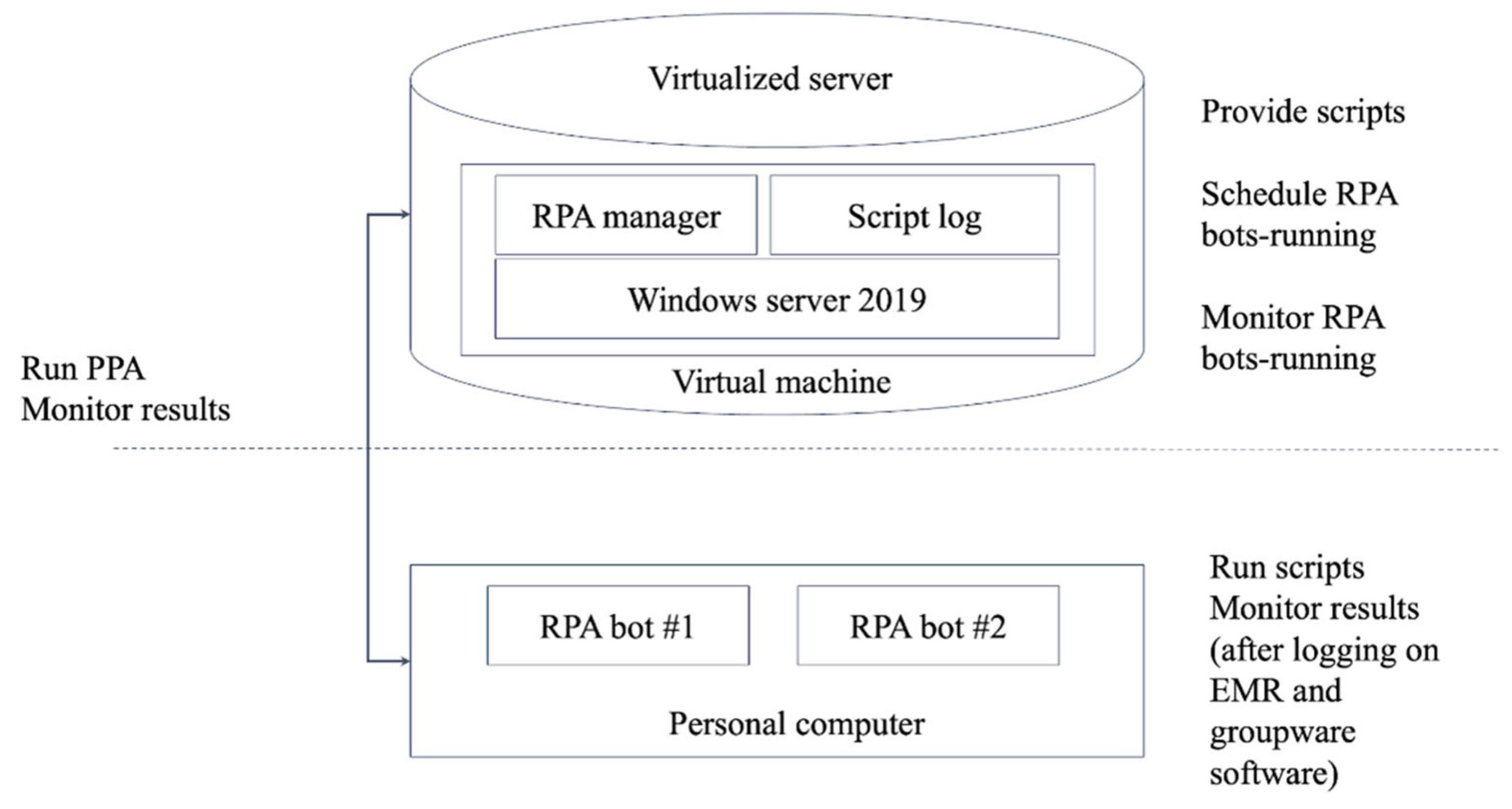
2.2. Overview of the RPA Architecture
2.3. Interview Framework and Qualitative Approach
2.4. Participant Recruitment
2.5. Data Collection (Quantitative and Qualitative)
2.6. Statistical Analysis
2.7. Ethical Approval
3. Results
3.1. Study Population Characteristics
3.2. Qualitative Findings Based on the PARiHS Framework
3.3. Effectiveness of RPA for Cancer Registry Data Abstraction
4. Discussion
5. Conclusions
Supplementary Materials
Author Contributions
Funding
Institutional Review Board Statement
Informed Consent Statement
Data Availability Statement
Conflicts of Interest
References
- Kim, Y.G.; Jung, K.; Park, Y.T.; Shin, D.; Cho, S.Y.; Yoon, D.; Park, R.W. Rate of electronic health record adoption in South Korea: A nation-wide survey. Int. J. Med. Inform. 2017, 101, 100–107. [Google Scholar] [CrossRef]
- Gunter, T.D.; Terry, N.P. The emergence of national electronic health record architectures in the United States and Australia: Models, costs, and questions. J. Med. Internet Res. 2005, 7, e3. [Google Scholar] [CrossRef] [PubMed]
- Seo, K.; Kim, H.N.; Kim, H. Current Status of the Adoption, Utilization and Helpfulness of Health Information Systems in Korea. Int. J. Environ. Res. Public. Health 2019, 16, 2122. [Google Scholar] [CrossRef] [PubMed]
- Bahensky, J.A.; Jaana, M.; Ward, M.M. Health care information technology in rural America: Electronic medical record adoption status in meeting the national agenda. J. Rural. Health. 2008, 24, 101–105. [Google Scholar] [CrossRef] [PubMed]
- HealthIT.gov. National Trends in Hospital and Physician Adoption of Electronic Health Records. Available online: https://www.healthit.gov/data/quickstats/national-trends-hospital-and-physician-adoption-electronic-health-records (accessed on 27 January 2026).
- Sun, W.; Cai, Z.; Li, Y.; Liu, F.; Fang, S.; Wang, G. Data Processing and Text Mining Technologies on Electronic Medical Records: A Review. J. Healthc. Eng. 2018, 2018, 4302425. [Google Scholar] [CrossRef]
- Yoo, S.; Lee, K.H.; Lee, H.J.; Ha, K.; Lim, C.; Chin, H.J.; Yun, J.; Cho, E.Y.; Chung, E.; Baek, R.M.; et al. Seoul National University Bundang Hospital’s electronic system for total care. Healthc. Inform. Res. 2012, 18, 145–152. [Google Scholar] [CrossRef]
- Yoo, S.; Kim, S.; Lee, K.H.; Jeong, C.W.; Youn, S.W.; Park, K.U.; Moon, S.Y.; Hwang, H. Electronically implemented clinical indicators based on a data warehouse in a tertiary hospital: Its clinical benefit and effectiveness. Int. J. Med. Inform. 2014, 83, 507–516. [Google Scholar] [CrossRef]
- Kong, H.J. Managing unstructured big data in healthcare system. Healthc. Inform. Res. 2019, 25, 1–2. [Google Scholar] [CrossRef]
- Diba, K.; Batoulis, K.; Weidlich, M.; Weske, M. Extraction, correlation, and abstraction of event data for process mining. Wiley Interdiscip. Rev. Data Min. Knowl. Discov. 2020, 10, e1346. [Google Scholar] [CrossRef]
- Polnaszek, B.; Gilmore-Bykovskyi, A.; Hovanes, M.; Roiland, R.; Ferguson, P.; Brown, R.; Kind, A.J. Overcoming the Challenges of Unstructured Data in Multisite, Electronic Medical Record-based Abstraction. Med Care 2016, 54, e65–e72. [Google Scholar] [CrossRef]
- van der Aalst, W.M.; Bichler, M.; Heinzl, A. Robotic Process Automation. Bus. Inf. Syst. Eng. 2018, 60, 269–272. [Google Scholar] [CrossRef]
- Patrício, L.; Costa, C.; Varela, L.; Silveira, Z.; Cruz-Cunha, M.M. Literature review on the implementation of Robotic Process Automation in healthcare and its social influence. Procedia Comput. Sci. 2025, 256, 972–979. [Google Scholar] [CrossRef]
- Huang, W.-L.; Liao, S.-L.; Huang, H.-L.; Su, Y.-X.; Jerng, J.-S.; Lu, C.-Y.; Ho, W.-S.; Xu, J.-R. A case study of lean digital transformation through robotic process automation in healthcare. Sci. Rep. 2024, 14, 14626. [Google Scholar] [CrossRef]
- Sreekrishna, A.; Jacob, T.P. Systematic mapping in improving the extraction of Cancer Pathology information using RPA orchestration. J. Integr. Sci. Technol. 2023, 11, 561. [Google Scholar]
- Park, A.; Jung, S.Y.; Yune, I.; Lee, H.Y. Applying Robotic Process Automation to Monitor Business Processes in Hospital Information Systems: Mixed Method Approach. JMIR Med. Inform. 2025, 13, e59801. [Google Scholar] [CrossRef]
- Aguirre, S.; Rodriguez, A. Automation in healthcare: Robotic process automation. In Proceedings of the International Conference on Knowledge and Information Management; Springer: Berlin/Heidelberg, Germany, 2017; pp. 1–8. [Google Scholar]
- Lamphier, I. Harnessing the Power of Robotic Process Automation for Efficient and Effective Workflow of Infection Preventionists. Am. J. Infect. Control. 2024, 52, S47. [Google Scholar] [CrossRef]
- Chaturvedi, A.; Sharma, S. Robotic Process Automation (RPA) in Healthcare: Transforming Revenue Cycle Operations. Int. J. Recent Innov. Trends Comput. Commun. 2023, 6, 652–658. [Google Scholar]
- Lee, K.; Jung, S.Y.; Hwang, H.; Yoo, S.; Baek, H.Y.; Baek, R.M.; Kim, S. A novel concept for integrating and delivering health information using a comprehensive digital dashboard: An analysis of healthcare professionals’ intention to adopt a new system and the trend of its real usage. Int. J. Med. Inform. 2017, 97, 98–108. [Google Scholar] [CrossRef]
- Cho, M.; Kim, K.; Lim, J.; Baek, H.; Kim, S.; Hwang, H.; Song, M.; Yoo, S. Developing data-driven clinical pathways using electronic health records: The cases of total laparoscopic hysterectomy and rotator cuff tears. Int. J. Med. Inform. 2020, 133, 104015. [Google Scholar] [CrossRef]
- Stetler, C.B.; Damschroder, L.J.; Helfrich, C.D.; Hagedorn, H.J. A guide for applying a revised version of the PARIHS framework for implementation. Implement. Sci. 2011, 6, 99. [Google Scholar] [CrossRef]
- Tong, A.; Sainsbury, P.; Craig, J. Consolidated criteria for reporting qualitative research (COREQ): A 32-item checklist for interviews and focus groups. Int. J. Qual. Health Care 2007, 19, 349–357. [Google Scholar] [CrossRef]
- Gentles, S.J.; Charles, C.; Ploeg, J.; McKibbon, K.A. Sampling in qualitative research: Insights from an overview of the methods literature. Qual. Rep. 2015, 20, 1772–1789. [Google Scholar] [CrossRef]
- Noy, C. Sampling knowledge: The hermeneutics of snowball sampling in qualitative research. Int. J. Soc. Res. Methodol. 2008, 11, 327–344. [Google Scholar] [CrossRef]
- Mishuris, R.G.; Linder, J.A. Electronic health records and the increasing complexity of medical practice: “It never gets easier, you just go faster”. J. Gen. Intern. Med. 2013, 28, 490–492. [Google Scholar] [CrossRef] [PubMed]
- McDonald, K.; Schultz, E.; Chapman, T.; Davies, S.; Pineda, N.; Lonhart, J. Prospects for Care Coordination Measurement Using Electronic Data Sources; Report No.: 12-EHC045-EF; Agency for Healthcare Research and Quality: Rockville, MD, USA, 2012.
- Thainimit, S.; Chaipayom, P.; Gansawat, D.; Kaneko, H. Robotic Process Automation-Based Glaucoma Screening System: A Framework. In Advances in Computer Vision and Computational Biology: Proceedings from IPCV’20, HIMS’20, BIOCOMP’20, and BIOENG’20; Springer International Publishing: Cham, Switzerland, 2021; pp. 569–578. [Google Scholar]
- Jerry, J. Use of robotic process automation (RPA) for rapid analysis and interpretation of multidrug resistant organisms and COVID-19 results. Antimicrob. Resist. Infect. Control. 2021, 10, 145. [Google Scholar]
- Kobayashi, T.; Arai, K.; Imai, T.; Tanimoto, S.; Sato, H.; Kanai, A. Communication robot for elderly based on robotic process automation. In Proceedings of the 2019 IEEE 43rd Annual Computer Software and Applications Conference (COMPSAC); IEEE: New York, NY, USA, 2019; pp. 251–256. [Google Scholar]
- Liu, W.L.; Zhang, W.; Dutta, B.; Wu, Z.; Goh, M. Digital twinning for productivity improvement opportunities with robotic process automation: Case of greenfield hospital. Int. J. Mech. Eng. Robot. Res. 2020, 9, 258–263. [Google Scholar] [CrossRef]
- Kim, J.; Kim, D. Automation of the process of examining and requesting medical care benefit cost using robotic process automation. ICIC Express Lett. B Appl. 2021, 12, 587–592. [Google Scholar]
- Ratia, M.; Myllärniemi, J.; Helander, N. Robotic Process Automation—Creating Value by Digitalizing Work in the Private Healthcare? In Proceedings of the 22nd International Academic Mindtrek Conference; ACM: New York, NY, USA, 2018; pp. 222–227. [Google Scholar]
- Wang, X.; Williams, C.; Liu, Z.H.; Croghan, J. Big data management challenges in health research—A literature review. Brief. Bioinform. 2019, 20, 156–167. [Google Scholar]
- Vassiliadis, P.; Simitsis, A.; Skiadopoulos, S. Conceptual modeling for ETL processes. In Proceedings of the 5th ACM International Workshop on Data Warehousing and OLAP; ACM: New York, NY, USA, 2002; pp. 14–21. [Google Scholar]
- Doan, A.; Halevy, A.Y. Semantic integration research in the database community: A brief survey. AI Manag. 2005, 26, 83. [Google Scholar]
- Halevy, A. Technical perspective: Schema mappings: Rules for mixing data. Commun. ACM 2010, 53, 100. [Google Scholar] [CrossRef]
- Haas, L.M.; Hentschel, M.; Kossmann, D.; Miller, R.J. Schema and data: A holistic approach to mapping, resolution and fusion in information integration. In International Conference on Conceptual Modeling; Springer: Berlin/Heidelberg, Germany, 2009; pp. 27–40. [Google Scholar]
- Halevy, A.; Rajaraman, A.; Ordille, J. Data integration: The teenage years. In Proceedings of the 32nd International Conference on Very Large Data Bases; VLDB Endowment: Los Angeles, CA, USA, 2006; pp. 9–16. [Google Scholar]
- Doan, A.; Domingos, P.; Halevy, A.Y. Reconciling schemas of disparate data sources: A machine-learning approach. SIGMOD Rec. 2001, 30, 509520. [Google Scholar] [CrossRef]
- Jordan, M.I.; Mitchell, T.M. Machine learning: Trends, perspectives, and prospects. Science 2015, 349, 255–260. [Google Scholar] [CrossRef]
- Alex, B.; Grover, C.; Haddow, B.; Kabadjov, M.; Klein, E.; Matthews, M.; Roebuck, S.; Tobin, R.; Wang, X. Assisted curation: Does text mining really help? In Proceedings of the Pacific Symposium on Biocomputing 2008; World Scientific: Singapore, 2008; pp. 556–567. [Google Scholar]
- Peters, S.E.; Zhang, C.; Livny, M.; Ré, C. A machine reading system for assembling synthetic paleontological databases. PLoS ONE 2014, 9, e113523. [Google Scholar] [CrossRef]



| Variables | n (%) |
|---|---|
| Mean age | 41.4 ± 5.6 |
| Sex | |
| Male | 9 (64) |
| Female | 5 (36) |
| Job kind | |
| Medical information team, nursing position | 2 (14) |
| Medical information team, administrative position | 3 (21) |
| Medical information team, developer | 9 (65) |
| Years of work | |
| Less than 5 years | 1 (7) |
| Between 5 and 10 years | 4 (29) |
| 10 years or more | 9 (64) |
| PARiHS Component | Nursing Position | Administrative Position | Developers |
|---|---|---|---|
| Evidence | |||
| Prior experience and background knowledge | Yes | Yes | Yes |
| Context | |||
| Environment | RPA replaces repetitive input operations to increase operational efficiency | Need clinicians’ cooperation to extract keywords | RPA replaces repetitive input operations to increase operational efficiency |
| Attitude | Positive | Positive | Positive, partially negative |
| Facilitating factors | |||
| Anticipated risks | Need a way to monitor RPA-generated results | Need a way to monitor RPA-generated results | If the hospital information system screen or environment changes frequently, it is difficult to apply RPA |
| Suggestion | |||
| Step-by-step RPA improvement with Power Users is needed | Improvement of RPA based on RPA project experience is needed | Establishment of a process for target operations is needed | |
| Type | Component | Application of RPA | Variables Automated/Total Variables | AWT Before RPA (min) | AWT After RPA (min) | Reduction (%) |
|---|---|---|---|---|---|---|
| Gastric cancer (N = 31) | Demographic | Partially Yes † | 0/12 | 19.5 ± 3.0 | 5.1 ± 1.8 | 73.8% |
| Preoperative Evaluation | Yes | 19/28 | ||||
| Operation Record | Yes | 27/34 | ||||
| Pathologic Report | Yes | 24/25 | ||||
| Postoperative | No | 0/69 | ||||
| Total components | 70/168 | |||||
| Breast cancer (N = 24) | Demographic | Yes | 14/28 | 25.4 ± 6.9 | 17.8 ± 5.5 | 29.9 |
| Preoperative Evaluation | Yes | 30/34 | ||||
| Operation Record | Yes | 5/9 | ||||
| Pathologic Report | Yes | 19/20 | ||||
| Postoperative | Yes | 15/30 | ||||
| Total components | 83/121 | |||||
Disclaimer/Publisher’s Note: The statements, opinions and data contained in all publications are solely those of the individual author(s) and contributor(s) and not of MDPI and/or the editor(s). MDPI and/or the editor(s) disclaim responsibility for any injury to people or property resulting from any ideas, methods, instructions or products referred to in the content. |
© 2026 by the authors. Licensee MDPI, Basel, Switzerland. This article is an open access article distributed under the terms and conditions of the Creative Commons Attribution (CC BY) license.
Share and Cite
Jung, S.Y.; Han, J.S.; Lee, K.; Lee, H.-Y. Evaluating the Effectiveness of Robotic Process Automation for Cancer Registry Data Abstraction in a Production EHR Environment. J. Clin. Med. 2026, 15, 2657. https://doi.org/10.3390/jcm15072657
Jung SY, Han JS, Lee K, Lee H-Y. Evaluating the Effectiveness of Robotic Process Automation for Cancer Registry Data Abstraction in a Production EHR Environment. Journal of Clinical Medicine. 2026; 15(7):2657. https://doi.org/10.3390/jcm15072657
Chicago/Turabian StyleJung, Se Young, Jong Soo Han, Kihyuk Lee, and Ho-Young Lee. 2026. "Evaluating the Effectiveness of Robotic Process Automation for Cancer Registry Data Abstraction in a Production EHR Environment" Journal of Clinical Medicine 15, no. 7: 2657. https://doi.org/10.3390/jcm15072657
APA StyleJung, S. Y., Han, J. S., Lee, K., & Lee, H.-Y. (2026). Evaluating the Effectiveness of Robotic Process Automation for Cancer Registry Data Abstraction in a Production EHR Environment. Journal of Clinical Medicine, 15(7), 2657. https://doi.org/10.3390/jcm15072657