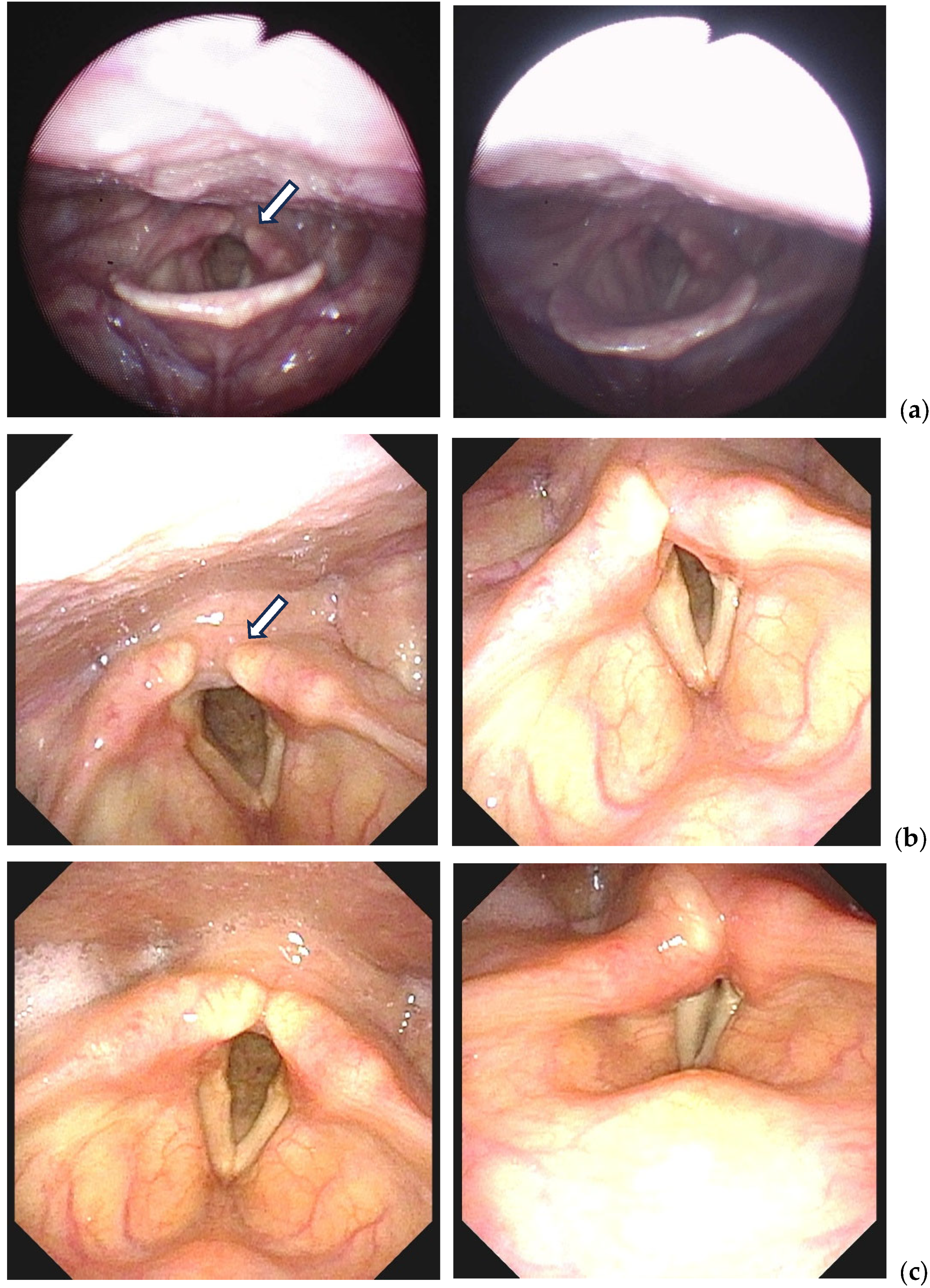
Posterior Arytenoid Cartilage Dislocation Despite Optimal Intubation During Prolonged Steep Trendelenburg Robotic Prostatectomy: A Potential Biomechanical Contributor

Abstract
1. Introduction
2. Materials and Methods
3. Results
4. Discussion
4.1. Role of Prolonged Trendelenburg Positioning as a Biomechanical Stressor
4.2. Reconsidering the Role of Video Laryngoscopy in Arytenoid Vulnerability
4.3. Diagnostic Delay and Its Clinical Implications
4.4. Clinical Implications in Contemporary Robotic Surgery
5. Conclusions
Author Contributions
Funding
Institutional Review Board Statement
Informed Consent Statement
Data Availability Statement
Conflicts of Interest
References
- Gómez-Ríos, M.; Sastre, J.A.; Onrubia-Fuertes, X.; López, T.; Abad-Gurumeta, A.; Casans-Frances, R.; Gómez-Ríos, D.; Garzón, J.C.; Martínez-Pons, V.; Casalderrey-Rivas, M.; et al. Executive Summary of the Spanish Society of Anesthesiology, Reanimation and Pain Therapy (SEDAR) Spanish Society of Emergency and Emergency Medicine (SEMES) and Spanish Society of Otolaryngology, Head and Neck Surgery (SEORL-CCC) Guideline for difficult airway management. Acta Otorrinolaringol. Esp. 2024, 75, 382–399. [Google Scholar]
- Chun, E.H.; Baik, H.J.; Chung, R.K.; Lee, H.J.; Shin, K.; Woo, J.H. Arytenoid cartilage dislocation mimicking bilateral vocal cord paralysis: A case report. Medicine 2017, 96, e8514. [Google Scholar] [CrossRef] [PubMed]
- Yan, W.Q.; Li, C.; Chen, Z. Delayed diagnosis of arytenoid cartilage dislocation after tracheal intubation in the intensive care unit: A case report. World J. Clin. Cases 2022, 10, 5119–5123. [Google Scholar] [CrossRef] [PubMed]
- Goz, V.; Qureshi, S.; Hecht, A.C. Arytenoid dislocation as a cause of prolonged hoarseness after cervical discectomy and fusion. Glob. Spine J. 2013, 3, 47–50. [Google Scholar]
- Tsuru, S.; Wakimoto, M.; Iritakenishi, T.; Ogawa, M.; Hayashi, Y. Cardiovascular operation: A significant risk factor of arytenoid cartilage dislocation/subluxation after anesthesia. Ann. Card. Anaesth. 2017, 20, 309–312. [Google Scholar] [CrossRef]
- Senoglu, N.; Oksuz, H.; Ugur, N.; Dogan, Z.; Kahraman, A. Arytenoid dislocation related to an uneventful endotracheal intubation: A case report. Cases J. 2008, 1, 251. [Google Scholar] [CrossRef][Green Version]
- Rubin, A.D.; Hawkshaw, M.J.; Moyer, C.A.; Dean, C.M.; Sataloff, R.T. Arytenoid Cartilage Dislocation: A 20-year Experience. J. Voice 2005, 19, 687–701. [Google Scholar] [CrossRef]
- Lombardi, R.A.; Arthur, M.E. Arytenoid Subluxation. In StatPearls; StatPearls Publishing LLC.: Treasure Island, FL, USA, 2025. [Google Scholar]
- Fujii-Abe, K.; Ikeda, M.; Yajima, M.; Kawahara, H. A Case of Anterior Arytenoid Cartilage Dislocation During Nasal Tracheal Intubation Using an Indirect Video Laryngoscope. Anesth. Prog. 2023, 70, 191–193. [Google Scholar]
- Alalyani, N.S.; Alhedaithy, A.A.; Alshammari, H.K.; AlHajress, R.I.; Alelyani, R.H.; Alshammari, M.F.; Alhalafi, A.H.; Alharbi, A.; Aldabal, N. Incidence and Risk Factors of Arytenoid Dislocation Following Endotracheal Intubation: A Systematic Review and Meta-Analysis. Cureus 2024, 16, e67917. [Google Scholar] [CrossRef]
- Kong, X.; Song, Y.; Wang, L.; He, G.; Ma, C.; Zhao, R.; Wang, M.; Shi, L.; Cui, W. Risk factors of arytenoid dislocation after endotracheal intubation: A propensity-matched analysis. Laryngoscope Investig. Otolaryngol. 2022, 7, 1979–1986. [Google Scholar]
- Oh, T.K.; Yun, J.Y.; Ryu, C.H.; Park, Y.N.; Kim, N.W. Arytenoid dislocation after uneventful endotracheal intubation: A case report. Korean J. Anesthesiol. 2016, 69, 93–96. [Google Scholar] [CrossRef][Green Version]
- Kiran, S.; Tandon, U.; Dwivedi, D.; Kumar, R. Prolonged hoarseness following endotracheal intubation―not so uncommon? Indian J. Anaesth. 2016, 60, 605–606. [Google Scholar] [CrossRef]
- Lee, Y.; Park, H.; Park, J.E.; Kim, S.K.; Park, E.S.; Rha, D.W. Incidental Diagnosis of Pediatric Arytenoid Cartilage Dislocation During Videofluoroscopic Swallowing Study: A Case Report. Ann. Rehabil. Med. 2020, 44, 94–98. [Google Scholar] [CrossRef] [PubMed]
- Sataloff, R.T. Arytenoid dislocation: Techniques of surgical reduction. Oper. Tech. Otolaryngol. Head Neck Surg. 1998, 9, 196–202. [Google Scholar] [CrossRef]
- Lee, S.W.; Park, K.N.; Welham, N.V. Clinical features and surgical outcomes following closed reduction of arytenoid dislocation. JAMA Otolaryngol. Head Neck Surg. 2014, 140, 1045–1050. [Google Scholar] [PubMed]
- Zhuang, P.; Nemcek, S.; Surender, K.; Hoffman, M.R.; Zhang, F.; Chapin, W.J.; Jiang, J.J. Differentiating arytenoid dislocation and recurrent laryngeal nerve paralysis by arytenoid movement in laryngoscopic video. Otolaryngol. Head Neck Surg. 2013, 149, 451–456. [Google Scholar] [CrossRef]
- Teng, Y.; Wang, H.E.; Lin, Z. Arytenoid cartilage dislocation from external blunt laryngeal trauma: Evaluation and therapy without laryngeal electromyography. Med. Sci. Monit. 2014, 20, 1496–1502. [Google Scholar]
- Yamanaka, H.; Hayashi, Y.; Watanabe, Y.; Uematu, H.; Mashimo, T. Prolonged hoarseness and arytenoid cartilage dislocation after tracheal intubation. Br. J. Anaesth. 2009, 103, 452–455. [Google Scholar] [CrossRef]
- Li, X.; Wang, L.; Lou, Z.; Lin, Z. Bilateral arytenoid dislocation after an emergency tracheal intubation: A rare case report. Acta Oto-Laryngol. Case Rep. 2024, 9, 129–132. [Google Scholar] [CrossRef]
- Pacheco-Lopez, P.C.; Berkow, L.C.; Hillel, A.T.; Akst, L.M. Complications of Airway Management. Respir. Care 2014, 59, 1006–1021. [Google Scholar] [CrossRef]
- Kilic, O.F.; Börgers, A.; Köhne, W.; Musch, M.; Kröpfl, D.; Groeben, H. Effects of steep Trendelenburg position for robotic-assisted prostatectomies on intra- and extrathoracic airways in patients with or without chronic obstructive pulmonary disease. Br. J. Anaesth. 2014, 114, 70–76. [Google Scholar] [CrossRef] [PubMed]
- Rajmohan, N.; Panikkaparambil, S.; Ramkumar, P.; Nair, S.G.; Shaji, A.; Menon, L.P. Observational study of airway changes in robotic-assisted laparoscopic surgeries in the steep Trendelenburg position after a short period of post-operative ventilation. J. Minim. Access Surg. 2026, 10, 4103. [Google Scholar] [CrossRef] [PubMed]
- Vaithialingam, B.; Masapu, D.; Rudrappa, S. Massive Congestive Facial and Submandibular Oedema Due to Extreme Neck Flexion Following Suboccipital Craniectomy: A Case Report. Cureus 2022, 14, e31759. [Google Scholar] [CrossRef] [PubMed]
- Henderson, A.C.; Levin, D.L.; Hopkins, S.R.; Olfert, I.M.; Buxton, R.B.; Prisk, G.K. Steep head-down tilt has persisting effects on the distribution of pulmonary blood flow. J. Appl. Physiol. 2006, 101, 583–589. [Google Scholar] [CrossRef][Green Version]
- Alvarez, M.; Llanes Rico, S.; Tsai, J.; Schaffer, R.M.; Masri, M.; Sciarra, J.; Kuchciak, A. Endotracheal Tube Migration in Steep Trendelenburg Position with the Estape TrenMAX Positioning System. Cureus 2021, 13, e20664. [Google Scholar] [CrossRef]
- Kwon, Y.; Jang, J.S.; Hwang, S.M.; Lee, J.J.; Hong, S.J.; Hong, S.J.; Kang, B.Y.; Lee, H.S. The Change of Endotracheal Tube Cuff Pressure During Laparoscopic Surgery. Open Med. 2019, 14, 431–436. [Google Scholar] [CrossRef]
- Inada, T.; Uesugi, F.; Kawachi, S.; Takubo, K. Changes in tracheal tube position during laparoscopic cholecystectomy. Anaesthesia 1996, 51, 823–826. [Google Scholar] [CrossRef]
- Friedman, A.D.; Kobler, J.B.; Landau-Zemer, T.; Barbu, A.M.; Burns, J.A. High-force simulated intubation fails to dislocate cricoarytenoid joint in ex vivo human larynges. Ann. Otol. Rhinol. Laryngol. 2012, 121, 746–753. [Google Scholar] [CrossRef]
- Oh, J.Y.; Lee, J.H.; Kim, Y.Y.; Baek, S.M.; Jung, D.W.; Park, J.H. A comparative study of glottis visualization according to the method of lifting the epiglottis in video laryngoscopy: Indirect and direct lifting methods. Anesth. Pain Med. 2021, 16, 196–200. [Google Scholar] [CrossRef]
- Choi, S.; Lee, D.J.; Shin, K.W.; Kim, Y.J.; Park, H.P.; Oh, H. Direct versus indirect epiglottis elevation in cervical spine movement during videolaryngoscopic intubation under manual in-line stabilization: A randomized controlled trial. BMC Anesthesiol. 2023, 23, 303. [Google Scholar] [CrossRef]
- Frosolini, A.; Caragli, V.; Badin, G.; Franz, L.; Bartolotta, P.; Lovato, A.; Vedovelli, L.; Genovese, E.; de Filippis, C.; Marioni, G. Optimal Timing and Treatment Modalities of Arytenoid Dislocation and Subluxation: A Meta-Analysis. Medicina 2025, 61, 92. [Google Scholar] [CrossRef]
- Lee, D.H.; Yoon, T.M.; Lee, J.K.; Lim, S.C. Treatment outcomes of closed reduction of arytenoid dislocation. Acta Otolaryngol. 2013, 133, 518–522. [Google Scholar] [CrossRef]
- Liu, K.; Hu, H.; Lu, Y.; Yu, Z. A Novel Five-Step Reduction Technique of Arytenoid Dislocation. Laryngoscope 2024, 134, 1744–1748. [Google Scholar] [CrossRef]

Disclaimer/Publisher’s Note: The statements, opinions and data contained in all publications are solely those of the individual author(s) and contributor(s) and not of MDPI and/or the editor(s). MDPI and/or the editor(s) disclaim responsibility for any injury to people or property resulting from any ideas, methods, instructions or products referred to in the content. |
© 2026 by the authors. Licensee MDPI, Basel, Switzerland. This article is an open access article distributed under the terms and conditions of the Creative Commons Attribution (CC BY) license.
Share and Cite
Lee, S.H.; Koh, H.J. Posterior Arytenoid Cartilage Dislocation Despite Optimal Intubation During Prolonged Steep Trendelenburg Robotic Prostatectomy: A Potential Biomechanical Contributor. J. Clin. Med. 2026, 15, 2652. https://doi.org/10.3390/jcm15072652
Lee SH, Koh HJ. Posterior Arytenoid Cartilage Dislocation Despite Optimal Intubation During Prolonged Steep Trendelenburg Robotic Prostatectomy: A Potential Biomechanical Contributor. Journal of Clinical Medicine. 2026; 15(7):2652. https://doi.org/10.3390/jcm15072652
Chicago/Turabian StyleLee, Seong Hyeok, and Hyun Jung Koh. 2026. "Posterior Arytenoid Cartilage Dislocation Despite Optimal Intubation During Prolonged Steep Trendelenburg Robotic Prostatectomy: A Potential Biomechanical Contributor" Journal of Clinical Medicine 15, no. 7: 2652. https://doi.org/10.3390/jcm15072652
APA StyleLee, S. H., & Koh, H. J. (2026). Posterior Arytenoid Cartilage Dislocation Despite Optimal Intubation During Prolonged Steep Trendelenburg Robotic Prostatectomy: A Potential Biomechanical Contributor. Journal of Clinical Medicine, 15(7), 2652. https://doi.org/10.3390/jcm15072652