Surgically Relative Risk Factors for Lower Colorectal Anastomotic Dehiscence and Rectovaginal Fistulas in Complex Deep Endometriosis Cases: A Single-Center Retrospective–Prospective Cohort Study

Abstract
1. Introduction
2. Materials and Methods
2.1. Study Design
2.2. Statistical Analysis
2.3. Eligibility Criteria
2.4. Examinations Used to Verify Eligibility Criteria
2.5. Characteristics of Lower Bowel Anastomoses
2.6. Patient Preparation for Surgery
2.7. Bowel Preparation and Perioperative Diet
2.8. Perioperative Antibiotic Prophylaxis
2.9. Thromboprophylaxis
2.10. Peritoneal Drainage and Bladder Catheterization
2.11. Surgery Involving the Urinary Tract
- Hysterectomy without additional vaginal surgery (n = 174; 41.3%);
- Hysterectomy with vaginal shaving (n = 96; 22.8%);
- Vaginal shaving without hysterectomy (n = 64; 15.2%);
- Excision of vaginal infiltrate with vaginal opening without hysterectomy (n = 19; 4.5%);
- Trachelectomy (n = 5; 1.2%).
- Full-thickness bladder resection with bladder opening (n = 25; 5.9%);
- Non-full-thickness resection without bladder opening using mucosal skinning technique (n = 14; 3.3%);
- Non-full-thickness resection without bladder opening using shaving technique (n = 38; 9.1%).
2.12. Protective Measures for Colorectal Anastomoses
- Low (from 6 to <8 cm), very low (from 5 to <6 cm), or ultra-low (<5 cm) colorectal anastomosis with concomitant vaginal opening and/or resection of a lesion involving the levator ani muscle;
- Low, very low, or ultra-low anastomosis with a thin bowel wall and concomitant ureteral procedures and vaginal shaving;
- Multisegment bowel resections or multiorgan resections with a low/very low/ultra-low anastomosis, with or without vaginal opening;
- Multisegment bowel resections in patients with bronchial asthma treated with systemic steroids;
- Multisegment bowel resection complicated by a stapler-related technical error (incomplete staple line), managed with re-resection and protective stoma formation.
- Impaired vascularization of the bowel segment combined with multiorgan surgery;
- Extensive adhesions and substantial small bowel dissection requiring multiple sutures, particularly in patients with a history of tubo-ovarian abscess;
- Multisegment bowel resection;
- Low anastomosis with concomitant vaginal opening;
- Multisegment bowel resection with ureteral dissection and vaginal opening;
- Multiple anastomoses with vaginal opening;
- Suspected microleakage or a history of perioperative pelvic inflammatory processes.
2.13. Details on Anastomotic Complications
2.14. Details on the Complexity of Surgery
- Ileocecal resection (n = 27; 6.4%), representing 2 separate bowel resections;
- Ileocecal resection and small-bowel resection (n = 27; 6.4%), representing three separate segmental resections;
- Ileocecal resection and hysterectomy (n = 18; 4.2%), representing 2 separate bowel resections and additional organ (uterus).
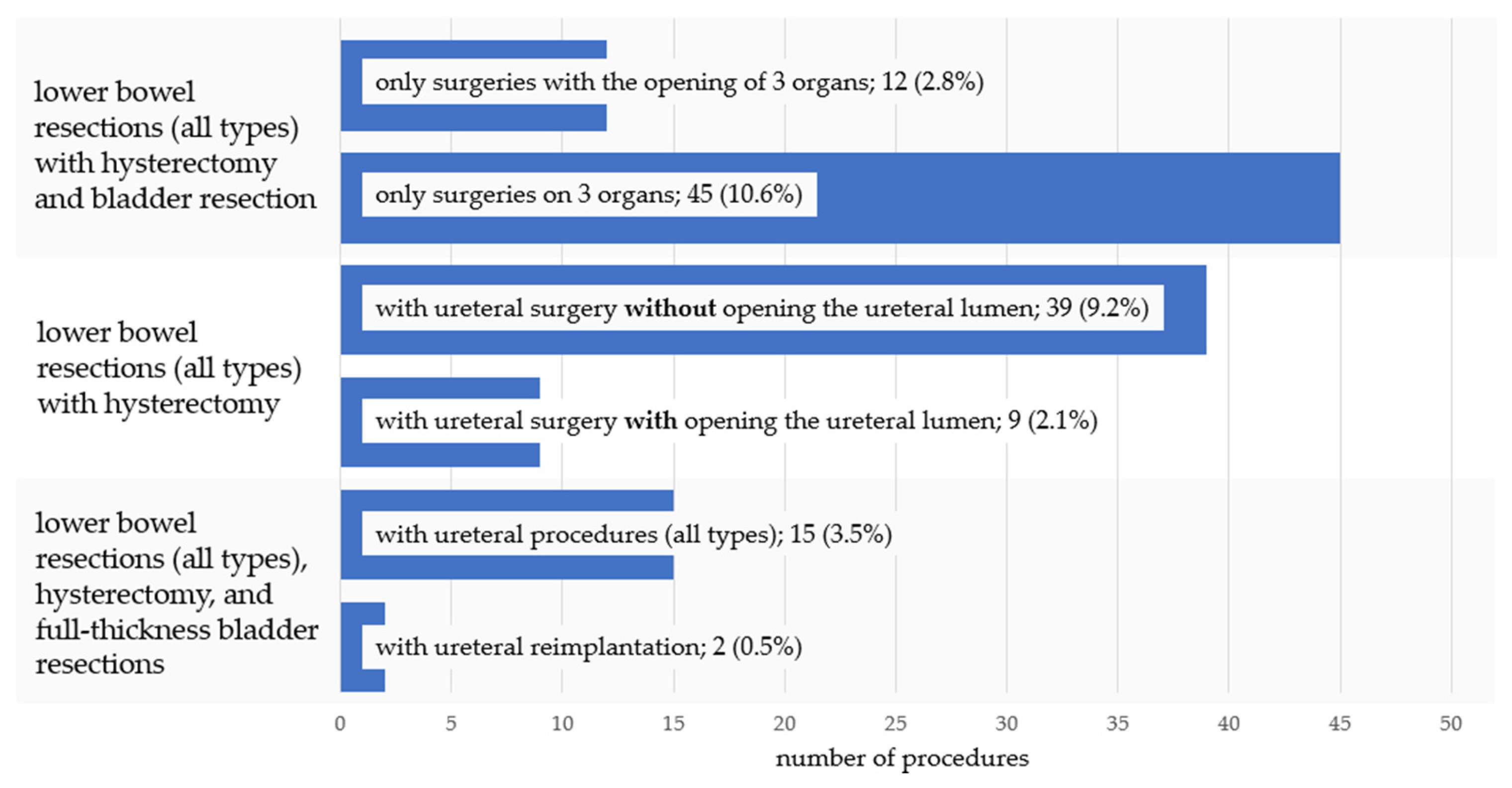
- Ileocecal resection, upper bowel resection, hysterectomy, and bladder resection (n = 6; 1.4%), representing surgery on five organs, of which at least three had opened lumen;
- Ileocecal resection, upper bowel resection, full-thickness bladder resection, ureteral reimplantation (n = 6; 1.4%), representing surgery on five organs, of which at least four had opened lumen;
- Renal resection (n = 2; 0.5%).
3. Results
Learning Curve
4. Discussion
5. Recommendations for Gynecological Surgeons
- The risk of anastomotic leakage is minimal when low rectal and sigmoid anastomoses are performed correctly and with high-quality stapling devices.
- The strongest risk factors for rectovaginal fistula are low anastomoses performed during segmental resection, particularly when accompanied by lateral infiltration of the levator ani muscle and concomitant hysterectomy or vaginal opening.
- For low and very low anastomoses in cases where vaginal opening is likely, discoid resection should be considered the preferred surgical technique.
- Protective stomas significantly reduce, although do not completely eliminate, the risk of fistula formation in very low (5–6 cm from the anal verge) or ultra low anastomoses. (below 5 cm).
- In patients with the co-occurrence of levator ani muscle infiltration undergoing concomitant surgery on the bowel and the vagina with low anastomosis location, the risk of fistula formation is high and may not be fully mitigated by a protective stoma. In such cases, performing the vaginal and bowel procedures in separate stages is recommended.
- Factors such as the number of previous surgeries, overall surgical complexity (number of operated organs, the number of opened organs) do not affect the risk of anastomotic failure.
- Despite the high complexity of procedures, the use of preventive techniques resulted in a low overall rate of rectovaginal fistulas (10/421; 2.3%) in patients undergoing lower bowel resection.
- Operative time is an important risk factor for postoperative complications, including rectovaginal fistula.
6. Conclusions
Author Contributions
Funding
Institutional Review Board Statement
Informed Consent Statement
Data Availability Statement
Conflicts of Interest
Abbreviations
| BMI | Body mass index |
| ee | End-to-end anastomosis |
| es | End-to-side anastomosis |
| F | Fishing per rectum |
| FP | Fishing per vaginam |
| ICG | Indocyanine green |
| MRI | Magnetic resonance imaging |
| OCO | Opole Oncology Center |
| RVF | Rectovaginal fistula |
| se | Side-to-end anastomosis |
| ss | Side-to-side anastomosis |
| SS | Per Surgisleeve |
| TVUS | Transvaginal ultrasound |
References
- Nezhat, C.; Li, A.; Falik, R.; Copeland, D.; Razavi, G.; Shakib, A.; Mihailide, C.; Bamford, H.; DiFrancesco, L.; Tazuke, S.; et al. Bowel endometriosis: Diagnosis and management. Am. J. Obstet. Gynecol. 2018, 218, 549–562. [Google Scholar] [CrossRef] [Scilit]
- Fruscalzo, A.; Vallée, A.; Marti, C.; Pugin, F.; Ayoubi, J.M.; Mueller, M.D.; Feki, A. Comprehensive Approaches to Endometriosis Management and Targeted Strategies for Bowel Endometriosis. J. Clin. Med. 2026, 15, 1040. [Google Scholar] [CrossRef] [Scilit] [PubMed]
- Koninckx, P.R.; Fernandes, R.; Ussia, A.; Schindler, L.; Wattiez, A.; Al-Suwaidi, S.; Amro, B.; Al-Maamari, B.; Hakim, Z.; Tahlak, M. Pathogenesis Based Diagnosis and Treatment of Endometriosis. Front. Endocrinol. 2021, 12, 745548. [Google Scholar] [CrossRef] [Scilit] [PubMed]
- Wattiez, A.; Puga, M.; Albornoz, J.; Faller, E. Surgical strategy in endometriosis. Best Pract. Res. Clin. Obstet. Gynaecol. 2013, 27, 381–392. [Google Scholar] [CrossRef] [Scilit] [PubMed]
- Jiao, H.; Feng, W.; Liu, H. Clinical diagnosis and treatment of bowel endometriosis and the distribution characteristics of lesions. BMC Women’s Health 2025, 26, 62. [Google Scholar] [CrossRef] [Scilit]
- Wolthuis, A.M.; Meuleman, C.; Tomassetti, C.; D’Hooghe, T.; de Buck van Overstraeten, A.; D’Hoore, A. Bowel endometriosis: Colorectal surgeon’s perspective in a multidisciplinary surgical team. World J. Gastroenterol. 2014, 20, 15616–15623. [Google Scholar] [CrossRef] [Scilit]
- Vigueras Smith, A.; Sumak, R.; Cabrera, R.; Kondo, W.; Ferreira, H. Bowel anastomosis leakage following endometriosis surgery: An evidence based analysis of risk factors and prevention techniques. Facts Views Vis. Obgyn 2020, 12, 207–225. [Google Scholar]
- Casas, S.G.L.; Spagnolo, E.; Saverio, S.D.; Álvarez-Gallego, M.; Carrasco, A.L.; López, M.C.; Cobos, S.T.; Campo, C.F.; Gutiérrez, A.H.; Miguelañez, I.P. Short-term outcomes in patients undergoing laparoscopic surgery for deep infiltrative endometriosis with rectal involvement: A single-center experience of 168 cases. Ann. Coloproctol. 2023, 39, 216–222. [Google Scholar] [CrossRef] [Scilit]
- Hernández, A.V.; Otten, J.; Christ, H.; Ulrici, C.; Piriyev, E.; Ludwig, S.; Rudroff, C. Ghost Ileostomy: Safe and Cost-effective Alternative to Ileostomy After Rectal Resection for Deep Infiltrating Endometriosis. In Vivo 2022, 36, 1290–1296. [Google Scholar] [CrossRef] [Scilit]
- Dolci, C.; Kerbage, Y.; Ruffolo, A.F.; Candiani, M.; Gandon, A.; Rubod, C. Protective defunctioning stoma in bowel segmental resection at the time of total hysterectomy for endometriosis: When less is more. Arch. Gynecol. Obstet. 2024, 310, 2123–2132. [Google Scholar] [CrossRef] [Scilit]
- Keckstein, J.; Hudelist, G. Classification of deep endometriosis (DE) including bowel endometriosis: From r-ASRM to #Enzian-classification. Best Pract. Res. Clin. Obstet. Gynaecol. 2021, 71, 27–37. [Google Scholar] [CrossRef] [Scilit]
- Borowiec, Z.; Mrugała, M.; Nowak, K.; Bek, W.; Milnerowicz-Nabzdyk, E. Concordance between Preoperative #ENZIANi Score and Postoperative #ENZIANs Score Classification-Why Do We Choose #ENZIAN and How Does It Impact the Future Classification Trend? J. Clin. Med. 2024, 13, 6005. [Google Scholar] [CrossRef] [Scilit]
- Abrão, M.S.; Andres, M.P.; Barbosa, R.N.; Bassi, M.A.; Kho, R.M. Optimizing Perioperative Outcomes with Selective Bowel Resection Following an Algorithm Based on Preoperative Imaging for Bowel Endometriosis. J. Minim. Invasive Gynecol. 2020, 27, 883–891. [Google Scholar] [CrossRef] [Scilit]
- Bailey, H.R.; Ott, M.T.; Hartendorp, P. Aggressive surgical management for advanced colorectal endometriosis. Dis. Colon Rectum 1994, 37, 747–753. [Google Scholar] [CrossRef] [Scilit]
- Richards, C.H.; Campbell, V.; Ho, C.; Hayes, J.; Elliott, T.; Thompson-Fawcett, M. Smoking is a major risk factor for anastomotic leak in patients undergoing low anterior resection. Colorectal Dis. 2012, 14, 628–633. [Google Scholar] [CrossRef] [Scilit]
- Abo, C.; Moatassim, S.; Marty, N.; Saint Ghislain, M.; Huet, E.; Bridoux, V.; Tuech, J.J.; Roman, H. Postoperative complications after bowel endometriosis surgery by shaving, disc excision, or segmental resection: A three-arm comparative analysis of 364 consecutive cases. Fertil. Steril. 2018, 109, 172–178.e1. [Google Scholar] [CrossRef] [Scilit] [PubMed]
- Mrugała, M.; Fiutowski, M.; Nowak, K.; Borowiec, Z.; Kasperski, M.; Bek, W.; Machnicka-Rusek, A.; Milnerowicz-Nabzdyk, E. Indocyanine Green for Assessment of Ureteral Vascularity Can Reduce the Rate of Ureteral Complications in Patients Undergoing Extended Hysterectomy. J. Clin. Med. 2024, 13, 5425. [Google Scholar] [CrossRef] [Scilit]
- Donnez, O.; Roman, H. Choosing the right surgical technique for deep endometriosis: Shaving, disc excision, or bowel resection? Fertil. Steril. 2017, 108, 931–942. [Google Scholar] [CrossRef] [Scilit]
- Hudelist, G.; Korell, M.; Burkhardt, M.; Chvatal, R.; Darici, E.; Dimitrova, D.; Drahonovsky, J.; Haj Hamoud, B.; Hornung, D.; Krämer, B.; et al. Rates of severe complications in patients undergoing colorectal surgery for deep endometriosis-a retrospective multicenter observational study. Acta Obstet. Gynecol. Scand. 2022, 101, 1057–1064. [Google Scholar] [CrossRef] [Scilit] [PubMed]
- Roman, H.; Dennis, T.; Forestier, D.; François, M.O.; Assenat, V.; Chanavaz-Lacheray, I.; Denost, Q.; Merlot, B. Excision of Deep Rectovaginal Endometriosis Nodules with Large Infiltration of Both Rectum and Vagina: What Is a Reasonable Rate of Preventive Stoma? A Comparative Study. J. Minim. Invasive Gynecol. 2023, 30, 147–155. [Google Scholar] [CrossRef] [Scilit] [PubMed]
- Bendifallah, S.; Puchar, A.; Vesale, E.; Moawad, G.; Daraï, E.; Roman, H. Surgical Outcomes after Colorectal Surgery for Endometriosis: A Systematic Review and Meta-analysis. J. Minim. Invasive Gynecol. 2021, 28, 453–466. [Google Scholar] [CrossRef] [Scilit]
- Silva-Velazco, J.; Stocchi, L.; Costedio, M.; Gorgun, E.; Kessler, H.; Remzi, F.H. Is there anything we can modify among factors associated with morbidity following elective laparoscopic sigmoidectomy for diverticulitis? Surg. Endosc. 2016, 30, 3541–3551. [Google Scholar] [CrossRef] [Scilit] [PubMed]
- Akiyoshi, T.; Ueno, M.; Fukunaga, Y.; Nagayama, S.; Fujimoto, Y.; Konishi, T.; Kuroyanagi, H.; Yamaguchi, T. Effect of body mass index on short-term outcomes of patients undergoing laparoscopic resection for colorectal cancer: A single institution experience in Japan. Surg. Laparosc. Endosc. Percutaneous Tech. 2011, 21, 409–414. [Google Scholar] [CrossRef] [Scilit]
- Akladios, C.; Messori, P.; Faller, E.; Puga, M.; Afors, K.; Leroy, J.; Wattiez, A. Is ileostomy always necessary following rectal resection for deep infiltrating endometriosis? J. Minim. Invasive Gynecol. 2015, 22, 103–109. [Google Scholar] [CrossRef] [Scilit]
- Malzoni, M.; Di Giovanni, A.; Exacoustos, C.; Lannino, G.; Capece, R.; Perone, C.; Rasile, M.; Iuzzolino, D. Feasibility and Safety of Laparoscopic-Assisted Bowel Segmental Resection for Deep Infiltrating Endometriosis: A Retrospective Cohort Study with Description of Technique. J. Minim. Invasive Gynecol. 2016, 23, 512–525. [Google Scholar] [CrossRef] [Scilit]
- Boyce, S.A.; Harris, C.; Stevenson, A.; Lumley, J.; Clark, D. Management of Low Colorectal Anastomotic Leakage in the Laparoscopic Era: More Than a Decade of Experience. Dis. Colon Rectum 2017, 60, 807–814. [Google Scholar] [CrossRef] [Scilit] [PubMed]
- Montedori, A.; Cirocchi, R.; Farinella, E.; Sciannameo, F.; Abraha, I. Covering ileo- or colostomy in anterior resection for rectal carcinoma. Cochrane Database Syst. Rev. 2010, 2010, Cd006878. [Google Scholar] [CrossRef] [Scilit]
- Huh, J.W.; Kim, H.R.; Kim, Y.J. Anastomotic leakage after laparoscopic resection of rectal cancer: The impact of fibrin glue. Am. J. Surg. 2010, 199, 435–441. [Google Scholar] [CrossRef] [Scilit] [PubMed]
- Belghiti, J.; Ballester, M.; Zilberman, S.; Thomin, A.; Zacharopoulou, C.; Bazot, M.; Thomassin-Naggara, I.; Daraï, E. Role of protective defunctioning stoma in colorectal resection for endometriosis. J. Minim. Invasive Gynecol. 2014, 21, 472–479. [Google Scholar] [CrossRef] [Scilit]
- Roman, H.; Bridoux, V.; Merlot, B.; Resch, B.; Chati, R.; Coget, J.; Forestier, D.; Tuech, J.J. Risk of bowel fistula following surgical management of deep endometriosis of the rectosigmoid: A series of 1102 cases. Hum. Reprod. 2020, 35, 1601–1611. [Google Scholar] [CrossRef] [Scilit]




| 33 mm Stapler | 31 mm Stapler | 28 mm Stapler | |
|---|---|---|---|
| Number (%) of cases | 344 (94.8%) | 18 (4.9) | 1 (0.3%) |
| Resected Segment | Number (%) | |
|---|---|---|
| Resected segments of the lower bowel | Rectum | 52 (11.9%) |
| Sigmoid colon | 83 (18.9%) | |
| Rectum and sigmoid colon | 159 (36.3%) | |
| Resected segments of the upper bowel (proximal to the sigmoid colon) accompanying lower bowel resections | Transverse colon and lower bowel resection * | 1 (0.2%) |
| Cecum and lower bowel resection * | 30 (6.9%) | |
| Appendix with concomitant upper bowel resection † and lower bowel resection * | 47 (10.7%) | |
| Appendix alone and lower bowel resection * | 16 (3.7%) | |
| Small intestine with concomitant upper bowel resection † and lower bowel resection * | 38 (8.7%) | |
| Small intestine and lower bowel resection * | 8 (1.8%) | |
| Other | Upper bowel resection † without lower bowel resection * | 4 (0.9%) |
| Type of Resection | Number (%) |
|---|---|
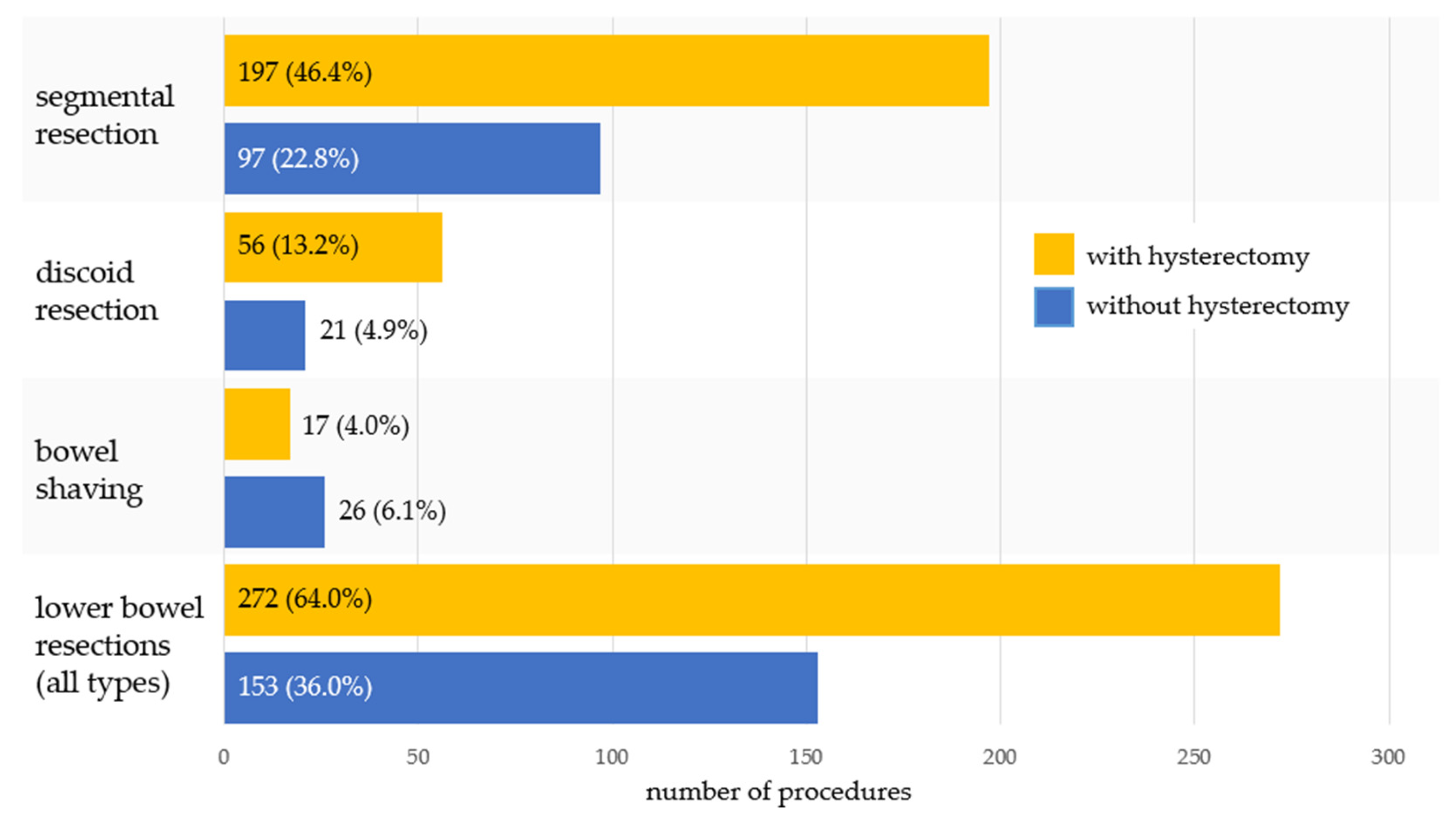
| Bowel shaving | 43 (10.2%) |
| Discoid resection only | 68 (16.2%) |
| Discoid resection and shaving | 16 (3.8%) |
| Discoid resection and segmental resection | 4 (9.5%) |
| All discoid resections * | 84 (20.0%) |
| All segmental resections | 294 (69.8%) |
| Type of Anastomosis | Side-to-Side (ss) | End-to-End (ee) | Side-to-End (se) | End-to-Side (es) |
|---|---|---|---|---|
| Number (%) | 15 (5.1%) | 263 (89.4%) | 9 (3.1%) | 7 (2.4%) |
| Type of Anvil Placement | Fishing Per Vaginam (FP) | Per Rectum (F) | Per Surgisleeve (SS) | Intra-Abdominal Placement of a Linear Stapler in Sigmoid—Sigmoid Anastomoses |
|---|---|---|---|---|
| Number (%) | 85 (28.9%) | 80 (27.2%) | 114 (38.8%) | 15 (5.1%) |
| Types of Procedures | 1 DJ Only | 2 DJ Only | Reimplantations (+DJ Always) | Shaving | Resection/Suturing | Lower Bowel Resections with Ureteral Procedure |
|---|---|---|---|---|---|---|
| Number | 58 | 37 | 14 | 43 | 12 | 164 |
| Relative to the entire group of patients undergoing ureteral procedures (n = 164) | 35.4% | 22.6% | 8.5% | 26.2% | 7.3% | 100% |
| Percentage relative to all operated patients (n = 421) | 13.8% | 8.9% | 3.3% | 10.2% | 2.9% | 38.9% |
| Number of Additional Organs Operated | Sigmoid/Rectum Only | 1 | 2 | 3 | 4 |
|---|---|---|---|---|---|
| Number (%) | 82 (19.5%) | 228 (54.2%) | 78 (18.5%) | 29 (6.9%) | 4 (0.9%) |
| Number of Operated Organs | 1 | 2 | 3 | 4 | 5 | 6 |
|---|---|---|---|---|---|---|
| Number (%) | 82 (21.8%) | 223 (59%) | 56 (14.9%) | 15 (3.7%) | 1 (0.3%) | 1 (0.3%) |
| Anastomotic Height | All Resections with Opening of the Bowel Lumen | Segmental Resection | Discoid Resection |
|---|---|---|---|
| High (≥8 cm) | 270 (71.4%) | 204 (69.4%) | 66 (78.6%) |
| Low (from 6 to <8 cm) | 93 (24.6%) | 77 (26.2%) | 16 (19.0%) |
| Very low (from 5 to <6 cm) | 12 (3.2%) | 10 (3.4%) | 2 (2.4%) |
| Ultra-low (<5 cm) | 3 (0.8%) | 3 (1.0%) | 0 |
| Total | 378 | 294 | 84 |
| Anastomotic Height | One | Two | Three | Four | Five | Six |
|---|---|---|---|---|---|---|
| All (n = 384) | 82 (21.4) | 228 (53.6%) | 57 (13.4%) | 15 (3.5%) | 1 (0.2%) | 1 (0.2%) |
| High (≥8 cm) | 60 (73.2%) | 160 (71.1%) | 39 (70.9%) | 9 (60.0%) | 1 (100%) | 0 |
| Low (from 6 to <8 cm) | 17 (20.7%) | 56 (25.1) | 13 (23.6%) | 6 (40%) | 0 | 1 (100%) |
| Very low (from 5 to <6 cm) | 4 (4.9%) | 6 (2.7%) | 2 (3.6%) | 0 | 0 | 0 |
| Ultra-low (<5 cm) | 1 (1.2%) | 1 (0.4%) | 1 (1.8%) | 0 | 0 | 0 |
| All segmental resection (n = 294) | 64 (21.8%) | 173 (58.8%) | 41 (13.9%) | 14 (4.8%) | 1 (0.3%) | 1 (0.3%) |
| High (≥8 cm) | 60 (73.2%) | 160 (71.1%) | 39 (70.9%) | 9 (60.0%) | 1 (100%) | 0 |
| Low (from 6 to <8 cm) | 17 (20.7%) | 56 (25.1) | 13 (23.6%) | 6 (40%) | 0 | 1 (100%) |
| Very low (from 5 to <6 cm) | 4 (4.9%) | 6 (2.7%) | 2 (3.6%) | 0 | 0 | 0 |
| Ultra-low (<5 cm) | 1 (1.2%) | 1 (0.4%) | 1 (1.8%) | 0 | 0 | 0 |
| All discoid resection (n = 84) | 18 (21.4%) | 50 (59.5%) | 15 (17.9%) | 1 (1.2%) | 0 | 0 |
| High (≥8 cm) | 16 (88.9%) | 37 (74%) | 13 (86.7%) | 0 | 0 | 0 |
| Low (from 6 to <8 cm) | 2 (11.1%) | 11 (22.0%) | 2 (13.3%) | 1 (100%) | 0 | 0 |
| Very low (from 5 to <6 cm) | 0 | 2 (4.0%) | 0 | 0 | 0 | 0 |
| Ultra-low (<5 cm) | 0 | 0 | 0 | 0 | 0 | 0 |
| Total (n = 378) | One (n = 82) | Two (n = 223) | Three (n = 55) | Four (n = 15) | Five (n = 1) | Six (n = 1) |
|---|---|---|---|---|---|---|
| High (≥8 cm) | 60 (73.2%) 0 | 160 (71.1%) 1/160 (0.6%) | 39 (70.9%) 1/39 (2.5%) | 9 (60%) 0 | 1 (100%) 0 | 0 |
| Low (from 6 to <8 cm) | 17 (20.7%) 0 | 56 (25.1) 2/56 (3.5%) | 13 (23.6%) 2/13 (15%) | 6 (40%) | 0 | 1 (100%) 0 |
| Very low (from 5 to <6 cm) | 4 (4.9%) 1/4 (25%) | 6 (2.7%) 2/6 (33.3%) | 2 (3.6%) 1/2 (50%) | 0 | 0 | 0 |
| Ultra-low (<5 cm) | 1 (1.2%) 0 | 1 (0.4%) 0 | 1 (1.8%) 0 | 0 | 0 | 0 |
| Risk Factor | Cases Without Rectovaginal Fistula | Cases with Rectovaginal Fistula | p-Value |
|---|---|---|---|
| Shaving alone | 43 (100%) | 0 (0%) | 0.6080 |
| Discoid resection alone | 68 (100%) | 0 (0%) | 0.3759 |
| Discoid and segmental resection | 6 (100%) | 0 (0%) | 1 |
| Discoid resection and shaving | 16 (100%) | 0 (0%) | 0.5273 |
| Segmental resection | 284 (96.6%) | 10 (3.4%) | 0.0355 |
| Stapler placement | bb, 15 (100%) f, 69 (95.8%) fp, 86 (96.6%) ss, 110 (96.5%) | 0 (0%) 3 (4.2%) 3 (3.4%) 4 (3.5%) 114 | 0.8849 |
| Anastomotic height | 8.97 ± 2.21 | 6.65 ± 2.12 | 0.0010 |
| Ileocecal anastomosis | 29 (96.7%) | 1 (3.3%) | 0.523 |
| Upper bowel resection | 53 (94.6%) | 3 (5.4%) | 0.1326 |
| Appendix alone | 14 (87.5%) | 2 (12.5%) | 0.0502 |
| Appendix with other procedures | 44 (93.6%) | 3 (6.4%) | 0.0872 |
| Small intestine alone | 7 (100.0%) | 0 (0%) | 1 |
| Small intestine with other procedures | 38 (97.4%) | 1 (2.6%) | 1 |
| Number of additionally operated organs | 1.17 ± 0.89 | 1.50 ± 0.71 | 0.1507 |
| Number of opened organs | 1.87 ± 0.88 | 2.30 ± 0.67 | 0.0626 |
| Hysterectomy with additional vaginal opening | 266 (97.8%) | 6 (2.2%) | 0.7515 |
| Vaginal infiltration with vaginal opening without hysterectomy | 17 (89.5%) | 2 (10.5%) | 0.0688 |
| Vaginal infiltration without hysterectomy and without vaginal opening | 64 (98.5%) | 1 (1.5%) | 1 |
| Hysterectomy with vaginal infiltration | 91 (94.8%) | 5 (5.2%) | 0.051 |
| Hysterectomy with other procedures | 266 (97.8%) | 6 (2.2%) | 0.7900 |
| DJ catheter | 0, 281 (97.6%) 1, 82 (97.6%) 2, 52 (98.1%) | 0, 7 (2.4%) 1, 2 (2.4%) 2, 1 (1.9%) | 0.9714 |
| Size of lower bowel infiltrates, cm | 4.41 ± 2.66 | 5.05 ± 2.24 | 0.2652 |
| Bladder | 76 (98.7%) | 1 (1.3%) | 0.6977 |
| Ureter | 63 (95.5%) | 3 (4.5%) | 0.2016 |
| Hysterectomy with segmental or discoid resection | 247 (97.6%) | 6 (2.4%) | 0.9756 |
| Retransplantation | 14 (100.0%) | 0 (0.00%) | 1 |
| Duration of surgery | 211.29 ± 84.38 | 309.00 ± 95.97 | 0.0010 |
| Fibrin glue | 366 (97.6%) | 9 (2.4%) | 1 |
| Omental flap | 83 (96.5%) | 3 (3.5%) | 0.4301 |
| Reinforcing sutures | 32 (97.0%) | 1 (3.0%) | 0.5584 |
| Trachelectomy | 4 (80.0%) | 1 (20.0%) | 0.1127 |
| Urine Leak | 3 (75.0%) | 1 (25.0%) | 0.0912 |
| Other complications | 20 (100.0%) | 0 (0.0%) | 1 |
| Number of prior surgeries | 1.64 ± 1.53 | 1.70 ± 1.49 | 0.8039 |
| Length of lower bowel resection | 7.85 ± 4.50 | 9.25 ± 5.25 | 0.3553 |
| Clostridioides difficile | 17 (4.1%) | 3 (30.0%) | 0.0001 |
| Involvement of the levator ani muscle | 15 (71.4%) | 6 (28.6%) | <0.0001 |
| BMI, kg/m2 | 23.5 ± 3.5 | 22.2 ± 3.2 | 0.1702 |
| Age, year | 37.7 ± 6.0 | 36.6 ± 5.5 | 0.5347 |
| Anastomotic Height, cm | Shaving | Anastomoses in Discoid Resections (No Anastomoses/No Patients) | Anastomoses in Segmental Resections (No Anastomoses/No Patients) |
|---|---|---|---|
| Entire cohort: shaving (n = 43), discoid resections (n = 84), segmental resections (n = 294) | |||
| High (≥8 cm) | NA | 0/66 (0%) | 2/204 (0.98%) |
| Low (from 6 to <8 cm) | NA | 0/16 (0%) | 4/77 (5.2%) |
| Very low (from 5 to <6 cm) | NA | 0/2 (0%) | 4/10 (40%) |
| Ultra-low (<5 cm) | NA | 0/0 (0%) | 0/3 (0%) |
| Total | 0 | 0/66 (0%) | 10/294 (3.4%) |
| With concomitant hysterectomy: shaving (n = 17), discoid resections (n = 56), segmental resections (n = 197) | |||
| High (≥8 cm) | NA | 0/44 (0%) | 1/140 (0.7%) |
| Low (from 6 to <8 cm) | NA | 0/10 (0%) | 4/50 (8.0%) |
| Very low (from 5 to <6 cm) | NA | 0/2 (0%) | 1/4 (25%) |
| Ultra-low (<5 cm) | NA | 0/0 (0%) | 0/2 (0%) |
| Total anastomoses | 0 | 0/56 (0%) | 6 (3.0%) |
| Anastomotic Height, cm | Vaginal Tumor Resection with Vaginal Lumen Opening and Segmental Bowel Resection (n = 12) (No Anastomoses/No Patients) | Vaginal Tumor Resection Without Vaginal Lumen Opening and Segmental Bowel Resection (n = 37) (No Anastomoses/No Patients) |
|---|---|---|
| High (≥8 cm) | 0/4 (0%) | 0/22 (0%) |
| Low (from 6 to <8 cm) | 0/5 (0%) | 0/12 (0%) |
| Very low (from 5 to <6 cm) | 2/3 (66.7%) | 1/2 (50%) |
| Ultra-low (<5 cm) | 0/0 (0%) | 0/1 (0%) |
| Total anastomoses | 2/12 (16.7%) | 1/37 (2.7%) |
| Anastomotic Height, cm | All Patients | All Protective Stomas | Segmental Resections/ Stomas | Discoid Resections/ Stomas | Rectovaginal Fistulas |
|---|---|---|---|---|---|
| High (≥8 cm) | 270 (71.4%) | 8 (32%) | 204 (69.4%) 8/204 (3.9%) | 66 (78.6%) 0/66 (0%) | 2 * |
| Low (from 6 to <8 cm) | 93 (24.6%) | 8 (32%) | 77 (26.2%) 8/77 (10.4%) | 16 (19%) 0/16 (0%) | 4 * |
| Very low (from 5 to <6 cm) | 12 (3.2%) | 6 (24%) | 10 (3.4%) 4/10 (40%) | 2 (2.4%) 2/2 (100%) | 4 * |
| Ultra-low (<5 cm) | 3 (0.8%) | 3 (12%) | 3 (1%) 3/3 (100%) | 0/0 (0%) 0 | 0 |
| Total | 378 | 25 | 23/294 (7.8%) 23/25 (92%) | 2/84 2/25 (8%) | 10 |
| Anastomotic Height, cm | Segmental Resection (n = 294) | Fistula (n = 10) | Fistula with Protective Stoma | Fistula Without Protective Stoma |
|---|---|---|---|---|
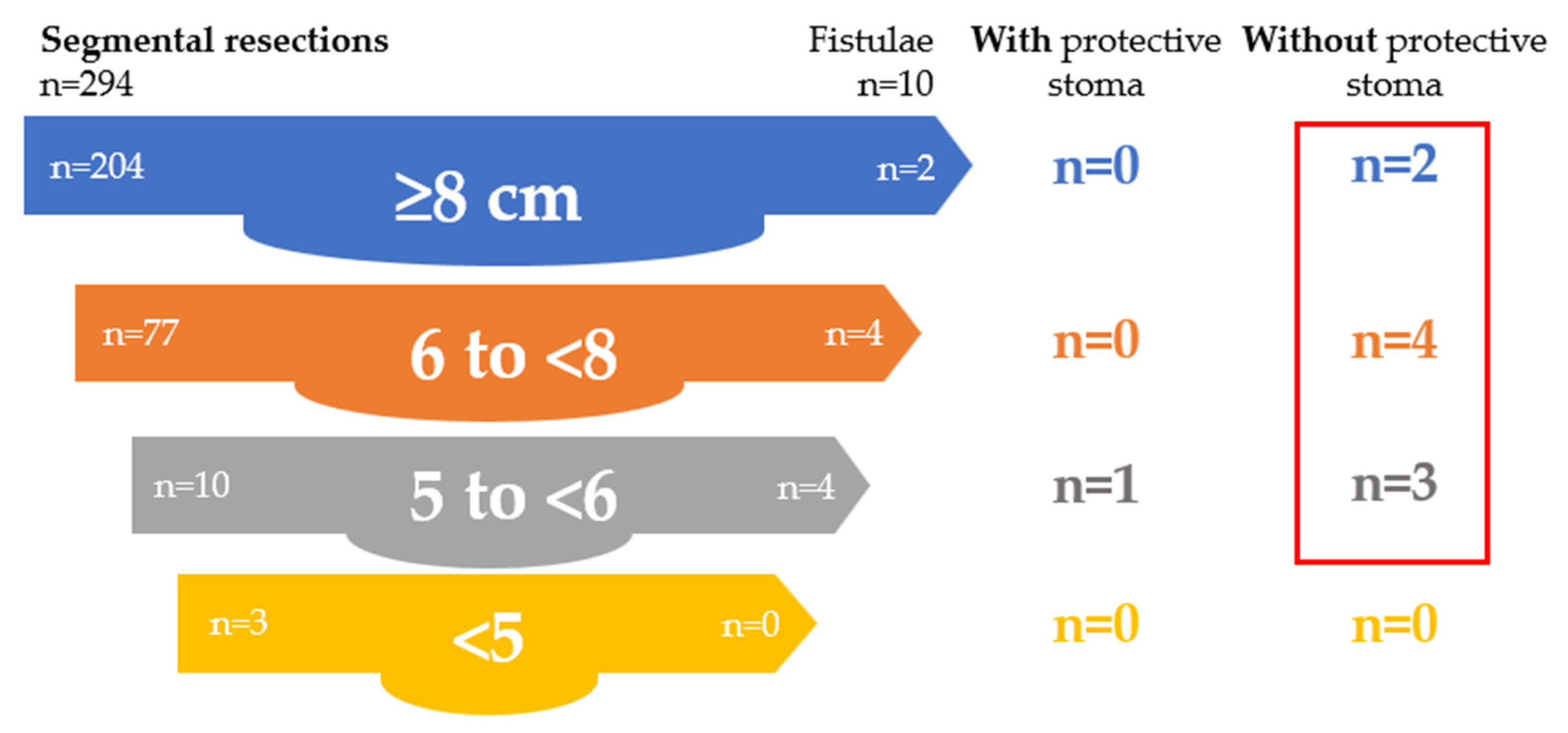
| High (≥8 cm) | 204 (69.4%) | 2/204 (0.98%) | 0 No cases of fistula | 2/2 (100%) All without stoma developed fistula |
| Low (from 6 to <8 cm) | 77 (26.2%) | 4/77 (5.2%) | 0 No cases of fistula | 4/4 (100%) All without stoma developed fistula |
| Very low (from 5 to <6 cm) | 10 (3.4%) | 4/10 (40%) | 1/4 (25%) 25% developed a fistula despite stoma protection | 3/4 (75%) 75% without stoma developed fistula |
| Ultra-low (<5 cm) | 3 (1%) | - | 0 No cases of fistula | 0 No cases of fistula |
| Anastomotic Height, cm | Discoid Resection (n = 84) | Protective Stoma (n = 2) | Fistula with Protective Stoma | Fistula Without Protective Stoma |
|---|---|---|---|---|
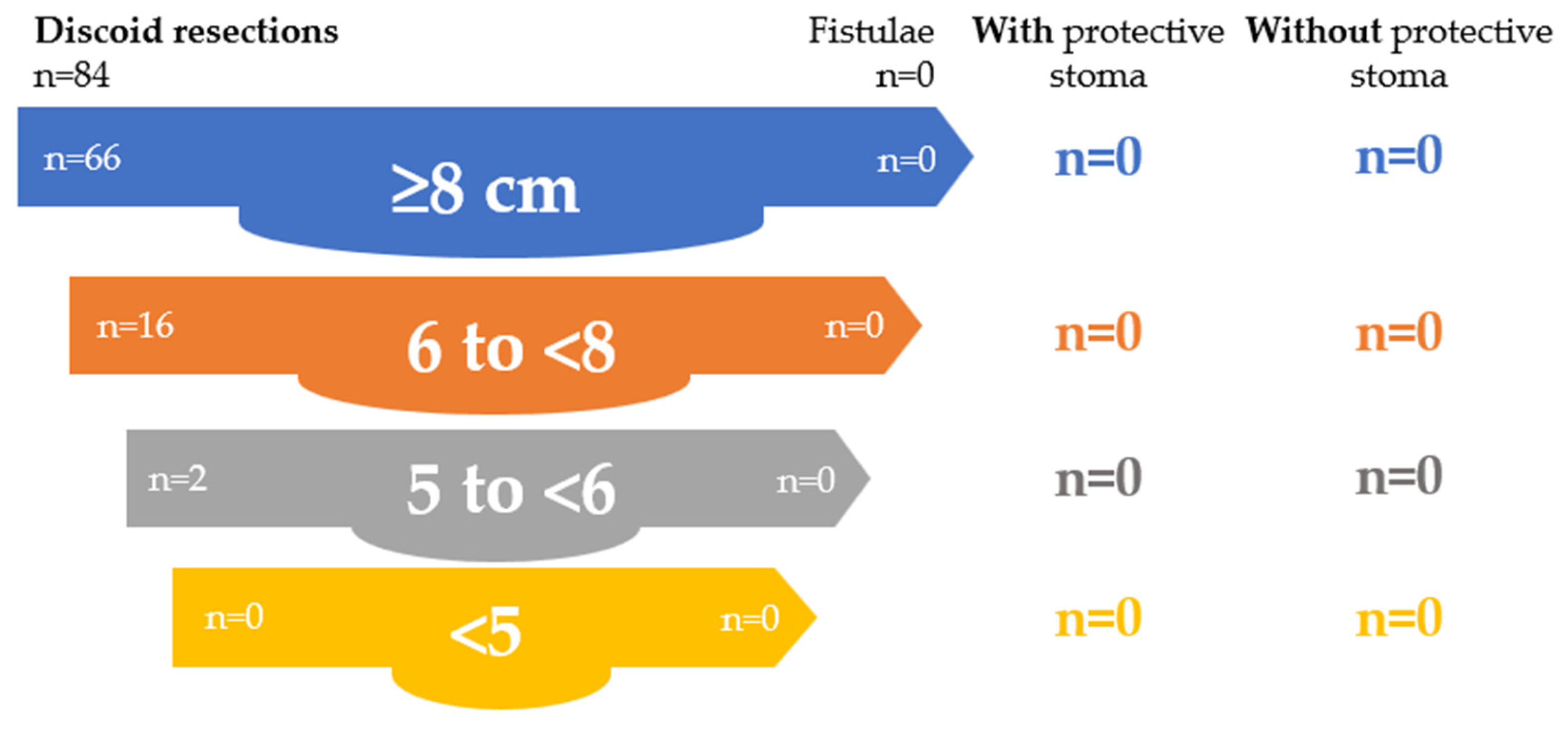
| High (≥8 cm) | 66 (78.6%) | 0/66 (0%) | 0 No cases of fistula | 0 No cases of fistula |
| Low (from 6 to <8 cm) | 16 (19%) | 0/16 (0%) | 0 No cases of fistula | 0 No cases of fistula |
| Very low (from 5 to <6 cm) | 2 (2.4%) | 2/2 (100%) | 0 No cases of fistula | 0 No cases of fistula |
| Ultra-low (<5 cm) | - | - | - | - |
| Anastomotic Height, cm | All Cases/ Ghost Stoma | Segmental Resection/ Ghost Stoma | Discoid Resection/ Ghost Stoma | Fistula |
|---|---|---|---|---|
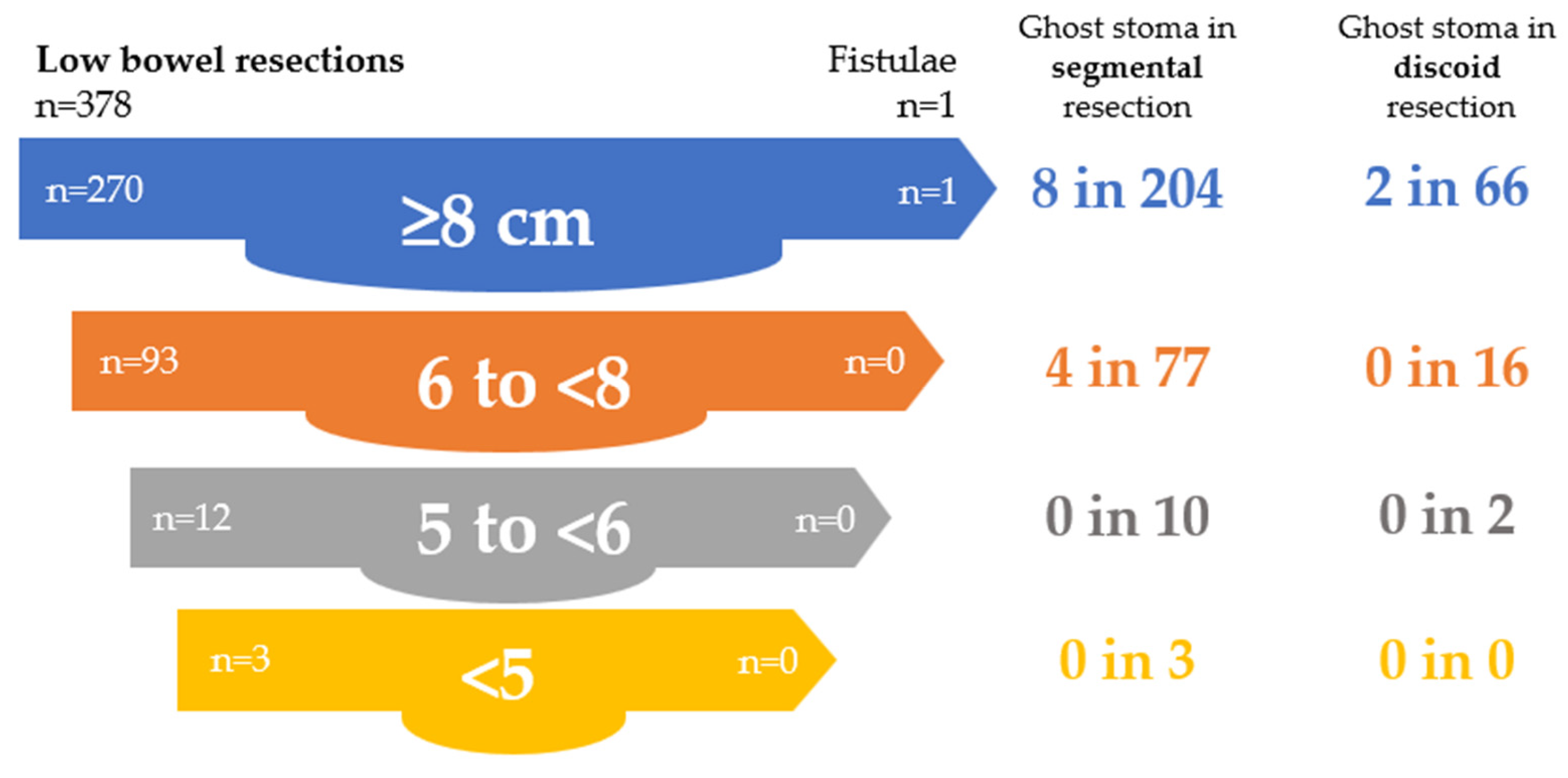
| High (≥8 cm) | 270 (71.4%) 10/270 (3.7%) | 204 (69.4%) 8/204 (3.9%) | 66 (78.6%) 2/66 (3%) | 1 * |
| Low (from 6 to <8 cm) | 93 (24.6%) 4/93 (4.3%) | 77 (26.2%) 4/77 (5.2%) | 16 (19%) 0/16 (0%) | 0 |
| Very low (from 5 to <6 cm) | 12 (3.2%) 0/12 (0%) | 10 (3.4%) 0/10 | 2 (2.4%) 0/2 (0%) | 0 |
| Ultra-low (<5 cm) | 3 (0.8%) 0/3 (0%) | 3 (1%) 0/3 (0%) | - | 0 |
| Total | 378 14/378 (3.7%) | 294 12/294 (4.1%) | 84 2/84 (2.4%) | 0 |
| Surgery Duration, min | Reinforcing Sutures | Omental Flap | Protective Stoma | Ghost Stoma | |
|---|---|---|---|---|---|
| 2020 n = 32 | 272.81 ± 134.66 (a) (b) (c) | 2 (6.2%) | 7 (21.9%) | 2 (6.2%) | 0 (0%) |
| 2021 n = 79 | 254.68 ± 81.52 (d) (e) (f) | 7 (8.9%) | 24 (30.4%) | 2 (2.5%) | 0 (0%) |
| 2022 n = 81 | 228.77 ± 84.42 (g) | 3 (3.7%) | 29 (35.8%) | 8 (9.9%) | 1 (1.2%) |
| 2023 n = 64 | 205.00 ± 58.67 (a) (d) | 3 (4.7%) | 16 (25.0%) | 5 (7.8%) | 12 (18.8%) |
| 2024 n = 83 | 191.81 ± 73.02 (b) (e) | 7 (8.4%) | 7 (8.4%) | 4 (4.8%) | 1 (1.2%) |
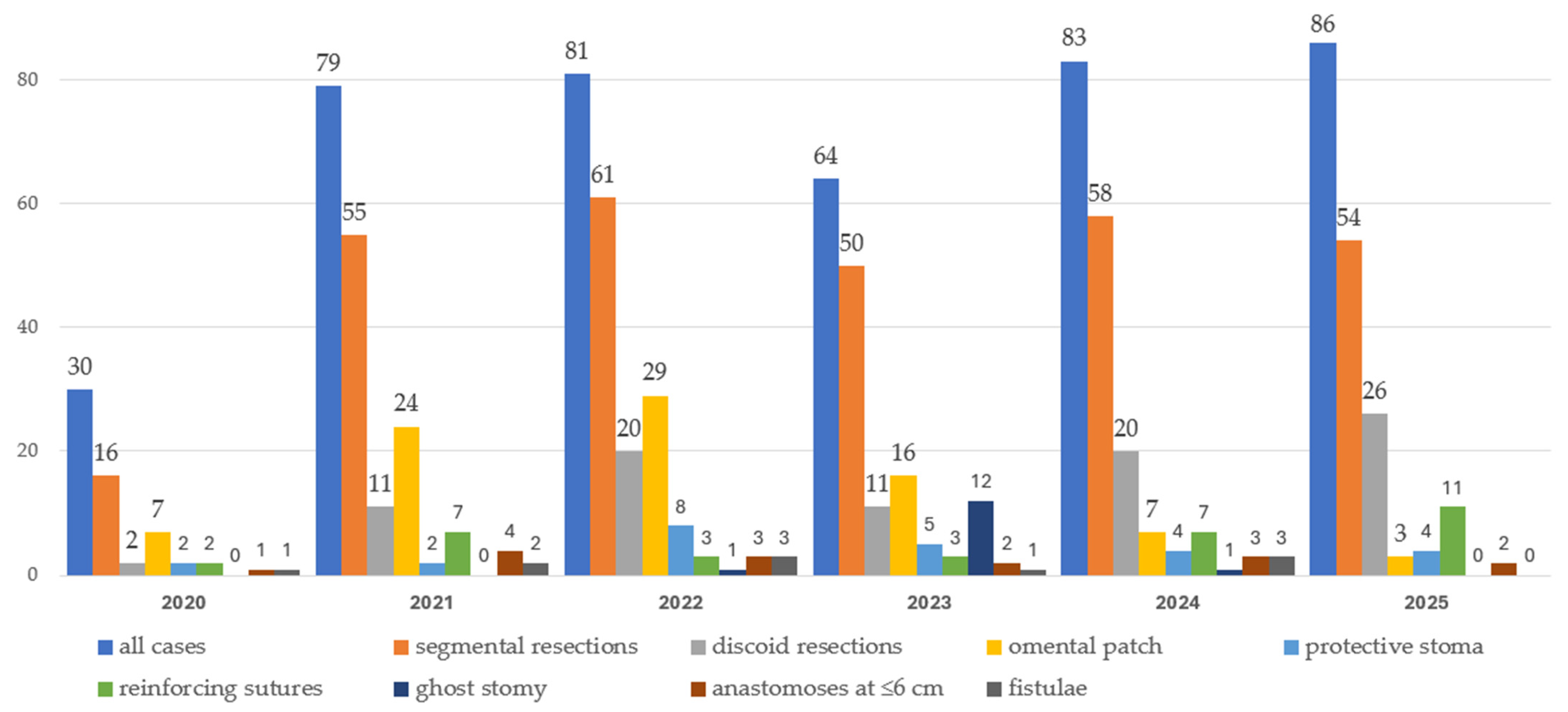
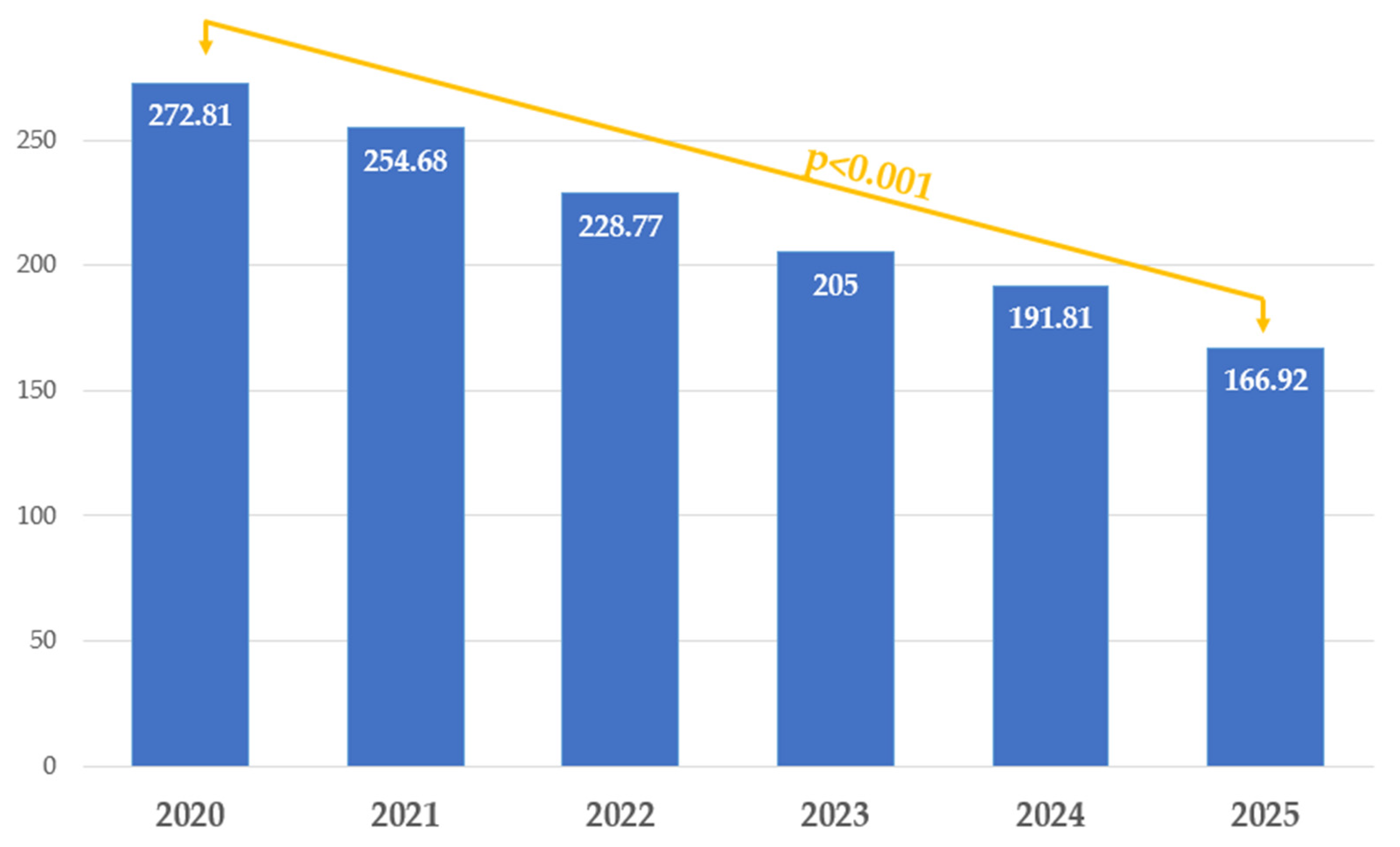
| 2025 n = 86 | 166.92 ± 61.67 (c) (f) (g) | 11 (12.8%) | 3 (3.5%) | 4 (4.7%) | 0 (0%) |
| p-value | <0.0001 * | 0.3031 † | <0.0001 † | 0.4434 † | <0.0001 † |
| p for trend | - | 0.1683 † | <0.0001 † | 0.8681 † | 0.6557 † |
Disclaimer/Publisher’s Note: The statements, opinions and data contained in all publications are solely those of the individual author(s) and contributor(s) and not of MDPI and/or the editor(s). MDPI and/or the editor(s) disclaim responsibility for any injury to people or property resulting from any ideas, methods, instructions or products referred to in the content. |
© 2026 by the authors. Licensee MDPI, Basel, Switzerland. This article is an open access article distributed under the terms and conditions of the Creative Commons Attribution (CC BY) license.
Share and Cite
Nowak, K.; Dąbrowska, A.; Mrugała, M.; Milnerowicz-Nabzdyk, E. Surgically Relative Risk Factors for Lower Colorectal Anastomotic Dehiscence and Rectovaginal Fistulas in Complex Deep Endometriosis Cases: A Single-Center Retrospective–Prospective Cohort Study. J. Clin. Med. 2026, 15, 2630. https://doi.org/10.3390/jcm15072630
Nowak K, Dąbrowska A, Mrugała M, Milnerowicz-Nabzdyk E. Surgically Relative Risk Factors for Lower Colorectal Anastomotic Dehiscence and Rectovaginal Fistulas in Complex Deep Endometriosis Cases: A Single-Center Retrospective–Prospective Cohort Study. Journal of Clinical Medicine. 2026; 15(7):2630. https://doi.org/10.3390/jcm15072630
Chicago/Turabian StyleNowak, Krzysztof, Alicja Dąbrowska, Maja Mrugała, and Ewa Milnerowicz-Nabzdyk. 2026. "Surgically Relative Risk Factors for Lower Colorectal Anastomotic Dehiscence and Rectovaginal Fistulas in Complex Deep Endometriosis Cases: A Single-Center Retrospective–Prospective Cohort Study" Journal of Clinical Medicine 15, no. 7: 2630. https://doi.org/10.3390/jcm15072630
APA StyleNowak, K., Dąbrowska, A., Mrugała, M., & Milnerowicz-Nabzdyk, E. (2026). Surgically Relative Risk Factors for Lower Colorectal Anastomotic Dehiscence and Rectovaginal Fistulas in Complex Deep Endometriosis Cases: A Single-Center Retrospective–Prospective Cohort Study. Journal of Clinical Medicine, 15(7), 2630. https://doi.org/10.3390/jcm15072630