Proton Pump Inhibitor Use for Gastroprotection and Stress Ulcer Prophylaxis Does Not Increase the Risk of Clostridioides difficile Infection or Pneumonia: A Systematic Review and Meta-Analysis of RCTs


 ,
,  ,
,  ,
,
Abstract
1. Introduction
2. Methods
2.1. Study Design
2.2. Identification of Studies
2.3. Inclusion and Exclusion Criteria
- Included adult participants (≥18 years) receiving a PPI;
- Reported CDI along with at least one other outcome of interest: either pneumonia or upper gastrointestinal bleeding (or both).
- Were quasi-randomized or non-randomized;
- Did not report CDI as an outcome;
- Lacked adequate data for extraction or analysis.
2.4. Data Extraction and Quality Assessment
2.5. Outcomes
- Clostridioides difficile infection while on treatment with the proton pump inhibitor and placebo.
- Pneumonia, defined as either community-acquired pneumonia or ventilator-acquired pneumonia for patients who were in the ICU while on treatment;
- Gastrointestinal bleeding, defined as the incidence of clinically important GI bleeding while the patient was on treatment.
2.6. Data Synthesis and Analysis
2.7. Statistical Analysis
3. Results
3.1. Primary Outcome
Risk of Developing CDI on PPIs Versus Placebo
3.2. Secondary Outcomes
3.2.1. Risk of Developing Pneumonia on PPIs Versus Placebo
3.2.2. Risk of Clinically Important Gastrointestinal Bleeding
4. Discussion
5. Conclusions
Supplementary Materials
Author Contributions
Funding
Institutional Review Board Statement
Informed Consent Statement
Data Availability Statement
Conflicts of Interest
Correction Statement
References
- Bergin, E.; Zylberberg, H.M.; Lebwohl, B.; Freedberg, D.E. Trends in use of proton pump inhibitors among adults in the United States from 1999 to 2018. Pharmacoepidemiol. Drug Saf. 2023, 32, 1406–1410. [Google Scholar] [CrossRef]
- Peery, A.F.; Dellon, E.S.; Lund, J.; Crockett, S.D.; McGowan, C.E.; Bulsiewicz, W.J.; Gangarosa, L.M.; Thiny, M.T.; Stizenberg, K.; Morgan, D.R.; et al. Burden of Gastrointestinal Disease in the United States: 2012 Update. Gastroenterology 2012, 143, 1179–1187.e3. [Google Scholar] [CrossRef]
- Desai, K.; Gupta, S.B.; Dubberke, E.R.; Prabhu, V.S.; Browne, C.; Mast, T.C. Epidemiological and economic burden of Clostridium difficile in the United States: Estimates from a modeling approach. BMC Infect. Dis. 2016, 16, 303. [Google Scholar] [CrossRef] [PubMed]
- Haque, M.; Sartelli, M.; McKimm, J.; Abu Bakar, M. Health care-associated infections—An overview. Infect. Drug Resist. 2018, 11, 2321–2333. [Google Scholar] [CrossRef]
- CDC. Clostridioides difficile Infection (CDI) Surveillance. Healthcare-Associated Infections (HAIs). 24 June 2025. Available online: https://www.cdc.gov/healthcare-associated-infections/php/haic-eip/cdiff.html (accessed on 8 September 2025).
- Tennant, S.M.; Hartland, E.L.; Phumoonna, T.; Lyras, D.; Rood, J.I.; Robins-Browne, R.M.; van Driel, I.R. Influence of Gastric Acid on Susceptibility to Infection with Ingested Bacterial Pathogens. Infect. Immun. 2008, 76, 639–645. [Google Scholar] [CrossRef]
- Imhann, F.; Bonder, M.J.; Vila, A.V.; Fu, J.; Mujagic, Z.; Vork, L.; Tigchelaar, E.F.; Jankipersadsing, S.A.; Cenit, M.C.; Harmsen, H.J.M.; et al. Proton pump inhibitors affect the gut microbiome. Gut 2016, 65, 740–748. [Google Scholar] [CrossRef]
- Schumacher, J.; Müller, P.; Sulzer, J.; Faber, F.; Molitor, B.; Maier, L. Proton-pump inhibitors increase C. difficile infection risk by altering pH rather than by affecting the gut microbiome based on a bioreactor model. Gut Microbes 2025, 17, 2519697. [Google Scholar] [CrossRef]
- Kim, J.W.; Lee, K.L.; Jeong, J.B.; Kim, B.G.; Shin, S.; Kim, J.S.; Jung, H.C.; Song, I.S. Proton pump inhibitors as a risk factor for recurrence of Clostridium-difficile-associated diarrhea. World J. Gastroenterol. 2010, 16, 3573–3577. [Google Scholar] [CrossRef]
- Howell, M.D.; Novack, V.; Grgurich, P.; Soulliard, D.; Novack, L.; Pencina, M.; Talmor, D. Iatrogenic Gastric Acid Suppression and the Risk of Nosocomial Clostridium difficile Infection. Arch. Intern. Med. 2010, 170, 784–790. [Google Scholar] [CrossRef] [PubMed]
- Moher, D.; Liberati, A.; Tetzlaff, J.; Altman, D.G. Preferred reporting items for systematic reviews and meta-analyses: The PRISMA statement. BMJ 2009, 339, b2535. [Google Scholar] [CrossRef] [PubMed]
- Page, M.J.; McKenzie, J.E.; Bossuyt, P.M.; Boutron, I.; Hoffmann, T.C.; Mulrow, C.D.; Shamseer, L.; Tetzlaff, J.M.; Akl, E.A.; Brennan, S.E.; et al. The PRISMA 2020 statement: An updated guideline for reporting systematic reviews. BMJ 2021, 372, n71. [Google Scholar] [CrossRef]
- Sterne, J.A.C.; Savović, J.; Page, M.J.; Elbers, R.G.; Blencowe, N.S.; Boutron, I.; Cates, C.J.; Cheng, H.-Y.; Corbett, M.S.; Eldridge, S.M.; et al. RoB 2: A revised tool for assessing risk of bias in randomised trials. BMJ 2019, 366, l4898. [Google Scholar] [CrossRef] [PubMed]
- Moayyedi, P.; Eikelboom, J.W.; Bosch, J.; Connolly, S.J.; Dyal, L.; Shestakovska, O.; Leong, D.; Anand, S.S.; Störk, S.; Branch, K.R.H.; et al. Safety of Proton Pump Inhibitors Based on a Large, Multi-Year, Randomized Trial of Patients Receiving Rivaroxaban or Aspirin. Gastroenterology 2019, 157, 682–691.e2. [Google Scholar] [CrossRef]
- Selvanderan, S.P.; Summers, M.J.; Finnis, M.E.; Plummer, M.P.; Ali Abdelhamid, Y.; Anderson, M.B.; Chapman, M.J.; Rayner, C.K.; Deane, A.M. Pantoprazole or Placebo for Stress Ulcer Prophylaxis (POP-UP): Randomized Double-Blind Exploratory Study*. Crit. Care Med. 2016, 44, 1842. [Google Scholar] [CrossRef]
- Alhazzani, W.; Guyatt, G.; Alshahrani, M.; Deane, A.M.; Marshall, J.C.; Hall, R.; Muscedere, J.; English, S.W.; Lauzier, F.; Thabane, L.; et al. Withholding Pantoprazole for Stress Ulcer Prophylaxis in Critically Ill Patients: A Pilot Randomized Clinical Trial and Meta-Analysis*. Crit. Care Med. 2017, 45, 1121. [Google Scholar] [CrossRef]
- Krag, M.; Marker, S.; Perner, A.; Wetterslev, J.; Wise, M.P.; Schefold, J.C.; Keus, F.; Guttormsen, A.B.; Bendel, S.; Borthwick, M.; et al. Pantoprazole in Patients at Risk for Gastrointestinal Bleeding in the ICU. N. Engl. J. Med. 2018, 379, 2199–2208. [Google Scholar] [CrossRef]
- Oliynyk, O. The effect of omeprazole on treatment outcomes in patients with severe traumatic brain injury and sepsis. Health Probl. Civiliz. 2020, 15, 137–141. [Google Scholar] [CrossRef]
- Cook, D.; Deane, A.; Lauzier, F.; Zytaruk, N.; Guyatt, G.; Saunders, L.; Hardie, M.; Heels-Ansdell, D.; Alhazzani, W.; Marshall, J.; et al. Stress Ulcer Prophylaxis during Invasive Mechanical Ventilation. N. Engl. J. Med. 2024, 391, 9–20. [Google Scholar] [CrossRef] [PubMed]
- Bhatt, D.L.; Cryer, B.L.; Contant, C.F.; Cohen, M.; Lanas, A.; Schnitzer, T.J.; Shook, T.L.; Lapuerta, P.; Goldsmith, M.A.; Laine, L.; et al. Clopidogrel with or without Omeprazole in Coronary Artery Disease. N. Engl. J. Med. 2010, 363, 1909–1917. [Google Scholar] [CrossRef] [PubMed]
- El-Kersh, K.; Jalil, B.; McClave, S.A.; Cavallazzi, R.; Guardiola, J.; Guilkey, K.; Persaud, A.K.; Furmanek, S.P.; Guinn, B.E.; Wiemken, T.L.; et al. Enteral nutrition as stress ulcer prophylaxis in critically ill patients: A randomized controlled exploratory study. J. Crit. Care 2018, 43, 108–113. [Google Scholar] [CrossRef]
- DerSimonian, R.; Laird, N. Meta-analysis in clinical trials. Control. Clin. Trials 1986, 7, 177–188. [Google Scholar] [CrossRef]
- Higgins, J.P.T.; Thompson, S.G.; Deeks, J.J.; Altman, D.G. Measuring inconsistency in meta-analyses. BMJ 2003, 327, 557–560. [Google Scholar] [CrossRef]
- Guyatt, G.H.; Oxman, A.D.; Kunz, R.; Woodcock, J.; Brozek, J.; Helfand, M.; Alonso-Coello, P.; Glasziou, P.; Jaeschke, R.; Akl, E.A.; et al. GRADE guidelines: 7. Rating the quality of evidence—Inconsistency. J. Clin. Epidemiol. 2011, 64, 1294–1302. [Google Scholar] [CrossRef]
- Cao, F.; Chen, C.X.; Wang, M.; Liao, H.R.; Wang, M.X.; Hua, S.Z.; Huang, B.; Xiong, Y.; Zhang, J.Y.; Xu, Y.L. Updated meta-analysis of controlled observational studies: Proton-pump inhibitors and risk of Clostridium difficile infection. J. Hosp. Infect. 2018, 98, 4–13. [Google Scholar] [CrossRef] [PubMed]
- Oshima, T.; Wu, L.; Li, M.; Fukui, H.; Watari, J.; Miwa, H. Magnitude and direction of the association between Clostridium difficile infection and proton pump inhibitors in adults and pediatric patients: A systematic review and meta-analysis. J. Gastroenterol. 2018, 53, 84–94. [Google Scholar] [CrossRef] [PubMed]
- Finke, M.; Boven, A.; Vlieghe, E.; Engstrand, L.; Orsini, N.; Brusselaers, N. Proton pump inhibitors and the risk of Clostridioides difficile infection: A systematic review and dose-response meta-analysis. J. Infect. 2025, 90, 106488. [Google Scholar] [CrossRef] [PubMed]
- Wang, Y.; Ge, L.; Ye, Z.; Siemieniuk, R.A.; Reintam Blaser, A.; Wang, X.; Perner, A.; Møller, M.H.; Alhazzani, W.; Cook, D.; et al. Efficacy and safety of gastrointestinal bleeding prophylaxis in critically ill patients: An updated systematic review and network meta-analysis of randomized trials. Intensive Care Med. 2020, 46, 1987–2000. [Google Scholar] [CrossRef]



| Question: Does the use of proton pump inhibitors increase the risk of developing Clostridioides difficile infection | ||||||||||||
| Setting: Both ICU and outpatient settings | ||||||||||||
| Certainty Assessment | № of Patients | Effect | Certainty | Importance | ||||||||
| № of Studies | Study Design | Risk of Bias | Inconsistency | Indirectness | Imprecision | Other Considerations | Proton Pump Inhibitors | Placebo | Relative (95% CI) | Absolute (95% CI) | ||
| Risk of Clostridioides difficile infection | ||||||||||||
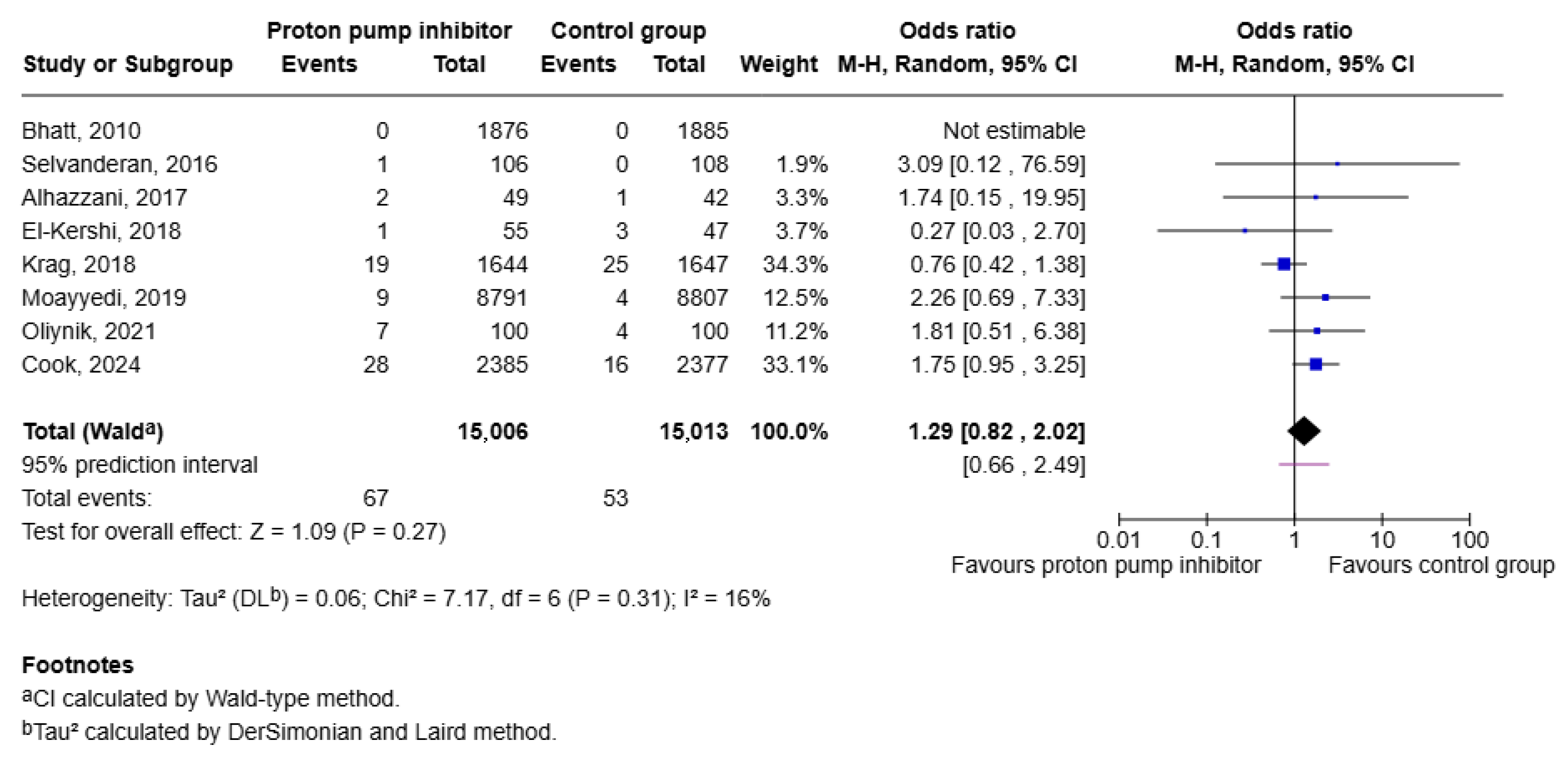
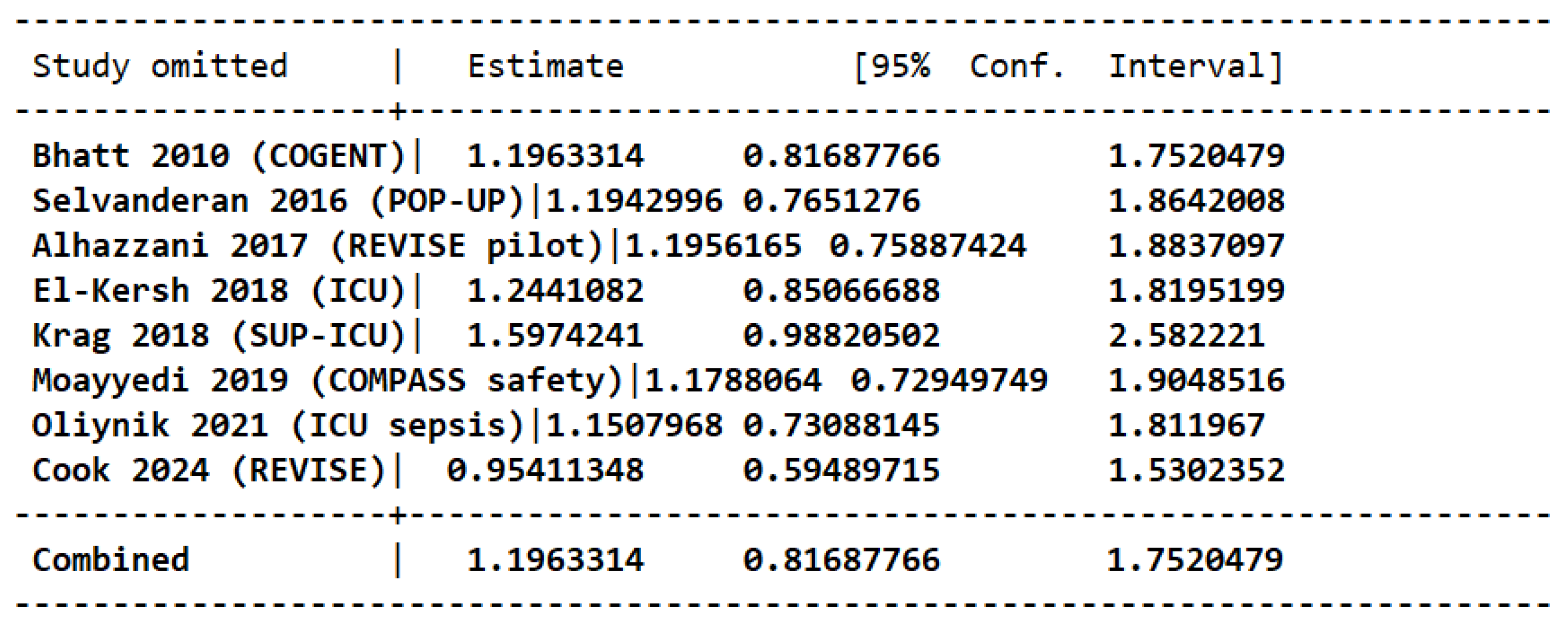
| 8 | Randomised trials | not serious | serious a | not serious | serious b | none | 67/15,006 (0.4%) | 53/15,013 (0.4%) | OR 1.29 (0.82 to 2.02) | 1 more per 1000 (from 1 fewer to 4 more) | ⨁⨁◯◯ Low a,b | IMPORTANT |
| Risk of developing pneumonia with proton pump inhibitors | ||||||||||||
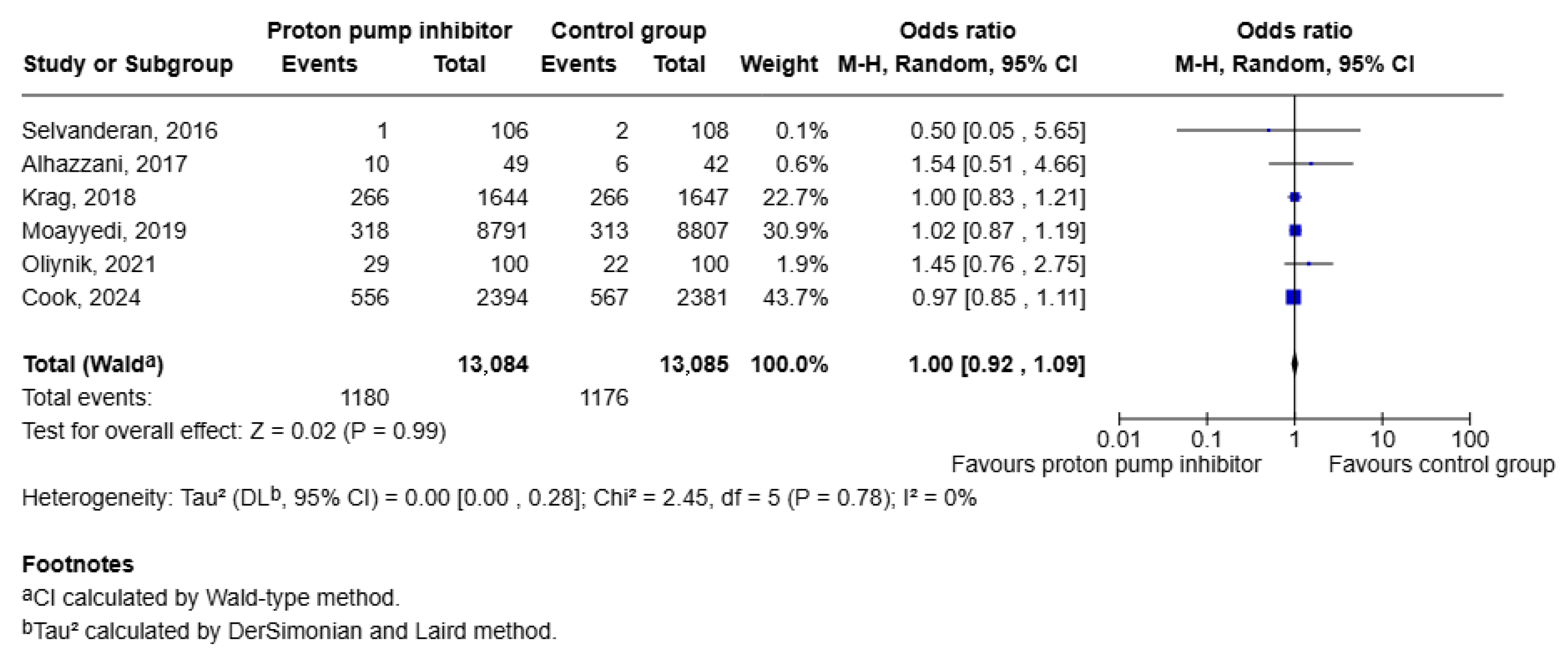
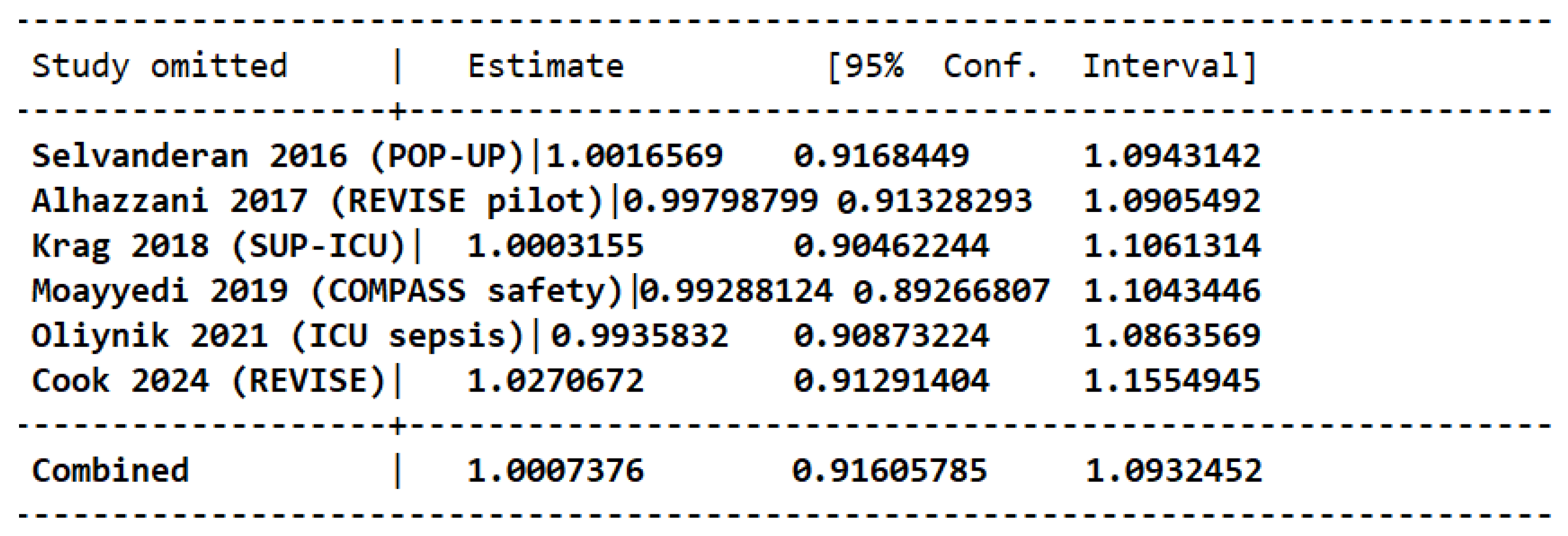
| 6 | Randomised trials | not serious | not serious | not serious | seriousc | none | 1180/13,084 (9.0%) | 1176/13,085 (9.0%) | RR 1.00 (0.92 to 1.09) | 0 fewer per 1000 (from 7 fewer to 8 more) | ⨁⨁⨁◯ Moderate c | IMPORTANT |
| Clinically important upper GI bleeding | ||||||||||||
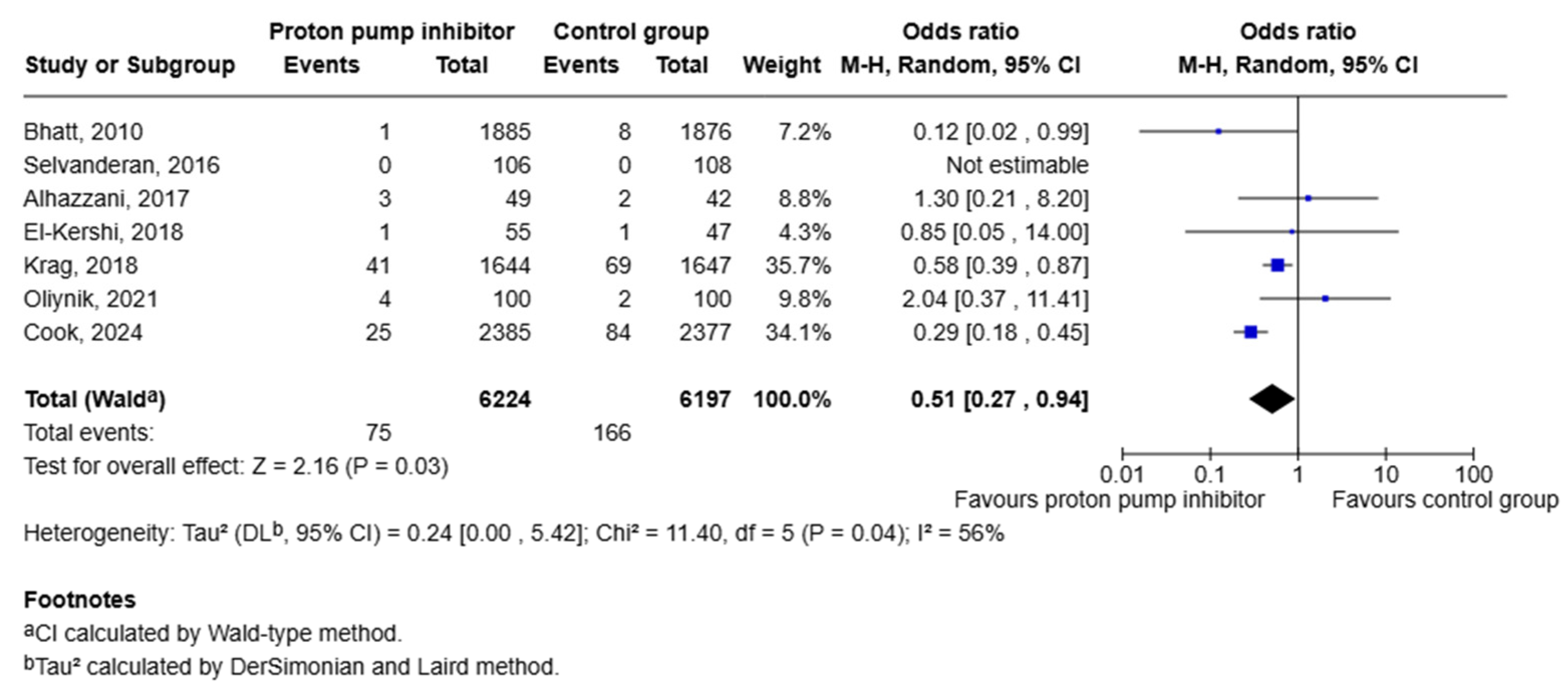
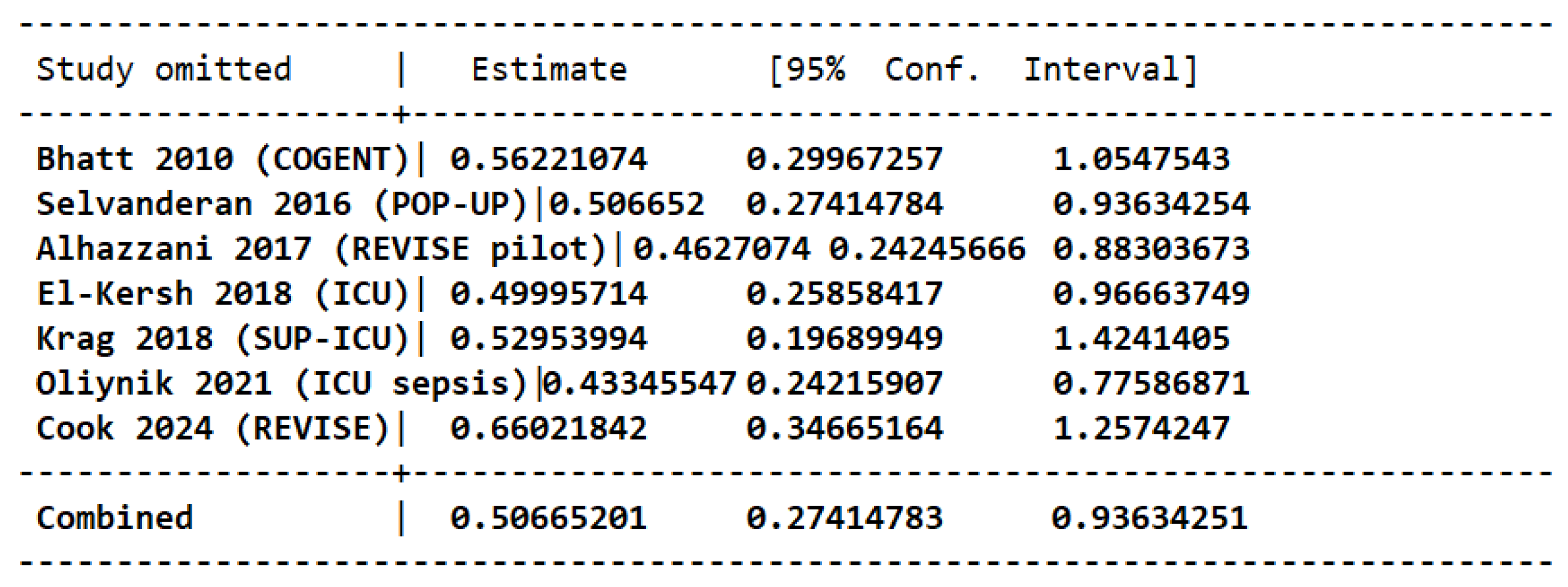
| 6 | Randomised trials | not serious | not serious | not serious | not serious | none | 74/4339 (1.7%) | 158/4321 (3.7%) | RR 0.51 (0.27 to 0.94) | 18 fewer per 1000 (from 27 fewer to 2 fewer) | ⨁⨁⨁⨁ High | IMPORTANT |
| Study Name | Location | Setting | Intervention | Comparator | Total Sample Size | Indication | Baseline Demographics | Outcomes of Interest | Length of Follow-Up | |
|---|---|---|---|---|---|---|---|---|---|---|
| Intervention Group | Comparator Group | |||||||||
| Bhatt 2010 (COGENT) [20] | International | Both acute and outpatient healthcare settings | 20 mg Omeprazole (oral) | Placebo | 3761 | Gastroprotection and bleeding prophylaxis in patients with dual antiplatelet therapy | -Median age: 68.5 years -Males: 66.9% | -Median age: 68.7 years -Males: 69.5% | - CDI -Upper GI bleeding | -Median follow-up 106 days (IQR 55–166), max 341 days |
| Selvanderan 2016 (POP-UP) [15] | Australia | Mixed medical–surgical ICU | 40 mg Pantoprazole (intravenous) | Placebo | 214 | Stress ulcer prophylaxis | -Age (mean ± SD): 52 ± 18 years -Males: 64% | -Age (mean ± SD): 52 ± 17 years -Males: 67% | -CDI -Pneumonia -Upper GI bleeding | -Outcomes were assessed throughout the ICU stay, with pneumonia additionally monitored up to 7 days after stopping the study drug and C. difficile infection monitored until hospital discharge. |
| Alhazzani 2017 (REVISE pilot) [16] | Canada, Saudi Arabia, and Australia | ICUs | 40 mg Pantoprazole (intravenous) | Placebo | 91 | Stress ulcer prophylaxis | -Median age: 61.8 years -Males: 55.1% | -Median age: 55.3 years -Males: 59.5% | -CDI -Pneumonia -Upper GI bleeding | -All outcomes were monitored throughout the ICU stay, with C. difficile followed until hospital discharge. |
| El-Kersh 2018 [21] | USA | ICUs | 40 mg Pantoprazole (intravenous) | Placebo | 102 | Stress ulcer prophylaxis | -Median age: 62 years -Males: 55% | -Median age: 58 years -Males: 60% | -CDI -Upper GI bleeding | -Patients were followed until ICU discharge or cessation of enteral nutrition with transition to oral feeding. |
| Krag 2018 (SUP-ICU) [17] | Denmark, Finland, Netherlands, Norway, Switzerland, and the UK | ICUs | 40 mg Pantoprazole (intravenous) | Placebo | 3291 | Stress ulcer prophylaxis | -Median age: 67 years -Males: 63% | -Median age: 67 years -Males: 65% | -CDI -Pneumonia -Upper GI bleeding | -Outcomes were assessed during the ICU stay. |
| Moayyedi 2019 (COMPASS safety) [14] | International | Outpatient and inpatient healthcare settings | 40 mg Pantoprazole (oral) | Placebo | 17,598 | Bleeding prophylaxis in patients with stable atherosclerotic disease on aspirin/rivaroxaban | -Age (mean ± SD): 67.6 ± 8.1 years -Males: 78% | -Age (mean ± SD): 67.7 ± 8.1 years -Males: 79% | -CDI -Pneumonia | -All outcomes were assessed at structured follow-up visits every 6 months for a median of 3.01 years. |
| Oliynyk 2020 [18] | Poland | Neurotrauma ICU | 0.2 mg/kg Omeprazole (intravenous) | Placebo | 200 | Stress ulcer prophylaxis | -Age (mean ± SD): 48.6 ± 7.6 years | -Age (mean ± SD): 46.3 ± 6.8 years | -CDI -Pneumonia -Upper GI bleeding | -Patients were monitored for one month. |
| Cook 2024 (REVISE) [19] | International | ICUs | 40 mg Pantoprazole (intravenous) | Placebo | 4821 | Stress ulcer prophylaxis | -Age (mean ± SD): 58.2 ± 16.4 years -Males: 63.5% | -Age (mean ± SD): 58.3 ± 16.4 years -Males: 63.8% | -CDI -Pneumonia -Upper GI bleeding | -Upper GI bleeding was followed for 90 days after randomization. Pneumonia was assessed during the ICU stay, and C. difficile infection was assessed during the hospital stay. |
Disclaimer/Publisher’s Note: The statements, opinions and data contained in all publications are solely those of the individual author(s) and contributor(s) and not of MDPI and/or the editor(s). MDPI and/or the editor(s) disclaim responsibility for any injury to people or property resulting from any ideas, methods, instructions or products referred to in the content. |
© 2026 by the authors. Licensee MDPI, Basel, Switzerland. This article is an open access article distributed under the terms and conditions of the Creative Commons Attribution (CC BY) license.
Share and Cite
Omar, M.A.; Katrib, M.; Shekhar, R.; Maundu, D.; Sheikh, A.B.; Gitau, J.; Tofteland, N. Proton Pump Inhibitor Use for Gastroprotection and Stress Ulcer Prophylaxis Does Not Increase the Risk of Clostridioides difficile Infection or Pneumonia: A Systematic Review and Meta-Analysis of RCTs. J. Clin. Med. 2026, 15, 2617. https://doi.org/10.3390/jcm15072617
Omar MA, Katrib M, Shekhar R, Maundu D, Sheikh AB, Gitau J, Tofteland N. Proton Pump Inhibitor Use for Gastroprotection and Stress Ulcer Prophylaxis Does Not Increase the Risk of Clostridioides difficile Infection or Pneumonia: A Systematic Review and Meta-Analysis of RCTs. Journal of Clinical Medicine. 2026; 15(7):2617. https://doi.org/10.3390/jcm15072617
Chicago/Turabian StyleOmar, Mohamed A., Marcel Katrib, Rahul Shekhar, David Maundu, Abu Baker Sheikh, Jane Gitau, and Nathan Tofteland. 2026. "Proton Pump Inhibitor Use for Gastroprotection and Stress Ulcer Prophylaxis Does Not Increase the Risk of Clostridioides difficile Infection or Pneumonia: A Systematic Review and Meta-Analysis of RCTs" Journal of Clinical Medicine 15, no. 7: 2617. https://doi.org/10.3390/jcm15072617
APA StyleOmar, M. A., Katrib, M., Shekhar, R., Maundu, D., Sheikh, A. B., Gitau, J., & Tofteland, N. (2026). Proton Pump Inhibitor Use for Gastroprotection and Stress Ulcer Prophylaxis Does Not Increase the Risk of Clostridioides difficile Infection or Pneumonia: A Systematic Review and Meta-Analysis of RCTs. Journal of Clinical Medicine, 15(7), 2617. https://doi.org/10.3390/jcm15072617