A Pediatric Case of Neurodevelopmental Delay with a Familial H4C11 Variant: Clinical Course and Diagnostic Challenges


 ,
,
Abstract
1. Introduction
2. Case Presentation: Patient with a Heterozygous H4C11 Variant
2.1. Family History and Early Development
2.2. First Evaluation (Age 5 Years)
- -
- Expressive Language Disorder
- -
- Attention and Activity Disturbance
- -
- Borderline Intellectual Functioning
2.3. Second Evaluation (Age 5 Years and 8 Months)
2.4. Third Evaluation (Age 7 Years)
2.5. Therapeutic Management and Follow-Up
3. Discussion
4. Conclusions
Author Contributions
Funding
Institutional Review Board Statement
Informed Consent Statement
Data Availability Statement
Acknowledgments
Conflicts of Interest
Abbreviations
| ACMG | American College of Medical Genetics and Genomics |
| HPO | Human Phenotype Ontology |
| IQ | Intelligence quotient |
| NGS | Next-generation sequencing |
| OMIM | Online Mendelian Inheritance in Man |
| SD | Standard deviation |
| TBvH2/TEBIVANED2 | Tessadori–Bicknell–van Haaften syndrome 2 |
| VUS | Variant of uncertain significance |
| CADD | Combined Annotation Dependent Depletion |
References
- OMIM. Available online: https://omim.org/entry/619759 (accessed on 10 November 2025).
- Tessadori, F.; Giltay, J.C.; Hurst, J.A.; Massink, M.P.; Duran, K.; Vos, H.R.; van Es, R.M.; Deciphering Developmental Disorders Study; Scott, R.H.; van Gassen, K.L.I.; et al. Deciphering Developmental Disorders Study Germline mutations affecting the histone H4 core cause a developmental syndrome by altering DNA damage response and cell cycle control. Nat. Genet. 2017, 49, 1642–1646. [Google Scholar] [CrossRef] [PubMed]
- HPO. Available online: https://hpo.jax.org/browse/disease/OMIM:619759 (accessed on 10 November 2025).
- Tessadori, F.; Rehman, A.U.; Giltay, J.C.; Xia, F.; Streff, H.; Duran, K.; Bakkers, J.; Lalani, S.R.; van Haaften, G. A de novo variant in the human HIST1H4J gene causes a syndrome analogous to the HIST1H4C-associated neurodevelopmental disorder. Eur. J. Hum. Genet. 2020, 28, 674–678. [Google Scholar] [CrossRef] [PubMed]
- Tessadori, F.; Duran, K.; Knapp, K.; Fellner, M.; Deciphering Developmental Disorders Study; Smithson, S.; Meireles, A.B.; Elting, M.W.; Waisfisz, Q.; O’Donnell-Luria, A.; et al. Recurrent de novo missense variants across multiple histone H4 genes underlie a neurodevelopmental syndrome. Am. J. Hum. Genet. 2022, 109, 750–758. [Google Scholar] [CrossRef] [PubMed]
- Gene Curation Coalition (GenCC), H4C11—Curated Gene–Disease Relationship: Neurodevelopmental Disorder, Autosomal Dominant. Available online: https://search.thegencc.org/genes/HGNC:4785 (accessed on 17 November 2025).
- Bjornsson, H.T. The Mendelian disorders of the epigenetic machinery. Genome Res. 2015, 25, 1473–1481. [Google Scholar] [CrossRef] [PubMed]
- Al Ojaimi, M.; Banimortada, B.J.; Alragheb, A.; Hajir, R.S.; Alves, C.; Walid, D.; Raza, A.; El-Hattab, A.W. Molecular and clinical aspects of histone-related disorders. Hum. Genom. 2025, 19, 47. [Google Scholar] [CrossRef] [PubMed]



| Parameter | Result | Reference Range | Comment |
|---|---|---|---|
| Thyroid-stimulating hormone (TSH) | 2.84 mIU/L | 0.670–4.160 mIU/L | Within normal limits |
| Free thyroxine (FT4) | 1.14 pmol/L | 0.86–1.40 pmol/L | Within normal limits |
| Ferritin | 10.0 ng/mL | 12.8–88.7 ng/mL | Low |
| Clinical Feature (HPO) | Reported in OMIM/HPO | Present Case | Comments |
|---|---|---|---|
| Global developmental delay | + | Mild developmental delay | Confirmed, improved with therapy |
| Intellectual disability | + | Borderline IQ (73→85) | Milder phenotype than classical form |
| Absent/delayed speech | + | Expressive language delay | Partial impairment, responsive to speech therapy |
| Growth delay/short stature | + | Persistent hypotrophy, moderate growth delay | Weight < P10; mild height delay |
| Hypotonia | + | Not observed | Normal muscle tone |
| Muscular atrophy | ± | Not observed | Absent in this case |
| Pes planus | ± | Not reported | — |
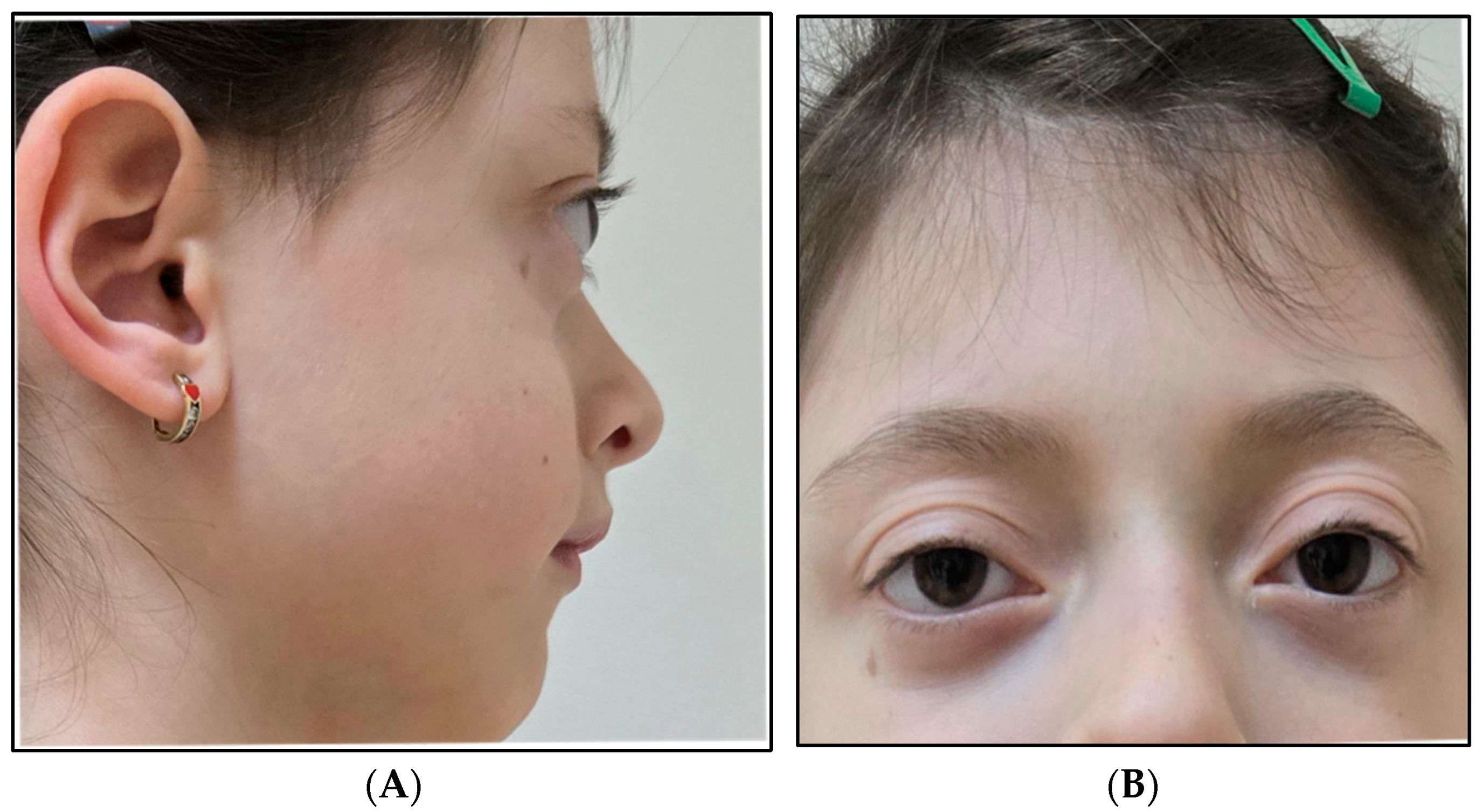
| Facial dysmorphism | + | Microcephaly confirmed (head circumference −2 SD), periorbital fullness (“puffy eyes”), exophthalmos, short philtrum | Consistent with syndrome pattern |
| Hypertelorism | + | Present (mild) | Typical craniofacial trait |
| Depressed nasal bridge | + | Mildly flattened nasal bridge | Concordant |
| Downturned corners of mouth | + | Present | Consistent |
| Wide mouth | + | Mildly wide mouth | Partial expression |
| Short philtrum | + | Present | Typical |
| Highly arched eyebrows | + | Present | Consistent |
| Upslanted palpebral fissures | + | Slight upslant noted | Mild expression |
| Periorbital fullness/puffy eyes | + | Marked “puffy eyes”, exophthalmos | Characteristic feature |
| Oculomotor apraxia | ± | Not observed | — |
| Autistic behavior/hyperactivity | + | Hyperactivity, distractibility, social adaptation difficulties | Mild neurobehavioral phenotype |
| Hypotrophy/muscular thinness | + | Present | Associated with low BMI |
| Short stature | + | Slightly below average height | — |
| Hypospadias | ± (male only) | Not applicable | — |
| Endocrine/metabolic alterations | Not consistently reported | Slightly elevated TSH, low ferritin | Possibly contributing to growth delay |
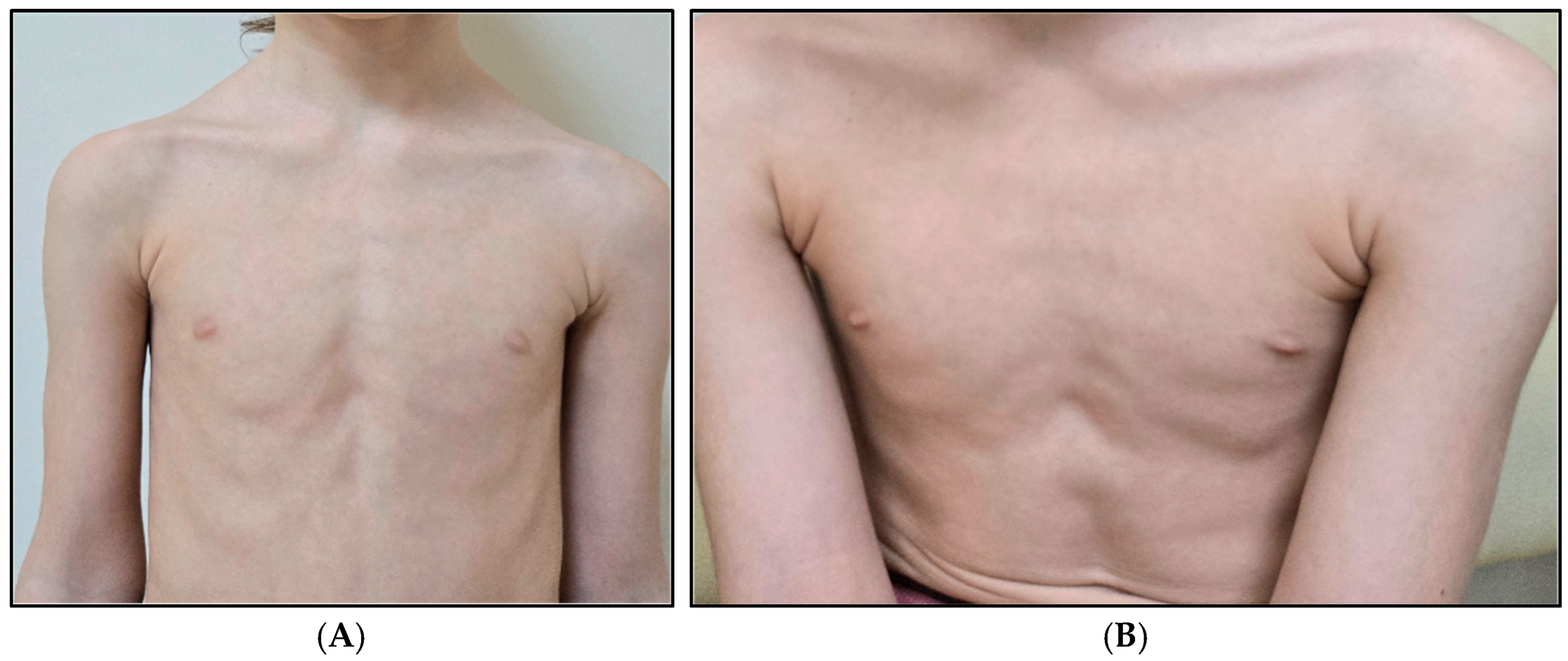
| Other features | Variable | Pectus excavatum, kyphotic posture | Additional skeletal findings |
| Parameter | Description | Comment/Interpretation |
|---|---|---|
| Gene | H4C11 (Histone Cluster 4, H4 family member 11) | Located on chromosome 6p22.1; encodes a canonical histone H4 protein. |
| OMIM entry | #619759—Tessadori–Bicknell–van Haaften syndrome 2 | Rare neurodevelopmental disorder with provisional to moderate evidence. |
| Variant identified | NM_021968.4:c.97C > T (p.Pro33Ser), heterozygous | Missense variant. |
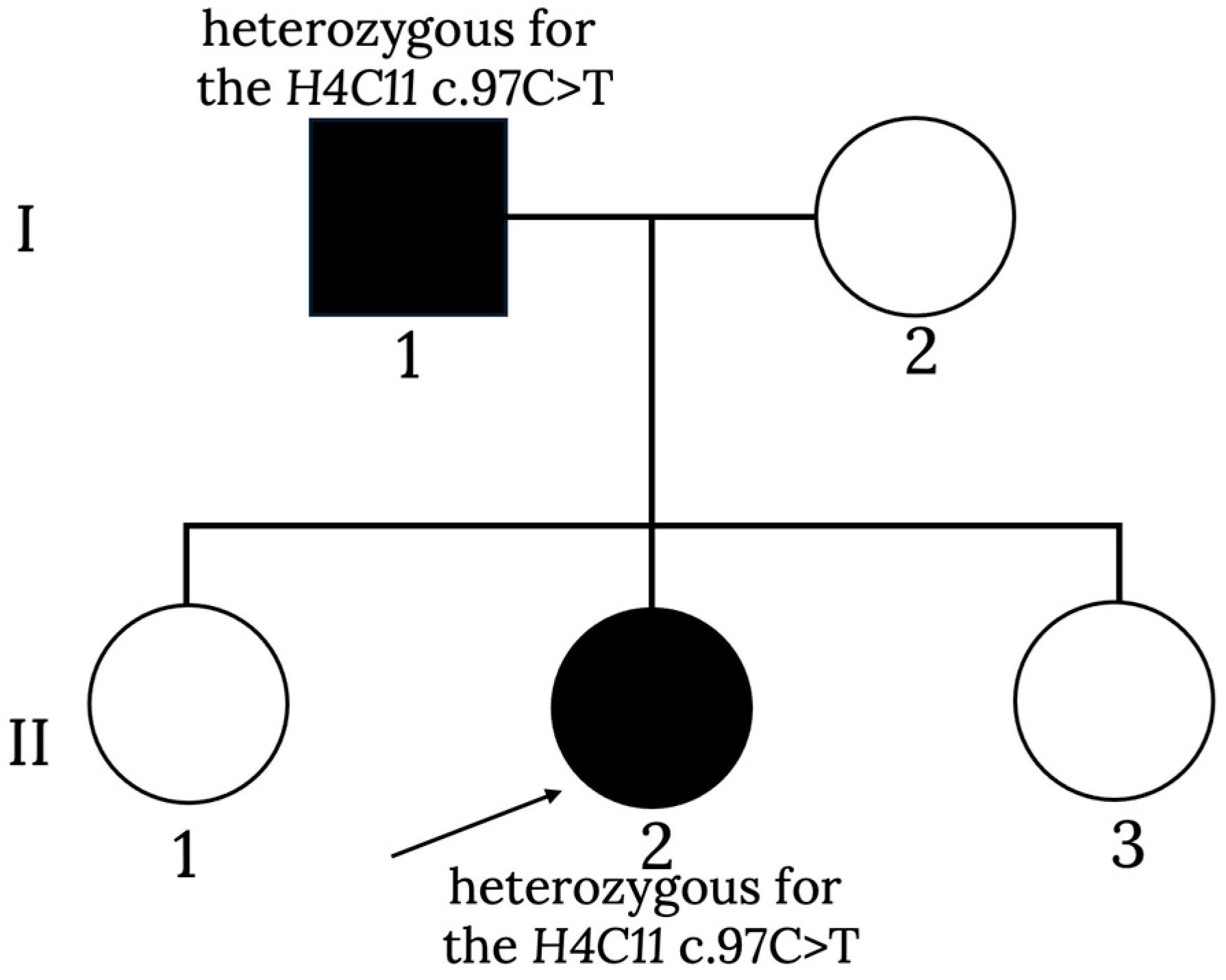
| Zygosity | Heterozygous | Variant identified in the proband and her father. |
| Inheritance pattern | Familial (paternally inherited) | Inheritance pattern cannot be established based on a single family. |
| Variant classification | Variant of Uncertain Significance (VUS) | Classified according to ACMG criteria. |
| Method of detection | NGS panel for neurodevelopmental disorders | Testing performed prior to referral using a commercial laboratory. |
| Father’s genotype/phenotype | Harboring the H4C11 c.97C > T variant; history of developmental language delay (IQ ~90) | Phenotype differs from that of the proband; IQ within normal range. |
| Mother’s genotype/phenotype | Wild-type for H4C11 | Clinically unaffected. |
| Proband’s phenotype summary | Borderline intellectual functioning, expressive language delay, growth delay, exophthalmos, periorbital fullness, hypotrophy, mild dysmorphism | Clinical features partially overlap with those reported in previous cases. |
| Segregation evidence | Variant identified in proband and father; mother tested wild-type | Segregation data alone are insufficient to establish pathogenicity. |
| Population data | Extremely low allele frequency in gnomAD v4.1.0 (<0.001%) | As reported by the testing laboratory. |
| Variant type | Missense change | Missense change: CADD PHRED score 22.9 suggests potential deleteriousness, although in silico predictions alone are insufficient to establish pathogenicity. |
Disclaimer/Publisher’s Note: The statements, opinions and data contained in all publications are solely those of the individual author(s) and contributor(s) and not of MDPI and/or the editor(s). MDPI and/or the editor(s) disclaim responsibility for any injury to people or property resulting from any ideas, methods, instructions or products referred to in the content. |
© 2026 by the authors. Licensee MDPI, Basel, Switzerland. This article is an open access article distributed under the terms and conditions of the Creative Commons Attribution (CC BY) license.
Share and Cite
Tudorache, E.; Giurgiuveanu, A.; Severin, E.; Iordănescu, I.-I.; Bulf, M.A. A Pediatric Case of Neurodevelopmental Delay with a Familial H4C11 Variant: Clinical Course and Diagnostic Challenges. J. Clin. Med. 2026, 15, 2505. https://doi.org/10.3390/jcm15072505
Tudorache E, Giurgiuveanu A, Severin E, Iordănescu I-I, Bulf MA. A Pediatric Case of Neurodevelopmental Delay with a Familial H4C11 Variant: Clinical Course and Diagnostic Challenges. Journal of Clinical Medicine. 2026; 15(7):2505. https://doi.org/10.3390/jcm15072505
Chicago/Turabian StyleTudorache, Elena, Andreea Giurgiuveanu, Emilia Severin, Irina-Ioana Iordănescu, and Mihaela Anca Bulf. 2026. "A Pediatric Case of Neurodevelopmental Delay with a Familial H4C11 Variant: Clinical Course and Diagnostic Challenges" Journal of Clinical Medicine 15, no. 7: 2505. https://doi.org/10.3390/jcm15072505
APA StyleTudorache, E., Giurgiuveanu, A., Severin, E., Iordănescu, I.-I., & Bulf, M. A. (2026). A Pediatric Case of Neurodevelopmental Delay with a Familial H4C11 Variant: Clinical Course and Diagnostic Challenges. Journal of Clinical Medicine, 15(7), 2505. https://doi.org/10.3390/jcm15072505