Time Is Kidney: A Case Study and Literature Review of Bilateral Renal Compartment Syndrome After Blunt Trauma, a Rare Complication

 , , ,
, , ,
Abstract
1. Introduction
Key Learning Points
- Bilateral traumatic renal compartment syndrome is an extremely rare but potentially reversible cause of acute kidney injury after blunt trauma.
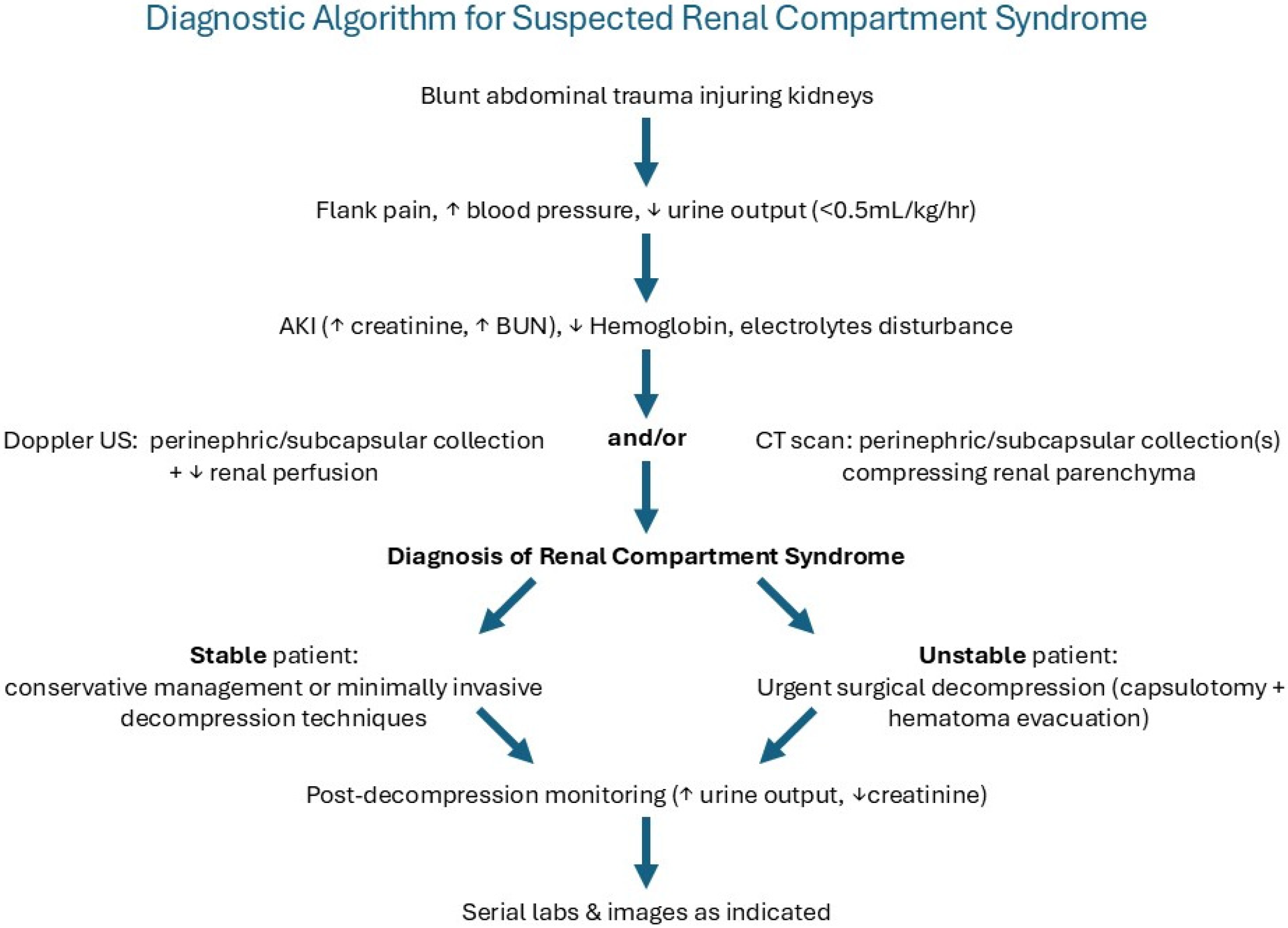
- The diagnostic triad includes acute kidney injury, perinephric or subcapsular collections on imaging, and reduced renal perfusion on Doppler ultrasound.
- Early recognition is critical as surgical decompression via renal capsulotomy can rapidly restore renal perfusion and urine output.
- Trauma surgeons should maintain a high index of suspicion for renal compartment syndrome in patients with worsening renal function and expanding perinephric hematomas.
2. Case Presentation
3. Literature Review
3.1. Literature Search Strategy
3.2. Summary of Table Findings
4. Discussion
4.1. Pathophysiology of Compartment Syndromes
4.2. Renal Hemodynamics and Compartment Physiology
4.3. Experimental Evidence on Renal Compartment Syndrome
4.4. Renal Compartment Syndrome Versus Page Kidney
4.5. Demographicl Distribution
4.6. Etiology
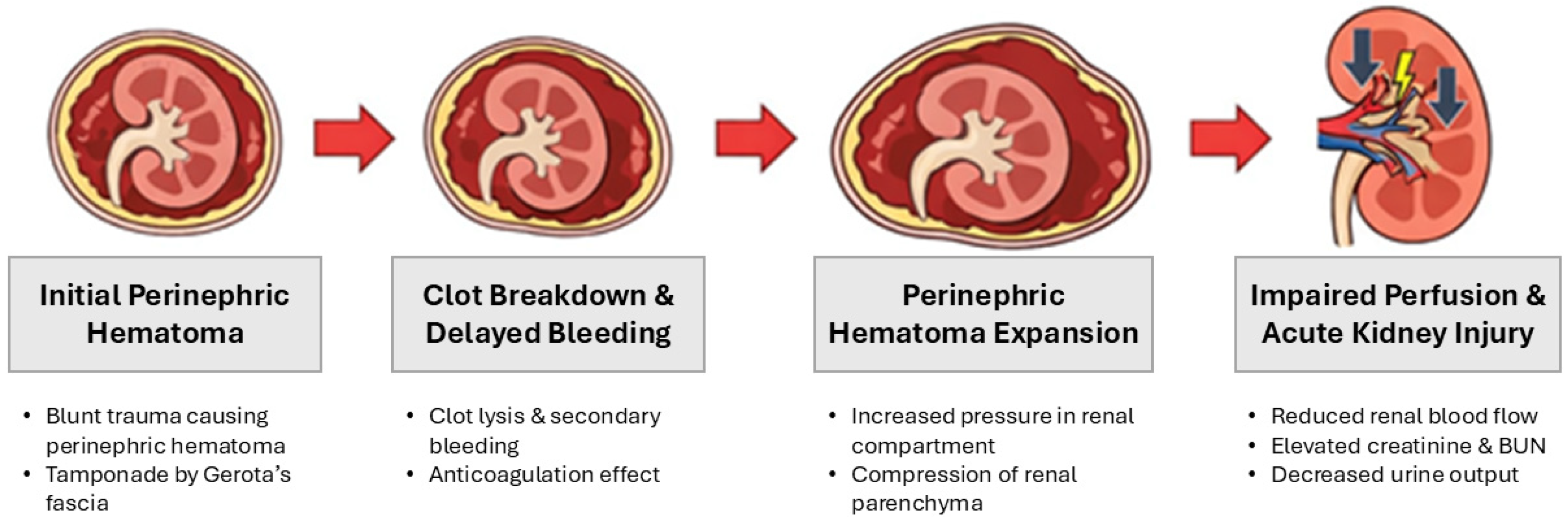
4.7. Pathophysiology Behind Delayed Clinical Presentation
4.8. Proposed Diagnostic Framework
- (1)
- Acute kidney injury;
- (2)
- Perinephric/subcapsular collections on imaging;
- (3)
- Reduced renal perfusion on Doppler ultrasound.
4.9. Measuring Preoperative Intra-Abdominal Pressure
4.10. Therapeutic Intervention
4.11. Role of Placing an Onlay Biosynthetic Mesh After Total Abdominal Closure
4.12. Secondary Abdominal Compartment Syndrome in the Setting of Bilateral Renal Compartment Syndrome
5. Limitations
6. Conclusions
Author Contributions
Funding
Institutional Review Board Statement
Informed Consent Statement
Data Availability Statement
Acknowledgments
Conflicts of Interest
Abbreviations
| ACS | Acute Compartment Syndrome |
| ABC | Argon Beam Coagulation |
| AKI | Acute Kidney Injury |
| BTRCS | Bilateral Traumatic Renal Compartment Syndrome |
| CKD | Chronic Kidney Disease |
| CT | Computed Tomography |
| CTAPiv | Computed Tomography of the Abdomen & Pelvis with Intravenous Contrast |
| CTA | Computed Tomography Angiography |
| DTPA | Diethylenetriaminepentaacetic Acid |
| DVT | Deep Vein Thrombosis |
| ESWL | Extracorporeal Shock Wave Lithotripsy |
| GCS | Glasgow Coma Scale |
| HOCL | Hypochlorous Acid |
| IM | Intramedullary |
| IV | Intravenous |
| IVC | Inferior Vena Cava |
| JP | Jackson–Pratt |
| MVC | Motor Vehicle Collision |
| NR | Not Reported |
| OR | Operating Room |
| ORIF | Open Reduction and Internal Fixation |
| PH | Perinephric Hematoma |
| PN | Perinephric |
| PO | Per Os (by mouth) |
| PSV/EDV | Peak Systolic Velocity/End-Diastolic Velocity |
| RACS | Renal Allograft Compartment Syndrome |
| RCC | Renal Cell Carcinoma |
| RCS | Renal Compartment Syndrome |
| RF | Renal Function |
| RI | Resistive Index |
| RP | Retroperitoneal |
| SC | Subcapsular |
| sCr | Serum Creatinine |
| TAC | Temporary Abdominal Closure |
| Tc-99m | Technetium-99m |
| US | Ultrasound |
| UO | Urine Output |
| WSACS | World Society of the Abdominal Compartment Syndrome |
References
- Torlincasi, A.M.; Lopez, R.A.; Waseem, M. Acute Compartment Syndrome. In StatPearls; StatPearls Publishing: Treasure Island, FL, USA, 2026. [Google Scholar]
- Hak, D.J.; Mauffrey, C. Limitations of Pressure Measurement. In Compartment Syndrome: A Guide to Diagnosis and Management; Mauffrey, C., Hak, D.J., Martin, M.P., III, Eds.; Springer: Cham, Switzerland, 2019; ISBN 978-3-030-22330-4. [Google Scholar]
- Kirkpatrick, A.W.; Roberts, D.J.; De Waele, J.; Jaeschke, R.; Malbrain, M.L.N.G.; De Keulenaer, B.; Duchesne, J.; Bjorck, M.; Leppaniemi, A.; Ejike, J.C.; et al. Intra-Abdominal Hypertension and the Abdominal Compartment Syndrome: Updated Consensus Definitions and Clinical Practice Guidelines from the World Society of the Abdominal Compartment Syndrome. Intensive Care Med. 2013, 39, 1190–1206. [Google Scholar] [CrossRef]
- Garner, M.R.; Taylor, S.A.; Gausden, E.; Lyden, J.P. Compartment Syndrome: Diagnosis, Management, and Unique Concerns in the Twenty-First Century. HSS J. 2014, 10, 143–152. [Google Scholar] [CrossRef] [PubMed]
- Ball, C.G.; Kirkpatrick, A.W.; Yilmaz, S.; Monroy, M.; Nicolaou, S.; Salazar, A. Renal Allograft Compartment Syndrome: An Underappreciated Postoperative Complication. Am. J. Surg. 2006, 191, 619–624. [Google Scholar] [CrossRef]
- Damiano, G.; Maione, C.; Maffongelli, A.; Ficarella, S.; Carmina, L.; Buscemi, S.; Palumbo, V.D.; De Luca, S.; Spinelli, G.; Lo Monte, A.I.; et al. Renal Allograft Compartment Syndrome: Is It Possible to Prevent? Transplant. Proc. 2016, 48, 340–343. [Google Scholar] [CrossRef]
- Cromie, W.J.; Jordan, M.H.; Leapman, S.B. Pseudorejection: The Page Kidney Phenomenon in Renal Allografts. J. Urol. 1976, 116, 658–659. [Google Scholar] [CrossRef]
- Yussim, A.; Shmuely, D.; Levy, J.; Servadio, C.; Shapira, Z. Page Kidney Phenomenon in Kidney Allograft Following Peritransplant Lymphocele. Urology 1988, 31, 512–514. [Google Scholar] [CrossRef]
- McCune, T.R.; Stone, W.J.; Breyer, J.A. Page Kidney: Case Report and Review of the Literature. Am. J. Kidney Dis. 1991, 18, 593–599. [Google Scholar] [CrossRef]
- Bex, A.; Goepel, M.; Möllhoff, S. Extensive Retroperitoneal Hematoma Following Extracorporeal Shock Wave Lithotripsy with Second Generation Lithotriptor. Urol. Int. 1992, 48, 111–114. [Google Scholar] [CrossRef] [PubMed]
- Dempsey, J.; Gavant, M.L.; Cowles, S.J.; Gaber, A.O. Acute Page Kidney Phenomenon: A Cause of Reversible Renal Allograft Failure. South. Med. J. 1993, 86, 574–577. [Google Scholar] [CrossRef] [PubMed]
- Matin, S.F.; Hsu, T.H.; Klein, E.A.; Streem, S.B. Acute Renal Failure Due to Subcapsular Renal Hematoma in a Solitary Kidney: Improvement after Decompression. J. Urol. 2002, 168, 2526–2527. [Google Scholar] [CrossRef]
- Suckling, R.; Uddin, F.; Pilcher, J.; MacPhee, I.A.M.; Eastwood, J.B.; Banerjee, D. Page Kidney: Successful Radiological Management of Acute Renal Failure. Nephrol. Dial. Transplant. 2006, 21, 1740. [Google Scholar] [CrossRef]
- Maione, C.; Gambino, G.; Di Bona, A.; Luna, E.; Turco, D.; Scio, A.; Damiano, G.; Virzì, C.; Gioviale, M.C.; Buscemi, G.; et al. PTFE Mesh in Renal Allograft Compartment Syndrome. Transplant. Proc. 2006, 38, 1049–1050. [Google Scholar] [CrossRef]
- Labanaris, A.P.; Kühn, R.; Schott, G.E.; Zugor, V. Perirenal Hematomas Induced by Extracorporeal Shock Wave Lithotripsy (ESWL). Therapeutic Management. Sci. World J. 2007, 7, 1563–1566. [Google Scholar] [CrossRef]
- Duchene, D.A.; Williams, R.D.; Winfield, H.N. Laparoscopic Management of Bilateral Page Kidneys. Urology 2007, 69, 1208.e1–1208.e3. [Google Scholar] [CrossRef]
- Patel, T. Increasing Incidence and Mortality of Primary Intrahepatic Cholangiocarcinoma in the United States. Hepatology 2001, 33, 1353–1357. [Google Scholar] [CrossRef] [PubMed]
- Heffernan, E.; Zwirewich, C.; Harris, A.; Nguan, C. Page Kidney after Renal Allograft Biopsy: Sonographic Findings. J. Clin. Ultrasound 2009, 37, 226–229. [Google Scholar] [CrossRef] [PubMed]
- Zhao, L.C.; Chan, S.W.; Macejko, A.M.; Lin, W.W. Percutaneous Radiofrequency Ablation-Induced Perinephric Hematoma with Acute Renal Failure in a Solitary Kidney. J. Endourol. 2008, 22, 1463–1465. [Google Scholar] [CrossRef] [PubMed]
- John, J.; Allen, S.; Perry, M.; Patel, H.R.H.; O’Brien, T. Page Kidney Phenomenon Presenting as Acute Renal Failure after Partial Nephrectomy: A Case Report and Review of the Literature. Urol. Int. 2008, 80, 440–443. [Google Scholar] [CrossRef]
- Chung, J.; Caumartin, Y.; Warren, J.; Luke, P.P.W. Acute Page Kidney Following Renal Allograft Biopsy: A Complication Requiring Early Recognition and Treatment. Am. J. Transplant. 2008, 8, 1323–1328. [Google Scholar] [CrossRef]
- Töro, K.; Kardos, M. Fatal Renal Hemorrhage after Extracorporeal Shock Wave Lithotripsy. J. Forensic Sci. 2008, 53, 1191–1193. [Google Scholar] [CrossRef]
- Caldés, S.; Fernández, A.; Rivera, M.; Merino, J.L.; González, R.; Amezquita, Y.; Marcén, R.; Burgos, F.J.; Ortuño, J. A Page Kidney Case Report with Diastolic Flow Reversion in Doppler Ultrasonography. Transplantation 2009, 87, 303–304. [Google Scholar] [CrossRef] [PubMed]
- El Madhoun, I.; Warnock, N.G.; Roy, A.; Jones, C.H. Bilateral Renal Hemorrhage Due to Polyarteritis Nodosa Wrongly Attributed to Blunt Trauma. Nat. Rev. Urol. 2009, 6, 563–567. [Google Scholar] [CrossRef] [PubMed]
- Posadas, M.A.; Yang, V.; Ho, B.; Omer, M.; Batlle, D. Acute Renal Failure and Severe Hypertension from a Page Kidney Post-Transplant Biopsy. Sci. World J. 2010, 10, 1539–1542. [Google Scholar] [CrossRef] [PubMed]
- Butt, F.K.; Seawright, A.H.; Kokko, K.E.; Hawxby, A.M. An Unusual Presentation of a Page Kidney 24 Days after Transplantation: Case Report. Transplant. Proc. 2010, 42, 4291–4294. [Google Scholar] [CrossRef]
- Vo, N.-J.; Hanevold, C.D.; Edwards, R.; Hoffer, F.A.; Koyle, M.A. Recurrent Page Kidney in a Child with a Congenital Solitary Kidney Requiring Capsular Artery Embolization. Pediatr. Radiol. 2010, 40, 1837–1840. [Google Scholar] [CrossRef]
- Gültekin, N.; Akın, F.; Küçükateş, E. Warfarin-Induced Bilateral Renal Hematoma Causing Acute Renal Failure. Turk. Kardiyol. Dern. Ars. 2011, 39, 228–230. [Google Scholar] [CrossRef]
- Thiyagarajan, U.M.; Bagul, A.; Mohamed, I.; Nicholson, M.L. Post-Biopsy Renal Allograft Compartment Syndrome: Addressing the Problem, Illustrated with a Case Report. Int. J. Surg. Case Rep. 2011, 2, 188–190. [Google Scholar] [CrossRef]
- Gandhi, V.; Khosravi, M.; Burns, A. Page Kidney in a 17-Year-Old Renal Allograft. BMJ Case Rep. 2012, 2012, bcr2012007653. [Google Scholar] [CrossRef]
- Heer, M.K.; Trevillian, P.R.; Hardy, D.B.; Hibberd, A.D. Salvaging Kidneys with Renal Allograft Compartment Syndrome. Transpl. Int. 2012, 25, e47–e49. [Google Scholar] [CrossRef]
- Tenisch, E.; Uldry, E.; Meuwly, J.-Y.; Becce, F. Bilateral Subcapsular Urinomas: An Uncommon Cause of Page Kidney with Renal Failure. Ultraschall Med. 2012, 33, 113–116. [Google Scholar] [CrossRef]
- Al Ghazal, A.; Schnoeller, T.J.; Baechle, C.; Steinestel, J.; Jentzmik, F.; Steffens, S.; Hirning, C.; Schrader, M.; Schrader, A.J. Capsulotomy for Treatment of Compartment Syndrome in Patients with Post Extracorporeal Shock Wave Lithotripsy Renal Hematomas: Safe and Effective, but Also Advisable? Urol. J. 2014, 11, 1569–1574. [Google Scholar]
- Sedigh, O.; Lasaponara, F.; Dalmasso, E.; Gai, M.; Hayashi, Y.; Bosio, A.; Pasquale, G.; Lillaz, B.; Biancone, L.; Frea, B. Subcapsular Hematoma Causing Anuria After Renal Graft Trauma. Exp. Clin. Transplant. 2017, 15, 578–580. [Google Scholar] [CrossRef] [PubMed][Green Version]
- Kobel, M.C.; Nielsen, T.K.; Graumann, O. Acute Renal Failure and Arterial Hypertension Due to Subcapsular Haematoma: Is Percutaneous Drainage a Feasible Treatment? BMJ Case Rep. 2016, 2016, bcr2015212769. [Google Scholar] [CrossRef]
- Chiu, Y.-L.; Hu, C.; Lee, S.-D.; Chen, P.-Y.; Wang, C.-P. The Role of Renoscintigraphy and Surgery in the Management of Page Kidney: A Case Report. Medicine 2017, 96, e6560. [Google Scholar] [CrossRef] [PubMed]
- Pineda-Solís, K.; Xie, W.Y.; McAlister, V.; Sener, A.; Luke, P.P. Retroperitoneal Compartment Syndrome in Renal Transplantation: How to Salvage the Graft? Urology 2017, 107, 268. [Google Scholar] [CrossRef] [PubMed]
- Vijayganapathy, S.; Karthikeyan, V.S.; Mallya, A.; Sreenivas, J. Page Kidney in Wunderlich Syndrome Causing Acute Renal Failure and Urosepsis: Successful Timely Minimally Invasive Management of a Devastating Clinical Entity. J. Clin. Diagn. Res. 2017, 11, PD03–PD04. [Google Scholar] [CrossRef]
- Aida, K.; Sasaki, H.; Matsumura, K.; Iwata, T.; Metoki, H.; Hachisuka, S.; Kudo, H.; Nakazawa, R.; Marui, Y.; Yazawa, M.; et al. Page Kidney Following a Nonepisode Protocol Renal Allograft Biopsy: A Case Report. Transplant. Proc. 2018, 50, 3961–3963. [Google Scholar] [CrossRef]
- Sampathkumar, K.; Mukuntharajan, T.; Rajiv, A.; Anandan, S. Acute Page Kidney Phenomenon Following Renal Allograft Biopsy. Kidney Int. 2018, 94, 1241. [Google Scholar] [CrossRef]
- Hori, S.; Tomizawa, M.; Maesaka, F.; Owari, T.; Morizawa, Y.; Nakai, Y.; Miyake, M.; Yoneda, T.; Tanaka, N.; Yoshida, K.; et al. Unexpected Presentation of Allograft Dysfunction Triggered by Page Kidney Phenomenon Immediately after Kidney Transplantation: A Case Report. BMC Nephrol. 2018, 19, 59. [Google Scholar] [CrossRef]
- Delmas, J.; Marcelin, C.; Petitpierre, F.; Lebras, Y.; Grenier, N. Page Kidney after Radiofrequency Ablation of Renal Tumor: Successful Management with Percutaneous Drainage. Diagn. Interv. Imaging 2019, 100, 721–723. [Google Scholar] [CrossRef]
- El-Bandar, N.; Lerchbaumer, M.; Hubatsch, M.; Lichy, I.M.; Schulz, M.R.G.; Friedersdorff, F. Renal Allograft Compartment Syndrome: A Case Report and Review of the Literature. Urol. Int. 2020, 104, 646–650. [Google Scholar] [CrossRef]
- Naranjo, J.; Villanego, F.; Cazorla, J.M.; León, C.; Ledo, M.J.; García, A.; García, T.; Ceballos, M.; Mazuecos, A. Acute Renal Failure in Kidney Transplantation Due to Subcapsular Hematoma After a Renal Allograft Biopsy: Report of Two Cases and Literature Review. Transplant. Proc. 2020, 52, 530–533. [Google Scholar] [CrossRef]
- Andrew, D.; Shyam, K.; Johny, J. Microscopic Polyangiitis Presenting with Bilateral Spontaneous Perinephric Haematoma. BMJ Case Rep. 2020, 13, e239282. [Google Scholar] [CrossRef] [PubMed]
- Singh Rana, A.K.; Agarwal, N.; Kumar, P. Recognition of Acute Page Kidney Following Renal Transplant: Varied Etiologies Requiring High Clinical Suspicion. Saudi J. Kidney Dis. Transpl. 2021, 32, 1134–1140. [Google Scholar] [CrossRef]
- Gander, R.; Asensio, M.; Royo, G.F.; Molino, J.A.; López, M.; Coma, A.; Muñoz, M.; Cruz, A.; Ríos, H.; Ariceta, G. Page Kidney after Pediatric Kidney Transplantation: A Case Report. Cir. Pediatr. 2022, 35, 94–98. [Google Scholar] [CrossRef]
- Lee, T.W.; Bae, W.; Choi, J.; Bae, E.; Jang, H.N.; Chang, S.-H.; Park, D.J. Page Kidney Following Spontaneous Subcapsular Hematoma Immediately after Kidney Transplantation: A Case Report. BMC Nephrol. 2022, 23, 239. [Google Scholar] [CrossRef]
- Kambayashi, Y.; Iseri, K.; Yamamoto, Y.; Abe, M.; Wada, Y.; Yanai, R.; Honda, H. Bilateral Renal Subcapsular Hematoma Caused by Polyarteritis Nodosa: A Case Report. CEN Case Rep. 2022, 11, 399–403. [Google Scholar] [CrossRef]
- Cisneros, R.; Nair, A.; Kashyap, R.; Pineda-Solis, K. Page Phenomenon in a Transplanted Kidney: Is It Salvageable? BMJ Case Rep. 2022, 15, e249625. [Google Scholar] [CrossRef]
- Taniguchi, T.; Yamamoto, K.; Tomita, M.; Iehara, N. Renal Tamponade in a Patient with Hydronephrosis-Related Page Kidney. CEN Case Rep. 2023, 12, 378–383. [Google Scholar] [CrossRef] [PubMed]
- Tang, W.; Yang, D.; Wu, T.; Liang, G. Delayed Bilateral Spontaneous Renal Rupture after Surgery for Unilateral Upper Ureteral Calculi: A Case Report. Front. Med. 2023, 10, 1173386. [Google Scholar] [CrossRef] [PubMed]
- Marmarou, A.; Shulman, K.; LaMorgese, J. Compartmental Analysis of Compliance and Outflow Resistance of the Cerebrospinal Fluid System. J. Neurosurg. 1975, 43, 523–534. [Google Scholar] [CrossRef]
- Malbrain, M.L.N.G. Different Techniques to Measure Intra-Abdominal Pressure (IAP): Time for a Critical Re-Appraisal. Intensive Care Med. 2004, 30, 357–371. [Google Scholar] [CrossRef]
- Cruces, P.; Salas, C.; Lillo, P.; Salomon, T.; Lillo, F.; Hurtado, D.E. The Renal Compartment: A Hydraulic View. Intensive Care Med. Exp. 2014, 2, 26. [Google Scholar] [CrossRef] [PubMed]
- Evans, R.G.; Ince, C.; Joles, J.A.; Smith, D.W.; May, C.N.; O’Connor, P.M.; Gardiner, B.S. Haemodynamic Influences on Kidney Oxygenation: Clinical Implications of Integrative Physiology. Clin. Exp. Pharmacol. Physiol. 2013, 40, 106–122. [Google Scholar] [CrossRef] [PubMed]
- Haydar, A.; Bakri, R.S.; Prime, M.; Goldsmith, D.J.A. Page Kidney—A Review of the Literature. J. Nephrol. 2003, 16, 329–333. [Google Scholar] [CrossRef]
- Herrler, T.; Tischer, A.; Meyer, A.; Feiler, S.; Guba, M.; Nowak, S.; Rentsch, M.; Bartenstein, P.; Hacker, M.; Jauch, K.-W. The Intrinsic Renal Compartment Syndrome: New Perspectives in Kidney Transplantation. Transplantation 2010, 89, 40–46. [Google Scholar] [CrossRef]
- Stone, H.H.; Fulenwider, J.T. Renal Decapsulation in the Prevention of Post-Ischemic Oliguria. Ann. Surg. 1977, 186, 343–355. [Google Scholar] [CrossRef]
- Stothert, J.C. Evaluation of Decapsulation of the Canine Kidney on Renal Function Following Acute Ischemia. J. Surg. Res. 1979, 26, 560–564. [Google Scholar] [CrossRef]
- Cruces, P.; Lillo, P.; Salas, C.; Salomon, T.; Lillo, F.; González, C.; Pacheco, A.; Hurtado, D.E. Renal Decapsulation Prevents Intrinsic Renal Compartment Syndrome in Ischemia-Reperfusion-Induced Acute Kidney Injury: A Physiologic Approach. Crit. Care Med. 2018, 46, 216–222. [Google Scholar] [CrossRef]
- Goyal, A.; Daneshpajouhnejad, P.; Hashmi, M.F.; Bashir, K. Acute Kidney Injury. In StatPearls; StatPearls Publishing: Treasure Island, FL, USA, 2026. [Google Scholar]
- James, M.; Bouchard, J.; Ho, J.; Klarenbach, S.; LaFrance, J.-P.; Rigatto, C.; Wald, R.; Zappitelli, M.; Pannu, N. Canadian Society of Nephrology Commentary on the 2012 KDIGO Clinical Practice Guideline for Acute Kidney Injury. Am. J. Kidney Dis. 2013, 61, 673–685. [Google Scholar] [CrossRef] [PubMed]
- Vaidya, P.N.; Rathi, B.M.; Finnigan, N.A. Page Kidney. In StatPearls; StatPearls Publishing: Treasure Island, FL, USA, 2026. [Google Scholar]
- Jakob, M.O.; Schwarz, C.; Haltmeier, T.; Zindel, J.; Pinworasarn, T.; Candinas, D.; Starlinger, P.; Beldi, G. Mesh-Augmented versus Direct Abdominal Closure in Patients Undergoing Open Abdomen Treatment. Hernia 2018, 22, 785–792. [Google Scholar] [CrossRef]
- Berrevoet, F. Prevention of Incisional Hernias after Open Abdomen Treatment. Front. Surg. 2018, 5, 11. [Google Scholar] [CrossRef]
- Schaaf, S.; Schwab, R.; Güsgen, C.; Willms, A. Prophylactic Onlay Mesh Implantation During Definitive Fascial Closure After Open Abdomen Therapy (PROMOAT): Absorbable or Non-Absorbable? Methodical Description and Results of a Feasibility Study. Front. Surg. 2020, 7, 578565. [Google Scholar] [CrossRef] [PubMed]
- Muysoms, F.E.; Antoniou, S.A.; Bury, K.; Campanelli, G.; Conze, J.; Cuccurullo, D.; de Beaux, A.C.; Deerenberg, E.B.; East, B.; Fortelny, R.H.; et al. European Hernia Society Guidelines on the Closure of Abdominal Wall Incisions. Hernia 2015, 19, 1–24. [Google Scholar] [CrossRef] [PubMed]
- Deerenberg, E.B.; Henriksen, N.A.; Antoniou, G.A.; Antoniou, S.A.; Bramer, W.M.; Fischer, J.P.; Fortelny, R.H.; Gök, H.; Harris, H.W.; Hope, W.; et al. Updated Guideline for Closure of Abdominal Wall Incisions from the European and American Hernia Societies. Br. J. Surg. 2022, 109, 1239–1250. [Google Scholar] [CrossRef] [PubMed]
- Burns, F.A.; Heywood, E.G.; Challand, C.P.; Lee, M.J. Is There a Role for Prophylactic Mesh in Abdominal Wall Closure after Emergency Laparotomy? A Systematic Review and Meta-Analysis. Hernia 2020, 24, 441–447. [Google Scholar] [CrossRef]
- Köckerling, F.; Alam, N.N.; Antoniou, S.A.; Daniels, I.R.; Famiglietti, F.; Fortelny, R.H.; Heiss, M.M.; Kallinowski, F.; Kyle-Leinhase, I.; Mayer, F.; et al. What Is the Evidence for the Use of Biologic or Biosynthetic Meshes in Abdominal Wall Reconstruction? Hernia 2018, 22, 249–269. [Google Scholar] [CrossRef]
- Rotondo, M.F.; Schwab, C.W.; McGonigal, M.D.; Phillips, G.R.; Fruchterman, T.M.; Kauder, D.R.; Latenser, B.A.; Angood, P.A. “Damage Control”: An Approach for Improved Survival in Exsanguinating Penetrating Abdominal Injury. J. Trauma 1993, 35, 375–382, Discussion 382–383. [Google Scholar] [CrossRef]
- Cheatham, M.L.; Demetriades, D.; Fabian, T.C.; Kaplan, M.J.; Miles, W.S.; Schreiber, M.A.; Holcomb, J.B.; Bochicchio, G.; Sarani, B.; Rotondo, M.F. Prospective Study Examining Clinical Outcomes Associated with a Negative Pressure Wound Therapy System and Barker’s Vacuum Packing Technique. World J. Surg. 2013, 37, 2018–2030. [Google Scholar] [CrossRef]





| Ref. | Year | No. of Pt. | Age (Y) | Sex | Etiology | sCr (mg/dL) | Imaging | Treatment | Outcome (RF; Status) |
|---|---|---|---|---|---|---|---|---|---|
| [7] | 1976 | 1 | 35 | M | Renal allograft dysfunction | 1.4 | US: SC hematoma | Laparotomy for hematoma evacuation | Recovered; alive |
| [8] | 1988 | 1 | 40 | F | Renal allograft dysfunction | 1.6 → 6.5 → 2.5 | US: normal Tc-99m scan: normal | Corticosteroid → Laparotomy for perirenal scar dissection | Recovered w/ residual CKD; alive |
| [9] | 1991 | 1 | 33 | M | Rt renal biopsy (h/o IgA nephropathy) | 1.3 → 2.7 → 2.7 → 3.8 | US: large rt PN hematoma CT: an 8 × 10 × 15 cm rt PN & SC hematoma → [after 9 months] calcified fibrotic rt renal capsule MRI: Rt PN & SC hematoma | Conservative management | Recovered w/ residual CKD; alive |
| [10] | 1992 | 1 | 35 | M | ESWL | 1.5 → 1 | US: Lt PN & SC hematoma CT: RP hematoma w/ displacement of L kidney | Ureteral stent + Laparotomy for RP hematoma evacuation | Recovered; alive |
| [11] | 1993 | 1 | 19 | F | Renal allograft biopsy | 7 → 2.2 | Doppler US: SC hematoma w/ ↓ perfusion | Laparotomy for hematoma evacuation | Recovered w/ residual CKD; alive |
| [12] | 2002 | 1 | 56 | M | NR (h/o rt nephrectomy) | 4.3 → 5.7 | CT: 13 cm Lt SC hematoma Angiography: medial distortion of renal vessels | Laparotomy for hematoma evacuation | Recovered; alive |
| [5] | 2006 | 11 | 45 * | 8 M 3 F | Renal allograft dysfunction | NR | Doppler US: peri-allograft SC collection & ↑ renal arterial resistance | Laparotomy for hematoma evacuation | Recovered; alive (except 1 pt died due to unrelated malignancy) |
| [13] | 2006 | 1 | 36 | F | Spontaneous hematoma possibly due to warfarin (h/o rt nephrectomy) | 1.5 → 5.7 → 1.2 | Doppler US: Lt SC hematoma w/ ↓ perfusion CT: Lt SC hematoma | Reversal of anticoagulation + percutaneous drainage of hematoma | Recovered; alive |
| [14] | 2006 | 1 | 42 | F | Renal allograft dysfunction | NR | Doppler US: peri-allograft SC collection & ↑ renal arterial resistance | Laparotomy for hematoma evacuation | Recovered; alive |
| [15] | 2007 | 1 | 46 | M | ESWL | 0.8 → 0.76 | US: large Lt PN hematoma w/ probable rupture into RP CT: a 12 × 16 × 8 cm RP hematoma | Conservative management | Recovered; alive |
| [16] | 2007 | 1 | 34 | F | ESWL | NR | CT: bilateral PN hematomas Doppler US: no renal artery stenosis MRI: a 6.8 × 5.1 × 4.0 cm rt SC hematoma & a 5.0 × 4.0 × 2.5 cm Lt SC hematoma | Conservative management → Bilateral percutaneous drainage of hematomas → Laparoscopic drainage of hematoma | Recovered; alive |
| [17] | 2007 | 1 | 69 | M | Renal allograft biopsy | 1.1 → 1.5 → 2.8 → 1.6 | US: peri-allograft SC hematoma CT: a 9 × 2 cm SC hematoma | Conservative management → Laparotomy for hematoma evacuation | Recovered w/ residual CKD; alive |
| [18] | 2008 | 1 | 64 | M | Renal allograft biopsy | 1.39 → 4.39 → 1.8 | Doppler US: a 5.1 cm SC hematoma w/ ↓ perfusion | Laparotomy for hematoma evacuation | Recovered w/ residual CKD; alive |
| [19] | 2008 | 1 | 71 | F | Radiofrequency ablation of a 1.5 cm mass in L kidney (h/o rt nephrectomy) | 4.5 | CT: 8.2 × 2.4 cm Lt SC hematoma | Laparotomy for hematoma evacuation | Recovered; alive |
| [20] | 2008 | 1 | 69 | NR | Rt partial nephrectomy of RCC (h/o solitary rt kidney) | 5.66→ 1.36 | Doppler US: ↓ perfusion CT: rt SC hematoma | Percutaneous drainage of hematoma | Recovered; alive |
| [21] | 2008 | 4 | 27 | F | Renal allograft biopsy | 7.7 | Doppler US: SC hematoma w/ ↓ perfusion CT: SC hematoma + RP hematoma | Laparotomy for hematoma evacuation | Recovered; alive |
| 39 | F | 3 | Doppler US: SC hematoma w/ ↓ perfusion | ||||||
| 35 | M | 5.6 | Doppler US: SC hematoma w/ ↓ perfusion CT: SC hematoma + RP hematoma | ||||||
| 33 | F | 2.7 | Doppler US: SC hematoma w/ ↓ perfusion | ||||||
| [22] | 2008 | 1 | 71 | F | ESWL | NR | CT: 8 × 4 cm Lt SC hematoma | Conservative management | Did not recover; died |
| [23] | 2009 | 1 | 60 | M | Renal allograft dysfunction | 8.6 | Doppler US: [day 0] Urinary tract dilation → [day 2] 8 × 2.9 cm SC hematoma w/ ↓ perfusion Pyelogram: stenosis of ureterovesical anastomosis CT: SC hematoma | [day 0] Nephrostomy → [day 2] Percutaneous drainage of hematoma → [day 3] Laparotomy for hematoma evacuation | Recovered; alive |
| [24] | 2009 | 1 | 36 | M | Polyarteritis nodosa causing intrarenal micro-aneurysms | 1.7 → 6.8 → 3.1 | CT: 15 × 13 × 12 cm rt SC hematoma → recurrent Lt SC hematoma Angiography: multiple renal microaneurysms | Rt nephrectomy → Lt renal aneurysm embolization → IV methylprednisolone + IV cyclophosphamide + PO prednisolone + hemodialysis | NR; alive |
| [25] | 2010 | 1 | 55 | M | Renal allograft biopsy | 3.5 → ~ 0.75 | Doppler US: peri-allograft SC hematoma & ↑ renal arterial resistance | Laparotomy for hematoma evacuation | Recovered; alive |
| [26] | 2010 | 1 | 61 | F | Renal allograft dysfunction | 5.9 → 1.2 | CT: SC hematoma + proximal Rt leg DVT | IVC Filter + Laparotomy for hematoma evacuation | Recovered; alive |
| [27] | 2010 | 1 | 16 | M | Recurrent spontaneous renal hematoma (h/o congenital solitary kidney & sports-related injury) | 1.7 → 1.2 → 1.4 → 1.1 | US: Solitary Rt kidney w/ SC hematoma CT: SC hematoma Angiography: dysplastic capsular arteries | Repeated percutaneous drainage of hematoma & use of sclerosing agents → Dysplastic capsular artery embolization | Recovered; alive |
| [28] | 2011 | 1 | 43 | M | Spontaneous bilateral kidney hematomas possibly due to warfarin | 1.8 | US: bilateral hydronephrosis CT: bilateral extensive hyperdense thickening of renal & ureteral walls & high-attenuation areas | Conservative management | Recovered; alive |
| [29] | 2011 | 1 | 45 | M | Renal allograft biopsy | 1.05 | Doppler US: a 2 × 2 × 2 cm peri-allograft hematoma & ↑ renal arterial resistance | Laparotomy for hematoma evacuation | Recovered; alive |
| [30] | 2012 | 1 | 46 | M | Renal allograft dysfunction | 6.84 | Doppler US: a 3 × 9 cm peri-allograft hematoma & ↑ renal arterial resistance | Laparotomy for hematoma evacuation | Recovered; alive |
| [31] | 2012 | 2 | 55 | M | Renal allograft dysfunction | NR | DTPA: ↓ perfusion w/ no extraction Duplex US: ↓ perfusion | Laparotomy for hematoma evacuation | Recovered; alive |
| 61 | F | Duplex US: ↓ perfusion | Laparotomy for hematoma evacuation | Recovered; alive | |||||
| [32] | 2012 | 1 | 35 | F | NR | 1.45 | Doppler US: bilateral PN fluid collections w/ ↓ perfusion CT: bilateral SC fluid collections | Percutaneous drainage of fluid | Recovered; alive |
| [33] | 2014 | 7 | 63 * | 5 M 2 F | ESWL | 1 | CT: SC hematoma | Laparotomy for hematoma evacuation | Recovered; alive |
| 8 | 52 * | 6 M 2 F | 1 | CT: SC hematoma | Conservative management | Recovered; alive | |||
| [34] | 2015 | 1 | 67 | M | Bicycle accident (h/o renal graft) | 2.73 → 0.88 → 0.81 | Doppler US: peri-allograft hematoma & ↑ renal arterial resistance CT: 4 cm SC hematoma | Laparotomy for hematoma evacuation | Recovered; alive |
| [35] | 2016 | 1 | 74 | F | Ureteroscopic procedure w/ biopsy causing trauma (h/o of Lt nephrectomy due to RCC) | 0.9 → 6.9 → 7.9 → 1.9 → 1.2 | US: Rt SC hematoma | Conservative management → hemodialysis → Percutaneous drainage of hematoma | Recovered; alive |
| [36] | 2017 | 1 | 17 | M | NR (possibly due to trauma during catheterization procedure) | 1.38 → 0.9 | CT: large Lt SC hematoma DTPA: ↓ perfusion in L kidney | [day 0] Selective Lt renal artery embolization → [day 5] Laparotomy for hematoma evacuation | Recovered; alive |
| [37] | 2017 | 1 | 23 | M | Early allograft dysfunction after rt kidney transplant | NR | Doppler US: no blood flow | Laparotomy for hematoma evacuation | Recovered; alive |
| [38] | 2017 | 1 | 32 | M | Bilateral idiopathic spontaneous RP hemorrhage (Wunderlich Syndrome) | 8.2 | US: enlarged Lt kidney & a 11.4 × 9.9 × 8.6 cm anechoic collection w/ septations CT: Lt PN collection MRI: bilateral PN hematomas CTA: 10.3 × 10.3 cm Lt SC hematoma + 3.6 × 3.1 cm rt PN & SC hematoma | Conservative management → Percutaneous drainage of a Lt PN abscess | Recovered; alive |
| [39] | 2018 | 1 | 31 | M | Renal allograft biopsy | 1.6 → 4.23 → 1.89 | Doppler US: peri-allograft SC hematoma w/ ↓ perfusion CT: SC hematoma | Laparotomy for hematoma evacuation | Recovered w/ residual CKD; alive |
| [40] | 2018 | 1 | 29 | M | Renal allograft biopsy | 1.8 → 2.3 → 1.5 | US: peri-allograft hematoma CT: 6 × 7 cm SC hematoma | Percutaneous drainage of hematoma | Recovered w/ residual CKD; alive |
| [41] | 2018 | 1 | 66 | M | Renal allograft dysfunction | 6 → 1.7 | Doppler US: ↓ perfusion in upper pole of allograft CT: small renal cyst at middle to upper pole of allograft | Laparotomy for hematoma evacuation | Recovered w/ residual CKD; alive |
| [42] | 2019 | 1 | 80 | M | Percutaneous radiofrequency ablation of a renal tumor (h/o left nephrectomy) | 2.1→ 4.33 → 6.4 → 2.3 | Doppler US: rt SC hematoma w/ ↓ perfusion | Percutaneous drainage of hematoma | Recovered w/ residual CKD; alive |
| [43] | 2020 | 1 | 49 | M | Renal allograft dysfunction | Duplex US: peri-allograft SC hematoma & ↑ renal arterial resistance CT: a 1.7 cm peri-allograft SC hematoma | Laparotomy for hematoma evacuation | Recovered; alive | |
| [44] | 2020 | 2 | 36 | M | Renal allograft biopsy | 4.9 | Doppler US: a 6.7 × 2.1 × 7.1 cm peri-allograft SC hematoma & ↑ renal arterial resistance | Laparotomy for hematoma evacuation | Recovered; alive |
| 68 | M | 7.4 | Doppler US: a 1.7 × 1.3 cm arteriovenous fistula in graft upper pole → a 9.3 × 3.3 × 4 cm peri-allograft SC hematoma & ↑ renal arterial resistance | Percutaneous drainage of hematoma → Laparotomy for hematoma evacuation | |||||
| [45] | 2020 | 1 | 50 | F | Spontaneous bilateral renal hematoma due to microscopic polyangiitis | 1.9 | CT: [Day 0] Lt PN hematoma → [day 2] bilateral PN hematomas | Bilateral percutaneous drainage of hematomas + methylprednisolone + cyclophosphamide. | NR |
| [46] | 2021 | 4 | 24 | M | Renal allograft dysfunction | 3.7 | Doppler US: 450 mL peri-allograft collection CT: large peri-allograft hematoma | Laparotomy for hematoma evacuation | Recovered; alive |
| 18 | M | 1.7 | Doppler US: ~2 L infraumbilical collection CT: peri-allograft collection & kinking of ureter (lymphocele) | Laparoscopic fenestration of lymphocele + opening marsupialization | Recovered; alive | ||||
| 25 | M | 4.8 | Doppler US: [day 3] ↓ perfusion → [day 7] ~2 L peri-allograft collection CT: large peri-allograft hematoma | Stenting for transplant artery stenosis + Aspiration & pigtail catheter drainage for hematoma | Recovered; alive | ||||
| 18 | F | 2 | Doppler US: ~2 L peri-allograft & pelvic collection; normal perfusion CT: pelvic collection compressing lower pole of graft (lymphocele) | Laparoscopic fenestration of lymphocele + opening marsupialization | Recovered; alive | ||||
| [47] | 2022 | 1 | 16 | M | Renal allograft dysfunction | 2.97 → 1.57 | Doppler US: peri-allograft SC hematoma w/ ↓ perfusion | Laparotomy for hematoma evacuation | Recovered w/ residual CKD; alive |
| [48] | 2022 | 1 | 56 | M | Renal allograft dysfunction | 6.03 → 0.98 | Doppler US: 2.8 cm peri-allograft SC hematoma w/ ↓ perfusion | Laparotomy for hematoma evacuation | Recovered; alive |
| [49] | 2022 | 1 | 73 | F | Polyarteritis nodosa causing intrarenal micro-aneurysms | 5.5 | CT: bilateral SC hematomas (rt:10.8 × 10 × 18 cm; Lt: 14.4 × 13.3 × 15 cm) Angiography: minor aneurysms in both renal arteries | IV methylprednisolone + IV cyclophosphamide | Recovered; alive |
| [50] | 2022 | 1 | Late 70s | M | MVC causing blunt abdominal trauma (h/o renal allograft) | NR | Doppler US: SC hematoma w/ ↓ perfusion CT: multiple fractures + large PN & RP hematoma | Laparotomy for hematoma evacuation | Recovered; alive |
| [51] | 2023 | 1 | 48 | F | Hydronephrosis-induced intrarenal pressure | 4.01 | US: bilateral hydronephrosis & PN fluid collection CT: bilateral hydronephrosis & PN fluid collection | Conservative management → [day 8] bilateral ureteral stents → [day 21] Percutaneous drainage of hematoma | Recovered; alive |
| [52] | 2023 | 1 | 40 | M | ESWL on rt ureter + Spontaneous Lt renal hematoma | 0.97 → 1.48 → 3.8 → 8.97 → 4.22 | CT: [Day 0] normal → [day 4] multiple hemorrhages & hypodense lesions in rt kidney + bladder clot → [day 7] hemorrhage & pneumatization in rt kidney & blood in bladder → [day 13] bleeding in both kidneys US: gradually increasing Lt PN hematoma | [day 4] Bladder clot removal & bilateral ureteral double-J tube placement & rt renal artery embolization → [day 7] repeat rt renal artery embolization → [day 13–32] conservative management → [day 33] Lt renal artery embolization | Recovered w/ residual CKD; alive on lifelong hemodialysis |
Disclaimer/Publisher’s Note: The statements, opinions and data contained in all publications are solely those of the individual author(s) and contributor(s) and not of MDPI and/or the editor(s). MDPI and/or the editor(s) disclaim responsibility for any injury to people or property resulting from any ideas, methods, instructions or products referred to in the content. |
© 2026 by the authors. Licensee MDPI, Basel, Switzerland. This article is an open access article distributed under the terms and conditions of the Creative Commons Attribution (CC BY) license.
Share and Cite
Fernandez, L.; Kanawati, A.J.; Abdelgawad, M.; Wu, D.; Wagner, B.; Navetta, A.; Mathews, M.; Kamel, S.; Armanyous, A.; Villareal, D. Time Is Kidney: A Case Study and Literature Review of Bilateral Renal Compartment Syndrome After Blunt Trauma, a Rare Complication. J. Clin. Med. 2026, 15, 2466. https://doi.org/10.3390/jcm15062466
Fernandez L, Kanawati AJ, Abdelgawad M, Wu D, Wagner B, Navetta A, Mathews M, Kamel S, Armanyous A, Villareal D. Time Is Kidney: A Case Study and Literature Review of Bilateral Renal Compartment Syndrome After Blunt Trauma, a Rare Complication. Journal of Clinical Medicine. 2026; 15(6):2466. https://doi.org/10.3390/jcm15062466
Chicago/Turabian StyleFernandez, Luis, Ahmad Jalal Kanawati, Mohamed Abdelgawad, Diana Wu, Brittany Wagner, Andrew Navetta, Marc Mathews, Sarah Kamel, Andrew Armanyous, and David Villareal. 2026. "Time Is Kidney: A Case Study and Literature Review of Bilateral Renal Compartment Syndrome After Blunt Trauma, a Rare Complication" Journal of Clinical Medicine 15, no. 6: 2466. https://doi.org/10.3390/jcm15062466
APA StyleFernandez, L., Kanawati, A. J., Abdelgawad, M., Wu, D., Wagner, B., Navetta, A., Mathews, M., Kamel, S., Armanyous, A., & Villareal, D. (2026). Time Is Kidney: A Case Study and Literature Review of Bilateral Renal Compartment Syndrome After Blunt Trauma, a Rare Complication. Journal of Clinical Medicine, 15(6), 2466. https://doi.org/10.3390/jcm15062466