Safety and Efficacy of Octyl 2-Cyanoacrylate (Dermabond) in Breast Surgery: A Systematic Review


Abstract
1. Introduction
2. Materials and Methods
2.1. Sources of Information and Search Strategy
2.2. Research Selection, Data Gathering and Collection Process
2.3. Data Items
2.4. Risk of Systematic Bias in Particular Studies
2.5. Effect Measures and Synthesis Methods
2.6. Reporting Bias Assessment
2.7. Assessment of Certainty
3. Results
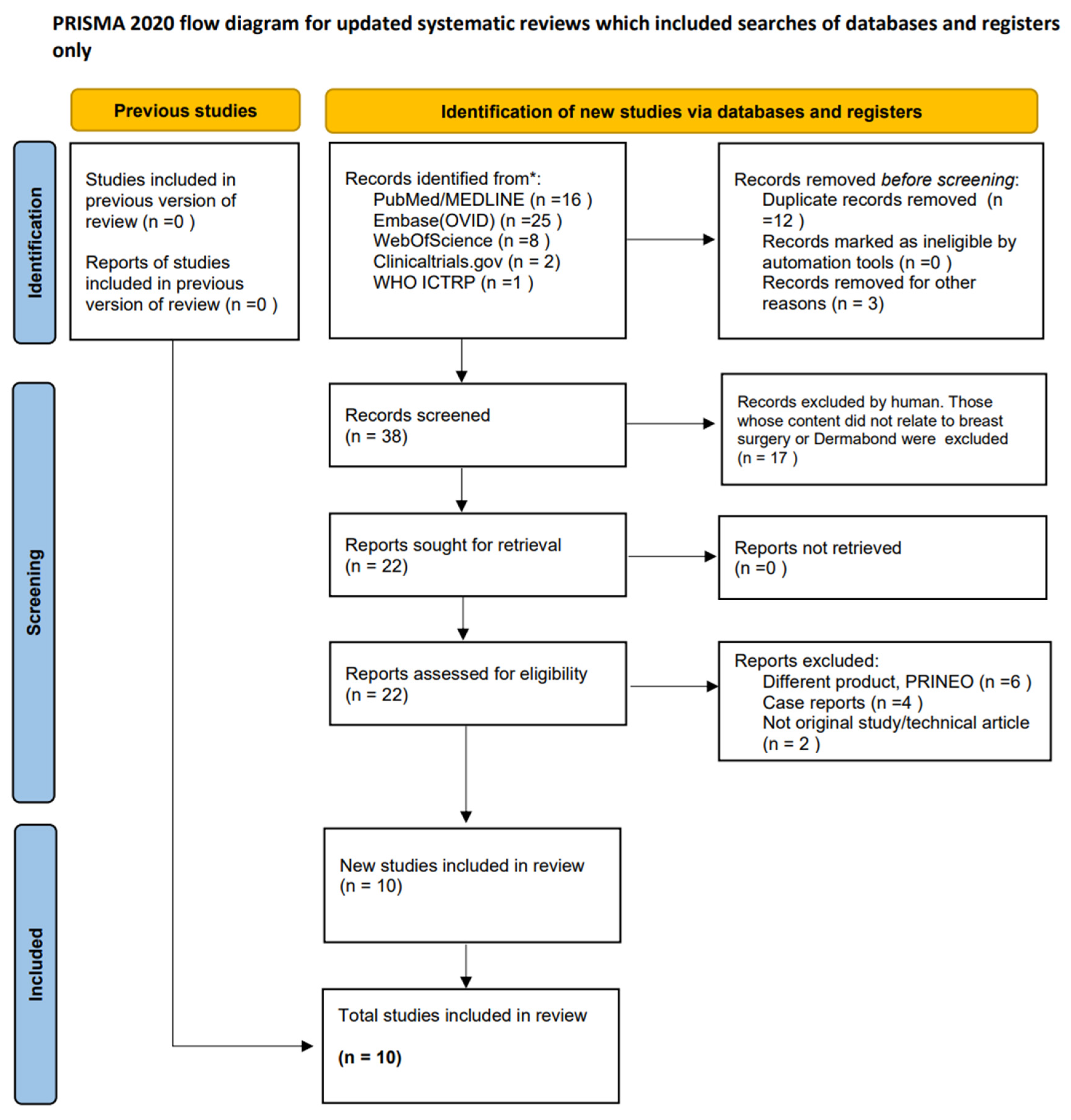
3.1. Study Selection and Geographical Distribution
3.2. Risk of Bias in Studies
- -
- If any one domain was rated as “high risk,” the entire study was classified as with a “high risk of bias”;
- -
- If any one or more domains were rated as “some concerns,” the study was classified as “some concerns”;
- -
- Studies in which all domains were rated as “low” were classified as with a “low risk of bias”.
- -
- 0–5 stars—high risk of bias;
- -
- 6–7 stars—moderate risk of bias;
- -
- 8–9 stars—low risk of bias.
3.3. Results of Overall Data
3.4. Adverse Events and Allergic Reactions
4. Discussion
5. Conclusions
Supplementary Materials
Author Contributions
Funding
Institutional Review Board Statement
Informed Consent Statement
Data Availability Statement
Conflicts of Interest
Abbreviations
| 2-OCA | Octyl 2-cyanoacrylate (Dermabond) |
| RCT | Randomized controlled trials |
| RoB 2 | Cochrane Risk of Bias 2 tool |
| NOS | Newcastle–Ottawa Scale |
| PRINEO | Wound closure system combining polymer mesh with 2-OCA |
| TE | Tissue expander |
| NSM | Nipple-sparing mastectomy |
| SSM | Skin-sparing mastectomy |
| AE(s) | Allergic reaction(s)/contact dermatitis |
References
- Thalji, S.Z.; Cortina, C.S.; Guo, M.S.; Kong, A.L. Postoperative Complications from Breast and Axillary Surgery. Surg. Clin. North Am. 2023, 103, 121–139. [Google Scholar] [CrossRef]
- Friedrich, M.; Krämer, S.; Friedrich, D.; Kraft, C.; Maass, N.; Rogmans, C. Difficulties of Breast Reconstruction—Problems That No One Likes to Face. Anticancer Res. 2021, 41, 5365–5375. [Google Scholar] [CrossRef] [PubMed]
- Tevis, S.E.; Steiman, J.G.; Neuman, H.B.; Greenberg, C.C.; Wilke, L.G. Postoperative Complications in Combined Gynecologic, Plastic, and Breast Surgery: An Analysis from National Surgical Quality Improvement Program. Breast J. 2019, 25, 1111–1116. [Google Scholar] [CrossRef] [PubMed]
- McNeely, M.L.; Binkley, J.M.; Pusic, A.L.; Campbell, K.L.; Gabram, S.; Soballe, P.W. A Prospective Model of Care for Breast Cancer Rehabilitation: Postoperative and Postreconstructive Issues. Cancer 2012, 118, 2226–2236. [Google Scholar] [CrossRef] [PubMed]
- Von Fritschen, U.; Seidenstücker, K.; Sigalove, S. Current Trends in Postmastectomy Breast Reconstruction. Curr. Opin. Obstet. Gynecol. 2023, 35, 73–79. [Google Scholar] [CrossRef]
- Efica, J.; Giuffrè, M.T.; Tringale, G.; Seth, I.; McClure, V.; Lim, B.; Rozen, W.M.; Cuomo, R. Breast Reconstruction Through the Decades: A Review of Innovations and Surgical Trends. Aesthetic Plast. Surg. 2025. [Google Scholar] [CrossRef]
- Craven, N.M.; Telfer, N.R. An Open Study of Tissue Adhesive in Full-Thickness Skin Grafting. J. Am. Acad. Dermatol. 1999, 40, 607–611. [Google Scholar] [CrossRef]
- Singer, A.J.; Quinn, J.V.; Clark, R.E.; Hollander, J.E. Closure of Lacerations and Incisions with Octylcyanoacrylate: A Multicenter Randomized Controlled Trial. Surgery 2002, 131, 270–276. [Google Scholar] [CrossRef]
- García Cerdá, D.; Ballester, A.M.; Aliena-Valero, A.; Carabén-Redaño, A.; Lloris, J.M. Use of Cyanoacrylate Adhesives in General Surgery. Surg. Today 2015, 45, 939–956. [Google Scholar] [CrossRef]
- Jenkins, L.E.; Davis, L.S. Comprehensive Review of Tissue Adhesives. Dermatol. Surg. 2018, 44, 1367–1372. [Google Scholar] [CrossRef]
- Gennari, R.; Rotmensz, N.; Ballardini, B.; Scevola, S.; Perego, E.; Zanini, V.; Costa, A. A Prospective, Randomized, Controlled Clinical Trial of Tissue Adhesive (2-Octylcyanoacrylate) versus Standard Wound Closure in Breast Surgery. Surgery 2004, 136, 593–599. [Google Scholar] [CrossRef] [PubMed]
- Toriumi, D.M.; OʼGrady, K.; Desai, D.; Bagal, A. Use of Octyl-2-Cyanoacrylate for Skin Closure in Facial Plastic Surgery. Plast. Reconstr. Surg. 1998, 102, 2209–2219. [Google Scholar] [CrossRef] [PubMed]
- Singer, A.J.; Thode, H.C. A Review of the Literature on Octylcyanoacrylate Tissue Adhesive. Am. J. Surg. 2004, 187, 238–248. [Google Scholar] [CrossRef]
- Bernard, L.; Doyle, J.; Friedlander, S.F.; Eichenfield, L.F.; Gibbs, N.F.; Cunningham, B.B. A Prospective Comparison of Octyl Cyanoacrylate Tissue Adhesive (Dermabond) and Suture for the Closure of Excisional Wounds in Children and Adolescents. Arch. Dermatol. 2001, 137, 1177–1180. [Google Scholar] [CrossRef] [PubMed]
- Shapiro, A.J.; Dinsmore, R.C.; North, J.H. Tensile Strength of Wound Closure with Cyanoacrylate Glue. Am. Surg. 2001, 67, 1113–1115. [Google Scholar] [CrossRef]
- Singer, A.J.; Hollander, J.E.; Quinn, J.V. Evaluation and Management of Traumatic Lacerations. N. Engl. J. Med. 1997, 337, 1142–1148. [Google Scholar] [CrossRef]
- Soni, A.; Narula, R.; Kumar, A.; Parmar, M.; Sahore, M.; Chandel, M. Comparing Cyanoacrylate Tissue Adhesive and Conventional Subcuticular Skin Sutures for Maxillofacial Incisions—A Prospective Randomized Trial Considering Closure Time, Wound Morbidity, and Cosmetic Outcome. J. Oral Maxillofac. Surg. 2013, 71, 2152.e1–2152.e8. [Google Scholar] [CrossRef]
- Leggat, P.A.; Smith, D.R.; Kedjarune, U. Surgical Applications of Cyanoacrylate Adhesives: A Review of Toxicity. ANZ J. Surg. 2007, 77, 209–213. [Google Scholar] [CrossRef]
- Autio, L.; Olson, K.K. The Four Sʼs of Wound Management. Holist. Nurs. Pract. 2002, 16, 80–88. [Google Scholar] [CrossRef]
- Cochetti, G.; Abraha, I.; Randolph, J.; Montedori, A.; Boni, A.; Arezzo, A.; Mazza, E.; Rossi De Vermandois, J.A.; Cirocchi, R.; Mearini, E. Surgical Wound Closure by Staples or Sutures? Medicine 2020, 99, e20573. [Google Scholar] [CrossRef]
- Sardiwalla, Y.; Zimmo, K.; Williams, J.; Bezuhly, M. The Effect of Steri-Strip Orientation on Wound Healing: A Survey of Current Applications and Trends amongst Surgeons. Dalhous. Med. J. 2018, 45, 4–7. [Google Scholar] [CrossRef]
- Nipshagen, M.D.; Hage, J.J.; Beekman, W.H. Use of 2-Octyl-Cyanoacrylate Skin Adhesive (Dermabond) for Wound Closure Following Reduction Mammaplasty: A Prospective, Randomized Intervention Study. Plast. Reconstr. Surg. 2008, 122, 10–18. [Google Scholar] [CrossRef] [PubMed]
- Saxena, A.; Dubey, M.; Saha, G.K.; Tiwari, D.; Tyagi, S.; Singh, R.A. A Prospective Comparison of Octyl-2-Cyanoacrylate and Suture in Facial Wounds. J. Pharm. Bioallied Sci. 2023, 15, S1145–S1148. [Google Scholar] [CrossRef] [PubMed]
- Rimmer, J.; Singh, A.; Banwell, P.; Clarke, P.; Evans, P.R. The Use of Octyl-2-Cyanoacrylate (DermabondTM) Tissue Adhesive for Skin Closure in Head and Neck Surgery. Ann. R. Coll. Surg. Engl. 2006, 88, 412–413. [Google Scholar] [CrossRef] [PubMed]
- Bruns, T.B.; Worthington, J.M. Using Tissue Adhesive for Wound Repair: A Practical Guide to Dermabond. Am. Fam. Physician 2000, 61, 1383–1388. [Google Scholar]
- Darras, O.; Ghazoul, A.; Pember, B.; Frisbie, S.; Phuyal, D.; Gurunian, R.; Bishop, S.N. Effects of Wise Pattern versus Vertical Approach on the Outcomes of Superomedial Pedicle Breast Reduction: Systematic Review and Pooled Analysis. Plast. Reconstr. Surg. 2026, 157, 332e–337e. [Google Scholar] [CrossRef]
- Page, M.J.; McKenzie, J.E.; Bossuyt, P.M.; Boutron, I.; Hoffmann, T.C.; Mulrow, C.D.; Shamseer, L.; Tetzlaff, J.M.; Akl, E.A.; Brennan, S.E.; et al. The PRISMA 2020 Statement: An Updated Guideline for Reporting Systematic Reviews. BMJ 2021, 372, n71. [Google Scholar] [CrossRef]
- Koonce, S.L.; Eck, D.L.; Shaddix, K.K.; Perdikis, G. A Prospective Randomized Controlled Trial Comparing N-Butyl-2 Cyanoacrylate (Histoacryl), Octyl Cyanoacrylate (Dermabond), and Subcuticular Suture for Closure of Surgical Incisions. Ann. Plast. Surg. 2015, 74, 107–110. [Google Scholar] [CrossRef]
- Majeed, S.; Soomro, R.; Khurshaidi, N. Skin Adhesive Versus Absorbable Suture in Closing Wound. Med. Forum Mon. 2018, 29, 48–51. [Google Scholar]
- Scott, G.R.; Carson, C.L.; Borah, G.L. Dermabond Skin Closures for Bilateral Reduction Mammaplasties: A Review of 255 Consecutive Cases. Plast. Reconstr. Surg. 2007, 120, 1460–1465. [Google Scholar] [CrossRef]
- Scott, G.R.; Carson, C.L.; Borah, G.L. Maximizing Outcomes in Breast Reduction Surgery: A Review of 518 Consecutive Patients. Plast. Reconstr. Surg. 2005, 116, 1633–1639. [Google Scholar] [CrossRef]
- Nakagawa, S.; Uda, H.; Sarukawa, S.; Sunaga, A.; Asahi, R.; Chi, D.; Yoshimura, K. Contact Dermatitis Caused by Dermabond Advanced Use. Plast. Reconstr. Surg. Glob. Open 2018, 6, e1841. [Google Scholar] [CrossRef] [PubMed]
- Nigro, L.C.; Parkerson, J.; Nunley, J.; Blanchet, N. Should We Stick with Surgical Glues? The Incidence of Dermatitis after 2-Octyl Cyanoacrylate Exposure in 102 Consecutive Breast Cases. Plast. Reconstr. Surg. 2020, 145, 32–37. [Google Scholar] [CrossRef]
- Alotaibi, N.N.; Ahmad, T.; Rabah, S.M.; Sheikh, M.T. Type IV Hypersensitivity Reaction to Dermabond (2-Octyl Cyanoacrylate) in Plastic Surgical Patients: A Retrospective Study. Plast. Surg. 2022, 30, 222–226. [Google Scholar] [CrossRef]
- Francalancia, S.; Lou, M.; McIntire, D.; Sobti, N.; Baranwal, N.; Persad-Paisley, E.; Menville, J.; Barrow, B.; Marquez, J.; Liu, P.; et al. Dermabond for Reduction Mammoplasty Revisited: Its Effects on Postoperative Wound Healing. J. Plast. Reconstr. Aesthetic Surg. 2025, 104, 67–75. [Google Scholar] [CrossRef] [PubMed]
- Richter, D.; Stoff, A.; Ramakrishnan, V.; Exner, K.; Jernbeck, J.; Blondeel, P.N. A Comparison of a New Skin Closure Device and Intradermal Sutures in the Closure of Full-Thickness Surgical Incisions. Plast. Reconstr. Surg. 2012, 130, 843–850. [Google Scholar] [CrossRef]
- Blondeel, P.N.; Richter, D.; Stoff, A.; Exner, K.; Jernbeck, J.; Ramakrishnan, V. Evaluation of a New Skin Closure Device in Surgical Incisions Associated with Breast Procedures. Ann. Plast. Surg. 2014, 73, 631–637. [Google Scholar] [CrossRef] [PubMed]
- Lee, J.C.; Ishtihar, S.; Means, J.J.; Wu, J.; Rohde, C.H. In Search of an Ideal Closure Method: A Randomized, Controlled Trial of Octyl-2-Cyanoacrylate and Adhesive Mesh versus Subcuticular Suture in Reduction Mammaplasty. Plast. Reconstr. Surg. 2018, 142, 850–856. [Google Scholar] [CrossRef]
- Libretti, A.; Bracci, B.; De Pedrini, A.; Surico, D.; Troìa, L.; Remorgida, V. The Dermabond Prineo Skin Closure System: Benefits and Complications. J. Gynecol. Surg. 2024, 40, 123–131. [Google Scholar] [CrossRef]
- Kulkarni, S.; Goodbun, M.; Chowdhury, M.; Stather, P.W. Dermabond Prineo: A Systematic Review and Meta-Analysis. J. Wound Care 2025, 34, 220–226. [Google Scholar] [CrossRef]
- Knackstedt, R.W.; Dixon, J.A.; O’Neill, P.J.; Herrera, F.A. Rash with DERMABOND PRINEO Skin Closure System Use in Bilateral Reduction Mammoplasty: A Case Series. Case Rep. Med. 2015, 2015, 642595. [Google Scholar] [CrossRef] [PubMed]
- Colwell, A.S.; Gadd, M.; Smith, B.L.; Austen, W.G. An Inferolateral Approach to Nipple-Sparing Mastectomy: Optimizing Mastectomy and Reconstruction. Ann. Plast. Surg. 2010, 65, 140–143. [Google Scholar] [CrossRef] [PubMed]
- Perry, A.W.; Sosin, M. Severe Allergic Reaction to Dermabond. Aesthet. Surg. J. 2009, 29, 314–316. [Google Scholar] [CrossRef] [PubMed]
- Ricci, J.A.; Parekh, N.N.; Desai, N.S. Diffuse Cutaneous Allergic Reaction to Dermabond. Prehosp. Disaster Med. 2014, 29, 546–548. [Google Scholar] [CrossRef]
- Howard, B.K.; Downey, S.E. Contact Dermatitis from Dermabond. Plast. Reconstr. Surg. 2010, 125, 252e–253e. [Google Scholar] [CrossRef]
- Mangano, A.; Albertin, A.; LaColla, L. Use of 2-Octyl-Cyanoacrylate Skin Adhesive (Dermabond) for Wound Closure Following Reduction Mammaplasty: A Prospective, Randomized Intervention Study. “Tips and Tricks” to Improve Statistical Analysis and Significance of Results. Plast. Reconstr. Surg. 2009, 124, 669. [Google Scholar] [CrossRef]
- De Luca, A.; Tripodi, D.; Frusone, F.; Leonardi, B.; Cerbelli, B.; Botticelli, A.; Vergine, M.; D’Andrea, V.; Pironi, D.; Sorrenti, S.; et al. Retrospective Evaluation of the Effectiveness of a Synthetic Glue and a Fibrin-Based Sealant for the Prevention of Seroma Following Axillary Dissection in Breast Cancer Patients. Front. Oncol. 2020, 10, 1061. [Google Scholar] [CrossRef]
- Kasielska-Trojan, A.; Antoszewski, B.; Fijałkowska, M. Impact of Different Dressings on Scars after Breast Surgery. J. Am. Acad. Dermatol. 2025, 93, 1339–1341. [Google Scholar] [CrossRef]
- Aburakawa, N.; Saito, Y.; Higuchi, A.; Iida, K.; Wada, N.; Mikami, M.; Urushidate, S. Research on Postoperative Scar Quality of Sutures and Skin Surface Adhesives. J. Plast. Reconstr. Surg. 2025, 4, 127–136. [Google Scholar] [CrossRef]


| No | Author (Year) | Country | Study Type | N | Surgical Context | Comparator |
|---|---|---|---|---|---|---|
| 1 | Gennari et al. (2004) [11] | Italy | RCT | 133 | Quadrantectomy, mastectomy, benign excisions | 2-OCA vs. subcutaneous sutures |
| 2 | Scott et al. (2005) [31] | USA | Observational (retrospective) | 518 | Breast reduction | 2-OCA vs. Monocryl (poliglecaprone 25) |
| 3 | Scott et al. (2007) [30] | USA | Observational (retrospective) | 255 | Bilateral breast reduction | 2-OCA vs. regular sutures |
| 4 | Nipshagen et al. (2008) [22] | Netherlands | RCT | 50 | Breast reduction | 2-OCA vs. Monocryl (poliglecaprone 25) |
| 5 | Koonce et al. (2015) [28] | USA | RCT | 20 | Breast reduction, mastopexy, abdominoplasty | 2-OCA vs. Histoacryl (n-butyl-2-cyanoacrylate) sutures |
| 6 | Majeed et al. (2018) [29] | Pakistan | RCT | 100 | Breast surgery (various procedures) | 2-OCA vs. sutures |
| 7 | Nakagawa et al. (2018) [32] | Japan | Observational | 100 | Breast reconstruction | No formal comparator |
| 8 | Nigro et al. (2020) [33] | USA | Observational (prospective) | 102 | Breast reconstruction | No formal comparator |
| 9 | Alotaibi et al. (2022) [34] | Saudi Arabia | Observational (retrospective) | 60 | Breast reduction and mastopexy | No formal comparator |
| 10 | Francalancia et al. (2025) [35] | USA | Observational (retrospective) | 532 | reduction mammoplasty | 2-OCA vs. Traditional dressing |
| No | Author (Year) | Study Type | Risk of Bias Tool | Domains/Components Assessed | Overall Risk of Bias |
|---|---|---|---|---|---|
| 1 | Gennari et al. (2004) [11] | RCT | RoB 2 | Randomization, deviations, missing data | Low |
| 2 | Scott et al. (2005) [31] | Observational (retrospective) | NOS | Selection, comparability, outcome assessment | Moderate |
| 3 | Scott et al. (2007) [30] | Observational (retrospective) | NOS | Selection, comparability, outcome assessment | Moderate |
| 4 | Nipshagen et al. (2008) [22] | RCT | RoB 2 | Randomization, deviations, missing data | Moderate |
| 5 | Koonce et al. (2015) [28] | RCT | RoB 2 | As above | Low |
| 6 | Majeed et al. (2018) [29] | RCT | RoB 2 | As above | Low |
| 7 | Nakagawa et al. (2018) [32] | Observational | NOS | Selection, outcome assessment | Moderate |
| 8 | Nigro et al. (2020) [33] | Observational (prospective) | NOS | Selection, comparability, outcome assessment | Moderate |
| 9 | Alotaibi et al. (2022) [34] | Observational (retrospective) | NOS | Selection, comparability, outcome assessment | High |
| 10 | Francalancia et al. (2025) [35] | Observational (retrospective) | NOS | Selection, comparability, outcome assessment | Low |
| Outcome | Events (Interv) | Total (Interv) | Mean Rate (Interv) | Events (Ctrl) | Total (Ctrl) | Mean Rate (Ctrl) | No. of Studies | Notes/Interpretation |
|---|---|---|---|---|---|---|---|---|
| Infection | 19 | 816 | 2.33% | 17 | 560 | 3.04% | 5 | Similar infection rates between groups; slight advantage for Dermabond. |
| Dehiscence | 50 | 697 | 7.17% | 14 | 476 | 2.94% | 5 | Higher percentage of separations with Dermabond in some studies (especially Francalancia, 2025) [35]. |
| Hematoma | 29 | 627 | 4.63% | 19 | 376 | 5.05% | 3 | Comparable results—no clear advantage of any method. |
| Seroma | 7 | 255 | 2.75% | 0 | 255 | 0.00% | 2 | Limited data; possible underestimation. |
| Nipple necrosis | 23 | 627 | 3.67% | 25 | 376 | 6.65% | 3 | Trend towards less necrosis with Dermabond. |
| Nipple epidermolysis | 6 | 358 | 1.68% | 3 | 113 | 2.65% | 2 | A slight difference; requires further research. |
| Satisfaction (Likert/score) | — | — | ~4.66 ± 0.90 | — | — | ~7.22 ± 0.70 | 7–10 | Various scales; generally high patient satisfaction—better for Dermabond. |
| Cosmetic score | — | — | 8.35 ± 0.05 | — | — | 8.05 ± 0.05 | 7–10 | High esthetic ratings in both groups. No significant difference |
| Study (Year) | Country | Design | N (Interv/Ctrl) | Surgery Type | Main Outcomes (2-OCA vs. Control) | Follow-Up | Key Findings/Comments |
|---|---|---|---|---|---|---|---|
| Gennari et al. (2004) [11] | Italy | RCT | 69/64 | Quadrantectomy, mastectomy | Infection NR; Dehiscence NR; Satisfaction 9.5 vs. 7.45 O Cosmetic 8.8 vs. 8.8 X | 5 d–12 mo | No major complications; similar cosmetic results, higher satisfaction and faster closure with 2-OCA. |
| Scott et al. (2005) [31] | USA | Retrospective | 103/113 | Reduction mammaplasty | Inf 0% vs. 0.9% X Dehiscence 3.9% vs. 4.4% X Hematoma 9.7% vs. 10.6% X Nipple necrosis 19% vs. 22% X | 6–12 mo | Comparable complication rates; no increase in wound healing issues; earlier series used sutures. |
| Scott et al. (2007) [30] | USA | Retrospective (single-arm) | 255/– | Reduction mammaplasty | Inf 1.2% X Dehiscence 2.0% X Hematoma 5.9% X Nipple necrosis 0.8% X | 6–12 mo | High satisfaction and low complication rate with 2-OCA; operative time reduced (120 vs. 102 min). |
| Nipshagen et al. (2008) [22] | Netherlands | Bilateral intra-patient RCT | 50/50 | Reduction mammaplasty | Infection 0% vs. 0% X; Dehiscence 0% vs. 0% X Satisfaction 7.2 vs. 7.0 X Cosmetic 7.9 vs. 7.3 O | 6 mo | Adhesive preferred by patients and panelists; less itching and better scar appearance. |
| Koonce et al. (2015) [28] | USA | RCT (intra-patient) | 20/20 | Reduction mammaplasty, mastopexy | Infection 5% vs. 5% X; Dehiscence 5% vs. 0% X Satisfaction similar X Scar width comparable X | 12 mo | Closure time reduced; one allergic and four mild adverse reactions observed. |
| Majeed et al. (2018) [29] | Pakistan | RCT | 50/50 | Lumpectomy | Infection 4% vs. 16% O Dehiscence 2% vs. 14% O | 7 d | Significantly fewer complications and faster closure in 2-OCA group (p < 0.05). |
| Nakagawa et al. (2018) [32] | Japan | Retrospective | 100/– | Reconstruction, donor site closure | CD 7% X | Variable | Allergic reactions mainly after repeated exposure; all mild and self-limited. |
| Nigro et al. (2020) [33] | USA | Prospective | 102/– | Cosmetic and reconstructive breast surgery | Allergic/CD 14% X | ≤1 week | All allergic to Dermabond also reacted to LiquiBand; symptoms resolved with topical therapy. |
| Alotaibi et al. (2022) [34] | Saudi Arabia | Retrospective | 60/– | Mastopexy, reduction | CD 6.6% X | 2 w–6 mo | Type IV hypersensitivity; post-inflammatory hyperpigmentation up to 6 mo. |
| Francalancia et al. (2025) [35] | USA | Retrospective cohort | 269/263 | Reduction mammaplasty | Infection 4.8% vs. 2.7% X Dehiscence 7.6% vs. 0.8% O Hematoma 1.5% vs. 2.7% X Nipple necrosis 0.4% vs. 0% X | Mean 183 d | Higher dehiscence in 2-OCA group; adjusted p < 0.001. No other differences observed. |
| No | Author (Year) | Country | Publication Type | n/N | Surgical Context | Description of AE |
|---|---|---|---|---|---|---|
| 1 | Perry and Sosin (2009) [43] | USA | Case report | 1/1 | Implant replacement + bilateral mastopexy | Severe allergic reaction to Dermabond |
| 2 | Howard and Downey (2010) [45] | USA | Case report | 2/2 | Bilateral breast reduction | Contact dermatitis to Dermabond |
| 3 | Ricci et al. (2014) [44] | USA | Case report | 1/1 | Bilateral skin-sparing mastectomy + reconstruction | Diffuse cutaneous allergic reaction to Dermabond |
| 4 | Nakagawa et al. (2018) [32] | Japan | Observational (retrospective) | 7/100 | Breast reconstruction | Contact dermatitis caused by Dermabond Advanced |
| 5 | Nigro et al. (2020) [33] | USA | RCT | 14/102 | Reconstructive breast surgery | Incidence of dermatitis after 2-OCA exposure |
| 6 | Alotaibi et al. (2022) [34] | Saudi Arabia | Observational (retrospective) | 4/60 | Reduction mammoplasty, mastopexy | Type IV hypersensitivity reaction to Dermabond |
Disclaimer/Publisher’s Note: The statements, opinions and data contained in all publications are solely those of the individual author(s) and contributor(s) and not of MDPI and/or the editor(s). MDPI and/or the editor(s) disclaim responsibility for any injury to people or property resulting from any ideas, methods, instructions or products referred to in the content. |
© 2026 by the authors. Licensee MDPI, Basel, Switzerland. This article is an open access article distributed under the terms and conditions of the Creative Commons Attribution (CC BY) license.
Share and Cite
Rybicki, M.; Fijałkowska, M.; Kasielska-Trojan, A. Safety and Efficacy of Octyl 2-Cyanoacrylate (Dermabond) in Breast Surgery: A Systematic Review. J. Clin. Med. 2026, 15, 2462. https://doi.org/10.3390/jcm15062462
Rybicki M, Fijałkowska M, Kasielska-Trojan A. Safety and Efficacy of Octyl 2-Cyanoacrylate (Dermabond) in Breast Surgery: A Systematic Review. Journal of Clinical Medicine. 2026; 15(6):2462. https://doi.org/10.3390/jcm15062462
Chicago/Turabian StyleRybicki, Maciej, Marta Fijałkowska, and Anna Kasielska-Trojan. 2026. "Safety and Efficacy of Octyl 2-Cyanoacrylate (Dermabond) in Breast Surgery: A Systematic Review" Journal of Clinical Medicine 15, no. 6: 2462. https://doi.org/10.3390/jcm15062462
APA StyleRybicki, M., Fijałkowska, M., & Kasielska-Trojan, A. (2026). Safety and Efficacy of Octyl 2-Cyanoacrylate (Dermabond) in Breast Surgery: A Systematic Review. Journal of Clinical Medicine, 15(6), 2462. https://doi.org/10.3390/jcm15062462