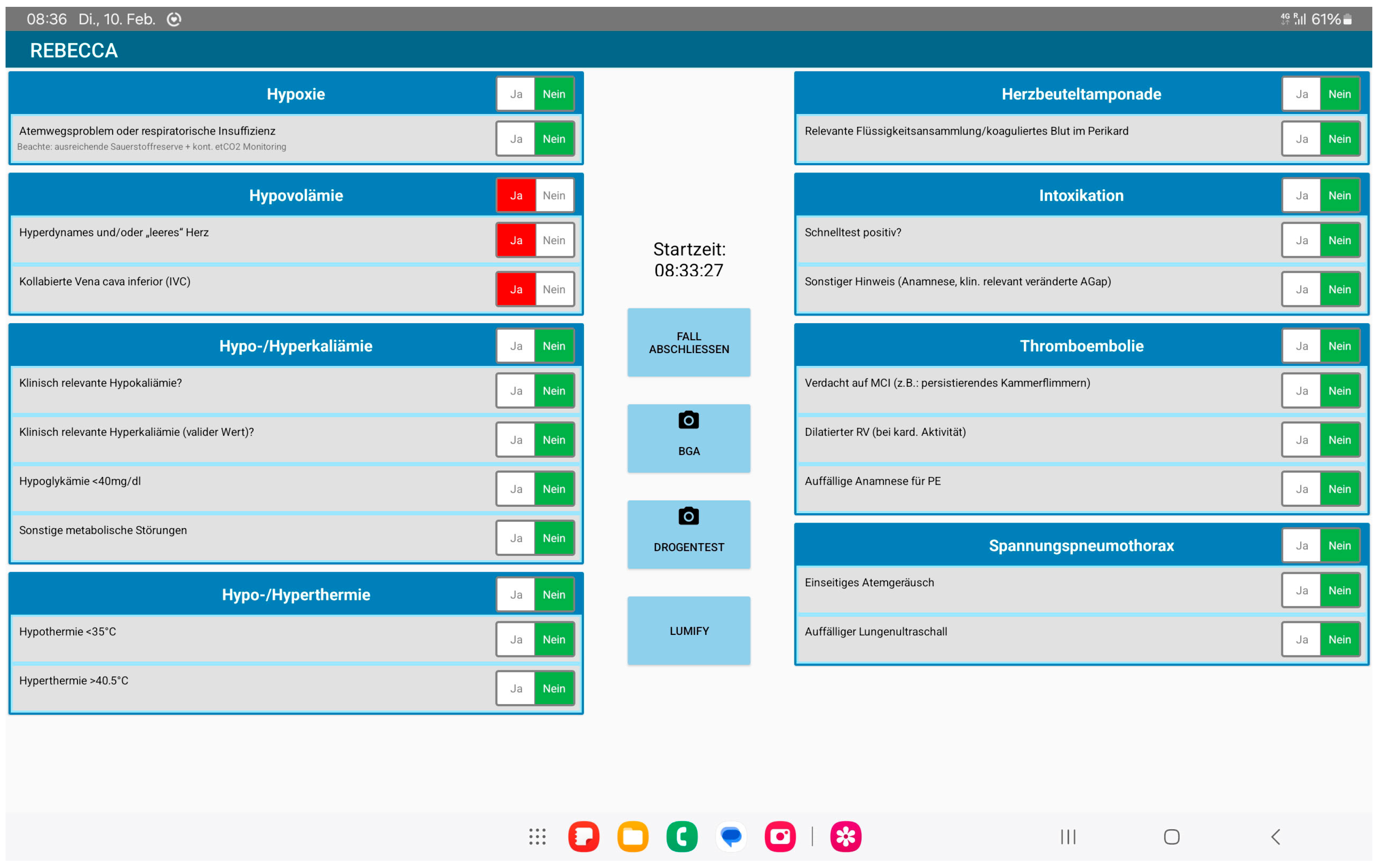
Relevance of Reversible Causes of Out-of-Hospital Cardiac Arrest: The “REBECCA” Interactive Checklist
 , , , , ,
Abstract
1. Introduction
2. Materials and Methods
2.1. Study Design
2.2. Study Setting
2.2.1. Phase I
2.2.2. Phase II
2.3. Study Population
2.4. Statistical Methods
2.5. Data Collection
3. Results
3.1. Phase I
3.1.1. Focus Group
3.1.2. Development Process
3.1.3. The “4 Hs”
3.1.4. The “4 Ts”
3.2. Phase II
3.2.1. Basic Characteristics
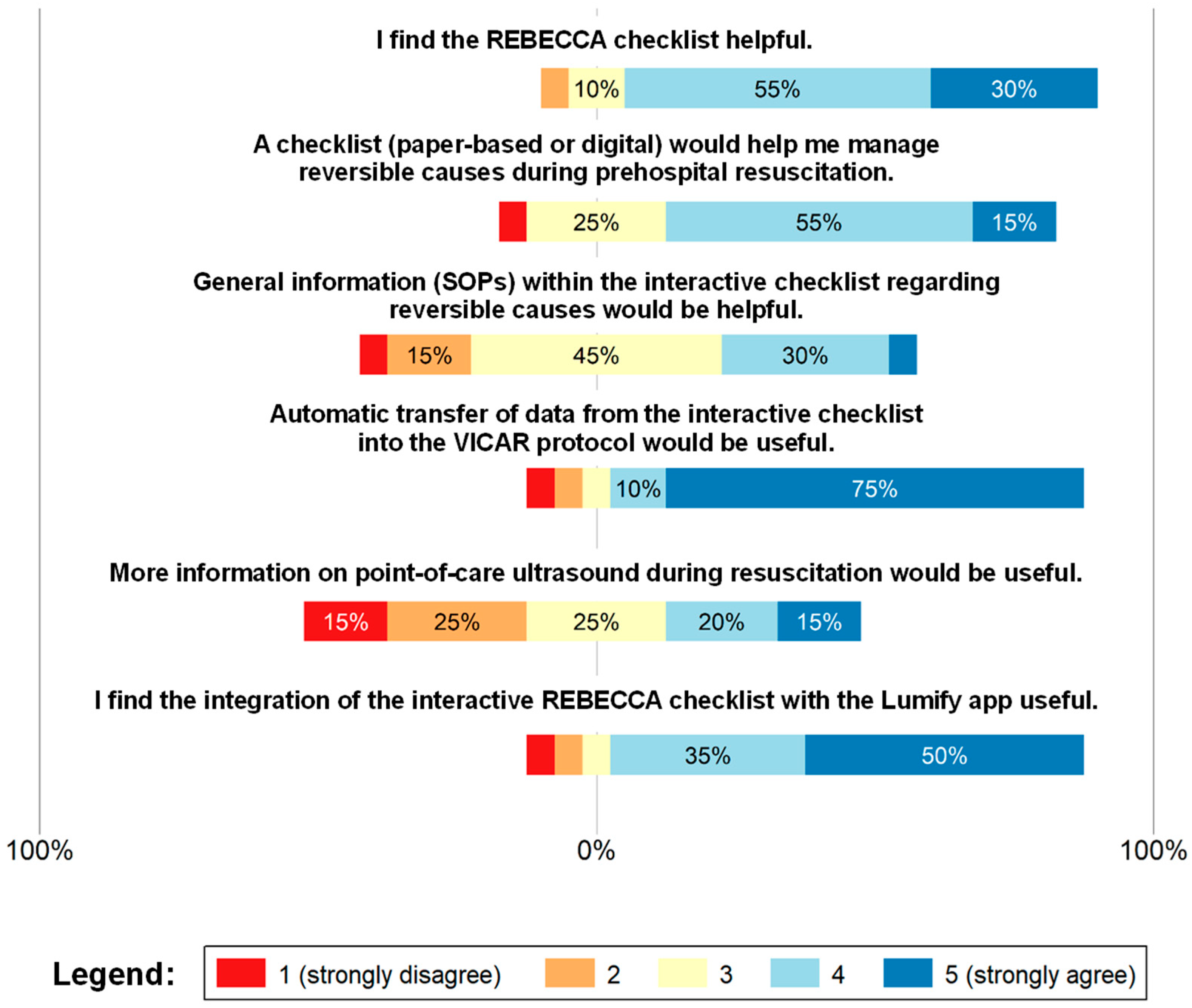
3.2.2. Checklist Evaluation
3.2.3. Subgroup Analysis
4. Discussion
Limitations
5. Conclusions
Author Contributions
Funding
Institutional Review Board Statement
Informed Consent Statement
Data Availability Statement
Acknowledgments
Conflicts of Interest
Abbreviations
| ACS | Acute coronary syndrome |
| ALS | Advanced Life Support |
| CPR | Cardiopulmonary resuscitation |
| eCDS | Electronic clinical decision support |
| eCPR | Extracorporeal cardiopulmonary resuscitation |
| EMS | Emergency medical services |
| EMTs | Emergency medical technicians |
| ERC | European Resuscitation Counsil |
| MAUQ | mHealth App Usability Questionnaire |
| OHCA | Out-of-hospital cardiac arrest |
| PE | Pulmonary embolism |
| POCUS | Point-of-care ultrasound |
| REBECCA | Reversible causes of out-of-hospital cardiac arrest |
| ROSC | Return of spontaneous circulation |
| SOPs | Standard operating procedures |
| VICAR | Vienna Cardiac Arrest Registry |
Appendix A. Table A1, Table A2, Table A3 and Table A4

| Item | 1 | 2 | 3 | 4 | 5 | 6 | 7 | 8 | 9 | 10 |
|---|---|---|---|---|---|---|---|---|---|---|
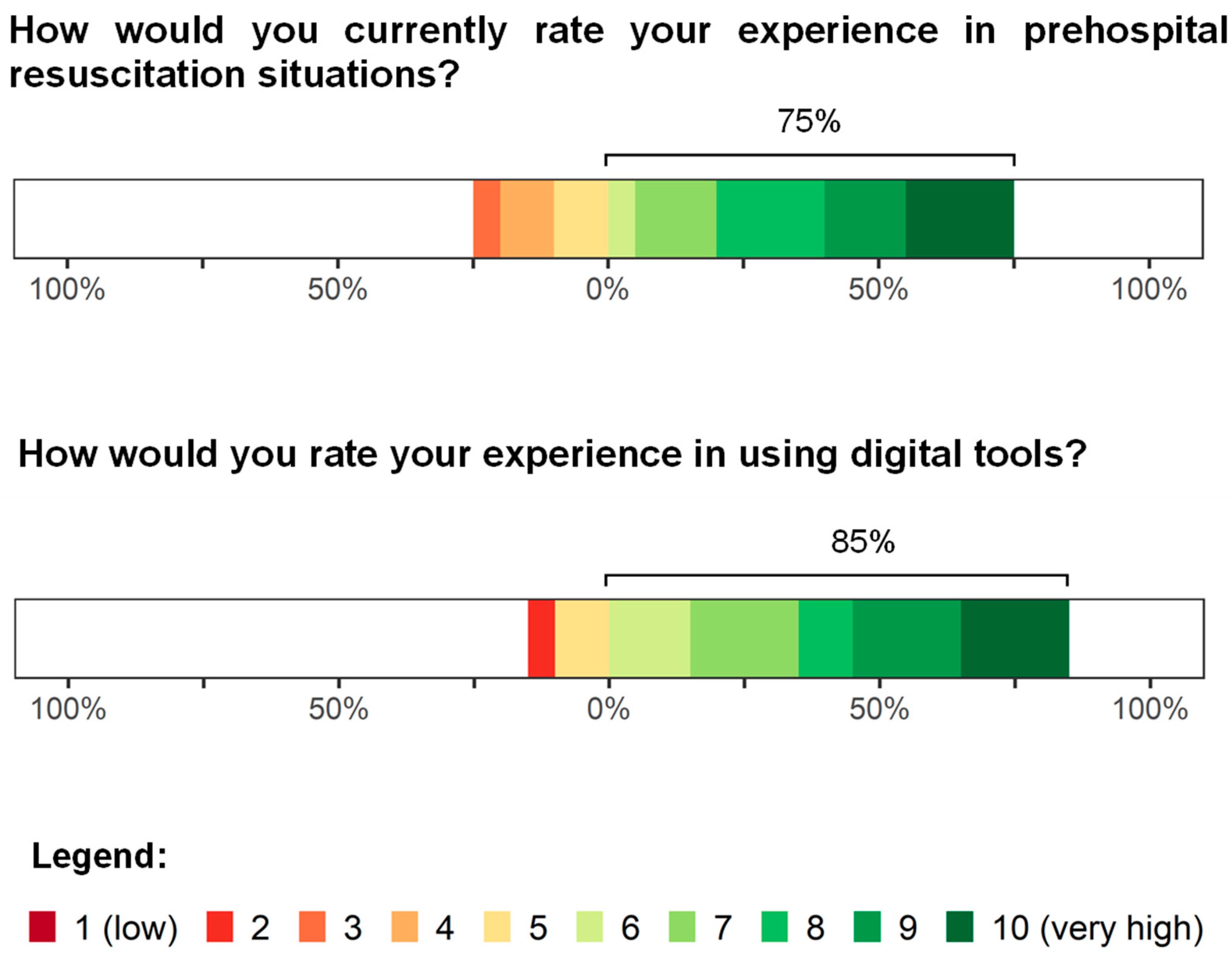
| How would you currently rate your experience in prehospital resuscitation situations? | 0 | 0 | 1 (5%) | 2 (10%) | 2 (10%) | 1 (5%) | 3 (15%) | 4 (20%) | 3 (15%) | 4 (20%) |
| How would you rate your experience in using digital tools? | 0 | 1 (5%) | 0 | 0 | 2 (10%) | 3 (15%) | 4 (20%) | 2 (10%) | 4 (20%) | 4 (20%) |
| Item | 1 | 2 | 3 | 4 | 5 |
|---|---|---|---|---|---|
| I find the REBECCA checklist helpful. | 0 | 1 (5%) | 2 (10%) | 11 (55%) | 6 (30%) |
| A checklist (paper-based or digital) would help me manage reversible causes during prehospital resuscitation. | 1 (5%) | 0 | 5 (25%) | 11 (55%) | 3 (15%) |
| General information (SOPs) within the interactive checklist regarding reversible causes would be helpful. | 1 (5%) | 3 (15%) | 9 (45%) | 6 (30%) | 1 (5%) |
| Automatic transfer of data from the interactive checklist into the VICAR protocol would be useful. | 1 (5%) | 1 (5%) | 1 (5%) | 2 (10%) | 15 (75%) |
| More information on point-of-care ultrasound during resuscitation would be useful. | 3 (15%) | 5 (25%) | 5 (25%) | 4 (20%) | 3 (15%) |
| I find the integration of the interactive REBECCA checklist with the Lumify app useful. | 1 (5%) | 1 (5%) | 1 (5%) | 7 (35%) | 10 (50%) |
| Item | 1 | 2 | 3 | 4 | 5 |
|---|---|---|---|---|---|
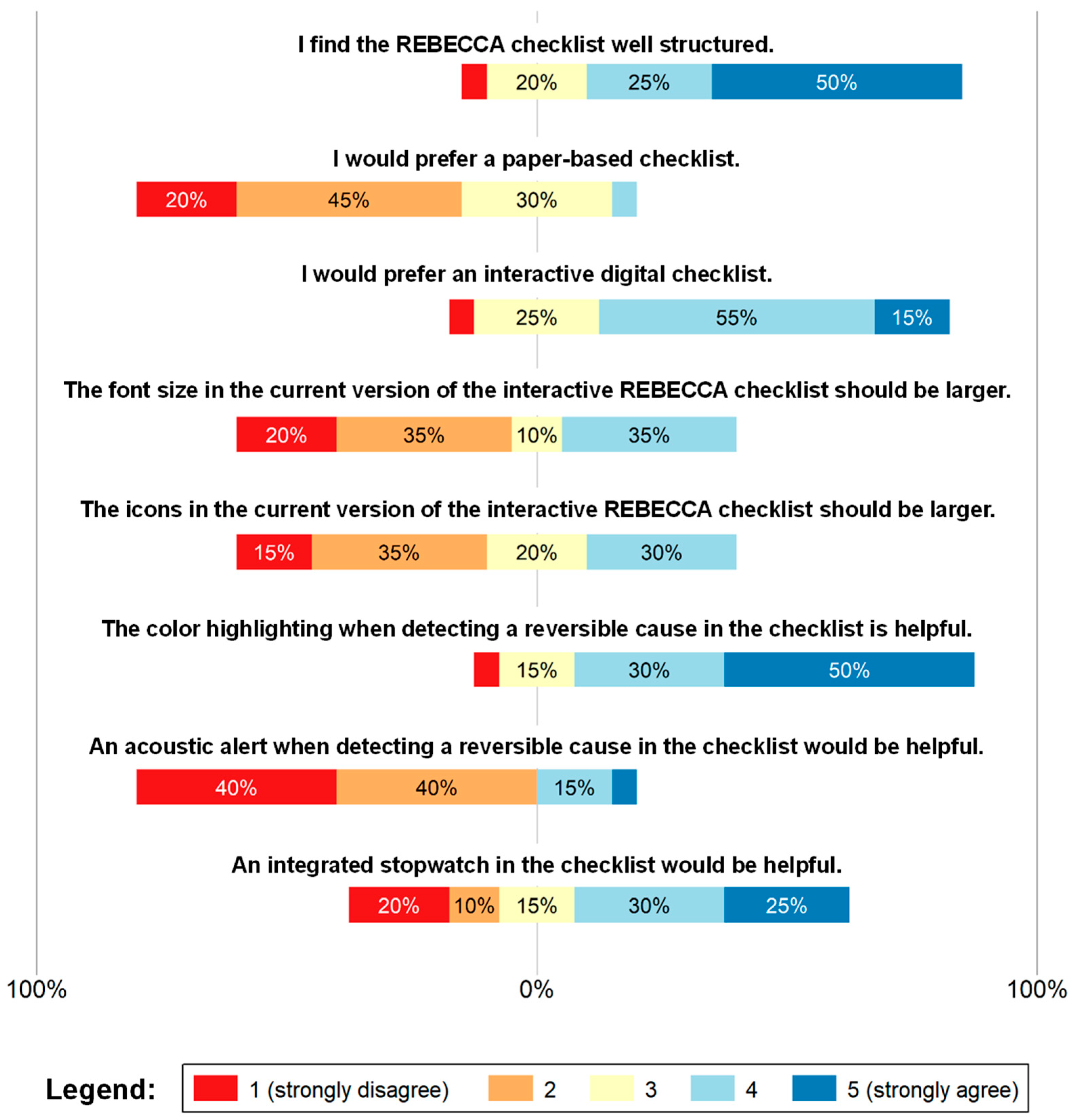
| I find the REBECCA checklist well structured. | 1 (5%) | 0 | 4 (20%) | 5 (25%) | 10 (50%) |
| I would prefer a paper-based checklist. | 4 (20%) | 9 (45%) | 6 (30%) | 1 (5%) | 0 |
| I would prefer an interactive digital checklist. | 1 (5%) | 0 | 5 (25%) | 11 (55%) | 3 (15%) |
| The font size in the current version of the interactive REBECCA checklist should be larger. | 4 (20%) | 7 (35%) | 2 (10%) | 7 (35%) | 0 |
| The icons in the current version of the interactive REBECCA checklist should be larger. | 3 (15%) | 7 (35%) | 4 (20%) | 6 (30%) | 0 |
| The color highlighting when detecting a reversible cause in the checklist is helpful. | 1 (5%) | 0 | 3 (15%) | 6 (30%) | 10 (50%) |
| An acoustic alert when detecting a reversible cause in the checklist would be helpful. | 8 (40%) | 8 (40%) | 0 | 3 (15%) | 1 (5%) |
| An integrated stopwatch in the checklist would be helpful. | 4 (20%) | 2 (10%) | 3 (15%) | 6 (30%) | 5 (25%) |
| Item | 1 | 2 | 3 | 4 | 5 |
|---|---|---|---|---|---|
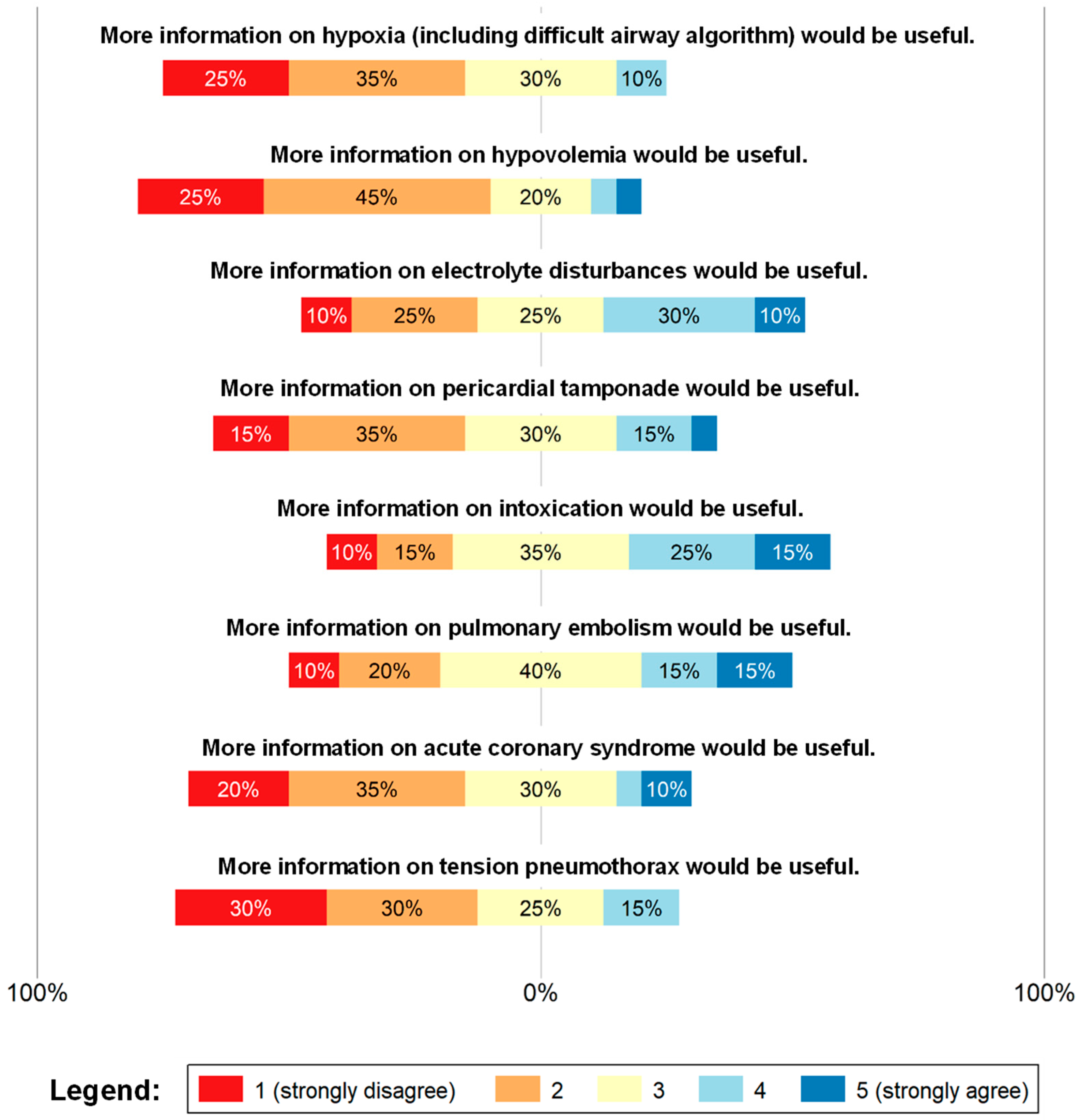
| More information on hypoxia (including difficult airway algorithm) would be useful. | 5 (25%) | 7 (35%) | 6 (30%) | 2 (10%) | 0 |
| More information on hypovolemia would be useful. | 5 (25%) | 9 (45%) | 4 (20%) | 1 (5%) | 1 (5%) |
| More information on electrolyte disturbances would be useful. | 2 (10%) | 5 (25%) | 5 (25%) | 6 (30%) | 2 (10%) |
| More information on pericardial tamponade would be useful. | 3 (15%) | 7 (35%) | 6 (30%) | 3 (15%) | 1 (5%) |
| More information on intoxication would be useful. | 2 (10%) | 3 (15%) | 7 (35%) | 5 (25%) | 3 (15%) |
| More information on pulmonary embolism would be useful. | 2 (10%) | 4 (20%) | 8 (40%) | 3 (15%) | 3 (15%) |
| More information on acute coronary syndrome would be useful. | 4 (20%) | 7 (35%) | 6 (30%) | 1 (5%) | 2 (10%) |
| More information on tension pneumothorax would be useful. | 6 (30%) | 6 (30%) | 5 (25%) | 3 (15%) | 0 |
Appendix B. Supplements (Study Questionnaire)
- Questionnaire ID: _________
- Interactive Checklist (“REBECCA Checklist”) for the Structured Management of Reversible Causes During Prehospital Resuscitation
- Dear Participant,
- Thank you very much for participating in this study.
- This questionnaire is intended to evaluate the use of a structured, virtual checklist for addressing potential reversible causes during cardiopulmonary resuscitation in the prehospital setting among emergency physicians. In order to investigate possible associations with individual experience in using such tools, it is necessary to collect various characteristics, attributes, and experiences of participants. All data will be analyzed in a pseudonymized manner. Please complete the following questionnaire after familiarizing yourself with the interactive “REBECCA” checklist.
- Demographic Information
- 1. How old are you?Age in years: ____
- 2. Which gender do you identify with?□ Male □ Female □ Diverse
- 3. What is your current level of training?Resident physician: Yes/NoSpecialist: Yes/No
- 4. How long have you been working as an emergency physician?Years: ____
- 5. Approximately how many emergency service shifts per month have you completed in the last six months?Number of shifts per month: ____
- 6. How would you currently rate your experience in prehospital resuscitation situations?Low to very high (1–10)
- 7. How would you rate your experience in using digital tools?Low to very high (1–10)
- Please indicate your level of agreement (1 = strongly disagree, 5 = strongly agree)
- A checklist (paper-based or digital) would help me manage reversible causes during prehospital resuscitation.
| 1 | 2 | 3 | 4 | 5 |
- I would prefer a paper-based checklist.
| 1 | 2 | 3 | 4 | 5 |
- I would prefer an interactive digital checklist.
| 1 | 2 | 3 | 4 | 5 |
- I find the REBECCA checklist well structured.
| 1 | 2 | 3 | 4 | 5 |
- I find the REBECCA checklist helpful.
| 1 | 2 | 3 | 4 | 5 |
- The font size in the current version of the interactive REBECCA checklist should be larger.
| 1 | 2 | 3 | 4 | 5 |
- The icons in the current version of the interactive REBECCA checklist should be larger.
| 1 | 2 | 3 | 4 | 5 |
- I find the integration of the interactive REBECCA checklist with the Lumify app useful.
| 1 | 2 | 3 | 4 | 5 |
- The color highlighting when detecting a reversible cause in the checklist is helpful.
| 1 | 2 | 3 | 4 | 5 |
- An acoustic alert when detecting a reversible cause in the checklist would be helpful.
| 1 | 2 | 3 | 4 | 5 |
- An integrated stopwatch in the checklist would be helpful.
| 1 | 2 | 3 | 4 | 5 |
- General information (SOPs) within the interactive checklist regarding reversible causes would be helpful.
| 1 | 2 | 3 | 4 | 5 |
- More information on hypoxia (including difficult airway algorithm) would be useful.
| 1 | 2 | 3 | 4 | 5 |
- More information on tension pneumothorax would be useful.
| 1 | 2 | 3 | 4 | 5 |
- More information on hypovolemia would be useful.
| 1 | 2 | 3 | 4 | 5 |
- More information on pulmonary embolism would be useful.
| 1 | 2 | 3 | 4 | 5 |
- More information on acute coronary syndrome would be useful.
| 1 | 2 | 3 | 4 | 5 |
- More information on pericardial tamponade would be useful.
| 1 | 2 | 3 | 4 | 5 |
- More information on electrolyte disturbances would be useful.
| 1 | 2 | 3 | 4 | 5 |
- More information on intoxication would be useful.
| 1 | 2 | 3 | 4 | 5 |
- More information on point-of-care ultrasound during resuscitation would be useful.
| 1 | 2 | 3 | 4 | 5 |
- Automatic transfer of data from the interactive checklist into the VICAR protocol would be useful.
| 1 | 2 | 3 | 4 | 5 |
- Questionnaire ‘REBECCA Checklist’—Version 1.1, 15 December 2023
References
- Baldi, E.; Wnent, J.; Caputo, M.L.; Haywood, K.L.; Lilja, G.; Masterson, S.; Nehme, Z.; Perkins, G.D.; Rosell-Ortiz, F.; Strömsöe, A.; et al. European Resuscitation Council Guidelines 2025 Epidemiology in Resuscitation. Resuscitation 2025, 215, 110733. [Google Scholar] [CrossRef]
- Soar, J.; Böttiger, B.W.; Carli, P.; Jiménez, F.C.; Cimpoesu, D.; Cole, G.; Couper, K.; D’Arrigo, S.; Deakin, C.D.; Ek, J.E.; et al. European Resuscitation Council Guidelines 2025 Adult Advanced Life Support. Resuscitation 2025, 215, 110769. [Google Scholar] [CrossRef]
- Lott, C.; Karageorgos, V.; Abelairas-Gomez, C.; Alfonzo, A.; Bierens, J.; Cantellow, S.; Debaty, G.; Einav, S.; Fischer, M.; González-Salvado, V.; et al. European Resuscitation Council Guidelines 2025 Special Circumstances in Resuscitation. Resuscitation 2025, 215, 110753. [Google Scholar] [CrossRef]
- Heikkilä, E.; Jousi, M.; Nurmi, J. Differential Diagnosis and Cause-Specific Treatment during Out-Of-Hospital Cardiac Arrest: A Retrospective Descriptive Study. Scand. J. Trauma Resusc. Emerg. Med. 2023, 31, 19. [Google Scholar] [CrossRef]
- Dewolf, P.; Wauters, L.; Clarebout, G.; Elen, J. Timing and Identification of the Cause and Treatment of a Cardiac Arrest: A Potential Survival Benefit. Med. Princ. Pract. 2022, 31, 384–391. [Google Scholar] [CrossRef]
- Pallas, J.D.; Smiles, J.P.; Zhang, M. Cardiac Arrest Nurse Leadership (CANLEAD) Trial: A Simulation-Based Randomised Controlled Trial Implementation of a New Cardiac Arrest Role to Facilitate Cognitive Offload for Medical Team Leaders. Emerg. Med. J. 2021, 38, 572–578. [Google Scholar] [CrossRef]
- Fernandez Castelao, E.; Russo, S.G.; Riethmüller, M.; Boos, M. Effects of Team Coordination during Cardiopulmonary Resuscitation: A Systematic Review of the Literature. J. Crit. Care 2013, 28, 504–521. [Google Scholar] [CrossRef] [PubMed]
- Crabb, D.B.; Hurwitz, J.E.; Reed, A.C.; Smith, Z.J.; Martin, E.T.; Tyndall, J.A.; Taasan, M.V.; Plourde, M.A.; Beattie, L.K. Innovation in Resuscitation: A Novel Clinical Decision Display System for Advanced Cardiac Life Support. Am. J. Emerg. Med. 2021, 43, 217–223. [Google Scholar] [CrossRef] [PubMed]
- Yadav, K.; Chamberlain, J.M.; Lewis, V.R.; Abts, N.; Chawla, S.; Hernandez, A.; Johnson, J.; Tuveson, G.; Burd, R.S. Designing Real-Time Decision Support for Trauma Resuscitations. Acad. Emerg. Med. 2015, 22, 1076–1084. [Google Scholar] [CrossRef]
- Richardson, K.M.; Fouquet, S.D.; Kerns, E.; McCulloh, R.J. Impact of Mobile Device-Based Clinical Decision Support Tool on Guideline Adherence and Mental Workload. Acad. Pediatr. 2019, 19, 828–834. [Google Scholar] [CrossRef] [PubMed]
- Field, L.C.; McEvoy, M.D.; Smalley, J.C.; Clark, C.A.; McEvoy, M.B.; Rieke, H.; Nietert, P.J.; Furse, C.M. Use of an Electronic Decision Support Tool Improves Management of Simulated In-Hospital Cardiac Arrest. Resuscitation 2014, 85, 138–142. [Google Scholar] [CrossRef]
- McEvoy, M.D.; Field, L.C.; Moore, H.E.; Smalley, J.C.; Nietert, P.J.; Scarbrough, S.H. The Effect of Adherence to ACLS Protocols on Survival of Event in the Setting of In-Hospital Cardiac Arrest. Resuscitation 2014, 85, 82–87. [Google Scholar] [CrossRef] [PubMed]
- Zhou, L.; Bao, J.; Setiawan, I.M.A.; Saptono, A.; Parmanto, B. The mHealth App Usability Questionnaire (MAUQ): Development and Validation Study. JMIR MHealth UHealth 2019, 7, e11500. [Google Scholar] [CrossRef] [PubMed]
- Krammel, M.; Kornfehl, A.; Grassmann, D.; Hamp, T.; Grubmiller, T.; Nuernberger, A.; Domanovits, H.; Aigner, P.; Girsa, M.; Glaninger, P.; et al. Incidence, Outcome and Dynamics of Out-Of-Hospital Cardiac Arrest in the City of Vienna between 2019 and 2023. Emerg. Med. J. 2025, 1–7. [Google Scholar] [CrossRef] [PubMed]
- Kornfehl, A.; Krammel, M.; Grassmann, D.; De Zordo, M.; Brock, R.; Veigl, C.; Adler, R.; Dunkl, S.; Gatterbauer, M.; Gonzo, P.; et al. The Impact of Additional Special Emergency Medical Service Units on Non-Traumatic Adult Out-Of-Hospital Cardiac Arrest Outcomes in a High-Resource Metropolitan Area. Resusc. Plus 2025, 25, 101046. [Google Scholar] [CrossRef]
- Mueller, M.; Losert, H.; Sterz, F.; Gelbenegger, G.; Girsa, M.; Gatterbauer, M.; Zajicek, A.; Grassmann, D.; Krammel, M.; Holzer, M.; et al. Prehospital Emergency Medicine Research by Additional Teams on Scene—Concepts and Lessons Learned. Resusc. Plus 2023, 16, 100494. [Google Scholar] [CrossRef]
- Pell, J.P.; Sirel, J.M.; Marsden, A.K.; Ford, I.; Walker, N.L.; Cobbe, S.M. Presentation, Management, and Outcome of out of Hospital Cardiopulmonary Arrest: Comparison by Underlying Aetiology. Heart 2003, 89, 839–842. [Google Scholar] [CrossRef]
- Lindqvist, E.; Hollenberg, J.; Ringh, M.; Nordberg, P.; Forsberg, S. Out-Of-Hospital Cardiac Arrest Caused by Poisoning—A Swedish Nationwide Study over 15 Years. Resuscitation 2023, 193, 110012. [Google Scholar] [CrossRef]
- Geri, G.; Passouant, O.; Dumas, F.; Bougouin, W.; Champigneulle, B.; Arnaout, M.; Chelly, J.; Chiche, J.-D.; Varenne, O.; Guillemet, L.; et al. Etiological Diagnoses of Out-Of-Hospital Cardiac Arrest Survivors Admitted to the Intensive Care Unit: Insights from a French Registry. Resuscitation 2017, 117, 66–72. [Google Scholar] [CrossRef]
- Hörburger, D.; Kurkciyan, I.; Sterz, F.; Schober, A.; Stöckl, M.; Stratil, P.; Uray, T.; Testori, C.; Weiser, C.; Haugk, M. Cardiac Arrest Caused by Acute Intoxication—Insight from a Registry. Am. J. Emerg. Med. 2013, 31, 1443–1447. [Google Scholar] [CrossRef]
- Bougouin, W.; Marijon, E.; Planquette, B.; Karam, N.; Dumas, F.; Celermajer, D.S.; Jost, D.; Lamhaut, L.; Beganton, F.; Cariou, A.; et al. Factors Associated with Pulmonary Embolism-Related Sudden Cardiac Arrest. Circulation 2016, 134, 2125–2127. [Google Scholar] [CrossRef]
- Javaudin, F.; Lascarrou, J.-B.; Esquina, H.; Baert, V.; Hubert, H.; Leclère, B. Improving Identification of Pulmonary Embolism-Related Out-Of-Hospital Cardiac Arrest to Optimize Thrombolytic Therapy during Resuscitation. Crit. Care 2019, 23, 409. [Google Scholar] [CrossRef]




| Characteristics | Total, N = 20 1 |
|---|---|
| Sex | |
| Female | 5/20 (25%) |
| Male | 15/20 (75%) |
| Age (years) | 34.5 (32.8–38.0) |
| Level of training | |
| Resident physician | 6/20 (30%) |
| Specialist physician | 14/20 (70%) |
| Experience as an emergency physician (years) | 2.0 (1.0–4.3) |
| Shifts (per month) | 4.0 (3.4–6.0) |
| Item | Mean | SD | 95% CI |
|---|---|---|---|
| How would you currently rate your experience in prehospital resuscitation situations? | 7.35 | 2.21 | 6.32–8.38 |
| How would you rate your experience using digital tools? | 7.50 | 2.12 | 6.51–8.49 |
| Item | Mean | SD | 95% CI |
|---|---|---|---|
| I find the REBECCA checklist helpful. | 4.1 | 0.79 | 3.73–4.47 |
| A checklist (paper-based or digital) would help me manage reversible causes during prehospital resuscitation. | 3.75 | 0.91 | 3.32–4.18 |
| General information (SOPs) within the interactive checklist regarding reversible causes would be helpful. | 3.15 | 0.93 | 2.71–3.59 |
| Automatic transfer of data from the interactive checklist into the VICAR protocol would be useful. | 4.45 | 1.15 | 3.91–4.99 |
| More information on point-of-care ultrasound during resuscitation would be useful. | 2.95 | 1.32 | 2.33–3.57 |
| I find the integration of the interactive REBECCA checklist with the Lumify app useful. | 4.2 | 1.11 | 3.68–4.72 |
| Item | Mean | SD | 95% CI |
|---|---|---|---|
| I find the REBECCA checklist well structured. | 4.15 | 1.09 | 3.64–4.66 |
| I would prefer a paper-based checklist. | 2.2 | 0.83 | 1.81–2.59 |
| I would prefer an interactive digital checklist. | 3.75 | 0.91 | 3.32–4.18 |
| The font size in the current version of the interactive REBECCA checklist should be larger. | 2.6 | 1.19 | 2.04–3.16 |
| The icons in the current version of the interactive REBECCA checklist should be larger. | 2.65 | 1.09 | 2.14–3.16 |
| The color highlighting when detecting a reversible cause in the checklist is helpful. | 4.2 | 1.06 | 3.71–4.69 |
| An acoustic alert when detecting a reversible cause in the checklist would be helpful. | 2.05 | 1.23 | 1.47–2.63 |
| An integrated stopwatch in the checklist would be helpful. | 3.3 | 1.49 | 2.60–4.00 |
| Item | Mean | SD | 95% CI |
|---|---|---|---|
| More information on hypoxia (including difficult airway algorithm) would be useful. | 2.25 | 0.97 | 1.80–2.70 |
| More information on hypovolemia would be useful. | 2.2 | 1.06 | 1.71–2.69 |
| More information on electrolyte disturbances would be useful. | 3.05 | 1.19 | 2.49–3.61 |
| More information on pericardial tamponade would be useful. | 2.6 | 1.10 | 2.09–3.11 |
| More information on intoxication would be useful. | 3.2 | 1.20 | 2.64–3.76 |
| More information on pulmonary embolism would be useful. | 3.05 | 1.19 | 2.49–3.61 |
| More information on acute coronary syndrome would be useful. | 2.5 | 1.19 | 1.94–3.06 |
| More information on tension pneumothorax would be useful. | 2.25 | 1.07 | 1.75–2.75 |
| Item | Training Level | 1 | 2 | 3 | 4 | 5 | p * |
|---|---|---|---|---|---|---|---|
| I would prefer a paper-based checklist. | R (n = 6) | 100% | 0.015 | ||||
| S (n = 14) | 28.6% | 21.4% | 42.9% | 7.1% | |||
| More information on hypoxia (including difficult airway algorithm) would be useful. | R (n = 6) | 16.7% | 50% | 33.3% | 0.045 | ||
| S (n = 14) | 28.6% | 28.6% | 42.9% |
Disclaimer/Publisher’s Note: The statements, opinions and data contained in all publications are solely those of the individual author(s) and contributor(s) and not of MDPI and/or the editor(s). MDPI and/or the editor(s) disclaim responsibility for any injury to people or property resulting from any ideas, methods, instructions or products referred to in the content. |
© 2026 by the authors. Licensee MDPI, Basel, Switzerland. This article is an open access article distributed under the terms and conditions of the Creative Commons Attribution (CC BY) license.
Share and Cite
Hermann, M.; Stoiber, A.; Schmid, A.; Hamp, T.; Santos, A.D.A.; Grassmann, D.; Krammel, M.; Lintschinger, J.M.; Ulbing, S.; Stria, A.; et al. Relevance of Reversible Causes of Out-of-Hospital Cardiac Arrest: The “REBECCA” Interactive Checklist. J. Clin. Med. 2026, 15, 2422. https://doi.org/10.3390/jcm15062422
Hermann M, Stoiber A, Schmid A, Hamp T, Santos ADA, Grassmann D, Krammel M, Lintschinger JM, Ulbing S, Stria A, et al. Relevance of Reversible Causes of Out-of-Hospital Cardiac Arrest: The “REBECCA” Interactive Checklist. Journal of Clinical Medicine. 2026; 15(6):2422. https://doi.org/10.3390/jcm15062422
Chicago/Turabian StyleHermann, Martina, Arthur Stoiber, Andreas Schmid, Thomas Hamp, Angelika De Abreu Santos, Daniel Grassmann, Mario Krammel, Josef M. Lintschinger, Stefan Ulbing, Alessa Stria, and et al. 2026. "Relevance of Reversible Causes of Out-of-Hospital Cardiac Arrest: The “REBECCA” Interactive Checklist" Journal of Clinical Medicine 15, no. 6: 2422. https://doi.org/10.3390/jcm15062422
APA StyleHermann, M., Stoiber, A., Schmid, A., Hamp, T., Santos, A. D. A., Grassmann, D., Krammel, M., Lintschinger, J. M., Ulbing, S., Stria, A., & Hafner, C. (2026). Relevance of Reversible Causes of Out-of-Hospital Cardiac Arrest: The “REBECCA” Interactive Checklist. Journal of Clinical Medicine, 15(6), 2422. https://doi.org/10.3390/jcm15062422