Machine Learning Models for Predicting Bleeding Risk in Anticoagulated Patients with Atrial Fibrillation and Venous Thromboembolism: A Comparative Evidence Synthesis

 , ,
, ,
Abstract
1. Introduction
2. Methods
2.1. Eligibility Criteria
2.2. Information Sources
2.3. Search Strategy
2.4. Selection Process
2.5. Data Extraction
3. Results
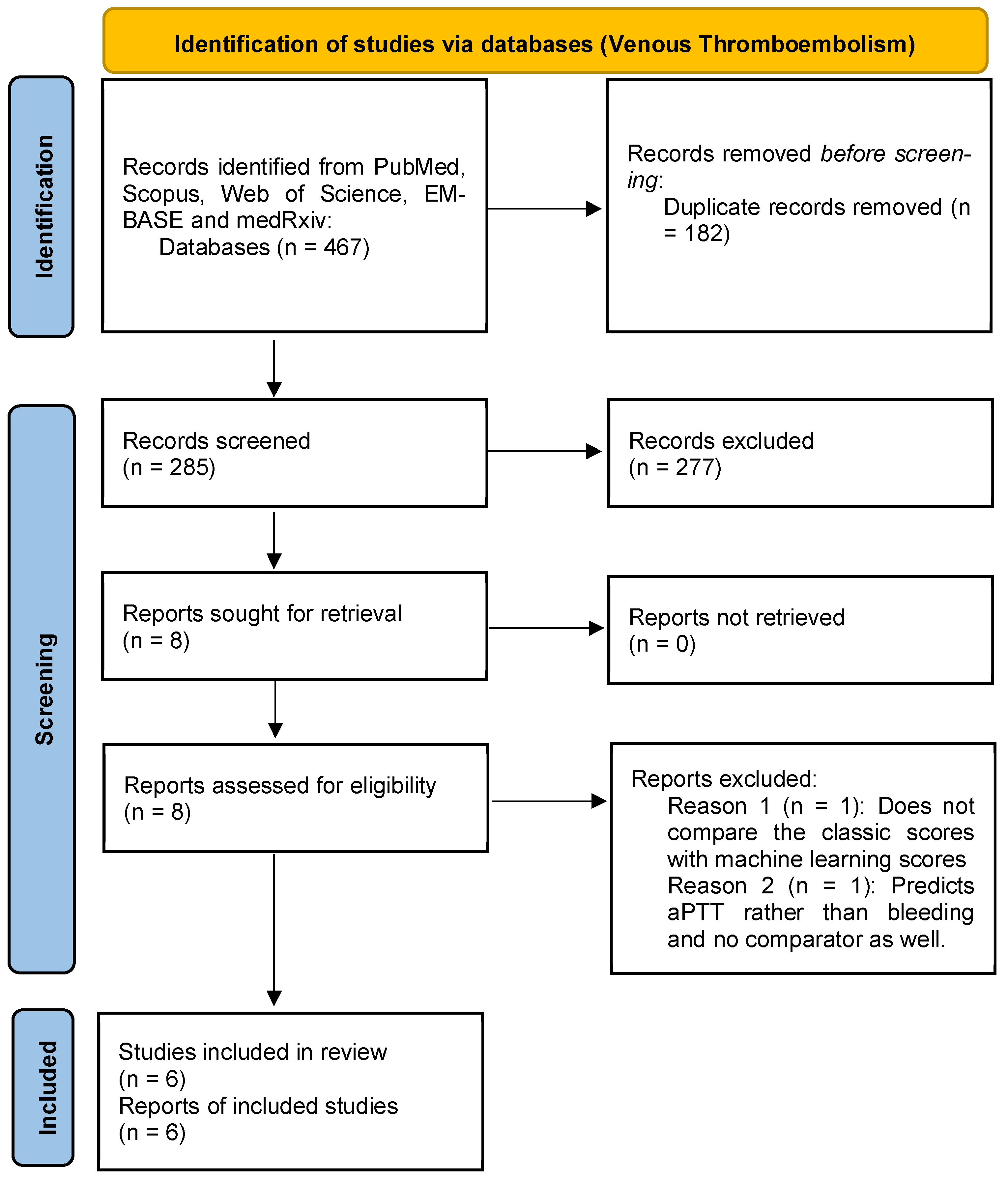
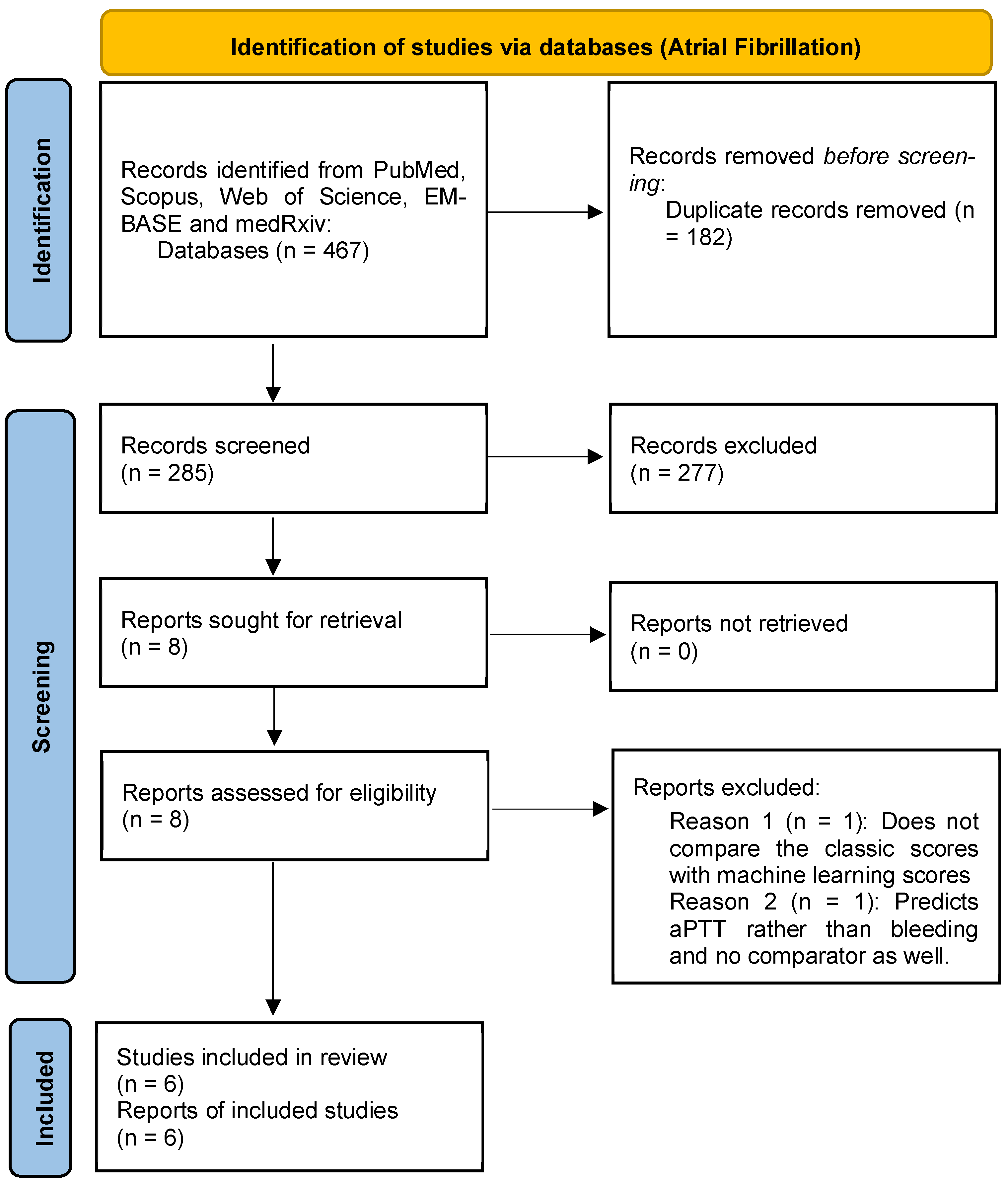
3.1. Study Selection and Characteristics
3.2. Machine Learning Algorithms and Performance
3.2.1. Atrial Fibrillation Cohort
3.2.2. Venous Thromboembolism Cohort
3.2.3. Risk of Bias and Study Quality
4. Discussion
5. Conclusions
Supplementary Materials
Author Contributions
Funding
Institutional Review Board Statement
Informed Consent Statement
Data Availability Statement
Conflicts of Interest
References
- Ruff, C.T.; Giugliano, R.P.; Braunwald, E.; Hoffman, E.B.; Deenadayalu, N.; Ezekowitz, M.D.; Camm, A.J.; Weitz, J.I.; Lewis, B.S.; Parkhomenko, A.; et al. Comparison of the efficacy and safety of new oral anticoagulants with warfarin in patients with atrial fibrillation: A meta-analysis of randomised trials. Lancet 2014, 383, 955–962. [Google Scholar] [CrossRef]
- Kearon, C.; Akl, E.A.; Ornelas, J.; Blaivas, A.; Jimenez, D.; Bounameaux, H.; Huisman, M.; King, C.S.; Morris, T.A.; Sood, N.; et al. Antithrombotic therapy for VTE disease: CHEST guideline and expert panel report. Chest 2016, 149, 315–352. [Google Scholar] [CrossRef]
- Khan, F.; Tritschler, T.; Kahn, S.R.; Rodger, M.A. Venous thromboembolism. Lancet 2021, 398, 64–77. [Google Scholar] [CrossRef] [PubMed]
- Pisters, R.; Lane, D.A.; Nieuwlaat, R.; de Vos, C.B.; Crijns, H.J.G.M.; Lip, G.Y.H. A novel user-friendly score (HAS-BLED) to assess 1-year risk of major bleeding in patients with atrial fibrillation: The Euro Heart Survey. Chest 2010, 138, 1093–1100. [Google Scholar] [CrossRef] [PubMed]
- O’Brien, E.C.; Simon, D.N.; Thomas, L.E.; Hylek, E.M.; Gersh, B.J.; Ansell, J.E.; Kowey, P.R.; Mahaffey, K.W.; Chang, P.; Fonarow, G.C.; et al. The ORBIT bleeding score: Simple bedside score assess bleeding risk atrial fibrillation. Eur. Heart J. 2015, 36, 3258–3264. [Google Scholar] [CrossRef] [PubMed]
- Fang, M.C.; Go, A.S.; Chang, Y.; Borowsky, L.H.; Pomernacki, N.K.; Udaltsova, N.; Singer, D.E. A new risk scheme to predict warfarin-associated hemorrhage: The ATRIA (Anticoagulation and Risk Factors in Atrial Fibrillation) Study. J. Am. Coll. Cardiol. 2011, 58, 395–401. [Google Scholar] [CrossRef]
- Gage, B.F.; Yan, Y.; Milligan, P.E.; Waterman, A.D.; Culverhouse, R.; Rich, M.W.; Radford, M.J. Clinical classification schemes for predicting hemorrhage: Results from the National Registry of Atrial Fibrillation (NRAF). Am. Heart J. 2006, 151, 713–719. [Google Scholar] [CrossRef]
- Apostolakis, S.; Lane, D.A.; Guo, Y.; Buller, H.; Lip, G.Y.H. Performance of the HEMORR(2)HAGES, ATRIA, and HAS-BLED bleeding risk-prediction scores in patients with atrial fibrillation undergoing anticoagulation: The AMADEUS (evaluating the use of SR34006 compared to warfarin or acenocoumarol in patients with atrial fibrillation) study. J. Am. Coll. Cardiol. 2012, 60, 861–867. [Google Scholar]
- Soler-Espejo, E.; Ramos-Bratos, M.P.; Rivera-Caravaca, J.M.; González-Lozano, E.; Marín, F.; Roldán, V.; Lip, G.Y. A comparative analysis of HAS-BLED, ORBIT, DOAC, and AF-BLEED bleeding-risk scores in anticoagulated patients with atrial fibrillation: A report from the prospective Murcia atrial fibrillation project III (MAFP-III) cohort. J. Thromb. Haemost. 2025, 24, 431–442. [Google Scholar] [CrossRef]
- Senoo, K.; Proietti, M.; Lane, D.A.; Lip, G.Y.H. Evaluation of the HAS-BLED, ATRIA, and ORBIT bleeding risk scores in patients with Atrial Fibrillation taking warfarin. Am. J. Med. 2016, 129, 600–607. [Google Scholar] [CrossRef]
- Deo, R.C. Machine learning in medicine. Circulation 2015, 132, 1920–1930. [Google Scholar] [CrossRef]
- Rajkomar, A.; Dean, J.; Kohane, I. Machine learning in medicine. N. Engl. J. Med. 2019, 380, 1347–1358. [Google Scholar] [CrossRef] [PubMed]
- Kasim, S.; Amir Rudin, P.N.F.; Malek, S.; Ibrahim, N.; Kiew, X.N.; Nasir, N.M.; Ibrahim, K.S.; Raja Shariff, R.E. Enhanced cardiovascular risk prediction in the Western Pacific: A machine learning approach tailored to the Malaysian population. PLoS ONE 2025, 20, e0323949. [Google Scholar] [CrossRef] [PubMed]
- Weng, S.F.; Reps, J.; Kai, J.; Garibaldi, J.M.; Qureshi, N. Can machine-learning improve cardiovascular risk prediction using routine clinical data? PLoS ONE 2017, 12, e0174944. [Google Scholar] [CrossRef] [PubMed]
- Wang, Y.; Aivalioti, E.; Stamatelopoulos, K.; Zervas, G.; Mortensen, M.B.; Zeller, M.; Liberale, L.; Di Vece, D.; Schweiger, V.; Camici, G.G.; et al. Machine learning in cardiovascular risk assessment: Towards a precision medicine approach. Eur. J. Clin. Investig. 2025, 55, e70017. [Google Scholar] [CrossRef]
- Pencina, M.J.; D’Agostino, S.R.B.; Steyerberg, E.W. Extensions of net reclassification improvement calculations to measure usefulness of new biomarkers. Stat. Med. 2011, 30, 11–21. [Google Scholar] [CrossRef]
- Watanabe, H. Comparison among RF, LR existing clinical risk scores predicting outcomes AF: J-RHYTHM registry. J. Cardiol. 2021, 78, 215–224. [Google Scholar]
- Lu, J. Predicting multi-faceted risks using machine learning AF: GLORIA-AF. Eur. Heart J. Digit. Health 2024, 5, 117–128. [Google Scholar]
- Chaudhary, D. Machine learning predicts bleeding risk AF patients DOACs. Thromb. Haemost. 2025, 125, 1032–1043. [Google Scholar]
- Bernardini, A.; Bindini, L.; Antonucci, E.; Berteotti, M.; Giusti, B.; Testa, S.; Palareti, G.; Poli, D.; Frasconi, P.; Marcucci, R. Machine learning approach for prediction of outcomes in anticoagulated patients with atrial fibrillation. Int. J. Cardiol. 2024, 407, 132088. [Google Scholar] [CrossRef]
- Herrin, J. ML approaches predicting GIB antithrombotic users. Circ. Cardiovasc. Qual. Outcomes 2021, 14, 579–586. [Google Scholar]
- Nopp, S.; Spielvogel, C.P.; Schmaldienst, S.; Klauser-Braun, R.; Lorenz, M.; Bauer, B.N.; Pabinger, I.; Säemann, M.; Königsbrügge, O.; Ay, C. Bleeding risk assessment in end-stage kidney disease: Validation of existing risk scores and evaluation of a machine learning-based approach. Thromb. Haemost. 2022, 122, 1558–1566. [Google Scholar] [CrossRef] [PubMed]
- Fard, F. Deep learning predict bleeding extended anticoagulation. Blood Adv. 2024, 8, 1159–1171. [Google Scholar]
- Mora, D.; Mateo, J.; Nieto, J.A.; Bikdeli, B.; Yamashita, Y.; Barco, S.; Jimenez, D.; Demelo-Rodriguez, P.; Rosa, V.; Yoo, H.H.B.; et al. Machine learning to predict major bleeding during anticoagulation for venous thromboembolism: Possibilities and limitations. Br. J. Haematol. 2023, 201, 971–981. [Google Scholar] [CrossRef]
- Grdinic, A.G.; Radovanovic, S.; Gleditsch, J.; Jørgensen, C.T.; Asady, E.; Pettersen, H.H.; Delibasic, B.; Ghanima, W. Developing a machine learning model for bleeding prediction in patients with cancer-associated thrombosis receiving anticoagulation therapy. J. Thromb. Haemost. 2024, 22, 1094–1104. [Google Scholar] [CrossRef]
- Fard, S.S.; Perkins, T.J.; Wells, P.S. Machine learning analysis of bleeding status in venous thromboembolism patients. Res. Pract. Thromb. Haemost. 2024, 8, 102403. [Google Scholar] [CrossRef]
- Martin, P. External validation PREDICT-AI bleeding model. Thromb. Res. 2024, 234, 118–126. [Google Scholar]
- Martin, P. Prediction model major bleeding using ML NLP. Thromb. Res. 2024, 232, 102–111. [Google Scholar]
- Moons, K.G.; Damen, J.A.; Kaul, T.; Hooft, L.; Navarro, C.A.; Dhiman, P.; Beam, A.L.; Van Calster, B.; Celi, L.A.; Denaxas, S.; et al. PROBAST+AI: An updated quality, risk of bias, and applicability assessment tool for prediction models using regression or artificial intelligence methods. BMJ 2025, 388, e082505. [Google Scholar] [CrossRef]
- Collins, G.S.; Moons, K.G.; Dhiman, P.; Riley, R.D.; Beam, A.L.; Van Calster, B.; Ghassemi, M.; Liu, X.; Reitsma, J.B.; Van Smeden, M.; et al. TRIPOD+AI statement: Updated guidance for reporting clinical prediction models that use regression or machine learning methods. BMJ 2024, 385, e078378. [Google Scholar] [CrossRef]
- Lu, J.; Hutchens, R.; Hung, J.; Bennamoun, M.; McQuillan, B.; Briffa, T.; Sohel, F.; Murray, K.; Stewart, J.; Chow, B.; et al. Performance of multilabel machine learning models and risk stratification schemas for predicting stroke and bleeding risk in patients with non-valvular atrial fibrillation. Comput. Biol. Med. 2022, 150, 106126. [Google Scholar] [CrossRef]
- Obermeyer, Z.; Emanuel, E.J. Predicting the future—Big data, machine learning, and clinical medicine. N. Engl. J. Med. 2016, 375, 1216–1219. [Google Scholar] [CrossRef] [PubMed]
- Alba, A.C.; Agoritsas, T.; Walsh, M.; Hanna, S.; Iorio, A.; Devereaux, P.J.; McGinn, T.; Guyatt, G. Discrimination and calibration of clinical prediction models: Users’ guides to the medical literature. JAMA 2017, 318, 1377–1384. [Google Scholar] [CrossRef] [PubMed]
- Lundberg, S.; Lee, S.-I. A unified approach to interpreting model predictions. arXiv 2017, arXiv:1705.07874. [Google Scholar] [CrossRef]
- Varma, S.; Simon, R. Bias in error estimation when using cross-validation for model selection. BMC Bioinform. 2006, 7, 91. [Google Scholar] [CrossRef]
- Barr Kumarakulasinghe, N.; Blomberg, T.; Liu, J.; Saraiva Leao, A.; Papapetrou, P. Evaluating local interpretable model-agnostic explanations on clinical machine learning classification models. In Proceedings of the 2020 IEEE 33rd International Symposium on Computer-Based Medical Systems (CBMS), Rochester, MN, USA, 28–30 July 2020; IEEE: New York, NY, USA, 2020. [Google Scholar] [CrossRef]
- Topol, E.J. High-performance medicine: The convergence of human and artificial intelligence. Nat. Med. 2019, 25, 44–56. [Google Scholar] [CrossRef]
- Yu, K.-H.; Beam, A.L.; Kohane, I.S. Artificial intelligence in healthcare. Nat. Biomed. Eng. 2018, 2, 719–731. [Google Scholar] [CrossRef]
- Obermeyer, Z.; Powers, B.; Vogeli, C.; Mullainathan, S. Dissecting racial bias in an algorithm used to manage the health of populations. Science 2019, 366, 447–453. [Google Scholar] [CrossRef]
- Food Drug Administration. Proposed Regulatory Framework Modifications Artificial Intelligence/Machine Learning-Based Software Medical Device (AI/ML-SaMD); FDA: Silver Spring, MD, USA, 2021. [Google Scholar]
- Kelly, C.J.; Karthikesalingam, A.; Suleyman, M.; Corrado, G.; King, D. Key challenges for delivering clinical impact with artificial intelligence. BMC Med. 2019, 17, 195. [Google Scholar] [CrossRef]
- Shortliffe, E.H.; Sepúlveda, M.J. Clinical decision support in the era of artificial intelligence. JAMA 2018, 320, 2199–2200. [Google Scholar] [CrossRef]
- Martin, B.; Bennett, T.D.; DeWitt, P.E.; Russell, S.; Sanchez-Pinto, L.N. Use of the area under the precision-recall curve to evaluate prediction models of rare critical illness events. Pediatr. Crit. Care Med. 2025, 26, e855–e859. [Google Scholar] [CrossRef]
- Page, M.J.; McKenzie, J.E.; Bossuyt, P.M.; Boutron, I.; Hoffmann, T.C.; Mulrow, C.D.; Shamseer, L.; Tetzlaff, J.M.; Akl, E.A.; Brennan, S.E.; et al. The PRISMA 2020 statement: An updated guideline for reporting systematic reviews. BMJ 2021, 372, n71. [Google Scholar] [CrossRef]
- Tricco, A.C.; Lillie, E.; Zarin, W.; O’Brien, K.K.; Colquhoun, H.; Levac, D.; Moher, D.; Peters, M.D.J.; Horsley, T.; Weeks, L.; et al. PRISMA Extension for Scoping Reviews (PRISMAScR): Checklist and Explanation. Ann. Intern. Med. 2018, 169, 467–473. [Google Scholar] [CrossRef]


| (A) | ||||||||
| Study (Year) | Population | ML Models Used | Sample Size (Bleeds) | Performance (AUC/C-Statistic) | Comparison to Risk Scores (AUC/C-Statistic) | Validation | Study Type | |
| AF1 | Watanabe et al. (2021) [17] Comparison among RF, LR and existing clinical risk scores | Non-valvular AF patients enrolled in J-RHYTHM registry | RF (primary); stepwise logistic regression (LR) (comparator) | 7406 patients; 140 major bleeds (1.8%) over 2 years | RF 0.69, (0.66–0.72); LR 0.66 (0.63–0.68) | RF: Outperformed HAS-BLED (0.61, p < 0.05) and ATRIA (0.62, p < 0.001), but not ORBIT (0.67, p = 0.07) | Internal (80/20 train–test split with 5-fold cross-validation) | Prospective observational cohort (Japan) |
| AF2 | Juan Lu et al. (2024) [18] Predicting multifaceted risks using machine learning in AF | Data from Phase II/III of GLORIA-AF registry: adults with newly diagnosed non-valvular AF (within 3 months) and CHA2DS2-VASc score ≥ 1 | Multi-label gradient-boosting decision tree (ML-GBDT) | 25,656 patients analyzed, 405 major bleeds (1.6%) at 1 year | 0.698 (0.651–0.745) | Outperformed HASBLED (0.607; p = 0.002) | Internal (70/10 train–test split with internal validation and hyperparameter tuning) | Prospective multinational observational registry (GLORIA-AF) |
| AF3 | Chaudhary et al. (2025) [19] ML predicts bleeding risk in AF patients on DOAC | Adults > 18 years old with non-valvular AF treated with DOACs | RF, XGBoost, LR, classification trees, k-nearest neighbor (KNN), naïve Bayes | 24,468 patients; 553 bleeds (2.3%) at 1 yr, 829 (3.5%) at 2 yrs, 1292 (5.8%) at 5 years | Best ML at 1 year Low-comorbidity test set: XGBoost 0.69 (0.63–0.74) and multivariate LR (L2) 0.69 (0.62–0.76) Random test set: RF 0.76 (0.70–0.81) | Best performing conventional risk score at 1 year: Low comorbidity test set: HAS-BLED: 0.54 (0.48–0.6), outperformed by XGBoost (p < 0.001) Random test set: HASBLED: 0.57 (0.50–0.63), outperformed by RF (p < 0.001) | Internal (70% training, two 15% test cohorts with stratified sampling) | Prognostic modeling with retrospective cohort study design using EHR data |
| AF4 | Bernardini et al. (2024) [20] ML approach for prediction of outcomes in anticoagulated patients with AF | Adults ≥ 18 years old with non-valvular AF receiving anticoagulation (46.4% VKA, 53.6% DOAC) from the START-2 registry | Stepwise logistic regression (SLR); gradient-boosted decision trees (GBDTs) | 11,078 patients; 240 major bleeding events (1.08 per 100 patient years) over median follow-up of 1.5 years | Best ML: Overall population MMoE: 0.641 ± 0.02 DOAC subgroup GBDT: 0.711 ± 0.029 Warfarin subgroup MMoE: 0.630 ± 0.037 | HAS-BLED: Overall 0.576 ± 0.010 (p = 0.352); DOAC subgroup: 0.586 ± 0.054 (ML superior, p < 0.001); Warfarin subgroup: 0.570 ± 0.034 (p = 0.831) | Internal validation only using 5-fold cross-validation with iterative stratification | Multicenter, prospective observational cohort |
| AF5 | Herrin et al. (2021) [21] Comparative effectiveness of ML approaches for predicting gastrointestinal bleeds in patients receiving antithrombotic treatment | Adults ≥18 years with AF, IHD or VTE newly initiated on OAC (warfarin or DOAC) and/or thienopyridine antiplatelets | Regularized Cox regression (RegCox); random survival forest (RSF), XGBoost | 306,463 patients; 12,322 GI bleeds (4.0%) over median follow-up of 133 days (IQR 49–320) | Validation cohort: RegCox 0.67 (6 mth), 0.66 (12 mth); XGBoost 0.67 (6 mth), 0.66 (12 mth); RSF 0.62 (6 mth), 0.60 (12 mth) | Validation cohort: HAS-BLED 0.60 (6 mth); 0.59 (12 mth) | Temporal internal validation (development cohort n = 105,837 vs. validation cohort n = 200,626) | Retrospective cross-sectional study using private insurance claims and Medicare advantage enrollees in USA |
| AF6 | Juan et al. (2022) [18] Performance of multilabel ML models for predicting stroke and bleeding risk in patients with non-valvular AF | Adult hospitalized patients with non-valvular AF (with and without oral anticoagulation) | Support vector machine (SVM); gradient-boosted machine (GBM); multi-layer neural networks (MLNNs) | 9670 patients; 430 major bleeding events (4.4%) at 1 year; 6266 patients were not on OAC | Entire cohort SVM 0.666 (0.661–0.670); MLNN 0.665 (0.654–0.674); GBM 0.709 (0.703–0.716) | Entire cohort HAS-BLED 0.522 (0.516–0.529); ATRIA 0.562 (0.554–0.570); ORBIT 0.511 (0.502–0.521) | Internal validation (75/25 train–test split, with 10% of training set used for internal validation) | Retrospective cohort study |
| AF7 | Nopp et al. (2022) [22] Bleeding risk assessment in end-stage kidney disease: validation of existing risk scores and evaluation of an ML-based approach | VIVALDI study: adult patients requiring chronic hemodialysis including a subset of patients with AF | KNN, decision tree (DT), RF, neural network algorithm | 625 patients (165 with AF); 89 (14.2%) major bleeds over median of 3.47 years | KNN 0.55; DT 0.51; neural network 0.50; RF 0.49 Subgroup with AF not reported | Total cohort: HAS-BLED 0.59; ATRIA 0.55, HEMORR2HAGES 0.58; ORBIT 0.59; ORBI 0.54; mOBRI 0.54 | Internal validation using 100-fold Monte Carlo cross-validation (85% training set) | Prospective cohort study; model validation and development |
| (B) | ||||||||
| VTE1 | Fard et al. (2024) [23] A deep learning approach to predict bleeding risk over time in patients on extended anticoagulation therapy | Patients with weakly provoked or unprovoked VTE who completed ≥3 months of OAC and required extended OAC therapy | Artificial neural networks (ANNs): Baseline-ANN, LastFUP-ANN; recurrent neural network (RNN): FUP-RNN; ensemble averaging (Baseline-ANN + FUP-RNN); Ensemble | 2542 patients; 118 major bleeds (4.6%) over 8 years | Baseline-ANN 0.612; LastFUP-ANN 0.771; FUP-RNN 0.807; Ensemble 0.824 | HASBLED 0.642; OBRI 0.663; RIETE 0.615; VTE-BLEED 0.651 | Internal validation (70/30 hold-out train–test split) | Prospective longitudinal cohort |
| VTE2 | Mora et al. (2023) [24] ML to predict major bleeding during anticoagulation for VTE | Objectively confirmed VTE patients receiving anticoagulation | Support vector machine; K-nearest neighbors; neural network; DT; XGBoost | 49,587 patients; 873 major bleeds (1.76%) within first three months | Best performing: XGBoost 0.91 (OR for major bleeding 5.89 (4.43–7.83)) | RIETE: OR 3.11 (2.16–4.48); VTE-BLEED: OR 2.34 (1.79–3.05); No AUC reported for clinical scores | Internal validation with train–test split; external validation via COMMAND-VTE database showed no improvement of XGBoost performance over RIETE | Registry-based cohort (RIETE registry) |
| VTE3 | Grdinic et al. (2023) [25] Developing a ML model for bleeding prediction in patients with cancer-associated thrombosis | Adults with active cancer and confirmed VTE receiving anticoagulation | Ridge and Lasso LR; RF; XGBoost | 1080 patients, 83 bleeds (7.7%) at 1–90 days; 122 bleeds (11.3%) at 1–365 days; 51 bleeds (4.7%) at 90–455 days | 1–90 days: Lasso LR 0.64 ± 0.12; RF 0.65 ± 0.06; XGBoost 0.64 ± 0.08 1–365 days: Lasso LR 0.64 ± 0.08; RF 0.63 ± 0.07; XGBoost 0.59 ± 0.08 | 1–90 days: CAT-BLEED 0.48 ± 0.13 (1–90 days); 0.47 ± 0.08 (1–365 days); 0.42 ± 0.10 (90–455 days) | Internal validation only (10-fold cross-validation) | Registry-based cohort (TROLL registry, Østfold hospital, Norway) |
| VTE4 | Fard et al. (2024) [26] ML analysis of bleeding status in VTE patients | Patients with weakly provoked or unprovoked VTE on anticoagulation for ≥3 months after diagnosis | LR, RF, linear discriminant analysis (QDA); Gaussian Naïve Bayes; support vector machine (SVC); adaptive boosting (Adaboost); gradient boosting | 2542 patients; 118 major bleeds (4.6%) | LR 0.58; RF 0.60; QDA 0.67; Gaussian NB 0.66; SVC 0.65; Adaboost 0.54; gradient boosting 0.58 | VTE-BLEED 0.65; HAS-BLED 0.66; OBRI 0.65; RIETE 0.63 | Internal validation only (5-fold cross-validation) | Prospective cohort (“bleeding risk” study) |
| VTE5 | Martin et al. (2024) [27] Prediction model for major bleeding in anticoagulated patients with cancer-associated VTE using ML and natural language processing | Adult patients with active cancer and confirmed VTE receiving anticoagulation | LR; DT; RF | 21,227 patients; 1790 (10.9%) bleeds within first 6 months | LR 0.60 (0.55–0.65); DT 0.60 (0.55–0.65); RF 0.61 (0.56–0.66) | CAT-BLEED 0.53 (0.48–0.59) | Internal validation only (75/25 train–test split); ongoing external validation using TESEO registry (refer to VTE6) | Observational, retrospective, multicenter study |
| VTE6 | Martin et al. (2024) [28] | Adult patients with active cancer and radiologically confirmed VTE receiving anticoagulation | LR; DT; RF | 2179 patients; 129 major bleeds (5.9%) within 6 months | LR 0.59 (0.53–0.65); DT 0.53 (0.48–0.59); RF 0.56 (0.51–0.62) | CAT-BLEED 0.53 (0.48–0.59) reported in VTE5 | External validation using TESEO registry (validation of VTE5) | Observational, retrospective, multicenter study |
Disclaimer/Publisher’s Note: The statements, opinions and data contained in all publications are solely those of the individual author(s) and contributor(s) and not of MDPI and/or the editor(s). MDPI and/or the editor(s) disclaim responsibility for any injury to people or property resulting from any ideas, methods, instructions or products referred to in the content. |
© 2026 by the authors. Licensee MDPI, Basel, Switzerland. This article is an open access article distributed under the terms and conditions of the Creative Commons Attribution (CC BY) license.
Share and Cite
Teo, W.Z.Y.; Wong, M.W.Y.; Lim, F.J.; Ong, E.S.-M.; Barr Kumarakulasinghe, N.; Yap, E.S. Machine Learning Models for Predicting Bleeding Risk in Anticoagulated Patients with Atrial Fibrillation and Venous Thromboembolism: A Comparative Evidence Synthesis. J. Clin. Med. 2026, 15, 2370. https://doi.org/10.3390/jcm15062370
Teo WZY, Wong MWY, Lim FJ, Ong ES-M, Barr Kumarakulasinghe N, Yap ES. Machine Learning Models for Predicting Bleeding Risk in Anticoagulated Patients with Atrial Fibrillation and Venous Thromboembolism: A Comparative Evidence Synthesis. Journal of Clinical Medicine. 2026; 15(6):2370. https://doi.org/10.3390/jcm15062370
Chicago/Turabian StyleTeo, Winnie Z. Y., Maggie Wing Yin Wong, Fang Jin Lim, Emmeliene Su-Min Ong, Nesaretnam Barr Kumarakulasinghe, and Eng Soo Yap. 2026. "Machine Learning Models for Predicting Bleeding Risk in Anticoagulated Patients with Atrial Fibrillation and Venous Thromboembolism: A Comparative Evidence Synthesis" Journal of Clinical Medicine 15, no. 6: 2370. https://doi.org/10.3390/jcm15062370
APA StyleTeo, W. Z. Y., Wong, M. W. Y., Lim, F. J., Ong, E. S.-M., Barr Kumarakulasinghe, N., & Yap, E. S. (2026). Machine Learning Models for Predicting Bleeding Risk in Anticoagulated Patients with Atrial Fibrillation and Venous Thromboembolism: A Comparative Evidence Synthesis. Journal of Clinical Medicine, 15(6), 2370. https://doi.org/10.3390/jcm15062370