Pioglitazone Attenuates Sepsis-Associated Acute Kidney Injury by Modulating TLR-4/NF-κB Signaling and Improving Survival and Renal Function
 , and
, and
Abstract
1. Introduction
2. Materials and Methods
2.1. Animals and Ethical Approval
2.2. Experimental Design
2.3. Cecal Ligation and Puncture (CLP) Procedure
2.4. Histopathological Examination of the Kidney
2.5. Biochemical Measurements
2.5.1. Plasma Biomarkers
2.5.2. Renal Tissue Assays
2.6. Statistical Analysis
3. Results
3.1. Survival Analysis
3.2. Renal Function and Histopathology
3.2.1. Quantitative Histopathological Scores
3.2.2. Representative Micrographs of Renal Injury
3.2.3. Renal Function Biomarkers
3.3. Oxidative Stress and Inflammatory Biomarkers
3.3.1. Oxidative Stress Biomarker
3.3.2. Inflammatory Biomarkers
4. Discussion
Limitation
5. Conclusions
Author Contributions
Funding
Institutional Review Board Statement
Data Availability Statement
Conflicts of Interest
References
- Fleischmann, C.; Scherag, A.; Adhikari, N.K.J.; Hartog, C.S.; Tsaganos, T.; Schlattmann, P.; Angus, D.C.; Reinhart, K.; International Forum of Acute Care Trialists. Assessment of global incidence and mortality of hospital-treated sepsis: Current estimates and limitations. Am. J. Respir. Crit. Care Med. 2016, 193, 259–272. [Google Scholar] [CrossRef] [PubMed]
- Rudd, K.E.; Johnson, S.C.; Agesa, K.M.; Shackelford, K.A.; Tsoi, D.; Kievlan, D.R.; Colombara, D.V.; Ikuta, K.S.; Kissoon, N.; Finfer, S.; et al. Global, regional, and national sepsis incidence and mortality, 1990–2017: Analysis for the Global Burden of Disease Study. Lancet 2020, 395, 200–211. [Google Scholar] [CrossRef] [PubMed]
- Uchino, S.; Kellum, J.A.; Bellomo, R.; Doig, G.S.; Morimatsu, H.; Morgera, S.; Schetz, M.; Tan, I.; Bouman, C.; Macedo, E.; et al. Acute renal failure in critically ill patients: A multinational, multicenter study. JAMA 2005, 294, 813–818. [Google Scholar] [CrossRef]
- The Cooperative Antimicrobial Therapy of Septic Shock (CATSS) Database Research Group; Bagshaw, S.M.; Lapinsky, S.; Dial, S.; Arabi, Y.; Dodek, P.; Wood, G.; Ellis, P.; Guzman, J.; Marshall, J.; et al. Acute kidney injury in septic shock: Clinical outcomes and impact of duration of hypotension prior to initiation of antimicrobial therapy. Intensive Care Med. 2009, 35, 871–881. [Google Scholar] [CrossRef]
- Zarjou, A.; Agarwal, A. Sepsis and acute kidney injury. J. Am. Soc. Nephrol. 2011, 22, 999–1006. [Google Scholar] [CrossRef]
- Evans, L.; Rhodes, A.; Alhazzani, W.; Antonelli, M.; Coopersmith, C.M.; French, C.; Machado, F.R.; Mcintyre, L.; Ostermann, M.; Prescott, H.C.; et al. Surviving sepsis campaign: International guidelines for management of sepsis and septic shock 2021. Crit. Care Med. 2021, 49, e1063–e1143. [Google Scholar] [PubMed]
- Dejager, L.; Pinheiro, I.; Dejonckheere, E.; Libert, C. Cecal ligation and puncture: The gold standard model for polymicrobial sepsis? Trends Microbiol. 2011, 19, 198–208. [Google Scholar] [CrossRef]
- Li, J.L.; Li, G.; Jing, X.Z.; Li, Y.F.; Ye, Q.Y.; Jia, H.H.; Liu, S.H.; Li, X.J.; Li, H.; Huang, R.; et al. Assessment of clinical sepsis-associated biomarkers in a septic mouse model. J. Int. Med. Res. 2018, 46, 2410–2422. [Google Scholar]
- Cai, L.; Rodgers, E.; Schoenmann, N.; Raju, R.P. Advances in rodent experimental models of sepsis. Int. J. Mol. Sci. 2023, 24, 9578. [Google Scholar] [CrossRef]
- Kannan, S.K.; Kim, C.Y.; Heidarian, M.; Berton, R.R.; Jensen, I.J.; Griffith, T.S.; Badovinac, V.P. Mouse Models of Sepsis. Curr. Protoc. 2024, 4, e997. [Google Scholar]
- Ramsay, S.D.; Kilgariff, D.E.; Young, B.J.; Plummer, M.P.; Nenke, M.A.; Meyer, E.J.; Torpy, D.J.; Young, R.L. Precision Profiling of Disease Progression in Murine Models of Sepsis and Septic Shock. Int. J. Mol. Sci. 2025, 26, 9954. [Google Scholar] [CrossRef]
- Fani, F.; Regolisti, G.; Delsante, M.; Cantaluppi, V.; Castellano, G.; Gesualdo, L.; Villa, G.; Fiaccadori, E. Recent advances in the pathogenetic mechanisms of sepsis-associated acute kidney injury. J. Nephrol. 2018, 31, 351–359. [Google Scholar] [CrossRef] [PubMed]
- Gómez, H.; Kellum, J.A.; Ronco, C. Metabolic reprogramming and tolerance during sepsis-induced AKI. Nat. Rev. Nephrol. 2017, 13, 143–151. [Google Scholar] [CrossRef] [PubMed]
- Zarbock, A.; Nadim, M.K.; Pickkers, P.; Gomez, H.; Bell, S.; Joannidis, M.; Kashani, K.; Koyner, J.L.; Pannu, N.; Meersch, M.; et al. Sepsis-associated acute kidney injury: Consensus report of the 28th Acute Disease Quality Initiative workgroup. Nat. Rev. Nephrol. 2023, 19, 401–417. [Google Scholar] [CrossRef] [PubMed]
- Gong, S.; Xiong, H.; Lei, Y.; Huang, S.; Ouyang, Y.; Cao, C.; Wang, Y. Usp9x contributes to the development of sepsis-induced acute kidney injury by promoting inflammation and apoptosis in renal tubular epithelial cells via activation of the TLR4/nf-κb pathway. Ren. Fail. 2024, 46, 2361089. [Google Scholar]
- Yue, L.; Liu, X.; Wu, C.; Lai, J.; Wang, J.; Zhong, H.; Chen, F. Toll-like receptor 4 promotes the inflammatory response in septic acute kidney injury by promoting p38 mitogen-activated protein kinase phosphorylation. J. Bioenerg. Biomembr. 2023, 55, 353–363. [Google Scholar] [CrossRef]
- Zhang, Y.; Liu, T.; Zuo, Z. Fortunellin attenuates sepsis-induced acute kidney injury by inhibiting inflammation and ferroptosis via the TLR4/NF-κB pathway. Histol. Histopathol. 2024, 40, 1083–1093. [Google Scholar] [CrossRef]
- Wang, H.-W.; Wu, M.-M.; Zhu, M.-M.; Qin, Y.-Y.; Wang, K.-Q.; Wu, C.-Y.; Zhang, R.-R.; Wang, Y.; Zhou, C.; Luo, S.; et al. Growth differentiation factor 11 attenuates sepsis-associated acute kidney injury by reducing inflammation and coagulation via PGC-1α/Nrf2 activation. Cell. Mol. Biol. Lett. 2025, 30, 102. [Google Scholar] [CrossRef]
- Kounatidis, D.; Tzivaki, I.; Daskalopoulou, S.; Daskou, A.; Adamou, A.; Rigatou, A.; Sdogkos, E.; Karampela, I.; Dalamaga, M.; Vallianou, N.G. Sepsis-Associated Acute Kidney Injury: What’s New Regarding Its Diagnostics and Therapeutics? Diagnostics 2024, 14, 2845. [Google Scholar] [CrossRef] [PubMed] [PubMed Central]
- He, F.F.; Wang, Y.M.; Chen, Y.Y.; Huang, W.; Li, Z.Q.; Zhang, C. Sepsis-induced AKI: From pathogenesis to therapeutic approaches. Front. Pharmacol. 2022, 13, 981578. [Google Scholar] [CrossRef]
- Kaplan, J.; Nowell, M.; Chima, R.; Zingarelli, B. Pioglitazone reduces inflammation through inhibition of NF-kappaB in polymicrobial sepsis. Innate Immun. 2014, 20, 519–528. [Google Scholar] [CrossRef] [PubMed]
- Cai, W.; Yang, T.; Liu, H.; Han, L.; Zhang, K.; Hu, X.; Zhang, X.; Yin, K.-J.; Gao, Y.; Bennett, M.V.; et al. Peroxisome proliferator-activated receptor γ (PPARγ): A master gatekeeper in CNS injury and repair. Prog. Neurobiol. 2018, 163, 27–58. [Google Scholar] [CrossRef] [PubMed]
- Dana, N.; Vaseghi, G.; Haghjooy Javanmard, S. Activation of PPARgamma Inhibits TLR4 Signal Transduction Pathway in Melanoma Cancer in Vitro. Adv. Pharm. Bull. 2020, 10, 458–463. [Google Scholar] [CrossRef] [PubMed]
- Gao, W.; Guo, L.; Yang, Y.; Wang, Y.; Xia, S.; Gong, H.; Zhang, B.K.; Yan, M. Dissecting the Crosstalk Between Nrf2 and NF-κB Response Pathways in Drug-Induced Toxicity. Front. Cell Dev. Biol. 2022, 9, 809952. [Google Scholar] [CrossRef] [PubMed] [PubMed Central]
- Jafari-Khataylou, Y.; Kazemi-Darabadi, S.; Afshar, S.A. Effects of adenosine N1-Oxide and pioglitazone on in-flammatory and antioxidant state in sepsis caused by experimental cecal puncture in rat. Vet. Res. Forum. 2023, 14, 381–387. [Google Scholar] [CrossRef]
- Erbas, O.; Taskiran, D. Sepsis-induced changes in behavioral stereotypy in rats; involvement of tumor necrosis factor-alpha, oxidative stress, and dopamine turnover. J. Surg. Res. 2014, 186, 262–268. [Google Scholar] [CrossRef]
- Dong, L.; Xie, Y.L.; Zhang, R.T.; Hu, Q.Y. Models of sepsis-induced acute kidney injury. Life Sci. 2024, 352, 122873. [Google Scholar] [CrossRef]
- Sun, S.; Wang, J.; Wang, J.; Wang, F.; Yao, S.; Xia, H. Maresin 1 mitigates sepsis-associated acute kidney injury in mice via inhibition of the NF-κB/STAT3/MAPK pathways. Front. Pharmacol. 2019, 10, 1323. [Google Scholar] [CrossRef]
- Yubolphan, R.; Kobroob, A.; Kongkaew, A.; Chiranthanut, N.; Jinadang, N.; Wongmekiat, O. Berberine mitigates Sepsis-Associated acute kidney injury in aged rats by preserving mitochondrial integrity and inhibiting TLR4/NF-κB and NLRP3 inflammasome activations. Antioxidants 2024, 13, 1398. [Google Scholar] [CrossRef]
- Nakamura, I.; Umehara, M.; Yagi-Tomita, A.; Yamamoto, S.; Sawai, S.; Nakamura, M.; Minamida, A.; Yamauchi-Sawada, H.; Sunahara, Y.; Matoba, Y.; et al. Toll like receptor 2 mediated exacerbation of sepsis associated acute kidney injury by renal congestion in mice. Sci. Rep. 2025, 15, 22081. [Google Scholar] [CrossRef]
- Çakır, M.; Tarakçı, B.; Aydın, A.; Bircan, B.; Fırat, S.; Şekerci, G. JAK1/JAK2 inhibitor baricitinib ameliorates sepsis-induced acute kidney injury in rats. Eur. J. Pharmacol. 2025, 1002, 177770. [Google Scholar] [PubMed]
- Ferreira, G.S.; Frota, M.L.; Gonzaga, M.J.D.; Vattimo, M.D.F.F.; Lima, C. The role of biomarkers in diagnosis of sepsis and acute kidney injury. Biomedicines 2024, 12, 931. [Google Scholar] [CrossRef] [PubMed]
- Zhou, H.; Hu, X.; Yu, S.; Chen, Y.; He, W. Diagnostic value of urinary neutrophil gelatinase-associated lipocalin for acute kidney injury in patients with suspected sepsis: A meta-analysis. BMC Nephrol. 2021, 22, 19. [Google Scholar]
- Albert, C.; Haase, M.; Albert, A.; Zapf, A.; Braun-Dullaeus, R.; Haase-Fielitz, A. Biomarker-guided risk assessment for acute kidney injury: Time for clinical implementation? Ann. Lab. Med. 2020, 40, 453–464. [Google Scholar] [CrossRef]
- Paul, A.; Newbigging, N.S.; Lenin, A.; Gowri, M.; Varghese, J.S.; Nell, A.J.; Abhilash, K.P.P.; Binu, A.J.; Chandiraseharan, V.K.; Iyyadurai, R.; et al. Role of Neutrophil Gelatinase-associated Lipocalin (NGAL) and Other Clinical Parameters as Predictors of Bacterial Sepsis in Patients Presenting to the Emergency Department with Fever. Indian J. Crit. Care Med. 2023, 27, 176–182. [Google Scholar] [CrossRef] [PubMed] [PubMed Central]
- Baeseman, L.; Gunning, S.; Koyner, J.L. Biomarker Enrichment in Sepsis-Associated Acute Kidney Injury: Finding High-Risk Patients in the Intensive Care Unit. Am. J. Nephrol. 2024, 55, 72–85. [Google Scholar] [CrossRef] [PubMed] [PubMed Central]
- Tsujimura, Y.; Matsutani, T.; Matsuda, A.; Kutsukake, M.; Uchida, E.; Sasajima, K.; Tamura, K. Effects of pioglitazone on survival and omental adipocyte function in mice with sepsis induced by cecal ligation and puncture. J. Surg. Res. 2011, 171, e215–e221. [Google Scholar] [CrossRef]
- Shafaroodi, H.; Hassanipour, M.; Mousavi, Z.; Rahimi, N.; Dehpour, A.R. The effects of sub-chronic treatment with pioglitazone on the septic mice mortality in the model of cecal ligation and puncture: Involvement of nitric oxide pathway. Acta Medica Iran. 2015, 53, 608–616. [Google Scholar]
- Xia, Y.M.; Guan, Y.Q.; Liang, J.F.; Wu, W.D. TAK-242 improves sepsis-associated acute kidney injury in rats by inhibiting the TLR4/NF-κB signaling pathway. Ren. Fail. 2024, 46, 2313176. [Google Scholar]
- Abdelnaser, M.; Attya, M.E.; El-Rehany, M.A.; Fathy, M. Clemastine mitigates sepsis-induced acute kidney injury in rats; the role of α-Klotho/TLR-4/MYD-88/NF-κB/Caspase-3/p-P38 MAPK signaling pathways. Arch. Biochem. Biophys. 2025, 763, 110229. [Google Scholar]
- Shen, Y.; Shi, Q.; Dai, T.; Cai, Y.; Sheng, M.; Qiu, Y.; Yang, M.; Hu, S.; Cheng, B. Spermidine alleviates sepsis-induced acute kidney injury by suppressing apoptosis and inflammation through modulation of TLR4-mediated signaling. J. Toxicol. Sci. 2025, 50, 555–567. [Google Scholar] [PubMed]
- Liu, B.; Wang, J.; Duan, Y.; Hussain, S.A.; Tripathi, A.S.; Li, K. Ononin promotes survival rate in cecal ligation puncture-induced sepsis rat model by regulating inflammatory pathway. Acta Cir. Bras. 2025, 40, e407825. [Google Scholar] [CrossRef] [PubMed] [PubMed Central]
- Li, X.; Jing, G.; Guo, Z.; Guo, Z. High-mobility group box 1 in acute kidney injury. Front. Pharmacol. 2025, 16, 1618971. [Google Scholar] [CrossRef] [PubMed]
- Wei, S.; Dai, Z.; Wu, L.; Xiang, Z.; Yang, X.; Jiang, L.; Du, Z. Lactate-induced macrophage HMGB1 lactylation promotes neutrophil extracellular trap formation in sepsis-associated acute kidney injury. Cell Biol. Toxicol. 2025, 41, 78. [Google Scholar] [CrossRef] [PubMed] [PubMed Central]
- Zhang, J.; Chen, Q.; Dai, Z.; Pan, H. miR-22 alleviates sepsis-induced acute kidney injury via targeting the HMGB1/TLR4/NF-κB signaling pathway. Int. Urol. Nephrol. 2023, 55, 409–421. [Google Scholar] [CrossRef]
- Gamarra-Morales, Y.; Molina-López, J.; Santiago-Ruiz, F.C.; Herrera-Quintana, L.; Vázquez-Lorente, H.; Gascón-Luna, F.; Planells, E. Efficiency of IL-6 in early prognosis and follow-up in critically ill patients with septic shock. Diseases 2024, 12, 298. [Google Scholar] [CrossRef]
- Gao, X.; Cai, S.; Li, X.; Wu, G. Sepsis-induced immunosuppression: Mechanisms, biomarkers and immunotherapy. Front. Immunol. 2025, 16, 1577105. [Google Scholar] [CrossRef]
- Murphy, M.P. How mitochondria produce reactive oxygen species. Biochem. J. 2009, 417, 1–13. [Google Scholar] [CrossRef]
- Helan, M.; Malaska, J.; Tomandl, J.; Jarkovsky, J.; Helanova, K.; Benesova, K.; Sitina, M.; Dastych, M.; Ondrus, T.; Goldbergova, M.P.; et al. Kinetics of Biomarkers of Oxidative Stress in Septic Shock: A Pilot Study. Antioxidants 2022, 11, 640. [Google Scholar] [CrossRef]
- Rodrigues, F.A.D.P.; Santos, A.D.D.C.; de Medeiros, P.H.Q.S.; Prata, M.D.M.G.; Santos, T.C.D.S.; da Silva, J.A.; Brito, G.A.D.C.; Dos Santos, A.A.; Silveira, E.R.; Lima, A.Â.M. Gingerol suppresses sepsis-induced acute kidney injury by modulating methylsulfonylmethane and dimethylamine production. Sci. Rep. 2018, 8, 12154. [Google Scholar] [CrossRef]
- Anter, A.; Ahmed, A.S.F.; Hammad, A.S.; Almalki, W.H.; Abdel Hafez, S.M.N.; Kasem, A.W.; El-Moselhy, M.A.; Alrabia, M.W.; Ibrahim, A.R.N.; El-Daly, M. The severity of acute kidney and lung injuries induced by cecal ligation and puncture is attenuated by menthol: Role of proliferating cell nuclear antigen and apoptotic markers. Front. Med. 2022, 9, 904286. [Google Scholar] [PubMed]
- Qiongyue, Z.; Xin, Y.; Meng, P.; Sulin, M.; Yanlin, W.; Xinyi, L.; Xuemin, S. Post-treatment with irisin attenuates acute kidney injury in sepsis mice through anti-ferroptosis via the SIRT1/Nrf2 pathway. Front. Pharmacol. 2022, 13, 857067. [Google Scholar]
- Li, X.; Zhou, W.; Chen, J.; Zhou, L.; Li, Y.; Wu, X.; Peng, X. Circ_001653 alleviates sepsis associated-acute kidney injury by recruiting BUD13 to regulate KEAP1/NRF2/HO-1 signaling pathway. J. Inflamm. 2024, 21, 37. [Google Scholar]
- Liu, H.; Wang, L.; Zhou, J. Nrf2 and its signaling pathways in sepsis and its complications: A comprehensive review of research progress. Medicine 2025, 104, e42132. [Google Scholar] [CrossRef] [PubMed] [PubMed Central]
- Gao, M.; Jiang, Y.; Xiao, X.; Peng, Y.; Xiao, X.; Yang, M. Protective effect of pioglitazone on sepsis-induced intestinal injury in a rodent model. J. Surg. Res. 2015, 195, 550–558. [Google Scholar] [CrossRef]
- Alharbi, M.; Mahmoud, M.A.; Alshammari, A.; Almutairi, M.M.; Al-Ghamdi, J.M.; Alsabhan, J.F.; Shabanah, O.A.; Alshalawi, N.A.; Alzarea, S.I.; Alasmari, A.F. The ameliorative effect of pioglitazone against colistin-induced nephrotoxicity is mediated by inhibition of NF-κB and restoration of Nrf2 signaling: An integrative bioinformatics prediction-guided in vitro study. PLoS ONE 2024, 19, e0314092. [Google Scholar] [CrossRef] [PubMed] [PubMed Central]
- Fan, H.Y.; Qi, D.; Yu, C.; Zhao, F.; Liu, T.; Zhang, Z.K.; Yang, M.-Y.; Zhang, L.-M.; Chen, D.-Q.; Du, Y. Paeonol protects endotoxin-induced acute kidney injury: Potential mechanism of inhibiting TLR4-NF-κB signal pathway. Oncotarget 2016, 7, 39497. [Google Scholar]
- Hsieh, M.S.; Hu, S.Y.; Liao, S.H.; Chang, C.M.; Hsieh, V.C.R.; How, C.K. Type 2 Diabetic Sepsis Patients Have a Lower Mortality Rate in Pioglitazone Use: A Nationwide 15-Year Propensity Score Matching Observational Study in Taiwan. Emerg. Med. Int. 2021, 2021, 4916777. [Google Scholar] [CrossRef]
- Kaplan, J.M.; Zingarelli, B.; Krallman, K.; Girdwood, S.T.; Lagory, D.; Mizuno, T.; Fei, L.; Wong, H.R.; Vinks, A.A. Phase 1 safety and pharmacokinetic study on the use of pioglitazone in critically ill patients with sepsis. Intensive Care Med. 2018, 44, 2006–2008. [Google Scholar] [CrossRef]
- Slim, M.A.; van Mourik, N.; Bakkerus, L.; Fuller, K.; Acharya, L.; Giannidis, T.; Dionne, J.C.; Oczkowski, S.J.W.; Netea, M.G.; Pickkers, P.; et al. Towards personalized medicine: A scoping review of immunotherapy in sepsis. Crit. Care 2024, 28, 183. [Google Scholar] [CrossRef]
- MacPhail, A.; Dendle, C.; Slavin, M.; Weinkove, R.; Bailey, M.; Pilcher, D.; McQuilten, Z. Neutropenic sepsis in the intensive care unit: Differences in clinical profile and outcomes according to the cause of neutropenia. In Open Forum Infectious Diseases; Oxford University Press: New York, NY, USA, 2024; Volume 11, p. ofae289. [Google Scholar]
- Yang, Y.; Dong, J.; Chen, X.; Chen, R.; Wang, H. Incidence, risk factors and clinical outcomes of septic acute renal injury in cancer patients with sepsis admitted to the ICU: A retrospective study. Front. Med. 2022, 9, 1015735. [Google Scholar] [CrossRef] [PubMed]
- Lyrio, R.M.D.C.; Rocha, B.R.A.; Corrêa, A.L.R.M.; Mascarenhas, M.G.S.; Santos, F.L.; Maia, R.D.H.; Segundo, L.B.; de Almeida, P.A.A.; Moreira, C.M.O.; Sassi, R.H. Chemotherapy-induced acute kidney injury: Epidemiology, pathophysiology, and therapeutic approaches. Front. Nephrol. 2024, 4, 1436896. [Google Scholar] [CrossRef] [PubMed]
- Vasileiou, M.; Diamantoudis, S.C.; Tsianava, C.; Nguyen, N.P. Therapeutic potential and challenges of pioglitazone in cancer treatment. Appl. Sci. 2025, 15, 1925. [Google Scholar] [CrossRef]
- Jia, X.; Qian, J.; Chen, H.; Liu, Q.; Hussain, S.; Jin, J.; Shi, J.; Hou, Y. PPARγ agonist pioglitazone enhances colorectal cancer immunotherapy by inducing PD-L1 autophagic degradation. Eur. J. Pharmacol. 2023, 950, 175749. [Google Scholar] [CrossRef]
- Xiong, Z.; Chan, S.L.; Zhou, J.; Vong, J.S.; Kwong, T.T.; Zeng, X.; Wu, H.; Cao, J.; Tu, Y.; Feng, Y.; et al. Targeting PPAR-gamma counteracts tumour adaptation to immune-checkpoint blockade in hepatocellular carcinoma. Gut 2023, 72, 1758–1773. [Google Scholar] [CrossRef]
- Baddam, S.; Banka, A.V.; Divity, S.; Sandesara, M.; Vityala, Y. Association between pioglitazone use and bladder cancer: A systematic review. Bladder 2024, 11, e21200023. [Google Scholar] [CrossRef]
- Malhotra, B.; Hiteshi, P.; Khalkho, P.; Malik, R.; Bhadada, S.K.; Bhansali, A.; Shafiq, N.; Malhotra, S.; Kumar, N.; Rajput, R.; et al. Bladder cancer with pioglitazone: A case-control study. Diabetes Metab. Syndr. 2022, 16, 102637. [Google Scholar] [CrossRef]
- Beery, A.K.; Zucker, I. Sex bias in neuroscience and biomedical research. Neurosci. Biobehav. Rev. 2011, 35, 565–572. [Google Scholar] [CrossRef]
- Justice, M.J. Sex matters in preclinical research. Dis. Models Mech. 2024, 17, dmm050759. [Google Scholar]
- Zucker, I.; Prendergast, B.J.; Beery, A.K. Pervasive neglect of sex differences in biomedical research. Cold Spring Harb. Perspect. Biol. 2022, 14, a039156. [Google Scholar] [CrossRef]
- Smarr, B.; Kriegsfeld, L.J. Female mice exhibit less overall variance, with a higher proportion of structured variance, than males at multiple timescales of continuous body temperature and locomotive activity records. Biol. Sex Differ. 2022, 13, 41. [Google Scholar] [CrossRef] [PubMed]
- Bojalil, R.; Ruíz-Hernández, A.; Villanueva-Arias, A.; Amezcua-Guerra, L.M.; Cásarez-Alvarado, S.; Hernández-Dueñas, A.M.; Rodríguez-Galicia, V.; Pavón, L.; Marquina, B.; Becerril-Villanueva, E.; et al. Two murine models of sepsis: Immunopathological differences between the sexes—Possible role of TGFβ1 in female resistance to endotoxemia. Biol. Res. 2023, 56, 54. [Google Scholar] [CrossRef] [PubMed]
- Peng, J.; Tang, R.; Yu, Q.; Wang, D.; Qi, D. No sex differences in the incidence, risk factors and clinical impact of acute kidney injury in critically ill patients with sepsis. Front. Immunol. 2022, 13, 895018. [Google Scholar] [CrossRef] [PubMed]
- Min, S.Y.; Yong, H.J.; Kim, D. Sex or gender differences in treatment outcomes of sepsis and septic shock. Acute Crit. Care 2024, 39, 207–213. [Google Scholar] [CrossRef] [PubMed] [PubMed Central]
- Harding, A.T.; Heaton, N.S. The Impact of Estrogens and Their Receptors on Immunity and Inflammation during Infection. Cancers 2022, 14, 909. [Google Scholar] [CrossRef] [PubMed] [PubMed Central]
- Guo, Y.; Lin, Z.; Zhang, W.; Chen, H.; Liu, Y.; Liu, J.; Zhang, J.; Zhang, A.; Mao, S.; Yao, X. Gender-Stratified analysis of sepsis mortality in cancer: A 45-Year Population-Based cohort study. JNCI Cancer Spectr. 2025, 10, pkaf109. [Google Scholar] [CrossRef]
- Wang, F.; Zhang, X.; Wang, Y.; Chen, Y.; Lu, H.; Meng, X.; Ye, X.; Chen, W. Activation/inactivation of anticancer drugs by CYP3A4: Influencing factors for personalized cancer therapy. Drug Metab. Dispos. 2023, 51, 543–559. [Google Scholar]
- Behal, M.; McCalla, Z.; Wang, X. Sex differences in hepatic enzymes and transporters involved in pharmacokinetics. Liver Res. 2025, 9, 253–272. [Google Scholar] [CrossRef] [PubMed] [PubMed Central]
- Kamel, G.A.M.; Elariny, H.A. Pioglitazone attenuates tamoxifen-induced liver damage in rats via modulating Keap1/Nrf2/HO-1 and SIRT1/Notch1 signaling pathways: In-vivo investigations, and molecular docking analysis. Mol. Biol. Rep. 2023, 50, 10219–10233. [Google Scholar] [CrossRef] [PubMed] [PubMed Central]
- Otero-Anton, E.; Gonzalez-Quintela, A.; Lopez-Soto, A.; Lopez-Ben, S.; Llovo, J.; Perez, L.F. Cecal ligation and puncture as a model of sepsis in the rat: Influence of the puncture size on mortality, bacteremia, endotoxemia and tumor necrosis factor alpha levels. Eur. Surg. Res. 2001, 33, 77–79. [Google Scholar] [CrossRef]
- Fang, H.; Gong, C.; Fu, J.; Liu, X.; Bi, H.; Cheng, Y.; Liu, Y.; Tang, Y.; Wang, D. Evaluation of 2 Rat Models for Sepsis Developed by Improved Cecal Ligation/Puncture or Feces Intraperitoneal-Injection. Med. Sci. Monit. Int. Med. J. Exp. Clin. Res. 2020, 26, e919054. [Google Scholar] [CrossRef]
- Tuccori, M.; Filion, K.B.; Yin, H.; Yu, O.H.; Platt, R.W.; Azoulay, L. Pioglitazone use and risk of bladder cancer: Population based cohort study. BMJ 2016, 352, i1541. [Google Scholar] [CrossRef] [PubMed] [PubMed Central]
- Tang, H.; Shi, W.; Fu, S.; Wang, T.; Zhai, S.; Song, Y.; Han, J. Pioglitazone and bladder cancer risk: A systematic review and meta-analysis. Cancer Med. 2018, 7, 1070–1080. [Google Scholar] [CrossRef] [PubMed] [PubMed Central]
- Percie du Sert, N.; Hurst, V.; Ahluwalia, A.; Alam, S.; Avey, M.T.; Baker, M.; Browne, W.J.; Clark, A.; Cuthill, I.C.; Dirnagl, U.; et al. The ARRIVE guidelines 2.0: Updated guidelines for reporting animal research. J. Cereb. Blood Flow Metab. 2020, 40, 1769–1777. [Google Scholar] [PubMed]
- Ewoldt, T.M.; Abdulla, A.; Hunfeld, N.; Li, L.; Smeets, T.J.; Gommers, D.; Koch, B.C.; Endeman, H. The impact of sepsis on hepatic drug metabolism in critically ill patients: A narrative review. Expert Opin. Drug Metab. Toxicol. 2022, 18, 413–421. [Google Scholar] [CrossRef] [PubMed]
- Morales Castro, D.; Dresser, L.; Granton, J.; Fan, E. Pharmacokinetic Alterations Associated with Critical Illness. Clin. Pharmacokinet. 2023, 62, 209–220. [Google Scholar] [CrossRef] [PubMed] [PubMed Central]
- Nusshag, C.; Rupp, C.; Schmitt, F.; Krautkraemer, E.; Speer, C.; Kaelble, F.; Tamulyte, S.; Bruckner, T.; Zeier, M.; Reiser, J.; et al. Cell cycle biomarkers and soluble urokinase-type plasminogen activator receptor for the prediction of sepsis-induced acute kidney injury requiring renal replacement therapy: A prospective, exploratory study. Crit. Care Med. 2019, 47, e999–e1007. [Google Scholar]
- Palmowski, L.; Lindau, S.; Henk, L.C.; Marko, B.; Witowski, A.; Nowak, H.; Stoll, S.E.; Zacharowski, K.; Böttiger, B.W.; Peters, J.; et al. Predictive enrichment for the need of renal replacement in sepsis-associated acute kidney injury: Combination of furosemide stress test and urinary biomarkers TIMP-2 and IGFBP-7. Ann. Intensive Care 2024, 14, 111. [Google Scholar]
- Licheng; Jia, H.; Jiang, Y.; Li, W. Predictive performance of two types of urinary biomarkers for renal non-recovery in sepsis-associated acute kidney injury: A prospective observational study. BMC Nephrol. 2024, 25, 153. [Google Scholar] [CrossRef]





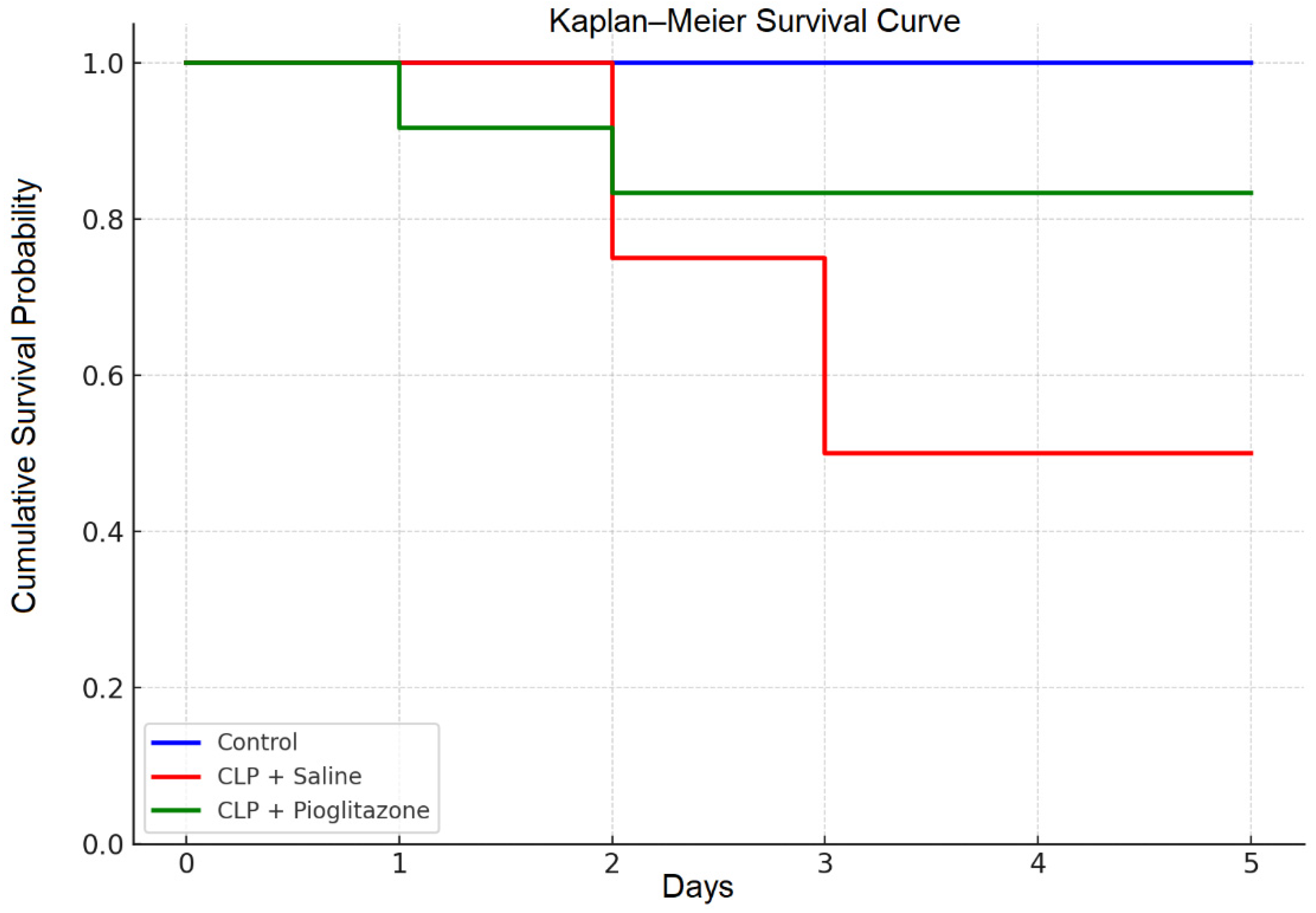
| Baseline (n) | Day 1 | Day 2 | Day 3 | Day 4 | Day 5 | |
|---|---|---|---|---|---|---|
| Control | 12 | 12 | 12 | 12 | 12 | 12 |
| CLP + Salin | 12 | 12 | 9 | 6 | 6 | 6 |
| CLP + Pio | 12 | 11 | 10 | 10 | 10 | 10 |
| Control | CLP + Saline | CLP + Pio | |
|---|---|---|---|
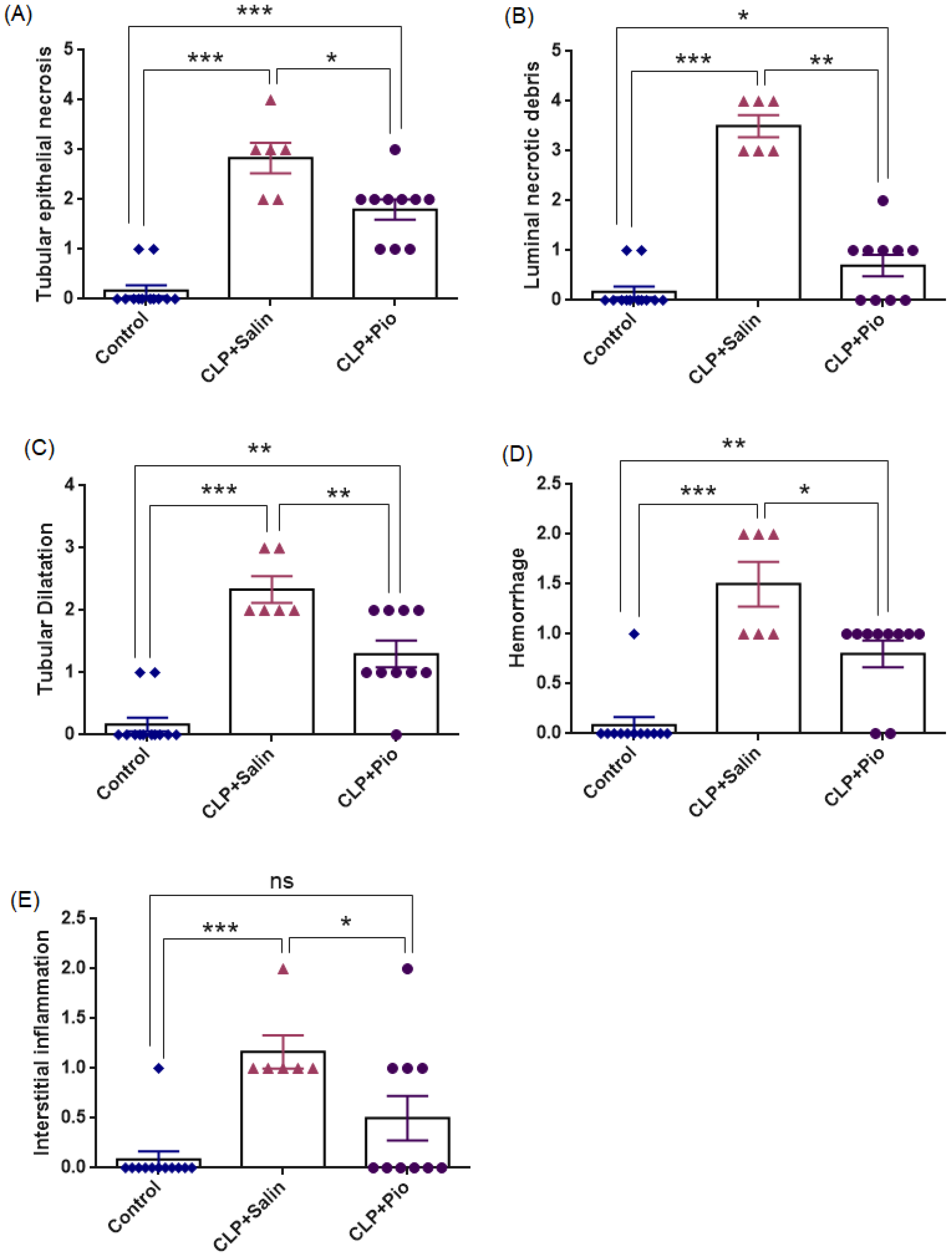
| Tubular epithelial necrosis | 0.0 [0.0–0.0] | 3.0 [2.0–3.25] a | 2.0 [1.0–2] b |
| Luminal necrotic debris | 0.0 [0.0–0.0] | 3.5 [3.0–4.0] a | 1.0 [0.0–1.0] c |
| Tubular Dilatation | 0.0 [0.0–0.0] | 2.0 [2.0–3.0] a | 1.0 [1.0–2.0] c |
| Hemorrhage | 0.0 [0.0–0.0] | 1.5 [1.0–2.0] a | 1.0 [0.75–1.0] b |
| Interstitial inflammation | 0.0 [0.0–0.0] | 1.0 [1.0–1.25] a | 0.5 [0.0–1.0] b |
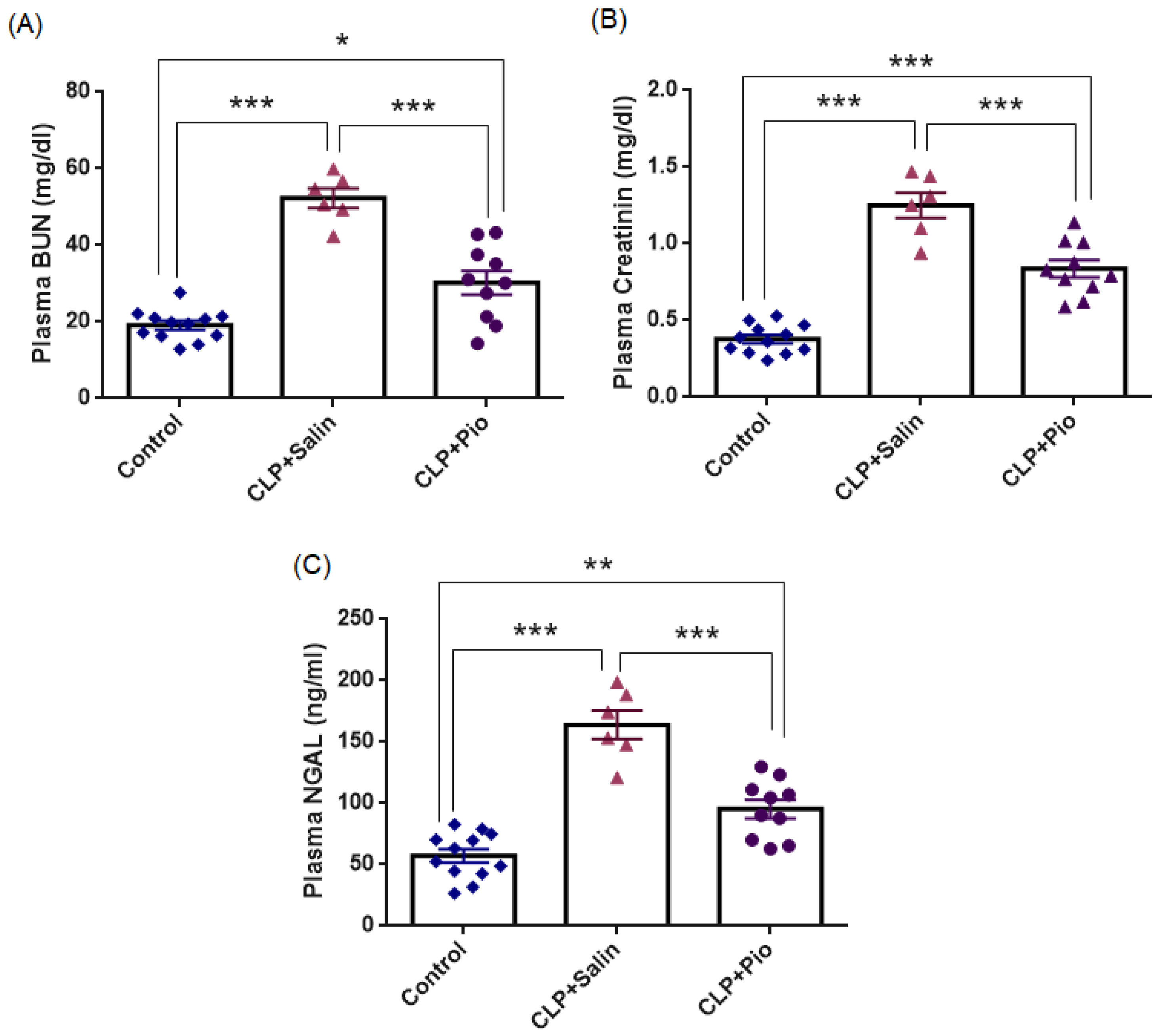
| Control (n = 12) | CLP + Saline (n = 6) | CLP + Pio (n = 10) | |
|---|---|---|---|
| Plasma BUN (mg/dL) | 19.1 ± 1.1 | 52.2 ± 2.5 a | 30.2 ± 3.1 b |
| Plasma Creatinine (mg/dL) | 0.37 ± 0.02 | 1.25 ± 0.08 a | 0.83 ± 0.05 b |
| Plasma NGAL (ng/mL) | 57.2 ± 5.4 | 163.9 ± 11.7 a | 95.2 ± 7.5 b |
| Control (n = 12) | CLP + Saline (n = 6) | CLP + Pio (n = 10) | |
|---|---|---|---|
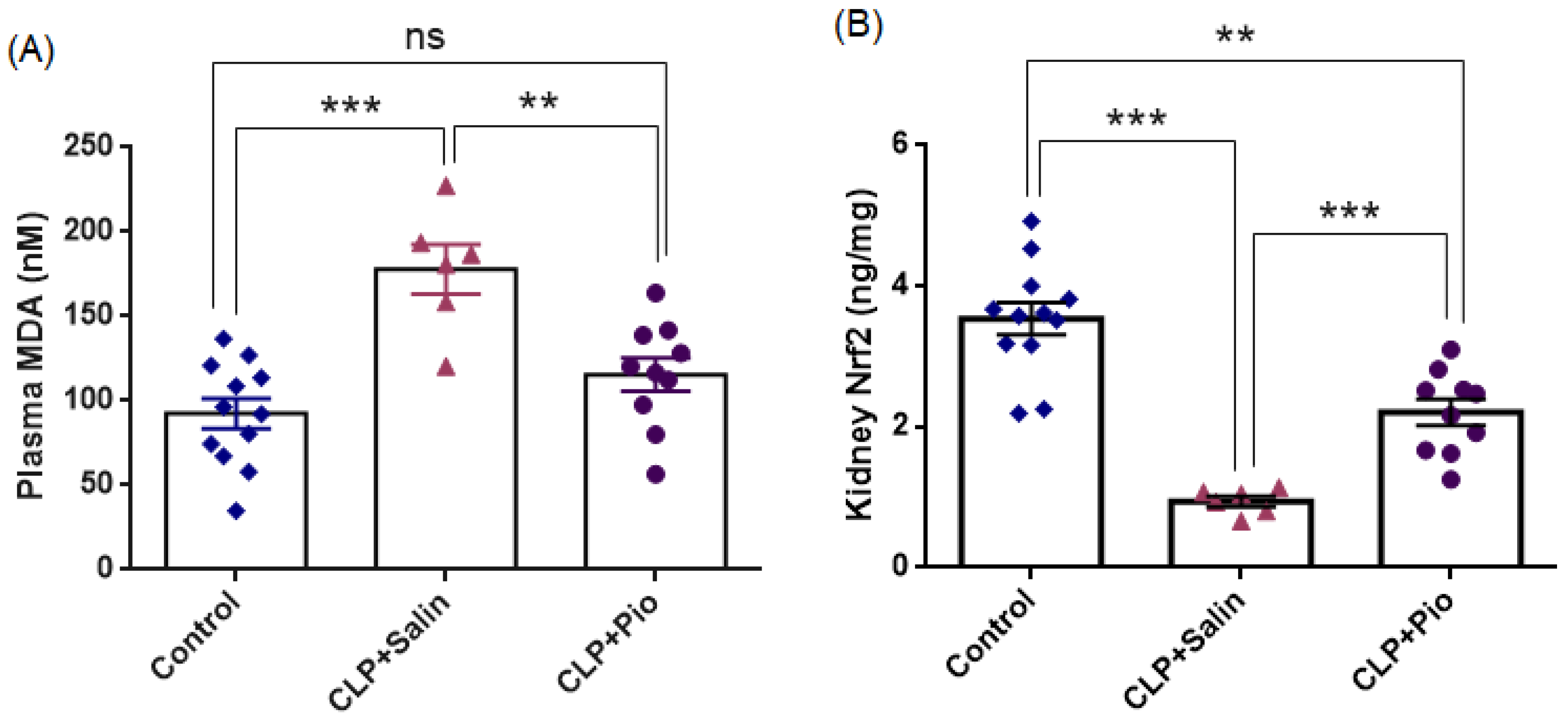
| Plasma MDA (nM) | 92.5 ± 8.8 | 177.9 ± 14.6 b | 115.6 ± 9.8 c |
| NRF2 (ng/mg) | 3.537 ± 0.229 | 0.942 ± 0.074 b | 2.206 ± 0.185 a,d |
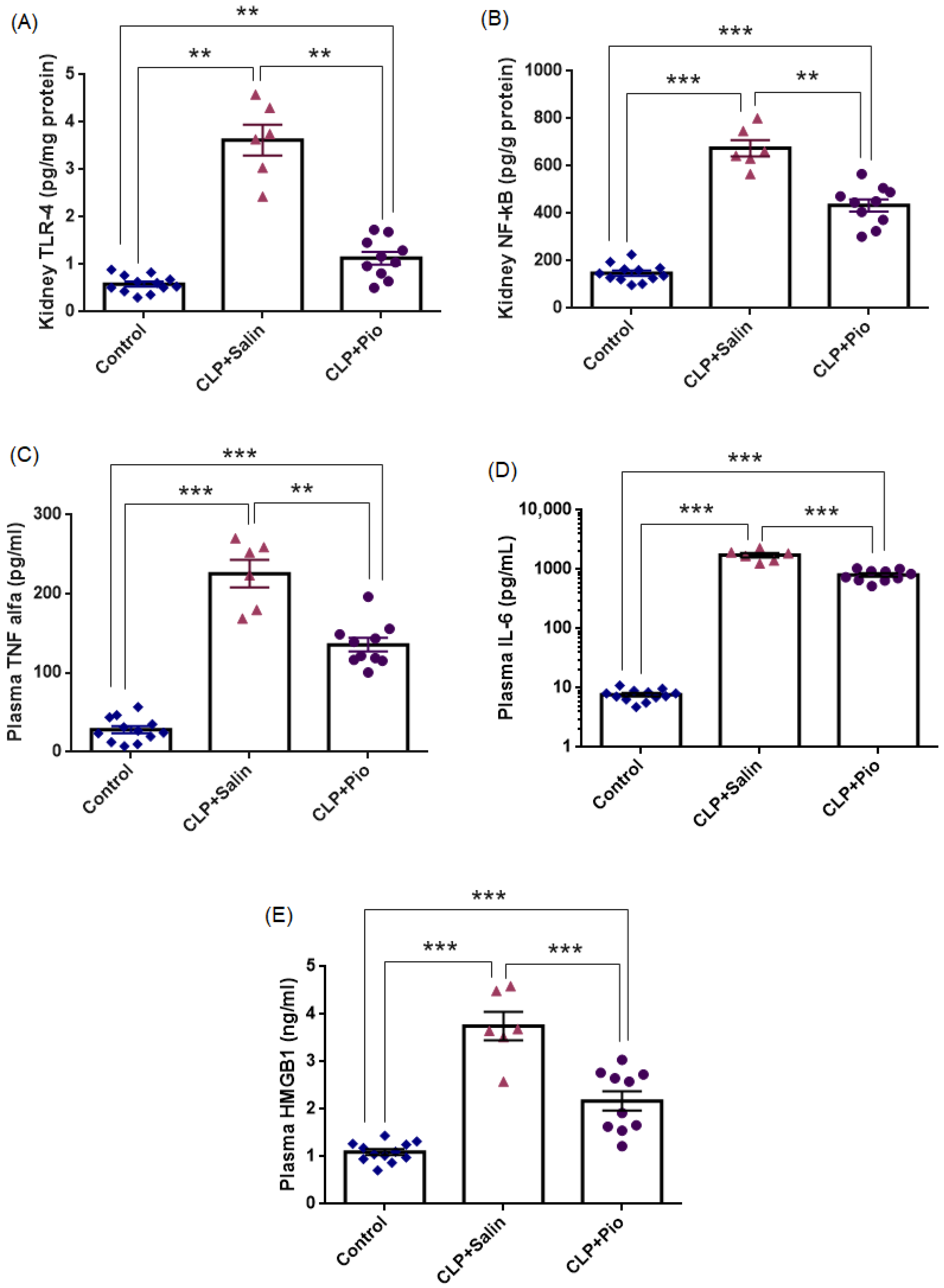
| Kidney TLR-4 (pg/mg protein) | 0.58 ± 0.05 | 3.62 ± 0.32 a | 1.13 ± 0.14 a,c |
| Kidney NF-κB (pg/g protein) | 148.2 ± 10.8 | 675.2 ± 34.79 b | 433.8 ± 26.16 b,c |
| Plasma TNF-α (pg/mL) | 28.17 ± 4.4 | 225.7 ± 17.4 b | 135.7 ± 8.6 b,c |
| Plasma IL-6 (pg/mL) | 7.72 ± 0.50 | 1744 ± 152.9 b | 804.6 ± 55.25 b,d |
| HMGB1 (ng/mL) | 1.09 ± 0.06 | 3.75 ± 0.29 b | 2.17 ± 0.20 b,d |
Disclaimer/Publisher’s Note: The statements, opinions and data contained in all publications are solely those of the individual author(s) and contributor(s) and not of MDPI and/or the editor(s). MDPI and/or the editor(s) disclaim responsibility for any injury to people or property resulting from any ideas, methods, instructions or products referred to in the content. |
© 2026 by the authors. Licensee MDPI, Basel, Switzerland. This article is an open access article distributed under the terms and conditions of the Creative Commons Attribution (CC BY) license.
Share and Cite
Hacım, N.A.; Akbaş, A.; Akbaş, B.; Ercan, G.; Serdaroglu, A.; Aygun, H.; Erbas, O. Pioglitazone Attenuates Sepsis-Associated Acute Kidney Injury by Modulating TLR-4/NF-κB Signaling and Improving Survival and Renal Function. J. Clin. Med. 2026, 15, 2270. https://doi.org/10.3390/jcm15062270
Hacım NA, Akbaş A, Akbaş B, Ercan G, Serdaroglu A, Aygun H, Erbas O. Pioglitazone Attenuates Sepsis-Associated Acute Kidney Injury by Modulating TLR-4/NF-κB Signaling and Improving Survival and Renal Function. Journal of Clinical Medicine. 2026; 15(6):2270. https://doi.org/10.3390/jcm15062270
Chicago/Turabian StyleHacım, Nadir Adnan, Ahmet Akbaş, Bakiye Akbaş, Gülçin Ercan, Ahmet Serdaroglu, Hatice Aygun, and Oytun Erbas. 2026. "Pioglitazone Attenuates Sepsis-Associated Acute Kidney Injury by Modulating TLR-4/NF-κB Signaling and Improving Survival and Renal Function" Journal of Clinical Medicine 15, no. 6: 2270. https://doi.org/10.3390/jcm15062270
APA StyleHacım, N. A., Akbaş, A., Akbaş, B., Ercan, G., Serdaroglu, A., Aygun, H., & Erbas, O. (2026). Pioglitazone Attenuates Sepsis-Associated Acute Kidney Injury by Modulating TLR-4/NF-κB Signaling and Improving Survival and Renal Function. Journal of Clinical Medicine, 15(6), 2270. https://doi.org/10.3390/jcm15062270