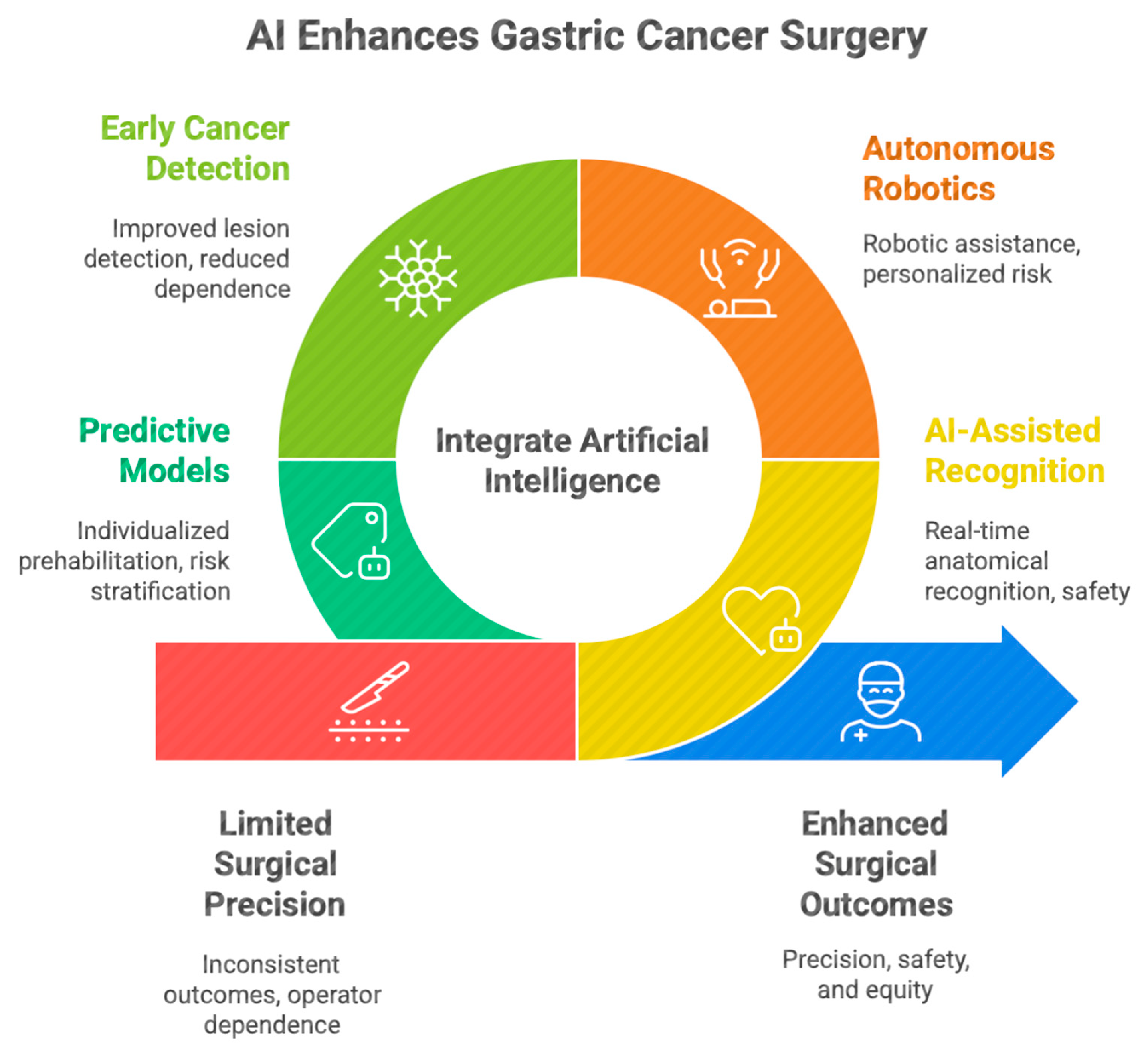
Artificial Intelligence Applications in Gastric Cancer Surgery: Bridging Early Diagnosis and Responsible Precision Medicine

 , , ,
, , ,  , , ,
, , ,  , , , ,
  , ,
, ,  , , , , , , and
  add
Show full author list
add
Show full author list
Abstract
1. Introduction
2. Materials and Methods
2.1. Search Strategy
2.2. Selection Criteria
2.3. Data Extraction and Narrative Appraisal
2.4. Synthesis
- (i)
- AI-assisted anatomical recognition and lymphadenectomy support;
- (ii)
- Progression toward autonomy and surgical workflow recognition;
- (iii)
- AI for early detection and diagnostic endoscopy;
- (iv)
- Predictive and frailty-oriented perioperative models
- (v)
- Ethical, regulatory, and medico-legal considerations.
3. Results of the Search and Scope of Evidence
3.1. AI for Improved Anatomical Recognition in Gastric Cancer Surgery
3.2. Advances in the Development of Autonomous Robotic Surgery
3.3. Artificial Intelligence in Early Detection and Diagnostic Endoscopy
3.4. Artificial Intelligence-Based Predictive Models for Assessing Perioperative Complication Risk in Gastric Cancer Surgery
3.5. Ethical and Regulatory Challenges of Big Data in Surgery
4. Conclusions
Funding
Institutional Review Board Statement
Data Availability Statement
Conflicts of Interest
References
- Wilczok, D. Deep learning and generative artificial intelligence in aging research and healthy longevity medicine. Aging 2025, 17, 251–275. [Google Scholar] [CrossRef]
- Montavon, G.; Samek, W.; Müller, K.R. Methods for interpreting and understanding deep neural networks. Digit. Signal Process. 2018, 73, 1–15. [Google Scholar] [CrossRef]
- Leek, J.T.; Scharpf, R.B.; Bravo, H.C.; Simcha, D.; Langmead, B.; Johnson, W.E.; Geman, D.; Baggerly, K.; Irizarry, R.A. Tackling the widespread and critical impact of batch effects in high-throughput data. Nat. Rev. Genet. 2010, 11, 733–739. [Google Scholar] [CrossRef]
- Hashimoto, D.A.; Rosman, G.; Rus, D.; Meireles, O.R. Artificial intelligence in surgery: Promises and perils. Ann. Surg. 2018, 268, 70–76. [Google Scholar] [CrossRef]
- Ferlay, J.; Ervik, M.; Lam, F.; Laversanne, M.; Colombet, M.; Mery, L.; Piñeros, M.; Znaor, A.; Soerjomataram, I.; Bray, F. Global Cancer Observatory: Cancer Today; International Agency for Research on Cancer: Lyon, France, 2022. [Google Scholar]
- Hashizume, M.; Sugimachi, K. Robot-assisted gastric surgery. Surg. Clin. N. Am. 2003, 83, 1429–1444. [Google Scholar] [CrossRef] [PubMed]
- Giulianotti, P.C.; Coratti, A.; Angelini, M.; Sbrana, F.; Cecconi, S.; Balestracci, T.; Caravaglios, G. Robotics in general surgery: Personal experience in a large community hospital. Arch. Surg. 2003, 138, 777–784. [Google Scholar] [CrossRef] [PubMed]
- Ding, J.; Goldman, R.E.; Xu, K.; Allen, P.K.; Fowler, D.L.; Simaan, N. Design and coordination kinematics of an insertable robotic effector platform for single-port access surgery. IEEE ASME Trans. Mechatron. 2013, 18, 1612–1624. [Google Scholar] [CrossRef] [PubMed]
- Zhang, T.; Li, G.; Ren, H.; Yang, L.; Yang, X.; Tan, R.; Tang, Y.; Guo, D.; Zhao, H.; Shang, W.; et al. Sub-millimeter fiberscopic robot with integrated maneuvering, imaging, and biomedical operation abilities. Nat. Commun. 2024, 15, 10874. [Google Scholar] [CrossRef]
- Kinoshita, T.; Komatsu, M. Artificial Intelligence in Surgery and Its Potential for Gastric Cancer. J. Gastric Cancer 2023, 23, 400–409. [Google Scholar] [CrossRef]
- Bhandari, M.; Zeffiro, T.; Reddiboina, M. Artificial intelligence and robotic surgery: Current perspective and future directions. Curr. Opin. Urol. 2020, 30, 48–54. [Google Scholar] [CrossRef]
- Matheny, M.E.; Goldsack, J.C.; Saria, S.; Shah, N.H.; Gerhart, J.; Cohen, I.G.; Price, W.N.; Patel, B.; Payne, P.R.; Embí, P.J.; et al. Artificial intelligence in health and health care: Priorities for action. Health Aff. 2025, 44, 163–170. [Google Scholar] [CrossRef]
- Whicher, D.; Ahmed, M.; Israni, S.T.; Matheny, M. (Eds.) Artificial Intelligence in Health Care: The Hope, the Hype, the Promise, the Peril; National Academy of Medicine: Washington, DC, USA, 2023. [Google Scholar]
- Mumtaz, H.; Ejaz, M.K.; Tayyab, M.; Vohra, L.I.; Sapkota, S.; Hasan, M.; Saqib, M. APACHE scoring as an indicator of mortality rate in ICU patients: A cohort study. Ann. Med. Surg. 2023, 85, 416–421. [Google Scholar] [CrossRef]
- Xing, Y.; Sun, Y.; Li, H.; Tang, M.; Huang, W.; Zhang, K.; Zhang, D.; Zhang, D.; Ma, Q. CHA2DS2-VASc score as a predictor of long-term cardiac outcomes in elderly patients with or without atrial fibrillation. Clin. Interv. Aging 2018, 13, 497–504. [Google Scholar] [CrossRef]
- Pilotto, A.; Custodero, C.; Maggi, S.; Polidori, M.C.; Veronese, N.; Ferrucci, L. A multidimensional approach to frailty in older people. Ageing Res. Rev. 2020, 60, 101047. [Google Scholar] [CrossRef] [PubMed]
- Banks, J. The ghost in the machine: Will AI open the door to fully autonomous robotic surgery? IEEE Pulse 2025, 16, 16–19. [Google Scholar] [CrossRef] [PubMed]
- Finlayson, S.G.; Subbaswamy, A.; Singh, K.; Bowers, J.; Kupke, A.; Zittrain, J.; Kohane, I.S.; Saria, S. The clinician and dataset shift in artificial intelligence. N. Engl. J. Med. 2021, 385, 283–286. [Google Scholar] [CrossRef]
- Lim, B.; Seth, I.; Cevik, J.; Mu, X.; Sofiadellis, F.; Cuomo, R.; Rozen, W.M. Artificial intelligence tools in surgical research: A narrative review of current applications and ethical challenges. Surgeries 2025, 6, 55. [Google Scholar] [CrossRef]
- Baethge, C.; Goldbeck-Wood, S.; Mertens, S. SANRA—A scale for the quality assessment of narrative review articles. Res. Integr. Peer Rev. 2019, 4, 5. [Google Scholar] [CrossRef] [PubMed]
- Greenhalgh, T.; Thorne, S.; Malterud, K. Time to challenge the spurious hierarchy of systematic over narrative reviews? Eur. J. Clin. Investig. 2018, 48, e12931. [Google Scholar] [CrossRef]
- Moher, D.; Liberati, A.; Tetzlaff, J.; Altman, D.G.; PRISMA Group. Preferred reporting items for systematic reviews and meta-analyses: The PRISMA statement. PLoS Med. 2009, 6, e1000097. [Google Scholar] [CrossRef]
- Marano, L.; Cwalinski, T.; Girnyi, S.; Skokowski, J.; Goyal, A.; Malerba, S.; Prete, F.P.; Mocarski, P.; Kania, M.K.; Świerblewski, M.; et al. Evaluating the role of robotic surgery in gastric cancer treatment: A comprehensive review by the Robotic Global Surgical Society (TROGSS) and European Federation—International Society for Digestive Surgery (EFISDS) joint working group. Curr. Oncol. 2025, 32, 83. [Google Scholar] [CrossRef]
- Chen, G.; Xie, Y.; Yang, B.; Tan, J.; Zhong, G.; Zhong, L.; Zhou, S.; Han, F. Artificial intelligence model for perigastric blood vessel recognition during laparoscopic radical gastrectomy with D2 lymphadenectomy in locally advanced gastric cancer. BJS Open 2024, 9, 158. [Google Scholar] [CrossRef]
- Kumazu, Y.; Kobayashi, N.; Kitamura, N.; Rayan, E.; Neculoiu, P.; Misumi, T.; Hojo, Y.; Nakamura, T.; Kumamoto, T.; Kurahashi, Y.; et al. Automated segmentation by deep learning of loose connective tissue fibers to define safe dissection planes in robot-assisted gastrectomy. Sci. Rep. 2021, 11, 21198. [Google Scholar] [CrossRef]
- Neyem, A.; Cadile, M.; Burgos-Martínez, S.A.; Farfán Cabello, E.; Inzunza, O.; Alvarado, M.S.; Tubbs, R.S.; Ottone, N.E. Enhancing medical anatomy education with the integration of virtual reality into traditional lab settings. Clin. Anat. 2024, 37, 1361–1372. [Google Scholar] [CrossRef] [PubMed]
- Rahimi, A.M.; Uluç, E.; Hardon, S.F.; Bonjer, H.J.; van der Peet, D.L.; Daams, F. Training in robotic-assisted surgery: A systematic review of training modalities and objective and subjective assessment methods. Surg. Endosc. 2024, 38, 3547–3555. [Google Scholar] [CrossRef] [PubMed]
- Rahmani, M.Z.; Bukhari, A.; Wiyono, N.; Amru, K.; Baharuddin, B.; Nurhadi, A.A. Exploring links between visuospatial ability and anatomy learning in education: A bibliometric analysis and scientific mapping. Narra J. 2024, 4, e1095. [Google Scholar] [CrossRef] [PubMed]
- Alrashidi, N.; Kim, K.-Y.; Park, S.H.; Lee, S.; Cho, M.; Kim, Y.M.; Kim, H.-I.; Hyung, W.J. Fluorescent lymphography-guided lymphadenectomy during minimally invasive completion total gastrectomy for remnant gastric cancer patients. Cancers 2022, 14, 4997. [Google Scholar] [CrossRef]
- Hockenberry, M.S.; Smith, Z.L.; Mucksavage, P. A novel use of near-infrared fluorescence imaging during robotic surgery without contrast agents. J. Endourol. 2014, 28, 509–512. [Google Scholar] [CrossRef]
- Komatsu, M.; Kitaguchi, D.; Yura, M.; Takeshita, N.; Yoshida, M.; Yamaguchi, M.; Kondo, H.; Kinoshita, T.; Ito, M. Automatic surgical phase recognition-based skill assessment in laparoscopic distal gastrectomy using multicenter videos. Gastric Cancer 2024, 27, 187–196. [Google Scholar] [CrossRef]
- Shademan, A.; Decker, R.S.; Opfermann, J.D.; Leonard, S.; Krieger, A.; Kim, P.C. Supervised autonomous robotic soft tissue surgery. Sci. Transl. Med. 2016, 8, 337ra64. [Google Scholar] [CrossRef]
- Yang, G.Z.; Yang, G.Z.; Cambias, J.; Cleary, K.; Daimler, E.; Drake, J.; Dupont, P.E.; Hata, N.; Kazanzides, P.; Martel, S.; et al. Medical robotics—Regulatory, ethical, and legal considerations for increasing levels of autonomy. Sci. Robot. 2017, 2, 8638. [Google Scholar] [CrossRef]
- Rivero-Moreno, Y.; Rodriguez, M.; Losada-Muñoz, P.; Redden, S.; Lopez-Lezama, S.; Vidal-Gallardo, A.; Machado-Paled, D.; Cordova Guilarte, J.; Teran-Quintero, S. Autonomous robotic surgery: Has the future arrived? Cureus 2024, 16, e52243. [Google Scholar] [CrossRef] [PubMed]
- Saeidi, H.; Opfermann, J.D.; Kam, M.; Wei, S.; Leonard, S.; Hsieh, M.H.; Kang, J.U.; Krieger, A. Autonomous robotic laparoscopic surgery for intestinal anastomosis. Sci. Robot. 2022, 7, 2908. [Google Scholar] [CrossRef]
- Iftikhar, M.; Saqib, M.; Zareen, M.; Mumtaz, H. Artificial intelligence: Revolutionizing robotic surgery. Ann. Med. Surg. 2024, 86, 5401–5409. [Google Scholar] [CrossRef]
- Zia, A.; Essa, I. Automated surgical skill assessment in RMIS training. Int. J. Comput. Assist. Radiol. Surg. 2018, 13, 731–739. [Google Scholar] [CrossRef]
- Kim, J.W.B.; Chen, J.T.; Hansen, P.; Shi, L.X.; Goldenberg, A.; Schmidgall, S.; Scheikl, P.M.; Deguet, A.; White, B.M.; Tsai, D.R.; et al. SRT-H: A hierarchical framework for autonomous surgery via language-conditioned imitation learning. Sci. Robot. 2025, 10, eadt5254. [Google Scholar] [CrossRef]
- Park, Y.M.; Cho, E.; Kang, H.Y.; Kim, J.M. The effectiveness and safety of endoscopic submucosal dissection compared with endoscopic mucosal resection for early gastric cancer: A systematic review and meta-analysis. Surg. Endosc. 2011, 25, 2666–2677. [Google Scholar] [CrossRef]
- Soong, T.K.; Kim, G.W.; Chia, D.K.A.; So, J.B.Y.; Lee, J.W.J.; Shabbir, A.; Lum, J.H.Y.; Soon, G.S.T.; Ho, K.Y. Comparing Raman spectroscopy-based artificial intelligence to high-definition white light endoscopy for endoscopic diagnosis of gastric neoplasia: A feasibility proof-of-concept study. Diagnostics 2024, 14, 2868. [Google Scholar] [CrossRef]
- Lei, C.; Sun, W.; Wang, K.; Weng, R.; Kan, X.; Li, R. Artificial intelligence-assisted diagnosis of early gastric cancer: Present practice and future prospects. Ann. Med. 2025, 57, 2461679. [Google Scholar] [CrossRef] [PubMed]
- Klang, E.; Soroush, A.; Nadkarni, G.N.; Sharif, K.; Lahat, A. Deep learning and gastric cancer: Systematic review of AI-assisted endoscopy. Diagnostics 2023, 13, 3785. [Google Scholar] [CrossRef] [PubMed]
- Rahman, S.A.; Giacobbi, P.; Pyles, L.; Mullett, C.; Doretto, G.; Adjeroh, D.A. Deep learning for biological age estimation. Brief. Bioinform. 2021, 22, 1767–1781. [Google Scholar] [CrossRef] [PubMed]
- Putin, E.; Mamoshina, P.; Aliper, A.; Korzinkin, M.; Moskalev, A.; Kolosov, A.; Ostrovskiy, A.; Cantor, C.; Vijg, J.; Zhavoronkov, A. Deep biomarkers of human aging: Application of deep neural networks to biomarker development. Aging 2016, 8, 1021–1033. [Google Scholar] [CrossRef]
- Malani, S.N.; Shrivastava, D.; Raka, M.S. A comprehensive review of the role of artificial intelligence in obstetrics and gynecology. Cureus 2023, 15, e34891. [Google Scholar] [CrossRef]
- Martin, R.K.; Ley, C.; Pareek, A.; Groll, A.; Tischer, T.; Seil, R. Artificial intelligence and machine learning: An introduction for orthopaedic surgeons. Knee Surg. Sports Traumatol. Arthrosc. 2022, 30, 361–364. [Google Scholar] [CrossRef]
- Fried, L.P.; Tangen, C.M.; Walston, J.; Newman, A.B.; Hirsch, C.; Gottdiener, J.; Seeman, T.; Tracy, R.; Kop, W.J.; Burke, G.; et al. Frailty in older adults: Evidence for a phenotype. J. Gerontol. A Biol. Sci. Med. Sci. 2001, 56, M146–M156. [Google Scholar] [CrossRef]
- Liu, F.; Huang, C.; Xu, Z.; Su, X.; Zhao, G.; Ye, J.; Du, X.; Huang, H.; Hu, J.; Li, G.; et al. Morbidity and mortality of laparoscopic vs open total gastrectomy for clinical stage I gastric cancer: The CLASS-02 multicenter randomized clinical trial. JAMA Oncol. 2020, 6, 1590–1597. [Google Scholar] [CrossRef]
- Hong, Q.Q.; Yan, S.; Zhao, Y.L.; Fan, L.; Yang, L.; Zhang, W.B.; Liu, H.; Lin, H.X.; Zhang, J.; Ye, Z.J.; et al. Machine learning identifies the risk of complications after laparoscopic radical gastrectomy for gastric cancer. World J. Gastroenterol. 2024, 30, 79–90. [Google Scholar] [CrossRef]
- Bihorac, A.; Ozrazgat-Baslanti, T.; Ebadi, A.; Motaei, A.; Madkour, M.; Pardalos, P.M.; Lipori, G.; Hogan, W.R.; Efron, P.A.; Moore, F.; et al. MySurgeryRisk: Development and validation of a machine-learning risk algorithm for major complications and death after surgery. Ann. Surg. 2019, 269, 652–662. [Google Scholar] [CrossRef]
- Ng, M.Y.; Helzer, J.; Pfeffer, M.A.; Seto, T.; Hernandez-Boussard, T. Development of secure infrastructure for advancing generative artificial intelligence research in healthcare at an academic medical center. J. Am. Med. Inform. Assoc. 2025, 32, 586–588. [Google Scholar] [CrossRef] [PubMed]
- Price, W.N.; Cohen, I.G. Privacy in the age of medical big data. Nat. Med. 2019, 25, 37–43. [Google Scholar] [CrossRef] [PubMed]
- Cath, C. Governing artificial intelligence: Ethical, legal and technical opportunities and challenges. Philos. Trans. A Math. Phys. Eng. Sci. 2018, 376, 20180080. [Google Scholar] [CrossRef] [PubMed]
- Char, D.S.; Shah, N.H.; Magnus, D. Implementing machine learning in health care—Addressing ethical challenges. N. Engl. J. Med. 2018, 378, 981–983. [Google Scholar] [CrossRef] [PubMed]
- Ong, J.C.L.; Chang, S.Y.; William, W.; Butte, A.J.; Shah, N.H.; Chew, L.S.T.; Liu, N.; Doshi-Velez, F.; Lu, W.; Savulescu, J.; et al. Ethical and regulatory challenges of large language models in medicine. Lancet Digit. Health 2024, 6, e428–e432. [Google Scholar] [CrossRef] [PubMed]
- Avila Negri, S.M.C. Robot as legal person: Electronic personhood in robotics and artificial intelligence. Front. Robot. AI 2021, 8, 789327. [Google Scholar] [CrossRef]


| Study | Surgical Context | Study Design | Dataset/Study Size | AI Application/Technology | Main Outcome | Evidence Maturity |
|---|---|---|---|---|---|---|
| Chen et al., 2024 [24] | Gastric cancer surgery | Retrospective analysis of laparoscopic gastrectomy video dataset | 116 laparoscopic gastrectomy videos (≈2460 extracted image frames used for training; validation on independent test videos) | Real-time perigastric blood vessel recognition model (PGBVRM) | Automated identification of perigastric vessels to assist lymphadenectomy and reduce vascular injury | Feasibility study (clinical video dataset) |
| Kumazu et al., 2021 [25] | Gastric cancer surgery | Deep learning model trained on robot-assisted gastrectomy surgical videos | Annotated frames extracted from robot-assisted gastrectomy videos (exact number of videos not consistently reported) | Automated segmentation of loose connective tissue and lymphatic planes | Identification of safe dissection planes during robotic D2 lymphadenectomy | Technical validation study |
| Neyem et al., 2024 [26] | Surgical education (general surgery/anatomy training) | Educational study evaluating VR-based anatomy training platforms | Educational cohort of medical students participating in VR-based anatomy training sessions | AI-assisted virtual reality simulation for anatomical learning | Improved visuospatial understanding and anatomy training performance | Educational feasibility |
| Rahimi et al., 2024 [27] | Robotic surgery training (general surgical procedures) | Systematic review of robotic surgical training methods | Not applicable (systematic review of published studies) | AI-supported simulation and performance assessment tools | Evaluation of training modalities for robotic surgery skill acquisition | Evidence synthesis (training research) |
| Rahmani et al., 2024 [28] | Surgical education/anatomy learning | Bibliometric and mapping study of anatomy education research | Not applicable (bibliometric analysis of scientific publications) | AI-assisted analysis of visuospatial learning and anatomy education | Identification of links between visuospatial ability and surgical/anatomical learning | Conceptual/educational research |
| Komatsu et al., 2024 [31] | Gastric cancer surgery | Multicenter dataset of laparoscopic distal gastrectomy videos | Multicenter surgical video dataset of laparoscopic distal gastrectomy procedures | Deep learning-based surgical phase recognition system | Automatic classification of operative phases and objective performance assessment | Multicenter technical validation |
| AI + ICG-NIRF imaging (multiple studies) [29,30] | Gastric cancer surgery and minimally invasive GI surgery | Clinical feasibility studies integrating fluorescence imaging with image analysis | Small clinical feasibility cohorts of patients undergoing minimally invasive gastrectomy | AI-enhanced interpretation of fluorescence-guided lymphatic and vascular visualization | Improved anatomical delineation during minimally invasive lymphadenectomy | Early clinical feasibility |
| Level of Autonomy (Analogy from Automotive Industry) | Surgical Context | Study Design | Principal Surgical Application | Representative Technology/Study | Main Outcome | Evidence Maturity |
|---|---|---|---|---|---|---|
| Level 1–2—Assistance | Gastric cancer surgery | Deep learning model trained on robot-assisted gastrectomy surgical videos | AI-assisted anatomical segmentation | Automated recognition of lymphatic connective tissue during robot-assisted gastrectomy (Kumazu et al., 2021 [25]) | Identification of connective tissue planes supporting safer D2 lymphadenectomy | Technical feasibility (gastric surgery dataset) |
| Level 3—Conditional autonomy | Gastric cancer surgery | Multicenter dataset of laparoscopic distal gastrectomy videos | Surgical-phase recognition | Deep-learning phase-classification network for laparoscopic distal gastrectomy (Komatsu et al., 2024 [31]) | 88.8% accuracy in operative phase classification, supporting workflow analysis and objective skill assessment | Multicenter technical validation |
| Level 4—High autonomy | Experimental gastrointestinal surgery (small bowel) | Animal and ex vivo experimental models | Autonomous anastomosis | Smart Tissue Autonomous Robot (STAR) (Shademan et al., 2016; Saeidi et al., 2022 [32,35]) | Autonomous intestinal anastomosis with consistent suture spacing and leak-resistant performance | Experimental preclinical model |
| Level 5—Full autonomy | Experimental general surgery model | Experimental robotic system tested in pilot surgical procedures | Complex multi-step robotic procedures | Surgical Robot Transformer–Hierarchy (SRT-H) framework (Kim et al., 2025 [38]) | 100% technical success in pilot robotic cholecystectomy procedures using language-conditioned imitation learning | Experimental proof-of-concept |
| Technology/Modality | Clinical Context | Study Design | Underlying Mechanism | Main Diagnostic Outcome | Evidence Maturity |
|---|---|---|---|---|---|
| Raman spectroscopy + AI (SPECTRA IMDx™) (Soong et al., 2024 [40]) | Upper gastrointestinal endoscopy including gastric neoplasia | Prospective feasibility/proof-of-concept study using Raman spectral data obtained during endoscopy | Detection of biochemical and molecular alterations in tissue via inelastic light scattering; machine-learning classifier interprets spectral signatures | High sensitivity and specificity for identifying high-risk neoplastic lesions compared with histopathology | Early clinical feasibility |
| AI-assisted endoscopy (CNN-based CAD systems) (Lei et al., 2025; Klang et al., 2023 [41,42]) | Gastric cancer detection in upper GI endoscopy | Prospective and retrospective multicenter datasets of endoscopic images and videos | Deep-learning analysis of high-definition white-light or narrow-band imaging frames for automated lesion detection and invasion-depth estimation | Diagnostic performance with AUC values often exceeding 0.90 and reduced inter-observer variability | Multicenter technical validation |
| Predictive Model/Study | Clinical Context | Study Design | Core Input Variables | Predicted Outcome(s) | Evidence Maturity |
|---|---|---|---|---|---|
| Traditional clinical risk scores (non-AI) | |||||
| APACHE, CURB-65, MPI, CHA2DS2-VASc | General medical and surgical populations | Clinical scoring systems derived from observational cohort studies | Demographics, comorbidities, physiological variables, laboratory parameters | Mortality risk, disease severity, or general morbidity | Established clinical tools |
| Machine-learning predictive models | |||||
| Hong et al., 2024 [49] | Gastric cancer surgery | Retrospective dataset of patients undergoing laparoscopic gastrectomy | Age, ASA score, ECOG performance status, operative time, surgical type, pulmonary disease | Prediction of postoperative complications following laparoscopic gastrectomy | Retrospective clinical validation |
| MySurgeryRisk (Bihorac et al., 2019 [50]) | General surgical population | Machine-learning model using large electronic health record datasets | Multidimensional perioperative clinical variables extracted from EHRs | Prediction of major postoperative complications and mortality | Large-scale retrospective validation |
| Emerging AI-driven frailty and prehabilitation models | |||||
| AI-based frailty and prehabilitation models | Surgical oncology and geriatric surgery | Multimodal datasets integrating clinical, functional, and biological variables | Physiological indicators, functional measures, metabolic and clinical parameters | Personalized frailty assessment and perioperative risk prediction | Conceptual/early translational research |
| Ethical/Regulatory Domain | Context of Application | Source of Evidence/Framework | Clinical Implication or Source of Risk | Recommended Mitigation or Governance Strategy | Evidence Type |
|---|---|---|---|---|---|
| Data privacy and cybersecurity | Clinical AI systems using surgical datasets and patient health records | Data protection frameworks and digital health governance literature | Re-identification of anonymized patient data; vulnerability to adversarial attacks or insecure data transfer | Differential-privacy algorithms, pseudonymization, end-to-end encryption, and mandatory cybersecurity testing before clinical deployment | Ethical and regulatory guidance |
| Informed consent and patient autonomy | Clinical implementation of AI-assisted decision systems | Medical ethics frameworks and data protection regulations | Insufficient disclosure regarding the role of AI in clinical decision-making; limited patient understanding of secondary data use | Tiered consent models, continuous patient education, and transparent communication regarding data use and algorithmic involvement | Ethical governance principles |
| Data provenance and intellectual property (IP) | Development and training of AI models using large datasets | Digital governance and intellectual property frameworks | Use of unlicensed or uncertain data sources within AI training datasets; unclear ownership of clinical data | Transparent data sourcing, dataset provenance documentation, and institutional legal review of training datasets | Regulatory compliance framework |
| Continuous learning and regulatory adaptation | Deployment of adaptive AI algorithms in healthcare systems | Emerging regulatory frameworks (e.g., EU Artificial Intelligence Act 2024) | Algorithmic performance may change over time beyond initial certification, creating potential oversight gaps | Dynamic regulatory monitoring, real-time algorithm auditing, and mandatory post-deployment surveillance mechanisms | Policy and regulatory framework |
Disclaimer/Publisher’s Note: The statements, opinions and data contained in all publications are solely those of the individual author(s) and contributor(s) and not of MDPI and/or the editor(s). MDPI and/or the editor(s) disclaim responsibility for any injury to people or property resulting from any ideas, methods, instructions or products referred to in the content. |
© 2026 by the authors. Licensee MDPI, Basel, Switzerland. This article is an open access article distributed under the terms and conditions of the Creative Commons Attribution (CC BY) license.
Share and Cite
Malerba, S.; Vladimirov, M.; Goyal, A.; Dulskas, A.; Baušys, A.; Cwalinski, T.; Girnyi, S.; Skokowski, J.; Duka, R.; Molchanov, R.; et al. Artificial Intelligence Applications in Gastric Cancer Surgery: Bridging Early Diagnosis and Responsible Precision Medicine. J. Clin. Med. 2026, 15, 2208. https://doi.org/10.3390/jcm15062208
Malerba S, Vladimirov M, Goyal A, Dulskas A, Baušys A, Cwalinski T, Girnyi S, Skokowski J, Duka R, Molchanov R, et al. Artificial Intelligence Applications in Gastric Cancer Surgery: Bridging Early Diagnosis and Responsible Precision Medicine. Journal of Clinical Medicine. 2026; 15(6):2208. https://doi.org/10.3390/jcm15062208
Chicago/Turabian StyleMalerba, Silvia, Miljana Vladimirov, Aman Goyal, Audrius Dulskas, Augustinas Baušys, Tomasz Cwalinski, Sergii Girnyi, Jaroslaw Skokowski, Ruslan Duka, Robert Molchanov, and et al. 2026. "Artificial Intelligence Applications in Gastric Cancer Surgery: Bridging Early Diagnosis and Responsible Precision Medicine" Journal of Clinical Medicine 15, no. 6: 2208. https://doi.org/10.3390/jcm15062208
APA StyleMalerba, S., Vladimirov, M., Goyal, A., Dulskas, A., Baušys, A., Cwalinski, T., Girnyi, S., Skokowski, J., Duka, R., Molchanov, R., Jovanovic, B., Ciarleglio, F. A., Brolese, A., Gonfa, K. B., Demmo, A. T., Dambrauskas, Z., Pérez Bonet, A., Testini, M., Prete, F. P., ... Marano, L. (2026). Artificial Intelligence Applications in Gastric Cancer Surgery: Bridging Early Diagnosis and Responsible Precision Medicine. Journal of Clinical Medicine, 15(6), 2208. https://doi.org/10.3390/jcm15062208