Effects of Continuous Postoperative Pericardial FLUshing with Investigational Device on Postoperative Re-Explorations for Bleeding (FLUID)—Randomized Clinical Trial
 , , , , , , , , and
Abstract
1. Introduction
2. Materials and Methods
2.1. Study Design
2.2. Patients
2.3. Investigational Device
2.4. Standard Care
2.5. Intervention
2.6. Randomization and Blinding
2.7. Data Collected
2.8. Definitions
2.9. Study Endpoints
2.10. Safety Assessment
2.11. Sample Size Calculation
2.12. Statistical Analysis
3. Results
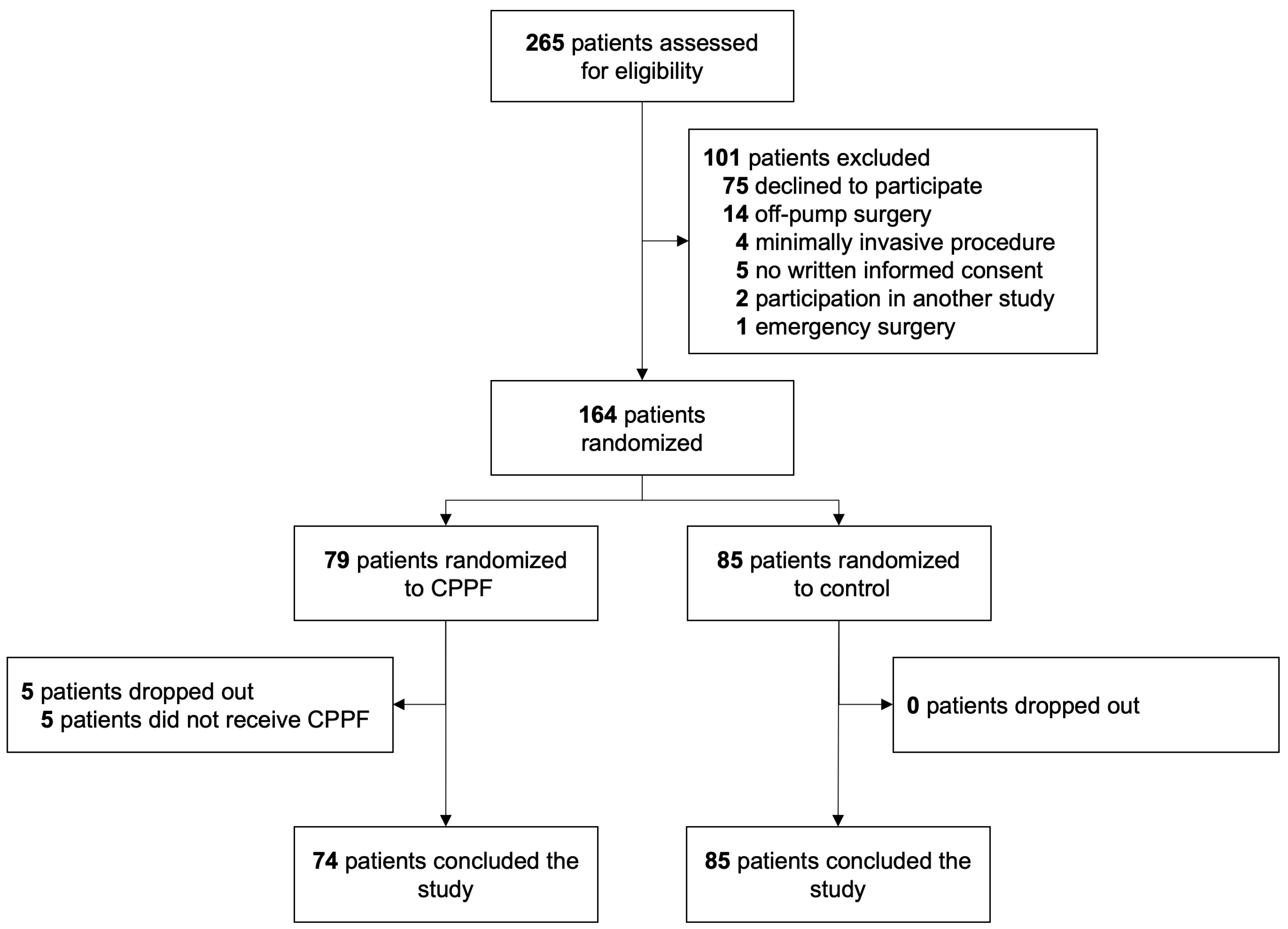
3.1. Patients
3.2. Primary Endpoint
3.3. Secondary Endpoints
3.4. Per-Protocol and Post Hoc Analyses
4. Discussion
Supplementary Materials
Author Contributions
Funding
Institutional Review Board Statement
Informed Consent Statement
Data Availability Statement
Conflicts of Interest
Abbreviations
References
- Brown, J.A.; Kilic, A.; Aranda-Michel, E.; Navid, F.; Serna-Gallegos, D.; Bianco, V.; Sultan, I. Long-Term Outcomes of Reoperation for Bleeding After Cardiac Surgery. Semin. Thorac. Cardiovasc. Surg. 2021, 33, 764–773. [Google Scholar] [CrossRef]
- Tirilomis, T.; Bougioukas, I.G.; Friedrich, M.G.; Danner, B.C.; Schoendube, F.A. Re-exploration Early after Cardiac Surgery in Adults: The Importance of Bleeding-Related Complications. Heart Surg. Forum 2020, 23, E174–E177. [Google Scholar] [CrossRef] [PubMed]
- Agarwal, S.; Choi, S.W.; Fletcher, S.N.; Klein, A.A.; Gill, R. The incidence and effect of resternotomy following cardiac surgery on morbidity and mortality: A 1-year national audit on behalf of the Association of Cardiothoracic Anaesthesia and Critical Care. Anaesthesia 2021, 76, 19–26. [Google Scholar] [CrossRef]
- Knapik, P.; Cieśla, D.; Saucha, W.; Knapik, M.; Zembala, M.O.; Przybyłowski, P.; Kapelak, B.; Kuśmierczyk, M.; Jasiński, M.J.; Tobota, Z.; et al. Outcome Prediction After Coronary Surgery and Redo Surgery for Bleeding (From the KROK Registry). J. Cardiothorac. Vasc. Anesth. 2019, 33, 2930–2937. [Google Scholar] [CrossRef]
- Heimisdottir, A.A.; Nielsen, S.J.; Karlsson, M.; Jeppsson, A.; Gudbjartsson, T. Long-term outcome of patients undergoing re-exploration for bleeding following cardiac surgery: A SWEDEHEART study. Eur. J. Cardio-Thorac. Surg. 2022, 62, ezac208. [Google Scholar] [CrossRef]
- Tauriainen, T.; Kinnunen, E.M.; Koski-Vähälä, J.; Mosorin, M.A.; Airaksinen, J.; Biancari, F. Outcome after procedures for retained blood syndrome in coronary surgery. Eur. J. Cardio-Thorac. Surg. 2017, 51, 1078–1085. [Google Scholar] [CrossRef]
- Karimov, J.H.; Gillinov, A.M.; Schenck, L.; Cook, M.; Kosty Sweeney, D.; Boyle, E.M.; Fukamachi, K. Incidence of chest tube clogging after cardiac surgery: A single-centre prospective observational study. Eur. J. Cardio-Thorac. Surg. 2013, 44, 1029–1036. [Google Scholar] [CrossRef]
- Butts, B.; Goeddel, L.A.; George, D.J.; Steele, C.; Davies, J.E.; Wei, C.C.; Varagic, J.; George, J.F.; Ferrario, C.M.; Melby, S.J.; et al. Increased Inflammation in Pericardial Fluid Persists 48 Hours after Cardiac Surgery. Circulation 2017, 136, 2284–2286. [Google Scholar] [CrossRef] [PubMed]
- Boyle, E.M., Jr.; Gillinov, A.M.; Cohn, W.E.; Ley, S.J.; Fischlein, T.; Perrault, L.P. Retained Blood Syndrome After Cardiac Surgery A New Look at an Old Problem. Innovations 2015, 10, 296–303. [Google Scholar] [CrossRef] [PubMed]
- Churyla, A.; Kruse, J.; Fiehler, M.; Andrei, A.-C.; Kislitsina, O.N.; Cox, J.L.; McCarthy, P.M. Does Active Chest Tube Clearance After Cardiac Surgery Provide Any Clear Benefits? Ann. Thorac. Surg. 2022, 114, 1334–1340. [Google Scholar] [CrossRef]
- Lobdell, K.W.; Engelman, D.T. Chest Tube Management: Past, Present, and Future Directions for Developing Evidence-Based Best Practices. Innovations 2023, 18, 41–48. [Google Scholar] [CrossRef]
- Baribeau, Y.; Westbrook, B.; Baribeau, Y.; Maltais, S.; Boyle, E.M.; Perrault, L.P. Active clearance of chest tubes is associated with reduced postoperative complications and costs after cardiac surgery: A propensity matched analysis. J. Cardiothorac. Surg. 2019, 14, 192. [Google Scholar] [CrossRef]
- St-Onge, S.; Chauvette, V.; Hamad, R.; Bouchard, D.; Jeanmart, H.; Lamarche, Y.; Perrault, L.P.; Demers, P. Active clearance vs conventional management of chest tubes after cardiac surgery: A randomized controlled study. J. Cardiothorac. Surg. 2021, 16, 44. [Google Scholar] [CrossRef]
- Kara, H.; Erden, T. Feasibility and acceptability of continuous postoperative pericardial flushing for blood loss reduction in patients undergoing coronary artery bypass grafting. Gen. Thorac. Cardiovasc. Surg. 2020, 68, 219–226. [Google Scholar] [CrossRef] [PubMed]
- Pelletier, M.P.; Solymoss, S.; Lee, A.; Chiu, R.C. Negative reexploration for cardiac postoperative bleeding: Can it be therapeutic? Ann. Thorac. Surg. 1998, 65, 999–1002. [Google Scholar] [CrossRef]
- Diephuis, E.; de Borgie, C.; Tomšič, A.; Winkelman, J.; van Boven, W.J.; Bouma, B.; Eberl, S.; Juffermans, N.; Schultz, M.; Henriques, J.P.; et al. Continuous postoperative pericardial flushing method versus standard care for wound drainage after adult cardiac surgery: A randomized controlled trial. eBioMedicine 2020, 55, 102744. [Google Scholar] [CrossRef] [PubMed]
- Diephuis, E.C.; de Borgie, C.A.; Zwinderman, A.; Winkelman, A.J.; van Boven, W.-J.P.; Henriques, J.P.; Eberl, S.; Juffermans, N.P.; Schultz, M.J.; Klautz, R.J.; et al. Continuous postoperative pericardial flushing reduces postoperative bleeding after coronary artery bypass grafting: A randomized trial. eClinicalMedicine 2020, 31, 100661. [Google Scholar] [CrossRef] [PubMed]
- Manshanden, J.S.; Gielen, C.L.; de Borgie, C.A.; Klautz, R.J.; de Mol, B.A.; Koolbergen, D.R. Continuous Postoperative Pericardial Flushing: A Pilot Study on Safety, Feasibility, and Effect on Blood Loss. eBioMedicine 2015, 2, 1217–1223. [Google Scholar] [CrossRef]
- Halm, M.A. To strip or not to strip? Physiological effects of chest tube manipulation. Am. J. Crit. Care 2007, 16, 609–612. [Google Scholar] [CrossRef]
- Day, T.G.; Perring, R.R.; Gofton, K. Is manipulation of mediastinal chest drains useful or harmful after cardiac surgery? Interact. Cardiovasc. Thorac. Surg. 2008, 7, 888–890. [Google Scholar] [CrossRef]
- Shalli, S.; Boyle, E.M.; Saeed, D.; Fukamachi, K.; Cohn, W.E.; Gillinov, A.M. The active tube clearance system: A novel bedside chest-tube clearance device. Innovations 2010, 5, 42–47. [Google Scholar] [CrossRef] [PubMed]
- Gozdek, M.; Pawliszak, W.; Hagner, W.; Zalewski, P.; Kowalewski, J.; Paparella, D.; Carrel, T.; Anisimowicz, L.; Kowalewski, M. Systematic review and meta-analysis of randomized controlled trials assessing safety and efficacy of posterior pericardial drainage in patients undergoing heart surgery. J. Thorac. Cardiovasc. Surg. 2017, 153, 865–875.e12. [Google Scholar] [CrossRef] [PubMed]
- Ali, J.M.; Gerrard, C.; Clayton, J.; Moorjani, N. Reduced re-exploration and blood product transfusion after the introduction of the Papworth haemostasis checklist. Eur. J. Cardio-Thorac. Surg. 2019, 55, 729–736. [Google Scholar] [CrossRef] [PubMed]
- Horvath, K.A.; Acker, M.A.; Chang, H.; Bagiella, E.; Smith, P.K.; Iribarne, A.; Kron, I.L.; Lackner, P.; Argenziano, M.; Ascheim, D.D.; et al. Blood Transfusion and Infection After Cardiac Surgery. Ann. Thorac. Surg. 2013, 95, 2194–2201. [Google Scholar] [CrossRef]
- Elassal, A.A.; Al-Ebrahim, K.E.; Debis, R.S.; Ragab, E.S.; Faden, M.S.; Fatani, M.A.; Allam, A.R.; Abdulla, A.H.; Bukhary, A.M.; Noaman, N.A.; et al. Re-exploration for bleeding after cardiac surgery: Revaluation of urgency and factors promoting low rate. J. Cardiothorac. Surg. 2021, 16, 166. [Google Scholar] [CrossRef]


| CPPF (n = 79) | Control (n = 85) | p | |
|---|---|---|---|
| age, years | 68 [61–73] | 66 [59–73] | 0.73 |
| sex, male | 62 (78.5%) | 74 (87.1%) | 0.21 |
| BMI, kg/m2 | 26.6 [24.1–30.2] | 26.4 [24.0–29.7] | 0.77 |
| Euroscore II | 1.73 [0.99–2.91] | 1.49 [0.96–2.91] | 0.46 |
| cardiovascular risk factors | |||
| smoking status | 0.26 | ||
| current | 11 (14.5%) | 21 (24.7%) | |
| former | 31 (40.8%) | 30 (35.3%) | |
| hypertension | 42 (55.3%) | 46 (56.1%) | 1.00 |
| hypercholesterolemia | 33 (45.2%) | 37 (44.6%) | 1.00 |
| diabetes mellitus | 17 (21.5%) | 23 (27.1%) | 0.52 |
| myocardial infarction | 37 (46.8%) | 43 (50.6%) | 0.75 |
| atrial fibrillation | 11 (13.95%) | 13 (15.3%) | 0.98 |
| comorbidities | |||
| micro- or macrovascular disease | 23 (29.5%) | 19 (22.4%) | 0.39 |
| decompensation cordis | 8 (10.3%) | 8 (9.5%) | 1.00 |
| chronic pulmonary diseases | 8 (10.1%) | 10 (11.8%) | 0.93 |
| neurological disease | 4 (5.1%) | 10 (11.9%) | 0.20 |
| renal disease | 9 (11.4%) | 5 (5.9%) | 0.32 |
| malignancy | 7 (9.0%) | 5 (5.9%) | 0.65 |
| current infection | 8 (10.1%) | 4 (4.7%) | 0.30 |
| left ventricular function | 0.54 | ||
| good | 40 (64.5%) | 40 (58.0%) | |
| moderate | 18 (29.0%) | 26 (37.7%) | |
| poor | 4 (6.5%) | 3 (4.3%) | |
| coagulation status | |||
| number of patients with preoperative anticoagulation use | 61 (77.2%) | 65 (76.5%) | 1.00 |
| type of anticoagulant use * | 0.20 | ||
| vitamin K antagonists | 4 (5.9%) | 0 (0%) | |
| heparins | 3 (4.4%) | 6 (8.2%) | |
| direct oral anticoagulants | 5 (7.3%) | 9 (12.3%) | |
| platelet aggregation inhibitors | 53 (77.9%) | 53 (72.6%) | |
| number of anticoagulants per patient | 0.65 | ||
| 1 | 33 (54.1%) | 41 (63.1%) | |
| 2 | 19 (31.1%) | 14 (21.5%) | |
| 3 | 7 (11.4%) | 8 (12.3%) | |
| 4 | 2 (3.3%) | 2 (3.1%) | |
| platelet count (·109/L) | 235 [220–301] | 245 [200–309] | 0.56 |
| INR | 1.00 [1.00–1.10] | 1.00 [1.00–1.03] | 0.57 |
| CPPF (n = 79) | Control (n = 85) | p | |
|---|---|---|---|
| type of surgery | 0.40 | ||
| CABG | 50 (63%) | 52 (61%) | |
| valve surgery | 10 (13%) | 6 (7%) | |
| CABG + valve surgery | 4 (5%) | 9 (11%) | |
| aortic surgery | 8 (10%) | 14 (16%) | |
| other | 7 (9%) | 4 (5%) | |
| surgery characteristics | |||
| operation duration, min. | 235 [201–304] | 245 [203–300] | 0.79 |
| CPB duration, min. | 111 [85–161] | 104 [78–152] | 0.66 |
| cross-clamp duration, min. | 73 [54–108] | 75 [56–111] | 0.70 |
| surgically opened pleural space | 0.56 | ||
| none | 25 (32%) | 34 (40%) | |
| one | 35 (44%) | 30 (35%) | |
| two | 19 (24%) | 21 (25%) | |
| transfusion | |||
| cell saver blood, mL | 450 [225–691] | 356 [125–538] | 0.11 |
| patients receiving any blood product | 32 (41%) | 27 (32%) | 0.32 |
| patients receiving PRBC | 21 (66%) | 16 (59%) | 0.82 |
| patients receiving FFP | 8 (25%) | 4 (15%) | 0.52 |
| patients receiving platelets | 21 (66%) | 20 (74%) | 0.68 |
| laboratory results at end of surgery | |||
| hemoglobin, mmol/L | 6.7 [6.0–7.3] | 6.7 [6.1–7.2] | 0.78 |
| aPTT, sec. | 28.3 [26.3–31.7] | 27.7 [25.6–30.7] | 0.47 |
| PT, sec. | 15.7 [14.7–16.7] | 15.0 [14.0–16.0] | 0.09 |
| CPPF (n = 79) | Control (n = 85) | Risk Ratio (95% Confidence Interval) | p | |
|---|---|---|---|---|
| Primary endpoint | ||||
| re-thoracotomy for | ||||
| tamponade or excessive bleeding due to non-surgical cause | 3/79 (3.8%) | 2/85 (2.4%) | 1.61 (0.28–9.41) | 0.67 |
| Secondary endpoints | ||||
| components of the primary endpoint * | ||||
| for tamponade | 2/79 (2.5%) | 1/85 (1.2%) | 2.15 (0.20–23.27) | 0.61 |
| for excessive bleeding due to non-surgical cause | 1/79 (1.3%) | 2/85 (2.4%) | 0.54 (0.05–5.82) | 1.00 |
| re-thoracotomy for excessive bleeding due to surgical cause | 1/79 (1.3%) | 3/85 (3.5%) | 0.36 (0.04–3.38) | 0.62 |
| re-thoracotomy not bleeding-related | 3/79 (3.8%) | 0/85 (0%) | ∞ | 0.11 |
| CPPF (n = 79) | Control (n = 85) | p | ||
|---|---|---|---|---|
| Other secondary endpoints | ||||
| blood loss * | ||||
| blood loss at 8 h, mL | 270 [40–490] | 355 [250–555] | 0.02 | |
| number of patients with blood loss > 0.5 L at 8 h | 15/67 (22.4%) | 34/80 (42.5%) | 0.014 | |
| number of patients with blood loss > 1 L at 8 h | 7/67 (10.4%) | 6/80 (7.5%) | 0.57 | |
| number of patients who had a transfusion | 14/79 (17.7%) | 20/85 (23.5%) | 0.36 | |
| patients receiving PRBC | 13/79 (16.5%) | 15/85 (17.6%) | 1.00 | |
| PRBC, units ** | 2.0 [2.0–6.0] | 2.0 [1.5–4.0] | 0.56 | |
| patients receiving FFP | 6/79 (7.6%) | 8/85 (9.4%) | 0.78 | |
| FFP, units ** | 2.5 [1.3–4.5] | 2.5 [2.0–4.0] | 0.95 | |
| patients receiving platelets | 4/79 (5.1%) | 11/85 (12.9%) | 0.11 | |
| platelets, units ** | 1.5 [1.0–2.8] | 1.0 [1.0–2.0] | 0.60 | |
| number of patients with new-onset atrial fibrillation requiring treatment | 19/79 (24.1%) | 21/85 (24.7%) | 1.00 | |
| electric cardioversion | 0/19 (0%) | 0/21 (0%) | ||
| chemical cardioversion | 17/19 (89.5%) | 19/21 (90.5%) | ||
| electric and chemical cardioversion | 2/19 (10.5%) | 2/21 (9.5%) | ||
| number of patients with an intervention for fluid accumulation | ||||
| intervention for pericardial effusion | 3/79 (3.8%) | 8/85 (9.4%) | 0.21 | |
| intervention for pleural effusion | 0/79 (0%) | 0/85 (0%) | 1.00 | |
| Patient follow-up | ||||
| hospital length of stay, days | 6.0 [4.0–9.0] | 5.0 [4.0–8.0] | 0.79 | |
| mortality rates | ||||
| ICU mortality | 2/79 (2.5%) | 1/85 (1.2%) | 0.45 | |
| hospital mortality | 2/79 (2.5%) | 1/85 (1.2%) | 0.45 | |
| 30-day mortality | 2/79 (2.5%) | 1/85 (1.2%) | 0.45 | |
| 90-day mortality | 2/79 (2.5%) | 1/85 (1.2%) | 0.45 | |
Disclaimer/Publisher’s Note: The statements, opinions and data contained in all publications are solely those of the individual author(s) and contributor(s) and not of MDPI and/or the editor(s). MDPI and/or the editor(s) disclaim responsibility for any injury to people or property resulting from any ideas, methods, instructions or products referred to in the content. |
© 2026 by the authors. Licensee MDPI, Basel, Switzerland. This article is an open access article distributed under the terms and conditions of the Creative Commons Attribution (CC BY) license.
Share and Cite
Molenaar, M.A.; Koolbergen, D.R.; Vegter, M.; Lam, K.; Hofman, F.N.; van Dinter, S.R.; van ‘t Loo, A.; de Weger, A.; Janson, J.A.; Bulte, C.S.E.; et al. Effects of Continuous Postoperative Pericardial FLUshing with Investigational Device on Postoperative Re-Explorations for Bleeding (FLUID)—Randomized Clinical Trial. J. Clin. Med. 2026, 15, 2151. https://doi.org/10.3390/jcm15062151
Molenaar MA, Koolbergen DR, Vegter M, Lam K, Hofman FN, van Dinter SR, van ‘t Loo A, de Weger A, Janson JA, Bulte CSE, et al. Effects of Continuous Postoperative Pericardial FLUshing with Investigational Device on Postoperative Re-Explorations for Bleeding (FLUID)—Randomized Clinical Trial. Journal of Clinical Medicine. 2026; 15(6):2151. https://doi.org/10.3390/jcm15062151
Chicago/Turabian StyleMolenaar, Manon A., Dave R. Koolbergen, Martijn Vegter, Kayan Lam, Frederik N. Hofman, Stefan R. van Dinter, Annette van ‘t Loo, Arend de Weger, Jeroen A. Janson, Carolien S. E. Bulte, and et al. 2026. "Effects of Continuous Postoperative Pericardial FLUshing with Investigational Device on Postoperative Re-Explorations for Bleeding (FLUID)—Randomized Clinical Trial" Journal of Clinical Medicine 15, no. 6: 2151. https://doi.org/10.3390/jcm15062151
APA StyleMolenaar, M. A., Koolbergen, D. R., Vegter, M., Lam, K., Hofman, F. N., van Dinter, S. R., van ‘t Loo, A., de Weger, A., Janson, J. A., Bulte, C. S. E., Eberl, S., Lagrand, W. K., Vonk, A., Lucas, F. R. M., Klautz, R. J. M., & Schultz, M. J. (2026). Effects of Continuous Postoperative Pericardial FLUshing with Investigational Device on Postoperative Re-Explorations for Bleeding (FLUID)—Randomized Clinical Trial. Journal of Clinical Medicine, 15(6), 2151. https://doi.org/10.3390/jcm15062151