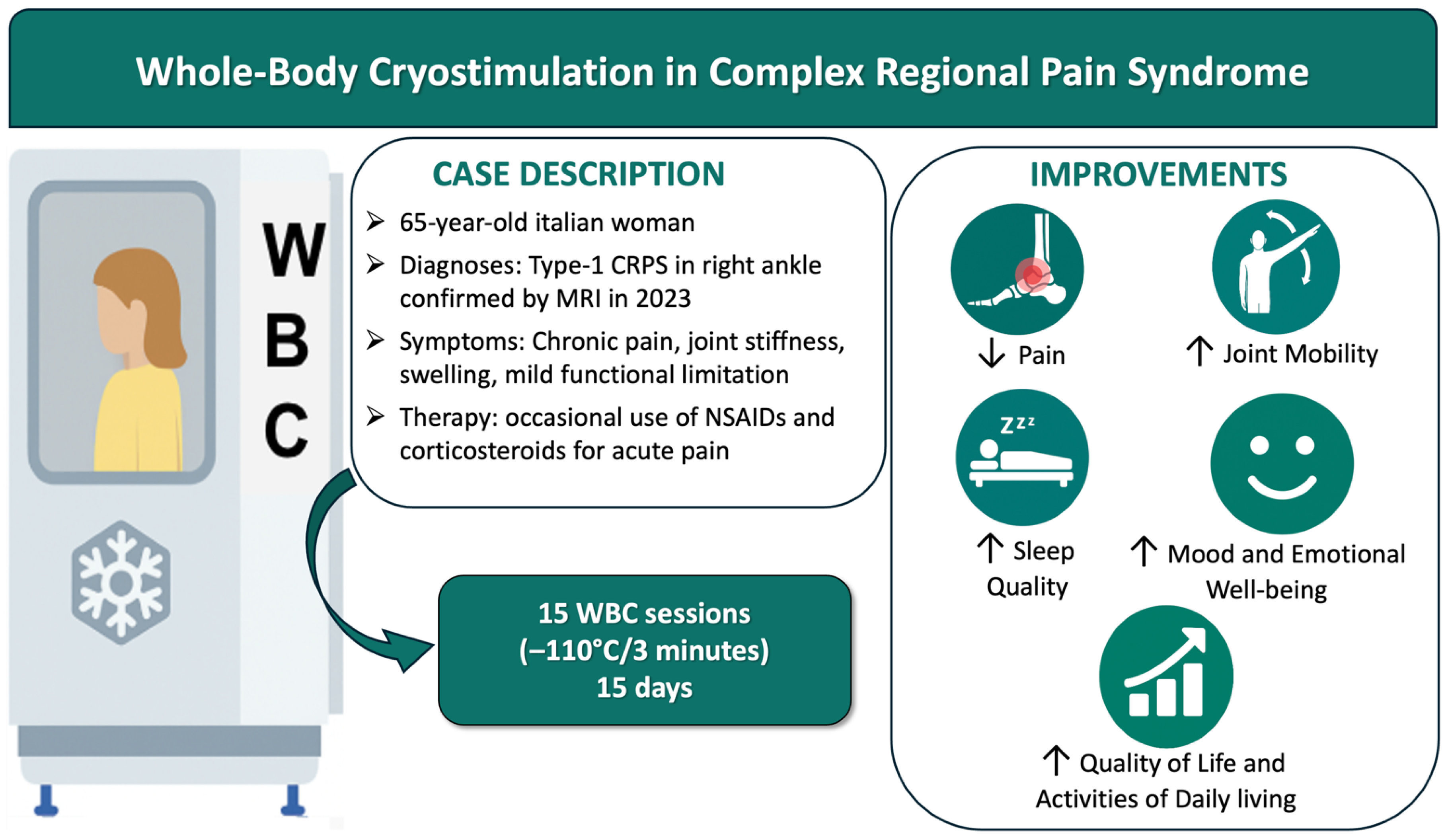
Whole-Body Cryostimulation in Complex Regional Pain Syndrome: A Case Study
 , ,
, , 
Abstract
1. Introduction
2. Materials and Methods
2.1. Case Description and Clinical History
2.2. Clinical Examination
2.3. Symptoms Assessment
2.3.1. Pain and Pain-Related Conditions
2.3.2. Functional Mobility and Performance
2.3.3. Range of Motion (ROM) and Strength
2.3.4. Skin Temperature Assessment
2.3.5. Edema Assessment
2.3.6. Psychosocial Assessment
2.3.7. Magnetic Resonance Imaging
2.4. Intervention
Whole-Body Cryostimulation (WBC)
2.5. Statistical Analysis
3. Results
3.1. Psychosocial Outcomes
3.2. Functional Mobility and Motor Performance
3.3. Range of Motion (ROM) and Strength
3.4. Temperature and Edema
3.5. Magnetic Resonance Imaging
4. Discussion
5. Conclusions
Author Contributions
Funding
Institutional Review Board Statement
Informed Consent Statement
Data Availability Statement
Conflicts of Interest
References
- Guthmiller, K.B.; Dua, A.; Dey, S.; Varacallo, M.A. Complex Regional Pain Syndrome. In StatPearls [Internet]; StatPearls Publishing: Treasure Island, FL, USA, 2025; Available online: http://www.ncbi.nlm.nih.gov/books/NBK430719/ (accessed on 30 January 2026).
- Ferraro, M.C.; O’Connell, N.E.; Sommer, C.; Goebel, A.; Bultitude, J.H.; Cashin, A.G.; Moseley, G.L.; McAuley, J.H. Complex regional pain syndrome: Advances in epidemiology, pathophysiology, diagnosis, and treatment. Lancet Neurol. 2024, 23, 522–533. [Google Scholar] [CrossRef]
- Borchers, A.T.; Gershwin, M.E. Complex regional pain syndrome: A comprehensive and critical review. Autoimmun. Rev. 2014, 13, 242–265. [Google Scholar] [CrossRef] [PubMed]
- Fooladi, S.; Hasoon, J.; Kaye, A.D.; Abd-Elsayed, A. Diagnostic Criteria and Technical Evaluation of Complex Regional Pain Syndrome: A Narrative Review. Diagnostics 2025, 15, 2281. [Google Scholar] [CrossRef] [PubMed]
- Harden, R.N.; McCabe, C.S.; Goebel, A.; Massey, M.; Suvar, T.; Grieve, S.; Bruehl, S. Complex Regional Pain Syndrome: Practical Diagnostic and Treatment Guidelines. Pain Med. 2022, 23, S1–S53. [Google Scholar] [CrossRef] [PubMed]
- de Mos, M.; de Bruijn, A.G.J.; Huygen, F.J.P.M.; Dieleman, J.P.; Stricker, B.H.C.; Sturkenboom, M.C.J.M. The incidence of complex regional pain syndrome: A population-based study. Pain 2007, 129, 12–20. [Google Scholar] [CrossRef]
- Lee, D.-H.; Noh, E.C.; Kim, Y.C.; Hwang, J.Y.; Kim, S.N.; Jang, J.H.; Byun, M.S.; Kang, D.-H. Risk Factors for Suicidal Ideation among Patients with Complex Regional Pain Syndrome. Psychiatry Investig. 2014, 11, 32–38. [Google Scholar] [CrossRef]
- Żyluk, A. Functional impairment of the extremities in patients who got over Complex Regional Pain Syndrome. Folia Med. Cracov 2024, 64, 119–127. [Google Scholar] [CrossRef] [PubMed]
- Birklein, F.; Dimova, V. Complex regional pain syndrome-up-to-date. Pain Rep. 2017, 2, e624. [Google Scholar] [CrossRef] [PubMed]
- Taylor, S.-S.; Noor, N.; Urits, I.; Paladini, A.; Sadhu, M.S.; Gibb, C.; Carlson, T.; Myrcik, D.; Varrassi, G.; Viswanath, O. Complex Regional Pain Syndrome: A Comprehensive Review. Pain Ther. 2021, 10, 875–892. [Google Scholar] [CrossRef] [PubMed]
- Andreieva, I.; Tarnacka, B.; Zalewski, A.; Wiśniowska, J. Tailoring Treatment in Complex Regional Pain Syndrome: A Comparative Study of Therapeutic Approaches in Complex Rehabilitation. Pharmaceuticals 2025, 18, 1114. [Google Scholar] [CrossRef]
- Wertli, M.M.; Kessels, A.G.H.; Perez, R.S.G.M.; Bachmann, L.M.; Brunner, F. Rational Pain Management in Complex Regional Pain Syndrome 1 (CRPS 1)—A Network Meta-Analysis. Pain Med. 2014, 15, 1575–1589. [Google Scholar] [CrossRef]
- Fassio, A.; Mantovani, A.; Gatti, D.; Rossini, M.; Viapiana, O.; Gavioli, I.; Benini, C.; Adami, G. Pharmacological treatment in adult patients with CRPS-I: A systematic review and meta-analysis of randomized controlled trials. Rheumatol. Oxf. Engl. 2022, 61, 3534–3546. [Google Scholar] [CrossRef] [PubMed]
- Candan, B.; Gungor, S. Current and Evolving Concepts in the Management of Complex Regional Pain Syndrome: A Narrative Review. Diagnostics 2025, 15, 353. Available online: https://www.mdpi.com/2075-4418/15/3/353 (accessed on 30 January 2026). [CrossRef] [PubMed]
- Özdemir, E.C.; Elhan, A.H.; Küçükdeveci, A.A. Effects of mirror therapy in post-traumatic complex regional pain syndrome type-1: A randomized controlled study. J. Rehabil. Med. 2024, 56, jrm40417. [Google Scholar] [CrossRef] [PubMed]
- Boichat, C.; Llewellyn, A.; Grieve, S.; McCabe, C. The Role of Nonmedical Therapeutic Approaches in the Rehabilitation of Complex Regional Pain Syndrome. Curr. Treat. Options Rheumatol. 2020, 6, 299–311. [Google Scholar] [CrossRef]
- Bruehl, S.; Chung, O.Y. Psychological and behavioral aspects of complex regional pain syndrome management. Clin. J. Pain 2006, 22, 430–437. [Google Scholar] [CrossRef]
- Doan, H.N.; Chang, M.C. Comprehensive Mechanisms and Non-Invasive Treatment for Complex Regional Pain Syndrome: A Narrative Review. J. Pain Res. 2025, 18, 4699–4726. [Google Scholar] [CrossRef]
- Capodaglio, P.; Cremascoli, R.; Piterà, P.; Fontana, J.M. Whole-Body Cryostimulation: A Rehabilitation Booster. J. Rehabil. Med. Clin. Commun. 2022, 5, 2810. [Google Scholar] [CrossRef]
- Wiedermann, C.J.; Piccoliori, G.; Engl, A. Whole-body cryotherapy for stress, sleep, and wellbeing: A narrative review. Acad. Ment. Health Well-Being 2025, 2. Available online: https://www.academia.edu/2997-9196/2/4/10.20935/MHealthWellB7937 (accessed on 30 January 2026). [CrossRef]
- Louis, M.; Velazquez, E. The Impact of New Weight-Loss Medications on Bariatric Surgery and Surgeon Employment. Cureus 2025, 17, e83903. [Google Scholar] [CrossRef]
- Louis, J.; Schaal, K.; Bieuzen, F.; Meur, Y.L.; Filliard, J.-R.; Volondat, M.; Brisswalter, J.; Hausswirth, C. Head Exposure to Cold during Whole-Body Cryostimulation: Influence on Thermal Response and Autonomic Modulation. PLoS ONE 2015, 10, e0124776. [Google Scholar] [CrossRef]
- Varallo, G.; Piterà, P.; Fontana, J.M.; Gobbi, M.; Arreghini, M.; Giusti, E.M.; Franceschini, C.; Plazzi, G.; Castel-nuovo, G.; Capodaglio, P. Is Whole-Body Cryostimulation an Effective Add-On Treatment in Individuals with Fibromyalgia and Obesity? A Randomized Controlled Clinical Trial. J. Clin. Med. 2022, 11, 4324. [Google Scholar] [CrossRef] [PubMed]
- Alito, A.; Verme, F.; Mercati, G.P.; Piterà, P.; Fontana, J.M.; Capodaglio, P. Whole Body Cryostimulation: A New Adjuvant Treatment in Central Sensitization Syndromes? An Expert Opinion. Healthcare 2024, 12, 546. [Google Scholar] [CrossRef] [PubMed]
- Sobeeh, M.G.; Hassan, K.A.; da Silva, A.G.; Youssef, E.F.; Fayaz, N.A.; Mohammed, M.M. Pain mechanisms in complex regional pain syndrome: A systematic review and meta-analysis of quantitative sensory testing outcomes. J. Orthop. Surg. 2023, 18, 2. [Google Scholar] [CrossRef] [PubMed]
- Vitenet, M.; Tubez, F.; Marreiro, A.; Polidori, G.; Taiar, R.; Legrand, F.; Boyer, F.C. Effect of whole body cryotherapy interventions on health-related quality of life in fibromyalgia patients: A randomized controlled trial. Complement. Ther. Med. 2018, 36, 6–8. [Google Scholar] [CrossRef]
- Vitenet, M.; Legrand, F.; Bouchet, B.; Bogard, F.; Taiar, R.; Polidori, G.; Rapin, A.; Boyer, F.C. Whole body cryotherapy in fibromyalgia patients: Effects on pain and functional mobility. Ann. Phys. Rehabil. Med. 2018, 61, e1–e2. [Google Scholar] [CrossRef]
- Chun, E.; Joseph, R.; Pojednic, R. Whole-Body Cryotherapy Reduces Systemic Inflammation in Healthy Adults: Pilot Cohort Study. Interact. J. Med. Res. 2024, 13, e60942. [Google Scholar] [CrossRef]
- Ritter, H.; Beuermann, R.; Unkelbach, V.; Bang, H.; Feist, E. Analgesia by Cryotherapy in Patients with Chronic Pain with Analysis of Pain-Modulating and Pro-Inflammatory Parameters-A Clinical Controlled Pilot Study. J. Clin. Med. 2025, 14, 7567. [Google Scholar] [CrossRef]
- Piterà, P.; Springhetti, I.; Alito, A.; Verme, F.; Fontana, J.M.; Capodaglio, P. Whole-Body Cryostimulation, a Complementary Treatment for Phantom Limb Syndrome: Preliminary Evidence from a Case Study. Med. Kaunas. Lith. 2023, 60, 22. [Google Scholar] [CrossRef]
- Barłowska-Trybulec, M.; Zawojska, K.; Szklarczyk, J.; Góralska, M. Effect of whole body cryotherapy on low back pain and release of endorphins and stress hormones in patients with lumbar spine osteoarthritis. Reumatologia 2022, 60, 247–251. [Google Scholar] [CrossRef]
- Rivera, J.; Tercero, M.J.; Salas, J.S.; Gimeno, J.H.; Alejo, J.S. The effect of cryotherapy on fibromyalgia: A randomised clinical trial carried out in a cryosauna cabin. Rheumatol. Int. 2018, 38, 2243–2250. [Google Scholar] [CrossRef]
- Capodaglio, P.; Alito, A.; Duguè, B.M.; Bouzigon, R.; Lombardi, G.; Miller, E.D.; Verme, F.; Modaffari, G.; Piterà, P.; Ziemann, E.; et al. Contraindications to Whole-Body Cryostimulation (WBC). A position paper from the WBC Working Group of the International Institute of Refrigeration and the multidisciplinary expert panel. Front. Rehabil. Sci. 2025, 6, 1567402. [Google Scholar] [CrossRef]
- Melzack, R. The McGill pain questionnaire: From description to measurement. Anesthesiology 2005, 103, 199–202. [Google Scholar] [CrossRef] [PubMed]
- Dworkin, R.H.; Turk, D.C.; Revicki, D.A.; Harding, G.; Coyne, K.S.; Peirce-Sandner, S.; Bhagwat, D.; Everton, D.; Burke, L.B.; Cowan, P.; et al. Development and initial validation of an expanded and revised version of the Short-form McGill Pain Questionnaire (SF-MPQ-2). Pain 2009, 144, 35–42. [Google Scholar] [CrossRef] [PubMed]
- Boonstra, A.M.; Schiphorst Preuper, H.R.; Reneman, M.F.; Posthumus, J.B.; Stewart, R.E. Reliability and validity of the visual analogue scale for disability in patients with chronic musculoskeletal pain. Int. J. Rehabil. Res. 2008, 31, 165. [Google Scholar] [CrossRef] [PubMed]
- McCormack, H.M.; Horne, D.J.D.L.; Sheather, S. Clinical applications of visual analogue scales: A critical review. Psychol. Med. 1988, 18, 1007–1019. [Google Scholar] [CrossRef]
- Ferreira-Valente, M.A.; Pais-Ribeiro, J.L.; Jensen, M.P. Validity of four pain intensity rating scales. Pain 2011, 152, 2399. [Google Scholar] [CrossRef]
- Tait, R.C.; Pollard, C.A.; Margolis, R.B.; Duckro, P.N.; Krause, S.J. The Pain Disability Index: Psychometric and validity data. Arch. Phys. Med. Rehabil. 1987, 68, 438–441. [Google Scholar]
- Sullivan, M.J.L.; Bishop, S.R.; Pivik, J. The Pain Catastrophizing Scale: Development and validation. Psychol. Assess. 1995, 7, 524–532. [Google Scholar] [CrossRef]
- Podsiadlo, D.; Richardson, S. The timed ‘Up & Go’: A test of basic functional mobility for frail elderly persons. J. Am. Geriatr. Soc. 1991, 39, 142–148. [Google Scholar]
- Jones, C.J.; Rikli, R.E.; Beam, W.C. A 30-s Chair-Stand Test as a Measure of Lower Body Strength in Community-Residing Older Adults. Res. Q. Exerc. Sport 1999, 70, 113–119. [Google Scholar] [CrossRef]
- Norkin, C.C.; White, D.J. Measurement of Joint Motion: A Guide to Goniometry; F.A. Davis: Philadelphia, PA, USA, 2016; 592p. [Google Scholar]
- Naqvi, U.; Margetis, K.; Sherman, A.L. Muscle Strength Grading. In StatPearls [Internet]; StatPearls Publishing: Treasure Island, FL, USA, 2025; Available online: http://www.ncbi.nlm.nih.gov/books/NBK436008/ (accessed on 30 January 2026).
- Esterson, P.S. Measurement of Ankle Joint Swelling Using a Figure of 8. J. Orthop. Sports Phys. Ther. 1979, 1, 51–52. [Google Scholar] [CrossRef] [PubMed]
- Ware, J.E.; Sherbourne, C.D. The MOS 36-item short-form health survey (SF-36). I. Conceptual framework and item selection. Med. Care 1992, 30, 473–483. [Google Scholar] [CrossRef] [PubMed]
- Buysse, D.J.; Reynolds, C.F.; Monk, T.H.; Berman, S.R.; Kupfer, D.J. The Pittsburgh Sleep Quality Index: A new instrument for psychiatric practice and research. Psychiatry Res. 1989, 28, 193–213. [Google Scholar] [CrossRef] [PubMed]
- Krupp, L.B.; LaRocca, N.G.; Muir-Nash, J.; Steinberg, A.D. Fatigue Severity Scale [Internet]. 2016. Available online: https://psycnet.apa.org/doiLanding?doi=10.1037%2Ft25491-000 (accessed on 30 January 2026).
- The World Health Organization-Five Well-Being Index (WHO-5) [Internet]. Available online: https://www.who.int/publications/m/item/WHO-UCN-MSD-MHE-2024.01 (accessed on 30 January 2026).
- Beck, A.T.; Ward, C.H.; Mendelson, M.; Mock, J.; Erbaugh, J. An inventory for measuring depression. Arch. Gen. Psychiatry 1961, 4, 561–571. [Google Scholar] [CrossRef]
- Spielberger, C.D. State-Trait Anxiety Inventory for Adults [Internet]. 2012. Available online: https://psycnet.apa.org/doiLanding?doi=10.1037%2Ft06496-000 (accessed on 30 January 2026).
- Klemm, P.; Becker, J.; Aykara, I.; Asendorf, T.; Dischereit, G.; Neumann, E.; Müller-Ladner, U.; Lange, U. Serial whole-body cryotherapy in fibromyalgia is effective and alters cytokine profiles. Adv. Rheumatol. Lond. Engl. 2021, 61, 3. [Google Scholar] [CrossRef]
- Garcia, C.; Karri, J.; Zacharias, N.A.; Abd-Elsayed, A. Use of Cryotherapy for Managing Chronic Pain: An Evidence-Based Narrative. Pain Ther. 2021, 10, 81–100. [Google Scholar] [CrossRef]
- Geneen, L.J.; Moore, R.A.; Clarke, C.; Martin, D.; Colvin, L.A.; Smith, B.H. Physical activity and exercise for chronic pain in adults: An overview of Cochrane Reviews. Cochrane Database Syst. Rev. 2017, 2017, CD011279. [Google Scholar]
- Steiner, J.L.; Bigatti, S.M.; Slaven, J.E.; Ang, D.C. The Complex Relationship between Pain Intensity and Physical Functioning in Fibromyalgia: The Mediating Role of Depression. J. Appl. Biobehav. Res. 2017, 22, e12079. [Google Scholar] [CrossRef]
- Bleakley, C.M.; Costello, J.T. Do thermal agents affect range of movement and mechanical properties in soft tissues? A systematic review. Arch. Phys. Med. Rehabil. 2013, 94, 149–163. [Google Scholar] [CrossRef]
- Costello, J.T.; Algar, L.A.; Donnelly, A.E. Effects of whole-body cryotherapy (-110 °C) on proprioception and indices of muscle damage. Scand. J. Med. Sci. Sports 2012, 22, 190–198. [Google Scholar] [CrossRef]
- Guillot, X.; Tordi, N.; Mourot, L.; Demougeot, C.; Dugué, B.; Prati, C.; Wendling, D. Cryotherapy in inflammatory rheumatic diseases: A systematic review. Expert Rev. Clin. Immunol. 2014, 10, 281–294. [Google Scholar] [CrossRef]
- Hausswirth, C.; Schaal, K.; Meur, Y.L.; Bieuzen, F.; Filliard, J.-R.; Volondat, M.; Louis, J. Parasympathetic Activity and Blood Catecholamine Responses Following a Single Partial-Body Cryostimulation and a Whole-Body Cryostimulation. PLoS ONE 2013, 8, e72658. [Google Scholar] [CrossRef]
- Louis, J.; Theurot, D.; Filliard, J.R.; Volondat, M.; Dugué, B.; Dupuy, O. The use of whole-body cryotherapy: Time- and dose-response investigation on circulating blood catecholamines and heart rate variability. Eur. J. Appl. Physiol. 2020, 120, 1733–1743. [Google Scholar] [CrossRef]
- Piterà, P.; Cremascoli, R.; Bianchi, L.; Borghesi, F.; Verme, F.; Cattaldo, S.; Prina, E.; Mai, S.; Cipresso, P.; Galli, F.; et al. Autonomic Modulation in Parkinson’s Disease Using Whole-Body Cryostimulation: A Pilot Study. Biomedicines 2024, 12, 2467. [Google Scholar] [CrossRef]
- Ziemann, E.; Olek, R.A.; Grzywacz, T.; Antosiewicz, J.; Kujach, S.; Łuszczyk, M.; Smaruj, M.; Sledziewska, E.; Laskowski, R. Whole-body cryostimulation as an effective method of reducing low-grade inflammation in obese men. J. Physiol. Sci. JPS 2013, 63, 333–343. [Google Scholar] [CrossRef]
- Paternostro-Sluga, T.; Grim-Stieger, M.; Posch, M.; Schuhfried, O.; Vacariu, G.; Mittermaier, C.; Bittner, C.; Fialka-Moser, V. Reliability and validity of the Medical Research Council (MRC) scale and a modified scale for testing muscle strength in patients with radial palsy. J. Rehabil. Med. 2008, 40, 665–671. [Google Scholar] [CrossRef]


| Outcome and Range | Pre | Post | Δ% |
|---|---|---|---|
| SF-36 | |||
| Physical functioning | 30% | 35.7% | +5.7% |
| Role limitations due to physical health | 0% | 25% | +25% |
| Role limitations due to emotional problems | 67% | 100% | +33% |
| Energy/fatigue | 44% | 70% | +26% |
| Emotional well-being | 44% | 72% | +28% |
| Social functioning | 75% | 75% | 0 |
| Pain | 50% | 60% | +10% |
| General health | 25% | 55% | +30% |
| WHO-5 (0–100) | 36 | 68 | +88.9% |
| PSQI (0–21) | 18 | 10 | −44.4% |
| FSS (9–63) | 50 | 27 | −46% |
| BDI (0–63) | 12 | 10 | −16.7% |
| STAI 1 (20–80) | 47 | 34 | −27.7% |
| STAI 2 (20–80) | 51 | 43 | −15.7% |
| Outcome and Range | Pre | Post | Δ% |
|---|---|---|---|
| PRI SF-MPQ (1–78) | 58 | 28 | −51.7% |
| VAS (0–10) | 9 | 3 | −66.7% |
| PNRS (0–10) | 10 | 3 | −70% |
| PDI (0–70) | 45 | 38 | −15.6% |
| PCS (0–52) | 34 | 9 | −73.5% |
| Outcome and Range | Pre | Post | Δ% |
|---|---|---|---|
| TUG (seconds) | 11.55 | 7.88 | −31.8% |
| Chair Stand Test (reps) | 8 | 10 | +25.0% |
| Measure | Side | Pre | Post | Δ% |
|---|---|---|---|---|
| Ankle Dorsiflexion AROM (°) | R | 15 | 25 | +66.7% |
| L | 15 | 25 | +66.7% | |
| Ankle Plantarflexion AROM (°) | R | 25 | 40 | +60% |
| L | 35 | 40 | +14.3% | |
| Knee MRC Flexion | R | 3 | 4 | +33.3% |
| L | 3 | 4 | +33.3% |
| Session | Right Ankle Pre (°C) | Right Ankle Post (°C) | Δ Right (°C) | Left Ankle Pre (°C) | Left Ankle Post (°C) | Δ Left (°C) |
|---|---|---|---|---|---|---|
| 1 | 35.2 | 26.9 | −8.3 | 32.0 | 22.3 | −9.7 |
| 2 | 34.6 | 24.3 | −10.3 | 33.0 | 24.0 | −9.0 |
| 3 | 32.1 | 24.1 | −8.0 | 30.3 | 24.9 | −5.4 |
| 4 | 34.5 | 26.9 | −7.6 | 32.3 | 26.3 | −6.0 |
| 5 | 35.2 | 26.7 | −8.5 | 35.2 | 25.0 | −10.2 |
| 6 | 34.3 | 23.7 | −10.6 | 34.2 | 23.9 | −10.3 |
| 7 | 33.4 | 23.8 | −9.6 | 33.0 | 23.5 | −9.5 |
| 8 | 34.8 | 24.4 | −10.4 | 34.0 | 24.1 | −9.9 |
| 9 | 34.1 | 23.7 | −10.4 | 32.4 | 23.4 | −9.0 |
| 10 | 34.2 | 25.2 | −9.0 | 34.0 | 24.4 | −9.6 |
| 11 | 34.6 | 23.8 | −10.8 | 34.3 | 23.9 | −10.4 |
| 12 | 34.8 | 25.5 | −9.3 | 34.5 | 24.7 | −9.8 |
| 13 | 33.9 | 26.4 | −7.5 | 33.5 | 23.5 | −10.0 |
| 14 | 33.6 | 23.7 | −9.9 | 33.4 | 24.0 | −9.4 |
| 15 | 33.4 | 25.7 | −7.7 | 33.0 | 23.2 | −9.8 |
| Site | MRI Date | Key Findings |
|---|---|---|
| Right Knee | August 2024 | Meniscal extrusion, cartilage thinning, mild edema, early degenerative changes. |
| 7 July 2025 (Pre-WBC) | Meniscal radial tear (medial), early tibiofemoral chondropathy (Grade II), mild synovial reaction, no significant effusion. | |
| 19 August 2025 (Post-WBC) | Stable meniscal and ligamentous findings. Notably reduced synovial reaction, absence of joint effusion, and no new degenerative signs. | |
| Right Ankle | August 2024 | Subchondral bone edema (cystic appearance), dorsal soft tissue edema, signs of algodystrophy. |
| 7 July 2025 (Pre-WBC) | Edema in periastragalic region and sinus tarsi, signs of chondropathy and joint space narrowing. | |
| 19 August 2025 (Post-WBC) | Reduction in soft tissue edema, improved subchondral bone appearance, no progression of arthrosis, stable cartilage. |
Disclaimer/Publisher’s Note: The statements, opinions and data contained in all publications are solely those of the individual author(s) and contributor(s) and not of MDPI and/or the editor(s). MDPI and/or the editor(s) disclaim responsibility for any injury to people or property resulting from any ideas, methods, instructions or products referred to in the content. |
© 2026 by the authors. Licensee MDPI, Basel, Switzerland. This article is an open access article distributed under the terms and conditions of the Creative Commons Attribution (CC BY) license.
Share and Cite
Piterà, P.; Camedda, A.; Prina, E.; Tibaldeo, E.F.; Baccalaro, G.; Capodaglio, P. Whole-Body Cryostimulation in Complex Regional Pain Syndrome: A Case Study. J. Clin. Med. 2026, 15, 2142. https://doi.org/10.3390/jcm15062142
Piterà P, Camedda A, Prina E, Tibaldeo EF, Baccalaro G, Capodaglio P. Whole-Body Cryostimulation in Complex Regional Pain Syndrome: A Case Study. Journal of Clinical Medicine. 2026; 15(6):2142. https://doi.org/10.3390/jcm15062142
Chicago/Turabian StylePiterà, Paolo, Alberto Camedda, Elisa Prina, Eleonora Franzini Tibaldeo, Gabriele Baccalaro, and Paolo Capodaglio. 2026. "Whole-Body Cryostimulation in Complex Regional Pain Syndrome: A Case Study" Journal of Clinical Medicine 15, no. 6: 2142. https://doi.org/10.3390/jcm15062142
APA StylePiterà, P., Camedda, A., Prina, E., Tibaldeo, E. F., Baccalaro, G., & Capodaglio, P. (2026). Whole-Body Cryostimulation in Complex Regional Pain Syndrome: A Case Study. Journal of Clinical Medicine, 15(6), 2142. https://doi.org/10.3390/jcm15062142