Digital Therapy for Male LUTS: Results After Mid- and Longterm Follow-Up

 and
and
Abstract
1. Background
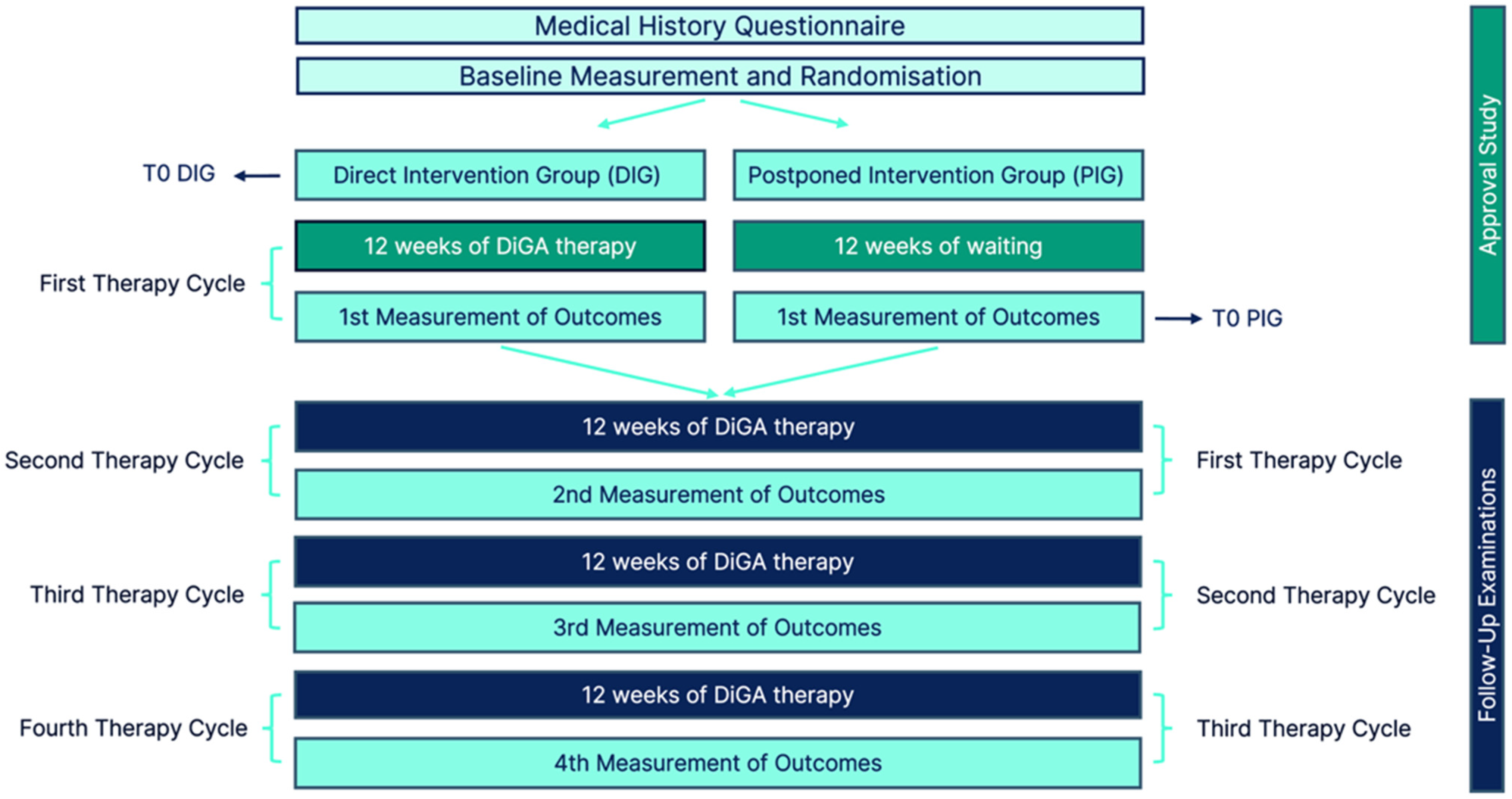
2. Material and Methods
Statistical Analyses
3. Results
3.1. Descriptive Results
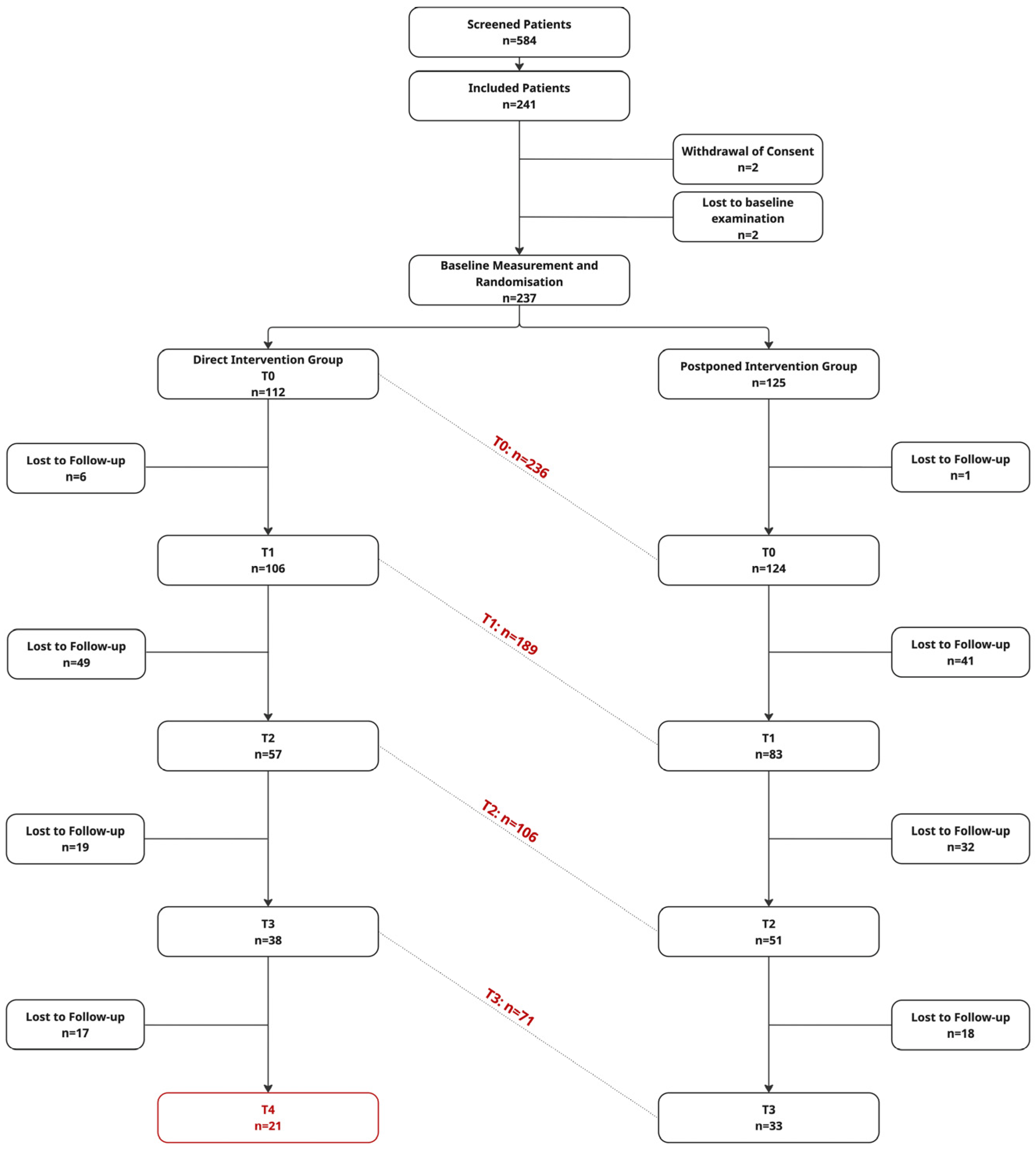
3.1.1. Patient Demographics
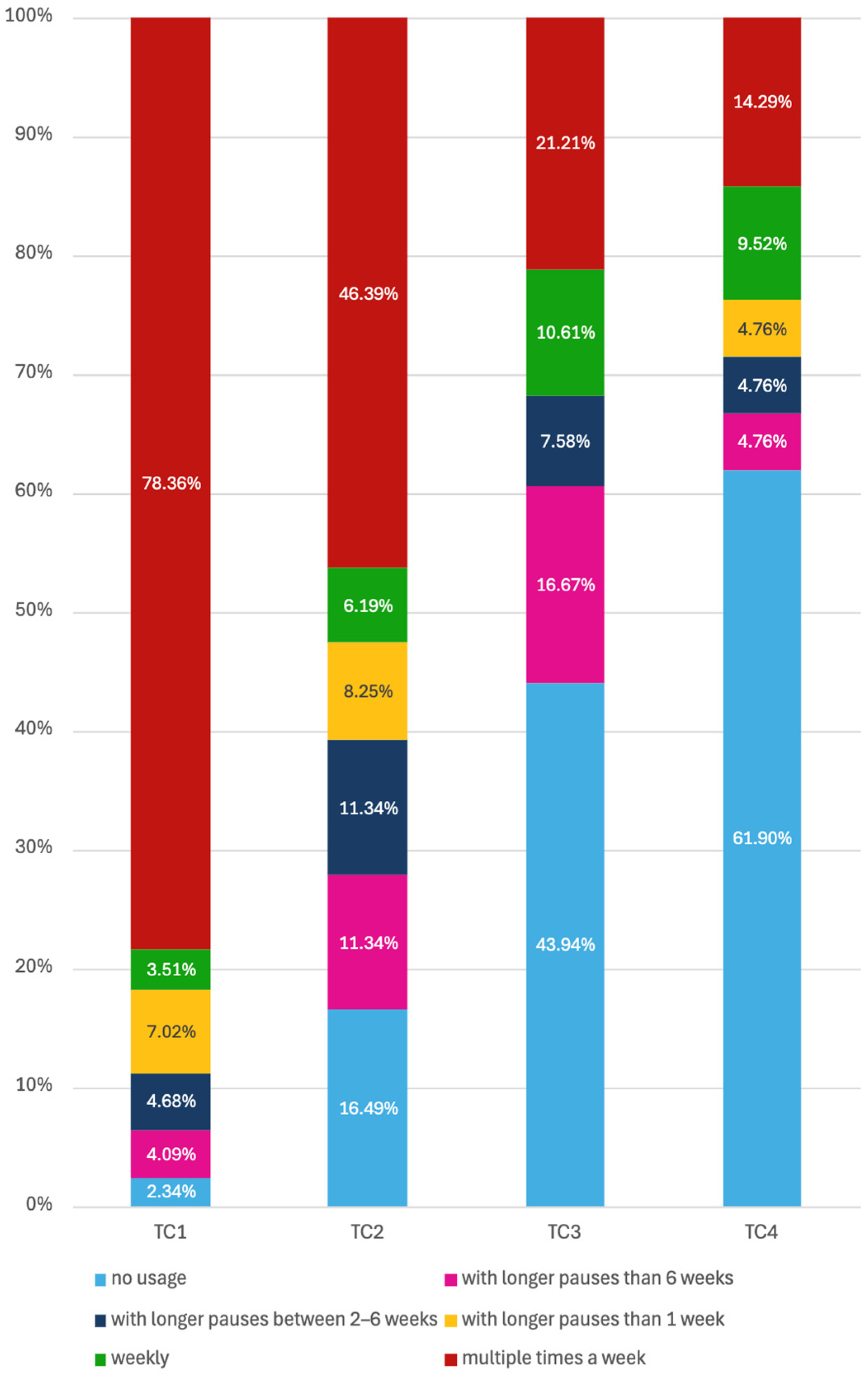
3.1.2. Adherence
3.2. Efficacy
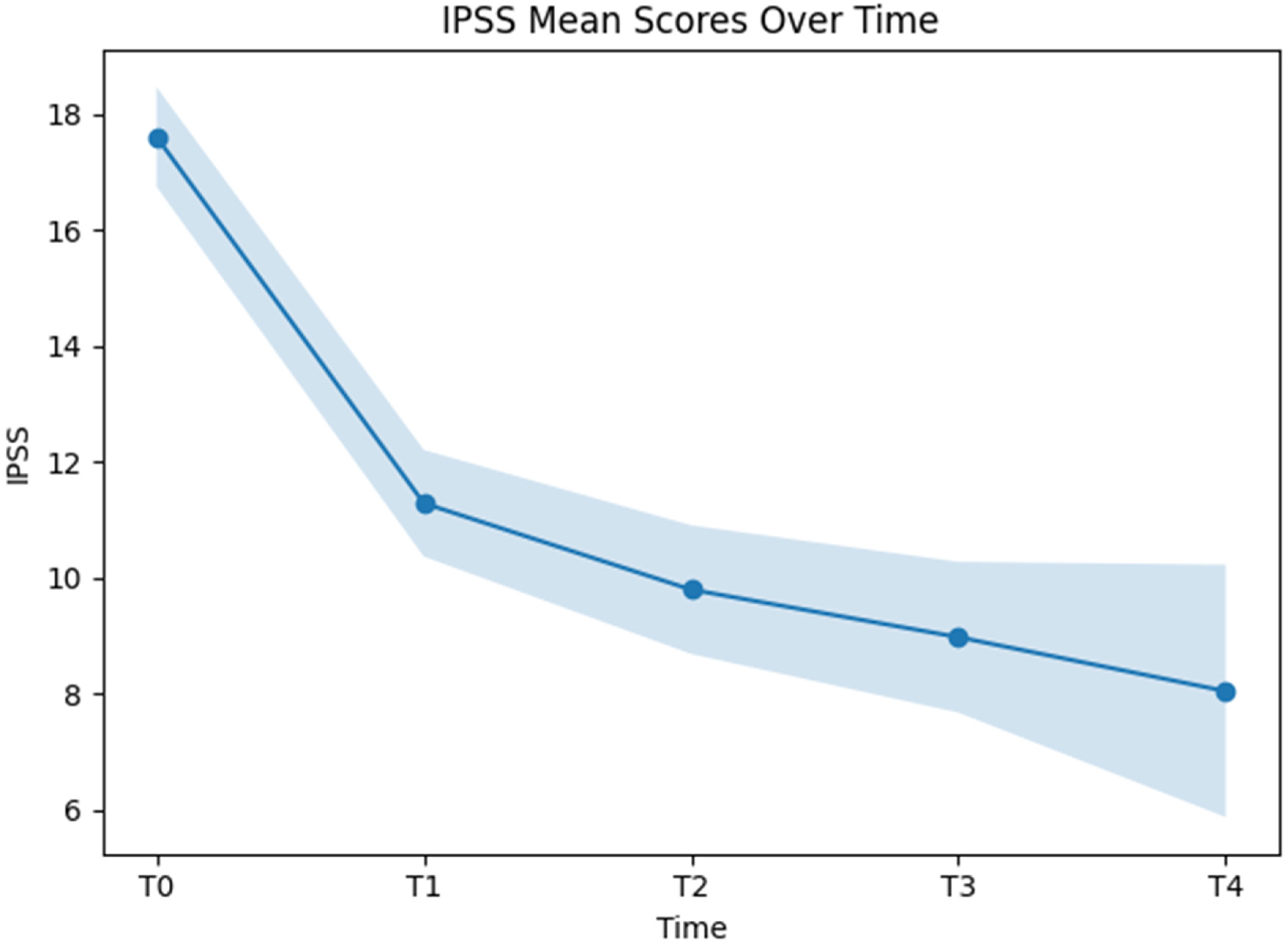
3.2.1. Primary Endpoint IPSS
3.2.2. Responder Analysis
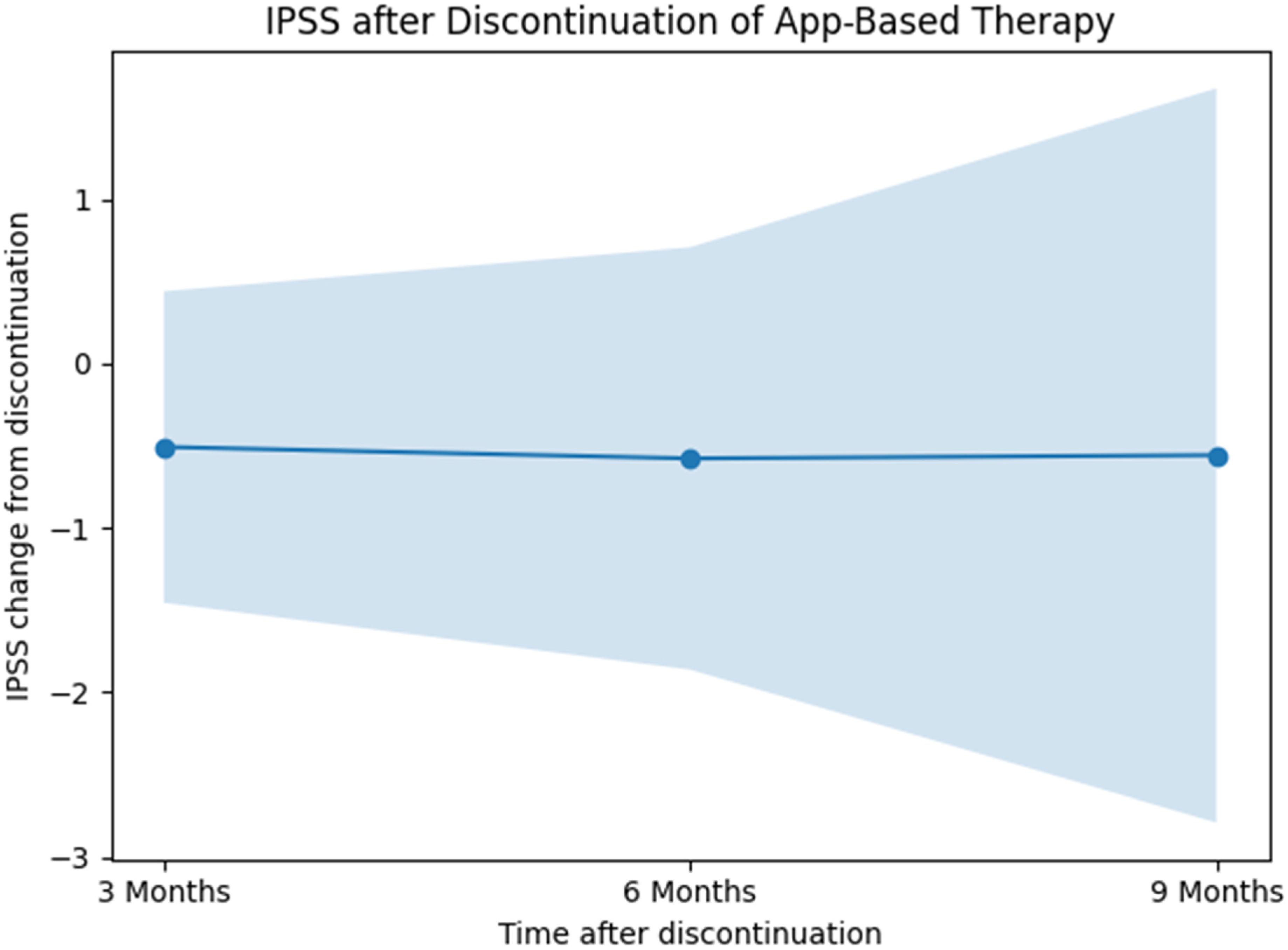
3.2.3. Persistence of Effects—IPSS After Discontinuation of App-Based Therapy
3.3. Secondary Efficacy Variables
3.3.1. OAB-q-SF
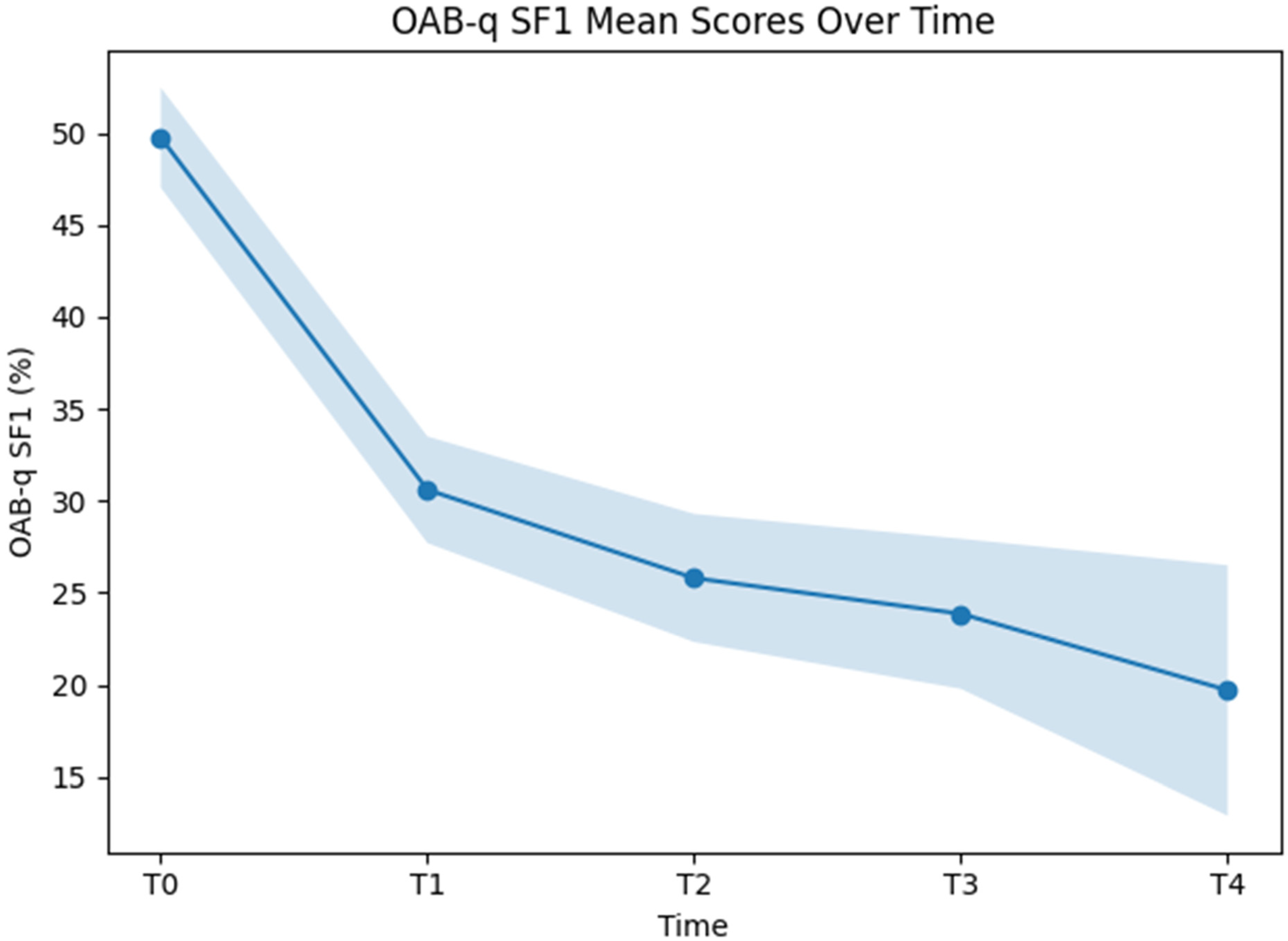
3.3.2. OAB-q-SF1
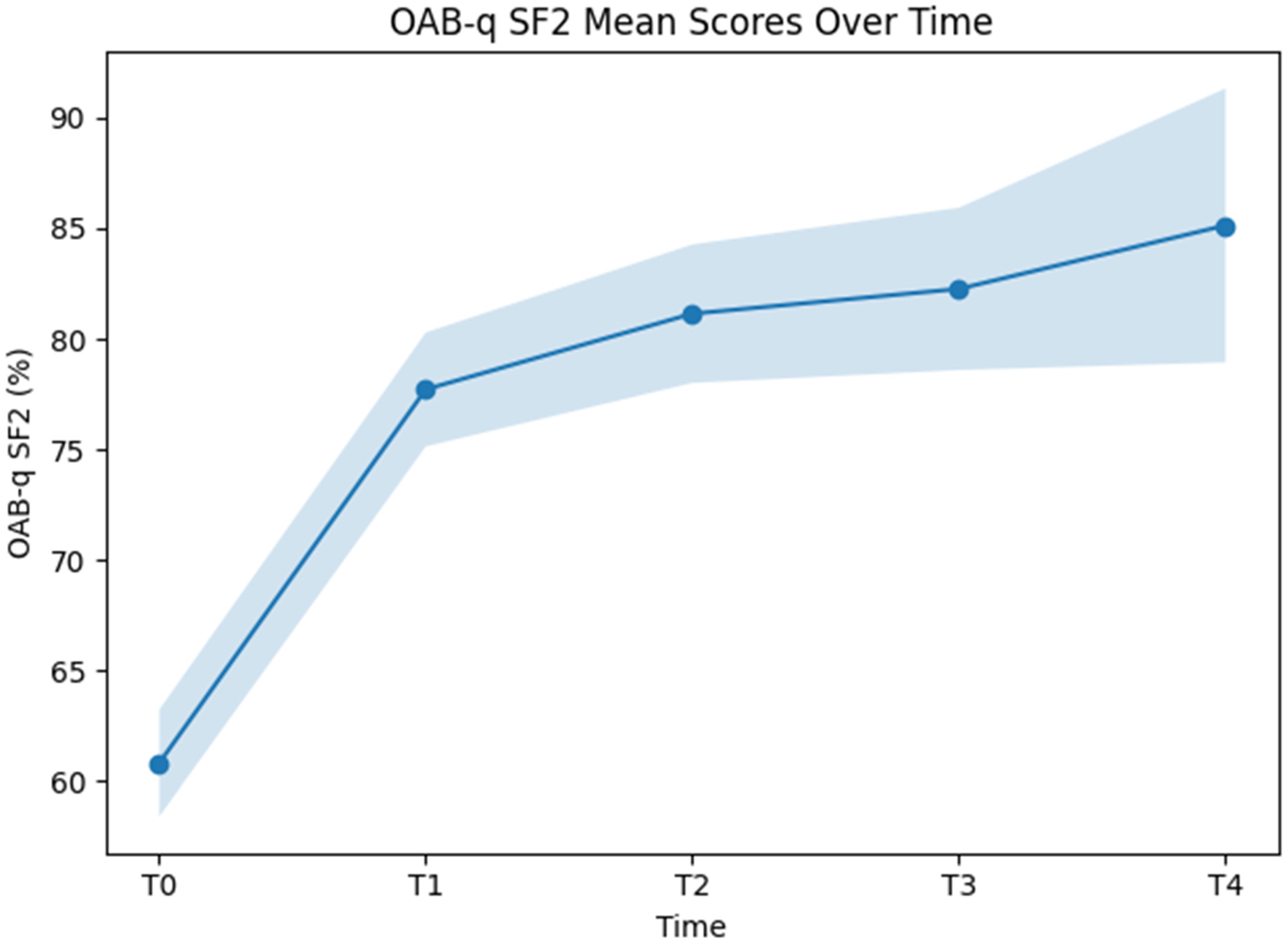
3.3.3. OAB-q-SF2
4. Discussion
5. Conclusions
Author Contributions
Funding
Institutional Review Board Statement
Informed Consent Statement
Data Availability Statement
Conflicts of Interest
References
- Schönburg, S.H. Digital health for benign prostate syndrome. Aktuelle Urol. 2025, 56, 445–450. [Google Scholar] [PubMed]
- Gratzke, C.; Schönburg, S.; Eger, S.; Raude, K.; Grabbert, M.; Astheimer, S.; Halbich, J.; Hercher, D.; Mousa, W.; Raschke, R.; et al. A Randomized Trial of an App-Based Therapeutic for Lower Urinary Tract Symptoms. NEJM Evid. 2025, 4, EVIDoa2400290. [Google Scholar] [CrossRef] [PubMed]
- Wiemer, L.; Gratzke, C.; Miller, K.; Krieger, E.; Papp, C.P.; Schönburg, S. Evaluating the impact of digital therapy for male LUTS: Insights from the BEST trial subgroup analysis. World J. Urol. 2025, 43, 660. [Google Scholar] [CrossRef] [PubMed]
- Schönburg, S.; Gratzke, C.; Miller, K.; Krieger, E.; Papp, P.; Wiemer, L. Differential impact of digital therapy on storage and voiding LUTS: A post-hoc IPSS analysis from the BEST randomized controlled trial. BJUI Compass 2025, 6, e70069. [Google Scholar] [CrossRef] [PubMed]
- Barry, M.J.; Fowler, F.J.; O’leary, M.P.; Bruskewitz, R.C.; Holtgrewe, H.L.; Mebust, W.K.; Cockett, A.T.; The Measurement Committee of the American Urological Association. The American Urological Association symptom index for benign prostatic hyperplasia. J. Urol. 1992, 148, 1549–1557; discussion 1564. [Google Scholar] [CrossRef] [PubMed]
- Coyne, K.; Revicki, D.; Hunt, T.; Corey, R.; Stewart, W.; Bentkover, J.; Kurth, H.; Abrams, P. Psychometric validation of an overactive bladder symptom and health-related quality of life questionnaire: The OAB-q. Qual. Life Res. 2002, 11, 563–574. [Google Scholar] [CrossRef] [PubMed]
- Barry, M.J.; Williford, W.O.; Chang, Y.; Machi, M.; Jones, K.M.; Walker-Corkery, E.; Lepor, H. Benign prostatic hyperplasia specific health status measures in clinical research: How much change in the American Urological Association symptom index and the benign prostatic hyperplasia impact index is perceptible to patients? J. Urol. 1995, 154, 1770–1774. [Google Scholar] [CrossRef] [PubMed]
- Wiemer, L.; Lehmacher, W.; Schönburg, S.; Gratzke, C.; Miller, K.; Papp, C.P. Defining the Minimal Important Difference in International Prostate Symptom Score for Men with Lower Urinary Tract Symptoms Using a Patient-centered Anchor Measure. Eur. Urol. Open Sci. 2025, 81, 44–49. [Google Scholar] [CrossRef] [PubMed]
- Hall, L.M.; Aljuraifani, R.; Hodges, P.W. Design of programs to train pelvic floor muscles in men with urinary dysfunction: Systematic review. Neurourol. Urodyn. 2018, 37, 2053–2087. [Google Scholar] [CrossRef] [PubMed]
- Brown, C.T.; Yap, T.; A Cromwell, D.; Rixon, L.; Steed, L.; Mulligan, K.; Mundy, A.; Newman, S.P.; van der Meulen, J.; Emberton, M. Self management for men with lower urinary tract symptoms: Randomised controlled trial. BMJ 2007, 334, 25. [Google Scholar] [CrossRef] [PubMed]
- Albarqouni, L.; Sanders, S.; Clark, J.; Tikkinen, K.A.O.; Glasziou, P. Self-Management for Men With Lower Urinary Tract Symptoms: A Systematic Review and Meta-Analysis. Ann. Fam. Med. 2021, 19, 157–167. [Google Scholar] [CrossRef] [PubMed]
- Yap, T.L.; Brown, C.; Cromwell, D.A.; Van Der Meulen, J.; Emberton, M. The impact of self-management of lower urinary tract symptoms on frequency-volume chart measures. BJU Int. 2009, 104, 1104–1108. [Google Scholar] [CrossRef] [PubMed]
- Chen, Y.; Zhang, X.; Hu, X.; Deng, Y.; Chen, J.; Li, S.; Zhang, C.; Wang, J.; Liu, Z.; Hao, Y.; et al. The potential role of a self-management intervention for benign prostate hyperplasia. Urology 2012, 79, 1385–1388. [Google Scholar] [CrossRef] [PubMed]
- Burgio, K.L.; Goode, P.S.; Johnson, T.M.; Hammontree, L.; Ouslander, J.G.; Markland, A.D.; Colli, J.; Vaughan, C.P.; Redden, D.T. Behavioral versus drug treatment for overactive bladder in men: The Male Overactive Bladder Treatment in Veterans (MOTIVE) Trial. J. Am. Geriatr. Soc. 2011, 59, 2209–2216. [Google Scholar] [CrossRef] [PubMed]
- Burgio, K.L.; Kraus, S.R.; Johnson, T.M.; Markland, A.D.; Vaughan, C.P.; Li, P. Effectiveness of Combined Behavioral and Drug Therapy for Overactive Bladder Symptoms in Men: A Randomized Clinical Trial. JAMA Intern. Med. 2020, 180, 411–419. [Google Scholar] [CrossRef] [PubMed]
- Hut, J.; van der Heide, W.K.; Kollen, B.J.; Messelink, E.J.; Blanker, M.H.; Dekker, J.H. Pelvic floor muscle therapy or alpha-blocking agents for treatment of men with lower urinary tract symptoms: An exploratory randomized controlled trial. Int. J. Urol. 2017, 24, 473–474. [Google Scholar] [CrossRef] [PubMed]
- Bautista, O.M.; Kusek, J.W.; Nyberg, L.M.; McConnell, J.D.; Bain, R.P.; Miller, G.; Crawford, E.; A Kaplan, S.; A Sihelnik, S.; Brawer, M.K.; et al. Study design of the Medical Therapy of Prostatic Symptoms (MTOPS) trial. Control. Clin. Trials 2003, 24, 224–243. [Google Scholar] [CrossRef] [PubMed]



| Parameter | Baseline (n = 237) | T1 (n = 189) | T2 (n = 108) | T3 (n = 71) | T4 (n = 21) |
|---|---|---|---|---|---|
| Mean Age (SD) | 58.4 (±12.3) | 58.6 (±11.8) | 60.1 (±9.8) | 60.6 (±8.6) | 58.5 (±7.3) |
| Age ≤ 65 (%) | 166 (70.0) | 132 (69.8) | 74 (68.5) | 48 (67.6) | 17 (81.0) |
| Age > 65 (%) | 71 (30.0) | 57 (30.2) | 34 (31.5) | 23 (32.4) | 4 (19.0) |
| BMI | 26.6 (±4.1) | 26.4 (±3.9) | 26.5 (±3.5) | 26.4 (±3.1) | 27.0 (±2.8) |
| Disease Characteristics | |||||
| Prostatic Hyperplasia—no. (%) | 110 (46.4) | 93 (49.2) | 60 (55.56) | 40 (56.3) | 12 (57.1) |
| Other specified diseases of the urinary bladder—no. (%) | 74 (31.2) | 52 (27.5) | 22 (20.4) | 15 (21.1) | 3 (14.3) |
| Combination prostatic hyperplasia (ICD code N40) and other specified diseases of the urinary bladder—no. (%) | 53 (22.4) | 44 (23.3) | 26 (24.1) | 16 (22.5) | 6 (28.6) |
| Current medication for bladder voiding dysfunction—no. (%) | 69 (29.1) | 57 (30.2) | 36 (33.3) | 22 (31.0) | 4 (19.0) |
| Previous therapies for bladder voiding dysfunction—no. (%) | 50 (21.1) | 42 (22.2) | 28 (25.9) | 19 (26.8) | 6 (28.6) |
| IPSS Average (SD) | 17.57 (±6.3) | 17.63 (±6.2) | 18.1 (±6.1) | 18.14 (±6.2) | 19.14 (±6.3) |
| No Usage | With Longer Pauses Than 6 Weeks | With Longer Pauses Between 2–6 Weeks | With Longer Pauses Than 1 Week | Weekly | Multiple Times a Week | |||||||
|---|---|---|---|---|---|---|---|---|---|---|---|---|
| DIG | PIG | DIG | PIG | DIG | PIG | DIG | PIG | DIG | PIG | DIG | PIG | |
| TC1 | 0.00% | 6.15% | 2.83% | 6.15% | 2.83% | 7.69% | 4.72% | 10.77% | 5.66% | 0.00% | 83.96% | 69.23% |
| TC2 | 19.30% | 12.50% | 10.53% | 12.50% | 8.77% | 15.00% | 7.02% | 10.00% | 5.26% | 7.50% | 49.12% | 42.50% |
| TC3 | 44.74% | 42.86% | 15.79% | 17.86% | 5.28% | 10.71% | 0.00% | 0.00% | 10.53% | 10.71% | 23.68% | 17.86% |
| TC4 | 61.90% | 4.76% | 4.76% | 4.76% | 9.52% | 14.29% | ||||||
| MID | Responder | T1 | T2 | T3 | T4 |
|---|---|---|---|---|---|
| 3 | Yes (%) | 126 (66.7) | 91 (84.3) | 62 (87.3) | 17 (80.1) |
| No (%) | 63 (33.3) | 17 (15.7) | 9 (12.7) | 4 (19.9) | |
| 5.26 | Yes (%) | 88 (46.6) | 67 (62.0) | 52 (73.2) | 16 (76.2) |
| No (%) | 101 (53.4) | 41 (38.0) | 19 (26.8) | 5 (23.8) |
Disclaimer/Publisher’s Note: The statements, opinions and data contained in all publications are solely those of the individual author(s) and contributor(s) and not of MDPI and/or the editor(s). MDPI and/or the editor(s) disclaim responsibility for any injury to people or property resulting from any ideas, methods, instructions or products referred to in the content. |
© 2026 by the authors. Licensee MDPI, Basel, Switzerland. This article is an open access article distributed under the terms and conditions of the Creative Commons Attribution (CC BY) license.
Share and Cite
Krieger, E.; Gratzke, C.; Miller, K.; Papp, C.P.; Wiemer, L.; Schönburg, S. Digital Therapy for Male LUTS: Results After Mid- and Longterm Follow-Up. J. Clin. Med. 2026, 15, 2128. https://doi.org/10.3390/jcm15062128
Krieger E, Gratzke C, Miller K, Papp CP, Wiemer L, Schönburg S. Digital Therapy for Male LUTS: Results After Mid- and Longterm Follow-Up. Journal of Clinical Medicine. 2026; 15(6):2128. https://doi.org/10.3390/jcm15062128
Chicago/Turabian StyleKrieger, Erik, Christian Gratzke, Kurt Miller, C. Patrick Papp, Laura Wiemer, and Sandra Schönburg. 2026. "Digital Therapy for Male LUTS: Results After Mid- and Longterm Follow-Up" Journal of Clinical Medicine 15, no. 6: 2128. https://doi.org/10.3390/jcm15062128
APA StyleKrieger, E., Gratzke, C., Miller, K., Papp, C. P., Wiemer, L., & Schönburg, S. (2026). Digital Therapy for Male LUTS: Results After Mid- and Longterm Follow-Up. Journal of Clinical Medicine, 15(6), 2128. https://doi.org/10.3390/jcm15062128