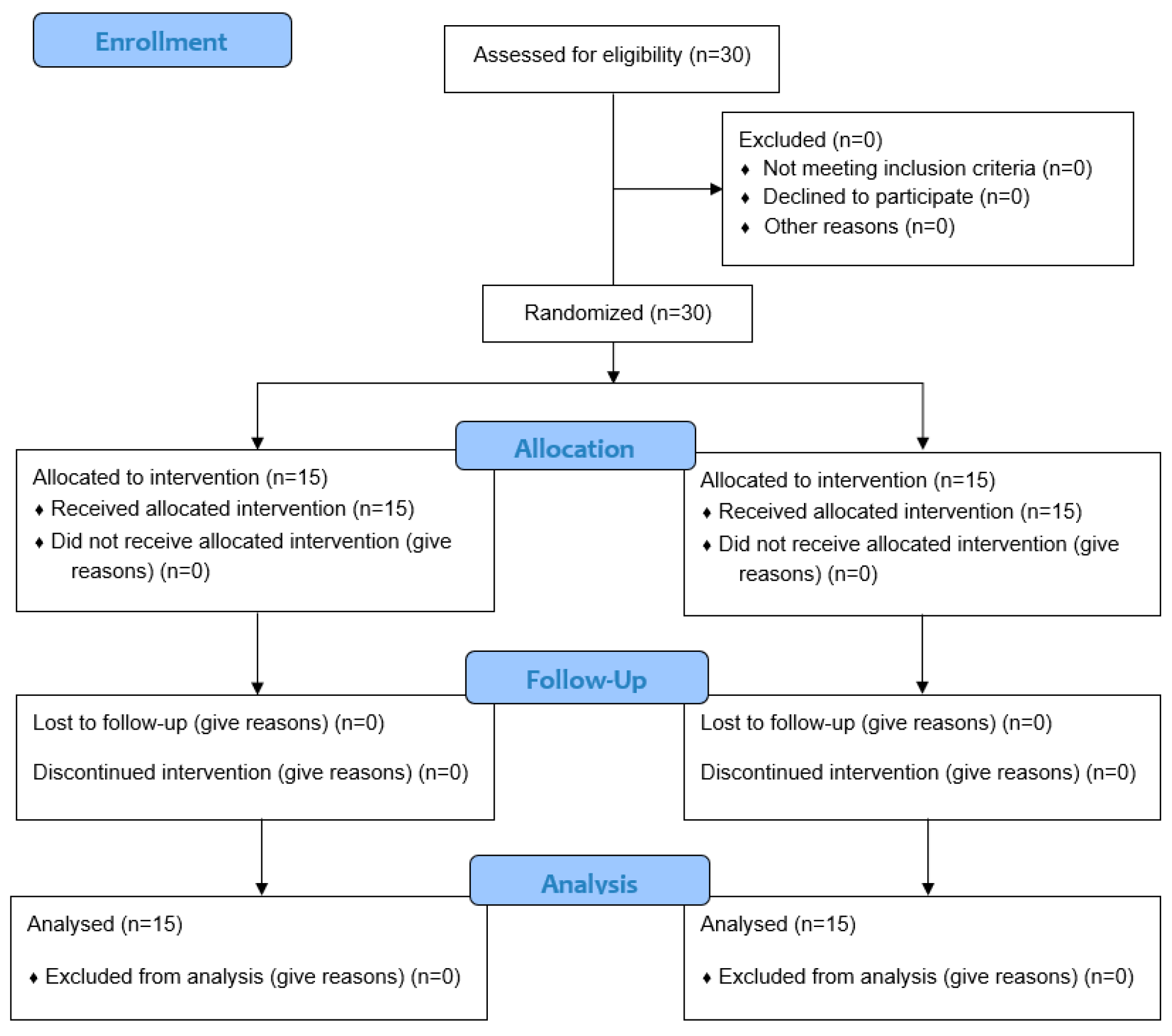
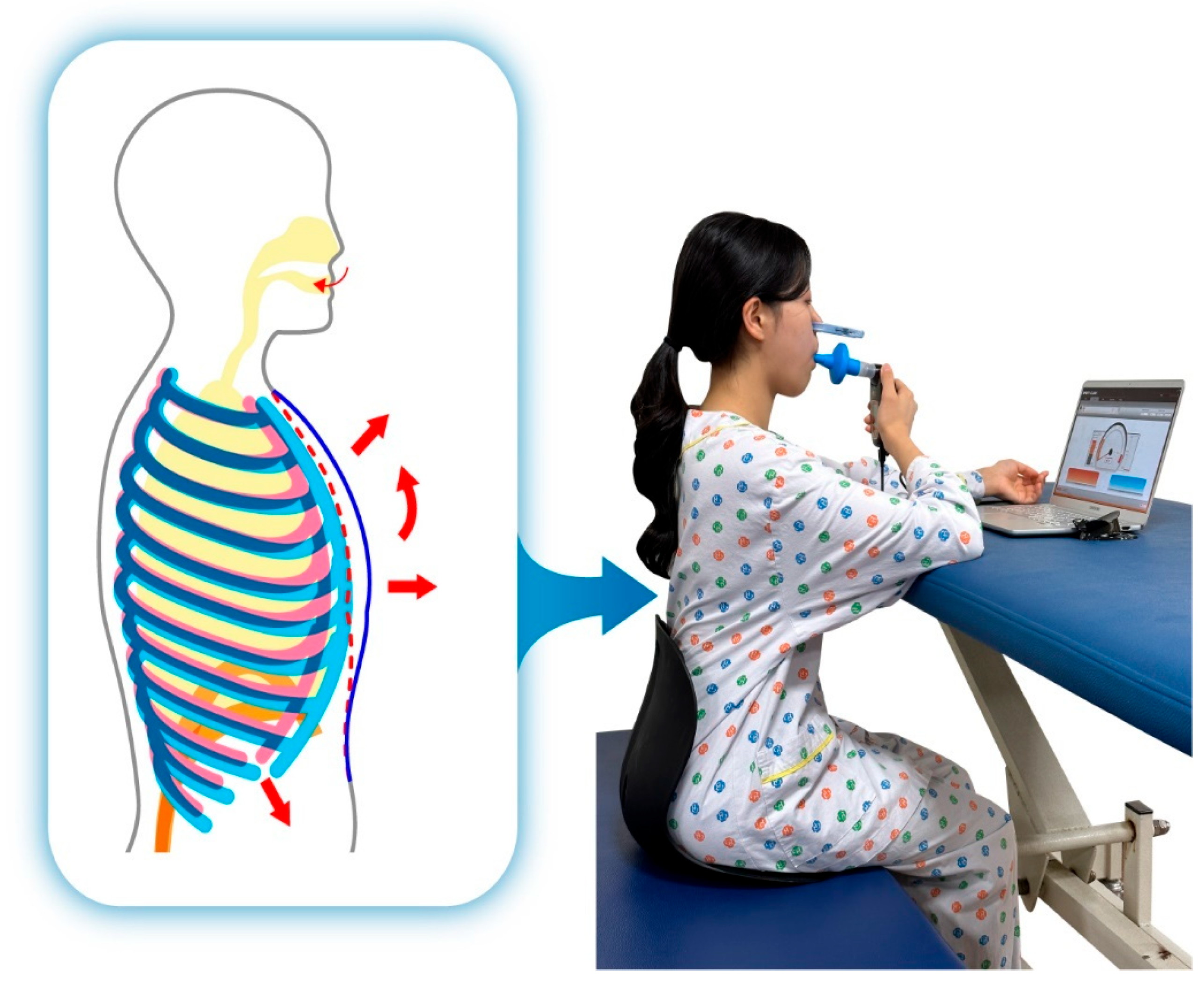
Effects of Trunk Extension-Based Inspiratory Muscle Strengthening on Respiratory Function, Balance, and Gait in Patients with Stroke: A Randomized Controlled Trial

Abstract
1. Introduction
2. Materials and Methods
2.1. Participants
2.2. Intervention
2.3. Measurement
2.4. Statistical Analysis
3. Results
3.1. General Characteristics of the Patients
3.2. Comparison of Respiratory Function
3.3. Comparison of the Balance Ability
3.4. Comparison of the Gait Ability
4. Discussion
5. Study Limitations
6. Conclusions
Author Contributions
Funding
Institutional Review Board Statement
Informed Consent Statement
Data Availability Statement
Conflicts of Interest
References
- Teixeira-Salmela, L.F.; Parreira, V.F.; Britto, R.R.; Brant, T.C.; Inácio, É.P.; Alcântara, T.O.; Carvalho, I.F. Respiratory pressures and thoracoabdominal motion in community-dwelling chronic stroke survivors. Arch. Phys. Med. Rehabil. 2005, 86, 1974–1978. [Google Scholar] [CrossRef] [Scilit] [PubMed]
- Fugl-Meyer, A.R.; Linderholm, H.; Wilson, A.F. Restrictive ventilatory dysfunction in stroke: Its relation to locomotor function. Scand. J. Rehabil. Med. Suppl. 1983, 9, 118–124. [Google Scholar]
- Azevedo, I.G.; Sousa, S.L.D.O.; Viana, E.D.S.R.; Dantas, D.D.S.; Maciel, Á.C.C.; Da Câmara, S.M.A. Relationship between symptomatic pelvic organ prolapse and respiratory muscle strength in middle-aged and older women in Northeast Brazil: A cross-sectional study. Physiother. Theory Pract. 2021, 37, 755–761. [Google Scholar] [CrossRef] [Scilit]
- Dunsky, A. The effect of balance and coordination exercises on quality of life in older adults: A mini-review. Front. Aging Neurosci. 2019, 11, 318. [Google Scholar] [CrossRef] [Scilit]
- Rodrigues, G.D.; Gurgel, J.L.; Galdino, I.d.S.; da Nóbrega, A.C.L.; Soares, P.P.d.S. Inspiratory muscle training improves cerebrovascular and postural control responses during orthostatic stress in older women. Eur. J. Appl. Physiol. 2020, 120, 2171–2181. [Google Scholar] [CrossRef] [Scilit]
- Tayashiki, K.; Takai, Y.; Maeo, S.; Kanehisa, H. Intra-abdominal pressure and trunk muscular activities during abdominal bracing and hollowing. Int. J. Sports Med. 2016, 37, 134–143. [Google Scholar] [CrossRef] [Scilit]
- Verheyden, G.; Ruesen, C.; Gorissen, M.; Brumby, V.; Moran, R.; Burnett, M.; Ashburn, A. Postural alignment is altered in people with chronic stroke and related to motor and functional performance. J. Neurol. Phys. Ther. 2014, 38, 239–245. [Google Scholar] [CrossRef] [Scilit] [PubMed]
- Dickstein, R.; Sheffi, S.; Haim, Z.B.; Shabtai, E.; Markovici, E. Activation of flexor and extensor trunk muscles in hemiparesis. Am. J. Phys. Med. Rehabil. 2000, 79, 228–234. [Google Scholar] [CrossRef] [Scilit] [PubMed]
- Lima, Í.N.; Fregonezi, G.A.; Melo, R.; Cabral, E.E.; Aliverti, A.; Campos, T.F.; Ferreira, G.M. Acute effects of volume-oriented incentive spirometry on chest wall volumes in patients after a stroke. Respir. Care 2014, 59, 1101–1107. [Google Scholar] [CrossRef] [Scilit]
- Britto, R.R.; Rezende, N.R.; Marinho, K.C.; Torres, J.L.; Parreira, V.F.; Teixeira-Salmela, L.F. Inspiratory muscular training in chronic stroke survivors: A randomized controlled trial. Arch. Phys. Med. Rehabil. 2011, 92, 184–190. [Google Scholar] [CrossRef] [Scilit]
- Dall’Ago, P.; Chiappa, G.R.; Guths, H.; Stein, R.; Ribeiro, J.P. Inspiratory muscle training in patients with heart failure and inspiratory muscle weakness: A randomized trial. J. Am. Coll. Cardiol. 2006, 47, 757–763. [Google Scholar] [CrossRef] [Scilit]
- Sutbeyaz, S.T.; Koseoglu, F.; Inan, L.; Coskun, O. Respiratory muscle training improves cardiopulmonary function and exercise tolerance in subjects with subacute stroke: A randomized controlled trial. Clin. Rehabil. 2010, 24, 240–250. [Google Scholar] [PubMed]
- Xiao, Y.; Luo, M.; Wang, J.; Luo, H. Inspiratory muscle training for the recovery of function after stroke. Cochrane Database Syst. Rev. 2012, 2012, CD009360. [Google Scholar] [CrossRef] [Scilit]
- Downey, A.E.; Chenoweth, L.M.; Townsend, D.K.; Ranum, J.D.; Ferguson, C.S.; Harms, C.A. Effects of inspiratory muscle training on exercise responses in normoxia and hypoxia. Respir. Physiol. Neurobiol. 2007, 156, 137–146. [Google Scholar] [CrossRef] [Scilit]
- Petrovic, M.; Lahrmann, H.; Pohl, W.; Wanke, T. Idiopathic diaphragmatic paralysis—Satisfactory improvement of inspiratory muscle function by inspiratory muscle training. Respir. Physiol. Neurobiol. 2009, 165, 266–267. [Google Scholar] [CrossRef] [Scilit]
- Illi, S.K.; Held, U.; Frank, I.; Spengler, C.M. Effect of respiratory muscle training on exercise performance in healthy individuals: A systematic review and meta-analysis. Sports Med. 2012, 42, 707–724. [Google Scholar] [CrossRef] [Scilit]
- Griffiths, L.A.; McConnell, A.K. The influence of inspiratory and expiratory muscle training upon rowing performance. Eur. J. Appl. Physiol. 2007, 99, 457–466. [Google Scholar] [CrossRef] [Scilit] [PubMed]
- Nason, L.K.; Walker, C.M.; McNeeley, M.F.; Burivong, W.; Fligner, C.L.; Godwin, J.D. Imaging of the diaphragm: Anatomy and function. Radiographics 2012, 32, E51–E70. [Google Scholar] [CrossRef] [Scilit]
- Develi, E.; Subasi, F.; Aslan, G.K.; Bingol, Z. The effects of core stabilization training on dynamic balance and pulmonary parameters in patients with asthma. J. Back Musculoskelet. Rehabil. 2021, 34, 639–648. [Google Scholar] [CrossRef] [Scilit] [PubMed]
- MacKay-Lyons, M.J.; Makrides, L. Exercise capacity early after stroke. Arch. Phys. Med. Rehabil. 2002, 83, 1697–1702. [Google Scholar] [CrossRef] [Scilit]
- Koppers, R.J.; Vos, P.J.; Boot, C.R.; Folgering, H.T.M. Exercise performance improves in patients with COPD due to respiratory muscle endurance training. Chest 2006, 129, 886–892. [Google Scholar] [CrossRef] [Scilit]
- Sezer, N.; Kutay Ordu, N.; Tomruk Sutheyaz, S.; Fusun Koseoglu, B. Cardiopulmonary and metabolic responses to maximum exercise and aerobic capacity in hemiplegic patients. Funct. Neurol. 2004, 19, 233–238. [Google Scholar]
- Aydoğan Arslan, S.; Uğurlu, K.; Sakizli Erdal, E.; Keskin, E.D.; Demirgüç, A. Effects of inspiratory muscle training on respiratory muscle strength, trunk control, balance and functional capacity in stroke patients: A single-blinded randomized controlled study. Top. Stroke Rehabil. 2022, 29, 40–48. [Google Scholar] [CrossRef] [Scilit] [PubMed]
- An, K.-B.; Jeon, H.-J.; Chang, W.-N. Effects of Inspiratory Muscle Training on Respiration and Balance in Patients with Stroke: A Pilot Randomized Controlled Trial. Exerc. Sci. 2022, 31, 181–187. [Google Scholar] [CrossRef] [Scilit]
- Faul, F.; Erdfelder, E.; Lang, A.-G.; Buchner, A. G* Power 3: A flexible statistical power analysis program for the social, behavioral, and biomedical sciences. Behav. Res. Methods 2007, 39, 175–191. [Google Scholar] [CrossRef] [Scilit] [PubMed]
- Weir, C.J.; Lees, K.R. Comparison of stratification and adaptive methods for treatment allocation in an acute stroke clinical trial. Stat. Med. 2003, 22, 705–726. [Google Scholar] [CrossRef] [Scilit]
- Campbell, M.K.; Elbourne, D.R.; Altman, D.G. CONSORT statement: Extension to cluster randomised trials. BMJ 2004, 328, 702–708. [Google Scholar] [CrossRef] [Scilit]
- Lee, K.-B.; Kim, M.-K.; Jeong, J.-R.; Lee, W.-H. Reliability of an electronic inspiratory loading device for assessing pulmonary function in post-stroke patients. Med. Sci. Monit. Int. Med. J. Exp. Clin. Res. 2016, 22, 191–196. [Google Scholar] [CrossRef] [Scilit]
- Berg, K.; Wood-Dauphinee, S.; Williams, J. The Balance Scale: Reliability assessment with elderly residents and patients with an acute stroke. Scand. J. Rehabil. Med. 1995, 27, 27–36. [Google Scholar] [CrossRef] [Scilit]
- Morris, S.; Morris, M.E.; Iansek, R. Reliability of measurements obtained with the Timed “Up & Go” test in people with Parkinson disease. Phys. Ther. 2001, 81, 810–818. [Google Scholar] [CrossRef] [Scilit]
- Dobkin, B.H. Short-distance walking speed and timed walking distance: Redundant measures for clinical trials? Neurology 2006, 66, 584–586. [Google Scholar] [CrossRef] [Scilit]
- Van Loo, M.; Moseley, A.; Bosman, J.; De Bie, R.; Hassett, L. Test–re-test reliability of walking speed, step length and step width measurement after traumatic brain injury: A pilot study. Brain Inj. 2004, 18, 1041–1048. [Google Scholar] [CrossRef] [Scilit]
- Kubo, H.; Nozoe, M.; Yamamoto, M.; Kamo, A.; Noguchi, M.; Kanai, M.; Mase, K.; Shimada, S. Recovery process of respiratory muscle strength in patients following stroke: A Pilot Study. Phys. Ther. Res. 2020, 23, 123–131. [Google Scholar] [CrossRef] [Scilit]
- Lanini, B.; Bianchi, R.; Romagnoli, I.; Coli, C.; Binazzi, B.; Gigliotti, F.; Pizzi, A.; Grippo, A.; Scano, G. Chest wall kinematics in patients with hemiplegia. Am. J. Respir. Crit. Care Med. 2003, 168, 109–113. [Google Scholar] [CrossRef] [Scilit]
- Narain, S.; Puckree, T. Pulmonary function in hemiplegia. Int. J. Rehabil. Res. 2002, 25, 57–59. [Google Scholar] [CrossRef] [Scilit]
- Zhang, X.; Zheng, Y.; Dang, Y.; Wang, L.; Cheng, Y.; Zhang, X.; Mao, M.; Lu, X. Can inspiratory muscle training benefit patients after stroke? A systematic review and meta-analysis of randomized controlled trials. Clin. Rehabil. 2020, 34, 866–876. [Google Scholar] [CrossRef] [Scilit]
- Pozuelo-Carrascosa, D.P.; Carmona-Torres, J.M.; Laredo-Aguilera, J.A.; Latorre-Román, P.Á.; Párraga-Montilla, J.A.; Cobo-Cuenca, A.I. Effectiveness of respiratory muscle training for pulmonary function and walking ability in patients with stroke: A systematic review with meta-analysis. Int. J. Environ. Res. Public Health 2020, 17, 5356. [Google Scholar] [CrossRef] [Scilit]
- Messaggi-Sartor, M.; Guillen-Solà, A.; Depolo, M.; Duarte, E.; Rodríguez, D.A.; Barrera, M.-C.; Barreiro, E.; Escalada, F.; Orozco-Levi, M.; Marco, E. Inspiratory and expiratory muscle training in subacute stroke: A randomized clinical trial. Neurology 2015, 85, 564–572. [Google Scholar] [CrossRef] [Scilit] [PubMed]
- Kim, J.; Park, J.H.; Yim, J. Effects of respiratory muscle and endurance training using an individualized training device on pulmonary function and exercise capacity in stroke patients. Med. Sci. Monit. Int. Med. J. Exp. Clin. Res. 2014, 20, 2543–2549. [Google Scholar] [CrossRef] [Scilit]
- Yoo, H.-J.; Pyun, S.-B. Efficacy of bedside respiratory muscle training in patients with stroke: A randomized controlled trial. Am. J. Phys. Med. Rehabil. 2018, 97, 691–697. [Google Scholar] [CrossRef] [Scilit] [PubMed]
- Alfieri, F.M.; Riberto, M.; Lopes, J.A.F.; Filippo, T.R.; Imamura, M.; Battistella, L.R. Postural control of healthy elderly individuals compared to elderly individuals with stroke sequelae. Open Neurol. J. 2016, 10, 1–8. [Google Scholar] [CrossRef] [Scilit]
- Jung, N.-J.; Na, S.-S.; Kim, S.-K.; Hwangbo, G. The effect of the inspiratory muscle training on functional ability in stroke patients. J. Phys. Ther. Sci. 2017, 29, 1954–1956. [Google Scholar] [CrossRef] [Scilit] [PubMed]
- de Almeida, I.C.L.; Clementino, A.C.C.R.; Rocha, E.H.T.; Brandão, D.C.; de Andrade, A.D. Effects of hemiplegy on pulmonary function and diaphragmatic dome displacement. Respir. Physiol. Neurobiol. 2011, 178, 196–201. [Google Scholar] [CrossRef] [Scilit]
- Hodges, P.W.; Gandevia, S.C. Changes in intra-abdominal pressure during postural and respiratory activation of the human diaphragm. J. Appl. Physiol. 2000, 89, 967–976. [Google Scholar] [CrossRef] [Scilit] [PubMed]
- Saunders, S.W.; Rath, D.; Hodges, P.W. Postural and respiratory activation of the trunk muscles changes with mode and speed of locomotion. Gait Posture 2004, 20, 280–290. [Google Scholar] [CrossRef] [Scilit]
- Dorsch, S.; Ada, L.; Canning, C.G.; Al-Zharani, M.; Dean, C. The strength of the ankle dorsiflexors has a significant contribution to walking speed in people who can walk independently after stroke: An observational study. Arch. Phys. Med. Rehabil. 2012, 93, 1072–1076. [Google Scholar] [CrossRef] [Scilit]
- Ng, S.S.; Hui-Chan, C.W. Contribution of ankle dorsiflexor strength to walking endurance in people with spastic hemiplegia after stroke. Arch. Phys. Med. Rehabil. 2012, 93, 1046–1051. [Google Scholar] [CrossRef] [Scilit]
- Verheyden, G.; Vereeck, L.; Truijen, S.; Troch, M.; Herregodts, I.; Lafosse, C.; Nieuwboer, A.; De Weerdt, W. Trunk performance after stroke and the relationship with balance, gait and functional ability. Clin. Rehabil. 2006, 20, 451–458. [Google Scholar] [CrossRef] [Scilit]
- Lee, K.; Park, D.; Lee, G. Progressive respiratory muscle training for improving trunk stability in chronic stroke survivors: A pilot randomized controlled trial. J. Stroke Cerebrovasc. Dis. 2019, 28, 1200–1211. [Google Scholar] [CrossRef] [Scilit]
- Yoon, H.S.; Cha, Y.J.; You, J.S.H. Effects of dynamic core-postural chain stabilization on diaphragm movement, abdominal muscle thickness, and postural control in patients with subacute stroke: A randomized control trial. NeuroRehabilitation 2020, 46, 381–389. [Google Scholar] [CrossRef] [Scilit] [PubMed]
- Frank, C.; Kobesova, A.; Kolar, P. Dynamic neuromuscular stabilization & sports rehabilitation. Int. J. Sports Phys. Ther. 2013, 8, 62–73. [Google Scholar]
- Jiroumaru, T.; Wachi, M.; Noguchi, S.; Ikeya, M.; Hattori, T.; Fujitani, R.; Suzuki, M.; Tanida, S.; Shichiri, N.; Fujikawa, T. Is the diaphragm thickness related to gait speed in patients with hemiplegia caused by cerebrovascular accident? J. Phys. Ther. Sci. 2021, 33, 450–454. [Google Scholar] [CrossRef] [Scilit] [PubMed]
- Courbon, A.; Calmels, P.; Roche, F.; Ramas, J.; Rimaud, D.; Fayolle-Minon, I. Relationship between maximal exercise capacity and walking capacity in adult hemiplegic stroke patients. Am. J. Phys. Med. Rehabil. 2006, 85, 436–442. [Google Scholar] [CrossRef] [Scilit] [PubMed]



| Variables | SG | CG | x/t2 | p |
|---|---|---|---|---|
| (n = 15) | (n = 15) | |||
| Gender (M/F, %) | 8/7 (53.3/46.7) | 8/7 (53.3/46.7) | 0.000 b | 1.000 |
| Paretic side (R/L, %) | 7/8 (46.7/53.3) | 7/8 (46.7/53.3) | 0.000 | 1.000 |
| Diagnosis (ICH/IS, %) | 9/6 (60/40) | 9/6 (60/40) | 0.000 | 1.000 |
| Age (years) | 54.33 ± 11.61 a | 53.20 ± 15.68 | 0.225 c | 0.824 |
| Height (cm) | 164.37 ± 7.40 | 166.40 ± 6.59 | 0.756 | 0.456 |
| Weight (kg) | 61.49 ± 9.49 | 62.87 ± 8.28 | 0.442 | 0.676 |
| Onset (months) | 15.13 ± 6.68 | 12.67 ± 6.23 | 1.046 | 0.304 |
| BMI (kg/m2) | 22.66 ± 2.49 | 22.64 ± 6.23 | 0.015 | 0.988 |
| MMSE-K (score) | 28.20 ± 1.37 | 27.93 ± 2.05 | 0.418 | 0.679 |
| Variables | SG | CG | t | p |
|---|---|---|---|---|
| (n = 15) | (n = 15) | |||
| MIP | 41.65 ± 11.57 a | 37.24 ± 8.34 | 1.196 b | 0.242 |
| MIFR | 2.28 ± 0.74 | 2.01 ± 0.51 | 1.154 | 0.258 |
| MIV | 1.04 ± 0.28 | 1.27 ± 0.44 | 1.668 | 0.109 |
| PEF | 308.27 ± 100.54 | 300.89 ± 104.89 | 0.197 | 0.846 |
| FEV1 | 1.89 ± 0.56 | 1.86 ± 0.65 | 0.118 | 0.907 |
| BBS | 42.67 ± 5.22 | 41.40 ± 5.32 | 0.659 | 0.516 |
| WDR | 22.32 ± 11.84 | 16.50 ± 9.19 | 1.503 | 0.144 |
| LOS | 33.74 ± 24.75 | 31.92 ± 26.31 | 0.195 | 0.847 |
| TUG | 56.62 ± 27.72 | 57.12 ± 35.49 | 0.315 | 0.965 |
| Gait velocity | 0.24 ± 0.15 | 0.27 ± 0.17 | 0.209 | 0.836 |
| Cadence | 60.01 ± 18.16 | 63.39 ± 23.88 | 0.437 | 0.666 |
| Stride length | 45.65 ± 16.49 | 47.05 ± 15.09 | 0.242 | 0.810 |
| Variable | Group | Pre | Post | Change (Post-Pre) | b Within-Group p | c Between-Group p |
|---|---|---|---|---|---|---|
| MIP (cm H2O) | SG (n = 15) | 41.65 ± 11.57 a | 53.53 ± 9.40 | 11.88 ± 12.01 | 0.002 | 0.002 |
| CG (n = 15) | 37.24 ± 8.34 | 36.67 ± 5.65 | −0.58 ± 7.57 | 0.773 | ||
| MIFR (L/s) | SG | 2.28 ± 0.74 | 3.07 ± 0.55 | 0.79 ± 0.75 | 0.001 | 0.001 |
| CG | 2.01 ± 0.51 | 1.97 ± 0.37 | −0.04 ± 0.42 | 0.702 | ||
| MIV (L) | SG | 1.04 ± 0.27 | 1.31 ± 0.28 | 0.27 ± 0.40 | 0.021 | 0.038 |
| CG | 1.27 ± 0.44 | 1.22 ± 0.42 | −0.04 ± 0.39 | 0.67 | ||
| PEF (L/min) | SG | 308.27 ± 100.54 | 355.33 ± 87.58 | 47.06 ± 82.52 | 0.044 | 0.045 |
| CG | 300.89 ± 104.89 | 299.89 ± 100.88 | −1.00 ± 22.59 | 0.866 | ||
| FEV1 (L) | SG | 1.89 ± 0.56 | 2.34 ± 0.71 | 0.45 ± 0.67 | 0.02 | 0.044 |
| CG | 1.86 ± 0.65 | 1.87 ± 0.70 | 0.00 ± 0.49 | 0.891 |
| Variable | Group | Pre | Post | Change (Post-Pre) | b Within-Group p | c Between-Group p |
|---|---|---|---|---|---|---|
| WDR (%) | SG (n = 15) | 22.32 ± 11.84 a | 11.29 ± 8.38 | −11.03 ± 9.56 | 0.001 | 0.003 |
| CG (n = 15) | 16.51 ± 9.19 | 14.16 ± 9.01 | −2.34 ± 4.02 | 0.041 | ||
| LOS (cm2) | SG | 33.74 ± 24.75 | 44.14 ± 27.94 | 10.40 ± 12.75 | 0.007 | 0.048 |
| CG | 31.92 ± 26.31 | 34.19 ± 24.81 | 2.27 ± 8.27 | 0.306 | ||
| BBS (score) | SG | 42.67 ± 5.22 | 46.80 ± 4.57 | 4.13 ± 2.13 | <0.001 | 0.018 |
| CG | 41.40 ± 5.32 | 43.27 ± 4.70 | 1.87 ± 2.77 | 0.021 |
| Variable | Group | Pre | Post | Change (Post-Pre) | b Within-Group p | c Between-Group p |
|---|---|---|---|---|---|---|
| TUG (s) | SG (n = 15) | 56.51 ± 27.72 a | 52.75 ± 30.92 | −3.87 ± 6.40 | 0.035 | 0.972 |
| CG (n = 15) | 57.13 ± 35.49 | 53.35 ± 32.43 | −3.78 ± 6.77 | 0.048 | ||
| Gait velocity (m/s) | SG | 0.24 ± 0.15 | 0.30 ± 0.20 | 0.05 ± 0.07 | 0.011 | 0.123 |
| CG | 0.27 ± 0.17 | 0.29 ± 0.19 | 0.02 ± 0.06 | 0.274 | ||
| Cadence (steps/min) | SG | 60.01 ± 18.16 | 63.41 ± 19.74 | 3.30 ± 5.92 | 0.043 | 0.154 |
| CG | 63.39 ± 23.88 | 63.50 ± 24.34 | 0.12 ± 6.36 | 0.944 | ||
| Stride length (cm) | SG | 46.65 ± 16.49 | 51.63 ± 21.05 | 5.98 ± 7.00 | 0.005 | 0.304 |
| CG | 47.05 ± 15.09 | 50.38 ± 16.89 | 3.33 ± 6.84 | 0.08 |
Disclaimer/Publisher’s Note: The statements, opinions and data contained in all publications are solely those of the individual author(s) and contributor(s) and not of MDPI and/or the editor(s). MDPI and/or the editor(s) disclaim responsibility for any injury to people or property resulting from any ideas, methods, instructions or products referred to in the content. |
© 2026 by the authors. Licensee MDPI, Basel, Switzerland. This article is an open access article distributed under the terms and conditions of the Creative Commons Attribution (CC BY) license.
Share and Cite
An, K.-B.; Jeon, H.-J.; Choi, Y.-S.; Lee, S.-Y.; Chang, W.-N. Effects of Trunk Extension-Based Inspiratory Muscle Strengthening on Respiratory Function, Balance, and Gait in Patients with Stroke: A Randomized Controlled Trial. J. Clin. Med. 2026, 15, 2017. https://doi.org/10.3390/jcm15052017
An K-B, Jeon H-J, Choi Y-S, Lee S-Y, Chang W-N. Effects of Trunk Extension-Based Inspiratory Muscle Strengthening on Respiratory Function, Balance, and Gait in Patients with Stroke: A Randomized Controlled Trial. Journal of Clinical Medicine. 2026; 15(5):2017. https://doi.org/10.3390/jcm15052017
Chicago/Turabian StyleAn, Kwang-Bin, Hye-Joo Jeon, Yu-Sik Choi, Soo-Yong Lee, and Woo-Nam Chang. 2026. "Effects of Trunk Extension-Based Inspiratory Muscle Strengthening on Respiratory Function, Balance, and Gait in Patients with Stroke: A Randomized Controlled Trial" Journal of Clinical Medicine 15, no. 5: 2017. https://doi.org/10.3390/jcm15052017
APA StyleAn, K.-B., Jeon, H.-J., Choi, Y.-S., Lee, S.-Y., & Chang, W.-N. (2026). Effects of Trunk Extension-Based Inspiratory Muscle Strengthening on Respiratory Function, Balance, and Gait in Patients with Stroke: A Randomized Controlled Trial. Journal of Clinical Medicine, 15(5), 2017. https://doi.org/10.3390/jcm15052017