Femoral Plaque Burden and Left Ventricular–Arterial Coupling in Patients with Chronic Heart Failure

Abstract
1. Introduction
2. Materials and Methods
2.1. Laboratory Study
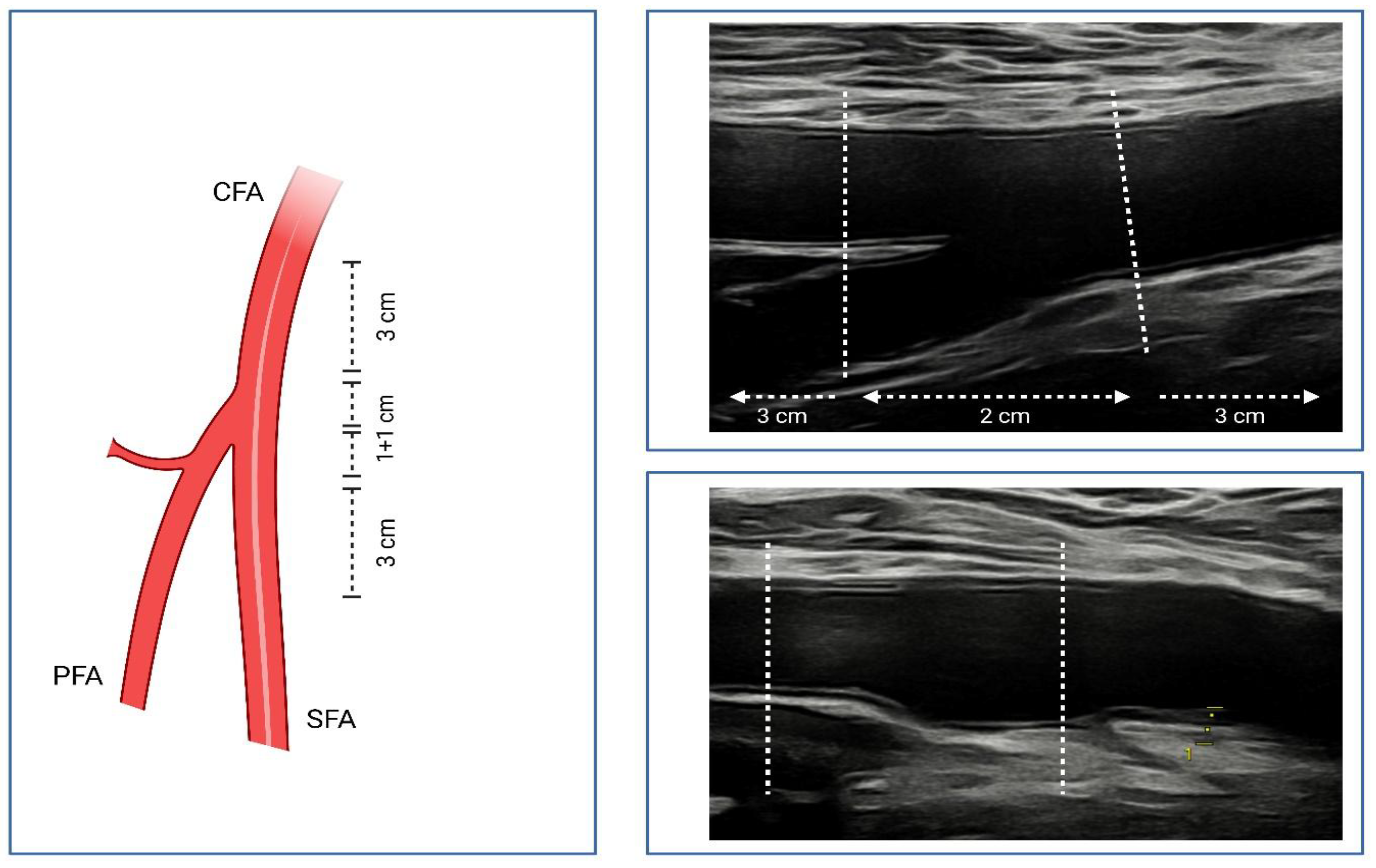
2.2. Duplex Ultrasound Scanning of the Lower Extremity Arteries
2.3. Echocardiography
2.4. Statistical Analysis
3. Results
4. Discussion
5. Conclusions
Author Contributions
Funding
Institutional Review Board Statement
Informed Consent Statement
Data Availability Statement
Conflicts of Interest
References
- Kim, M.S.; Hwang, J.; Yon, D.K.; Lee, S.W.; Jung, S.Y.; Park, S.; Johnson, C.O.; Stark, B.A.; Razo, C.; Abbasian, M.; et al. GBD 2019 Peripheral Artery Disease Collaborators. Global burden of peripheral artery disease and its risk factors, 1990–2019: A systematic analysis for the Global Burden of Disease Study 2019. Lancet Glob. Health 2023, 11, e1553–e1565. [Google Scholar] [CrossRef]
- Criqui, M.H.; Matsushita, K.; Aboyans, V.; Hess, C.N.; Hicks, C.W.; Kwan, T.W.; McDermott, M.M.; Misra, S.; Ujueta, F.; American Heart Association Council on Epidemiology and Prevention; et al. Lower extremity peripheral artery disease: Contemporary epidemiology, management gaps, and future directions: A scientific statement from the American Heart Association. Circulation 2021, 144, e171–e191. [Google Scholar] [CrossRef] [PubMed]
- Aboyans, V.; Canonico, M.E.; Chastaingt, L.; Anand, S.S.; Brodmann, M.; Couffinhal, T.; Criqui, M.H.; Debus, E.S.; Mazzolai, L.; McDermott, M.M.; et al. Peripheral artery disease. Nat. Rev. Dis. Primers 2025, 11, 68. [Google Scholar] [CrossRef]
- Behroozian, A.A.; Beckman, J.A. Asymptomatic peripheral artery disease: Silent but deadly. Prog. Cardiovasc. Dis. 2021, 65, 2–8. [Google Scholar] [CrossRef] [PubMed]
- Colledanchise, K.N.; Mantella, L.E.; Bullen, M.; Hétu, M.F.; Abunassar, J.G.; Johri, A.M. Combined femoral and carotid plaque burden identifies obstructive coronary artery disease in women. J. Am. Soc. Echocardiogr. 2020, 33, 90–100. [Google Scholar] [CrossRef] [PubMed]
- Korosoglou, G.; Maylar, N. Looking to the femoral rather than the carotid bifurcation to predict obstructive coronary artery disease? Int. J. Cardiovasc. Imaging 2021, 37, 2975–2977. [Google Scholar] [CrossRef]
- Ibrahim, N.E.; Song, Y.; Cannon, C.P.; Doros, G.; Russo, P.; Ponirakis, A.; Alexanian, C.; Januzzi, J.L., Jr. Heart failure with mid-range ejection fraction: Characterization of patients from the PINNACLE Registry®. ESC Heart Fail. 2019, 6, 784–792. [Google Scholar] [CrossRef]
- da Cunha, G.R.; Brugnarotto, R.J.; Halal, V.A.E.; Menezes, M.G.; Bartholomay, E.; Albuquerque, L.C.; Danzmann, L.C. Prevalence of peripheral arterial disease in patients with heart failure with preserved ejection fraction. Clinics 2019, 74, e978. [Google Scholar] [CrossRef]
- Prasada, S.; Shah, S.J.; Michos, E.D.; Polak, J.F.; Greenland, P. Ankle-brachial index and incident heart failure with reduced versus preserved ejection fraction: The Multi-Ethnic Study of Atherosclerosis. Vasc. Med. 2019, 24, 501–510. [Google Scholar] [CrossRef]
- Verma, S.; Dhingra, N.K.; Bonaca, M.P.; Butler, J.; Anker, S.D.; Ferreira, J.P.; Filippatos, G.; Januzzi, J.L.; Lam, C.S.P.; Sattar, N.; et al. Presence of Peripheral Artery Disease Is Associated with Increased Risk of Heart Failure Events: Insights From EMPEROR-Pooled. Arter. Thromb. Vasc. Biol. 2023, 43, 1334–1337. [Google Scholar] [CrossRef]
- Nishimura, H.; Miura, T.; Minamisawa, M.; Ueki, Y.; Abe, N.; Hashizume, N.; Mochidome, T.; Harada, M.; Shimizu, K.; Shoin, W.; et al. Prognostic value of ankle brachial index for future incident heart failure in patients without previous heart failure: Data from the Impressive Predictive Value of Ankle Brachial Index for Clinical Long Term Outcome in Patients with Cardiovascular Disease Examined by ABI Study. Heart Vessel. 2017, 32, 295–302. [Google Scholar] [CrossRef]
- McDonagh, T.A.; Metra, M.; Adamo, M.; Gardner, R.S.; Baumbach, A.; Böhm, M.; Burri, H.; Butler, J.; Čelutkienė, J.; Chioncel, O.; et al. 2021 ESC Guidelines for the Diagnosis and Treatment of Acute and Chronic Heart Failure: Developed by the Task Force for the Diagnosis and Treatment of Acute and Chronic Heart Failure of the European Society of Cardiology (ESC). With the Special Contribution of the Heart Failure Association (HFA) of the ESC. Eur. J. Heart Fail. 2022, 24, 4–131. [Google Scholar] [CrossRef] [PubMed]
- Galyavich, A.S.; Tereshchenko, S.N.; Uskach, T.M.; Ageev, F.T.; Aronov, D.M.; Arutyunov, G.P.; Begrambekova, Y.L.; Belenkov, Y.N.; Boytsov, S.A.; Bubnova, M.G.; et al. 2024 Clinical Practice Guidelines for Chronic Heart Failure. Russ. J. Cardiol. 2024, 29, 6162. (In Russian) [Google Scholar] [CrossRef]
- Szabóová, E.; Lisovszki, A.; Rajnič, A.; Kolarčik, P.; Szabó, P.; Molnár, T.; Dekanová, L. Subclinical Atherosclerosis Progression in Low-Risk, Middle-Aged Adults: Carotid Leads Femoral in IMT Increase but Not in Plaque Formation. J. Cardiovasc. Dev. Dis. 2024, 11, 271. [Google Scholar] [CrossRef] [PubMed]
- Nicolaides, A.N.; Panayiotou, A.G.; Griffin, M.; Tyllis, T.; Bond, D.; Georgiou, N.; Kyriacou, E.; Avraamides, C.; Martin, R.M. Arterial ultrasound testing to predict atherosclerotic cardiovascular events. J. Am. Coll. Cardiol. 2022, 79, 1969–1982. [Google Scholar] [CrossRef]
- Akazawa, S.; Tojikubo, M.; Nakano, Y.; Nakamura, S.; Tamai, H.; Yonemoto, K.; Sadasima, E.; Kawasaki, T.; Koga, N. Usefulness of carotid plaque (sum and maximum of plaque thickness) in combination with intima-media thickness for the detection of coronary artery disease in asymptomatic patients with diabetes. J. Diabetes Investig. 2016, 7, 396–403. [Google Scholar] [CrossRef]
- Mazzolai, L.; Teixido-Tura, G.; Lanzi, S.; Boc, V.; Bossone, E.; Brodmann, M.; Bura-Rivière, A.; De Backer, J.; Deglise, S.; Della Corte, A.; et al. 2024 ESC Guidelines for the management of peripheral arterial and aortic diseases. Eur. Heart J. 2024, 45, 3538–3700. [Google Scholar] [CrossRef]
- Nagueh, N.F.; Smiseth, O.A.; Appleton, C.P.; Byrd, B.F.; Dokainish, H.; Edvardsen, T.; Flachskampf, F.A.; Gillebert, T.C.; Klein, A.L.; Lancellotti, P.; et al. Recommendations for the evaluation of left ventricular diastolic function by echocardiography: An update from the American Society of Echocardiography and the European Association of Cardiovascular Imaging. J. Am. Soc. Echocardiogr. 2016, 29, 277–314. [Google Scholar] [CrossRef]
- Lang, R.M.; Badano, L.P.; Mor-Avi, V.; Afilalo, J.; Armstrong, A.; Ernande, L.; Flachskampf, F.A.; Foster, E.; Goldstein, S.A.; Kuznetsova, T.; et al. Recommendations for cardiac chamber quantification by echocardiography in adults: An update from the American Society of Echocardiography and the European Association of Cardiovascular Imaging. J. Am. Soc. Echocardiogr. 2015, 28, 1–39. [Google Scholar] [CrossRef]
- Matskeplishvili, S.T.; Saidova, M.A.; Mironenko, M.Y.; Safarova, A.F.; Pavlyukova, E.N.; Boshchenko, A.A.; Yaroslavskaya, E.I.; Akhunova, S.Y.; Skidan, V.I.; Irtyuga, O.B.; et al. Standard transthoracic echocardiography. Guidelines 2024. Russ. J. Cardiol. 2025, 30, 6271. (In Russian) [Google Scholar] [CrossRef]
- Dons, M.; Jensen, J.S.; Olsen, F.J.; de Knegt, M.C.; Fritz-Hansen, T.; Vazir, A.; Biering-Sørensen, T. Global longitudinal strain corrected by RR-interval is a superior echocardiographic predictor of outcome in patients with atrial fibrillation. Int. J. Cardiol. 2018, 263, 42–47. [Google Scholar] [CrossRef] [PubMed]
- Liu, X.; Wang, J.; Tong, Y.; Wang, S. The power of the left atrioventricular coupling index in cardiovascular disease. Front. Cardiovasc. Med. 2025, 12, 1567856. [Google Scholar] [CrossRef] [PubMed]
- Dong, T.X.; Li, S.W.; Pan, X.F.; Wang, C.F.; Liu, Y.; Wu, J.; Guan, X.P.; Zhang, S.L.; Zuo, P.F.; Liu, Y.L.; et al. Normal values of echocardiographic left atrioventricular coupling index and left atrial stiffness index reflecting left ventricular diastolic function: A multicenter study. J. Am. Soc. Echocardiogr. 2025, 38, 794–803. [Google Scholar] [CrossRef] [PubMed]
- Alekhin, M.N. Two-Dimensional Speckle-Tracking Echocardiography for Assessment of Myocardial Deformation and Cardiac Chambers: Training Manual; Vidar-M Publishing House: Moscow, Russia, 2022; 112p. (In Russian) [Google Scholar]
- Badano, L.P.; Kolias, T.J.; Muraru, D.; Abraham, T.P.; Aurigemma, G.; Edvardsen, T.; D’Hooge, J.; Donal, E.; Fraser, A.G.; Marwick, T.; et al. Standardization of left atrial, right ventricular, and right atrial deformation imaging using two-dimensional speckle tracking echocardiography: A consensus document of the EACVI/ASE/Industry Task Force to standardize deformation imaging. Eur. Heart J. Cardiovasc. Imaging 2018, 19, 591–600. [Google Scholar] [CrossRef]
- Henein, M.Y.; Holmgren, A.; Lindqvist, P. Left atrial function in volume versus pressure overloaded left atrium. Int. J. Cardiovasc. Imaging 2015, 31, 959–965. [Google Scholar] [CrossRef]
- Zhu, S.; Lin, Y.; Zhang, Y.; Wang, G.; Qian, M.; Gao, L.; Ji, M.; Xie, M.; Li, Y.; Zhang, L. Prognostic relevance of left atrial function and stiffness in heart failure with preserved ejection fraction patients with and without diabetes mellitus. Front. Cardiovasc. Med. 2022, 9, 947639. [Google Scholar] [CrossRef]
- Shirkov, N.E.; Yaroslavskaya, E.I.; Kosterev, M.D.; Krinochkin, D.V.; Gorbunov, E.A.; Enina, T.N.; Musikhina, N.A. Left atrial stiffness index in determining heart failure with preserved ejection fraction. Cardiovasc. Ther. Prev. 2024, 23, 3901. (In Russian) [Google Scholar] [CrossRef]
- Drapkina, O.M.; Djioeva, O.N. Modern echocardiographic criteria for heart failure with preserved ejection fraction: Beyond just diastolic function. Cardiovasc. Ther. Prev. 2020, 19, 2454. (In Russian) [Google Scholar] [CrossRef]
- Guinot, P.G.; Andrei, S.; Longrois, D. Ventriculo-arterial coupling: From physiological concept to clinical application in peri-operative care and ICUs. Eur. J. Anaesthesiol. Intensive Care 2022, 1, e004. [Google Scholar] [CrossRef]
- Kobalava, Z.D.; Lukina, O.I.; Meray, I.; Villevalde, S.V. Ventricular-arterial coupling parameters and their prognostic significance in patients with decompensated heart failure. Russ. J. Cardiol. 2020, 25, 3695. (In Russian) [Google Scholar] [CrossRef]
- Holm, H.; Magnusson, M.; Jujić, A.; Pugliese, N.R.; Bozec, E.; Lamiral, Z.; Huttin, O.; Zannad, F.; Rossignol, P.; Girerd, N. Ventricular-arterial coupling (VAC) in a population-based cohort of middle-aged individuals: The STANISLAS cohort. Atherosclerosis 2023, 374, 11–20. [Google Scholar] [CrossRef] [PubMed]
- Mihaileanu, S.; Antohi, E.L. Revisiting the relationship between left ventricular ejection fraction and ventricular-arterial coupling. ESC Heart Fail. 2020, 7, 2214–2222. [Google Scholar] [CrossRef] [PubMed]
- Zhou, X.; Zhang, Y.; Pan, J.; Wang, Y.; Wang, H.; Xu, Z.; Chen, B.; Hu, C. Optimizing left ventricular-arterial coupling during the initial resuscitation in septic shock—A pilot prospective randomized study. BMC Anesthesiol. 2022, 22, 31. [Google Scholar] [CrossRef] [PubMed]
- Wang, X.; Ji, X. Sample Size Estimation in Clinical Research: From Randomized Controlled Trials to Observational Studies. Chest 2020, 158, S12–S20. [Google Scholar] [CrossRef]
- Bland, M. An Introduction to Medical Statistics, 3rd ed.; Oxford University Press: Oxford, UK, 2000; pp. 300–301. [Google Scholar]
- Hanley, J.A.; McNeil, B.J. The meaning and use of the area under a receiver operating characteristic (ROC) curve. Radiology 1982, 143, 29–36. [Google Scholar] [CrossRef]
- Gornik, H.L.; Aronow, H.D.; Goodney, P.P.; Arya, S.; Brewster, L.P.; Byrd, L.; Chandra, V.; Drachman, D.E.; Eaves, J.M.; Ehrman, J.K.; et al. 2024 ACC/AHA/AACVPR/APMA/ABC/SCAI/SVM/SVN/SVS/SIR/VESS Guideline for the Management of Lower Extremity Peripheral Artery Disease: A Report of the American College of Cardiology/American Heart Association Joint Committee on Clinical Practice Guidelines. J. Am. Coll. Cardiol. 2024, 83, 2497–2604. [Google Scholar] [CrossRef]
- Geurts, S.; Brunborg, C.; Papageorgiou, G.; Ikram, M.A.; Kavousi, M. Subclinical measures of peripheral atherosclerosis and the risk of new-onset atrial fibrillation in the general population: The Rotterdam Study. J. Am. Heart Assoc. 2022, 11, e023967. [Google Scholar] [CrossRef]
- Yanaka, K.; Akahori, H.; Imanaka, T.; Miki, K.; Yoshihara, N.; Tanaka, T.; Asakura, M.; Masuyama, T.; Ishihara, M. Impact of peripheral artery disease on left ventricular diastolic function. J. Cardiol. 2019, 73, 453–458. [Google Scholar] [CrossRef]
- Lin, Y.H.; Sung, K.T.; Tsai, C.T.; Lai, Y.H.; Lo, C.I.; Yu, F.C.; Lan, W.R.; Hung, T.C.; Kuo, J.Y.; Hou, C.J.; et al. Preclinical systolic dysfunction related to ankle-brachial index among high-risk peripheral artery disease populations with preserved left ventricular ejection fraction. Sci. Rep. 2024, 14, 6145. [Google Scholar] [CrossRef]
- Taher, R.; Sara, J.D.; Toya, T.; Borlaug, B.A.; Lerman, L.O.; Lerman, A. Peripheral endothelial dysfunction is a novel risk factor for systolic dysfunction and heart failure progression. Int. J. Cardiol. Heart Vasc. 2020, 30, 100584. [Google Scholar] [CrossRef]
- Boulet, J.; Sridhar, V.S.; Bouabdallaoui, N.; Tardif, J.C.; White, M. Inflammation in heart failure: Pathophysiology and therapeutic strategies. Inflamm. Res. 2024, 73, 709–723. [Google Scholar] [CrossRef] [PubMed]
- Pugliese, N.R.; Balletti, A.; Armenia, S.; De Biase, N.; Faita, F.; Mengozzi, A.; Paneni, F.; Ruschitzka, F.; Virdis, A.; Ghiadoni, L.; et al. Ventricular-arterial coupling derived from proximal aortic stiffness and aerobic capacity across the heart failure spectrum. JACC Cardiovasc. Imaging 2022, 15, 1545–1559. [Google Scholar] [CrossRef] [PubMed]
- Gaczoł, M.; Rajzer, M.; Wojciechowska, W. Ventricular-arterial coupling: Changes with aging and implications across cardiovascular conditions. Blood Press. 2025, 34, 2457698. [Google Scholar] [CrossRef] [PubMed]
- Chirinos, J.A.; Sweitzer, N. Ventricular-arterial coupling in chronic heart failure. Card. Fail. Rev. 2017, 3, 12–18. [Google Scholar] [CrossRef]
- Takemoto, R.; Uchida, H.A.; Toda, H.; Okada, K.; Otsuka, F.; Ito, H.; Wada, J. Total vascular resistance, augmentation index, and augmentation pressure increase in patients with peripheral artery disease. Medicine 2021, 100, e26931. [Google Scholar] [CrossRef]
- Lilly, S.M.; Jacobs, D.R., Jr.; Kronmal, R.; Bluemke, D.A.; Criqui, M.; Lima, J.; Allison, M.; Duprez, D.; Segers, P.; Chirinos, J.A. Arterial compliance across the spectrum of ankle-brachial index: The multiethnic study of atherosclerosis. Atherosclerosis 2014, 233, 691–696. [Google Scholar] [CrossRef]
- Hayden, M.R. Peripheral artery disease: Atherosclerosis, decreased nitric oxide, and vascular arterial stiffening. J. Vasc. Dis. 2025, 4, 21. [Google Scholar] [CrossRef]
- Takahashi, T.; Tomiyama, H.; Aboyans, V.; Kumai, K.; Nakano, H.; Fujii, M.; Shiina, K.; Matsumoto, C.; Yamashina, A.; Chikamori, T. Association of pulse wave velocity and pressure wave reflection with the ankle-brachial pressure index in Japanese men not suffering from peripheral artery disease. Atherosclerosis 2021, 317, 29–35. [Google Scholar] [CrossRef]
- Zheng, H.; Wu, S.; Liu, X.; Qiu, G.; Chen, S.; Wu, Y.; Li, J.; Yin, C.; Zhang, Q. Association between arterial stiffness and new-onset heart failure: The Kailuan Study. Arter. Thromb. Vasc. Biol. 2023, 43, e104–e111. [Google Scholar] [CrossRef]
- Yokoyama, H.; Yamanaka, F.; Shishido, K.; Ochiai, T.; Yokota, S.; Moriyama, N.; Watanabe, Y.; Shirai, S.; Tada, N.; Araki, M.; et al. Prognostic value of ventricular-arterial coupling after transcatheter aortic valve replacement on mid-term clinical outcomes. J. Am. Heart Assoc. 2021, 10, e019267. [Google Scholar] [CrossRef]
- Ikonomidis, I.; Aboyans, V.; Blacher, J.; Brodmann, M.; Brutsaert, D.L.; Chirinos, J.A.; De Carlo, M.; Delgado, V.; Lancellotti, P.; Lekakis, J.; et al. The role of ventricular-arterial coupling in cardiac disease and heart failure: Assessment, clinical implications and therapeutic interventions. A consensus document of the European Society of Cardiology Working Group on Aorta & Peripheral Vascular Diseases, European Association of Cardiovascular Imaging, and Heart Failure Association. Eur. J. Heart Fail. 2019, 21, 402–424, Erratum in Eur. J. Heart Fail. 2022, 24, 1452. https://doi.org/10.1002/ejhf.2452. [Google Scholar] [CrossRef] [PubMed]
- Dewan, P.; Ferreira, J.P.; Butt, J.H.; Petrie, M.C.; Abraham, W.T.; Desai, A.S.; Dickstein, K.; Køber, L.; Packer, M.; Rouleau, J.L.; et al. Impact of multimorbidity on mortality in heart failure with reduced ejection fraction: Which comorbidities matter most? An analysis of PARADIGM-HF and ATMOSPHERE. Eur. J. Heart Fail. 2023, 25, 687–697. [Google Scholar] [CrossRef] [PubMed]
- Ye, Z.; Smith, C.; Pellikka, P.A.; Borlaug, B.A.; Kullo, I.J. Abstract 17624: Ventricular-arterial coupling is altered in patients with peripheral arterial disease and associated with mortality. Circulation 2013, 128. [Google Scholar]
- Fu, T.; Pan, Y.; Sun, Q.; Zhang, X.; Cong, T.; Jiang, Y.; Liu, Y. Associations of brachial-ankle pulse wave velocity with left atrial stiffness and left atrial phasic function in inpatients with hypertension. Hypertens. Res. 2023, 46, 2378–2387. [Google Scholar] [CrossRef]
- Yun, H.E.; Joo, S.J.; Ko, G.; Boo, K.Y.; Lee, J.G.; Choi, J.H.; Kim, S.Y. Differential impact of ventricular-arterial coupling on left ventricular function in patients with acute myocardial infarction: A comparison between preserved and reduced ejection fraction. J. Cardiovasc. Imaging 2025, 33, 2. [Google Scholar] [CrossRef]
- Tzoumas, A.; Tapp, D.; Crousillat, D.; Honigberg, M.C.; Rodriguez-Lozano, P.F.; Aggarwal, N.R.; Ebong, I.A.; Briller, J.; De Oliveira, G.M.; Harrington, C.M.; et al. The Role of Coronary Microvascular Dysfunction in Heart Failure with Preserved Ejection Fraction. JACC Adv. 2025, 4, 102345. [Google Scholar] [CrossRef]
- Borlaug, B.A.; Olson, T.P.; Lam, C.S.; Flood, K.S.; Lerman, A.; Johnson, B.D.; Redfield, M.M. Global cardiovascular reserve dysfunction in heart failure with preserved ejection fraction. J. Am. Coll. Cardiol. 2010, 56, 845–854. [Google Scholar] [CrossRef]
- Li, R.; Liu, Y.; Zhao, Z.; Zhang, C.; Dong, W.; Qi, Y.; Gao, J.; Gu, F.; Carlson, B.E.; Beard, D.A.; et al. Machine learning-based phenotyping and assessment of treatment responses in heart failure with preserved ejection fraction. EClinicalMedicine 2025, 88, 103462. [Google Scholar] [CrossRef]
- Paraskevaidis, I.; Tsougos, E.; Kourek, C. One syndrome, many faces: A unified perspective on heart failure phenotypes. Int. J. Mol. Sci. 2025, 26, 8960. [Google Scholar] [CrossRef]
- Meijs, C.; Handoko, M.L.; Savarese, G.; Vernooij, R.W.M.; Vaartjes, I.; Banerjee, A.; Koudstaal, S.; Brugts, J.J.; Asselbergs, F.W.; Uijl, A. Discovering distinct phenotypical clusters in heart failure across the ejection fraction spectrum: A systematic review. Curr. Heart Fail. Rep. 2023, 20, 333–349. [Google Scholar] [CrossRef]
- Cohen, J.B.; Schrauben, S.J.; Zhao, L.; Basso, M.D.; Cvijic, M.E.; Li, Z.; Yarde, M.; Wang, Z.; Bhattacharya, P.T.; Chirinos, D.A.; et al. Clinical phenogroups in heart failure with preserved ejection fraction: Detailed phenotypes, prognosis, and response to spironolactone. JACC Heart Fail. 2020, 8, 172–184. [Google Scholar] [CrossRef] [PubMed]
- Tao, M.J.; Gotra, A.; Tan, K.T.; Eisenberg, N.; Roche-Nagle, G.; Mafeld, S. SUPERA Stenting in the Common Femoral Artery: Early Experience and Practical Considerations. Vasc. Endovasc. Surg. 2022, 56, 357–368. [Google Scholar] [CrossRef] [PubMed]
- Barcena, A.J.R.; Perez, J.V.D.; Bernardino, M.R.; Damasco, J.A.; San Valentin, E.M.D.; Klusman, C.; Martin, B.; Canlas, G.M.; Heralde, F.M., 3rd; Fowlkes, N.; et al. Bismuth-infused perivascular wrap facilitates delivery of mesenchymal stem cells and attenuation of neointimal hyperplasia in rat arteriovenous fistulas. Biomater. Adv. 2025, 166, 214052. [Google Scholar] [CrossRef] [PubMed]
- Huang, N.F.; Stern, B.; Oropeza, B.P.; Zaitseva, T.S.; Paukshto, M.V.; Zoldan, J. Bioengineering Cell Therapy for Treatment of Peripheral Artery Disease. Arter. Thromb. Vasc. Biol. 2024, 44, 66–81. [Google Scholar] [CrossRef]
- Kosiborod, M.N.; Abildstrøm, S.Z.; Borlaug, B.A.; Butler, J.; Rasmussen, S.; Davies, M.; Hovingh, G.K.; Kitzman, D.W.; Lindegaard, M.L.; Møller, D.V.; et al. Semaglutide in Patients with Heart Failure with Preserved Ejection Fraction and Obesity. N. Engl. J. Med. 2023, 389, 1069–1084. [Google Scholar] [CrossRef]
- Bonaca, M.P.; Catarig, A.M.; Houlind, K.; Ludvik, B.; Nordanstig, J.; Ramesh, C.K.; Rasouli, N.; Sourij, H.; Videmark, A.; Verma, S. Semaglutide and walking capacity in people with symptomatic peripheral artery disease and type 2 diabetes (STRIDE): A phase 3b, double-blind, randomised, placebo-controlled trial. Lancet 2025, 405, 1580–1593. [Google Scholar] [CrossRef]
- Harada, T.; Sorimachi, H.; Obokata, M.; Naser, J.A.; Ibe, T.; Tada, A.; Doi, S.; Kazui, S.; Murakami, T.; Kagami, K.; et al. Echocardiographic Diastolic Function Grading in HFpEF: Testing the Updated 2025 ASE Criteria. J. Am. Coll. Cardiol. 2026; in press. [Google Scholar] [CrossRef]
- Teramoto, K.; Nochioka, K.; Sakata, Y.; Nishimura, K.; Shimokawa, H.; Yasuda, S. Heart Failure With Preserved Ejection Fraction and Lower Natriuretic Peptide: Clinical Characteristics and Change in Natriuretic Peptide Levels. J. Am. Heart Assoc. 2025, 14, e041208. [Google Scholar] [CrossRef]
- Abatzis-Papadopoulos, M.; Tigkiropoulos, K.; Nikas, S.; Antza, C.; Alexou, C.; Lazaridi, A.M.; Stavridis, K.; Kotsis, V.; Lazaridis, I.; Saratzis, N. Treatment Length and External Iliac Artery Extension Are Associated with Increased Aortic Stiffness After Endovascular Aortic Repair: A Prospective, Monocentric, Single-Arm Study. Biomedicines 2025, 13, 1279. [Google Scholar] [CrossRef]
- Shahbad, R.; Zermeno, E.; Razian, S.A.; Maleckis, K.; Jadidi, M.; Desyatova, A. Effect of stent-graft length and compliance on aortic hemodynamics in a bench-top physiological flow circuit. J. Mech. Behav. Biomed. Mater. 2026, 174, 107269. [Google Scholar] [CrossRef]



| Parameter | Measurement Method | References |
|---|---|---|
| Left Ventricular Myocardial Mass (LVMM) | Parasternal long-axis (PLAX) view in B-mode. M-mode measurements: left ventricular end-diastolic diameter (LVEDD), diastolic thickness of the posterior wall (PWT), and diastolic thickness of the interventricular septum (IVSd). LVMM = 0.8 × (1.04 × (((LVEDD/10) + (PWT/10) + (IVSd/10))3 − ((LVEDD/10))3)) + 0.6 | [18,19,20] |
| Left Ventricular Mass Index (LVMI) | Body Surface Area (BSA) = √((height (cm) × weight (kg))/3600) LVMI =LVMM/Body Surface Area (BSA) | [18,19,20] |
|
Left Atrial Volume
(LAV) |
LAV was measured in the apical four-chamber view in B-mode.
Delineation of the left atrial endocardial borders during atrial diastole followed by volumetric analysis. It was performed similarly to the left ventricular volume measurement. Simpson’s method was applied for volume calculation in two orthogonal planes, excluding the pulmonary vein orifices and the left atrial appendage. | [18,19,20] |
| Left atrial volume index (LAVI) | LAVI = LAV/BSA | [18,19,20] |
| Left atrial-ventricular coupling index (LACI) | Left atrial end-diastolic volume (LAEDV)/Left ventricular end-diastolic volume (LVEDV) | [22,23] |
|
Global Longitudinal Strain of the Left Atrium
(LAGLS) |
The maximum long-axis view of the left atrium was obtained in the apical four-chamber position.
The endocardial border of the left atrium was then traced from one aspect of the mitral annulus to the opposite aspect, with linear extrapolation performed between the ostia of the left atrial appendage and the pulmonary veins. | [24,25] |
| Left Atrial Reservoir Strain (LASr) | It was measured as the difference between strain values at the time of mitral valve opening and at left ventricular end-diastole. | [24,26] |
| Left Atrial Stiffness Index (LASI) | (E/e′)/LASr | [27,28] |
| Global Longitudinal Strain of the Left Ventricle (LVGLS) |
Measurements were performed during stable ECG recording of at least one complete cardiac cycle in the apical four-chamber, two-chamber, and long-axis views.
Data analysis was performed in a semi-automated mode. The endocardial contour of the region of interest was traced manually in the apical views. After analysis of longitudinal strain from the three standard views, the software automatically produced a bull’s-eye plot, providing a topographic color-coded display of the calculated strain values for all 17 left ventricular segments. | [20,24] |
| Global Longitudinal Strain Rate of the Left Ventricle (LVGLSR) | The rate at which myocardial deformation occurs in one dimension. | [20,24] |
| Circumferential strain of the left ventricle (LVCS) |
Measurements were performed during stable ECG recording of at least one cardiac cycle in the short-axis view of the left ventricle.
Data analysis was performed in a semi-automated mode. The endocardial borders of the region of interest were delineated in the left ventricular short-axis views at the level of the mitral valve leaflets, papillary muscles, and left ventricular apex. After analysis of circumferential strain from the three standard views, the software automatically produced a bull’s-eye plot, providing a topographic color-coded display of the calculated strain values for all 17 left ventricular segments. | [20,24] |
| E/e′ | Early diastolic transmitral flow velocity (E) (cm/s) Tissue Doppler Imaging: medial mitral annular early diastolic velocity (TDI E’ medial MV) Tissue Doppler Imaging: lateral mitral annular early diastolic velocity (TDI E’ lateral MV) E/e′ = E/((TDI E’ medial MV + TDI E’ lateral MV)/2) The ratio of early diastolic transmitral flow velocity (E) to early diastolic mitral annular velocity (e’). Tissue Doppler Imaging (TDI) was employed to measure the average mitral annular e’ velocity. The e’ velocity is measured in the lateral and septal basal segments in close proximity to the mitral annulus. Pulsed-wave Doppler was used to measure the early diastolic transmitral flow velocity from the apical four-chamber view. The sample volume was positioned parallel to the blood flow just distal to the mitral valve leaflet coaptation point on the left ventricular side, where transmitral flow velocity is maximal. | [20,29] |
| Ventricular elastance (Ees) |
0.9 × Systolic Arterial Pressure (SAP)/Left Ventricular End-Systolic Volume (LVESV)
Left ventricular end-systolic volume (LVESV) was measured in the apical four-chamber view. | [30,31] |
| Arterial elastance (Ea) |
0.9 × SAP/Stroke Volume (SV)
LVOT= Left Ventricular Outflow Tract VTI LVOT= Velocity − Time Integral of the Left Ventricular Outflow Tract SV= 0.785 × (diameter LVOT2) × VTI LVOT LVOT VTI was measured by placing the pulsed-wave (PW) Doppler sample volume in the left ventricular outflow tract just below the aortic valve and recording the flow velocity (cm/s). VTI LVOT, corresponding to the stroke distance (cm), was derived by planimetry of the Doppler spectral envelope. LVOT diameter was measured in mid-systole from the parasternal long-axis view in 2D mode. The measurement was taken 5–10 mm apical to the aortic valve using the inner-edge to inner-edge technique. | [30,31] |
| Left ventricular–arterial coupling | Ea/Ees | [30,31] |
| Characteristics | Patients (n = 89) |
|---|---|
| Male, n (%)/Female, n (%) | 37 (41.6)/52 (58.4) |
| Age, Me (IQR) | 73.0 (65.7; 75.0) |
| HFrEF, n (%) | 26 (29.2) |
| HFmrEF, n (%) | 12 (13.5) |
| HFpEF, n (%) | 51 (57.3) |
| NYHA | |
| I, n (%) | 3 (3.40) |
| II, n (%) | 18 (20.2) |
| III, n (%) | 57 (64.0) |
| IV, n (%) | 11 (12.4) |
| BMI, kg/m2, Me (IQR) | 27.1 (24.1; 31.7) |
| Obesity, n (%) | 29 (32.6) |
| Current smoking, n (%) | 21 (23.6) |
| Hypertension, n (%) | 89 (100.0) |
| CAD, n (%) | 39 (43.8) |
| Coronary revascularization, n (%) | 9 (10.1) |
| Type 2 diabetes mellitus, n (%) | 24 (27.0) |
| Atrial fibrillation, n (%) | 15 (16.9) |
| Antiplatelet therapy, n (%) | 25 (28.1) |
| Beta-blockers, n (%) | 61 (68.5) |
| RAAS inhibitors, n (%) | 76 (85.4) |
| SGLT2 inhibitors, n (%) | 41 (46.1) |
| MRAs, n (%) | 53 (59.6) |
| Diuretics, n (%) | 39 (43.8) |
| Statins, n (%) | 71 (79.8) |
| NT-proBNP, pg/mL, Me (IQR) | 214.9 (14.0; 1478.0) |
| hs-CRP, mg/L, Me (IQR) | 4.02 (1.08; 9.73) |
| TC, mmol/L, Me (IQR) | 4.69 (3.97; 5.81) |
| LDL-C, mmol/L, Me (IQR) | 2.74 (2.28; 3.59) |
| HDL-C, mmol/L, Me (IQR) | 1.14 (0.96; 1.34) |
| Non-HDL-C, mmol/L, Me (IQR) | 3.58 (2.92; 4.58) |
| TG, mmol/L, Me (IQR) | 1.09 (0.79; 1.89) |
| Glucose, mmol/L, Me (IQR) | 6.22 (5.22; 7.99) |
| Creatinine, μmol/L, Me (IQR) | 95.0 (81.0; 117.5) |
| eGFR, mL/min/1.73 m2, Me (IQR) | 55.2 (46.7; 68.7) |
| Potassium, mmol/L, Me (IQR) | 4.30 (3.95; 4.80) |
| Sodium, mmol/L, Me (IQR) | 138.0 (135.0; 141.0) |
| Characteristics | Patients (n = 89) |
|---|---|
| Atherosclerotic plaques in lower extremity arteries, n (%) | 81 (91.0) |
| Number of atherosclerotic plaques in lower extremity arteries (TPN), Me (IQR) | 3.00 (2.00; 4.00) |
| Total plaque area in femoral arteries (fTPA), mm2, Me (IQR) | 57.0 (35.5; 86.5) |
| Total plaque thickness in femoral arteries (fTPT), mm, Me (IQR) | 4.98 (3.51; 7.74) |
| MaxStenosis of Lower Extremity Arteries, %, Me (IQR) | 28.0 (21.0; 38.0) |
| ABIm, Me (IQR) | 1.19 (1.10; 1.30) |
| ABIm < 0.9, n (%) | 7 (7.86) |
| IVSd, mm, Me (IQR) | 10.0 (9.00; 12.0) |
| PWT, mm, Me (IQR) | 10.0 (9.00; 11.0) |
| LVMM, g, Me (IQR) | 206.0 (167.8; 265.0) |
| LVMI, g/m2, Me (IQR) | 108.5 (81.7; 143.5) |
| LAV, mL, Me (IQR) | 65.5 (53.5; 87.5) |
| LAVI, mL/m2, Me (IQR) | 36.0 (30.0; 45.0) |
| LVEDV, mL, Me (IQR) | 93.5 (72.0; 116.5) |
| LVESV, mL, Me (IQR) | 43.0 (30.0; 63.5) |
| LACI, Me (IQR) | 0.77 (0.56; 0.98) |
| LAGLS, %, Me (IQR) | 18.1 (11.2; 24.9) |
| LASr, %, Me (IQR) | 15.5 (9.65; 21.0) |
| LASI, Me (IQR) | 0.41 (0.24; 0.70) |
| LVEF, %, Me (IQR) | 52.7 (38.7; 61.5) |
| LVGLS, %, Me (IQR) | −9.20 (−11.2; −5.75) |
| Reduced LVGLS, n (%) | 76 (85.4) |
| LVSR, s−1, Me (IQR) | −0.25 (−0.60; 0.60) |
| LVCS, %, Me (IQR) | −12.2 (−17.6; −8.10) |
| E/e′, Me (IQR) | 6.00 (4.15; 7.80) |
| Ees, mmHg/mL, Me (IQR) | 2.68 (1.78; 4.03) |
| Ea, mmHg/mL, Me (IQR) | 1.87 (1.33; 2.76) |
| Ea/Ees, Me (IQR) | 0.67 (0.39; 1.18) |
| Ea/Ees > 1.0, n (%) | 35 (39.3) |
| Indicator | Model 1 | Model 2 | Model 3 | |||
|---|---|---|---|---|---|---|
| OR (95% CI) | p | OR (95% CI) | p | OR (95% CI) | p | |
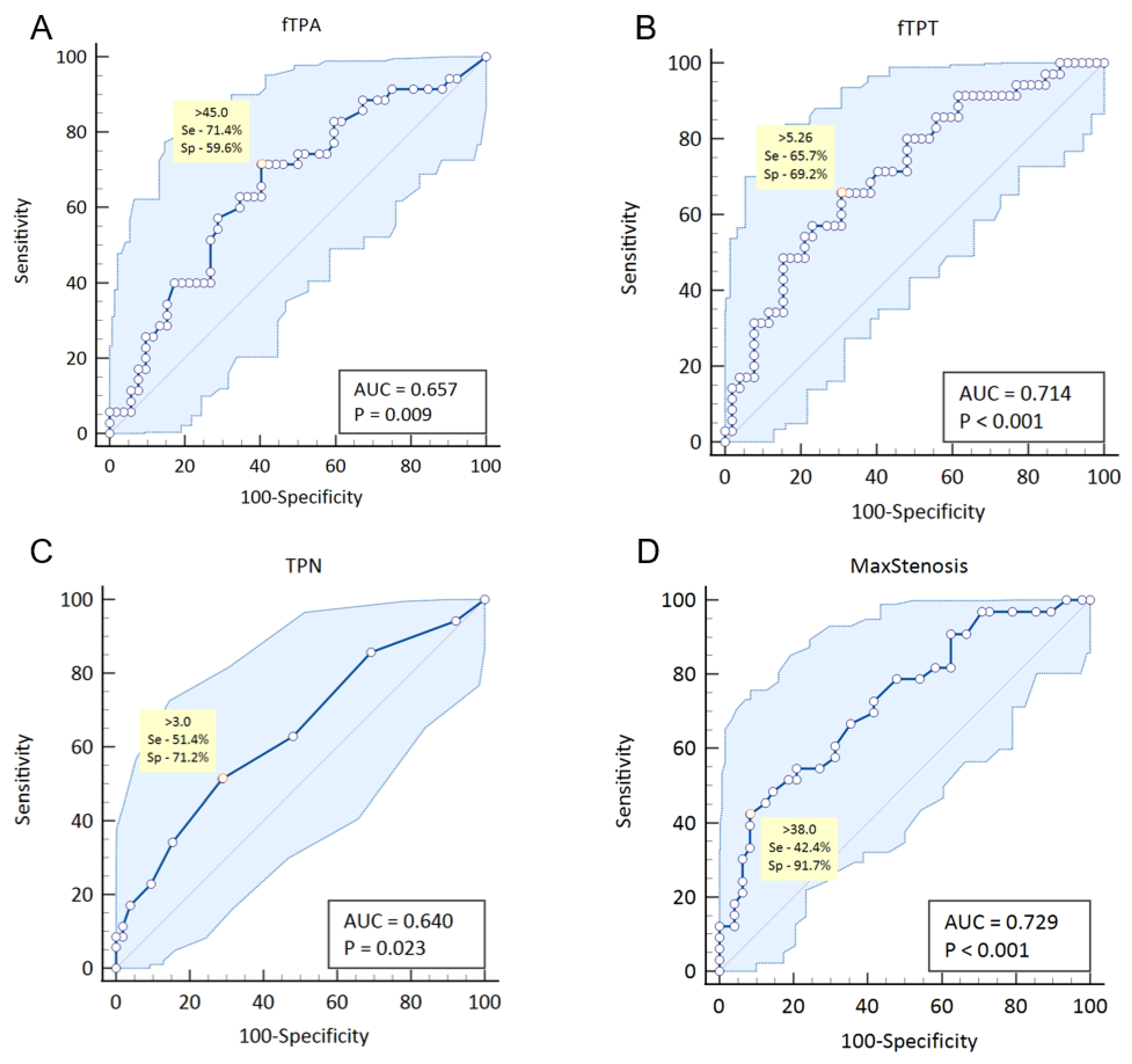
| fTPA > 45.0 mm2 | 3.69 (1.47; 9.25) | 0.005 | 2.10 (0.72; 6.13) | 0.175 | 3.38 (0.75; 14.9) | 0.114 |
| fTPT > 5.26 mm | 2.83 (1.16; 6.89) | 0.022 | 1.62 (0.54; 4.83) | 0.387 | 3.76 (0.87; 16.2) | 0.076 |
| TPN > 3.00 | 2.38 (0.98; 5.78) | 0.055 | 1.25 (0.41; 3.79) | 0.697 | 1.67 (0.41; 6.85) | 0.478 |
| MaxStenosis > 38.0% | 8.00 (2.35; 27.2) | 0.001 | 4.49 (1.10; 18.2) | 0.036 | 8.44 (1.50; 47.4) | 0.015 |
Disclaimer/Publisher’s Note: The statements, opinions and data contained in all publications are solely those of the individual author(s) and contributor(s) and not of MDPI and/or the editor(s). MDPI and/or the editor(s) disclaim responsibility for any injury to people or property resulting from any ideas, methods, instructions or products referred to in the content. |
© 2026 by the authors. Licensee MDPI, Basel, Switzerland. This article is an open access article distributed under the terms and conditions of the Creative Commons Attribution (CC BY) license.
Share and Cite
Genkel, V.; Ershov, S.; Lebedev, E.; Zaripova, Y.; Shaposhnik, I. Femoral Plaque Burden and Left Ventricular–Arterial Coupling in Patients with Chronic Heart Failure. J. Clin. Med. 2026, 15, 2014. https://doi.org/10.3390/jcm15052014
Genkel V, Ershov S, Lebedev E, Zaripova Y, Shaposhnik I. Femoral Plaque Burden and Left Ventricular–Arterial Coupling in Patients with Chronic Heart Failure. Journal of Clinical Medicine. 2026; 15(5):2014. https://doi.org/10.3390/jcm15052014
Chicago/Turabian StyleGenkel, Vadim, Sergey Ershov, Evgeny Lebedev, Yana Zaripova, and Igor Shaposhnik. 2026. "Femoral Plaque Burden and Left Ventricular–Arterial Coupling in Patients with Chronic Heart Failure" Journal of Clinical Medicine 15, no. 5: 2014. https://doi.org/10.3390/jcm15052014
APA StyleGenkel, V., Ershov, S., Lebedev, E., Zaripova, Y., & Shaposhnik, I. (2026). Femoral Plaque Burden and Left Ventricular–Arterial Coupling in Patients with Chronic Heart Failure. Journal of Clinical Medicine, 15(5), 2014. https://doi.org/10.3390/jcm15052014