Craniocervical Posture and Skeletal Malocclusion in Adolescents: A Cross-Sectional Study

Abstract
1. Introduction
2. Materials and Methods
2.1. Study Design and Participants
2.2. Ethics Approval and Consent to Participate
2.3. Postural Assessment and Natural Head Position Standardization
2.4. Postural Measurements
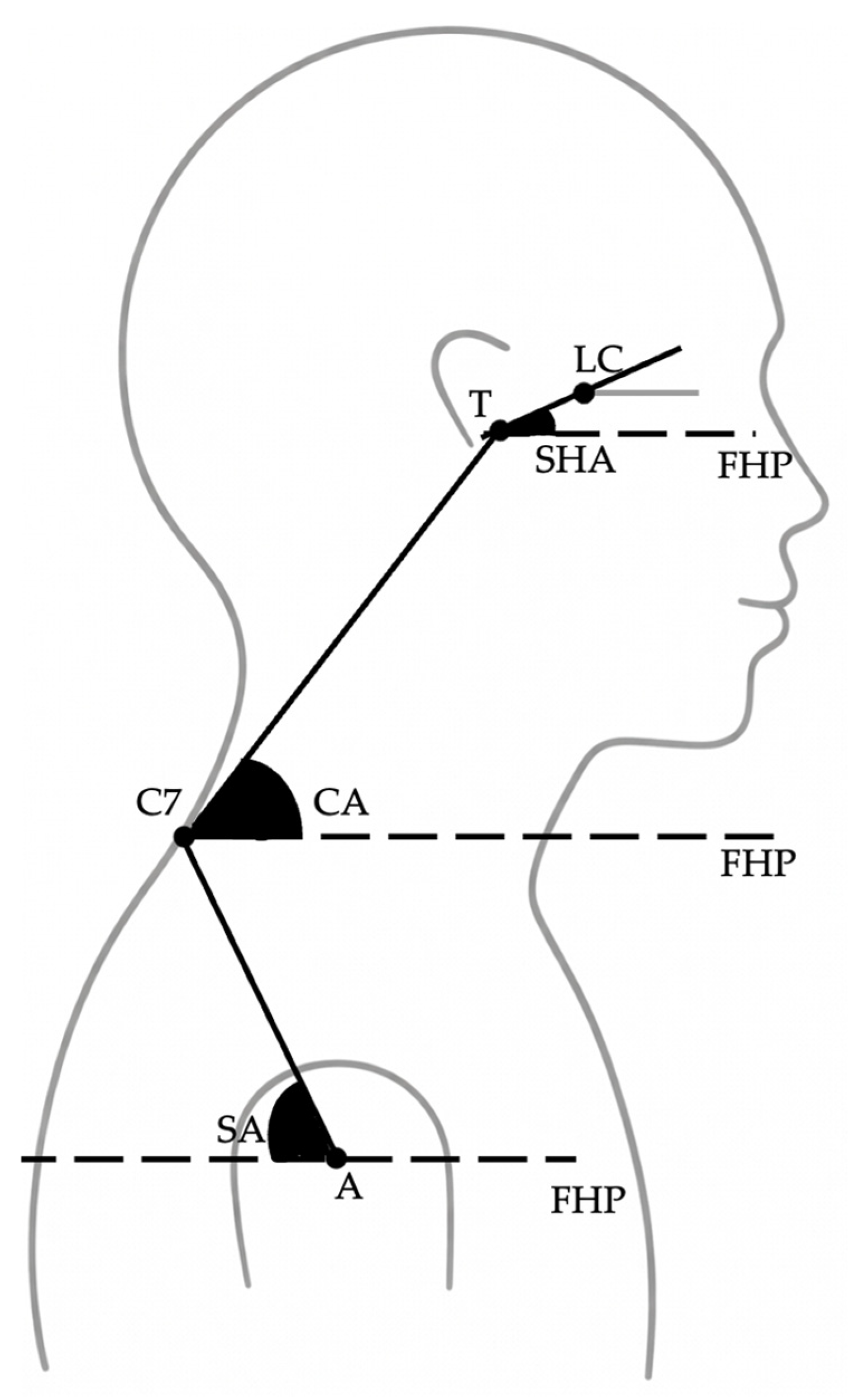
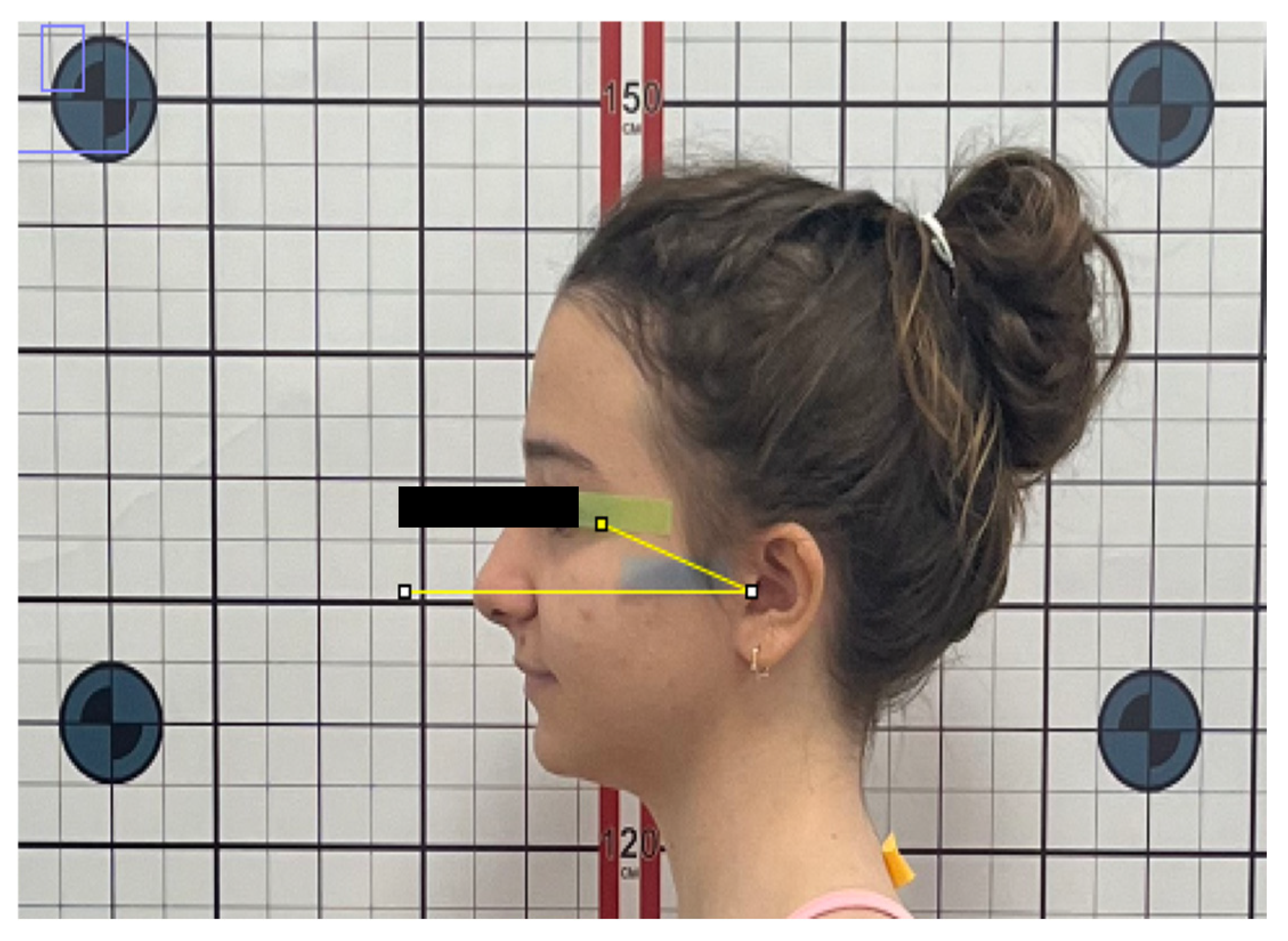
- Sagittal Head Angle (SHA): defined as the angle between the true horizontal reference line (FHP) and the line connecting the tragus to the lateral canthus of the eye (Figure 2).
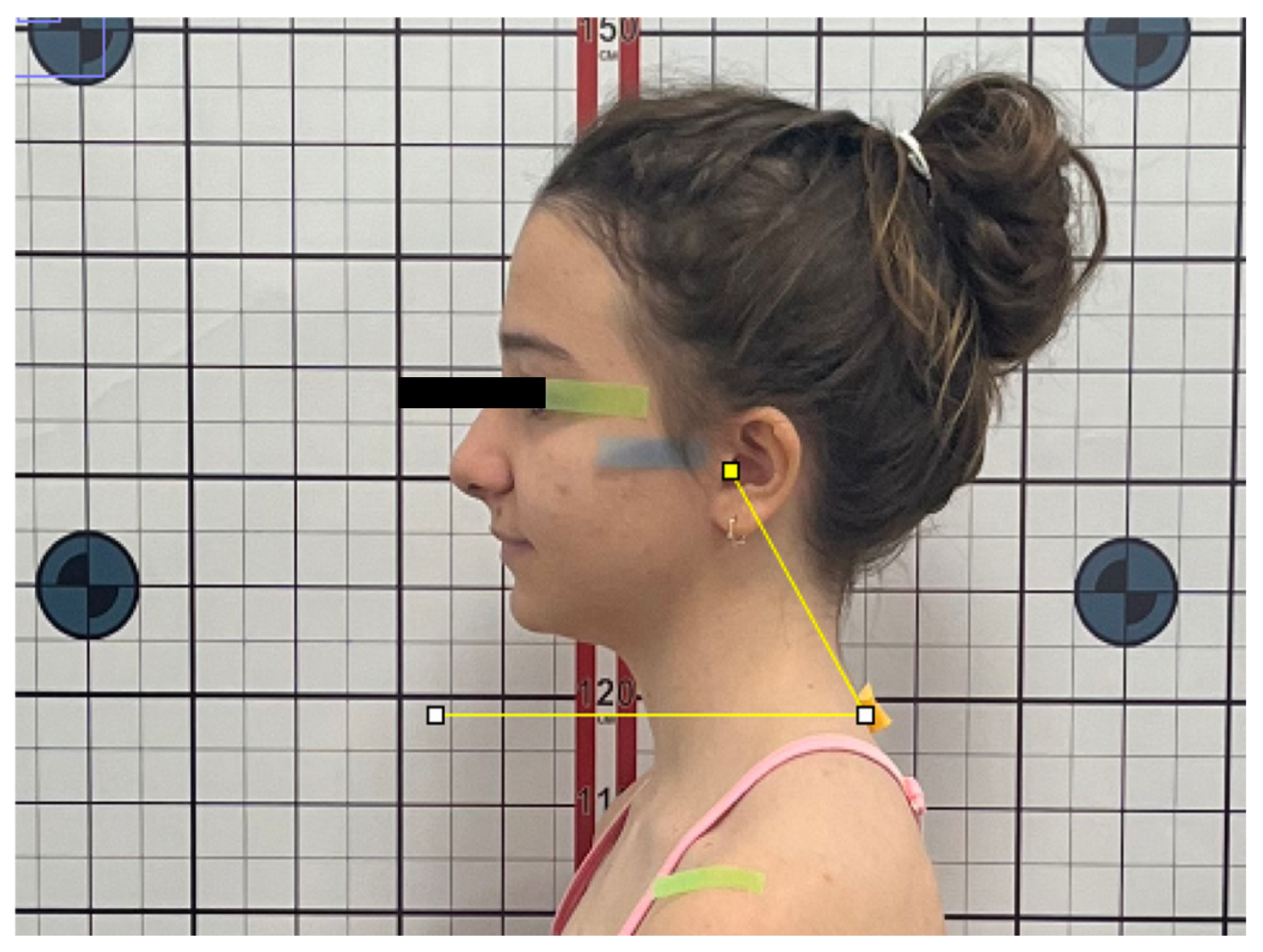
- Craniocervical Angle (CA): defined as the angle between the true horizontal reference line (FHP) and the line connecting the tragus to the spinous process of the seventh cervical vertebra (C7) (Figure 3).
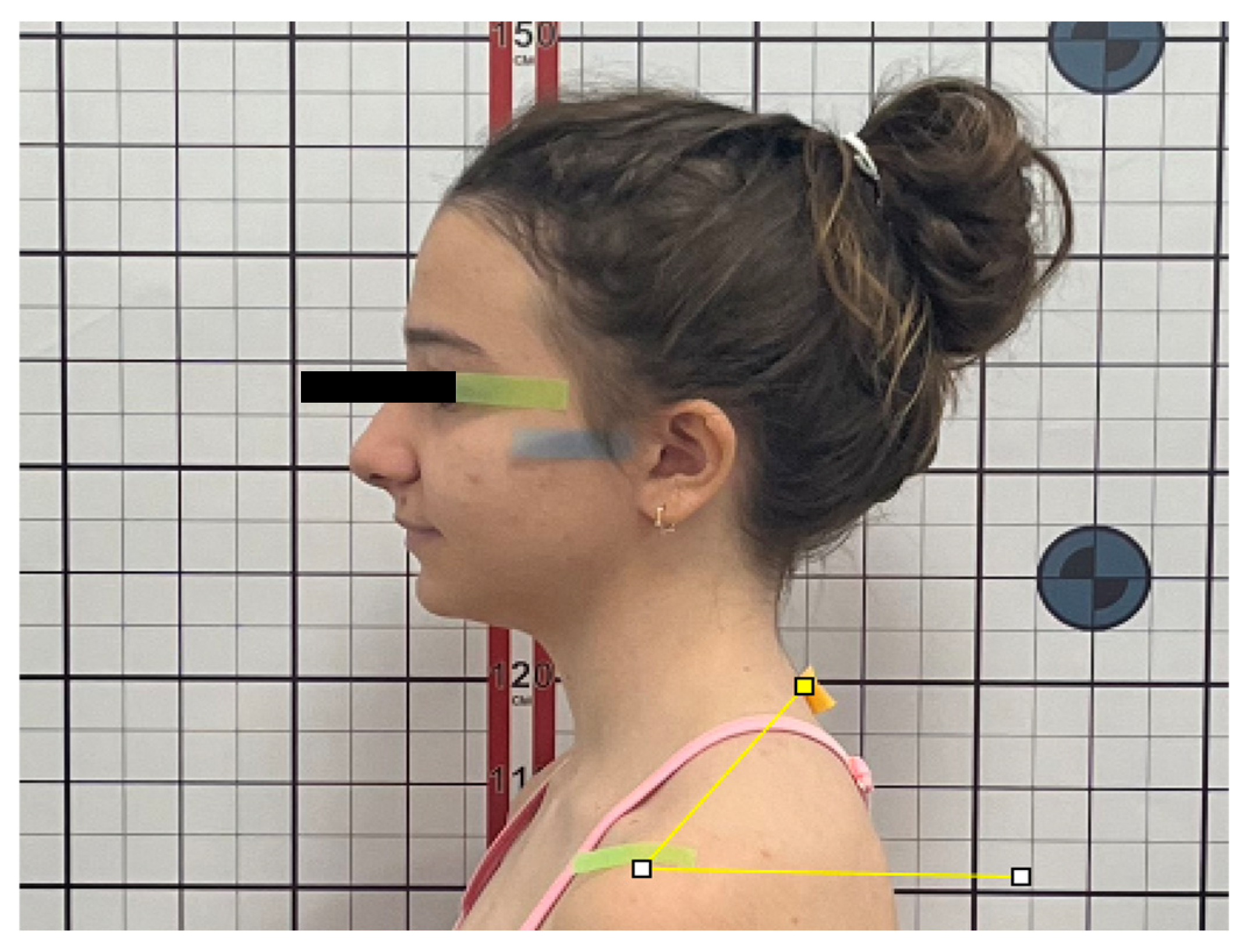
- Shoulder Angle (SA): defined as the angle between the true horizontal reference line (FHP) passing through the acromion and the line connecting the acromion to C7 (Figure 4).
2.5. Skeletal Classification
- Class I: ANB = 2° ± 2°;
- Class II: ANB > 4°;
- Class III: ANB < 0°.
2.6. Measurement Reliability
2.7. Statistical Analysis
3. Results
4. Discussion
5. Conclusions
Author Contributions
Funding
Institutional Review Board Statement
Informed Consent Statement
Data Availability Statement
Conflicts of Interest
Abbreviations
| ANB | Angle between points A, Nasion, and B |
| CA | Craniocervical Angle |
| C7 | Spinous process of the seventh cervical vertebra |
| FHP | Frankfurt Horizontal Plane (true horizontal reference line) |
| GoGn/SN | Mandibular plane angle relative to the SN plane |
| ICC | Intraclass Correlation Coefficient |
| LC | Lateral canthus |
| NHP | Natural Head Position |
| Occ.Pl/SN | Occlusal plane angle relative to the SN plane |
| SA | Shoulder Angle |
| SHA | Sagittal Head Angle |
| SNA | Angle between Sella, Nasion, and Point A |
| SNB | Angle between Sella, Nasion, and Point B |
| SN | Sella–Nasion line |
References
- Okeson, J.P. Management of Temporomandibular Disorders and Occlusion, 7th ed.; Mosby Elsevier: St. Louis, MO, USA, 2013. [Google Scholar]
- Bogduk, N. Clinical Anatomy of the Lumbar Spine and Sacrum, 5th ed.; Elsevier Health Sciences: London, UK, 2011. [Google Scholar]
- White, A.A.; Panjabi, M.M. Clinical Biomechanics of the Spine, 2nd ed.; Lippincott Williams & Wilkins: Philadelphia, PA, USA, 1990. [Google Scholar]
- Solow, B.; Sandham, A. Cranio-cervical posture: A factor in the development and function of the dentofacial structures. Eur. J. Orthod. 2002, 24, 447–456. [Google Scholar] [CrossRef] [PubMed]
- Lin, X.; Liu, Y.; Edwards, S.P. Effect of mandibular advancement on the natural position of the head: A preliminary study of 3-dimensional cephalometric analysis. Br. J. Oral Maxillofac. Surg. 2013, 51, e178–e182. [Google Scholar] [CrossRef]
- Gomes, L.C.; Horta, K.O.; Gonçalves, J.R.; Santos-Pinto, A.D. Systematic review: Craniocervical posture and craniofacial morphology. Eur. J. Orthod. 2014, 36, 55–66. [Google Scholar] [CrossRef]
- Peng, H.; Liu, W.; Yang, L.; Zhong, W.; Yin, Y.; Gao, X.; Song, J. Does head and cervical posture correlate to malocclusion? A systematic review and meta-analysis. PLoS ONE 2022, 17, e0276156. [Google Scholar] [CrossRef] [PubMed]
- Różańska-Perlińska, D.; Potocka-Mitan, M.; Rydzik, Ł.; Lipińska, P.; Perliński, J.; Javdaneh, N.; Jaszczur-Nowicki, J. The correlation between malocclusion and body posture and cervical vertebral, podal system, and gait parameters in children: A systematic review. J. Clin. Med. 2024, 13, 3463. [Google Scholar] [CrossRef]
- Enlow, D.H.; Hans, M.G.; McGrew, L. Essentials of Facial Growth; W.B. Saunders: Philadelphia, PA, USA, 1996. [Google Scholar]
- Buschang, P.H.; Gandini Júnior, L.G. Mandibular skeletal growth and modelling between 10 and 15 years of age. Eur. J. Orthod. 2002, 24, 69–79. [Google Scholar] [CrossRef]
- Solow, B.; Tallgren, A. Head posture and craniofacial morphology. Am. J. Phys. Anthropol. 1976, 44, 417–435. [Google Scholar] [CrossRef]
- Solow, B.; Siersbaek-Nielsen, S. Growth changes in head posture related to craniofacial development. Am. J. Orthod. 1986, 89, 132–140. [Google Scholar] [CrossRef]
- Peng, H.; Liu, W.; Yang, L.; Yan, P.; Zhong, W.; Gao, X.; Song, J. Craniocervical posture in patients with skeletal malocclusion and its correlation with craniofacial morphology during different growth periods. Sci. Rep. 2024, 14, 5280. [Google Scholar] [CrossRef] [PubMed]
- Otman, A.S.; Demirel, H.; Sade, A. Basic Assessment Principles of Therapeutic Movements; Hacettepe University School of Physical Therapy and Rehabilitation Publications: Ankara, Turkey, 1995; pp. 14–20. [Google Scholar]
- Wong, W.Y. Smart garment for trunk posture monitoring: A preliminary study. Scoliosis 2008, 3, 7. [Google Scholar] [CrossRef]
- Morais, T.B. Age- and sex-specific prevalence of scoliosis and the value of school screening programs. Am. J. Public Health 1985, 75, 1377–1380. [Google Scholar] [CrossRef] [PubMed]
- Kratěnová, J.; Žejglicová, K.; Malý, M.; Filipová, V. Prevalence and risk factors of poor posture in school children in the Czech Republic. J. Sch. Health 2007, 77, 131–137. [Google Scholar] [CrossRef]
- Björk, A.; Skieller, V. Congenital bilateral hypoplasia of the mandibular condyles associated with congenital bilateral palpebral ptosis: A radiographic analysis of craniofacial growth by the implant method. Am. J. Orthod. 1968, 54, 548–600. [Google Scholar] [CrossRef]
- Solow, B.; Kreiborg, S. Soft-tissue stretching: A possible control factor in craniofacial morphogenesis. Eur. J. Oral Sci. 1977, 85, 505–507. [Google Scholar] [CrossRef]
- Björk, A. Cranial base development: A follow-up x-ray study of individual variation in growth between ages 12 and 20 years. Am. J. Orthod. 1955, 41, 198–225. [Google Scholar] [CrossRef]
- Meibodi, S.E.; Parhiz, H.; Motamedi, M.H.K.; Fetrati, A.; Meibodi, E.M.; Meshkat, A. Cervical vertebrae anomalies in patients with Class III skeletal malocclusion. J. Craniovertebr. Junction Spine 2011, 2, 73–76. [Google Scholar]
- Sidlauskienė, M.; Smailienė, D.; Lopatienė, K.; Čekanauskas, E.; Pribuišienė, R.; Šidlauskas, M. Relationships between malocclusion, body posture, and nasopharyngeal pathology. Med. Sci. Monit. 2015, 21, 1765. [Google Scholar]
- Garg, T.; Khanna, R.; Pratap, R.; Maurya, K.; Srivastava, S.L. Is head posture and malocclusion related? J. Contemp. Orthod. 2019, 3, 38–47. [Google Scholar] [CrossRef]
- Zokaitė, G.; Lopatienė, K.; Vasiliauskas, A.; Smailienė, D.; Trakinienė, G. Relationship between craniocervical posture and sagittal position of the mandible: A systematic review. Appl. Sci. 2022, 12, 5331. [Google Scholar] [CrossRef]
- Baccetti, T.; Franchi, L.; McNamara, J.A. The cervical vertebral maturation (CVM) method for the assessment of optimal treatment timing in dentofacial orthopedics. Semin. Orthod. 2005, 11, 119–129. [Google Scholar] [CrossRef]
- World Medical Association. World Medical Association Declaration of Helsinki: Ethical principles for medical research involving human subjects. JAMA 2013, 310, 2191–2194. [Google Scholar] [CrossRef] [PubMed]
- Showfety, K.J.; Vig, P.S.; Matteson, S. A simple method for taking natural-head-position cephalograms. Am. J. Orthod. 1983, 83, 495–500. [Google Scholar] [CrossRef] [PubMed]
- George, D.; Mallery, P. SPSS for Windows Step by Step: A Simple Guide and Reference, 10th ed.; Allyn & Bacon: Boston, MA, USA, 2010. [Google Scholar]
- Proffit, W.R.; Fields, H.W.; Larson, B.; Sarver, D.M. Contemporary Orthodontics, 6th ed.; Elsevier: St. Louis, MO, USA, 2018. [Google Scholar]
- Jacobson, A. The “Wits” appraisal of jaw disharmony. Am. J. Orthod. 1975, 67, 125–138. [Google Scholar] [CrossRef]
- AlKofide, E.A.; Alnamankani, E.A. The association between head posture and malocclusion. CRANIO 2007, 25, 98–105. [Google Scholar] [CrossRef]
- Vukićević, V.; Petrović, D. Relationship between head posture and sagittal jaw position. Med. Pregl. 2016, 69, 288–293. [Google Scholar] [CrossRef]
- Sandoval, C.D.; Díaz, A.; Manríquez, G. Relationship between craniocervical posture and skeletal class: A multivariate approach for studying Class II and Class III malocclusions. CRANIO 2021, 39, 133–140. [Google Scholar] [CrossRef] [PubMed]
- Ansar, J.M.; Maheshwari, S.; Verma, S.K.; Singh, R.K.; Agarwal, D.K.; Bhattacharya, P. Soft tissue airway dimensions and craniocervical posture in different growth patterns. Angle Orthod. 2015, 85, 604–610. [Google Scholar] [CrossRef]
- Shen, Y.; Li, X.; Feng, X.; Yu, L.; Weng, L.; Zhang, C.; Shang, Y.; Lin, J. Differences in the effects of orthodontic treatment on airway-craniocervical functional environment in adult and adolescent patients with skeletal class II high-angle: A retrospective pilot study. BMC Oral Health 2023, 23, 605. [Google Scholar] [CrossRef]
- Kim, P.; Sarauw, M.T.; Sonnesen, L. Cervical vertebral column morphology and head posture in preorthodontic patients with anterior open bite. Am. J. Orthod. Dentofacial Orthop. 2014, 145, 359–366. [Google Scholar] [CrossRef]
- Michelotti, A.; Buonocore, G.; Farella, M.; Pellegrino, G.; Piergentili, C.; Altobelli, S.; Martina, R. Postural stability and unilateral posterior crossbite: Is there a relationship? Neurosci. Lett. 2006, 392, 140–144. [Google Scholar] [CrossRef]
- Zurita-Hernandez, J.; Ayuso-Montero, R.; Cuartero-Balana, M.; Willaert, E.; Martinez-Gomis, J. Relationship between unilateral posterior crossbite and human static body posture. Int. J. Environ. Res. Public Health 2020, 17, 5303. [Google Scholar] [CrossRef] [PubMed]
- Sambataro, S.; Bocchieri, S.; Cervino, G.; La Bruna, R.; Cicciù, A.; Innorta, M.; Torrisi, B.; Cicciù, M. Correlations between malocclusion and postural anomalies in children with mixed dentition. J. Funct. Morphol. Kinesiol. 2019, 4, 45. [Google Scholar] [CrossRef] [PubMed]




| Measurement | Class I Median (Min–Max) | Class II Div 1 Median (Min–Max) | Class II Div 2 Median (Min–Max) | Class III Median (Min–Max) | p |
|---|---|---|---|---|---|
| Sagittal Head Angle (°) | 19.37 (7.91–34.13) | 22.71 (11.37–30.67) | 25.75 (9.34–35.70) | 21.67 (12.53–31.76) | 0.091 |
| Craniocervical Angle (°) | 52.36 (39.16–62.17) | 52.94 (32.98–60.09) | 48.45 (39.10–57.83) | 50.79 (40.10–78.45) | 0.248 |
| Shoulder Angle (°) | 56.29 (34.33–75.03) | 56.58 (35.62–80.76) | 56.57 (27.11–78.58) | 58.70 (40.31–68.00) | 0.944 |
| Cephalometric Parameter | SHA (r) | SHA (p) | CA (r) | CA (p) | SA (r) | SA (p) |
|---|---|---|---|---|---|---|
| SNA (°) | −0.284 | 0.0106 ** | −0.007 | 0.950 | −0.127 | 0.262 |
| SNB (°) | −0.381 | 0.0005 ** | 0.048 | 0.675 | −0.113 | 0.318 |
| ANB (°) | 0.155 | 0.170 | −0.067 | 0.556 | −0.001 | 0.993 |
| Occlusal Plane/SN (°) | 0.235 | 0.036 * | 0.071 | 0.535 | 0.140 | 0.215 |
| GoGn/SN (°) | 0.166 | 0.142 | −0.028 | 0.804 | 0.127 | 0.260 |
| Cephalometric Parameter | SHA (r) | SHA (p) | CA (r) | CA (p) | SA (r) | SA (p) |
|---|---|---|---|---|---|---|
| SNA (°) | 0.080 | 0.738 | −0.099 | 0.679 | −0.202 | 0.392 |
| SNB (°) | 0.129 | 0.588 | 0.008 | 0.973 | −0.205 | 0.385 |
| ANB (°) | −0.190 | 0.423 | −0.272 | 0.247 | 0.002 | 0.993 |
| Occlusal Plane/SN (°) | −0.108 | 0.652 | −0.232 | 0.325 | 0.331 | 0.155 |
| GoGn/SN (°) | 0.173 | 0.467 | 0.084 | 0.724 | −0.008 | 0.973 |
| Cephalometric Parameter | SHA (r) | SHA (p) | CA (r) | CA (p) | SA (r) | SA (p) |
|---|---|---|---|---|---|---|
| SNA (°) | −0.177 | 0.456 | 0.382 | 0.096 | −0.055 | 0.817 |
| SNB (°) | −0.172 | 0.470 | 0.315 | 0.176 | −0.057 | 0.810 |
| ANB (°) | 0.171 | 0.472 | 0.198 | 0.403 | 0.222 | 0.347 |
| Occlusal Plane/SN (°) | 0.016 | 0.946 | −0.084 | 0.724 | 0.104 | 0.664 |
| GoGn/SN (°) | −0.130 | 0.586 | −0.085 | 0.722 | 0.220 | 0.351 |
| Cephalometric Parameter | SHA (r) | SHA (p) | CA (r) | CA (p) | SA (r) | SA (p) |
|---|---|---|---|---|---|---|
| SNA (°) | −0.358 | 0.122 | −0.130 | 0.586 | −0.249 | 0.289 |
| SNB (°) | −0.344 | 0.139 | −0.135 | 0.571 | −0.296 | 0.205 |
| ANB (°) | −0.012 | 0.960 | −0.193 | 0.416 | 0.430 | 0.058 |
| Occlusal Plane/SN (°) | 0.256 | 0.276 | 0.089 | 0.711 | 0.000 | 1.000 |
| GoGn/SN (°) | 0.067 | 0.778 | −0.211 | 0.372 | 0.102 | 0.666 |
| Cephalometric Parameter | SHA (r) | SHA (p) | CA (r) | CA (p) | SA (r) | SA (p) |
|---|---|---|---|---|---|---|
| SNA (°) | −0.653 | 0.0018 ** | −0.430 | 0.058 | −0.265 | 0.260 |
| SNB (°) | −0.605 | 0.0046 ** | −0.309 | 0.186 | −0.230 | 0.329 |
| ANB (°) | −0.067 | 0.778 | −0.153 | 0.522 | −0.298 | 0.202 |
| Occlusal Plane/SN (°) | 0.330 | 0.156 | 0.044 | 0.853 | 0.033 | 0.890 |
| GoGn/SN (°) | 0.177 | 0.454 | 0.102 | 0.666 | 0.082 | 0.732 |
Disclaimer/Publisher’s Note: The statements, opinions and data contained in all publications are solely those of the individual author(s) and contributor(s) and not of MDPI and/or the editor(s). MDPI and/or the editor(s) disclaim responsibility for any injury to people or property resulting from any ideas, methods, instructions or products referred to in the content. |
© 2026 by the authors. Licensee MDPI, Basel, Switzerland. This article is an open access article distributed under the terms and conditions of the Creative Commons Attribution (CC BY) license.
Share and Cite
Ertem Arslan, H.; Tanrısever, N.C.; Akçam, M.O. Craniocervical Posture and Skeletal Malocclusion in Adolescents: A Cross-Sectional Study. J. Clin. Med. 2026, 15, 1974. https://doi.org/10.3390/jcm15051974
Ertem Arslan H, Tanrısever NC, Akçam MO. Craniocervical Posture and Skeletal Malocclusion in Adolescents: A Cross-Sectional Study. Journal of Clinical Medicine. 2026; 15(5):1974. https://doi.org/10.3390/jcm15051974
Chicago/Turabian StyleErtem Arslan, Hande, Nuri Can Tanrısever, and Mehmet Okan Akçam. 2026. "Craniocervical Posture and Skeletal Malocclusion in Adolescents: A Cross-Sectional Study" Journal of Clinical Medicine 15, no. 5: 1974. https://doi.org/10.3390/jcm15051974
APA StyleErtem Arslan, H., Tanrısever, N. C., & Akçam, M. O. (2026). Craniocervical Posture and Skeletal Malocclusion in Adolescents: A Cross-Sectional Study. Journal of Clinical Medicine, 15(5), 1974. https://doi.org/10.3390/jcm15051974