Lifetime Management of Transcatheter Aortic Valve Replacement: A Guide to Decision-Making and Future Reinterventions
Abstract
1. Introduction
2. Materials and Methods
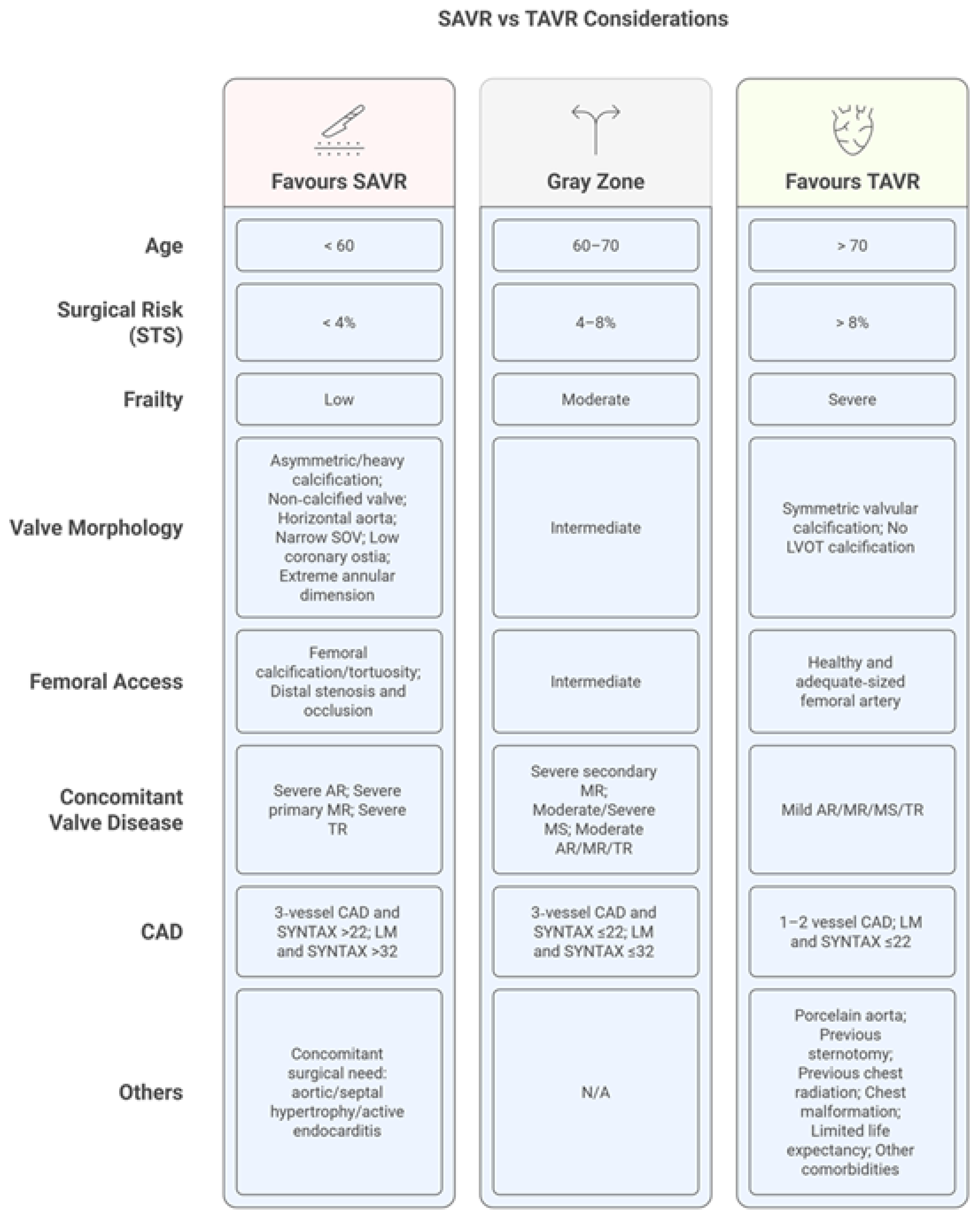
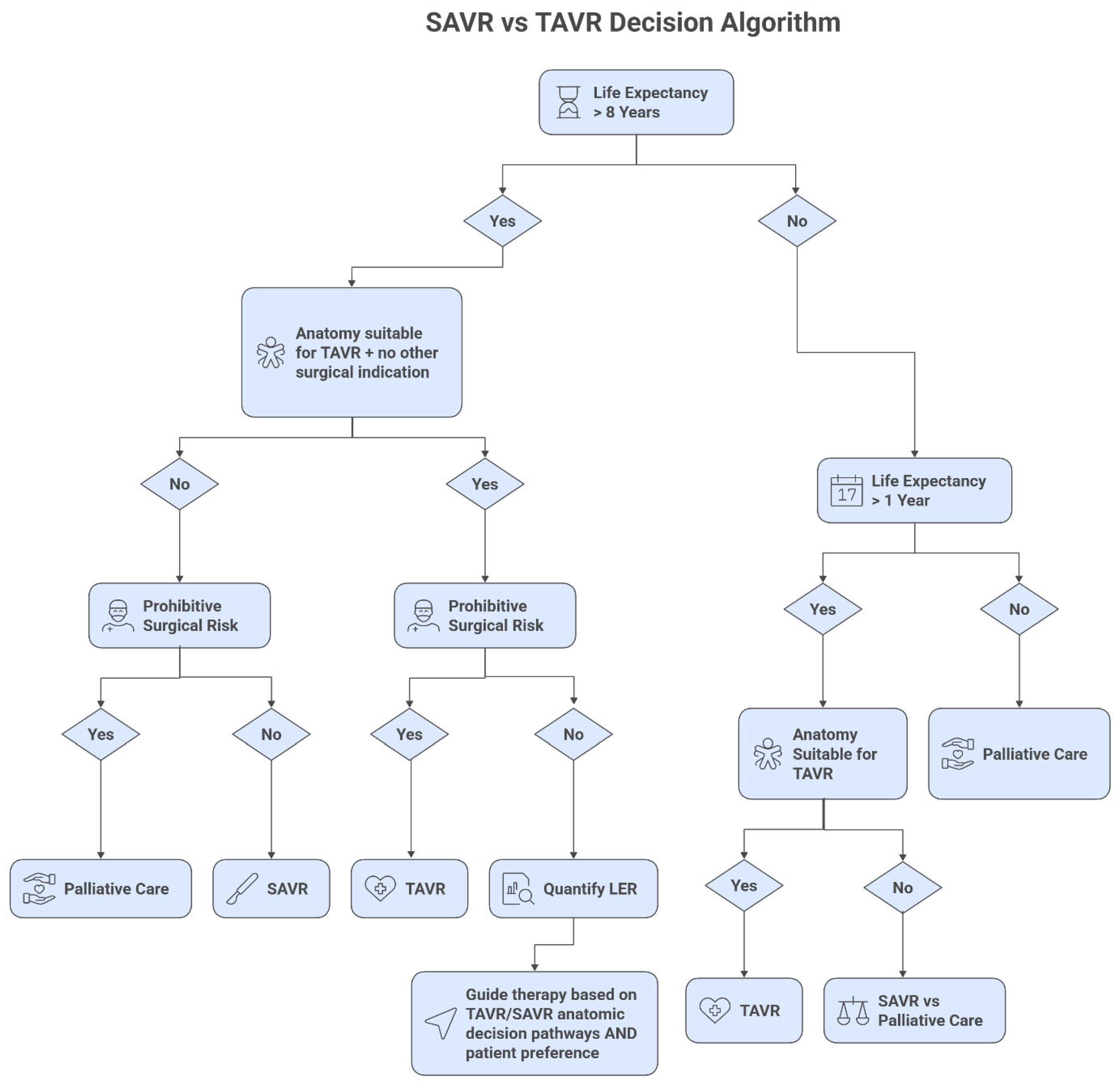
3. Decision Framework: TAVR vs. SAVR as Initial Therapy
4. Optimizing the Index TAVR Procedure
5. Patient-Prosthesis Mismatch
6. Minimizing Paravalvular Regurgitation
7. Preventing Conduction Abnormalities
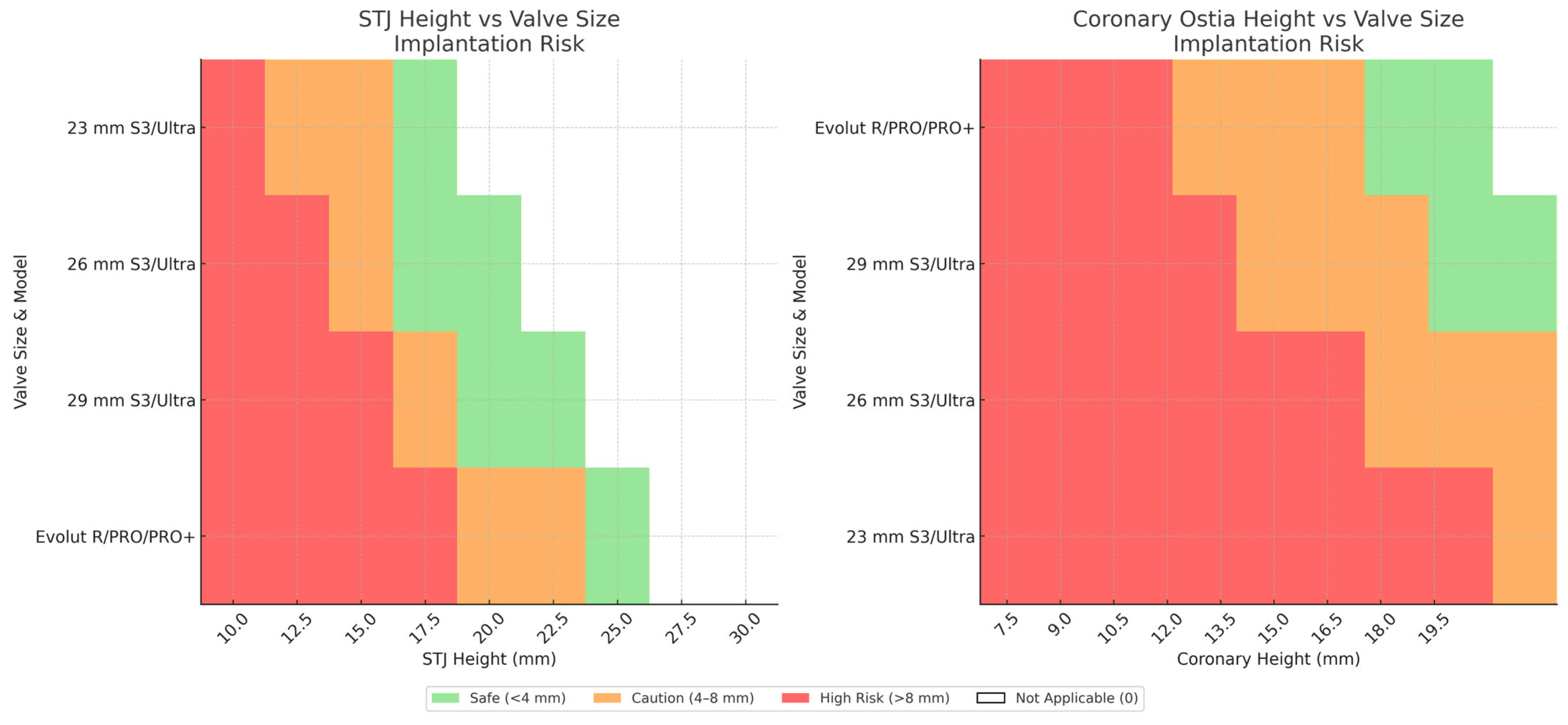
8. Preventing Coronary Obstruction
- Coronary origins below 12 mm from the annular plane
- Sinotubular junction or sinus width under 30 mm
- Extensive leaflet calcification with bulky morphology
- Diminutive sinus of Valsalva volume
- Reduced sinotubular junction height
9. Preventing Annular Rupture
- Maximum diameter should not surpass the smaller of mean LVOT or STJ dimensions
- Semicompliant balloons permit 1:1 vessel ratios
- Non-compliant devices require ratios below 1.0
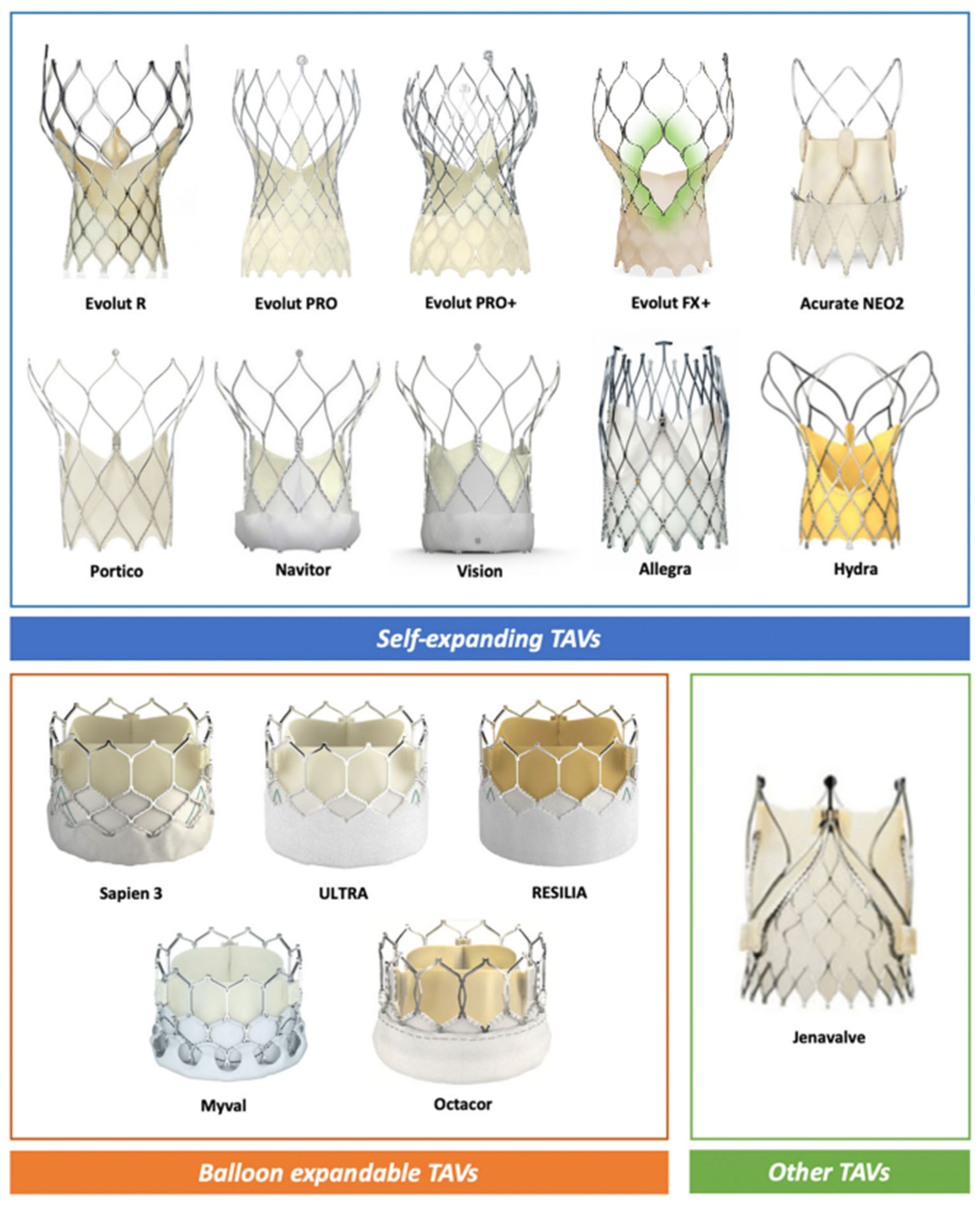
10. Optimizing Future TAVR-in-TAVR Feasibility
- SAPIEN 3 balloon-expandable: leaflets terminate at commissural tab apex
- Self-expanding designs (Evolut, ACURATE neo2, Portico): leaflets reach commissural post summit
- Supra-annular architectures generate substantially taller risk planes
11. Optimizing the Index SAVR Procedure
12. Aortic Root Enlargement
13. Prosthesis Selection for Future Valve-in-Valve
14. Preventing Future Coronary Obstruction
15. Optimizing for Future Patient Prosthesis Mismatch
16. Special Considerations
17. Valve-in-Valve TAVR: Planning and Execution
18. TAVR-in-SAVR Considerations
19. TAVR-in-TAVR Considerations
- Coronary access and obstruction risk: Ideally, the projected neoskirt remains below the coronary ostia. When the risk plane lies between coronary height and the STJ, redo feasibility depends on adequate valve-to-coronary (VTC) distance and accessible frame cells; pragmatic thresholds such as VTC > 4 mm have been used in virtual simulation datasets but are platform- and technique-dependent [16,52]. If the risk plane extends above the STJ, valve-to-STJ clearance becomes critical (e.g., VTSTJ > 2 mm in some datasets), and coronary inaccessibility may occur even when coronary heights are not low [16,52].
- Neoskirt Management: Post-TAVR CT studies by Grubb and colleagues [54] demonstrated valve-specific strategies for managing neoskirt height. For index Evolut valves, implanting a SAPIEN 3 at low position (node 4) resulted in only 20% high-risk cases for coronary compromise. Conversely, tall-frame valve combinations predictably produce the highest risk planes. Understanding these interactions guides both initial valve selection and subsequent reintervention planning [54,55].
- Patient Prosthesis Mismatch Risk: The “Russian doll” effect of multiple valves significantly increases PPM risk, particularly in small annuli. Fukui et al. found that using two SAPIEN 3 valves resulted in 21% incidence of at least moderate PPM compared to 1% with mixed platforms. CT-based calculation of predicted indexed EOA becomes crucial, using established formulas accounting for both valves’ contributions to flow restriction [16,56].
20. Technical Optimization Strategies
21. Leaflet Modification Techniques
22. SAVR After Failed TAVR
23. Future Directions
- Advanced Valve Design
24. Computational Modelling and Artificial Intelligence
25. Personalized Lifetime Risk Assessment
26. Standardization of Care Pathways
27. Conclusions
Funding
Data Availability Statement
Conflicts of Interest
References
- Iung, B.; Delgado, V.; Rosenhek, R.; Price, S.; Prendergast, B.; Wendler, O.; De Bonis, M.; Tribouilloy, C.; Evangelista, A.; Bogachev-Prokophiev, A.; et al. Contemporary presentation and management of valvular heart disease: The EURObservational Research Programme Valvular Heart Disease II Survey. Circulation 2019, 140, 1156–1169. [Google Scholar] [CrossRef]
- Mack, M.J.; Leon, M.B.; Thourani, V.H.; Makkar, R.; Kodali, S.K.; Russo, M.; Kapadia, S.R.; Malaisrie, S.C.; Cohen, D.J.; Pibarot, P.; et al. Transcatheter aortic-valve replacement with a balloon-expandable valve in low-risk patients. N. Engl. J. Med. 2019, 380, 1695–1705. [Google Scholar] [CrossRef] [PubMed]
- Otto, C.M.; Nishimura, R.A.; Bonow, R.O.; Carabello, B.A.; Erwin, J.P., III; Gentile, F.; Jneid, H.; Krieger, E.V.; Mack, M.; McLeod, C.; et al. 2020 ACC/AHA guideline for the management of patients with valvular heart disease: Executive summary: A report of the American College of Cardiology/American Heart Association Joint Committee on Clinical Practice Guidelines. J. Am. Coll. Cardiol. 2021, 77, 450–500. [Google Scholar] [CrossRef] [PubMed]
- Popma, J.J.; Deeb, G.M.; Yakubov, S.J.; Mumtaz, M.; Gada, H.; O’Hair, D.; Bajwa, T.; Heiser, J.C.; Merhi, W.; Kleiman, N.S.; et al. Transcatheter aortic-valve replacement with a self-expanding valve in low-risk patients. N. Engl. J. Med. 2019, 380, 1706–1715. [Google Scholar] [CrossRef]
- Van Mieghem, N.M.; Deeb, G.M.; Søndergaard, L.; Grube, E.; Windecker, S.; Gada, H.; Mumtaz, M.; Olsen, P.S.; Heiser, J.C.; Merhi, W.; et al. Self-expanding transcatheter vs surgical aortic valve replacement in intermediate-risk patients: 5-year outcomes of the SURTAVI randomized clinical trial. JAMA Cardiol. 2022, 7, 1000–1008. [Google Scholar] [CrossRef]
- Vahanian, A.; Beyersdorf, F.; Praz, F.; Milojevic, M.; Baldus, S.; Bauersachs, J.; Capodanno, D.; Conradi, L.; De Bonis, M.; De Paulis, R.; et al. 2021 ESC/EACTS Guidelines for the management of valvular heart disease. Eur. Heart J. 2022, 43, 561–632. [Google Scholar] [CrossRef]
- Praz, F.; Borger, M.A.; Lanz, J.; Marin-Cuartas, M.; Abreu, A.; Adamo, M.; Marsan, N.A.; Barili, F.; Bonaros, N.; Cosyns, B.; et al. 2025 ESC/EACTS Guidelines for the management of valvular heart disease: Developed by the task force for the management of valvular heart disease of the European Society of Cardiology (ESC) and the European Association for Cardio-Thoracic Surgery (EACTS). Eur. Heart J. 2025, 46, 4635–4736. [Google Scholar] [CrossRef]
- Russo, G.; Tang, G.H.; Sangiorgi, G.; Pedicino, D.; Enriquez-Sarano, M.; Maisano, F.; Taramasso, M. Lifetime management of aortic stenosis: Transcatheter versus surgical treatment for young and low-risk patients. Circ. Cardiovasc. Interv. 2022, 15, 915–927. [Google Scholar] [CrossRef] [PubMed]
- Green, P.; Woglom, A.E.; Genereux, P.; Daneault, B.; Paradis, J.-M.; Schnell, S.; Hawkey, M.; Maurer, M.S.; Kirtane, A.J.; Kodali, S.; et al. The impact of frailty status on survival after transcatheter aortic valve replacement in older adults with severe aortic stenosis: A single-center experience. JACC Cardiovasc. Interv. 2012, 5, 974–981. [Google Scholar] [CrossRef]
- Athappan, G.; Patvardhan, E.; Tuzcu, E.M.; Svensson, L.G.; Lemos, P.A.; Fraccaro, C.; Tarantini, G.; Sinning, J.-M.; Nickenig, G.; Capodanno, D.; et al. Incidence, predictors, and outcomes of aortic regurgitation after transcatheter aortic valve replacement: Meta-analysis and systematic review of literature. J. Am. Coll. Cardiol. 2013, 61, 1585–1595. [Google Scholar] [CrossRef]
- Vinayak, M.; Leone, P.P.; Tanner, R.; Dhulipala, V.; Camaj, A.; Makhija, R.R.K.; Hooda, A.; Kini, A.S.; Sharma, S.K.; Khera, S. Transcatheter Aortic Valve Replacement: Current Status and Future Indications. J. Clin. Med. 2024, 13, 373. [Google Scholar] [CrossRef] [PubMed]
- Chen, S.; Pop, A.; Dasi, L.P.; George, I. Lifetime management for aortic stenosis: Strategy and decision-making in the current era. Ann. Thorac. Surg. 2025, 119, 296–307. [Google Scholar] [CrossRef]
- Yoon, S.-H.; Kim, W.-K.; Dhoble, A.; Pio, S.M.; Babaliaros, V.; Jilaihawi, H.; Pilgrim, T.; De Backer, O.; Bleiziffer, S.; Vincent, F.; et al. Bicuspid aortic valve morphology and outcomes after transcatheter aortic valve replacement. J. Am. Coll. Cardiol. 2020, 76, 1018–1030. [Google Scholar] [CrossRef]
- Leon, M.B.; Smith, C.R.; Mack, M.; Miller, D.C.; Moses, J.W.; Svensson, L.G.; Tuzcu, E.M.; Webb, J.G.; Fontana, G.P.; Makkar, R.R.; et al. Transcatheter aortic-valve implantation for aortic stenosis in patients who cannot undergo surgery. N. Engl. J. Med. 2010, 363, 1597–1607. [Google Scholar] [CrossRef] [PubMed]
- Jubran, A.; Patel, R.V.; Sathananthan, J.; Wijeysundera, H.C. Lifetime management of patients with severe aortic stenosis in the era of transcatheter aortic valve replacement. Can. J. Cardiol. 2023, 40, 210–217. [Google Scholar] [CrossRef]
- Rao, K.; Baer, A.; Bapat, V.N.; Piazza, N.; Hansen, P.; Prendergast, B.; Bhindi, R. Lifetime management considerations to optimise transcatheter aortic valve implantation: A practical guide. EuroIntervention 2024, 20, e1493–e1504. [Google Scholar] [CrossRef]
- Herrmann, H.C.; Daneshvar, S.A.; Fonarow, G.C.; Stebbins, A.; Vemulapalli, S.; Desai, N.D.; Malenka, D.J.; Thourani, V.H.; Rymer, J.; Kosinski, A.S. Prosthesis–patient mismatch in patients undergoing transcatheter aortic valve replacement: From the STS/ACC TVT registry. J. Am. Coll. Cardiol. 2018, 72, 2701–2711. [Google Scholar] [CrossRef]
- Hahn, R.T.; Leipsic, J.; Douglas, P.S.; Jaber, W.A.; Weissman, N.J.; Pibarot, P.; Blanke, P.; Oh, J.K. Comprehensive Echocardiographic Assessment of Normal Transcatheter Valve Function. JACC Cardiovasc. Imaging 2019, 12, 25–34. [Google Scholar] [CrossRef]
- Pibarot, P.; Herrmann, H.C.; Wu, C.; Hahn, R.T.; Otto, C.M.; Abbas, A.E.; Chambers, J.; Dweck, M.R.; Leipsic, J.A.; Simonato, M.; et al. Standardized definitions for bioprosthetic valve dysfunction following aortic or mitral valve replacement: JACC state-of-the-art review. J. Am. Coll. Cardiol. 2022, 80, 545–561. [Google Scholar] [CrossRef]
- Khalique, O.K.; Hahn, R.T.; Gada, H.; Nazif, T.M.; Vahl, T.P.; George, I.; Kalesan, B.; Forster, M.; Williams, M.B.; Leon, M.B.; et al. Quantity and location of aortic valve complex calcification predicts severity and location of paravalvular regurgitation and frequency of post-dilation after balloon-expandable transcatheter aortic valve replacement. JACC Cardiovasc. Interv. 2014, 7, 885–894. [Google Scholar] [CrossRef] [PubMed]
- Jilaihawi, H.; Makkar, R.R.; Kashif, M.; Okuyama, K.; Chakravarty, T.; Shiota, T.; Friede, G.; Nakamura, M.; Doctor, N.; Rafique, A.; et al. A revised methodology for aortic-valvar complex calcium quantification for transcatheter aortic valve implantation. Eur. Heart J.-Cardiovasc. Imaging 2014, 15, 1324–1332. [Google Scholar] [CrossRef]
- Abdel-Wahab, M.; Mehilli, J.; Frerker, C.; Neumann, F.-J.; Kurz, T.; Tölg, R.; Zachow, D.; Guerra, E.; Massberg, S.; Schäfer, U.; et al. Comparison of balloon-expandable vs self-expandable valves in patients undergoing transcatheter aortic valve replacement: The CHOICE randomized clinical trial. JAMA 2014, 311, 1503–1514. [Google Scholar] [CrossRef]
- Abdel-Wahab, M.; Landt, M.; Neumann, F.-J.; Massberg, S.; Frerker, C.; Kurz, T.; Kaur, J.; Toelg, R.; Sachse, S.; Jochheim, D.; et al. 5-Year Outcomes After TAVR With Balloon-Expandable Versus Self-Expanding Valves: Results From the CHOICE Randomized Clinical Trial. JACC Cardiovasc. Interv. 2020, 13, 1071–1082. [Google Scholar] [CrossRef] [PubMed]
- Rocatello, G.; El Faquir, N.; De Santis, G.; Iannaccone, F.; Bosmans, J.; De Backer, O.; Sondergaard, L.; Segers, P.; De Beule, M.; de Jaegere, P.; et al. Patient-specific computer simulation to elucidate the role of contact pressure in the development of new conduction abnormalities after catheter-based implantation of a self-expanding aortic valve. Circ. Cardiovasc. Interv. 2018, 11, e005344. [Google Scholar] [CrossRef] [PubMed]
- Ueyama, H.A.; Miyamoto, Y.; Hashimoto, K.; Watanabe, A.; Kolte, D.; Latib, A.; Kuno, T.; Tsugawa, Y. Comparison of Patient Outcomes Between Leadless vs Transvenous Pacemakers Following Transcatheter Aortic Valve Replacement. JACC Cardiovasc. Interv. 2024, 17, 1779–1791. [Google Scholar] [CrossRef]
- Mitacchione, G.; Schiavone, M.; Gasperetti, A.; Arabia, G.; Tundo, F.; Breitenstein, A.; Montemerlo, E.; Monaco, C.; Gulletta, S.; Palmisano, P.; et al. Sex differences in leadless pacemaker implantation: A propensity-matched analysis from the i-LEAPER registry. Heart Rhythm. 2023, 20, 1429–1435. [Google Scholar] [CrossRef]
- Rodés-Cabau, J.; Ellenbogen, K.A.; Krahn, A.D.; Latib, A.; Mack, M.; Mittal, S.; Muntané-Carol, G.; Nazif, T.M.; Sondergaard, L.; Urena, M.; et al. Management of conduction disturbances associated with transcatheter aortic valve replacement: JACC scientific expert panel. J. Am. Coll. Cardiol. 2019, 74, 1086–1106. [Google Scholar] [CrossRef] [PubMed]
- Lederman, R.J.; Babaliaros, V.C.; Rogers, T.; Khan, J.M.; Kamioka, N.; Dvir, D.; Greenbaum, A.B. Preventing coronary obstruction during transcatheter aortic valve replacement: From computed tomography to BASILICA. JACC Cardiovasc. Interv. 2019, 12, 1197–1216. [Google Scholar] [CrossRef]
- Khan, J.M.; Dvir, D.; Greenbaum, A.B.; Babaliaros, V.C.; Rogers, T.; Aldea, G.; Reisman, M.; Mackensen, G.B.; Eng, M.H.K.; Paone, G.; et al. Transcatheter laceration of aortic leaflets to prevent coronary obstruction during transcatheter aortic valve replacement: Concept to first-in-human. JACC Cardiovasc. Interv. 2018, 11, 677–689. [Google Scholar] [CrossRef]
- Khan, J.M.; Greenbaum, A.B.; Babaliaros, V.C.; Dvir, D.; Reisman, M.; McCabe, J.M.; Satler, L.; Waksman, R.; Eng, M.H.; Paone, G.; et al. BASILICA Trial: One-Year Outcomes of Transcatheter Electrosurgical Leaflet Laceration to Prevent TAVR Coronary Obstruction. Circ. Cardiovasc. Interv. 2021, 14, e010238. [Google Scholar] [CrossRef]
- Faroux, L.; Guimaraes, L.; Wintzer-Wehekind, J.; Junquera, L.; Ferreira-Neto, A.N.; del Val, D.; Muntané-Carol, G.; Mohammadi, S.; Paradis, J.-M.; Rodés-Cabau, J. Coronary Artery Disease and Transcatheter Aortic Valve Replacement: JACC State-of-the-Art Review. J. Am. Coll. Cardiol. 2019, 74, 362–372. [Google Scholar] [CrossRef]
- Barbanti, M.; Costa, G.; Picci, A.; Criscione, E.; Reddavid, C.; Valvo, R.; Todaro, D.; Deste, W.; Condorelli, A.; Scalia, M.; et al. Coronary Cannulation After Transcatheter Aortic Valve Replacement: The RE-ACCESS Study. JACC Cardiovasc. Interv. 2020, 13, 2542–2555. [Google Scholar] [CrossRef]
- Rogers, T.; Greenspun, B.C.; Weissman, G.; Torguson, R.; Craig, P.; Shults, C.; Gordon, P.; Ehsan, A.; Wilson, S.R.; Goncalves, J.; et al. Feasibility of Coronary Access and Aortic Valve Reintervention in Low-Risk TAVR Patients. JACC Cardiovasc. Interv. 2020, 13, 726–735. [Google Scholar] [CrossRef]
- Chan, K.-Y.E.; Chan, D.T.-L.; Lam, C.-C.S.; Sze, M.S.-Y.; Un, K.-C.; Tam, C.-C.F.; Lam, Y.-M.; Wong, C.-K. First-in-human undermining iatrogenic coronary obstruction with radiofrequency needle (UNICORN) procedure during valve-in-valve transcatheter aortic valve replacement. Circ. Cardiovasc. Interv. 2022, 15, 928–931. [Google Scholar] [CrossRef] [PubMed]
- Dvir, D.; Leon, M.B.; Abdel-Wahab, M.; Unbehaun, A.; Kodali, S.; Tchetche, D.; Pibarot, P.; Leipsic, J.; Blanke, P.; Gerckens, U.; et al. First-in-Human Dedicated Leaflet Splitting Device for Prevention of Coronary Obstruction in Transcatheter Aortic Valve Replacement. JACC Cardiovasc. Interv. 2023, 16, 94–102. [Google Scholar] [CrossRef]
- Medranda, G.M.; Jimenez, C.E.S.; Torguson, R.; Case, B.C.; Forrestal, B.F.; Ali, S.A.; Shea, C.; Zhang, C.; Wang, J.W.; Gordon, P.; et al. Lifetime management of patients with symptomatic severe aortic stenosis: A computed tomography simulation study. EuroIntervention 2022, 18, e407–e416. [Google Scholar] [CrossRef] [PubMed]
- Valvo, R.; Rubbio, A.P.; Sisinni, A.; Squillace, M.; Bedogni, F.; Testa, L. Platform Selection for Patients Undergoing Transcatheter Aortic Valve Replacement: A Practical Approach. Catheter. Cardiovasc. Interv. 2025, 105, 1042–1055. [Google Scholar] [CrossRef] [PubMed]
- Matsushita, K.; Morel, O.; Ohlmann, P. Contemporary issues and lifetime management in patients underwent transcatheter aortic valve replacement. Cardiovasc. Interv. Ther. 2023, 38, 275–286. [Google Scholar] [CrossRef]
- Reddy, P.; Cohen, J.; Chitturi, K.R.; Merdler, I.; Ben-Dor, I.; Satler, L.F.; Waksman, R.; MacGillivray, T.; Rogers, T. What Are the Implications of Choosing a TAVR-First Strategy in the Lifetime Management of Aortic Stenosis? A Critical Review of TAVR-Explant- and Redo-TAVR. Circ. Cardiovasc. Interv. 2025, 18, e014882. [Google Scholar] [CrossRef]
- Yousef, S.; Brown, J.A.; Serna-Gallegos, D.; Navid, F.; Warraich, N.; Yoon, P.; Kaczorowski, D.; Bonatti, J.; Wang, Y.; Sultan, I. Impact of Aortic Root Enlargement on Patients Undergoing Aortic Valve Replacement. Ann. Thorac. Surg. 2023, 115, 396–402. [Google Scholar] [CrossRef]
- Pibarot, P.; Dumesnil, J.G. Prosthesis-patient mismatch: Definition, clinical impact, and prevention. Heart 2006, 92, 1022–1029. [Google Scholar] [CrossRef] [PubMed]
- Pibarot, P.; Magne, J.; Leipsic, J.; Côté, N.; Blanke, P.; Thourani, V.H.; Hahn, R. Imaging for Predicting and Assessing Prosthesis-Patient Mismatch After Aortic Valve Replacement. JACC Cardiovasc. Imaging 2019, 12, 149–162. [Google Scholar] [CrossRef]
- Okada, A.; Beckmann, E.; Rocher, E.E.; Fukui, M.; Wang, C.; Phichaphop, A.; Koike, H.; Thao, K.R.; Willett, A.; Walser-Kuntz, E.; et al. Preprocedural Computed Tomography Planning for Surgical Aortic Valve Replacement. Ann. Thorac. Surg. 2024, 117, 1154–1162. [Google Scholar] [CrossRef]
- del Val, D.; Panagides, V.; Mestres, C.A.; Miró, J.M.; Rodés-Cabau, J. Infective Endocarditis After Transcatheter Aortic Valve Replacement: JACC State-of-the-Art Review. J. Am. Coll. Cardiol. 2023, 81, 394–412. [Google Scholar] [CrossRef] [PubMed]
- Hayashida, K.; Lefèvre, T.; Chevalier, B.; Hovasse, T.; Romano, M.; Garot, P.; Mylotte, D.; Uribe, J.; Farge, A.; Donzeau-Gouge, P.; et al. Transfemoral aortic valve implantation: New criteria to predict vascular complications. JACC Cardiovasc. Interv. 2011, 4, 851–858. [Google Scholar] [CrossRef]
- Thiele, H.; Kurz, T.; Feistritzer, H.-J.; Stachel, G.; Hartung, P.; Eitel, I.; Marquetand, C.; Nef, H.; Doerr, O.; Lauten, A.; et al. Comparison of newer generation self-expandable vs. balloon-expandable valves in transcatheter aortic valve implantation: The randomized SOLVE-TAVI trial. Eur. Heart J. 2020, 41, 1890–1899. [Google Scholar] [CrossRef] [PubMed]
- Lee, S.H. Commentary: The Never-Ending Debate on the Type of Aortic Prosthesis in Patients Aged 50–70, as TAVR Peaks in Popularity: Which Prosthesis Should Be Used for Aortic Valve Replacement? J. Chest Surg. 2024, 57, 252–254. [Google Scholar] [CrossRef]
- Mazine, A.; El-Hamamsy, I. What is the best alternative if the aortic valve cannot be repaired? Ann. Cardiothorac. Surg. 2019, 8, 399–400. [Google Scholar] [CrossRef]
- Stoica, S.; Beard, C.; Takkenberg, J.J.M.; Mokhles, M.M.; Turner, M.; Pepper, J.; Hopewell-Kelly, N.; Benedetto, U.; Nashef, S.A.M.; El-Hamamsy, I.; et al. Formal consensus study on surgery to replace the aortic valve in adults aged 18–60 years. Heart 2023, 109, 857–865. [Google Scholar] [CrossRef]
- Mori, M.; Shioda, K.; Waldron, C.; Huang, C.; Gaudino, M.; George, I.; Takayama, H.; Geirsson, A. Comparison of Outcomes Between Low-Risk Aortic Valve Replacement Trials and a Surgical Registry. JAMA Netw. Open 2025, 8, e2453267. [Google Scholar] [CrossRef]
- Bapat, V.N.; Fukui, M.; Zaid, S.; Okada, A.; Jilaihawi, H.; Rogers, T.; Khalique, O.; Cavalcante, J.L.; Landes, U.; Sathananthan, J.; et al. A Guide to Transcatheter Aortic Valve Design and Systematic Planning for a Redo-TAV (TAV-in-TAV) Procedure. JACC Cardiovasc. Interv. 2024, 17, 1631–1651. [Google Scholar] [CrossRef] [PubMed]
- Tarantini, G.; Fabris, T.; Fovino, L.N. TAVR-in-TAVR and coronary access: Importance of preprocedural planning. EuroIntervention 2020, 16, e129–e132. [Google Scholar] [CrossRef]
- Ribeiro, H.B.; Webb, J.G.; Makkar, R.R.; Cohen, M.G.; Kapadia, S.R.; Kodali, S.; Tamburino, C.; Barbanti, M.; Chakravarty, T.; Jilaihawi, H.; et al. Predictive factors, management, and clinical outcomes of coronary obstruction following transcatheter aortic valve implantation: Insights from a large multicenter registry. J. Am. Coll. Cardiol. 2013, 62, 1552–1562. [Google Scholar] [CrossRef] [PubMed]
- Grubb, K.J.; Ueyama, H.A.; Tom, S.K.; Reul, R.M.; Nissen, A.P.; Tully, A.; Camaj, A.; Lisko, J.; Xie, J.; Norton, E.L.; et al. How to avoid transcatheter aortic valve replacement explant as the second valve procedure: Image assessment for the index transcatheter aortic valve replacement. Ann. Cardiothorac. Surg. 2025, 14, 112–121. [Google Scholar] [CrossRef]
- Ochiai, T.; Chakravarty, T.; Yoon, S.-H.; Kaewkes, D.; Flint, N.; Patel, V.; Mahani, S.; Tiwana, R.; Sekhon, N.; Nakamura, M.; et al. Coronary Access After TAVR. JACC Cardiovasc. Interv. 2020, 13, 693–705. [Google Scholar] [CrossRef]
- Fukui, M.; Bapat, V.N.; Garcia, S.; Dworak, M.W.; Hashimoto, G.; Sato, H.; Gössl, M.; Enriquez-Sarano, M.; Lesser, J.R.; Cavalcante, J.L.; et al. Deformation of Transcatheter Aortic Valve Prostheses: Implications for Hypoattenuating Leaflet Thickening and Clinical Outcomes. Circulation 2022, 146, 480–493. [Google Scholar] [CrossRef]
- Yang, B.; Ghita, C.; Makkinejad, A.; Green, C.; Wu, X. Early outcomes of the Y-incision technique to enlarge the aortic annulus 3 to 4 valve sizes. J. Thorac. Cardiovasc. Surg. 2024, 167, 1196–1205.e2. [Google Scholar] [CrossRef]
- Parness, S.; Womble, J.T.; Hester, T.E.; Tasoudis, P.; Merlo, A.E. Aortic Valve Replacement in the Current Era. J. Clin. Med. 2025, 14, 1447. [Google Scholar] [CrossRef] [PubMed]
- Zaid, S.; Fukui, M.; Bapat, V.N. Navigating the Nuances: Overcoming Challenges in Valve-in-Valve TAVR for Sutureless and Stentless Valves. JACC Case Rep. 2024, 29, 102472. [Google Scholar] [CrossRef]
- Mehaffey, J.H.; Kawsara, M.; Jagadeesan, V.; Chauhan, D.; Hayanga, J.A.; Mascio, C.E.; Wei, L.; Rankin, J.S.; Daggubati, R.; Badhwar, V. Atrial Fibrillation Management During Surgical vs Transcatheter Aortic Valve Replacement. Ann. Thorac. Surg. 2024, 118, 421–428. [Google Scholar] [CrossRef]
- Kitamura, M.; Wilde, J.; Dumpies, O.; Richter, I.; Obradovic, D.; Krieghoff, C.; Gohmann, R.F.; Majunke, N.; Desch, S.; Gutberlet, M.; et al. Risk Assessment of Coronary Obstruction During Transcatheter Aortic Valve Replacement: Insights from Post-BASILICA Computed Tomography. JACC Cardiovasc. Interv. 2022, 15, 496–507. [Google Scholar] [CrossRef]
- Komatsu, I.; Mackensen, G.B.; Aldea, G.S.; Reisman, M.; Dvir, D. Bioprosthetic or native aortic scallop intentional laceration to prevent iatrogenic coronary artery obstruction. Part 1: How to evaluate patients for BASILICA. EuroIntervention 2019, 15, 47–54. [Google Scholar] [CrossRef]
- Dvir, D.; Tchétché, D.; Leon, M.B.; Généreux, P.; Seguy, B.; Makkar, R.; Pibarot, P.; Gada, H.; Nazif, T.; Hildick-Smith, D.; et al. Leaflet modification before transcatheter aortic valve implantation in patients at risk for coronary obstruction: The ShortCut study. Eur. Heart J. 2024, 45, 3031–3041. [Google Scholar] [CrossRef]
- Fang, J.X.; Giustino, G.; Frisoli, T.M.; Lee, J.C.; Villablanca, P.A. Lacerate and Macerate: The BASILICA–LLAMACORN/UNICORN Combination to Optimize Bioprosthetic Bileaflet Modification. J. Soc. Cardiovasc. Angiogr. Interv. 2025, 4, 102614. [Google Scholar] [CrossRef]
- Mew, C.; Dahiya, A.; Chong, A.A.; Hayman, S.M.; Moore, P.T.; Harrop, D.L.; Reyaldeen, R.; Cole, C.M.W.; Ross, J.D.W.; Roberts, S.; et al. First-in-human: Leaflet laceration with balloon mediated annihilation to prevent coronary obstruction with radiofrequency needle (LLAMACORN) for valve-in-valve transcatheter aortic valve replacement. Catheter. Cardiovasc. Interv. 2024, 104, 1079–1085. [Google Scholar] [CrossRef]
- Landes, U.; Webb, J.G.; De Backer, O.; Sondergaard, L.; Abdel-Wahab, M.; Crusius, L.; Kim, W.-K.; Hamm, C.; Buzzatti, N.; Montorfano, M.; et al. Repeat transcatheter aortic valve replacement for transcatheter prosthesis dysfunction. J. Am. Coll. Cardiol. 2020, 75, 1882–1893. [Google Scholar] [CrossRef]
- Bapat, V.N.; Zaid, S.; Fukuhara, S.; Saha, S.; Vitanova, K.; Squiers, J.J.; Voisine, P.; Pirelli, L.; von Ballmoos, M.W.; Chu, M.W.; et al. Surgical Explantation After TAVR Failure: Mid-Term Outcomes From the EXPLANT-TAVR International Registry. JACC Cardiovasc. Interv. 2021, 14, 1978–1991. [Google Scholar] [CrossRef]
- Sheikh, O.; Moras, E.; Mascarenhas, L.; Samimi, S.; Kayani, W.T.; Zaid, S. Innovations in TAVR: The Latest in Device Technology. J. Clin. Med. 2025, 14, 4906. [Google Scholar] [CrossRef] [PubMed]
- Tang, G.H.L.; Zaid, S.; Fuchs, A.; Yamabe, T.; Yazdchi, F.; Gupta, E.; Ahmad, H.; Kofoed, K.F.; Goldberg, J.B.; Undemir, C.; et al. Alignment of Transcatheter Aortic-Valve Neo-Commissures (ALIGN TAVR): Impact on Final Valve Orientation and Coronary Artery Overlap. JACC Cardiovasc. Interv. 2020, 13, 1030–1042. [Google Scholar] [CrossRef] [PubMed]
- Dvir, D.; Bourguignon, T.; Otto, C.M.; Hahn, R.T.; Rosenhek, R.; Webb, J.G.; Treede, H.; Sarano, M.E.; Feldman, T.; Wijeysundera, H.C.; et al. Standardized Definition of Structural Valve Degeneration for Surgical and Transcatheter Bioprosthetic Aortic Valves. Circulation 2018, 137, 388–399. [Google Scholar] [CrossRef] [PubMed]
- Dvir, D.; Webb, J.; Brecker, S.; Bleiziffer, S.; Hildick-Smith, D.; Colombo, A.; Descoutures, F.; Hengstenberg, C.; Moat, N.E.; Bekeredjian, R.; et al. Transcatheter aortic valve replacement for degenerative bioprosthetic surgical valves: Results from the global valve-in-valve registry. Circulation 2012, 126, 2335–2344. [Google Scholar] [CrossRef]
- Aoun, J.; Kharsa, C.; Reardon, M.; Kleiman, N.; Chang, S.M.; Atkins, M.; Faza, N.N.; Little, S.H.; Goel, S.S. Transcatheter Aortic Valve Implantation Using the Evolut FX+ Platform with Optimal Diamond-Coronary Alignment. JACC Case Rep. 2024, 29, 102506. [Google Scholar] [CrossRef] [PubMed]
- Bapat, V. Valve-in-valve apps: Why and how they were developed and how to use them. EuroIntervention 2014, 10, U44–U51. [Google Scholar] [CrossRef]
- Bolaños-Cardet, J.; Ruiz-Molina, D.; Yuste, V.J.; Suárez-García, S. Bioinspired phenol-based coatings for medical fabrics against antimicrobial resistance. Chem. Eng. J. 2024, 481, 148674. [Google Scholar] [CrossRef]
- Kodali, S.K.; Sorajja, P.; Meduri, C.U.; Feldt, K.; Cavalcante, J.L.; Garg, P.; Hamid, N.; Poon, K.K.; Settergren, M.R.; Burns, M.R.; et al. Early safety and feasibility of a first-in-class biomimetic transcatheter aortic valve—DurAVR. EuroIntervention 2023, 19, e352–e362. [Google Scholar] [CrossRef] [PubMed]
- Hayek, A.; Prieur, C.; Dürrleman, N.; Chatelain, Q.; Ibrahim, R.; Asgar, A.; Modine, T.; Ben Ali, W. Clinical considerations and challenges in TAV-in-TAV procedures. Front. Cardiovasc. Med. 2024, 11, 1334871. (In English) [Google Scholar] [CrossRef]
- Zaid, S.; Atkins, M.D.; Kleiman, N.S.; Reardon, M.J.; Tang, G.H.L. What’s New with TAVR? An Update on Device Technology. Methodist Debakey Cardiovasc. J. 2023, 19, 4–14. [Google Scholar] [CrossRef]
- Zaid, S.; Bapat, V.N.; Sathananthan, J.; Landes, U.; De Backer, O.; Tarantini, G.; Grubb, K.J.; Kaneko, T.; Khalique, O.K.; Jilaihawi, H.; et al. Challenges and Future Directions in Redo Aortic Valve Reintervention After Transcatheter Aortic Valve Replacement Failure. Circ. Cardiovasc. Interv. 2023, 16, e012966. [Google Scholar] [CrossRef]



| Planning Domain | High-Impact Predictors (Primary Drivers) | Adjunctive Modifiers and Planning Metrics |
|---|---|---|
| Patient-prosthesis mismatch (index and redo) | Small annulus relative to body surface area (low predicted indexed EOA); small THV size; compounding restriction from nested valves (“Russian doll” effect) | Supra-annular versus intra-annular leaflet position; implantation depth; predicted EOA models; CT image quality, artefact, and heavy calcification |
| Paravalvular regurgitation | High calcium burden with adverse distribution (LVOT, annular, bulky nodules, marked asymmetry) | Annular eccentricity and ellipticity; cover index and oversizing strategy; sealing skirt design; need for balloon pre- or post-dilatation; deployment angle |
| Conduction disturbance and permanent pacing | Short membranous septum with deep implantation relative to membranous septum length; baseline conduction disease; LVOT calcium at the NCC-RCC interface | Valve platform and radial force; cusp-overlap or high-implant technique; degree of oversizing; post-dilatation; anticipated pacing strategy |
| Coronary obstruction and sinus sequestration | Low coronary height with small sinus dimensions or narrow sinotubular junction; long native leaflet length; small virtual valve-to-coronary distance | Valve-to-sinotubular junction clearance; commissural alignment; implantation height; leaflet calcium distribution; choice of coronary protection or leaflet modification strategy |
| Annular rupture | Subannular and LVOT calcification (particularly nodular); aggressive oversizing with balloon expansion (balloon-expandable platforms) | Balloon type and sizing; predilatation strategy; self-expanding versus balloon-expandable platform selection; avoidance of excessive post-dilatation |
| Redo-TAVR feasibility and coronary re-access | Neoskirt or risk plane above coronary ostia or sinotubular junction with limited valve-to-coronary or valve-to-sinotubular junction clearance; tall commissural posts | Achievable implantation depth of the index valve; commissural alignment strategy; valve-pairing effects including index valve re-expansion; CT simulation and catheter access planning |
Disclaimer/Publisher’s Note: The statements, opinions and data contained in all publications are solely those of the individual author(s) and contributor(s) and not of MDPI and/or the editor(s). MDPI and/or the editor(s) disclaim responsibility for any injury to people or property resulting from any ideas, methods, instructions or products referred to in the content. |
© 2026 by the authors. Licensee MDPI, Basel, Switzerland. This article is an open access article distributed under the terms and conditions of the Creative Commons Attribution (CC BY) license.
Share and Cite
Lankaputhra, M.; Stub, D.; Batchelor, R.J.; Goel, V.; Htun, N.M. Lifetime Management of Transcatheter Aortic Valve Replacement: A Guide to Decision-Making and Future Reinterventions. J. Clin. Med. 2026, 15, 1917. https://doi.org/10.3390/jcm15051917
Lankaputhra M, Stub D, Batchelor RJ, Goel V, Htun NM. Lifetime Management of Transcatheter Aortic Valve Replacement: A Guide to Decision-Making and Future Reinterventions. Journal of Clinical Medicine. 2026; 15(5):1917. https://doi.org/10.3390/jcm15051917
Chicago/Turabian StyleLankaputhra, Malanka, Dion Stub, Riley J. Batchelor, Vishal Goel, and Nay Min Htun. 2026. "Lifetime Management of Transcatheter Aortic Valve Replacement: A Guide to Decision-Making and Future Reinterventions" Journal of Clinical Medicine 15, no. 5: 1917. https://doi.org/10.3390/jcm15051917
APA StyleLankaputhra, M., Stub, D., Batchelor, R. J., Goel, V., & Htun, N. M. (2026). Lifetime Management of Transcatheter Aortic Valve Replacement: A Guide to Decision-Making and Future Reinterventions. Journal of Clinical Medicine, 15(5), 1917. https://doi.org/10.3390/jcm15051917