

Comparison of Hemodynamics After Fenestrated, Branched, and Chimney Endovascular Aneurysm Repair Employing Computational Fluid Dynamics
 , , ,
, , ,  and
and
Abstract
1. Introduction
2. Materials and Methods
2.1. Study Design and Patient Selection
2.2. Endovascular Approaches
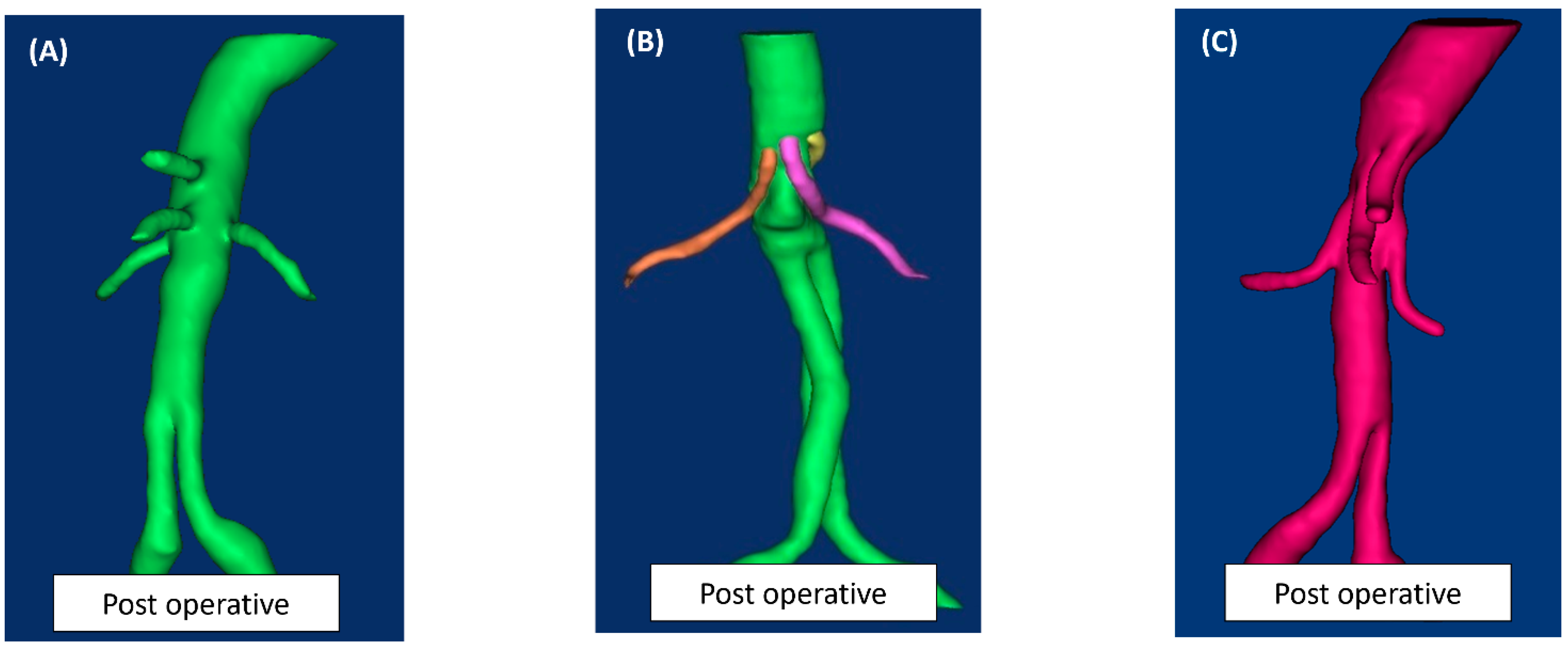
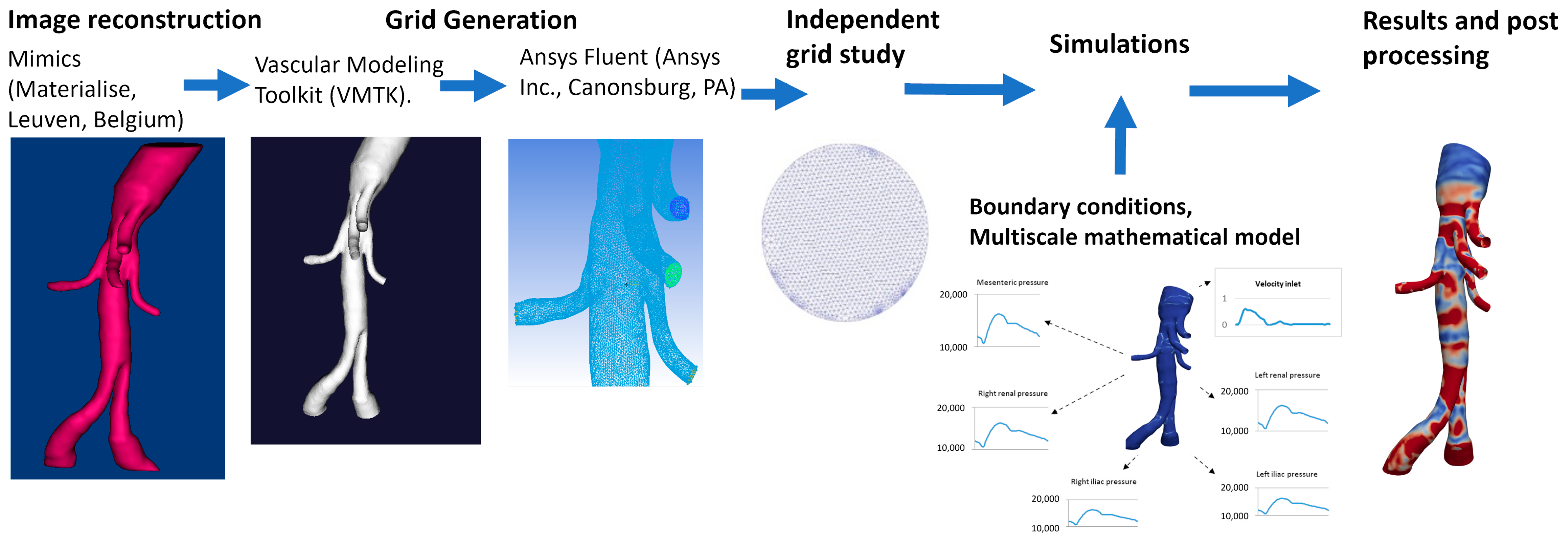
2.3. Modeling
2.4. Statistical Analysis
3. Results
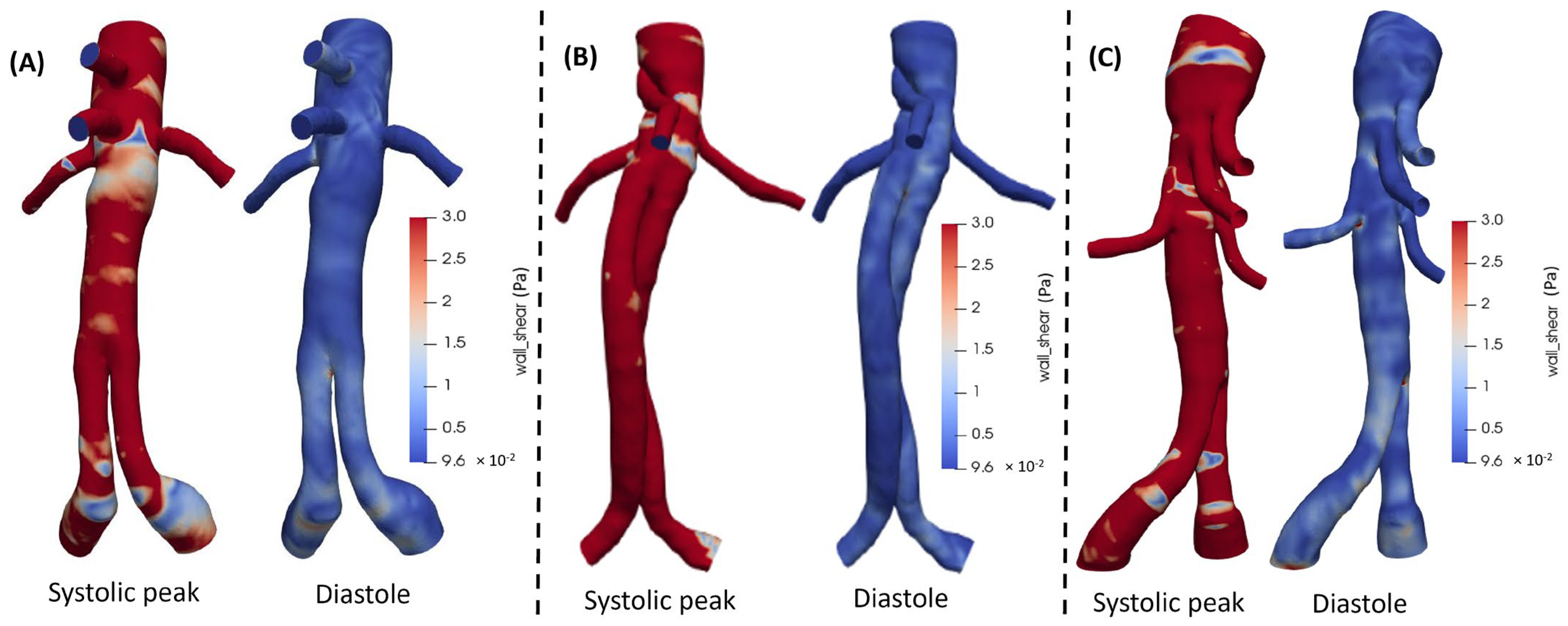
3.1. Wall Shear Stress (WSS)
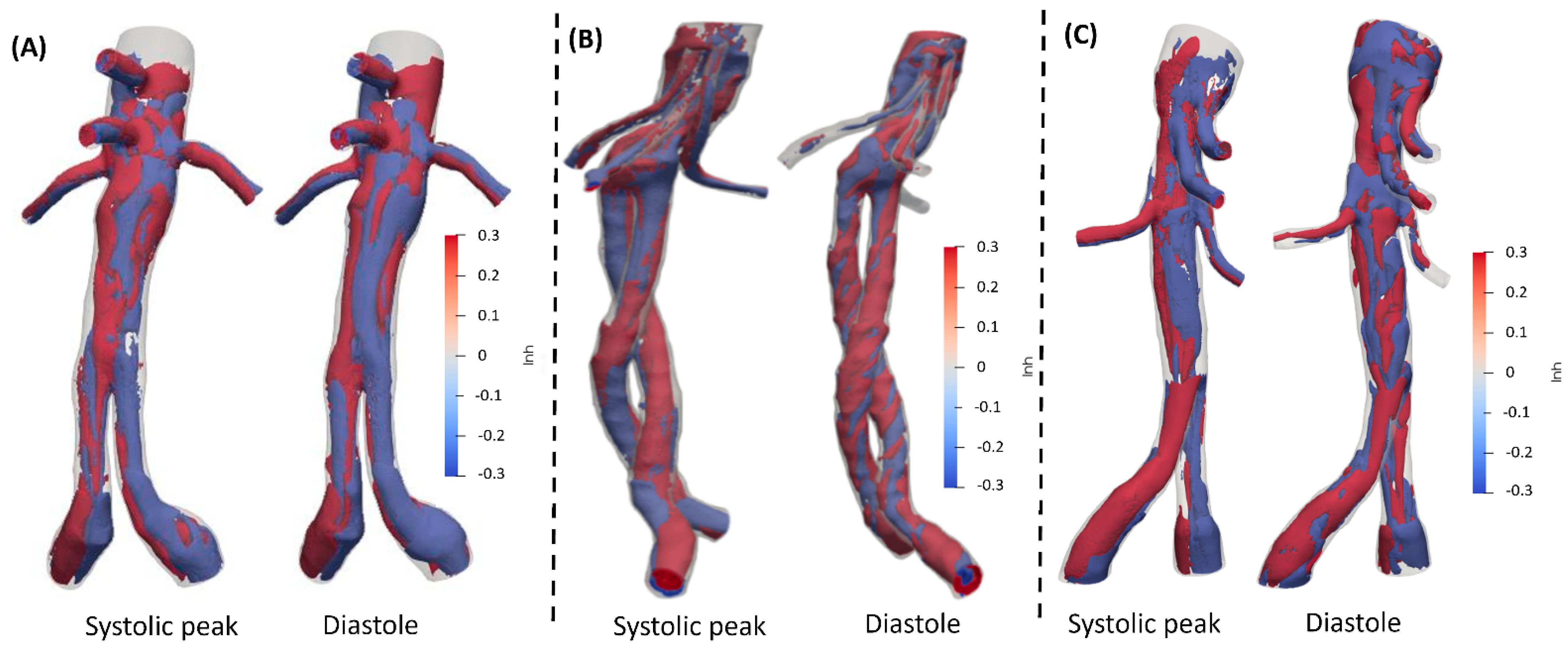
3.2. Local Normalized Helicity (LNH)
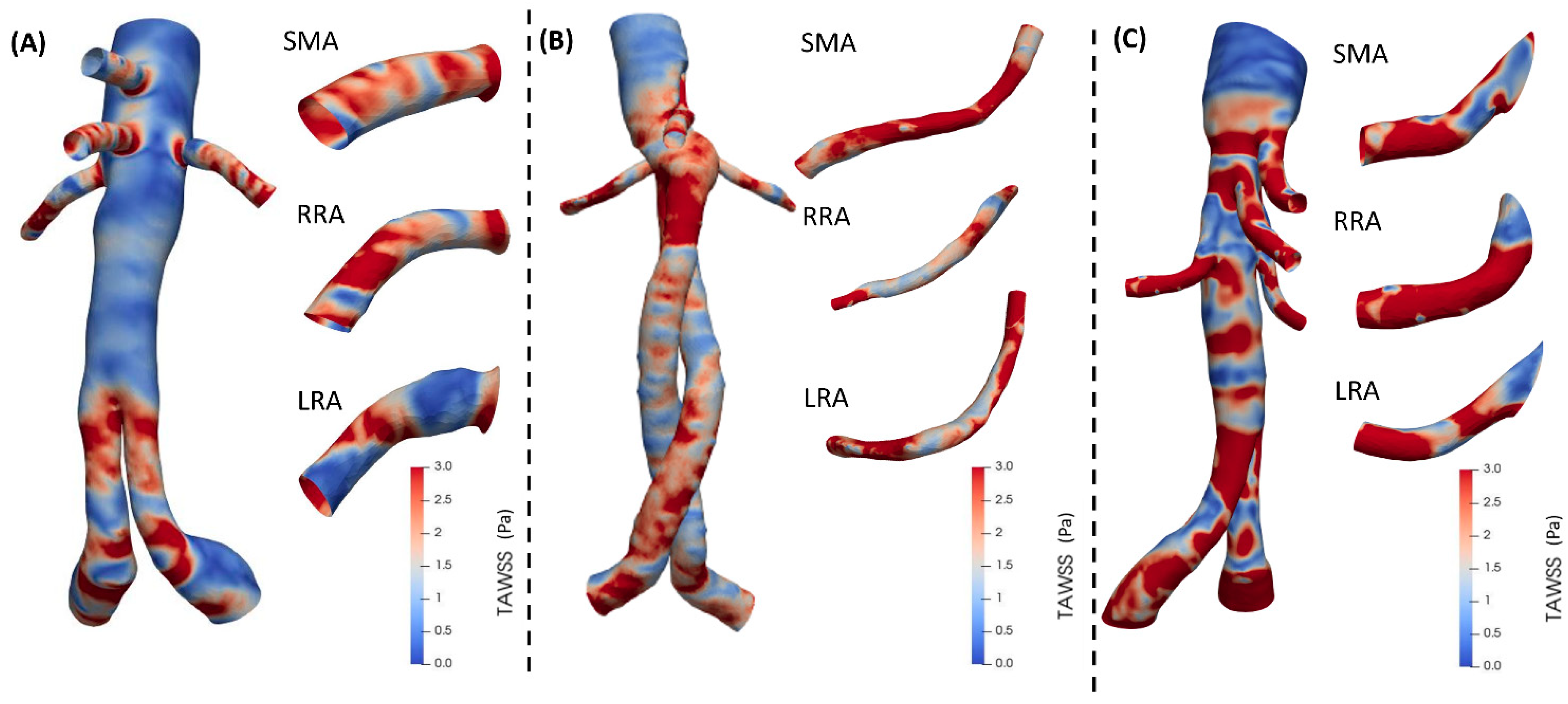
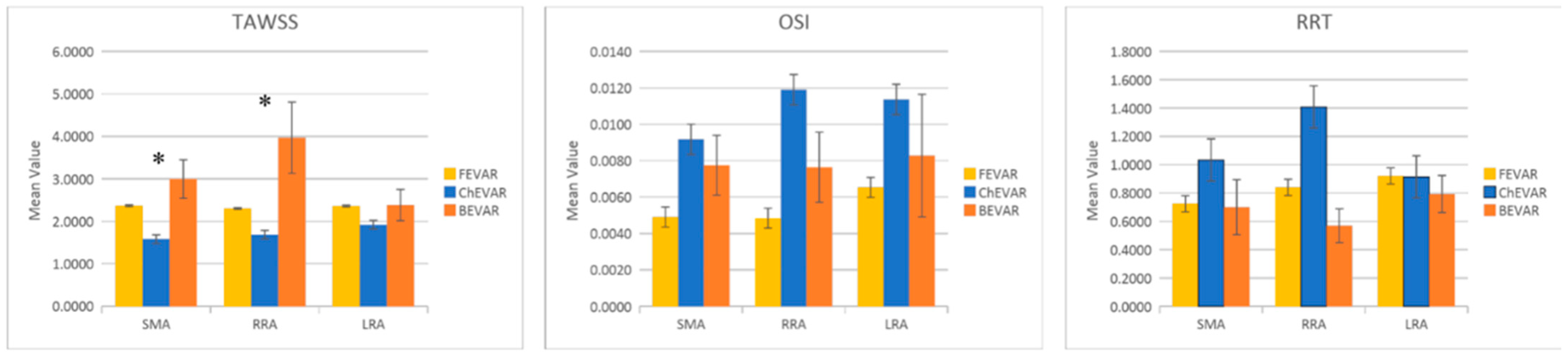
3.3. Time-Averaged Wall Shear Stress (TAWSS)
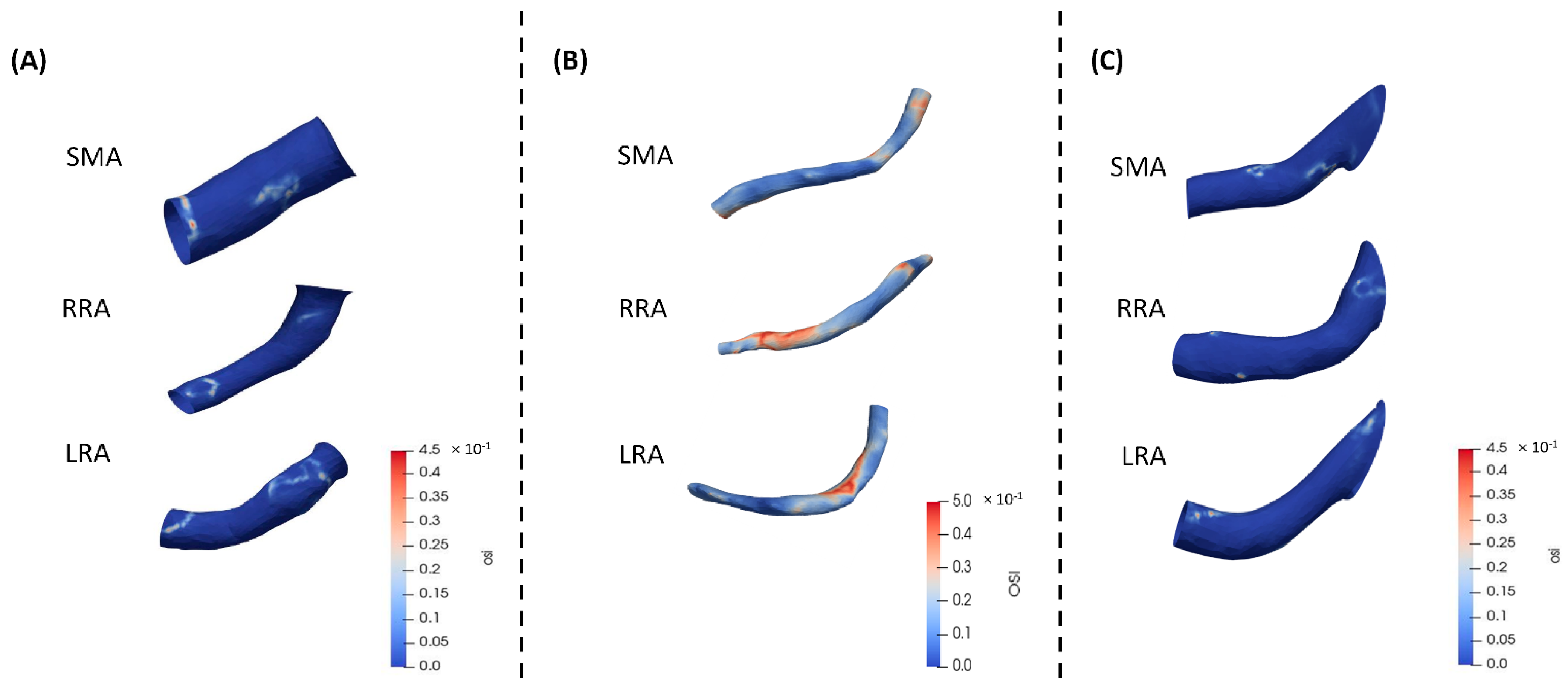
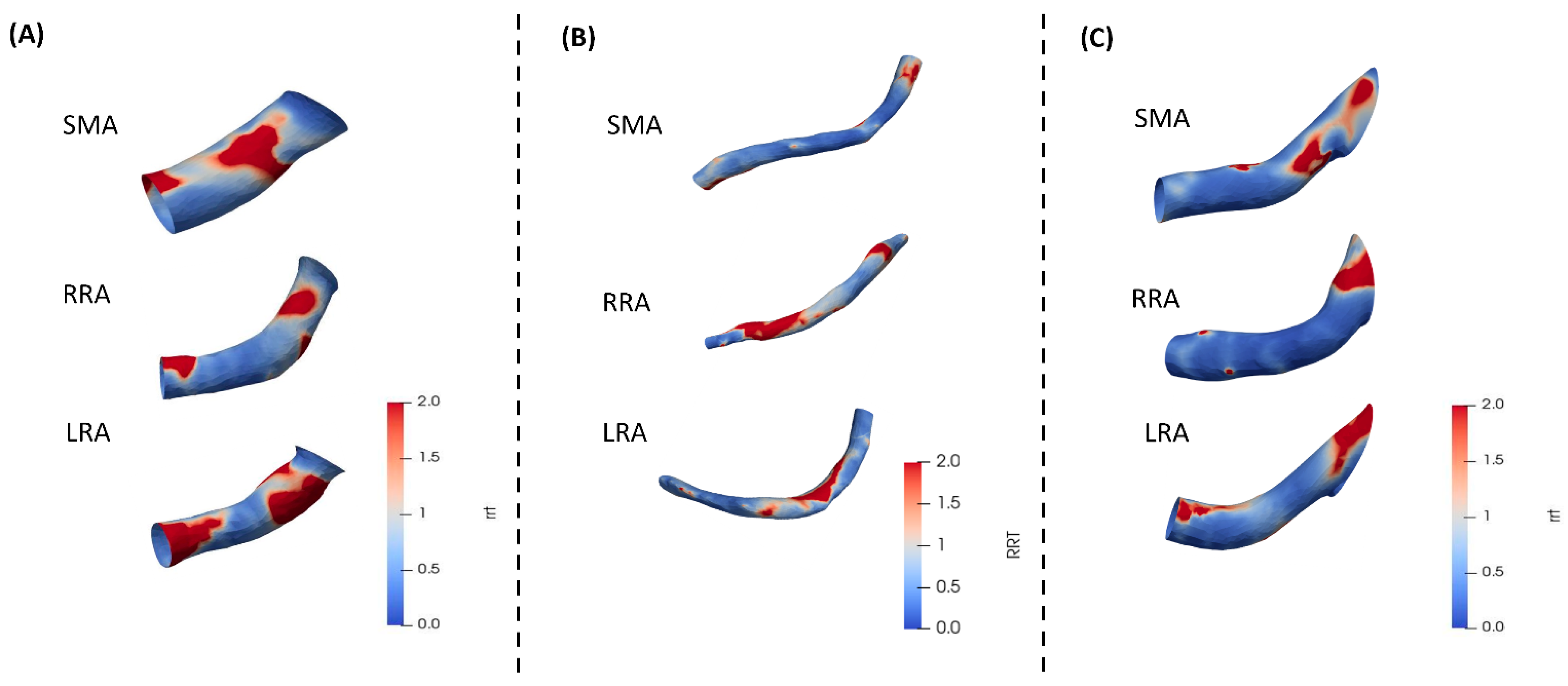
3.4. Oscillatory Shear Index (OSI) and Relative Residence Time (RRT)
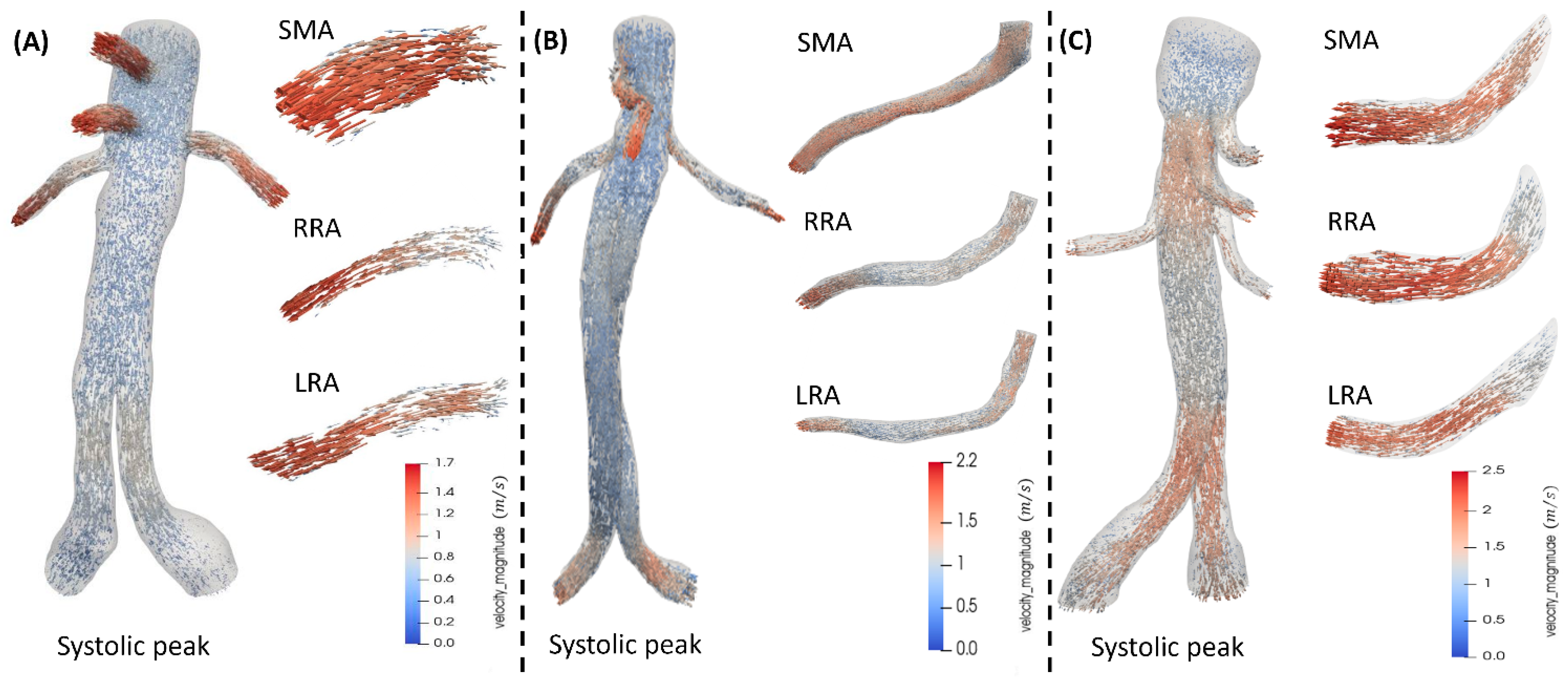
3.5. Flow Comparison in FEVAR, chEVAR, and BEVAR
3.6. Mean Visceral Hemodynamics
4. Discussion
Limitations
5. Conclusions
Author Contributions
Funding
Institutional Review Board Statement
Informed Consent Statement
Data Availability Statement
Conflicts of Interest
Abbreviations
| FEVAR | Fenestrated endovascular repair |
| BEVAR | Branched endovascular repair |
| chEVAR | Chimney endovascular repair |
| CFD | Computational fluid dynamics |
| WSS | Wall shear stress |
| AAA | Abdominal aortic aneurysm |
| RRA | Right renal artery |
| LRA | Left renal artery |
| SMA | Superior mesenteric Artery |
| CA | Celiac artery |
| RRT | Relative residence time |
| OSI | Oscillatory shear index |
| TAWSS | Time-averaged wall shear stress |
| LNH | Local normalized helicity |
Appendix A


References
- Tran, K.; Deslarzes-Dubuis, C.; DeGlise, S.; Kaladji, A.; Yang, W.; Marsden, A.L.; Lee, J.T. Patient-specific computational flow simulation reveals significant differences in paravisceral aortic hemodynamics between fenestrated and branched endovascular aneurysm repair. JVS-Vasc. Sci. 2024, 5, 100183. [Google Scholar] [CrossRef]
- Greenberg, R.; Eagleton, M.; Mastracci, T. Branched endografts for thoracoabdominal aneurysms. J. Thorac. Cardiovasc. Surg. 2010, 140, S171–S178. [Google Scholar] [CrossRef]
- Wanhainen, A.; Van Herzeele, I.; Bastos Goncalves, F.; Bellmunt Montoya, S.; Berard, X.; Boyle, J.R.; D’Oria, M.; Prendes, C.F.; Karkos, C.D.; Kazimierczak, A.; et al. Editor’s Choice—European Society for Vascular Surgery (ESVS) 2024 Clinical Practice Guidelines on the Management of Abdominal Aorto-Iliac Artery Aneurysms. Eur. J. Vasc. Endovasc. Surg. 2024, 67, 192–331. [Google Scholar] [CrossRef]
- Finnesgard, E.J.; Jones, D.W.; Beck, A.W.; Eagleton, M.J.; Farber, M.A.; Gasper, W.J.; Lee, W.A.; Oderich, G.S.; Schneider, D.B.; Sweet, M.P.; et al. Trends and outcomes over time with fenestrated and branched endovascular aortic repair in the United States Aortic Research Consortium. J. Vasc. Surg. 2025, 81, 1235–1243. [Google Scholar] [CrossRef]
- Fargion, A.T.; Esposito, D.; Speziali, S.; Pulli, R.; Gallitto, E.; Faggioli, G.; Gargiulo, M.; Bertoglio, L.; Melissano, G.; Chiesa, R.; et al. Fate of target visceral vessels in fenestrated and branched complex endovascular aortic repair. J. Vasc. Surg. 2023, 78, 584–592.e2. [Google Scholar] [CrossRef] [PubMed]
- Dossabhoy, S.S.; Simons, J.P.; Diamond, K.R.; Flahive, J.M.; Aiello, F.A.; Arous, E.J.; Messina, L.M.; Schanzer, A. Reinterventions after fenestrated or branched endovascular aortic aneurysm repair. J. Vasc. Surg. 2018, 68, 669–681. [Google Scholar] [CrossRef] [PubMed]
- Gorgatti, F.; Nana, P.; Panuccio, G.; Rohlffs, F.; Torrealba, J.I.; Kölbel, T. Post-dissection Thoraco-abdominal Aortic Aneurysm Managed by Fenestrated or Branched Endovascular Aortic Repair. Eur. J. Vasc. Endovasc. Surg. 2024, 68, 325–334. [Google Scholar] [CrossRef] [PubMed]
- Malatos, S.; Fazzini, L.; Raptis, A.; Nana, P.; Kouvelos, G.; Tasso, P.; Gallo, D.; Morbiducci, U.; Xenos, M.A.; Giannoukas, A.; et al. Evaluation of Hemodynamic Properties After Chimney and Fenestrated Endovascular Aneurysm Repair. Ann. Vasc. Surg. 2024, 104, 237–247. [Google Scholar] [CrossRef]
- Katsoudas, S.; Malatos, S.; Raptis, A.; Matsagkas, M.; Giannoukas, A.; Xenos, M. Blood Flow Simulation in Bifurcating Arteries: A Multiscale Approach After Fenestrated and Branched Endovascular Aneurysm Repair. Mathematics 2025, 13, 1362. [Google Scholar] [CrossRef]
- Raptis, A.; Xenos, M.; Georgakarakos, E.; Kouvelos, G.; Giannoukas, A.; Labropoulos, N.; Matsagkas, M. Comparison of physiological and post-endovascular aneurysm repair infrarenal blood flow. Comput. Methods Biomech. Biomed. Eng. 2017, 20, 242–249. [Google Scholar] [CrossRef]
- Suess, T.; Anderson, J.; Danielson, L.; Pohlson, K.; Remund, T.; Blears, E.; Gent, S.; Kelly, P. Examination of near-wall hemodynamic parameters in the renal bridging stent of various stent graft configurations for repairing visceral branched aortic aneurysms. J. Vasc. Surg. 2016, 64, 788–796. [Google Scholar] [CrossRef]
- Malatos, S.; Raptis, A.; Xenos, M.A.; Kouvelos, G.; Katsargyris, A.; Giannoukas, A.; Verhoeven, E.L.; Matsagkas, M. A multiscale model for hemodynamic properties’ prediction after fenestrated endovascular aneurysm repair. A pilot study. Hell. J. Vasc. Endovasc. Surg. 2019, 1, 73–79. [Google Scholar]
- Vignon-Clementel, I.E.; Figueroa, C.A.; Jansen, K.E.; Taylor, C.A. Outflow boundary conditions for three-dimensional finite element modeling of blood flow and pressure in arteries. Comput. Methods Appl. Mech. Eng. 2006, 195, 3776–3796. [Google Scholar] [CrossRef]
- Figueroa, C.A.; Vignon-Clementel, I.E.; Jansen, K.E.; Hughes, T.J.R.; Taylor, C.A. A coupled momentum method for modeling blood flow in three-dimensional deformable arteries. Comput. Methods Appl. Mech. Eng. 2006, 195, 5685–5706. [Google Scholar] [CrossRef]
- Chait, J.; Tenorio, E.R.; Mendes, B.C.; Barbosa Lima, G.B.; Marcondes, G.B.; Wong, J.; Macedo, T.A.; De Martino, R.R.; Oderich, G.S. Impact of gap distance between fenestration and aortic wall on target artery instability following fenestrated-branched endovascular aortic repair. J. Vasc. Surg. 2022, 76, 79–87.e4. [Google Scholar] [CrossRef] [PubMed]
- Fazzini, S.; Martinelli, O.; Torsello, G.; Austermann, M.; Pipitone, M.D.; Torsello, G.F.; Irace, L.; Donas, K.P. The PROTAGORAS 2.0 Study to Identify Sizing and Planning Predictors for Optimal Outcomes in Abdominal Chimney Endovascular Procedures. Eur. J. Vasc. Endovasc. Surg. 2021, 61, 591–602. [Google Scholar] [CrossRef] [PubMed]
- Olufsen, M.S.; Peskin, C.S.; Kim, W.Y.; Pedersen, E.M.; Nadim, A.; Larsen, J. Numerical simulation and experimental validation of blood flow in arteries with structured-tree outflow conditions. Ann. Biomed. Eng. 2000, 28, 1281–1899. [Google Scholar] [CrossRef] [PubMed]
- Reymond, P.; Merenda, F.; Perren, F.; Rüfenacht, D.; Stergiopulos, N. Validation of a one-dimensional model of the systemic arterial tree. Am. J. Physiol.-Heart Circ. Physiol. 2009, 297, H208–H222. [Google Scholar] [CrossRef]
- Malatos, S.; Raptis, A.; Xenos, M. Advances in Low-Dimensional Mathematical Modeling of the Human Cardiovascular System. J. Hypertens. Manag. 2016, 2, 017. [Google Scholar] [CrossRef]
- Morbiducci, U.; Ponzini, R.; Gallo, D.; Bignardi, C.; Rizzo, G. Inflow boundary conditions for image-based computational hemodynamics: Impact of idealized versus measured velocity profiles in the human aorta. J. Biomech. 2013, 46, 102–109. [Google Scholar] [CrossRef]
- van de Vosse, F.; Stergiopulos, N. Pulse Wave Propagation in the Arterial Tree. Annu. Rev. Fluid Mech. 2011, 43, 467–499. [Google Scholar] [CrossRef]
- Raptis, A.; Xenos, M.; Georgakarakos, E.; Kouvelos, G.; Giannoukas, A.; Matsagkas, M. Hemodynamic Profile of Two Aortic Endografts Accounting for Their Postimplantation Position. J. Med. Devices 2017, 11, 021003. [Google Scholar] [CrossRef]
- Reymond, P.; Bohraus, Y.; Perren, F.; Lazeyras, F.; Stergiopulos, N. Validation of a patient-specific one-dimensional model of the systemic arterial tree. Am. J. Physiol. Heart Circ. Physiol. 2011, 301, H1173–H1182. [Google Scholar] [CrossRef]
- Alastruey, J.; Parker, K.; Peiro, J.; Sherwin, S. Lumped parameter outflow models for 1-D blood flow simulations: Effect on pulse waves and parameter estimation. Commun. Comput. Phys. 2008, 4, 317–336. [Google Scholar]
- Sherwin, S.J.; Franke, V.; Peiró, J.; Parker, K. One-dimensional modelling of a vascular network in space-time variables. J. Eng. Math. 2003, 47, 217–250. [Google Scholar] [CrossRef]
- Xiao, N.; Humphrey, J.D.; Figueroa, C.A. Multi-scale computational model of three-dimensional hemodynamics within a deformable full-body arterial network. J. Comput. Phys. 2013, 244, 22–40. [Google Scholar] [CrossRef]
- Tasso, P.; Raptis, A.; Matsagkas, M.; Rizzini, M.L.; Gallo, D.; Xenos, M.; Morbiducci, U. Abdominal Aortic Aneurysm Endovascular Repair: Profiling Postimplantation Morphometry and Hemodynamics With Image-Based Computational Fluid Dynamics. J. Biomech. Eng. 2018, 140, 111003. [Google Scholar] [CrossRef] [PubMed]
- Pan, W.; Kulisa, P.; Bou-Saïd, B.; Hajem, M.E.; Simoëns, S.; Sigovan, M. A proposal of risk indicators for pathological development from hemodynamic simulation: Application to aortic dissection. J. Cardiol. Cardiovasc. Med. 2023, 8, 029–038. [Google Scholar] [CrossRef]
- Gallo, D.; Bijari, P.B.; Morbiducci, U.; Qiao, Y.; Xie, Y.J.; Etesami, M.; Habets, D.; Lakatta, E.G.; Wasserman, B.A.; Steinman, D.A. Segment-specific associations between local haemodynamic and imaging markers of early atherosclerosis at the carotid artery: An in vivo human study. J. R. Soc. Interface 2018, 15, 20180352. [Google Scholar] [CrossRef]
- Raulli, S.J.; Gomes, V.C.; Parodi, F.E.; Vasan, P.; Sun, D.; Marston, W.A.; Pascarella, L.; McGinigle, K.L.; Wood, J.C.; Farber, M.A. Five-year outcomes of fenestrated and branched endovascular repair of complex aortic aneurysms based on aneurysm extent. J. Vasc. Surg. 2024, 80, 302–310. [Google Scholar] [CrossRef]
- Dossabhoy, S.S.; Sorondo, S.M.; Tran, K.; Stern, J.R.; Dalman, R.L.; Lee, J.T. Reintervention does not affect long-term survival after fenestrated endovascular aneurysm repair. J. Vasc. Surg. 2022, 76, 1180–1188.e8. [Google Scholar] [CrossRef] [PubMed]
- Bannazadeh, M.; Beckerman, W.E.; Korayem, A.H.; McKinsey, J.F. Two-year evaluation of fenestrated and parallel branch endografts for the treatment of juxtarenal, suprarenal, and thoracoabdominal aneurysms at a single institution. J. Vasc. Surg. 2020, 71, 15–22. [Google Scholar] [CrossRef] [PubMed]
- Tenorio, E.R.; Schanzer, A.; Timaran, C.H.; Schneider, D.B.; Mendes, B.C.; Eagleton, M.J.; Farber, M.A.; Parodi, F.E.; Gasper, W.J.; Beck, A.W.; et al. Mid-term Renal and Mesenteric Artery Outcomes During Fenestrated and Branched Endovascular Aortic Repair for Complex Abdominal and Thoracoabdominal Aortic Aneurysms in the United States Aortic Research Consortium. Ann. Surg. 2023, 278, e893–e902. [Google Scholar] [CrossRef] [PubMed]
- TPini, R.; Faggioli, G.; Gallitto, E.; Mascoli, C.; Fenelli, C.; Ancetti, S.; Vacirca, A.; Gargiulo, M. The different effect of branches and fenestrations on early and long-term visceral vessel patency in complex aortic endovascular repair. J. Vasc. Surg. 2020, 71, 1128–1134. [Google Scholar] [CrossRef]
- TMartin-Gonzalez, T.; Mastracci, T.; Carrell, T.; Constantinou, J.; Dias, N.; Katsargyris, A.; Modarai, B.; Resch, T.; Verhoeven, E.; Haulon, S. Mid-term Outcomes of Renal Branches Versus Renal Fenestrations for Thoraco-abdominal Aneurysm Repair. Eur. J. Vasc. Endovasc. Surg. 2016, 52, 141–148. [Google Scholar] [CrossRef]



| Cases | Main Body | Max Aortic Diameter at Proximal Landing Zone | Max Visceral Aortic Diameter | Infrarenal Aortic Angulation | Neck Calcification/Thrombus in >25% of the Circumference of Landing Zone | Bridging Stent | Diameter of TVs at Landing Zone | Angles of TVs |
|---|---|---|---|---|---|---|---|---|
| FEVAR | ||||||||
| 1 | Cook Fenestrated graft: 36 × 22 × 162 mm | 30.2 mm | 33.0 mm | 20.0° | No | RRA: BeGraft 6 × 28 mm LRA: BeGraft 6 × 28 mm SMA: BeGraft 8 × 37 mm CA: BeGraft 9 × 37 mm | RRA: 6.1 mm LRA: 6.1 mm SMA: 7.5 mm | RRA: 25° LRA: 3° SMA: 27° |
| 2 | Cook Fenestrated graft: 30 × 22 × 114 mm | 26.0 mm | 29.6 mm | 8.0° | No | RRA: BeGraft 6 × 28 mm LRA: BeGraft 6 × 28 mm SMA: BeGraft 8 × 37 mm | RRA: 6.0 mm LRA: 5.7 mm SMA: 7.6 mm | RRA: 23° LRA: 18° SMA: 10° |
| 3 | Cook Fenestrated graft: 38 × 35 × 162 mm | 31.5 mm | 30.7 mm | 17.0° | No | RRA: BeGraft 6 × 28 mm LRA: Begraft 6 × 28 mm SMA: Begraft 8 × 37 mm CA: Begraft 9 × 37 mm | RRA: 5.7 mm LRA: 6.0 mm SMA: 7.7 mm | RRA: 27° LRA: 17° SMA: 23° |
| ChEVAR | ||||||||
| 1 | Endurant IIs: 36 × 14 × 103 mm | 27.6 mm | 32.0 mm | 15.8° | No | RRA: BeGraft 6 × 58 mm LRA: BeGraft 6 × 58 mm SMA: BeGraft 8 × 57 mm | RRA: 5.3 mm LRA: 6.0 mm SMA: 7.9 mm | RRA: 32° LRA: 12° SMA: 31° |
| 2 | Endurant IIs: 36 × 14 × 103 mm | 27.1 mm | 27.6 mm | 31.0° | No | RRA: Begraft 6 × 58 mm LRA: BeGraft 6 × 58 mm SMA: BeGraft 8 × 57 mm | RRA: 5.1 mm LRA: 5.6 mm SMA: 7.9 mm | RRA: 37° LRA: 8° SMA: 26° |
| 3 | Endurant IIs GRAFT: 36 × 14 × 103 mm | 27.0 mm | 29.0 mm | 28.0° | No | RRA: BeGraft 6 × 58 mm LRA: BeGraft 6 × 58 mm SMA: BeGraft 8 × 57 mm | RRA: 5.5 mm LRA: 5.9 mm SMA: 7.7 mm | RRA: 24° LRA: 28° SMA: 43° |
| BEVAR | ||||||||
| 1 | Cook t-Branch: 34 × 19 × 202 mm | 30.5 mm | 36.8 mm | 15° | No | RRA: BeGraft 6 × 57 mm LRA: BeGraft 6 × 57 mm CA: BeGraft 8 × 57 mm SMA: BeGraft 8 × 57 mm | RRA: 5.6 mm LRA:5.2 mm CA: 8.1 mm SMA: 7.8 mm | RRA:21° LRA:20° SMA: 17° |
| 2 | Cook thoracic graft 49 × 36 × 217 mm+ Cook t-Branch: 34 × 19 × 202 mm | 26 mm | 32.4 mm | 14° | No | RRA: BeGraft 7 × 57 mm LRA: BeGraft 7 × 57 mm CA: BeGraft 9 × 59 mm SMA: BeGraft 8 × 57 mm | RRA: 6.7 mm LRA:7 mm CA: 8.6 mm SMA: 8.1 mm | RRA:6° LRA:16° SMA: 6° |
| 3 | Cook t-Branch: 34 × 19 × 202 mm | 31 mm | 33 mm | 15° | No | RRA: BeGraft 6 × 57 mm LRA: BeGraft 7 × 57 mm CA: BeGraft 8 × 59 mm SMA: BeGraft 9 × 57 mm | RRA: 6.5 mm LRA:7.1 mm CA: 8 mm SMA: 8.6 mm | RRA:10° LRA:14° SMA: 101° |
| FEVAR | ChEVAR | BEVAR | FEVAR | ChEVAR | BEVAR | FEVAR | ChEVAR | BEVAR | |
| RRT-Mean (1/Pa) | SMA | SMA | SMA | RRA | RRA | RRA | LRA | LRA | LRA |
| P1 | 1.0069 | 0.5225 | 0.5350 | 1.0478 | 1.0941 | 0.5196 | 1.4802 | 0.9316 | 0.8077 |
| P2 | 0.6430 | 1.7459 | 0.9139 | 0.6088 | 2.0717 | 0.7050 | 0.5181 | 0.8775 | 0.6557 |
| P3 | 0.5212 | 0.8302 | 0.6503 | 0.8630 | 1.0577 | 0.4820 | 0.7628 | 0.9322 | 0.9160 |
| Average | 0.7237 | 1.0328 | 0.6997 | 0.8399 | 1.4078 | 0.5689 | 0.9204 | 0.9138 | 0.7931 |
| OSI-Mean (Dimensionless) | SMA | SMA | SMA | RRA | RRA | RRA | LRA | LRA | LRA |
| P1 | 0.0070 | 0.0084 | 0.0062 | 0.0061 | 0.0175 | 0.0067 | 0.0107 | 0.0073 | 0.0091 |
| P2 | 0.0038 | 0.0118 | 0.0095 | 0.0052 | 0.0129 | 0.0064 | 0.0050 | 0.0210 | 0.0045 |
| P3 | 0.0040 | 0.0073 | 0.0075 | 0.0033 | 0.0053 | 0.0098 | 0.0038 | 0.0057 | 0.0111 |
| Average | 0.0049 | 0.0092 | 0.0077 | 0.0048 | 0.0119 | 0.0076 | 0.0065 | 0.0114 | 0.0083 |
| TAWSS-Mean (Pa) | SMA | SMA | SMA | RRA | RRA | RRA | LRA | LRA | LRA |
| P1 | 2.0107 | 1.6635 | 3.3955 | 1.8828 | 0.9943 | 4.5400 | 1.7417 | 1.4609 | 2.8088 |
| P2 | 2.4245 | 1.1021 | 2.5005 | 2.7818 | 1.3462 | 3.0023 | 2.8822 | 2.1734 | 2.1953 |
| P3 | 2.6638 | 1.9726 | 3.0866 | 2.2412 | 2.7191 | 4.3557 | 2.4512 | 2.1275 | 2.1453 |
| Average | 2.3663 | 1.5794 | 2.9942 | 2.3019 | 1.6865 | 3.9660 | 2.3584 | 1.9206 | 2.3831 |
| Mean Flow Rate of the cardiac cycle (l/s) | SMA | SMA | SMA | RRA | RRA | RRA | LRA | LRA | LRA |
| P1 | 1.20 × 10⁻⁵ | 7.05 × 10⁻⁶ | 1.25 × 10⁻⁵ | 7.77 × 10⁻⁶ | 3.22 × 10⁻⁶ | 8.78 × 10⁻⁶ | 7.99 × 10⁻⁶ | 4.79 × 10⁻⁶ | 8.78 × 10⁻⁶ |
| P2 | 4.53 × 10⁻⁶ | 4.39 × 10⁻⁶ | 8.67 × 10⁻⁶ | 5.77 × 10⁻⁶ | 1.59 × 10⁻⁶ | 6.88 × 10⁻⁶ | 4.78 × 10⁻⁶ | 4.14 × 10⁻⁶ | 4.14 × 10⁻⁶ |
| P3 | 8.29 × 10⁻⁶ | 3.92 × 10⁻⁶ | 1.13 × 10⁻⁵ | 5.04 × 10⁻⁶ | 1.62 × 10⁻⁶ | 6.65 × 10⁻⁶ | 5.90 × 10⁻⁶ | 2.51 × 10⁻⁶ | 5.90 × 10⁻⁶ |
| Average | 8.28 × 10⁻⁶ | 5.12 × 10⁻⁶ | 1.08 × 10⁻⁵ | 6.20 × 10⁻⁶ | 2.15 × 10⁻⁶ | 7.44 × 10⁻⁶ | 6.22 × 10⁻⁶ | 3.81 × 10⁻⁶ | 6.27 × 10⁻⁶ |
| Pressure-MAP (Mean Arterial Pressure) (Pa) | SMA | SMA | SMA | RRA | RRA | RRA | LRA | LRA | LRA |
| P1 | 12,448.0 | 12,595.4 | 13,042.2 | 12,423.6 | 12,607.7 | 12,881.4 | 12,436.0 | 12,523.1 | 12,937.9 |
| P2 | 12,449.0 | 12,528.7 | 12,794.0 | 12,425.3 | 12,515.9 | 12,691.8 | 12,436.3 | 12,573.5 | 12,652.1 |
| P3 | 12,447.6 | 12,447.3 | 12,903.6 | 12,423.6 | 12,423.3 | 12,889.4 | 12,436.0 | 12,437.0 | 12,986.0 |
| Average | 12,448.2 | 12,523.8 | 12,913.2 | 12,424.2 | 12,515.6 | 12,820.9 | 12,436.1 | 12,511.2 | 12,858.7 |
| WSS-Mean at peak systole (Pa) | SMA | SMA | SMA | RRA | RRA | RRA | LRA | LRA | LRA |
| P1 | 15.75 | 11.40 | 23.92 | 12.61 | 7.96 | 31.86 | 13.09 | 9.94 | 26.29 |
| P2 | 21.32 | 14.95 | 22.98 | 20.66 | 12.23 | 21.89 | 22.79 | 15.52 | 19.16 |
| P3 | 20.58 | 27.57 | 26.27 | 18.05 | 19.52 | 33.24 | 19.60 | 18.70 | 26.67 |
| Average | 19.22 | 17.98 | 24.39 | 17.11 | 13.24 | 28.99 | 18.50 | 14.72 | 24.04 |
| FEVAR cases | ||||
| Target vessel | Patient 1 (%) | Patient 2 (%) | Patient 3 (%) | Mean Value |
| SMA | 11.1834 | 24.7713 | 14.3677 | 16.7741 |
| LRA | 5.4558 | 19.0680 | 6.2420 | 10.2552 |
| RRA | 1.6034 | 10.3179 | 6.0401 | 5.9871 |
| ChEVAR cases | ||||
| Target vessel | Patient 1 (%) | Patient 2 (%) | Patient 3 (%) | Mean Value |
| SMA | 14.3160 | 29.9458 | 20.5075 | 21.5897 |
| LRA | 11.9259 | 21.2901 | 29.2485 | 20.8215 |
| RRA | 10.0024 | 36.8587 | 26.1691 | 24.3434 |
| BEVAR cases | ||||
| Target vessel | Patient 1 (%) | Patient 2 (%) | Patient 3 (%) | Mean Value |
| SMA | 3.6570 | 13.2076 | 12.8335 | 9.8994 |
| LRA | 2.2868 | 23.7582 | 60.3961 | 28.0514 |
| RRA | 2.2868 | 2.4989 | 10.3019 | 5.0292 |
Disclaimer/Publisher’s Note: The statements, opinions and data contained in all publications are solely those of the individual author(s) and contributor(s) and not of MDPI and/or the editor(s). MDPI and/or the editor(s) disclaim responsibility for any injury to people or property resulting from any ideas, methods, instructions or products referred to in the content. |
© 2026 by the authors. Licensee MDPI, Basel, Switzerland. This article is an open access article distributed under the terms and conditions of the Creative Commons Attribution (CC BY) license.
Share and Cite
Malatos, S.; Katsoudas, S.; Raptis, A.; Fazzini, L.; Nana, P.; Kouvelos, G.; Giannoukas, A.; Xenos, M.; Matsagkas, M. Comparison of Hemodynamics After Fenestrated, Branched, and Chimney Endovascular Aneurysm Repair Employing Computational Fluid Dynamics. J. Clin. Med. 2026, 15, 1914. https://doi.org/10.3390/jcm15051914
Malatos S, Katsoudas S, Raptis A, Fazzini L, Nana P, Kouvelos G, Giannoukas A, Xenos M, Matsagkas M. Comparison of Hemodynamics After Fenestrated, Branched, and Chimney Endovascular Aneurysm Repair Employing Computational Fluid Dynamics. Journal of Clinical Medicine. 2026; 15(5):1914. https://doi.org/10.3390/jcm15051914
Chicago/Turabian StyleMalatos, Stavros, Spyridon Katsoudas, Anastasios Raptis, Laura Fazzini, Petroula Nana, George Kouvelos, Athanasios Giannoukas, Michalis Xenos, and Miltiadis Matsagkas. 2026. "Comparison of Hemodynamics After Fenestrated, Branched, and Chimney Endovascular Aneurysm Repair Employing Computational Fluid Dynamics" Journal of Clinical Medicine 15, no. 5: 1914. https://doi.org/10.3390/jcm15051914
APA StyleMalatos, S., Katsoudas, S., Raptis, A., Fazzini, L., Nana, P., Kouvelos, G., Giannoukas, A., Xenos, M., & Matsagkas, M. (2026). Comparison of Hemodynamics After Fenestrated, Branched, and Chimney Endovascular Aneurysm Repair Employing Computational Fluid Dynamics. Journal of Clinical Medicine, 15(5), 1914. https://doi.org/10.3390/jcm15051914