Introducing the Universal Periprosthetic Femur Fracture (UPFF) Classification: All Fractures Femur

Abstract
1. Introduction
2. Universal Periprosthetic Femur Fracture (UPFF) Classification
- Descriptive communication:
- The framework is designed to provide a concise alphanumeric description that supports an intuitive mental visualization of the fracture and implants, avoiding the need for rote memorization.
- The system provides descriptive rules without the need for calculations, allowing efficiency in communication.
- Cross-discipline usability:
- The framework is designed for use by all orthopedists, including generalists and trauma and arthroplasty surgeons, reducing specialty-dependent interpretation.
- Clinical actionability:
- The included elements were specifically selected to provide information relevant to surgical planning and execution.
- Operational simplicity:
- The descriptive system is designed to allow physicians and surgeons of various training to communicate effectively amongst their peers, utilizing defined steps.
- Pan-femoral inclusivity:
- Its structure is designed to permit the incorporation of all periprosthetic femur fractures, hip to knee, and to incorporate all future fracture patterns without redefining its core principles.
- Fracture patterns yet unknown can be incorporated into the scheme, possibly with the addition of a new modifier. This flexibility will prevent the classification scheme from becoming obsolete.
- Fidelity in research stratification:
- Classifying PPFF by location, bone quality, implant fixation and modifiers will allow each fracture type to be included as individual MeSH (Medical Subject Heading) keywords. For academic study, this scheme may reduce research heterogeneity and allow critical analysis of outcome measures based upon specified fracture patterns.
- Future automation/Artificial Intelligence (AI) applicability:
- Because UPFF is anthropometrically defined and rule-based, it may be suitable for future development of AI-based classification tools. This will require a large dataset development and validation.
- An AI-trained model may assist in immediate classification, aiding all healthcare personnel from trainees to senior staff.
- Stratification of PPFF by AI may assist in research analysis, potentially enhancing evidence-based, recommended treatment for specified fracture patterns.
3. Basic Rules of UPFF
3.1. Order and Sequencing
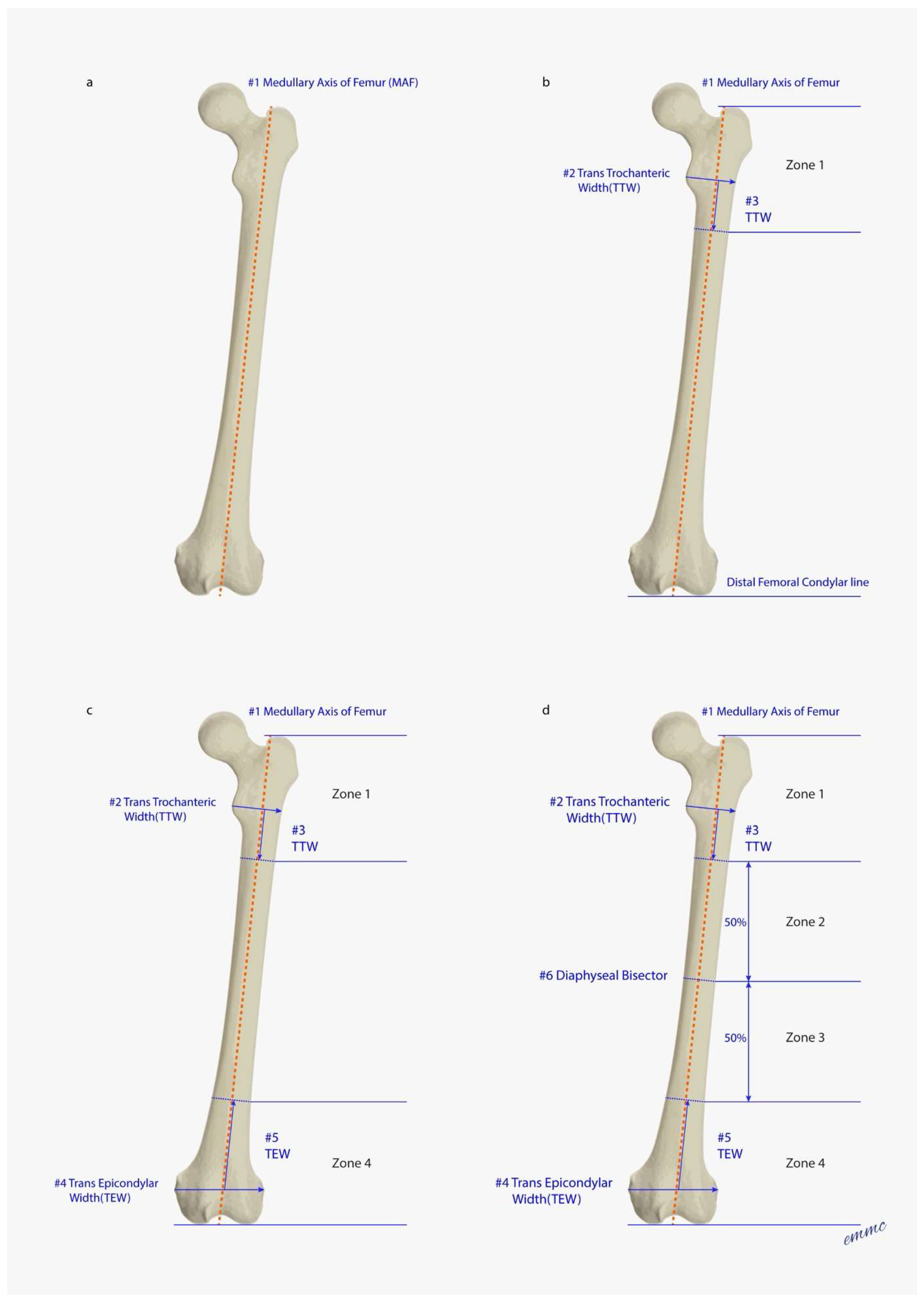
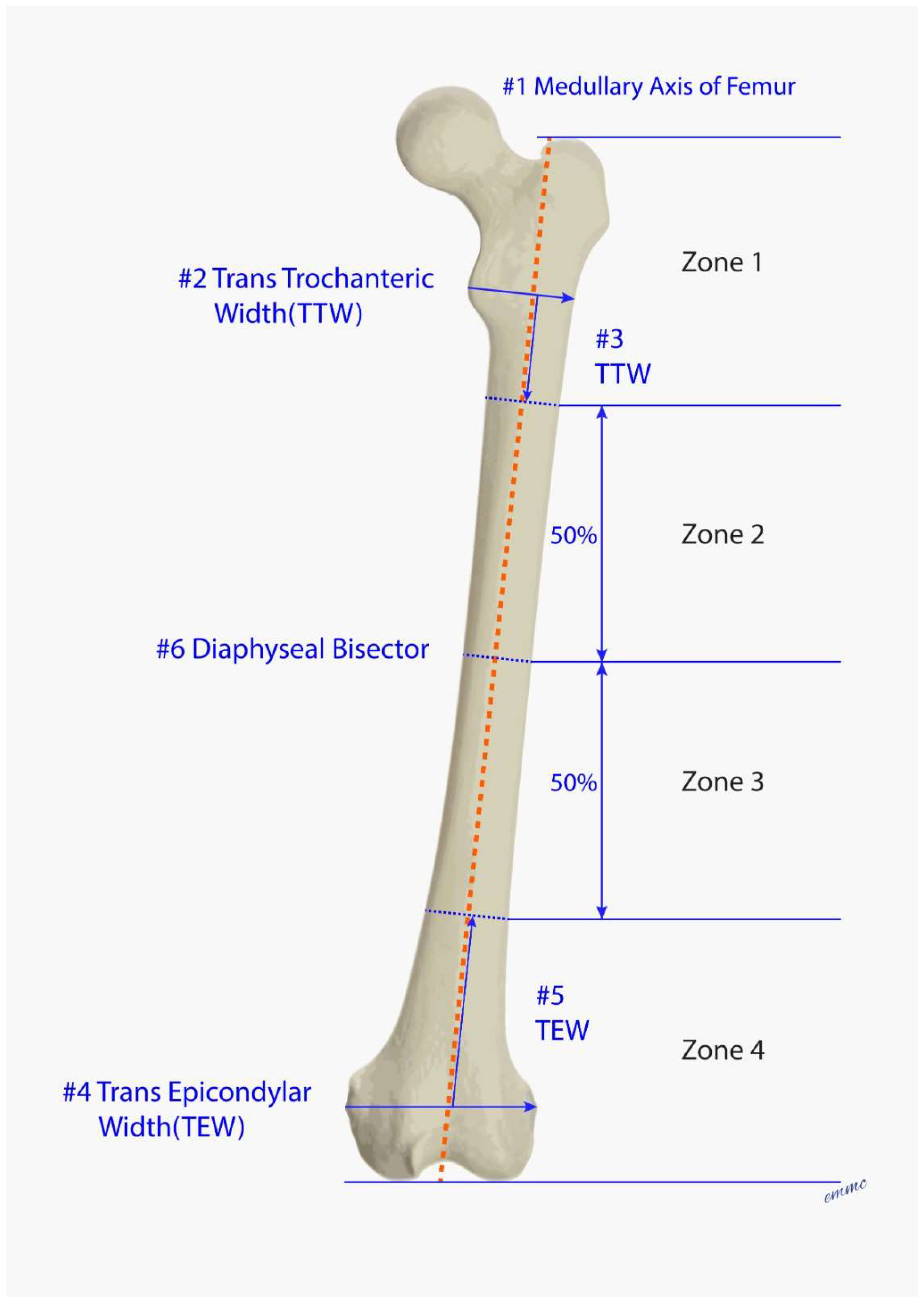
- Letters and numbers describing a fracture start from the top (superior) of the femur and proceed towards the knee.
- Classification is based upon Anterior–Posterior (AP) radiographic views of the entire femur. Orthogonal views and Computer Tomography (CT) are supplementary, confirming fracture extent, implant stability, and additional bone findings, ordered as needed.
- By convention, a fracture is periprosthetic when it originates or ends within the same fracture zone of an arthroplasty implant.
3.1.1. Fracture Location
- Zone 1: Starts from the proximal tip of the greater trochanter, extending one trans-trochanteric width (TTW) (of the lesser trochanter) distal to the TTW along the femoral medullary axis. The TTW is defined as the width measured at the medial lesser trochanteric apex to the outer lateral femoral cortex.
- Zone 4: Starts from a line joining the distal femoral condyles, extending one trans-epicondylar width (TEW) proximal to the TEW along the femoral medullary axis (i.e., extending proximal to the meta-diaphyseal knee flare). The TEW is defined as the line joining the medial and lateral epicondyles.
- Zone 2: The femoral diaphysis is divided into two equal sections between Zone 1 and Zone 4. Zone 2 begins from the inferior extent of Zone 1 to the top of Zone 3.
- Zone 3: The femoral diaphysis is divided into two equal sections between Zone 1 and Zone 4. Zone 3 begins from the inferior extent of Zone 2 to the top of Zone 4.
3.1.2. Bone Quality
3.1.3. Implant Descriptors
- HL — Hip Loose
- HS — Hip Stable
- KL — Knee Loose
- KS — Knee Stable
- C — Cemented
- U — Uncemented
3.1.4. Modifiers
- GT — Greater trochanter separation—state separation in (cm) with brackets
- LT — Lesser trochanter separation—state separation in (cm) with brackets
- ST — Stem present (at knee)
- IS — Inter-stem fracture—state distance in between stems in (cm) with brackets
- SG — Segmental fracture (more than 2 main segments)
- BS — Broken Stem
- BP — Broken Plate/Nail
- CB — Closed box knee prosthesis (if recognizable)
- IF — Infection present
- MT— Metastatic tumor
- OF — Open fracture
3.2. Staging Steps
- Step #1—State Fracture Location
- Fracture location is described using the 4 defined femoral zones
- One zone fracture—state the femoral zone of involvement
- Multi-zone fracture—state first the most proximal femoral zone of fracture, followed by the most distal femoral zone of fracture.
- Examples: 2, 4, 13, 24, etc.
- Step #2—State Bone Quality
- Cortical bone quality descriptor will follow the fracture zone, and by convention, there will be no space.
- Examples: 1B,12B, 34A, 23C, etc.
- Step #3—State Implant Descriptor
- Implant descriptors follow bone quality. By convention, the implant descriptor will be preceded by a hyphen.
- By convention, in cases of ipsilateral femoral implants, state the descriptor for both the hip and knee, starting with the hip descriptor first. Place a comma between the hip and knee descriptors.
- Examples: 12B-HLU, 23B-HLC, 4B-KSC, 13B-HLU, KSC, etc.
- Step #4—State Modifiers
- Modifiers follow implant descriptors, and by convention will be preceded by a hyphen.
- If there are no modifiers, this section is left blank.
- State all applicable modifiers. If multiple modifiers are used, place a comma between each modifier.
- When discussing by telephone, the modifiers may be described, rather than using their acronym, for ease of communication.
- Examples: 23A-HLC-IF, 1B-HLU-GT (3 cm), 4A-KSC-CB, 34A-KLC-ST, etc.
3.3. Examples of UPFF Classification with Translation
- 1C-HSU-GT (2.5 cm)
- Fracture of the proximal hip, with chitty bone (riddled bone) (e.g., massive osteolysis), with a stable uncemented hip implant, with proximal displacement of the Greater Trochanter by 2.5 cm.
- 2B-HSC
- Fracture of the meta-diaphyseal hip, with bad bone, with a stable cemented hip implant.
- 34B-KSC-SG
- Fracture of the meta-diaphyseal knee, with bad bone, with a stable cemented knee implant, with a segmental fracture above.
- 34B-KLC-ST
- Fracture of the meta-diaphyseal knee, with bad bone, with a loose cemented knee implant, with a stem.
- 23A-HSU, KSC-ST, IS (5 cm); this could also be written as 23A-HSU, KSC-IS-5 cm.
- Fracture of the diaphysis, with adequate bone, with a stable uncemented hip implant, with a stable cemented knee implant with a stem, with an inter-stem fracture with 5 cm stem tip separation.
- Alternative description: Inter-stem fracture between fixed uncemented THA and fixed cemented TKA with a stem, adequate bone, and stem separation of 5 cm.
- 13A-HLU-SG
- Fracture of the proximal 3/4 femur, with adequate bone, with a loose uncemented hip implant, with a segmental fracture.
- 4B-KSC
- Fracture of the distal knee, with bad bone, with a stable cemented knee implant. Note: since the CB modifier is not included, an intramedullary stem is permissible.
- 2A-HLU-IF
- Fracture of the meta-diaphyseal hip, with adequate bone, with a loose uncemented hip implant, with infection.
- 24A-KLC-ST, SG
- Fracture of the distal 3/4 femur, with adequate bone, with a loose cemented knee implant with stem, with a segmental fracture.
- 23B-HSU-MT
- Fracture of the diaphysis, with bad bone, with a stable uncemented hip implant, with metastatic tumor (e.g., multiple myeloma).
3.4. Radiographic Cases of UPFF Classification (Table 4)

| UPFF Classification | Description | Radiograph 1 | Radiograph 2 |
|---|---|---|---|
| 1B-HSU-GT (2 cm) | Fracture zone 1, bad bone (lateral view), hip stable uncemented, greater troch w/2 cm displacement |  |  |
| 1B-HSU-GT (1.0 cm), LT (0.5 cm) | Fracture zone 1, bad bone, hip stable uncemented, greater troch w/1 cm & lesser troch w/0.5 cm displacement |  |  |
| 2A-HSC-SG | Fracture zone 2, adequate bone, hip stable cemented, segmental |  | |
| 2C-HLC | Fracture zone 2, chitty bone, hip loose cemented (>1/3 of cement mantle disrupted) |  |  |
| 12A-HLC | Fracture zone 1 through 2, adequate bone, hip loose cemented (>1/3 of cement mantle disrupted) |  | |
| 12A-HLU | Fracture zone 1 through 2, adequate bone, hip loose, uncemented |  | 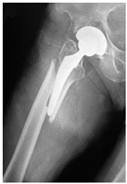 |
| 12A-HLU-SG | Fracture zone 1 through 2, adequate bone, hip loose uncemented, segmental |  |  |
| 12A-HSU | Fracture zone 1 through 2, adequate bone, hip stable, uncemented (note: image on the right is a 3D CT scan) |  |  |
| 13B-HLC | Fracture zone 1 through 3, bad bone, hip loose cemented |  |  |
| 2A-HSU-BP | Fracture zone 2, adequate bone, hip stable uncemented, broken plate |  |  |
| 2B-HSU-BS | Fracture zone 2, bad bone, hip stable uncemented, broken stem |  | |
| 3A-HSU, KSC-ST, IS (6.5cm), BP | Fracture zone 3, adequate bone, hip stable uncemented, knee stable cemented w/stem, inter-stem w/6.5 cm separation, broken plate |  |  |
| 14A-HLU, KSC-SG | Fracture zone 1 through 4, adequate bone, hip loose uncemented, knee stable cemented, segmental |  |  |
| 2C-KLC-ST | Fracture zone 2, chitty bone (lateral cortex), knee loose cemented, knee stem |  |  |
| 24A-KLC-ST | Fracture zone 2 through 4, adequate bone, knee loose cemented (>1/3 of cement mantle disrupted), knee stem |  |  |
| 34A-KLC-ST | Fracture zone 3 through 4, adequate bone, knee loose cemented (>1/3 of cement mantle disrupted), knee stem |  |  |
| 34A-KLC-ST | Fracture zone 3 through 4, adequate bone, knee loose cemented, knee stem |  |  |
| 34A-KLC | Fracture zone 3 through 4, adequate bone, knee loose cemented (>1/3 of cement mantle disrupted) knee stem. Note: knee is endofusion | 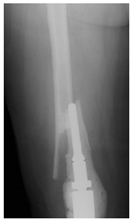 | |
| 34A-HSU, KSC-SG | Fracture zone 3 through 4, adequate bone, hip stable uncemented, knee stable cemented, segmental |  |  |
| 4B-KSC | Fracture zone 4, bad bone, knee stable cemented |  |  |
| 4A-KSC | Fracture zone 4, adequate bone, knee stable cemented | 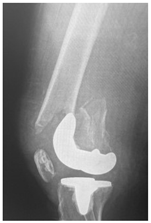 | |
| 4C-KLC | Fracture zone 4, chitty bone (at fracture site), knee loose, cemented |  |  |
4. Discussion
5. Conclusions
Author Contributions
Funding
Institutional Review Board Statement
Informed Consent Statement
Data Availability Statement
Conflicts of Interest
References
- Kurtz, S.M.; Lau, E.; Watson, H.; Schmier, J.K.; Parvizi, J. Economic burden of periprosthetic joint infection in the United States. J. Arthroplast. 2012, 27, 61–65.e61. [Google Scholar] [CrossRef]
- Jennison, T.; MacGregor, A.; Goldberg, A. Hip arthroplasty practice across the Organisation for Economic Co-operation and Development (OECD) over the last decade. Ann. R. Coll. Surg. Engl. 2023, 105, 645–652. [Google Scholar] [CrossRef]
- Le Stum, M.; Le Goff-Pronost, M.; Stindel, E. Knee arthroplasty: An international systemic review of epidemiological trends. Orthop. Traumatol. Surg. Res. 2025, 111, 104006. [Google Scholar] [CrossRef]
- Lamb, J.N.; Evans, J.T.; Relton, S.; Whitehouse, M.R.; Wilkinson, J.M.; Pandit, H. The incidence of postoperative periprosthetic femoral fracture following total hip replacement: An analysis of UK National Joint Registry and Hospital Episodes statistics data. PLoS Med. 2024, 21, e1004462. [Google Scholar] [CrossRef]
- Ryan, S.P.; Stambough, J.B.; Huddleston, J.I., 3rd; Levine, B.R. Highlights of the 2023 American Joint Replacement Registry Annual Report. Arthroplast Today 2024, 26, 101325. [Google Scholar] [CrossRef]
- Stetzer, M.; Bircher, J.; Klika, A.K.; Rullán, P.J.; Bloomfield, M.M.; Krebs, V.E.; Molloy, R.M.; Piuzzi, N.S. Intraincisional Pin Placement is Safe for Robotic-Assisted Total Knee Arthroplasty. J. Arthroplast. 2024, 39, 910–915.e911. [Google Scholar] [CrossRef] [PubMed]
- Sánchez Del Saz, J.; Coderch Carretero, J.; García Coiradas, J.; García Crespo, R. Watch out your pins! Periprosthetic femoral fracture at tracking pin site early after robotic-assisted knee arthroplasty treated with dual nail-plate fixation. Trauma Case Rep. 2025, 57, 101182. [Google Scholar] [CrossRef]
- Smith, T.J.; Siddiqi, A.; Forte, S.A.; Judice, A.; Sculco, P.K.; Vigdorchik, J.M.; Schwarzkopf, R.; Springer, B.D. Periprosthetic Fractures Through Tracking Pin Sites Following Computer Navigated and Robotic Total and Unicompartmental Knee Arthroplasty: A Systematic Review. JBJS Rev. 2021, 9, e20.00091. [Google Scholar] [CrossRef] [PubMed]
- Mühling, M.; Sandriesser, S.; Glowalla, C.; Herrmann, S.; Augat, P.; Hungerer, S. Risk of Interprosthetic Femur Fracture Is Associated with Implant Spacing-A Biomechanical Study. J. Clin. Med. 2023, 12, 3095. [Google Scholar] [CrossRef]
- Townsend, O.; Jain, S.; Lamb, J.N.; Scott, C.E.H.; Dunlop, D.G.; Pandit, H.G. Periprosthetic femoral fracture type and location are influenced by the presence of an ipsilateral knee arthroplasty implant: A case-control study of 84 interprosthetic femoral fractures. Injury 2022, 53, 645–652. [Google Scholar] [CrossRef] [PubMed]
- Choi, Y.S.; Park, J.W.; Kim, T.W.; Kang, K.S.; Lee, Y.K.; Koo, K.H.; Chang, C.B. Effect of Total Hip Arthroplasty on Ipsilateral Lower Limb Alignment and Knee Joint Space Width: Minimum 5-Year Follow-up. J. Korean Med. Sci. 2023, 38, e148. [Google Scholar] [CrossRef]
- Neitzke, C.C.; Coxe, F.R.; Chandi, S.K.; Belay, E.S.; Sculco, P.K.; Chalmers, B.P.; Westrich, G.H.; Gausden, E.B. High Rate of Unplanned Reoperation for Interprosthetic Femur Fractures After Total Hip and Knee Arthroplasty. J. Arthroplast. 2024, 39, 2607–2614.e2601. [Google Scholar] [CrossRef]
- Miettinen, S.S.A.; Sund, R.; Törmä, S.V.; Kröger, H. Incidences and Outcomes of Operatively Treated Interprosthetic Femoral Fractures Compared to Vancouver Type C and Rorabeck Type II Fractures. J. Arthroplast. 2024, 39, 452–458. [Google Scholar] [CrossRef]
- Shah, J.K.; Abwini, L.Z.; Tang, A.; Yang, J.I.; Keller, D.M.; Menken, L.G.; Liporace, F.A.; Yoon, R.S. Comparative outcomes after treatment of peri-implant, periprosthetic, and interprosthetic femur fractures: Which factors increase mortality risk? OTA Int. 2024, 7, e322. [Google Scholar] [CrossRef] [PubMed]
- Washburn, F.; Mushaben, J.; Eichenseer, C.; Sanderson, B.; Tran, B.; Golden, T. Perioperative periprosthetic femur fracture associated with direct anterior total hip arthroplasty using metaphyseal fit and fill stem. Eur. J. Orthop. Surg. Traumatol. 2024, 34, 869–877. [Google Scholar] [CrossRef] [PubMed]
- Cooper, H.J.; Rodriguez, J.A. Early Post-operative Periprosthetic Femur Fracture in the Presence of a Non-cemented Tapered Wedge Femoral Stem. Hss J. 2010, 6, 150–154. [Google Scholar] [CrossRef] [PubMed]
- Kelly, M.; Chen, A.F.; Ryan, S.P.; Working, Z.M.; De, A.; Mullen, K.; Porter, K.R.; Kagan, R. Femoral Component Design Is Associated With the Risk of Periprosthetic Femur Fracture After Cementless THA in Patients 65 Years or Older. Clin. Orthop. Relat. Res. 2024, 482, 1485–1493. [Google Scholar] [CrossRef]
- Mori, Y.; Tanaka, H.; Kurishima, H.; Kanabuchi, R.; Mori, N.; Sasagawa, K.; Aizawa, T. Biomechanical and Clinical Validation of a Modulus-Graded Ti-Nb-Sn Femoral Stem for Suppressing Stress Shielding in Total Hip Arthroplasty. Appl. Sci. 2025, 15, 4827. [Google Scholar] [CrossRef]
- Fleischman, A.N.; Chen, A.F. Periprosthetic fractures around the femoral stem: Overcoming challenges and avoiding pitfalls. Ann. Transl. Med. 2015, 3, 234. [Google Scholar]
- Tierney, J.; Jackman, E.; Holder, C.; Wall, C.J.; Wilson, C.J. Increased Rates of Late Periprosthetic Fractures in Larger Hydroxyapatite-Coated Cementless Stems: Are Collared Stems a Better Alternative for Total Hip Arthroplasty? J. Arthroplast. 2024, 39, 744–749. [Google Scholar] [CrossRef]
- Duncan, C.P.; Haddad, F.S. The Unified Classification System (UCS): Improving our understanding of periprosthetic fractures. Bone Jt. J. 2014, 96-b, 713–716. [Google Scholar] [CrossRef]
- Ninan, T.M.; Costa, M.L.; Krikler, S.J. Classification of femoral periprosthetic fractures. Injury 2007, 38, 661–668. [Google Scholar] [CrossRef]
- Duncan, C.P.; Masri, B.A. Fractures of the femur after hip replacement. Instr. Course Lect. 1995, 44, 293–304. [Google Scholar]
- Lindahl, H.; Malchau, H.; Herberts, P.; Garellick, G. Periprosthetic femoral fractures classification and demographics of 1049 periprosthetic femoral fractures from the Swedish National Hip Arthroplasty Register. J. Arthroplast. 2005, 20, 857–865. [Google Scholar] [CrossRef] [PubMed]
- Kavanagh, B.F. Femoral fractures associated with total hip arthroplasty. Orthop. Clin. N. Am. 1992, 23, 249–257. [Google Scholar] [CrossRef] [PubMed]
- Pascarella, R.; Sangiovanni, P.; Cerbasi, S.; Fantasia, R.; Consonni, O.; Zottola, V.; Panella, A.; Moretti, B. Periprosthetic acetabular fractures: A New classification proposal. Injury 2018, 49, S65–S73. [Google Scholar] [CrossRef] [PubMed]
- King, S.W.; Lamb, J.N.; Cage, E.S.; Pandit, H. Periprosthetic femoral fractures following total hip and total knee arthroplasty. Maturitas 2018, 117, 1–5. [Google Scholar] [CrossRef]
- Gaski, G.E.; Scully, S.P. In brief: Classifications in brief: Vancouver classification of postoperative periprosthetic femur fractures. Clin. Orthop. Relat. Res. 2011, 469, 1507–1510. [Google Scholar] [CrossRef]
- Patsiogiannis, N.; Kanakaris, N.K.; Giannoudis, P.V. Periprosthetic hip fractures: An update into their management and clinical outcomes. EFORT Open Rev. 2021, 6, 75–92. [Google Scholar] [CrossRef]
- Yao, Z.Y.; Fan, S.Y.; Zhao, W.Q.; Huang, J.F. The History of Classification Systems for Periprosthetic Femoral Fractures: A Literature Review. Orthop. Surg. 2024, 16, 1816–1831. [Google Scholar] [CrossRef]
- Park, J.W.; Kim, J.K.; Kim, H.S.; Lee, Y.K.; Ha, Y.C.; Koo, K.H. Resection of the femoral neck: A new technique for the treatment of mallory type I intraoperative femoral fracture during total hip arthroplasty. Acta Orthop. Belg. 2023, 89, 619–623. [Google Scholar] [CrossRef]
- Pires, R.E.; de Toledo Lourenço, P.R.; Labronici, P.J.; da Rocha, L.R.; Balbachevsky, D.; Cavalcante, F.R.; de Andrade, M.A. Interprosthetic femoral fractures: Proposed new classification system and treatment algorithm. Injury 2014, 45, S2–S6. [Google Scholar] [CrossRef]
- Rorabeck, C.H.; Taylor, J.W. Classification of periprosthetic fractures complicating total knee arthroplasty. Orthop. Clin. N. Am. 1999, 30, 209–214. [Google Scholar] [CrossRef] [PubMed]
- Bethea, J.S., 3rd; DeAndrade, J.R.; Fleming, L.L.; Lindenbaum, S.D.; Welch, R.B. Proximal femoral fractures following total hip arthroplasty. Clin. Orthop. Relat. Res. 1982, 170, 95–106. [Google Scholar] [CrossRef]
- Su, E.T.; DeWal, H.; Di Cesare, P.E. Periprosthetic femoral fractures above total knee replacements. J. Am. Acad. Orthop. Surg. 2004, 12, 12–20. [Google Scholar] [CrossRef] [PubMed]
- Baba, T.; Kaneko, K.; Homma, Y.; Ochi, H.; Ozaki, Y.; Watari, T.; Matsumoto, M. The Baba classification focused on implant designs is useful in setting the therapeutic strategy for interprosthetic femoral fracture. Eur. J. Orthop. Surg. Traumatol. 2018, 28, 247–254. [Google Scholar] [CrossRef]
- Beals, R.K.; Tower, S.S. Periprosthetic fractures of the femur. An analysis of 93 fractures. Clin. Orthop. Relat. Res. 1996, 327, 238–246. [Google Scholar] [CrossRef]
- Uzoigwe, C.E.; Watts, A.T.; Briggs, P.; Symes, T. Periprosthetic Femoral Fractures-Beyond B2. J. Am. Acad. Orthop. Surg. Glob. Res. Rev. 2024, 8, e23. [Google Scholar] [CrossRef]
- Su, E.T.; Kubiak, E.N.; DeWal, H.; Hiebert, R.; Di Cesare, P.E. A Proposed Classification of Supracondylar Femur Fractures Above Total Knee Arthroplasties. J. Arthroplast. 2006, 21, 405–408. [Google Scholar] [CrossRef]
- Fakler, J.K.M.; Pönick, C.; Edel, M.; Möbius, R.; Brand, A.G.; Roth, A.; Josten, C.; Zajonz, D. A new classification of TKA periprosthetic femur fractures considering the implant type. BMC Musculoskelet. Disord. 2017, 18, 490. [Google Scholar] [CrossRef]
- Ayers, M.E.; Iorio, R.; Healy, W.L. Periprosthetic Fractures After Total Knee Arthroplasty. In Revision Total Knee Arthroplasty; Bono, J.V., Scott, R.D., Eds.; Springer: New York, NY, USA, 2005; pp. 183–194. [Google Scholar]
- Makaram, N.; Ross, L.; Keenan, O.; Magill, M.; Moran, M.; Scott, C. Reliability of current classification systems for periprosthetic distal femur fractures. Injury 2022, 53, 3430–3437. [Google Scholar] [CrossRef]
- Late, S.V.; Keche, H. Morphometric Study of Proximal End of the Fully Ossified Human Femur: A Cross-Sectional Study. Cureus 2022, 14, e29188. [Google Scholar] [CrossRef] [PubMed]
- Solan, S.; Kulkarni, R. Estimation of total Length of Femur From Its Fragments in South Indian Population. J. Clin. Diagn. Res. 2013, 7, 2111–2115. [Google Scholar] [CrossRef]
- Sahu, S.; Pradhan, S.; Nayak, L. Estimation of Length of Femur from their Proximal Segments in Population of Eastern Odisha. Int. J. Pharm. Sci. Rev. Res. 2024, 84, 1–4. [Google Scholar] [CrossRef]
- Seebeck, J.; Goldhahn, J.; Städele, H.; Messmer, P.; Morlock, M.M.; Schneider, E. Effect of cortical thickness and cancellous bone density on the holding strength of internal fixator screws. J. Orthop. Res. 2004, 22, 1237–1242. [Google Scholar] [CrossRef] [PubMed]
- Zdero, R.; Elfallah, K.; Olsen, M.; Schemitsch, E.H. Cortical screw purchase in synthetic and human femurs. J. Biomech. Eng. 2009, 131, 094503. [Google Scholar] [CrossRef] [PubMed]
- Vilani, G.N.; Ruellas, A.C.; Mattos, C.T.; Fernandes, D.J.; Elias, C.N. Influence of cortical thickness on the stability of mini-implants with microthreads. Braz. Oral Res. 2015, 29, 1–7. [Google Scholar] [CrossRef]
- Dorr, L.D.; Faugere, M.C.; Mackel, A.M.; Gruen, T.A.; Bognar, B.; Malluche, H.H. Structural and cellular assessment of bone quality of proximal femur. Bone 1993, 14, 231–242. [Google Scholar] [CrossRef]
- Schmalzried, T.P.; Jasty, M.; Harris, W.H. Periprosthetic bone loss in total hip arthroplasty. Polyethylene wear debris and the concept of the effective joint space. J. Bone Jt. Surg. Am. 1992, 74, 849–863. [Google Scholar] [CrossRef]
- Andriamananaivo, T.; Odri, G.A.; Ollivier, M.; Mattesi, L.; Renault, A.; Rongieras, F.; Pesenti, S.; Severyns, M. Contribution of the remaining attachment index in the management of Vancouver B1 periprosthetic hip fracture. Orthop. Traumatol. Surg. Res. 2020, 106, 1413–1417. [Google Scholar] [CrossRef]
- Stoffel, K.; Horn, T.; Zagra, L.; Mueller, M.; Perka, C.; Eckardt, H. Periprosthetic fractures of the proximal femur: Beyond the Vancouver classification. EFORT Open Rev. 2020, 5, 449–456. [Google Scholar] [CrossRef] [PubMed]
- Gausden, E.B.; Bedard, N.A.; Gililland, J.M.; Haidukewych, G.J. What’s New in Periprosthetic Femur Fractures? J. Arthroplast. 2024, 39, S18–S25. [Google Scholar] [CrossRef] [PubMed]
- Van Houwelingen, A.P.; Duncan, C.P. The pseudo A(LT) periprosthetic fracture: It’s really a B2. Orthopedics 2011, 34, e479–481. [Google Scholar] [CrossRef] [PubMed]


| Fracture Description | Zones of Fracture Involvement |
|---|---|
| 1 | Zone 1 only |
| 12 | Zone 1 and 2 |
| 13 | Zone 1 through 3 |
| 14 | Zone 1 through 4 |
| 2 | Zone 2 only |
| 23 | Zone 2 and 3 |
| 24 | Zone 2 through 4 |
| 3 | Zone 3 only |
| 34 | Zone 3 and 4 |
| 4 | Zone 4 only |
| Bone Type | Definition | Implication |
|---|---|---|
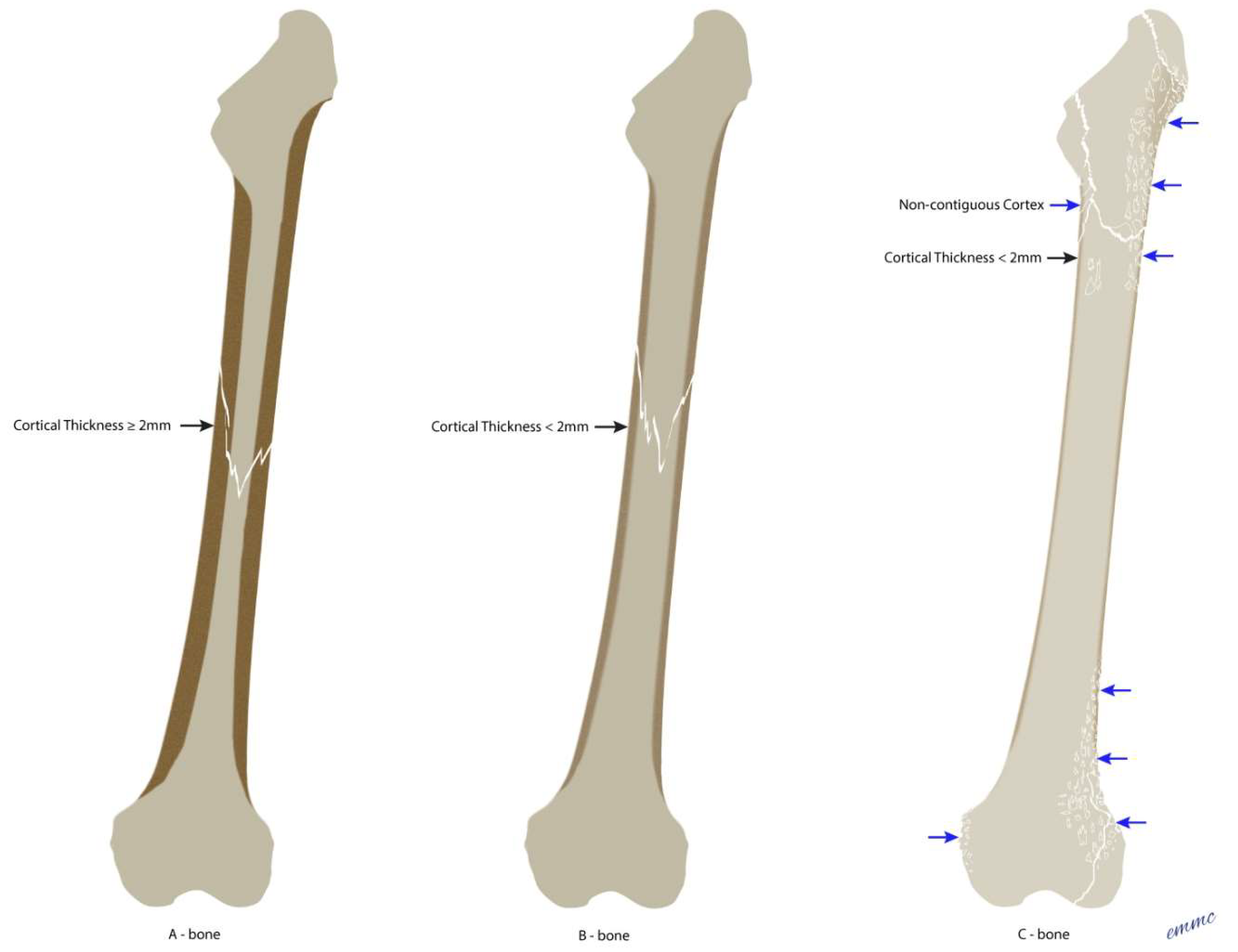
| A–Bone (Adequate) | Cortical thickness ≥ 2.0 mm | Adequate bone for screws |
| B–Bone (Bad bone) | Cortical thickness < 2.0 mm | Screws may be possible |
| C–Bone (Chitty * bone) | Bone is riddled | Inadequate bone for screws |
| Implant Acronym | Acronym Description |
|---|---|
| HLC | Hip Implant Loose — Cemented |
| HLU | Hip Implant Loose — Uncemented |
| HSC | Hip Implant Stable — Cemented |
| HSU | Hip Implant Stable — Uncemented |
| KLC | Knee Implant Loose — Cemented |
| KLU | Knee Implant Loose — Uncemented |
| KSC | Knee Implant Stable — Cemented |
| KSU | Knee Implant Stable — Uncemented |
| UPFF | VCS b | UCPF/OTA a,b | Lewis/ Rorabeck | Su et al. | Baba et al. | |
|---|---|---|---|---|---|---|
| Year introduced | 2026 | 1995 [23] | 2014 [21] | 1999 [33] | 2004 [39] | 2015 [36] |
| Rating Regions | Hip to Knee | Hip & Femur | Hip & Femur | Knee only | Knee & Femur | Prosthetic Stability Hip &/or Knee only |
| Anthropometrically defines femur fracture zones | Yes | No | No | No | No | No |
| Bone quality rating | Quantitative + Descriptive | Qualitative | Qualitative | No | No | No |
| Classifies entire femur | Yes | No | Yes-separate schemes hip & knee | No | No | No |
| Simultaneous hip & knee implant description | Yes | No | No | No | No | No |
| Classifies multi-zone fractures | Yes | No | No | No | No | No |
| Classifies inter-stem fractures | Yes | No | Yes | No | No | No |
| Implant descriptors: (e.g., knee stem, closed box) | Yes | No | No | No | No | Yes |
| Implant fixation description: cemented vs. uncemented | Yes | No | No | Yes | No | Yes |
| Broken hardware descriptor (stem, implant or plate) | Yes | No | No | No | No | No |
| Expandable for new conditions | Yes | No | No | No | No | Yes |
| Intuitive | Yes | Yes | No | Yes | Yes | No |
Disclaimer/Publisher’s Note: The statements, opinions and data contained in all publications are solely those of the individual author(s) and contributor(s) and not of MDPI and/or the editor(s). MDPI and/or the editor(s) disclaim responsibility for any injury to people or property resulting from any ideas, methods, instructions or products referred to in the content. |
© 2026 by the authors. Licensee MDPI, Basel, Switzerland. This article is an open access article distributed under the terms and conditions of the Creative Commons Attribution (CC BY) license.
Share and Cite
McPherson, E.J.; Chowdhry, M. Introducing the Universal Periprosthetic Femur Fracture (UPFF) Classification: All Fractures Femur. J. Clin. Med. 2026, 15, 1824. https://doi.org/10.3390/jcm15051824
McPherson EJ, Chowdhry M. Introducing the Universal Periprosthetic Femur Fracture (UPFF) Classification: All Fractures Femur. Journal of Clinical Medicine. 2026; 15(5):1824. https://doi.org/10.3390/jcm15051824
Chicago/Turabian StyleMcPherson, Edward J., and Madhav Chowdhry. 2026. "Introducing the Universal Periprosthetic Femur Fracture (UPFF) Classification: All Fractures Femur" Journal of Clinical Medicine 15, no. 5: 1824. https://doi.org/10.3390/jcm15051824
APA StyleMcPherson, E. J., & Chowdhry, M. (2026). Introducing the Universal Periprosthetic Femur Fracture (UPFF) Classification: All Fractures Femur. Journal of Clinical Medicine, 15(5), 1824. https://doi.org/10.3390/jcm15051824