Local Hemostasis as the Critical Enabler for Safe Antithrombotic Therapy in Dentistry—Navigating Future Frontiers and Innovative Concepts

 , ,
, , 
Abstract
1. Introduction—The Paradigm Shift from Drug Cessation to Local Control
2. Materials and Methods
- The objective is to synthesize a rapidly evolving field over the past decade (2015–2025) to identify paradigm shifts, conceptual frameworks, and future directions.
- The evidence base includes heterogeneous study designs (guidelines, randomized clinical trials, observational studies) that do not lend themselves to quantitative meta-analysis.
- The goal is to propose a new conceptual framework (risk-adapted stratified hemostasis) that synthesizes the existing evidence into a clinically applicable model.
2.1. Search Strategy
2.2. Eligibility Criteria
- Human patients (adults ≥18 years) receiving any form of chronic anticoagulation (e.g., vitamin K antagonists, DOACs, heparins) and/or antiplatelet therapy (e.g., single or dual antiplatelet therapy) who underwent any form of dental or oral surgical procedure.
- The perioperative management strategy for the antithrombotic agent(s), encompassing continuation, interruption (with or without bridging therapy), or modification of dosing.
- Any comparator, including different management strategies, placebo, or no intervention.
- Primary outcomes of interest were the incidence of postoperative bleeding (major and minor, as defined by study authors) and thromboembolic events (e.g., stroke, systemic embolism, myocardial infarction, stent thrombosis). Secondary outcomes included other surgical complications, need for re-intervention, and health-economic indicators when available.
- High-level evidence, including clinical practice guidelines from major professional societies (e.g., American College of Cardiology, American Heart Association, European Society of Cardiology, International Society on Thrombosis and Hemostasis, national dental associations), systematic reviews and meta-analyses, randomized controlled trials (RCTs), and prospective cohort studies.
- Studies involving only animal models or in vitro experiments, unless they provided unique mechanistic insights critical for interpreting clinical findings.
- Non-dental surgical procedures (e.g., major orthopedic or cardiothoracic surgery), unless they included a direct comparative dental cohort or provided foundational management principles.
- Editorials, letters to the editor, and commentaries that did not present original data or a systematic analysis.
- Publications not in the English language, or for which a reliable translation was unavailable.
- Duplicate publications from the same patient cohort; only the most comprehensive or recent report was included.
3. Assessing the Hemostatic Mechanism Under Pharmacological Influence
3.1. Perioperative Management and Contemporary Evidence on DOACs, Novel Antiplatelets, and Pharmacogenomic Guidance
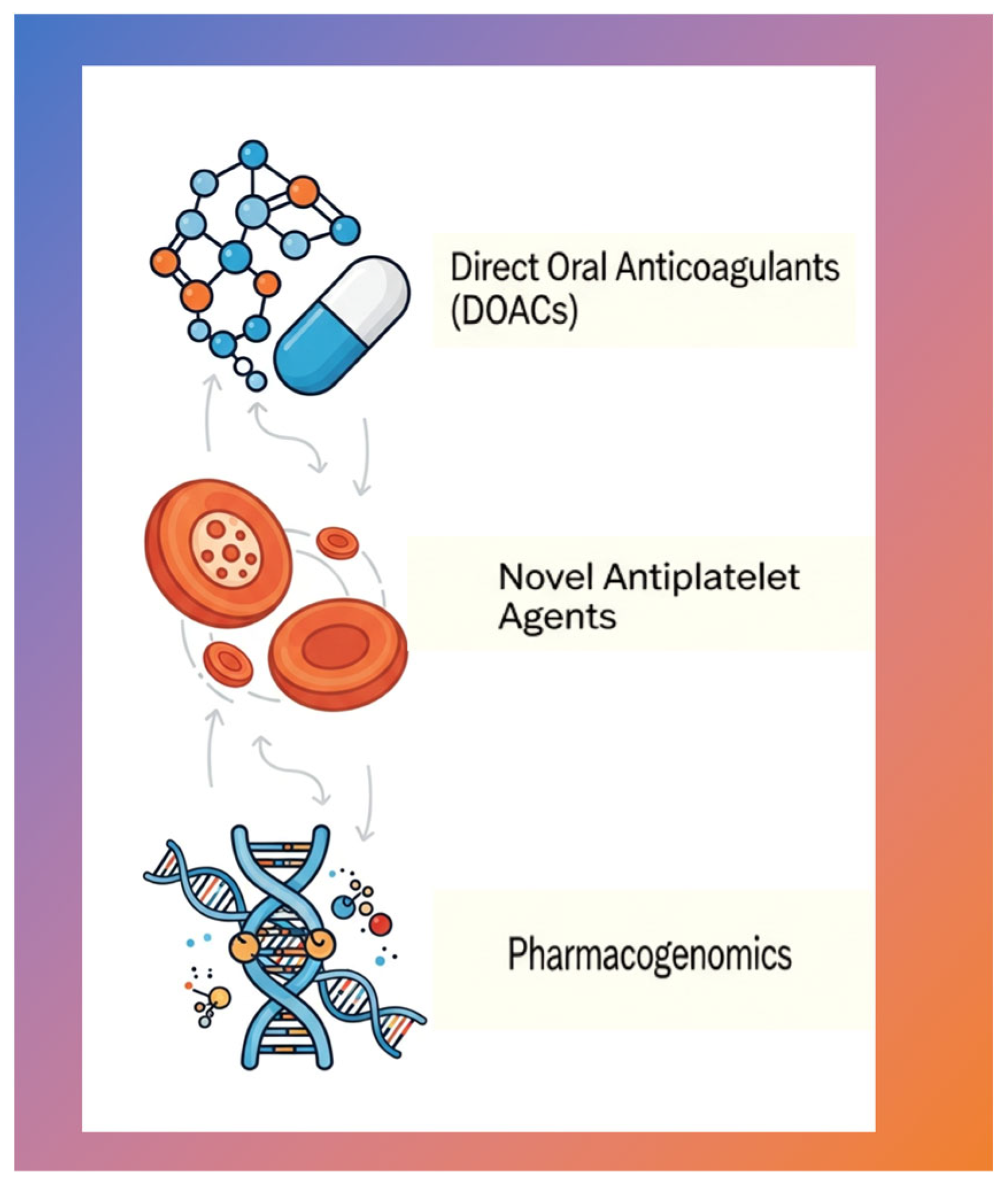
- DOACs—Emerging evidence supports a “timed interruption” strategy, taking advantage of their short half-lives. For procedures with low bleeding risk, omitting one dose (12–24 or ~30 h before the procedure) is usually sufficient, as demonstrated in studies such as the PAUSE trial, which showed low rates of major bleeding (1.8%) and thromboembolic events (0.4%) [46,47,48]. For the management of bleeding, specific bleeding reversal agents such as idarucizumab and andexanet alfa are now available, allowing for safer periprocedural management [49,50,51].
- Pharmacogenomics (Current Reality and Future Potential)—Genetic testing (e.g., for CYP2C9 and VKORC1 variants) represents a scientifically advanced approach that can guide more precise, individualized warfarin dosing to achieve stable, low-therapeutic INR preoperatively, minimizing protocol deviations [54,55,56] (Figure 1).
3.2. Pharmacologic Disruption Points: Creating a Unique “Hemostatic Gap”
- Direct thrombin inhibitors (such as dabigatran) bind directly to the thrombin molecule, preventing its essential functions: the conversion of fibrinogen to fibrin, platelet activation, and the autoamplification of the coagulation cascade [79,80,81]. Thus, this class of drugs directly intervenes at the common final pathway, affecting both fibrin clot formation and platelet receptor (PAR) signaling [82,83]. Direct factor Xa inhibitors (such as apixaban, rivaroxaban, and edoxaban) bind to and directly block factor Xa activity, preventing the conversion of prothrombin to thrombin and thus prophylactically reducing the thrombin burst central to clot formation [84,85,86]. As a result, the amount of thrombin available to form and stabilize a clot is limited [87,88,89,90].
- Heparins UFH and LMWH exert their anticoagulant effect by potentiating antithrombin (AT), which inactivates the key enzymes of the coagulation cascade, thrombin (FIIa) and activated factor X (FXa). The mechanism differs between classes: UFH, through its pentasaccharide sequence, inhibits both enzymes equally, while LMWH has a predominant anti-FXa activity. As a result, the therapeutic effect is immediate after administration. This strong pharmacodynamic profile requires mandatory monitoring: the use of aPTT for UFH and anti-FXa levels for LMWH to optimize dosing and minimize the bleeding risk [91,92,93].
4. The Risk-Adapted Layered Hemostasis Framework
4.1. Stratification of the Pharmacologic Hemorrhagic Risk
4.1.1. Low Pharmacologic Risk
4.1.2. Moderate Pharmacologic Risk
4.1.3. High Pharmacologic Risk
4.2. Stratification of the Procedural Hemorrhagic Risk
4.2.1. Low-Trauma Procedures
4.2.2. Procedures Involving Many Injuries or Extensive Vascular Networks
4.2.3. High-Trauma Procedures
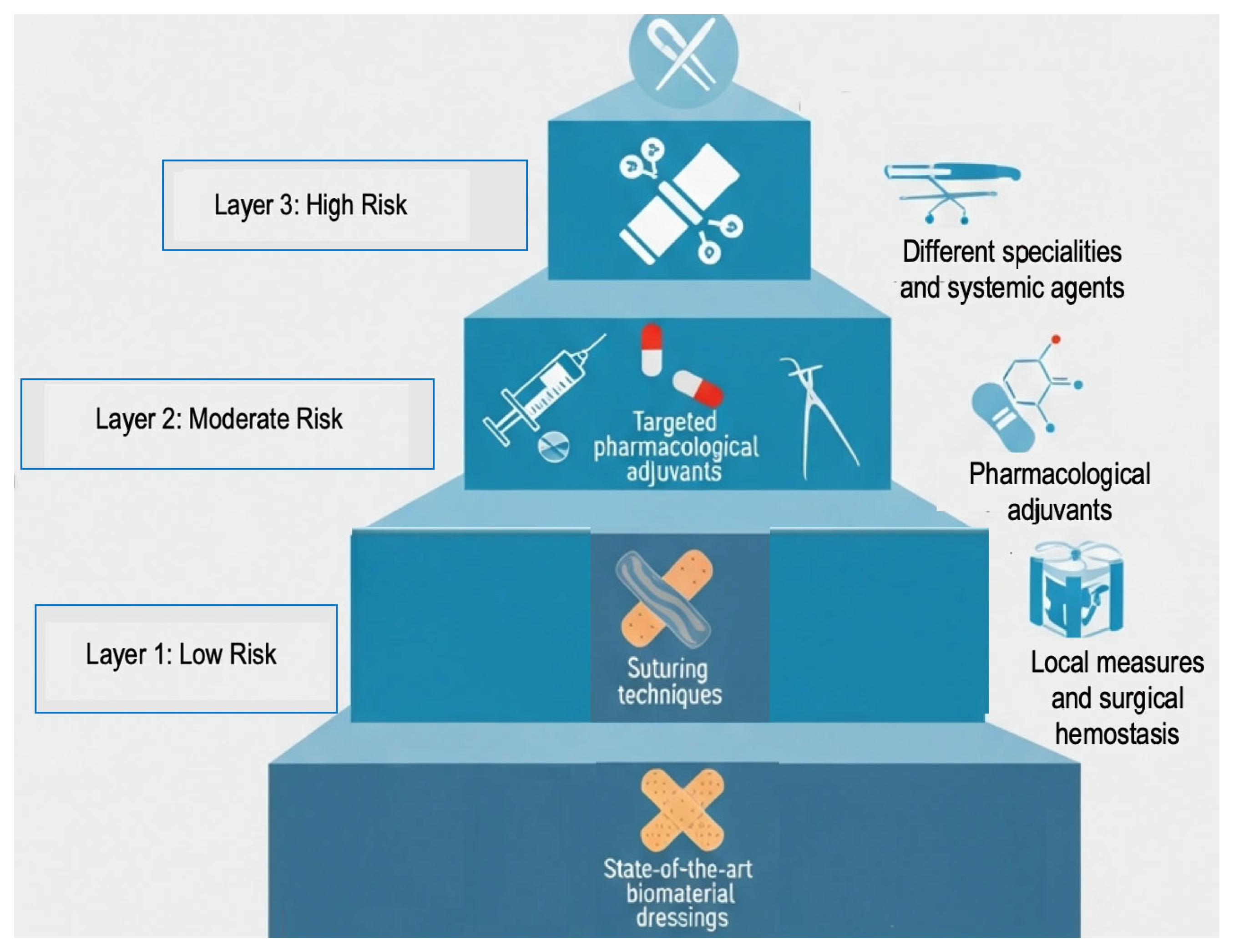
4.3. Application of the Layered Hemostatic Plan
4.3.1. Foundation Layer: Applied to All Procedures
4.3.2. Augmentation Layer: Pharmacologic Risk-Guided
- Contemporary management of patients on chronic antithrombotic therapy undergoing invasive dental procedures requires a paradigm shift from generic compression to a mechanism-based, targeted hemostatic approach. This strategy, termed the Stratified Hemostatic Plan, advocates the selection of topical adjuvants based on an assessment of pharmacological risk that directly counteracts the specific adverse effect of the anticoagulant or antiplatelet [51].
- For patients receiving direct oral anticoagulants (DOACs), classified as having moderate pharmacological risk, the therapeutic goal is to bypass the pharmacologically inhibited factor. DOACs directly inhibit Factor Xa or thrombin (Factor IIa), halting the propagation phase of the coagulation cascade. Consequently, agents that rely on an intact intrinsic or extrinsic pathway are suboptimal. The ideal strategy utilizes a physiological agent, such as a thrombin-gelatin matrix. Accordingly, the strategic goal is to enhance and accelerate the development of the first platelet plug. This is best achieved with a contact activator, such as a collagen sponge or microfibrillar collagen. Randomized clinical trials indicate that these materials create a potent thrombogenic surface that directly promotes adherence, activation, and release of granular contents, thereby effectively enhancing the primary hemostatic phase despite diminished platelet activity. Recent prospective studies further validate the efficacy of other hemostatic dressings, such as chitosan, which similarly promote platelet aggregation and adherence to the injury site [133].
- The most complex scenario involves patients treated with vitamin K antagonists (VKA), who often present a moderate to high pharmacological risk due to functional deficiency of multiple coagulation factors (II, VII, IX, X). While traditional agents such as oxidized cellulose, which form an artificial seal, are commonly used, some investigators suggest that the most physiologically consistent strategy within the layered plan may be the use of a physiological agent (thrombin-gelatin). However, direct comparative evidence supporting this preference over traditional agents in VKA patients is limited, and clinical decisions should consider availability, cost, and practitioner experience. Systematic studies of localized hemostatic measures validate the essential function of these personalized therapies in achieving safe hemostasis in this demographic. Systematic, risk-based methodology, based on physiological principles and growing clinical evidence, aims to enhance the safety and efficacy of dental surgical hemostasis in patients with complicated medical conditions [134,135].
4.3.3. Stabilization Layer: Procedure-Guided Approach Based on Anatomical and Functional Requirements
- The integrity of the initial fibrin clot, necessary for the healing of postsurgical wounds, is strictly dependent on the enzymatically active oral cavity environment, which also contains a vast microbial flora. Therefore, contemporary surgical protocols emphasize the strategic application of specific sealing and stabilizing agents to create an optimal environment for regeneration. This approach is fundamentally guided by a detailed analysis of anatomical and functional requirements, moving beyond a universal methodology towards a personalized therapeutic intervention.
- In the posterior regions, especially at the molar level, functional challenges are pronounced due to the complex anatomy, combined with significant masticatory forces, tongue movement, and the constant presence of oral fluids that create a high-risk environment for the development of alveolitis or for the destruction of the blood clot. In such situations, the main objective is to establish a durable physical barrier [53].
- In situations with generalized suppuration or in patients with underlying coagulopathy characterized by hyperfibrinolysis, a condition in which the fibrin matrix of the clot is prematurely degraded, a simple local barrier is ineffective. The central pathological process is rapid enzymatic dissolution of the clot, often exacerbated by inflammatory factors. For these complex cases, procedural guidelines are directed towards achieving sustained local hemostatic and antifibrinolytic activity. This is best achieved by the use of an impregnated support matrix.
- Filling the postoperative wound with an absorbable gelatin sponge or surgical gauze saturated with tranexamic acid (TXA) is an appropriate therapeutic intervention in such situations. TXA, a synthetic lysine analog, competitively inhibits the activation of plasminogen to plasmin, the key enzyme in fibrinolysis. By delivering the agent directly to the alveolus via a carrier, a high local concentration is maintained, providing prolonged antifibrinolytic activity. This method ensures stabilization of the fibrin network against premature degradation. Topical administration limits the pharmacological effect, resulting in negligible systemic absorption and an exemplary safety profile, a consideration of major importance for patients on complex anticoagulant regimens, as highlighted in contemporary reviews of periprocedural bleeding management.
- The algorithmic selection between a passive and active sealant, drug-impregnated stabilizer, is influenced by a clear assessment of anatomical structures versus biological risks. This site-specific, procedure-guided paradigm ensures that therapeutic interventions are tailored to clinical requirements, thereby protecting the clot, increasing patient comfort, and promoting predictable bone healing [42,136,137] (summarized in Table 1).
5. The Hierarchy and Technical Detail of Critical Local Measures
5.1. Procedural Risk Stratification: A Clinical Classification System
- Supragingival prophylaxis and scaling;
- Administration of local anesthesia (including nerve blocks);
- Minor soft tissue procedures (frenectomy, small excisional biopsies <0.5 cm);
- Placement of orthodontic bands/brackets;
- Endodontic treatment (access cavity preparation, root canal instrumentation) limited to the pulp chamber;
- Single, uncomplicated tooth extraction (mobile teeth, simple forceps extraction);
- Alveoloplasty (limited, involving 1–2 alveolar sites);
- Apicoectomy (anterior teeth);
- Soft tissue biopsies requiring suture closure;
- Multiple dental extractions (2–3 teeth) in the same quadrant;
- Surgical extraction of impacted teeth requiring osteotomy;
- Flap periodontal surgery (open debridement, crown lengthening);
- Placement of a single dental implant with flapless or minimal flap techniques.
- Periodontal surgery involving bone resection;
- Multiple tooth extractions (>3) with extensive alveoloplasty;
- Surgical resection of intraoral pathology (torus removal, large cystic lesions);
- Procedures in highly vascularized anatomical regions (posterior palate, floor of mouth, retromolar area);
- Full-arch or multi-quadrant implantology (≥4 implants);
- Complex bone graft procedures (en bloc grafts, sinus lift with lateral window);
- Any surgical procedure requiring general anesthesia with a high risk of immediate postoperative bleeding.
5.2. Surgical Technique
5.2.1. Primary Surgical Control: The Minimally Traumatic Philosophy
5.2.2. Intra-Socket and Wound Management: Ensuring an Optimal Hemostatic Environment
5.2.3. Immediate Post-Extraction Tamponade: Socket Compression
5.3. Advanced Local Hemostatic Agents
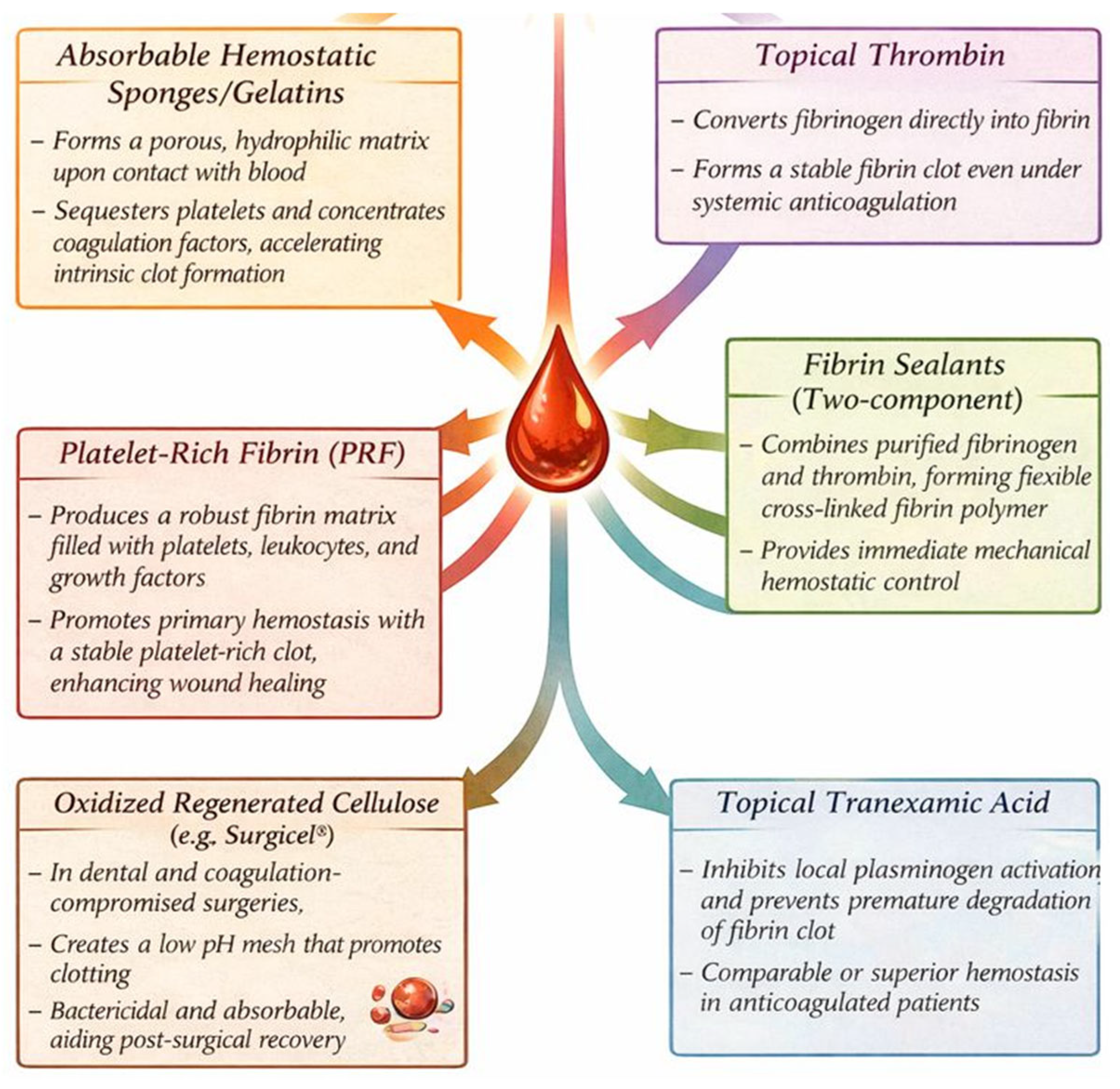
5.3.1. Absorbable Hemostatic Sponges/Gelatins
5.3.2. Topical Thrombin
5.3.3. Fibrin Sealants (Two-Component)
5.3.4. Tranexamic Acid
5.3.5. Oxidized Regenerated Cellulose (e.g., Surgicel®)
Platelet-Rich Fibrin (PRF)
6. Discussion—How Local Measures Make Drug Continuation Safe?
- Cost and reimbursement—Genetic testing panels typically cost $200–500, with inconsistent insurance coverage and no specific reimbursement codes for dental procedures.
- Processing time—Results require 3–7 days from reference laboratories, excluding decisions on same-day procedures or medical emergencies.
- Interpretation complexity—Genotype-guided dosing requires specialized pharmacokinetic knowledge and access to clinical decision support tools that are not typically available in dental offices.
Pathway to Clinical Adoption
- Primarily used in university medical centers and hospital dental offices, where integrated electronic medical records and pharmacy services exist. Genetic information, when already available in patient records, can inform perioperative planning.
- Development of direct-to-provider test panels with rapid turnaround times (24–48 h) and simplified interpretive reports. Integration into preoperative assessment protocols for patients requiring high-risk surgery (complex procedures, unstable INR).
- Widespread availability of low-cost genetic screening as part of comprehensive health assessments.
7. Educational and Collaborative Objectives
7.1. Role of Dental Education in Preparing Students to Manage Patients on Antiplatelet/Anticoagulant Therapy
7.2. Importance of Continuing Professional Development for Practicing Clinicians
7.3. Value of Interdisciplinary Collaboration in Optimizing Patient Care
8. Limitations of This Review
9. Conclusions and Future Directions
Author Contributions
Funding
Data Availability Statement
Conflicts of Interest
Abbreviations
| AGT | Anticoagulant therapy |
| APT | Antiplatelet therapy |
| INR | International Normalized Ratio |
| DOACs | Direct oral anticoagulants |
| NOAC | Non-Vitamin K Antagonist Oral Anticoagulants |
| LDA | Low-dose aspirin |
| DAPT | Dual antiplatelet therapy |
| VKAs | Vitamin K antagonists |
| FXa | Factor X |
| PAR | Platelet activation receptors |
| AT | Antithrombin |
| UFH | Unfractionated heparin |
| LMWH | Low-molecular-weight heparin |
| aPTT | Activated partial thromboplastin time |
| SAPT | Single-agent antiplatelet therapy |
| TXA | Tranexamic acid |
| ORC | Oxidized regenerated cellulose |
References
- Statman, B.J. Perioperative Management of Oral Antithrombotics in Dentistry and Oral Surgery: Part 2. Anesth. Prog. 2023, 70, 37–48. [Google Scholar] [CrossRef]
- Yang, J.-H.; Chen, H.-M.; Kuo, Y.-S.; Chiang, C.-P. Management of Patients Taking Antithrombotic Drugs before Dental Surgery. J. Dent. Sci. 2020, 15, 222–224. [Google Scholar] [CrossRef]
- Gao, J.-H.; Chu, X.-C.; Wang, L.-L.; Ning, B.; Zhao, C.-X. Effects of Different Anticoagulant Drugs on the Prevention of Complications in Patients after Arthroplasty: A Network Meta-Analysis. Medicine 2017, 96, e8059. [Google Scholar] [CrossRef]
- Motta, R.H.L.; Bergamaschi, C.D.C.; De Andrade, N.K.; Guimaraes, C.C.; Ramacciato, J.C.; Araújo, J.D.O.; Lopes, L.C. Bleeding Risk in Patients Using Oral Anticoagulants Submitted to Surgical Procedures in Dentistry: A Systematic Review Protocol. BMJ Open 2017, 7, e019161. [Google Scholar] [CrossRef]
- Souza, A.F.; Rocha, A.L.; Castro, W.H.; Gelape, C.L.; Nunes, M.C.P.; Oliveira, S.R.; Travassos, D.V.; Silva, T.A. Dental Management for Patients Undergoing Heart Valve Surgery. J. Card. Surg. 2017, 32, 627–632. [Google Scholar] [CrossRef] [PubMed]
- Kim, J.H.; Lim, K.-M.; Gwak, H.S. New Anticoagulants for the Prevention and Treatment of Venous Thromboembolism. Biomol. Ther. 2017, 25, 461–470. [Google Scholar] [CrossRef]
- Martinez, M.; Tsakiris, D.A. Management of Antithrombotic Agents in Oral Surgery Maria Martinez and Dimitrios A. Tsakiris. Dent. J. 2015, 3, 93–101. [Google Scholar] [CrossRef] [PubMed]
- Buchbender, M.; Schlee, N.; Kesting, M.R.; Grimm, J.; Fehlhofer, J.; Rau, A. A Prospective Comparative Study to Assess the Risk of Postoperative Bleeding after Dental Surgery While on Medication with Direct Oral Anticoagulants, Antiplatelet Agents, or Vitamin K Antagonists. BMC Oral Health 2021, 21, 504. [Google Scholar] [CrossRef] [PubMed]
- Chahine, J.; Khoudary, M.N.; Nasr, S. Anticoagulation Use Prior to Common Dental Procedures: A Systematic Review. Cardiol. Res. Pract. 2019, 2019, 9308631. [Google Scholar] [CrossRef]
- Schreuder, W.H.; Peacock, Z.S. Antiplatelet Therapy and Exodontia. J. Am. Dent. Assoc. 2015, 146, 851–856. [Google Scholar] [CrossRef]
- Ganapathi, A.; Vijayakumar, J. Antiplatelets, Anticoagulants and Its Implications in Dentistry—A Review of Literature. J. Pharm. Res. Int. 2020, 32, 134–146. [Google Scholar] [CrossRef]
- Doganay, O.; Atalay, B.; Karadag, E.; Aga, U.; Tugrul, M. Bleeding Frequency of Patients Taking Ticagrelor, Aspirin, Clopidogrel, and Dual Antiplatelet Therapy after Tooth Extraction and Minor Oral Surgery. J. Am. Dent. Assoc. 2018, 149, 132–138. [Google Scholar] [CrossRef]
- Gröbe, A.; Fraederich, M.; Smeets, R.; Heiland, M.; Kluwe, L.; Zeuch, J.; Haase, M.; Wikner, J.; Hanken, H.; Semmusch, J.; et al. Postoperative Bleeding Risk for Oral Surgery under Continued Clopidogrel Antiplatelet Therapy. BioMed Res. Int. 2015, 2015, 823651. [Google Scholar] [CrossRef]
- Borges, J.; Oliveira De Carvalho, F.; Gomes, I.; Borges Rosa, M.; Sousa, A.C.S. Antiplatelet Agents in Perioperative Noncardiac Surgeries: To Maintain or to Suspend? Ther. Clin. Risk Manag. 2018, 14, 1887–1895. [Google Scholar] [CrossRef]
- Li, L.; Zhang, W.; Yang, Y.; Zhao, L.; Zhou, X.; Zhang, J. Dental Management of Patient with Dual Antiplatelet Therapy: A Meta-Analysis. Clin. Oral Investig. 2019, 23, 1615–1623. [Google Scholar] [CrossRef]
- Dinkova, A.S.; Atanasov, D.T.; Vladimirova-Kitova, L.G. Discontinuation of Oral Antiplatelet Agents before Dental Extraction—Necessity or Myth? Folia Medica 2017, 59, 336–343. [Google Scholar] [CrossRef] [PubMed][Green Version]
- Calcia, T.B.B.; Oballe, H.J.R.; de Oliveira Silva, A.M.; Friedrich, S.A.; Muniz, F.W.M.G. Is Alteration in Single Drug Anticoagulant/Antiplatelet Regimen Necessary in Patients Who Need Minor Oral Surgery? A Systematic Review with Meta-Analysis. Clin. Oral Investig. 2021, 25, 3369–3381. [Google Scholar] [CrossRef] [PubMed]
- Babaji, P.; Rishal, Y. Clinical Evaluation of Role of Dual Antiplatelet Therapy on Bleeding after Dental Extraction. Contemp. Clin. Dent. 2018, 9, 41. [Google Scholar] [CrossRef]
- Boccatonda, A.; Frisone, A.; Lorusso, F.; Bugea, C.; Di Carmine, M.; Schiavone, C.; Cocco, G.; D’Ardes, D.; Scarano, A.; Guagnano, M.T. Perioperative Management of Antithrombotic Therapy in Patients Who Undergo Dental Procedures: A Systematic Review of the Literature and Network Meta-Analysis. Int. J. Environ. Res. Public Health 2023, 20, 5293. [Google Scholar] [CrossRef] [PubMed]
- Wójcik, S.; Mocny-Pachońska, K.; Bisch-Wójcik, S.; Balicz, A.; Morawiec, T. Perioperative Management of Dental Surgery Patients Chronically Taking Antithrombotic Medications. Int. J. Environ. Res. Public Health 2022, 19, 16151. [Google Scholar] [CrossRef]
- Miller, C.S. A Perspective on “The Mythology of Anticoagulation Interruption for Dental Surgery”. J. Am. Dent. Assoc. 2018, 149, 3–6. [Google Scholar] [CrossRef] [PubMed]
- Wahl, M.J.; Pinto, A.; Kilham, J.; Lalla, R.V. Dental Surgery in Anticoagulated Patients—Stop the Interruption. Oral Surg. Oral Med. Oral Pathol. Oral Radiol. 2015, 119, 136–157. [Google Scholar] [CrossRef] [PubMed]
- Baron, T.H.; Kamath, P.S.; McBane, R.D. Management of Antithrombotic Therapy in Patients Undergoing Invasive Procedures. N. Engl. J. Med. 2013, 368, 2113–2124. [Google Scholar] [CrossRef]
- Wahl, M.J. The Mythology of Anticoagulation Therapy Interruption for Dental Surgery. J. Am. Dent. Assoc. 2018, 149, e1–e10. [Google Scholar] [CrossRef]
- Lee, J.K. Dental Management of Patients on Anti-Thrombotic Agents. J. Korean Assoc. Oral Maxillofac. Surg. 2018, 44, 143. [Google Scholar] [CrossRef]
- Mingarro-de-Leon, A.; Chaveli-Lopez, B.; Gavalda-Esteve, C. Dental Management of Patients Receiving Anticoagulant and/or Antiplatelet Treatment. J. Clin. Exp. Dent. 2014, 6, e155–e161. [Google Scholar] [CrossRef]
- Ozyilmaz, O.D.; Gundogdu, S.; Alkan, A. Attitude and Practice of Dentists in Patients Taking Oral Antiplatelet and Anticoagulant Medications. BMC Oral Health 2025, 25, 606. [Google Scholar] [CrossRef]
- Homaj, M.; Malinowski, K.; Motyl, S.; Homaj, A.; Janion, M.; Siudak, Z. Safety of Dental Extractions in Patients on Single and Dual Antiplatelet Therapy a Meta-Analysis. Eur. Heart J. 2018, 39, 5077. [Google Scholar] [CrossRef]
- Johnston, S. An Evidence Summary of the Management of the Care of Patients Taking Novel Oral Antiplatelet Drugs Undergoing Dental Surgery. J. Am. Dent. Assoc. 2016, 147, 271–277. [Google Scholar] [CrossRef]
- Gotoh, S.; Yasaka, M.; Nakamura, A.; Kuwashiro, T.; Okada, Y. Management of Antithrombotic Agents During Surgery or Other Kinds of Medical Procedures With Bleeding: The MARK Study. J. Am. Hear. Assoc. 2020, 9, e012774. [Google Scholar] [CrossRef] [PubMed]
- Johnston, S. A New Generation of Antiplatelet, and Anticoagulant Medication and the Implications for the Dental Surgeon. Dent. Update 2015, 42, 840–842, 845–846, 849–850. [Google Scholar] [CrossRef][Green Version]
- Yong, C.W.; Tan, S.H.X.; Teo, G.N.; Tan, T.S.; Ng, W.H. Should We Stop Dual Anti-Platelet Therapy for Dental Extractions? An Umbrella Review for This Dental Dilemma. J. Stomatol. Oral Maxillofac. Surg. 2022, 123, e708–e716. [Google Scholar] [CrossRef]
- Ringel, R.; Maas, R. Dental Procedures in Patients Treated with Antiplatelet or Oral Anticoagulation Therapy—An Anonymous Survey. Gerodontology 2016, 33, 447–452. [Google Scholar] [CrossRef]
- Johnston, S. A Study of the Management of Patients Taking Novel Oral Antiplatelet or Direct Oral Anticoagulant Medication Undergoing Dental Surgery in a Rural Setting. Dent. J. 2015, 3, 102–110. [Google Scholar] [CrossRef] [PubMed]
- Costantinides, F.; Rizzo, R.; Pascazio, L.; Maglione, M. Managing Patients Taking Novel Oral Anticoagulants (NOAs) in Dentistry: A Discussion Paper on Clinical Implications. BMC Oral Health 2016, 16, 5. [Google Scholar] [CrossRef][Green Version]
- Elad, S.; Marshall, J.; Meyerowitz, C.; Connolly, G. Novel Anticoagulants: General Overview and Practical Considerations for Dental Practitioners. Oral Dis. 2016, 22, 23–32. [Google Scholar] [CrossRef]
- Nathwani, S.; Wanis, C. Novel Oral Anticoagulants and Exodontia: The Evidence. Br. Dent. J. 2017, 222, 623–628. [Google Scholar] [CrossRef]
- Johansson, K.; Becktor, J.P.; Naimi-Akbar, A.; Svensson, P.J.; Götrick, B. Continuous Use of Direct Oral Anticoagulants during and after Simple and Surgical Tooth Extractions: A Prospective Clinical Cohort Study. BMC Oral Health 2025, 25, 554. [Google Scholar] [CrossRef] [PubMed]
- Lupi, S.M.; Rodriguez, Y.; Baena, A. Patients Taking Direct Oral Anticoagulants (DOAC) Undergoing Oral Surgery: A Review of the Literature and a Proposal of a Peri-Operative Management Protocol. Healthcare 2020, 8, 281. [Google Scholar] [CrossRef] [PubMed]
- Johansson, K.; Götrick, B.; Holst, J.; Tranæus, S.; Naimi-Akbar, A. Impact of Direct Oral Anticoagulants on Bleeding Tendency and Postoperative Complications in Oral Surgery: A Systematic Review of Controlled Studies. Oral Surg. Oral Med. Oral Pathol. Oral Radiol. 2023, 135, 333–346. [Google Scholar] [CrossRef]
- Clemm, R.; Neukam, F.W.; Rusche, B.; Bauersachs, A.; Musazada, S.; Schmitt, C.M. Management of Anticoagulated Patients in Implant Therapy: A Clinical Comparative Study. Clin. Oral Implant. Res. 2016, 27, 1274–1282. [Google Scholar] [CrossRef]
- Ockerman, A.; Bornstein, M.M.; Leung, Y.Y.; Li, S.K.Y.; Politis, C.; Jacobs, R. Incidence of Bleeding after Minor Oral Surgery in Patients on Dual Antiplatelet Therapy: A Systematic Review and Meta-Analysis. Int. J. Oral Maxillofac. Surg. 2020, 49, 90–98. [Google Scholar] [CrossRef]
- Mauprivez, C.; Khonsari, R.H.; Razouk, O.; Goudot, P.; Lesclous, P.; Descroix, V. Management of Dental Extraction in Patients Undergoing Anticoagulant Oral Direct Treatment: A Pilot Study. Oral Surg. Oral Med. Oral Pathol. Oral Radiol. 2016, 122, e146–e155. [Google Scholar] [CrossRef]
- Miclotte, I.; Vanhaverbeke, M.; Agbaje, J.O.; Legrand, P.; Vanassche, T.; Verhamme, P.; Politis, C. Pragmatic Approach to Manage New Oral Anticoagulants in Patients Undergoing Dental Extractions: A Prospective Case-Control Study. Clin. Oral Investig. 2017, 21, 2183–2188. [Google Scholar] [CrossRef]
- Miller, S.; Miller, C. Direct Oral Anticoagulants: A Retrospective Study of Bleeding, Behavior, and Documentation. Oral Dis. 2018, 24, 243–248. [Google Scholar] [CrossRef]
- Lababidi, E.; Breik, O.; Savage, J.; Engelbrecht, H.; Kumar, R.; Crossley, C.W. Assessing an Oral Surgery Specific Protocol for Patients on Direct Oral Anticoagulants: A Retrospective Controlled Cohort Study. Int. J. Oral Maxillofac. Surg. 2018, 47, 940–946. [Google Scholar] [CrossRef]
- Brennan, Y.; Gu, Y.; Schifter, M.; Crowther, H.; Favaloro, E.J.; Curnow, J. Dental Extractions on Direct Oral Anticoagulants vs. Warfarin: The DENTST Study. Res. Pract. Thromb. Haemost. 2020, 4, 278–284. [Google Scholar] [CrossRef] [PubMed]
- Cocero, N.; Basso, M.; Grosso, S.; Carossa, S. Direct Oral Anticoagulants and Medical Comorbidities in Patients Needing Dental Extractions: Management of the Risk of Bleeding. J. Oral Maxillofac. Surg. 2019, 77, 463–470. [Google Scholar] [CrossRef] [PubMed]
- Mahmood, H.; Siddique, I.; McKechnie, A. Antiplatelet Drugs: A Review of Pharmacology and the Perioperative Management of Patients in Oral and Maxillofacial Surgery. Ann. R. Coll. Surg. Engl. 2020, 102, 9–13. [Google Scholar] [CrossRef] [PubMed]
- Dudek, D.; Kuliczkowski, W.; Kaczmarski, J.; Wiechec, J.; Reichman-Warmusz, E.; Segiet, O.; Helewski, K.; Wojnicz, R.; Serebruany, V.L. Response to Dual Antiplatelet Therapy Does Not Impact Bleeding Risks in Patients Undergoing Oral Surgery after Acute Coronary Syndromes. Cardiology 2015, 132, 119–123. [Google Scholar] [CrossRef]
- Erden, I.; Cakcak Erden, E.; Aksu, T.; Golcuk, S.E.; Turan, B.; Erkol, A.; Akcakoyun, M.; Sayin, T. Comparison of Uninterrupted Warfarin and Bridging Therapy Using Low-Molecular Weight Heparin with Respect to the Severity of Bleeding after Dental Extractions in Patients with Prosthetic Valves. Anatol. J. Cardiol. 2015, 16, 467–473. [Google Scholar] [CrossRef]
- Lombardi, N.; Varoni, E.M.; Sorrentino, D.; Lodi, G. International Normalized Ratio (INR) Values in Patients Receiving Oral Vitamin K Antagonists and Undergoing Oral Surgery: A Clinical Audit. Spec. Care Dent. 2020, 40, 374–381. [Google Scholar] [CrossRef]
- Kumbargere Nagraj, S.; Prashanti, E.; Aggarwal, H.; Lingappa, A.; Muthu, M.S.; Kiran Kumar Krishanappa, S.; Hassan, H. Interventions for Treating Post-Extraction Bleeding. Cochrane Database Syst. Rev. 2018, 3, CD011930. [Google Scholar] [CrossRef] [PubMed]
- Iwata, E.; Tachibana, A.; Kusumoto, J.; Takata, N.; Hasegawa, T.; Akashi, M. Does Prophylactic Antibiotic Administration for Tooth Extraction Affect PT-INR in Patients Taking Warfarin? BMC Oral Health 2020, 20, 33. [Google Scholar] [CrossRef] [PubMed]
- Markova, E.N.; Vedenikin, T.Y.; Kuzub, A.A.; Kuchieva, N.V.; Navasardyan, A.R.; Dzhioeva, O.N. Practical Aspects of Perioperative Management in Patients with Non-Valvular Atrial Fibrillation Receiving Direct Oral Anticoagulants. Racion. Farmakoter. V Kardiol. 2025, 21, 74–81. [Google Scholar] [CrossRef]
- Albarkheel, A.; Alshareef, H.; Albar, A.; Altbaili, S.; Alminaqash, M.; Alotibie, A.; Sheikh, A.; Alahmadi, A.; Alaifan, B.; Tamim, H.; et al. The Value of Using Bedside Point of Care Testing for International Normalized Ratio in Patients on Warfarin Undergoing Dental Procedures and Bleeding Assessment; A Single Center Prospective Study. J. Blood Med. 2025, 16, 337–348. [Google Scholar] [CrossRef] [PubMed]
- Sunu, V.; Roshni, A.; Ummar, M.; Aslam, S.A.; Nair, R.B.; Thomas, T. A Longitudinal Study to Evaluate the Bleeding Pattern of Patients on Low Dose Aspirin Therapy Following Dental Extraction. J. Fam. Med. Prim. Care 2021, 10, 1399–1403. [Google Scholar] [CrossRef]
- Gupta, R.; Dugal, A.; Sane, V.D.; Hiwarkar, S.; Khandelwal, S.; Iyengar, A. Effect of Low-Dose Aspirin on Bleeding Following Exodontia: A Prospective Clinical Study. J. Maxillofac. Oral Surg. 2018, 17, 350–355. [Google Scholar] [CrossRef]
- Shenoy, A.; Panicker, P.; Vijayan, A.; George, A.L. Prospective Comparative Evaluation of Post-Extraction Bleeding in Cardiovascular-Compromised Patients with and without Antiplatelet Medications. J. Maxillofac. Oral Surg. 2021, 20, 486–495. [Google Scholar] [CrossRef]
- Nagao, Y.; Masuda, R.; Ando, A.; Nonaka, M.; Nishimura, A.; Goto, K.; Maruoka, Y.; Iijima, T. Whole Blood Platelet Aggregation Test and Prediction of Hemostatic Difficulty After Tooth Extraction in Patients Receiving Antiplatelet Therapy. Clin. Appl. Thromb. Hemost. 2018, 24, 151–156. [Google Scholar] [CrossRef]
- Zabojszcz, M.; Malinowski, K.P.; Janion-Sadowska, A.; Lillis, T.; Ziakas, A.; Sławska, A.; Janion, M.; Siudak, Z. Safety of Dental Extractions in Patients on Dual Antiplatelet Therapy—A Meta-Analysis. Adv. Interv. Cardiol. 2019, 15, 68–73. [Google Scholar] [CrossRef] [PubMed]
- Tabrizi, R.; Khaheshi, I.; Hoseinzadeh, A.; Rezvanpour, B.; Shafie, S. Do Antiplatelet Drugs Increase the Risk of Bleeding After Dental Implant Surgery? A Case-and-Crossover Study. J. Oral Maxillofac. Surg. 2018, 76, 2092–2096. [Google Scholar] [CrossRef] [PubMed]
- Kumar, A.; Rao, A.; Nimkar, A.; Mahajani, M.; Suvvari, R.K.; Bhanot, R. Evaluating the Need of Continuing the Antiplatelet Drug Therapy in Patients Undergoing Minor Oral Surgical Procedures. J. Pharm. Bioallied Sci. 2021, 13, S80–S83. [Google Scholar] [CrossRef] [PubMed]
- Toole, J.; McKenna, G.; Smyth, J. Managing Patients at Risk of Medication Related Complications Requiring Dental Extractions in Primary Care. Prim. Dent. J. 2020, 9, 54–58. [Google Scholar] [CrossRef]
- Almuntashri, A.A.; Kaur, M.; Verghese, Y.; Azad, A.K.; Dalai, R.P.; Bhasin, R.; Sonkar, T.P. Evaluation of Extraction of Teeth without Alteration in Aspirin Therapy: A Cross Sectional Study. J. Pharm. Bioallied Sci. 2024, 16, S440–S442. [Google Scholar] [CrossRef]
- Mahé, I.; Hajage, D.; Monnet–Corti, V.; Maman, L.; Descroix, V.; De Rycke, Y.; Radoï, L.; Nguyen, T.; Pecorari, R.; Loing, A.; et al. Oral Anticoagulant Periprocedural Management in Patients Undergoing an Oral, Dental Implant or Periodontal Surgery: A Prospective National Observational Survey. Res. Pract. Thromb. Haemost. 2025, 9, 102848. [Google Scholar] [CrossRef]
- Rubino, R.T.; Dawson, D.R.; Kryscio, R.J.; Al-Sabbagh, M.; Miller, C.S. Postoperative Bleeding Associated with Antiplatelet and Anticoagulant Drugs: A Retrospective Study. Oral Surg. Oral Med. Oral Pathol. Oral Radiol. 2019, 128, 243–249. [Google Scholar] [CrossRef]
- Zhang, Y.; Zhao, Y.Z.; Wang, M.; Wang, J.; Yang, Z.; Lu, M. Effect of Clopidogrel on Post Extraction Clotting in Patients on Dual Antiplatelet Therapy. Trop. J. Pharm. Res. 2023, 22, 189–197. [Google Scholar] [CrossRef]
- Chan, M.H.; Sun, F.; Malakan, J. Controversies in Stoppage of Antiplatelet and Anticoagulant Medications Prior to Oral Surgery. Dent. Clin. N. Am. 2024, 68, 21–45. [Google Scholar] [CrossRef]
- Lee, J.-S.; Kim, M.-K.; Kang, S.-H. Effect of Warfarin Discontinuation on the Incidence of Postoperative Bleeding in Tooth Extraction. J. Korean Assoc. Oral Maxillofac. Surg. 2020, 46, 228–234. [Google Scholar] [CrossRef]
- Kataoka, T.; Hoshi, K.; Ando, T. Is the HAS-BLED Score Useful in Predicting Post-Extraction Bleeding in Patients Taking Warfarin? A Retrospective Cohort Study. BMJ Open 2016, 6, e010471. [Google Scholar] [CrossRef]
- Yoshikawa, H.; Yoshida, M.; Yasaka, M.; Yoshida, H.; Murasato, Y.; Fukunaga, D.; Shintani, A.; Okada, Y. Safety of Tooth Extraction in Patients Receiving Direct Oral Anticoagulant Treatment versus Warfarin: A Prospective Observation Study. Int. J. Oral Maxillofac. Surg. 2019, 48, 1102–1108. [Google Scholar] [CrossRef]
- Lu, S.-Y.; Lin, L.-H.; Hsue, S.-S. Management of Dental Extractions in Patients on Warfarin and Antiplatelet Therapy. J. Formos. Med. Assoc. 2018, 117, 979–986. [Google Scholar] [CrossRef]
- Yagyuu, T.; Kawakami, M.; Ueyama, Y.; Imada, M.; Kurihara, M.; Matsusue, Y.; Imai, Y.; Yamamoto, K.; Kirita, T. Risks of Postextraction Bleeding after Receiving Direct Oral Anticoagulants or Warfarin: A Retrospective Cohort Study. BMJ Open 2017, 7, e015952. [Google Scholar] [CrossRef] [PubMed]
- Lu, S.-Y.; Tsai, C.-Y.; Lu, S.-N.; Lin, L.-H. Is Alteration of Warfarin Regimen Necessary before Dental Extractions in Taiwanese Patients? Results of a Retrospective Cohort Study. J. Dent. Sci. 2015, 10, 352–358. [Google Scholar] [CrossRef][Green Version]
- Kwak, E.-J.; Nam, S.; Park, K.; Kim, S.; Huh, J.; Park, W. Bleeding Related to Dental Treatment in Patients Taking Novel Oral Anticoagulants (NOACs): A Retrospective Study. Clin. Oral Investig. 2019, 23, 477–484. [Google Scholar] [CrossRef] [PubMed]
- Yefet, E.; Givol, N.; Pesis, M. Direct Oral Anticoagulant Use in Oral Surgery: Insights from a Systematic Review. Oral Maxillofac. Surg. 2025, 29, 51. [Google Scholar] [CrossRef]
- Kapsali, A.; Papakitsos, G. PB1850 dental management of patients taking novel oral anticoagulants (NOAS): Dabigatran. HemaSphere 2019, 3, 844–845. [Google Scholar] [CrossRef]
- Chowdhury, W.; Renapurkar, S.K.; Tran, D.Q.; DeLuke, D.M.; Glickman, A.; Clay, M. Retrospective Cohort Study of the Effects of NOACs on Postoperative Bleeding Following Dental Extraction. J. Oral Maxillofac. Surg. 2023, 81, S70–S71. [Google Scholar] [CrossRef]
- Bajkin, B.V.; Tadic, A.J.; Komsic, J.J.; Vuckovic, B.A. Risk of Dentoalveolar Surgery Postoperative Bleeding in Patients Taking Direct Oral Anticoagulants and Vitamin K Antagonists: A Prospective Observational Study. J. Cranio-Maxillofac. Surg. 2024, 52, 772–777. [Google Scholar] [CrossRef]
- Chen, C.; Saxena, M.; Von Heymann, C.; Vanassche, T.; Jin, J.; Lersch, R.; Köhler, S.; Santamaria, A.; Unverdorben, M.; Colonna, P. Edoxaban Use in the Context of Dental Procedures: Analysis from the EMIT-AF/VTE Database. BDJ Open 2023, 9, 38. [Google Scholar] [CrossRef]
- Kyyak, S.; Jari, A.; Heimes, D.; Heider, J.; Kämmerer, P.W. Platelet-Rich Fibrin Ensures Hemostasis after Single-Tooth Removal under Factor Xa Inhibitors—a Clinical Prospective Randomized Split-Mouth Study. Clin. Oral Investig. 2023, 27, 7275–7283. [Google Scholar] [CrossRef]
- Hanken, H.; Gröbe, A.; Heiland, M.; Smeets, R.; Kluwe, L.; Wikner, J.; Koehnke, R.; Al-Dam, A.; Eichhorn, W. Postoperative Bleeding Risk for Oral Surgery under Continued Rivaroxaban Anticoagulant Therapy. Clin. Oral Investig. 2016, 20, 1279–1282. [Google Scholar] [CrossRef]
- Andrade, N.K.D.; Motta, R.H.L.; Bergamaschi, C.D.C.; Oliveira, L.B.; Guimarães, C.C.; Araújo, J.D.O.; Lopes, L.C. Bleeding Risk in Patients Using Oral Anticoagulants Undergoing Surgical Procedures in Dentistry: A Systematic Review and Meta-Analysis. Front. Pharmacol. 2019, 10, 866. [Google Scholar] [CrossRef] [PubMed]
- Manfredi, M.; Dave, B.; Percudani, D.; Christoforou, J.; Karasneh, J.; Diz Dios, P.; Glick, M.; Kumar, N.; Lockhart, P.B.; Patton, L.L. World Workshop on Oral Medicine VII: Direct Anticoagulant Agents Management for Invasive Oral Procedures: A Systematic Review and Meta-analysis. Oral Dis. 2019, 25, 157–173. [Google Scholar] [CrossRef] [PubMed]
- Kim, M.-J.; Kim, M.-K.; Kang, S.-H. Post-Extraction Bleeding in Patients on Direct Oral Anticoagulants. J. Ayurveda Integr. Med. Sci. 2024, 50, 189–196. [Google Scholar] [CrossRef]
- Halaszynski, T.M. Administration of Coagulation-Altering Therapy in the Patient Presenting for Oral Health and Maxillofacial Surgery. Oral Maxillofac. Surg. Clin. N. Am. 2016, 28, 443–460. [Google Scholar] [CrossRef]
- Suresh, V.; Bishawi, M.; Manning, M.W.; Patel, C.; Rogers, J.; Milano, C.; Schroder, J.; Daneshmand, M.; Powers, D. Management of Patients With Left Ventricular Assist Devices Requiring Teeth Extraction: Is Halting Anticoagulation Appropriate? J. Oral Maxillofac. Surg. 2018, 76, 1859–1863. [Google Scholar] [CrossRef]
- Hamzah, N.A.; Graf, H.L.; Kaluđerović, M.R.; Meyer, A.L.; Dieterlen, M.T.; Hemprich, A. Haemostasis in Oral Surgical Procedures Involving Patients with a Ventricular Assist Device. Int. J. Oral Maxillofac. Surg. 2020, 49, 1355–1359. [Google Scholar] [CrossRef]
- Okuyama, K.; Sakamoto, Y.; Naruse, T.; Yanamoto, S.; Umeda, M. Tooth Extraction in a Patient after Autologous Skeletal Myoblast Sheet Transplantation for Severe Dilated Cardiomyopathy. Ann. Med. Surg. 2017, 15, 34–36. [Google Scholar] [CrossRef] [PubMed]
- AlAgil, J.; AlDaamah, Z.; Khan, A.; Omar, O. Risk of Postoperative Bleeding after Dental Extraction in Patients on Antiplatelet Therapy: Systematic Review and Meta-Analysis. Oral Surg. Oral Med. Oral Pathol. Oral Radiol. 2024, 137, 224–242. [Google Scholar] [CrossRef]
- Hua, W.; Huang, Z.; Huang, Z. Bleeding Outcomes After Dental Extraction in Patients Under Direct-Acting Oral Anticoagulants vs. Vitamin K Antagonists: A Systematic Review and Meta-Analysis. Front. Pharmacol. 2021, 12, 702057. [Google Scholar] [CrossRef] [PubMed]
- Minervini, G.; Franco, R.; Marrapodi, M.M.; Di Blasio, M.; Cicciù, M.; Ronsivalle, V. The Effectiveness of Chitosan as a Hemostatic in Dentistry in Patients with Antiplatelet/Anticoagulant Therapy: Systematic Review with Meta-Analysis. BMC Oral Health 2024, 24, 70. [Google Scholar] [CrossRef] [PubMed]
- Mei, A.; Qiu, L. The Efficacy of Tranexamic Acid for Orthognathic Surgery: A Meta-Analysis of Randomized Controlled Trials. Int. J. Oral Maxillofac. Surg. 2019, 48, 1323–1328. [Google Scholar] [CrossRef] [PubMed]
- Sadhasivam, G.; Bhushan, S.; Chiang, K.C.; Agarwal, N.; Vasundhar, P.L. Clinical Trial Evaluating the Risk of Thromboembolic Events During Dental Extractions. J. Maxillofac. Oral Surg. 2016, 15, 506–511. [Google Scholar] [CrossRef]
- Moldovan, M.A.; Filip, L.V.; Ciurea, M.; Termure, D.A.; Ostas, D.; Rotar, H.; Faur, C.I.; Roman, R.C. Bleeding and Thromboembolic Risk in Patients under Anticoagulant Therapy Receiving Oral Surgery: A Systematic Review. Med. Pharm. Rep. 2023, 96, 346–357. [Google Scholar] [CrossRef]
- Sui, J.; Devoize, L.; Gonnu-Levallois, S.; Mulliez, A.; Baudet-Pommel, M.; Barthélémy, I.; Dang, N.P. Retrospective study on bleeding and thromboembolic complications related to tooth extraction, in 93 patients usually treated by antithrombotic therapy. Rev. Stomatol. Chir. Maxillo-Faciale Chir. Orale 2015, 116, 5–11. [Google Scholar]
- Queiroz, S.; Alves, H.; Assis, G.; Conceicao, T.; Germano, A.; Silva, J. An Evaluation of the Efficacy of Local Hemostatic Measures in Dental Patients Taking Oral Anticoagulants: A Critical Review of the Literature Over the Past Two Decades. Curr. Clin. Pharmacol. 2016, 11, 230–240. [Google Scholar] [CrossRef]
- Dinkova, A.; Petrov, P.; Shopova, D.; Daskalov, H.; Harizanova, S. Biomaterial-Based and Surgical Approaches to Local Hemostasis in Contemporary Oral Surgery: A Narrative Review. J. Funct. Biomater. 2025, 16, 190. [Google Scholar] [CrossRef]
- Brancaccio, Y.; Antonelli, A.; Barone, S.; Bennardo, F.; Fortunato, L.; Giudice, A. Evaluation of Local Hemostatic Efficacy after Dental Extractions in Patients Taking Antiplatelet Drugs: A Randomized Clinical Trial. Clin. Oral Investig. 2021, 25, 1159–1167. [Google Scholar] [CrossRef]
- Bensi, C.; Belli, S.; Paradiso, D.; Lomurno, G. Postoperative Bleeding Risk of Direct Oral Anticoagulants after Oral Surgery Procedures: A Systematic Review and Meta-Analysis. Int. J. Oral Maxillofac. Surg. 2018, 47, 923–932. [Google Scholar] [CrossRef]
- Wahl, M.J. Anticoagulation in Dental Surgery: Is It Rude to Interrupt? Clevel. Clin. J. Med. 2016, 83, 409–413. [Google Scholar] [CrossRef]
- Buchbender, M.; Rößler, F.; Kesting, M.R.; Frohwitter, G.; Adler, W.; Rau, A. Management of Anticoagulated Patients in Dentoalveolar Surgery: A Retrospective Study Comparing Bridging with Heparin versus Unpaused Vitamin K Antagonist Medication. BMC Oral Health 2021, 21, 96. [Google Scholar] [CrossRef]
- Cools, F.; Johnson, D.; Camm, A.J.; Bassand, J.-P.; Verheugt, F.W.A.; Yang, S.; Tsiatis, A.; Fitzmaurice, D.A.; Goldhaber, S.Z.; Kayani, G.; et al. Risks Associated with Discontinuation of Oral Anticoagulation in Newly Diagnosed Patients with Atrial Fibrillation: Results from the GARFIELD-AF Registry. J. Thromb. Haemost. 2021, 19, 2322–2334. [Google Scholar] [CrossRef]
- Gunturu, S.; Chawla, J.; Karipineni, S.; Jayam, C. Perioperative Management of a Patient with Systemic Lupus Erythematosus-Associated Antiphospholipid Syndrome Undergoing Mandibular Third Molar Surgery. BMJ Case Rep. 2024, 17, e259644. [Google Scholar] [CrossRef] [PubMed]
- Berton, F.; Costantinides, F.; Rizzo, R.; Franco, A.; Contarin, J.; Stacchi, C.; Maglione, M.; Visintini, E.; Di Lenarda, A.; Di Lenarda, R. Should We Fear Direct Oral Anticoagulants More than Vitamin K Antagonists in Simple Single Tooth Extraction? A Prospective Comparative Study. Clin. Oral Investig. 2019, 23, 3183–3192. [Google Scholar] [CrossRef]
- Nasyam, F.A.; Jethlia, A.; Lunkad, H.; Kukreja, P.; Ganesh, R.; Haleem, S.; Haque, M.; Kumar, S. Warfarinized Patients: Perioperative Mild to Moderate Hemorrhage Undergoing Oral Surgery and Management—A Systematic Review. Bangladesh J. Med. Sci. 2025, 24, 9–23. [Google Scholar] [CrossRef]
- Nery, D.T.F.; Ranali, J.; Zanetta Barbosa, D.; Marangon Júnior, H.; Pereira, R.M.A.; Afonso Pereira, P.C.D.O. Excisional Biopsy of the Pyogenic Granuloma in Very High-Risk Patient. Case Rep. Dent. 2018, 2018, 5180385. [Google Scholar] [CrossRef] [PubMed]
- Biedermann, J.S.; Rademacher, W.M.H.; Hazendonk, H.C.A.M.; van Diermen, D.E.; Leebeek, F.W.G.; Rozema, F.R.; Kruip, M.J.H.A. Predictors of Oral Cavity Bleeding and Clinical Outcome after Dental Procedures in Patients on Vitamin K Antagonists. A Cohort Study. J. Thromb. Haemost. 2017, 117, 1432–1439. [Google Scholar]
- Curtis, J.; Henderson, D.P.; Zarghami, M.; Rashedi, S.; Bikdeli, B. Management of Antithrombotic Therapy in Patients Undergoing Dental Procedures. J. Thromb. Haemost. 2025, 23, 47–72. [Google Scholar] [CrossRef]
- AlSheef, M.; Gray, J.; AlShammari, A. Risk of Postoperative Bleeding Following Dental Extractions in Patients on Antithrombotic Treatment. Saudi Dent. J. 2021, 33, 511–517. [Google Scholar] [CrossRef]
- De Abreu De Vasconcellos, S.J.; Souza Dos Santos Marques, R.; Gomes Magalhães De Melo, E.; Silva De Almeida, C.; De Almeida Góes Silva, J.V.; De Almeida Souza, L.M.; Martins-Filho, P.R. Risk of Bleeding in Anticoagulated Patients Undergoing Dental Extraction Treated with Topical Tranexamic Acid Compared to Collagen-Gelatin Sponge: Randomized Clinical Trial. J. Cranio-Maxillofac. Surg. 2023, 51, 393–398. [Google Scholar] [CrossRef] [PubMed]
- Soares, E.C.S.; Costa, F.W.G.; Bezerra, T.P.; Nogueira, C.B.P.; De Barros Silva, P.G.; Batista, S.H.B.; Sousa, F.B.; Sá Roriz Fonteles, C. Postoperative Hemostatic Efficacy of Gauze Soaked in Tranexamic Acid, Fibrin Sponge, and Dry Gauze Compression Following Dental Extractions in Anticoagulated Patients with Cardiovascular Disease: A Prospective, Randomized Study. Oral Maxillofac. Surg. 2015, 19, 209–216. [Google Scholar] [CrossRef]
- Zirk, M.; Zinser, M.; Buller, J.; Bilinsky, V.; Dreiseidler, T.; Zöller, J.E.; Kreppel, M. Supportive Topical Tranexamic Acid Application for Hemostasis in Oral Bleeding Events—Retrospective Cohort Study of 542 Patients. J. Cranio-Maxillofac. Surg. 2018, 46, 932–936. [Google Scholar] [CrossRef]
- Shi, Q.; Xu, J.; Zhang, T.; Zhang, B.; Liu, H. Post-Operative Bleeding Risk in Dental Surgery for Patients on Oral Anticoagulant Therapy: A Meta-Analysis of Observational Studies. Front. Pharmacol. 2017, 8, 58. [Google Scholar] [CrossRef]
- Ohba, S.; Yoshimura, H.; Matsuda, S.; Kobayashi, J.; Kimura, T.; Aiki, M.; Nagase, J.; Ishimaru, K.; Sano, K. Risk Factors for Postoperative Hemorrhage after Minor Oral Surgery in Patients Treated with Antithrombotic Agents. Odontology 2015, 103, 227–232. [Google Scholar] [CrossRef]
- Villanueva, J.; Salazar, J.; Alarcon, A.; Araya, I.; Yanine, N.; Domancic, S.; Carrasco-Labra, A. Antiplatelet Therapy in Patients Undergoing Oral Surgery: A Systematic Review and Meta-Analysis. Med. Oral Patol. Oral Cir. Bucal 2018, 1, e103–e113. [Google Scholar] [CrossRef] [PubMed]
- Rocha, A.L.; Souza, A.F.; Martins, M.A.P.; Fraga, M.G.; Travassos, D.V.; Oliveira, A.C.B.; Ribeiro, D.D.; Silva, T.A. Oral Surgery in Patients under Antithrombotic Therapy: Perioperative Bleeding as a Significant Risk Factor for Postoperative Hemorrhage. Blood Coagul. Fibrinolysis 2018, 29, 97–103. [Google Scholar] [CrossRef]
- Iwata, E.; Tachibana, A.; Kusumoto, J.; Hasegawa, T.; Kadoya, R.; Enomoto, Y.; Takata, N.; Akashi, M. Risk Factors Associated with Post-Extraction Bleeding in Patients on Warfarin or Direct-Acting Oral Anticoagulants: A Retrospective Cohort Study. Oral Maxillofac. Surg. 2022, 26, 641–648. [Google Scholar] [CrossRef]
- Bajkin, B.V.; Wahl, M.J.; Miller, C.S. Dental Implant Surgery and Risk of Bleeding in Patients on Antithrombotic Medications: A Review of the Literature. Oral Surg. Oral Med. Oral Pathol. Oral Radiol. 2020, 130, 522–532. [Google Scholar] [CrossRef] [PubMed]
- Kang, T.; Park, K. Risk of Bleeding during Flapless Immediate Implant Placement after Tooth Extraction in Patients Taking Antithrombotics. Oral Sci. Int. 2024, 21, 425–432. [Google Scholar] [CrossRef]
- Miziara, L.N.B.; Sendyk, W.R.; Ortega, K.L.; Gallottini, M.; Sendyk, D.I.; Martins, F. Risk of Bleeding during Implant Surgery in Patients Taking Antithrombotics: A Systematic Review. Semin. Thromb. Hemost. 2021, 47, 702–708. [Google Scholar] [CrossRef]
- Mochizuki, Y.; Harada, H.; Yokokawa, M.; Kinoshita, N.; Kubota, K.; Okado, T.; Fukayama, H. Oral and Maxillofacial Surgery in Patients Undergoing Dialysis for Advanced Renal Disease: Report of Five Cases. BMC Oral Health 2018, 18, 166. [Google Scholar] [CrossRef]
- De Falco, D.; Di Venere, D.; Favia, G. Laser Vestibuloplasty for Peri-Implant Gingiva Implementation in the Atrophic Mandible of a Medically Compromised Patient. Cureus 2020, 12, e7349. [Google Scholar] [CrossRef]
- Babayan, M.; Bidra, A.S. Management of Bleeding during Dental Implant Surgery Using a Novel Implant with an Abbreviated Drilling Protocol: A Clinical Report. J. Prosthodont. 2024, 33, 206–211. [Google Scholar] [CrossRef]
- Manor, Y.; Peleg, O.; Mijiritsky, E.; Manor, A.; Reiter, S. A Retrospective Analysis of Dental Implantation under Anticoagulant Treatment. Clin. Oral Investig. 2021, 25, 1001–1009. [Google Scholar] [CrossRef] [PubMed]
- Iijima, Y.; Yamada, M.; Takahashi, T.; Hino, S.; Sano, M.; Sakagami, H.; Horie, N.; Kaneko, T. Persistent Gingival Bleeding Related to Periodontal Disease. Cureus 2025, 17, e77693. [Google Scholar] [CrossRef]
- Katz, M.S.; Ooms, M.; Heitzer, M.; Steiner, T.; Bock, A.; Peters, F.; Hölzle, F.; Modabber, A. Platelet-Rich Fibrin as a Hemostatic Agent in Dental Extractions in Patients Taking Anticoagulants or Antiplatelet Medication: A Systematic Review. Clin. Oral Investig. 2024, 28, 587. [Google Scholar] [CrossRef]
- Flanagan, D. Tranexamic Acid Tamponade to Control Postoperative Surgical Hemorrhage. J. Oral Implantol. 2015, 41, e82–e89. [Google Scholar] [CrossRef] [PubMed]
- Lewandowski, B.; Myszka, A.; Migut, M.; Czenczek-Lewandowska, E.; Brodowski, R. Analysing the Effectiveness of Topical Bleeding Care Following Tooth Extraction in Patients Receiving Dual Antiplatelet Therapy-Retrospective Observational Study. BMC Oral Health 2021, 21, 31. [Google Scholar] [CrossRef] [PubMed]
- Agrawal, D.; Zaheer, S.; Newaskar, V. Efficacy of Chitosan Dressing as a Local Haemostatic Agent in the Management of Dental Extractions in Patients on Antiplatelet Therapy. A Prospective Randomized Study. J. Oral Biol. Craniofacial Res. 2025, 15, 1715–1720. [Google Scholar] [CrossRef] [PubMed]
- Campana, M.D.; Aliberti, A.; Acerra, A.; Sammartino, P.; Dolce, P.; Sammartino, G.; Gasparro, R. The Effectiveness and Safety of Autologous Platelet Concentrates as Hemostatic Agents after Tooth Extraction in Patients on Anticoagulant Therapy: A Systematic Review of Randomized, Controlled Trials. J. Clin. Med. 2023, 12, 5342. [Google Scholar] [CrossRef]
- Takadoum, S.; Douilly, G.; de Boutray, M.; Kabani, S.; Maladière, E.; Demattei, C.; Lapeyrie, P. Sutureless Socket Technique after Removal of Third Molars: A Multicentric, Open, Randomized Controlled Trial. BMC Oral Health 2022, 22, 256. [Google Scholar] [CrossRef] [PubMed]
- Nisi, M.; Carli, E.; Gennai, S.; Gulia, F.; Izzetti, R. Hemostatic Agents for the Management of Bleeding Risk Associated with Oral Anticoagulant Therapy Following Tooth Extraction: A Systematic Review. Appl. Sci. 2022, 12, 11017. [Google Scholar] [CrossRef]
- Dou, K.; Shi, Y.; Yang, B.; Zhao, Z. Risk of Bleeding with Dentoalveolar Surgery in Patients Taking Direct Oral Anticoagulants or Vitamin K Antagonists: A Systematic Review and Meta-Analysis. Jpn. Dent. Sci. Rev. 2025, 61, 188–199. [Google Scholar] [CrossRef]
- Caliskan, M.; Tükel, H.-C.; Benlidayi, M.-E.; Deniz, A. Is It Necessary to Alter Anticoagulation Therapy for Tooth Extraction in Patients Taking Direct Oral Anticoagulants? Med. Oral Patol. Oral Cir. Bucal 2017, 22, e767–e773. [Google Scholar] [CrossRef]
- Jimson, S.; Amaldhas, J.; Jimson, S.; Kannan, I.; Parthiban, J. Assessment of Bleeding during Minor Oral Surgical Procedures and Extraction in Patients on Anticoagulant Therapy. J. Pharm. Bioallied Sci. 2015, 7, S134–S137. [Google Scholar] [CrossRef]
- Al-Suliman, W.; Wehbeh, I.; Al-Hafyan, S. Comparative Evaluation of Surgicel and Gelfoam in Controlling Post-Extraction Bleeding in Patients on Anticoagulant Therapy: A Clinical Study. BMC Oral Health 2025, 25, 1393. [Google Scholar] [CrossRef]
- Engelen, E.T.; Schutgens, R.E.; Mauser-Bunschoten, E.P.; van Es, R.J.; van Galen, K.P. Antifibrinolytic Therapy for Preventing Oral Bleeding in People on Anticoagulants Undergoing Minor Oral Surgery or Dental Extractions. Cochrane Database Syst. Rev. 2018, 7, CD012293. [Google Scholar] [CrossRef]
- Sahar-Helft, S.; Chackartchi, T.; Polak, D.; Findler, M. Dental Treatment in the Era of New Anti-Thrombotic Agents. Int. Dent. J. 2018, 68, 131–137. [Google Scholar] [CrossRef] [PubMed]
- Hamzani, Y.; Chaushu, G. Evaluation of Early Wound Healing Scales/Indexes in Oral Surgery: A Literature Review. Clin. Implant. Dent. Relat. Res. 2018, 20, 1030–1035. [Google Scholar] [CrossRef] [PubMed]
- Berton, F.; Costantinides, F.; Stacchi, C.; Corradini, A.; Di Lenarda, A.; Di Lenarda, R. Is L-PRF an Effective Hemostatic Agent in Single Tooth Extractions? A Cohort Study on VKA and DOAC Patients. Clin. Oral Investig. 2023, 27, 2865–2874. [Google Scholar] [CrossRef] [PubMed]
- Lee, J.-Y.; Park, S.-H.; Kim, D.-M.; Ko, K.-A.; Park, J.-Y.; Lee, J.-S.; Jung, U.-W.; Cha, J.-K. Risk of Post-Operative Bleeding after Dentoalveolar Surgery in Patients Taking Anticoagulants: A Cohort Study Using the Common Data Model. Sci. Rep. 2024, 14, 7787. [Google Scholar] [CrossRef] [PubMed]
- Vuletić, L.; Vladić, M.B.; Salarić, I.; Zdunić, E.; Perić, B. Audit of Referrals of Patients on Oral Antithrombotic Therapy to a Hospital Oral Surgery Service for Simple Tooth Extractions. Int. J. Risk Saf. Med. 2025, 37, 09246479251389205. [Google Scholar] [CrossRef]
- Sadeghi-Ghahrody, M.; Yousefi-Malekshah, S.H.; Karimi-Sari, H.; Yazdanpanah, H.; Rezaee-Zavareh, M.S.; Yavarahmadi, M. Bleeding after Tooth Extraction in Patients Taking Aspirin and Clopidogrel (Plavix®) Compared with Healthy Controls. Br. J. Oral Maxillofac. Surg. 2016, 54, 568–572. [Google Scholar] [CrossRef]
- Bajkin, B.V.; Urosevic, I.M.; Stankov, K.M.; Petrovic, B.B.; Bajkin, I.A. Dental Extractions and Risk of Bleeding in Patients Taking Single and Dual Antiplatelet Treatment. Br. J. Oral Maxillofac. Surg. 2015, 53, 39–43. [Google Scholar] [CrossRef]
- Akhlaghi, F.; Khaheshi, I.; Amirhassani, S.; Tabrizi, R. Do Antiplatelet Drugs Increase the Risk of Bleeding after Tooth Extraction? A Case-Crossover Study. Int. J. Oral Maxillofac. Surg. 2017, 46, 1475–1478. [Google Scholar] [CrossRef]
- Felix, J.; Chaban, P.; Ouanounou, A. Dental Management of Patients Undergoing Antithrombotic Therapy. J. Can. Dent. Assoc. 2020, 86, k17. [Google Scholar]
- Gaballah, K.; Hassan, M. Knowledge and Practice of Dentists Managing Patients on Antithrombotic Medications: A Cross-Sectional Survey. Eur. J. Dent. 2022, 16, 775–780. [Google Scholar] [CrossRef]
- Mohamed Rohani, M.; Fisal, A.A. The Dental Management of Patients With Common Hematological Disorders and Bleeding Tendency. Spec. Care Dent. 2025, 45, e70090. [Google Scholar] [CrossRef]
- Schmitt, C.; Rusche, B.; Clemm, R.; Neukam, F.; Buchbender, M. Management of Anticoagulated Patients in Dentoalveolar Surgery: A Clinical Comparative Study. Clin. Oral Investig. 2020, 24, 2653–2662. [Google Scholar] [CrossRef]
- Woolcombe, S.A.; Ball, R.E.; Patel, J.P. Managing Direct Oral Anticoagulants in Accordance with the Scottish Dental Clinical Effectiveness Programme Guidance for Patients Undergoing Dentoalveolar Surgery. Br. Dent. J. 2022, 232, 547–554. [Google Scholar] [CrossRef]
- Valenzuela-Mencia, J.; Serrera-Figallo, M.; Torres-Lagares, D.; Machuca-Portillo, G.; Sánchez-Fernández, E.; Valmaseda-Castellón, E.; Peñarrocha-Diago, M.; Fernández-Mosteirín, N.; Somoza-Martin, J.; Pérez-Jardón, A.; et al. Clinical Practice Guideline of the Spanish Society of Oral Surgery for Oral Surgery in Patients with Coagulation Disorders. Med. Oral Patol. Oral Y Cirugia Bucal 2024, 29, e58–e66. [Google Scholar] [CrossRef] [PubMed]
- Chinnaswami, R. Dentists’ Knowledge, Attitude and Practice in Treating Patients Taking Oral Antithrombotic Medications—A Survey. J. Clin. Diagn. Res. 2017, 11, ZC88–ZC91. [Google Scholar] [CrossRef] [PubMed]
- Radoï, L.; Hajage, D.; Giboin, C.; Maman, L.; Monnet-Corti, V.; Descroix, V.; Mahé, I. Perioperative Management of Oral Anticoagulated Patients Undergoing an Oral, Implant, or Periodontal Procedure: A Survey of Practices of Members of Two Dental Scientific Societies, the PRADICO Study. Clin. Oral Investig. 2019, 23, 4311–4323. [Google Scholar] [CrossRef]
- Lamauviniere, M.; Chrusciel, J.; Finot, C.; Basset, A.; Graftieaux, M.; Ohl-Hurtaud, A.; Sanchez, S. Physician Characteristics Associated with the Referral from General Practitioners to Dental Surgeons and Proposal for a Referral Letter Template Endorsed by Dental Surgeons in France: A Nationwide Cross-Sectional Survey-Based Study. BMC Prim. Care 2025, 26, 31. [Google Scholar] [CrossRef] [PubMed]
- Galletti, G.; Alfonsi, F.; Raffaele, A.; Valente, N.A.; Chatelain, S.; Kolerman, R.; Cinquini, C.; Romeggio, S.; Iezzi, G.; Barone, A. Implant Placement in Patients under Treatment with Rivaroxaban: A Retrospective Clinical Study. Int. J. Environ. Res. Public Health 2020, 17, 4607. [Google Scholar] [CrossRef]
- Katz, M.S.; Benidamou, R.; Ooms, M.; Heitzer, M.; Bock, A.; Elvers, D.; Steiner, T.; Peters, F.; Hölzle, F.; Modabber, A. Influence of Antiplatelet Medication and Anticoagulation Therapy after Dental Extractions on Hospitalization: A Retrospective 10-Year Study. BMC Oral Health 2024, 24, 1485. [Google Scholar] [CrossRef]
- Chatzopoulos, G.S.; Wolff, L.F. Effect of Antiplatelet and Anticoagulant Medications on Implant Survival: A Long-Term Retrospective Cohort Study. Oral Maxillofac. Surg. 2025, 29, 43. [Google Scholar] [CrossRef]
- Manfredini, M.; Poli, P.P.; Creminelli, L.; Porro, A.; Maiorana, C.; Beretta, M. Comparative Risk of Bleeding of Anticoagulant Therapy with Vitamin K Antagonists (VKAs) and with Non-Vitamin K Antagonists in Patients Undergoing Dental Surgery. J. Clin. Med. 2021, 10, 5526. [Google Scholar] [CrossRef]
- Tang, M.; Yu, C.; Hu, P.; Wang, C.; Sheng, J.; Ma, S. Risk Factors for Bleeding after Dental Extractions in Patients over 60 Years of Age Who Are Taking Antiplatelet Drugs. Br. J. Oral Maxillofac. Surg. 2018, 56, 854–858. [Google Scholar] [CrossRef]
- Ueda, K.; Inokoshi, M.; Kubota, K.; Yamaga, E.; Minakuchi, S. Factors Influencing Postoperative Bleeding after Dental Extraction in Older Adult Patients Receiving Anticoagulation Therapy. Clin. Oral Investig. 2023, 28, 22. [Google Scholar] [CrossRef] [PubMed]
- Bajkin, B.V.; Vujkov, S.B.; Milekic, B.R.; Vuckovic, B.A. Risk Factors for Bleeding after Oral Surgery in Patients Who Continued Using Oral Anticoagulant Therapy. J. Am. Dent. Assoc. 2015, 146, 375–381. [Google Scholar] [CrossRef] [PubMed]
- Wahl, M.J.; Schmitt, M.M. Postextraction Bleeding in a Patient Taking Antithrombotics: Report of a Case. Gen. Dent. 2016, 64, 60–63. [Google Scholar]
- Sohn, J.-B.; Lee, H.; Han, Y.-S.; Jung, D.-U.; Sim, H.-Y.; Kim, H.-S.; Oh, S. When Do We Need More than Local Compression to Control Intraoral Haemorrhage? J. Korean Assoc. Oral Maxillofac. Surg. 2019, 45, 343–350. [Google Scholar] [CrossRef]
- Strauch, K.A.; Robbins, M.R. Scaling and Root Planing in a Patient with Atherosclerosis, Arrhythmia, and Anticoagulation. Dent. Clin. N. Am. 2023, 67, 393–396. [Google Scholar] [CrossRef] [PubMed]
- Pippi, R.; Scorsolini, M.G.; Luigetti, L.; Pietrantoni, A.; Cafolla, A. Tooth Extraction without Discontinuation of Oral Antithrombotic Treatment: A Prospective Study. Oral Dis. 2021, 27, 1300–1312. [Google Scholar] [CrossRef]
- Sambrook, P. Dental Note: Dentistry Concerns for Patients Taking Anticoagulants and Antiplatelet Drugs. Aust. Prescr. 2018, 41, 116. [Google Scholar] [CrossRef]
- Seo, M.H. Impact of Continued Antithrombotic Use on Bleeding Risk in Oral Surgery- a Retrospectively Study in a Population Patients Treated in a Korean University Hospital. J. Dent. Sci. 2025, 20, 1506–1512. [Google Scholar] [CrossRef]
- Dell’Olio, F.; De Falco, D.; Di Nanna, S.; Casorelli, A.; Favia, G. Diode Laser Photocoagulation of Oral Venous Malformations in Patients on Anticoagulant Therapy Without Drug Discontinuation. Cureus 2020, 12, e7340. [Google Scholar] [CrossRef]
- Guardieiro, B.; Santos-Paul, M.A.; Furtado, R.H.D.M.; Dalçóquio, T.; Salsoso, R.; Neves, I.L.I.; Neves, R.S.; Cavalheiro Filho, C.; Baracioli, L.M.; Nicolau, J.C. Comparison between Two Different Local Hemostatic Methods for Dental Extractions in Patients on Dual Antiplatelet Therapy: A within-Person, Single-Blind, Randomized Study. J. Evid.-Based Dent. Pract. 2023, 23, 101863. [Google Scholar] [CrossRef]
- Bacci, C.; Schiazzano, C.; Zanon, E.; Stellini, E.; Sbricoli, L. Bleeding Disorders and Dental Implants: Review and Clinical Indications. J. Clin. Med. 2023, 12, 4757. [Google Scholar] [CrossRef]
- Mincer, R.C.; Mincer, M.; Vitzthum, K. Dental Management Considerations for the Cardiac Patient. Spec. Care Dent. 2025, 45, e70048. [Google Scholar] [CrossRef]
- Römer, P.; Heimes, D.; Pabst, A.; Becker, P.; Thiem, D.G.E.; Kämmerer, P.W. Bleeding Disorders in Implant Dentistry: A Narrative Review and a Treatment Guide. Int. J. Implant. Dent. 2022, 8, 20. [Google Scholar] [CrossRef] [PubMed]
- Pippi, R.; Santoro, M.; Cafolla, A. The Use of a Chitosan-Derived Hemostatic Agent for Postextraction Bleeding Control in Patients on Antiplatelet Treatment. J. Oral Maxillofac. Surg. 2017, 75, 1118–1123. [Google Scholar] [CrossRef]
- Olmos-Carrasco, O.; Pastor-Ramos, V.; Espinilla-Blanco, R.; Ortiz-Zárate, A.; García-Ávila, I.; Rodríguez-Alonso, E.; Herrero-Sanjuán, R.; Ruiz-García, M.-M.; Gallego-Beuter, P.; Sánchez-Salgado, M.-P.; et al. Hemorrhagic Complications of Dental Extractions in 181 Patients Undergoing Double Antiplatelet Therapy. J. Oral Maxillofac. Surg. 2015, 73, 203–210. [Google Scholar] [CrossRef]
- Da Silva, R.V.; Gadelha, T.B.; Luiz, R.R.; Torres, S.R. Intra-Alveolar Epsilon-Aminocaproic Acid for the Control of Post-Extraction Bleeding in Anticoagulated Patients: Randomized Clinical Trial. Int. J. Oral Maxillofac. Surg. 2018, 47, 1138–1144. [Google Scholar] [CrossRef]
- Jonas, E.; Masri, D.; Avishai, G.; Masri-Iraqi, H.; Chaushu, G.; Chaushu, L. The Impact of Antiplatelet and Anticoagulant Medications on Early Implant Failure Following Sinus Floor Augmentation: A Retrospective Cohort Analysis. Clin. Implant. Dent. Relat. Res. 2024, 26, 1046–1055. [Google Scholar] [CrossRef] [PubMed]
- Qureshi, I.; Shahzad, M.; Bashir, U.; Jalbani, B.A.; Memon, A.S.; Shams, S. Comparison of Postoperative Bleeding with and without Discontinuing the Antiplatelet Drugs (Aspirin, Clopidogrel) after Tooth Extraction. J. Pharm. Res. Int. 2021, 33, 145–151. [Google Scholar] [CrossRef]
- Rojanaworarit, C.; Limsawan, S. Risk of Hemorrhage Attributed to Underlying Chronic Diseases and Uninterrupted Aspirin Therapy of Patients Undergoing Minor Oral Surgical Procedures: A Retrospective Cohort Study. J. Prev. Med. Public Health 2017, 50, 165–176. [Google Scholar] [CrossRef] [PubMed]
- Brignardello-Petersen, R. There Seems to Be a Low Risk of Experiencing Postoperative Bleeding in Patients Undergoing Dental Extractions or Minor Oral Surgery Who Continue Using Antiplatelet Therapy. J. Am. Dent. Assoc. 2018, 149, e141. [Google Scholar] [CrossRef] [PubMed]
- Nathwani, S.; Martin, K. Exodontia in Dual Antiplatelet Therapy: The Evidence. Br. Dent. J. 2016, 220, 235–238. [Google Scholar] [CrossRef] [PubMed]
- Alabdulkarim, M.N.; Ramalingam, S. Knowledge and Attitude of Dental Students in Treating Patients on Antiplatelet and/or Anticoagulant Medications. Int. J. Community Med. Public Health 2022, 9, 596. [Google Scholar] [CrossRef]



| Risk Level | Agent/Therapy | Key Impact | Management for Dental Extraction |
|---|---|---|---|
| Low | Single Antiplatelet (SAPT)
| Minimal impact on hemostasis. No significant increase in clinically relevant bleeding. | Continue. Standard local measures suffice (pressure, sutures, gauze). |
| Moderate | Dual Antiplatelet (DAPT) Aspirin + Clopidogrel | Synergistic platelet inhibition. Increased bleeding risk, but manageable. | Continue (cardiac safety). Required: Planned robust local hemostasis (hemostatic socket sealants, TXA rinse). |
Direct Oral Anticoagulants (DOACs)
| Direct, predictable anticoagulation. Higher immediate oozing vs. warfarin. Local agents do not reverse. | Continue. Schedule at trough. Use targeted local agents (e.g., TXA). | |
| Therapeutic LMWH | Significant anticoagulant effect. | Continue. Perform surgery at trough (≥12 h post-dose). Aggressive local measures. | |
| High | Triple Therapy DAPT + Anticoagulant (e.g., Apixaban) | Maximal hemostatic impairment. Very high bleeding risk. | Mandatory specialist consult. Individualized plan; may briefly hold one agent. Maximal local hemostasis. |
| High-Intensity VKA (INR > 4.0) | Uncontrolled anticoagulation. | Correct INR (low-dose vitamin K) > cessation. Postpone if elective. Aggressive local hemostasis | |
| Inherited Bleeding Disorder (e.g., Hemophilia on bypassing agents) | Unpredictable hemostasis. High delayed bleeding risk. | Pre-op Hematology consult. Coordinate factor replacement. Use antifibrinolytics (TXA). Meticulous technique. |
| Agent | Half-Life | Primary Elimination Route | Timing of Last Dose Before Procedure |
|---|---|---|---|
| Warfarin | 36–42 h | Hepatic metabolism (CYP2C9, CYP1A2, CYP2C19, CYP3A4); minimal renal excretion | Continue (INR ≤ 3.5) or hold 3–5 days pre-op if INR is supratherapeutic |
| Apixaban | 12 h | 27% renal, 73% biliary/intestinal | Low risk: 24 h; high risk: 48 h |
| Rivaroxaban | 5–9 h (young), 11–13 h (elderly) | 66% renal, 28% feces | Low risk: 24 h; high risk: 48 h |
| Edoxaban | 10–14 h | 50% renal, 50% liver, and biliary/intestinal | Low risk: 24h; high risk: 48–72 h |
| Dabigatran | 12–17 h | 80% renal | CrCl > 50: 24 h (low risk), 72 h (high risk); CrCl < 50: 72 h (low risk), 120 h (high risk) |
| Aspirin | 15–20 min (parent); platelet effect 7–10 days | Renal (urine) | Continue for low risk; hold 5–7 days before high-risk surgery |
| Clopidogrel | 30–60 min (prodrug) | Renal (urine) and fecal | Continue for low risk; hold 5–7 days before high-risk surgery |
| Prasugrel | 30–60 min (prodrug); 7 h (active metabolite) | Renal (urine) | Continue only after cardiology consult; hold 7 days before high-risk surgery |
| Ticagrelor | 7–9 h; 6–12 h | Biliary elimination; urine/fecal | Continue for low risk; hold 3–5 days before high-risk surgery |
| Enoxaparin | 4.5–7 h | Renal (40% of radioactivity, 8–20% of anti-Factor Xa activity recovered in urine at 24 h | 12–24 h pre-op (at trough) |
| Procedural Risk ↓/Pharmacological Risk → | LOW (SAPT, Cilostazol) | MODERATE (DAPT, DOACs, Therapeutic LMWH) | HIGH (Triple Therapy, INR > 4.0, Bleeding Disorders) |
|---|---|---|---|
| Low (Single extraction, prophylaxis) | Standard local measures; continue therapy | Planned local hemostasis (Foundation Layer + TXA rinse). | Interdisciplinary consult; consider postponement if INR > 4.0 |
| Moderate (Multiple extractions, single implant) | Enhanced local measures (Foundation + optional Augmentation) | Aggressive local protocol (Foundation + Augmentation + Stabilization). | Mandatory specialist consult; likely to be postponed for medical optimization |
| High (Full-arch surgery, complex grafting) | Augmented protocol with stabilization layer; consider timing optimization | Maximal hemostatic protocol; schedule at drug trough; interdisciplinary planning | Hospital-based setting; coordinate with cardiology/hematology; consider temporary modification only after risk-benefit analysis |
Disclaimer/Publisher’s Note: The statements, opinions and data contained in all publications are solely those of the individual author(s) and contributor(s) and not of MDPI and/or the editor(s). MDPI and/or the editor(s) disclaim responsibility for any injury to people or property resulting from any ideas, methods, instructions or products referred to in the content. |
© 2026 by the authors. Licensee MDPI, Basel, Switzerland. This article is an open access article distributed under the terms and conditions of the Creative Commons Attribution (CC BY) license.
Share and Cite
Tatarciuc, D.; Trandafirescu, M.F.; Ghica, D.C.; Foia, I.; Armencia, A.O.; Gradinaru, I.; Antohe, M.E.; Burlea, L.S.; Esanu, I.M.; Vasluianu, R.-I. Local Hemostasis as the Critical Enabler for Safe Antithrombotic Therapy in Dentistry—Navigating Future Frontiers and Innovative Concepts. J. Clin. Med. 2026, 15, 1823. https://doi.org/10.3390/jcm15051823
Tatarciuc D, Trandafirescu MF, Ghica DC, Foia I, Armencia AO, Gradinaru I, Antohe ME, Burlea LS, Esanu IM, Vasluianu R-I. Local Hemostasis as the Critical Enabler for Safe Antithrombotic Therapy in Dentistry—Navigating Future Frontiers and Innovative Concepts. Journal of Clinical Medicine. 2026; 15(5):1823. https://doi.org/10.3390/jcm15051823
Chicago/Turabian StyleTatarciuc, Diana, Mioara Florentina Trandafirescu, Dragos Catalin Ghica, Iolanda Foia, Adina Oana Armencia, Irina Gradinaru, Magda Ecaterina Antohe, Lucian Stefan Burlea, Irina Mihaela Esanu, and Roxana-Ionela Vasluianu. 2026. "Local Hemostasis as the Critical Enabler for Safe Antithrombotic Therapy in Dentistry—Navigating Future Frontiers and Innovative Concepts" Journal of Clinical Medicine 15, no. 5: 1823. https://doi.org/10.3390/jcm15051823
APA StyleTatarciuc, D., Trandafirescu, M. F., Ghica, D. C., Foia, I., Armencia, A. O., Gradinaru, I., Antohe, M. E., Burlea, L. S., Esanu, I. M., & Vasluianu, R.-I. (2026). Local Hemostasis as the Critical Enabler for Safe Antithrombotic Therapy in Dentistry—Navigating Future Frontiers and Innovative Concepts. Journal of Clinical Medicine, 15(5), 1823. https://doi.org/10.3390/jcm15051823