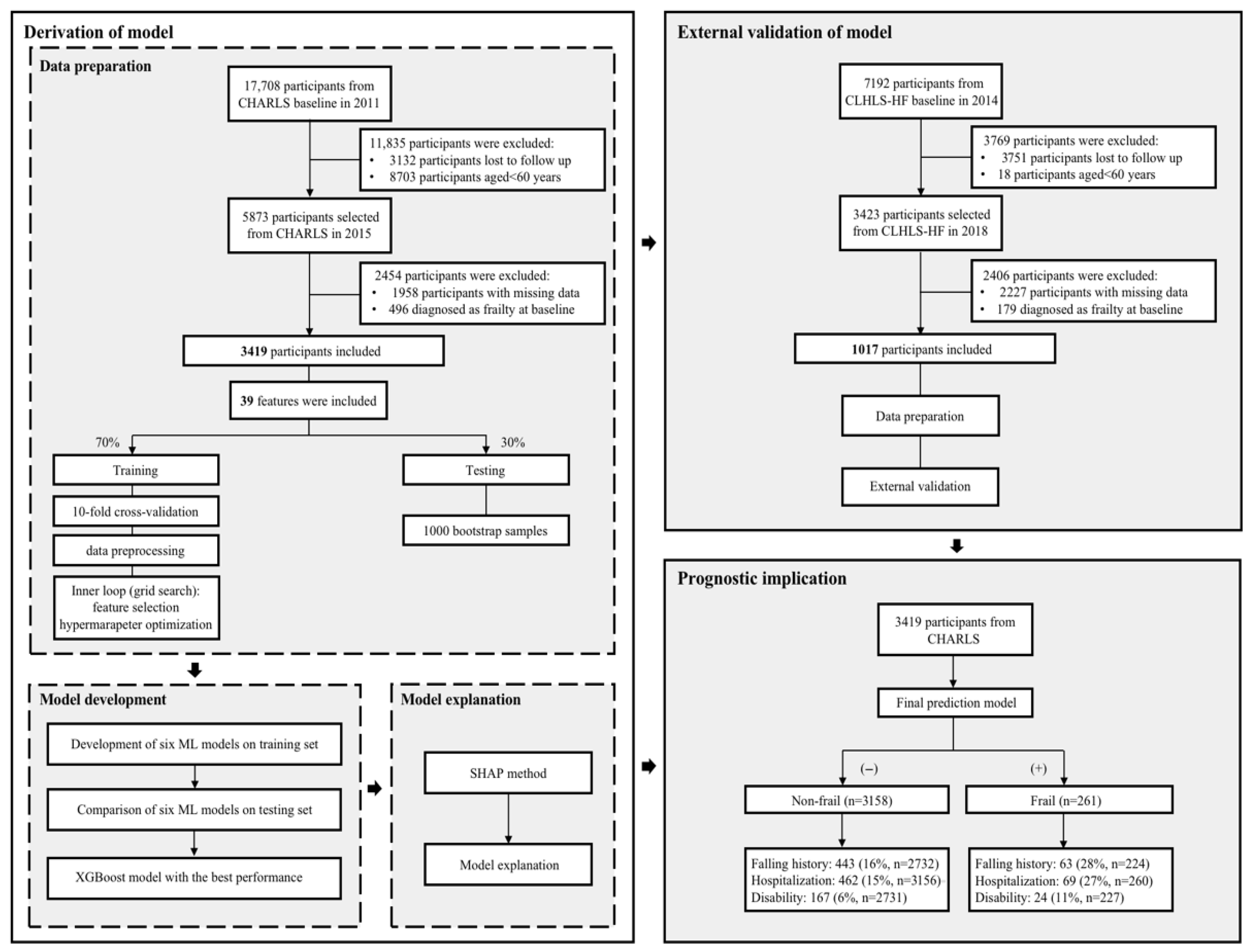
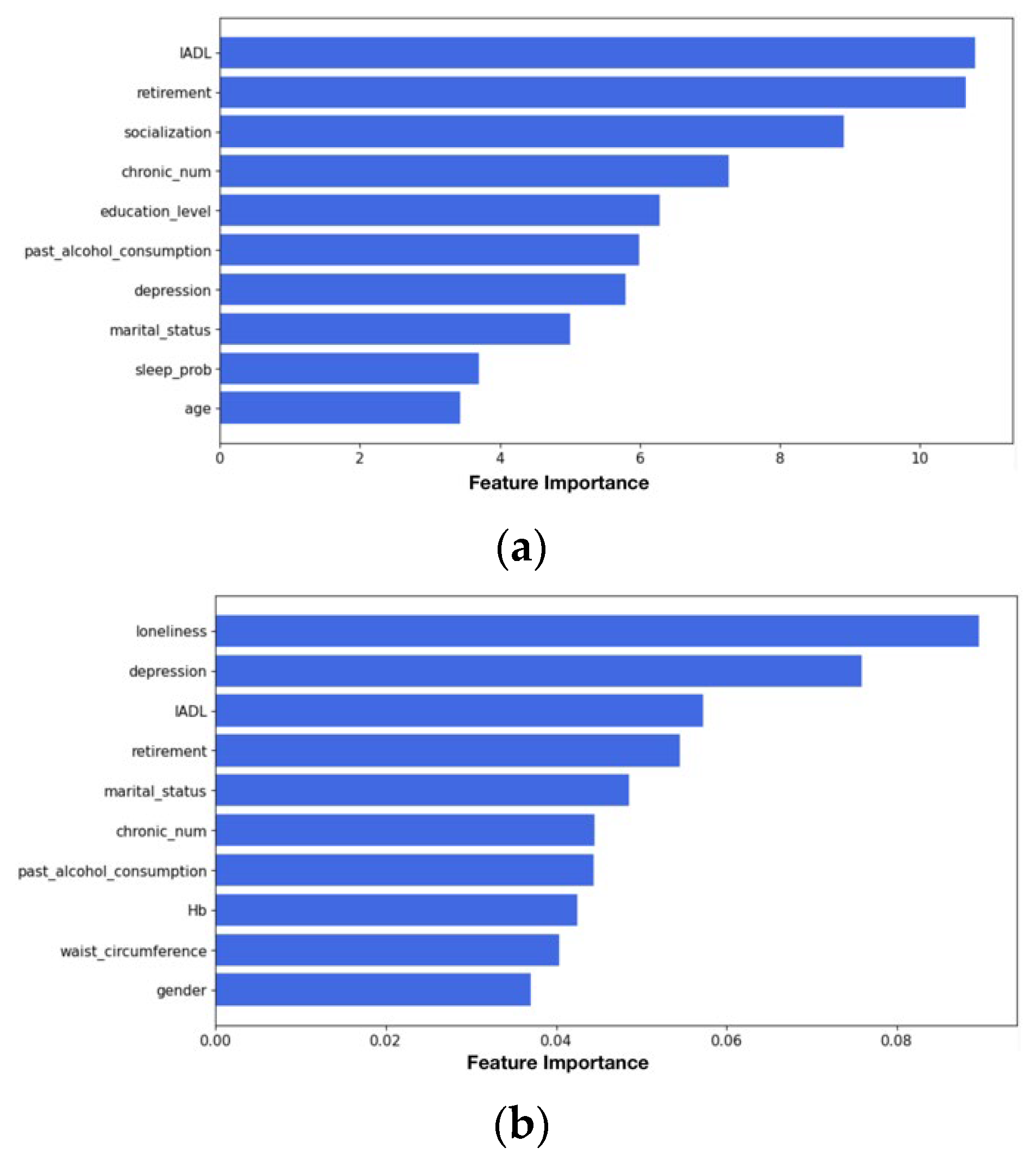
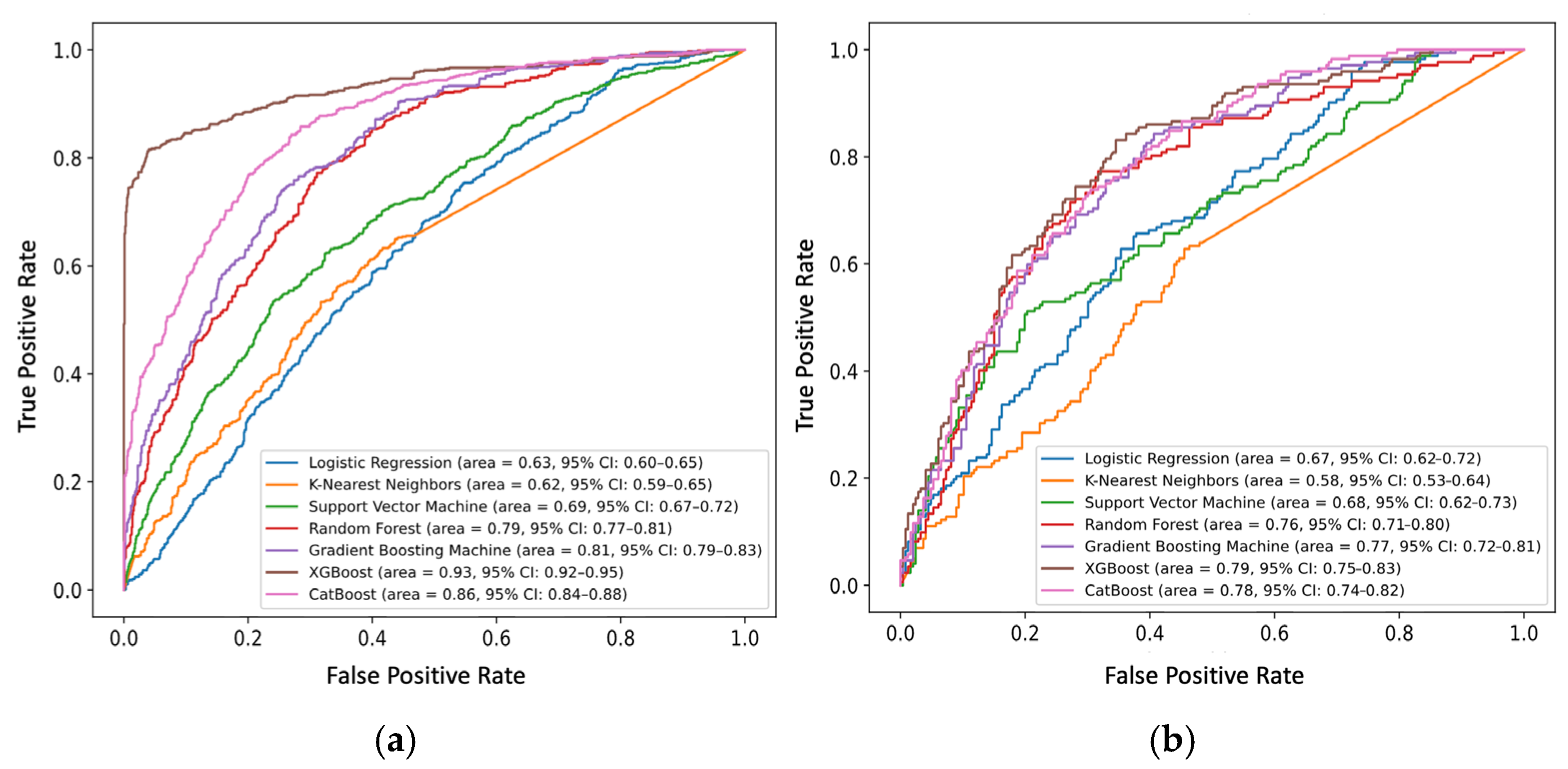
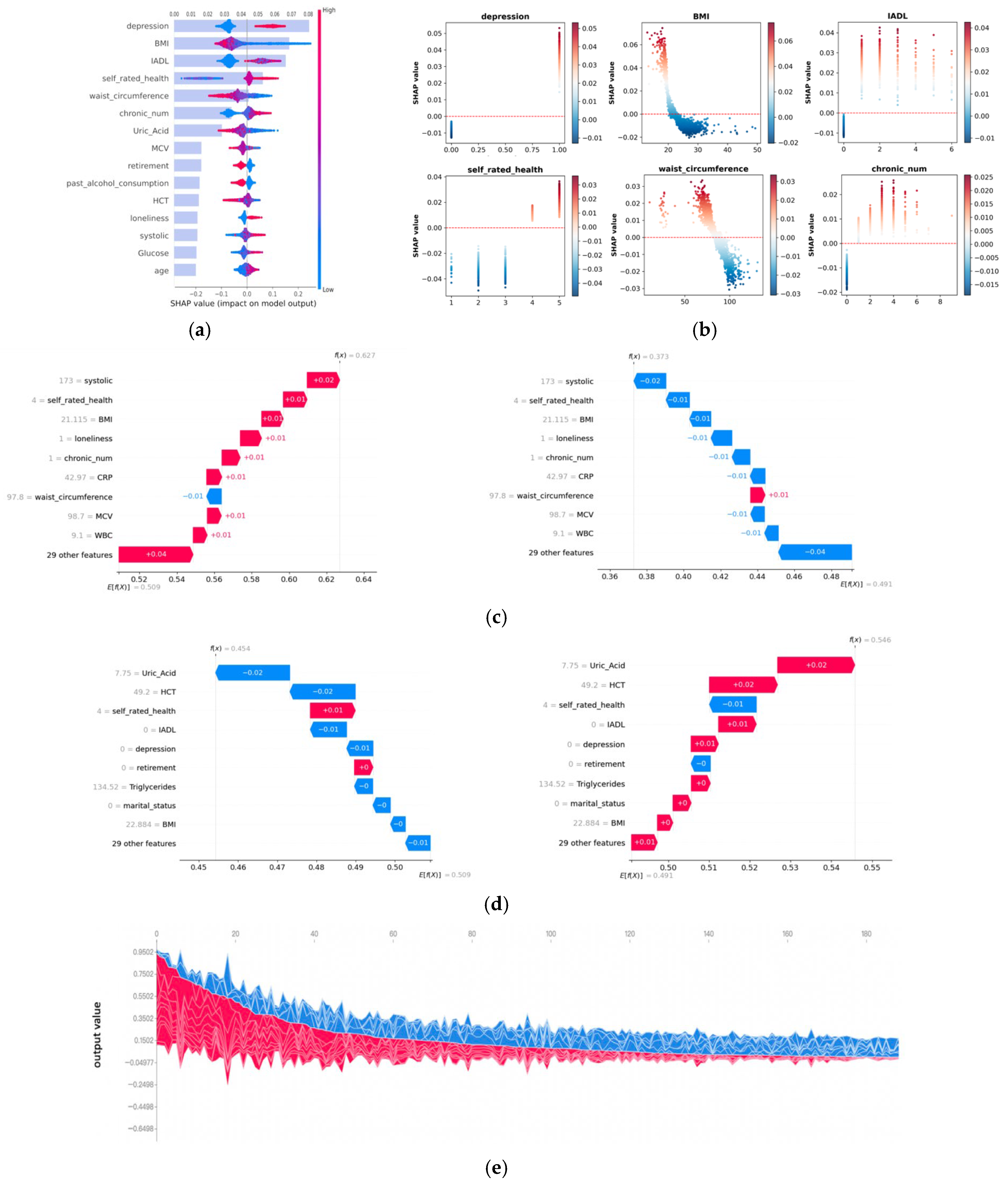
Explainable Machine Learning Approaches Predict Frailty and Adverse Outcomes in Older Adults: Development and Validation with Two Longitudinal Cohorts

Abstract
1. Introduction
2. Materials and Methods
2.1. Data Source and Study Participants
2.2. Assessment of Frailty
2.3. Potential Predictors
2.4. Model Development and Validation
2.5. Interpretation Analysis
2.6. Statistical Analysis
3. Results
3.1. Baseline Characteristics
3.2. The Result of Predictor Selection and Model Development
3.3. Model Performance in Internal Validation
3.4. Model Performance in External Validation
3.5. Clinical Interpretation
3.6. Prognostic Analysis
4. Discussion
5. Conclusions
Supplementary Materials
Author Contributions
Funding
Institutional Review Board Statement
Informed Consent Statement
Data Availability Statement
Conflicts of Interest
References
- Clegg, A.; Young, J.; Iliffe, S.; Rikkert, M.O.; Rockwood, K. Frailty in elderly people. Lancet 2013, 381, 752–762. [Google Scholar] [CrossRef] [PubMed]
- Fried, L.; Tangen, C.; Walston, J.; Newman, A.; Hirsch, C.; Gottdiener, J.; Seeman, T.; Tracy, R.; Kop, W.; Burke, G.; et al. Frailty in older adults: Evidence for a phenotype. J. Gerontol. A Biol. Sci. Med. Sci. 2001, 56, M146–M156. [Google Scholar] [CrossRef]
- Kim, D.H.; Rockwood, K. Frailty in Older Adults. N. Engl. J. Med. 2024, 391, 538–548. [Google Scholar] [CrossRef]
- O’Caoimh, R.; Sezgin, D.; O’Donovan, M.R.; Molloy, D.W.; Clegg, A.; Rockwood, K.; Liew, A. Prevalence of frailty in 62 countries across the world: A systematic review and meta-analysis of population-level studies. Age Ageing 2021, 50, 96–104. [Google Scholar] [CrossRef]
- Chu, W.; Chang, S.-F.; Ho, H.-Y. Adverse Health Effects of Frailty: Systematic Review and Meta-Analysis of Middle-Aged and Older Adults With Implications for Evidence-Based Practice. Worldviews Evid. Based Nurs. 2021, 18, 282–289. [Google Scholar] [CrossRef]
- Rockwood, K.; Song, X.; MacKnight, C.; Bergman, H.; Hogan, D.; McDowell, I.; Mitnitski, A. A global clinical measure of fitness and frailty in elderly people. Can. Med. Assoc. J. 2005, 173, 489–495. [Google Scholar] [CrossRef]
- Amon, J.N.; Ridley, E.J. Clinimetrics: Clinical Frailty Scale. J. Physiother. 2022, 68, 147. [Google Scholar] [CrossRef] [PubMed]
- Saliba, D.; Elliott, M.; Rubenstein, L.Z.; Solomon, D.H.; Young, R.T.; Kamberg, C.J.; Roth, C.; MacLean, C.H.; Shekelle, P.G.; Sloss, E.M.; et al. The Vulnerable Elders Survey: A tool for identifying vulnerable older people in the community. J. Am. Geriatr. Soc. 2001, 49, 1691–1699. [Google Scholar] [CrossRef]
- Ambagtsheer, R.C.; Shafiabady, N.; Dent, E.; Seiboth, C.; Beilby, J. The application of artificial intelligence (AI) techniques to identify frailty within a residential aged care administrative data set. Int. J. Med. Inform. 2020, 136, 104094. [Google Scholar] [CrossRef] [PubMed]
- Aponte-Hao, S.; Wong, S.T.; Thandi, M.; Ronksley, P.; McBrien, K.; Lee, J.; Grandy, M.; Mangin, D.; Katz, A.; Singer, A.; et al. Machine learning for identification of frailty in Canadian primary care practices. Int. J. Popul. Data Sci. 2021, 6, 1650. [Google Scholar] [CrossRef]
- Da Cunha Leme, D.E. The use of Bayesian network models to identify factors related to frailty phenotype and health outcomes in middle-aged and older persons. Arch. Gerontol. Geriatr. 2021, 92, 104212. [Google Scholar] [CrossRef]
- Peng, L.-N.; Hsiao, F.-Y.; Lee, W.-J.; Huang, S.-T.; Chen, L.-K. Comparisons Between Hypothesis- and Data-Driven Approaches for Multimorbidity Frailty Index: A Machine Learning Approach. J. Med. Internet Res. 2020, 22, e16213. [Google Scholar] [CrossRef]
- Tarekegn, A.; Ricceri, F.; Costa, G.; Ferracin, E.; Giacobini, M. Predictive Modeling for Frailty Conditions in Elderly People: Machine Learning Approaches. JMIR Med. Inform. 2020, 8, e16678. [Google Scholar] [CrossRef]
- Wu, Y.; Jia, M.; Xiang, C.; Fang, Y. Latent trajectories of frailty and risk prediction models among geriatric community dwellers: An interpretable machine learning perspective. BMC Geriatr. 2022, 22, 900. [Google Scholar] [CrossRef]
- Leghissa, M.; Carrera, Á.; Iglesias, C.A. Machine learning approaches for frailty detection, prediction and classification in elderly people: A systematic review. Int. J. Med. Inform. 2023, 178, 105172. [Google Scholar] [CrossRef] [PubMed]
- Zhao, Y.; Strauss, J.; Yang, G. China Health and Retirement Longitudinal Study; Peking University Open Research Data Platform: Beijing, China, 2015. [Google Scholar]
- Center for Healthy Aging and Development Studies. The Chinese Longitudinal Healthy Longevity Survey (CLHLS)-Longitudinal Data (1998–2018); Peking University Open Research Data Platform: Beijing, China, 2020. [Google Scholar]
- Herr, M.; Jeune, B.; Fors, S.; Andersen-Ranberg, K.; Ankri, J.; Arai, Y.; Cubaynes, S.; Santos-Eggimann, B.; Zekry, D.; Parker, M.; et al. Frailty and Associated Factors among Centenarians in the 5-COOP Countries. Gerontology 2018, 64, 521–531. [Google Scholar] [CrossRef] [PubMed]
- Wu, C.; Smit, E.; Xue, Q.-L.; Odden, M.C. Prevalence and Correlates of Frailty Among Community-Dwelling Chinese Older Adults: The China Health and Retirement Longitudinal Study. J. Gerontol. Ser. A 2018, 73, 102–108. [Google Scholar] [CrossRef]
- van Kan, G.A.; Rolland, Y.M.; Morley, J.E.; Vellas, B. Frailty: Toward a Clinical Definition. J. Am. Med. Dir. Assoc. 2008, 9, 71–72. [Google Scholar] [CrossRef]
- Bu, F.; Deng, X.-H.; Zhan, N.-N.; Cheng, H.; Wang, Z.-L.; Tang, L.; Zhao, Y.; Lyu, Q.-Y. Development and validation of a risk prediction model for frailty in patients with diabetes. BMC Geriatr. 2023, 23, 172. [Google Scholar] [CrossRef]
- Wang, H.-Y.; Lv, X.; Du, J.; Kong, G.; Zhang, L. Age- and Gender-Specific Prevalence of Frailty and Its Outcomes in the Longevous Population: The Chinese Longitudinal Healthy Longevity Study. Front. Med. 2021, 8, 719806. [Google Scholar] [CrossRef] [PubMed]
- Hanlon, P.; Nicholl, B.I.; Jani, B.D.; Lee, D.; McQueenie, R.; Mair, F.S. Frailty and pre-frailty in middle-aged and older adults and its association with multimorbidity and mortality: A prospective analysis of 493 737 UK Biobank participants. Lancet Public Health 2018, 3, e323–e332. [Google Scholar] [CrossRef]
- Feng, Q.; Yang, S.; Ye, S.; Wan, C.; Wang, H.; You, J. Mediation of depressive symptoms in the association between blood urea nitrogen to creatinine ratio and cognition among middle-aged and elderly adults: Evidence from a national longitudinal cohort study. BMC Psychiatry 2024, 24, 515. [Google Scholar] [CrossRef]
- Pang, J.; Xu, Y.; Liu, Q.; Huang, J.; Li, P.; Ma, L.; Zeng, C.; Ma, X.; Xie, H. Trajectories of cognitive function development and predictive factors in disabled middle-aged and older adults. Front. Public Health 2024, 12, 1436722. [Google Scholar] [CrossRef] [PubMed]
- Stekhoven, D.J.; Bühlmann, P. MissForest--non-parametric missing value imputation for mixed-type data. Bioinformatics 2012, 28, 112–118. [Google Scholar] [CrossRef] [PubMed]
- Waljee, A.K.; Mukherjee, A.; Singal, A.G.; Zhang, Y.; Warren, J.; Balis, U.; Marrero, J.; Zhu, J.; Higgins, P.D. Comparison of imputation methods for missing laboratory data in medicine. BMJ Open 2013, 3, e002847. [Google Scholar] [CrossRef]
- Alghamdi, M.; Al-Mallah, M.; Keteyian, S.; Brawner, C.; Ehrman, J.; Sakr, S. Predicting diabetes mellitus using SMOTE and ensemble machine learning approach: The Henry Ford Exercise Testing (FIT) project. PLoS ONE 2017, 12, e0179805. [Google Scholar] [CrossRef]
- Tibshirani, R. Regression Shrinkage and Selection Via the Lasso. J. R. Stat. Soc. Ser. B 1996, 58, 267–288. [Google Scholar] [CrossRef]
- Zhou, Y. Developing a machine learning model for detecting depression, anxiety, and apathy in older adults with mild cognitive impairment using speech and facial expressions: A cross-sectional observational study. Int. J. Nurs. Stud. 2023, 146, 104562. [Google Scholar] [CrossRef]
- Tan, J.; Ma, C.; Zhu, C.; Wang, Y.; Zou, X.; Li, H.; Li, J.; He, Y.; Wu, C. Prediction models for depression risk among older adults: Systematic review and critical appraisal. Ageing Res. Rev. 2023, 83, 101803. [Google Scholar] [CrossRef]
- Palar, P.S.; Zuhal, L.R.; Shimoyama, K. Enhancing the explainability of regression-based polynomial chaos expansion by Shapley additive explanations. Reliab. Eng. Syst. Saf. 2023, 232, 109045. [Google Scholar] [CrossRef]
- Haagsma, J.A.; Olij, B.F.; Majdan, M.; van Beeck, E.F.; Vos, T.; Castle, C.D.; Dingels, Z.V.; Fox, J.T.; Hamilton, E.B.; Liu, Z.; et al. Falls in older aged adults in 22 European countries: Incidence, mortality and burden of disease from 1990 to 2017. Inj. Prev. 2020, 26, i67–i74. [Google Scholar] [CrossRef]
- Bally, E.L.S.; Ye, L.; Van Grieken, A.; Tan, S.S.; Mattace-Raso, F.; Procaccini, E.; Alhambra-Borrás, T.; Raat, H. Factors associated with falls among hospitalized and community-dwelling older adults: The APPCARE study. Front. Public Health 2023, 11, 1180914. [Google Scholar] [CrossRef]
- Zhang, Q.; Guo, H.; Gu, H.; Zhao, X. Gender-associated factors for frailty and their impact on hospitalization and mortality among community-dwelling older adults: A cross-sectional population-based study. PeerJ 2018, 6, e4326. [Google Scholar] [CrossRef]
- Lahousse, L.; Maes, B.; Ziere, G.; Loth, D.W.; Verlinden, V.J.A.; Zillikens, M.C.; Uitterlinden, A.G.; Rivadeneira, F.; Tiemeier, H.; Franco, O.H.; et al. Adverse outcomes of frailty in the elderly: The Rotterdam Study. Eur. J. Epidemiol. 2014, 29, 419–427. [Google Scholar] [CrossRef]
- Ye, B.; Li, Y.; Wang, Y.; Ji, X.; Wang, J.; Huang, Y.; Chen, J.; Bao, Z. A Modified Frailty Phenotype Used for Identifying Frailty in Health Care Practice: Validation Among Chinese Older Adults. J. Am. Med. Dir. Assoc. 2024, 25, 105016. [Google Scholar] [CrossRef] [PubMed]
- Wang, H.; Zhang, M.; Sun, X. Sex-Specific Association Between Socioeconomic Status, Lifestyle, and the Risk of Frailty Among the Elderly in China. Front. Med. 2021, 8, 775518. [Google Scholar] [CrossRef] [PubMed]
- Zhang, W.; Wang, J.; Xie, F.; Wang, X.; Dong, S.; Luo, N.; Li, F.; Li, Y. Development and validation of machine learning models to predict frailty risk for elderly. J. Adv. Nurs. 2024, 80, 5064–5075. [Google Scholar] [CrossRef]
- Yang, C.-C.; Chen, P.-H.; Yang, C.-H.; Dai, C.-Y.; Luo, K.-H.; Chen, T.-H.; Chuang, H.-Y.; Kuo, C.-H. Physical frailty identification using machine learning to explore the 5-item FRAIL scale, Cardiovascular Health Study index, and Study of Osteoporotic Fractures index. Front. Public Health 2024, 12, 1303958. [Google Scholar] [CrossRef] [PubMed]
- Hassler, A.P.; Menasalvas, E.; García-García, F.J.; Rodríguez-Mañas, L.; Holzinger, A. Importance of medical data preprocessing in predictive modeling and risk factor discovery for the frailty syndrome. BMC Med. Inform. Decis. Mak. 2019, 19, 33. [Google Scholar] [CrossRef]
- Li, Z.K.; Huang, Y.; Wang, Z.P.; Jing, H.; Teng, Y.X.; Liu, Y.Z.; Shen, Y.; Li, Q.; Mi, B.B.; Yang, J.M.; et al. Prevalence of frailty and importance of influencing factors in adults in Shaanxi Province. Zhonghua Liu Xing Bing. Xue Za Zhi 2025, 46, 131–139. [Google Scholar] [CrossRef]
- Soltani, S.; Jayedi, A.; Ghoreishy, S.; Mousavirad, M.; Movahed, S.; Jabbari, M.; Asoudeh, F. Alcohol consumption and frailty risk: A dose-response meta-analysis of cohort studies. Age Ageing 2024, 53, afae199. [Google Scholar] [CrossRef] [PubMed]
- Wang, G.; Liu, Z. Frailty and Depression Were Associated With Laughter in Rheumatoid Arthritis Patients With Controlled Disease Activity. Int. J. Rheum. Dis. 2025, 28, e70073. [Google Scholar] [CrossRef] [PubMed]
- Xin, M.; Wang, W.; Zhou, M.; Geng, Y.; Liu, H.; Luo, W.; Zhang, G.Z.; Huang, L. Genetically-predicted effects of lifestyle factors on frailty: Evidence from Mendelian randomization study. Arch. Gerontol. Geriatr. 2025, 129, 105662. [Google Scholar] [CrossRef] [PubMed]
- Baron, S.; Latham, A.J.; Varga, S. Explainable AI and stakes in medicine: A user study. Artif. Intell. 2025, 340, 104282. [Google Scholar] [CrossRef]



| Characteristics | CHARLS | CLHLS-HF | p a | ||||||||
|---|---|---|---|---|---|---|---|---|---|---|---|
| Total (n = 3419) | Non-Frail (n = 3103) | Frail (n = 316) | p | Effect Size c (95% CI) | Total (n = 1017) | Non-Frail (n = 833) | Frail (n = 184) | p | Effect Size (95% CI) | ||
| Age (year, IQR) | 65 (62–70) | 65 (62–70) | 66 (63–71) | 0.025 | −0.108 (−0.224, 0.007) | 78 (71–86) | 71 (77–84) | 85 (78–92) | <0.001 | 0.552 (0.431, 0.673) | <0.001 |
| Gender | <0.001 | 0.058 (0.024, 0.092) | <0.001 | 0.092 (0.049, 0.135) | 0.002 | ||||||
| Female | 1543 (45.1%) | 1367 (44.1%) | 176 (55.7%) | 404 (39.7%) | 304 (36.5%) | 100 (54.3%) | |||||
| Male | 1876 (54.9%) | 1736 (55.9%) | 140 (44.3%) | 613 (60.3%) | 529 (63.5%) | 84 (45.7%) | |||||
| Educational level | 0.069 | 0.028 (0.002, 0.056) | <0.001 | 0.131 (0.088, 0.174) | <0.001 | ||||||
| Illiterate | 1006 (29.4%) | 897 (29.0%) | 107 (33.9%) | 463 (45.5%) | 341 (40.9%) | 122 (66.3%) | |||||
| Educated | 2413 (70.6%) | 2204 (71.0%) | 209 (66.1%) | 554 (54.5%) | 492 (59.1%) | 62 (33.7%) | |||||
| Marital status | 0.874 | 0.003 (0.001, 0.006) | <0.001 | 0.126 (0.083, 0.169) | <0.001 | ||||||
| Married | 2693 (78.8%) | 2443 (78.7%) | 250 (79.1%) | 603 (59.3%) | 532 (63.9%) | 71 (38.6%) | |||||
| Other | 726 (21.2%) | 660 (21.3%) | 66 (20.9%) | 414 (40.7%) | 301 (36.1%) | 113 (61.4%) | |||||
| BMI b (kg/m2, IQR) | 23.1 (21.1–25.0) | 23.2 (21.2–25.1) | 21.9 (19.7–24.2) | <0.001 | 0.339 (0.223, 0.455) | 22.8 (22.8–24.6) | 22.5 (20.4–24.8) | 21.1 (19.3–23.7) | <0.001 | 0.412 (0.291, 0.533) | <0.001 |
| Waist circumference (cm, IQR) | 85.0 (79.2–91.1) | 85.1 (79.8–91.4) | 82.1 (75.9–88.2) | <0.001 | 0.313 (0.197, 0.429) | 82.0 (76.0–89.0) | 83.0 (77.0–89.0) | 79.0 (74.0–88.0) | <0.001 | 0.198 (0.077, 0.319) | <0.001 |
| Pulse (bpm, IQR) | 71.2 (66.0–76.0) | 71.1 (66.0–76.0) | 71.8 (66.6–78.0) | 0.021 | −0.170 (−0.285, −0.054) | 75.0 (68.0–80.0) | 75.0 (68.0–80.0) | 76.5 (70.0–81.0) | 0.042 | −0.124 (−0.245, −0.003) | <0.001 |
| Diastolic blood pressure (mmHg, IQR) | 74.3 (68.5–80.5) | 74.4 (68.5–80.5) | 73.5 (67.5–79.5) | 0.240 | 0.054 (−0.062, 0.170) | 80.0 (73.0–87.5) | 80.0 (74.5–87.5) | 80.0 (72.5–85.4) | 0.513 | −0.029 (−0.150, 0.092) | <0.001 |
| Systolic blood pressure (mmHg, IQR) | 132.0 (120.5–144.5) | 132.0 (120.5–144.0) | 131.1 (119.6–144.9) | 0.899 | −0.029 (−0.145, 0.087) | 140.2 (128.0–156.0) | 140.0 (129.0–157.0) | 141.1 (126.4–155.0) | 0.979 | 0.001 (−0.120, 0.122) | <0.001 |
| Model 1 a | Model 2 b | Model 3 c | ||
|---|---|---|---|---|
| Outcome | Total n | OR (95% CI) | OR (95% CI) | OR (95% CI) |
| Falling history | ||||
| Non-frail | 443 | 1.0 | 1.0 | 1.0 |
| Frail | 63 | 2.11 (1.27–3.50) | 2.03 (1.21–3.26) | 1.90 (1.15–3.14) |
| Hospitalization | ||||
| Non-frail | 462 | 1.0 | 1.0 | 1.0 |
| Frail | 69 | 1.75 (1.21–2.53) | 1.65 (1.14–2.39) | 1.62 (1.15–2.24) |
| Disability | ||||
| Non-frail | 167 | 1.0 | 1.0 | 1.0 |
| Frail | 24 | 1.42 (1.23–1.64) | 1.41 (1.21–1.63) | 1.46 (1.02–2.11) |
Disclaimer/Publisher’s Note: The statements, opinions and data contained in all publications are solely those of the individual author(s) and contributor(s) and not of MDPI and/or the editor(s). MDPI and/or the editor(s) disclaim responsibility for any injury to people or property resulting from any ideas, methods, instructions or products referred to in the content. |
© 2026 by the authors. Licensee MDPI, Basel, Switzerland. This article is an open access article distributed under the terms and conditions of the Creative Commons Attribution (CC BY) license.
Share and Cite
He, A.; Zhang, J.; Hu, X. Explainable Machine Learning Approaches Predict Frailty and Adverse Outcomes in Older Adults: Development and Validation with Two Longitudinal Cohorts. J. Clin. Med. 2026, 15, 1812. https://doi.org/10.3390/jcm15051812
He A, Zhang J, Hu X. Explainable Machine Learning Approaches Predict Frailty and Adverse Outcomes in Older Adults: Development and Validation with Two Longitudinal Cohorts. Journal of Clinical Medicine. 2026; 15(5):1812. https://doi.org/10.3390/jcm15051812
Chicago/Turabian StyleHe, Aixuan, Jiang Zhang, and Xiuying Hu. 2026. "Explainable Machine Learning Approaches Predict Frailty and Adverse Outcomes in Older Adults: Development and Validation with Two Longitudinal Cohorts" Journal of Clinical Medicine 15, no. 5: 1812. https://doi.org/10.3390/jcm15051812
APA StyleHe, A., Zhang, J., & Hu, X. (2026). Explainable Machine Learning Approaches Predict Frailty and Adverse Outcomes in Older Adults: Development and Validation with Two Longitudinal Cohorts. Journal of Clinical Medicine, 15(5), 1812. https://doi.org/10.3390/jcm15051812