Additional Stroke Risk Factors Beyond the CHA2DS2-VA Score in Non-Valvular Atrial Fibrillation: An Interdisciplinary Expert Opinion

 , , and
Abstract
1. Introduction
2. Heterogeneity of Stroke Risk in NVAF Patients
3. Clinical Predictors and NVAF
3.1. Chronic Kidney Disorder and NVAF
3.1.1. Proteinuria
3.1.2. GFR < 45 mL/min
3.2. Improving the Management of Patients with Coexisting CKD and NVAF in Routine Clinical Practice
- Bullet Summary for NVAF Patients with CKD
- NVAF patients with an index CHA2DS2-VA score of one should be assessed for renal function at baseline and in routine follow-up visits according to individual patient needs.
- The frequency of follow-up visits of CKD patients on OAC should be determined based on the patient-specific requirements and according to the disease stage.
- Time intervals between follow-up visits should be shorter in patients with advanced CKD. These patients would benefit more from close interdisciplinary collaborations between nephrology and cardiology clinics.
- Initiation or discontinuation of OAC should be a joint interdisciplinary decision-making process in CKD patients with NVAF.
- It is recommended that interdisciplinary collaboration should be initiated in patients with eGFR < 60 mL/min/1.73 m2 and/or proteinuria. However, considering the daily workloads of both cardiology and nephrology outpatient clinics, patients with an eGFR < 30 mL/min/1.73 m2 would benefit from interdisciplinary dialog.
- It should be noted that in the current AF guidelines, GFR < 45 mL/min is underlined as an additional risk factor for stroke risk, not included in CHA2DS2-VA.
- Cardiologists should consult a nephrologist when they determine a protein level of more than 200 mg in spot urine.
- NVAF patients who develop ARF during follow-up may consult with a nephrologist for precautionary purposes.
- Patients should be well-informed about the coexistence of CKD and AF diseases.
- Joint meetings should be organized to establish an interdisciplinary structure for assessing and planning treatment for patients with coexisting CKD and AF, according to current guidelines.
3.3. Obesity and NVAF
3.4. Commonly Encountered Issues in NVAF Patients with Obesity
3.5. Improving the Management of Patients with Coexisting Obesity and NVAF in Routine Clinical Practice
3.6. AF Type and Burden/Long Duration
- Bullet Summary for AF Type and Burden/Long Duration
- The consensus on AF diagnosis recommends a 10 s measurement of a standard 12-lead ECG and a 30 s measurement on ECG devices with one or more leads. The exact time interval spent on diagnosing AF on monitoring devices is unclear.
- Non-ECG-based methods and devices, typically using photoplethysmography, are not diagnostic for AF but may be indicative of AF.
- Unlike subclinical AF, patients with clinically documented paroxysmal AF should receive anticoagulation treatment, preferably with a NOAC, similar to subjects with non-paroxysmal AF.
- In the 2024 ESC AF guidelines, it is recommended to consider a prolonged non-invasive ECG-based approach in individuals aged ≥75 years or ≥65 years with additional CHA2DS2-VA to ensure earlier detection of AF [4].
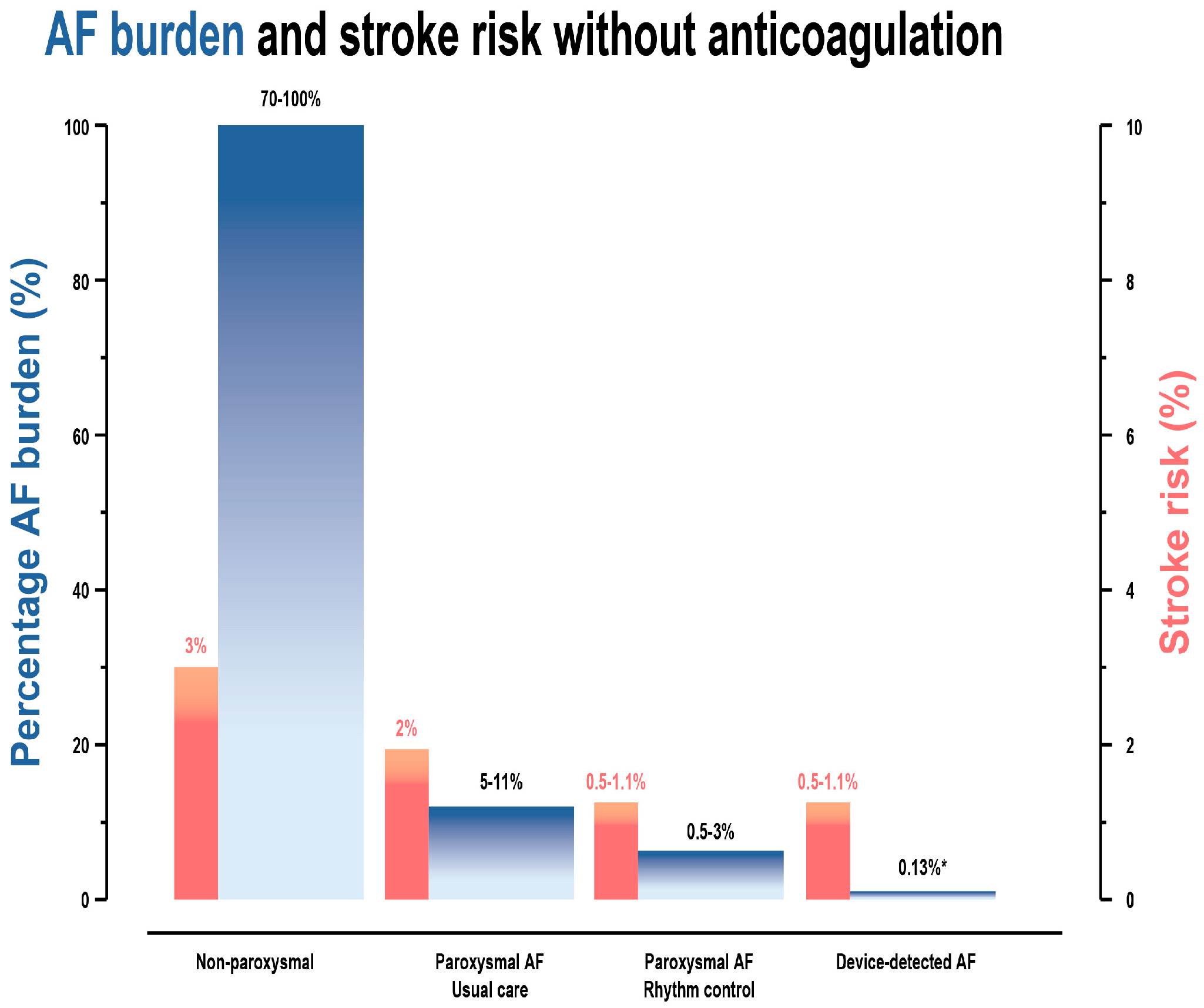
- Recently, there has been a paradigm shift in AF management: AF burden reduction is included in the therapeutic goals along with anticoagulation, treatment of comorbidity, and risk factor management. Consequently, AF ablation is reported to reduce AF burden, thus AF-related CV outcomes [63].
4. Laboratory Predictors and NVAF
NT-proBNP and Cardiac Troponin
5. Imaging Predictors
5.1. Enlarged Left Atrium (LA) Volume (≥73 mL) or Diameter (≥4.0 cm)
5.2. Left Atrial Appendage (LAA) Morphology and Emptying Velocity (<20 cm/s)
- Left Atrial Appendage Evaluation for Stroke Risk Stratification: Clinical Practice Recommendations
- LAA morphology is assessed with TEE or 3D echocardiography.
- In patients with cauliflower and windsock morphologies, more aggressive anticoagulation or LAA closure should be considered.
- Anatomical complexity and volume increase result in blood stasis and spontaneous echocontrast (SEC) in LAA, leading to thrombosis and embolism.
- The combined assessment of the morphology and emptying velocity (<20 cm/s) of LAA may help clinicians in embolic risk estimation. However, not all functional anatomical markers provide an evidence-based indication for anticoagulation, but rather may indicate an increased thermogenicity risk [88].
- LAA morphology can be combined with the CHA2DS2-VA score when assessing stroke risk, but it is not yet routinely included in the guidelines.
6. The Other Additional Risk Factors
6.1. Hypertrophic Cardiomyopathy (HCM)
6.2. Obstructive Sleep Apnea Syndrome (OSAS)
6.3. Future Research Directions
7. Conclusions
Supplementary Materials
Author Contributions
Funding
Institutional Review Board Statement
Informed Consent Statement
Data Availability Statement
Acknowledgments
Conflicts of Interest
References
- Gorenek, B.; Pelliccia, A.; Benjamin, E.J.; Boriani, G.; Crijns, H.J.; Fogel, R.I.; Van Gelder, I.C.; Halle, M.; Kudaiberdieva, G.; Lane, D.A.; et al. European Heart Rhythm Association (EHRA)/European Association of Cardiovascular Prevention and Rehabilitation (EACPR) Position Paper on How to Prevent Atrial Fibrillation Endorsed by the Heart Rhythm Society (HRS) and Asia Pacific Heart Rhythm Society (APHRS). Eur. J. Prev. Cardiol. 2017, 24, 4–40. [Google Scholar] [CrossRef] [PubMed]
- Lippi, G.; Sanchis-Gomar, F.; Cervellin, G. Global Epidemiology of Atrial Fibrillation: An Increasing Epidemic and Public Health Challenge. Int. J. Stroke 2021, 16, 217–221. [Google Scholar] [CrossRef]
- Elsheikh, S.; Hill, A.; Irving, G.; Lip, G.Y.H.; Abdul-Rahim, A.H. Atrial Fibrillation and Stroke: State-of-the-Art and Future Directions. Curr. Probl. Cardiol. 2024, 49, 102181. [Google Scholar] [CrossRef]
- Van Gelder, I.C.; Rienstra, M.; Bunting, K.V.; Casado-Arroyo, R.; Caso, V.; Crijns, H.J.G.M.; De Potter, T.J.R.; Dwight, J.; Guasti, L.; Hanke, T.; et al. 2024 ESC Guidelines for the Management of Atrial Fibrillation Developed in Collaboration with the European Association for Cardio-Thoracic Surgery (EACTS). Eur. Heart J. 2024, 45, 3314–3414. [Google Scholar] [CrossRef]
- Hindricks, G.; Potpara, T.; Dagres, N.; Arbelo, E.; Bax, J.J.; Blomström-Lundqvist, C.; Boriani, G.; Castella, M.; Dan, G.-A.; Dilaveris, P.E.; et al. 2020 ESC Guidelines for the Diagnosis and Management of Atrial Fibrillation Developed in Collaboration with the European Association for Cardio-Thoracic Surgery (EACTS). Eur. Heart J. 2021, 42, 373–498. [Google Scholar] [CrossRef]
- Sgarra, L.; Desantis, V.; Matteucci, A.; Caccavo, V.P.; Troisi, F.; Di Monaco, A.; Mangini, F.; Katsouras, G.; Guaricci, A.I.; Dadamo, M.L.; et al. Non-Anticoagulation Strategies Aimed at Primary Stroke Prevention in Nascent Atrial Fibrillation. Biomedicines 2025, 13, 660. [Google Scholar] [CrossRef]
- Yavuz, B.; Ata, N.; Oto, E.; Katircioglu-Öztürk, D.; Aytemir, K.; Evranos, B.; Koselerli, R.; Ertugay, E.; Burkan, A.; Ertugay, E.; et al. Demographics, Treatment and Outcomes of Atrial Fibrillation in a Developing Country: The Population-Based TuRkish Atrial Fibrillation (TRAF) Cohort. EP Eur. 2017, 19, 734–740. [Google Scholar] [CrossRef]
- Sayın, B. Antithrombotic Treatment Patterns and Stroke Prevention in Patients with Atrial Fibrillation in TURKEY: Inferences from GARFIELD-AF Registry. Anatol. J. Cardiol. 2019, 21, 272–280. [Google Scholar] [CrossRef]
- Alkhouli, M.; Friedman, P.A. Ischemic Stroke Risk in Patients with Nonvalvular Atrial Fibrillation. J. Am. Coll. Cardiol. 2019, 74, 3050–3065. [Google Scholar] [CrossRef] [PubMed]
- Joglar, J.A.; Chung, M.K.; Armbruster, A.L.; Benjamin, E.J.; Chyou, J.Y.; Cronin, E.M.; Deswal, A.; Eckhardt, L.L.; Goldberger, Z.D.; Gopinathannair, R.; et al. 2023 ACC/AHA/ACCP/HRS Guideline for the Diagnosis and Management of Atrial Fibrillation: A Report of the American College of Cardiology/American Heart Association Joint Committee on Clinical Practice Guidelines. Circulation 2024, 149, e1–e156. [Google Scholar] [CrossRef]
- Sulzgruber, P.; Wassmann, S.; Semb, A.G.; Doehner, W.; Widimsky, P.; Gremmel, T.; Kaski, J.C.; Savarese, G.; Rosano, G.M.C.; Borghi, C.; et al. Oral Anticoagulation in Patients with Non-Valvular Atrial Fibrillation and a CHA2DS2-VASc Score of 1: A Current Opinion of the European Society of Cardiology Working Group on Cardiovascular Pharmacotherapy and European Society of Cardiology Council on Stroke. Eur. Heart J. Cardiovasc. Pharmacother. 2019, 5, 171–180. [Google Scholar] [CrossRef]
- Cheng, C.-M.; Lin, C.-H.; Chou, P.; Jong, G.-P. Antithrombotic Treatment May Reduce Mortality Among New-Onset Atrial Fibrillation Patients with Gray-Zone Risk of Stroke: A Population-Based Cohort Study. Int. Heart J. 2019, 60, 303–309. [Google Scholar] [CrossRef]
- Xie, X.; Li, T. Anticoagulation for Atrial Fibrillation Patients with the CHA2DS2-VASc Score = 1 (beyond Sex). Acta Cardiol. 2021, 76, 258–264. [Google Scholar] [CrossRef]
- Proietti, M.; Vitolo, M.; Harrison, S.L.; Lane, D.A.; Fauchier, L.; Marin, F.; Nabauer, M.; Potpara, T.S.; Dan, G.-A.; Boriani, G.; et al. Impact of Clinical Phenotypes on Management and Outcomes in European Atrial Fibrillation Patients: A Report from the ESC-EHRA EURObservational Research Programme in AF (EORP-AF) General Long-Term Registry. BMC Med. 2021, 19, 256. [Google Scholar] [CrossRef] [PubMed]
- Vitolo, M.; Proietti, M.; Shantsila, A.; Boriani, G.; Lip, G.Y.H. Clinical Phenotype Classification of Atrial Fibrillation Patients Using Cluster Analysis and Associations with Trial-Adjudicated Outcomes. Biomedicines 2021, 9, 843. [Google Scholar] [CrossRef] [PubMed]
- Chao, T.-F.; Liu, C.-J.; Wang, K.-L.; Lin, Y.-J.; Chang, S.-L.; Lo, L.-W.; Hu, Y.-F.; Tuan, T.-C.; Chen, T.-J.; Lip, G.Y.H.; et al. Should Atrial Fibrillation Patients with 1 Additional Risk Factor of the CHA2DS2-VASc Score (Beyond Sex) Receive Oral Anticoagulation? J. Am. Coll. Cardiol. 2015, 65, 635–642. [Google Scholar] [CrossRef]
- Jagadish, P.S.; Kabra, R. Stroke Risk in Atrial Fibrillation: Beyond the CHA2DS2-VASc Score. Curr. Cardiol. Rep. 2019, 21, 95. [Google Scholar] [CrossRef] [PubMed]
- Wang, J.; Zhang, D.-P.; Liu, H.-B.; Zhong, J.-C.; Yang, X.-C. Should Atrial Fibrillation Patients with Hypertension as an Additional Risk Factor of the CHA2DS2-VASc Score Receive Oral Anticoagulation? J. Geriatr. Cardiol. 2018, 15, 229–234. [Google Scholar] [CrossRef]
- Wang, W.; Zhou, T.; Li, J.; Yuan, C.; Li, C.; Chen, S.; Shen, C.; Gu, D.; Lu, X.; Liu, F. Association between NT-proBNP Levels and Risk of Atrial Fibrillation: A Systematic Review and Meta-Analysis of Cohort Studies. Heart 2025, 111, 109–116. [Google Scholar] [CrossRef]
- Joundi, R.A.; Cipriano, L.E.; Sposato, L.A.; Saposnik, G.; on behalf of the Stroke Outcomes Research Working Group. Ischemic Stroke Risk in Patients with Atrial Fibrillation and CHA2 DS2 -VASc Score of 1: Systematic Review and Meta-Analysis. Stroke 2016, 47, 1364–1367. [Google Scholar] [CrossRef]
- Neefs, J.; Klamer, T.A.; Krul, S.P.J.; De Groot, J.R. Should Every Patient with Atrial Fibrillation and a CHA2DS2-VASc Score of 1 Be Anticoagulated? A Systematic Review of 37,030 Patients. Cardiol. Rev. 2019, 27, 249–255. [Google Scholar] [CrossRef]
- Patti, G.; Cavallari, I. Patients with Atrial Fibrillation and CHA2DS2-VASc Score 1: “To Anticoagulate or Not to Anticoagulate? That Is the Question!”. Heart Rhythm. 2015, 12, 2515–2520. [Google Scholar] [CrossRef]
- Curcio, A.; Anselmino, M.; Di Biase, L.; Migliore, F.; Nigro, G.; Rapacciuolo, A.; Sergi, D.; Tomasi, L.; Pedrinelli, R.; Mercuro, G.; et al. The Gray Areas of Oral Anticoagulation for Prevention of Thromboembolic Events in Atrial Fibrillation Patients. J Cardiovasc. Med. 2023, 24, e97–e105. [Google Scholar] [CrossRef] [PubMed]
- Kakkar, A.K.; Mueller, I.; Bassand, J.-P.; Fitzmaurice, D.A.; Goldhaber, S.Z.; Goto, S.; Haas, S.; Hacke, W.; Lip, G.Y.H.; Mantovani, L.G.; et al. Risk Profiles and Antithrombotic Treatment of Patients Newly Diagnosed with Atrial Fibrillation at Risk of Stroke: Perspectives from the International, Observational, Prospective GARFIELD Registry. PLoS ONE 2013, 8, e63479. [Google Scholar] [CrossRef] [PubMed]
- Liao, J.-N.; Chao, T.-F.; Chen, S.-A. How Do Aging and Comorbidities Impact Risk of Ischemic Stroke in Patients with Atrial Fibrillation. Trends Cardiovasc. Med. 2019, 29, 386–391. [Google Scholar] [CrossRef]
- Bikbov, B.; Purcell, C.A.; Levey, A.S.; Smith, M.; Abdoli, A.; Abebe, M.; Adebayo, O.M.; Afarideh, M.; Agarwal, S.K.; Agudelo-Botero, M.; et al. Global, Regional, and National Burden of Chronic Kidney Disease, 1990–2017: A Systematic Analysis for the Global Burden of Disease Study 2017. Lancet 2020, 395, 709–733. [Google Scholar] [CrossRef] [PubMed]
- Stevens, P.E.; Ahmed, S.B.; Carrero, J.J.; Foster, B.; Francis, A.; Hall, R.K.; Herrington, W.G.; Hill, G.; Inker, L.A.; Kazancıoğlu, R.; et al. KDIGO 2024 Clinical Practice Guideline for the Evaluation and Management of Chronic Kidney Disease. Kidney Int. 2024, 105, S117–S314. [Google Scholar] [CrossRef]
- Roy-Chaudhury, P.; Tumlin, J.A.; Koplan, B.A.; Costea, A.I.; Kher, V.; Williamson, D.; Pokhariyal, S.; Charytan, D.M.; Williamson, D.; Roy-Chaudhury, P.; et al. Primary Outcomes of the Monitoring in Dialysis Study Indicate That Clinically Significant Arrhythmias Are Common in Hemodialysis Patients and Related to Dialytic Cycle. Kidney Int. 2018, 93, 941–951. [Google Scholar] [CrossRef]
- Benn, M. Atrial Fibrillation and Chronic Kidney Disease. Eur. Heart J. 2021, 42, 2824–2826. [Google Scholar] [CrossRef]
- Sidhu, B.; Mavilakandy, A.; Hull, K.L.; Koev, I.; Vali, Z.; Burton, J.O.; Ng, G.A. Atrial Fibrillation and Chronic Kidney Disease: Aetiology and Management. Rev. Cardiovasc. Med. 2024, 25, 143. [Google Scholar] [CrossRef]
- Mahmoodi, B.K.; Ten Kate, M.K.; Waanders, F.; Veeger, N.J.G.M.; Brouwer, J.-L.P.; Vogt, L.; Navis, G.; Van Der Meer, J. High Absolute Risks and Predictors of Venous and Arterial Thromboembolic Events in Patients with Nephrotic Syndrome: Results from a Large Retrospective Cohort Study. Circulation 2008, 117, 224–230. [Google Scholar] [CrossRef] [PubMed]
- Vestergaard, S.V.; Birn, H.; Darvalics, B.; Nitsch, D.; Sørensen, H.T.; Christiansen, C.F. Risk of Arterial Thromboembolism, Venous Thromboembolism, and Bleeding in Patients with Nephrotic Syndrome: A Population-Based Cohort Study. Am. J. Med. 2022, 135, 615–625.e9. [Google Scholar] [CrossRef]
- Singhal, R.; Brimble, K.S. Thromboembolic Complications in the Nephrotic Syndrome: Pathophysiology and Clinical Management. Thromb. Res. 2006, 118, 397–407. [Google Scholar] [CrossRef] [PubMed]
- Loscalzo, J. Venous Thrombosis in the Nephrotic Syndrome. N. Engl. J. Med. 2013, 368, 956–958. [Google Scholar] [CrossRef]
- Piccini, J.P.; Stevens, S.R.; Chang, Y.; Singer, D.E.; Lokhnygina, Y.; Go, A.S.; Patel, M.R.; Mahaffey, K.W.; Halperin, J.L.; Breithardt, G.; et al. Renal Dysfunction as a Predictor of Stroke and Systemic Embolism in Patients with Nonvalvular Atrial Fibrillation: Validation of the R2 CHADS2 Index in the ROCKET AF (Rivaroxaban Once-Daily, Oral, Direct Factor Xa Inhibition Compared with Vitamin K Antagonism for Prevention of Stroke and Embolism Trial in Atrial Fibrillation) and ATRIA (AnTicoagulation and Risk Factors In Atrial Fibrillation) Study Cohorts. Circulation 2013, 127, 224–232. [Google Scholar] [CrossRef]
- Singer, D.E.; Chang, Y.; Borowsky, L.H.; Fang, M.C.; Pomernacki, N.K.; Udaltsova, N.; Reynolds, K.; Go, A.S. A New Risk Scheme to Predict Ischemic Stroke and Other Thromboembolism in Atrial Fibrillation: The ATRIA Study Stroke Risk Score. J. Am. Heart Assoc. 2013, 2, e000250. [Google Scholar] [CrossRef]
- Alonso, A.; Lopez, F.L.; Matsushita, K.; Loehr, L.R.; Agarwal, S.K.; Chen, L.Y.; Soliman, E.Z.; Astor, B.C.; Coresh, J. Chronic Kidney Disease Is Associated with the Incidence of Atrial Fibrillation: The Atherosclerosis Risk in Communities (ARIC) Study. Circulation 2011, 123, 2946–2953. [Google Scholar] [CrossRef]
- Kumar, S.; Lim, E.; Covic, A.; Verhamme, P.; Gale, C.P.; Camm, A.J.; Goldsmith, D. Anticoagulation in Concomitant Chronic Kidney Disease and Atrial Fibrillation. J. Am. Coll. Cardiol. 2019, 74, 2204–2215. [Google Scholar] [CrossRef]
- Ding, W.Y.; Potpara, T.S.; Blomström-Lundqvist, C.; Boriani, G.; Marin, F.; Fauchier, L.; Lip, G.Y.H.; the ESC-EHRA EORP-AF Long-Term General Registry Investigators. Impact of Renal Impairment on Atrial Fibrillation: ESC-EHRA EORP-AF Long-Term General Registry. Eur. J. Clin. Investig. 2022, 52, e13745. [Google Scholar] [CrossRef]
- Dimitrijevic, Z.M.; Mitic, B.P.; Tasic, D.D.; Vrecic, T.; Paunovic, K.; Salinger, S. Bleeding and Thrombotic Events in Hemodialysis Patients with Atrial Fibrillation on Anticoagulation and Antiplatelet Therapy: A 24-Month Cohort Study. Medicina 2024, 60, 1760. [Google Scholar] [CrossRef] [PubMed]
- Lin, W.-Y.; Lin, Y.-J.; Chung, F.-P.; Chao, T.-F.; Liao, J.-N.; Chang, S.-L.; Lo, L.-W.; Hu, Y.-F.; Chiang, C.-E.; Cheng, S.-M.; et al. Impact of Renal Dysfunction on Clinical Outcome in Patients with Low Risk of Atrial Fibrillation. Circ. J. 2014, 78, 853–858. [Google Scholar] [CrossRef]
- Szummer, K.; Evans, M.; Carrero, J.J.; Alehagen, U.; Dahlström, U.; Benson, L.; Lund, L.H. Comparison of the Chronic Kidney Disease Epidemiology Collaboration, the Modification of Diet in Renal Disease Study and the Cockcroft-Gault Equation in Patients with Heart Failure. Open Heart 2017, 4, e000568. [Google Scholar] [CrossRef]
- Yang, F.; Hellyer, J.A.; Than, C.; Ullal, A.J.; Kaiser, D.W.; Heidenreich, P.A.; Hoang, D.D.; Winkelmayer, W.C.; Schmitt, S.; Frayne, S.M.; et al. Warfarin Utilisation and Anticoagulation Control in Patients with Atrial Fibrillation and Chronic Kidney Disease. Heart 2017, 103, 818–826. [Google Scholar] [CrossRef] [PubMed]
- Steffel, J.; Collins, R.; Antz, M.; Cornu, P.; Desteghe, L.; Haeusler, K.G.; Oldgren, J.; Reinecke, H.; Roldan-Schilling, V.; Rowell, N.; et al. 2021 European Heart Rhythm Association Practical Guide on the Use of Non-Vitamin K Antagonist Oral Anticoagulants in Patients with Atrial Fibrillation. EP Eur. 2021, 23, 1612–1676. [Google Scholar] [CrossRef]
- De Vriese, A.S.; Caluwé, R.; Van Der Meersch, H.; De Boeck, K.; De Bacquer, D. Safety and Efficacy of Vitamin K Antagonists versus Rivaroxaban in Hemodialysis Patients with Atrial Fibrillation: A Multicenter Randomized Controlled Trial. J. Am. Soc. Nephrol. 2021, 32, 1474–1483. [Google Scholar] [CrossRef]
- Pokorney, S.D.; Chertow, G.M.; Al-Khalidi, H.R.; Gallup, D.; Dignacco, P.; Mussina, K.; Bansal, N.; Gadegbeku, C.A.; Garcia, D.A.; Garonzik, S.; et al. Apixaban for Patients with Atrial Fibrillation on Hemodialysis: A Multicenter Randomized Controlled Trial. Circulation 2022, 146, 1735–1745. [Google Scholar] [CrossRef] [PubMed]
- Jones, A.; Swan, D.; Lisman, T.; Barnes, G.D.; Thachil, J. Anticoagulation in Chronic Kidney Disease: Current Status and Future Perspectives. J. Thromb. Haemost. 2024, 22, 323–336. [Google Scholar] [CrossRef]
- Ng, M.; Gakidou, E.; Lo, J.; Abate, Y.H.; Abbafati, C.; Abbas, N.; Abbasian, M.; Abd ElHafeez, S.; Abdel-Rahman, W.M.; Abd-Elsalam, S.; et al. Global, Regional, and National Prevalence of Adult Overweight and Obesity, 1990–2021, with Forecasts to 2050: A Forecasting Study for the Global Burden of Disease Study 2021. Lancet 2025, 405, 813–838. [Google Scholar] [CrossRef]
- Turkish Statistical Institute Turkish Health Research. 2019. Available online: https://data.tuik.gov.tr/Bulten/Index?p=Turkey-Health-Survey-2019-33661 (accessed on 16 June 2025).
- Gigante, B.; Tamargo, J.; Agewall, S.; Atar, D.; Ten Berg, J.; Campo, G.; Cerbai, E.; Christersson, C.; Dobrev, D.; Ferdinandy, P.; et al. Update on Antithrombotic Therapy and Body Mass: A Clinical Consensus Statement of the European Society of Cardiology Working Group on Cardiovascular Pharmacotherapy and the European Society of Cardiology Working Group on Thrombosis. Eur. Heart J. Cardiovasc. Pharmacother. 2024, 10, 614–645. [Google Scholar] [CrossRef]
- Connolly, S.J.; Ezekowitz, M.D.; Yusuf, S.; Eikelboom, J.; Oldgren, J.; Parekh, A.; Pogue, J.; Reilly, P.A.; Themeles, E.; Varrone, J.; et al. Dabigatran versus Warfarin in Patients with Atrial Fibrillation. N. Engl. J. Med. 2009, 361, 1139–1151. [Google Scholar] [CrossRef]
- Granger, C.B.; Alexander, J.H.; McMurray, J.J.V.; Lopes, R.D.; Hylek, E.M.; Hanna, M.; Al-Khalidi, H.R.; Ansell, J.; Atar, D.; Avezum, A.; et al. Apixaban versus Warfarin in Patients with Atrial Fibrillation. N. Engl. J. Med. 2011, 365, 981–992. [Google Scholar] [CrossRef]
- Giugliano, R.P.; Ruff, C.T.; Braunwald, E.; Murphy, S.A.; Wiviott, S.D.; Halperin, J.L.; Waldo, A.L.; Ezekowitz, M.D.; Weitz, J.I.; Špinar, J.; et al. Edoxaban versus Warfarin in Patients with Atrial Fibrillation. N. Engl. J. Med. 2013, 369, 2093–2104. [Google Scholar] [CrossRef] [PubMed]
- Patel, M.R.; Mahaffey, K.W.; Garg, J.; Pan, G.; Singer, D.E.; Hacke, W.; Breithardt, G.; Halperin, J.L.; Hankey, G.J.; Piccini, J.P.; et al. Rivaroxaban versus Warfarin in Nonvalvular Atrial Fibrillation. N. Engl. J. Med. 2011, 365, 883–891. [Google Scholar] [CrossRef] [PubMed]
- Boriani, G.; Ruff, C.T.; Kuder, J.F.; Shi, M.; Lanz, H.J.; Rutman, H.; Mercuri, M.F.; Antman, E.M.; Braunwald, E.; Giugliano, R.P. Relationship between Body Mass Index and Outcomes in Patients with Atrial Fibrillation Treated with Edoxaban or Warfarin in the ENGAGE AF-TIMI 48 Trial. Eur. Heart J. 2019, 40, 1541–1550. [Google Scholar] [CrossRef] [PubMed]
- Fleischmann, E.; Teal, N.; Dudley, J.; May, W.; Bower, J.D.; Salahudeen, A.K. Influence of Excess Weight on Mortality and Hospital Stay in 1346 Hemodialysis Patients. Kidney Int. 1999, 55, 1560–1567. [Google Scholar] [CrossRef]
- Brar, T.; Chua, D. Direct-Acting Oral Anticoagulant Choice for Stroke Prevention in Obese Patients with Atrial Fibrillation. Can. J. Cardiol. 2021, 37, 1489–1492. [Google Scholar] [CrossRef]
- Karakasis, P.; Ktenopoulos, N.; Pamporis, K.; Sagris, M.; Soulaidopoulos, S.; Gerogianni, M.; Leontsinis, I.; Giannakoulas, G.; Tousoulis, D.; Fragakis, N.; et al. Efficacy and Safety of Direct Oral Anticoagulants versus Warfarin in Obese Patients (BMI ≥ 30 Kg/M2) with Atrial Fibrillation or Venous Thromboembolism: An Updated Systematic Review and Meta-Analysis. J. Clin. Med. 2024, 13, 3784. [Google Scholar] [CrossRef]
- Deitelzweig, S.; Keshishian, A.; Kang, A.; Dhamane, A.D.; Luo, X.; Li, X.; Balachander, N.; Rosenblatt, L.; Mardekian, J.; Pan, X.; et al. Effectiveness and Safety of Oral Anticoagulants among NVAF Patients with Obesity: Insights from the ARISTOPHANES Study. J. Clin. Med. 2020, 9, 1633. [Google Scholar] [CrossRef]
- Kushnir, M.; Choi, Y.; Eisenberg, R.; Rao, D.; Tolu, S.; Gao, J.; Mowrey, W.; Billett, H.H. Efficacy and Safety of Direct Oral Factor Xa Inhibitors Compared with Warfarin in Patients with Morbid Obesity: A Single-Centre, Retrospective Analysis of Chart Data. Lancet Haematol. 2019, 6, e359–e365. [Google Scholar] [CrossRef]
- Ardeshna, N.; Feldeisen, T.; Kong, X.; Haymart, B.; Kaatz, S.; Ali, M.; Barnes, G.D.; Froehlich, J.B. Comparing DOAC and Warfarin Outcomes in an Obese Population Using the ‘Real-World’ Michigan Anticoagulation Quality Improvement Initiative (MAQI2) Registry. Vasc. Med. 2024, 29, 543–552. [Google Scholar] [CrossRef]
- Doehner, W.; Boriani, G.; Potpara, T.; Blomstrom-Lundqvist, C.; Passman, R.; Sposato, L.A.; Dobrev, D.; Freedman, B.; Van Gelder, I.C.; Glotzer, T.V.; et al. Atrial Fibrillation Burden in Clinical Practice, Research, and Technology Development: A Clinical Consensus Statement of the European Society of Cardiology Council on Stroke and the European Heart Rhythm Association. Europace 2025, 27, euaf019. [Google Scholar] [CrossRef]
- Becher, N.; Metzner, A.; Toennis, T.; Kirchhof, P.; Schnabel, R.B. Atrial Fibrillation Burden: A New Outcome Predictor and Therapeutic Target. Eur. Heart J. 2024, 45, 2824–2838. [Google Scholar] [CrossRef]
- Solari, D.; Bertero, E.; Miceli, R.; Brunelli, C.; Ameri, P.; Canepa, M. Methods, Accuracy and Clinical Implications of Atrial Fibrillation Detection by Cardiac Implantable Electronic Devices. Int. J. Cardiol. 2017, 236, 262–269. [Google Scholar] [CrossRef]
- Lazarus, A.; Gentils, M.; Klaes, S.; Ibnouhsein, I.; Rosier, A.; Moubarak, G.; Bonnet, J.-L.; Singh, J.P.; Defaye, P. Filtering of Remote Monitoring Alerts Transmitted by Cardiac Implantable Electronic Devices and Reclassification of Atrial Fibrillation Events by a New Algorithm. Cardiovasc. Digit. Health J. 2023, 4, 149–154. [Google Scholar] [CrossRef] [PubMed]
- Charitos, E.I.; Pürerfellner, H.; Glotzer, T.V.; Ziegler, P.D. Clinical Classifications of Atrial Fibrillation Poorly Reflect Its Temporal Persistence. J. Am. Coll. Cardiol. 2014, 63, 2840–2848. [Google Scholar] [CrossRef]
- Yang, S.-Y.; Huang, M.; Wang, A.-L.; Ge, G.; Ma, M.; Zhi, H.; Wang, L.-N. Atrial Fibrillation Burden and the Risk of Stroke: A Systematic Review and Dose-Response Meta-Analysis. World J. Clin. Cases 2022, 10, 939–953. [Google Scholar] [CrossRef] [PubMed]
- Botto, G.L.; Padeletti, L.; Santini, M.; Capucci, A.; Gulizia, M.; Zolezzi, F.; Favale, S.; Molon, G.; Ricci, R.; Biffi, M.; et al. Presence and Duration of Atrial Fibrillation Detected by Continuous Monitoring: Crucial Implications for the Risk of Thromboembolic Events. J. Cardiovasc. Electrophysiol. 2009, 20, 241–248. [Google Scholar] [CrossRef] [PubMed]
- Israel, C.W.; Grönefeld, G.; Ehrlich, J.R.; Li, Y.-G.; Hohnloser, S.H. Long-Term Risk of Recurrent Atrial Fibrillation as Documented by an Implantable Monitoring Device. J. Am. Coll. Cardiol. 2004, 43, 47–52. [Google Scholar] [CrossRef]
- Flaker, G.C.; Belew, K.; Beckman, K.; Vidaillet, H.; Kron, J.; Safford, R.; Mickel, M.; Barrell, P. Asymptomatic Atrial Fibrillation: Demographic Features and Prognostic Information from the Atrial Fibrillation Follow-up Investigation of Rhythm Management (AFFIRM) Study. Am. Heart J. 2005, 149, 657–663. [Google Scholar] [CrossRef]
- Healey, J.S.; Lopes, R.D.; Granger, C.B.; Alings, M.; Rivard, L.; McIntyre, W.F.; Atar, D.; Birnie, D.H.; Boriani, G.; Camm, A.J.; et al. Apixaban for Stroke Prevention in Subclinical Atrial Fibrillation. N. Engl. J. Med. 2024, 390, 107–117. [Google Scholar] [CrossRef]
- Brambatti, M.; Connolly, S.J.; Gold, M.R.; Morillo, C.A.; Capucci, A.; Muto, C.; Lau, C.P.; Van Gelder, I.C.; Hohnloser, S.H.; Carlson, M.; et al. Temporal Relationship Between Subclinical Atrial Fibrillation and Embolic Events. Circulation 2014, 129, 2094–2099. [Google Scholar] [CrossRef]
- Vassiliki’ Coutsoumbas, G.; Di Pasquale, G. Ischaemic Stroke in the Absence of Documented Atrial Fibrillation: Is There Who Could Benefit from Anticoagulant Therapy? Eur. Heart J. Suppl. 2022, 24, I89–I95. [Google Scholar] [CrossRef] [PubMed]
- Patton, K.K.; Ellinor, P.T.; Heckbert, S.R.; Christenson, R.H.; DeFilippi, C.; Gottdiener, J.S.; Kronmal, R.A. N-Terminal Pro-B-Type Natriuretic Peptide Is a Major Predictor of the Development of Atrial Fibrillation: The Cardiovascular Health Study. Circulation 2009, 120, 1768–1774. [Google Scholar] [CrossRef]
- Bai, Y.; Guo, S.-D.; Liu, Y.; Ma, C.-S.; Lip, G.Y.H. Relationship of Troponin to Incident Atrial Fibrillation Occurrence, Recurrence after Radiofrequency Ablation and Prognosis: A Systematic Review, Meta-Analysis and Meta-Regression. Biomarkers 2018, 23, 512–517. [Google Scholar] [CrossRef]
- Hijazi, Z.; Siegbahn, A.; Andersson, U.; Lindahl, B.; Granger, C.B.; Alexander, J.H.; Atar, D.; Gersh, B.J.; Hanna, M.; Harjola, V.-P.; et al. Comparison of Cardiac Troponins I and T Measured with High-Sensitivity Methods for Evaluation of Prognosis in Atrial Fibrillation: An ARISTOTLE Substudy. Clin. Chem. 2015, 61, 368–378. [Google Scholar] [CrossRef]
- Hijazi, Z.; Oldgren, J.; Andersson, U.; Connolly, S.J.; Ezekowitz, M.D.; Hohnloser, S.H.; Reilly, P.A.; Vinereanu, D.; Siegbahn, A.; Yusuf, S.; et al. Cardiac Biomarkers Are Associated with an Increased Risk of Stroke and Death in Patients with Atrial Fibrillation: A Randomized Evaluation of Long-Term Anticoagulation Therapy (RE-LY) Substudy. Circulation 2012, 125, 1605–1616. [Google Scholar] [CrossRef] [PubMed]
- Hijazi, Z.; Lindbäck, J.; Alexander, J.H.; Hanna, M.; Held, C.; Hylek, E.M.; Lopes, R.D.; Oldgren, J.; Siegbahn, A.; Stewart, R.A.H.; et al. The ABC (Age, Biomarkers, Clinical History) Stroke Risk Score: A Biomarker-Based Risk Score for Predicting Stroke in Atrial Fibrillation. Eur. Heart J. 2016, 37, 1582–1590. [Google Scholar] [CrossRef]
- Bayes-Genis, A.; Docherty, K.F.; Petrie, M.C.; Januzzi, J.L.; Mueller, C.; Anderson, L.; Bozkurt, B.; Butler, J.; Chioncel, O.; Cleland, J.G.F.; et al. Practical Algorithms for Early Diagnosis of Heart Failure and Heart Stress Using NT-proBNP: A Clinical Consensus Statement from the Heart Failure Association of the ESC. Eur. J. Heart Fail. 2023, 25, 1891–1898. [Google Scholar] [CrossRef] [PubMed]
- Di Fusco, S.A.; Alonzo, A.; Aimo, A.; Matteucci, A.; Intravaia, R.C.M.; Aquilani, S.; Cipriani, M.; De Luca, L.; Navazio, A.; Valente, S.; et al. ANMCO Position Paper on Vericiguat Use in Heart Failure: From Evidence to Place in Therapy. Eur. Heart J. Suppl. 2023, 25, D278–D286. [Google Scholar] [CrossRef]
- Abhayaratna, W.P.; Seward, J.B.; Appleton, C.P.; Douglas, P.S.; Oh, J.K.; Tajik, A.J.; Tsang, T.S.M. Left Atrial Size. J. Am. Coll. Cardiol. 2006, 47, 2357–2363. [Google Scholar] [CrossRef]
- Lang, R.M.; Badano, L.P.; Mor-Avi, V.; Afilalo, J.; Armstrong, A.; Ernande, L.; Flachskampf, F.A.; Foster, E.; Goldstein, S.A.; Kuznetsova, T.; et al. Recommendations for Cardiac Chamber Quantification by Echocardiography in Adults: An Update from the American Society of Echocardiography and the European Association of Cardiovascular Imaging. J. Am. Soc. Echocardiogr. 2015, 28, 1–39.e14. [Google Scholar] [CrossRef]
- Regazzoli, D.; Ancona, F.; Trevisi, N.; Guarracini, F.; Radinovic, A.; Oppizzi, M.; Agricola, E.; Marzi, A.; Sora, N.C.; Della Bella, P.; et al. Left Atrial Appendage: Physiology, Pathology, and Role as a Therapeutic Target. BioMed Res. Int. 2015, 2015, 1–13. [Google Scholar] [CrossRef]
- He, W.; Yin, L.; Liu, Q.; Zhang, Y.; Zhao, Y.; Wang, L.; You, L. Influencing Factors and Predictive Model for Left Atrial Appendage Emptying Velocity in Nonvalvular AF Patients. Front. Cardiovasc. Med. 2024, 11, 1468379. [Google Scholar] [CrossRef]
- Wang, Y.; Di Biase, L.; Horton, R.P.; Nguyen, T.; Morhanty, P.; Natale, A. Left Atrial Appendage Studied by Computed Tomography to Help Planning for Appendage Closure Device Placement. J. Cardiovasc. Electrophysiol. 2010, 21, 973–982. [Google Scholar] [CrossRef]
- Collado, F.M.S.; Lama Von Buchwald, C.M.; Anderson, C.K.; Madan, N.; Suradi, H.S.; Huang, H.D.; Jneid, H.; Kavinsky, C.J. Left Atrial Appendage Occlusion for Stroke Prevention in Nonvalvular Atrial Fibrillation. J. Am. Hear. Assoc. 2021, 10, e022274. [Google Scholar] [CrossRef] [PubMed]
- Di Biase, L.; Santangeli, P.; Anselmino, M.; Mohanty, P.; Salvetti, I.; Gili, S.; Horton, R.; Sanchez, J.E.; Bai, R.; Mohanty, S.; et al. Does the Left Atrial Appendage Morphology Correlate with the Risk of Stroke in Patients with Atrial Fibrillation? J. Am. Coll. Cardiol. 2012, 60, 531–538. [Google Scholar] [CrossRef]
- Mahon, C.; Keane, D.; Erwin, J. Incidence of Thromboembolism Following Detection by Trans-Oesophageal Echocardiography of Left Atrial Thrombus. IJC Heart Vasc. 2015, 8, 95–97. [Google Scholar] [CrossRef]
- Weissler-Snir, A.; Saberi, S.; Wong, T.C.; Pantazis, A.; Owens, A.; Leunig, A.; Alvarez, C.; Rader, F. Atrial Fibrillation in Hypertrophic Cardiomyopathy. JACC Adv. 2024, 3, 101210. [Google Scholar] [CrossRef] [PubMed]
- May, A.M.; Van Wagoner, D.R.; Mehra, R. OSA and Cardiac Arrhythmogenesis: Mechanistic Insights. Chest 2017, 151, 225–241. [Google Scholar] [CrossRef] [PubMed]
- Pengo, M.F.; Faini, A.; Grote, L.; Ludka, O.; Joppa, P.; Pataka, A.; Dogas, Z.; Mihaicuta, S.; Hein, H.; Anttalainen, U.; et al. Impact of Sleep Apnea on Cardioembolic Risk in Patients with Atrial Fibrillation: Data from the ESADA Cohort. Stroke 2021, 52, 712–715. [Google Scholar] [CrossRef]
- Loke, Y.K.; Brown, J.W.L.; Kwok, C.S.; Niruban, A.; Myint, P.K. Association of Obstructive Sleep Apnea with Risk of Serious Cardiovascular Events: A Systematic Review and Meta-Analysis. Circ. Cardiovasc. Qual. Outcomes 2012, 5, 720–728. [Google Scholar] [CrossRef] [PubMed]
- Condoleo, V.; Severini, G.; Armentaro, G.; Francica, M.; Crudo, G.; De Marco, M.; Maruca, F.; Ciaccio, G.; Fuoco, C.; Pastura, C.A.; et al. Effect of Continuous Positive Airway Pressure on Non-Fatal Stroke and Paroxysmal Atrial Fibrillation Recurrence in Obstructive Sleep Apnoea Elderly Patients. Eur. J. Intern. Med. 2025, 133, 78–85. [Google Scholar] [CrossRef] [PubMed]
- McEvoy, R.D.; Antic, N.A.; Heeley, E.; Luo, Y.; Ou, Q.; Zhang, X.; Mediano, O.; Chen, R.; Drager, L.F.; Liu, Z.; et al. CPAP for Prevention of Cardiovascular Events in Obstructive Sleep Apnea. N. Engl. J. Med. 2016, 375, 919–931. [Google Scholar] [CrossRef]
- Bidaoui, G.; Massad, C.; Abi-Rached, J.; Abdelmaksoud, A.; Toraih, E.; Abou-Khalil, M.; Bsoul, M.; Atasi, M.; Pandey, A.; Marrouche, N.; et al. Catheter Ablation Is Associated with a Decrease in Major Adverse Cardiovascular Events and All-Cause Mortality in Patients with Atrial Fibrillation and Obstructive Sleep Apnea. J. Cardiovasc. Electrophysiol. 2026, 37, 36–45. [Google Scholar] [CrossRef] [PubMed]



| All Cohort (N = 224) | Without AF (n = 181) | With AF (n = 43) | p Value | ||
|---|---|---|---|---|---|
| Bleeding Outcomes | Any bleeding event | 80 (35.7%) | 58 (32.4%) | 22 (51.2%) | 0.029 |
| Major bleeding | 21 (9.4%) | 13 (7.2%) | 8 (18.6%) | 0.043 | |
| Clinically relevant bleeding | 23 (10.3%) | 20 (11.4%) | 3 (7.0%) | 0.61 | |
| Minor bleeding | 24 (10.7%) | 19 (10.5%) | 5 (11.6%) | 1 | |
| Death due to bleeding | 12 (5.3%) | 6 (3.3%) | 6 (14.0%) | 0.016 | |
| Thrombotic Outcomes | Any thrombotic event | 60 (26.8%) | 39 (21.5%) | 21 (48.8%) | 0.0006 |
| Ischemic stroke | 15 (6.7%) | 7 (3.9%) | 8 (18.6%) | 0.0117 | |
| AVF thrombosis | 28 (12.5%) | 21 (11.6%) | 7 (16.2%) | 0.563 | |
| MI | 10 (4.5%) | 5 (2.8%) | 5 (11.6%) | 0.034 | |
| PTE | 7 (3.5%) | 6 (3.3%) | 1 (2.3%) | 1 | |
| Death due to thrombosis | 12 (5.4%) | 5 (2.8%) | 7 (16.2%) | 0.0016 |
| Additional Risk Factors | When to Consider? | How to Assess? | Impact On Stroke Risk |
|---|---|---|---|
| Left atrial enlargement (≥47 mm) | When identified on TTE/TEE | 2-D echocardiographic LA diameter | ↑ Risk of thrombus formation and embolus |
| Low LAA emptying velocity (<20 cm/s) | If TEE is available | Doppler interrogation of LAA | ↑ Risk of thrombus and spontaneous echo contrast |
| Spontaneous echocontrast (SEC) | If visible on TEE | Qualitative intensity grading (LAA) | High stroke risk, especially grade 3–4 |
| Non-chicken wing LAA morphology | When morphology can be defined by TEE or CT | LAA morphologic classification | ↑ Embolic risk in non-chicken wing types |
| Left ventricle EF < 50% or LV dilatation | If LV is evaluated by echocardiography | LV EF and LVEDD measurement | ↑ Stroke risk in association with heart failure |
| Morphology | Prevalence | Radiologic Appearance | Correlation with Stroke Risk |
|---|---|---|---|
| Chicken Wing | 48% | An obvious bend in the proximal or middle part of the dominant lobe, or folding back of the LAA anatomy on itself at some distance from the perceived LAA ostium. | Low risk Narrow and tortuous, thrombus formation is low. |
| Windsock | 19% | There is one dominant lobe of sufficient length as the primary structure. Variations in this LAA type arise with the location and number of secondary or even tertiary lobes arising from the dominant lobe. | Moderate/high risk More prone to blood flow stasis and thrombus formation due to the complex and voluminous structure. |
| Cauliflower | 3% | Limited overall length with more complex internal characteristics. Variations in this LAA type have a more irregular shape of the LAA ostium (oval vs. round) and a variable number of lobes, lacking a dominant lobe. | Very high risk A complex anatomical structure increases the risk of thrombus. |
| Cactus | 30% | A dominant central lobe with secondary lobes extending from the central lobe in both superior and inferior directions | Moderate risk Structural branching creates an intermediate profile for thrombosis. |
Disclaimer/Publisher’s Note: The statements, opinions and data contained in all publications are solely those of the individual author(s) and contributor(s) and not of MDPI and/or the editor(s). MDPI and/or the editor(s) disclaim responsibility for any injury to people or property resulting from any ideas, methods, instructions or products referred to in the content. |
© 2026 by the authors. Licensee MDPI, Basel, Switzerland. This article is an open access article distributed under the terms and conditions of the Creative Commons Attribution (CC BY) license.
Share and Cite
Simsek, E.Ç.; Sert Sekerci, S.; Gucun, M.; Tanrikulu, S.; Dundar Ahi, E.; Ozdengulsun, B.; Aras, D. Additional Stroke Risk Factors Beyond the CHA2DS2-VA Score in Non-Valvular Atrial Fibrillation: An Interdisciplinary Expert Opinion. J. Clin. Med. 2026, 15, 1758. https://doi.org/10.3390/jcm15051758
Simsek EÇ, Sert Sekerci S, Gucun M, Tanrikulu S, Dundar Ahi E, Ozdengulsun B, Aras D. Additional Stroke Risk Factors Beyond the CHA2DS2-VA Score in Non-Valvular Atrial Fibrillation: An Interdisciplinary Expert Opinion. Journal of Clinical Medicine. 2026; 15(5):1758. https://doi.org/10.3390/jcm15051758
Chicago/Turabian StyleSimsek, Ersin Çagrı, Sena Sert Sekerci, Murat Gucun, Seher Tanrikulu, Emine Dundar Ahi, Begum Ozdengulsun, and Dursun Aras. 2026. "Additional Stroke Risk Factors Beyond the CHA2DS2-VA Score in Non-Valvular Atrial Fibrillation: An Interdisciplinary Expert Opinion" Journal of Clinical Medicine 15, no. 5: 1758. https://doi.org/10.3390/jcm15051758
APA StyleSimsek, E. Ç., Sert Sekerci, S., Gucun, M., Tanrikulu, S., Dundar Ahi, E., Ozdengulsun, B., & Aras, D. (2026). Additional Stroke Risk Factors Beyond the CHA2DS2-VA Score in Non-Valvular Atrial Fibrillation: An Interdisciplinary Expert Opinion. Journal of Clinical Medicine, 15(5), 1758. https://doi.org/10.3390/jcm15051758