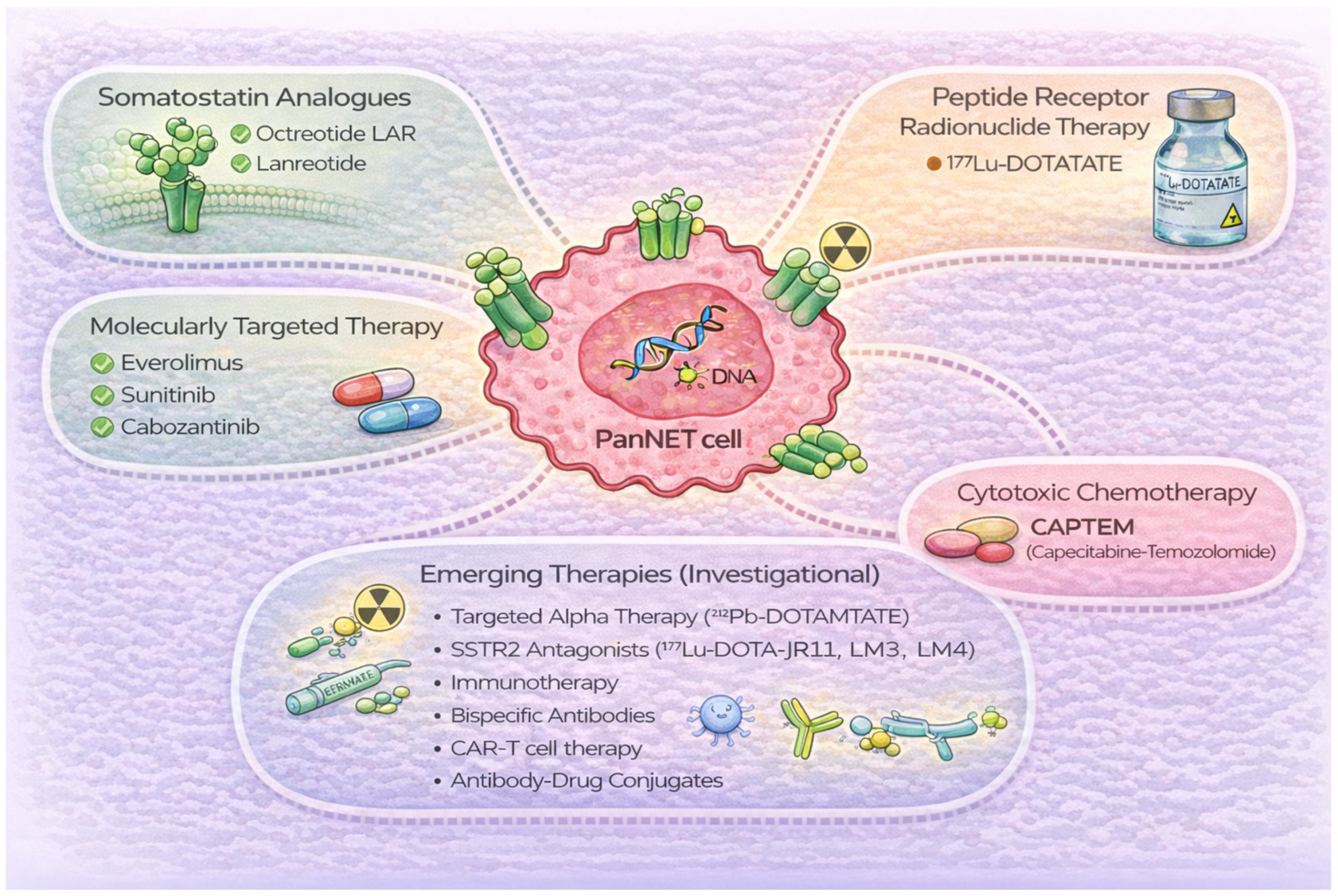
Medical Management of Well-Differentiated Pancreatic Neuroendocrine Tumors: From Conventional Therapies to Emerging Strategies

Abstract
1. Introduction
2. Treatment
2.1. Somatostatin Analogues (SSAs)
2.2. Molecularly Targeted Therapy
2.2.1. Everolimus
2.2.2. Sunitinib
2.2.3. Cabozantinib
2.2.4. Belzutifan
2.3. Cytotoxic Chemotherapy
2.4. Peptide Receptor Radionuclide Therapy (PRRT)
3. Emerging Therapies
3.1. Targeted Alpha Therapy (TAT)
3.2. Somatostatin Receptor 2 (SSTR2) Antagonists
3.3. Immunotherapy
3.4. Bispecific Antibodies
3.5. Chimeric Antigen Receptor T-Cell (CAR-T) Therapy
3.6. Antibody Drug Conjugate (ADC)-Based Modalities
4. Symptom-Based Approaches for Functional PanNETs
5. Conclusions
Author Contributions
Funding
Data Availability Statement
Conflicts of Interest
Abbreviations
| PanNET | Pancreatic neuroendocrine tumor |
| SSTR | Somatostatin receptor |
| SSA | Somatostatin analogue |
| PRRT | Peptide receptor radionuclide therapy |
| TAT | Targeted alpha therapy |
| VIPoma | Vasoactive intestinal peptide-secreting tumor |
| PFS | Progression free survival |
| GEP-NET | Gastroenteropancreatic neuroendocrine tumor |
| OS | Overall survival |
| TTP | Time to tumor progression |
| HR | Hazard ratio |
| CI | Confidence interval |
| FDA | Food and Drug Administration |
| TTP | Time to progression |
| TKI | Tyrosine kinase inhibitor |
| VHL | von Hippel-Lindau |
| VEGF | Vascular endothelial growth factor |
| ECG | Electrocardiography |
| ORR | Objective response rate |
| HIF-2α | Hypoxia-inducible factor 2α |
| US FDA | United States Food and Drug Administration |
| CAPTEM | Capecitabine plus temozolomide |
| ENETS | European Neuroendocrine Tumor Society |
| MDS | Myelodysplastic syndrome |
| DCR | Disease control rate |
| ASCO | American Society of Clinical Oncology |
| ESMO | European Society for Medical Oncology |
| HSPC | Hematopoietic stem and progenitor cell |
| PD-1 | Programmed death 1 |
| PD-L1 | Programmed death-ligand 1 |
| CTLA-4 | Cytotoxic T-lymphocyte–associated antigen 4 |
| DLL3 | Delta-like ligand 3 |
| CAR-T | Chimeric antigen receptor T-cell |
| CDH17 | Cadherin-17 |
| ADC | Antibody-drug conjugate |
| DLK1 | Delta-like 1 homolog |
References
- Carriaga, M.T.; Henson, D.E. Liver, gallbladder, extrahepatic bile ducts, and pancreas. Cancer 1995, 75, 171–190. [Google Scholar] [CrossRef]
- Vortmeyer, A.O.; Huang, S.; Lubensky, I.; Zhuang, Z. Non-islet origin of pancreatic islet cell tumors. J. Clin. Endocrinol. Metab. 2004, 89, 1934–1938. [Google Scholar] [CrossRef]
- Del Rivero, J.; Perez, K.; Kennedy, E.B.; Mittra, E.S.; Vijayvergia, N.; Arshad, J.; Basu, S.; Chauhan, A.; Dasari, A.N.; Bellizzi, A.M.; et al. Systemic Therapy for Tumor Control in Metastatic Well-Differentiated Gastroenteropancreatic Neuroendocrine Tumors: ASCO Guideline. J. Clin. Oncol 2023, 41, 5049–5067. [Google Scholar] [CrossRef]
- Pavel, M.; Oberg, K.; Falconi, M.; Krenning, E.P.; Sundin, A.; Perren, A.; Berruti, A. Gastroenteropancreatic neuroendocrine neoplasms: ESMO Clinical Practice Guidelines for diagnosis, treatment and follow-up. Ann. Oncol 2020, 31, 844–860. [Google Scholar] [CrossRef]
- Rindi, G.; Klimstra, D.S.; Abedi-Ardekani, B.; Asa, S.L.; Bosman, F.T.; Brambilla, E.; Busam, K.J.; de Krijger, R.R.; Dietel, M.; El-Naggar, A.K.; et al. A common classification framework for neuroendocrine neoplasms: An International Agency for Research on Cancer (IARC) and World Health Organization (WHO) expert consensus proposal. Mod. Pathol. 2018, 31, 1770–1786. [Google Scholar] [CrossRef]
- Reubi, J.C.; Kvols, L.K.; Waser, B.; Nagorney, D.M.; Heitz, P.U.; Charboneau, J.W.; Reading, C.C.; Moertel, C. Detection of somatostatin receptors in surgical and percutaneous needle biopsy samples of carcinoids and islet cell carcinomas. Cancer Res. 1990, 50, 5969–5977. [Google Scholar]
- Susini, C.; Buscail, L. Rationale for the use of somatostatin analogs as antitumor agents. Ann. Oncol 2006, 17, 1733–1742. [Google Scholar] [CrossRef]
- Caplin, M.E.; Pavel, M.; Ćwikła, J.B.; Phan, A.T.; Raderer, M.; Sedláčková, E.; Cadiot, G.; Wolin, E.M.; Capdevila, J.; Wall, L.; et al. Lanreotide in metastatic enteropancreatic neuroendocrine tumors. N. Engl. J. Med. 2014, 371, 224–233. [Google Scholar] [CrossRef] [PubMed]
- Sundin, A.; Arnold, R.; Baudin, E.; Cwikla, J.B.; Eriksson, B.; Fanti, S.; Fazio, N.; Giammarile, F.; Hicks, R.J.; Kjaer, A.; et al. ENETS Consensus Guidelines for the Standards of Care in Neuroendocrine Tumors: Radiological, Nuclear Medicine & Hybrid Imaging. Neuroendocrinology 2017, 105, 212–244. [Google Scholar] [CrossRef] [PubMed]
- Grawe, F.; Rosenberger, N.; Ingenerf, M.; Beyer, L.; Eschbach, R.; Todica, A.; Seidensticker, R.; Schmid-Tannwald, C.; Cyran, C.C.; Ricke, J.; et al. Diagnostic performance of PET/CT in the detection of liver metastases in well-differentiated NETs. Cancer Imaging 2023, 23, 41. [Google Scholar] [CrossRef]
- Metz, D.C.; Jensen, R.T. Gastrointestinal neuroendocrine tumors: Pancreatic endocrine tumors. Gastroenterology 2008, 135, 1469–1492. [Google Scholar] [CrossRef]
- Nikou, G.C.; Toubanakis, C.; Nikolaou, P.; Giannatou, E.; Safioleas, M.; Mallas, E.; Polyzos, A. VIPomas: An update in diagnosis and management in a series of 11 patients. Hepatogastroenterology 2005, 52, 1259–1265. [Google Scholar]
- Frankton, S.; Bloom, S.R. Gastrointestinal endocrine tumours. Glucagonomas. Baillieres. Clin. Gastroenterol. 1996, 10, 697–705. [Google Scholar] [CrossRef]
- Healy, M.L.; Dawson, S.J.; Murray, R.M.; Zalcberg, J.; Jefford, M. Severe hypoglycaemia after long-acting octreotide in a patient with an unrecognized malignant insulinoma. Intern. Med. J. 2007, 37, 406–409. [Google Scholar] [CrossRef] [PubMed]
- Stehouwer, C.D.; Lems, W.F.; Fischer, H.R.; Hackeng, W.H.; Naafs, M.A. Aggravation of hypoglycemia in insulinoma patients by the long-acting somatostatin analogue octreotide (Sandostatin). Acta Endocrinol. 1989, 121, 34–40. [Google Scholar] [CrossRef] [PubMed]
- Kulke, M.H. Gastrointestinal Neuroendocrine Tumors. In Harrison’s Principles of Internal Medicine, 22nd ed.; Longo, D., Fauci, A., Kasper, D., Hauser, S., Jameson, J.L., Loscalzo, J., Holland, S., Langford, C., Eds.; McGraw Hill: New York, NY, USA, 2026. [Google Scholar]
- Pavel, M.; Baudin, E.; Couvelard, A.; Krenning, E.; Öberg, K.; Steinmüller, T.; Anlauf, M.; Wiedenmann, B.; Salazar, R. ENETS Consensus Guidelines for the management of patients with liver and other distant metastases from neuroendocrine neoplasms of foregut, midgut, hindgut, and unknown primary. Neuroendocrinology 2012, 95, 157–176. [Google Scholar] [CrossRef] [PubMed]
- Aparicio, T.; Ducreux, M.; Baudin, E.; Sabourin, J.C.; De Baere, T.; Mitry, E.; Schlumberger, M.; Rougier, P. Antitumour activity of somatostatin analogues in progressive metastatic neuroendocrine tumours. Eur. J. Cancer 2001, 37, 1014–1019. [Google Scholar] [CrossRef]
- Sidéris, L.; Dubé, P.; Rinke, A. Antitumor effects of somatostatin analogs in neuroendocrine tumors. Oncologist 2012, 17, 747–755. [Google Scholar] [CrossRef]
- Strosberg, J.; Kvols, L. Antiproliferative effect of somatostatin analogs in gastroenteropancreatic neuroendocrine tumors. World J. Gastroenterol. 2010, 16, 2963–2970. [Google Scholar] [CrossRef]
- Verslype, C.; Carton, S.; Borbath, I.; Delaunoit, T.; Demetter, P.; Demolin, G.; Hendlisz, A.; Pattyn, P.; Pauwels, S.; Peeters, M.; et al. The antiproliferative effect of somatostatin analogs: Clinical relevance in patients with neuroendocrine gastro-entero-pancreatic tumours. Acta Gastroenterol. Belg. 2009, 72, 54–58. [Google Scholar]
- Rinke, A.; Müller, H.H.; Schade-Brittinger, C.; Klose, K.J.; Barth, P.; Wied, M.; Mayer, C.; Aminossadati, B.; Pape, U.F.; Bläker, M.; et al. Placebo-controlled, double-blind, prospective, randomized study on the effect of octreotide LAR in the control of tumor growth in patients with metastatic neuroendocrine midgut tumors: A report from the PROMID Study Group. J. Clin. Oncol. 2009, 27, 4656–4663. [Google Scholar] [CrossRef]
- Michael, M.; Garcia-Carbonero, R.; Weber, M.M.; Lombard-Bohas, C.; Toumpanakis, C.; Hicks, R.J. The Antiproliferative Role of Lanreotide in Controlling Growth of Neuroendocrine Tumors: A Systematic Review. Oncologist 2017, 22, 272–285. [Google Scholar] [CrossRef]
- Ter-Minassian, M.; Zhang, S.; Brooks, N.V.; Brais, L.K.; Chan, J.A.; Christiani, D.C.; Lin, X.; Gabriel, S.; Dinet, J.; Kulke, M.H. Association Between Tumor Progression Endpoints and Overall Survival in Patients with Advanced Neuroendocrine Tumors. Oncologist 2017, 22, 165–172. [Google Scholar] [CrossRef]
- Carmona-Bayonas, A.; Jiménez-Fonseca, P.; Lamarca, Á.; Barriuso, J.; Castaño, Á.; Benavent, M.; Alonso, V.; Riesco-Martínez, M.D.C.; Alonso-Gordoa, T.; Custodio, A.; et al. Prediction of Progression-Free Survival in Patients With Advanced, Well-Differentiated, Neuroendocrine Tumors Being Treated With a Somatostatin Analog: The GETNE-TRASGU Study. J. Clin. Oncol 2019, 37, 2571–2580. [Google Scholar] [CrossRef] [PubMed]
- Rinke, A.; Wittenberg, M.; Schade-Brittinger, C.; Aminossadati, B.; Ronicke, E.; Gress, T.M.; Müller, H.H.; Arnold, R. Placebo-Controlled, Double-Blind, Prospective, Randomized Study on the Effect of Octreotide LAR in the Control of Tumor Growth in Patients with Metastatic Neuroendocrine Midgut Tumors (PROMID): Results of Long-Term Survival. Neuroendocrinology 2017, 104, 26–32. [Google Scholar] [CrossRef]
- Caplin, M.E.; Pavel, M.; Ćwikła, J.B.; Phan, A.T.; Raderer, M.; Sedláčková, E.; Cadiot, G.; Wolin, E.M.; Capdevila, J.; Wall, L.; et al. Anti-tumour effects of lanreotide for pancreatic and intestinal neuroendocrine tumours: The CLARINET open-label extension study. Endocr. Relat. Cancer 2016, 23, 191–199. [Google Scholar] [CrossRef] [PubMed]
- Yao, J.C.; Shah, M.H.; Ito, T.; Bohas, C.L.; Wolin, E.M.; Van Cutsem, E.; Hobday, T.J.; Okusaka, T.; Capdevila, J.; de Vries, E.G.; et al. Everolimus for advanced pancreatic neuroendocrine tumors. N. Engl. J. Med. 2011, 364, 514–523. [Google Scholar] [CrossRef] [PubMed]
- Raymond, E.; Dahan, L.; Raoul, J.L.; Bang, Y.J.; Borbath, I.; Lombard-Bohas, C.; Valle, J.; Metrakos, P.; Smith, D.; Vinik, A.; et al. Sunitinib malate for the treatment of pancreatic neuroendocrine tumors. N. Engl. J. Med. 2011, 364, 501–513. [Google Scholar] [CrossRef]
- Chan Jennifer, A.; Geyer, S.; Zemla, T.; Knopp Michael, V.; Behr, S.; Pulsipher, S.; Ou, F.-S.; Dueck Amylou, C.; Acoba, J.; Shergill, A.; et al. Phase 3 Trial of Cabozantinib to Treat Advanced Neuroendocrine Tumors. N. Engl. J. Med. 2025, 392, 653–665. [Google Scholar] [CrossRef]
- Jonasch, E.; Donskov, F.; Iliopoulos, O.; Rathmell, W.K.; Narayan, V.K.; Maughan, B.L.; Oudard, S.; Else, T.; Maranchie, J.K.; Welsh, S.J.; et al. Belzutifan for Renal Cell Carcinoma in von Hippel-Lindau Disease. N. Engl. J. Med. 2021, 385, 2036–2046. [Google Scholar] [CrossRef]
- Else, T.; Jonasch, E.; Iliopoulos, O.; Beckermann, K.E.; Narayan, V.; Maughan, B.L.; Oudard, S.; Maranchie, J.K.; Iversen, A.B.; Goldberg, C.M.; et al. Belzutifan for von Hippel-Lindau Disease: Pancreatic Lesion Population of the Phase 2 LITESPARK-004 Study. Clin. Cancer Res. 2024, 30, 1750–1757. [Google Scholar] [CrossRef]
- Baudin, E.; Walter, T.A.; Beron, A.; Smith, D.; Hadoux, J.; Lachachi, C.; Taieb, D.; Ansquer, C.; Dierickx, L.O.; de Mestier du Bourg, L.; et al. 887O First multicentric randomized phase II trial investigating the antitumor efficacy of peptide receptor radionucleide therapy with 177Lutetium-Octreotate (OCLU) in unresectable progressive neuroendocrine pancreatic tumor: Results of the OCLURANDOM trial. Ann. Oncol. 2022, 33, S954. [Google Scholar] [CrossRef]
- Singh, S.; Halperin, D.; Myrehaug, S.; Herrmann, K.; Pavel, M.; Kunz, P.L.; Chasen, B.; Tafuto, S.; Lastoria, S.; Capdevila, J.; et al. [(177)Lu]Lu-DOTA-TATE plus long-acting octreotide versus high-dose long-acting octreotide for the treatment of newly diagnosed, advanced grade 2-3, well-differentiated, gastroenteropancreatic neuroendocrine tumours (NETTER-2): An open-label, randomised, phase 3 study. Lancet 2024, 403, 2807–2817. [Google Scholar] [CrossRef]
- Baudin, E.; Walter, T.; Docao, C.; Haissaguerre, M.; Hadoux, J.; Taieb, D.; Ansquer, C.; Dierickx, L.; De Mestier, L.; Deshayes, E.; et al. First multicentric randomized phase II trial investigating the antitumor efficacy of peptide receptor radionuclide therapy with 177Lutetium—Octreotate (OCLU) in unresectable progressive neuroendocrine pancreatic tumor: Results of the OCLURANDOM trial, on behalf of the ENDOCAN RENATEN network and GTE. Ann. d’Endocrinologie 2022, 83, 289–290. [Google Scholar] [CrossRef]
- Kunz, P.L.; Graham, N.T.; Catalano, P.J.; Nimeiri, H.S.; Fisher, G.A.; Longacre, T.A.; Suarez, C.J.; Martin, B.A.; Yao, J.C.; Kulke, M.H.; et al. Randomized Study of Temozolomide or Temozolomide and Capecitabine in Patients With Advanced Pancreatic Neuroendocrine Tumors (ECOG-ACRIN E2211). J. Clin. Oncol 2023, 41, 1359–1369. [Google Scholar] [CrossRef]
- Pavel, M.; Ćwikła, J.B.; Lombard-Bohas, C.; Borbath, I.; Shah, T.; Pape, U.F.; Capdevila, J.; Panzuto, F.; Truong Thanh, X.M.; Houchard, A.; et al. Efficacy and safety of high-dose lanreotide autogel in patients with progressive pancreatic or midgut neuroendocrine tumours: CLARINET FORTE phase 2 study results. Eur. J. Cancer 2021, 157, 403–414. [Google Scholar] [CrossRef] [PubMed]
- Strosberg, J.; El-Haddad, G.; Wolin, E.; Hendifar, A.; Yao, J.; Chasen, B.; Mittra, E.; Kunz, P.L.; Kulke, M.H.; Jacene, H.; et al. Phase 3 Trial of (177)Lu-Dotatate for Midgut Neuroendocrine Tumors. N. Engl. J. Med. 2017, 376, 125–135. [Google Scholar] [CrossRef]
- Ayyagari, R.; Neary, M.; Li, S.; Rokito, A.; Yang, H.; Xie, J.; Benson, A.B., 3rd. Comparing the Cost of Treatment with Octreotide Long-Acting Release versus Lanreotide in Patients with Metastatic Gastrointestinal Neuroendocrine Tumors. Am. Health Drug Benefits 2017, 10, 408–415. [Google Scholar] [PubMed]
- Raj, N.; Cruz, E.; O’Shaughnessy, S.; Calderon, C.; Chou, J.F.; Capanu, M.; Heffernan, O.; DeMore, A.; Punn, S.; Le, T.; et al. A Randomized Trial Evaluating Patient Experience and Preference Between Octreotide Long-Acting Release and Lanreotide for Treatment of Well-Differentiated Neuroendocrine Tumors. JCO Oncol. Pract. 2022, 18, e1533–e1541. [Google Scholar] [CrossRef]
- Lamberts, S.W.; van der Lely, A.J.; de Herder, W.W.; Hofland, L.J. Octreotide. N. Engl. J. Med. 1996, 334, 246–254. [Google Scholar] [CrossRef] [PubMed]
- Newman, C.B.; Melmed, S.; Snyder, P.J.; Young, W.F.; Boyajy, L.D.; Levy, R.; Stewart, W.N.; Klibanski, A.; Molitch, M.E.; Gagel, R.F. Safety and efficacy of long-term octreotide therapy of acromegaly: Results of a multicenter trial in 103 patients—A clinical research center study. J. Clin. Endocrinol. Metab. 1995, 80, 2768–2775. [Google Scholar] [CrossRef]
- Fasano, C.J.; O’Malley, G.; Dominici, P.; Aguilera, E.; Latta, D.R. Comparison of octreotide and standard therapy versus standard therapy alone for the treatment of sulfonylurea-induced hypoglycemia. Ann. Emerg. Med. 2008, 51, 400–406. [Google Scholar] [CrossRef]
- Plöckinger, U.; Holst, J.J.; Messerschmidt, D.; Hopfenmüller, W.; Quabbe, H.J. Octreotide suppresses the incretin glucagon-like peptide (7-36) amide in patients with acromegaly or clinically nonfunctioning pituitary tumors and in healthy subjects. Eur. J. Endocrinol. 1999, 140, 538–544. [Google Scholar] [CrossRef] [PubMed][Green Version]
- Davies, R.R.; Turner, S.J.; Alberti, K.G.; Johnston, D.G. Somatostatin analogues in diabetes mellitus. Diabet. Med. 1989, 6, 103–111. [Google Scholar] [CrossRef]
- Orskov, L.; Møller, N.; Bak, J.F.; Pørksen, N.; Schmitz, O. Effects of the somatostatin analog, octreotide, on glucose metabolism and insulin sensitivity in insulin-dependent diabetes mellitus. Metabolism 1996, 45, 211–217. [Google Scholar] [CrossRef] [PubMed]
- Yao, J.C.; Pavel, M.; Lombard-Bohas, C.; Van Cutsem, E.; Voi, M.; Brandt, U.; He, W.; Chen, D.; Capdevila, J.; de Vries, E.G.E.; et al. Everolimus for the Treatment of Advanced Pancreatic Neuroendocrine Tumors: Overall Survival and Circulating Biomarkers From the Randomized, Phase III RADIANT-3 Study. J. Clin. Oncol 2016, 34, 3906–3913. [Google Scholar] [CrossRef] [PubMed]
- Lombard-Bohas, C.; Yao, J.C.; Hobday, T.; Van Cutsem, E.; Wolin, E.M.; Panneerselvam, A.; Stergiopoulos, S.; Shah, M.H.; Capdevila, J.; Pommier, R. Impact of prior chemotherapy use on the efficacy of everolimus in patients with advanced pancreatic neuroendocrine tumors: A subgroup analysis of the phase III RADIANT-3 trial. Pancreas 2015, 44, 181–189. [Google Scholar] [CrossRef]
- Panzuto, F.; Rinzivillo, M.; Fazio, N.; de Braud, F.; Luppi, G.; Zatelli, M.C.; Lugli, F.; Tomassetti, P.; Riccardi, F.; Nuzzo, C.; et al. Real-world study of everolimus in advanced progressive neuroendocrine tumors. Oncologist 2014, 19, 966–974. [Google Scholar] [CrossRef]
- Kulke, M.H.; Lenz, H.J.; Meropol, N.J.; Posey, J.; Ryan, D.P.; Picus, J.; Bergsland, E.; Stuart, K.; Tye, L.; Huang, X.; et al. Activity of sunitinib in patients with advanced neuroendocrine tumors. J. Clin. Oncol. 2008, 26, 3403–3410. [Google Scholar] [CrossRef]
- Faivre, S.; Niccoli, P.; Castellano, D.; Valle, J.W.; Hammel, P.; Raoul, J.L.; Vinik, A.; Van Cutsem, E.; Bang, Y.J.; Lee, S.H.; et al. Sunitinib in pancreatic neuroendocrine tumors: Updated progression-free survival and final overall survival from a phase III randomized study. Ann. Oncol. 2017, 28, 339–343. [Google Scholar] [CrossRef]
- Zou, W.; Yang, H.; Xi, Y.; Zeng, C.; Chen, W.; Fu, X. A disproportionality analysis of sunitinib in the FDA adverse event reporting system (FAERS). Heliyon 2024, 10, e37543. [Google Scholar] [CrossRef]
- Blumenthal, G.M.; Cortazar, P.; Zhang, J.J.; Tang, S.; Sridhara, R.; Murgo, A.; Justice, R.; Pazdur, R. FDA approval summary: Sunitinib for the treatment of progressive well-differentiated locally advanced or metastatic pancreatic neuroendocrine tumors. Oncologist 2012, 17, 1108–1113. [Google Scholar] [CrossRef]
- Zhu, X.; Stergiopoulos, K.; Wu, S. Risk of hypertension and renal dysfunction with an angiogenesis inhibitor sunitinib: Systematic review and meta-analysis. Acta Oncol. 2009, 48, 9–17. [Google Scholar] [CrossRef]
- Richards, C.J.; Je, Y.; Schutz, F.A.; Heng, D.Y.; Dallabrida, S.M.; Moslehi, J.J.; Choueiri, T.K. Incidence and risk of congestive heart failure in patients with renal and nonrenal cell carcinoma treated with sunitinib. J. Clin. Oncol. 2011, 29, 3450–3456. [Google Scholar] [CrossRef]
- Bello, C.L.; Mulay, M.; Huang, X.; Patyna, S.; Dinolfo, M.; Levine, S.; Van Vugt, A.; Toh, M.; Baum, C.; Rosen, L. Electrocardiographic characterization of the QTc interval in patients with advanced solid tumors: Pharmacokinetic- pharmacodynamic evaluation of sunitinib. Clin. Cancer Res. 2009, 15, 7045–7052. [Google Scholar] [CrossRef] [PubMed]
- Schmidinger, M.; Zielinski, C.C.; Vogl, U.M.; Bojic, A.; Bojic, M.; Schukro, C.; Ruhsam, M.; Hejna, M.; Schmidinger, H. Cardiac toxicity of sunitinib and sorafenib in patients with metastatic renal cell carcinoma. J. Clin. Oncol. 2008, 26, 5204–5212. [Google Scholar] [CrossRef]
- Shah, R.R.; Morganroth, J.; Shah, D.R. Cardiovascular safety of tyrosine kinase inhibitors: With a special focus on cardiac repolarisation (QT interval). Drug Saf. 2013, 36, 295–316. [Google Scholar] [CrossRef]
- Strevel, E.L.; Ing, D.J.; Siu, L.L. Molecularly targeted oncology therapeutics and prolongation of the QT interval. J. Clin. Oncol. 2007, 25, 3362–3371. [Google Scholar] [CrossRef]
- Armenian, S.H.; Lacchetti, C.; Barac, A.; Carver, J.; Constine, L.S.; Denduluri, N.; Dent, S.; Douglas, P.S.; Durand, J.B.; Ewer, M.; et al. Prevention and Monitoring of Cardiac Dysfunction in Survivors of Adult Cancers: American Society of Clinical Oncology Clinical Practice Guideline. J. Clin. Oncol. 2017, 35, 893–911. [Google Scholar] [CrossRef] [PubMed]
- Lyon, A.R.; López-Fernández, T.; Couch, L.S.; Asteggiano, R.; Aznar, M.C.; Bergler-Klein, J.; Boriani, G.; Cardinale, D.; Cordoba, R.; Cosyns, B.; et al. 2022 ESC Guidelines on cardio-oncology developed in collaboration with the European Hematology Association (EHA), the European Society for Therapeutic Radiology and Oncology (ESTRO) and the International Cardio-Oncology Society (IC-OS). Eur. Heart. J. 2022, 43, 4229–4361. [Google Scholar] [CrossRef] [PubMed]
- de Mestier, L.; Walter, T.; Brixi, H.; Lombard-Bohas, C.; Cadiot, G. Sunitinib achieved fast and sustained control of VIPoma symptoms. Eur. J. Endocrinol. 2015, 172, K1–K3. [Google Scholar] [CrossRef]
- Chen, J.; Wang, C.; Han, J.; Luan, Y.; Cui, Y.; Shen, R.; Sha, D.; Cong, L.; Zhang, Z.; Wang, W. Therapeutic effect of sunitinib malate and its influence on blood glucose concentrations in a patient with metastatic insulinoma. Expert Rev. Anticancer. Ther. 2013, 13, 737–743. [Google Scholar] [CrossRef]
- Fountas, A.; Tigas, S.; Giotaki, Z.; Petrakis, D.; Pentheroudakis, G.; Tsatsoulis, A. Severe resistant hypoglycemia in a patient with a pancreatic neuroendocrine tumor on sunitinib treatment. Hormones 2015, 14, 438–441. [Google Scholar] [CrossRef]
- Ohn, J.H.; Kim, Y.G.; Lee, S.H.; Jung, H.S. Transformation of nonfunctioning pancreatic neuroendocrine carcinoma cells into insulin producing cells after treatment with sunitinib. Endocrinol. Metab. 2013, 28, 149–152. [Google Scholar] [CrossRef] [PubMed][Green Version]
- Liu, B.; Ding, F.; Liu, Y.; Xiong, G.; Lin, T.; He, D.; Zhang, Y.; Zhang, D.; Wei, G. Incidence and risk of hypertension associated with vascular endothelial growth factor receptor tyrosine kinase inhibitors in cancer patients: A comprehensive network meta-analysis of 72 randomized controlled trials involving 30013 patients. Oncotarget 2016, 7, 67661–67673. [Google Scholar] [CrossRef]
- Pandey, A.K.; Singhi, E.K.; Arroyo, J.P.; Ikizler, T.A.; Gould, E.R.; Brown, J.; Beckman, J.A.; Harrison, D.G.; Moslehi, J. Mechanisms of VEGF (Vascular Endothelial Growth Factor) Inhibitor-Associated Hypertension and Vascular Disease. Hypertension 2018, 71, e1–e8. [Google Scholar] [CrossRef]
- Buttar, C.; Lakhdar, S.; Nassar, M.; Landry, I.; Munira, M. Cabozantinib-Induced Severe Cardiac Dysfunction: A Case Report and a Systematic Review of the Literature. Cureus 2022, 14, e23740. [Google Scholar] [CrossRef] [PubMed]
- Ishiguchi, H.; Uchida, M.; Okamura, T.; Kobayashi, S.; Yano, M. Acute heart failure following the initiation of cabozantinib, a multikinase inhibitor: A case report. J. Cardiol. Cases 2022, 26, 217–220. [Google Scholar] [CrossRef] [PubMed]
- Fallah, J.; Brave, M.H.; Weinstock, C.; Mehta, G.U.; Bradford, D.; Gittleman, H.; Bloomquist, E.W.; Charlab, R.; Hamed, S.S.; Miller, C.P.; et al. FDA Approval Summary: Belzutifan for von Hippel-Lindau Disease-Associated Tumors. Clin. Cancer Res. 2022, 28, 4843–4848. [Google Scholar] [CrossRef]
- Pelle, E.; Al-Toubah, T.; Morse, B.; Strosberg, J. Belzutifan in a Patient With VHL-Associated Metastatic Pancreatic Neuroendocrine Tumor. J. Natl. Compr. Canc. Netw. 2022, 20, 1285–1287. [Google Scholar]
- Kulke, M.H.; Stuart, K.; Enzinger, P.C.; Ryan, D.P.; Clark, J.W.; Muzikansky, A.; Vincitore, M.; Michelini, A.; Fuchs, C.S. Phase II study of temozolomide and thalidomide in patients with metastatic neuroendocrine tumors. J. Clin. Oncol. 2006, 24, 401–406. [Google Scholar] [CrossRef]
- Chan, J.A.; Stuart, K.; Earle, C.C.; Clark, J.W.; Bhargava, P.; Miksad, R.; Blaszkowsky, L.; Enzinger, P.C.; Meyerhardt, J.A.; Zheng, H.; et al. Prospective study of bevacizumab plus temozolomide in patients with advanced neuroendocrine tumors. J. Clin. Oncol. 2012, 30, 2963–2968. [Google Scholar] [CrossRef]
- Moertel, C.G.; Lefkopoulo, M.; Lipsitz, S.; Hahn, R.G.; Klaassen, D. Streptozocin-doxorubicin, streptozocin-fluorouracil or chlorozotocin in the treatment of advanced islet-cell carcinoma. N. Engl. J. Med. 1992, 326, 519–523. [Google Scholar] [CrossRef]
- Kouvaraki, M.A.; Ajani, J.A.; Hoff, P.; Wolff, R.; Evans, D.B.; Lozano, R.; Yao, J.C. Fluorouracil, doxorubicin, and streptozocin in the treatment of patients with locally advanced and metastatic pancreatic endocrine carcinomas. J. Clin. Oncol. 2004, 22, 4762–4771. [Google Scholar] [CrossRef]
- Dilz, L.M.; Denecke, T.; Steffen, I.G.; Prasad, V.; von Weikersthal, L.F.; Pape, U.F.; Wiedenmann, B.; Pavel, M. Streptozocin/5-fluorouracil chemotherapy is associated with durable response in patients with advanced pancreatic neuroendocrine tumours. Eur. J. Cancer 2015, 51, 1253–1262. [Google Scholar] [CrossRef] [PubMed]
- Kunz, P.L.; Balise, R.R.; Fehrenbacher, L.; Pan, M.; Venook, A.P.; Fisher, G.A.; Tempero, M.A.; Ko, A.H.; Korn, W.M.; Hwang, J.; et al. Oxaliplatin-Fluoropyrimidine Chemotherapy Plus Bevacizumab in Advanced Neuroendocrine Tumors: An Analysis of 2 Phase II Trials. Pancreas 2016, 45, 1394–1400. [Google Scholar] [CrossRef] [PubMed]
- Bajetta, E.; Catena, L.; Procopio, G.; De Dosso, S.; Bichisao, E.; Ferrari, L.; Martinetti, A.; Platania, M.; Verzoni, E.; Formisano, B.; et al. Are capecitabine and oxaliplatin (XELOX) suitable treatments for progressing low-grade and high-grade neuroendocrine tumours? Cancer Chemother. Pharmacol. 2007, 59, 637–642. [Google Scholar] [CrossRef]
- Capdevila, J.; Amthauer, H.; Ansquer, C.; Deshayes, E.; Garcia-Carbonero, R.; Teule, A.; Verberne, H.J.; Cwikla, J.B.; Sri Rajaskanthan, R.; Grana, C.M.; et al. 1706O Efficacy, safety and subgroup analysis of 177Lu-edotreotide vs everolimus in patients with grade 1 or grade 2 GEP-NETs: Phase III COMPETE trial. Ann. Oncol. 2025, 36, S941. [Google Scholar] [CrossRef]
- Brabander, T.; van der Zwan, W.A.; Teunissen, J.J.M.; Kam, B.L.R.; Feelders, R.A.; de Herder, W.W.; van Eijck, C.H.J.; Franssen, G.J.H.; Krenning, E.P.; Kwekkeboom, D.J. Long-Term Efficacy, Survival, and Safety of [(177)Lu-DOTA(0),Tyr(3)]octreotate in Patients with Gastroenteropancreatic and Bronchial Neuroendocrine Tumors. Clin. Cancer Res. 2017, 23, 4617–4624. [Google Scholar] [CrossRef]
- Zhang, J.; Song, Q.; Cai, L.; Xie, Y.; Chen, Y. The efficacy of (177)Lu-DOTATATE peptide receptor radionuclide therapy (PRRT) in patients with metastatic neuroendocrine tumours: A systematic review and meta-analysis. J. Cancer Res. Clin. Oncol. 2020, 146, 1533–1543. [Google Scholar] [CrossRef]
- Hope, T.A.; Abbott, A.; Colucci, K.; Bushnell, D.L.; Gardner, L.; Graham, W.S.; Lindsay, S.; Metz, D.C.; Pryma, D.A.; Stabin, M.G.; et al. NANETS/SNMMI Procedure Standard for Somatostatin Receptor-Based Peptide Receptor Radionuclide Therapy with (177)Lu-DOTATATE. J. Nucl. Med. 2019, 60, 937–943. [Google Scholar] [CrossRef] [PubMed]
- Kennedy, K.R.; Turner, J.H.; MacDonald, W.B.G.; Claringbold, P.G.; Boardman, G.; Ransom, D.T. Long-term survival and toxicity in patients with neuroendocrine tumors treated with (177) Lu-octreotate peptide radionuclide therapy. Cancer 2022, 128, 2182–2192. [Google Scholar] [CrossRef] [PubMed]
- Brieau, B.; Hentic, O.; Lebtahi, R.; Palazzo, M.; Ben Reguiga, M.; Rebours, V.; Maire, F.; Hammel, P.; Ruszniewski, P.; Fenaux, P. High risk of myelodysplastic syndrome and acute myeloid leukemia after 177Lu-octreotate PRRT in NET patients heavily pretreated with alkylating chemotherapy. Endocr. Relat. Cancer 2016, 23, L17–L23. [Google Scholar] [CrossRef][Green Version]
- Poty, S.; Francesconi, L.C.; McDevitt, M.R.; Morris, M.J.; Lewis, J.S. α-Emitters for Radiotherapy: From Basic Radiochemistry to Clinical Studies-Part 2. J. Nucl. Med. 2018, 59, 1020–1027. [Google Scholar] [CrossRef]
- Khazaei Monfared, Y.; Heidari, P.; Klempner, S.J.; Mahmood, U.; Parikh, A.R.; Hong, T.S.; Strickland, M.R.; Esfahani, S.A. DNA Damage by Radiopharmaceuticals and Mechanisms of Cellular Repair. Pharmaceutics 2023, 15, 2761. [Google Scholar] [CrossRef]
- Kassis, A.I.; Adelstein, S.J. Radiobiologic principles in radionuclide therapy. J. Nucl. Med. 2005, 46, 4s–12s. [Google Scholar]
- Morgenstern, A.; Apostolidis, C.; Kratochwil, C.; Sathekge, M.; Krolicki, L.; Bruchertseifer, F. An Overview of Targeted Alpha Therapy with (225)Actinium and (213)Bismuth. Curr. Radiopharm. 2018, 11, 200–208. [Google Scholar] [CrossRef]
- Sgouros, G.; Roeske, J.C.; McDevitt, M.R.; Palm, S.; Allen, B.J.; Fisher, D.R.; Brill, A.B.; Song, H.; Howell, R.W.; Akabani, G.; et al. MIRD Pamphlet No. 22 (abridged): Radiobiology and dosimetry of alpha-particle emitters for targeted radionuclide therapy. J. Nucl. Med. 2010, 51, 311–328. [Google Scholar] [CrossRef]
- Makvandi, M.; Dupis, E.; Engle, J.W.; Nortier, F.M.; Fassbender, M.E.; Simon, S.; Birnbaum, E.R.; Atcher, R.W.; John, K.D.; Rixe, O.; et al. Alpha-Emitters and Targeted Alpha Therapy in Oncology: From Basic Science to Clinical Investigations. Target. Oncol. 2018, 13, 189–203. [Google Scholar] [CrossRef] [PubMed]
- Hooijman, E.L.; Radchenko, V.; Ling, S.W.; Konijnenberg, M.; Brabander, T.; Koolen, S.L.W.; de Blois, E. Implementing Ac-225 labelled radiopharmaceuticals: Practical considerations and (pre-)clinical perspectives. EJNMMI Radiopharm. Chem. 2024, 9, 9. [Google Scholar] [CrossRef]
- Poty, S.; Francesconi, L.C.; McDevitt, M.R.; Morris, M.J.; Lewis, J.S. α-Emitters for Radiotherapy: From Basic Radiochemistry to Clinical Studies-Part 1. J. Nucl. Med. 2018, 59, 878–884. [Google Scholar] [CrossRef]
- Tosato, M.; Favaretto, C.; Kleynhans, J.; Burgoyne, A.R.; Gestin, J.F.; van der Meulen, N.P.; Jalilian, A.; Köster, U.; Asti, M.; Radchenko, V. Alpha Atlas: Mapping global production of α-emitting radionuclides for targeted alpha therapy. Nucl. Med. Biol. 2025, 142–143, 108990. [Google Scholar] [CrossRef]
- Shober, M. Regulating alpha-emitting radioisotopes and specific considerations for actinium-225 containing actinium-227. Appl. Radiat. Isot. 2022, 187, 110337. [Google Scholar] [CrossRef] [PubMed]
- Miederer, M.; Benešová-Schäfer, M.; Mamat, C.; Kästner, D.; Pretze, M.; Michler, E.; Brogsitter, C.; Kotzerke, J.; Kopka, K.; Scheinberg, D.A.; et al. Alpha-Emitting Radionuclides: Current Status and Future Perspectives. Pharmaceuticals 2024, 17, 76. [Google Scholar] [CrossRef]
- Elgqvist, J.; Frost, S.; Pouget, J.P.; Albertsson, P. The potential and hurdles of targeted alpha therapy—Clinical trials and beyond. Front. Oncol. 2014, 3, 324. [Google Scholar] [CrossRef] [PubMed]
- Strosberg, J.R.; Naqvi, S.; Cohn, A.; Delpassand, E.; Wagner, V.J.; Tworowska, I.; Torgue, J.; Woloski, R.M.; Ruffner, K.; Vadanahalli Shankar, A.K.; et al. 1034MO Long-term follow-up of peptide receptor radionuclide therapy (PRRT)-naïve patients with gastroenteropancreatic neuroendocrine tumors (GEP-NETs) treated with targeted alpha therapy 212Pb-DOTAMTATE in the phase II ALPHAMEDIX 02 trial. Ann. Oncol. 2025, 36, S631. [Google Scholar] [CrossRef]
- Sen, I.; Malik, D.; Thakral, P.; Schultz, M. 212Pb-VMT-a-NET Targeted Alpha Therapy in Metastatic Neuroendocrine Tumors: First in Human study on Safety and Efficacy. J. Nucl. Med. 2024, 65, 242556. [Google Scholar]
- Prasad, V.; Trikalinos, N.; Hanna, A.; Johnson, F.; Puhlmann, M.; Wahl, R. A Phase I/IIa of [212Pb]VMT-a-NET Targeted Alpha-Particle Therapy for Advanced SSTR2 Positive Neuroendocrine Tumors. J. Nucl. Med. 2024, 65, 242430. [Google Scholar]
- Ginj, M.; Zhang, H.; Waser, B.; Cescato, R.; Wild, D.; Wang, X.; Erchegyi, J.; Rivier, J.; Mäcke, H.R.; Reubi, J.C. Radiolabeled somatostatin receptor antagonists are preferable to agonists for in vivo peptide receptor targeting of tumors. Proc. Natl. Acad. Sci. USA 2006, 103, 16436–16441. [Google Scholar] [CrossRef]
- Minczeles, N.S.; Hofland, J.; de Herder, W.W.; Brabander, T. Strategies Towards Improving Clinical Outcomes of Peptide Receptor Radionuclide Therapy. Curr. Oncol. Rep. 2021, 23, 46. [Google Scholar] [CrossRef]
- Baum, R.P.; Zhang, J.; Schuchardt, C.; Müller, D.; Mäcke, H. First-in-Humans Study of the SSTR Antagonist (177)Lu-DOTA-LM3 for Peptide Receptor Radionuclide Therapy in Patients with Metastatic Neuroendocrine Neoplasms: Dosimetry, Safety, and Efficacy. J. Nucl. Med. 2021, 62, 1571–1581. [Google Scholar] [CrossRef]
- Fani, M.; Nicolas, G.P.; Wild, D. Somatostatin Receptor Antagonists for Imaging and Therapy. J. Nucl. Med. 2017, 58, 61s–66s. [Google Scholar] [CrossRef]
- Lin, Z.; Zhu, W.; Zhang, J.; Miao, W.; Yao, S.; Huo, L. Head-to-Head Comparison of (68)Ga-NODAGA-JR11 and (68)Ga-DOTATATE PET/CT in Patients with Metastatic, Well-Differentiated Neuroendocrine Tumors: Interim Analysis of a Prospective Bicenter Study. J. Nucl. Med. 2023, 64, 1406–1411. [Google Scholar] [CrossRef] [PubMed]
- Nicolas, G.P.; Schreiter, N.; Kaul, F.; Uiters, J.; Bouterfa, H.; Kaufmann, J.; Erlanger, T.E.; Cathomas, R.; Christ, E.; Fani, M.; et al. Sensitivity Comparison of (68)Ga-OPS202 and (68)Ga-DOTATOC PET/CT in Patients with Gastroenteropancreatic Neuroendocrine Tumors: A Prospective Phase II Imaging Study. J. Nucl. Med. 2018, 59, 915–921. [Google Scholar] [CrossRef]
- Viswanathan, R.; Ballal, S.; Yadav, M.P.; Roesch, F.; Sheokand, P.; Satapathy, S.; Tripathi, M.; Agarwal, S.; Moon, E.S.; Bal, C. Head-to-Head Comparison of SSTR Antagonist [(68)Ga]Ga-DATA(5m)-LM4 with SSTR Agonist [(68)Ga]Ga-DOTANOC PET/CT in Patients with Well Differentiated Gastroenteropancreatic Neuroendocrine Tumors: A Prospective Imaging Study. Pharmaceuticals 2024, 17, 275. [Google Scholar] [CrossRef] [PubMed]
- Zhang, J.; Greifenstein, L.; Jakobsson, V.; Kramer, C.; Zan, E.; Klega, A.; Rösch, F.; Landvogt, C.; Mueller, C.; Baum, R.P. First-in-human Study of an Optimized, potential Kit-type, SSTR Antagonist 68Ga-DATA5m-LM4 in Patients with Metastatic Neuroendocrine Tumors. J. Nucl. Med. 2023, 64, P1610. [Google Scholar] [CrossRef]
- Zhu, W.; Jia, R.; Yang, Q.; Cheng, Y.; Zhao, H.; Bai, C.; Xu, J.; Yao, S.; Huo, L. A prospective randomized, double-blind study to evaluate the diagnostic efficacy of (68)Ga-NODAGA-LM3 and (68)Ga-DOTA-LM3 in patients with well-differentiated neuroendocrine tumors: Compared with (68)Ga-DOTATATE. Eur. J. Nucl. Med. Mol. Imaging 2022, 49, 1613–1622. [Google Scholar] [CrossRef]
- Wild, D.; Grønbæk, H.; Navalkissoor, S.; Haug, A.; Nicolas, G.P.; Pais, B.; Ansquer, C.; Beauregard, J.M.; McEwan, A.; Lassmann, M.; et al. A phase I/II study of the safety and efficacy of [(177)Lu]Lu-satoreotide tetraxetan in advanced somatostatin receptor-positive neuroendocrine tumours. Eur. J. Nucl. Med. Mol. Imaging 2023, 51, 183–195. [Google Scholar] [CrossRef] [PubMed]
- Reidy-Lagunes, D.; Pandit-Taskar, N.; O’Donoghue, J.A.; Krebs, S.; Staton, K.D.; Lyashchenko, S.K.; Lewis, J.S.; Raj, N.; Gönen, M.; Lohrmann, C.; et al. Phase I Trial of Well-Differentiated Neuroendocrine Tumors (NETs) with Radiolabeled Somatostatin Antagonist (177)Lu-Satoreotide Tetraxetan. Clin. Cancer Res. 2019, 25, 6939–6947. [Google Scholar] [CrossRef]
- Nguyen, N.; Min, Y.; Rivière, J.; van der Garde, M.; Ghosh, S.; Bartos, L.M.; Brendel, M.; Bassermann, F.; Azhdarinia, A.; Weber, W.A.; et al. Limitations of the radiotheranostic concept in neuroendocrine tumors due to lineage-dependent somatostatin receptor expression on hematopoietic stem and progenitor cells. Theranostics 2025, 15, 6497–6515. [Google Scholar] [CrossRef]
- Marabelle, A.; Le, D.T.; Ascierto, P.A.; Di Giacomo, A.M.; De Jesus-Acosta, A.; Delord, J.P.; Geva, R.; Gottfried, M.; Penel, N.; Hansen, A.R.; et al. Efficacy of Pembrolizumab in Patients With Noncolorectal High Microsatellite Instability/Mismatch Repair-Deficient Cancer: Results From the Phase II KEYNOTE-158 Study. J. Clin. Oncol. 2020, 38, 1–10. [Google Scholar] [CrossRef]
- Lu, M.; Zhang, P.; Zhang, Y.; Li, Z.; Gong, J.; Li, J.; Li, J.; Li, Y.; Zhang, X.; Lu, Z.; et al. Efficacy, Safety, and Biomarkers of Toripalimab in Patients with Recurrent or Metastatic Neuroendocrine Neoplasms: A Multiple-Center Phase Ib Trial. Clin. Cancer Res. 2020, 26, 2337–2345. [Google Scholar] [CrossRef]
- Klein, O.; Kee, D.; Markman, B.; Michael, M.; Underhill, C.; Carlino, M.S.; Jackett, L.; Lum, C.; Scott, C.; Nagrial, A.; et al. Immunotherapy of Ipilimumab and Nivolumab in Patients with Advanced Neuroendocrine Tumors: A Subgroup Analysis of the CA209-538 Clinical Trial for Rare Cancers. Clin. Cancer Res. 2020, 26, 4454–4459. [Google Scholar] [CrossRef]
- Patel, S.P.; Othus, M.; Chae, Y.K.; Giles, F.J.; Hansel, D.E.; Singh, P.P.; Fontaine, A.; Shah, M.H.; Kasi, A.; Baghdadi, T.A.; et al. A Phase II Basket Trial of Dual Anti-CTLA-4 and Anti-PD-1 Blockade in Rare Tumors (DART SWOG 1609) in Patients with Nonpancreatic Neuroendocrine Tumors. Clin. Cancer Res. 2020, 26, 2290–2296. [Google Scholar] [CrossRef]
- Halperin, D.M.; Liu, S.; Dasari, A.; Fogelman, D.; Bhosale, P.; Mahvash, A.; Estrella, J.S.; Rubin, L.; Morani, A.C.; Knafl, M.; et al. Assessment of Clinical Response Following Atezolizumab and Bevacizumab Treatment in Patients With Neuroendocrine Tumors: A Nonrandomized Clinical Trial. JAMA Oncol. 2022, 8, 904–909. [Google Scholar] [CrossRef] [PubMed]
- Choi, S.M.; Lee, J.H.; Ko, S.; Hong, S.S.; Jin, H.E. Mechanism of Action and Pharmacokinetics of Approved Bispecific Antibodies. Biomol. Ther. 2024, 32, 708–722. [Google Scholar] [CrossRef] [PubMed]
- Lee, S.-H.; Chu, S.Y.; Rashid, R.; Phung, S.; Leung, I.W.; Muchhal, U.S.; Moore, G.L.; Bernett, M.J.; Schubbert, S.; Ardila, C.; et al. Abstract 3633: Anti-SSTR2 × anti-CD3 bispecific antibody induces potent killing of human tumor cells in vitro and in mice, and stimulates target-dependent T cell activation in monkeys: A potential immunotherapy for neuroendocrine tumors. Cancer Res. 2017, 77. [Google Scholar] [CrossRef]
- El-Rayes, B.; Pant, S.; Villalobos, V.; Hendifar, A.; Chow, W.; Konda, B.; Reilley, M.; Benson, A.; Fisher, G.; Starr, J. Preliminary safety, PK/PD, and antitumor activity of XmAb18087, an SSTR2 x CD3 bispecific antibody, in patients with advanced neuroendocrine tumors. In Proceedings of the PANCREAS, Miami Beach, FL, USA, 3–6 November 2021; pp. 445–446. [Google Scholar]
- Wermke, M.; Felip, E.; Kuboki, Y.; Morgensztern, D.; Sayehli, C.; Sanmamed, M.F.; Arriola, E.; Oum’amed, Z.; Song, E.; Studeny, M.; et al. First-in-human dose-escalation trial of BI 764532, a delta-like ligand 3 (DLL3)/CD3 IgG-like T-cell engager in patients (pts) with DLL3-positive (DLL3+) small-cell lung cancer (SCLC) and neuroendocrine carcinoma (NEC). J. Clin. Oncol. 2023, 41, 8502. [Google Scholar] [CrossRef]
- Beltran, H.; Dowlati, A.; Jain, P.; Johnson, M.L.; Sanborn, R.E.; Thompson, J.R.; Mamdani, H.; Schenk, E.L.; Aggarwal, R.R.; Sankar, K.; et al. Interim results from a phase 1/2 study of HPN328, a tri-specific, half-life (T1/2) extended DLL3-targeting T-cell engager, in patients (pts) with neuroendocrine prostate cancer (NEPC) and other neuroendocrine neoplasms (NEN). J. Clin. Oncol. 2024, 42, 121. [Google Scholar] [CrossRef]
- Sands, J.; Henry, J.T.; Spira, A.I.; Mahadevan, D.; Meador, C.B.; Weiss, J.; Naqash, A.R.; Chan, J.A.; Beltran, H.; McGregor, G.H.; et al. An open-label, multicenter, phase 1/2 study of peluntamig (PT217), an anti-DLL3/anti-CD47 bispecific antibody, in patients with DLL3-expressing cancers such as SCLC, LCNEC and EP-NEC (SKYBRIDGE study). J. Clin. Oncol. 2025, 43, TPS8128. [Google Scholar] [CrossRef]
- Wagner, D.L.; Fritsche, E.; Pulsipher, M.A.; Ahmed, N.; Hamieh, M.; Hegde, M.; Ruella, M.; Savoldo, B.; Shah, N.N.; Turtle, C.J.; et al. Immunogenicity of CAR T cells in cancer therapy. Nat. Rev. Clin. Oncol. 2021, 18, 379–393. [Google Scholar] [CrossRef]
- Feng, Z.; He, X.; Zhang, X.; Wu, Y.; Xing, B.; Knowles, A.; Shan, Q.; Miller, S.; Hojnacki, T.; Ma, J.; et al. Potent suppression of neuroendocrine tumors and gastrointestinal cancers by CDH17CAR T cells without toxicity to normal tissues. Nat.Cancer 2022, 3, 581–594. [Google Scholar] [CrossRef]
- Pellegrino, C.; Favalli, N.; Volta, L.; Benz, R.; Puglioli, S.; Bassi, G.; Zitzmann, K.; Auernhammer, C.J.; Nölting, S.; Magnani, C.F.; et al. Peptide-guided adaptor-CAR T-Cell therapy for the treatment of SSTR2-expressing neuroendocrine tumors. Oncoimmunology 2024, 13, 2412371. [Google Scholar] [CrossRef]
- Eads, J.R.; Morelli, M.P.; Olson, D.; Litten, J.B.; Astrow, S.H.; Pelster, M. A phase 1/2 study to evaluate CHM-2101, an autologous cadherin 17 (CDH17) chimeric antigen receptor (CAR) T cell therapy for the treatment of relapsed or refractory gastrointestinal cancers. J. Clin. Oncol. 2025, 43, TPS844. [Google Scholar] [CrossRef]
- Pettinato, M.C. Introduction to Antibody-Drug Conjugates. Antibodies 2021, 10, 42. [Google Scholar] [CrossRef]
- Rivero, J.D. A First-in-Human Phase I Trial with Antibody Drug Conjugate ADCT-701 in Neuroendocrine Tumors and Carcinomas. Available online: https://clinicaltrials.gov/study/NCT06041516 (accessed on 16 February 2026).
- ZaiLab_1310-002_StudyTeam. A Phase 1b/2, Open-Label, Multi-Center Study of ZL-1310 in Participants with Selected Solid Tumors. Available online: https://clinicaltrials.gov/study/NCT06885281 (accessed on 16 February 2026).
- Brown, E.; Watkin, D.; Evans, J.; Yip, V.; Cuthbertson, D.J. Multidisciplinary management of refractory insulinomas. Clin. Endocrinol. 2018, 88, 615–624. [Google Scholar] [CrossRef]
- Matej, A.; Bujwid, H.; Wroński, J. Glycemic control in patients with insulinoma. Hormones 2016, 15, 489–499. [Google Scholar] [CrossRef] [PubMed]
- Wahba, A.; Tan, Z.; Dillon, J.S. Management of functional neuroendocrine tumors. Curr. Probl. Cancer 2024, 52, 101130. [Google Scholar] [CrossRef]
- Jensen, R.T.; Fraker, D.L. Zollinger-Ellison syndrome. Advances in treatment of gastric hypersecretion and the gastrinoma. JAMA 1994, 271, 1429–1435. [Google Scholar] [CrossRef] [PubMed]
- Hirschowitz, B.I.; Simmons, J.; Mohnen, J. Clinical outcome using lansoprazole in acid hypersecretors with and without Zollinger-Ellison syndrome: A 13-year prospective study. Clin. Gastroenterol. Hepatol. 2005, 3, 39–48. [Google Scholar] [CrossRef] [PubMed]
- Metz, D.C.; Comer, G.M.; Soffer, E.; Forsmark, C.E.; Cryer, B.; Chey, W.; Pisegna, J.R. Three-year oral pantoprazole administration is effective for patients with Zollinger-Ellison syndrome and other hypersecretory conditions. Aliment. Pharmacol. Ther. 2006, 23, 437–444. [Google Scholar] [CrossRef] [PubMed]
- Hofland, J.; Falconi, M.; Christ, E.; Castaño, J.P.; Faggiano, A.; Lamarca, A.; Perren, A.; Petrucci, S.; Prasad, V.; Ruszniewski, P.; et al. European Neuroendocrine Tumor Society 2023 guidance paper for functioning pancreatic neuroendocrine tumour syndromes. J. Neuroendocrinol. 2023, 35, e13318. [Google Scholar] [CrossRef] [PubMed]
- Perrier, M.; Brugel, M.; Gérard, L.; Goichot, B.; Lièvre, A.; Lepage, C.; Hautefeuille, V.; Do Cao, C.; Smith, D.; Thuillier, P.; et al. Characteristics and treatment options of glucagonomas: A national study from the French Group of Endocrine Tumors and ENDOCAN-RENATEN network. Eur. J. Endocrinol. 2023, 189, 575–583. [Google Scholar] [CrossRef] [PubMed]
- Oberg, K.E.; Reubi, J.C.; Kwekkeboom, D.J.; Krenning, E.P. Role of somatostatins in gastroenteropancreatic neuroendocrine tumor development and therapy. Gastroenterology 2010, 139, 742–753.e1. [Google Scholar] [CrossRef]
- La Salvia, A.; Modica, R.; Rossi, R.E.; Spada, F.; Rinzivillo, M.; Panzuto, F.; Faggiano, A.; Cinieri, S.; Fazio, N. Targeting neuroendocrine tumors with octreotide and lanreotide: Key points for clinical practice from NET specialists. Cancer Treat. Rev. 2023, 117, 102560. [Google Scholar] [CrossRef]
- Kos-Kudla, B.; Castano, J.P.; Denecke, T.; Grande, E.; Kjaer, A.; Koumarianou, A.; de Mestier, L.; Partelli, S.; Perren, A.; Stattner, S.; et al. European Neuroendocrine Tumour Society (ENETS) 2023 guidance paper for nonfunctioning pancreatic neuroendocrine tumours. J. Neuroendocrinol. 2023, 35, e13343. [Google Scholar] [CrossRef]


| Regimen | Treatment Arms | N | Primary Site | Grade | PFS Results | OS Results | Common Adverse Events |
|---|---|---|---|---|---|---|---|
| Octreotide LAR [22] | Arm A: Octreotide LAR 30 Arm B: Placebo | A: 42 B: 43 | Midgut | G1 | Median TTP A vs. B: 14.3 vs. 6.0 months HR 0.34 (95% CI 0.20–0.59) Stable disease at 6 months A vs. B: 66.7% vs. 37.2% | Median OS: N.E. HR 0.81 (95% CI 0.30–2.18); p = 0.77 | Diarrhea, flatulence, bile stones |
| Lanreotide LAR [8] | Arm A: Lanreotide LAR Arm B: Placebo | A: 101 B: 103 | Pancreas Other GI | G1/2 (Ki67 < 10%) G1: 69% G2: 20% | Median PFS A vs. B: NR vs. 18.0 months HR 0.47 (95% CI 0.30–0.73) 24 months PFS A vs. B: 65.1% vs. 33.0% | Not reported | Diarrhea, hyperglycemia, cholelithiasis, flatulence, injection-site pain, nausea, vomiting, headache, lethargy, decreased pancreatic enzymes |
| Everolimus [28] | Arm A: Everolimus Arm B: Placebo | A: 207 B: 203 | Pancreas | G1: 83% G2: 16% | Median PFS A vs. B: 11.0 vs. 4.6 months HR 0.35 (95% CI 0.27–0.45) 18-month PFS A vs. B: 34% vs. 9% | Median OS A vs. B: 44.0 vs. 37.7 months HR 1.05 (95% CI 0.71–1.55); p = 0.59 | Stomatitis, rash, diarrhea, fatigue, infections, anemia, hyperglycemia, thrombocytopenia, hypophosphatemia, neutropenia |
| Sunitinib [29] | Arm A: Sunitinib Arm B: Placebo | A: 86 B: 85 | Pancreas | G1/2 Arm A Ki-67 > 5%: 36% Arm B Ki-67 > 5%: 45% | Median PFSa A vs. B: 11.4 vs. 5.5 months HR 0.42 (95% CI 0.26–0.66) 6-month PFS A vs. B: 71.3% vs. 43.2% | Median OS A vs. B: NR vs. NR HR 0.41 (95% CI 0.19–0.89); p = 0.02 | Diarrhea, nausea, asthenia, vomiting, fatigue, erythrodysesthesia, hypertension, neutropenia |
| Cabozantinib [30] | Arm A: Cabozantinib Arm B; Placebo | A; 64 B; 31 | Pancreas | G1; 22% G2; 61% G3; 12% | Median PFS A vs. B: 13.8 vs. 4.4 months HR 0.23 (95% CI 0.12–0.42) DCR at data-cutoff A vs. B: 50% vs. 19% | Median OS A vs. B: 40.0 vs. 31.1 HR 0.95 (95% CI 0.45–2.00) | Hypertension, fatigue, diarrhea, nausea, thromboembolic events |
| Belzutifan [31,32] | Single arm | 22 | VHL-mutated PanNETs | Not reported | Median PFS; NR (95% CI NR to NR) | Not reported | Anemia, fatigue, headache, dizziness, nausea, dyspnea, arthralgia, constipation |
| 177Lu-Dotatate [33,34,35] | Arm A: 177Lu-Dotatate Arm B: Sunitinib | A: 41 B: 43 | Pancreas | G1: 19% G2/3: 81% | 12-month PFS A vs. B: 81% vs. 42% Median PFSa A vs. B: 20.7 vs. 11 months | Not reported | Fatigue, decrease blood count, hypertension |
| Arm A: 177Lu-Dotatate + Octreotide LAR Arm B: Octreotide LAR | A: 151 B: 75 | Pancreas Other GI | G2 65% G3 35% | Median PFSa A vs. B: 22.8 vs. 8.5 months HR 0.276 (95% CI 0.18–0.42) DCR at data cutoff A vs. B: 90.7% vs. 66.7% | Not reported | Nausea, diarrhea, abdominal pain, decrease blood count | |
| CAPTEM [36] | Arm A: Temozolomide Arm B: Capecitabine-temozolomide | A: 72 B: 72 | Pan | Arm A, G1/2: 38/62% Arm B. G1/2: 50/49% | Median PFSa B vs. A: 22.7 vs. 14.4 months HR 0.58 (95% CI 95% CI, 0.36 to 0.93); p = 0.023 DCR at end point A vs. B: 48% vs. 57%, p = 0.20 | Median OS A vs. B: 53.8 vs. 58.7 months HR 0.8 (95% CI 0.51–1.33); p = 0.42 | Fatigue, nausea, constipation, vomiting, headache, diarrhea, anorexia, abdominal pain, decrease blood count |
Disclaimer/Publisher’s Note: The statements, opinions and data contained in all publications are solely those of the individual author(s) and contributor(s) and not of MDPI and/or the editor(s). MDPI and/or the editor(s) disclaim responsibility for any injury to people or property resulting from any ideas, methods, instructions or products referred to in the content. |
© 2026 by the authors. Licensee MDPI, Basel, Switzerland. This article is an open access article distributed under the terms and conditions of the Creative Commons Attribution (CC BY) license.
Share and Cite
Sung, M.J.; Park, N. Medical Management of Well-Differentiated Pancreatic Neuroendocrine Tumors: From Conventional Therapies to Emerging Strategies. J. Clin. Med. 2026, 15, 1713. https://doi.org/10.3390/jcm15051713
Sung MJ, Park N. Medical Management of Well-Differentiated Pancreatic Neuroendocrine Tumors: From Conventional Therapies to Emerging Strategies. Journal of Clinical Medicine. 2026; 15(5):1713. https://doi.org/10.3390/jcm15051713
Chicago/Turabian StyleSung, Min Je, and Namyoung Park. 2026. "Medical Management of Well-Differentiated Pancreatic Neuroendocrine Tumors: From Conventional Therapies to Emerging Strategies" Journal of Clinical Medicine 15, no. 5: 1713. https://doi.org/10.3390/jcm15051713
APA StyleSung, M. J., & Park, N. (2026). Medical Management of Well-Differentiated Pancreatic Neuroendocrine Tumors: From Conventional Therapies to Emerging Strategies. Journal of Clinical Medicine, 15(5), 1713. https://doi.org/10.3390/jcm15051713