Plasma Bicarbonate as a Determinant of Fluid-Induced Acid–Base Changes in Postoperative Critically Ill Patients: A Retrospective Analysis
 , , , , , and
Abstract
1. Introduction
2. Materials and Methods
2.1. Study Population
2.2. Data Collection
2.3. Definitions
2.4. Study Subgroups
2.5. Statistical Analysis
3. Results
3.1. Study Population
3.2. Acid–Base Balance and Plasma Electrolyte Concentration at ICU Admission
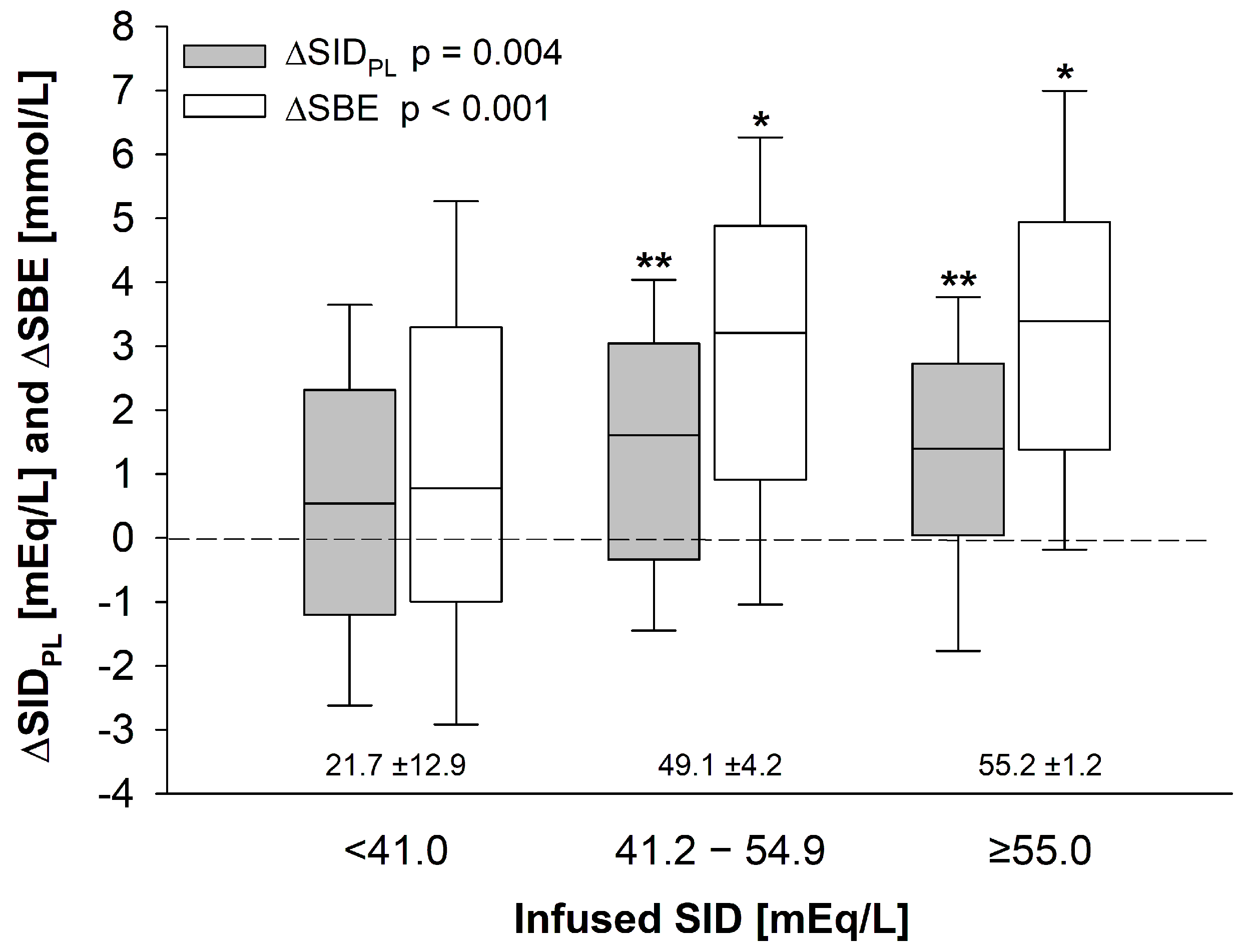
3.3. Effect of SIDINF on Acid–Base Balance
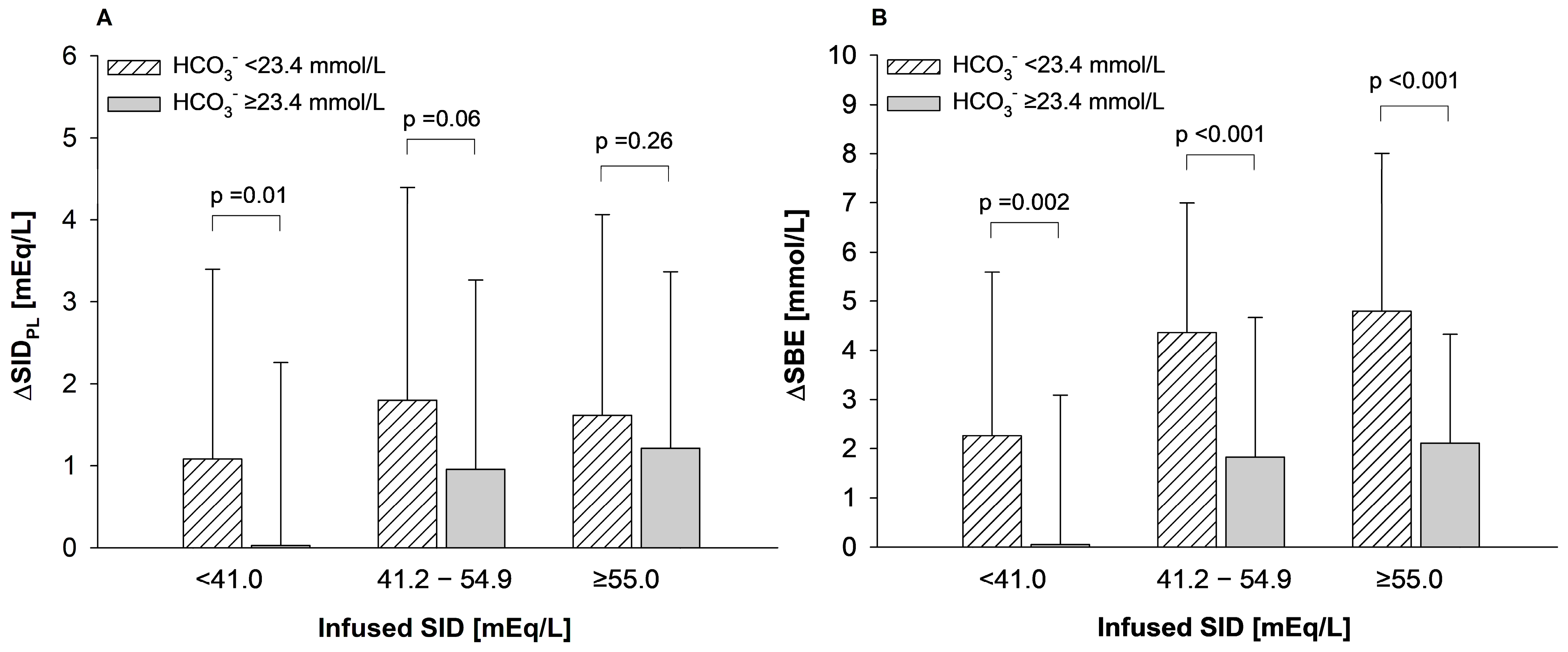
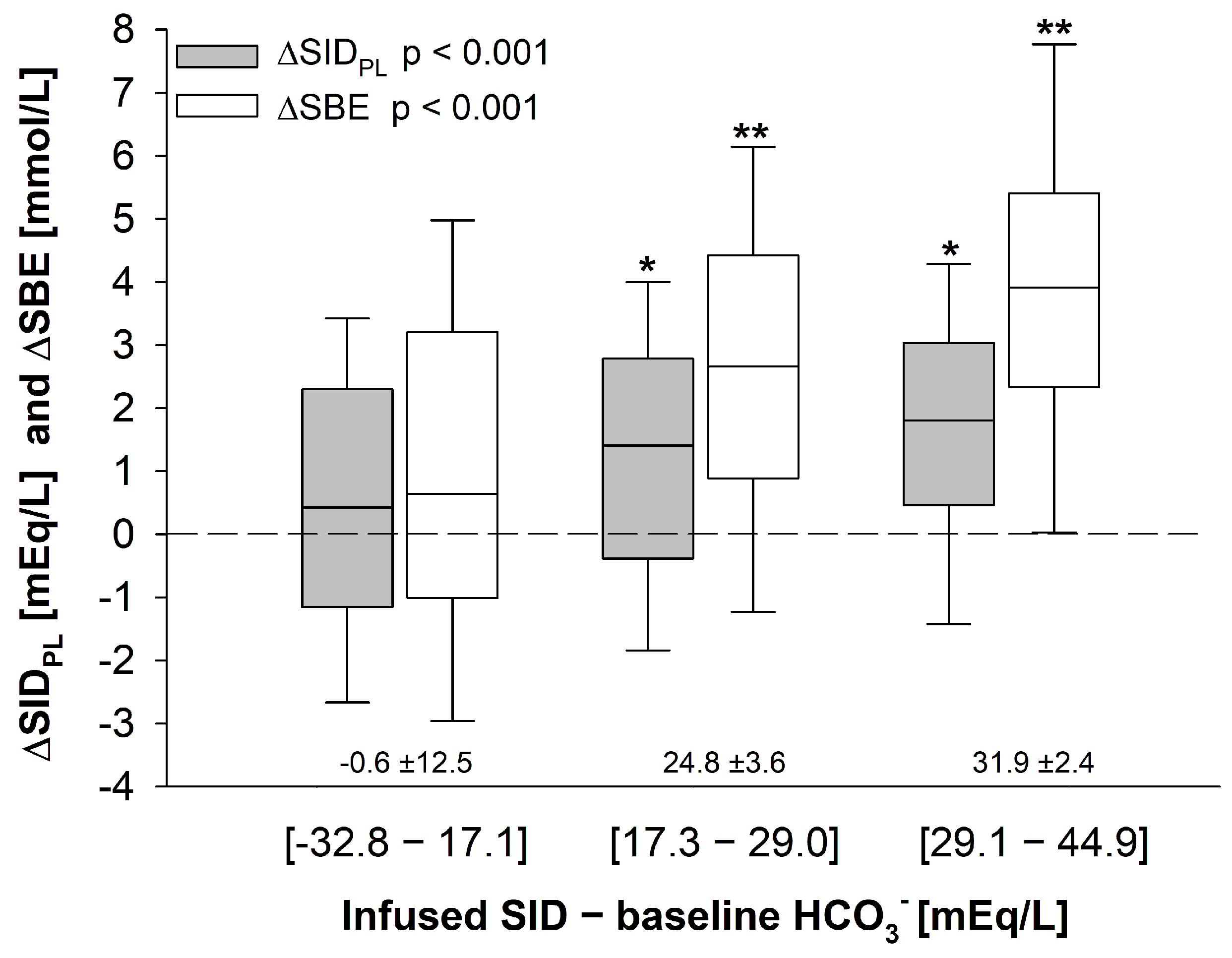
3.4. Effect of Pre-Infusion HCO3− Concentration on Fluid-Induced Acid–Base Changes
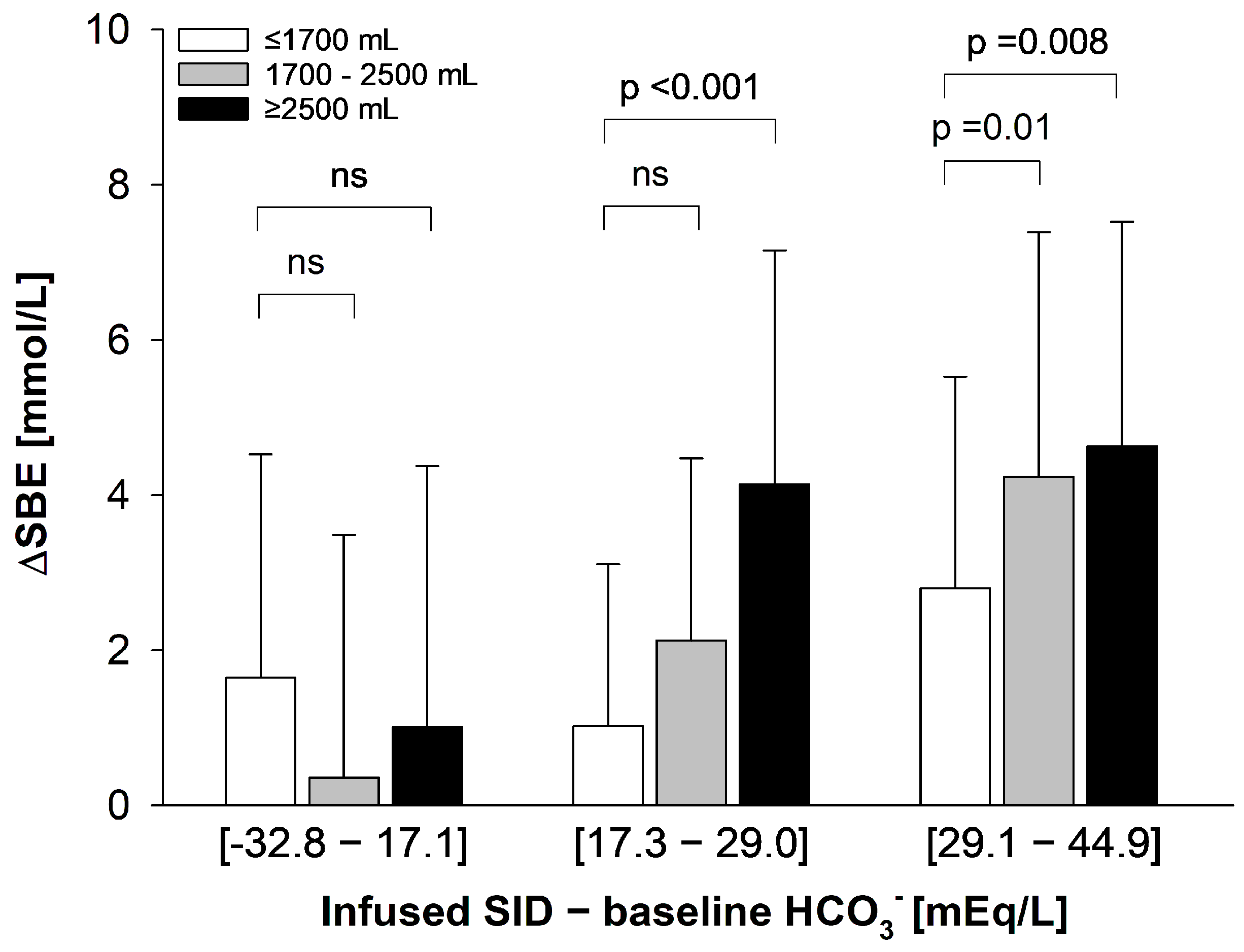
3.5. Volume Effect
4. Discussion
5. Conclusions
Supplementary Materials
Author Contributions
Funding
Institutional Review Board Statement
Informed Consent Statement
Data Availability Statement
Conflicts of Interest
Abbreviations
| A− | Dissociated form of total non-volatile weak acids |
| ATOT | Plasma concentration of total non-volatile weak acids |
| BMI | Body mass index |
| Ca2+ | Calcium |
| Cl− | Chloride |
| FiO2 | Inspired oxygen fraction |
| Hb | Hemoglobin |
| HCO3− | Plasma bicarbonate concentration |
| ICU | Intensive care unit |
| K+ | Potassium |
| Ma2+ | Magnesium |
| Na+ | Sodium |
| P | Phosphate |
| PaCO2 | Arterial partial pressure of carbon dioxide |
| SBE | Standard base excess |
| SID | Strong ion difference |
| SIDPL | Plasma strong ion differences |
| SIDINF | Average infused strong ion difference |
References
- Finfer, S.; Myburgh, J.; Bellomo, R. Intravenous Fluid Therapy in Critically Ill Adults. Nat. Rev. Nephrol. 2018, 14, 541–557. [Google Scholar] [CrossRef]
- Messina, A.; Bakker, J.; Chew, M.; De Backer, D.; Hamzaoui, O.; Hernandez, G.; Myatra, S.N.; Monnet, X.; Ostermann, M.; Pinsky, M.; et al. Pathophysiology of Fluid Administration in Critically Ill Patients. Intensive Care Med. Exp. 2022, 10, 46. [Google Scholar] [CrossRef] [PubMed]
- Ostermann, M.; Auzinger, G.; Grocott, M.; Morton-Bailey, V.; Raphael, J.; Shaw, A.D.; Zarbock, A. POQI XI Investigators Perioperative Fluid Management: Evidence-Based Consensus Recommendations from the International Multidisciplinary PeriOperative Quality Initiative. Br. J. Anaesth. 2024, 133, 1263–1275. [Google Scholar] [CrossRef]
- Malbrain, M.L.N.G.; Caironi, P.; Hahn, R.G.; Llau, J.V.; McDougall, M.; Patrão, L.; Ridley, E.; Timmins, A. Multidisciplinary Expert Panel Report on Fluid Stewardship: Perspectives and Practice. Ann. Intensive Care 2023, 13, 89. [Google Scholar] [CrossRef]
- Myburgh, J.A.; Mythen, M.G. Resuscitation Fluids. N. Engl. J. Med. 2013, 369, 1243–1251. [Google Scholar] [CrossRef]
- Zampieri, F.G.; Cavalcanti, A.B.; Luca, G.; Tanna, D.; Damiani, L.P.; Hammond, N.E.; Machado, F.R.; Micallef, S.; Myburgh, J.; Ramanan, M.; et al. Balanced Crystalloids versus Saline for Critically Ill Patients (BEST-Living): A Systematic Review and Individual Patient Data Meta-Analysis. Lancet Respir. Med. 2024, 12, 237–246. [Google Scholar] [CrossRef] [PubMed]
- Zwager, C.L.; Tuinman, P.R.; de Grooth, H.-J.; Kooter, J.; Ket, H.; Fleuren, L.M.; Elbers, P.W.G. Why Physiology Will Continue to Guide the Choice between Balanced Crystalloids and Normal Saline: A Systematic Review and Meta-Analysis. Crit. Care 2019, 23, 366. [Google Scholar] [CrossRef] [PubMed]
- Arabi, Y.M.; Belley-Cote, E.; Carsetti, A.; De Backer, D.; Donadello, K.; Juffermans, N.P.; Hammond, N.; Laake, J.H.; Liu, D.; Maitland, K.; et al. European Society of Intensive Care Medicine Clinical Practice Guideline on Fluid Therapy in Adult Critically Ill Patients. Part 1: The Choice of Resuscitation Fluids. Intensive Care Med. 2024, 50, 813–831. [Google Scholar] [CrossRef]
- Malbrain, M.L.N.G.; Langer, T.; Annane, D.; Gattinoni, L.; Elbers, P.; Hahn, R.G.; De laet, I.; Minini, A.; Wong, A.; Ince, C.; et al. Intravenous Fluid Therapy in the Perioperative and Critical Care Setting: Executive Summary of the International Fluid Academy (IFA). Ann. Intensive Care 2020, 10, 64. [Google Scholar] [CrossRef]
- Dell’Anna, A.M.; Grieco, D.L.; Dominedò, C.; Cicetti, M.; Cisterna, I.; Festa, R.; Lamacchia, R.; Giannì, G.; Filetici, N.; Michi, T.; et al. Stewart’s Theory and Acid–Base Changes Induced by Crystalloid Infusion in Humans: A Randomized Physiological Trial. Ann. Intensive Care 2025, 15, 54. [Google Scholar] [CrossRef]
- Scheingraber, S.; Rehm, M.; Sehmisch, C.; Finsterer, U. Rapid Saline Infusion Produces Hyperchloremic Acidosis in Patients Undergoing Gynecologic Surgery. Anesthesiology 1999, 90, 1265–1270. [Google Scholar] [CrossRef]
- Cosgriff, N.; Moore, E.E.; Sauaia, A.; Kenny-Moynihan, M.; Burch, J.M.; Galloway, B. Predicting Life-Threatening Coagulopathy in the Massively Transfused Trauma Patient. J. Trauma: Inj. Infect. Crit. Care 1997, 42, 857–862. [Google Scholar] [CrossRef]
- O’Malley, C.M.N.; Frumento, R.J.; Hardy, M.A.; Benvenisty, A.I.; Brentjens, T.E.; Mercer, J.S.; Bennett-Guerrero, E. A Randomized, Double-Blind Comparison of Lactated Ringer’s Solution and 0.9% NaCl during Renal Transplantation. Anesth. Analg. 2005, 100, 1518–1524. [Google Scholar] [CrossRef]
- Collins, M.G.; Fahim, M.A.; Pascoe, E.M.; Hawley, C.M.; Johnson, D.W.; Varghese, J.; Hickey, L.E.; Clayton, P.A.; Dansie, K.B.; McConnochie, R.C.; et al. Balanced Crystalloid Solution versus Saline in Deceased Donor Kidney Transplantation (BEST-Fluids): A Pragmatic, Double-Blind, Randomised, Controlled Trial. Lancet 2023, 402, 105–117. [Google Scholar] [CrossRef] [PubMed]
- Ramanan, M.; Attokaran, A.; Murray, L.; Bhadange, N.; Stewart, D.; Rajendran, G.; Pusapati, R.; Petty, M.; Garrett, P.; Kruger, P.; et al. Sodium Chloride or Plasmalyte-148 Evaluation in Severe Diabetic Ketoacidosis (SCOPE-DKA): A Cluster, Crossover, Randomized, Controlled Trial. Intensive Care Med. 2021, 47, 1248–1257. [Google Scholar] [CrossRef] [PubMed]
- Raes, M.; Kellum, J.A.; Colman, R.; Wallaert, S.; Crivits, M.; Viaene, F.; Hemeryck, M.; Benoit, D.; Poelaert, J.; Hoste, E. Effect of a Single Small Volume Fluid Bolus with Balanced or Un-Balanced Fluids on Chloride and Acid–Base Status: A Prospective Randomized Pilot Study (the FLURES-Trial). J. Nephrol. 2024, 37, 1299–1308. [Google Scholar] [CrossRef]
- Fencl, V.; Leith, D.E. Stewart’s Quantitative Acid-Base Chemistry: Applications in Biology and Medicine. Respir. Physiol. 1993, 91, 1–16. [Google Scholar] [CrossRef]
- Langer, T.; Ferrari, M.; Zazzeron, L.; Gattinoni, L.; Caironi, P. Effects of Intravenous Solutions on Acid-Base Equilibrium: From Crystalloids to Colloids and Blood Components. Anaesthesiol. Intensive Ther. 2014, 46, 350–360. [Google Scholar] [CrossRef] [PubMed]
- Morgan, T.J.; Venkatesh, B.; Hall, J. Crystalloid Strong Ion Difference Determines Metabolic Acid-Base Change during Acute Normovolaemic Haemodilution. Intensive Care Med. 2004, 30, 1432–1437. [Google Scholar] [CrossRef]
- Morgan, T.J.; Venkatesh, B. Designing “balanced” Crystalloids. Crit. Care Resusc. 2003, 5, 284–291. [Google Scholar] [CrossRef]
- Carlesso, E.; Maiocchi, G.; Tallarini, F.; Polli, F.; Valenza, F.; Cadringher, P.; Gattinoni, L. The Rule Regulating PH Changes during Crystalloid Infusion. Intensive Care Med. 2011, 37, 461–468. [Google Scholar] [CrossRef]
- Langer, T.; Carlesso, E.; Protti, A.; Monti, M.; Comini, B.; Zani, L.; Andreis, D.T.; Iapichino, G.E.; Dondossola, D.; Caironi, P.; et al. In Vivo Conditioning of Acid-Base Equilibrium by Crystalloid Solutions: An Experimental Study on Pigs. Intensive Care Med. 2012, 38, 686–693. [Google Scholar] [CrossRef] [PubMed]
- Waskowski, J.; Salvato, S.M.; Müller, M.; Hofer, D.; van Regenmortel, N.; Pfortmueller, C.A. Choice of Creep or Maintenance Fluid Type and Their Impact on Total Daily ICU Sodium Burden in Critically Ill Patients: A Systematic Review and Meta-Analysis. J. Crit. Care 2023, 78, 154403. [Google Scholar] [CrossRef]
- Morgan, T.J.; Clark, C.; Endre, Z.H. Accuracy of Base Excess—An in Vitro Evaluation of the Van Slyke Equation. Crit. Care Med. 2000, 28, 2932–2936. [Google Scholar] [CrossRef] [PubMed]
- Mateu-de Antonio, J. New Predictive Equations for Serum Ionized Calcium in Hospitalized Patients. Med. Princ. Pract. 2016, 25, 219–226. [Google Scholar] [CrossRef]
- Figge, J.; Rossing, T.H.; Fencl, V. The Role of Serum Proteins in Acid-Base Equilibria. J. Lab. Clin. Med. 1991, 117, 453–467. [Google Scholar]
- Figge, J.; Mydosh, T.; Fencl, V. Serum Proteins and Acid-Base Equilibria: A Follow-Up. J. Lab. Clin. Med. 1992, 120, 713–719. [Google Scholar]
- Slinker, B.K.; Glantz, S.A. Multiple Linear Regression. Circulation 2008, 117, 1732–1737. [Google Scholar] [CrossRef]
- Mickey, R.M.; Greenland, S. The Impact of Confounder Selection Criteria on Effect Estimation. Am. J. Epidemiol. 1989, 129, 125–137. [Google Scholar] [CrossRef]
- Vrieze, S.I. Model Selection and Psychological Theory: A Discussion of the Differences between the Akaike Information Criterion (AIC) and the Bayesian Information Criterion (BIC). Psychol. Methods 2012, 17, 228–243. [Google Scholar] [CrossRef] [PubMed]
- Brandenburger, A.; Contreras-Tejada, P.; La Mura, P.; Scarpa, G.; Steverson, K. Agreement and Disagreement in a Non-Classical World. Philos. Trans. R. Soc. A: Math. Phys. Eng. Sci. 2024, 382, 20230004. [Google Scholar] [CrossRef]
- von Elm, E.; Altman, D.G.; Egger, M.; Pocock, S.J.; Gøtzsche, P.C.; Vandenbroucke, J.P. STROBE Initiative The Strengthening the Reporting of Observational Studies in Epidemiology (STROBE) Statement: Guidelines for Reporting Observational Studies. Lancet 2007, 370, 1453–1457. [Google Scholar] [CrossRef] [PubMed]
- Langer, T.; Zanella, A.; Caironi, P. Understanding the Role of the Cerebrospinal Fluid in Acid–Base Disorders. Intensive Care Med. 2016, 42, 436–439. [Google Scholar] [CrossRef] [PubMed]
- Gabel, R.A.; Fencl, V. Respiratory Adaptations in Acid-Base Disturbances: Role of Cerebral Fluids. Contr. Nephrol. 1980, 21, 145–149. [Google Scholar] [CrossRef]
- Posner, J.B.; Plum, F. Spinal-Fluid PH and Neurologic Symptoms in Systemic Acidosis. N. Engl. J. Med. 1967, 277, 605–613. [Google Scholar] [CrossRef]
- Pierce, N.F.; Fedson, D.S.; Brigham, K.L.; Mitra, R.C.; Sack, R.B.; Mondal, A. The Ventilatory Response to Acute Base Deficit in Humans. Time Course during Development and Correction of Metabolic Acidosis. Ann. Intern. Med. 1970, 72, 633–640. [Google Scholar] [CrossRef]
- Dempsey, J.A.; Forster, H.V. Mediation of Ventilatory Adaptations. Physiol. Rev. 1982, 62, 262–346. [Google Scholar] [CrossRef]
- Fencl, V.; Miller, T.B.; Pappenheimer, J.R. Studies on the Respiratory Response to Disturbances of Acid-Base Balance, with Deductions Concerning the Ionic Composition of Cerebral Interstitial Fluid. Am. J. Physiol. 1966, 210, 459–472. [Google Scholar] [CrossRef]
- Kazemi, H.; Johnson, D.C. Regulation of Cerebrospinal Fluid Acid-Base Balance. Physiol. Rev. 1986, 66, 953–1037. [Google Scholar] [CrossRef] [PubMed]
- Nattie, E.E.; Birchard, G.F. Ventilation and CSF Ions during Hypocapnic HCl and HNO3 Acidosis in Conscious Rabbits. J. Appl. Physiol. 1983, 55, 1748–1757. [Google Scholar] [CrossRef]



| Infused SID | |||||
|---|---|---|---|---|---|
| Variable | All Population n = 641 | Low-SIDINF (<41.0) n = 212 | Medium-SIDINF (41.2–54.9) n = 160 | High-SIDINF (≥55.0) n = 269 | p-Value |
| Parameters at admission to ICU | |||||
| Age, year | 63 ± 16 | 65 ± 15 | 64 ± 16 | 60 ± 17 | 0.008 |
| Female sex, n. (%) | 272 (42) | 81 (38) | 73 (46) | 117 (44) | 0.31 |
| BMI, kg/m2 | 27.1 ± 7.2 | 25.8 ± 6.1 | 25.4 ± 5.6 | 29.3 ± 8.2 | <0.001 |
| Cause of admission to ICU | |||||
| Elective surgical cases, n. (%) | 534 (83) | 162 (76) | 130 (81) | 242 (90) | <0.001 |
| Emergency surgical cases, n. (%) | 80 (12) | 33 (16) | 24 (15) | 23 (9) | |
| Medical cases, n. (%) | 27 (5) | 17 (8) | 6 (4) | 4 (1) | |
| Medication history | |||||
| Diuretics, n. (%) | 191 (30) | 71 (34) | 50 (31) | 70 (26) | 0.16 |
| Calcium channel blocker, n. (%) | 120 (19) | 42 (20) | 30 (19) | 48 (18) | 0.84 |
| Angiotensin receptor binders, n. (%) | 54 (9) | 15 (7) | 14 (9) | 25 (9) | 0.69 |
| Angiotensin-converting enzyme inhibitors, n. (%) | 174 (27) | 48 (23) | 45 (28) | 81 (30) | 0.19 |
| Beta-blockers, n. (%) | 176 (28) | 64 (31) | 36 (23) | 76 (28) | 0.22 |
| Comorbidities | |||||
| Hypertension, n. (%) | 332 (52) | 117 (55) | 81 (51) | 134 (50) | 0.48 |
| Chronic obstructive pulmonary disease, n. (%) | 77 (12) | 28 (13) | 26 (16) | 23 (9) | 0.05 |
| Chronic heart failure, n. (%) | 37 (6) | 17 (8) | 7 (4) | 13 (5) | 0.23 |
| Diabetes, n. (%) | 126 (20) | 41 (19) | 31(19) | 54 (20) | 0.96 |
| Chronic kidney disease, n. (%) | 58 (9) | 37 (18) | 12 (8) | 9 (3) | <0.001 |
| Creatinine clearance, mL/min/1.73 m2 | 96 ± 39 | 83 ± 43 | 104 ± 43 | 101 ± 30 | <0.001 |
| Infused SID | |||||
|---|---|---|---|---|---|
| All Population n = 641 | Low-SIDINF (<41.0) n = 212 | Medium-SIDINF (41.2–54.9) n = 160 | High-SIDINF (≥55.0) n = 269 | p-Value | |
| Hemodynamic and oxygenation | |||||
| Heart rate, beats/min | 75 ± 18 | 77 ± 20 | 75 ± 18 | 73 ± 16 | 0.19 |
| Mean arterial pressure, mmHg | 91 ± 15 | 88 ± 15 | 90 ± 14 | 94 ± 14 | <0.001 |
| Hemoglobin, g/dL | 11.9 ± 1.9 | 11.7 ± 2.0 | 11.5 ± 1.8 | 12.3 ± 1.6 | <0.001 |
| Mechanically ventilated, n. (%) | 523 (81) | 174 (82) | 146 (91) | 197 (73) | <0.001 |
| PaO2, mmHg | 161 ± 59 | 158 ± 56 | 167 ± 60 | 159 ± 60 | 0.34 |
| FiO2, % | 50 [45–50] | 50 [40–50] | 50 [45–50] | 50 [45–50] | 0.38 |
| Plasma Acid-Base Parameters | |||||
| pH | 7.41 ± 0.06 | 7.41 ± 0.07 | 7.43 ± 0.06 | 7.41 ± 0.06 | 0.03 |
| PaCO2, mmHg | 38 ± 6 | 37 ± 6 | 38 ± 6 | 39 ± 6 | 0.002 |
| HCO3−, mmol/L | 24.4 ± 3.2 | 23.7 ± 3.5 | 25.0 ± 3.5 | 24.5 ± 2.7 | 0.002 |
| SBE, mmol/L | 0.2 ± 4.1 | −0.6 ± 4.5 | 1.1 ± 4.3 | 0.2 ± 3.5 | 0.01 |
| Na+, mEq/L | 139 ± 3 | 138 ± 4 | 139 ± 3 | 139 ± 3 | 0.002 |
| K+, mEq/L | 3.9 ± 0.5 | 4.2 ± 0.6 | 3.8 ± 0.5 | 3.8 ± 0.4 | <0.001 |
| Ca2+, mEq/L | 2.3 ± 0.1 | 2.3 ± 0.1 | 2.3 ± 0.2 | 2.4 ± 0.1 | 0.58 |
| Mg2+, mEq/L | 1.4 ± 0.2 | 1.4 ± 0.3 | 1.4 ± 0.3 | 1.4 ± 0.2 | 0.88 |
| Cl−, mEq/L | 105 ± 4 | 105 ± 5 | 106 ± 3 | 106 ± 3 | 0.26 |
| Lactate−, mEq/L | 1.3 ± 1.0 | 1.4 ± 1.2 | 1.2 ± 0.9 | 1.2 ± 0.8 | 0.17 |
| SIDPL, mEq/L | 39.2 ± 2.8 | 38.7 ± 3.0 | 39.4 ± 2.7 | 39.4 ± 2.6 | 0.04 |
| ATOT, mmol/L | 19.0 ± 2.8 | 18.6 ± 3.0 | 18.5 ± 3.0 | 19.5 ± 2.2 | <0.001 |
| Infused SID | |||||
|---|---|---|---|---|---|
| Variable | All Population n = 641 | Low-SIDINF (<41.0) n = 212 | Medium-SIDINF (41.2–54.9) n = 160 | High-SIDINF (≥55.0) n = 269 | p-Value |
| Study period, hours | 18 [15–20] | 18 [14–20] | 18 [15–20] | 18 [15–20] | 0.77 |
| Duration of mechanical ventilation, hours | 4 [3–5] | 4 [3–6] | 4 [3–6] | 3 [3–4] | 0.31 |
| Furosemide administration, n. (%) | 134 (21) | 61 (29) | 30 (19) | 43 (16) | 0.002 |
| Furosemide dose, mg | 20 [10–25] | 15.0 [10–30] | 20 [10–25] | 20 [10–30] | 0.21 |
| ΔpH | 0.2 ± 0.7 | 0.00 ± 0.07 | 0.02 ± 0.06 | 0.03 ± 0.06 | <0.001 |
| ΔPCO2, mmHg | 1.5 ± 7.1 | 2.2 ± 8.0 | 2.2 ± 6.0 | 0.6 ± 7.0 | 0.11 |
| ΔHCO3−, mmol/L | 2.0 ± 2.6 | 1.1 ± 2.4 | 2.4 ± 2.6 | 2.4 ± 2.6 | <0.001 |
| ΔSBE, mmol/L | 2.6 ± 3.3 | 1.2 ± 3.4 | 3.0 ± 3.0 | 3.4 ± 3.0 | <0.001 |
| ΔSIDPL, mEq/L | 1.1 ± 2.3 | 0.6 ± 2.3 | 1.3 ± 2.4 | 1.4 ± 2.3 | 0.004 |
| ΔHb, g/dL | −0.7 ± 1.2 | −0.7 ± 1.2 | −0.7 ± 1.1 | −0.7 ± 1.3 | 0.26 |
| Total infusions, mL | 2327 ± 1111 | 2583 ± 1411 | 2612 ± 878 | 1957 ± 827 | <0.001 |
| Crystalloids | 2163 ± 971 | 2323 ± 1213 | 2338 ± 775 | 1933 ± 806 | <0.001 |
| Colloids | 81 ± 200 | 135 ± 252 | 147 ± 241 | − | <0.001 |
| Blood products | 86 ± 207 | 135 ± 241 | 127 ± 235 | 24 ± 130 | <0.001 |
| Urine output, mL | 1210 ± 799 | 1206 ± 822 | 1164 ± 690 | 1240 ± 842 | 0.61 |
| Fluid balance, mL | 893 ± 1296 | 1178 ± 1514 | 1155 ± 1059 | 506 ± 1156 | <0.001 |
| SIDINF, mEq/L | 42.6 ± 16.8 | 21.7 ± 12.9 | 49.1 ± 4.2 | 55.2 ± 1.2 | <0.001 |
| SIDINF—HCO3−, mEq/L | 18.8 ± 15.9 | −0.7 ± 12.8 | 24.0 ± 5.5 | 30.7 ± 3.1 | <0.001 |
Disclaimer/Publisher’s Note: The statements, opinions and data contained in all publications are solely those of the individual author(s) and contributor(s) and not of MDPI and/or the editor(s). MDPI and/or the editor(s) disclaim responsibility for any injury to people or property resulting from any ideas, methods, instructions or products referred to in the content. |
© 2026 by the authors. Licensee MDPI, Basel, Switzerland. This article is an open access article distributed under the terms and conditions of the Creative Commons Attribution (CC BY) license.
Share and Cite
Zadek, F.; Ottolina, D.; Zazzeron, L.; Nafi, M.; Bastreghi, J.; Gandini, L.; Langer, T.; Caironi, P. Plasma Bicarbonate as a Determinant of Fluid-Induced Acid–Base Changes in Postoperative Critically Ill Patients: A Retrospective Analysis. J. Clin. Med. 2026, 15, 1703. https://doi.org/10.3390/jcm15051703
Zadek F, Ottolina D, Zazzeron L, Nafi M, Bastreghi J, Gandini L, Langer T, Caironi P. Plasma Bicarbonate as a Determinant of Fluid-Induced Acid–Base Changes in Postoperative Critically Ill Patients: A Retrospective Analysis. Journal of Clinical Medicine. 2026; 15(5):1703. https://doi.org/10.3390/jcm15051703
Chicago/Turabian StyleZadek, Francesco, Davide Ottolina, Luca Zazzeron, Matteo Nafi, Jessica Bastreghi, Lucia Gandini, Thomas Langer, and Pietro Caironi. 2026. "Plasma Bicarbonate as a Determinant of Fluid-Induced Acid–Base Changes in Postoperative Critically Ill Patients: A Retrospective Analysis" Journal of Clinical Medicine 15, no. 5: 1703. https://doi.org/10.3390/jcm15051703
APA StyleZadek, F., Ottolina, D., Zazzeron, L., Nafi, M., Bastreghi, J., Gandini, L., Langer, T., & Caironi, P. (2026). Plasma Bicarbonate as a Determinant of Fluid-Induced Acid–Base Changes in Postoperative Critically Ill Patients: A Retrospective Analysis. Journal of Clinical Medicine, 15(5), 1703. https://doi.org/10.3390/jcm15051703