Return to Sports in Recreational Athletes After Complex Elbow Dislocation
 ,
,  ,
,
Abstract
1. Introduction
2. Materials and Methods
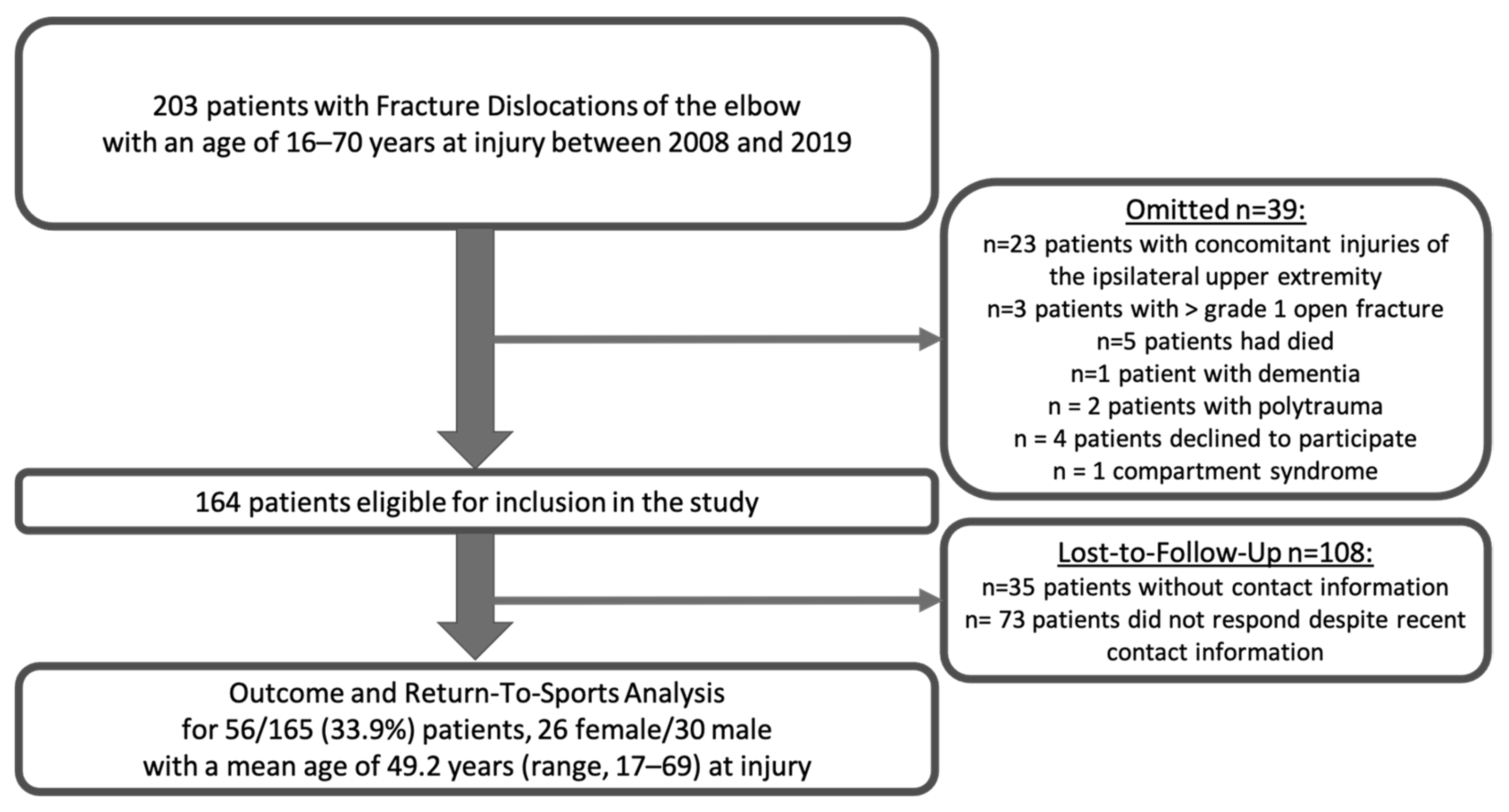
2.1. Patients and Study Design
2.2. Return-to-Sport Metrics
- Full return to pre-injury sport: Resuming the same sport at the same level as before injury.
- Partial return to pre-injury sport: Returning to the same sport but at a lower level than before injury.
- No return to pre-injury sport but return to other sports: Participating in a different type of sport at any level.
- No return to sports: No participation in any type of sport.
2.3. Statistical Analysis
3. Results
3.1. Demographics
3.2. Injury Pattern, Type of Fracture and Treatment Course
3.3. Patient-Reported Outcome Measures (PROMs) and Arc of Motion
3.4. Return to Sports
3.5. Return to Work
3.6. Complications
3.7. Revisions
4. Discussion
5. Conclusions
Author Contributions
Funding
Institutional Review Board Statement
Informed Consent Statement
Data Availability Statement
Conflicts of Interest
Abbreviations
| DALY | disability-adjusted life-years |
| PROM | patient-reported outcome measures |
| MEPS | Mayo Elbow Performance Score |
| OES | Oxford Elbow Score |
| PACS | Picture Archiving and Communication System |
| NRS | Numerical Rating Scale |
| SEV | Subjective Elbow Value |
| CI | confidence interval |
References
- Stoneback, J.W.; Owens, B.D.; Sykes, J.; Athwal, G.S.; Pointer, L.; Wolf, J.M. Incidence of elbow dislocations in the United States population. J. Bone Jt. Surg. Am. 2012, 94, 240–245. [Google Scholar] [CrossRef] [PubMed]
- Dizdarevic, I.; Low, S.; Currie, D.W.; Comstock, R.D.; Hammoud, S.; Atanda, A. Epidemiology of Elbow Dislocations in High School Athletes. Am. J. Sports Med. 2016, 44, 202–208. [Google Scholar] [CrossRef] [PubMed]
- Nabian, M.H.; Zadegan, S.A.; Zanjani, L.O.; Mehrpour, S.R. Epidemiology of Joint Dislocations and Ligamentous/Tendinous Injuries among 2700 Patients: Five-year Trend of a Tertiary Center in Iran. Arch. Bone Jt. Surg. 2017, 5, 426–434. [Google Scholar] [PubMed]
- Giai Via, R.; Faccenda, C.; Artiaco, S.; Dutto, E.; Lavia, A.D.; Massè, A.; Battiston, B. Functional and subjective outcomes after surgical management of complex elbow dislocations: A retrospective study. Eur. J. Orthop. Surg. Traumatol. 2024, 34, 4027–4036. [Google Scholar] [CrossRef]
- Almalki, M.A.; Alkhudhayri, M.; Aljomah, A.; Alhinti, N.; Alhumidani, A.; Alassaf, M.; Alshehri, S. Elbow dislocation in sports: A narrative review. J. Musculoskelet. Surg. Res. 2020, 4, 124. [Google Scholar] [CrossRef]
- Adams, J.E. Elbow Instability: Evaluation and Treatment. Hand Clin. 2020, 36, 485–494. [Google Scholar] [CrossRef]
- Wyrick, J.D.; Dailey, S.K.; Gunzenhaeuser, J.M.; Casstevens, E.C. Management of complex elbow dislocations: A mechanistic approach. J. Am. Acad. Orthop. Surg. 2015, 23, 297–306. [Google Scholar] [CrossRef]
- Josefsson, P.O.; Nilsson, B.E. Incidence of elbow dislocation. Acta Orthop. Scand. 1986, 57, 537–538. [Google Scholar] [CrossRef]
- Heifner, J.J.; Mercer, D.M. Improved Understanding of Traumatic Complex Elbow Instability. J. Am. Acad. Orthop. Surg. Glob. Res. Rev. 2023, 7, e23. [Google Scholar] [CrossRef]
- Moldovan, F. Anterior Radial Head Dislocation Associated with a Bifocal Fracture of the Ulna: A Bado Type ID Monteggia Fracture-Dislocation? Life 2025, 15, 637. [Google Scholar] [CrossRef]
- Cueto, R.J.; Kakalecik, J.; Burns, M.Q.; Janke, R.L.; Hones, K.M.; Hao, K.A.; Wright, L.T.; Buchanan, T.R.; Aibinder, W.R.; Patrick, M.R.; et al. Reported outcome measures in complex fracture elbow dislocations: A systematic review. J. Shoulder Elb. Surg. 2024, 33, 1709–1723. [Google Scholar] [CrossRef] [PubMed]
- Gavaskar, A.S.; Tummala, N.C.; Srinivasan, P.; Ayyadurai, P.; Ca, A.; Chand, B. Differences in outcome and complications between 2 distinct complex traumatic elbow instability patterns. A retrospective comparison of terrible triad and olecranon fracture dislocations. JSES Int. 2025, 9, 912–919. [Google Scholar] [CrossRef] [PubMed]
- Waymack, J.R.; An, J. Posterior Elbow Dislocation. In StatPearls; StatPearls Publishing LLC.: Treasure Island, FL, USA, 2025. [Google Scholar]
- McLean, J.; Kempston, M.P.; Pike, J.M.; Goetz, T.J.; Daneshvar, P. Varus Posteromedial Rotatory Instability of the Elbow: Injury Pattern and Surgical Experience of 27 Acute Consecutive Surgical Patients. J. Orthop. Trauma 2018, 32, e469–e474. [Google Scholar] [CrossRef] [PubMed]
- Rezaie, N.; Gupta, S.; Osbahr, D.C. Elbow Dislocation. Clin. Sports Med. 2020, 39, 637–655. [Google Scholar] [CrossRef]
- Ferrari, A.J.; Santomauro, D.F.; Aali, A.; Abate, Y.H.; Abbafati, C.; Abbastabar, H.; Abd ElHafeez, S.; Abdelmasseh, M.; Abd-Elsalam, S.; Abdollahi, A.; et al. Global incidence, prevalence, years lived with disability (YLDs), disability-adjusted life-years (DALYs), and healthy life expectancy (HALE) for 371 diseases and injuries in 204 countries and territories and 811 subnational locations, 1990–2021: A systematic analysis for the Global Burden of Disease Study 2021. Lancet 2024, 403, 2133–2161. [Google Scholar]
- Holtslag, H.R.; Post, M.W.; van der Werken, C.; Lindeman, E. Return to work after major trauma. Clin. Rehabil. 2007, 21, 373–383. [Google Scholar] [CrossRef]
- Geyer, S.; Lacheta, L.; Aspang, J.S.U.; Willinger, L.; Lutz, P.M.; Lappen, S.; Imhoff, A.B.; Siebenlist, S. Patient satisfaction, joint stability and return to sports following simple elbow dislocations: Surgical versus non-surgical treatment. Arch. Orthop. Trauma Surg. 2023, 143, 1481–1489. [Google Scholar] [CrossRef]
- Nolte, P.C.; Walde, M.V.; Elrick, B.P.; Grützner, P.-A.; Porschke, F.; Schnetzke, M. High return to sport rate and good patient-reported outcomes in recreational athletes following simple elbow dislocations. J. Orthop. Surg. Res. 2023, 18, 453. [Google Scholar] [CrossRef]
- Jakobi, T.; Gramlich, Y.; Sauter, M.; Schnetz, M.; Hoffmann, R.; Klug, A. Complex elbow fracture-dislocations- what factors are associated with a poor post-operative outcome? Eur. J. Trauma Emerg. Surg. 2024, 50, 1823–1830. [Google Scholar] [CrossRef]
- Mason, M.L. Some observations on fractures of the head of the radius with a review of one hundred cases. Br. J. Surg. 1954, 42, 123–132. [Google Scholar] [CrossRef]
- Regan, W.; Morrey, B.F. Classification and treatment of coronoid process fractures. Orthopedics 1992, 15, 845–848. [Google Scholar] [CrossRef] [PubMed]
- Cabanela, M.; Morrey, B. The elbow and its disorders. In Fractures of the Proximal Ulna and Olecranon, 2nd ed.; W. B. Saunders Co.: Philadelphia, PA, USA, 1993; pp. 405–408. [Google Scholar]
- Dawson, J.; Doll, H.; Boller, I.; Fitzpatrick, R.; Little, C.; Rees, J.; Jenkinson, C.; Carr, A.J. The development and validation of a patient-reported questionnaire to assess outcomes of elbow surgery. J. Bone Jt. Surg. Br. 2008, 90, 466–473. [Google Scholar] [CrossRef] [PubMed]
- Cusick, M.C.; Bonnaig, N.S.; Azar, F.M.; Mauck, B.M.; Smith, R.A.; Throckmorton, T.W. Accuracy and reliability of the Mayo Elbow Performance Score. J. Hand Surg. Am. 2014, 39, 1146–1150. [Google Scholar] [CrossRef] [PubMed]
- Jensen, M.P.; Turner, J.A.; Romano, J.M. What is the maximum number of levels needed in pain intensity measurement? Pain 1994, 58, 387–392. [Google Scholar] [CrossRef]
- Schneeberger, A.G.; Kosters, M.C.; Steens, W. Comparison of the subjective elbow value and the Mayo elbow performance score. J. Shoulder Elb. Surg. 2014, 23, 308–312. [Google Scholar] [CrossRef]
- Engelke, J.; Walde, M.V.; Schnetzke, M.; Grützner, P.-A.; Nolte, P.-C. High correlation of the subjective elbow value with Mayo Elbow Performance Score and Oxford Elbow Score in patients with elbow dislocation. JSES Int. 2023, 7, 868–871. [Google Scholar] [CrossRef]
- de Haan, J.; den Hartog, D.; Tuinebreijer, W.E.; Iordens, G.I.; Breederveld, R.S.; Bronkhorst, M.W.; Bruijninckx, M.M.; De Vries, M.R.; Dwars, B.J.; Eygendaal, D.; et al. Functional treatment versus plaster for simple elbow dislocations (FuncSiE): A randomized trial. BMC Musculoskelet. Disord. 2010, 11, 263. [Google Scholar] [CrossRef]
- Lambert, C.; Ritzmann, R.; Geßlein, M.; Bouillon, B.; Höher, J.; Akoto, R.; Wafaisade, A. Return to sport after conservative treatment of elbow dislocation in judoka. Sportverletz. Sportschaden 2023, 37, 126–132. [Google Scholar] [CrossRef]
- Müller, M.; Pedersen, S.; Mair, O.; Twardy, V.; Siebenlist, S.; Biberthaler, P.; Banke, I. Mid- to long-term functional outcome and return to sport after elbow dislocation in bouldering: A clinical retrospective cohort study. Arch. Orthop. Trauma. Surg. 2024, 144, 3145–3151. [Google Scholar] [CrossRef]
- Jaecker, V.; Zocholl, M.; Friederichs, J.; Osten, P.; Fuchs, T.; Stuby, F.M.; Regenbogen, S. Intermediate to Long-Term Results Following Traumatic Hip Dislocation: Characteristics, CT-Based Analysis, and Patient-Reported Outcome Measures. J. Bone Jt. Surg. Am. 2024, 106, 346–352. [Google Scholar] [CrossRef]
- Sinha, A.; Robertson, G.; Maffulli, N. Doctor, I fractured my ankle. When can I return to play? An updated systematic review. Br. Med. Bull. 2022, 143, 35–45. [Google Scholar] [CrossRef]
- Webber, K.J.; Balboni, J.M.; Semelsberger, S.D.; Boggiano, V.J.; Levine, A.R.; Butler, J.; Gianakos, A.L. Return to sport following Lisfranc injuries in elite athletes-2024 international foot and ankle sports consensus and systematic review. Knee Surg. Sports Traumatol. Arthrosc. 2026. [Google Scholar] [CrossRef]
- Popchak, A.; Patterson-Lynch, B.; Christain, H.; Irrgang, J.J. Rehabilitation and return to sports after anterior shoulder stabilization. Ann. Jt. 2017, 2, 62. [Google Scholar] [CrossRef]
- Watson, S.; Allen, B.; Grant, J.A. A Clinical Review of Return-to-Play Considerations After Anterior Shoulder Dislocation. Sports Health 2016, 8, 336–341. [Google Scholar] [CrossRef]
- Basile, G. Beneficial effects of music in the healing process of traumatic injuries: Perceptual control of suffering and possible abatement of disability conditions. Clin. Ter. 2023, 174, 531–536. [Google Scholar]


| Mean (Range; %) | |
|---|---|
| Age at injury, years (range) | 49.2 (17.9–69.7) |
| Sex, n (%) | |
| Men | 30 (53.6) |
| Women | 27 (46.4) |
| Dominant side injured, n (%) | 22 (39.3) |
| Follow-up, years (range) | 6.4 (2.0–12.5) |
| Workers’ compensation claims, n (%) | 21 (37.5) |
| N (%) | ||
|---|---|---|
| Injured anatomic structure | Radial head fracture * | 45 (80.3) |
| Coronoid fracture | 13 (62.5) | |
| • Reagan/Morrey type I | 13 (23.2) | |
| • Reagan/Morrey type II | 15 (26.8) | |
| • Reagan/Morrey type III | 7 (12.5) | |
| Olecranon fracture †, | 5 (8.9) | |
| Injury pattern | Terrible triad injury | 24 (42.9) |
| Essex-Lopresti lesion | 1 (1.8) | |
| Monteggia-like lesion | 5 (8.9) |
| Anatomic Structure | Operative Procedure | N (%) |
|---|---|---|
| Radial head | ORIF * with screw | 11 (16.6) |
| ORIF with plate | 8 (14.3) | |
| Resection | 3 (5.4) | |
| Arthroplasty | 22 (39.3) | |
| Coronoid | Ante/retrograde screw | 7 (12.5) |
| ORIF with plate | 3 (5.4) | |
| Suture anchor | 12 (21.4) | |
| Reconstruction with radial head | 1 (1.8) | |
| Olecranon | ORIF with plate | 3 (5.4) |
| ORIF with tension band wiring | 2 (3.6) | |
| Lateral collateral ligament | 20 (35.7) | |
| Collateral ligament fixation | Medial collateral ligament | 7 (12.5) |
| Both collateral ligaments | 12 (21.4) |
| PROM | Mean (95% CI) |
|---|---|
| MEPS | 83.8 (78.8–88.7) |
| SEV | 80.2 (74.7–85.8) |
| OES | 37.8 (35.1–40.5) |
| NRS rest, median(range) | 0 (0–6) |
| NRS load, median(range) | 1 (0–9) |
| Arc of extension/flexion | 115.2 (107.2–123.2) |
| Arc of pronation/supination | 141.6 (133.2–150.1) |
| Patients with <100° arc of extension/flexion, n (%) | 5 (8.9) |
| Return to sport (n = 41) | Return to sport, n (%) | 37 (90.2) |
| Return to preinjury sport level, n (%) | ||
| • Fully | 13 (31.7) | |
| • Partially | 18 (43.9) | |
| Return to work (n = 49) | Fully | 40 (81.6) |
| Partially | 4 (8.2) | |
| Time to return to work, mean days (95% CI) | 144.7 (94.4–195.0) | |
| Complications (n = 56) | Yes, n (%) | 17 (30.4) |
| Elbow stiffness | 8 (14.3) | |
| Painful hardware | 4 (7.1) | |
| Ulnar nerve neuropathy | 3 (5.4) | |
| Redislocation/subluxation | 2 (3.6) | |
| Ankylosis | 2 (3.6) | |
| Non-union of the coronoid process | 1 (1.8) |
Disclaimer/Publisher’s Note: The statements, opinions and data contained in all publications are solely those of the individual author(s) and contributor(s) and not of MDPI and/or the editor(s). MDPI and/or the editor(s) disclaim responsibility for any injury to people or property resulting from any ideas, methods, instructions or products referred to in the content. |
© 2026 by the authors. Licensee MDPI, Basel, Switzerland. This article is an open access article distributed under the terms and conditions of the Creative Commons Attribution (CC BY) license.
Share and Cite
Regenbogen, S.; Nolte, P.-C.; Schnetzke, M.; Vorm Walde, M.; Bruttel, J. Return to Sports in Recreational Athletes After Complex Elbow Dislocation. J. Clin. Med. 2026, 15, 1702. https://doi.org/10.3390/jcm15051702
Regenbogen S, Nolte P-C, Schnetzke M, Vorm Walde M, Bruttel J. Return to Sports in Recreational Athletes After Complex Elbow Dislocation. Journal of Clinical Medicine. 2026; 15(5):1702. https://doi.org/10.3390/jcm15051702
Chicago/Turabian StyleRegenbogen, Stephan, Philip-Christian Nolte, Marc Schnetzke, Melina Vorm Walde, and Jennifer Bruttel. 2026. "Return to Sports in Recreational Athletes After Complex Elbow Dislocation" Journal of Clinical Medicine 15, no. 5: 1702. https://doi.org/10.3390/jcm15051702
APA StyleRegenbogen, S., Nolte, P.-C., Schnetzke, M., Vorm Walde, M., & Bruttel, J. (2026). Return to Sports in Recreational Athletes After Complex Elbow Dislocation. Journal of Clinical Medicine, 15(5), 1702. https://doi.org/10.3390/jcm15051702