


Clinical Applications and Diagnostic Performance of Adjunctive Light-Based Optical Technologies in Oral Potentially Malignant Disorders and Squamous Cell Carcinoma: A Systematic Review


 and
and
Abstract
1. Introduction
1.1. Rationale
1.2. Objectives
2. Materials and Methods
2.1. Focused Question
- Diagnostic Assessment: In adult patients presenting with oral mucosal lesions or potentially malignant disorders (Population), what is the diagnostic performance of adjunctive light-based visualization technologies, including autofluorescence and chemiluminescence (Index test), compared with histopathological examination (Reference standard), for the detection of epithelial dysplasia or squamous cell carcinoma (Outcome)?
- Intraoperative Guidance: In adult patients undergoing surgical treatment for oral squamous cell carcinoma (Population), does the use of fluorescence- or light-guided surgical techniques (Intervention), compared with conventional surgery or surgeon visual assessment (Comparator), improve surgical or oncologic outcomes such as margin status, lymph node yield, or recurrence (Outcomes)?” [22].
2.2. Search Strategy
2.3. Outcome Measures
- (1)
- device modality (autofluorescence, chemiluminescence, multimodal imaging),
- (2)
- clinical setting (screening/general dental vs. specialist referral),
- (3)
- lesion spectrum (OPMD-predominant vs. OSCC-enriched cohorts),
- (4)
- positivity threshold definition.
2.4. Selection of Studies
2.5. Quality Assessment and Risk of Bias Across Studies
2.6. Data Extraction
- Study characteristics: first author, year of publication, country, and study design.
- Participants: sample size, age range or mean age, and sex distribution.
- Index test: type of adjunctive light-based screening technology used and examination protocol.
- Reference standard: histopathological confirmation method and biopsy criteria.
- Diagnostic accuracy outcomes: sensitivity, specificity, positive predictive value, negative predictive value, likelihood ratios, and overall diagnostic accuracy, where reported.
- Additional outcomes: false-positive and false-negative rates, interobserver agreement, and reported clinical limitations or adverse consequences of screening.
- Follow-up: interval between index test and reference standard, when applicable.
3. Results
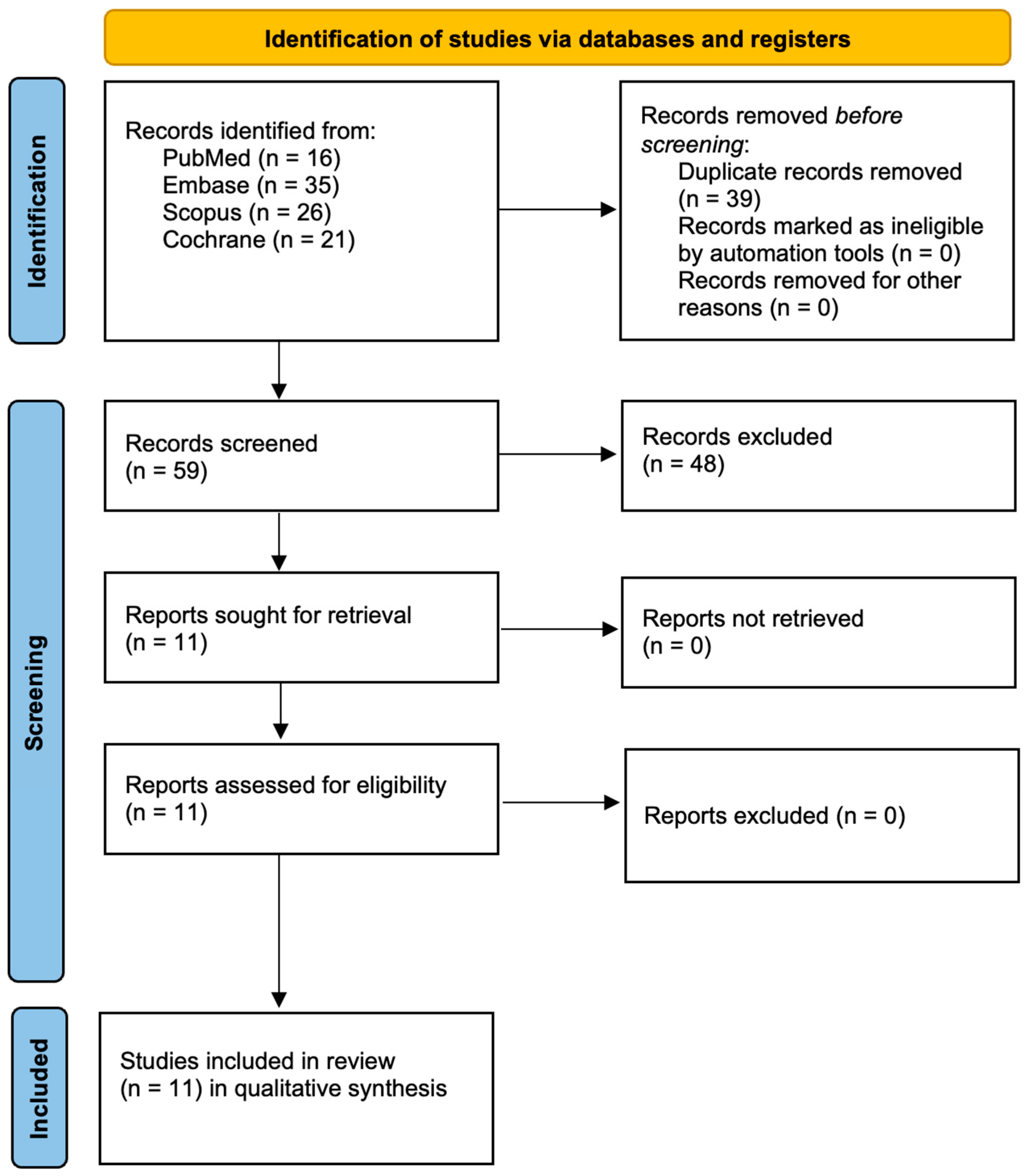
3.1. Study Selection
3.2. Risk of Bias and Quality Assessment of Evidence Results
3.3. General Characteristics of the Included Studies
3.3.1. Diagnostic Assessment Studies
3.3.2. Intraoperative Optical Guidance Studies
4. Discussion
4.1. Results in the Context of Other Evidence
4.2. Limitations of the Evidence
4.3. Limitations of the Review
4.4. Implications
5. Conclusions
Supplementary Materials
Author Contributions
Funding
Institutional Review Board Statement
Informed Consent Statement
Data Availability Statement
Conflicts of Interest
References
- Mody, M.D.; Rocco, J.W.; Yom, S.S.; Haddad, R.I.; Saba, N.F. Head and neck cancer. Lancet 2021, 398, 2289–2299. [Google Scholar] [CrossRef] [PubMed]
- Rumgay, H.; Colombet, M.; Ramos da Cunha, A.; Filho, A.M.; Warnakulasuriya, S.; Conway, D.I.; Chaturvedi, A.; Virani, S.; Lauby-Secretan, B.; Carvalho, A.L.; et al. Global incidence of lip, oral cavity, and pharyngeal cancers by subsite in 2022. CA Cancer J. Clin. 2026, 76. [Google Scholar] [CrossRef]
- Dunn, L.A.; Ho, A.L.; Pfister, D.G. Head and neck cancer. JAMA 2026, 335, 531–541. [Google Scholar] [CrossRef]
- Zumsteg, Z.S.; Luu, M.; Rosenberg, P.S.; Elrod, J.K.; Bray, F.; Vaccarella, S.; Gay, C.; Lu, D.J.; Chen, M.M.; Chaturvedi, A.K.; et al. Global epidemiologic patterns of oropharyngeal cancer incidence trends. J. Natl. Cancer Inst. 2023, 115, 1544–1554. [Google Scholar] [CrossRef]
- Wang, Y.; Zheng, J.; Ren, W.; Li, S.; Zhi, K.; Gao, L. Head and neck cancer incidence, mortality, and disability-adjusted life years from 1990 to 2021: A systematic analysis for the Global Burden of Disease Study. Int. Dent. J. 2025, 75, 103947. [Google Scholar] [CrossRef]
- Jang, W.; Kim, S.; Son, Y.; Kim, S.; Lee, S.; Kim, H.J.; Jo, H.; Park, J.; Lee, K.; Lee, H.; et al. Global, Regional, and National Burden of Pharyngeal Cancer and Projections to 2050 in 185 Countries: A Population-Based Systematic Analysis of GLOBOCAN 2022. J Korean Med. Sci. 2025, 40, e177. [Google Scholar] [CrossRef] [PubMed] [PubMed Central]
- Ghanem, A.S.; Tóth, Á.; Nagy, A.C. Socio-demographic disparities in global trends of lip and oral cavity neoplasms from 1990 to 2021. Sci. Rep. 2025, 15, 4230. [Google Scholar] [CrossRef] [PubMed]
- Bosetti, C.; Carioli, G.; Santucci, C.; Bertuccio, P.; Gallus, S.; Garavello, W.; Negri, E.; La Vecchia, C. Global trends in oral and pharyngeal cancer incidence and mortality. Int. J. Cancer 2020, 147, 1040–1049. [Google Scholar] [CrossRef] [PubMed]
- Lorenzoni, V.; Chaturvedi, A.K.; Vignat, J.; Laversanne, M.; Bray, F.; Vaccarella, S. The current burden of oropharyngeal cancer: A global assessment based on GLOBOCAN 2020. Cancer Epidemiol. Biomark. Prev. 2022, 31, 2054–2062. [Google Scholar] [CrossRef]
- GBD 2021 Oral Disorders Collaborators. Trends in the global, regional, and national burden of oral conditions from 1990 to 2021: A systematic analysis for the Global Burden of Disease Study 2021. Lancet 2025, 405, 897–910. [Google Scholar] [CrossRef]
- GBD 2019 Lip, Oral, and Pharyngeal Cancer Collaborators; Cunha, A.R.D.; Compton, K.; Xu, R.; Mishra, R.; Drangsholt, M.T.; Antunes, J.L.F.; Kerr, A.R.; Acheson, A.R.; Lu, D.; et al. The Global, Regional, and National Burden of Adult Lip, Oral, and Pharyngeal Cancer in 204 Countries and Territories: A Systematic Analysis for the Global Burden of Disease Study 2019. JAMA Oncol. 2023, 9, 1401–1416. [Google Scholar] [CrossRef] [PubMed] [PubMed Central]
- Fatih, M.T.; Mahmood, M.K.; Garib, B.T.; Amin, Y.M.M.; Talabani, R.M.; Rasheed, T.A.; Kurda, H.A.; Qadir, B.H.; Noori, Z.F.; Abdulghafor, M.A.; et al. Malignant transformation of oral leukoplakia and proliferative verrucous leukoplakia and its biomarker predictors: A systematic umbrella review. Head Neck 2025, 48, 246–260. [Google Scholar] [CrossRef]
- Iocca, O.; Sollecito, T.P.; Alawi, F.; Weinstein, G.S.; Newman, J.G.; De Virgilio, A.; Di Maio, P.; Spriano, G.; Pardiñas López, S.; Shanti, R.M. Potentially malignant disorders of the oral cavity and oral dysplasia: A systematic review and meta-analysis of malignant transformation rate by subtype. Head Neck 2020, 42, 539–555. [Google Scholar] [CrossRef]
- Villa, A.; Lodolo, M.; Ha, P. Oncological outcomes of patients with oral potentially malignant disorders. JAMA Otolaryngol. Head. Neck Surg. 2025, 151, 65–71. [Google Scholar] [CrossRef]
- Meci, A.; Goyal, N.; Goldenberg, D. Malignant transformation rate of oral premalignant disorders: A large database analysis. Laryngoscope 2025, 135, 3654–3659. [Google Scholar] [CrossRef] [PubMed]
- Gurizzan, C.; Licata, A.G.; Lorini, L.; Piazza, C.; Mattavelli, D.; Paderno, A.; Battocchio, S.; Ardighieri, L.; Bozzola, A.; Resteghini, C.; et al. The interplay of hypoxia, inflammation, and microbiota as indicators of malignant transformation in oral potentially malignant disorders. Oral. Oncol. 2025, 168, 107583. [Google Scholar] [CrossRef] [PubMed]
- Wils, L.J.; Poell, J.B.; Brink, A.; Evren, I.; Brouns, E.R.; de Visscher, J.G.A.M.; Bloemena, E.; Brakenhoff, R.H. Elucidating the genetic landscape of oral leukoplakia to predict malignant transformation. Clin. Cancer Res. 2023, 29, 602–613. [Google Scholar] [CrossRef]
- Müller, S. Oral epithelial dysplasia, atypical verrucous lesions and oral potentially malignant disorders: Focus on histopathology. Oral. Surg. Oral. Med. Oral. Pathol. Oral. Radiol. 2018, 125, 591–602. [Google Scholar] [CrossRef]
- Tang, J.A.; Amadio, G.; Ridge, J.A. Clinical and histologic features associated with malignant transformation of oral cavity dysplasia managed at a single North American institution. JAMA Otolaryngol. Head Neck Surg. 2022, 148, 28–34. [Google Scholar] [CrossRef]
- Moffa, A.; Giorgi, L.; Costantino, A.; De Benedetto, L.; Cassano, M.; Spriano, G.; Mercante, G.; De Virgilio, A.; Casale, M. Accuracy of autofluorescence and chemiluminescence in the diagnosis of oral dysplasia and carcinoma: A systematic review and meta-analysis. Oral. Oncol. 2021, 121, 105482. [Google Scholar] [CrossRef] [PubMed]
- Buenahora, M.R.; Peraza-L, A.; Díaz-Báez, D.; Bustillo, J.; Santacruz, I.; Trujillo, T.G.; Lafaurie, G.I.; Chambrone, L. Diagnostic accuracy of clinical visualization and light-based tests in precancerous and cancerous lesions of the oral cavity and oropharynx: A systematic review and meta-analysis. Clin. Oral. Investig. 2021, 25, 4145–4159. [Google Scholar] [CrossRef]
- Schardt, C.; Adams, M.B.; Owens, T.; Keitz, S.; Fontelo, P. Utilization of the PICO Framework to Improve Searching PubMed for Clinical Questions. BMC Med. Inform. Decis. Mak. 2007, 7, 16. [Google Scholar] [CrossRef]
- Page, M.J.; McKenzie, J.E.; Bossuyt, P.M.; Boutron, I.; Hoffmann, T.C.; Mulrow, C.D.; Shamseer, L.; Tetzlaff, J.M.; Akl, E.A.; Brennan, S.E.; et al. The PRISMA 2020 Statement: An Updated Guideline for Reporting Systematic Reviews. BMJ 2021, 372, n71. [Google Scholar] [CrossRef]
- Watson, P.F.; Petrie, A. Method Agreement Analysis: A Review of Correct Methodology. Theriogenology 2010, 73, 1167–1179. [Google Scholar] [CrossRef]
- Higgins, J.; Thomas, J.; Chandler, J.; Cumpston, M.; Li, T.; Page, M. Welch Cochrane Handbook for Systematic Reviews of Interventions Version 6.4; Cochrane: London, UK, 2023; Available online: www.training.cochrane.org/handbook (accessed on 20 October 2025).
- Christensen, A.; Juhl, K.; Kiss, K.; Lelkaitis, G.; Charabi, B.W.; Mortensen, J.; Kjær, A.; von Buchwald, C. Near-infrared fluorescence imaging improves the nodal yield in neck dissection in oral cavity cancer—A randomized study. Eur. J. Surg. Oncol. 2019, 45, 2151–2158. [Google Scholar] [CrossRef] [PubMed]
- Cicciù, M.; Herford, A.S.; Cervino, G.; Troiano, G.; Lauritano, F.; Laino, L. Tissue fluorescence imaging (VELscope) for quick non-invasive diagnosis in oral pathology. J. Craniofac Surg. 2017, 28, e112–e115. [Google Scholar] [CrossRef]
- Durham, J.S.; Brasher, P.; Anderson, D.W.; Yoo, J.; Hart, R.; Dort, J.C.; Seikaly, H.; Kerr, P.; Rosin, M.P.; Poh, C.F. Effect of Fluorescence Visualization-Guided Surgery on Local Recurrence of Oral Squamous Cell Carcinoma: A Randomized Clinical Trial. JAMA Otolaryngol. Head Neck Surg. 2020, 146, 1149–1155. [Google Scholar] [CrossRef] [PubMed] [PubMed Central]
- Ikeda, Y.; Suzuki, T.; Saitou, H.; Ogane, S.; Hashimoto, K.; Takano, N.; Nomura, T. Usefulness of fluorescence visualization-guided surgery for early-stage tongue squamous cell carcinoma compared to iodine vital staining. Int. J. Clin. Oncol. 2020, 25, 1604–1611. [Google Scholar] [CrossRef] [PubMed] [PubMed Central]
- Krishnan, G.; van den Berg, N.S.; Nishio, N.; Kapoor, S.; Pei, J.; Freeman, L.; Lee, Y.J.; Zhou, Q.; van Keulen, S.; Farkurnejad, S.; et al. Fluorescent Molecular Imaging Can Improve Intraoperative Sentinel Margin Detection in Oral Squamous Cell Carcinoma. J. Nucl. Med. 2022, 63, 1162–1168. [Google Scholar] [CrossRef] [PubMed] [PubMed Central]
- Saini, R.; Cantore, S.; Saini, S.R.; Mastrangelo, F.; Ballini, A.; Santacroce, L. Efficacy of fluorescence technology versus conventional oral examination for the early detection of oral pre-malignant lesions: A clinical comparative study. Endocr. Metab. Immune Disord. Drug Targets 2019, 19, 852–858. [Google Scholar] [CrossRef] [PubMed]
- Simonato, L.E.; Tomo, S.; Miyahara, G.I.; Navarro, R.S.; Villaverde, A.J.G.B. Fluorescence visualization efficacy for detecting oral lesions more prone to be dysplastic and potentially malignant disorders: A pilot study. Photodiagn. Photodyn. Ther. 2017, 17, 230–235. [Google Scholar] [CrossRef]
- Swathi, K.V.; Maragathavalli, G.; Uma Maheswari, T.N. Comparing the efficacy of chemiluminescence with Lugol’s iodine versus toluidine blue in the diagnosis of dysplasia in tobacco-associated oral lesions: A diagnostic study. Indian. J. Dent. Res. 2021, 32, 459–466. [Google Scholar] [CrossRef]
- Yang, E.C.; Schwarz, R.A.; Lang, A.K.; Bass, N.; Badaoui, H.; Vohra, I.S.; Cherry, K.D.; Williams, M.D.; Gillenwater, A.M.; Vigneswaran, N.; et al. In Vivo Multimodal Optical Imaging: Improved Detection of Oral Dysplasia in Low-Risk Oral Mucosal Lesions. Cancer Prev. Res 2018, 11, 465–476. [Google Scholar] [CrossRef] [PubMed] [PubMed Central]
- Coll, Y.; Geddes, A.; Thomson, E. The light at the end of the tunnel? Can light-based tests increase the accuracy of our diagnoses of pre-cancerous/cancerous lesions? Evid. Based Dent. 2022, 23, 16–17. [Google Scholar] [CrossRef] [PubMed]
- Macey, R.; Walsh, T.; Brocklehurst, P.; Kerr, A.R.; Liu, J.L.; Lingen, M.W.; Ogden, G.R.; Warnakulasuriya, S.; Scully, C. Diagnostic tests for oral cancer and potentially malignant disorders in patients presenting with clinically evident lesions. Cochrane Database Syst. Rev. 2015, 2015, CD010276. [Google Scholar] [CrossRef] [PubMed Central]
- Ganga, R.S.; Gundre, D.; Bansal, S.; Shirsat, P.M.; Prasad, P.; Desai, R.S. Evaluation of the diagnostic efficacy and spectrum of autofluorescence of benign, dysplastic and malignant lesions of the oral cavity using VELscope. Oral Oncol. 2017, 75, 67–74. [Google Scholar] [CrossRef] [PubMed]
- Li, C.; Zhang, Q.; Sun, K.; Jia, H.; Shen, X.; Tang, G.; Liu, W.; Shi, L. Autofluorescence Imaging as a Risk Stratification Tool. Oral. Oncol. 2022, 130, 105941. [Google Scholar] [CrossRef]
- Shi, L.; Li, C.; Shen, X.; Liu, W.; Tang, G. Autofluorescence Imaging in Biopsy Determination. Oral. Oncol. 2019, 98, 176–179. [Google Scholar] [CrossRef]
- Mendonca, P.; Sunny, S.P.; Mohan, U.; Birur, N.P.; Suresh, A.; Kuriakose, M.A. Non-Invasive Imaging of Oral Lesions. Oral Oncol. 2022, 130, 105877. [Google Scholar] [CrossRef] [PubMed]
- Rashid, A.; Warnakulasuriya, S. Light-Based Detection Systems. J. Oral. Pathol. Med. 2015, 44, 307–328. [Google Scholar] [CrossRef] [PubMed]
- Lingen, M.W.; Abt, E.; Agrawal, N.; Cohen, E.; D’Souza, G.; Gurenlian, J.; Kalmar, J.R.; Kerr, A.R.; Lambert, P.M.; Patton, L.L.; et al. ADA Evidence-Based Clinical Practice Guideline. J. Am. Dent. Assoc. 2017, 148, 712–727.e10. [Google Scholar] [CrossRef]
- Awan, K.H.; Morgan, P.R.; Warnakulasuriya, S. Diagnostic Accuracy of Optical Tools. Clin. Oral. Investig. 2015, 19, 2267–2272. [Google Scholar] [CrossRef]
- Tkaczyk, M.; Mertas, A.; Kuśka-Kiełbratowska, A.; Fiegler-Rudol, J.; Bobela, E.; Cisowska, M.; Morawiec, T.; Skaba, D.; Wiench, R. In Vitro Evaluation of Candida spp. and Staphylococcus aureus Sensitivity to 450 nm Diode Laser-Mediated Antimicrobial Photodynamic Therapy with Curcumin and Riboflavin. Int. J. Mol. Sci. 2025, 26, 5645. [Google Scholar] [CrossRef]
- Nagi, R.; Reddy-Kantharaj, Y.B.; Rakesh, N.; Janardhan-Reddy, S.; Sahu, S. Light-Based Detection Systems Review. Med. Oral. Patol. Oral. Cir. Bucal 2016, 21, e447–e455. [Google Scholar]
- Tkaczyk, M.; Kuśka-Kielbratowska, A.; Fiegler-Rudol, J.; Niemczyk, W.; Mertas, A.; Skaba, D.; Wiench, R. The Prevalence and Drug Susceptibility of Candida Species and an Analysis of Risk Factors for Oral Candidiasis—A Retrospective Study. Antibiotics 2025, 14, 876. [Google Scholar] [CrossRef]
- Ram, S.; Siar, C.H. Chemiluminescence as a diagnostic aid in the detection of oral cancer and potentially malignant epithelial lesions. Int. J. Oral. Maxillofac. Surg. 2005, 34, 521–527. [Google Scholar] [CrossRef] [PubMed]
- Kim, D.H.; Kim, S.W.; Hwang, S.H. Autofluorescence Imaging Meta-Analysis. Head Neck 2020, 42, 3735–3743. [Google Scholar] [CrossRef] [PubMed]
- Moyer, V.A. USPSTF Recommendation Statement. Ann. Intern. Med. 2014, 160, 55–60. [Google Scholar] [CrossRef]
- Kumar, P.; Rathod, S. Fluorescence Device With AI Tools. Sci. Rep. 2025, 15, 10222. [Google Scholar] [CrossRef] [PubMed]
- Fiegler-Rudol, J.; Skaba, D.; Kawczyk-Krupka, A.; Wiench, R. Antibacterial and Bactericidal Effects of the Er: YAG Laser on Oral Bacteria: A Systematic Review of Microbiological Evidence. J. Funct. Biomater. 2025, 16, 209. [Google Scholar] [CrossRef]
- Ohnishi, Y.; Fujii, T.; Ugaki, Y.; Yasui, H.; Watanabe, M.; Dateoka, S.; Kakudo, K. Fluorescence Visualization System Utility. Oncol. Rep. 2016, 36, 514–520. [Google Scholar] [CrossRef]
- Luo, X.; Xu, H.; He, M.; Han, Q.; Wang, H.; Sun, C.; Li, J.; Jiang, L.; Zhou, Y.; Dan, H.; et al. Autofluorescence Accuracy Study. Sci. Rep. 2016, 6, 29943. [Google Scholar] [CrossRef] [PubMed]
- Lajolo, C.; Tranfa, M.; Patini, R.; Fiorino, A.; Musarra, T.; Boniello, R.; Moro, A. GOCCLES® Clinical Evaluation. Int. J. Environ. Res. Public Health 2022, 19, 5579. [Google Scholar] [CrossRef]
- Wiench, R.; Fiegler-Rudol, J.; Latusek, K.; Brus-Sawczuk, K.; Fiegler, H.; Kasperski, J.; Skaba, D. Indocyanine Green as a Photosensitizer in Periodontitis Treatment: A Systematic Review of Randomized Controlled Trials. Life 2025, 15, 1015. [Google Scholar] [CrossRef] [PubMed]
- Mitbander, R.; Brenes, D.; Coole, J.B.; Kortum, A.; Vohra, I.S.; Carns, J.; Schwarz, R.A.; Varghese, I.; Durab, S.; Anderson, S.; et al. Automated Multimodal Mobile Detection System. Cancer Prev. Res. 2025, 18, 197–207. [Google Scholar] [CrossRef]
- Morikawa, T.; Shingyouchi, M.; Ariizumi, T.; Watanabe, A.; Shibahara, T.; Katakura, A. CNN Classification Performance. Int. J. Oral. Maxillofac. Surg. 2025, 54, 511–518. [Google Scholar] [CrossRef]
- Wiench, R.; Fiegler-Rudol, J.; Grzech-Leśniak, K.; Skaba, D.; Arnabat-Dominguez, J. Photodithazine-Mediated Antimicrobial Photodynamic Therapy: A Systematic Review of Efficacy and Applications. Int. J. Mol. Sci. 2025, 26, 8049. [Google Scholar] [CrossRef] [PubMed]
- Huang, T.T.; Huang, J.S.; Wang, Y.Y.; Chen, K.C.; Wong, T.Y.; Chen, Y.C.; Wu, C.W.; Chan, L.P.; Lin, Y.C.; Kao, Y.H.; et al. Quantitative Autofluorescence Analysis. Oral. Oncol. 2017, 68, 20–26. [Google Scholar] [CrossRef]
- Nemichand Shukla, S.; Singha Deo, B.; Nath Sah, A.; Mishra, S.; Rath, R.; Pradhan, A. Smartphone-Based Bimodal Device. Opt. Lett. 2025, 50, 1993–1996. [Google Scholar] [CrossRef]
- Warakomska, A.; Kępa, M.; Fiegler-Rudol, J.; Latusek-Kotyczka, K.; Skaba, D.; Wiench, R. In Vitro Antifungal Efficacy of Blue-Light Photodynamic Therapy with Curcumin and Riboflavin Formulation Activated by 450 nm Diode Laser Against Candida albicans Biofilm on Titanium Implants. Pharmaceutics 2025, 17, 1437. [Google Scholar] [CrossRef]
- Walsh, T.; Warnakulasuriya, S.; Lingen, M.W.; Glenny, A.M.; Lingen, M.; Kerr, A.R.; Ogden, G.; Warnakulasuriya, S.; Scully, C. Clinical Assessment in Healthy Adults. Cochrane Database Syst. Rev. 2021, 12, CD010173. [Google Scholar] [PubMed]
- Winiarski, P.; Szewczyk-Golec, K.; Orłowski, P.; Kałużna, E.; Wamka, M.; Mackiewicz-Nartowicz, H.; Kałużna, E.; Wamka, M.; Mackiewicz-Nartowicz, H.; Sinkiewicz, A.; et al. Autofluorescence spectroscopy in the differentiation of laryngeal epithelial lesions: Preliminary results. Acta Otolaryngol. 2016, 136, 727–733. [Google Scholar] [CrossRef] [PubMed]
- Srubar, J.; Uhrikova, T.; Delongova, P. Atypical carcinoma detected after regression of a “benign” oral white lesion: A case report. Biomed. Pap. Med. Fac. Univ. Palacky. Olomouc Czech Repub. 2021, 165, 229–232. [Google Scholar] [CrossRef] [PubMed]

| Inclusion Criteria | Exclusion Criteria |
|---|---|
| Randomized controlled trials | Narrative reviews |
| Non-randomized controlled trials | Systematic reviews and meta-analyses |
| Prospective or retrospective diagnostic accuracy studies | Letters to the editor |
| Full-text articles available | Conference abstracts or proceedings without full text |
| Human studies | Animal or in vitro studies |
| English-language publications | Studies evaluating therapeutic laser interventions only |
| Adult patients (≥18 years) | Studies without histopathological confirmation of diagnosis |
| Use of adjunctive light-based screening technologies | |
| Histopathological examination as reference standard | |
| Low or moderate risk of bias |
| Study | Laser Parameters Reported | Protocol Clearly Described | Diagnosis Confirmed | Control/Placebo Group | Randomization Described | Statistical Analysis Appropriate | Transparent Outcome Reporting | Follow-Up & Attrition Reported | Funding/COI Disclosed |
|---|---|---|---|---|---|---|---|---|---|
| Christensen et al., 2019 [26] | Yes | Yes | No | Yes | Yes | Yes | Yes | Yes | Yes |
| Cicciù et al., 2017 [27] | No | No | No | No | No | Limited | Yes | No | Unclear |
| Durham et al., 2020 [28] | No | Yes | No | Yes | Yes | Yes | Yes | Yes | Yes |
| Ikeda et al., 2020 [29] | No | Yes | No | No | No | Yes | Yes | Yes | Yes |
| Krishnan et al., 2022 [30] | Yes | Yes | No | Yes | Yes | Yes | Yes | Yes | Yes |
| Saini et al., 2019 [31] | Yes | Yes | No | No | No | Yes | Yes | Limited | Yes |
| Simonato et al., 2017 [32] | No | Partial | No | No | No | Yes | Yes | No | Unclear |
| Swathi et al., 2021 [33] | Yes | Yes | No | No | No | Yes | Yes | Limited | Yes |
| Yang et al., 2018 [34] | No | Yes | No | Yes | No | Yes | Yes | Yes | Yes |
| Study | Country | Study Design | Main Outcomes |
|---|---|---|---|
| Christensen et al., 2019 [26] | Denmark | Randomized clinical trial | Near-infrared fluorescence–guided neck dissection significantly increased lymph node yield compared with conventional neck dissection (primary endpoint: lymph node yield in levels Ib–III). |
| Cicciù et al., 2017 [27] | Italy | Clinical study | Fluorescence imaging described as a non-invasive adjunct for early diagnosis of oral premalignant and malignant lesions; no quantitative clinical outcome defined. |
| Durham et al., 2020 [28] | Canada | Multicenter randomized clinical trial | Fluorescence visualization–guided surgery did not reduce 3-year local recurrence compared with conventional surgery; no significant differences in margin status, survival, or recurrence. |
| Ikeda et al., 2020 [29] | Japan | Prospective clinical study | Fluorescence visualization delineated oral epithelial dysplasia adjacent to early tongue squamous cell carcinoma comparably to iodine vital staining; FV loss correlated with higher expression of CK17, Ki-67, and p53. |
| Krishnan et al., 2022 [30] | India | Randomized clinical trial | Chemiluminescence combined with toluidine blue showed higher diagnostic accuracy than chemiluminescence with Lugol’s iodine for detecting dysplasia in tobacco-associated oral lesions. |
| Saini et al., 2019 [31] | Italy | Randomized clinical trial | Adjunctive autofluorescence examination with OralID increased sensitivity and specificity for detecting oral potentially malignant lesions compared with conventional white-light examination alone, supporting its value as an adjunctive screening tool. |
| Simonato et al., 2017 [32] | Brazil | Pilot clinical study | Fluorescence visualization increased sensitivity, specificity, and diagnostic accuracy for detecting epithelial dysplasia and oral potentially malignant disorders compared with white-light examination. |
| Swathi et al., 2021 [33] | USA, Australia, | Prospective clinical trial | Fluorescent molecular imaging more accurately identified the sentinel margin than surgeon assessment, showing higher agreement and correlation with final pathology, and enabling improved real-time detection of the closest tumor margins during oral cancer resection. |
| Yang et al., 2018 [34] | United States | Prospective diagnostic accuracy study | Combined autofluorescence imaging and high-resolution microendoscopy improved detection accuracy of moderate dysplasia or worse compared with either modality alone. |
Disclaimer/Publisher’s Note: The statements, opinions and data contained in all publications are solely those of the individual author(s) and contributor(s) and not of MDPI and/or the editor(s). MDPI and/or the editor(s) disclaim responsibility for any injury to people or property resulting from any ideas, methods, instructions or products referred to in the content. |
© 2026 by the authors. Licensee MDPI, Basel, Switzerland. This article is an open access article distributed under the terms and conditions of the Creative Commons Attribution (CC BY) license.
Share and Cite
Paliga, D.; Kronenberg, M.; Pihut, M.; Pietrzko, M.; Skaba, D.; Wiench, R. Clinical Applications and Diagnostic Performance of Adjunctive Light-Based Optical Technologies in Oral Potentially Malignant Disorders and Squamous Cell Carcinoma: A Systematic Review. J. Clin. Med. 2026, 15, 1693. https://doi.org/10.3390/jcm15051693
Paliga D, Kronenberg M, Pihut M, Pietrzko M, Skaba D, Wiench R. Clinical Applications and Diagnostic Performance of Adjunctive Light-Based Optical Technologies in Oral Potentially Malignant Disorders and Squamous Cell Carcinoma: A Systematic Review. Journal of Clinical Medicine. 2026; 15(5):1693. https://doi.org/10.3390/jcm15051693
Chicago/Turabian StylePaliga, Dariusz, Magdalena Kronenberg, Małgorzata Pihut, Magdalena Pietrzko, Dariusz Skaba, and Rafał Wiench. 2026. "Clinical Applications and Diagnostic Performance of Adjunctive Light-Based Optical Technologies in Oral Potentially Malignant Disorders and Squamous Cell Carcinoma: A Systematic Review" Journal of Clinical Medicine 15, no. 5: 1693. https://doi.org/10.3390/jcm15051693
APA StylePaliga, D., Kronenberg, M., Pihut, M., Pietrzko, M., Skaba, D., & Wiench, R. (2026). Clinical Applications and Diagnostic Performance of Adjunctive Light-Based Optical Technologies in Oral Potentially Malignant Disorders and Squamous Cell Carcinoma: A Systematic Review. Journal of Clinical Medicine, 15(5), 1693. https://doi.org/10.3390/jcm15051693

