


Present Advances and Emerging Challenges in Kidney Xenotransplantation

 , , , , , and
Abstract
1. Introduction
2. Genetically Modified Pigs
2.1. Complement Regulation
2.2. Coagulation Control
2.3. Innate Immune Checkpoint Modulation
2.4. Anti-Inflammatory Cytoprotection
2.5. Organ Growth Control
2.6. Viral Safety
2.7. Survival Outcomes of Pig-to-Non-Human Primate Kidney Xenotransplantation in Preclinical Models
3. Current Status of Clinical Translation and Regulatory Progress in Xenotransplantation
4. Ethical Considerations
5. Innovations in Diagnostic and Analytical Technologies for Xenotransplantation
6. Complement Dysregulation and Immunothrombotic Injury in Xenotransplantation
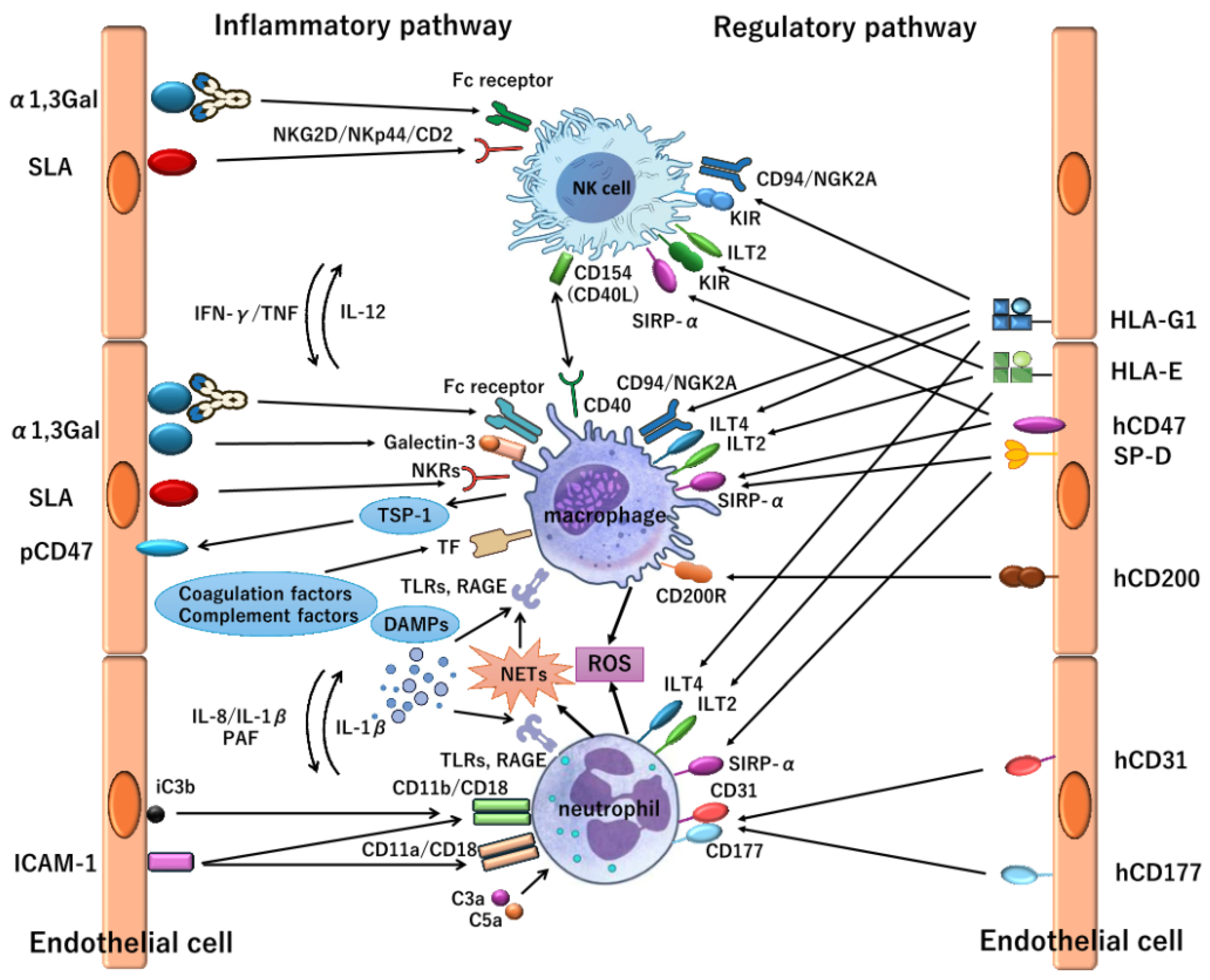
7. Macrophage Activation and Innate Immune Amplification in Xenotransplantation
8. NK Cell Activation and Cytotoxic Mechanisms in Xenotransplantation
9. Neutrophils as Early Innate Immune Effectors in Xenotransplantation
10. Future Perspectives on Genetic Strategies in Xenotransplantation
11. Conclusions
Author Contributions
Funding
Institutional Review Board Statement
Data Availability Statement
Conflicts of Interest
References
- Nakai, S.; Wada, A.; Wakai, K.; Abe, M.; Nitta, K. Calculation of expected remaining lifetime of dialysis patients in Japan. Ren. Replace. Ther. 2020, 6, 58. [Google Scholar] [CrossRef]
- Cooper, D.K. A brief history of cross-species organ transplantation. Bayl. Univ. Med. Cent. Proc. 2012, 25, 49–57. [Google Scholar] [CrossRef] [PubMed]
- Ryczek, N.; Hryhorowicz, M.; Zeyland, J.; Lipinski, D.; Slomski, R. CRISPR/Cas Technology in Pig-to-Human Xenotransplantation Research. Int. J. Mol. Sci. 2021, 22, 3196. [Google Scholar] [CrossRef] [PubMed]
- Scalea, J.; Hanecamp, I.; Robson, S.C.; Yamada, K. T-cell-mediated immunological barriers to xenotransplantation. Xenotransplantation 2012, 19, 23–30. [Google Scholar] [CrossRef]
- Kalscheuer, H.; Onoe, T.; Dahmani, A.; Li, H.W.; Holzl, M.; Yamada, K.; Sykes, M. Xenograft tolerance and immune function of human T cells developing in pig thymus xenografts. J. Immunol. 2014, 192, 3442–3450. [Google Scholar] [CrossRef]
- Arabi, T.Z.; Sabbah, B.N.; Lerman, A.; Zhu, X.Y.; Lerman, L.O. Xenotransplantation: Current Challenges and Emerging Solutions. Cell Transplant. 2023, 32, 9636897221148771. [Google Scholar] [CrossRef]
- Cooper, D.K.C.; Ekser, B.; Tector, A.J. Immunobiological barriers to xenotransplantation. Int. J. Surg. 2015, 23, 211–216. [Google Scholar] [CrossRef]
- Kim, E.J.; Kwun, J.; Gibby, A.C.; Hong, J.J.; Farris, A.B., 3rd; Iwakoshi, N.N.; Villinger, F.; Kirk, A.D.; Knechtle, S.J. Costimulation blockade alters germinal center responses and prevents antibody-mediated rejection. Am. J. Transplant. 2014, 14, 59–69. [Google Scholar] [CrossRef]
- Cooper, D.K.; Ezzelarab, M.B.; Hara, H.; Iwase, H.; Lee, W.; Wijkstrom, M.; Bottino, R. The pathobiology of pig-to-primate xenotransplantation: A historical review. Xenotransplantation 2016, 23, 83–105. [Google Scholar] [CrossRef]
- Bender, M.; Abicht, J.M.; Reichart, B.; Neumann, E.; Radan, J.; Mokelke, M.; Buttgereit, I.; Leuschen, M.; Wall, F.; Michel, S.; et al. Combination of Anti-CD40 and Anti-CD40L Antibodies as Co-Stimulation Blockade in Preclinical Cardiac Xenotransplantation. Biomedicines 2024, 12, 1927. [Google Scholar] [CrossRef]
- Higginbotham, L.; Mathews, D.; Breeden, C.A.; Song, M.; Farris, A.B., 3rd; Larsen, C.P.; Ford, M.L.; Lutz, A.J.; Tector, M.; Newell, K.A.; et al. Pre-transplant antibody screening and anti-CD154 costimulation blockade promote long-term xenograft survival in a pig-to-primate kidney transplant model. Xenotransplantation 2015, 22, 221–230. [Google Scholar] [CrossRef] [PubMed]
- Kuwaki, K.; Knosalla, C.; Dor, F.J.; Gollackner, B.; Tseng, Y.L.; Houser, S.; Mueller, N.; Prabharasuth, D.; Alt, A.; Moran, K.; et al. Suppression of natural and elicited antibodies in pig-to-baboon heart transplantation using a human anti-human CD154 mAb-based regimen. Am. J. Transplant. 2004, 4, 363–372. [Google Scholar] [CrossRef] [PubMed]
- Mohiuddin, M.M.; Singh, A.K.; Corcoran, P.C.; Thomas, M.L., III; Clark, T.; Lewis, B.G.; Hoyt, R.F.; Eckhaus, M.; Pierson, R.N., III; Belli, A.J.; et al. Chimeric 2C10R4 anti-CD40 antibody therapy is critical for long-term survival of GTKO.hCD46.hTBM pig-to-primate cardiac xenograft. Nat. Commun. 2016, 7, 11138. [Google Scholar] [CrossRef] [PubMed]
- Perrin, S.; Magill, M. The Inhibition of CD40/CD154 Costimulatory Signaling in the Prevention of Renal Transplant Rejection in Nonhuman Primates: A Systematic Review and Meta Analysis. Front. Immunol. 2022, 13, 861471. [Google Scholar] [CrossRef]
- Estrada, J.L.; Martens, G.; Li, P.; Adams, A.; Newell, K.A.; Ford, M.L.; Butler, J.R.; Sidner, R.; Tector, M.; Tector, J. Evaluation of human and non-human primate antibody binding to pig cells lacking GGTA1/CMAH/β4GalNT2 genes. Xenotransplantation 2015, 22, 194–202. [Google Scholar] [CrossRef]
- Sandrin, M.; McKenzie, I.F.C. Galα(1,3)Gal, the Major Xenoantigen(s) Recognised in Pigs by Human Natural Antibodies. Immunol. Rev. 1994, 141, 169–190. [Google Scholar] [CrossRef]
- Puga Yung, G.; Schneider, M.K.; Seebach, J.D. Immune responses to alpha1,3 galactosyltransferase knockout pigs. Curr. Opin. Organ. Transplant. 2009, 14, 154–160. [Google Scholar] [CrossRef]
- Kuwaki, K.; Tseng, Y.L.; Dor, F.J.; Shimizu, A.; Houser, S.L.; Sanderson, T.M.; Lancos, C.J.; Prabharasuth, D.D.; Cheng, J.; Moran, K.; et al. Heart transplantation in baboons using alpha1,3-galactosyltransferase gene-knockout pigs as donors: Initial experience. Nat. Med. 2005, 11, 29–31. [Google Scholar] [CrossRef]
- Phelps, C.J.; Koike, C.; Vaught, T.D.; Boone, J.; Wells, K.D.; Chen, S.H.; Ball, S.; Specht, S.M.; Polejaeva, I.A.; Monahan, J.A.; et al. Production of alpha 1,3-galactosyltransferase-deficient pigs. Science 2003, 299, 411–414. [Google Scholar] [CrossRef]
- Lutz, A.J.; Li, P.; Estrada, J.L.; Sidner, R.A.; Chihara, R.K.; Downey, S.M.; Burlak, C.; Wang, Z.Y.; Reyes, L.M.; Ivary, B.; et al. Double knockout pigs deficient in N-glycolylneuraminic acid and galactose alpha-1,3-galactose reduce the humoral barrier to xenotransplantation. Xenotransplantation 2013, 20, 27–35. [Google Scholar] [CrossRef]
- Byrne, G.W.; Stalboerger, P.G.; Du, Z.; Davis, T.R.; McGregor, C.G. Identification of new carbohydrate and membrane protein antigens in cardiac xenotransplantation. Transplantation 2011, 91, 287–292. [Google Scholar] [CrossRef] [PubMed]
- Zhou, C.Y.; McInnes, E.; Copeman, L.; Langford, G.; Parsons, N.; Lancaster, R.; Richards, A.; Carrington, C.; Thompson, S. Transgenic pigs expressing human CD59, in combination with human membrane cofactor protein and human decay-accelerating factor. Xenotransplantation 2005, 12, 142–148. [Google Scholar] [CrossRef] [PubMed]
- Diamond, L.E.; Quinn, C.M.; Martin, M.J.; Lawson, J.; Platt, J.L.; Logan, J.S. A human CD46 transgenic pig model system for the study of discordant xenotransplantation. Transplantation 2001, 71, 132–142. [Google Scholar] [CrossRef] [PubMed]
- Menoret, S.; Plat, M.; Blancho, G.; Martinat-Botte, F.; Bernard, P.; Karam, G.; Tesson, L.; Renaudin, K.; Guillouet, P.; Weill, B.; et al. Characterization of human CD55 and CD59 transgenic pigs and kidney xenotransplantation in the pig-to-baboon combination. Transplantation 2004, 77, 1468–1471. [Google Scholar] [CrossRef]
- Lavitrano, M.; Stoppacciaro, A.; Bacci, M.L.; Forni, M.; Fioretti, D.; Pucci, L.; Di Stefano, C.; Lazzereschi, D.; Rughetti, A.; Ceretta, S.; et al. Human decay accelerating factor transgenic pigs for xenotransplantation obtained by sperm-mediated gene transfer. Transplant. Proc. 1999, 31, 972–974. [Google Scholar] [CrossRef]
- Ko, N.; Shim, J.; Kim, H.J.; Lee, Y.; Park, J.K.; Kwak, K.; Lee, J.W.; Jin, D.I.; Kim, H.; Choi, K. A desirable transgenic strategy using GGTA1 endogenous promoter-mediated knock-in for xenotransplantation model. Sci. Rep. 2022, 12, 9611. [Google Scholar] [CrossRef]
- Kroshus, T.J.; Bolman, R.M., III; Dalmasso, A.P.; Rollins, S.A.; Guilmette, E.R.; Williams, B.L.; Squinto, S.P.; Fodor, W.L. Expression of Human Cd59 in Transgenic Pig Organs Enhances Organ Survival In an Ex Vivo Xenogeneic Perfusion Model1,2. Transplantation 1996, 61, 1513–1521. [Google Scholar] [CrossRef]
- Kenawy, H.I.; Boral, I.; Bevington, A. Complement-Coagulation Cross-Talk: A Potential Mediator of the Physiological Activation of Complement by Low pH. Front. Immunol. 2015, 6, 215. [Google Scholar] [CrossRef]
- Gultom, M.; Rieben, R. Complement, Coagulation, and Fibrinolysis: The Role of the Endothelium and Its Glycocalyx Layer in Xenotransplantation. Transpl. Int. 2024, 37, 13473. [Google Scholar] [CrossRef]
- Miwa, Y.; Yamamoto, K.; Onishi, A.; Iwamoto, M.; Yazaki, S.; Haneda, M.; Iwasaki, K.; Liu, D.; Ogawa, H.; Nagasaka, T.; et al. Potential value of human thrombomodulin and DAF expression for coagulation control in pig-to-human xenotransplantation. Xenotransplantation 2010, 17, 26–37. [Google Scholar] [CrossRef]
- Wuensch, A.; Baehr, A.; Bongoni, A.K.; Kemter, E.; Blutke, A.; Baars, W.; Haertle, S.; Zakhartchenko, V.; Kurome, M.; Kessler, B.; et al. Regulatory sequences of the porcine THBD gene facilitate endothelial-specific expression of bioactive human thrombomodulin in single- and multitransgenic pigs. Transplantation 2014, 97, 138–147. [Google Scholar] [CrossRef] [PubMed]
- Huai, G.; Wang, Y.; Du, J.; Cheng, Z.; Xie, Y.; Zhou, J.; Tang, H.; Jiang, Y.; Xing, X.; Deng, S.; et al. The generation and evaluation of TKO/hCD55/hTM/hEPCR gene-modified pigs for clinical organ xenotransplantation. Front. Immunol. 2024, 15, 1488552. [Google Scholar] [CrossRef] [PubMed]
- Iwase, H.; Ekser, B.; Hara, H.; Phelps, C.; Ayares, D.; Cooper, D.K.; Ezzelarab, M.B. Regulation of human platelet aggregation by genetically modified pig endothelial cells and thrombin inhibition. Xenotransplantation 2014, 21, 72–83. [Google Scholar] [CrossRef] [PubMed]
- Crikis, S.; Lu, B.; Murray-Segal, L.M.; Selan, C.; Robson, S.C.; D’Apice, A.J.; Nandurkar, H.H.; Cowan, P.J.; Dwyer, K.M. Transgenic overexpression of CD39 protects against renal ischemia-reperfusion and transplant vascular injury. Am. J. Transplant. 2010, 10, 2586–2595. [Google Scholar] [CrossRef]
- Ide, K.; Wang, H.; Tahara, H.; Liu, J.; Wang, X.; Asahara, T.; Sykes, M.; Yang, Y.G.; Ohdan, H. Role for CD47-SIRPalpha signaling in xenograft rejection by macrophages. Proc. Natl. Acad. Sci. USA 2007, 104, 5062–5066. [Google Scholar] [CrossRef]
- Nomura, S.; Ariyoshi, Y.; Watanabe, H.; Pomposelli, T.; Takeuchi, K.; Garcia, G.; Tasaki, M.; Ayares, D.; Sykes, M.; Sachs, D.; et al. Transgenic expression of human CD47 reduces phagocytosis of porcine endothelial cells and podocytes by baboon and human macrophages. Xenotransplantation 2020, 27, e12549. [Google Scholar] [CrossRef]
- Wang, H.; VerHalen, J.; Madariaga, M.L.; Xiang, S.; Wang, S.; Lan, P.; Oldenborg, P.A.; Sykes, M.; Yang, Y.G. Attenuation of phagocytosis of xenogeneic cells by manipulating CD47. Blood 2007, 109, 836–842. [Google Scholar] [CrossRef]
- Wang, C.; Wang, H.; Ide, K.; Wang, Y.; Van Rooijen, N.; Ohdan, H.; Yang, Y.G. Human CD47 expression permits survival of porcine cells in immunodeficient mice that express SIRPalpha capable of binding to human CD47. Cell Transplant. 2011, 20, 1915–1920. [Google Scholar] [CrossRef]
- Petersen, B.; Ramackers, W.; Lucas-Hahn, A.; Lemme, E.; Hassel, P.; Queisser, A.L.; Herrmann, D.; Barg-Kues, B.; Carnwath, J.W.; Klose, J.; et al. Transgenic expression of human heme oxygenase-1 in pigs confers resistance against xenograft rejection during ex vivo perfusion of porcine kidneys. Xenotransplantation 2011, 18, 355–368. [Google Scholar] [CrossRef]
- Yeom, H.J.; Koo, O.J.; Yang, J.; Cho, B.; Hwang, J.I.; Park, S.J.; Hurh, S.; Kim, H.; Lee, E.M.; Ro, H.; et al. Generation and characterization of human heme oxygenase-1 transgenic pigs. PLoS ONE 2012, 7, e46646. [Google Scholar] [CrossRef]
- Oropeza, M.; Petersen, B.; Carnwath, J.W.; Lucas-Hahn, A.; Lemme, E.; Hassel, P.; Herrmann, D.; Barg-Kues, B.; Holler, S.; Queisser, A.L.; et al. Transgenic expression of the human A20 gene in cloned pigs provides protection against apoptotic and inflammatory stimuli. Xenotransplantation 2009, 16, 522–534. [Google Scholar] [CrossRef] [PubMed]
- Hinrichs, A.; Riedel, E.O.; Klymiuk, N.; Blutke, A.; Kemter, E.; Langin, M.; Dahlhoff, M.; Kessler, B.; Kurome, M.; Zakhartchenko, V.; et al. Growth hormone receptor knockout to reduce the size of donor pigs for preclinical xenotransplantation studies. Xenotransplantation 2021, 28, e12664. [Google Scholar] [CrossRef] [PubMed]
- Goerlich, C.E.; Griffith, B.; Hanna, P.; Hong, S.N.; Ayares, D.; Singh, A.K.; Mohiuddin, M.M. The growth of xenotransplanted hearts can be reduced with growth hormone receptor knockout pig donors. J. Thorac. Cardiovasc. Surg. 2023, 165, e69–e81. [Google Scholar] [CrossRef] [PubMed]
- Anand, R.P.; Layer, J.V.; Heja, D.; Hirose, T.; Lassiter, G.; Firl, D.J.; Paragas, V.B.; Akkad, A.; Chhangawala, S.; Colvin, R.B.; et al. Design and testing of a humanized porcine donor for xenotransplantation. Nature 2023, 622, 393–401. [Google Scholar] [CrossRef]
- Denner, J. Porcine endogenous retroviruses in xenotransplantation. Nephrol. Dial. Transplant. 2024, 39, 1221–1227. [Google Scholar] [CrossRef]
- Fishman, J.A.; Denner, J.; Scobie, L. International Xenotransplantation Association (IXA) Position Paper on Infectious Disease Considerations in Xenotransplantation. Transplantation 2025, 109, 1296–1300. [Google Scholar] [CrossRef]
- Firl, D.J.; Markmann, J.F. Measuring success in pig to non-human-primate renal xenotransplantation: Systematic review and comparative outcomes analysis of 1051 life-sustaining NHP renal allo- and xeno-transplants. Am. J. Transplant. 2022, 22, 1527–1536. [Google Scholar] [CrossRef]
- Porrett, P.M.; Orandi, B.J.; Kumar, V.; Houp, J.; Anderson, D.; Cozette Killian, A.; Hauptfeld-Dolejsek, V.; Martin, D.E.; Macedon, S.; Budd, N.; et al. First clinical-grade porcine kidney xenotransplant using a human decedent model. Am. J. Transplant. 2022, 22, 1037–1053. [Google Scholar] [CrossRef]
- Montgomery, R.A.; Stern, J.M.; Fathi, F.; Suek, N.; Kim, J.I.; Khalil, K.; Vermette, B.; Tatapudi, V.S.; Mattoo, A.; Skolnik, E.Y.; et al. Physiology and immunology of pig-to-human decedent kidney xenotransplant. Nature 2025, 650, 218–229. [Google Scholar] [CrossRef]
- Montgomery, R.A.; Griesemer, A.D.; Segev, D.L.; Sommer, P. The decedent model: A new paradigm for de-risking high stakes clinical trials like xenotransplantation. Am. J. Transplant. 2024, 24, 526–532. [Google Scholar] [CrossRef]
- Healey, N. World-first pig kidney trials mark turning point for xenotransplantation. Nat. Med. 2025; ahead of print. [Google Scholar] [CrossRef]
- A tipping point for kidney xenotransplantation. Nat. Med. 2025, 31, 2075. [CrossRef] [PubMed]
- Pullen, L.C. Extracorporeal liver support with a porcine liver: The United States Food and Drug Administration approves the first trial. Am. J. Transplant. 2025, 25, 1589–1591. [Google Scholar] [CrossRef] [PubMed]
- Xu, K.; Zhao, H.; Jia, B.; Wang, J.; Siddig, N.; Jamal, M.A.; Mao, A.; Liu, K.; Cheng, W.; Yang, C.; et al. Specific pathogen free ten gene-edited donor pigs for xenotransplantation. Protein Cell 2025, 16, 1002–1016. [Google Scholar] [CrossRef] [PubMed]
- Xing, K.; Chang, Y.; Zhang, X.; Du, X.; Song, J. Xenotransplantation in China: Past, Present, and Future. Xenotransplantation 2025, 32, e70038. [Google Scholar] [CrossRef]
- Zhu, Y.; Tang, A.; Xiao, Q.; Hu, J. A milestone in liver xenotransplantation: The first 10-gene-edited pig-to-living-human auxiliary transplantation and the road ahead. Cell Transplant. 2026, 35, 09636897251411036. [Google Scholar] [CrossRef]
- Tao, K.S.; Yang, Z.X.; Zhang, X.; Zhang, H.T.; Yue, S.Q.; Yang, Y.L.; Song, W.J.; Wang, D.S.; Liu, Z.C.; Li, H.M.; et al. Gene-modified pig-to-human liver xenotransplantation. Nature 2025, 641, 1029–1036. [Google Scholar] [CrossRef]
- Hwang, S.A.; Park, K.S.; Kim, W.S.; Shin, K.C.; Ahn, Y.R.; Kim, J.S.; Chee, H.K.; Yang, H.S.; Oh, K.B.; Choi, K.M.; et al. Current Status of Genetically Engineered Pig to Monkey Kidney Xenotransplantation in Korea. Transplant. Proc. 2023, 55, 1043–1047. [Google Scholar] [CrossRef]
- Kim, B.J.; Shin, J.S.; Min, B.H.; Kim, J.M.; Park, C.G.; Kang, H.J.; Hwang, E.S.; Lee, W.W.; Kim, J.S.; Kim, H.J.; et al. Clinical Trial Protocol for Porcine Islet Xenotransplantation in South Korea. Diabetes Metab. J. 2024, 48, 1160–1168. [Google Scholar] [CrossRef]
- Choi, H.J.; Yoon, C.H.; Hyon, J.Y.; Lee, H.K.; Song, J.S.; Chung, T.Y.; Mo, H.; Kim, J.; Kim, J.E.; Hahm, B.J.; et al. Protocol for the first clinical trial to investigate safety and efficacy of corneal xenotransplantation in patients with corneal opacity, corneal perforation, or impending corneal perforation. Xenotransplantation 2019, 26, e12446. [Google Scholar] [CrossRef]
- Lee, S.H.; Kim, C.Y.; Ryu, J.S.; Choi, D.H.; Yoon, C.H.; Park, C.G.; Choi, K.; Kim, H.; Kim, M.K. Biocompatibility of Genetically-Engineered Pig Cornea in Corneal Xenotransplantation: Preliminary In Vitro Study. Xenotransplantation 2025, 32, e70081. [Google Scholar] [CrossRef] [PubMed]
- Fedson, S.; Lavee, J.; Bryce, K.; Egan, T.; Olland, A.; Kanwar, M.; Courtwright, A.; Holm, A.M. Ethical considerations in xenotransplantation of thoracic organs–A call for a debate on value based decisions. J. Heart Lung Transplant. 2024, 43, 1033–1038. [Google Scholar] [CrossRef] [PubMed]
- Khush, K.K.; Bernat, J.L.; Pierson, R.N., 3rd; Silverman, H.J.; Parent, B.; Glazier, A.K.; Adams, A.B.; Fishman, J.A.; Gusmano, M.; Hawthorne, W.J.; et al. Research opportunities and ethical considerations for heart and lung xenotransplantation research: A report from the National Heart, Lung, and Blood Institute workshop. Am. J. Transplant. 2024, 24, 918–927. [Google Scholar] [CrossRef] [PubMed]
- Bobier, C.; Rodger, D.; Hurst, D.J. Xenotransplantation and lifelong monitoring. Am. J. Transplant. 2024, 24, 697–698. [Google Scholar] [CrossRef]
- Bobier, C.; Hurst, D.J.; Rodger, D.; Omelianchuk, A. Xenograft recipients and the right to withdraw from a clinical trial. Bioethics 2024, 38, 308–315. [Google Scholar] [CrossRef]
- Hurst, D.J.; Padilla, L.; Rodger, D.; Schiff, T.; Cooper, D.K.C. Close contacts of xenograft recipients: Ethical considerations due to risk of xenozoonosis. Xenotransplantation 2024, 31, e12847. [Google Scholar] [CrossRef]
- George, A.J. Ethics, virtues and xenotransplantation. Perfusion 2024, 39, 334–343. [Google Scholar] [CrossRef]
- Ladowski, J.M.; Houp, J.; Hauptfeld-Dolejsek, V.; Javed, M.; Hara, H.; Cooper, D.K.C. Aspects of histocompatibility testing in xenotransplantation. Transpl. Immunol. 2021, 67, 101409. [Google Scholar] [CrossRef]
- Hara, H.; Yamamoto, T.; Wei, H.J.; Cooper, D.K.C. What Have We Learned from In Vitro Studies About Pig-to-primate Organ Transplantation? Transplantation 2023, 107, 1265–1277. [Google Scholar] [CrossRef]
- Porrett, P.M.; Locke, J.E. A roadmap for human trials of xenotransplantation. J. Clin. Investig. 2022, 132, e164484. [Google Scholar] [CrossRef]
- Cho, S.I.; Park, H.; Kang, H.; Oh, E.-J. Flowcytometric xeno-crossmatching: Assessment of pig cells (WT, QKO) compatibility with human/non-human primate sera and human leukocyte antigen antibody profiling. Korean J. Transplant. 2023, 37, S241–S241. [Google Scholar] [CrossRef]
- Cho, S.I.; Yan, J.J.; Kim, B.S.; Ko, N.; Shim, J.; Kim, H.; Oh, E.J. Epitope-level analysis of cross-reactive human HLA antibodies against genetically modified swine leukocyte antigens in xenotransplantation. Front. Immunol. 2025, 16, 1712793. [Google Scholar] [CrossRef]
- Schmalkuche, K.; Schwinzer, R.; Wenzel, N.; Valdivia, E.; Petersen, B.; Blasczyk, R.; Figueiredo, C. Downregulation of Swine Leukocyte Antigen Expression Decreases the Strength of Xenogeneic Immune Responses towards Renal Proximal Tubular Epithelial Cells. Int. J. Mol. Sci. 2023, 24, 12711. [Google Scholar] [CrossRef] [PubMed]
- Hisadome, Y.; Eisenson, D.L.; Santillan, M.R.; Iwase, H.; Yamada, K. Pretransplant Screening for Prevention of Hyperacute Graft Loss in Pig-to-primate Kidney Xenotransplantation. Transplantation 2024, 108, 1749–1759. [Google Scholar] [CrossRef] [PubMed]
- Fishman, J.A. Prevention of infection in xenotransplantation: Designated pathogen-free swine in the safety equation. Xenotransplantation 2020, 27, e12595. [Google Scholar] [CrossRef] [PubMed]
- Mehta, S.A.; Saharia, K.K.; Nellore, A.; Blumberg, E.A.; Fishman, J.A. Infection and clinical xenotransplantation: Guidance from the Infectious Disease Community of Practice of the American Society of Transplantation. Am. J. Transplant. 2023, 23, 309–315. [Google Scholar] [CrossRef]
- Fishman, J.A.; Mueller, N.J. Infectious Diseases and Clinical Xenotransplantation. Emerg. Infect. Dis. 2024, 30, 1311–1318. [Google Scholar] [CrossRef]
- Otabi, H.; Miura, H.; Uryu, H.; Kobayashi-Harada, R.; Abe, K.; Nakano, K.; Umeyama, K.; Hasegawa, K.; Tsukahara, T.; Nagashima, H.; et al. Development of a panel for detection of pathogens in xenotransplantation donor pigs. Xenotransplantation 2023, 30, e12825. [Google Scholar] [CrossRef]
- Loupy, A.; Goutaudier, V.; Giarraputo, A.; Mezine, F.; Morgand, E.; Robin, B.; Khalil, K.; Mehta, S.; Keating, B.; Dandro, A.; et al. Immune response after pig-to-human kidney xenotransplantation: A multimodal phenotyping study. Lancet 2023, 402, 1158–1169. [Google Scholar] [CrossRef]
- Pan, W.; Zhang, W.; Zheng, B.; Camellato, B.R.; Stern, J.; Lin, Z.; Khodadadi-Jamayran, A.; Kim, J.; Sommer, P.; Khalil, K.; et al. Cellular dynamics in pig-to-human kidney xenotransplantation. Med 2024, 5, 1016–1029.e4. [Google Scholar] [CrossRef]
- Schmauch, E.; Piening, B.; Mohebnasab, M.; Xia, B.; Zhu, C.; Stern, J.; Zhang, W.; Dowdell, A.K.; Kim, J.I.; Andrijevic, D.; et al. Integrative multi-omics profiling in human decedents receiving pig heart xenografts. Nat. Med. 2024, 30, 1448–1460. [Google Scholar] [CrossRef] [PubMed]
- Cheung, M.D.; Asiimwe, R.; Erman, E.N.; Fucile, C.F.; Liu, S.; Sun, C.W.; Hanumanthu, V.S.; Pal, H.C.; Wright, E.D.; Ghajar-Rahimi, G.; et al. Spatiotemporal immune atlas of a clinical-grade gene-edited pig-to-human kidney xenotransplant. Nat. Commun. 2024, 15, 3140. [Google Scholar] [CrossRef] [PubMed]
- Ribas, G.T.; Cunha, A.F.; Avila, J.P.; Giarraputo, A.; Morena, L.; Lima, K.; Gassen, R.B.; Chen, J.Y.; Lin, J.R.; Santagata, S.; et al. Immune profiling in a living human recipient of a gene-edited pig kidney. Nat. Med. 2026, 32, 270–280. [Google Scholar] [CrossRef] [PubMed]
- Miyagawa, S.; Maeda, A.; Toyama, C.; Kogata, S.; Okamatsu, C.; Yamamoto, R.; Masahata, K.; Kamiyama, M.; Eguchi, H.; Watanabe, M.; et al. Aspects of the Complement System in New Era of Xenotransplantation. Front. Immunol. 2022, 13, 860165. [Google Scholar] [CrossRef]
- Kakuta, Y.; Miyagawa, S.; Matsumura, S.; Higa-Maegawa, Y.; Fukae, S.; Tanaka, R.; Nakazawa, S.; Yamanaka, K.; Kawamura, T.; Saito, S.; et al. Complement and complement regulatory protein in allogeneic and xenogeneic kidney transplantation. Transplant. Rev. 2025, 39, 100885. [Google Scholar] [CrossRef]
- Magee, J.C.; Collins, B.H.; Harland, R.C.; Lindman, B.J.; Bollinger, R.R.; Frank, M.M.; Platt, J.L. Immunoglobulin prevents complement-mediated hyperacute rejection in swine-to-primate xenotransplantation. J. Clin. Investig. 1995, 96, 2404–2412. [Google Scholar] [CrossRef]
- Walpen, A.J.; Mohacsi, P.; Frey, C.; Roos, A.; Daha, M.R.; Rieben, R. Activation of complement pathways in xenotransplantation: An in vitro study. Transpl. Immunol. 2002, 9, 271–280. [Google Scholar] [CrossRef]
- Hecker, J.M.; Lorenz, R.; Appiah, R.; Vangerow, B.; Loss, M.; Kunz, R.; Schmidtko, J.; Mengel, M.; Klempnauer, J.; Piepenbrock, S.; et al. C1-inhibitor for prophylaxis of xenograft rejection after pig to cynomolgus monkey kidney transplantation. Transplantation 2002, 73, 688–694. [Google Scholar] [CrossRef]
- Suckfüll, M.; Müdsam, M.; Pieske, O.; Enders, G.; Babic, R.; Hammer, C. Immunohistological studies of complement activation after xenogeneic perfusion of a working heart model. Transpl. Int. 1994, 7, 324–328. [Google Scholar] [CrossRef]
- Fromell, K.; Adler, A.; Aman, A.; Manivel, V.A.; Huang, S.; Duhrkop, C.; Sandholm, K.; Ekdahl, K.N.; Nilsson, B. Assessment of the Role of C3(H2O) in the Alternative Pathway. Front. Immunol. 2020, 11, 530. [Google Scholar] [CrossRef]
- Bongoni, A.K.; Kiermeir, D.; Jenni, H.; Wunsch, A.; Bahr, A.; Ayares, D.; Seebach, J.D.; Wolf, E.; Klymiuk, N.; Constantinescu, M.A.; et al. Activation of the lectin pathway of complement in pig-to-human xenotransplantation models. Transplantation 2013, 96, 791–799. [Google Scholar] [CrossRef]
- Schmauch, E.; Piening, B.D.; Dowdell, A.K.; Mohebnasab, M.; Williams, S.H.; Stukalov, A.; Robinson, F.L.; Bombardi, R.; Jaffe, I.; Khalil, K.; et al. Multi-omics analysis of a pig-to-human decedent kidney xenotransplant. Nature 2025, 650, 205–217. [Google Scholar] [CrossRef] [PubMed]
- Barilla-LaBarca, M.L.; Liszewski, M.K.; Lambris, J.D.; Hourcade, D.; Atkinson, J.P. Role of membrane cofactor protein (CD46) in regulation of C4b and C3b deposited on cells. J. Immunol. 2002, 168, 6298–6304. [Google Scholar] [CrossRef] [PubMed]
- Loveland, B.E.; Milland, J.; Kyriakou, P.; Thorley, B.R.; Christiansen, D.; Lanteri, M.B.; van Regensburg, M.; Duffield, M.; French, A.J.; Williams, L.; et al. Characterization of a CD46 transgenic pig and protection of transgenic kidneys against hyperacute rejection in non-immunosuppressed baboons. Xenotransplantation 2004, 11, 171–183. [Google Scholar] [CrossRef] [PubMed]
- Mohiuddin, M.M.; Corcoran, P.C.; Singh, A.K.; Azimzadeh, A.; Hoyt, R.F., Jr.; Thomas, M.L.; Eckhaus, M.A.; Seavey, C.; Ayares, D.; Pierson, R.N., 3rd; et al. B-cell depletion extends the survival of GTKO.hCD46Tg pig heart xenografts in baboons for up to 8 months. Am. J. Transplant. 2012, 12, 763–771. [Google Scholar] [CrossRef]
- Kuttner-Kondo, L.A.; Mitchell, L.; Hourcade, D.E.; Medof, M.E. Characterization of the active sites in decay-accelerating factor. J. Immunol. 2001, 167, 2164–2171. [Google Scholar] [CrossRef]
- McCurry, K.R.; Kooyman, D.L.; Alvarado, C.G.; Cotterell, A.H.; Martin, M.J.; Logan, J.S.; Platt, J.L. Human complement regulatory proteins protect swine-to-primate cardiac xenografts from humoral injury. Nat. Med. 1995, 1, 423–427. [Google Scholar] [CrossRef]
- Kim, S.C.; Mathews, D.V.; Breeden, C.P.; Higginbotham, L.B.; Ladowski, J.; Martens, G.; Stephenson, A.; Farris, A.B.; Strobert, E.A.; Jenkins, J.; et al. Long-term survival of pig-to-rhesus macaque renal xenografts is dependent on CD4 T cell depletion. Am. J. Transplant. 2019, 19, 2174–2185. [Google Scholar] [CrossRef]
- Couves, E.C.; Gardner, S.; Voisin, T.B.; Bickel, J.K.; Stansfeld, P.J.; Tate, E.W.; Bubeck, D. Structural basis for membrane attack complex inhibition by CD59. Nat. Commun. 2023, 14, 890. [Google Scholar] [CrossRef]
- Iwase, H.; Liu, H.; Wijkstrom, M.; Zhou, H.; Singh, J.; Hara, H.; Ezzelarab, M.; Long, C.; Klein, E.; Wagner, R.; et al. Pig kidney graft survival in a baboon for 136 days: Longest life-supporting organ graft survival to date. Xenotransplantation 2015, 22, 302–309. [Google Scholar] [CrossRef]
- Byrne, G.W.; McCurry, K.R.; Martin, M.J.; McClellan, S.M.; Platt, J.L.; Logan, J.S. Transgenic pigs expressing human CD59 and decay-accelerating factor produce an intrinsic barrier to complement-mediated damage. Transplantation 1997, 63, 149–155. [Google Scholar] [CrossRef] [PubMed]
- Engelmann, B.; Massberg, S. Thrombosis as an intravascular effector of innate immunity. Nat. Rev. Immunol. 2013, 13, 34–45. [Google Scholar] [CrossRef] [PubMed]
- Lin, C.C.; Ezzelarab, M.; Shapiro, R.; Ekser, B.; Long, C.; Hara, H.; Echeverri, G.; Torres, C.; Watanabe, H.; Ayares, D.; et al. Recipient tissue factor expression is associated with consumptive coagulopathy in pig-to-primate kidney xenotransplantation. Am. J. Transplant. 2010, 10, 1556–1568. [Google Scholar] [CrossRef] [PubMed]
- Rataj, D.; Werwitzke, S.; Haarmeijer, B.; Winkler, M.; Ramackers, W.; Petersen, B.; Niemann, H.; Wunsch, A.; Bahr, A.; Klymiuk, N.; et al. Inhibition of complement component C5 prevents clotting in an ex vivo model of xenogeneic activation of coagulation. Xenotransplantation 2016, 23, 117–127. [Google Scholar] [CrossRef]
- Hess, K.; Ajjan, R.; Phoenix, F.; Dobo, J.; Gal, P.; Schroeder, V. Effects of MASP-1 of the complement system on activation of coagulation factors and plasma clot formation. PLoS ONE 2012, 7, e35690. [Google Scholar] [CrossRef]
- Galbusera, M.; Buelli, S.; Gastoldi, S.; Macconi, D.; Angioletti, S.; Testa, C.; Remuzzi, G.; Morigi, M. Activation of porcine endothelium in response to xenogeneic serum causes thrombosis independently of platelet activation. Xenotransplantation 2005, 12, 110–120. [Google Scholar] [CrossRef]
- Cowan, P.J.; Aminian, A.; Barlow, H.; Brown, A.A.; Chen, C.G.; Fisicaro, N.; Francis, D.M.; Goodman, D.J.; Han, W.; Kurek, M.; et al. Renal xenografts from triple-transgenic pigs are not hyperacutely rejected but cause coagulopathy in non-immunosuppressed baboons. Transplantation 2000, 69, 2504–2515. [Google Scholar] [CrossRef]
- Wang, J.; Xu, K.; Liu, T.; Zhao, H.; Jamal, M.A.; Chen, G.; Huo, X.; Yang, C.; Jiao, D.; Wei, T.; et al. Production and Functional Verification of 8-Gene (GGTA1, CMAH, beta4GalNT2, hCD46, hCD55, hCD59, hTBM, hCD39)-Edited Donor Pigs for Xenotransplantation. Cell Prolif. 2025, 58, e70028. [Google Scholar] [CrossRef]
- Lu, T.; Yang, B.; Wang, R.; Qin, C. Xenotransplantation: Current Status in Preclinical Research. Front. Immunol. 2019, 10, 3060. [Google Scholar] [CrossRef]
- Yang, H.; Hreggvidsdottir, H.S.; Palmblad, K.; Wang, H.; Ochani, M.; Li, J.; Lu, B.; Chavan, S.; Rosas-Ballina, M.; Al-Abed, Y.; et al. A critical cysteine is required for HMGB1 binding to Toll-like receptor 4 and activation of macrophage cytokine release. Proc. Natl. Acad. Sci. USA 2010, 107, 11942–11947. [Google Scholar] [CrossRef]
- Xu, X.C.; Goodman, J.; Sasaki, H.; Lowell, J.; Mohanakumar, T. Activation of natural killer cells and macrophages by porcine endothelial cells augments specific T-cell xenoresponse. Am. J. Transplant. 2002, 2, 314–322. [Google Scholar] [CrossRef] [PubMed]
- French, B.M.; Sendil, S.; Sepuru, K.M.; Ranek, J.; Burdorf, L.; Harris, D.; Redding, E.; Cheng, X.; Laird, C.T.; Zhao, Y.; et al. Interleukin-8 mediates neutrophil-endothelial interactions in pig-to-human xenogeneic models. Xenotransplantation 2018, 25, e12385. [Google Scholar] [CrossRef] [PubMed]
- Schneider, M.K.; Ghielmetti, M.; Rhyner, D.M.; Antsiferova, M.A.; Seebach, J.D. Human leukocyte transmigration across Galalpha(1,3)Gal-negative porcine endothelium is regulated by human CD18 and CD99. Transplantation 2009, 87, 491–499. [Google Scholar] [CrossRef] [PubMed]
- Maeda, A.; Lo, P.C.; Sakai, R.; Noguchi, Y.; Kodama, T.; Yoneyama, T.; Toyama, C.; Wang, H.T.; Esquivel, E.; Jiaravuthisan, P.; et al. A Strategy for Suppressing Macrophage-mediated Rejection in Xenotransplantation. Transplantation 2020, 104, 675–681. [Google Scholar] [CrossRef]
- Lin, C.C.; Chen, D.; McVey, J.H.; Cooper, D.K.; Dorling, A. Expression of tissue factor and initiation of clotting by human platelets and monocytes after incubation with porcine endothelial cells. Transplantation 2008, 86, 702–709. [Google Scholar] [CrossRef][Green Version]
- Yan, J.J.; Koo, T.Y.; Lee, H.S.; Lee, W.B.; Kang, B.; Lee, J.G.; Jang, J.Y.; Fang, T.; Ryu, J.H.; Ahn, C.; et al. Role of Human CD200 Overexpression in Pig-to-Human Xenogeneic Immune Response Compared with Human CD47 Overexpression. Transplantation 2018, 102, 406–416. [Google Scholar] [CrossRef]
- McHeik, S.; Wang, H.; Ding, X.; Li, H.W.; Sykes, M. Transgenic expression of hCD47 on pig cells provides only partial protection against human macrophage-mediated destruction in human immune system (HIS) mice. Am. J. Transplant. 2026, in press. [Google Scholar] [CrossRef]
- Narizhneva, N.V.; Razorenova, O.V.; Podrez, E.A.; Chen, J.; Chandrasekharan, U.M.; DiCorleto, P.E.; Plow, E.F.; Topol, E.J.; Byzova, T.V. Thrombospondin-1 up-regulates expression of cell adhesion molecules and promotes monocyte binding to endothelium. FASEB J. 2005, 19, 1158–1160. [Google Scholar] [CrossRef]
- Isenberg, J.S.; Romeo, M.J.; Yu, C.; Yu, C.K.; Nghiem, K.; Monsale, J.; Rick, M.E.; Wink, D.A.; Frazier, W.A.; Roberts, D.D. Thrombospondin-1 stimulates platelet aggregation by blocking the antithrombotic activity of nitric oxide/cGMP signaling. Blood 2008, 111, 613–623. [Google Scholar] [CrossRef]
- Takeuchi, K.; Ariyoshi, Y.; Shimizu, A.; Okumura, Y.; Cara-Fuentes, G.; Garcia, G.E.; Pomposelli, T.; Watanabe, H.; Boyd, L.; Ekanayake-Alper, D.K.; et al. Expression of human CD47 in pig glomeruli prevents proteinuria and prolongs graft survival following pig-to-baboon xenotransplantation. Xenotransplantation 2021, 28, e12708. [Google Scholar] [CrossRef]
- Goldstone, A.B.; Bacha, E.A.; Sykes, M. On cardiac xenotransplantation and the role of xenogeneic tolerance. J. Thorac. Cardiovasc. Surg. 2023, 166, 968–972. [Google Scholar] [CrossRef] [PubMed]
- Jiaravuthisan, P.; Maeda, A.; Takakura, C.; Wang, H.T.; Sakai, R.; Shabri, A.M.; Lo, P.C.; Matsuura, R.; Kodama, T.; Eguchi, H.; et al. A membrane-type surfactant protein D (SP-D) suppresses macrophage-mediated cytotoxicity in swine endothelial cells. Transpl. Immunol. 2018, 47, 44–48. [Google Scholar] [CrossRef] [PubMed]
- Kim, B.; Yan, J.J.; Kang, T.K.; Lee, W.B.; Jeong, J.C.; Yang, J. Molecular incompatibility between pig CD200 and human CD200 receptor in in vitro xenogeneic immune responses. Xenotransplantation 2024, 31, e12863. [Google Scholar] [CrossRef] [PubMed]
- Hofmeister, V.; Weiss, E.H. HLA-G modulates immune responses by diverse receptor interactions. Semin. Cancer Biol. 2003, 13, 317–323. [Google Scholar] [CrossRef]
- Sasaki, H.; Xu, X.C.; Mohanakumar, T. HLA-E and HLA-G expression on porcine endothelial cells inhibit xenoreactive human NK cells through CD94/NKG2-dependent and -independent pathways. J. Immunol. 1999, 163, 6301–6305. [Google Scholar] [CrossRef]
- Esquivel, E.L.; Maeda, A.; Eguchi, H.; Asada, M.; Sugiyama, M.; Manabe, C.; Sakai, R.; Matsuura, R.; Nakahata, K.; Okuyama, H.; et al. Suppression of human macrophage-mediated cytotoxicity by transgenic swine endothelial cell expression of HLA-G. Transpl. Immunol. 2015, 32, 109–115. [Google Scholar] [CrossRef]
- Eguchi, H.; Maeda, A.; Lo, P.C.; Matsuura, R.; Esquivel, E.L.; Asada, M.; Sakai, R.; Nakahata, K.; Yamamichi, T.; Umeda, S.; et al. HLA-G1, but Not HLA-G3, Suppresses Human Monocyte/Macrophage-mediated Swine Endothelial Cell Lysis. Transplant. Proc. 2016, 48, 1285–1287. [Google Scholar] [CrossRef]
- Greenwald, A.G.; Jin, R.; Waddell, T.K. Galectin-3-mediated xenoactivation of human monocytes. Transplantation 2009, 87, 44–51. [Google Scholar] [CrossRef]
- Goldszmid, R.S.; Caspar, P.; Rivollier, A.; White, S.; Dzutsev, A.; Hieny, S.; Kelsall, B.; Trinchieri, G.; Sher, A. NK cell-derived interferon-gamma orchestrates cellular dynamics and the differentiation of monocytes into dendritic cells at the site of infection. Immunity 2012, 36, 1047–1059. [Google Scholar] [CrossRef]
- Costantini, C.; Micheletti, A.; Calzetti, F.; Perbellini, O.; Pizzolo, G.; Cassatella, M.A. Neutrophil activation and survival are modulated by interaction with NK cells. Int. Immunol. 2010, 22, 827–838. [Google Scholar] [CrossRef]
- Lopez, K.J.; Cross-Najafi, A.A.; Farag, K.; Obando, B.; Thadasina, D.; Isidan, A.; Park, Y.; Zhang, W.; Ekser, B.; Li, P. Strategies to induce natural killer cell tolerance in xenotransplantation. Front. Immunol. 2022, 13, 941880. [Google Scholar] [CrossRef] [PubMed]
- Lu, T.Y.; Xu, X.L.; Du, X.G.; Wei, J.H.; Yu, J.N.; Deng, S.L.; Qin, C. Advances in Innate Immunity to Overcome Immune Rejection during Xenotransplantation. Cells 2022, 11, 3865. [Google Scholar] [CrossRef] [PubMed]
- Galdina, V.; Puga Yung, G.L.; Seebach, J.D. Cytotoxic Responses Mediated by NK Cells and Cytotoxic T Lymphocytes in Xenotransplantation. Transpl. Int. 2025, 38, 13867. [Google Scholar] [CrossRef] [PubMed]
- Valés-Gómez, M.; Reyburn, H.T.; Erskine, R.A.; López-Botet, M.; Strominger, J.L. Kinetics and peptide dependency of the binding of the inhibitory NK receptor CD94/NKG2-A and the activating receptor CD94/NKG2-C to HLA-E. EMBO J. 1999, 18, 4250–4260. [Google Scholar] [CrossRef]
- Navarro, F.; Llano, M.; Bellón, T.; Colonna, M.; Geraghty, D.E.; López-Botet, M. The ILT2(LIR1) and CD94/NKG2A NK cell receptors respectively recognize HLA-G1 and HLA-E molecules co-expressed on target cells. Eur. J. Immunol. 1999, 29, 277–283. [Google Scholar] [CrossRef]
- Matsunami, K.; Miyagawa, S.; Nakai, R.; Murase, A.; Shirakura, R. The possible use of HLA-G1 and G3 in the inhibition of NK cell-mediated swine endothelial cell lysis. Clin. Exp. Immunol. 2001, 126, 165–172. [Google Scholar] [CrossRef]
- Matsunami, K.; Miyagawa, S.; Nakai, R.; Yamada, M.; Shirakura, R. Modulation of the leader peptide sequence of the HLA-E gene up-regulates its expression and down-regulates natural killer cell-mediated swine endothelial cell lysis. Transplantation 2002, 73, 1582–1589. [Google Scholar] [CrossRef]
- Rajagopalan, S.; Bryceson, Y.T.; Kuppusamy, S.P.; Geraghty, D.E.; van der Meer, A.; Joosten, I.; Long, E.O. Activation of NK cells by an endocytosed receptor for soluble HLA-G. PLoS Biol. 2006, 4, e9. [Google Scholar] [CrossRef]
- Forte, P.; Baumann, B.C.; Schneider, M.K.; Seebach, J.D. HLA-Cw4 expression on porcine endothelial cells reduces cytotoxicity and adhesion mediated by CD158a+ human NK cells. Xenotransplantation 2009, 16, 19–26. [Google Scholar] [CrossRef]
- Cross-Najafi, A.A.; Farag, K.; Isidan, A.; Li, W.; Zhang, W.; Lin, Z.; Walsh, J.R.; Lopez, K.; Park, Y.; Higgins, N.G.; et al. Co-expression of HLA-E and HLA-G on genetically modified porcine endothelial cells attenuates human NK cell-mediated degranulation. Front. Immunol. 2023, 14, 1217809. [Google Scholar] [CrossRef]
- Deuse, T.; Hu, X.; Agbor-Enoh, S.; Jang, M.K.; Alawi, M.; Saygi, C.; Gravina, A.; Tediashvili, G.; Nguyen, V.Q.; Liu, Y.; et al. The SIRPalpha-CD47 immune checkpoint in NK cells. J. Exp. Med. 2021, 218, e20200839. [Google Scholar] [CrossRef]
- Forte, P.; Lilienfeld, B.G.; Baumann, B.C.; Seebach, J.D. Human NK cytotoxicity against porcine cells is triggered by NKp44 and NKG2D. J. Immunol. 2005, 175, 5463–5470. [Google Scholar] [CrossRef]
- Kim, T.J.; Kim, N.; Kim, E.O.; Choi, J.R.; Bluestone, J.A.; Lee, K.M. Suppression of human anti-porcine natural killer cell xenogeneic responses by combinations of monoclonal antibodies specific to CD2 and NKG2D and extracellular signal-regulated kinase kinase inhibitor. Immunology 2010, 130, 545–555. [Google Scholar] [CrossRef] [PubMed]
- Puga Yung, G.; Schneider, M.K.J.; Seebach, J.D. The Role of NK Cells in Pig-to-Human Xenotransplantation. J. Immunol. Res. 2017, 2017, 4627384. [Google Scholar] [CrossRef]
- Dehoux, J.P.; de la Parra, B.; Latinne, D.; Bazin, H.; Gianello, P. Effect in vitro and in vivo of a rat anti-CD2 monoclonal antibody (LO-CD2b) on pig-to-baboon xenogeneic cellular (T and natural killer cells) immune response. Xenotransplantation 2001, 8, 193–201. [Google Scholar] [CrossRef]
- Brossay, A.; Hube, F.; Moreau, T.; Bardos, P.; Watier, H. Porcine CD58: cDNA cloning and molecular dissection of the porcine CD58-human CD2 interface. Biochem. Biophys. Res. Commun. 2003, 309, 992–998. [Google Scholar] [CrossRef] [PubMed]
- Lopez, K.J.; Spence, J.P.; Li, W.; Zhang, W.; Wei, B.; Cross-Najafi, A.A.; Butler, J.R.; Cooper, D.K.C.; Ekser, B.; Li, P. Porcine UL-16 Binding Protein 1 Is Not a Functional Ligand for the Human Natural Killer Cell Activating Receptor NKG2D. Cells 2023, 12, 2587. [Google Scholar] [CrossRef] [PubMed]
- Kumagai-Braesch, M.; Satake, M.; Qian, Y.; Holgersson, J.; Möller, E. Human NK cell and ADCC reactivity against xenogeneic porcine target cells including fetal porcine islet cells. Xenotransplantation 1998, 5, 132–145. [Google Scholar] [CrossRef]
- Baumann, B.C.; Stussi, G.; Huggel, K.; Rieben, R.; Seebach, J.D. Reactivity of human natural antibodies to endothelial cells from Galalpha(1,3)Gal-deficient pigs. Transplantation 2007, 83, 193–201. [Google Scholar] [CrossRef]
- Hisashi, Y.; Yamada, K.; Kuwaki, K.; Tseng, Y.L.; Dor, F.J.; Houser, S.L.; Robson, S.C.; Schuurman, H.J.; Cooper, D.K.; Sachs, D.H.; et al. Rejection of cardiac xenografts transplanted from alpha1,3-galactosyltransferase gene-knockout (GalT-KO) pigs to baboons. Am. J. Transplant. 2008, 8, 2516–2526. [Google Scholar] [CrossRef]
- Baumann, B.C.; Forte, P.; Hawley, R.J.; Rieben, R.; Schneider, M.K.; Seebach, J.D. Lack of galactose-alpha-1,3-galactose expression on porcine endothelial cells prevents complement-induced lysis but not direct xenogeneic NK cytotoxicity. J. Immunol. 2004, 172, 6460–6467. [Google Scholar] [CrossRef]
- Hu, X.; Tediashvili, G.; Gravina, A.; Stoddard, J.; McGill, T.J.; Connolly, A.J.; Deuse, T.; Schrepfer, S. Inhibition of polymorphonuclear cells averts cytotoxicity against hypoimmune cells in xenotransplantation. Nat. Commun. 2025, 16, 3706. [Google Scholar] [CrossRef] [PubMed]
- Buelli, S.; Imberti, B.; Morigi, M. The complement C3a and C5a signaling in renal diseases: A bridge between acute and chronic inflammation. Nephron 2024, 148, 712–723. [Google Scholar] [CrossRef] [PubMed]
- Vercellotti, G.M.; Platt, J.L.; Bach, F.H.; Dalmasso, A.P. Neutrophil adhesion to xenogeneic endothelium via iC3b. J. Immunol. 1991, 146, 730–734. [Google Scholar] [CrossRef] [PubMed]
- Morigi, M.; Zoja, C.; Colleoni, S.; Angioletti, S.; Imberti, B.; Donadelli, R.; Remuzzi, A.; Remuzzi, G. Xenogeneic serum promotes leukocyte-endothelium interaction under flow through two temporally distinct pathways: Role of complement and nuclear factor-kappaB. J. Am. Soc. Nephrol. 1999, 10, 2197–2207. [Google Scholar] [CrossRef]
- Al-Mohanna, F.; Collison, K.; Parhar, R.; Kwaasi, A.; Meyer, B.; Saleh, S.; Allen, S.; Al-Sedairy, S.; Stern, D.; Yacoub, M. Activation of naive xenogeneic but not allogeneic endothelial cells by human naive neutrophils: A potential occult barrier to xenotransplantation. Am. J. Pathol. 1997, 151, 111–120. [Google Scholar]
- Cardozo, L.A.; Rouw, D.B.; Ambrose, L.R.; Midulla, M.; Florey, O.; Haskard, D.O.; Warrens, A.N. The neutrophil: The unnoticed threat in xenotransplantation? Transplantation 2004, 78, 1721–1728. [Google Scholar] [CrossRef]
- Ehrnfelt, C.; Serrander, L.; Holgersson, J. Porcine endothelium activated by anti-alpha-GAL antibody binding mediates increased human neutrophil adhesion under flow. Transplantation 2003, 76, 1112–1119. [Google Scholar] [CrossRef]
- Gilli, U.O.; Schneider, M.K.; Loetscher, P.; Seebach, J.D. Human polymorphonuclear neutrophils are recruited by porcine chemokines acting on CXC chemokine receptor 2, and platelet-activating factor. Transplantation 2005, 79, 1324–1331. [Google Scholar] [CrossRef]
- Al-Mohanna, F.; Saleh, S.; Parhar, R.S.; Khabar, K.; Collison, K. Human neutrophil gene expression profiling following xenogeneic encounter with porcine aortic endothelial cells: The occult role of neutrophils in xenograft rejection revealed. J. Leukoc. Biol. 2005, 78, 51–61. [Google Scholar] [CrossRef][Green Version]
- Yadav, S.K.; Park, S.; Lee, Y.M.; Hurh, S.; Kim, D.; Min, S.; Kim, S.; Yan, J.J.; Kang, B.C.; Kim, S.; et al. Application of microphysiologic system to assess neutrophil extracellular trap in xenotransplantation. J. Immunol. Methods 2023, 521, 113537. [Google Scholar] [CrossRef] [PubMed]
- van Zyl, M.; Cramer, E.; Sanders, J.F.; Leuvenink, H.G.D.; Lisman, T.; van Rooy, M.J.; Hillebrands, J.L. The role of neutrophil extracellular trap formation in kidney transplantation: Implications from donors to the recipient. Am. J. Transplant. 2024, 24, 1547–1557. [Google Scholar] [CrossRef] [PubMed]
- Wang, H.T.; Maeda, A.; Sakai, R.; Lo, P.C.; Takakura, C.; Jiaravuthisan, P.; Mod Shabri, A.; Matsuura, R.; Kodama, T.; Hiwatashi, S.; et al. Human CD31 on porcine cells suppress xenogeneic neutrophil-mediated cytotoxicity via the inhibition of NETosis. Xenotransplantation 2018, 25, e12396. [Google Scholar] [CrossRef]
- Yoneyama, T.; Maeda, A.; Kogata, S.; Toyama, C.; Lo, P.C.; Masahata, K.; Kamiyama, M.; Haneda, T.; Okamatu, C.; Eguchi, H.; et al. The Regulation of Neutrophil Extracellular Trap-induced Tissue Damage by Human CD177. Transpl. Direct 2021, 7, e734. [Google Scholar] [CrossRef]
- Takase, K.; Gadomska, K.; Maeda, A.; Matsui, J.; Nakahata, K.; Nomura, M.; Kamiyama, M.; Ueno, T.; Saito, S.; Ike, A.; et al. HLA-Class Ib Expression Suppresses Neutrophil Xenogeneic Immune Responses Against Pig Cells. J. Clin. Exp. Nephrol. 2025, 10, 292. [Google Scholar] [CrossRef]
- Iemitsu, K.; Sakai, R.; Maeda, A.; Gadomska, K.; Kogata, S.; Yasufuku, D.; Matsui, J.; Masahata, K.; Kamiyama, M.; Eguchi, H.; et al. The hybrid CL-SP-D molecule has the potential to regulate xenogeneic rejection by human neutrophils more efficiently than CD47. Transpl. Immunol. 2024, 84, 102020. [Google Scholar] [CrossRef]
- Wang, Y.; Chen, G.; Pan, D.; Guo, H.; Jiang, H.; Wang, J.; Feng, H.; He, S.; Du, J.; Zhang, M.; et al. Pig-to-human kidney xenotransplants using genetically modified minipigs. Cell Rep. Med. 2024, 5, 101744. [Google Scholar] [CrossRef]
- Patkova, B.; Svenningsson, A.; Almstrom, M.; Svensson, J.F.; Eriksson, S.; Wester, T.; Eaton, S. Long-Term Outcome of Nonoperative Treatment of Appendicitis. JAMA Surg. 2023, 158, 1105–1106. [Google Scholar] [CrossRef]
- Beyer, M.C. Third Genetically Modified Kidney Xenotransplantation in Living Human Recipient. Artif. Organs 2025, 49, 337–338. [Google Scholar] [CrossRef]
- Anderson, D.J.; Jones-Carr, M.; Perry, J.; Kumar, V.; Porrett, P.M.; Locke, J.E. Genetically Modified Porcine Kidneys Have Sufficient Tissue Integrity for Use in Pig-to-Human Xenotransplantation. Ann. Surg. 2024, 280, 374–382. [Google Scholar] [CrossRef]

| Genetic Modification | Modification Type | Immunological/Physiological Barrier (Function) |
|---|---|---|
| GGTA1 | Knockout | Hyperacute rejection (natural antibody, α-Gal) |
| CMAH | Knockout | Antibody response against non-Gal antigens |
| B4GALNT2 | Knockout | Antibody response against non-Gal antigen (Sd(a)) |
| GHR | Knockout | Organ overgrowth and size mismatch (physiological barrier) |
| hCD46 | Transgene | Complement activation (MCP) |
| hCD55 | Transgene | Complement activation (DAF) |
| hCD59 | Transgene | Complement activation (MAC formation) |
| hTHBD/hTBM | Transgene | Coagulation incompatibility and thrombus formation |
| hPROCR/hEPCR | Transgene | Coagulation incompatibility and thrombotic microangiopathy (TMA) |
| hENTPD1/hCD39 | Transgene | Platelet activation and inflammation-coagulation link |
| hCD47 | Transgene | Innate immunity (macrophage-mediated phagocytosis) |
| hHMOX1/hHO-1 | Transgene | Inflammation and ischemia–reperfusion injury |
| hTNFAIP3/hA20 | Transgene | Amplification of inflammatory signaling and cell death |
| PERV inactivation | Multi-locus editing | Infection risk (porcine endogenous retroviruses) |
| Regulatory Feature | Expanded Access (Compassionate Use) | Investigational New Drug (IND) |
|---|---|---|
| Approval Status | FDA authorization under Expanded Access (three cases approved) | IND approved; clinical trials in preparation |
| Number of Patients | Case-by-case, single-patient use (up to 3 patients) | Defined cohorts (initially 6 patients, expandable up to 50) |
| Patient Eligibility | Patients ineligible for standard kidney transplantation or with an extremely low probability of receiving a human kidney in the short term | End-stage renal disease patients ineligible for standard transplantation or unlikely to receive a human kidney within 5 years |
| Genetic Modifications | Extensive multi-locus genetic modifications, including inactivation of PERV sequences (59 loci), together with additional edits targeting immunological and physiological barriers | Standardized design consisting of 6 human transgenes and 4 porcine gene knockouts |
| Primary Objective | Compassionate salvage treatment for critically ill patients | Systematic evaluation of safety as the primary endpoint, with exploratory assessment of efficacy |
| Clinical Significance | Initial proof-of-concept demonstrating the feasibility of human xenotransplantation | First clinical framework to systematically verify safety and efficacy |
| Evaluation Design | Sequential, descriptive evaluation on a case-by-case basis | Prospective, protocol-driven systematic evaluation |
| Primary Evaluation Period | Not specified (evaluated per case) | 24 weeks |
| Long-term Follow-up | Ongoing follow-up for each case | Lifelong follow-up, in principle |
Disclaimer/Publisher’s Note: The statements, opinions and data contained in all publications are solely those of the individual author(s) and contributor(s) and not of MDPI and/or the editor(s). MDPI and/or the editor(s) disclaim responsibility for any injury to people or property resulting from any ideas, methods, instructions or products referred to in the content. |
© 2026 by the authors. Licensee MDPI, Basel, Switzerland. This article is an open access article distributed under the terms and conditions of the Creative Commons Attribution (CC BY) license.
Share and Cite
Yamanaka, K.; Kakuta, Y.; Miyagawa, S.; Inoue, K.; Matsumura, S.; Fukae, S.; Kawamura, M.; Nakazawa, S.; Kobayashi, K.; Kageyama, S.; et al. Present Advances and Emerging Challenges in Kidney Xenotransplantation. J. Clin. Med. 2026, 15, 1692. https://doi.org/10.3390/jcm15051692
Yamanaka K, Kakuta Y, Miyagawa S, Inoue K, Matsumura S, Fukae S, Kawamura M, Nakazawa S, Kobayashi K, Kageyama S, et al. Present Advances and Emerging Challenges in Kidney Xenotransplantation. Journal of Clinical Medicine. 2026; 15(5):1692. https://doi.org/10.3390/jcm15051692
Chicago/Turabian StyleYamanaka, Kazuaki, Yoichi Kakuta, Shuji Miyagawa, Kentaro Inoue, Soichi Matsumura, Shota Fukae, Masataka Kawamura, Shigeaki Nakazawa, Kenichi Kobayashi, Susumu Kageyama, and et al. 2026. "Present Advances and Emerging Challenges in Kidney Xenotransplantation" Journal of Clinical Medicine 15, no. 5: 1692. https://doi.org/10.3390/jcm15051692
APA StyleYamanaka, K., Kakuta, Y., Miyagawa, S., Inoue, K., Matsumura, S., Fukae, S., Kawamura, M., Nakazawa, S., Kobayashi, K., Kageyama, S., & Nonomura, N. (2026). Present Advances and Emerging Challenges in Kidney Xenotransplantation. Journal of Clinical Medicine, 15(5), 1692. https://doi.org/10.3390/jcm15051692

