Subsequent Pregnancies After Conservative Placenta Accreta Management: Recurrent Accreta and Preserved Fertility, a Systematic Review and Meta-Analysis

 , , , , and
Abstract
1. Introduction
2. Materials and Methods
2.1. Search Strategy
2.2. Eligibility Criteria
2.3. Study Selection
2.4. Data Extraction
2.5. Quality Appraisal
2.6. Statistical Analysis
3. Results
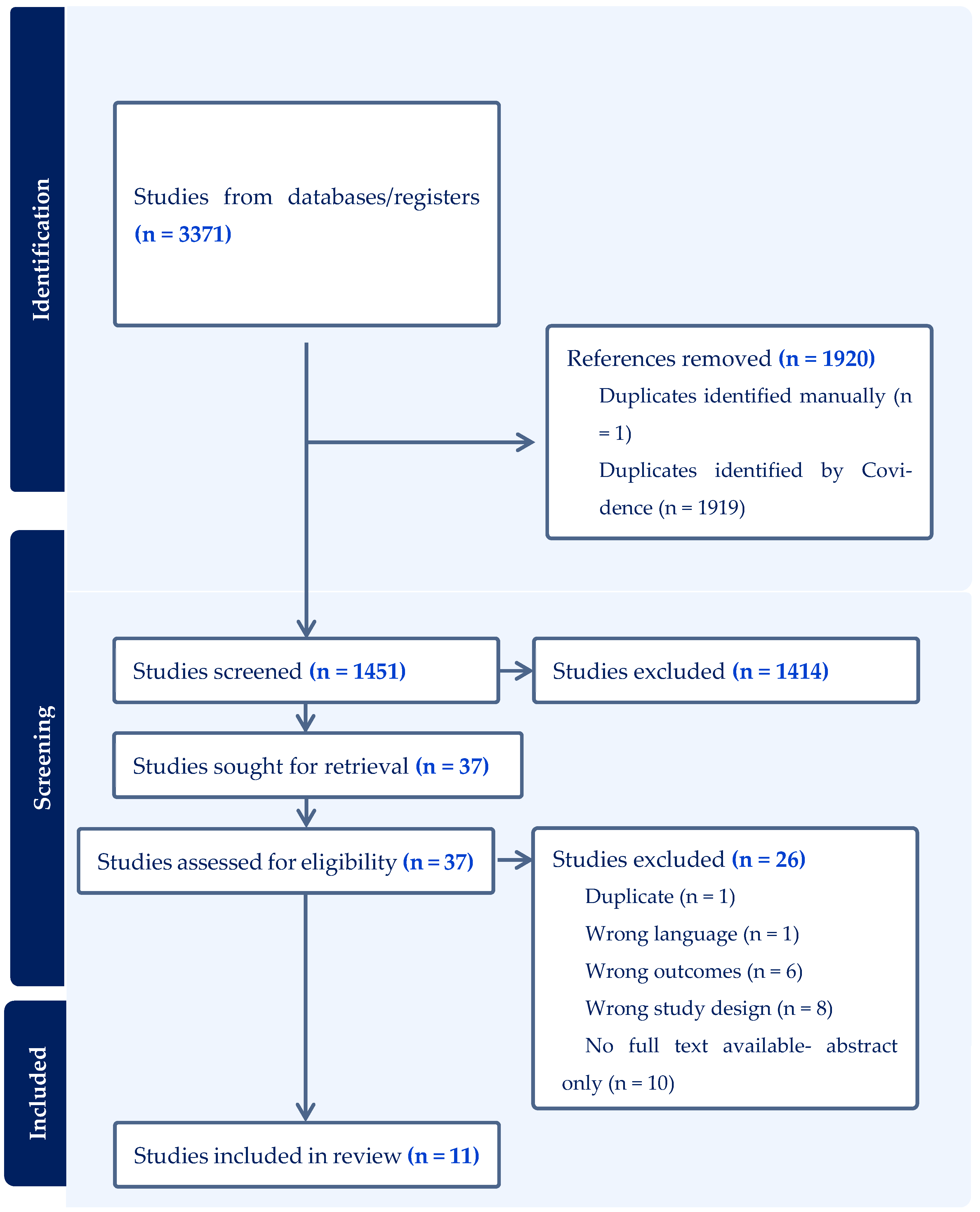
3.1. Search Results
3.2. Study Characteristics
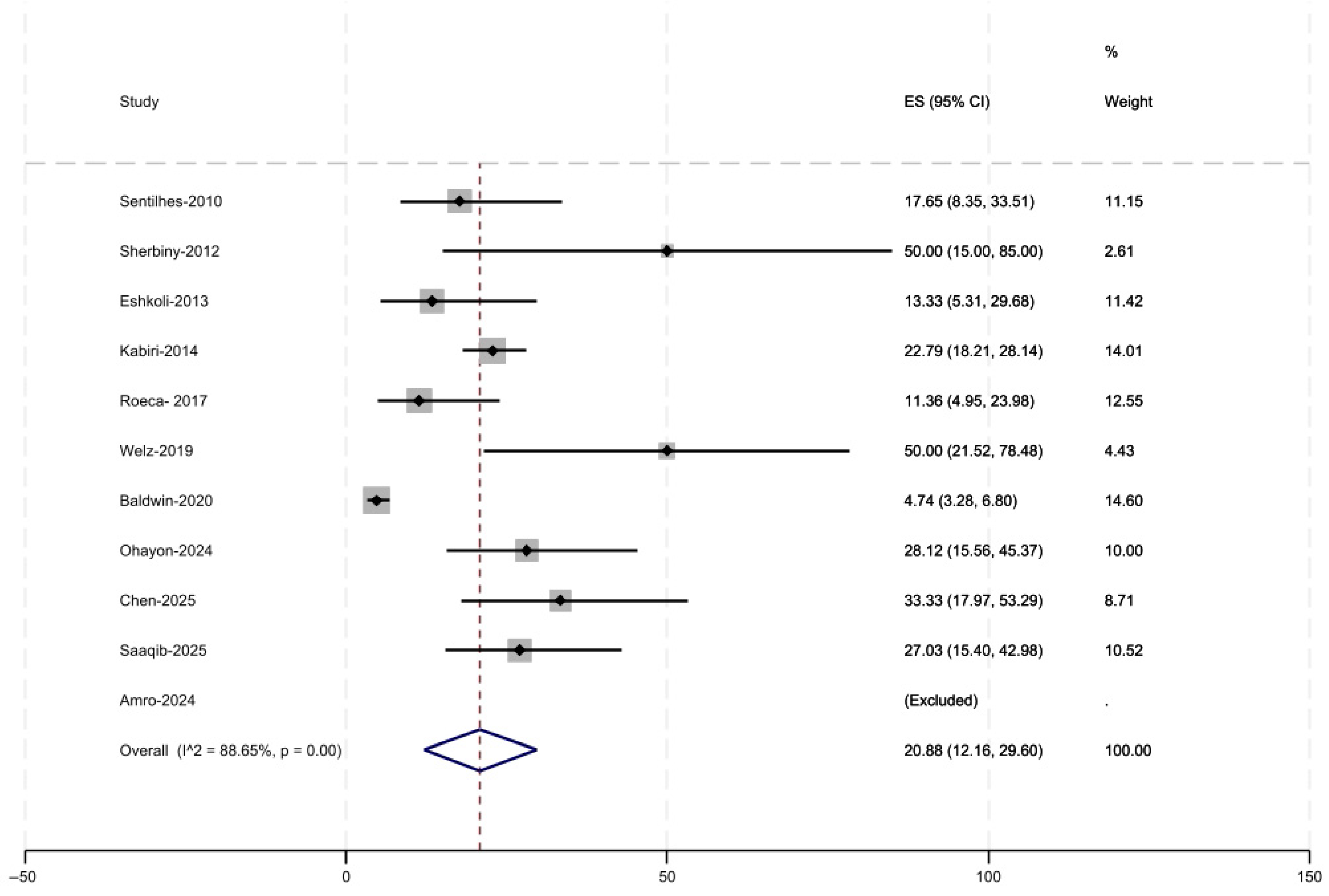
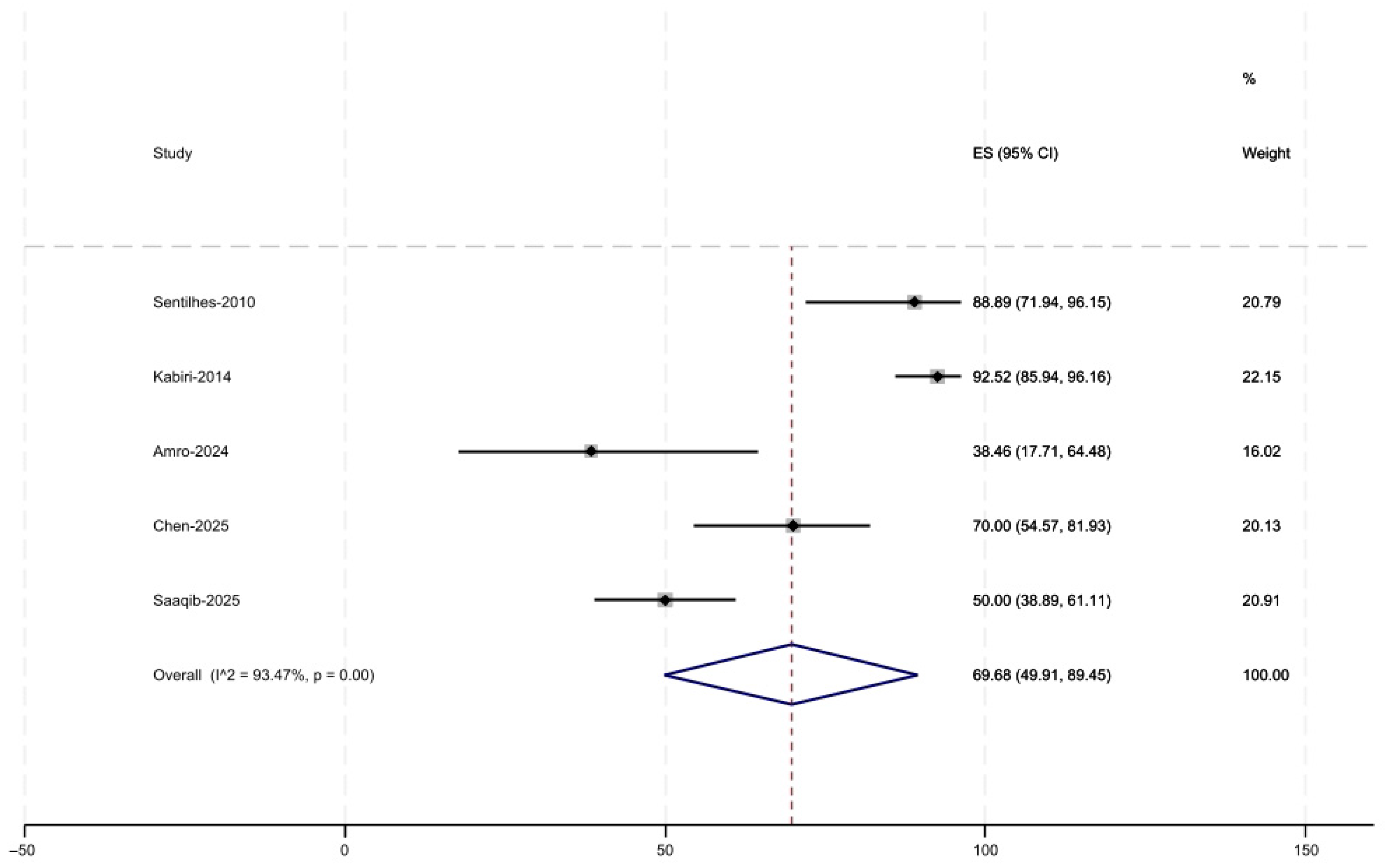
3.3. Outcomes
4. Discussion
5. Conclusions
Supplementary Materials
Author Contributions
Funding
Institutional Review Board Statement
Informed Consent Statement
Data Availability Statement
Conflicts of Interest
Abbreviations
| PAS | Placenta Accreta Spectrum |
| ACOG | American College of Gynecology |
| CI | Confidence Interval |
Appendix A
- Full Search Strategies
- Embase
- Date Searched: 18 July 2022
- Applied Database Supplied Limits: none
- Number of Results: 923
- Search updated: 22 December 2025
- Results: 1274
- Full Search Strategy:
- (‘placenta accreta’/exp OR ‘placenta accreta spectrum’/exp OR ‘placenta accreta spectrum disorder’/exp OR (placenta* NEAR/3 (accrete OR percreta OR increta)):ti,ab,kw OR (‘abnormal placental attachment’ OR ‘placental attachment disorder’):ti,ab,kw) AND (‘conservative treatment’/exp OR ‘organ preservation’/exp OR ‘organ sparing surgery’/exp OR ((conservative OR nonoperative OR ‘non operative’ OR ‘non-operative’ OR nonsurgical) NEAR/3 (treatment* OR management OR therap*)):ti,ab,kw OR ((uterine OR uterus OR organ) NEAR/3 (conserve* OR sparing OR spare* OR preserv*)):ti,ab,kw OR (remov* NEAR/3 placenta):ti,ab,kw)
- Ovid Medline
- Date Searched: 18 July 2022
- Applied Database Supplied Limits: none
- Number of Results: 452
- Search updated: 22 December 2025
- Results: 559
- Full Search Strategy:
- (exp Placenta Accreta/OR (placenta* ADJ3 (accrete OR percreta OR increta)).ti,ab,kf. OR (abnormal placental attachment OR placental attachment disorder).ti,ab,kf.) AND (exp Conservative Treatment/OR exp Organ Preservation/OR exp Organ Sparing Treatments/OR ((conservative OR nonoperative OR non operative OR non-operative OR nonsurgical) ADJ3 (treatment* OR management OR therap*)).ti,ab,kf. OR ((uterine OR uterus OR organ) ADJ3 (conserve* OR sparing OR spare* OR preserv*)).ti,ab,kf. OR (remov* ADJ3 placenta).ti,ab,kf.)
- Scopus
- Date Searched: 18 July 2022
- Applied Database Supplied Limits: none
- Number of Results: 353
- Search updated: 22 December 2025
- Results: 437
- Full Search Strategy:
- ((TITLE-ABS-KEY(placenta* W/3 (accrete OR percreta OR increta))) OR (TITLE-ABS-KEY(“abnormal placental attachment” OR “placental attachment disorder”))) AND ((TITLE-ABS-KEY((conservative OR nonoperative OR “non operative” OR “non-operative” OR nonsurgical) W/3 (treatment* OR management OR therap*))) OR (TITLE-ABS-KEY((uterine OR uterus OR organ) W/3 (conserve* OR sparing OR spare* OR preserv*))) OR (TITLE-ABS-KEY(remov* W/3 placenta)))
- The Cochrane Library
- Date Searched: 18 July 2022
- Applied Database Supplied Limits: none
- Number of Results
- CENTRAL: 14
- CDSR: 0
- Search updated: 22 December 2025
- Results
- CENTRAL: 23
- CDSR: 0
- Full Search Strategy:
- ([mh “Placenta Accreta”] OR (placenta* NEAR/3 (accrete OR percreta OR increta)):ti,ab,kw OR (“abnormal placental attachment” OR “placental attachment disorder”):ti,ab,kw) AND ([mh “Conservative Treatment”] OR [mh “Organ Preservation”] OR [mh “Organ Sparing Treatments”] OR ((conservative OR nonoperative OR “non operative” OR “non operative” OR nonsurgical) NEAR/3 (treatment* OR management OR therap*)):ti,ab,kw OR ((uterine OR uterus OR organ) NEAR/3 (conserve* OR sparing OR spare* OR preserv*)):ti,ab,kw OR (remov* NEAR/3 placenta):ti,ab,kw)
- ClinicalTrials.gov
- Date Searched: 18 July 2022
- Number of Results: 26
- Search updated: 12/22/2025
- Results: 54
- Full Search Strategy:
- “Placenta Accreta” AND (conservative OR “non-operative”)
Appendix B
- Reasons For Exclusion
- Bretelle 2007 [26]—The same patients were analyzed in the reported Sentilhes study.
- Courbière 2003 [27]—This did not include information on recurrent placenta accretas.
- Cunningham 2015 [28]—This is a literature review.
- Mei 2015 [29]—This is a literature review.
- Pineles 2023 [30]—This did not assess for subsequent placenta accreta.
- Provansal 2010 [6]—The same patients were analyzed in the reported Sentilhes study.
- Verspyck 2005 [31]—Recurrent placenta accretas were not confirmed.
- Pineles 2024 [32]—The same patients were analyzed in the reported Amros study.
- Hwu 2005 [33]—This is a case report.
- Legendre 2012 [34]—This did not assess for subsequent placenta accreta.
References
- Morlando, M.; Collins, S. Placenta Accreta Spectrum Disorders: Challenges, Risks, and Management Strategies. Int. J. Women’s Health 2020, 12, 1033–1045. [Google Scholar] [CrossRef]
- American College of Obstetricians and Gynecologists, Society for Maternal-Fetal Medicine. Obstetric care consensus no. 7: Placenta accreta spectrum. Obstet. Gynecol. 2018, 132, e259–e275. [Google Scholar] [CrossRef] [PubMed]
- Pegu, B.; Thiagaraju, C.; Nayak, D.; Subbaiah, M. Placenta accreta spectrum-a catastrophic situation in obstetrics. Obstet. Gynecol. Sci. 2021, 64, 239–247. [Google Scholar] [CrossRef] [PubMed]
- Herzberg, S.; Ezra, Y.; Yahya, R.H.; Weiniger, C.F.; Hochler, H.; Kabiri, D. Long-term gynecological complications after conservative treatment of placenta accreta spectrum. Front. Med. 2022, 9, 992215. [Google Scholar] [CrossRef] [PubMed]
- Berhan, Y.; Urgie, T. A Literature Review of Placenta Accreta Spectrum Disorder: The Place of Expectant Management in Ethiopian Setup. Ethiop. J. Health Sci. 2020, 30, 277–292. [Google Scholar] [CrossRef]
- Provansal, M.; Courbiere, B.; Agostini, A.; D’Ercole, C.; Boubli, L.; Bretelle, F. Fertility and obstetric outcome after conservative man-agement of placenta accreta. Int. J. Gynecol. Obstet. 2010, 109, 147–150. [Google Scholar] [CrossRef]
- Liu, X.; Wang, Y.; Wu, Y.; Zeng, J.; Yuan, X.; Tong, C.; Qi, H. What we know about placenta accreta spectrum (PAS). Eur. J. Obstet. Gynecol. Reprod. Biol. 2021, 259, 81–89. [Google Scholar] [CrossRef]
- Jauniaux, E.; Collins, S.; Burton, G. Placenta accreta spectrum: Pathophysiology and evidence-based anatomy for prenatal ultrasound imaging. Am. J. Obstet. Gynecol. 2018. [Google Scholar] [CrossRef]
- Silver, R.M.; Barbour, K.D. Placenta accreta spectrum: Accreta, increta, and percreta. Obstet. Gynecol. Clin. North Am. 2015, 42, 381–402. [Google Scholar] [CrossRef]
- Sentilhes, L.; Kayem, G.; Silver, R.M. Conservative Management of Placenta Accreta Spectrum. Clin. Obstet. Gynecol. 2018, 61, 783–794. [Google Scholar] [CrossRef]
- Hessami, K.; Kamepalli, S.; Lombaard, H.A.; Shamshirsaz, A.A.; Belfort, M.A.; Munoz, J.L. Conservative management of placenta accreta spectrum is associated with improved surgical outcomes compared to cesarean hysterectomy: A systematic review and meta-analysis. Am. J. Obstet. Gynecol. 2025, 232, 432–452.e3. [Google Scholar] [CrossRef] [PubMed]
- Vuong, A.D.B.; Pham, T.H.; Pham, X.T.T.; Truong, D.P.; Nguyen, X.T.; Trinh, N.B.; Nguyen, D.V.; Nguyen, Y.O.N.; Nguyen, T.N.T.N.; Ho, Q.N.; et al. Modified one-step conservative uterine surgery (MOSCUS) versus cesarean hysterectomy in the management of placenta accreta spectrum: A single-center retrospective analysis based on 619 Vietnamese pregnant women. Int. J. Gynecol. Obstet. 2023, 165, 723–736. [Google Scholar] [CrossRef] [PubMed]
- Page, M.J.; McKenzie, J.E.; Bossuyt, P.M.; Boutron, I.; Hoffmann, T.C.; Mulrow, C.D.; Shamseer, L.; Tetzlaff, J.M.; Akl, E.A.; Brennan, S.E.; et al. The PRISMA 2020 statement: An updated guideline for reporting systematic reviews. BMJ 2021, 372, n71. [Google Scholar] [CrossRef] [PubMed]
- Javinani, A.; Qaderi, S.; Hessami, K.; A Shainker, S.; A Shamshirsaz, A.; A Fox, K.; Mustafa, H.J.; Subramaniam, A.; Khandelwal, M.; Sandlin, A.T.; et al. Delivery outcomes in the subsequent pregnancy following the conservative management of placenta accreta spectrum disorder: A systematic review and meta-analysis. Am. J. Obstet. Gynecol. 2023, 230, 485–492.e7. [Google Scholar] [CrossRef]
- Baldwin, H.J.M.; Nippita, T.A.P.; Torvaldsen, S.M.; Ibiebele, I.M.; Ford, J.B.; Patterson, J.A.M. Outcomes of Subsequent Births After Placenta Accreta Spectrum. Obstet. Gynecol. 2020, 136, 745–755. [Google Scholar] [CrossRef]
- Kabiri, D.; Hants, Y.; Shanwetter, N.; Simons, M.; Weiniger, C.F.; Gielchinsky, Y.; Ezra, Y. Outcomes of subsequent pregnancies after conservative treatment for placenta accreta. Int. J. Gynecol. Obstet. 2014, 127, 206–210. [Google Scholar] [CrossRef]
- Saaqib, S.; Naheed, M.; Iqbal, A.; Rehman, R.M.A.U.; Khalid, M. Evaluating a novel approach to placenta accreta spectrum management: The modified Triple-P technique with cystoinflation (a randomized controlled trial). Sci. Rep. 2025, 15, 25870. [Google Scholar] [CrossRef]
- Eshkoli, T.; Weintraub, A.Y.; Sergienko, R.; Sheiner, E. Placenta accreta: Risk factors, perinatal outcomes, and consequences for subsequent births. Am. J. Obstet. Gynecol. 2013, 208, 219.e1–219.e7. [Google Scholar] [CrossRef]
- Roeca, C.; Little, S.E.; Carusi, D.A. Pathologically diagnosed placenta accreta and hemorrhagic morbidity in a subsequent pregnancy. Obs. Gynecol. 2017, 129, 321–326. [Google Scholar] [CrossRef]
- Sentilhes, L.; Kayem, G.; Ambroselli, C.; Provansal, M.; Fernandez, H.; Perrotin, F.; Winer, N.; Pierre, F.; Benachi, A.; Dreyfus, M.; et al. Fertility and pregnancy outcomes following conservative treatment for placenta accreta. Hum. Reprod. 2010, 25, 2803–2810. [Google Scholar] [CrossRef]
- Sherbiny, M.E.; Gowely, H.A.E.; Sherbiny, A.E.; Hamouda, S.M. Conservative management of placenta previa-accreta by prophylactic uterine arteries ligation and stepwise vertical compression sutures. Int. J. Gynecol. Obstet. 2012, 119, S483. [Google Scholar] [CrossRef]
- Welz, J.; Keyver-Paik, M.-D.; Gembruch, U.; Merz, W.M. Self-reported physical, mental, and reproductive sequelae after treatment of abnormally invasive placenta: A single-center observational study. Arch. Gynecol. Obstet. 2019, 300, 95–101. [Google Scholar] [CrossRef] [PubMed]
- Amro, F.H.; Hernandez-Andrade, E.A.; Papanna, R.; Mehl, S.T.; Kassir, E.; Soto-Torres, E.E.; Chen, H.-Y.; Zamorano, A.S.; Guerra, R.A.; Blackwell, S.C.; et al. Leaving Placenta In Situ for Management of Placenta Accreta Spectrum Disorder. Obstet. Gynecol. 2025, 145, 683–689. [Google Scholar] [CrossRef] [PubMed]
- Chen, K.; Bai, Y.; Ma, Y.; Chen, J.; Huang, Y.; Yang, F.; Long, Y. Subsequent pregnancy outcomes following conservative management for placenta accreta spectrum disorders: An ambispective cohort study. J. Matern. Neonatal Med. 2025, 38, 2477782. [Google Scholar] [CrossRef]
- Ohayon, A.; Castel, E.; Friedrich, L.; Mor, N.; Levin, G.; Meyer, R.; Toussia-Cohen, S. Pregnancy Outcomes after Uterine Preservation Surgery for Placenta Accreta Spectrum: A Retrospective Cohort Study. Am. J. Perinatol. 2024, 42, 068–074. [Google Scholar] [CrossRef]
- Bretelle, F.; Courbière, B.; Mazouni, C.; Agostini, A.; Cravello, L.; Boubli, L.; Gamerre, M.; D’eRcole, C. Management of placenta accreta: Morbidity and outcome. Eur. J. Obstet. Gynecol. Reprod. Biol. 2007, 133, 34–39. [Google Scholar] [CrossRef]
- Courbière, B.; Bretelle, F.; Porcu, G.; Gamerre, M.; Blanc, B. [Conservative treatment of placenta accreta]. J. Gynecol. Obstet. Biol. Reprod. 2003, 32, 549–554. [Google Scholar]
- Cunningham, K.; Anwar, A.; Lindow, S. The recurrence risk of placenta accreta following uterine conserving management. J. Neonatal-Perinat. Med. 2016, 8, 293–296. [Google Scholar] [CrossRef]
- Mei, J.; Wang, Y.; Zou, B.; Hou, Y.; Ma, T.; Chen, M.; Xie, L. Systematic review of uterus-preserving treatment modalities for abnormally invasive placenta. J. Obstet. Gynaecol. 2015, 35, 777–782. [Google Scholar] [CrossRef]
- Pineles, B.L.; Sibai, B.M.; Sentilhes, L. Is conservative management of placenta accreta spectrum disorders practical in the United States? Am. J. Obstet. Gynecol. MFM 2023, 5, 100749. [Google Scholar] [CrossRef]
- Verspyck, E.; Resch, B.; Sergent, F.; Marpeau, L. Surgical uterine devascularization for placenta accreta: Immediate and long-term follow-up. Acta Obstet. Gynecol. Scand. 2005, 84, 444–447. [Google Scholar] [CrossRef]
- Pineles, B.L.; Coselli, J.; Ghorayeb, T.; Bartal, M.F.; Zvavanjanja, R.C.; Blackwell, S.C.; Papanna, R.; Sibai, B.M. Leaving the Placenta In Situ in Placenta Accreta Spectrum Disorders: A Single-Center Case Series. Am. J. Perinatol. 2024, 41, e420–e429. [Google Scholar] [CrossRef]
- Hwu, Y.; Chen, C.; Chen, H.; Su, T. Parallel vertical compression sutures: A technique to control bleeding from placenta praevia or accreta during caesarean section. BJOG Int. J. Obstet. Gynaecol. 2005, 112, 1420–1423. [Google Scholar] [CrossRef]
- Legendre, G.; Kinn, J.; Fernandez, H. Conservative Treatment by Hysteroscopic Resection of Placenta Accreta. J. Minim. Invasive Gynecol. 2012, 19, S62. [Google Scholar] [CrossRef]



| Author and Year of Publication | Selection | Comparability | Outcome | Median Duration of Follow-Up | Quality |
|---|---|---|---|---|---|
| Baldwin-2020 [15] | 4/4 | 2/2 | 3/3 | 5 years | Good |
| Kabiri-2014 [16] | 4/4 | 1/2 | 3/3 | Follow up was 10 years after the study | Good |
| Sentilhes-2010 [20] | 3/4 | 0/2 | 2/3 | 2–172 months | Poor |
| Sherbiny-2012 [21] | 3/4 | 0/2 | 2/3 | 2 months-2 years | Poor |
| Welz-2019 [22] | 3/4 | 0/2 | 1/3 | 6 months-14 years | Poor |
| Roeca-2017 [19] | 3/4 | 0/2 | 3/3 | Unspecified | Poor |
| Eshkoli-2013 [18] | 3/4 | 1/2 | 2/3 | Unspecified | Good |
| Amro-2025 [23] | 4/4 | 2/2 | 0/3 | Unspecified | Fair |
| Chen-2025 [24] | 4/4 | 1/2 | 3/3 | Unspecified | Good |
| Ohayon-2025 [25] | 4/4 | 2/2 | 2/3 | Unspecified | Good |
| Saaqib-2025 [17] | 4/4 | 1/2 | 3/3 | 5 years | Good |
| Author and Year | Years and Location of Study | Type of Conservative Treatment(s) Used | N of Patients in the Study | Attempted Pregnancies | Pregnancy Achieved | Live Births | Recurrent PAS | Diagnosis of PAS |
|---|---|---|---|---|---|---|---|---|
| Baldwin-2020 [15] | 2003–2016 Australia | - | 1222 | - | - | 565 | 27 | International Classification of Diseases, 10th Revision, Australian Modification diagnosis code for morbidly adherent placenta. |
| Eshkoli-2013 [18] | 1988–2011 Israel | - | 139 | - | 30 | - | 4 | Clinical diagnosis. Only included cesarian deliveries and based on difficulties of the physician removing the placenta during the operation. |
| Kabiri-2014 [16] | 1990–2000, Pregnancies until 2010 Israel | - | 134 | 107 | 99 | 280 | 62 | Patients who met one or more of the following criteria: 1. Impossibility of, or incomplete, manual removal of the placenta with evidence of placental retention, despite active management of the third stage of labor. 2. Sonographic evidence of retained placental fragments requiring removal after vaginal delivery. 3. Heavy bleeding from the implantation site after placental removal during cesarean delivery with excision of part of the uterine wall and the attached placenta or oversewing of the bleeding defects. 4. Histologic confirmation of placenta accreta. |
| Roeca-2017 [19] | 2007–2015 | - | 339 | - | - | 39 | 21 | Confirmed by pathologic diagnosis. Pathology sent based on provider’s discretion |
| Sentilhes-2010 [20] | 1993–2007 United States | Leaving placenta in situ | 131 | 27 | 24 | 2 | 6 | The clinical criteria for diagnosis were one of the following: 1. Manual removal of the placenta was partially or totally impossible and there was no cleavage plane between part or all the placenta and the uterus. 2. The prenatal diagnosis of placenta accreta was confirmed by the failure of a gentle attempt at removal during the third stage of labor. |
| Sherbiny-2012 [21] | Egypt | Uterine artery bilateral double ligation | 10 | - | - | 4 | 2 | Diagnosed by ultrasound findings. |
| Welz-2019 [22] | 2003–2017 Germany | Bilateral uterine artery embolization, Bakri catheter, placental bed suture, B-Lynch suture, and Chitosan tamponade insertion | 39 managed conservatively. 24 lost to follow up. | - | - | 8 | 4 | Prenatal included color Doppler ultrasound. Some patients underwent subsequent MR or cystoscopy depending on area of suspected invasion. During labor it was defined by clinical criteria based on severity of hemorrhage and depth of invasion. |
| Amro-2025 [23] | 2015–2024 United States | Leaving placenta in situ | 13 Successful Uterine Preservation | - | 5 | - | 0 | Antenatal ultrasound suspicion of PAS with intraoperative confirmation |
| Chen-2025 [24] | 2013–2021 China | Extirpative placental removal, leaving placenta in situ, or one-step conservative surgery | 178 conservatively managed | 40 | 43 | 23 | 8 | Prenatal ultrasound/MRI with intraoperative or postpartum clinical findings, supported by pathology. |
| Ohayon-2025 [25] | 2011–2022 Israel | One-step uterine-preserving surgery with placental removal and uterine reconstruction. | 287 | - | - | 32 | 9 | Prenatal ultrasound with clinical/intraoperative confirmation using FIGO PAS classification. |
| Saaqib-2025 [17] | 2017–2024 Pakistan | Leaving placenta in situ | 150 | 74 | 37 | - | 10 | Prenatal ultrasound ± MRI with intraoperative clinical confirmation; pathology when tissue available. |
Disclaimer/Publisher’s Note: The statements, opinions and data contained in all publications are solely those of the individual author(s) and contributor(s) and not of MDPI and/or the editor(s). MDPI and/or the editor(s) disclaim responsibility for any injury to people or property resulting from any ideas, methods, instructions or products referred to in the content. |
© 2026 by the authors. Licensee MDPI, Basel, Switzerland. This article is an open access article distributed under the terms and conditions of the Creative Commons Attribution (CC BY) license.
Share and Cite
Somer, S.; Kabiri, D.; Yaeger, L.H.; Herzberg, S.; Ezra, Y.; Tevet, A.; Rosenbloom, J.I. Subsequent Pregnancies After Conservative Placenta Accreta Management: Recurrent Accreta and Preserved Fertility, a Systematic Review and Meta-Analysis. J. Clin. Med. 2026, 15, 1684. https://doi.org/10.3390/jcm15051684
Somer S, Kabiri D, Yaeger LH, Herzberg S, Ezra Y, Tevet A, Rosenbloom JI. Subsequent Pregnancies After Conservative Placenta Accreta Management: Recurrent Accreta and Preserved Fertility, a Systematic Review and Meta-Analysis. Journal of Clinical Medicine. 2026; 15(5):1684. https://doi.org/10.3390/jcm15051684
Chicago/Turabian StyleSomer, Shmuel, Doron Kabiri, Lauren H. Yaeger, Shmuel Herzberg, Yossef Ezra, Aharon Tevet, and Joshua I. Rosenbloom. 2026. "Subsequent Pregnancies After Conservative Placenta Accreta Management: Recurrent Accreta and Preserved Fertility, a Systematic Review and Meta-Analysis" Journal of Clinical Medicine 15, no. 5: 1684. https://doi.org/10.3390/jcm15051684
APA StyleSomer, S., Kabiri, D., Yaeger, L. H., Herzberg, S., Ezra, Y., Tevet, A., & Rosenbloom, J. I. (2026). Subsequent Pregnancies After Conservative Placenta Accreta Management: Recurrent Accreta and Preserved Fertility, a Systematic Review and Meta-Analysis. Journal of Clinical Medicine, 15(5), 1684. https://doi.org/10.3390/jcm15051684