Range of Motion and Muscle Activity During the Front Kick in Karate Kyokushin

Abstract
1. Introduction
2. Materials and Methods
2.1. Participants
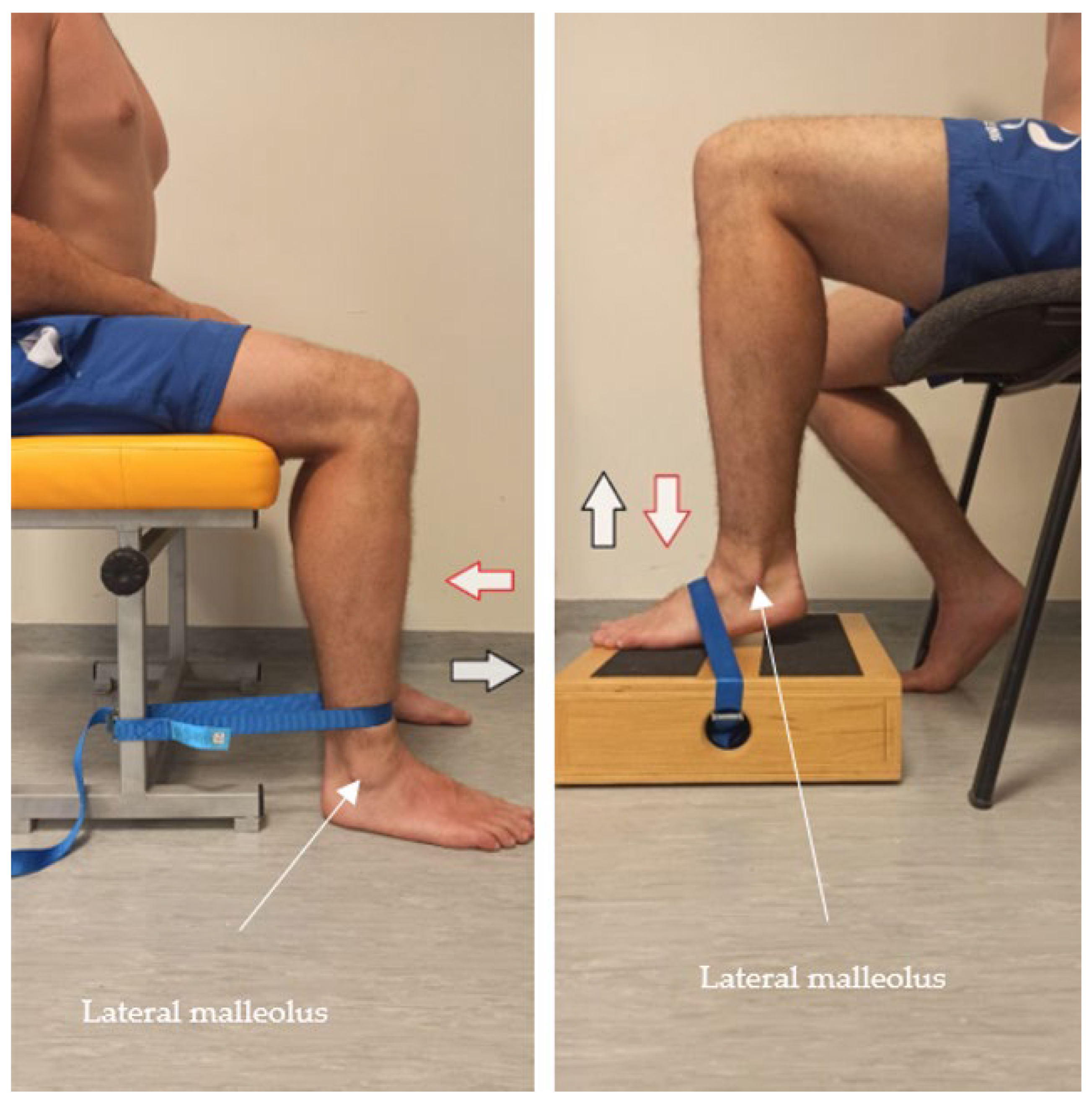
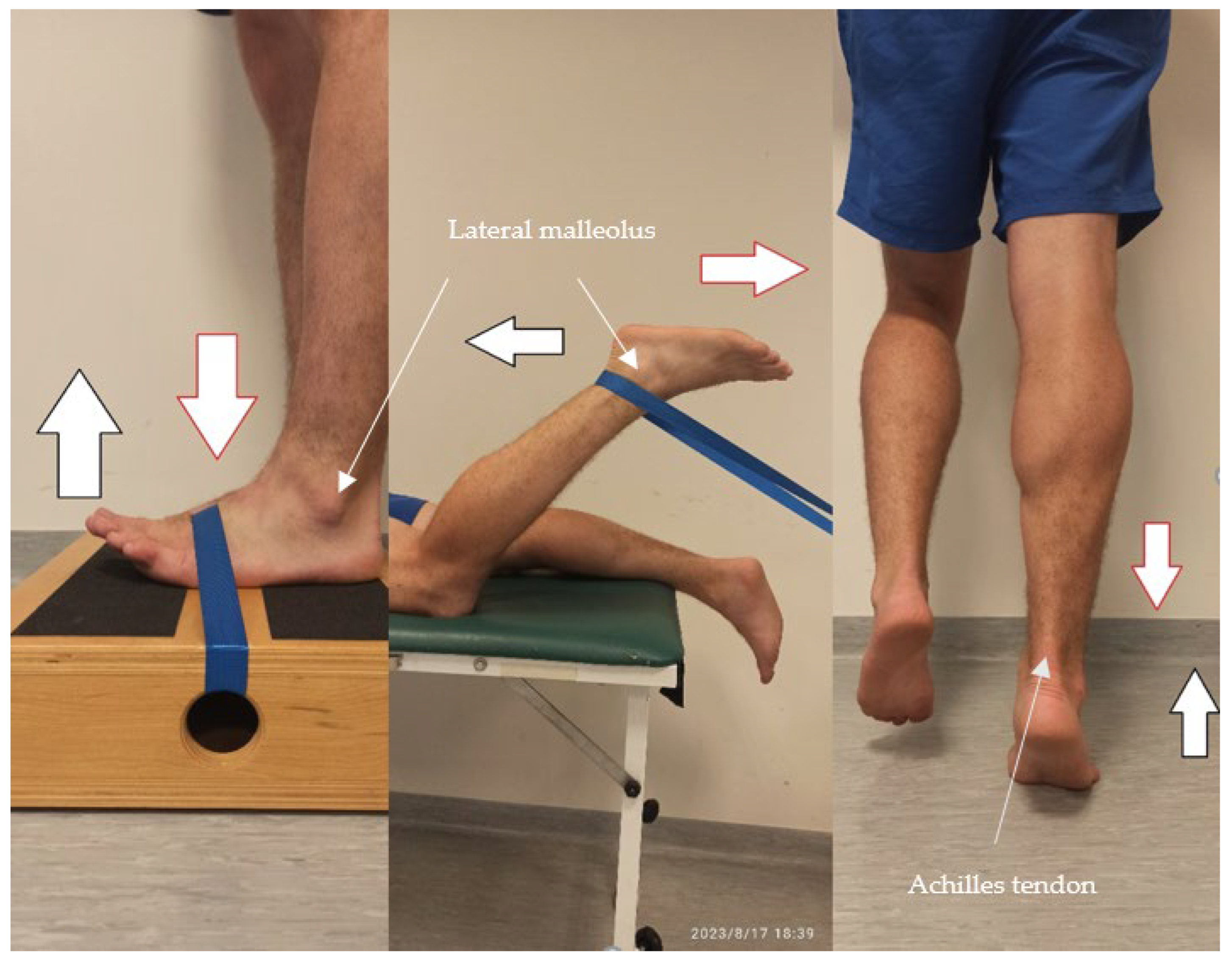
2.2. Measurements
2.2.1. Surface Electromyography (sEMG)
2.2.2. Inertial Measurement Unit (IMU)
2.3. Statistical Analysis
3. Results
4. Discussion
Practical Recommendations
5. Conclusions
6. Limitations
Author Contributions
Funding
Institutional Review Board Statement
Informed Consent Statement
Data Availability Statement
Acknowledgments
Conflicts of Interest
References
- Wąsik, J. Kinematic analysis of the side kick in Taekwon-do. Acta Bioeng. Biomech. 2011, 13, 71–75. [Google Scholar] [PubMed]
- Jeknić, V.; Dopsaj, M.; Koropanovski, N. Relationship Between Intermuscular Synchronization of Upper Leg Muscles and Training Level in Karate Kumite Practitioners. J. Funct. Morphol. Kinesiol. 2025, 10, 234. [Google Scholar] [CrossRef] [PubMed]
- Wąsik, J.; Mosler, D.; Ortenburger, D.; Góra, T.; Podstawski, R. Differences in Velocities of Crucial Body Segments while Executing Roundhouse Kicks for Both Sides. J. Hum. Kinet. 2023, 86, 97–105. [Google Scholar] [CrossRef] [PubMed] [PubMed Central]
- Szczęsna, A.; Błaszczyszyn, M.; Pawlyta, M. Optical motion capture dataset of selected techniques in beginner and advanced Kyokushin karate athletes. Sci. Data 2021, 8, 13. [Google Scholar] [CrossRef] [PubMed] [PubMed Central]
- Ioannides, C.; Apostolidis, A.; Hadjicharalambous, M.; Zaras, N. Effect of a 6-week plyometric training on power, muscle strength, and rate of force development in young competitive karate athletes. J. Phys. Educ. Sport 2020, 20, 1740–1746. [Google Scholar]
- Zvonar, M.; Kolářová, K.; Zahradníček, V.; Reguli, Z.; Vit, M. Kinematic Analysis in Combative Sports. Ido Mov. Cult. J. Martial Arts Anthropol. 2012, 12, 12–19. [Google Scholar]
- Wakeling, J.M.; Blake, O.M.; Wong, I.; Rana, M.; Lee, S.S. Movement mechanics as a determinate of muscle structure, recruitment and coordination. Philos. Trans. R. Soc. Lond. B Biol. Sci. 2011, 366, 1554–1564. [Google Scholar] [CrossRef] [PubMed] [PubMed Central]
- Błaszczyszyn, M.; Szczęsna, A.; Pawlyta, M.; Marszałek, M.; Karczmit, D. Kinematic Analysis of Mae-Geri Kicks in Beginner and Advanced Kyokushin Karate Athletes. Int. J. Environ. Res. Public Health 2019, 16, 3155. [Google Scholar] [CrossRef] [PubMed] [PubMed Central]
- Valevicius, A.M.; Jun, P.Y.; Hebert, J.S.; Vette, A.H. Use of optical motion capture for the analysis of normative upper body kinematics during functional upper limb tasks: A systematic review. J. Electromyogr. Kinesiol. 2018, 40, 1–15. [Google Scholar] [CrossRef]
- Hasiec, P.; Świtoński, A.; Josiński, H.; Wojciechowski, K. Anomaly Detection of Motion Capture Data Based on the Autoencoder Approach. In Computational Science—ICCS 2023; Mikyška, J., de Mulatier, C., Paszynski, M., Krzhizhanovskaya, V.V., Dongarra, J.J., Sloot, P.M., Eds.; Lecture Notes in Computer Science; Springer: Cham, Switzerland, 2023; Volume 14074, pp. 611–622. [Google Scholar] [CrossRef]
- Del Vecchio, L.; Whitting, J.; Hollier, J.; Keene, A.; Climstein, M. Reliability and Practical Use of a Commercial Device for Measuring Punch and Kick Impact Kinetics. Sports 2022, 10, 206. [Google Scholar] [CrossRef]
- Stewart, D.; Macaluso, A.; De Vito, G. The effect of an active warm-up on surface EMG and muscle performance in healthy humans. Eur. J. Appl. Physiol. 2003, 89, 509–513. [Google Scholar] [CrossRef] [PubMed]
- Sant’ Ana, J.; Kons, R.L.; Detanico, D.; Diefenthaeler, F. The use of mobile solutions for biomechanical assessment in combat sports: A narrative review. Proc. Inst. Mech. Eng. Part P J. Sports Eng. Technol. 2023, 239, 813–829. [Google Scholar] [CrossRef]
- Moreira, P.V.S.; Falco, C.; Menegaldo, L.L.; Goethel, M.F.; de Paula, L.V.; Gonçalves, M. Are isokinetic leg torques and kick velocity reliab.le predictors of competitive level in taekwondo athletes? PLoS ONE 2021, 16, e0235582. [Google Scholar] [CrossRef] [PubMed]
- Zemková, E. Differential Contribution of Reaction Time and Movement Velocityto the Agility Performance Reflects Sport-Specific Demands. Hum. Mov. 2016, 17, 94–101. [Google Scholar] [CrossRef]
- Vagner, M.; Malecek, J.; Tomšovský, L.; Kubový, P.; Levitova, A.; Stastny, P. Isokinetic Strength of Rotators, Flexors and Hip Extensors is Strongly Related toFront Kick Dynamics in Military Professionals. J. Hum. Kinet. 2019, 68, 145–155. [Google Scholar] [CrossRef]
- Mosler, D.; Góra, T.; Kaczmarski, J.; Błaszczyszyn, M.; Chociaj, M.; Borysiuk, Z. Target kinematic effect in Kyokushin karate front kicks: An analysis of velocity, acceleration, and muscle activation patterns. Phys. Act. Rev. 2025, 13, 156–166. [Google Scholar] [CrossRef]
- Katić, R.; Jukić, J.; Cavala, M.; Vucić, D.; Blazević, S. Motor determinants offighting efficacy in Croatian youth karateka. Coll. Antropol. 2013, 37, 1–8. [Google Scholar]
- Wąsik, J.; Góra, T. Impact of target selection on front kick kinematics intaekwondo—Pilot study. Phys. Act. Rev. 2016, 4, 57–61. [Google Scholar]
- Branco, M.A.C.; VencesBrito, A.M.V.; Rodrigues-Ferreira, M.A.; Branco, G.A.C.; Polak, E.; Cynarski, W.J.; Jacek, W. Effect of Aging on the Lower Limb Kinematics in Karate Practitioners: Comparing Athletes and Their Senseis. J. Healthc. Eng. 2019, 2019, 2672185. [Google Scholar] [CrossRef]
- Milošević, M.; Mudrić, R.; Mudrić, M. The Biomechanical Analysis of the Karate Kick (Mae Geri) in the Function of Defining Educational Training Aims and Methods. Sport Sci. Pract. 2012, 2, 5–14. [Google Scholar]
- Ervilha, U.F.; Fernandes, F.M.; Souza, C.C.; Hamill, J. Reaction time and muscle activation patterns in elite and novice athletes performing a taekwondo kick. Sports Biomech. 2020, 19, 665–677. [Google Scholar] [CrossRef]
- Gianino, C.; Fermi, E. Physics of Karate. Kinematics analysis of karate techniques by a digital movie camera. Lat.-Am. J. Phys. Educ. 2010, 4, 5. [Google Scholar]
- VencesBrito, A.; Branco, M.; Fernandes, R. Characterization of kinesiologicalpatterns of the frontal kick Mae-geri in karate experts and non-karatepractitioners. Rev. Artes Marciales Asiáticas 2014, 9, 20–31. [Google Scholar] [CrossRef][Green Version]
- VencesBrito, A.M.; Rodrigues Ferreira, M.A.; Cortes, N.; Fernandes, O.; Pezarat-Correia, P. Kinematic and electromyographic analyses of a karate punch. J. Electromyogr. Kinesiol. 2011, 21, 1023–1029. [Google Scholar] [CrossRef] [PubMed]
- Boullosa, D. Post-Activation Performance Enhancement Strategies IN SPORT: A Brief Review for Practitioners. Hum. Mov. 2021, 22, 101–109. [Google Scholar] [CrossRef]
- Croom, A.M. Muay Thai, Psychological Well-Being, and Cultivation of Combat-Relevant Affordances. Philosophies 2022, 7, 65. [Google Scholar] [CrossRef]
- Croom, A.M. The impact of shadowboxing on the psychological well-being of professional martial artists. Discov. Psychol. 2023, 3, 4. [Google Scholar] [CrossRef]
- Cynarski, W.J.; Yu, J.H.; Borysiuk, Z. Technical forms in teaching karate and taekwondo. J. Combat. Sports Martial Arts 2017, 8, 31–36. [Google Scholar] [CrossRef]
- Untag Cirebon, F.; Sundari, S.; Praja, H.N.; Setiawahyu, M.I.; Rosalina, M.; Pebriansyah, V.F. The Effectiveness of the Shadow Fight Method in Improving the Fighting Reflexes of Pujo Janoko Club Pencak Silat Athletes. Kinestetik J. Ilm. Pendidik. Jasm. 2025, 9, 1068–1084. [Google Scholar] [CrossRef]
- Xue, H.; Han, C.; Zhu, D. Limb biomechanics in combat sports: Insights from wearable sensor technology. Front. Bioeng. Biotechnol. 2025, 13, 1663592. [Google Scholar] [CrossRef] [PubMed] [PubMed Central]
- Di Paolo, S.; Nijmeijer, E.; Bragonzoni, L.; Dingshoff, E.; Gokeler, A.; Benjaminse, A. Comparing lab and field agility kinematics in young talented female football players: Implications for ACL injury prevention. Eur. J. Sport Sci. 2023, 23, 859–868. [Google Scholar] [CrossRef] [PubMed]
- Kühne, M.; Federolf, P.; Jaén-Carrillo, D.; Schiel, K.; Mohr, M. Comparison of Joint Kinematics from Optical Marker-Based and Inertial Sensor-Based Motion Capture During Change-of-Direction Movements. CISS 2024, 9, 017. [Google Scholar] [CrossRef]
- Ghattas, J.; Jarvis, D.N. Validity of inertial measurement units for tracking human motion: A systematic review. Sports Biomech. 2024, 23, 1853–1866. [Google Scholar] [CrossRef] [PubMed]
- McGowan, C.J.; Pyne, D.B.; Thompson, K.G.; Rattray, B. Warm-Up Strategies for Sport and Exercise: Mechanisms and Applications. Sports Med. 2015, 45, 1523–1546. [Google Scholar] [CrossRef]
- Aandahl, H.S.; Von Heimburg, E.; Van den Tillaar, R. Effect of Postactivation Potentiation Induced by Elastic Resistance on Kinematics and Performance in a Roundhouse Kick of Trained Martial Arts Practitioners. J. Strength Cond. Res. 2018, 32, 990–996. [Google Scholar] [CrossRef]
- Kacprzak, J.; Mosler, D.; Tsos, A.; Wąsik, J. Biomechanics of Punching—The Impact of Effective Mass and Force Transfer on Strike Performance. Appl. Sci. 2025, 15, 4008. [Google Scholar] [CrossRef]
- Magalhães, T.; Ribeiro, F.; Pinheiro, A.; Oliveira, J. Warming-up before sporting activity improves knee position sense. Phys. Ther. Sport 2010, 11, 86–90. [Google Scholar] [CrossRef]
- Piepiora, P.A.; Jaskowska, K. Study on the level of intrinsic motivation of Poland’s U-21 Kyokushin karate national team. Ido Mov. Cult. J. Martial Arts Anthropol. 2025, 25, 96–100. [Google Scholar] [CrossRef]
- Vagner, M.; Cleather, D.J.; Olah, V.; Vacek, J.; Stastny, P. A Systematic Review of Dynamic Forces and Kinematic Indicators of Front and Roundhouse Kicks across Varied Conditions and Participant Experience. Sports 2023, 11, 141. [Google Scholar] [CrossRef]
- Silva, R.M.; González-Fernández, F.; Rusillo-Magdaleno, A.; Loureiro, V.; Pires, D.; Ferreira, F.; Silva, A.F. The Effects of Post-Warm-Up Active and Passive Rest Periods on a Vigilance Task in Karate Athletes. Behav. Sci. 2024, 14, 1102. [Google Scholar] [CrossRef]



| Karate Practitioner | Age [Years] | Body Mass [kg] | Body Height [m] | BMI | Rank | Leg Dominance |
|---|---|---|---|---|---|---|
| 1i | 21 | 87 | 1.78 | 27.46 | 6th kyu | R |
| 2i | 37 | 93 | 1.79 | 29.03 | 6th kyu | R |
| 3i | 21 | 63 | 1.72 | 21.30 | 6th kyu | R |
| 4i | 35 | 84 | 1.82 | 25.36 | 5th kyu | R |
| 5i | 18 | 70 | 1.70 | 24.22 | 6th kyu | R |
| 6i | 19 | 83 | 1.85 | 24.25 | 6th kyu | R |
| 7i | 20 | 67 | 1.82 | 20.23 | 5th kyu | R |
| 8i | 18 | 65 | 1.75 | 21.22 | 6th kyu | R |
| 9i | 23 | 74.5 | 1.82 | 22.49 | 5th kyu | R |
| 10i | 20 | 93 | 1.96 | 24.21 | 6th kyu | R |
| 11i | 22 | 78 | 1.83 | 23.29 | 5th kyu | R |
| 12i | 21 | 114 | 1.80 | 35.19 | 4th kyu | R |
| 13i | 39 | 90 | 1.84 | 26.58 | 6th kyu | R |
| 14i | 23 | 73 | 1.80 | 22.53 | 4th kyu | R |
| 15i | 30 | 78 | 1.79 | 24.34 | 5th kyu | R |
| 1a | 22 | 85 | 1.80 | 26.23 | 3rd kyu | R |
| 2a | 37 | 84 | 1.82 | 25.36 | 1st dan | R |
| 3a | 41 | 96 | 1.82 | 28.98 | 2nd kyu | R |
| 4a | 34 | 105 | 1.83 | 31.35 | 1st dan | R |
| 5a | 22 | 66.5 | 1.79 | 20.75 | 2nd kyu | R |
| 6a | 55 | 89 | 1.82 | 26.87 | 3rd dan | R |
| 7a | 43 | 89.5 | 1.85 | 26.15 | 2nd kyu | R |
| 8a | 20 | 64 | 1.70 | 22.15 | 3rd kyu | R |
| 9a | 18 | 75 | 1.80 | 23.15 | 1st kyu | R |
| 10a | 24 | 91.5 | 1.86 | 26.45 | 1st dan | R |
| 11a | 24 | 74 | 1.75 | 24.16 | 2nd kyu | R |
| 12a | 38 | 83 | 1.82 | 25.06 | 2nd kyu | R |
| 13a | 28 | 73 | 1.78 | 23.04 | 2nd kyu | R |
| Variable/Measure | A1 Mean ± SD | A2 Mean ± SD | A3 Mean ± SD | Mean Diff | SE | df | t | p (Tukey) |
|---|---|---|---|---|---|---|---|---|
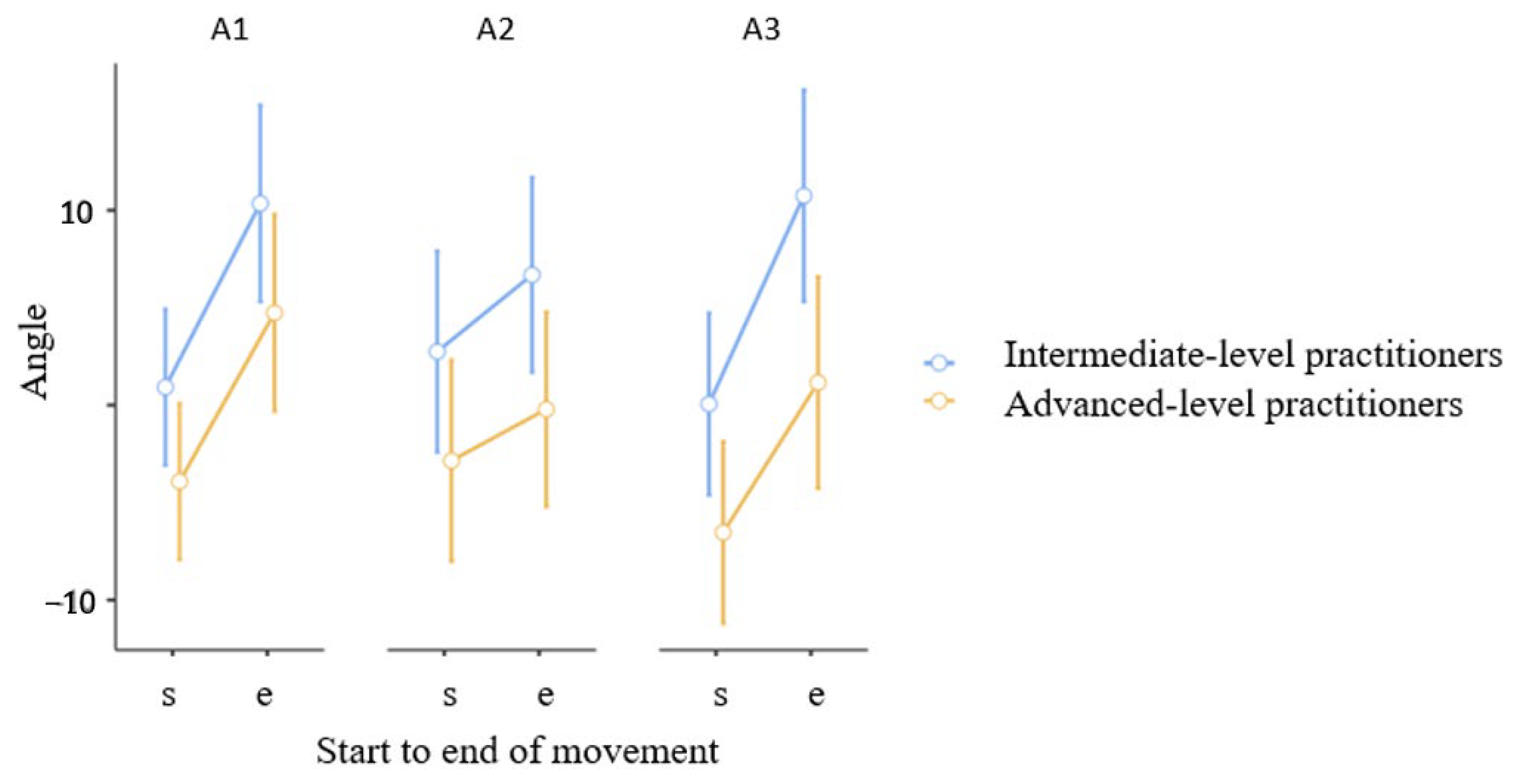
| Knee joint rotation—advanced (°) | 4.74 ± 11.99 | −0.21 ± 11.28 | – | 4.95 | 1.27 | 24 | 3.90 | 0.026 |
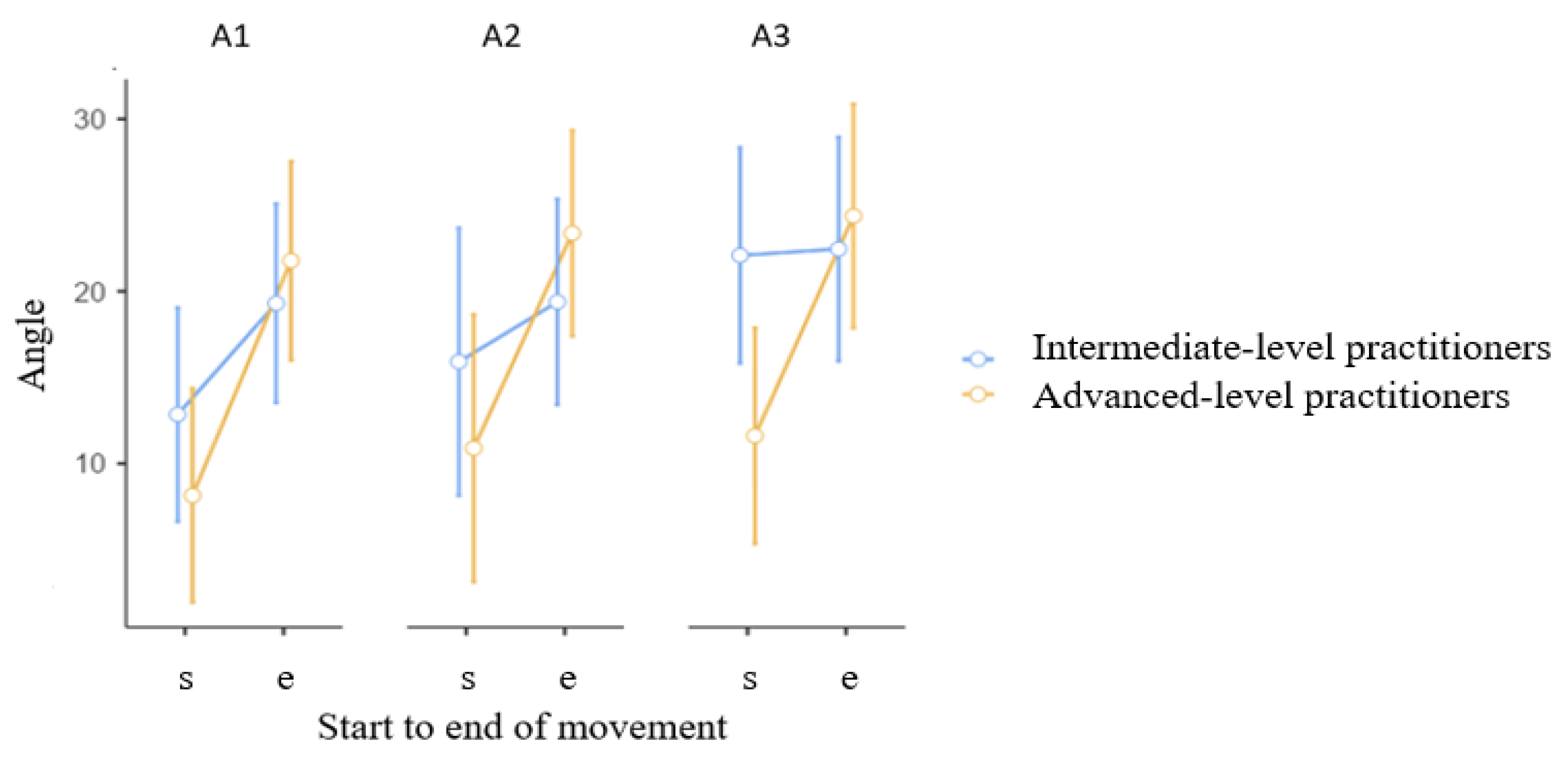
| Knee flexion—intermediate (°) | 12.84 ± 9.96 | – | 22.08 ± 11.57 | −9.24 | 2.50 | 24 | −3.69 | 0.041 |
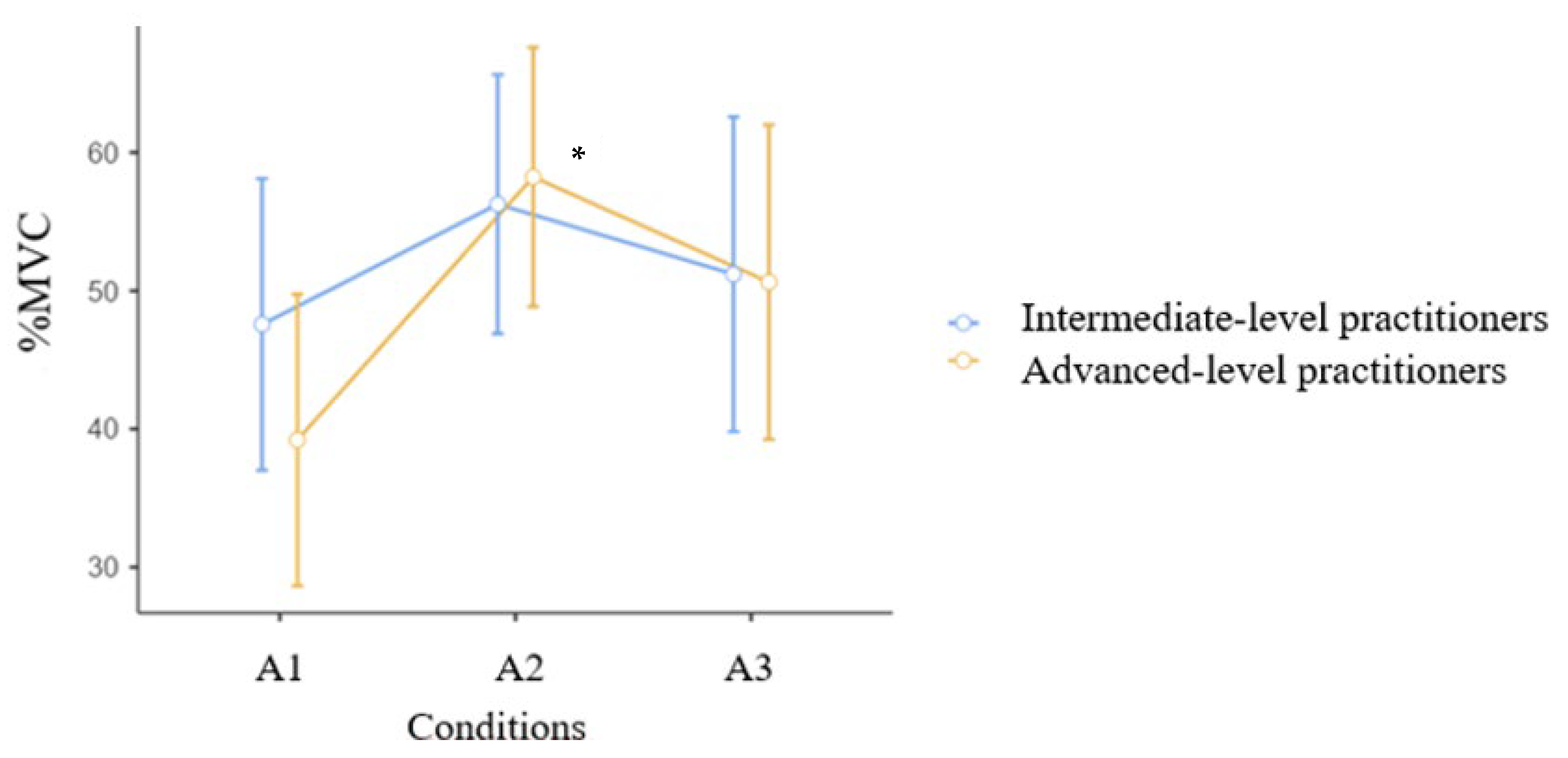
| Medial gastrocnemius—advanced (%MVC) | 39.20 ± 19.07 | 58.23 ± 15.10 | – | −19.03 | 5.28 | 24 | −3.60 | 0.016 |
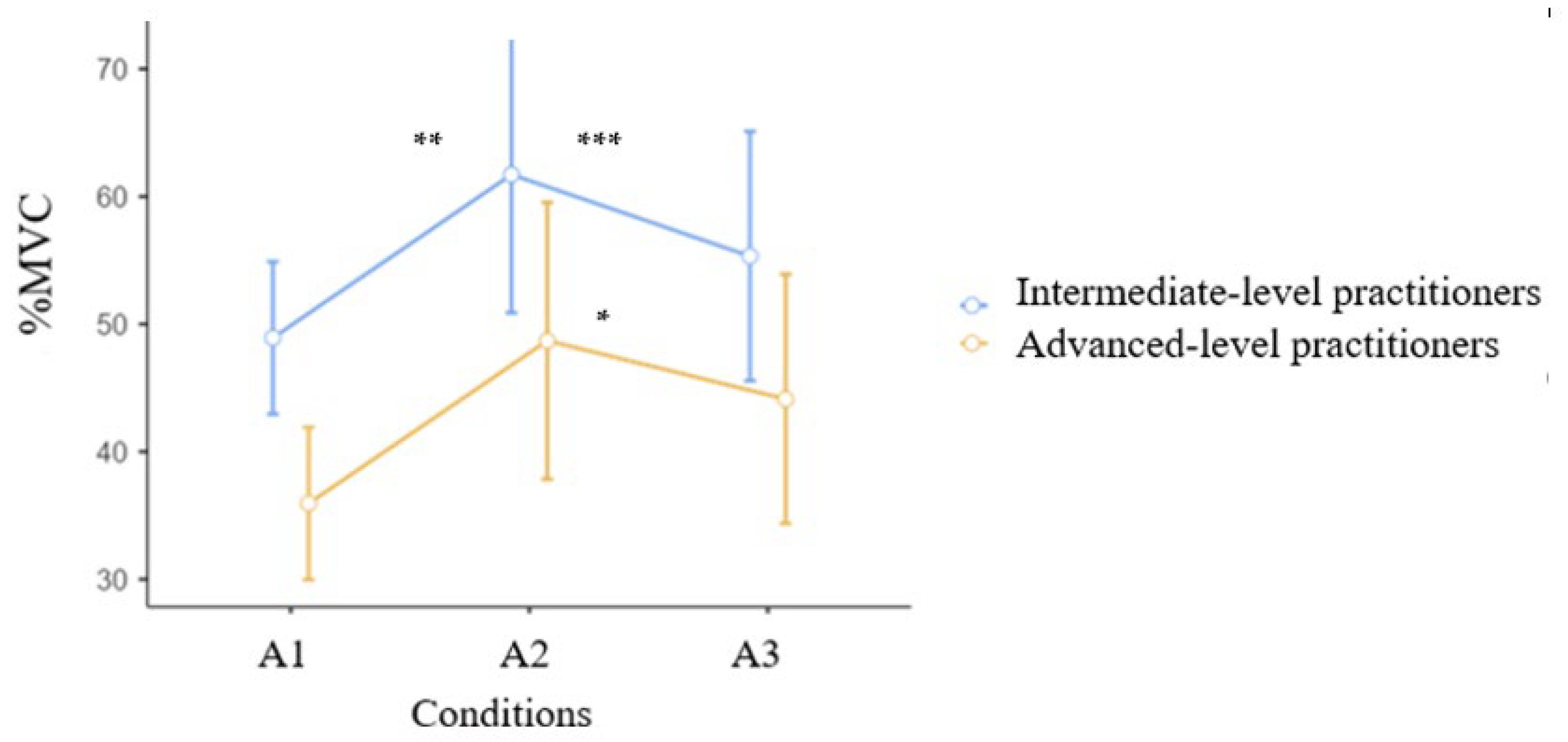
| Soleus—advanced (%MVC) | 35.94 ± 12.37 | 48.69 ± 15.09 | – | −12.75 | 4.08 | 24 | −3.13 | 0.046 |
| Soleus—intermediate (%MVC) | 48.92 ± 8.07 | 61.72 ± 22.13 | – | −12.80 | 4.08 | 24 | −3.14 | 0.045 |
| Soleus—advanced vs. intermediate (%MVC) | 35.94 ± 12.37 vs. 48.92 ± 8.07 | – | – | 12.98 | 4.10 | 24 | 3.17 | 0.042 |
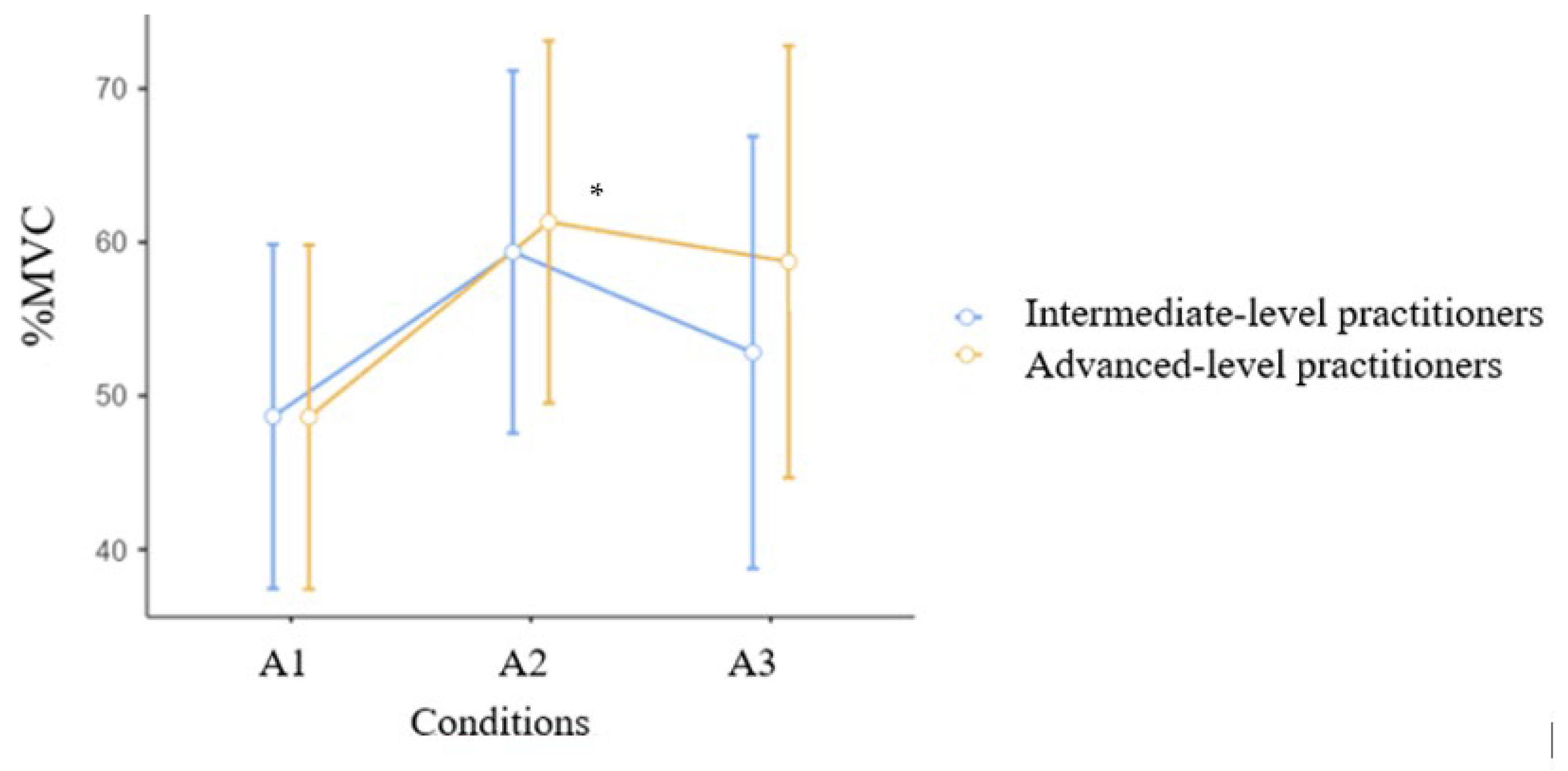
| Lateral gastrocnemius—advanced (%MVC) | 48.61 ± 23.96 | 61.32 ± 23.72 | – | −12.71 | 3.72 | 24 | −3.42 | 0.024 |
Disclaimer/Publisher’s Note: The statements, opinions and data contained in all publications are solely those of the individual author(s) and contributor(s) and not of MDPI and/or the editor(s). MDPI and/or the editor(s) disclaim responsibility for any injury to people or property resulting from any ideas, methods, instructions or products referred to in the content. |
© 2026 by the authors. Licensee MDPI, Basel, Switzerland. This article is an open access article distributed under the terms and conditions of the Creative Commons Attribution (CC BY) license.
Share and Cite
Kaczmarski, J.; Błaszczyszyn, M.; Borysiuk, Z. Range of Motion and Muscle Activity During the Front Kick in Karate Kyokushin. J. Clin. Med. 2026, 15, 1662. https://doi.org/10.3390/jcm15041662
Kaczmarski J, Błaszczyszyn M, Borysiuk Z. Range of Motion and Muscle Activity During the Front Kick in Karate Kyokushin. Journal of Clinical Medicine. 2026; 15(4):1662. https://doi.org/10.3390/jcm15041662
Chicago/Turabian StyleKaczmarski, Jacek, Monika Błaszczyszyn, and Zbigniew Borysiuk. 2026. "Range of Motion and Muscle Activity During the Front Kick in Karate Kyokushin" Journal of Clinical Medicine 15, no. 4: 1662. https://doi.org/10.3390/jcm15041662
APA StyleKaczmarski, J., Błaszczyszyn, M., & Borysiuk, Z. (2026). Range of Motion and Muscle Activity During the Front Kick in Karate Kyokushin. Journal of Clinical Medicine, 15(4), 1662. https://doi.org/10.3390/jcm15041662