Postmortem Redistribution of Drugs Commonly Used in Rapid Sequence Induction for Anesthesia: A Review
 , , , , , , ,
  ,
,  ,
,  and
and
Abstract
1. Introduction
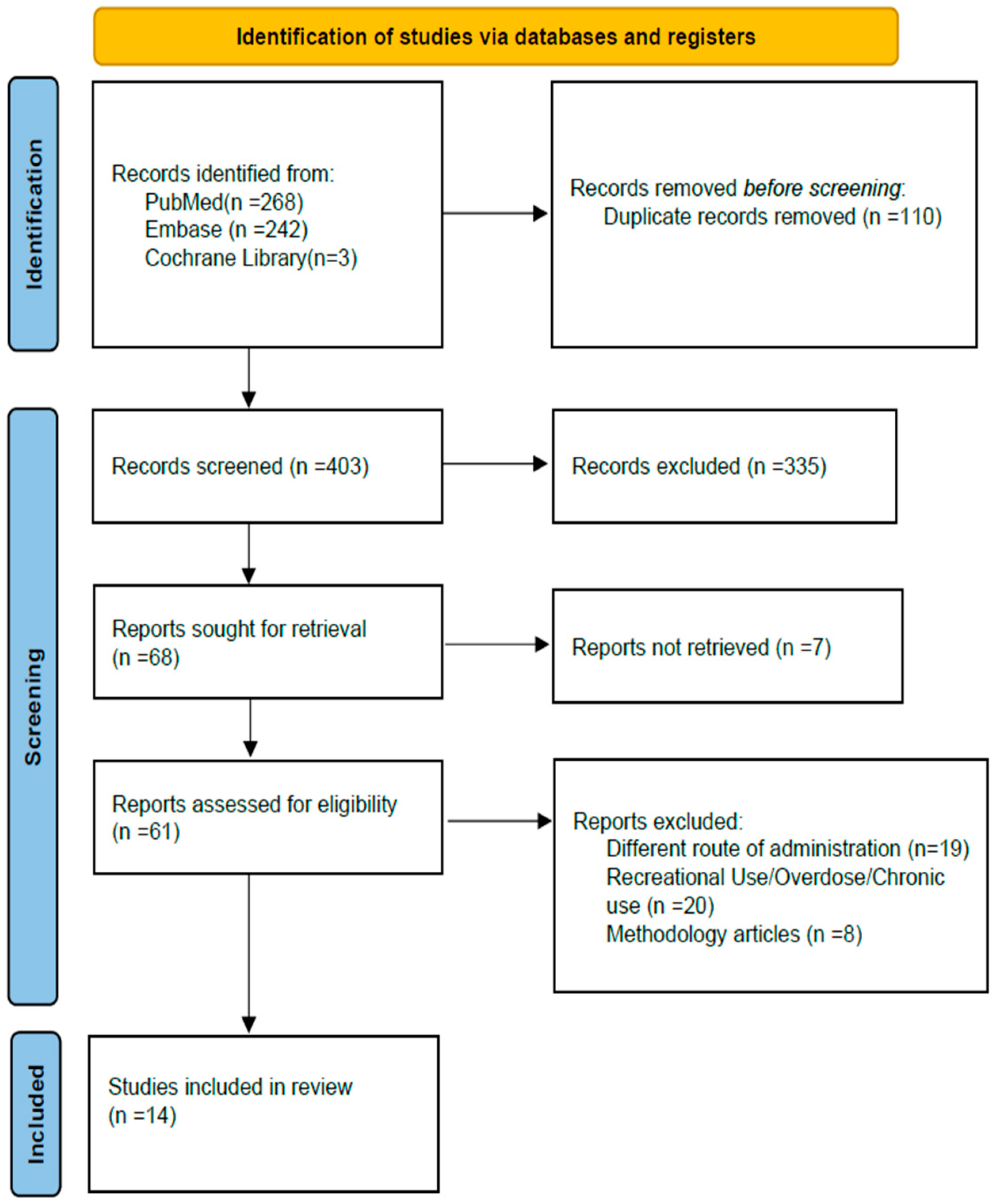
2. Literature Search Strategy
3. Pharmacological Categories
3.1. Intravenous Anesthetics
3.1.1. Midazolam
3.1.2. Thiopental
3.1.3. Etomidate
3.1.4. Propofol
3.1.5. Ketamine
3.2. Neuromuscular Blocking Agents
Suxamethonium (Succinylcholine)
3.3. IV Opioids Used in RSI
Fentanyl
4. Discussion
5. Conclusions
Author Contributions
Funding
Data Availability Statement
Conflicts of Interest
Abbreviations
| RSI | Rapid Sequence Induction |
| RSII | Rapid Sequence Induction and Intubation |
| PMR | Postmortem Drug Redistribution |
| ICU | Intensive Care Unit |
| PMI | Postmortem Interval |
| CT | Computed Tomography |
| IV | Intravenous |
| BMI | Body Mass Index |
| C/P | Central to Peripheral Blood |
| L/P | Liver to Peripheral Blood |
| ADME | Absorption, Distribution, Metabolism, and Excretion |
| BChE | Butyrylcholinesterase |
| Vd | Volume of Distribution |
References
- Russotto, V.; Rahmani, L.S.; Parotto, M.; Bellani, G.; Laffey, J.G. Tracheal intubation in the critically ill patient. Eur. J. Anaesthesiol. 2022, 39, 463–472. [Google Scholar] [CrossRef]
- Collins, J.; O’Sullivan, E.P. Rapid sequence induction and intubation. BJA Educ. 2022, 22, 484–490. [Google Scholar] [CrossRef]
- Eichelsbacher, C.; Ilper, H.; Noppens, R.; Hinkelbein, J.; Loop, T. Rapid sequence induction and intubation in patients with risk of aspiration: Recommendations for action for practical management of anesthesia. Anaesthesist 2018, 67, 568–583. [Google Scholar] [CrossRef]
- Sorbello, M.; Paternò, D.S.; Zdravkovic, I.; La Via, L. Pharmacological approach to rapid sequence induction/intubation: A contemporary perspective. Curr. Opin. Anaesthesiol. 2025, 38, 369–374. [Google Scholar] [CrossRef]
- Faine, B.A.; Carroll, E.; Sharma, A.; Mohr, N. Rapid sequence intubation, is it time to find an alternative induction agent? A narrative review. J. Pharm. Pract. 2024, 37, 977–984. [Google Scholar] [CrossRef]
- Yeung, J.K.; Zed, P.J. A review of etomidate for rapid sequence intubation in the emergency department. Can. J. Emerg. Med. 2002, 4, 194–198. [Google Scholar] [CrossRef][Green Version]
- Baekgaard, J.S.; Eskesen, T.G.; Sillesen, M.; Rasmussen, L.S.; Steinmetz, J. Ketamine as a rapid sequence induction agent in the trauma population: A systematic review: A systematic review. Anesth. Analg. 2019, 128, 504–510. [Google Scholar] [CrossRef]
- Radkowski, P.; Szewczyk, M.; Grażewicz, M.; Sobolewski, K.; Onichimowski, D. Use of muscle relaxants in emergency medicine: A review. Med. Sci. Monit. 2025, 31, e949876. [Google Scholar] [CrossRef]
- Amin Aljefri, A.; Alqurashi, A.S.; Alshahrani, M.F.; Alshahrani, S.N.; Allehaimeed, I.S.; Alotaibi, M.A.; Alarifi, S.T.; Aljohani, A.A.; Khoj, H.A.; Samman, H.M.; et al. Selection of induction agents for safe and effective rapid sequence intubation. Int. J. Community Med. Public Health 2025, 12, 1044–1048. [Google Scholar]
- Bakhsh, A.; Bakhribah, A.; Alshehri, R.; Alghazzawi, N.; Alsubhi, J.; Redwan, E.; Nour, Y.; Nashar, A.; Babekir, E.; Azzam, M. Association between fentanyl use and post-intubation mean arterial pressure during rapid sequence intubation: Prospective observational study. West. J. Emerg. Med. 2025, 26, 10–19. [Google Scholar] [CrossRef]
- Gindre, S.; Ciais, J.F.; Levraut, J.; Dellamonica, J.; Guerin, J.P.; Grimaud, D. Rapid sequence intubation in emergency: Is there any place for fentanyl? Ann. Fr. Anesth. Reanim. 2002, 21, 760–766. [Google Scholar] [CrossRef]
- De Jong, A.; Rolle, A.; Molinari, N.; Paugam-Burtz, C.; Constantin, J.-M.; Lefrant, J.-Y.; Asehnoune, K.; Jung, B.; Futier, E.; Chanques, G.; et al. Cardiac arrest and mortality related to intubation procedure in critically ill adult patients: A multicenter cohort study. Crit. Care Med. 2018, 46, 532–539. [Google Scholar] [CrossRef]
- Ali, N.; Kapadia, N.N.; Soomar, S.M.; Raheem, A.; Habibullah, N.; Habib, Z.; Waheed, S. Risk factors of Peri-intubation cardiac arrest in critically ill patients presenting to the Emergency Department of a low-income country: A case-control study. J. Emerg. Med. 2025, 76, 26–32. [Google Scholar] [CrossRef]
- Downing, J.; Yardi, I.; Ren, C.; Cardona, S.; Zahid, M.; Tang, K.; Bzhilyanskaya, V.; Patel, P.; Pourmand, A.; Tran, Q.K. Prevalence of peri-intubation major adverse events among critically ill patients: A systematic review and meta analysis. Am. J. Emerg. Med. 2023, 71, 200–216. [Google Scholar] [CrossRef]
- Sacco, M.A.; Gualtieri, S.; Spiliopoulou, C.; Tarallo, A.P.; Verrina, M.C.; Aquila, I. The role of toxicology investigations in overdose deaths. Cureus 2025, 17, e79352. [Google Scholar] [CrossRef]
- Musshoff, F.; Padosch, S.; Steinborn, S.; Madea, B. Fatal blood and tissue concentrations of more than 200 drugs. Forensic Sci. Int. 2004, 142, 161–210. [Google Scholar] [CrossRef]
- Ferner, R.E. Post-mortem clinical pharmacology. Br. J. Clin. Pharmacol. 2008, 66, 430–443. [Google Scholar] [CrossRef]
- Pélissier-Alicot, A.-L.; Gaulier, J.-M.; Champsaur, P.; Marquet, P. Mechanisms underlying postmortem redistribution of drugs: A review. J. Anal. Toxicol. 2003, 27, 533–544. [Google Scholar] [CrossRef]
- Mantinieks, D.; Gerostamoulos, D.; Glowacki, L.; Di Rago, M.; Schumann, J.; Woodford, N.W.; Drummer, O.H. Postmortem drug redistribution: A compilation of postmortem/antemortem drug concentration ratios. J. Anal. Toxicol. 2021, 45, 368–377. [Google Scholar] [CrossRef]
- Concheiro, M.; Chesser, R.; Pardi, J.; Cooper, G. Postmortem toxicology of new synthetic opioids. Front. Pharmacol. 2018, 9, 1210. [Google Scholar] [CrossRef]
- Pounder, D.J.; Jones, G.R. Post-mortem drug redistribution--a toxicological nightmare. Forensic Sci. Int. 1990, 45, 253–263. [Google Scholar] [CrossRef]
- Irwin, M.R.; Curay, C.M.; Choi, S.; Kiyatkin, E.A. Basic metabolic and vascular effects of ketamine and its interaction with fentanyl. Neuropharmacology 2023, 228, 109465. [Google Scholar] [CrossRef]
- Wiczling, P.; Bieda, K.; Przybyłowski, K.; Hartmann-Sobczyńska, R.; Borsuk, A.; Matysiak, J.; Kokot, Z.J.; Sobczyński, P.; Grześkowiak, E.; Bienert, A. Pharmacokinetics and pharmacodynamics of propofol and fentanyl in patients undergoing abdominal aortic surgery—A study of pharmacodynamic drug-drug interactions: PK/PD OF PROPOFOL AND FENTANYL DURING ABDOMINAL AORTIC SURGERY. Biopharm. Drug Dispos. 2016, 37, 252–263. [Google Scholar] [CrossRef]
- Lennborn, U.; Johansson, A.; Lindgren, E.; Nielsen, E.I.; Sandler, H.; Kronstrand, R.; Ahlner, J.; Kugelberg, F.C.; Rubertsson, S. Comparison of pre-mortem and post-mortem blood concentrations of analgesic and sedative drugs in intensive care patients. Forensic Sci. Int. 2025, 375, 112551. [Google Scholar] [CrossRef]
- Oertel, R.; Pietsch, J.; Arenz, N.; Zeitz, S.G.; Goltz, L.; Kirch, W. Distribution of metoprolol, tramadol, and midazolam in human autopsy material. J. Chromatogr. A 2011, 1218, 4988–4994. [Google Scholar] [CrossRef]
- de Groot, A.D.E.; Borra, L.C.P.; van der Hulst, R.; Etsouli, O.; Kloos, D.-P.; Rijken, D.J.; Elsinga, P.H.; Boersma, H.H.; Bosman, I.J.; Touw, D.J. Postmortem redistribution of amphetamines and benzodiazepines in humans: Important variables that might be influencing the central blood / peripheral blood ratio. Forensic Sci. Int. 2023, 353, 111876. [Google Scholar] [CrossRef]
- Tominaga, M.; Michiue, T.; Ishikawa, T.; Kawamoto, O.; Oritani, S.; Ikeda, K.; Ogawa, M.; Maeda, H. Postmortem analyses of drugs in pericardial fluid and bone marrow aspirate. J. Anal. Toxicol. 2013, 37, 423–429. [Google Scholar] [CrossRef][Green Version]
- Gerostamoulos, D.; Beyer, J.; Staikos, V.; Tayler, P.; Woodford, N.; Drummer, O.H. The effect of the postmortem interval on the redistribution of drugs: A comparison of mortuary admission and autopsy blood specimens. Forensic Sci. Med. Pathol. 2012, 8, 373–379. [Google Scholar] [CrossRef]
- Yasudal, T.; Yamaba, T.; Sawazaki, K.; Masuyama, F.; Nadano, D.; Takeshita, H.; Kishi, K. Postmortem concentrations of thiopental in tissues: A sudden death case. Int. J. Leg. Med. 1993, 105, 239–241. [Google Scholar] [CrossRef]
- Molina, D.K.; Hargrove, V.M.; Rodriguez, R.G. Distribution of etomidate in a fatal intoxication. J. Anal. Toxicol. 2008, 32, 715–718. [Google Scholar] [CrossRef]
- George, A.A.; Hargrove, V.M.; Molina, D.K. Postmortem propofol levels: A case of residual detection long after administration. Am. J. Forensic Med. Pathol. 2016, 37, 4–6. [Google Scholar] [CrossRef]
- Arora, B.; Lalwani, S.; Saxena, R.; Ghose, S.; Velpandian, T. Postmortem redistribution of ketamine in ocular matrices: A study of forensic relevance. Leg. Med. 2020, 47, 101777. [Google Scholar] [CrossRef] [PubMed]
- Malthe-Sørenssen, D.; Odden, E.; Blanch, J.; Bugge, A.; Mørland, J. Determination of succinyldicholine in different tissue samples from guinea pigs after injection of a single intravenous dose. Forensic Sci. Int. 1986, 32, 171–178. [Google Scholar] [CrossRef]
- Brockbals, L.; Staeheli, S.N.; Gascho, D.; Ebert, L.C.; Kraemer, T.; Steuer, A.E. Time-dependent postmortem redistribution of opioids in blood and alternative matrices. J. Anal. Toxicol. 2018, 42, 365–374. [Google Scholar] [CrossRef]
- Nedahl, M.; Johansen, S.S.; Linnet, K. Postmortem brain-blood ratios of codeine, fentanyl, oxycodone and tramadol. J. Anal. Toxicol. 2021, 45, 53–59. [Google Scholar] [CrossRef]
- McIntyre, I.M.; Gary, R.D.; Estrada, J.; Nelson, C.L. Antemortem and postmortem fentanyl concentrations: A case report. Int. J. Leg. Med. 2014, 128, 65–67. [Google Scholar] [CrossRef]
- Olson, K.N.; Luckenbill, K.; Thompson, J.; Middleton, O.; Geiselhart, R.; Mills, K.M.; Kloss, J.; Apple, F.S. Postmortem redistribution of fentanyl in blood. Am. J. Clin. Pathol. 2010, 133, 447–453. [Google Scholar] [CrossRef]
- Luckenbill, K.; Thompson, J.; Middleton, O.; Kloss, J.; Apple, F. Fentanyl postmortem redistribution: Preliminary findings regarding the relationship among femoral blood and liver and heart tissue concentrations. J. Anal. Toxicol. 2008, 32, 639–643. [Google Scholar] [CrossRef][Green Version]
- Palamalai, V.; Olson, K.N.; Kloss, J.; Middleton, O.; Mills, K.; Strobl, A.Q.; Thomas, L.C.; Apple, F.S. Superiority of postmortem liver fentanyl concentrations over peripheral blood influenced by postmortem interval for determination of fentanyl toxicity. Clin. Biochem. 2013, 46, 598–602. [Google Scholar] [CrossRef]
- Rodney, G.; Raju, P.; Brull, S.J. Neuromuscular block management: Evidence-based principles and practice. BJA Educ. 2024, 24, 13–22. [Google Scholar] [CrossRef]
- Grissinger, M. Paralyzed by Mistakes—Reassess the Safety of Neuromuscular Blockers in Your Facility. Pharm. Ther. 2019, 44, 91–107. [Google Scholar]
- Perše, M. Animal Models of Human Pathology: Revision, relevance and refinements. Biomedicines 2024, 12, 2418. [Google Scholar] [CrossRef]
- Leenaars, C.H.C.; Kouwenaar, C.; Stafleu, F.R.; Bleich, A.; Ritskes-Hoitinga, M.; De Vries, R.B.M.; Meijboom, F.L.B. Animal to human translation: A systematic scoping review of reported concordance rates. J. Transl. Med. 2019, 17, 223. [Google Scholar] [CrossRef]
- Zagalioti, S.-C.; Gkarmiri, S.; Karagiannidis, E.; Stachteas, P.; Zgouridou, A.; Zagaliotis, P.; Kotzampassi, K.; Grosomanidis, V.; Raikos, N.; Aggou, M.; et al. Does the injection site matter during CPR? A systematic review and meta-analysis of drug pharmacokinetics and pharmacodynamics. J. Clin. Med. 2025, 14, 7497. [Google Scholar] [CrossRef]
- McIntyre, I.M. Postmortem Fentanyl Concentrations: A Review. J. Forensics Res. 2012, 3, 1000157. [Google Scholar] [CrossRef]
- Kuip, E.J.M.; Zandvliet, M.L.; Koolen, S.L.W.; Mathijssen, R.H.J.; van der Rijt, C.C.D. A review of factors explaining variability in fentanyl pharmacokinetics; focus on implications for cancer patients. Br. J. Clin. Pharmacol. 2017, 83, 294–313. [Google Scholar] [CrossRef]
- Bird, H.E.; Huhn, A.S.; Dunn, K.E. Fentanyl absorption, distribution, metabolism, and excretion: Narrative review and Clinical significance related to illicitly manufactured fentanyl. J. Addict. Med. 2023, 17, 503–508. [Google Scholar] [CrossRef]
- Stephenson, L.; Van Den Heuvel, C.; Scott, T.; Byard, R.W. Difficulties associated with the interpretation of postmortem toxicology. J. Anal. Toxicol. 2024, 48, 405–412. [Google Scholar] [CrossRef]
- Peter, J.-U.; Dieudonné, P.; Zolk, O. Pharmacokinetics, pharmacodynamics, and side effects of midazolam: A review and case example. Pharmaceuticals 2024, 17, 473. [Google Scholar] [CrossRef]
- Greenblatt, D.J.; Abernethy, D.R.; Locniskar, A.; Harmatz, J.S.; Limjuco, R.A.; Shader, R.I. Effect of age, gender, and obesity on midazolam kinetics. Anesthesiology 1984, 61, 27–35. [Google Scholar] [CrossRef]
- National Center for Biotechnology Information. PubChem Compound Summary for CID 4192, Midazolam. Available online: https://pubchem.ncbi.nlm.nih.gov/compound/Midazolam (accessed on 11 January 2026).
- National Center for Biotechnology Information. PubChem Compound Summary for CID 3000715, Thiopental. Available online: https://pubchem.ncbi.nlm.nih.gov/compound/Thiopental (accessed on 11 January 2026).
- Levron, J.C.; Assoune, P. Pharmacocinétique de l’étomidate. Ann. Fr. Anesth. Reanim. 1990, 9, 123–126. [Google Scholar] [CrossRef]
- Sahinovic, M.M.; Struys, M.M.R.F.; Absalom, A.R. Clinical Pharmacokinetics and Pharmacodynamics of Propofol. Clin. Pharmacokinet. 2018, 57, 1539–1558. [Google Scholar] [CrossRef]
- Dinis-Oliveira, R.J. Metabolism and metabolomics of ketamine: A toxicological approach. Forensic Sci. Res. 2017, 2, 2–10. [Google Scholar] [CrossRef]
- Roy, J.J.; Varin, F. Physicochemical properties of neuromuscular blocking agents and their impact on the pharmacokinetic-pharmacodynamic relationship. Br. J. Anaesth. 2004, 93, 241–248. [Google Scholar] [CrossRef] [PubMed]
- McIntyre, I.M. Liver and peripheral blood concentration ratio (L/P) as a marker of postmortem drug redistribution: A literature review. Forensic Sci. Med. Pathol. 2014, 10, 91–96. [Google Scholar] [CrossRef] [PubMed]
- Cheng, T.; Curley, M.; Barmettler, A. Pseudocholinesterase deficiency in ophthalmology: A systematic review. Orbit 2024, 43, 429–437. [Google Scholar] [CrossRef] [PubMed]
- Akan, M.; Çakırgöz, M.; Demirel, İ.; Saraç, Ö.; Kar, A.A.; Alaygut, E.; Demirel, O.; Yeniay, H.; Tünay, A. Thiopental Versus Propofol in Combination with Remifentanil for Successful Classic Laryngeal Mask Airway Insertion: A Prospective, Randomised, Double-Blind Trial. Pharmaceuticals 2025, 18, 1173. [Google Scholar] [CrossRef]


| Search Entry—PubMed | ||
|---|---|---|
| Search | Entry Terms | Result |
| #1 | “postmortem redistribution” OR “postmortem distribution” OR “postmortem pharmacokinetics” | 12,234 |
| #2 | “sedative drugs” OR “neuromuscular blockade” OR “rapid sequence induction” OR “propofol” OR “ketamine” OR “midazolam” OR “fentanyl” OR “etomidate” OR “rocuronium” OR “vecuronium” OR “succinylcholine” OR “suxamethonium” OR “thiopental” OR “thiopentone” | 226,261 |
| #3 | #1 AND #2 | 268 |
| Drugs | Study | Type of Study | Route | Study Population | Results |
|---|---|---|---|---|---|
| Anesthetics | |||||
| Midazolam | Lennborn et al. [24] | Observational | IV | ICU patients | Increased perimortem concentration due to incomplete antemortem distribution |
| Oertel et al. [25] | Observational | IV | Patients that underwent emergency/urgent procedures | Time elapsed between administration and death determines the distribution of the drug between sampling sites (cardiac blood, peripheral blood, brain, liver, kidneys), with cardiac blood and brain concentrations being the highest when distribution is deemed incomplete | |
| Tominaga et al. [27] | Observational | IV | Forensic cases | Postmortem concentrations in the pericardial fluid were significantly lower than bone marrow aspirate and cardiac blood concentrations Insufficient data | |
| de Groot et al. [26] | Observational | IV | Forensic cases | Higher values of C/P ratio were noted for higher BMI Small number of cases with low BMI | |
| Gerostamoulos et al. [28] | Observational | IV | Forensic cases | No statistically significant changes Small sample | |
| Thiopental | Lennborn et al. [24] | Observational | IV | ICU patients | Inconclusive |
| Yasuda et al. [29] | Case report | IV | Patient that underwent procedural sedation | Very low postmortem concentrations in all samples, except for the brain and thymus | |
| Etomidate | Molina et al. [30] | Case report | IV | Individual—fatal intoxication | Postmortem concentration just above therapeutic levels in a case of fatal intoxication |
| Propofol | Lennborn et al. [24] | Observational | IV | ICU patients | Inconclusive |
| Tominaga et al. [27] | Observational | IV | Forensic cases | Postmortem concentrations in the pericardial fluid were significantly lower than bone marrow aspirate and cardiac blood concentrations Insufficient data | |
| George et al. [31] | Case report | IV | Patient that underwent a surgical procedure | Propofol detected postmortem 7 days after continuous IV administration | |
| Ketamine | Lennborn et al. [24] | Observational | IV | ICU patients | Inconclusive |
| Arora et al. [32] | In vivo animal study | IV | Rats | Decrease in postmortem blood concentrations Increased levels of ketamine and norketamine in ocular tissues (highest in the retina and choroid) Not statistically significant changes | |
| Neuromuscular Blocking Agents | |||||
| Suxamethonium (Succinylcholine) | Malthe- Sørenssen et al. [33] | In vivo animal study | IV | Guinea pigs | Low postmortem concentrations in muscle, kidney, and urine Ocular tissues exhibited highest concentrations |
| Rocuronium | N/A | N/A | N/A | N/A | N/A |
| Vecuronium | N/A | N/A | N/A | N/A | N/A |
| Opioids | |||||
| Fentanyl | Lennborn et al. [24] | Observational | IV | ICU patients | Significant PMR Perimortem concentrations were 5 times higher than observed concentrations in living patients Increase in postmortem compared to perimortem concentrations in 72% of cases |
| Brockbals et al. [34] | Observational | IV/transdermal | ICU patients/chronic pain patients | Highest concentrations in liver and kidney L/P ratio was significantly higher than C/P ratio; C/P ratio was also considered high Significant time-dependent increases in peripheral blood Small sample | |
| Mantinieks et al. [19] | Observational | IV | Patients who died in hospital | Median postmortem/antemortem ratio = 1 Small sample | |
| Nerdahl et al. [35] | Observational | IV/transdermal | Patients that received fentanyl IV or transdermally | No statistically significant difference for the brain–blood ratios between the two different routes of administration | |
| McIntyre et al. [36] | Case report | IV | Patient who underwent RSI | C/P: 1.37 Minimal increase in the postmortem concentrations (12%), with a PMI of 12.6 h |
| Drugs | Factors | Studies | Rationale |
|---|---|---|---|
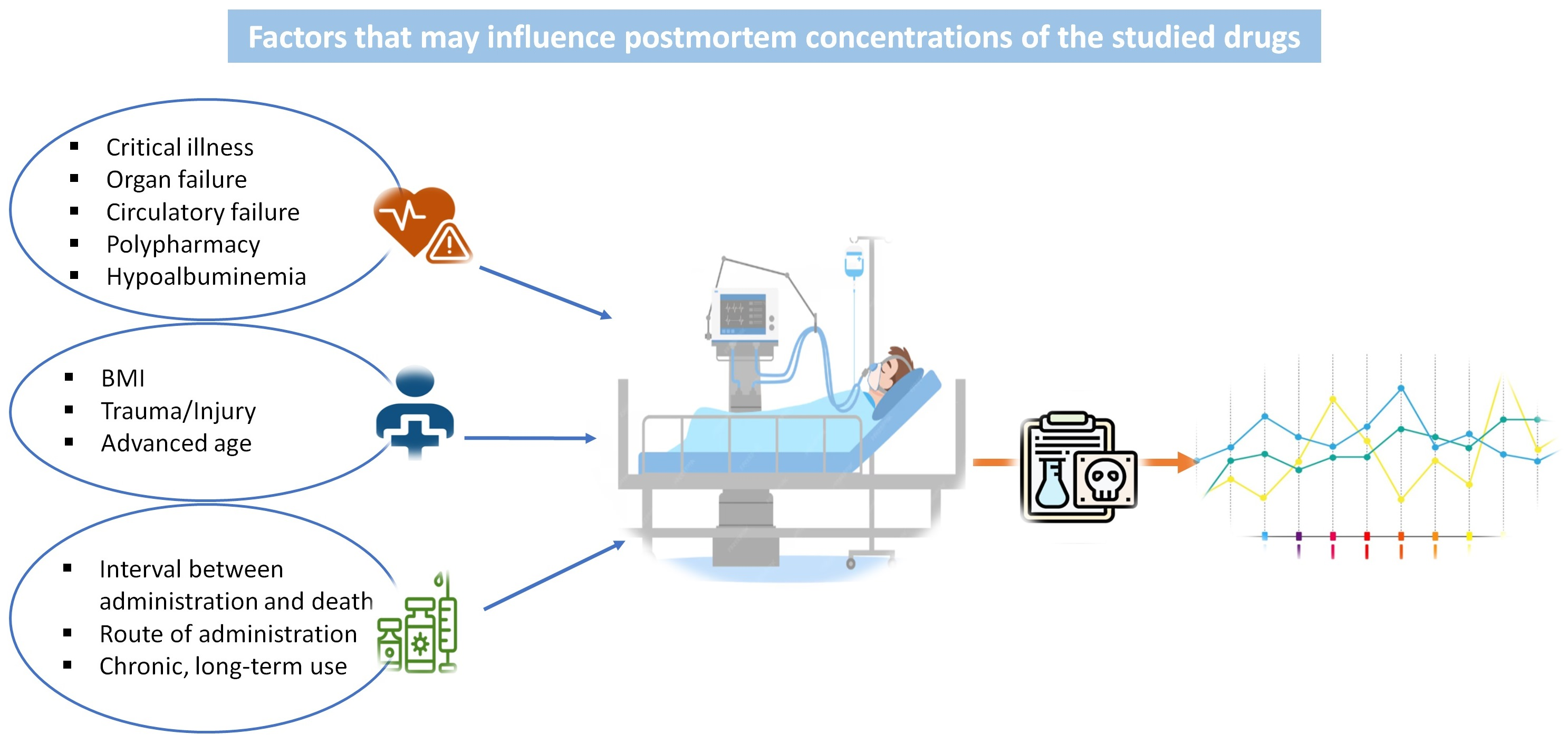
| Midazolam | Short interval between administration and death | [24,25] | Incomplete distribution |
| Sampling from central line | [24] | Central blood is more susceptible to postmortem concentration changes | |
| Circulatory compromise (shock) | [24,27] | Incomplete distribution | |
| Critical illness | [24,27] | Incomplete distribution | |
| Fentanyl | Unknown interval between administration and death | [19] | Possible incomplete distribution |
| Sampling from central line | [24] | Incomplete distribution | |
| Circulatory compromise (shock) | [24] | Incomplete distribution | |
| Critical illness | [24,34] | Incomplete distribution |
| Drugs | pKa | logP/ logD | Lipophilic | Hydrophilic | Vd (L/kg) | Protein Binding | Risk for PMR |
|---|---|---|---|---|---|---|---|
| Anesthetics | |||||||
| Midazolam [25,28,50,51] | 6–7 | 2.73 | Highly | 1–3 | 96–97% | Moderate | |
| Thiopental [29,52] | 7.55 | 2.85 | Highly | 2–3 | 70–80% | Moderate | |
| Etomidate [30,53] | 4.2–4.5 | 2.8–3 | Highly | 2–8 | 75% | High/Uncertain | |
| Propofol [27,31,54] | 11 | 3.8–4.2 | Highly | 2–12 | 95–99% | High | |
| Ketamine [32,55] | 7.5 | 2.2–3.1 | Highly | 3–5 | 20–50% | High | |
| Neuromuscular Blocking Agents | |||||||
| Suxamethonium (Sucinylcholine) [33,56] | Ionized | −0.74/ −4.15 | Highly | 0.16–0.5 | 20% | Low/Uncertain | |
| Rocuronium [56] | 7.4 | Low/0.54 | Highly | 0.2–0.27 | 46% | Low/Uncertain | |
| Vecuronium [56] | 8.97 | 0.9–2/0.75 | Poorly | Highly | 0.2–0.3 | 60–80% | Low/Uncertain |
| Opioids | |||||||
| Fentanyl [19,45,47] | 8.4 | 3.94–4.05 | Highly | 3–8 | 80–90% | High |
Disclaimer/Publisher’s Note: The statements, opinions and data contained in all publications are solely those of the individual author(s) and contributor(s) and not of MDPI and/or the editor(s). MDPI and/or the editor(s) disclaim responsibility for any injury to people or property resulting from any ideas, methods, instructions or products referred to in the content. |
© 2026 by the authors. Licensee MDPI, Basel, Switzerland. This article is an open access article distributed under the terms and conditions of the Creative Commons Attribution (CC BY) license.
Share and Cite
Gkarmiri, S.; Zagalioti, S.-C.; Karagiannidis, E.; Zagaliotis, P.; Stachteas, P.; Apostolopoulou, A.; Diamantoudis, S.C.; Bantidos, M.G.; Kofos, C.; Kotzampassi, K.; et al. Postmortem Redistribution of Drugs Commonly Used in Rapid Sequence Induction for Anesthesia: A Review. J. Clin. Med. 2026, 15, 1622. https://doi.org/10.3390/jcm15041622
Gkarmiri S, Zagalioti S-C, Karagiannidis E, Zagaliotis P, Stachteas P, Apostolopoulou A, Diamantoudis SC, Bantidos MG, Kofos C, Kotzampassi K, et al. Postmortem Redistribution of Drugs Commonly Used in Rapid Sequence Induction for Anesthesia: A Review. Journal of Clinical Medicine. 2026; 15(4):1622. https://doi.org/10.3390/jcm15041622
Chicago/Turabian StyleGkarmiri, Sofia, Sofia-Chrysovalantou Zagalioti, Efstratios Karagiannidis, Panagiotis Zagaliotis, Panagiotis Stachteas, Aikaterini Apostolopoulou, Sotirios Charalampos Diamantoudis, Marios G. Bantidos, Christos Kofos, Katerina Kotzampassi, and et al. 2026. "Postmortem Redistribution of Drugs Commonly Used in Rapid Sequence Induction for Anesthesia: A Review" Journal of Clinical Medicine 15, no. 4: 1622. https://doi.org/10.3390/jcm15041622
APA StyleGkarmiri, S., Zagalioti, S.-C., Karagiannidis, E., Zagaliotis, P., Stachteas, P., Apostolopoulou, A., Diamantoudis, S. C., Bantidos, M. G., Kofos, C., Kotzampassi, K., Grosomanidis, V., Raikos, N., & Fyntanidou, B. (2026). Postmortem Redistribution of Drugs Commonly Used in Rapid Sequence Induction for Anesthesia: A Review. Journal of Clinical Medicine, 15(4), 1622. https://doi.org/10.3390/jcm15041622