
TP53 Functional-Domain-Specific Mutations Define Distinct Clinical Outcomes in EGFR-Mutant Non-Small Cell Lung Cancer Treated with EGFR Tyrosine Kinase Inhibitors

Abstract
1. Introduction
2. Materials and Methods
2.1. Patient Population
2.2. Genomic Analysis
- (1)
- DBD-involved TP53 mutations, defined as mutations involving the DNA-binding domain (DBD), including DBD-only mutations and complex mutations with additional oligomerization domain (OD) involvement;
- (2)
- Other TP53 mutations (DBD/OD-non-involved), defined as mutations involving neither the DBD nor the OD (e.g., transactivation domain mutations, frameshift mutations, splice-site mutations);
- (3)
- TP53 wild type, defined as no detectable TP53 mutations.
2.3. Study Endpoints
2.4. Statistical Analysis
2.5. Ethics Statement
3. Results
3.1. Patient Characteristics
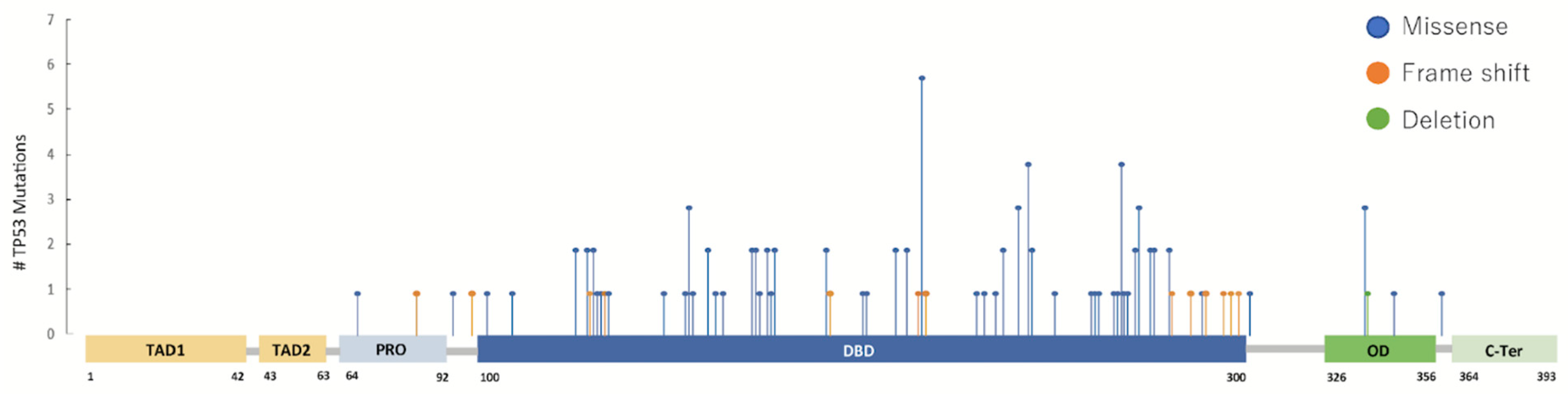
3.2. Distribution of TP53 Mutations
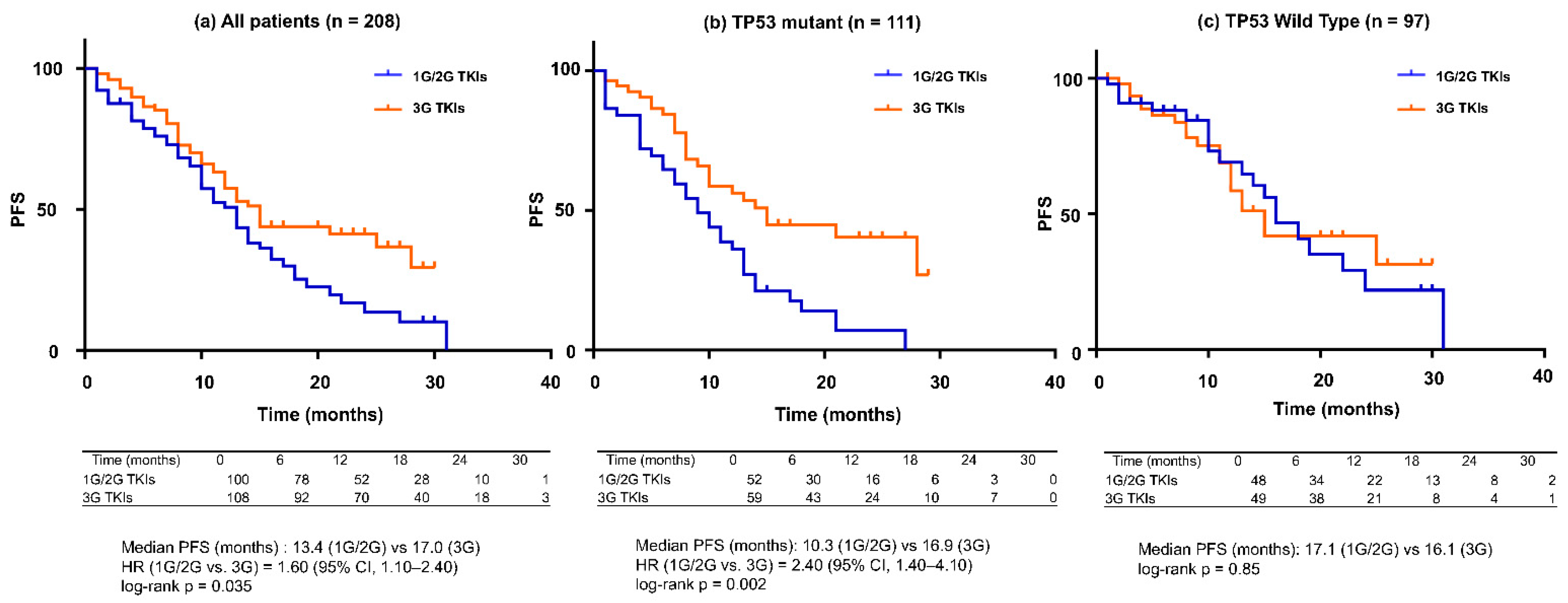
3.3. PFS by First-Line EGFR-TKI Generation and TP53 Status (Figure 3)

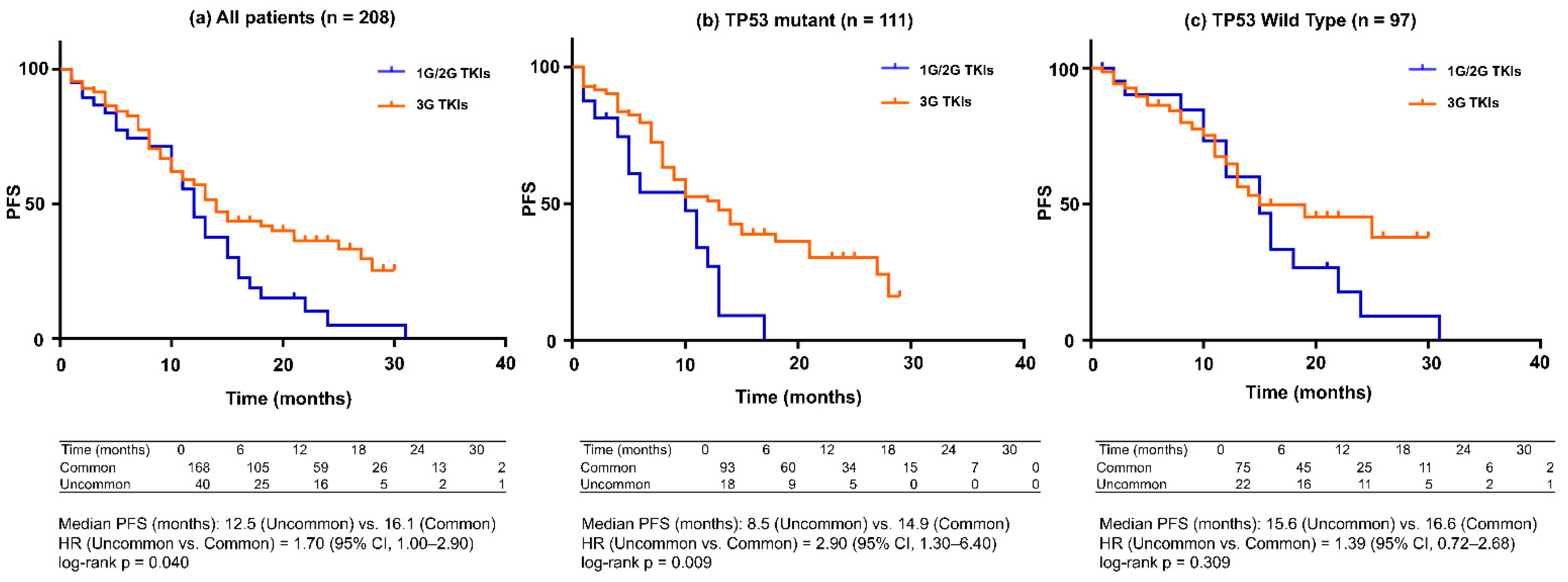
3.4. PFS by EGFR Mutation Subtype and TP53 Status (Figure 4)

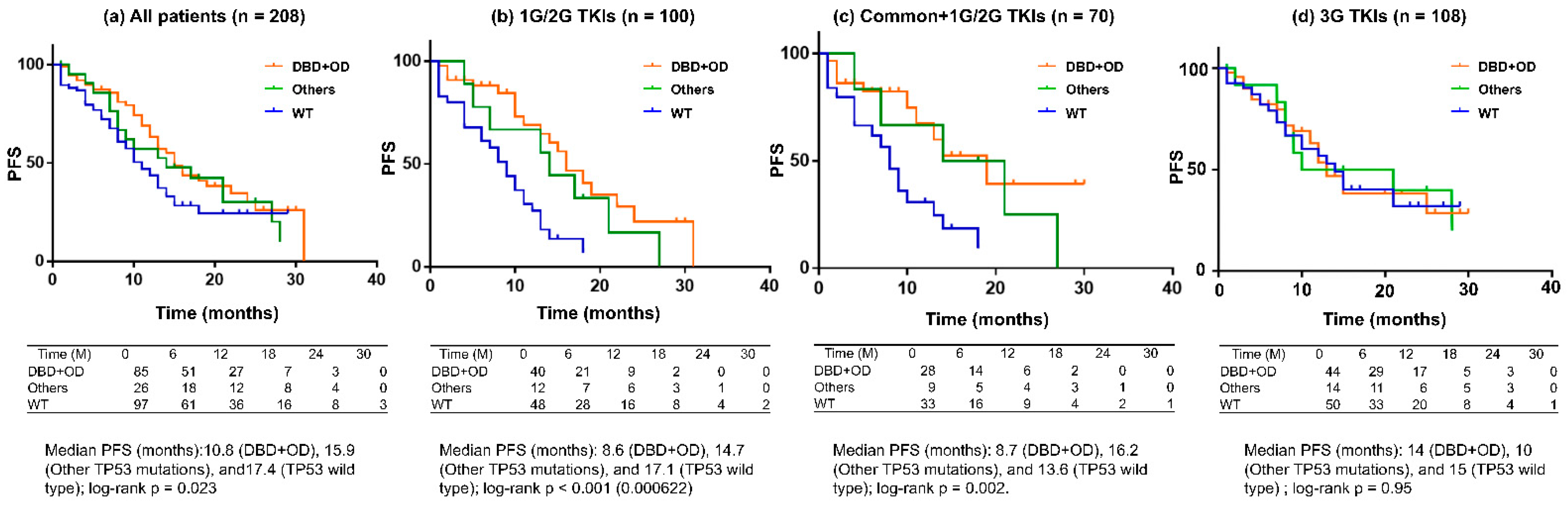
3.5. PFS by TP53 Functional Subtype (Figure 5)

4. Discussion
4.1. Patient Characteristics and TP53 Mutation Distribution
4.2. Functional Heterogeneity of TP53 Mutations and the Rationale for Our Classification
4.3. Clinical Implications in the Context of First-Line EGFR-TKI Selection
5. Limitations
6. Conclusions
Supplementary Materials
Funding
Institutional Review Board Statement
Informed Consent Statement
Data Availability Statement
Acknowledgments
Conflicts of Interest
Abbreviations
| NSCLC | non-small cell lung cancer |
| EGFR | epidermal growth factor receptor |
| TKI | tyrosine kinase inhibitor |
| EGFR-TKI | epidermal growth factor receptor tyrosine kinase inhibitor |
| PFS | progression-free survival |
| OS | overall survival |
| HR | hazard ratio |
| CI | confidence interval |
| DBD | DNA-binding domain |
| OD | oligomerization domain |
| WT | wild type |
| NGS | next-generation sequencing |
| 1G/2G | first- or second-generation |
| 3G | third-generation |
References
- Mok, T.S.; Wu, Y.-L.; Thongprasert, S.; Yang, C.-H.; Chu, D.-T.; Saijo, N.; Sunpaweravong, P.; Han, B.; Margono, B.; Ichinose, Y.; et al. Gefitinib or carboplatin-paclitaxel in pulmonary adenocarcinoma. N. Engl. J. Med. 2009, 361, 947–957. [Google Scholar] [CrossRef] [PubMed]
- Maemondo, M.; Inoue, A.; Kobayashi, K.; Sugawara, S.; Oizumi, S.; Isobe, H.; Gemmatsu, A.; Watanabe, H.; Sugiura, T.; Ohashi, K.; et al. Gefitinib or chemotherapy for non-small-cell lung cancer with mutated EGFR. N. Engl. J. Med. 2010, 362, 2380–2388. [Google Scholar] [CrossRef] [PubMed]
- Rosell, R.; Carcereny, E.; Gervais, R.; Vergnenegre, A.; Massuti, B.; Felip, E.; Palmero, R.; Garcia-Gomez, R.; Pallares, C.; Sanchez, J.M.; et al. Erlotinib versus standard chemotherapy as first-line treatment for European patients with advanced EGFR mutation-positive non-small-cell lung cancer (EURTAC): A multicentre, open-label, randomised phase 3 trial. Lancet Oncol. 2012, 13, 239–246. [Google Scholar] [CrossRef] [PubMed]
- Soria, J.-C.; Ohe, Y.; Vansteenkiste, J.; Reungwetwattana, T.; Chewaskulyong, B.; Lee, K.H.; Dechaphunkul, A.; Imamura, F.; Nogami, N.; Kurata, T.; et al. Osimertinib in Untreated EGFR-Mutated Advanced Non-Small-Cell Lung Cancer. N. Engl. J. Med. 2018, 378, 113–125. [Google Scholar] [CrossRef] [PubMed]
- Yang, J.C.-H.; Schuler, M.; Popat, S.; Miura, S.; Heeke, S.; Park, K.; Märten, A.; Kim, E.S. Afatinib for the Treatment of NSCLC Harboring Uncommon EGFR Mutations: A Database of 693 Cases. J. Thorac. Oncol. 2020, 15, 803–815. [Google Scholar] [CrossRef] [PubMed]
- John, T.; Taylor, A.; Wang, H.; Eichinger, C.; Freeman, C.; Ahn, M.J. Uncommon EGFR mutations in non-small-cell lung cancer: A systematic literature review of prevalence and clinical outcomes. Cancer Epidemiol. 2022, 76, 102080. [Google Scholar] [CrossRef] [PubMed]
- Qin, K.; Hou, H.; Liang, Y.; Zhang, X. Prognostic value of TP53 concurrent mutations for EGFR- TKIs and ALK-TKIs based targeted therapy in advanced non-small cell lung cancer: A meta-analysis. BMC Cancer 2020, 20, 328. [Google Scholar] [CrossRef] [PubMed]
- Canale, M.; Petracci, E.; Delmonte, A.; Chiadini, E.; Dazzi, C.; Papi, M.; Ludovini, V.; Pistola, L.; Righi, L.; Crinò, L.; et al. Impact of TP53 Mutations on Outcome in EGFR-Mutated Patients Treated with First-Line Tyrosine Kinase Inhibitors. Clin. Cancer Res. 2017, 23, 2195–2202. [Google Scholar] [CrossRef] [PubMed]
- Ferrara, M.G.; Belluomini, L.; Smimmo, A.; Sposito, M.; Avancini, A.; Giannarelli, D.; Milella, M.; Pilotto, S.; Bria, E. Meta-analysis of the prognostic impact of TP53 co-mutations in EGFR-mutant advanced non-small-cell lung cancer treated with tyrosine kinase inhibitors. Crit. Rev. Oncol. Hematol. 2023, 184, 103929. [Google Scholar] [CrossRef] [PubMed]
- Brosh, R.; Rotter, V. When mutants gain new powers: News from the mutant p53 field. Nat. Rev. Cancer 2009, 9, 701–713. [Google Scholar] [CrossRef] [PubMed]
- Muller, P.A.; Vousden, K.H. p53 mutations in cancer. Nat. Cell Biol. 2013, 15, 2–8. [Google Scholar] [CrossRef] [PubMed]
- Gencel-Augusto, J.; Lozano, G. p53 tetramerization: At the center of the dominant-negative effect of mutant p53. Genes Dev. 2020, 34, 1128–1146. [Google Scholar] [CrossRef] [PubMed]
- Canale, M.; Petracci, E.; Delmonte, A.; Bronte, G.; Chiadini, E.; Ludovini, V.; Dubini, A.; Papi, M.; Baglivo, S.; De Luigi, N.; et al. Concomitant TP53 Mutation Confers Worse Prognosis in EGFR-Mutated Non-Small Cell Lung Cancer Patients Treated with TKIs. J. Clin. Med. 2020, 9, 1047. [Google Scholar] [CrossRef] [PubMed]
- Graham, R.P.; Treece, A.L.; Lindeman, N.I.; Vasalos, P.; Shan, M.; Jennings, L.J.; Rimm, D.L. Worldwide Frequency of Commonly Detected EGFR Mutations. Arch. Pathol. Lab. Med. 2018, 142, 163–167. [Google Scholar] [CrossRef] [PubMed]
- Pelosof, L.; Ahn, C.; Gao, A.; Horn, L.; Madrigales, A.; Cox, J.; McGavic, D.; Minna, J.D.; Gazdar, A.F.; Schiller, J. Proportion of Never-Smoker Non-Small Cell Lung Cancer Patients at Three Diverse Institutions. J. Natl. Cancer Inst. 2017, 109, djw295. [Google Scholar] [CrossRef] [PubMed]
- Oren, M.; Rotter, V. Mutant p53 gain-of-function in cancer. Cold Spring Harb. Perspect. Biol. 2010, 2, a001107. [Google Scholar] [CrossRef] [PubMed]
- Labbé, C.; Cabanero, M.; Korpanty, G.J.; Tomasini, P.; Doherty, M.K.; Mascaux, C.; Jao, K.; Pitcher, B.; Wang, R.; Pintilie, M.; et al. Prognostic and predictive effects of TP53 co-mutation in patients with EGFR-mutated non-small cell lung cancer (NSCLC). Lung Cancer 2017, 111, 23–29. [Google Scholar] [CrossRef] [PubMed]
- Blakely, C.M.; Watkins, T.B.K.; Wu, W.; Gini, B.; Chabon, J.J.; McCoach, C.E.; McGranahan, N.; A Wilson, G.; Birkbak, N.J.; Olivas, V.R.; et al. Evolution and clinical impact of co-occurring genetic alterations in advanced-stage EGFR-mutant lung cancers. Nat. Genet. 2017, 49, 1693–1704. [Google Scholar] [CrossRef] [PubMed]


| (a) | ||||
| Variable | Overall | |||
| Sex, n (%) | ||||
| Female | 125 (60.0) | |||
| Male | 83 (40.0) | |||
| Age at start of first-line therapy, years—Mean ± SD | 66.8 ± 10.6 | |||
| Smoking status, n (%) | ||||
| Never smoker | 162 (77.9) | |||
| Former smoker | 30 (14.4) | |||
| Current smoker | 16 (7.7) | |||
| Histology, n (%) | ||||
| Adenocarcinoma | 201 (96.6) | |||
| Others | 7 (3.4) | |||
| Stage (8th edition), n (%) | ||||
| IIIA | 1 (0.5) | |||
| IIIB | 1 (0.5) | |||
| IVA | 69 (33.2) | |||
| IVB | 137 (65.9) | |||
| EGFR mutation, n (%) | ||||
| Exon 19 deletion | 103 (49.5) | |||
| L858R | 65 (31.3) | |||
| Others | 40 (19.2) | |||
| Type of first-line EGFR-TKI, n (%) | ||||
| Osimertinib | 107 (51.4) | |||
| Afatinib | 35 (16.8) | |||
| Gefitinib | 26 (12.5) | |||
| Erlotinib | 22 (10.6) | |||
| Dacomitinib | 17 (8.2) | |||
| Nazartinib | 1 (0.5) | |||
| Type of first-line EGFR-TKI, n (%) | ||||
| 1st/2nd generation TKI | 100 (48.1) | |||
| 3rd generation TKI | 108 (51.9) | |||
| Type of first-line EGFR-TKI, n (%)—Therapy response, n (%) | n = 181 | |||
| Complete response (CR) | 0 (0.0) | |||
| Partial response (PR) | 135 (74.6) | |||
| Stable disease (SD) | 10 (5.5) | |||
| Progressive disease (PD) | 26 (14.4) | |||
| Others | 10 (5.5) | |||
| TP53 status, n (%) | ||||
| Wild type | 97 (46.6) | |||
| Mutated | 111 (53.4) | |||
| TP53 mutation subtype (mutated cases) | n = 111 | |||
| Missense mutation | 86 (77.5) | |||
| Frameshift mutation | 15 (13.5) | |||
| Splicing mutation | 5 (4.5) | |||
| Deletion mutation | 1 (0.9) | |||
| Deletion/insertion mutation | 1 (0.9) | |||
| Other types | 3 (2.7) | |||
| (b) | ||||
| Variable | TP53 DBD-Involved | TP53 Other | TP53 WT | p Value |
| Age at diagnosis, years—Median (range) | 67 (50–89) | 67 (40–87) | 67 (32–94) | 0.328 |
| Sex, n (%) | ||||
| Female | 54 (68.4) | 16 (69.6) | 55 (51.9) | |
| Male | 25 (31.6) | 7 (30.4) | 51 (48.1) | 0.0477 |
| Smoking status, n (%) | ||||
| Never | 72 (91.1) | 14 (60.9) | 76 (71.7) | |
| Former | 6 (7.6) | 6 (26.1) | 18 (17.0) | |
| Current | 1 (1.3) | 3 (13.0) | 12 (11.3) | 0.0042 |
| EGFR mutation subtype, n (%) | ||||
| Common | 62 (78.5) | 19 (82.6) | 81 (76.4) | |
| Uncommon | 17 (21.5) | 4 (17.4) | 25 (23.6) | 0.800 |
| First-line EGFR-TKI, n (%) | ||||
| 1st generation | 23 (29.1) | 4 (17.4) | 21 (19.8) | |
| 2nd generation | 25 (31.6) | 3 (13.0) | 24 (22.6) | |
| 3rd generation | 31 (39.2) | 16 (69.6) | 61 (57.5) | 0.050 |
| Variable | Hazard Ratio | 95% CI | p Value |
|---|---|---|---|
| TP53 functional subtype | |||
| Others vs. WT | 1.41 | 0.78–2.54 | 0.259 |
| DBD-involved vs. WT | 1.85 | 1.17–2.91 | 0.0085 |
| Age (per 1-year increase) | 1.00 | 0.98–1.02 | 0.772 |
| Male vs. Female | 1.26 | 0.84–1.90 | 0.269 |
| EGFR uncommon vs. common | 1.47 | 0.90–2.41 | 0.123 |
| 1G/2G vs. 3G EGFR-TKI | 1.56 | 1.01–2.40 | 0.046 |
| Stage IVB vs. IVA | 1.55 | 0.98–2.44 | 0.06 |
Disclaimer/Publisher’s Note: The statements, opinions and data contained in all publications are solely those of the individual author(s) and contributor(s) and not of MDPI and/or the editor(s). MDPI and/or the editor(s) disclaim responsibility for any injury to people or property resulting from any ideas, methods, instructions or products referred to in the content. |
© 2026 by the author. Licensee MDPI, Basel, Switzerland. This article is an open access article distributed under the terms and conditions of the Creative Commons Attribution (CC BY) license.
Share and Cite
Kobayashi, K. TP53 Functional-Domain-Specific Mutations Define Distinct Clinical Outcomes in EGFR-Mutant Non-Small Cell Lung Cancer Treated with EGFR Tyrosine Kinase Inhibitors. J. Clin. Med. 2026, 15, 1552. https://doi.org/10.3390/jcm15041552
Kobayashi K. TP53 Functional-Domain-Specific Mutations Define Distinct Clinical Outcomes in EGFR-Mutant Non-Small Cell Lung Cancer Treated with EGFR Tyrosine Kinase Inhibitors. Journal of Clinical Medicine. 2026; 15(4):1552. https://doi.org/10.3390/jcm15041552
Chicago/Turabian StyleKobayashi, Keigo. 2026. "TP53 Functional-Domain-Specific Mutations Define Distinct Clinical Outcomes in EGFR-Mutant Non-Small Cell Lung Cancer Treated with EGFR Tyrosine Kinase Inhibitors" Journal of Clinical Medicine 15, no. 4: 1552. https://doi.org/10.3390/jcm15041552
APA StyleKobayashi, K. (2026). TP53 Functional-Domain-Specific Mutations Define Distinct Clinical Outcomes in EGFR-Mutant Non-Small Cell Lung Cancer Treated with EGFR Tyrosine Kinase Inhibitors. Journal of Clinical Medicine, 15(4), 1552. https://doi.org/10.3390/jcm15041552