Changes in CO2-Derived Variables, Induced by Passive Leg Raising Test, Detect Preload Responsiveness in Mechanically Ventilated Patients: A Pilot Study

 , , and
Abstract
1. Introduction
2. Methods
2.1. Patients
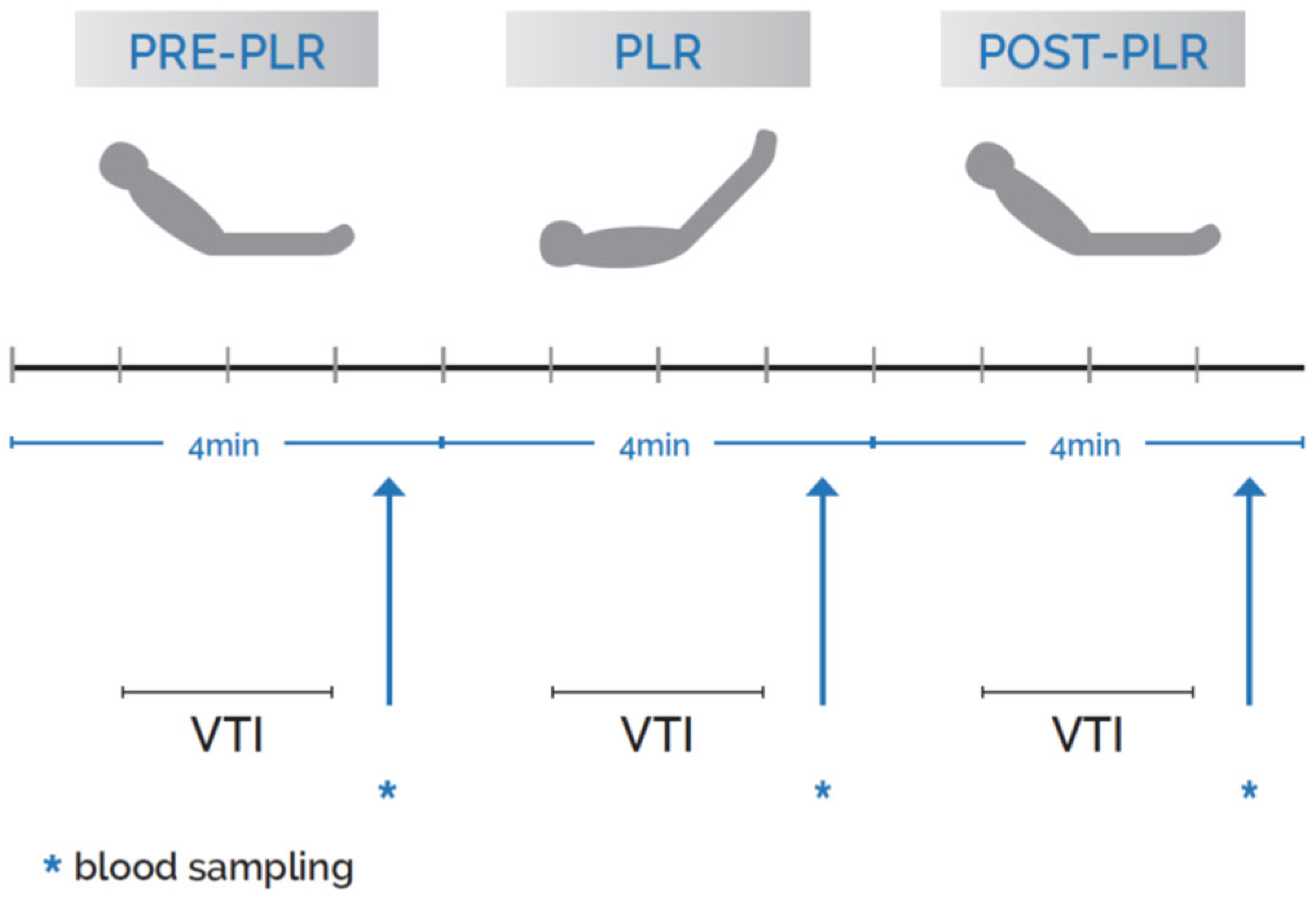
2.2. Protocol and Measurements
2.3. Intra-Observer Variability
2.4. Gas Exchange Measurements
2.5. Statistical Analysis
3. Results
3.1. Patient Characteristics
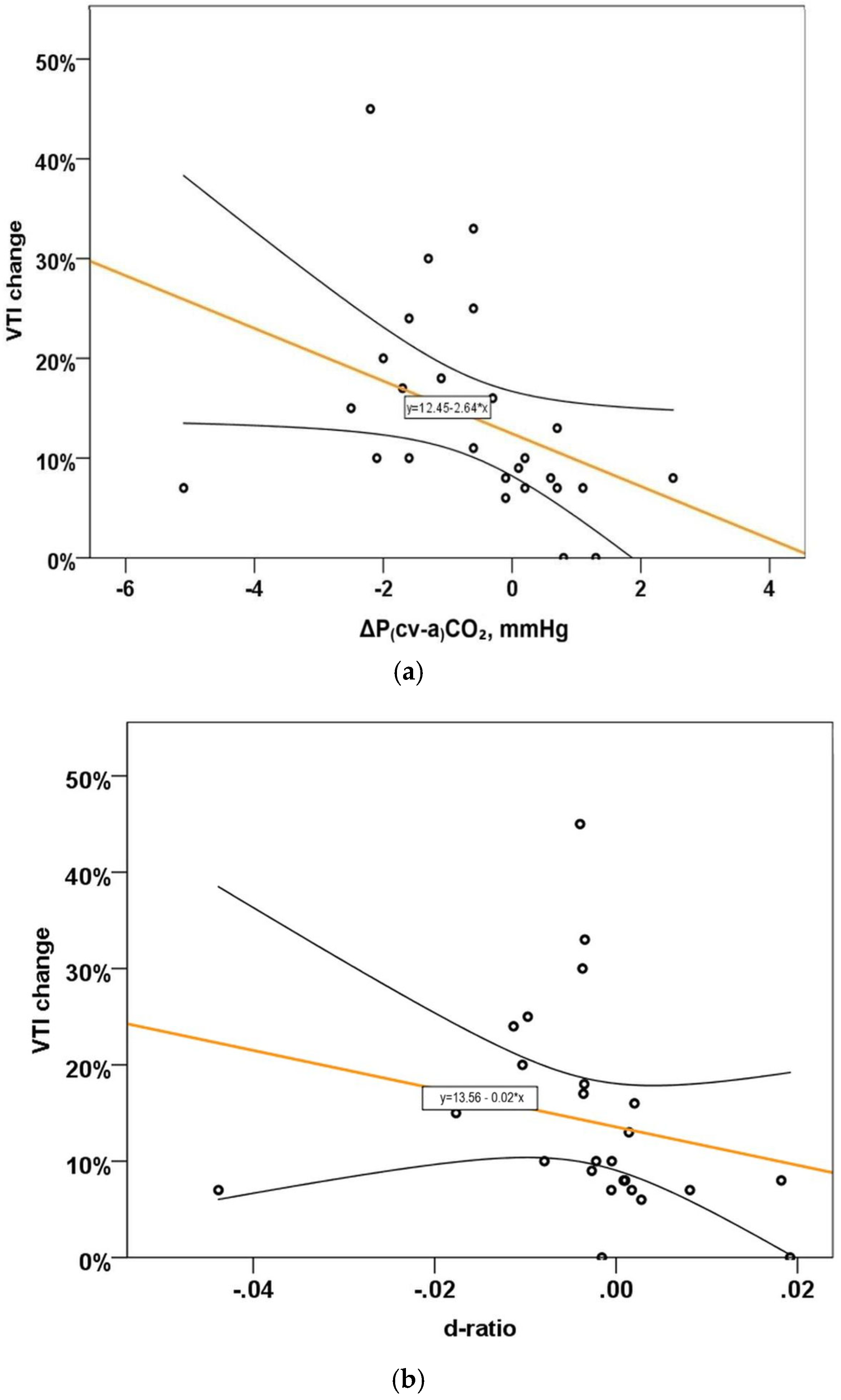
3.2. Correlations
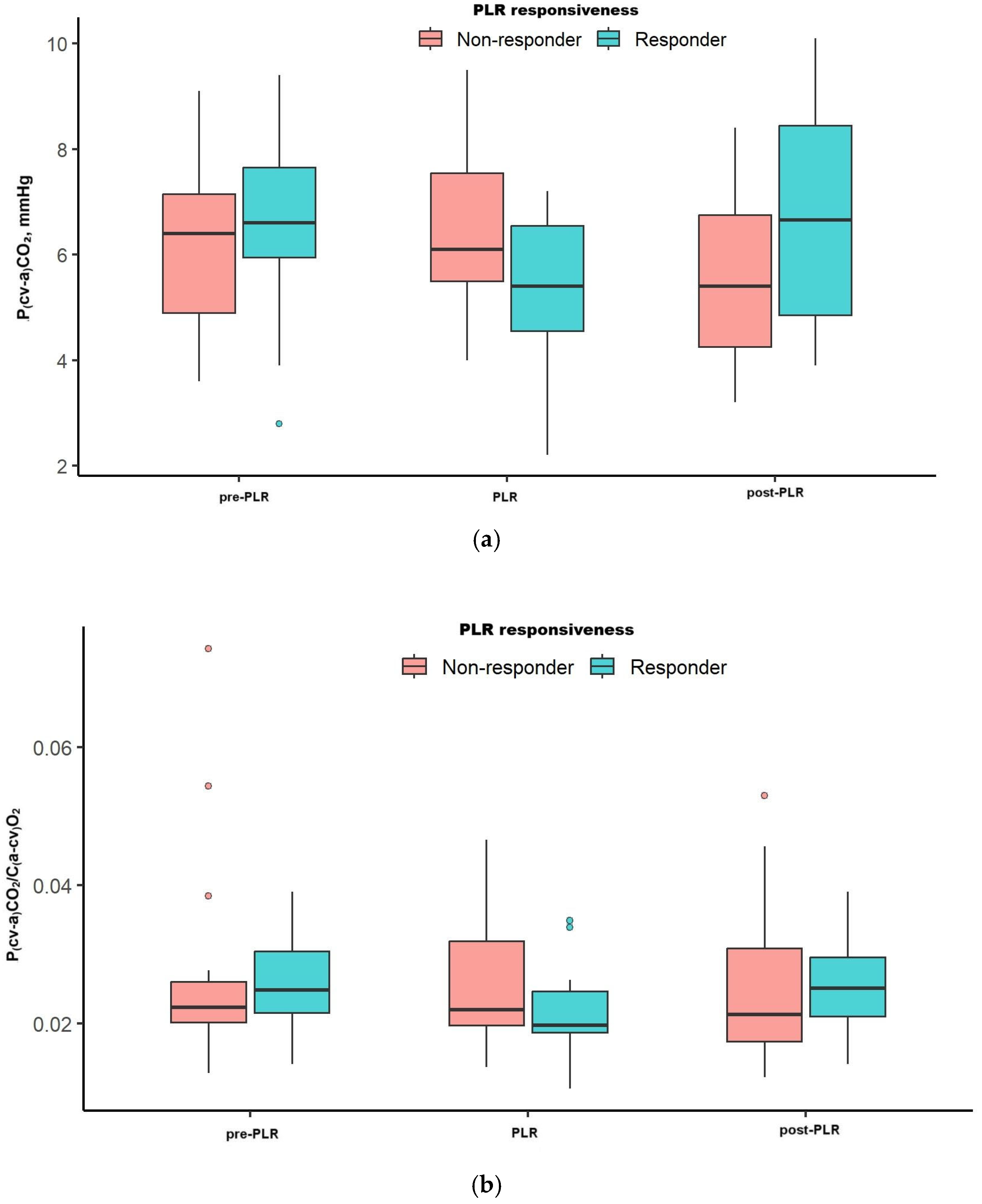
3.3. Dynamics of CO2-Derived Variables Across the PLR Test
3.4. Multivariate Logistic Regressions
Sensitivity Analyses
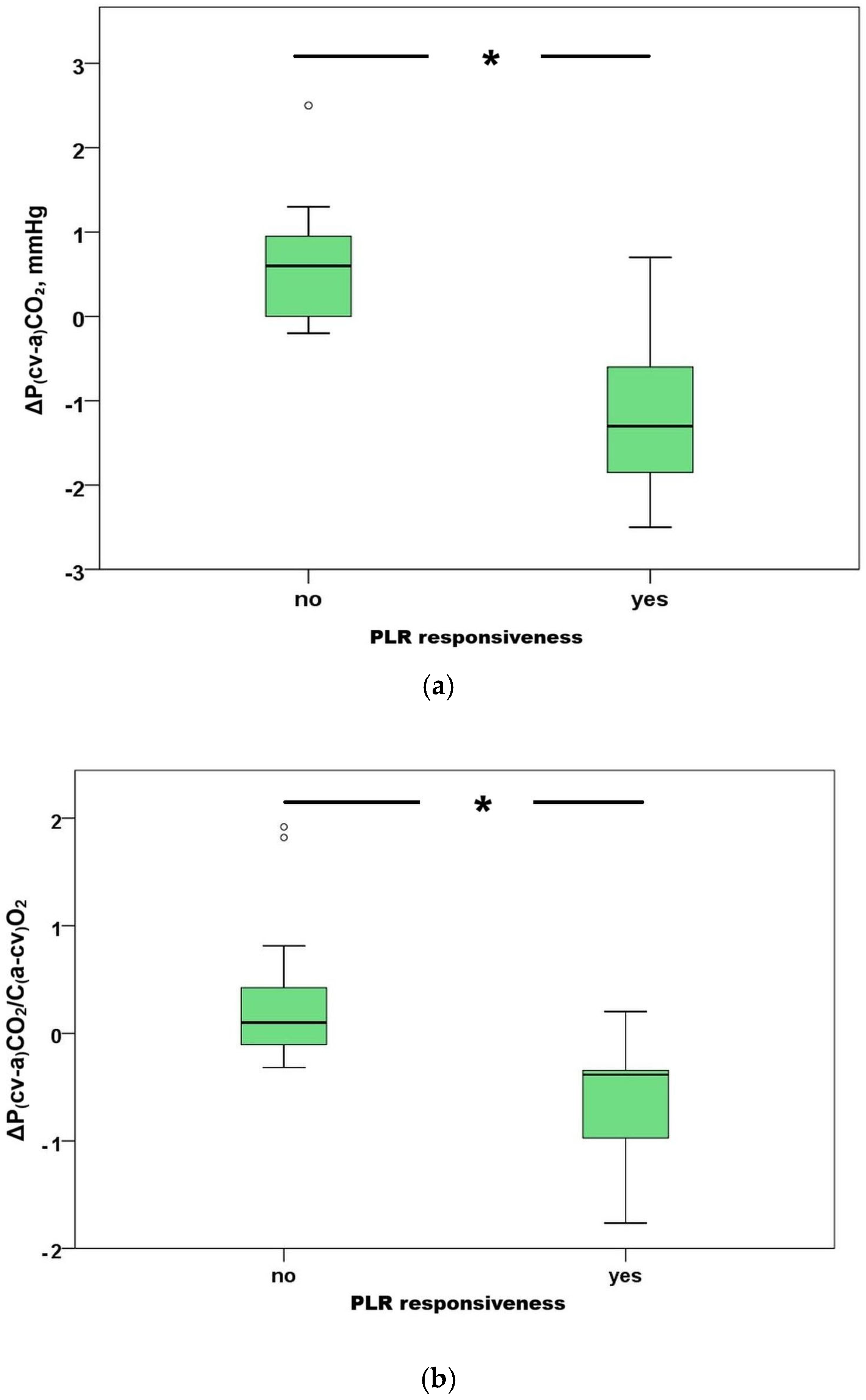
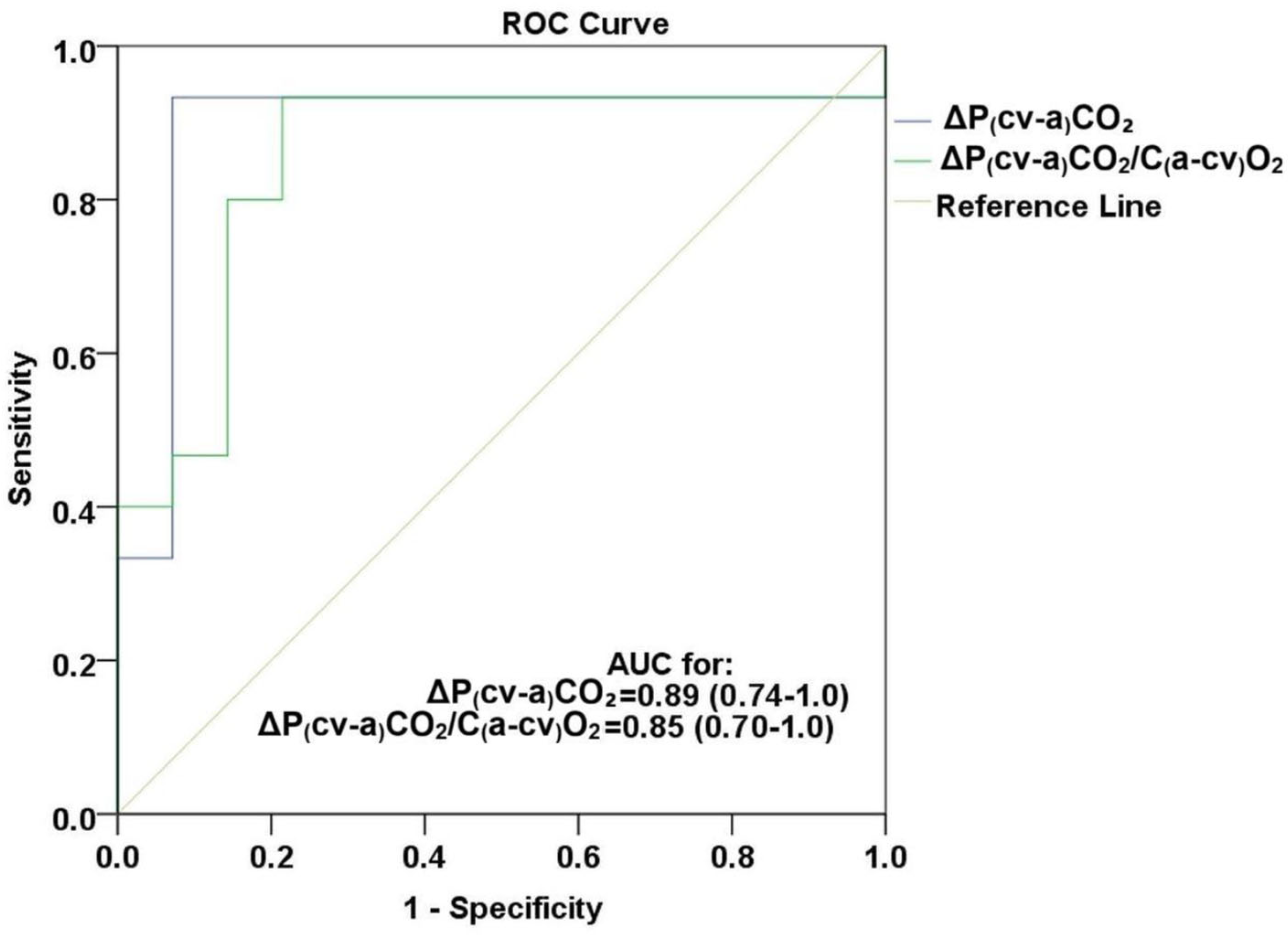
3.5. Predictive Value of PLR-Induced ΔP(cv-a)CO2 and ΔP(cv-a)CO2/C(a-cv)O2 for Preload Responsiveness
4. Discussion
Limitations
5. Conclusions
Supplementary Materials
Author Contributions
Funding
Institutional Review Board Statement
Informed Consent Statement
Data Availability Statement
Conflicts of Interest
References
- Evans, L.; Rhodes, A.; Alhazzani, W.; Antonelli, M.; Coopersmith, C.M.; French, C.; Machado, F.R.; Mcintyre, L.; Ostermann, M.; Prescott, H.C.; et al. Surviving sepsis campaign: International guidelines for management of sepsis and septic shock. Intensive Care Med. 2021, 47, 1181–1247. [Google Scholar] [CrossRef] [PubMed]
- Monnet, X.; Marik, P.E.; Teboul, J.L. Prediction of fluid responsiveness: An update. Ann. Intensive Care 2016, 6, 111. [Google Scholar] [CrossRef] [PubMed]
- Marik, P.E.; Baram, M.; Vahid, B. Does central venous pressure predict fluid responsiveness? A systematic review of the literature. Chest 2008, 134, 172–178. [Google Scholar] [CrossRef] [PubMed]
- Bednarczyk, J.M.; Fridfinnson, J.A.; Kumar, A.; Blanchard, L.; Rabbani, R.; Bell, D.; Funk, D.; Turgeon, A.F.; Abou-Setta, A.M.; Zarychanski, R. Incorporating dynamic assessment of fluid responsiveness into goal-directed therapy: A systematic review and meta-analysis. Crit. Care Med. 2017, 45, 1538–1545. [Google Scholar] [CrossRef]
- Wang, J.; Blake, L.M.; Orozco, N.; Fiorini, K.; McChesney, C.; Slessarev, M.; Prager, R.; Leligdowicz, A.; Sharif, S.; Lewis, K.; et al. Dynamic measures of fluid responsiveness to guide resuscitation in patients with sepsis and septic shock: A systematic review and meta-analysis. Crit. Care Explor. 2025, 7, e1303. [Google Scholar] [CrossRef]
- Malbrain, M.L.; Van Regenmortel, N.; Saugel, B.; De Tavernier, B.; Van Gaal, P.J.; Joannes-Boyau, O.; Teboul, J.L.; Rice, T.W.; Mythen, M.; Monnet, X. Principles of fluid management and stewardship in septic shock: It is time to consider the four D’s and the four phases of fluid therapy. Ann. Intensive Care 2018, 8, 66. [Google Scholar] [CrossRef]
- Monnet, X.; Teboul, J.L. Passive leg raising: Five rules, not a drop of fluid! Crit. Care 2015, 19, 18. [Google Scholar] [CrossRef]
- Aneman, A.; Sondergaard, S. Understanding the passive leg raising test. Intensive Care Med. 2016, 42, 1493–1495. [Google Scholar] [CrossRef]
- Blanco, P. Rationale for using the velocity–time integral and the minute distance for assessing stroke volume and cardiac output in point-of-care settings. Ultrasound J. 2020, 12, 21. [Google Scholar] [CrossRef]
- Monnet, X.; Shi, R.; Teboul, J.L. Prediction of fluid responsiveness: What’s new? Ann. Intensive Care 2022, 12, 46. [Google Scholar] [CrossRef]
- Janotka, M.; Ostadal, P. Biochemical markers for clinical monitoring of tissue perfusion. Mol. Cell. Biochem. 2021, 476, 1313–1326. [Google Scholar] [CrossRef]
- Mekontso-Dessap, A.; Castelain, V.; Anguel, N.; Bahloul, M.; Schauvliege, F.; Richard, C.; Teboul, J.-L. Combination of venoarterial PCO2 difference with arteriovenous O2 content difference to detect anaerobic metabolism in patients. Intensive Care Med. 2002, 28, 272–277. [Google Scholar] [CrossRef] [PubMed]
- Mallat, J.; Jozwiak, M.; Orozco, N.; Hamzaoui, O.; Monnet, X.; Teboul, J.-L.; De Backer, D.; Ospina-Tascón, G.A. Use of CO2-derived variables in critically ill patients. Ann. Intensive Care 2025, 15, 142. [Google Scholar] [CrossRef] [PubMed]
- Scheeren, T.W.L.; Wicke, J.N.; Teboul, J.L. Understanding the carbon dioxide gaps. Curr. Opin. Crit. Care 2018, 24, 181–189. [Google Scholar] [CrossRef] [PubMed]
- Mecher, C.E.; Rackow, E.C.; Astiz, M.E.; Weil, M.H. Venous hypercarbia associated with severe sepsis and systemic hypoperfusion. Crit. Care Med. 1990, 18, 585–589. [Google Scholar] [CrossRef]
- Mallat, J.; Pepy, F.; Lemyze, M.; Gasan, G.; Vangrunderbeeck, N.; Tronchon, L.; Vallet, B.; Thevenin, D. Central venous-to-arterial carbon dioxide partial pressure difference in early resuscitation from septic shock: A prospective observational study. Eur. J. Anaesthesiol. 2014, 31, 371–380. [Google Scholar] [CrossRef]
- Nassar, B.; Badr, M.; Van Grunderbeeck, N.; Temime, J.; Pepy, F.; Gasan, G.; Tronchon, L.; Thevenin, D.; Mallat, J. Central venous-to-arterial PCO2 difference as a marker to identify fluid responsiveness in septic shock. Sci. Rep. 2021, 11, 17256. [Google Scholar] [CrossRef]
- Pierrakos, C.; De Bels, D.; Nguyen, T.; Velissaris, D.; Attou, R.; Devriendt, J.; Honore, P.M.; Taccone, F.S.; De Backer, D. Changes in central venous-to-arterial carbon dioxide tension induced by fluid bolus in critically ill patients. PLoS ONE 2021, 16, e0257314. [Google Scholar] [CrossRef]
- Mallat, J.; Abou-Arab, O.; Lemyze, M.; Saleh, D.; Guinot, P.G.; Fischer, M.O. Changes in central venous-to-arterial PCO2 difference and central venous oxygen saturation as markers to define fluid responsiveness in critically ill patients: A post-hoc analysis. Crit. Care 2024, 28, 360. [Google Scholar] [CrossRef]
- Monnet, X.; Julien, F.; Ait-Hamou, N.; Lequoy, M.; Gosset, C.; Jozwiak, M.; Persichini, R.; Anguel, N.; Richard, C.; Teboul, J.L. Lactate and venoarterial carbon dioxide difference/arterial-venous oxygen difference ratio predict increase in cardiac output. Crit. Care Med. 2013, 41, 1412–1420. [Google Scholar] [CrossRef]
- Cecconi, M.; De Backer, D.; Antonelli, M.; Beale, R.; Bakker, J.; Hofer, C.; Jaeschke, R.; Mebazaa, A.; Pinsky, M.R.; Teboul, J.L.; et al. Consensus on circulatory shock and hemodynamic monitoring. Task force of the European Society of Intensive Care Medicine. Intensive Care Med. 2014, 40, 1795–1815. [Google Scholar] [PubMed]
- Singer, M.; Deutschman, C.S.; Seymour, C.W.; Shankar-Hari, M.; Annane, D.; Bauer, M.; Bellomo, R.; Bernard, G.R.; Chiche, J.-D.; Coopersmith, C.M.; et al. The Third International Consensus Definitions for Sepsis and Septic Shock (Sepsis-3). JAMA 2016, 315, 801–810. [Google Scholar] [CrossRef] [PubMed]
- Vincent, J.L.; Moreno, R.; Takala, J.; Willatts, S.; De Mendonça, A.; Bruining, H.; Reinhart, C.K.; Suter, P.M.; Thijs, L.G. The SOFA score to describe organ dysfunction/failure. Intensive Care Med. 1996, 22, 707–710. [Google Scholar] [CrossRef] [PubMed]
- Mallat, J.; Fischer, M.O.; Granier, M.; Vinsonneau, C.; Jonard, M.; Mahjoub, Y.; Baghdadi, F.A.; Préau, S.; Poher, F.; Rebet, O.; et al. Passive leg raising-induced changes in pulse pressure variation to assess fluid responsiveness in mechanically ventilated patients: A multicentre prospective observational study. Br. J. Anaesth. 2022, 129, 308–316. [Google Scholar] [CrossRef]
- Monnet, X.; Rienzo, M.; Osman, D.; Anguel, N.; Richard, C.; Pinsky, M.R.; Teboul, J.-L. Passive leg raising predicts fluid responsiveness in the critically ill. Crit. Care Med. 2006, 34, 1402–1407. [Google Scholar] [CrossRef]
- Jabot, J.; Teboul, J.L.; Richard, C.; Monnet, X. Passive leg raising for predicting fluid responsiveness: Importance of the postural change. Intensive Care Med. 2009, 35, 85–90. [Google Scholar] [CrossRef]
- Vieillard-Baron, A.; Boissier, F.; Slama, M. Using echocardiography to predict fluid-responsiveness and manage the need for fluids. Intensive Care Med. 2024, 50, 1137–1142. [Google Scholar] [CrossRef]
- Trigkidis, K.K.; Routsi, C.; Kokkoris, S. Correlation of venous excess ultrasound (VExUS) score to fluid responsiveness in critically ill patients. J. Crit. Care 2025, 85, 154905. [Google Scholar] [CrossRef]
- Zhou, X.; Fang, H.; Xu, C.; Pan, J.; Wang, H.; Pan, T.; Xu, Z.; Chen, B. Variations in central venous oxygen saturation and central venous-to-arterial carbon dioxide tension difference to define fluid responsiveness: A prospective observational study. Front. Cardiovasc. Med. 2025, 12, 1628380. [Google Scholar] [CrossRef]
- Faris, F.; El-Houfi, A.; El Shahat, M.; Khalid, H.; Al-Azab, A. CO2 gap changes compared with cardiac output changes in response to intravenous volume expansion and/or vasopressor therapy in septic shock. S. Afr. J. Crit. 2024, 40, e652. [Google Scholar] [CrossRef]
- Hannequin, T.; Ughetto, A.; Eliet, J.; Blin, C.; Canon, A.; Saour, M.; Gaudard, P.; Vidal, C.; Molinari, N.; Colson, P.; et al. End-tidal carbon dioxide changes induced by passive leg raising can predict fluid responsiveness in patients on veno-arterial extracorporeal membrane oxygenation: A prospective, interventional study. Ann. Intensive Care 2025, 15, 185. [Google Scholar] [CrossRef] [PubMed]
- Ellouze, O.; Nguyen, M.; Missaoui, A.; Berthoud, V.; Aho, S.; Bouchot, O.; Guinot, P.G.; Bouhemad, B. Prognosis Value of Early Veno Arterial PCO2 Difference in Patients Under Peripheral Veno Arterial Extracorporeal Membrane Oxygenation. Shock 2020, 54, 744–750. [Google Scholar] [CrossRef] [PubMed]
- McDonald, C.I.; Brodie, D.; Schmidt, M.; Hay, K.; Shekar, K. Elevated venous to arterial carbon dioxide gap and anion gap are associated with poor outcome in cardiogenic shock requiring extracorporeal membrane oxygenation support. ASAIO J. 2021, 67, 263–269. [Google Scholar] [CrossRef] [PubMed]
- Jendoubi, A.; de Roux, Q.; Ribot, S.; Desauge, V.; Betbeder, T.; Picard, L.; Ghaleh, B.; Tissier, R.; Kohlhauer, M.; Mongardon, N. Optimising fluid therapy during venoarterial extracorporeal membrane oxygenation: Current evidence and future directions. Ann. Intensive Care 2025, 15, 32. [Google Scholar] [CrossRef]
- Blancas, R.; Martínez-González, Ó.; Ballesteros, D.; Núñez, A.; Luján, J.; Rodríguez-Serrano, D.; Hernández, A.; Martínez-Díaz, C.; Parra, C.M.; Matamala, B.L.; et al. Lack of correlation between left ventricular outflow trat velocity time integral and stroke volume index in mechanically ventilated patients. Med. Intensiv. (Engl. Ed.) 2019, 43, 73–78. [Google Scholar] [CrossRef]
- Jozwiak, M.; Mercado, P.; Teboul, J.L.; Benmalek, A.; Gimenez, J.; Dépret, F.; Richard, C.; Monnet, X. What is the lowest change in cardiac output that transthoracic echocardiography can detect? Crit. Care 2019, 23, 116. [Google Scholar] [CrossRef]
- Muller, L.; Toumi, M.; Bousquet, P.J.; Riu-Poulenc, B.; Louart, G.; Candela, D.; Zoric, L.; Suehs, C.; de La Coussaye, J.-E.; Molinari, N.; et al. An increase in aortic blood flow after an infusion of 100 ml colloid over 1 minute can predict fluid responsiveness: The mini-fluid challenge study. Anesthesiology 2011, 115, 541–547. [Google Scholar] [CrossRef]
- Teboul, J.L.; Scheeren, T. Understanding the Haldane effect. Intensive Care Med. 2017, 43, 91–93. [Google Scholar] [CrossRef]



| Variable | All Patients n = 30 | Non-Responders n = 15 | Responders * n = 15 | |||
|---|---|---|---|---|---|---|
| Sex, male, n (%) | 23 | (77) | 11 | (73) | 12 | (80) |
| Age, years | 59 | (54–75) | 57 | (52–78) | 62 | (57–69) |
| SOFA score | 10 | (9–14) | 13 | (10–15) | 10 | (8–12) |
| Septic shock, n (%) | 19 | (63) | 10 | (67) | 9 | (60) |
| Time to PLR test from ICU admission, days | 3 | (3–13) | 3 | (2–13) | 4 | (3–13) |
| Hemoglobin, gr/dL | 8.5 | (8.0–10.5) | 8.5 | (8.0–11.0) | 8.4 | (7.7–9.4) |
| IVC diameter, mm | 20 | (17–23) | 19 | (17–23) | 21 | (16–23) |
| CVP, mmHg | 12 | (9–14) | 11 | (8–17) | 13 | (9–14) |
| VTI, cm | 14.2 | (13.0–17.4) | 15.1 | (13.5–19.5) | 13.8 | (12.8–17.4) |
| MAP, mmHg | 77 | (73–83) | 76 | (73–83) | 77 | (73–88) |
| Heart rate, beats/min | 91 | (85–99) | 89 | (83–106) | 92 | (85–99) |
| pH | 7.35 | (7.30–7.42) | 7.35 | (7.30–7.42) | 7.35 | (7.30–7.46) |
| PaCO2, mmHg | 40 | (37–43) | 40 | (36–43) | 41 | (37–44) |
| PcvCO2, mmHg | 46 | (42–50) | 44 | (41–50) | 48 | (43–51) |
| CaO2, mL/dL | 11. | 1(10.5–13.5) | 11.1 | (10.6–14.6) | 11.1 | (10.1–12.4) |
| CvO2, mL/dL | 8.6 | (7.8–11.4) | 9.3 | (7.8–11.7) | 8.5 | (7.8–9.5) |
| Lactate, mmol/L | 1.9 | (1.0–3.1) | 1.9 | (1.0–3.9) | 1.5 | (0.9–3.1) |
| Noradrenaline dose, µg/kg/min | 0.19 | (0.03–0.37) | 0.22 | (0.17–0.41) | 0.04 | (0.01–0.3) |
| PaO2, mmHg | 118 | (99–137) | 112 | (91–140) | 122 | (106–137) |
| PcvO2, mmHg | 45 | (41–50) | 45 | (38–51) | 43 | (41–49) |
| SaO2, % | 98 | (97–98) | 98 | (96–98) | 98 | (97–98) |
| VTI change, % | 10 | (7–18) | 7 | (7–8) | 18 | (13–25) |
| C(a-cvO2), mL/dL | 2.7 | (1.7–3.3) | 2.5 | (1.7–3.3) | 2.8 | (1.7–3.7) |
| P(cv-a)CO2/C(a-cv)O2, mmHg · dL/mLO2 | 2.4 | (2.0–2.9) | 2.2 | (1.2–2.8) | 2.5 | (2.1–3.3) |
| P(cv-a)CO2, mmHg | 6.4 | (5.1–7.4) | 6.4 | (4.7–7.3) | 6.6 | (5.7–7.8) |
| ΔP(cv-aCO2)/C(a-cv)O2, mmHg · dL/mLO2 | 0.22 | (−0.39–0.17) | 0.10 | (−0.15–0.57) | −0.38 | (−0.97–−0.34) # |
| ΔP(cv-a)CO2, mmHg | −0.3 | (−1.6–0.7) | 0.6 | (−0.1–1.1) | −1.3 | (−2.0–−0.6) # |
| Respiratory rate, breaths/min | 24 | (22–26) | 24 | (22–26) | 24 | (22–26) |
| VT, ml | 470 | (430–500) | 470 | (397–535) | 460 | (430–500) |
| Minute ventilation, L/min | 10.7 | (9.6–12.2) | 12.0 | (9.0–13.3) | 10.6 | (9.8–11.0) |
| PEEP, cm H2O | 10 | (8–13) | 10 | (8–14) | 10 | (8–12) |
| PaO2/FiO2, mmHg | 264 | (189–305) | 230 | (178–286) | 290 | (212–340) |
| Driving pressure, cm H2O | 10 | (9–12) | 9 | (8–11) | 11 | (9–13) |
| ΔVTI | ΔP(cv-a)CO2 | ΔP(cv-aCO2) /C(a-cv)O2 | IVC | CVP | Lactate | SOFA | MAP | HR | |
|---|---|---|---|---|---|---|---|---|---|
| ΔVTI | −0.601 ** | −0.584 ** | 0.113 | 0.361 | −0.149 | −0.248 | 0.132 | −0.160 | |
| ΔP(cv-a)CO2 | −0.601 ** | 0.857 ** | −0.291 | −0.182 | 0.027 | 0.430 | 0.290 | −0.111 | |
| ΔP(cv-aCO2)/C(a-cv)O2 | −0.584 ** | 0.857 ** | −0.418 * | −0.234 | −0.089 | 0.223 | 0.282 | −0.170 | |
| IVC | 0.113 | −0.291 | −0.418 * | 0.461 * | 0.478 * | 0.091 | −0.214 | 0.262 | |
| CVP | 0.361 | −0.182 | −0.234 | 0.461 * | 0.494 ** | 0.473 * | 0.043 | 0.239 | |
| Lactate | −0.149 | 0.027 | −0.089 | 0.478 * | 0.494 ** | 0.632 ** | 0.012 | 0.573 ** | |
| SOFA | −0.248 | 0.430 | 0.223 | 0.091 | 0.473 * | 0.632 ** | 0.040 | 0.275 | |
| MAP | 0.132 | 0.290 | 0.282 | −0.214 | 0.043 | 0.012 | 0.040 | −0.003 | |
| HR | −0.160 | −0.111 | −0.170 | 0.262 | 0.239 | 0.573 ** | 0.275 | −0.003 |
| Variable | Pre-PLR | PLR | Post-PLR |
|---|---|---|---|
| VTI | 14.2 (13.0–17.4) | 17.0 (15.5–19.1) * | 14.8 (12.5–18.0) |
| P(cv-a)CO2 | 6.45 (5.1–7.4) | 5.80 (4.6–7.1) | 5.7 (4.3–7.4) |
| P(cv-a)CO2/C(a-cv)O2 | 2.4 (2.0–2.9) | 2.1 (1.9–2.1) | 2.2 (1.8–3.0) |
| MAP | 77 (73–83) | 84 (75–90) * | 77 (70–86) |
| Heart rate | 91 (85–99) | 90 (82–98) | 89 (82–100) |
| Variable | OR | 95% CI | p Value | 95% Bootstrap CI |
|---|---|---|---|---|
| Model 1 | ||||
| CVP | 1.01 | 0.86–1.21 | 0.93 | 0.66–1.31 |
| Lactate | 0.95 | 0.36–1.18 | 0.66 | 0.27–2.36 |
| ΔP(cv-a)CO2 | 0.48 | 0.20–0.89 | 0.016 | 0.00–0.85 |
| Sensitivity analysis 1: Model 1 plus noradrenaline dose | ||||
| ΔP(cv-a)CO2 | 0.50 | 0.21–0.92 | 0.023 | 0.00–0.97 |
| Sensitivity analysis 2: Model 1 plus shock category (septic vs. non-septic) | ||||
| ΔP(cv-a)CO2 | 0.49 | 0.20–0.90 | 0.018 | 0.00–0.87 |
| Threshold | Sensitivity | Specificity | PPV | NPV | PLR | NLR | |
|---|---|---|---|---|---|---|---|
| ΔP(cv-a)CO2 | −0.25 | 0.93 (0.68–0.99) | 0.93 (0.68–0.99) | 0.93 (0.68–0.99) | 0.93 (0.68–0.99) | 14 (2.10–44.71) | 0.07 (0.02–0.48) |
| ΔP(cv-a)CO2/ C(a-cv)O2 | −0.003 | 0.78 (0.49–0.95) | 0.93 (0.68–0.99) | 0.91 (0.61–0.99) | 0.82 (0.56–0.96) | 11.78 (1.74–38.48) | 0.23 (0.10–0.65) |
Disclaimer/Publisher’s Note: The statements, opinions and data contained in all publications are solely those of the individual author(s) and contributor(s) and not of MDPI and/or the editor(s). MDPI and/or the editor(s) disclaim responsibility for any injury to people or property resulting from any ideas, methods, instructions or products referred to in the content. |
© 2026 by the authors. Licensee MDPI, Basel, Switzerland. This article is an open access article distributed under the terms and conditions of the Creative Commons Attribution (CC BY) license.
Share and Cite
Baladima, A.; Kokkoris, S.; Tzalas, D.; Kolonia, K.; Ntaidou, T.; Pittaras, T.; Trikas, A.; Vasileiadis, I.; Routsi, C. Changes in CO2-Derived Variables, Induced by Passive Leg Raising Test, Detect Preload Responsiveness in Mechanically Ventilated Patients: A Pilot Study. J. Clin. Med. 2026, 15, 1551. https://doi.org/10.3390/jcm15041551
Baladima A, Kokkoris S, Tzalas D, Kolonia K, Ntaidou T, Pittaras T, Trikas A, Vasileiadis I, Routsi C. Changes in CO2-Derived Variables, Induced by Passive Leg Raising Test, Detect Preload Responsiveness in Mechanically Ventilated Patients: A Pilot Study. Journal of Clinical Medicine. 2026; 15(4):1551. https://doi.org/10.3390/jcm15041551
Chicago/Turabian StyleBaladima, Angeliki, Stelios Kokkoris, Dimitrios Tzalas, Konstantina Kolonia, Theodora Ntaidou, Theodoros Pittaras, Athanasios Trikas, Ioannis Vasileiadis, and Christina Routsi. 2026. "Changes in CO2-Derived Variables, Induced by Passive Leg Raising Test, Detect Preload Responsiveness in Mechanically Ventilated Patients: A Pilot Study" Journal of Clinical Medicine 15, no. 4: 1551. https://doi.org/10.3390/jcm15041551
APA StyleBaladima, A., Kokkoris, S., Tzalas, D., Kolonia, K., Ntaidou, T., Pittaras, T., Trikas, A., Vasileiadis, I., & Routsi, C. (2026). Changes in CO2-Derived Variables, Induced by Passive Leg Raising Test, Detect Preload Responsiveness in Mechanically Ventilated Patients: A Pilot Study. Journal of Clinical Medicine, 15(4), 1551. https://doi.org/10.3390/jcm15041551