Hemodynamic Effect of IgM-Enriched Immunoglobulin in the Early Stage of E. coli-Induced Experimental Sepsis
 , ,
, ,  and
and
Abstract
1. Introduction
2. Materials and Methods
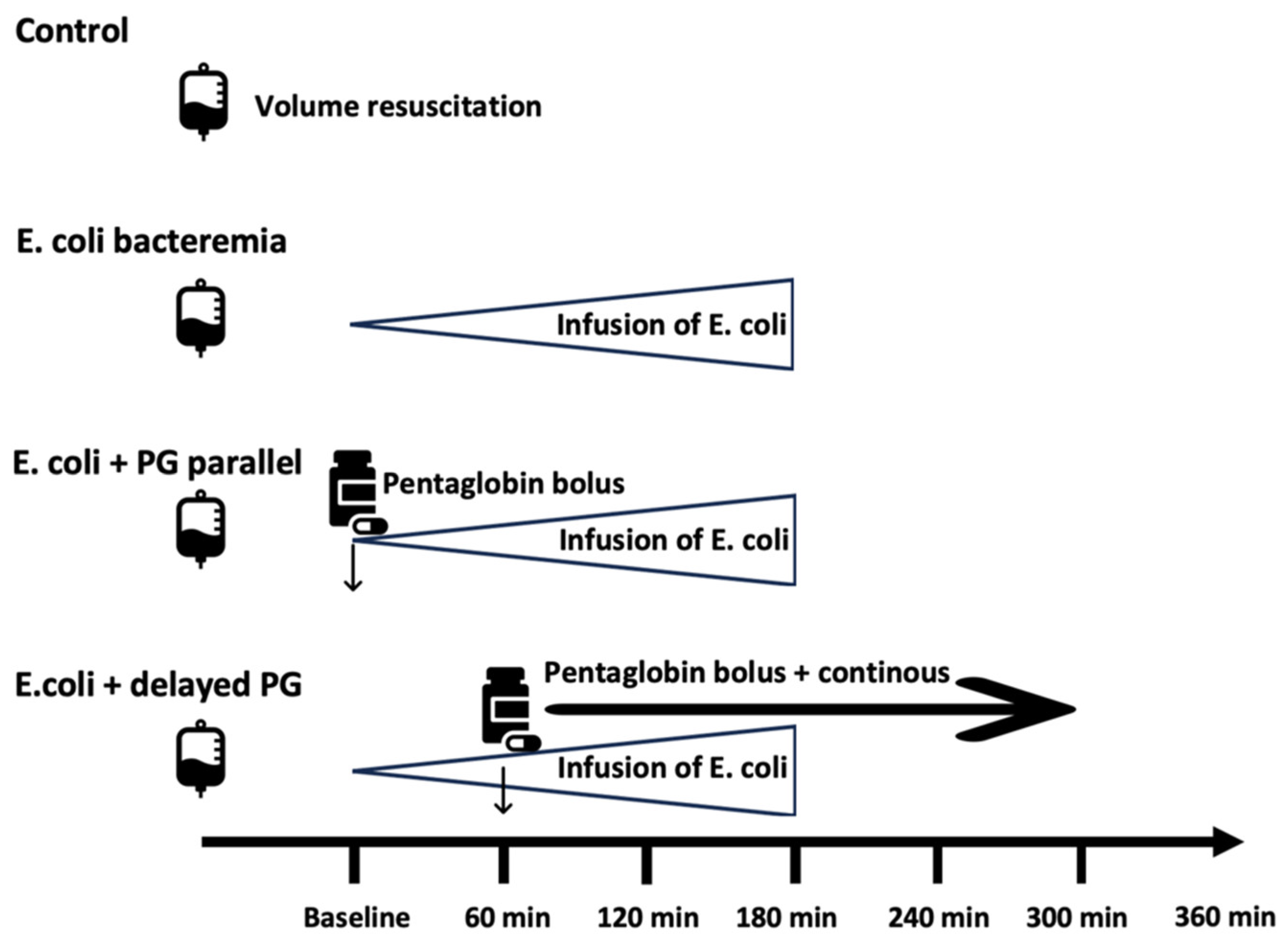
2.1. Experimental Animals and Protocol
- Control group: The control group received only volume replacement therapy.
- E. coli bacteriemia group: this group only received E. coli suspension.
- E. coli parallel Pentaglobin (PG) group: animals received IgM-enriched immunoglobulin concomitantly with E. coli suspension.
- E. coli delayed PG group: administration of Pentaglobin was started 60 min after the start of the E. coli suspension.
2.2. Laboratory Tests
2.3. Hemodynamic Measurements
2.4. Statistical Analysis
3. Results
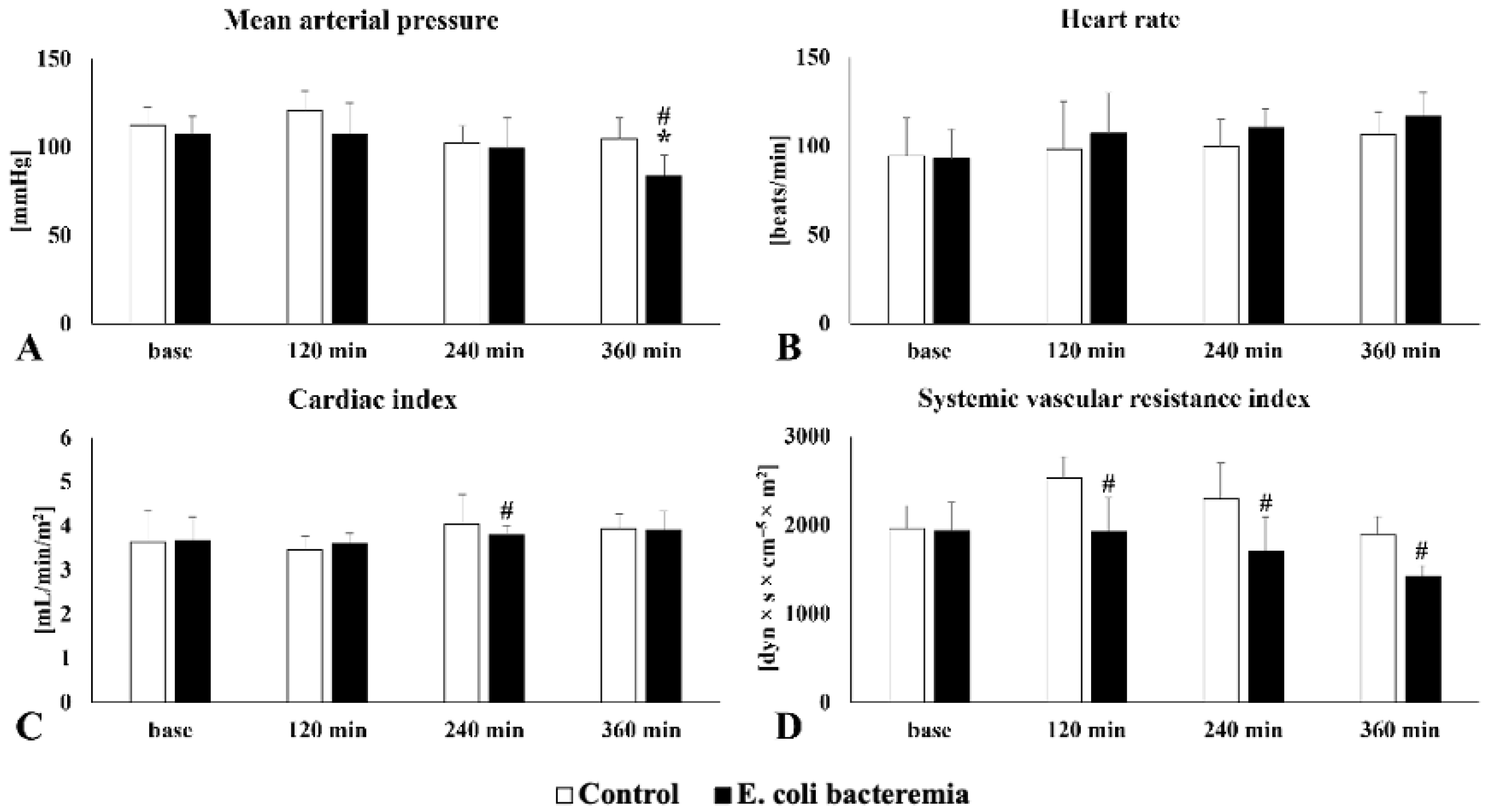
3.1. Model Validation in the Control and Untreated E. coli Bacteriemia Groups
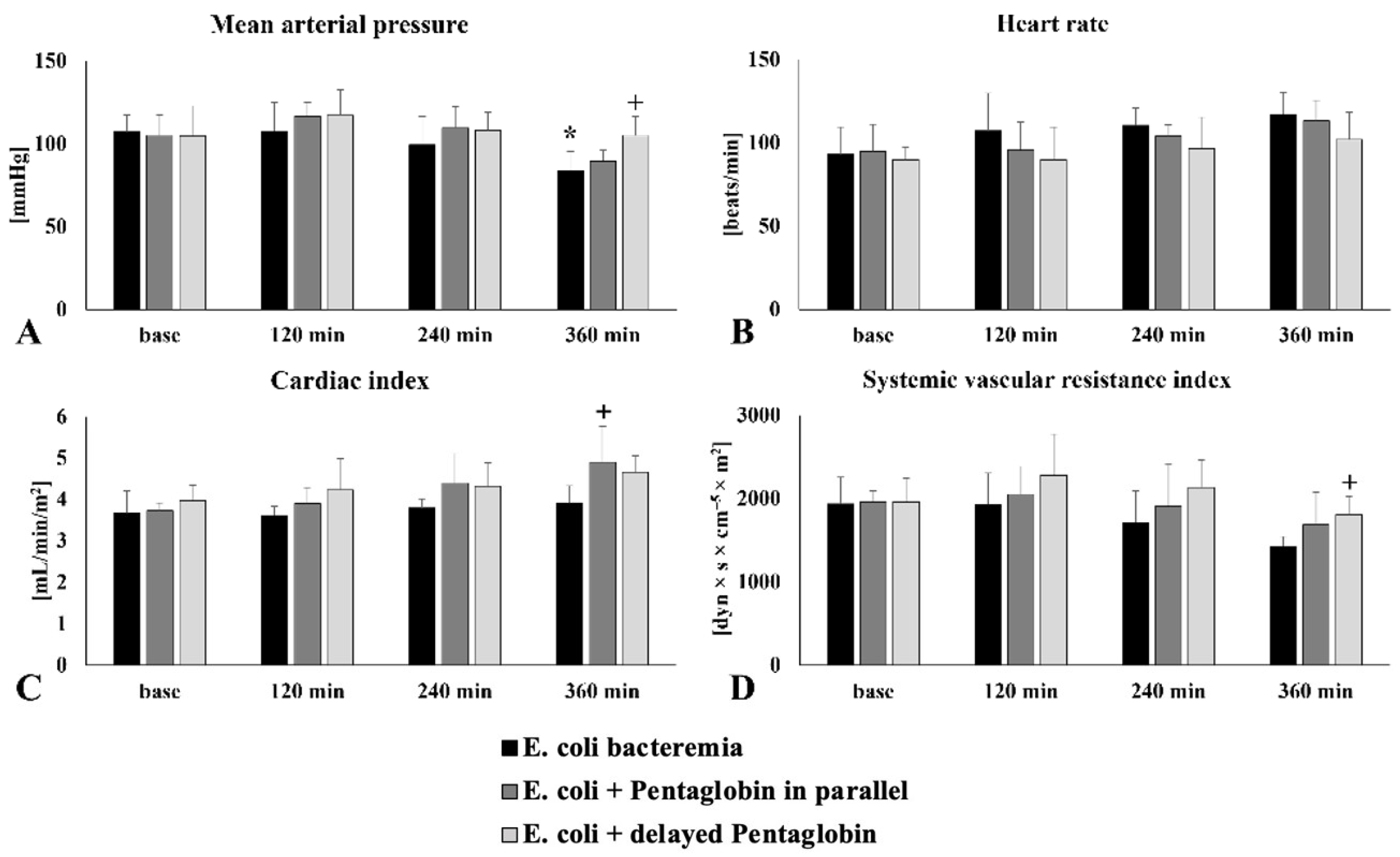
3.2. Comparison of Hemodynamic Changes in E. coli Bacteriemia Group and PG-Treated Animals
4. Discussion
5. Conclusions
Author Contributions
Funding
Institutional Review Board Statement
Data Availability Statement
Conflicts of Interest
References
- Steindl, D.; Schroeder, T.; Krannich, A.; Nee, J. Hemoadsorption in the Management of Septic Shock: A Systematic Review and Meta-Analysis. J. Clin. Med. 2025, 14, 2285. [Google Scholar] [CrossRef] [PubMed]
- Lai, P.S.; Matteau, A.; Iddriss, A.; Hawes, J.C.; Ranieri, V.; Thompson, B.T. An updated meta-analysis to understand the variable effi-acy of drotrecogin alfa (activated) in severe sepsis and septic shock. Minerva Anestesiol. 2013, 79, 33–43. [Google Scholar]
- Gretland, J.; Sjømæling, S.; Mosevoll, K.A.; Reikvam, H. Timing of antibiotic initiation in sepsis and neutropenic fever. Front. Med. 2025, 12, 1597047. [Google Scholar] [CrossRef] [PubMed]
- Sterling, S.A.; Miller, W.R.; Pryor, J.; Puskarich, M.A.; Jones, A.E. The Impact of Timing of Antibiotics on Outcomes in Severe Sepsis and Septic Shock: A Systematic Review and Meta-Analysis. Crit. Care Med. 2015, 43, 1907–1915. [Google Scholar] [CrossRef] [PubMed]
- Evans, L.; Rhodes, A.; Alhazzani, W.; Antonelli, M.; Coopersmith, C.M.; French, C.; Machado, F.R.; Mcintyre, L.; Ostermann, M.; Prescott, H.C.; et al. Surviving sepsis campaign: International guidelines for management of sepsis and septic shock 2021. Intensive Care Med. 2021, 47, 1181–1247. [Google Scholar] [CrossRef]
- Alejandria, M.M.; Lansang, M.A.; Dans, L.F.; Mantaring, J.B., 3rd. Intravenous immunoglobulin for treating sepsis, severe sepsis and septic shock. Cochrane Database Syst. Rev. 2013, 2013, CD001090. [Google Scholar] [CrossRef]
- Busani, S.; Damiani, E.; Cavazzuti, I.; Donati, A.; Girardis, M. Intravenous immunoglobulin in septic shock: Review of the mechanisms of action and meta-analysis of the clinical effectiveness. Minerva Anestesiol. 2016, 82, 559–572. [Google Scholar]
- Pan, B.; Sun, P.; Pei, R.; Lin, F.; Cao, H. Efficacy of IVIG therapy for patients with sepsis: A systematic review and meta-analysis. J. Transl. Med. 2023, 21, 765. [Google Scholar] [CrossRef]
- Goulas, K.; Müller, M.; Exadaktylos, A.K. Assessing Monoclonal and Polyclonal Antibodies in Sepsis and Septic Shock: A Systematic Review of Efficacy and Safety. Int. J. Mol. Sci. 2025, 26, 8859. [Google Scholar] [CrossRef]
- Berlot, G.; Zanchi, S.; Moro, E.; Tomasini, A.; Bixio, M. The Role of the Intravenous IgA and IgM-Enriched Immunoglobulin Preparation in the Treatment of Sepsis and Septic Shock. J. Clin. Med. 2023, 12, 4645. [Google Scholar] [CrossRef]
- Krautz, C.; Maier, S.L.; Brunner, M.; Langheinrich, M.; Giamarellos-Bourboulis, E.J.; Gogos, C.; Armaganidis, A.; Kunath, F.; Grützmann, R.; Weber, G.F. Reduced circulating B cells and plasma IgM levels are associated with decreased survival in sepsis—A meta-analysis. J. Crit. Care 2018, 45, 71–75. [Google Scholar] [CrossRef] [PubMed]
- Venet, F.; Gebeile, R.; Bancel, J.; Guignant, C.; Poitevin-Later, F.; Malcus, C.; Lepape, A.; Monneret, G. Assessment of plasmatic immunoglobulin G, A and M levels in septic shock patients. Int. Immunopharmacol. 2011, 11, 2086–2090. [Google Scholar] [CrossRef] [PubMed]
- Giamarellos-Bourboulis, E.J.; Apostolidou, E.; Lada, M.; Perdios, I.; Gatselis, N.K.; Tsangaris, I.; Georgitsi, M.; Bristianou, M.; Kanni, T.; Sereti, K.; et al. Kinetics of circulating immunoglobulin M in sepsis: Relationship with final outcome. Crit. Care 2013, 17, R247. [Google Scholar] [CrossRef] [PubMed]
- Rodriguez, A.; Rello, J.; Neira, J.; Maskin, B.; Ceraso, D.; Vasta, L.; Palizas, F. Effects of high-dose of intravenous immunoglobulin and antibiotics on survival for severe sepsis undergoing surgery. Shock 2005, 23, 298–304. [Google Scholar] [CrossRef]
- Schedel, I.; Dreikhausen, U.; Nentwig, B.; Hockenschnieder, M.; Rauthmann, D.; Balikcioglu, S.; Coldewey, R.; Deicher, H. Treatment of gram-negative septic shock with an immunoglobulin preparation: A prospective, randomized clinical trial. Crit. Care Med. 1991, 19, 1104–1113. [Google Scholar] [CrossRef]
- Tascini, C.; Fraganza, F.; Salani, F.; Sozio, E.; Rossi, M.; Sbrana, F.; Carannante, N.; Chiesa, M.D.; Ripoli, A.; Bertolino, G.; et al. Potential role of IgM-enriched immuno-globulin as adjuvant treatment for invasive meningococcal disease. Intensive Care Med. 2018, 44, 261–262. [Google Scholar] [CrossRef]
- Parks, T.; Wilson, C.; Curtis, N.; Norrby-Teglund, A.; Sriskandan, S. Polyspecific intravenous immunoglobulin in clindamycin-treated patients with strep-tococcal toxic shock syndrome: A systematic review and meta-analysis. Clin. Infect. Dis. 2018, 67, 1434–1436. [Google Scholar] [CrossRef]
- Giamarellos-Bourboulis, E.J.; Tziolos, N.; Routsi, C.; Katsenos, C.; Tsangaris, I.; Pneumatikos, I.; Vlachogiannis, G.; Theodorou, V.; Prekates, A.; Antypa, E.; et al. Improving outcomes of severe infections by multidrug-resistant pathogens with polyclonal IgM-enriched immunoglobulins. Clin. Microbiol. Infect. 2016, 22, 499–506. [Google Scholar] [CrossRef]
- Welte, T.; Dellinger, R.P.; Ebelt, H.; Ferrer, M.; Opal, S.M.; Singer, M.; Vincent, J.L.; Werdan, K.; Martin-Loeches, I.; Almirall, J.; et al. Efficacy and safety of trimodulin, a novel polyclonal antibody preparation, in patients with severe community-acquired pneumonia: A randomized, placebo-controlled, double-blind, multicenter, phase II trial (CIGMA study). Intensive Care Med. 2018, 44, 438–448. [Google Scholar] [CrossRef]
- Jarczak, D.; Kluge, S.; Nierhaus, A. Use of intravenous immunoglobulins in sepsis therapy- A clinical view. Int. J. Mol. Sci. 2020, 21, 554. [Google Scholar] [CrossRef]
- Rieben, R.; Roos, A.; Muizert, Y.; Tinguely, C.; Gerritsen, A.F.; Daha, M.R. Immunoglobulin M-enriched human intravenous immunoglobulin prevents complement activation in vitro and in vivo in a rat model of acute inflammation. Blood 1999, 93, 942–951. [Google Scholar] [CrossRef]
- Hoffman, J.N.; Fertmann, J.M.; Vollmar, B.; Laschke, M.W.; Jauch, K.W.; Menger, M.D. Immunoglobulin M-enriched human intravenous immunoglobulins reduce leukocyte-endothelial cell interactions and attenuate microvascular perfusion failure in normotensive endotoxemia. Shock 2008, 29, 133–139. [Google Scholar] [CrossRef]
- Kiss, F.; Molnár, L.; Hajdu, E.; Deák, A.; Molnár, Á.; Berhés, M.; Szabó, J.; Németh, N.; Fülesdi, B. Skin microcirculatory changes reflect early the circulatory deterioration in a fulminant sepsis model in the pig. Acta Cir. Bras. 2015, 30, 470–477. [Google Scholar] [CrossRef] [PubMed][Green Version]
- Berhés, M.; Németh, N.; Pető, K.; Deák, Á.; Hajdú, E.; Molnár, Á.; Árkosy, P.; Szabó, J.; Fülesdi, B. Hemodynamic consequences of intravenously given E. coli suspension: Observations in a fulminant sepsis model in pigs, a descriptive case-control study. Eur. J. Med. Res. 2019, 24, 11. [Google Scholar] [CrossRef] [PubMed]
- Barratt-Due, A.; Sokolov, A.; Gustavsen, A.; Hellerud, B.C.; Egge, K.; Pischke, S.E.; Lindstad, J.K.; Pharo, A.; Castellheim, A.; Thorgersen, E.B.; et al. Polyvalent immunoglobulin significantly attenuated the formation of IL-1β in Escherichia coli-induced sepsis in pigs. Immunobiology 2013, 218, 683–689. [Google Scholar] [CrossRef] [PubMed]
- Michard, F.; Lopes, M.R.; Auler, J.O., Jr. Pulse pressure variation: Beyond the fluid management of patients with shock. Crit. Care 2007, 11, 13. [Google Scholar] [CrossRef]
- Turcato, G.; Zaboli, A.; Filippi, L.; Cipriano, A.; Ferretto, P.; Maggi, M.; Lucente, F.; Marchetti, M.; Ghiadoni, L.; Wiedermann, C.J. Endothelial Damage in Sepsis: The Interplay of Coagulopathy, Capillary Leak, and Vasoplegia—A Physiopathological Study. Clin. Pract. 2025, 15, 120. [Google Scholar] [CrossRef]
- Pytel, P.; Alexander, J.J. Pathogenesis of septic encephalopathy. Curr. Opin. Neurol. 2009, 22, 283–287. [Google Scholar] [CrossRef]
- Crow, A.R.; Song, S.; Semple, J.W.; Freedman, J.; Lazarus, A.H. A role for IL-1 receptor antagonist or other cytokines in the acute therapeutic effects of IVIg? Blood 2007, 109, 155–158. [Google Scholar] [CrossRef]
- Toungouz, M.; Denys, C.H.; De Groote, D.; Dupont, E. In vitro inhibition of tumour necrosis factor-alpha and interleukin-6 production by intravenous immunoglobulins. Br. J. Haematol. 1995, 89, 698–703. [Google Scholar] [CrossRef]
- Barratt-Due, A.; Thorgersen, E.B.; Egge, K.; Pischke, S.; Sokolov, A.; Hellerud, B.C.; Lindstad, J.K.; Pharo, A.; Bongoni, A.K.; Rieben, R.; et al. Combined inhibition of complement C5 and CD14 markedly attenuates inflammation thrombogenicity, and hemodynamic changes in porcine sepsis. J. Immunol. 2013, 191, 819–827. [Google Scholar] [CrossRef]


| Control | E. coli Bacteriemia | E. coli + Pentaglobin in Parallel | E. coli + Delayed Pentaglobin | ||
|---|---|---|---|---|---|
| PaO2/FiO2 (mmHg) | baseline | 780.3 ± 137.8 | 681.6 ± 256.5 | 706.9 ± 230.4 | 712.9 ± 174.3 |
| 2 h | 618.1 ± 46.1 (−26%) | 630.9 ± 156 (−8%) | 757.3 ± 493.4 (+7%) | 591.2 ± 150.7 (−20%) | |
| 4 h | 652.1 ± 120.4 (−19%) | 538.1 ± 83.8 (−26%) | 502.8 ± 114.7 (−40%) | 523.6 ± 112.3 (−36%) | |
| 6 h | 588.9 ± 89.2 (−32%) | 471.4 ± 95.7 (−44%) | 541.8 ± 201.4 (−30%) | 444.3 ± 75 (−60%) | |
| MAP (mmHg) | baseline | 112.2 ± 10.3 | 107.1 ± 10.3 | 105 ± 12.6 | 104.8 ± 17.9 |
| 2 h | 120.6 ± 10.9 (+7%) | 107.4 ± 17.7 (+1%) | 116.5 ± 8.7 (+10%) | 117.1 ± 15.5 (+11%) | |
| 4 h | 102 ± 9.8 (−10%) | 99.4 ± 17.4 (−7%) | 109.5 ± 12.9 (+5%) | 108 ± 11.0 (+3%) | |
| 6 h | 104.5 ± 11.9 (−7%) | 83.8 ± 11.5 (−27%) | 89.7 ± 6.7 (−17%) | 105 ± 11.5 (+0.2%) | |
| Platelets (G/L) | baseline | 502.6 ± 110.6 | 540.2 ± 130.9 | 494.2 ± 158.5 | 462.5 ± 115.3 |
| 2 h | 462.5 ± 175.4 (−9%) | 494.8 ± 105.4 (−9%) | 439.9 ± 128.6 (−12%) | 383.8 ± 143.7 (−20%) | |
| 4 h | 484.8 ± 134.6 (−4%) | 474.9 ± 64.6 (−13%) | 432.6 ± 124.6 (−14%) | 402.6 ± 131.1 (−14%) | |
| 6 h | 484.3 ± 134.8 (−4%) | 485.9 ± 81.6 (−11%) | 411.8 ± 111.9 (−20%) | 375.8 ± 128.4 (−23%) | |
| Creatinine (µmol/L) | baseline | 86.8 ± 29.3 | 73.4 ± 35.1 | 85.9 ± 13.5 | 84.6 ± 14.9 |
| 2 h | 88.6 ± 23.9 (+2%) | 92.1 ± 21.2 (+20%) | 89.6 ± 9.1 (+4%) | 83.4 ± 13.5 (−1%) | |
| 4 h | 93.7 ± 22.6 (+7%) | 84.3 ± 15.2 (+13%) | 93.1 ± 15.7 (+8%) | 97.8 ± 12.3 (+13%) | |
| 6 h | 93.3 ± 15.9 (+7%) | 110.7 ± 31.9 (+34%) | 108.2 ± 25.9 (+21%) | 117.2 ± 19.5 (+28%) | |
| Urine output (ml/h) | baseline | 162.5 ± 185.1 | 132.5 ± 133 | 126.1 ± 81.2 | 80 ± 40.4 |
| 2 h | 100 ± 32.2 (−62%) | 99.3 ± 51.9 (−33%) | 140 ± 120.8 (+10%) | 132.3 ± 62.7 (+40%) | |
| 4 h | 220 ± 107.7 (+26%) | 221.9 ± 95.8 (+40%) | 170 ± 125.6 (+26%) | 153.3 ± 66.2 (+48%) | |
| 6 h | 185 ± 76.4 (+12%) | 198.1 ± 81.4 (+33%) | 239.6 ± 160.2 (+47%) | 207.2 ± 94.8 (+61%) | |
| Lactate (mmol/L) | baseline | 0.84 ± 0.18 | 1.05 ± 0.49 | 0.84 ± 0.24 | 0.91 ± 0.24 |
| 2 h | 1.01 ± 0.11 (+17%) | 1.19 ± 0.51 (+12%) | 0.93 ± 0.41 (+10%) | 1.27 ± 0.28 (+28%) | |
| 4 h | 0.96 ± 0.19 (+12%) | 1.31 ± 0.49 (+20%) | 1.11 ± 0.32 (+24%) | 1.09 ± 0.38 (+17%) | |
| 6 h | 1.14 ± 0.21 (+26%) | 1.41 ± 0.26 (+26%) | 1.12 ± 0.48 (+25%) | 1.06 ± 0.39 (+14%) |
| Variables | Baseline | 120 min | 240 min | 360 min | |
|---|---|---|---|---|---|
| GEDVI [mL/m2] | Control | 661.2 ± 71.4 | 634.7 ± 42.6 | 603.7 ± 94.1 | 595 ± 52.2 |
| E. coli bacteriemia | 653 ± 58.4 | 628.9 ± 143.4 | 604.3 ± 120.3 | 612.4 ± 95.8 | |
| ITBVI [mL/m2] | Control | 826.8 ± 89.5 | 793.7 ± 52.9 | 754.8 ± 117.4 | 743.8 ± 64.8 |
| E. coli bacteriemia | 838.2 ± 73.4 | 786.6 ± 179 | 755. 8 ± 150.3 | 766.1 ± 119.9 | |
| EVLWI [mL/kg] | Control | 18.7 ± 1.5 | 18.4 ± 2.8 | 18.7 ± 3.0 | 18.5 ± 2.7 |
| E. coli bacteriemia | 18.2 ± 2.2 | 17.7 ± 1.5 | 21.4 ± 4.8 | 21.6 ± 4.2 | |
| SVV [%] | Control | 14.2 ± 1.5 | 16.2 ± 0.9 | 13.5 ± 4.6 | 16 ± 2.9 |
| E. coli bacteriemia | 14.1 ± 3.7 | 19 ± 3.1 | 19.5 ± 2.3 # | 19.6 ± 4. 2 | |
| PPV [%] | Control | 15.5 ± 2.08 | 17.25 ± 2.36 | 17.5 ± 3 | 17.75 ± 2.87 |
| E. coli bacteriemia | 14.8 ± 1.64 | 19 ± 2.53 | 18 ± 1.55 | 19.8 ± 2.17 | |
| Variables | Baseline | 120 min | 240 min | 360 min | |
|---|---|---|---|---|---|
| GEDVI [mL/m2] | E. coli bacteriemia | 653 ± 58.4 | 628.9 ± 143.4 | 604.3 ± 120.29 | 612.4 ± 95.8 |
| E. coli PG in parallel | 667.8 ± 103.5 | 677 ± 116.7 | 657.2 ± 125.1 | 647.6 ± 99.5 | |
| E. coli + delayed PG | 696.6 ± 60.8 | 705 ± 101.0 | 711.3 ± 89.5 | 710.8 ± 102.5 | |
| ITBVI [mL/m2] | E. coli bacteriemia | 838.2 ± 73.4 | 786.6 ± 179 | 755.8 ± 150.3 | 766.1 ± 119.9 |
| E. coli PG in parallel | 835.2 ± 129. 6 | 846.7 ± 145.6 | 805.9 ± 166.6 | 809.4 ± 124.1 | |
| E. coli + delayed PG | 846.5 ± 60.7 | 881.3 ± 126.2 | 889.5 ± 112.1 | 888.5 ± 127.7 | |
| EVLWI [mL/kg] | E. coli bacteriemia | 18.2 ± 2.2 | 17.67 ± 1.5 | 21.4 ± 4.8 | 21.6 ± 4.2 |
| E. coli PG in parallel | 18 ± 1 | 17.83 ± 1.8 | 18. 7 ± 1.2 | 20 ± 2 | |
| E. coli + delayed PG | 17.7 ± 1.4 | 18.7 ± 1.5 | 19.2 ± 1.5 | 19 ± 1.5 | |
| SVV [%] | E. coli bacteriemia | 14.1 ± 3.7 | 19 ± 3.1 | 19.5 ± 2.3 | 19.6 ± 4.2 |
| E. coli PG in parallel | 14.3 ± 2.3 | 13.1 ± 2.2 # | 13 ± 3.7 # | 16 ± 5.3 | |
| E. coli + delayed PG | 14 ± 3.8 | 15.7 ± 4.3 | 13.6 ± 3.7 # | 15.17 ± 2.3 | |
| PPV [%] | E. coli bacteriemia | 14.8 ± 1.6 | 19 ± 2.5 | 18 ± 1.5 | 19.8 ± 2.2 |
| E. coli PG in parallel | 14 ± 1.9 | 13.8 ± 2.8 # | 13.4 ± 2.4 # | 15 ± 3.6 # | |
| E. coli + delayed PG | 14 ± 2.4 | 13.5 ± 2.3 # | 13.4 ± 3.8 # | 15.33 ± 1.2 # | |
Disclaimer/Publisher’s Note: The statements, opinions and data contained in all publications are solely those of the individual author(s) and contributor(s) and not of MDPI and/or the editor(s). MDPI and/or the editor(s) disclaim responsibility for any injury to people or property resulting from any ideas, methods, instructions or products referred to in the content. |
© 2026 by the authors. Licensee MDPI, Basel, Switzerland. This article is an open access article distributed under the terms and conditions of the Creative Commons Attribution (CC BY) license.
Share and Cite
Ujhelyi, B.; Mátrai, Á.A.; Berhés, M.; Molnár, L.P.; Deák, Á.; Tóth, Z.; László, I.; Németh, N.; Fülesdi, B. Hemodynamic Effect of IgM-Enriched Immunoglobulin in the Early Stage of E. coli-Induced Experimental Sepsis. J. Clin. Med. 2026, 15, 1522. https://doi.org/10.3390/jcm15041522
Ujhelyi B, Mátrai ÁA, Berhés M, Molnár LP, Deák Á, Tóth Z, László I, Németh N, Fülesdi B. Hemodynamic Effect of IgM-Enriched Immunoglobulin in the Early Stage of E. coli-Induced Experimental Sepsis. Journal of Clinical Medicine. 2026; 15(4):1522. https://doi.org/10.3390/jcm15041522
Chicago/Turabian StyleUjhelyi, Balázs, Ádám Attila Mátrai, Mariann Berhés, Luca Panka Molnár, Ádám Deák, Zoltán Tóth, István László, Norbert Németh, and Béla Fülesdi. 2026. "Hemodynamic Effect of IgM-Enriched Immunoglobulin in the Early Stage of E. coli-Induced Experimental Sepsis" Journal of Clinical Medicine 15, no. 4: 1522. https://doi.org/10.3390/jcm15041522
APA StyleUjhelyi, B., Mátrai, Á. A., Berhés, M., Molnár, L. P., Deák, Á., Tóth, Z., László, I., Németh, N., & Fülesdi, B. (2026). Hemodynamic Effect of IgM-Enriched Immunoglobulin in the Early Stage of E. coli-Induced Experimental Sepsis. Journal of Clinical Medicine, 15(4), 1522. https://doi.org/10.3390/jcm15041522