Vulvovaginal Collagen Injection as a Regenerative Strategy in Genitourinary Syndrome of Menopause: Results of a Pilot Study

 , and
, and
Abstract
1. Introduction
1.1. Background
1.2. Rationale of the Study
1.3. Aim of the Study
- (1)
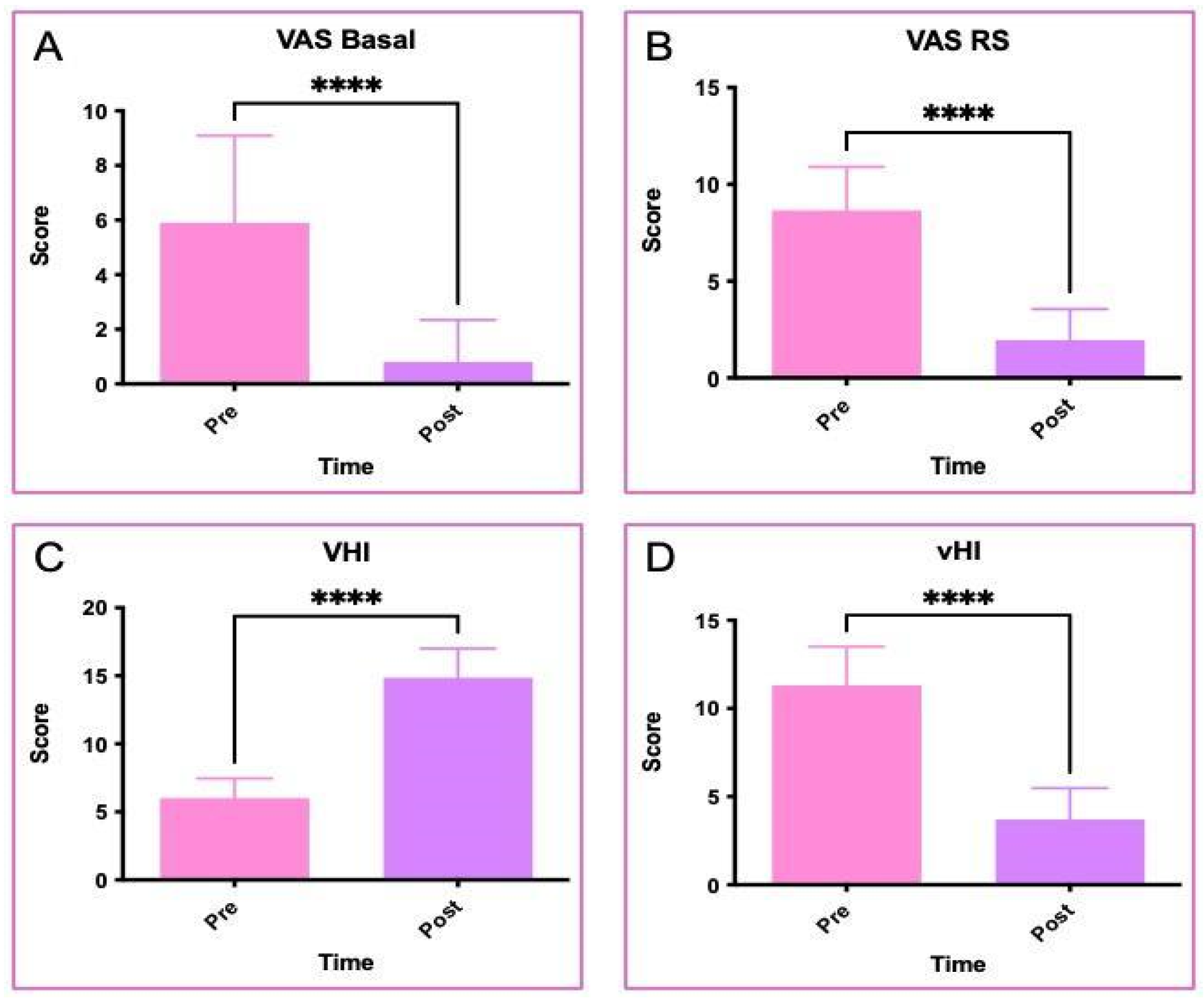
- Primary aim: The primary aim of this study was to examine the efficacy of multipoint intradermal injections of collagen (MD-Tissue) in the vulvovaginal area in patients with GSM refractory to conventional first-line therapy. The main criterion for efficacy was considered to be pain reduction, as assessed by the Visual Analog Scale (VAS).
- (2)
- Secondary aims:
- Analyze the improvement in symptomatology associated with GSM as measured by validated questionnaires.
- Analyze impact on general and sexual quality of life using validated questionnaires. Assess patient satisfaction with the treatment received using the specific scale.
2. Materials and Methods
2.1. Type of the Study
2.2. Study Population
- -
- Inclusion criteria:
- Over 18 years of age.
- Genitourinary syndrome of menopause.
- No association with other pelvic pain conditions.
- Refractory to conventional first-line treatments listed in clinical practice guidelines.
- -
- Exclusion criteria:
- Mental or cognitive disorder that impedes comprehension.
- Local infections at the site of injection.
- Total or partial denervation of the pelvic floor.
- Neurological diseases: CVA, LM, MS.
- Active urinary tract infections and vulvovaginosis.
- Lichen sclerosus.
2.3. Assessment Variables
2.3.1. Primary Variable
2.3.2. Secondary Variables
2.3.3. Demographic and Other Clinical Variables
2.4. Data Collection and Study Protocol
2.5. Injection Technique
2.6. Safety Assessment Criteria
2.7. Questionnaires Characteristics
- The Visual Analog Scale (VAS) was used to measure the intensity of pain perceived by patients, both at rest and during sexual relations (SR). It consists of a 10 cm line where 0 represents ‘no pain’ and 10 represents ‘the worst pain imaginable’. Patients marked the point that reflected the intensity of their pain (Figure S1).
- The modified Vaginal Health Index (VHI) comprises four items (elasticity, discharge volume, epithelial integrity, and moisture). Each symptom is classified from 1 to 5, with 1 being the worst situation and 5 the best. GSM is defined when a total score below 12 is identified at the beginning of the study (Table S1).
- The vulvar health index (vHI) consists of five items (labia majora and labia minora, clitoris, vestibule and elasticity, color, discomfort and pain). Each item is graded with a score ranging from 0 (best clinical condition) to 3 (worst clinical condition). GSM is graded into mild (0–5 points), moderate (6–10 points) and severe (>10) (Table S2).
- To assess the impact on quality of life and sex life, the vulvovaginal symptoms questionnaire (VSQ) was used, which consists of 21 items (itching, burning or stinging, pain, irritation, dryness, discharge, vulvar or vaginal odor, worry about vulvar symptoms, appearance, frustration about symptoms, embarrassment about symptoms, effects of symptoms on social interactions and desire to be with others, symptoms making it difficult to show affection, affecting daily activities, affecting desire for intimacy, whether they are sexually active with a partner, vulvar symptoms having an effect on sexual relations, causing pain, dryness or bleeding during intercourse). Each item has only two possible responses to be checked by the patient, ‘Yes’ and ‘No’ (Table S3).
- To assess patient satisfaction with treatment, we use the Clinical Global Impression (CGI) scale. It provides a measure of the overall change in clinical status from baseline to the time of assessment. This scale aims to reflect the perception of change experienced by the patient, considering the improvement or worsening of symptoms. Scores range from 1 (much better) to 7 (much worse) (Table S4).
- Finally, patients were questioned and the expected side effects, such as persistent edema (>24 h), ecchymosis, necrosis, and infection after injection, were discussed.
2.8. Statistical Analysis
2.9. Ethical Considerations
3. Results
3.1. Patients Included
3.2. Qualitative Analyses
3.3. Primary Study Variable: Pain Reduction Through VAS
3.4. Secondary Study Variables: VHI and vHI
3.5. Vulvovaginal Symptoms Questionnaire (VSQ)
4. Discussion
5. Conclusions
Supplementary Materials
Author Contributions
Funding
Institutional Review Board Statement
Informed Consent Statement
Data Availability Statement
Conflicts of Interest
Correction Statement
References
- Portman, D.J.; Gass, M.L.S. Genitourinary Syndrome of Menopause: New Terminology for Vulvovaginal Atrophy from the International Society for the Study of Women’s Sexual Health and The North American Menopause Society. Menopause 2014, 21, 1063–1068. [Google Scholar] [CrossRef] [PubMed]
- Da Silva, A.S.; Baines, G.; Araklitis, G.; Robinson, D.; Cardozo, L. Modern Management of Genitourinary Syndrome of Menopause. Fac. Rev. 2021, 10, 25. [Google Scholar] [CrossRef]
- Angelou, K.; Grigoriadis, T.; Diakosavvas, M.; Zacharakis, D.; Athanasiou, S. The Genitourinary Syndrome of Menopause: An Overview of the Recent Data. Cureus 2020, 12, e7586. [Google Scholar] [CrossRef]
- Nappi, R.E.; Martini, E.; Cucinella, L.; Martella, S.; Tiranini, L.; Inzoli, A.; Brambilla, E.; Bosoni, D.; Cassani, C.; Gardella, B. Addressing Vulvovaginal Atrophy (VVA)/Genitourinary Syndrome of Menopause (GSM) for Healthy Aging in Women. Front. Endocrinol. 2019, 10, 561. [Google Scholar] [CrossRef]
- Mainar, L.B.; Méndez, S.S.; Altaba, T.A. Síndrome Genitourinario de La Menopausia; Editorial Universidad de Granada: Granada, Spain, 2020. [Google Scholar]
- Kaufman, M.R.; Ackerman, A.L.; Amin, K.A.; Coffey, M.; Danan, E.; Faubion, S.S.; Hardart, A.; Goldstein, I.; Ippolito, G.M.; Northington, G.M.; et al. The AUA/SUFU/AUGS Guideline on Genitourinary Syndrome of Menopause. J. Urol. 2025, 214, 242–250. [Google Scholar] [CrossRef]
- Kingsberg, S.A.; Wysocki, S.; Magnus, L.; Krychman, M.L. Vulvar and Vaginal Atrophy in Postmenopausal Women: Findings from the REVIVE (REal Women’s VIews of Treatment Options for Menopausal Vaginal ChangEs) Survey. J. Sex. Med. 2013, 10, 1790–1799. [Google Scholar] [CrossRef] [PubMed]
- Palacios, S.; Nappi, R.E.; Bruyniks, N.; Particco, M.; Panay, N. The European Vulvovaginal Epidemiological Survey (EVES): Prevalence, Symptoms and Impact of Vulvovaginal Atrophy of Menopause. Climacteric 2018, 21, 286–291. [Google Scholar] [CrossRef] [PubMed]
- Chen, B.; Yeh, J. Alterations in Connective Tissue Metabolism in Stress Incontinence and Prolapse. J. Urol. 2011, 186, 1768–1772. [Google Scholar] [CrossRef]
- Sarmento, A.C.A.; Costa, A.P.F.; Vieira-Baptista, P.; Giraldo, P.C.; Eleutério, J.; Gonçalves, A.K. Genitourinary Syndrome of Menopause: Epidemiology, Physiopathology, Clinical Manifestation and Diagnostic. Front. Reprod. Health 2021, 3, 779398. [Google Scholar] [CrossRef]
- Moral, E.; Delgado, J.L.; Carmona, F.; Caballero, B.; Guillán, C.; González, P.M.; Suárez-Almarza, J.; Velasco-Ortega, S.; Nieto, C.; as the writing group of the GENISSE study. Genitourinary Syndrome of Menopause. Prevalence and Quality of Life in Spanish Postmenopausal Women. The GENISSE Study. Climacteric 2018, 21, 167–173. [Google Scholar] [CrossRef]
- Kagan, R.; Kellogg-Spadt, S.; Parish, S.J. Practical Treatment Considerations in the Management of Genitourinary Syndrome of Menopause. Drugs Aging 2019, 36, 897–908. [Google Scholar] [CrossRef]
- Berreni, N.; Salerno, J.; Chevalier, T.; Alonso, S.; Mares, P. Evaluation of the Effect of Multipoint Intra-Mucosal Vaginal Injection of a Specific Cross-Linked Hyaluronic Acid for Vulvovaginal Atrophy: A Prospective Bi-Centric Pilot Study. BMC Women’s Health 2021, 21, 322. [Google Scholar] [CrossRef]
- Carlson, K.; Nguyen, H. Genitourinary Syndrome of Menopause. In StatPearls; StatPearls Publishing: St. Petersburg, FL, USA, 2025. [Google Scholar]
- Buzzaccarini, G.; Marin, L.; Noventa, M.; Vitagliano, A.; Riva, A.; Dessole, F.; Capobianco, G.; Bordin, L.; Andrisani, A.; Ambrosini, G. Hyaluronic Acid in Vulvar and Vaginal Administration: Evidence from a Literature Systematic Review. Climacteric 2021, 24, 560–571. [Google Scholar] [CrossRef]
- López, D.M.L. Management of Genitourinary Syndrome of Menopause in Breast Cancer Survivors: An Update. World J. Clin. Oncol. 2022, 13, 71–100. [Google Scholar] [CrossRef]
- Marchand Lamiraud, F.; Bensmail, H.; Martin, C.; Pelckmans, S.; Cha’ban, F.; Siboni Frisch, A.; Deniz, G.; Sabban Serfati, P.; Caubo, B.; Gurriet, B.; et al. Hyaluronic acid injection to treat symptoms of vulvovaginal atrophy in postmenopausal women: A 12-week randomised, placebo-controlled, multicentric study. Maturitas 2025, 197, 108264. [Google Scholar] [CrossRef] [PubMed]
- Moccia, F.; Pentangelo, P.; Ceccaroni, A.; Raffone, A.; Losco, L.; Alfano, C. Injection Treatments for Vulvovaginal Atrophy of Menopause: A Systematic Review. Aesth Plast. Surg. 2023, 47, 2788–2799. [Google Scholar] [CrossRef] [PubMed]
- Liu, M.; Li, F.; Zhou, Y.; Cao, Y.; Li, S.; Li, Q. Eficacia de La CO2 Tratamiento Láser En Mujeres Posmenopáusicas Con Atrofia Vulvovaginal: Un Metaanálisis. Rev. Int. Ginecol. Obstet. Órgano Fed. Int. Ginecol. Obstet. 2022, 158, 241–251. [Google Scholar] [CrossRef]
- Elia, D.; Gambacciani, M.; Berreni, N.; Bohbot, J.M.; Druckmann, R.; Geoffrion, H.; Haab, F.; Heiss, N.; Rygaloff, N.; Russo, E. Genitourinary Syndrome of Menopause (GSM) and Laser VEL: A Review. Horm. Mol. Biol. Clin. Investig. 2020, 41, 20190024. [Google Scholar] [CrossRef] [PubMed]
- Filippini, M.; Porcari, I.; Ruffolo, A.F.; Casiraghi, A.; Farinelli, M.; Uccella, S.; Franchi, M.; Candiani, M.; Salvatore, S. CO2-Laser Therapy and Genitourinary Syndrome of Menopause: A Systematic Review and Meta-Analysis. J. Sex. Med. 2022, 19, 452–470. [Google Scholar] [CrossRef] [PubMed]
- Leibaschoff, G.; Izasa, P.G.; Cardona, J.L.; Miklos, J.R.; Moore, R.D. Transcutaneous Temperature Controlled Radiofrequency (TTCRF) for the Treatment of Menopausal Vaginal/Genitourinary Symptoms. Surg. Technol. Int. 2016, 29, 149–159. [Google Scholar]
- Kamilos, M.F.; Costa, A.P.F.; Sarmento, A.C.A.; Eleutério, J., Jr.; Gonçalves, A.K. Microablative Fractional Radiofrequency as a Therapeutical Option for Genitourinary Syndrome of Menopause: Perspectives. Front. Reprod. Health 2021, 3, 779421. [Google Scholar] [CrossRef] [PubMed]
- Saleh, D.M.; Abdelghani, R. Clinical Evaluation of Autologous Platelet Rich Plasma Injection in Postmenopausal Vulvovaginal Atrophy: A Pilot Study. J. Cosmet. Dermatol. 2022, 21, 4269–4275. [Google Scholar] [CrossRef]
- Chen, A.H.; Trabuco, E.C.; Chumsri, S.; Thielen, J.M.; Cornella, J.L.; Shapiro, S.A.; Heckman, M.G.; Dukes, R.E.; Arthurs, J.R.; Blumenfeld, S.G.; et al. Platelet-Rich Plasma for Genitourinary Syndrome of Menopause in Breast Cancer Survivors. Obstet. Gynecol. 2025, 146, 728–736. [Google Scholar] [CrossRef] [PubMed]
- Faubion, S.S.; Larkin, L.C.; Stuenkel, C.A.; Bachmann, G.A.; Chism, L.A.; Kagan, R.; Kaunitz, A.M.; Krychman, M.L.; Parish, S.J.; Partridge, A.H.; et al. Management of genitourinary syndrome of menopause in women with or at high risk for breast cancer: Consensus recommendations from The North American Menopause Society and The International Society for the Study of Women’s Sexual Health. Menopause 2018, 25, 596–608. [Google Scholar] [CrossRef] [PubMed]
- Jimenez-Cano, V.M.; Cuevas Garcia, J.C.; Fabregat-Hernandez, J. Efectividad de Las Infiltraciones Con Colágeno Para La Fascitis Plantar: Ensayo Clínico Aleatorizado. Rev. Esp. Pod. 2022, 33, 14–20. [Google Scholar] [CrossRef]
- Micarelli, A.; Viziano, A.; Granito, I.; Antonuccio, G.; Felicioni, A.; Loberti, M.; Carlino, P.; Micarelli, R.X.; Alessandrini, M. Combination of In-Situ Collagen Injection and Rehabilitative Treatment in Long-Lasting Facial Nerve Palsy: A Pilot Randomized Controlled Trial. Eur. J. Phys. Rehabil. Med. 2021, 57, 366–375. [Google Scholar] [CrossRef] [PubMed]
- Godek, P. Collagen Therapy in Lumbar Spondylosis—A Pilot Study. Does the Route of Administration Matter? Ortop. Traumatol. Rehabil. 2019, 21, 427–436. [Google Scholar] [CrossRef]
- Randelli, F.; Sartori, P.; Carlomagno, C.; Bedoni, M.; Menon, A.; Vezzoli, E.; Sommariva, M.; Gagliano, N. The Collagen-Based Medical Device MD-Tissue Acts as a Mechanical Scaffold Influencing Morpho-Functional Properties of Cultured Human Tenocytes. Cells 2020, 9, 2641. [Google Scholar] [CrossRef]
- Shim, S.; Park, K.-M.; Chung, Y.-J.; Kim, M.-R. Updates on Therapeutic Alternatives for Genitourinary Syndrome of Menopause: Hormonal and Non-Hormonal Managements. J. Menopausal. Med. 2021, 27, 1–7. [Google Scholar] [CrossRef] [PubMed]
- Maris, E.; Salerno, J.; Hédon, B.; Mares, P. Traitements physiques de l’atrophie vulvovaginale. RPC Les femmes ménopausées du CNGOF et du GEMVi. Gynécologie Obs. Fertil. Sénologie 2021, 49, 414–419. [Google Scholar] [CrossRef]
- Szymański, J.K.; Siekierski, B.P.; Kajdy, A.; Jakiel, G. Post-Menopausal Vulvovaginal Atrophy—An Overview of the Current Treatment Options. Ginekol. Pol. 2018, 89, 40–47. [Google Scholar] [CrossRef] [PubMed]
- Romero-Cullerés, G.; Amela-Arévalo, A.; Jané-Feixas, C.; Vilaseca-Grané, A.; Arnau, A.; Torà, N. Eficacia de las infiltraciones con colágeno en el dolor pélvico causado por cicatrices de episiotomía y cesáreas. Ensayo clínico piloto aleatorizado. Rehabilitación 2022, 56, 85–92. [Google Scholar] [CrossRef]
- Oyardı, P.; Mete Ural, Ü. Evaluation of the Efficacy of Injectable Platelet-Rich Fibrin in Genitourinary Syndrome of Menopause. J. Turkish German Gynecol. Assoc. 2025, 26, 15–19. [Google Scholar] [CrossRef]
- Ragy, S.; Kahky, H.E.; Elfakkar, N.M.Z.; Nassar, S.A.M.; El-Husseiny, R.M. Injection of Hyaluronic Acid versus Platelet Rich Plasma for Treatment of Vulvovaginal Atrophy in Post-Menopausal Females. Arch. Dermatol. Res. 2025, 317, 305. [Google Scholar] [CrossRef]
- Núñez Remiseiro, L.; Da Cuña Carrera, I.; González González, Y. Factores que influyen en la dispareunia posparto: Una revisión sistemática. Clínica Investig. Ginecol. Obstet. 2020, 47, 168–173. [Google Scholar] [CrossRef]
- Gong, R.; Xia, Z. Collagen Changes in Pelvic Support Tissues in Women with Pelvic Organ Prolapse. Eur. J. Obstet. Gynecol. Reprod. Biol. 2019, 234, 185–189. [Google Scholar] [CrossRef]
- Hersant, B.; SidAhmed-Mezi, M.; Belkacemi, Y.; Darmon, F.; Bastuji-Garin, S.; Werkoff, G.; Bosc, R.; Niddam, J.; Hermeziu, O.; La Padula, S.; et al. Efficacy of Injecting Platelet Concentrate Combined with Hyaluronic Acid for the Treatment of Vulvovaginal Atrophy in Postmenopausal Women with History of Breast Cancer: A Phase 2 Pilot Study. Menopause 2018, 25, 1124–1130. [Google Scholar] [CrossRef] [PubMed]
- Angelucci, M.; Frascani, F.; Franceschelli, A.; Lusi, A.; Garo, M.L. Efficacy of Intradermal Hyaluronic Acid plus Polynucleotides in Vulvovaginal Atrophy: A Pilot Study. Climacteric 2022, 25, 490–496. [Google Scholar] [CrossRef]
- Leonhardt, C.; Krysl, J.; Arenson, A.M.; Herschorn, S. Periurethral Injection of Collagen in the Treatment of Urinary Stress Incontinence: Ultrasonographic Appearance. Can. Assoc. Radiol. J. 1995, 46, 189–193. [Google Scholar] [PubMed]
- Defreitas, G.A.; Wilson, T.S.; Zimmern, P.E.; Forte, T.B. Three-Dimensional Ultrasonography: An Objective Outcome Tool to Assess Collagen Distribution in Women with Stress Urinary Incontinence. Urology 2003, 62, 232–236. [Google Scholar] [CrossRef]


| Genital | Sexual | Urinal |
|---|---|---|
| Vaginal dryness | Dyspareunia | Dysuria |
| Irritation, burning, itchiness | Decreased lubrication | Urgent urination |
| Leucorrhoea | Post-coital bleeding | Urethral prolapse |
| Thinning of the vaginal mucosa | Loss of libido and arousal | Stress/urgency urinary incontinence |
| Vaginal or pelvic pain | Dysorgasmia | Predisposition to urinary tract infections |
| Vaginal vault prolapse | Nocturia | |
| Retraction/thinning of labia minora and labia majora | Polyuria | |
| Retraction of the vaginal introitus | ||
| Loss of pubic hair | ||
| Vulvar pallor | ||
| Disappearance of the clitoral hood |
| Variable | n = 20 |
|---|---|
| Age | |
| Median (Range) | 54 (48–58) |
| Mean (SD) | 54 (8) |
| Reason for referral, n (%) | |
| Dyspareunia | 1 (5.0%) |
| Pelvic pain | 11 (55.0%) |
| Urinary incontinence | 6 (30.0%) |
| Vulvodynia | 2 (10.0%) |
| Main diagnosis (in rhb consultation), n (%) | |
| GSM | 20 (100.0%) |
| Prior GSM Treatments | n = 20 |
|---|---|
| Lubricant treatment (%) | |
| No | 9 (45.0%) |
| Yes | 11 (55.0%) |
| Moisturizing treatment (without hyaluronic acid) (%) | |
| No | 15 (75.0%) |
| Yes | 5 (25.0%) |
| Moisturizing treatment (hyaluronic acid) (%) | |
| No | 10 (50.0%) |
| Yes | 10 (50.0%) |
| Local estrogen therapy (%) | |
| No | 16 (80.0%) |
| Yes | 4 (20.0%) |
| Systemic estrogen therapy (%) | |
| No | 19 (95.0%) |
| Yes | 1 (5.0%) |
| Ospemifene (%) | |
| No | 19 (95.0%) |
| Yes | 1 (5.0%) |
| Lidocaine cream (%) | |
| No | 19 (95.0%) |
| Yes | 1 (5.0%) |
| Most Common Signs and Symptoms | n = 20 |
|---|---|
| Dyspareunia/sexual dysfunction (%) | |
| No | 5 (25.0%) |
| Yes | 15 (75.0%) |
| Dryness (%) | |
| No | 2 (10.0%) |
| Yes | 18 (90.0%) |
| Irritation/Itching/Burning (%) | |
| Yes | 20 (100.0%) |
| Over-active bladder (%) | |
| No | 19 (95.0%) |
| Yes | 1 (5.0%) |
| Urinary incontinence (%) | |
| No | 11 (55.0%) |
| Yes | 9 (45.0%) |
| Variable | Overall n = 40 | PRE n = 20 | POST n = 20 | p-Value |
|---|---|---|---|---|
| Q1 Have you experienced vulvar itching? | <0.001 | |||
| No | 20 (50%) | 0 (0%) | 20 (100%) | |
| Yes | 20 (50%) | 20 (100%) | 0 (0%) | |
| Q2 Do you feel your vulva burning or stinging? | <0.001 | |||
| No | 20 (50%) | 0 (0%) | 20 (100%) | |
| Yes | 20 (50%) | 20 (100%) | 0 (0%) | |
| Q3 Are you experiencing vulva pain? | <0.001 | |||
| No | 16 (40%) | 0 (0%) | 16 (80%) | |
| Yes | 24 (60%) | 20 (100%) | 4 (20%) | |
| Q4 Is you vulva irritated? | <0.001 | |||
| No | 20 (50%) | 0 (0%) | 20 (100%) | |
| Yes | 20 (50%) | 20 (100%) | 0 (0%) | |
| Q5 Do you have vaginal or vulva dryness? | <0.001 | |||
| No | 21 (53%) | 2 (10%) | 19 (95%) | |
| Yes | 19 (48%) | 18 (90%) | 1 (5.0%) | |
| Q6 Are you experiencing any discharge from your vulva or vagina? | 0.005 | |||
| No | 31 (78%) | 19 (95%) | 12 (60%) | |
| Yes | 9 (23%) | 1 (5.0%) | 8 (40%) | |
| Q7 Do you notice any oduor from your vulva or vagina? | 0.5 | |||
| No | 37 (93%) | 18 (90%) | 19 (95%) | |
| Yes | 3 (7.5%) | 2 (10%) | 1 (5.0%) | |
| Q8 Do you worry about your vulvar symptoms? | <0.001 | |||
| No | 20 (50%) | 1 (5.0%) | 19 (95%) | |
| Yes | 20 (50%) | 19 (95%) | 1 (5.0%) | |
| Q9 How do you feel about the appearance of your vulva? | <0.001 | |||
| No | 20 (50%) | 1 (5.0%) | 19 (95%) | |
| Yes | 20 (50%) | 19 (95%) | 1 (5.0%) | |
| Q10 Do you feel frustrated about your vulvar symptoms? | <0.001 | |||
| No | 20 (50%) | 0 (0%) | 20 (100%) | |
| Yes | 20 (50%) | 20 (100%) | 0 (0%) | |
| Q11 Are you embarrassed about your vulvar symptoms? | <0.001 | |||
| No | 22 (55%) | 2 (10%) | 20 (100%) | |
| Yes | 18 (45%) | 18 (90%) | 0 (0%) | |
| Q12 How have your vulvar symptoms affected your interactions with others? | <0.001 | |||
| No | 24 (60%) | 4 (20%) | 20 (100%) | |
| Yes | 16 (40%) | 16 (80%) | 0 (0%) | |
| Q13 Do your vulvar symptoms effect your desire to be with people? | <0.001 | |||
| No | 25 (63%) | 5 (25%) | 20 (100%) | |
| Yes | 15 (38%) | 15 (75%) | 0 (0%) | |
| Q14 Have your vulvar symptoms made it hard to show affection? | <0.001 | |||
| No | 25 (63%) | 5 (25%) | 20 (100%) | |
| Yes | 15 (38%) | 15 (75%) | 0 (0%) | |
| Q15 How do your vulvar symptoms affect your daily activities? | <0.001 | |||
| No | 22 (55%) | 2 (10%) | 20 (100%) | |
| Yes | 18 (45%) | 18 (90%) | 0 (0%) | |
| Q16 Do your vulvar symptoms affect your desire to be intimate? | <0.001 | |||
| No | 20 (50%) | 0 (0%) | 20 (100%) | |
| Yes | 20 (50%) | 20 (100%) | 0 (0%) | |
| Q17 Are you currently sexually active with a partner? | 0.001 | |||
| No | 18 (45%) | 14 (70%) | 4 (20%) | |
| Yes | 22 (55%) | 6 (30%) | 16 (80%) | |
| Q18 How have your vulvar symptoms affected your sexual relationships? | <0.001 | |||
| No | 20 (50%) | 0 (0%) | 20 (100%) | |
| Yes | 20 (50%) | 20 (100%) | 0 (0%) | |
| Q19 Do your vulvar symptoms cause pain during sexual activity? | <0.001 | |||
| No | 14 (35%) | 0 (0%) | 14 (70%) | |
| Yes | 26 (65%) | 20 (100%) | 6 (30%) | |
| Q20 Do your vulvar symptoms cause dryness during sexual activity? | <0.001 | |||
| No | 20 (50%) | 0 (0%) | 20 (100%) | |
| Yes | 20 (50%) | 20 (100%) | 0 (0%) | |
| Q21 Do your vulvar symptoms cause bleeding during sexual activity? | <0.001 | |||
| No | 20 (50%) | 0 (0%) | 20 (100%) | |
| Yes | 20 (50%) | 20 (100%) | 0 (0%) | |
| Variable | n = 20 |
|---|---|
| CGI, n (%) | |
| Moderately better | 4 (20%) |
| Much better | 16 (80%) |
Disclaimer/Publisher’s Note: The statements, opinions and data contained in all publications are solely those of the individual author(s) and contributor(s) and not of MDPI and/or the editor(s). MDPI and/or the editor(s) disclaim responsibility for any injury to people or property resulting from any ideas, methods, instructions or products referred to in the content. |
© 2026 by the authors. Licensee MDPI, Basel, Switzerland. This article is an open access article distributed under the terms and conditions of the Creative Commons Attribution (CC BY) license.
Share and Cite
Borobia Pérez, A.I.; Estévez Espejo, J.J.; Jiménez-González, M.; García López, R.D. Vulvovaginal Collagen Injection as a Regenerative Strategy in Genitourinary Syndrome of Menopause: Results of a Pilot Study. J. Clin. Med. 2026, 15, 1408. https://doi.org/10.3390/jcm15041408
Borobia Pérez AI, Estévez Espejo JJ, Jiménez-González M, García López RD. Vulvovaginal Collagen Injection as a Regenerative Strategy in Genitourinary Syndrome of Menopause: Results of a Pilot Study. Journal of Clinical Medicine. 2026; 15(4):1408. https://doi.org/10.3390/jcm15041408
Chicago/Turabian StyleBorobia Pérez, Ana Isabel, Javier Jesús Estévez Espejo, María Jiménez-González, and Roger David García López. 2026. "Vulvovaginal Collagen Injection as a Regenerative Strategy in Genitourinary Syndrome of Menopause: Results of a Pilot Study" Journal of Clinical Medicine 15, no. 4: 1408. https://doi.org/10.3390/jcm15041408
APA StyleBorobia Pérez, A. I., Estévez Espejo, J. J., Jiménez-González, M., & García López, R. D. (2026). Vulvovaginal Collagen Injection as a Regenerative Strategy in Genitourinary Syndrome of Menopause: Results of a Pilot Study. Journal of Clinical Medicine, 15(4), 1408. https://doi.org/10.3390/jcm15041408