Congenital Temporomandibular Joint Ankylosis: Investigating Potential Genetic Etiologies with Whole Exome Sequencing
 , , , ,
  , and
, and
Abstract
1. Introduction
2. Materials and Methods
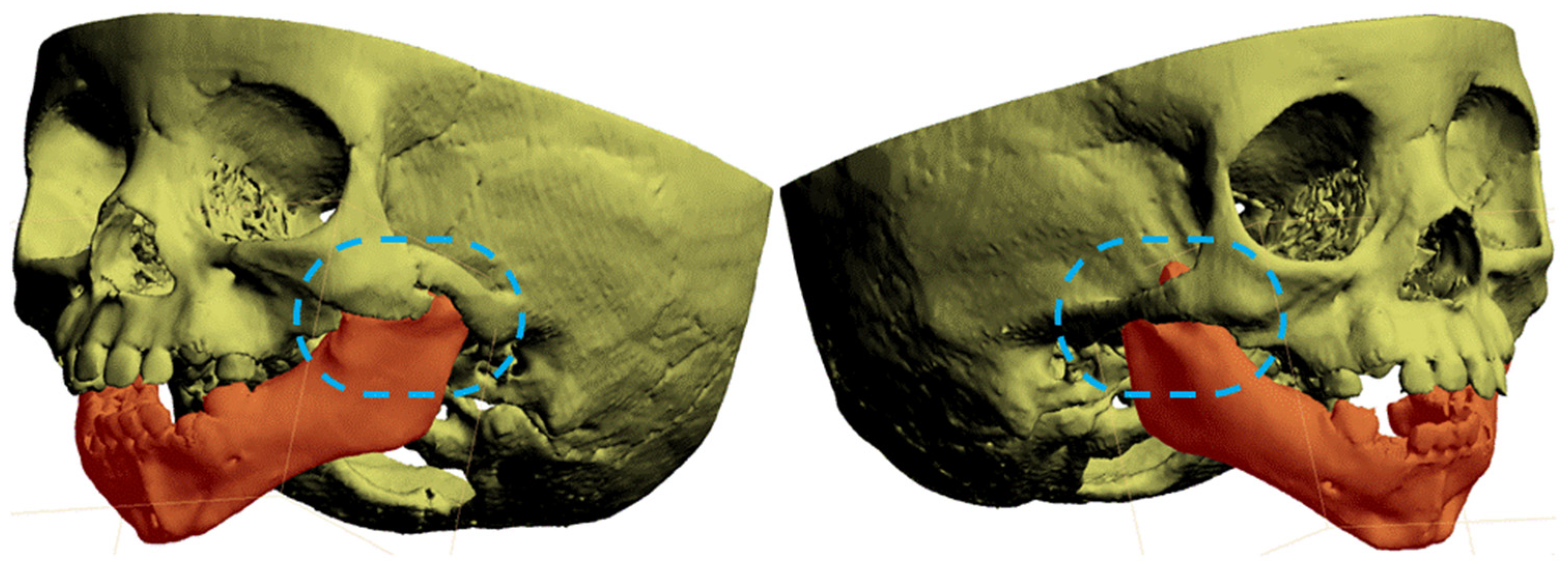
- Age 2—surgery to release ankylosis of the mandibular coronoid process with zygomatic arch on the left side. After the procedure, there was a recurrence of the ankylosis (reankylosis);
- Age 3—removal of the reankylosis obstruction of the left temporomandibular joint: patient intubated with a fibreoptic scope, intubation extremely difficult;
- Age 7—mandibular osteotomy with placement of distractors bilaterally, removal of bilateral mandibular distractors;
- Age 8—bilateral temporomandibular joint prosthesis.
2.1. Genetic Analyses
2.2. Bioinformatic Analysis
3. Results
WES Analysis
4. Discussion
5. Conclusions
Author Contributions
Funding
Institutional Review Board Statement
Informed Consent Statement
Data Availability Statement
Acknowledgments
Conflicts of Interest
Abbreviations
| COSMIC | Catalogue of Somatic Mutation In Cancer |
| CT | Computed tomography |
| MS | Miller syndrome |
| OSAS | Obstructive Sleep Apnea Syndrome |
| OMIM | Online Mendelian Inheritance in Man |
| PCR | Polymerase Chain Reaction |
| TMJ | Temporomandibular Joint |
| WES | Whole Exome Sequencing |
References
- Allori, A.C.; Chang, C.C.; Fariña, R.; Grayson, B.H.; Warren, S.M.; McCarthy, J.G. Current concepts in pediatric temporomandibular joint disorders: Part 1. Etiology, epidemiology, and classification. Plast. Reconstr. Surg. 2010, 126, 1263–1275. [Google Scholar] [CrossRef] [PubMed]
- Gundlach, K.K. Ankylosis of the temporomandibular joint. J. Craniomaxillofac. Surg. 2010, 38, 122–130. [Google Scholar] [CrossRef] [PubMed]
- Burket, L.W. Congenital bony temporomandibular ankylosis and facial hemiatrophy. Review of the literature and report of a case. J. Am. Med. Assoc. 1936, 106, 1719–1722. [Google Scholar] [CrossRef]
- Marszałek-Kruk, B.A.; Wójcicki, P.; Dowgierd, K.; Śmigiel, R. Treacher Collins Syndrome: Genetics, Clinical Features and Management. Genes 2021, 12, 1392. [Google Scholar] [CrossRef] [PubMed]
- Yang, K.; Fu, L.M.; Chu, X.Y.; Zhang, J.; Chen, W.Q.; Yan, Y.S.; Wang, Y.P.; Zhang, D.L.; Yin, C.H.; Guo, Q. Assessment of a novel variation in DHODH gene causing Miller syndrome: The first report in Chinese population. Mol. Genet. Genom. Med. 2023, 11, e2186. [Google Scholar] [CrossRef] [PubMed] [PubMed Central]
- Dowgierd, K.; Lipowicz, A.; Kulesa-Mrowiecka, M.; Wolański, W.; Linek, P.; Myśliwiec, A. Efficacy of immediate physiotherapy after surgical release of zygomatico-coronoid ankylosis in a young child: A case report. Physiother. Theory Pract. 2022, 38, 3187–3193. [Google Scholar] [CrossRef] [PubMed]
- Saini, R.S.; Ibrahim, M.; Khader, M.A.; Kanji, M.A.; Mosaddad, S.A.; Heboyan, A. The role of physiotherapy interventions in the management of temporomandibular joint ankylosis: A systematic review and meta-analysis. Head Face Med. 2024, 20, 15. [Google Scholar] [CrossRef] [PubMed]
- Dowgierd, K.; Pokrowiecki, R.; Kulesa-Mrowiecka, M.; Dowgierd, M.; Woś, J.; Szymor, P.; Kozakiewicz, M.; Lipowicz, A.; Roman, M.; Myśliwiec, A. Protocol for Multi-Stage Treatment of Temporomandibular Joint Ankylosis in Children and Adolescents. J. Clin. Med. 2022, 11, 428. [Google Scholar] [CrossRef] [PubMed]
- Lipowicz, A.; Wolański, W.; Kawlewska, E.; Zwolska, P.; Kulesa-Mrowiecka, M.; Dowgierd, K.; Linek, P.; Myśliwiec, A. Evaluation of Mandibular Growth and Symmetry in Child with Congenital Zygomatic-Coronoid Ankylosis. Symmetry 2021, 13, 1634. [Google Scholar] [CrossRef]
- Wolański, W.; Kawlewska, E.; Łysy, I.; Lipowicz, A.; Walatek, J.; Dowgierd, K.; Kulesa-Mrowiecka, M.; Marszałek-Kruk, B.; Myśliwiec, A. Morphometric assessment of mandibles with complications resulting from temporomandibular joint ankylosis in children from 4 months to 3 years of age. Acta Bioeng. Biomech. 2025, 26, 159–169. [Google Scholar] [CrossRef] [PubMed]
- Sim, N.L.; Kumar, P.; Hu, J.; Henikoff, S.; Schneider, G.; Ng, P.C. SIFT web server: Predicting effects of amino acid substitutions on proteins. Nucleic Acids Res. 2012, 40, W452–W457. [Google Scholar] [CrossRef] [PubMed]
- Adzhubei, I.; Jordan, D.M.; Sunyaev, S.R. Predicting functional effect of human missense mutations using PolyPhen-2. Curr. Protoc. Hum. Genet. 2013. [Google Scholar] [CrossRef] [PubMed]
- Rosa, R.F.; Guimarães, V.B.; Beltrão, L.A.; Trombetta, J.S.; Lliguin, K.L.; de Mattos, V.F.; Zen, P.R. Nager syndrome and Pierre Robin sequence. Pediatr. Int. 2015, 57, e69–e72. [Google Scholar] [CrossRef] [PubMed]
- Karempelis, P.; Hagen, M.; Morrell, N.; Roby, B.B. Associated syndromes in patients with Pierre Robin Sequence. Int. J. Pediatr. Otorhinolaryngol. 2020, 131, 109842. [Google Scholar] [CrossRef] [PubMed]
- Kulesa-Mrowiecka, M.; Piech, J.; Dowgierd, K.; Myśliwiec, A. Physical therapy of temporomandibular disorder in a child with arthrogryposis multiplex congenita: A case report and literature review. CRANIO 2024, 42, 25–32. [Google Scholar] [CrossRef] [PubMed]



| Pathogenic Variant and Effect Result from SHIFT and PolyPhen-2: Scores and Effect Predictions | |||||||
|---|---|---|---|---|---|---|---|
| Variant ID | Gene | Reference SNP | Consequence | Sift | PolyPhen | ||
| Prediction | Score | Prediction | Score | ||||
| 2:112551896:T | POLR1B | rs1545133 | missense_variant | tolerated | 0.46 | benign | 0.0 |
| 5:150392717:G | TCOF1 | rs1136103 | missense_variant | deleterious | 0.01 | possibly damaging | 0.88 |
| 16:72008783:C | DHODH | rs3213422 | missense_variant, splice_region_variant | tolerated | 0.19 | benign | 0.005 |
| 17:44850353:A | HIGD1B | rs1071682 | missense_variant | tolerated | 0.21 | benign | 0.0 |
| 2:227307878:C | COL4A3 | rs200302125 | missense_variant | deleterious | 0.0 | probably damaging | 1.0 |
| 4:154611883:C | FGG | rs148685782 | missense_variant | tolerated | 0.33 | benign | 0.01 |
| 7:66994210:G | SBDS | rs113993993 | splice_donor_variant | ||||
| 11:17574890:T | OTOG | rs554847663 | stop_gained | ||||
| 11:59211653:T | MPEG1 | rs200420254 | missense_variant | deleterious | 0.0 | possibly damaging | 0.785 |
| 1:109252937:G | CELSR2 | rs1223692503 | missense_variant | deleterious | 0.0 | probably damaging | 1.0 |
| 2:32154383:G | SPAST | rs1259072587 | missense_variant | deleterious | 0.02 | possibly damaging | 0.46 |
| 16:2118021:A | PKD1 | rs199476099 | missense_variant | deleterious | 0.04 | benign | 0.245 |
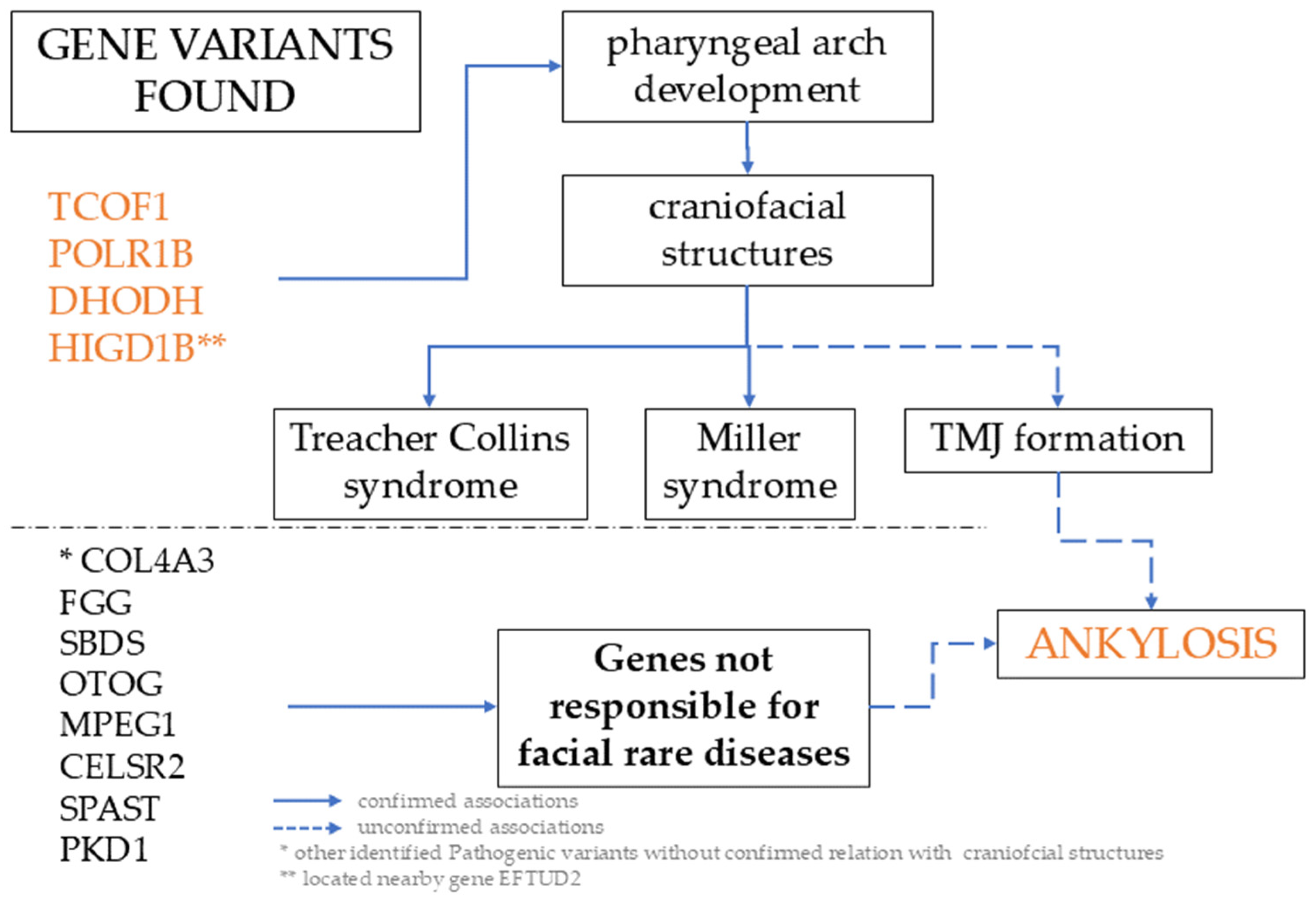
| Pathogenic Variants Identified in Genes Known to be Responsible for Deformations in First and Second Facial Arches | |||||
| Variant ID | Gene | Exon | HGVSC | HGVSP | Zygosity |
| 2:112551896:T | POLR1B | 7/16 | c.998C>T | p.(Ser333Leu) | Homozygous |
| 5:150392717:G | TCOF1 | 22/27 | c.3527C>G | p.(Pro1176Arg) | Heterozygous |
| 16:72008783:C | DHODH | 1/9 | c.19A>C | p.(Lys7Gln) | Homozygous |
| 17:44850353:A | HIGD1B | 4/4 | c.257G>A | p.(Ser86Asn) | Heterozygous |
| Pathogenic Variants Identified in Genes Not Known to be Responsible for Rare Facial Diseases | |||||
| Variant ID | Gene | Exon | HGVSC | HGVSP | Zygosity |
| 2:227307878:C | COL4A3 | 48/52 | c.4421T>C | p.(Leu1474Pro) | Heterozygous |
| 4:154611883:C | FGG | 4/9 | c.323C>G | p.(Ala108Gly) | Heterozygous |
| 7:66994210:G | SBDS | c.258+2T>C | Heterozygous | ||
| 11:17574890:T | OTOG | 19/55 | c.2500C>T | p.(Gln834Ter) | Heterozygous |
| 11:59211653:T | MPEG1 | 1/1 | c.1213C>A | p.(Pro405Thr) | Heterozygous |
| 1:109252937:G | CELSR2 | 1/34 | c.2858A>G | p.(Asn953Ser) | Heterozygous |
| 2:32154383:G | SPAST | 17/17 | c.1738A>G | p.(Ile580Val) | Heterozygous |
| 16:2118021:A | PKD1 | 5/46 | c.971G>T | p.(Arg324Leu) | Heterozygous |
Disclaimer/Publisher’s Note: The statements, opinions and data contained in all publications are solely those of the individual author(s) and contributor(s) and not of MDPI and/or the editor(s). MDPI and/or the editor(s) disclaim responsibility for any injury to people or property resulting from any ideas, methods, instructions or products referred to in the content. |
© 2026 by the authors. Licensee MDPI, Basel, Switzerland. This article is an open access article distributed under the terms and conditions of the Creative Commons Attribution (CC BY) license.
Share and Cite
Marszałek-Kruk, B.A.; Dowgierd, K.; Lejawa, M.; Kulesa-Mrowiecka, M.; Wolański, W.; Myśliwiec, A.; Lipowicz, A. Congenital Temporomandibular Joint Ankylosis: Investigating Potential Genetic Etiologies with Whole Exome Sequencing. J. Clin. Med. 2026, 15, 1403. https://doi.org/10.3390/jcm15041403
Marszałek-Kruk BA, Dowgierd K, Lejawa M, Kulesa-Mrowiecka M, Wolański W, Myśliwiec A, Lipowicz A. Congenital Temporomandibular Joint Ankylosis: Investigating Potential Genetic Etiologies with Whole Exome Sequencing. Journal of Clinical Medicine. 2026; 15(4):1403. https://doi.org/10.3390/jcm15041403
Chicago/Turabian StyleMarszałek-Kruk, Bożena Anna, Krzysztof Dowgierd, Mateusz Lejawa, Małgorzata Kulesa-Mrowiecka, Wojciech Wolański, Andrzej Myśliwiec, and Anna Lipowicz. 2026. "Congenital Temporomandibular Joint Ankylosis: Investigating Potential Genetic Etiologies with Whole Exome Sequencing" Journal of Clinical Medicine 15, no. 4: 1403. https://doi.org/10.3390/jcm15041403
APA StyleMarszałek-Kruk, B. A., Dowgierd, K., Lejawa, M., Kulesa-Mrowiecka, M., Wolański, W., Myśliwiec, A., & Lipowicz, A. (2026). Congenital Temporomandibular Joint Ankylosis: Investigating Potential Genetic Etiologies with Whole Exome Sequencing. Journal of Clinical Medicine, 15(4), 1403. https://doi.org/10.3390/jcm15041403