Protocol for a Pilot Two-Arm Crossover Randomized Controlled Trial of the ACTIVE Intervention for Older Adults with and Without Mild Dementia and Their Care Partners

Abstract
1. Introduction
2. Materials and Methods
2.1. Eligibility Criteria
2.2. Screening, Recruitment, and Enrollment
2.3. Randomization
2.4. Study Materials
2.5. Intervention Design
2.6. Intervention and Control Groups
2.7. Study Procedure
2.8. Sample Size Determination
2.9. Data Collection, Management, and Retention
2.10. Outcome Measures
- Feasibility Outcome Measures:
- Preliminary Efficacy Outcome Measures:
2.11. Covariates
2.12. Data Collection by Study Phase
2.13. Analysis Plan
2.14. Ethical and Safety Considerations
3. Discussion
4. Conclusions
Author Contributions
Funding
Institutional Review Board Statement
Informed Consent Statement
Data Availability Statement
Conflicts of Interest
Abbreviations
| ACTIVE | Activity Tracking, Care Partner Co-Participation, Text Reminders, Instructional Education, Video-Guided Physical Rehabilitation, and Exercise |
| AD/ADRD | Alzheimer’s disease and Alzheimer’s disease-related dementias |
| STEADI | Stopping Elderly Accidents, Deaths, and Injuries |
| SCT | Social Cognitive Theory |
| REDCap | Research Electronic Data Capture |
References
- Szychowska, A.; Drygas, W. Physical activity as a determinant of successful aging: A narrative review article. Aging Clin. Exp. Res. 2022, 34, 1209–1214. [Google Scholar] [CrossRef] [Scilit] [PubMed]
- Arjunan, P.; Annamalai, M.; Subramaniam, A.; Arulappan, J. Physical Activity, Functional Status, and Quality of Life Among Older Adults in India. SAGE Open Nurs. 2024, 10, 23779608241290384. [Google Scholar] [CrossRef] [Scilit] [PubMed]
- Bartley, M.M.; Sauver, J.L.S.; Baer-Benson, H.; Schroeder, D.R.; Khera, N.; Fortune, E.; Griffin, J.M. Exploring social determinants of health and physical activity levels in older adults living with mild cognitive impairment and dementia in the Upper Midwest of the United States. Prev. Med. 2023, 177, 107773. [Google Scholar] [CrossRef] [Scilit] [PubMed]
- Zhou, F.; Zhang, H.; Wang, H.Y.; Liu, L.F.; Zhang, X.G. Barriers and facilitators to older adult participation in intergenerational physical activity program: A systematic review. Aging Clin. Exp. Res. 2024, 36, 39. [Google Scholar] [CrossRef] [Scilit]
- Telenius, E.W.; Tangen, G.G.; Eriksen, S.; Rokstad, A.M.M. Fun and a meaningful routine: The experience of physical activity in people with dementia. BMC Geriatr. 2022, 22, 500. [Google Scholar] [CrossRef] [Scilit]
- Chantanachai, T.; Sturnieks, D.L.; Lord, S.R.; Payne, N.; Webster, L.; Taylor, M.E. Risk factors for falls in older people with cognitive impairment living in the community: Systematic review and meta-analysis. Ageing Res. Rev. 2021, 71, 101452. [Google Scholar] [CrossRef] [Scilit]
- Wang, C.; Zhang, Y.; Wang, J.; Wan, L.; Li, B.; Ding, H. A study on the falls factors among the older adult with cognitive impairment based on large-sample data. Front. Public Health 2024, 12, 1376993. [Google Scholar] [CrossRef] [Scilit]
- Mądra-Gackowska, K.; Szewczyk-Golec, K.; Gackowski, M.; Woźniak, A.; Kędziora-Kornatowska, K. Evaluation of Selected Parameters of Oxidative Stress and Adipokine Levels in Hospitalized Older Patients with Diverse Nutritional Status. Antioxidants 2023, 12, 569. [Google Scholar] [CrossRef] [Scilit]
- Mądra-Gackowska, K.; Szewczyk-Golec, K.; Gackowski, M.; Hołyńska-Iwan, I.; Parzych, D.; Czuczejko, J.; Graczyk, M.; Husejko, J.; Jabłoński, T.; Kędziora-Kornatowska, K. Selected Biochemical, Hematological, and Immunological Blood Parameters for the Identification of Malnutrition in Polish Senile Inpatients: A Cross-Sectional Study. J. Clin. Med. 2025, 14, 1494. [Google Scholar] [CrossRef] [Scilit]
- de Souto Barreto, P.; Rolland, Y.; Vellas, B.; Maltais, M. Association of Long-term Exercise Training With Risk of Falls, Fractures, Hospitalizations, and Mortality in Older Adults: A Systematic Review and Meta-analysis. JAMA Intern. Med. 2019, 179, 394–405. [Google Scholar] [CrossRef] [Scilit]
- Patti, A.; Zangla, D.; Sahin, F.N.; Cataldi, S.; Lavanco, G.; Palma, A.; Fischietti, F. Physical exercise and prevention of falls. Effects of a Pilates training method compared with a general physical activity program: A randomized controlled trial. Medicine 2021, 100, e25289. [Google Scholar] [CrossRef] [Scilit] [PubMed]
- Gill, D.L.; Hammond, C.C.; Reifsteck, E.J.; Jehu, C.M.; Williams, R.A.; Adams, M.M.; Lange, E.H.; Becofsky, K.; Rodriguez, E.; Shang, Y.T. Physical activity and quality of life. J. Prev. Med. Public Health 2013, 46, S28–S34. [Google Scholar] [CrossRef] [Scilit]
- White, S.M.; Wójcicki, T.R.; McAuley, E. Physical activity and quality of life in community dwelling older adults. Health Qual. Life Outcomes 2009, 7, 10. [Google Scholar] [CrossRef] [Scilit]
- de la Fuente, J.; Kauffman, D.F.; Boruchovitch, E. Editorial: Past, present and future contributions from the social cognitive theory (Albert Bandura). Front. Psychol. 2023, 14, 1258249. [Google Scholar] [CrossRef] [Scilit]
- Schunk, D.H.; DiBenedetto, M.K. Learning from a social cognitive theory perspective. In International Encyclopedia of Education, 4th ed.; Tierney, R.J., Rizvi, F., Ercikan, K., Eds.; Elsevier: Oxford, UK, 2023; pp. 22–35. [Google Scholar]
- Bandura, A. Self-efficacy mechanism in human agency. Am. Psychol. 1982, 37, 122–147. [Google Scholar] [CrossRef]
- Ferguson, T.; Olds, T.; Curtis, R.; Blake, H.; Crozier, A.J.; Dankiw, K.; Dumuid, D.; Kasai, D.; O’Connor, E.; Virgara, R.; et al. Effectiveness of wearable activity trackers to increase physical activity and improve health: A systematic review of systematic reviews and meta-analyses. Lancet Digit. Health 2022, 4, e615–e626. [Google Scholar] [CrossRef] [Scilit] [PubMed]
- Kononova, A.; Li, L.; Kamp, K.; Bowen, M.; Rikard, R.V.; Cotten, S.; Peng, W. The Use of Wearable Activity Trackers Among Older Adults: Focus Group Study of Tracker Perceptions, Motivators, and Barriers in the Maintenance Stage of Behavior Change. JMIR mHealth uHealth 2019, 7, e9832. [Google Scholar] [CrossRef] [Scilit]
- Wu, S.; Li, G.; Du, L.; Chen, S.; Zhang, X.; He, Q. The effectiveness of wearable activity trackers for increasing physical activity and reducing sedentary time in older adults: A systematic review and meta-analysis. Digit. Health 2023, 9, 20552076231176705. [Google Scholar] [CrossRef] [Scilit]
- Müller, A.M.; Khoo, S.; Morris, T. Text Messaging for Exercise Promotion in Older Adults From an Upper-Middle-Income Country: Randomized Controlled Trial. J. Med. Internet Res. 2016, 18, e5. [Google Scholar] [CrossRef] [Scilit]
- Notthoff, N.; Klomp, P.; Doerwald, F.; Scheibe, S. Positive messages enhance older adults’ motivation and recognition memory for physical activity programmes. Eur. J. Ageing 2016, 13, 251–257. [Google Scholar] [CrossRef] [Scilit] [PubMed]
- Zhang, S.; Dieciuc, M.; Dilanchian, A.; Lustria, M.L.A.; Carr, D.; Charness, N.; He, Z.; Boot, W.R. Adherence Promotion with Tailored Motivational Messages: Proof of Concept and Message Preferences in Older Adults. Gerontol. Geriatr. Med. 2024, 10, 23337214231224571. [Google Scholar] [CrossRef] [Scilit]
- Alrwaily, M. Delivering Musculoskeletal Rehabilitation in the Digital Era: A Perspective on Clinical Strategies for Remote Practice. Healthcare 2025, 13, 2286. [Google Scholar] [CrossRef] [Scilit]
- Plavoukou, T.; Iosifidis, M.; Papagiannis, G.; Stasinopoulos, D.; Georgoudis, G. The Effectiveness of Telerehabilitation in Managing Pain, Strength, and Balance in Adult Patients With Knee Osteoarthritis: Systematic Review. JMIR Rehabil. Assist. Technol. 2025, 12, e72466. [Google Scholar] [CrossRef] [Scilit]
- Suhr, M.; Keese, M. The Role of Virtual Physical Therapy in the Management of Musculoskeletal Patients: Current Practices and Future Implications. Curr. Rev. Musculoskelet. Med. 2025, 18, 289–301. [Google Scholar] [CrossRef] [Scilit] [PubMed]
- Ungvari, Z.; Fazekas-Pongor, V.; Csiszar, A.; Kunutsor, S.K. The multifaceted benefits of walking for healthy aging: From Blue Zones to molecular mechanisms. GeroScience 2023, 45, 3211–3239. [Google Scholar] [CrossRef] [Scilit] [PubMed]
- Faronbi, J.O.; Faronbi, G.O.; Ayamolowo, S.J.; Olaogun, A.A. Caring for the seniors with chronic illness: The lived experience of caregivers of older adults. Arch. Gerontol. Geriatr. 2019, 82, 8–14. [Google Scholar] [CrossRef] [Scilit]
- Schulz, R.; Eden, J.; National Academies of Sciences, Engineering, and Medicine. Family caregiving roles and impacts. In Families Caring for an Aging America; National Academies Press: Washington, DC, USA, 2016. [Google Scholar]
- ResearchMatch. What is ResearchMatch? Available online: https://www.researchmatch.org/ (accessed on 22 November 2025).
- Hendry, K.; Green, C.; McShane, R.; Noel-Storr, A.H.; Stott, D.J.; Anwer, S.; Sutton, A.J.; Burton, J.K.; Quinn, T.J. AD-8 for detection of dementia across a variety of healthcare settings. Cochrane Database Syst. Rev. 2019, 3, Cd011121. [Google Scholar] [CrossRef] [Scilit] [PubMed]
- Morris, J.C. Clinical Dementia Rating: A Reliable and Valid Diagnostic and Staging Measure for Dementia of the Alzheimer Type. Int. Psychogeriatr. 1997, 9, 173–176. [Google Scholar] [CrossRef] [Scilit]
- Jeste, D.V.; Palmer, B.W.; Appelbaum, P.S.; Golshan, S.; Glorioso, D.; Dunn, L.B.; Kim, K.; Meeks, T.; Kraemer, H.C. A new brief instrument for assessing decisional capacity for clinical research. Arch. Gen. Psychiatry 2007, 64, 966–974. [Google Scholar] [CrossRef] [Scilit]
- Harris, P. Research Electronic Data Capture (REDCap). J. Med. Libr. Assoc. 2018, 106, 142–144. [Google Scholar] [CrossRef] [Scilit]
- ACTIVE Research Team. My ACTIVE Steps. Available online: https://myactivesteps.com/ (accessed on 8 October 2025).
- Centers for Disease Control and Prevention. Stay Independent: Learn more about fall prevention. In Stopping Elderly Accidents, Deaths and Injuries; Centers for Disease Control and Prevention: Atlanta, Georgia, 2023; Available online: https://www.cdc.gov/steadi/pdf/steadi-brochure-stayindependent-508.pdf (accessed on 1 February 2026).
- Centers for Disease Control and Prevention. Family Caregivers: Protect Your Loved Ones From Falling. In Stopping Elderly Accidents, Deaths and Injuries; Centers for Disease Control and Prevention: Atlanta, Georgia, 2018. [Google Scholar]
- Centers for Disease Control and Prevention. STEADI—Older Adult Fall Prevention. Available online: https://www.cdc.gov/steadi/index.html (accessed on 21 January 2023).
- Adeyemi, O.; Chippendale, T.; Ogedegbe, G.; Boatright, D.; Chodosh, J. Content Validation and Perceived Value of Text Messages to Promote Physical Activity Among U.S. Older Adults and Care Partners. Preprints 2026. [Google Scholar] [CrossRef] [Scilit]
- Leon, A.C.; Davis, L.L.; Kraemer, H.C. The role and interpretation of pilot studies in clinical research. J. Psychiatr. Res. 2011, 45, 626–629. [Google Scholar] [CrossRef] [Scilit]
- National Center for Complementary and Integrative Health. Pilot Studies: Common Uses and Misuses. Available online: https://www.nccih.nih.gov/grants/pilot-studies-common-uses-and-misuses (accessed on 26 May 2024).
- Kim, S.H.; De Gagne, J.C. Examining the Effectiveness of Interactive Webtoons for Premature Birth Prevention: Protocol for a Randomized Controlled Trial. JMIR Res. Protoc. 2024, 13, e58326. [Google Scholar] [CrossRef] [Scilit] [PubMed]
- Meinke, A.; Peters, R.; Knols, R.H.; Swanenburg, J.; Karlen, W. Feedback on Trunk Movements From an Electronic Game to Improve Postural Balance in People with Nonspecific Low Back Pain: Pilot Randomized Controlled Trial. JMIR Serious Games 2022, 10, e31685. [Google Scholar] [CrossRef] [Scilit] [PubMed]
- Taylor, R.W.; Male, R.; Economides, M.; Bolton, H.; Cavanagh, K. Feasibility and Preliminary Efficacy of Digital Interventions for Depressive Symptoms in Working Adults: Multiarm Randomized Controlled Trial. JMIR Form. Res. 2023, 7, e41590. [Google Scholar] [CrossRef] [Scilit]
- Sim, J.; Lewis, M. The size of a pilot study for a clinical trial should be calculated in relation to considerations of precision and efficiency. J. Clin. Epidemiol. 2012, 65, 301–308. [Google Scholar] [CrossRef] [Scilit] [PubMed]
- Browne, R.H. On the use of a pilot sample for sample size determination. Stat. Med. 1995, 14, 1933–1940. [Google Scholar] [CrossRef] [Scilit]
- Teare, M.D.; Dimairo, M.; Shephard, N.; Hayman, A.; Whitehead, A.; Walters, S.J. Sample size requirements to estimate key design parameters from external pilot randomised controlled trials: A simulation study. Trials 2014, 15, 264. [Google Scholar] [CrossRef] [Scilit]
- Du, H.; Wang, L. The Impact of the Number of Dyads on Estimation of Dyadic Data Analysis Using Multilevel Modeling. Methodology 2016, 12, 21–31. [Google Scholar] [CrossRef] [Scilit]
- Kerkhoff, D.; Nussbeck, F.W. The Influence of Sample Size on Parameter Estimates in Three-Level Random-Effects Models. Front. Psychol. 2019, 10, 1067. [Google Scholar] [CrossRef] [Scilit]
- Lewis, J.R. The System Usability Scale: Past, Present, and Future. Int. J. Hum.–Comput. Interact. 2018, 34, 577–590. [Google Scholar] [CrossRef] [Scilit]
- Sauro, J.; Lewis, J.R. Chapter 8—Standardized usability questionnaires. In Quantifying the User Experience, 2nd ed.; Sauro, J., Lewis, J.R., Eds.; Morgan Kaufmann: Boston, MA, USA, 2016; pp. 185–248. [Google Scholar]
- Cheah, W.H.; Mat Jusoh, N.; Aung, M.M.T.; Ab Ghani, A.; Mohd Amin Rebuan, H. Mobile Technology in Medicine: Development and Validation of an Adapted System Usability Scale (SUS) Questionnaire and Modified Technology Acceptance Model (TAM) to Evaluate User Experience and Acceptability of a Mobile Application in MRI Safety Screening. Indian J. Radiol. Imaging 2023, 33, 36–45. [Google Scholar] [CrossRef] [Scilit]
- Chuttur, M. Overview of the technology acceptance model: Origins, developments and future directions. All Sprouts Content 2009, 9, 290. [Google Scholar]
- Adeyemi, O.; Boatright, D.; Chodosh, J. Development and Validation of a Perception, Attitude, and Practice of Physical Activity to Support Personalized Physical Activity Promotion Among U.S. Older Adults. Preprints 2026. [Google Scholar] [CrossRef] [Scilit]
- Ritchey, K.; Olney, A.; Chen, S.; Phelan, E.A. STEADI Self-Report Measures Independently Predict Fall Risk. Gerontol. Geriatr. Med. 2022, 8, 23337214221079222. [Google Scholar] [CrossRef] [Scilit] [PubMed]
- Yardley, L.; Beyer, N.; Hauer, K.; Kempen, G.; Piot-Ziegler, C.; Todd, C. Development and initial validation of the Falls Efficacy Scale-International (FES-I). Age Ageing 2005, 34, 614–619. [Google Scholar] [CrossRef] [Scilit]
- Arik, G.; Varan, H.D.; Yavuz, B.B.; Karabulut, E.; Kara, O.; Kilic, M.K.; Kizilarslanoglu, M.C.; Sumer, F.; Kuyumcu, M.E.; Yesil, Y.; et al. Validation of Katz index of independence in activities of daily living in Turkish older adults. Arch. Gerontol. Geriatr. 2015, 61, 344–350. [Google Scholar] [CrossRef] [Scilit]
- Katz, S. Assessing self-maintenance: Activities of daily living, mobility, and instrumental activities of daily living. J. Am. Geriatr. Soc. 1983, 31, 721–727. [Google Scholar] [CrossRef] [Scilit]
- Shou, J.; Ren, L.; Wang, H.; Yan, F.; Cao, X.; Wang, H.; Wang, Z.; Zhu, S.; Liu, Y. Reliability and validity of 12-item Short-Form health survey (SF-12) for the health status of Chinese community elderly population in Xujiahui district of Shanghai. Aging Clin. Exp. Res. 2016, 28, 339–346. [Google Scholar] [CrossRef] [Scilit]
- Pulok, M.H.; Theou, O.; van der Valk, A.M.; Rockwood, K. The role of illness acuity on the association between frailty and mortality in emergency department patients referred to internal medicine. Age Ageing 2020, 49, 1071–1079. [Google Scholar] [CrossRef] [Scilit] [PubMed]
- Rockwood, K.; Song, X.; MacKnight, C.; Bergman, H.; Hogan, D.B.; McDowell, I.; Mitnitski, A. A global clinical measure of fitness and frailty in elderly people. Cmaj 2005, 173, 489–495. [Google Scholar] [CrossRef] [Scilit] [PubMed]
- Charlson, M.; Szatrowski, T.P.; Peterson, J.; Gold, J. Validation of a combined comorbidity index. J. Clin. Epidemiol. 1994, 47, 1245–1251. [Google Scholar] [CrossRef] [Scilit]
- Charlson, M.E.; Pompei, P.; Ales, K.L.; MacKenzie, C.R. A new method of classifying prognostic comorbidity in longitudinal studies: Development and validation. J. Chronic Dis. 1987, 40, 373–383. [Google Scholar] [CrossRef] [Scilit] [PubMed]
- Little, R.J. A test of missing completely at random for multivariate data with missing values. J. Am. Stat. Assoc. 1988, 83, 1198–1202. [Google Scholar] [CrossRef]
- Fox-Wasylyshyn, S.M.; El-Masri, M.M. Handling missing data in self-report measures. Res. Nurs. Health 2005, 28, 488–495. [Google Scholar] [CrossRef] [Scilit]
- Enders, C.K. Multiple imputation as a flexible tool for missing data handling in clinical research. Behav. Res. Ther. 2017, 98, 4–18. [Google Scholar] [CrossRef] [Scilit]
- Patrician, P.A. Multiple imputation for missing data. Res. Nurs. Health 2002, 25, 76–84. [Google Scholar] [CrossRef] [Scilit]
- Sterne, J.A.; White, I.R.; Carlin, J.B.; Spratt, M.; Royston, P.; Kenward, M.G.; Wood, A.M.; Carpenter, J.R. Multiple imputation for missing data in epidemiological and clinical research: Potential and pitfalls. BMJ 2009, 338, b2393. [Google Scholar] [CrossRef] [Scilit]
- Hennink, M.M.; Kaiser, B.N.; Marconi, V.C. Code Saturation Versus Meaning Saturation: How Many Interviews Are Enough? Qual. Health Res. 2017, 27, 591–608. [Google Scholar] [CrossRef] [Scilit] [PubMed]
- Fusch, P.; Ness, L. Are We There Yet? Data Saturation in Qualitative Research. Qual. Rep. 2015, 20, 1408–1416. [Google Scholar] [CrossRef] [Scilit]
- Etikan, I.; Musa, S.A.; Alkassim, R.S. Comparison of convenience sampling and purposive sampling. Am. J. Theor. Appl. Stat. 2016, 5, 1–4. [Google Scholar] [CrossRef] [Scilit]
- Lavrakas, P. Purposive Sample. In Encyclopedia of Survey Research Methods; Sage Publications: Thousand Oaks, CA, USA, 2008. [Google Scholar] [CrossRef] [Scilit]
- Charmaz, K. Constructing Grounded Theory: A Practical Guide Through Qualitative Analysis; Sage Publications: Thousand Oaks, CA, USA, 2006. [Google Scholar]
- Chiovitti, R.F.; Piran, N. Rigour and grounded theory research. J. Adv. Nurs. 2003, 44, 427–435. [Google Scholar] [CrossRef] [Scilit]
- Cooney, A. Rigour and grounded theory. Nurse Res. 2011, 18, 17–22. [Google Scholar] [CrossRef] [Scilit] [PubMed]
- Saldaña, J. The Coding Manual for Qualitative Researchers; Sage Publications: Thousand Oaks, CA, USA, 2013. [Google Scholar]
- Beck, C.T. Qualitative research: The evaluation of its credibility, fittingness, and auditability. West. J. Nurs. Res. 1993, 15, 263–266. [Google Scholar] [CrossRef] [Scilit]
- Houghton, C.; Casey, D.; Shaw, D.; Murphy, K. Rigour in qualitative case-study research. Nurse Res. 2013, 20, 12–17. [Google Scholar] [CrossRef] [Scilit]
- Boatright, D.; Adeyemi, O. Activity Tracking, Care Partner Co-participation, Text Reminders, Instructional Education, Virtual Physical Therapy and Exercise (ACTIVE). Available online: https://clinicaltrials.gov/study/NCT07321587#study-record-dates (accessed on 13 January 2026).
- Chan, A.-W.; Boutron, I.; Hopewell, S.; Moher, D.; Schulz, K.F.; Collins, G.S.; Tunn, R.; Aggarwal, R.; Berkwits, M.; Berlin, J.A.; et al. SPIRIT 2025 statement: Updated guideline for protocols of randomised trials. BMJ 2025, 389, e081477. [Google Scholar] [CrossRef] [Scilit] [PubMed]
- Ji, S.; Baek, J.Y.; Go, J.; Lee, C.K.; Yu, S.S.; Lee, E.; Jung, H.W.; Jang, I.Y. Effect of Exercise and Nutrition Intervention for Older Adults with Impaired Physical Function with Preserved Muscle Mass (Functional Sarcopenia): A Randomized Controlled Trial. Clin. Interv. Aging 2025, 20, 161–170. [Google Scholar] [CrossRef] [Scilit] [PubMed]
- Nelligan, R.K.; Hinman, R.S.; Kasza, J.; Crofts, S.J.C.; Bennell, K.L. Effects of a Self-directed Web-Based Strengthening Exercise and Physical Activity Program Supported by Automated Text Messages for People With Knee Osteoarthritis: A Randomized Clinical Trial. JAMA Intern. Med. 2021, 181, 776–785. [Google Scholar] [CrossRef] [Scilit]
- Tore, N.G.; Oskay, D.; Haznedaroglu, S. The quality of physiotherapy and rehabilitation program and the effect of telerehabilitation on patients with knee osteoarthritis. Clin. Rheumatol. 2023, 42, 903–915. [Google Scholar] [CrossRef] [Scilit]
- Wang, P.; Yang, T.; Peng, W.; Wang, M.; Chen, X.; Yang, Y.; Huang, Y.; Jiang, Y.; Wang, F.; Sun, S.; et al. Effects of a Multicomponent Intervention With Cognitive Training and Lifestyle Guidance for Older Adults at Risk of Dementia: A Randomized Controlled Trial. J. Clin. Psychiatry 2024, 85, 54825. [Google Scholar] [CrossRef] [Scilit]
- Mastrogiovanni, C.; Rosenbaum, S.; Delbaere, K.; Tiedemann, A.; Teasdale, S.; Sherrington, C.; Ambrens, M.; Kurt, G.; McKeon, G. MovingTogether: A randomised controlled trial of a mental-health-informed, digital health promotion intervention for older adults. Age Ageing 2025, 54, afaf190. [Google Scholar] [CrossRef] [Scilit] [PubMed]
- Tan, J.; Gong, E.; Gallis, J.A.; Sun, S.; Chen, X.; Turner, E.L.; Luo, S.; Duan, J.; Li, Z.; Wang, Y.; et al. Primary Care-Based Digital Health-Enabled Stroke Management Intervention: Long-Term Follow-Up of a Cluster Randomized Clinical Trial. JAMA Netw. Open 2024, 7, e2449561. [Google Scholar] [CrossRef] [Scilit]
- Althubaiti, A. Information bias in health research: Definition, pitfalls, and adjustment methods. J. Multidiscip. Healthc. 2016, 9, 211–217. [Google Scholar] [CrossRef] [Scilit] [PubMed]
- Van de Mortel, T.F. Faking it: Social desirability response bias in self-report research. Aust. J. Adv. Nurs. 2008, 25, 40. [Google Scholar]



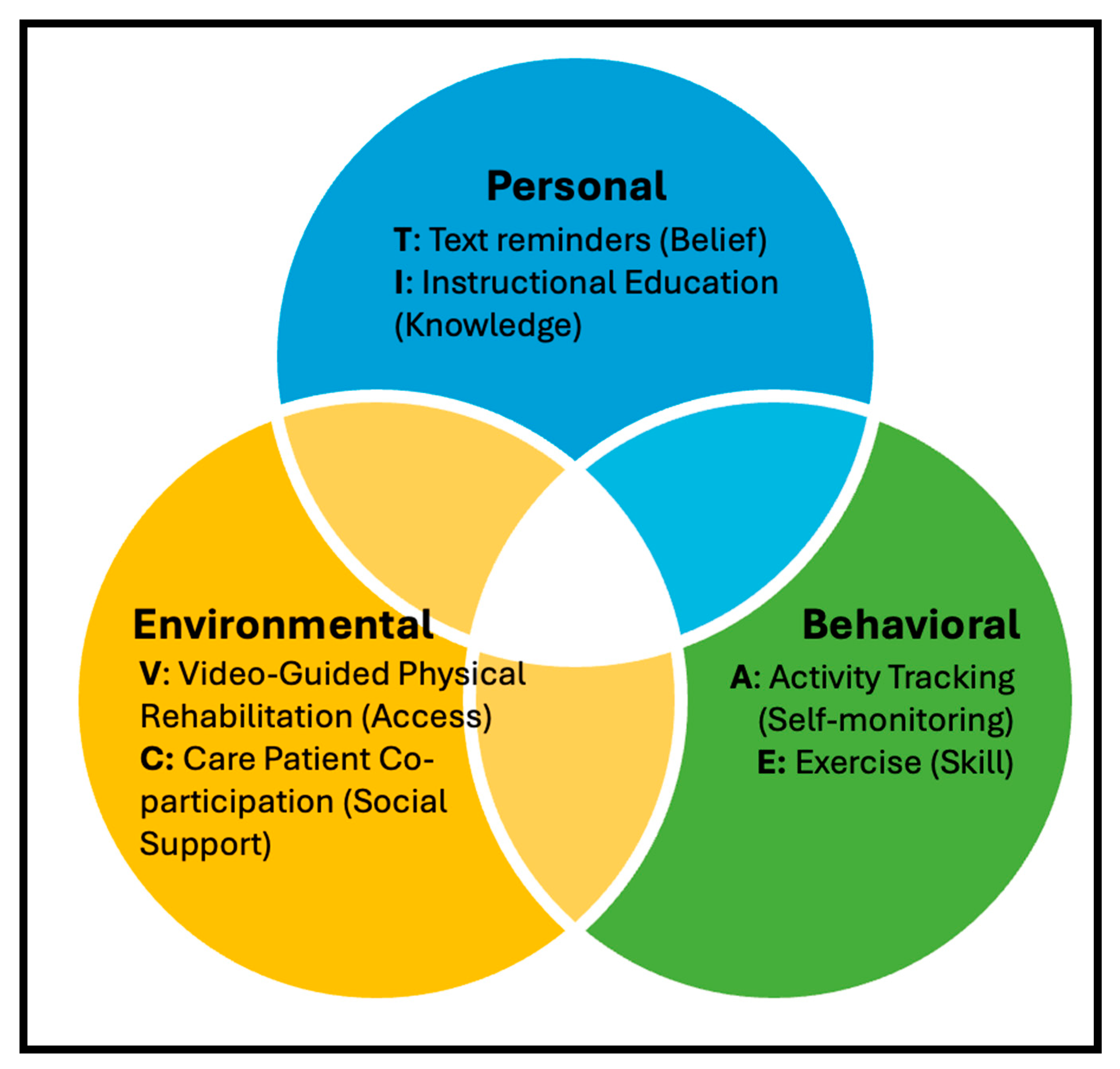
| Activity Tracking, Care Partner Co-Participation, Text Reminders, Instructional Education, Video-Guided Physical Rehabilitation, and Exercise | |
|---|---|
| Component | What It Includes |
| Activity Tracking | Fitbit Inspire 3 wearable, continuous step count and activity intensity monitoring, synced weekly |
| Care Partner Co-Participation | Care partner joining to supervise for safety and engage in home exercise, provide encouragement, and assist with technology |
| Text Reminders | Automated daily motivational text messages tailored to preceding day’s activity |
| Instructional Education | Digital education modules (short videos + PDFs): safe exercise, fall prevention |
| Video-Guided Physical Rehabilitation | Scheduled remote PT via video platform:
|
| Exercise | Daily walking goal (≥15 min), tracked with wearable; progressive increase based on baseline activity |
| Time Point | Dyad Roles |
|---|---|
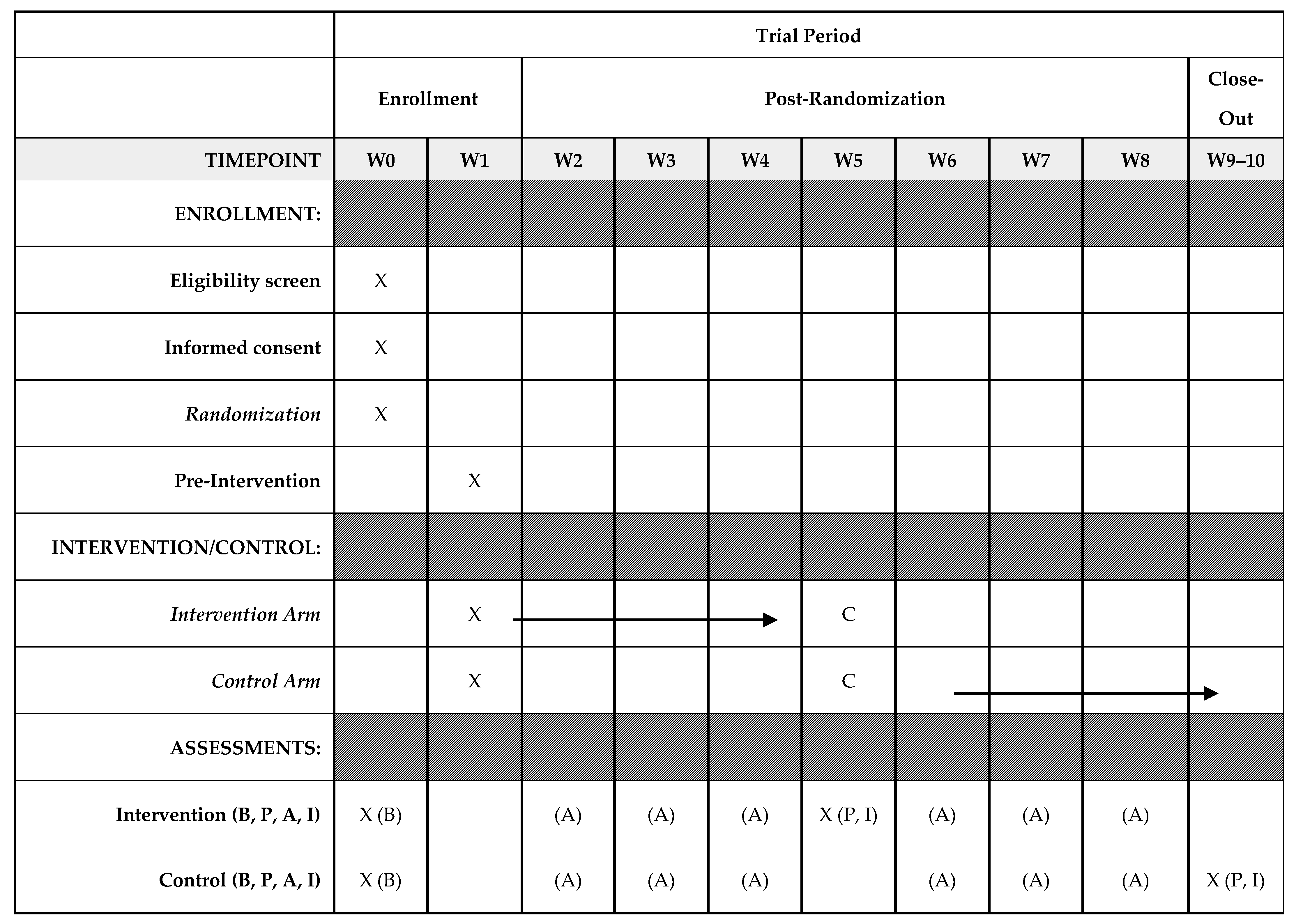
| Weeks 1: Pre-intervention | Control + Intervention Dyad: Mailing of printed educational infographics and smartwatch Troubleshooting to ensure data capture |
| Weeks 2–4 | Control + Intervention Dyad: 1. Weekly dyad telephone check-in by research staff 2. Continuous tracking of activity Intervention Dyad Alone: 3. Two-weekly 3 min educational videos 4. Three-weekly video-guided physical rehabilitation schedule 5. Daily motivational texts |
| Week 5: Cross-over | Switch roles Interviews and Surveys Troubleshooting to ensure data capture |
| Weeks 6–8 | Control + Intervention Dyad: 1. Weekly dyad telephone check-in by research staff 2. Continuous tracking of activity Control Dyad Alone: 3. Two-weekly 3 min educational videos 4. Three-weekly video-guided physical rehabilitation schedule 5. Daily motivational texts |
| Week 9–10 | Interviews and Surveys |
| Outcome Measures | Analysis | Data Source |
|---|---|---|
| Recruitment | ||
| 1. % of dyad recruited 2. % of dyad randomized | Benchmark: ≥75% | REDCap REDCap |
| Adoption (measured in week 1) | ||
| 1. Smartwatch use ≥ 3 days | Benchmark: ≥75% | Fitabase |
| 2. Motivational Texts ≥ 1 opened | Fitabase | |
| 3. Virtual PT videos ≥ 1 sessions | myACTIVEsteps | |
| Adherence (measured weeks 1–3) | ||
| 1. Smartwatch use: % days ≥ 8 h | Benchmark: ≥75% | Fitabase |
| 2. Videos: % sessions completed | myACTIVEsteps | |
| 3. Virtual PT: % completed | myACTIVEsteps | |
| Acceptability (Week 5 and 9) | ||
| 1. Website SUS score 2. Virtual PT SUS Score | Benchmark: Mean ≥ 68 | REDCap REDCap |
| 1. Smartwatch TAM Score | Benchmark: Mean ≥ 4.0 | REDCap |
| 2. Motivational Texts TAM Score | REDCap | |
| 3. Educational Videos TAM Score | REDCap | |
| 4. Virtual PT TAM Score | REDCap | |
| Fidelity (Week 5 and 9) | ||
| 1. % motivational text sent 2. % educational text notification sent | Benchmark: ≥90% | Fitabase Fitabase |
| Retention | ||
| 1. % of dyad completed the study | Benchmark: ≥75% | REDCap |
| Preliminary Effectiveness (Week 5 and 9) | ||
| 1. Activity: MET-mins/week | Linear Mixed Effect Model | Fitabase |
| 2. FES-I score pre/post | REDCap | |
| 3. ADL/IADL score | REDCap | |
| 4. SF-12 pre/post | REDCap | |
| 5. KAP Scores–pre/post | REDCap | |
| Covariate Measures (Assessed at Baseline) | ||
| Sociodemographic: Age, Sex, Race/Ethnicity, Health Insurance, Education, Marital Status, Living Situation | REDCap | |
| Health Measures: Clinical Frailty Scale, Charlson Comorbidity Index, | REDCap | |
Disclaimer/Publisher’s Note: The statements, opinions and data contained in all publications are solely those of the individual author(s) and contributor(s) and not of MDPI and/or the editor(s). MDPI and/or the editor(s) disclaim responsibility for any injury to people or property resulting from any ideas, methods, instructions or products referred to in the content. |
© 2026 by the authors. Licensee MDPI, Basel, Switzerland. This article is an open access article distributed under the terms and conditions of the Creative Commons Attribution (CC BY) license.
Share and Cite
Adeyemi, O.; Chippendale, T.; Chodosh, J.; Boatright, D. Protocol for a Pilot Two-Arm Crossover Randomized Controlled Trial of the ACTIVE Intervention for Older Adults with and Without Mild Dementia and Their Care Partners. J. Clin. Med. 2026, 15, 1341. https://doi.org/10.3390/jcm15041341
Adeyemi O, Chippendale T, Chodosh J, Boatright D. Protocol for a Pilot Two-Arm Crossover Randomized Controlled Trial of the ACTIVE Intervention for Older Adults with and Without Mild Dementia and Their Care Partners. Journal of Clinical Medicine. 2026; 15(4):1341. https://doi.org/10.3390/jcm15041341
Chicago/Turabian StyleAdeyemi, Oluwaseun, Tracy Chippendale, Joshua Chodosh, and Dowin Boatright. 2026. "Protocol for a Pilot Two-Arm Crossover Randomized Controlled Trial of the ACTIVE Intervention for Older Adults with and Without Mild Dementia and Their Care Partners" Journal of Clinical Medicine 15, no. 4: 1341. https://doi.org/10.3390/jcm15041341
APA StyleAdeyemi, O., Chippendale, T., Chodosh, J., & Boatright, D. (2026). Protocol for a Pilot Two-Arm Crossover Randomized Controlled Trial of the ACTIVE Intervention for Older Adults with and Without Mild Dementia and Their Care Partners. Journal of Clinical Medicine, 15(4), 1341. https://doi.org/10.3390/jcm15041341