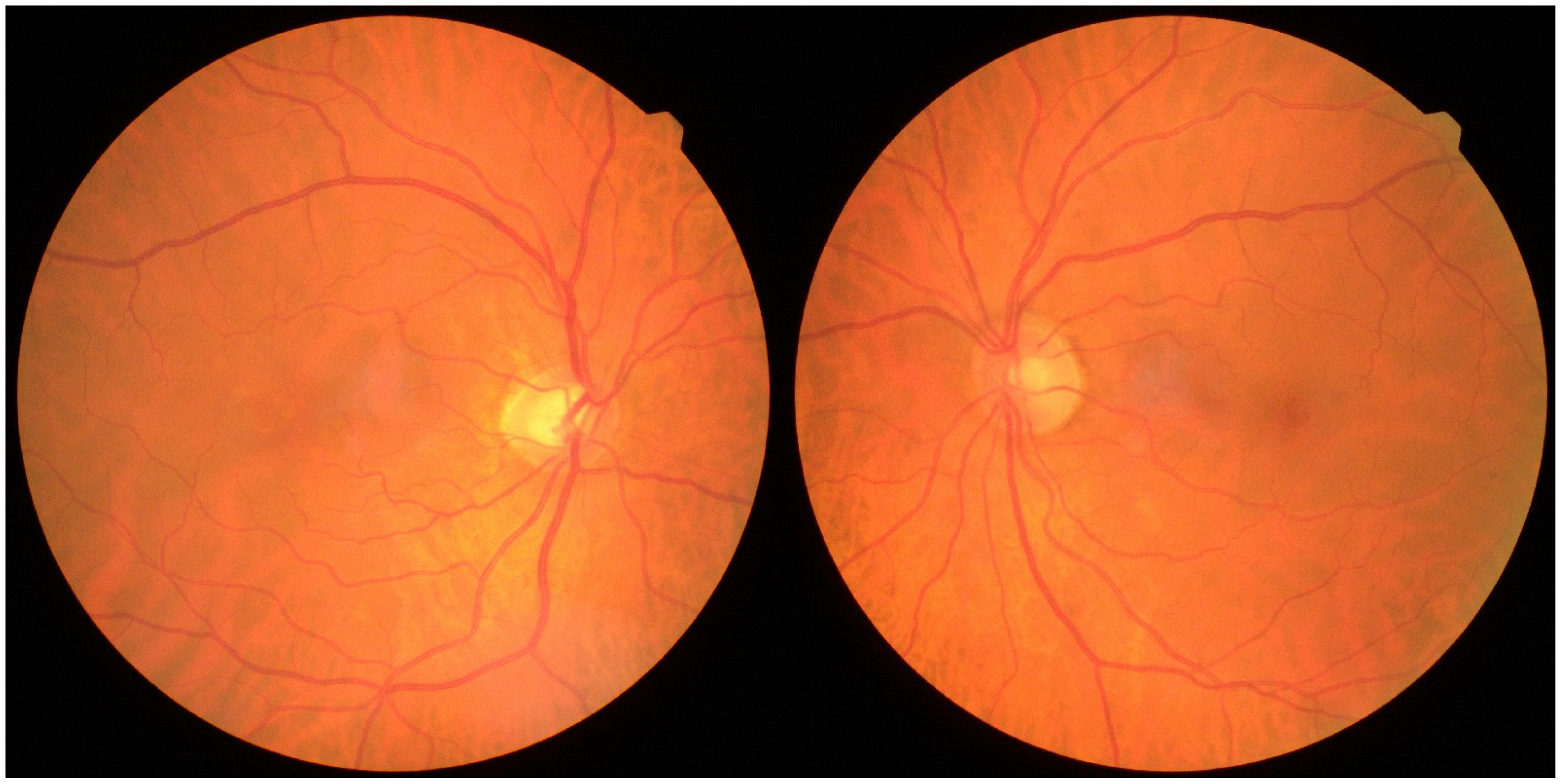
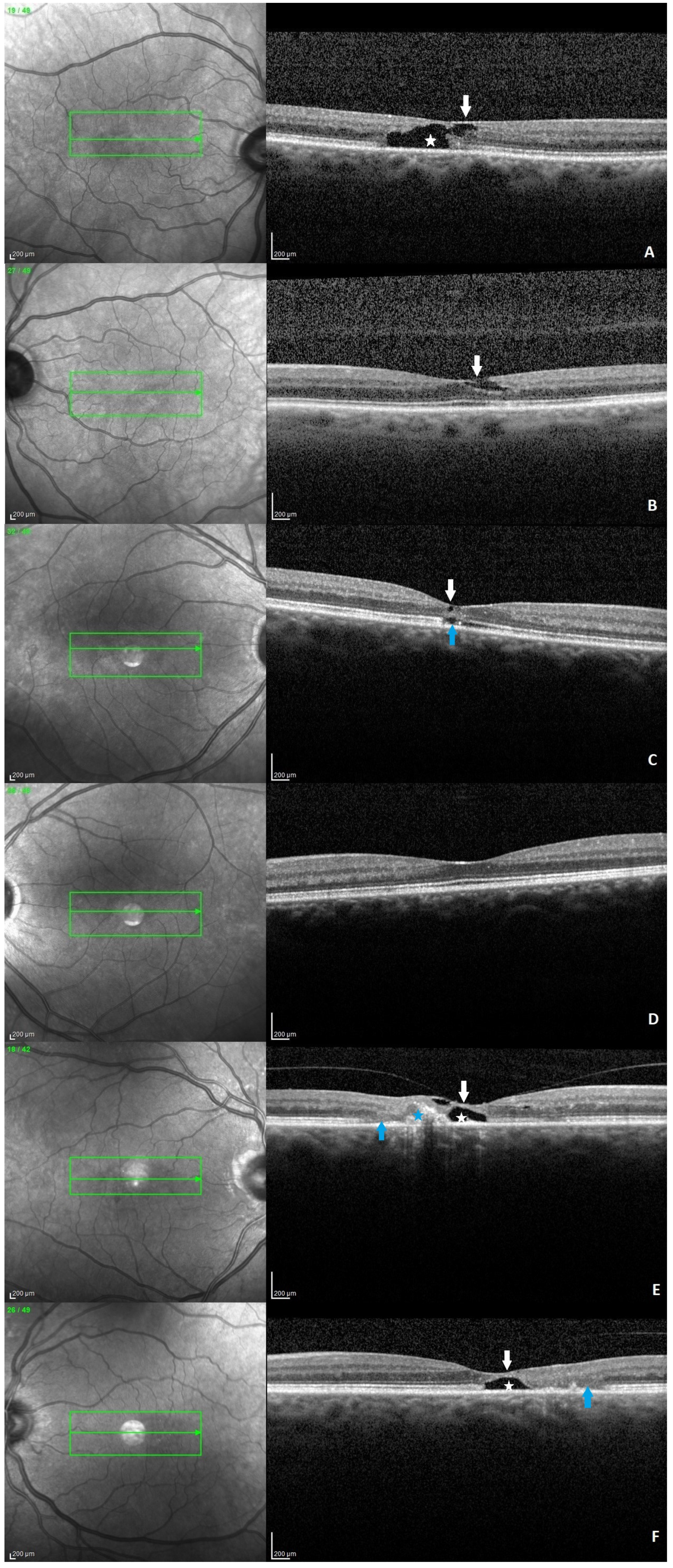
Macular Telangiectasia Type 2: The Role of Optical Coherence Tomography and Management Options

 and
and
Abstract
1. Introduction
2. Materials and Methods
3. Literature Review
3.1. Classification
3.2. Epidemiology
3.3. Clinical Features
3.4. Optical Coherence Tomography
3.4.1. Typical Changes
3.4.2. Central Retinal Thickness
3.4.3. Clinical Correlations
3.5. Other Paraclinical Features
3.5.1. Fluorescein Angiography
3.5.2. Optical Coherence Tomography Angiography
3.5.3. Fundus Autofluorescence (FAF)
3.6. Differential Diagnosis
3.7. Association with Systemic Diseases
3.8. Treatment
3.8.1. Non-Proliferative MacTel Type 2

| Treatment | Drug/Compound | Study | Type | Outcome |
|---|---|---|---|---|
| Carbonic anhydrase inhibitors | Acetazolamide | Chen et al. [43] | Retrospective | Acetazolamide may reduce macular cysts and thickness without visual acuity improvement. |
| Carotenoids | Zeaxanthin | Choi et al. [44] | Randomized control trial | Zeaxanthin provided no visual benefit or restoration of foveal macular pigment. |
| Lutein, meso-zeaxanthin, zeaxanthin | Tan et al. [45] | Observational | Lutein, meso-zeaxanthin, and zeaxanthin supplements may stabilize vision and improve macular cavitations. | |
| AREDS2 | Berger et al. [46] | Retrospective | Off-label AREDS2 may prevent anatomical and visual deterioration. | |
| Laser | Argon laser photocoagulation | Stoffelns et al. [47] | Retrospective | Laser photocoagulation is not recommended due to a lack of visual improvement and the risk of subretinal neovascularization. |
| Photodynamic therapy (PDT) | PDT + intravitreal ranibizumab | Zehetner et al. [48] | Retrospective case series | Reduced-fluence PDT combined with intravitreal ranibizumab may help eyes with progressive vision loss. |
| PTD | Hurley et al. [49] | Retrospective case series | No significant difference in best corrected visual acuity or central foveal thickness. | |
| Intravitreal anti-VEGF | Bevacizumab | Matt et al. [50] | Interventional case series | Moderate overall effect, with some patients showing marked long-term functional and morphological benefit. |
| Bevacizumab | Singler et al. [51] | Interventional case series | Ineffective in improving visual outcomes. | |
| Ranibizumab | Kupitz. et al. [52] | Case series | Monthly dosing for 1 year showed no long-term benefit 5 years after therapy. | |
| Ranibizumab | Do et al. [53] | Randomized controlled trial | Ranibizumab reduces leakage, but visual acuity improvement is minimal and similar to that of untreated eyes. | |
| Aflibercept | Bénichou et al. [54] | Case report | No improvement in anatomical or functional results. | |
| Ciliary neurotrophic factor | NT-501 | Chew et al. [39] | Phase 3, multicenter, randomized sham-controlled trials | NT-501 significantly reduced EZ area loss compared with sham treatment |
| Surgery | Pars plana vitrectomy with internal limiting membrane peeling | Singler et al. [51] | Interventional case series | Ineffective in improving visual outcomes. |
3.8.2. Proliferative MacTel Type 2
3.9. Present and Future Studies
3.10. Prognosis and Progression
4. Conclusions
Funding
Institutional Review Board Statement
Informed Consent Statement
Data Availability Statement
Acknowledgments
Conflicts of Interest
Abbreviations
References
- Wu, L. Unraveling the mysteries of macular telangiectasia 2: The intersection of philanthropy, multimodal imaging and molecular genetics. The 2022 founders lecture of the pan American vitreoretinal society. Int. J. Retin. Vitr. 2023, 9, 69. [Google Scholar] [CrossRef]
- Gass, J.D.; Blodi, B.A. Idiopathic juxtafoveolar retinal telangiectasis. Update of classification and follow-up study. Ophthalmology 1993, 100, 1536–1546. [Google Scholar] [CrossRef] [PubMed]
- Kedarisetti, K.C.; Narayanan, R.; Stewart, M.W.; Reddy Gurram, N.; Khanani, A.M. Macular Telangiectasia Type 2: A Comprehensive Review. Clin. Ophthalmol. 2022, 16, 3297–3309. [Google Scholar] [CrossRef] [PubMed] [PubMed Central]
- Klein, R.; Blodi, B.A.; Meuer, S.M.; Myers, C.E.; Chew, E.Y.; Klein, B.E. The prevalence of macular telangiectasia type 2 in the Beaver Dam eye study. Am. J. Ophthalmol. 2010, 150, 55–62.e2. [Google Scholar] [CrossRef] [PubMed] [PubMed Central]
- Aung, K.Z.; Wickremasinghe, S.S.; Makeyeva, G.; Robman, L.; Guymer, R.H. The prevalence estimates of macular telangiectasia type 2: The Melbourne Collaborative Cohort Study. Retina 2010, 30, 473–478. [Google Scholar] [CrossRef] [PubMed]
- Sallo, F.B.; Leung, I.; Mathenge, W.; Kyari, F.; Kuper, H.; Gilbert, C.E.; Bird, A.C.; Peto, T.; MacTel Study Group. The prevalence of type 2 idiopathic macular telangiectasia in two African populations. Ophthalmic Epidemiol. 2012, 19, 185–189. [Google Scholar] [CrossRef] [PubMed]
- Charbel Issa, P.; Gillies, M.C.; Chew, E.Y.; Bird, A.C.; Heeren, T.F.; Peto, T.; Holz, F.G.; Scholl, H.P. Macular telangiectasia type 2. Prog. Retin. Eye Res. 2013, 34, 49–77. [Google Scholar] [CrossRef] [PubMed] [PubMed Central]
- Scerri, T.S.; Quaglieri, A.; Cai, C.; Zernant, J.; Matsunami, N.; Baird, L.; Scheppke, L.; Bonelli, R.; Yannuzzi, L.A.; Friedlander, M.; et al. Genome-wide analyses identify common variants associated with macular telangiectasia type 2. Nat. Genet. 2017, 49, 559–567. [Google Scholar] [CrossRef] [PubMed]
- Bonelli, R.; Ansell, B.R.E.; Lotta, L.; Scerri, T.; Clemons, T.E.; Leung, I.; MacTel Consortium; Peto, T.; Bird, A.C.; Sallo, F.B.; et al. Genetic disruption of serine biosynthesis is a key driver of macular telangiectasia type 2 aetiology and progression. Genome Med. 2021, 13, 39. [Google Scholar] [CrossRef] [PubMed] [PubMed Central]
- Kunčič, A.; Urbančič, M.; Dobovšek Divjak, D.; Hudler, P.; Debeljak, N. Genetic Background of Macular Telangiectasia Type 2. Int. J. Mol. Sci. 2025, 26, 684. [Google Scholar] [CrossRef]
- Yannuzzi, L.A.; Bardal, A.M.; Freund, K.B.; Chen, K.J.; Eandi, C.M.; Blodi, B. Idiopathic macular telangiectasia. Arch. Ophthalmol. 2006, 124, 450–460. [Google Scholar] [CrossRef] [PubMed]
- Tapia Quijada, H.E.; Mantolan Sarmiento, C.; Serrano García, M.; Betancor Caro, N. Atypical bilateral presentation in idiopathic macular telangiectasia type 1. Arch. Soc. Esp. Oftalmol. (Engl. Ed.) 2020, 96, 602–606, (In English, Spanish). [Google Scholar] [CrossRef] [PubMed]
- Reddy, N.G.; Prabhu, V.; Sharma, S.V.; Acharya, I.; Mangla, R.; Yadav, N.K.; Chhablani, J.; Narayanan, R.; Venkatesh, R. Baseline demographic, clinical and multimodal imaging features of young patients with type 2 macular telangiectasia. Int. J. Retin. Vitr. 2023, 9, 47. [Google Scholar] [CrossRef] [PubMed] [PubMed Central]
- Clemons, T.E.; Gillies, M.C.; Chew, E.Y.; Bird, A.C.; Peto, T.; Figueroa, M.J.; Harrington, M.W.; MacTel Research Group. Baseline characteristics of participants in the natural history study of macular telangiectasia (MacTel) MacTel Project Report No. 2. Ophthalmic Epidemiol. 2010, 17, 66–73. [Google Scholar] [CrossRef] [PubMed] [PubMed Central]
- Chew, E.Y.; Peto, T.; Clemons, T.E.; Sallo, F.B.; Pauleikhoff, D.; Leung, I.; Jaffe, G.J.; Heeren, T.F.C.; Egan, C.A.; Charbel Issa, P.; et al. Macular Telangiectasia Type 2: A Classification System Using MultiModal Imaging MacTel Project Report Number 10. Ophthalmol. Sci. 2022, 3, 100261. [Google Scholar] [CrossRef] [PubMed] [PubMed Central]
- Venkatesh, R.; Reddy, N.G.; Mishra, P.; Agrawal, S.; Mutalik, D.; Yadav, N.K.; Chhablani, J. Spectral domain OCT features in type 2 macular telangiectasia (type 2 MacTel): Its relevance with clinical staging and visual acuity. Int. J. Retin. Vitr. 2022, 8, 26. [Google Scholar] [CrossRef]
- Venkatesh, R.; Handa, A.; Chitturi, S.P.; Choudhary, A.; Prabhu, V.; Acharya, I.; Mangla, R.; Yadav, N.K.; Chhablani, J. Right-angled vessel characteristics in different stages of type 2 macular telangiectasia (MacTel). Eye 2024, 38, 1162–1167. [Google Scholar] [CrossRef] [PubMed] [PubMed Central]
- Engelbert, M.; Chew, E.Y.; Yannuzzi, L.A. Chapter 55—Macular Telangiectasia. In Retina, 5th ed.; Ryan, S.J., Sadda, S.R., Hinton, D.R., Schachat, A.P., Sadda, S.R., Wilkinson, C.P., Wiedemann, P., Schachat, A.P., Eds.; W.B. Saunders: Philadelphia, PA, USA, 2013; pp. 1050–1057. [Google Scholar] [CrossRef]
- Zerbinopoulos, B.; Goman-Baskin, E.; Greenberg, P.B.; Bryan, R.; Messina, C. The Role of Diagnostic Imaging in Macular Telangiectasia Type 2. Fed. Pract. 2021, 38, 594–597. [Google Scholar] [CrossRef] [PubMed] [PubMed Central]
- Venkatesh, R.; Nahata, H.; Reddy, N.G.; Mishra, P.; Mangla, R.; Yadav, N.K.; Chhablani, J. Is Type 2 Macular Telangiectasia a Bilateral and Symmetrical Disease Entity? J. Curr. Ophthalmol. 2023, 34, 428–435. [Google Scholar] [CrossRef] [PubMed] [PubMed Central]
- Kim, Y.H.; Chung, Y.R.; Oh, J.; Kim, S.W.; Lee, C.S.; Yun, C.; Lee, B.; Ahn, S.M.; Choi, E.Y.; Jang, S.; et al. Optical coherence tomographic features of macular telangiectasia type 2: Korean Macular Telangiectasia Type 2 Study-Report No. 1. Sci. Rep. 2020, 10, 16594. [Google Scholar] [CrossRef] [PubMed] [PubMed Central]
- Peto, T.; Heeren, T.F.C.; Clemons, T.E.; Sallo, F.B.; Leung, I.; Chew, E.Y.; Bird, A.C. CORRELATION OF CLINICAL AND STRUCTURAL PROGRESSION WITH VISUAL ACUITY LOSS IN MACULAR TELANGIECTASIA TYPE 2: MacTel Project Report No. 6-The MacTel Research Group. Retina 2018, 38, S8–S13. [Google Scholar] [CrossRef] [PubMed] [PubMed Central]
- Pandya, B.U.; Grinton, M.; Mandelcorn, E.D.; Felfeli, T. RETINAL OPTICAL COHERENCE TOMOGRAPHY IMAGING BIOMARKERS: A Review of the Literature. Retina 2024, 44, 369–380. [Google Scholar] [CrossRef] [PubMed] [PubMed Central]
- Toto, L.; Di Antonio, L.; Mastropasqua, R.; Mattei, P.A.; Carpineto, P.; Borrelli, E.; Rispoli, M.; Lumbroso, B.; Mastropasqua, L. Multimodal Imaging of Macular Telangiectasia Type 2: Focus on Vascular Changes Using Optical Coherence Tomography Angiography. Investig. Ophthalmol. Vis. Sci. 2016, 57, OCT268–OCT276. [Google Scholar] [CrossRef] [PubMed]
- Çoban Karataş, M.; Yılmaz, G.; Yüce Sezen, A.; Sarıtürk, Ç. Clinical Features of Untreated Type 2 Macular Telangiectasia and Efficacy of Anti-Vascular Endothelial Growth Factor Therapy in Macular Neovascularization. Turk. J. Ophthalmol. 2022, 52, 45–49. [Google Scholar] [CrossRef] [PubMed] [PubMed Central]
- Heeren, T.F.C.; Kitka, D.; Florea, D.; Clemons, T.E.; Chew, E.Y.; Bird, A.C.; Pauleikhoff, D.; Charbel Issa, P.; Holz, F.G.; Peto, T. LONGITUDINAL CORRELATION OF ELLIPSOID ZONE LOSS AND FUNCTIONAL LOSS IN MACULAR TELANGIECTASIA TYPE 2. Retina 2018, 38, S20–S26. [Google Scholar] [CrossRef] [PubMed] [PubMed Central]
- Cai, C.X.; Choong, J.; Farsiu, S.; Chiu, S.J.; Chew, E.Y.; Jaffe, G.J. Retinal cavitations in macular telangiectasia type 2 (MacTel): Longitudinal structure-function correlations. Br. J. Ophthalmol. 2021, 105, 109–112. [Google Scholar] [CrossRef] [PubMed] [PubMed Central]
- Batıoğlu, F.; Yanık, Ö.; Demirel, S.; Özmert, E. Clinical Use of Optical Coherence Tomography Angiography in Retinal Diseases. Diagnostics 2023, 13, 1820. [Google Scholar] [CrossRef] [PubMed] [PubMed Central]
- Zhang, L.; Van Dijk, E.H.C.; Borrelli, E.; Fragiotta, S.; Breazzano, M.P. OCT and OCT Angiography Update: Clinical Application to Age-Related Macular Degeneration, Central Serous Chorioretinopathy, Macular Telangiectasia, and Diabetic Retinopathy. Diagnostics 2023, 13, 232. [Google Scholar] [CrossRef] [PubMed] [PubMed Central]
- Chandran, K.; Giridhar, A.; Gopalakrishnan, M.; Sivaprasad, S. Microvascular changes precede visible neurodegeneration in fellow eyes of patients with asymmetric type 2 macular telangiectasia. Eye 2022, 36, 1623–1630. [Google Scholar] [CrossRef] [PubMed] [PubMed Central]
- Pauleikhoff, L.; Heeren, T.F.C.; Gliem, M.; Lim, E.; Pauleikhoff, D.; Holz, F.G.; Clemons, T.; Balaskas, K.; MACTEL STUDY GROUP; Egan, C.A.; et al. Fundus Autofluorescence Imaging in Macular Telangiectasia Type 2: MacTel Study Report Number 9. Am. J. Ophthalmol. 2021, 228, 27–34. [Google Scholar] [CrossRef] [PubMed]
- Wu, L. When is macular edema not macular edema? An update on macular telangiectasia type 2. Taiwan J. Ophthalmol. 2015, 5, 149–155. [Google Scholar] [CrossRef] [PubMed] [PubMed Central]
- Van Romunde, S.H.M.; van der Sommen, C.M.; Martinez Ciriano, J.P.; Vingerling, J.R.; Yzer, S. Prevalence and Severity of Diabetic Retinopathy in Patients with Macular Telangiectasia Type 2. Ophthalmol. Retin. 2021, 5, 999–1004. [Google Scholar] [CrossRef] [PubMed]
- Amram, A.L.; Whitmore, S.S.; Wang, C.; Clavell, C.; Lyons, L.J.; Rusakevich, A.M.; Han, I.; Folk, J.; Boldt, H.C.; Stone, E.M.; et al. Progressive inner retinal neurodegeneration in non-proliferative macular telangiectasia type 2. Br. J. Ophthalmol. 2025, 109, 401–407. [Google Scholar] [CrossRef] [PubMed] [PubMed Central]
- Dorrell, M.I.; Aguilar, E.; Jacobson, R.; Yanes, O.; Gariano, R.; Heckenlively, J.; Banin, E.; Ramirez, G.A.; Gasmi, M.; Bird, A.; et al. Antioxidant or neurotrophic factor treatment preserves function in a mouse model of neovascularization-associated oxidative stress. J. Clin. Investig. 2009, 119, 611–623. [Google Scholar] [CrossRef] [PubMed] [PubMed Central]
- Chew, E.Y.; Clemons, T.E.; Peto, T.; Sallo, F.B.; Ingerman, A.; Tao, W.; Singerman, L.; Schwartz, S.D.; Peachey, N.S.; Bird, A.C.; et al. Ciliary neurotrophic factor for macular telangiectasia type 2: Results from a phase 1 safety trial. Am. J. Ophthalmol. 2015, 159, 659–666.e1. [Google Scholar] [CrossRef] [PubMed] [PubMed Central]
- Kauper, K.; McGovern, C.; Sherman, S.; Heatherton, P.; Rapoza, R.; Stabila, P.; Dean, B.; Lee, A.; Borges, S.; Bouchard, B.; et al. Two-year intraocular delivery of ciliary neurotrophic factor by encapsulated cell technology implants in patients with chronic retinal degenerative diseases. Investig. Ophthalmol. Vis. Sci. 2012, 53, 7484–7491. [Google Scholar] [CrossRef] [PubMed]
- Chew, E.Y.; Clemons, T.E.; Jaffe, G.J.; Johnson, C.A.; Farsiu, S.; Lad, E.M.; Guymer, R.; Rosenfeld, P.; Hubschman, J.P.; Constable, I.; et al. Effect of Ciliary Neurotrophic Factor on Retinal Neurodegeneration in Patients with Macular Telangiectasia Type 2: A Randomized Clinical Trial. Ophthalmology 2019, 126, 540–549. [Google Scholar] [CrossRef] [PubMed] [PubMed Central]
- Chew, E.Y.; Gillies, M.; Jaffe, G.J.; Gaudric, A.; Egan, C.; Constable, I.; Clemons, T.; Aaberg, T.; Manning, D.C.; Hohman, T.C.; et al. Cell-Based Ciliary Neurotrophic Factor Therapy for Macular Telangiectasia Type 2. NEJM Evid. 2025, 4, EVIDoa2400481. [Google Scholar] [CrossRef] [PubMed]
- Hoy, S.M. Revakinagene Taroretcel: First Approval. Mol. Diagn. Ther. 2025, 29, 553–561, Erratum in Mol. Diagn. Ther. 2025, 29, 705. https://doi.org/10.1007/s40291-025-00802-9. [Google Scholar] [CrossRef] [PubMed] [PubMed Central]
- Nystuen, A.; Gonzalez-Lopez, E.; Kauper, K.A.; Eade, K.; Aaberg, T.M., Jr. Neuroprotective properties of ciliary neurotrophic factor in the retina for the treatment of macular telangiectasia type 2. Cytokine Growth Factor Rev. 2025, 84, 12–19. [Google Scholar] [CrossRef] [PubMed]
- Neurotech Pharmaceuticals, Inc. ENCELTO (Revakinagene Taroretcel-Lwey) Implant, for Intravitreal Use: US Prescribing Information. 2025. Available online: https://www.fda.gov/ (accessed on 7 December 2025).
- Chen, J.J.; Sohn, E.H.; Folk, J.C.; Mahajan, V.B.; Kay, C.N.; Boldt, H.C.; Russell, S.R. Decreased macular thickness in nonproliferative macular telangiectasia type 2 with oral carbonic anhydrase inhibitors. Retina 2014, 34, 1400–1406. [Google Scholar] [CrossRef] [PubMed]
- Choi, R.Y.; Gorusupudi, A.; Wegner, K.; Sharifzadeh, M.; Gellermann, W.; Bernstein, P.S. MACULAR PIGMENT DISTRIBUTION RESPONSES TO HIGH-DOSE ZEAXANTHIN SUPPLEMENTATION IN PATIENTS WITH MACULAR TELANGIECTASIA TYPE 2. Retina 2017, 37, 2238–2247. [Google Scholar] [CrossRef] [PubMed] [PubMed Central]
- Tan, A.C.; Balaratnasingam, C.; Yannuzzi, L.A. Treatment of Macular Telangiectasia Type 2 with Carotenoid Supplements Containing Meso-Zeaxanthin: A Pilot Study. Ophthalmic Surg. Lasers Imaging Retin. 2016, 47, 528–535. [Google Scholar] [CrossRef] [PubMed]
- Berger, T.A.; Manry, M.W.; Lindsell, L.B.; Osher, J.M.; Miller, D.M.; Foster, R.E.; Riemann, C.D.; Petersen, M.R.; Sisk, R.A. Outcome of Off-Label AREDS 2 Supplementation for the Treatment of Macular Degeneration in Non-Proliferative Idiopathic Type 2 Macular Telangiectasia. Clin. Ophthalmol. 2021, 15, 1133–1143. [Google Scholar] [CrossRef] [PubMed] [PubMed Central]
- Stoffelns, B.M.; Schoepfer, K.; Kramann, C. Idiopathische makuläre Teleangiektasie (IMT)—Verlaufsbeobachtung mit und ohne Laserphotokoagulation [Idiopathic macular telangiectasia—Follow-up with and without laser photocoagulation]. Klin. Monbl. Augenheilkd. 2010, 227, 252–256. (In German) [Google Scholar] [CrossRef] [PubMed]
- Zehetner, C.; Haas, G.; Treiblmayr, B.; Kieselbach, G.F.; Kralinger, M.T. Reduced-fluence photodynamic therapy combined with ranibizumab for nonproliferative macular telangiectasia type 2. Ophthalmologica 2013, 229, 195–202. [Google Scholar] [CrossRef] [PubMed]
- Hurley, D.J.; Gallagher, D.; Petronzi, V.; O’Rourke, M.; Kinsella, F.; Townley, D. Examining the efficacy of verteporfin photo-dynamic therapy (PDT) at different dose & fluence levels. Photodiagnosis Photodyn. Ther. 2023, 44, 103848. [Google Scholar] [CrossRef]
- Matt, G.; Sacu, S.; Ahlers, C.; Schütze, C.; Dunavoelgyi, R.; Prager, F.; Pruente, C.; Schmidt-Erfurth, U. Thirty-month follow-up after intravitreal bevacizumab in progressive idiopathic macular telangiectasia type 2. Eye 2010, 24, 1535–1542. [Google Scholar] [CrossRef] [PubMed][Green Version]
- Sigler, E.J.; Randolph, J.C.; Calzada, J.I.; Charles, S. Comparison of observation, intravitreal bevacizumab, or pars plana vitrectomy for non-proliferative type 2 idiopathic macular telangiectasia. Graefe’s Arch. Clin. Exp. Ophthalmol. 2013, 251, 1097–1101. [Google Scholar] [CrossRef] [PubMed]
- Kupitz, E.H.; Heeren, T.F.; Holz, F.G.; Charbel Issa, P. POOR LONG-TERM OUTCOME OF ANTI-VASCULAR ENDOTHELIAL GROWTH FACTOR THERAPY IN NONPROLIFERATIVE MACULAR TELANGIECTASIA TYPE 2. Retina 2015, 35, 2619–2626. [Google Scholar] [CrossRef] [PubMed]
- Do, D.V.; Bressler, S.B.; Cassard, S.D.; Gower, E.W.; Tabandeh, H.; Jefferys, J.L.; Bressler, N.M. Ranibizumab for macular telangiectasia type 2 in the absence of subretinal neovascularization. Retina 2014, 34, 2063–2071. [Google Scholar] [CrossRef] [PubMed]
- Bénichou, J.; Soler, V.; Denis, D.; Matonti, F. Inefficacité de l’aflibercept dans le traitement des télangiectasies maculaires idiopathiques de type 2 sans néovascularisation [Inefficacy of aflibercept in the treatment of idiopathic macular telangiectasia type 2 without neovascularization]. J. Fr. Ophtalmol. 2017, 40, 547–551. (In French) [Google Scholar] [CrossRef] [PubMed]
- Sriranganathan, A.; Grad, J.; Mihalache, A.; Popovic, M.M.; Kertes, P.J.; Kohly, R.; Muni, R.H. Anti-Vascular Endothelial Growth Factor Treatment Outcomes in Macular Telangiectasia: A Systematic Review. Ophthalmologica 2025, 248, 123–136. [Google Scholar] [CrossRef] [PubMed] [PubMed Central]
- Rao, P.; Rao, A.; Jaffer, J.M.; John, A.S. Intravitreal Faricimab for the Management of Bilateral Macular Neovascularization Secondary to Macular Telangiectasia Type 2. Cureus 2025, 17, e92696. [Google Scholar] [CrossRef] [PubMed] [PubMed Central]
- Chatziralli, I.P.; Sharma, P.K.; Sivaprasad, S. Treatment Modalities for Idiopathic Macular Telangiectasia: An Evidence-Based Systematic Review of the Literature. Semin. Ophthalmol. 2017, 32, 384–394. [Google Scholar] [CrossRef] [PubMed]
- Khodabande, A.; Roohipoor, R.; Zamani, J.; Mirghorbani, M.; Zolfaghari, H.; Karami, S.; Modjtahedi, B.S. Management of Idiopathic Macular Telangiectasia Type 2. Ophthalmol. Ther. 2019, 8, 155–175. [Google Scholar] [CrossRef] [PubMed] [PubMed Central]
- Reddy, N.G.; Venkatesh, R.; Jayadev, C.; Agrawal, S.; Yadav, N.K.; Chhablani, J. DIRECT LASER PHOTOCOAGULATION TO THE DILATED RIGHT-ANGLED VESSEL IN THE MANAGEMENT OF PROLIFERATIVE TYPE 2 MACULAR TELANGIECTASIA. Retin. Cases Brief. Rep. 2023, 17, 620–624. [Google Scholar] [CrossRef] [PubMed]
- Shukla, D.; Singh, J.; Kolluru, C.M.; Kim, R.; Namperumalsamy, P. Transpupillary thermotherapy for subfoveal neovascularization secondary to group 2A idiopathic juxtafoveolar telangiectasis. Am. J. Ophthalmol. 2004, 138, 147–149. [Google Scholar] [CrossRef] [PubMed]
- Rishi, P.; Shroff, D.; Rishi, E. Combined photodynamic therapy and intravitreal ranibizumab as primary treatment for subretinal neovascular membrane (SRNVM) associated with type 2 idiopathic macular telangiectasia. Graefe’s Arch. Clin. Exp. Ophthalmol. 2008, 246, 619–621. [Google Scholar] [CrossRef] [PubMed]
- Karasu, B.; Gunay, B.O. Comparison of anatomical and visual outcomes following different anti-vascular endothelial growth factor treatments in subretinal neovascular membrane secondary to type 2 proliferative macular telangiectasia. Graefe’s Arch. Clin. Exp. Ophthalmol. 2020, 258, 99–106. [Google Scholar] [CrossRef] [PubMed]
- Sen, S.; Rajan, R.P.; Damodaran, S.; Arumugam, K.K.; Kannan, N.B.; Ramasamy, K. Real-world outcomes of intravitreal anti-vascular endothelial growth factor monotherapy in proliferative type 2 macular telangiectasia. Graefe’s Arch. Clin. Exp. Ophthalmol. 2021, 259, 1135–1143. [Google Scholar] [CrossRef] [PubMed]
- A Natural History Observation and Registry Study of Macular Telangiectasia Type 2: The MacTel Study, Mayo Clinic Clinical Trials. Available online: https://www.mayo.edu/research/clinical-trials/cls-20366168 (accessed on 25 January 2026).
- Serine and Fenofibrate Study in Patients with MacTel Type 2 (SAFE), Clinical Trials Registry. Available online: https://ichgcp.net/clinical-trials-registry/NCT04907084 (accessed on 25 January 2026).
- Study of Serine Supplementation to Protect Vision in MacTel (SEErine). Available online: https://clinicaltrials.gov/study/NCT07342439?term=TREATMENt (accessed on 25 January 2026).
- Phase 4 Study: Long-Term Safety and Efficacy of NT-501 in MacTel Type 2, Including Sham Procedure Participants. Available online: https://clinicaltrials.gov/study/NCT06971939 (accessed on 25 January 2026).
- Heeren, T.F.; Clemons, T.; Scholl, H.P.; Bird, A.C.; Holz, F.G.; Charbel Issa, P. Progression of Vision Loss in Macular Telangiectasia Type 2. Investig. Ophthalmol. Vis. Sci. 2015, 56, 3905–3912. [Google Scholar] [CrossRef] [PubMed]
- Marsonia, K.; Kiran Chandra, K.; Ali, M.H.; Chhablani, J.; Narayanan, R. Long term follow-up of visual acuity and incidence of subretinal neovascularization in Mactel Type 2 in 82 Eyes. Semin. Ophthalmol. 2022, 37, 136–141. [Google Scholar] [CrossRef] [PubMed] [PubMed Central]


| Common OCT Feature | Study | Number of Eyes Involved (Percent from Total Eyes Examined) |
|---|---|---|
| Hyporeflective inner retinal cavities | Kim et al. [21] | 121 (72.9%) |
| Venkatesk et al. [16] | 104 (49%) | |
| Hyperreflective middle retinal layer | Venkatesk et al. [16] | 184 (87%) |
| Hyporeflective outer retinal cavities | Venkatesk et al. [16] | 32 (15%) |
| Kim et al. [21] | Above ELM: 56 (33.7%) Below ELM: 52 (31.3%) | |
| Peto et al. [22] | 243 (24.9%) | |
| Outward bending of the inner retinal layers | Venkatesk et al. [16] | 74 (35%) |
| Retinal pigment clumps | 74 (35%) | |
| Foveal contour irregularity | 66 (31%) | |
| Internal limiting membrane drape | 62 (29%) | |
| Discontinuity of the external limiting membrane | Kim et al. [21] | 67 (40.4%) |
| Discontinuity of the ellipsoid zone | Kim et al. [21] | 87 (52.4%) |
| Peto et al. [22] | 602 (61.8%) | |
| Discontinuity of the interdigitation zone | Kim et al. [21] | 94 (56.6%) |
| Treatment | Drug/Compound | Study | Type | Outcome |
|---|---|---|---|---|
| Laser | Argon laser photocoagulation | Reddy et al. [59] | Descriptive case report | Direct laser photocoagulation to right-angled vessels may be considered for proliferative type unresponsive to anti-VEGF. |
| Transpupillary thermotherapy | Shukla et al. [60] | Non-randomized interventional case series | Transpupillary thermotherapy may be a safe and useful alternative treatment. | |
| Photodynamic therapy (PDT) | PDT + intravitreal ranibizumab | Rishi et al. [61] | Case report | PDT combined with intravitreal ranibizumab appears effective for subretinal neovascular membrane. |
| Intravitreal anti-VEGF | Bevacizumab, ranibizumab, and aflibercept. | Karasu et al. [62] | Retrospective | Improve anatomical and visual outcomes; aflibercept and bevacizumab required fewer injections; ranibizumab and bevacizumab reduced subfoveal choroidal thickness, aflibercept does not. |
| Bevacizumab and ranibizumab | Sen et al. [63] | Observational | Intravitreal bevacizumab and ranibizumab monotherapy both had similar efficacy. | |
| Ranibizumab and aflibercept | Çoban Karataş et al. [25] | Retrospective | Low vision may benefit from intravitreal anti-VEGF treatment. |
Disclaimer/Publisher’s Note: The statements, opinions and data contained in all publications are solely those of the individual author(s) and contributor(s) and not of MDPI and/or the editor(s). MDPI and/or the editor(s) disclaim responsibility for any injury to people or property resulting from any ideas, methods, instructions or products referred to in the content. |
© 2026 by the authors. Licensee MDPI, Basel, Switzerland. This article is an open access article distributed under the terms and conditions of the Creative Commons Attribution (CC BY) license.
Share and Cite
Beuran, D.-I.; Boca, I.R.; Cornăcel, C.; Tătaru, C.P.; Tătaru, C.I.; Cerghedean-Florea, M.-E.; Teodoru, C.A. Macular Telangiectasia Type 2: The Role of Optical Coherence Tomography and Management Options. J. Clin. Med. 2026, 15, 1327. https://doi.org/10.3390/jcm15041327
Beuran D-I, Boca IR, Cornăcel C, Tătaru CP, Tătaru CI, Cerghedean-Florea M-E, Teodoru CA. Macular Telangiectasia Type 2: The Role of Optical Coherence Tomography and Management Options. Journal of Clinical Medicine. 2026; 15(4):1327. https://doi.org/10.3390/jcm15041327
Chicago/Turabian StyleBeuran, David-Ionuț, Ioana Ruxandra Boca, Cătălin Cornăcel, Călin Petru Tătaru, Cătălina Ioana Tătaru, Maria-Emilia Cerghedean-Florea, and Cosmin Adrian Teodoru. 2026. "Macular Telangiectasia Type 2: The Role of Optical Coherence Tomography and Management Options" Journal of Clinical Medicine 15, no. 4: 1327. https://doi.org/10.3390/jcm15041327
APA StyleBeuran, D.-I., Boca, I. R., Cornăcel, C., Tătaru, C. P., Tătaru, C. I., Cerghedean-Florea, M.-E., & Teodoru, C. A. (2026). Macular Telangiectasia Type 2: The Role of Optical Coherence Tomography and Management Options. Journal of Clinical Medicine, 15(4), 1327. https://doi.org/10.3390/jcm15041327