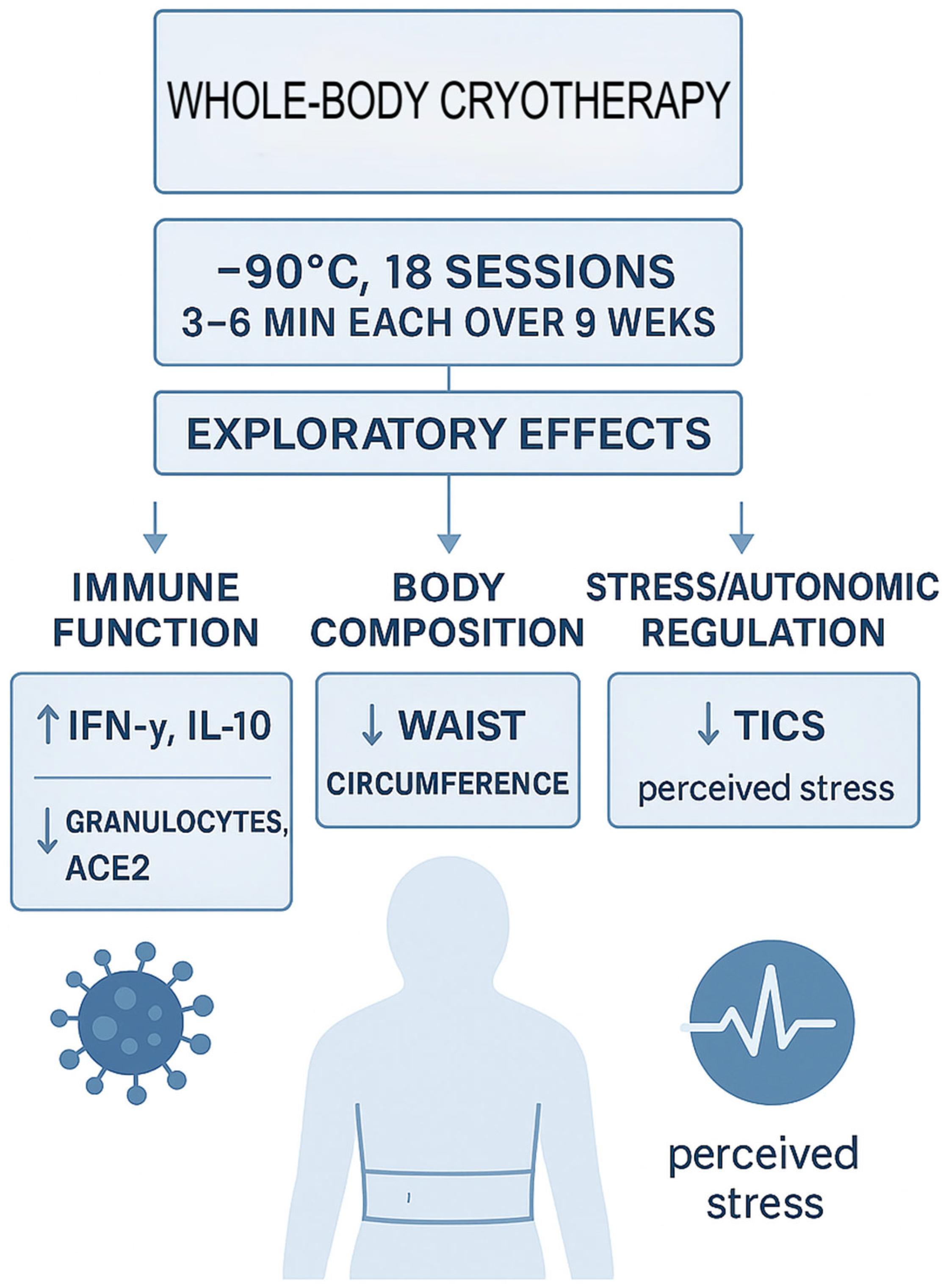
Whole-Body Cryotherapy at −90 °C for 9 Weeks: Effects on Immune Function, Stress, and Immune-Related and Vascular Blood Parameters in Healthy Adults—Results of an Exploratory One-Armed Pilot Study


Abstract
1. Introduction
2. Materials and Methods
2.1. Study Design
2.2. Ethical Approval and Registration
2.3. Sample Size Justification
2.4. Recruitment
2.5. Eligibility Criteria
2.6. Procedures and Measurements
2.7. Laboratory Analyses
2.8. Protocol Deviations
2.9. Statistical Analysis
3. Results
3.1. Description of the Study Cohort and Received Cryotherapy
3.2. Bioimpedance Analysis
3.3. Immuno-Blood Parameter and Further Blood Parameters
3.4. Subjective Perception of Stress
4. Discussion
5. Conclusions
Supplementary Materials
Author Contributions
Funding
Institutional Review Board Statement
Informed Consent Statement
Data Availability Statement
Acknowledgments
Conflicts of Interest
Abbreviations
| WBC | Whole Body Cryotherapy |
| BIA | Bioelectrical Impedance Analysis |
| BVP | Blood Volume Pulse Amplitude |
| TICS | Trier Inventory for Chronic Stress |
| ESR | Erythrocyte Sedimentation Rate (German: BKS) |
| sACE2 | Soluble Angiotensin Converting Enzyme 2 |
| IL 2 | Interleukin 2 |
| IL 10 | Interleukin 10 |
| IFN γ | Interferon gamma |
| TNF α | Tumor Necrosis Factor alpha |
| CD4/CD8 | T cell Subsets (Helper/Cytotoxic) |
| RM ANOVA | Repeated Measures Analysis of Variance |
References
- He, J.; Zhang, X.; Ge, Z.; Shi, J.; Guo, S.; Chen, J. Whole-body cryotherapy can reduce the inflammatory response in humans: A meta-analysis based on 11 randomized controlled trials. Sci. Rep. 2025, 15, 7759. [Google Scholar] [CrossRef]
- Karppinen, J.E.; Suojanen, L.; Heinonen, S.; Kaye, S.; van der Kolk, B.W.; White, J.W.; Orava, J.; Lee, S.H.T.; Dillon, E.; Muniandy, M.; et al. Effects of Whole-Body Cryotherapy Combined with Conventional Obesity Management Versus Obesity Management Alone: A Clinical Trial. Obesity 2025, 33, 2112–2127. [Google Scholar] [CrossRef] [PubMed]
- Chun, E.; Joseph, R.; Pojednic, R. Whole-Body Cryotherapy Reduces Systemic Inflammation in Healthy Adults: Pilot Cohort Study. Interact. J. Med. Res. 2024, 13, e60942. [Google Scholar] [CrossRef] [PubMed]
- Jdidi, H.; Dugué, B.; de Bisschop, C.; Dupuy, O.; Douzi, W. The effects of cold exposure (cold water immersion, whole- and partial-body cryostimulation) on cardiovascular and cardiac autonomic control responses in healthy individuals: A systematic review, meta-analysis and meta-regression. J. Therm. Biol. 2024, 121, 103857. [Google Scholar] [CrossRef] [PubMed]
- Solaro, N.; Giovanelli, L.; Bianchi, L.; Piterà, P.; Verme, F.; Malacarne, M.; Pagani, M.; Fontana, J.M.; Capodaglio, P.; Lucini, D. Whole-Body Cold Stimulation Improves Cardiac Autonomic Control Independently of the Employed Temperature. J. Clin. Med. 2024, 13, 7728. [Google Scholar] [CrossRef]
- Jurecka, A.; Woźniak, A.; Mila-Kierzenkowska, C.; Augustyńska, B.; Oleksy, Ł.; Stolarczyk, A.; Gądek, A. The Influence of Single Whole-Body Cryostimulation on Cytokine Status and Oxidative Stress Biomarkers during Exhaustive Physical Effort: A Crossover Study. Int. J. Mol. Sci. 2023, 24, 5559. [Google Scholar] [CrossRef]
- Ptaszek, B.; Podsiadło, S.; Wójcik, A.; Czerwińska-Ledwig, O.; Teległów, A. The influence of whole-body cryotherapy or winter swimming on the lipid profile and selected adipokines. BMC Sports Sci. Med. Rehabil. 2023, 15, 135. [Google Scholar] [CrossRef] [PubMed] [PubMed Central]
- Huang, T.; Dan, L.; Wang, W.; Ren, J.; Liu, X.; Li, J. Effect of whole-body cryotherapy on recovery after high-intensity training in elite rowers. Front. Physiol. 2024, 15, 1428554. [Google Scholar] [CrossRef]
- Cerfoglio, S.; Verme, F.; Fontana, J.M.; Alito, A.; Galli, M.; Capodaglio, P.; Cimolin, V. Effects of whole-body cryostimulation on spinal and shoulder range of motion in individuals with obesity. Front. Rehabil. Sci. 2025, 6, 1568280. [Google Scholar] [CrossRef]
- Alito, A.; Verme, F.; Mercati, G.P.; Piterà, P.; Fontana, J.M.; Capodaglio, P. Whole Body Cryostimulation: A New Adjuvant Treatment in Central Sensitization Syndromes? An Expert Opinion. Healthcare 2024, 12, 546. [Google Scholar] [CrossRef]
- Banfi, G.; Melegati, G.; Barassi, A.; Dogliotti, G.; Melzi d’Eril, G.; Dugué, B.; Corsi, M.M. Effects of whole-body cryotherapy on serum mediators of inflammation and serum muscle enzymes in athletes. J. Therm. Biol. 2009, 34, 55–59. [Google Scholar] [CrossRef]
- Lubkowska, A.; Szygula, Z.; Klimek, A.J.; Torii, M. Do sessions of cryostimulation have influence on white blood cell count, level of IL6 and total oxidative and antioxidative status in healthy men? Eur. J. Appl. Physiol. 2010, 109, 67–72. [Google Scholar] [CrossRef] [PubMed]
- Leppäluoto, J.; Westerlund, T.; Huttunen, P.; Oksa, J.; Smolander, J.; Dugué, B.; Mikkelsson, M. Effects of long-term whole-body cold exposures on plasma concentrations of ACTH, beta-endorphin, cortisol, catecholamines and cytokines in healthy females. Scand. J. Clin. Lab. Investig. 2008, 68, 145–153. [Google Scholar] [CrossRef] [PubMed]
- Janský, L.; Pospíšilová, D.; Honzová, S.; Uličný, B.; Šrámek, P.; Zeman, V.; Kamínková, J. Immune system of cold-exposed and cold-adapted humans. Eur. J. Appl. Physiol. 1996, 72, 445–450. [Google Scholar] [CrossRef]
- Wojtecka-Lukasik, E.; Ksiezopolska-Orlowska, K.; Gaszewska, E.; Krasowicz-Towalska, O.; Rzodkiewicz, P.; Maslinska, D.; Szukiewicz, D.; Maslinski, S. Cryotherapy decreases histamine levels in the blood of patients with rheumatoid arthritis. Inflamm. Res. 2010, 59, 253–255. [Google Scholar] [CrossRef]
- Sattler, A.; Angermair, S.; Stockmann, H.; Heim, K.M.; Khadzhynov, D.; Treskatsch, S.; Halleck, F.; Kreis, M.E.; Kotsch, K. SARS-CoV-2-specific T cell responses and correlations with COVID-19 patient predisposition. J. Clin. Investig. 2020, 130, 6477–6489. [Google Scholar] [CrossRef]
- Swärd, P.; Edsfeldt, A.; Reepalu, A.; Jehpsson, L.; Rosengren, B.E.; Karlsson, M.K. Age and sex differences in soluble ACE2 may give insights for COVID-19. Crit. Care 2020, 24, 221. [Google Scholar] [CrossRef]
- Farshbafnadi, M.; Zonouzi, S.K.; Sabahi, M.; Dolatshahi, M.; Aarabi, M.H. Aging & COVID-19 susceptibility, disease severity, and clinical outcomes: The role of entangled risk factors. Exp. Gerontol. 2021, 154, 111507. [Google Scholar] [CrossRef]
- Kragstrup, T.W.; Singh, H.S.; Grundberg, I.; Nielsen, A.L.-L.; Rivellese, F.; Mehta, A.; Goldberg, M.B.; Filbin, M.R.; Qvist, P.; Bibby, B.M. Plasma ACE2 predicts outcome of COVID-19 in hospitalized patients. PLoS ONE 2021, 16, e0252799. [Google Scholar] [CrossRef]
- Fagyas, M.; Fejes, Z.; Sütö, R.; Nagy, Z.; Székely, B.; Pócsi, M.; Ivády, G.; Bíró, E.; Bekő, G.; Nagy, A.; et al. Circulating ACE2 activity predicts mortality and disease severity in hospitalized COVID-19 patients. Int. J. Infect. Dis. 2022, 115, 8–16. [Google Scholar] [CrossRef]
- Mariappan, V.; Ranganadin, P.; Shanmugam, L.; Rao, S.; Pillai, A.B. Early shedding of membrane-bounded ACE2 could be an indicator for disease severity in SARS-CoV-2. Biochimie 2022, 201, 139–147. [Google Scholar] [CrossRef] [PubMed]
- Viveiros, A.; Rasmuson, J.; Vu, J.; Mulvagh, S.L.; Yip, C.Y.Y.; Norris, C.M.; Oudit, G.Y. Sex differences in COVID-19: Candidate pathways, genetics of ACE2, and sex hormones. Am. J. Physiol. Heart Circ. Physiol. 2021, 320, H296–H304. [Google Scholar] [CrossRef] [PubMed]
- Jia, H.; Neptune, E.; Cui, H. Targeting ACE2 for COVID-19 therapy: Opportunities and challenges. Am. J. Respir. Cell Mol. Biol. 2021, 64, 416–425. [Google Scholar] [CrossRef] [PubMed]
- Hausswirth, C.; Schaal, K.; Le Meur, Y.; Bieuzen, F.; Filliard, J.-R.; Volondat, M.; Louis, J. Parasympathetic activity and blood catecholamine responses following a single partial-body cryostimulation and a whole-body cryostimulation. PLoS ONE 2013, 8, e72658. [Google Scholar] [CrossRef]
- Swenson, C.; Swärd, L.; Karlsson, J. Cryotherapy in sports medicine. Scand. J. Med. Sci. Sports 1996, 6, 193–200. [Google Scholar] [CrossRef]
- Schulz, P.; Schlotz, W.; Becker, P. Trierer Inventar zur Erfassung von chronischem Stress (TICS): Skalenkonstruktion, teststatistische Überprüfung und Validierung der Skala Arbeitsüberlastung. Diagnostica 1999, 45, 8–19. [Google Scholar] [CrossRef]
- Petrowski, K.; Paul, S.; Albani, C.; Brähler, E. Factor structure and psychometric properties of the Trier Inventory for Chronic Stress (TICS) in a representative German sample. BMC Med. Res. Methodol. 2012, 12, 42. [Google Scholar] [CrossRef]
- Petrowski, K.; Kliem, S.; Sadler, M.; Meuret, A.E.; Ritz, T.; Brähler, E. Factor structure and psychometric properties of the English version of the Trier Inventory for Chronic Stress (TICS-E). BMC Med. Res. Methodol. 2018, 18, 18. [Google Scholar] [CrossRef]
- Kocalevent, R.D.; Klapp, B.F.; Albani, C.; Brähler, E. Zusammenhänge von Ressourcen, chronisch aktiviertem Distress und Erschöpfung in der deutschen Allgemeinbevölkerung. PPmP-Psychother.·Psychosom.·Med. Psychol. 2013, 63, 115–121. [Google Scholar] [CrossRef]
- Bonaz, B.; Sinniger, V.; Pellissier, S. Anti-inflammatory properties of the vagus nerve: Potential therapeutic implications of vagus nerve stimulation. J. Physiol. 2016, 594, 5781–5790. [Google Scholar] [CrossRef]
- Capodaglio, P.; Alito, A.; Duguè, B.M.; Bouzigon, R.; Lombardi, G.; Miller, E.D.; Verme, F.; Modaffari, G.; Piterà, P.; Ziemann, E.; et al. Contraindications to Whole-Body Cryostimulation (WBC). A position paper from the WBC Working Group of the International Institute of Refrigeration and the multidisciplinary expert panel. Front. Rehabil. Sci. 2025, 6, 1567402. [Google Scholar] [CrossRef]
- Malik, M.; Camm, A.J.; Bigger, J.T.; Kleiger, R.E.; Malliani, A.; Moss, A.J.; Schwartz, P.J. Heart rate variability: Standards of measurement, physiological interpretation, and clinical use. Eur. Heart J. 1996, 17, 354–381. [Google Scholar] [CrossRef]
- Porges, S. W. Respiratory sinus arrhythmia: Physiological basis, quantitative methods, and clinical implications. In Cardiorespiratory and Cardiosomatic Psychophysiology; NATO ASI Series; Grossman, P., Janssen, K. H. L., Vaitl, D., Eds.; Springer: Boston, MA, USA, 1986; Volume 114, pp. 101–115. [Google Scholar] [CrossRef]
- Bouzigon, R.; Dupuy, O.; Tiemessen, I.; De Nardi, M.; Bernard, J.-P.; Mihailovic, T.; Theurot, D.; Miller, E.D.; Lombardi, G.; Dugué, B.M. Cryostimulation for post-exercise recovery in athletes: A consensus and position paper. Front. Sports Act. Living 2021, 3, 688828. [Google Scholar] [CrossRef] [PubMed]
- Kusmierczyk, J.; Wiecek, M.; Wojciak, G.; Mardyła, M.; Kreiner, G.; Szygula, Z.; Szymura, J. The effect of physical activity and repeated whole-body cryotherapy on the expression of modulators of the inflammatory response in mononuclear blood cells among young men. J. Clin. Med. 2024, 13, 2724. [Google Scholar] [CrossRef] [PubMed]
- Jdidi, H.; de Bisschop, C.; Dugué, B.; Bouzigon, R.; Douzi, W. Optimal duration of whole-body cryostimulation exposure to achieve target skin temperature: Influence of body mass index—A randomized cross-over controlled trial. J. Physiol. Anthr. 2024, 43, 28. [Google Scholar] [CrossRef]
- Pournot, H.; Bieuzen, F.; Louis, J.; Fillard, J.-R.; Barbiche, E.; Hausswirth, C. Time-course of changes in inflammatory response after whole-body cryotherapy multi exposures following severe exercise. PLoS ONE 2011, 6, e22748. [Google Scholar] [CrossRef]
- He, Y.; Fekete, G. The effect of cryotherapy on balance recovery at different moments after lower extremity muscle fatigue. Phys. Act. Health 2021, 5, 255–270. [Google Scholar] [CrossRef]
- Cocks, K.; Torgerson, D.J. Sample size calculations for pilot randomized trials: A confidence interval approach. J. Clin. Epidemiol. 2013, 66, 197–201. [Google Scholar] [CrossRef]
- Kleiger, R.E.; Stein, P.K.; Bigger, J.T., Jr. Heart rate variability: Measurement and clinical utility. Ann. Noninvasive Electrocardiol. 2005, 10, 88–101. [Google Scholar] [CrossRef]
- Bouzigon, R.; Grappe, F.; Ravier, G.; Dugue, B. Whole- and partial-body cryostimulation/cryotherapy: Current technologies and practical applications. J. Therm. Biol. 2016, 61, 67–81. [Google Scholar] [CrossRef]



| Parameter | Measurement 1 (Mean ± SD) | Measurement 2 (Mean ± SD) | Measurement 3 (Mean ± SD) | p-Value Anova | M1 vs. M2 | M1 vs. M3 | M2 vs. M3 |
|---|---|---|---|---|---|---|---|
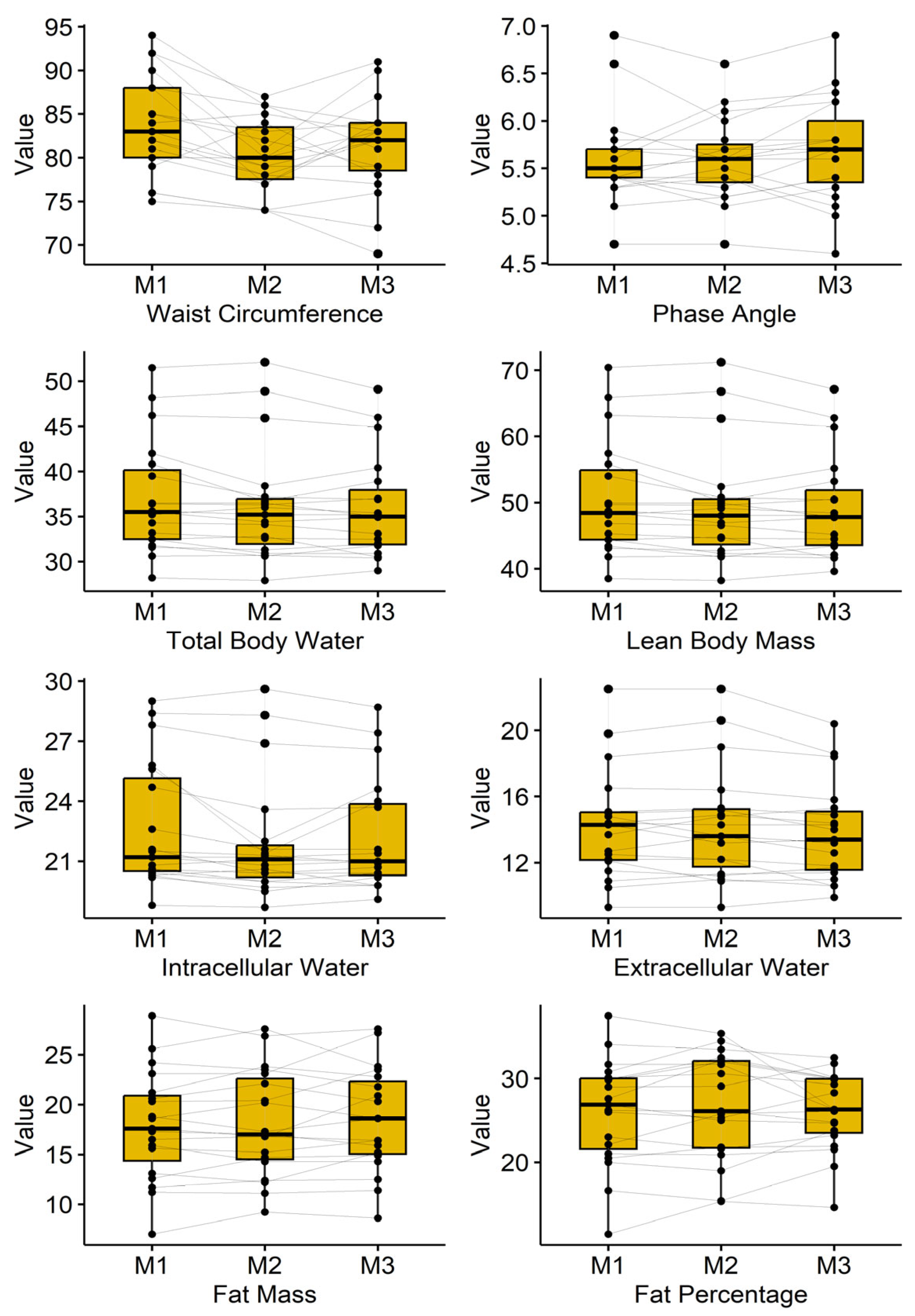
| Waist Circumference (cm) | 83.8 ± 5.7 | 80.2 ± 4.2 | 81.3 ± 5.5 | 0.001 | 0.004 | 0.008 | 0.316 |
| Phase Angle | 5.60 ± 0.49 | 5.60 ± 0.43 | 5.69 ± 0.55 | 0.240 | 1.000 | 0.374 | 0.360 |
| Total Body Water (L) | 36.95 ± 6.3 | 36.24 ± 6.4 | 35.99 ± 5.7 | 0.008 | 0.067 | 0.003 | 0.483 |
| Lean Body Mass (kg) | 50.48 ± 8.6 | 49.49 ± 8.7 | 49.17 ± 7.7 | 0.008 | 0.063 | 0.004 | 0.497 |
| Intracellular Water (L) | 22.71 ± 3.2 | 21.95 ± 3.0 | 22.16 ± 2.8 | 0.005 | 0.035 | 0.002 | 0.347 |
| Extracellular Water (L) | 14.24 ± 3.3 | 14.29 ± 3.4 | 13.81 ± 2.9 | 0.021 | 0.760 | 0.098 | 0.050 |
| Fat Mass (kg) | 17.88 ± 5.5 | 18.14 ± 5.4 | 18.46 ± 5.2 | 0.396 | 0.882 | 0.597 | 0.882 |
| Fat Percentage (%) | 26.0 ± 6.4 | 26.7 ± 6.4 | 26.0 ± 4.6 | 0.530 | 0.486 | 0.98 | 0.762 |
| Parameter | Measurement 1 (Mean ± SD) | Measurement 2 (Mean ± SD) | Measurement 3 (Mean ± SD) | p-Value Anova | M1 vs. M2 | M1 vs. M3 | M2 vs. M3 |
|---|---|---|---|---|---|---|---|
| Lymphocytes | 25.6 ± 7.1 | 29.3 ± 8.3 | 26.9 ± 6.9 | 0.012 | 0.016 | 0.467 | 0.079 |
| Monocytes | 7.9 ± 1.4 | 8.5 ± 2.4 | 7.8 ± 1.5 | 0.121 | 0.45 | 0.783 | 0.486 |
| Granulocytes | 63.5 ± 6.8 | 58.7 ± 7.9 | 62.2 ± 6.6 | 0.011 | 0.017 | 0.390 | 0.102 |
| T-cells | 72.6 ± 8.5 | 72.7 ± 8.2 | 72.7 ± 7.7 | 0.986 | 1.000 | 1.000 | 1.000 |
| CD4 | 45.5 ± 9.3 | 45.4 ± 9.5 | 45.7 ± 9.1 | 0.982 | 1.000 | 1.000 | 1.000 |
| CD8 | 23.8 ± 7.5 | 22.9 ± 9.5 | 23.8 ± 7.8 | 0.503 | 1.000 | 1.000 | 1.000 |
| CD4/CD8 ratio | 2.2 ± 1.0 | 2.2 ± 1.2 | 2.2 ± 1.2 | 0.799 | 1.000 | 1.000 | 1.000 |
| IL2-virus | 36.4 ± 29.3 | 28.5 ± 25.2 | 22.9 ± 26.7 | 0.069 | 0.394 | 0.101 | 0.394 |
| IL10-virus | 33.5 ± 29.3 | 63.5 ± 50.5 | 20.5 ± 26.8 | <0.001 | 0.011 | 0.015 | 0.001 |
| INF-γ-virus | 18.9 ± 14.8 | 19.4 ± 18.7 | 44 ± 62.1 | 0.031 | 0.895 | 0.178 | 0.178 |
| TNF-α-virus | 760 ± 830 | 795 ± 764 | 620 ± 965 | 0.681 | 1.000 | 1.000 | 1.000 |
| IL2-bacteria | 63.8 ± 158 | 24.1 ± 32.3 | 27.6 ± 61.1 | 0.169 | 0.453 | 0.453 | 0.683 |
| IL10-bacteria | 5.5 ± 8.8 | 17.3 ± 34.1 | 3.6 ± 10.9 | 0.092 | 0.345 | 0.537 | 0.345 |
| INF-γ-bacteria | 1.6 ± 3.3 | 1.7 ± 4.8 | 2.6 ± 5.5 | 0.400 | 0.893 | 0.622 | 0.435 |
| TNF-α-bacteria | 6.9 ± 9.2 | 8.6 ± 15.4 | 6.9 ± 9.5 | 0.799 | 1.000 | 1.000 | 1.000 |
| IL2-fungal | 10.6 ± 15.1 | 6.2 ± 5.7 | 4.4 ± 4.6 | 0.063 | 0.184 | 0.184 | 0.184 |
| IL10-fungal | 53.5 ± 40.0 | 73.1 ± 51.7 | 34.9 ± 39.6 | 0.001 | 0.068 | 0.033 | 0.007 |
| INF-γ-fungal | 2.1 ± 4.8 | 2.2 ± 5.9 | 1.8 ± 3.5 | 0.936 | 1.000 | 1.000 | 1.000 |
| TNF-α-fungal | 577 ± 675 | 696 ± 436 | 790 ± 296 | 0.711 | 1.000 | 1.000 | 1.000 |
| ESR | 8.8 ± 7.6 | 8.9 ± 7.4 | 8.8 ± 8.1 | 0.997 | 1.000 | 1.000 | 1.000 |
| sACE2 | 0.5 ± 0.9 | 0.5 ± 0.7 | 0.3 ± 0.4 | 0.029 | 0.157 | 0.150 | 0.157 |
| BVP mean | 68.3 ± 32.7 | 103 ± 71.7 | 92.3 ± 49.7 | 0.068 | 0.040 | 0.106 | 0.570 |
| BVP SD | 7.5 ± 4.4 | 12.5 ± 9.8 | 9.9 ± 7.0 | 0.076 | 0.029 | 0.350 | 0.351 |
| Parameter | Measurement 1 (Mean ± SD) | Measurement 2 (Mean ± SD) | Measurement 3 (Mean ± SD) | p-Value Anova | M1 vs. M2 | M1 vs. M3 | M2 vs. M3 |
|---|---|---|---|---|---|---|---|
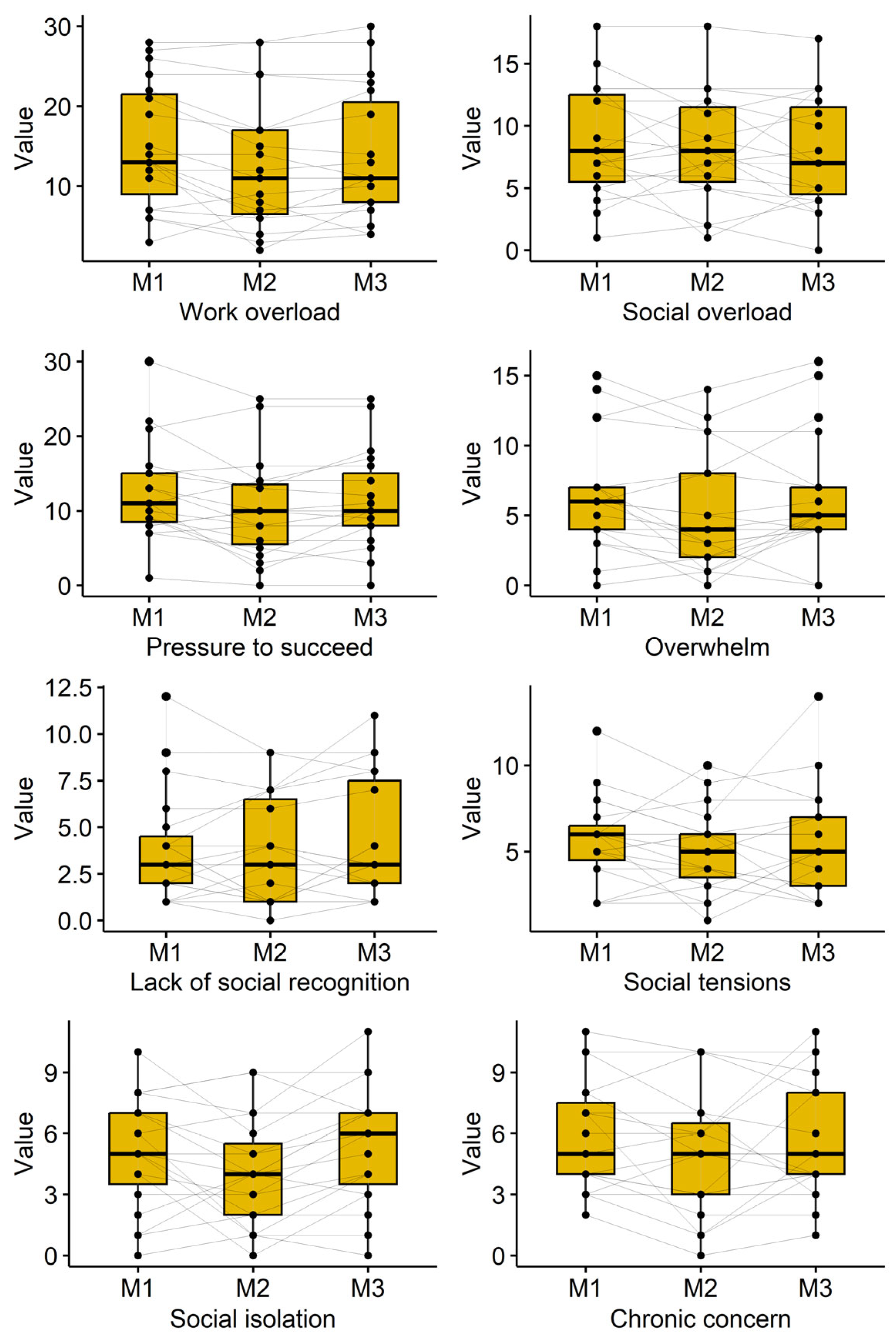
| Work overload | 15.1 ± 7.8 | 12.7 ± 8.3 | 13.7 ± 8.2 | 0.009 | 0.027 | 0.166 | 0.166 |
| Social overload | 8.7 ± 4.5 | 8.1 ± 4.4 | 7.7 ± 4.5 | 0.339 | 0.77 | 0.423 | 0.77 |
| Pressure to succeed | 12.4 ± 6.6 | 10.2 ± 6.7 | 11.3 ± 6.5 | 0.018 | 0.045 | 0.196 | 0.107 |
| Overwhelm | 6.4 ± 4.1 | 5.2 ± 4.3 | 6.2 ± 4.4 | 0.081 | 0.064 | 0.761 | 0.142 |
| Lack of social recognition | 3.9 ± 3.0 | 3.7 ± 2.9 | 4.4 ± 3.2 | 0.324 | 0.758 | 0.758 | 0.351 |
| Social tensions | 5.7 ± 2.5 | 5.1 ± 2.4 | 5.4 ± 3.1 | 0.533 | 0.594 | 1.000 | 1.000 |
| Social isolation | 5.0 ± 2.7 | 4.1 ± 2.7 | 5.4 ± 2.9 | 0.049 | 0.190 | 0.564 | 0.012 |
| Chronic concern | 5.8 ± 2.7 | 4.9 ± 3.1 | 5.6 ± 2.9 | 0.232 | 0.169 | 0.723 | 0.496 |
Disclaimer/Publisher’s Note: The statements, opinions and data contained in all publications are solely those of the individual author(s) and contributor(s) and not of MDPI and/or the editor(s). MDPI and/or the editor(s) disclaim responsibility for any injury to people or property resulting from any ideas, methods, instructions or products referred to in the content. |
© 2026 by the authors. Licensee MDPI, Basel, Switzerland. This article is an open access article distributed under the terms and conditions of the Creative Commons Attribution (CC BY) license.
Share and Cite
Aisenpreis, P.M.; Aisenpreis, S.; Feisst, M.; Schleip, R. Whole-Body Cryotherapy at −90 °C for 9 Weeks: Effects on Immune Function, Stress, and Immune-Related and Vascular Blood Parameters in Healthy Adults—Results of an Exploratory One-Armed Pilot Study. J. Clin. Med. 2026, 15, 967. https://doi.org/10.3390/jcm15030967
Aisenpreis PM, Aisenpreis S, Feisst M, Schleip R. Whole-Body Cryotherapy at −90 °C for 9 Weeks: Effects on Immune Function, Stress, and Immune-Related and Vascular Blood Parameters in Healthy Adults—Results of an Exploratory One-Armed Pilot Study. Journal of Clinical Medicine. 2026; 15(3):967. https://doi.org/10.3390/jcm15030967
Chicago/Turabian StyleAisenpreis, Punito Michael, Sibylle Aisenpreis, Manuel Feisst, and Robert Schleip. 2026. "Whole-Body Cryotherapy at −90 °C for 9 Weeks: Effects on Immune Function, Stress, and Immune-Related and Vascular Blood Parameters in Healthy Adults—Results of an Exploratory One-Armed Pilot Study" Journal of Clinical Medicine 15, no. 3: 967. https://doi.org/10.3390/jcm15030967
APA StyleAisenpreis, P. M., Aisenpreis, S., Feisst, M., & Schleip, R. (2026). Whole-Body Cryotherapy at −90 °C for 9 Weeks: Effects on Immune Function, Stress, and Immune-Related and Vascular Blood Parameters in Healthy Adults—Results of an Exploratory One-Armed Pilot Study. Journal of Clinical Medicine, 15(3), 967. https://doi.org/10.3390/jcm15030967